
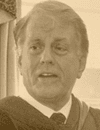
Calvary No.4 The Theology of The Cross
Tony Sargent explains that the theology of the cross reveals the unified work of the Father, Son, and Holy Spirit in God's eternal plan of salvation, emphasizing that Jesus' death is central but not the entirety of redemption.
In this teaching sermon, Tony Sargent explores the profound theology of the cross, emphasizing the collaborative work of the Father, Son, and Holy Spirit in the plan of salvation. Drawing from Scripture and personal reflection, he reveals that Jesus’ death on Calvary is central but part of a larger divine design conceived before creation. Tony challenges listeners to deepen their understanding of redemption and the ongoing ministry of the Holy Spirit in their lives.
Full Transcript
I'm reading this evening from the fourth chapter of John's first letter, 1 John 4, and we begin at verse 7. Dear friends, let us love one another, for love comes from God. Everyone who loves has been born of God and knows God. Whoever does not love does not know God, because God is love.
This is how God showed his love among us. He sent his one and only son into the world that we might live through him. This is love, not that we loved God, but that he loved us, and sent his son as an atoning sacrifice for our sins.
Dear friends, since God so loved us, we also ought to love one another. No one has ever seen God, but if we love each other, God lives in us and his love is made complete in us. We know that we live in him and he in us, because he has given us of his spirit, and we have seen and testify that the father has sent his son to be the saviour of the world.
If anyone acknowledges that Jesus is the son of God, God lives in him and he in God, and so we know and rely on the love God has for us. God is love. Whoever lives in love lives in God, and God in him.
Love is made complete among us so that we will have confidence on the day of judgment, because in this world we are like him. There is no fear in love, but perfect love drives out fear, because fear has to do with punishment. The man who fears is not made perfect in love.
We love because he first loved us. If anyone says, I love God, yet hates his brother, he is a liar. For anyone who does not love his brother, whom he has seen, cannot love God, whom he has not seen.
And he has given us this command. Whoever loves God must also love his brother. May God bless to us that reading from his word.
Thank you. Now, Hilda, you should be rather used to facing people, inasmuch as I understand at one stage that you worked, what must have been quite an interesting assignment, as a wardrobe manageress, without being a mistress, of the Chichester Festival Theatre. Yes, yes.
And some years ago you were telling me, when you lost your dear father, you were very depressed, and tell us a little bit about your spiritual experience then. Well, forgive my voice, sorry. I lost my dad in 1973, and I was really at rock bottom, because he meant so much to me.
And having had 57 years of him, it was very hard. People said, well, he was 82, and you had to expect it. But it makes no difference how old.
It was 57 years I'd had him. So, he died in the January. And then, usually, I started at the theatre in the April, ready for all the shows and the actors to come down.
Now, I gather you hadn't been a churchgoer at that stage for some time. No, no. I had not been inside a church for nearly 30 years.
I had quite bitter experiences as a young person. And then I left Lancashire and went to London when I was about 19, and I was really thrown in at the deep end. Now, I gather when you were at Chichester, after your father's death, you met an actor, and you came across a Bible, and the combination of those two events led to something remarkable in your life.
Could you just go over that for a moment or two? Quickly, yes. Excuse me. Well, I went into the dressing room of this certain actor, Australian actor called Robert Coleman, and I took his costumes in, and on his dressing table was a Bible.
Now, this shook me, because I'd never seen a Bible before in all the... I'd been there since 1962, and I'd never known a Christian actor. And anyway, while I was looking, he came in, and I felt a bit guilty. And I said, Oh, are you a believer? And he said, yes, and his face lit up, and he said, Are you? And I said, I was.
But I said, all my faith has gone. I said, I just can't believe anymore. And, of course, I broke down, and he comforted me, and... Excuse me.
But when I recall it, it's rather... He comforted me, and said... I told him I'd lost my father, and I felt there was nothing. And I said... So he said to me, well, he said, before each show, he said, I shall come down to the wardrobe, and we will have a time together with the Bible. So he came down, and amidst my weeping and everything, and he spoke to me again of the Lord.
And before I knew where I was, I was saying, Let not your heart be troubled. You believe in God, believe also in me. For in my father's house are many mansions.
If it were not so, I would have told you, because I go to prepare a place for you. And he came back to me, and over those months that he was there, we shared fellowship together. And he said, I had no idea I was coming to Chichester this year.
He said, it wasn't in my plans at all. But he said, here I am. And I thought to myself how the Lord puts people there.
He has his man. And he lifted me. Love lifted me.
And I think I could say really that, Oh, love that will not let me go. He never let me go. And so he came.
And then when it came to the end of the season in September, I'm sorry I'm going on so long. I shall finish. But you asked for it.
And it's a long story, you see, and I have to condense it. And it's difficult. And when it came to the end of the season, I said, what shall I do? What shall I do? Because I didn't know any Christians, you see.
And he said, well, he said, I've been singing in the little C of E church called St. Pancras in Chichester, he said. And they're a lovely lot. So he said, go there.
So they left, all the company left, and came the first Sunday. And I went there. And I was welcomed.
And I had to sit and kneel and stand, or so it said. But me being a very stubborn Lancashire person, I thought, I'm not doing that. And I didn't.
And it took me a year before I would do it. Because it had to come from my heart. Anyway, then the Lord led me to someone else, a lady in St. Pancras.
This was 1973. And we're still together. And I go over there, and we've been to conferences together.
And I got to know the Lord deeper. And I love him. Don't ever go away.
Not like me. And that actor then, you said, went to Australia? Yes. He wasn't sure what his ministry was to be.
Anyway, the Lord called him to Australia, back to Australia. And in 1974, we still correspond. He still sends me all the gin.
And he's now the director of the Blackburn Baptist Church in Melbourne, Australia, and doing tremendous work. Well, thank you, Hilda. And thank you for that snippet of your testimony.
God bless you. Thank you. I want to read to you, actually, some verses a little lower down the chapter than the verse that was printed out in Notes and News from the fourth chapter of John's Gospel, the thirteenth verse through to the sixteenth, and then we pray.
We know. We know that we live in Him. And He that is God in us, because He has given us of His Spirit.
And we have seen and testified that the Father has sent His Son to be the Savior of the world. If anyone acknowledges that Jesus is the Son of God, God lives in him, and he in God. And so we know and rely on the love God has for us.
Father, we pray for your help now as, before we come around this blessed table, we come around your Holy Word. Speak to our hearts. Enlarge our understanding of the truths of the Gospel.
And prepare us, Father, even more for that moment when we shall take bread and drink wine in remembrance of your Son, in recollection of the greatness of the plan of salvation that He unfurled for His sake. Amen. I want this evening, albeit briefly, and I trust simply, to speak to you about the theology of the cross.
Now, don't let that term, theology, in any way put you off. It's really a term which denotes this, God's Word. God's Word.
Just over a month or so ago, when I had the privilege again of being in Jerusalem, I was looking at a site that filled me with a great deal of interest. There are possibly two places where the death and the burial of the Lord Jesus Christ could have occurred in the precincts of the Holy City. One has been covered up with a church that dates back to the time of Constantine's mother, who erected such an edifice over one of the spots.
But the other is largely untouched, and it is reckoned, albeit by a minority of people, to be the authentic place where our Lord Jesus was crucified. It so happens that down by the foot of the hill, which has a strange resemblance to a skull, there is a hewn-out cave, which dates back to the first century. All the evidence seems to indicate that this could well be the place where Jesus was crucified and the place where he was buried.
Now, and I think that this is quite interesting too, the fact that that discovery is relatively recent as to where the burial of our Lord might have taken place has meant that there's no church to spoil that area at all. Indeed, the only thing in front of the skull-shaped hill, and it seems to me once more to be appropriate, is a bus station. Casually going by, quite indifferent to what might have happened on that strangely shaped hill are thousands of people who in the weeks and months wait for the arrival of a Hebrew bus and catch the same and go down to Bethany or to one of the villages.
Indifferent to what might have happened on the hill to whose body might have been placed in that tomb. Now, I was looking at this spot from the vantage point of one of the old walls, the old remaining city walls of Jerusalem. And from that height, I remember as I stared on the scene thinking to myself, God spoke to humanity, probably on that hill, definitely through the death and the resurrection of Jesus.
You see, it's true to say that we are saved because Jesus died. But that's not the whole of the gospel. It's part of the truth.
But your theological understanding of the way that you are reconciled to God and your sins are forgiven is complete, or rather is incomplete. If that is all that you have grasped, there is more to your redemption than the fact that Jesus died on Calvary's cross and was raised the third day in the power of an endless life. God speaks at Calvary.
He speaks theologically. He also speaks relatively simply for us to comprehend something of the enormous nature of His love. Let me try to open out my thinking so you follow me more clearly by using an analogy.
Let's imagine for a moment that you're getting married and you want to purchase a house. Now at least three agencies will be involved for you to have your particular wish fulfilled. First of all, even though possibly you will never meet Him, there must have been an architect who drew up a plan.
And then the whole enterprise was passed over to a builder who got the necessary materials together and constructed a dwelling. And then finally, there was a man or men involved who we call estate agents. And it was up to them to make you aware of the fact that such a dwelling was available for you to live in.
To enter into that house, you needed the architect, you needed the builder and you needed the estate agent. And in a very real sense, my dear young and older friends, this is true of salvation. It's not just the fact that Jesus died, if you like, as the builder of our salvation, which is important, that is.
But there's a lot, lot more to be said about the way that men and women have sins forgiven and are reconciled to the Father. That's why when John in these verses is speaking about our redemption, he refers to God the Father, God the Son and God the Holy Spirit. We are not, I repeat, we are not saved just because Jesus died.
He is not, and I speak so reverently, for I love Him with every fiber of my being, He is not the beginning and the end of our salvation. He is partially responsible with the other two members of the Godhead. And it's as a result of the combined activity of Father, Son and Holy Spirit that you and I can become Christians and have become Christians, the majority of us, before this evening.
The Bible tells us that before the world was ever made, before people like you and me were ever on this globe earth, God the Father had conceived a plan whereby He would bring men and women out of the sin into which He knew they would fall and forgive them and reconcile them to Himself. The Apostle Peter, in one of the letters that bears his name, speaks of the Lord Jesus Christ as a lamb who was slain before the foundation of the world. What does that mean? Well, if you unscramble the language, if you make it very simple, it means just this, that as the architect in the illustration I gave you drew up a building plan before there was ever a construction of the dwelling, so the Heavenly Father had it in mind to redeem us, had a perfect plan before the world was ever created.
I think that's absolutely fantastic. And when I was standing on that city wall looking towards the skull-shaped hill, I believed that God was speaking to me afresh and reminding me of the remarkable dimensions of the plan of salvation. Not simply that Jesus died on the cross, that's wonderful, but years ago, ages ago, worlds ago, God the Father had it in mind for His Son to visit planet earth and to offer His life as an atoning sacrifice for you and for me.
So, one of the ways in which God speaks to us at Calvary is in reminding us of His great design in redemption, a plan conceived thousands and thousands of years before, but going back to my illustration of the architect and the house, not only was a plan necessary, but a builder had to be found, or else the plan would have been of no consequence at all. Now very often in Scripture, particularly in Paul's epistles, and the Corinthian one to be precise, the Lord Jesus is referred to as a master builder. And you've got a little story tucked away in one of the dusty volumes of the Old Testament in which we have some insight into what happened in heaven eons ago, ages ago.
God the Father was, so to speak, looking for someone to make perfect His plan of salvation on the earth. And there was a question which reverberated, which re-echoed around heaven. Who will go? Who will I send? Who will bring into possibility the plan that I have in my mind? Now, within heaven there are angels and archangels, cherubim, seraphim, a whole range of heavenly beings.
But there was not one of them that had the particular qualifications to do the plan of God and bring salvation within the grasp of men and women. The reason being that they themselves were not God. God exists as Father, Son, and Holy Spirit.
At the beginning of time, the Bible teaches us that God created the world. He spoke, and it was through the instrumentality, the agency of the second person of the Trinity, the Son, that the world came into existence. Man, when he sinned, he spoiled God's word, God's world, God's handiwork.
And there was a very astute theologian in the third century by the name of Athanasius, and he wrote a most remarkable book, and in that book he makes this significant comment. What it took God to create, it would take God to recreate. It took God to bring the world into existence, it would take God to make possible salvation, renewal, regeneration, for people like you and me.
And the reason why Jesus stepped into the world and was born in Bethlehem as a babe, why he grew up at Nazareth, why he exercised a three-year period of ministry when he was adult from the age of approximately 29 to 32, was so that he could show to this world who God was, what God is like. And by preserving his own sinful nature, he could take to the cross of Calvary his own clean, innocent body. And when he was pinned to the cross, he died, not because he'd done anything wrong, but he was dying, as the scripture reading makes clear, as an atonement for you and for me.
He was our representative, he takes upon himself our sins. This is what Jesus has done. The Bible puts it quite clearly in another epistle, when it says, He, Jesus, who knew no sin, became sin, that we might become the righteousness of God in him.
You see, there was a plan drawn up years ago, eons ago, light ages ago, that there needed to be someone who could bring this planet into fulfillment. And Jesus does this. And he makes his own innocent body, the atonement whereby your sins and my sins can be forgiven.
Now, will you notice this, young people, and all the friends too, that when we think of the cross of Calvary, it's Jesus, the Son of God, who dies there, not the Father. You can't speak of the Father dying. God the Father did not die.
It was God the Son who died. God the Father was involved in his death, had feeling when he saw his Son so maltreated. But the provision whereby you and I should be redeemed was made by the death of Jesus.
It was Jesus who died. You can't talk about the death of the Father. You can't say, Thank you, Father, for dying for me.
It wasn't the Father who died. It was the Father's Son, Jesus Christ, who died. And the Father felt something of the pain.
And in the latter hours when Jesus became sin, the Father turned his back upon the Son because the Holy Father cannot look upon sin. You see the point? We've got an architect, the Father. We've got a builder, the Lord Jesus.
But before the house can become yours and mine, we need an agent, as you must have an estate agent to point out to you the property that is available, that is vacant here in Worthing. And that, my dear young friend, is the ministry of the Holy Spirit. He, it is, who gives me a desire to have my sins forgiven.
Before I was a Christian, perhaps you remember the situation more yourself because my conversion goes back almost to infancy. There was a period when you felt uncomfortable. Somebody preached about the holiness of God and the wrath of God and you thought of all the terrible things that you'd done and you were afraid.
You felt distinctly uncomfortable in church. What caused that feeling? It was none other than the Holy Spirit. It's His ministry to convict.
It's His ministry to make you feel embarrassed. But He doesn't just stop there. He doesn't just convict you.
He turns you to someone who can help you. Like the estate agent in Worthing will point out to the married couple an ideal house. You go and live on Shakespeare Road.
There's such marvellous people there. And the houses there are all purpose built for the likes of you. You go and buy a house there.
And it so happens that we, my firm, has got one available on that road. Now, joking aside, Jesus Christ has available for needy sinners the gift of salvation. And it's the Holy Spirit who directs us to the Lord Jesus.
Let me change the illustration for a moment. Let's imagine that your Aunt Agatha dies and she's a very wealthy lady. And she has administering her will none other than our Church Secretary.
When he reads the will he discovers that this fortunate member in track one has been detailed by the deceased lady to receive all her wealth. So what does Mr. Lamb do? Well, he acts as an executor. He rings you up or he gets in his car and he finds you.
And he says, I've got some very interesting information to tell you. You'll not believe this but your auntie has left all her wealth to you. He is the go-between.
He acts as the executor. He directs the will according to the instruction of the person who's died. Now that's exactly what the Spirit of God does.
He acts as the executor. He comes to the sinner in all his need and he says, you've no need to stay in that condition. I can point you to one who can meet you.
One who died to save you. One who's in heaven now to represent you before God. That's the ministry of the Spirit.
He comes into my heart. He convicts me of sin. And ultimately, he makes me aware of forgiveness and the fact that I belong to God through Jesus Christ.
I go back to that event in Jerusalem. Looking down from my high point on the old city wall to that skull-shaped hill. At Calvary, God speaks.
There's a theology about the cross which we must all understand. What is said to us at Calvary? This, that God the Father, soul of the world, He gave His Son to die for us. What else is spoken at Calvary? God the Son was obedient to the requirements of the Father and hung there on the hill for us.
What more is spoken at Calvary? God the Son, when He was taken back after His resurrection into heaven, sent His Holy Spirit into this world to act as His agent to convict people like you and me of our sinfulness and to take us to the foot of the cross where our sins are dealt with and where we are ransomed, healed, restored, forgiven. That's the theology of the cross. Not just the fact that Jesus died makes us Christians.
It's more than that. God the Father, eons ago, had a plan, brought to fulfillment by the Son who died for us and the plan is made alive in our experience by the Spirit who takes up residence as we say yes to the claims of Jesus on our lives and receive His forgiveness. In a moment or two, we're going to come around this table and I trust that we're going to come with perhaps a greater understanding of what we're doing as we take bread and wine.
We're going to be thanking the Triune God for making our salvation possible and I'm going to ask that as these trays go around, only those who are confessed Christians receive this bread and wine. If you're here just as an inquirer this evening, we're glad to have you in the sanctuary but just pass the tray by. But if you belong to Jesus, if at this very moment you confess Him as your Saviour, then take the bread and the wine at the appropriate moment and remember the great plan of Father, Son and Holy Spirit which has contributed exclusively to your redemption.
Now we're going to sing about that great act of our Lord Jesus and the obedience that He had to the directive of His Father as we sing that most lovely of hymns, 169 in Hymns of Faith. My song is Love Unknown. 169.
And Father, for the dispelling of our natural ignorance, we bless you and for the opening up of the light of your presence through the love of the Triune God, we just bless you. And from the depths of our being, we offer you unqualified praise. Take our lives and use them throughout this week and until next we gather together for your honour and for your glory.
In the name of the Lord Jesus, Amen.
Sermon Outline
-
I. Introduction and Scripture Reading
- Reading from 1 John 4 about God's love
- Emphasis on love as evidence of knowing God
- Introduction to the theology of the cross
-
II. The Plan of Salvation: The Architect, Builder, and Agent
- God the Father as the architect with a plan before creation
- Jesus Christ as the builder who executes the plan through His life and death
- The Holy Spirit as the agent who convicts and draws people to salvation
-
III. The Role of Jesus in Redemption
- Jesus' incarnation and sinless life
- His death as an atoning sacrifice for sins
- The distinction that God the Son died, not the Father
-
IV. The Ministry of the Holy Spirit
- Conviction of sin and drawing to repentance
- Enabling believers to live in God's love
- Completing the work of salvation
Key Quotes
“God is love. Whoever lives in love lives in God, and God in him.” — Tony Sargent
“He, Jesus, who knew no sin, became sin, that we might become the righteousness of God in him.” — Tony Sargent
“It was Jesus who died. You can't talk about the death of the Father. You can't say, Thank you, Father, for dying for me.” — Tony Sargent
Application Points
- Recognize the full scope of salvation involving the Father’s plan, the Son’s sacrifice, and the Spirit’s work.
- Live confidently in God's perfect love that drives out fear.
- Allow the Holy Spirit to convict and guide you toward deeper faith and love for others.