
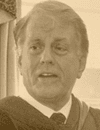
Centennial Anniversary - A forward look
Tony Sargent challenges believers to embrace their frailty as vessels entrusted with the priceless gospel, urging commitment to discipleship, prayer, and forward mission in the church's continuing legacy.
In this teaching sermon, Tony Sargent reflects on the centennial legacy of the church, highlighting the vital role of discipleship, prayer, and faithful ministry. He encourages believers to recognize their own frailty as vessels carrying the invaluable gospel treasure. Through personal stories and biblical insights, Tony challenges the congregation to commit to building faith and advancing the church's mission into the future.
Full Transcript
Welcome to my lecture. We raise to Zion's hymn, and hail the pow'r of God, that o'er the ages may stand in gracious grace, and those of strength embraced in love. Christ was joyful sound.
His praise the sun, and his royal throng. He sits for grace and judgment day. He is the song of every tongue.
He leads the past in his sacred past. Oh, there my friends and foes draw. They see his blest abode.
My soul shall ever love him. Since love has made him come to us, a rising man. We believe he died to save us.
For our sins he was crucified. Then from death his rising tide is ascending to the Father's side. Jesus, Lord of all, Lord of all.
Jesus, Lord of all, Lord of all. Gracious now we look up again in glory. Just the living and the dead.
So, we've been talking about winning people for the Lord, and there are many ministries within the tab that would illustrate our attempts in that area. But it's not just a category that you slot into in terms of whether you're in Cameo or the Outreach, because if you're a card-carrying member of the tab, we do ask you to try to tell others about the Lord Jesus Christ. Win.
But following on from win, build, building up in the Most Holy Faith through Alpha, through Pathfinders, and several other ministries that are dedicated to that objective. We're going to hear from a couple of them now. We're here tonight to tell you briefly about Sunday Pathfinders.
We cater for 3 to 11-year-olds and have between 65 and 80 children each Sunday morning. That's divided into seven classes. We considered the best way of trying to explain to you what we do in our classes and decided we would look at our teaching material and follow the steps it suggests for each lesson.
The first thing we have to consider is the lesson focus. Everything we do in our lesson is based on one simple lesson focus, which represents a single Bible truth as we move through four activities. Bible readiness, Bible story, Bible activity, and Bible response.
Step one, Bible readiness. This helps us personalise the lesson focus by connecting it to our own experiences. It begins with a discussion starter, which invites us to share our own ideas, opinions, and experiences.
It helps us to get motivated to learn what is ahead in our story. Step two, Bible story. This step presents the Bible content of our lesson and checks for basic understanding and Bible knowledge.
This is where we start to discover what God's Word has to say to us about the lesson focus. It's an enjoyable time of exploration and discussion. Step three, Bible activities.
This is where we explore the Bible stories and look at the lesson focus in a practical way. These activities vary in format but always help to re-emphasise the things we have been learning in the lesson. Step four.
This final step gives each child the opportunity to make a plan of action to apply the lesson focus to his or her daily life. Children will take what they have learnt into their own world, at home or at school, and this could start to build the foundation for their future, whether it's at home here in the TAB or in the worldwide mission field. Some 20 years ago we started a Bible beginners group which we had in our various homes.
We had about 15 to 35 folk come along, age ranges between 17 and 84. The 84-year-old used to actually turn up on his bike. We had the rich and famous attending the groups, the Lands, the Davisons, a few names like that, the Kennards and what have you, and it was very encouraging.
We actually started with basic subjects like the fullness of eschatology. We then sort of went on to things like predestination of the saints and perseverance of the saints, and basically I think we thoroughly enjoyed ourselves, and in the words of Mike Jenkins, I think they were very choice times indeed. I'm telling you about the discipleship classes.
The aim of the discipleship classes was to help people who had made an initial commitment in faith to build some foundation stones, because these people lacked the teaching that we've just been hearing about from the pathfinders, and so they needed that to help them to develop their Christian lives. We developed a course here. A number of the leaders and pastors helped to put together a course of lessons which covered the basics of the Christian faith.
These sessions were followed over a period of three to six months or so, and then they could go on to do another deeper course. The leaders were from a number of different areas of the church. We had people like Bob and Ethel Brown who ran a discipleship class which attracted older friends, and then there were married people and young people.
We held them in homes. We held them here, and they were usually very well attended, and people developed a great bond of friendship and fellowship in the groups. I want to just tell you of three examples as to what happened in these groups.
I want to tell you about Neil and Linda Cashman, because one Sunday night they came into the foyer, and the people on the foyer took down their details. They passed them to the home group who took them under their wing, and they realized that they needed some deeper teaching, and so they sent them to the discipleship group. This young couple, they both made a commitment to the Lord, and they went on in their faith.
They were both baptized here together, which was a wonderful time. Then later they were married, and their careers took them away from Worthing, but they are now very keen members of an evangelical church in Eastbourne, and we keep in touch with them. Then another example is Neil and Jane Kinghorn.
That was a young couple that, again, came into the foyer on the first meeting of a discipleship class, and they came with their newborn baby, Joshua. They came in, and they came from a Jehovah's Witness background, but they had just become Christians, and they were well-motivated. Brenda Stenning was their discipleship group leader, and she was able to take them on and take them through the steps that they needed.
They later became church members and became involved in the TAB fellowship. Now, of course, as many of you know, they are actually working with the London City Mission, and we'll see them in a couple of weeks' time when they come down for the missionary weekend. The third couple, the third ones I want to tell you about, were two young men.
One was called Andrew, and one was called Paul. Their jobs brought them to Worthing, and they actually were sharing digs. One night, Paul or Andrew said, well, I won't be in tonight.
I'm going out this evening. The other one said, oh, that's fine. Actually, I'm going out too.
So, they both went out, and they both arrived at the same discipleship group at the TAB, and it was just totally amazing. They'd come from different contacts, and they both were in the discipleship group. They both made very clear commitments.
They were then, both of them, they were baptized, and they have since become members. They've both married, and they are very involved in the fellowship. Paul has been involved with his wife with Pathfinders, and Andrew is on my right, and he was not only a member of the discipleship group, but he then became a leader of the discipleship group, and now he heads up Alpha.
Not everything is as successful as that, but I thought those three examples just gave you an idea of what happens in the discipleship groups. I'd just like to finish by saying it's been a real privilege to be involved in the discipleship groups. Yes, thank you, Jenny.
Then there was Alpha. Alpha is a course which is run by about two or three thousand churches in this country, including about half a dozen in Worthing. What is Alpha? Alpha stands for A, anybody who is interested in finding out more about the Christian faith, so all ages are welcome.
L is about learning and laughter. We believe it is possible to learn about the Christian faith and enjoy yourself at the same time. P is for people meeting together.
It's a chance to get to meet new people and make new friends, and we've seen quite a bit of that here in our Alpha courses. The H is helping one another. We use small groups, so you learn from each other and with each other.
And the final A is to ask anything. Alpha is a place where questions are never too simple or unfortunately never too hostile. Who is Alpha for? Alpha is for anybody who is interested in finding out more about the Christian faith.
It's for newcomers to a church, it's for new Christians and even established Christians who just want to brush up on the basics. If you want to know anything else, I'm sitting down here, and come and see me afterwards. Thank you.
Let's have the Bible reading, just a few verses, someone scheduled to read that? Let's take it from 2 Corinthians chapter 4, and will you read from 7 to 12, Julian, please? But we have this treasure in jars of clay, to show that this all-surpassing power is from God, and not from us. We are hard-pressed on every side, but not crushed. Perplexed, but not in despair.
Persecuted, but not abandoned. Struck down, but not destroyed. We always carry around in our body the death of Jesus, so that the life of Jesus may also be revealed in our body.
For we who are alive are always being given over to death for Jesus' sake, so that his life may be revealed in our mortal body. So then, death is at work in us, but life is at work in you. Let's take that seventh verse again, shall we? If you've got a Bible, then read it out.
2 Corinthians 4, verse 7. One, two, three. But we have this treasure in jars of clay, to show that this all-surpassing power is from God, and not from us. There is a sense in which, as I've tried to show this evening thus far, all of us in a measure are involved, if we have been one for the Lord, in endeavouring to build other people up, and ourselves in volunteering to be sent into a secular society in order to try and convince others of the good news of the gospel of Jesus Christ.
And as we bring this particular commemorative Sunday to a climax, I want to bring this to you in terms of a challenge regarding your own covenant and your own commitment to the Lord. Look, this text makes reference to earthen vessels. Let's just have my overhead on for the first part, just for a moment.
The earthen vessel into which the gospel has been placed is actually the Apostle Paul himself. You, me. If we claim to belong to the Lord Jesus Christ, then we are the containers into which the gospel message has been proclaimed.
Now, the reason why I say that is because an earthen vessel is actually a very fragile thing. And one of the things that comes out very clearly when you read the history of the tab, men like Douglas Crouch and Reverend Atwood and Reverend Land, my predecessors, although God significantly used them, they were actually very frail people, as in many, many ways, more than you'll understand. I too am a frail person.
You say, I couldn't tell anyone else about Jesus. When I was sixteen years of age, to be in the company of more than ten people terrified me. I had the blessing of a brother who was older than I and far, far more clever.
And though he was always a loving brother, I found him or his abilities so intimidating. And if you had said to me at that point, a time will come and not too far hence, for I was Nick Turnbull's age when I came here or just about, when you will be ministering to a large-ish congregation, I would have laughed. The Apostle Paul would probably have laughed.
If you'd known him as Saul, because that was his Greek name in Tarsus, God is going to take this man. He's only a small man. He prematurely bowls according to tradition.
He's hook-nosed. He can't easily put his words together. He talks about his stammering.
Maybe in the Bible he's actually underplaying his abilities. But when you thread together the few autobiographical references, you come with a picture of a frail man. And he says, into me was placed the gospel, entrusted to me the message of life, ordinary, fragile, and as you will discover in this, the history of Worthing Taub, replaceable.
Douglas Crouch didn't live forever. His predecessor, his successor didn't live forever. And Mr. Atwood was replaced by Mr. Land, who's now with the Lord.
This is it, you see. This is part of the team. This is part of the relay picture of the history of the Christian church.
Frail men, frail woman, in the pulpit, in the pew, working for the Lord. And what is it that God places within them, within the container? Move to the second aspect in that slide, the contents. Well, the contents are nothing less than treasure.
And that's how the Bible declares the gospel, how it describes the gospel. It speaks in Romans 9.23, the riches of his glory. In Romans 11.33, the depth of the riches.
Second Corinthians 6.10 and 8 and 9, the gospel through Jesus makes many rich. Ephesians 2.7, the incomparable riches of Christ. Colossians 1.27, the glorious riches.
What does it mean? You're a Christian? When you look in a mirror, and here I'm being serious, in a morning, you should be telling yourself that encased in you, placed in your understanding, working its way out through your personality, is the gospel of Jesus Christ, the richest, most valuable thing in the world. And you've received it. It's more important than the manifesto of the Labour Party, or the Conservative Party, or any political philosophy.
To know the key to life, why you're here, what you're supposed to do, why, when you're here, and where you're bound for ultimately. These are our blessed truths. And entrusted to you, if you're a Christian, are the riches of the gospel, placed in a frail human casket.
There'll be times when you let the Lord down, times when this church lets the Lord down, times when you feel utterly inadequate. The Apostle Paul felt just like that. But he'd been one for the Lord, and he tried to take that gospel message that he believed, and share the riches of it with other people.
So you take a project, you take Challenge Magazine, you tell somebody about a Christian radio program, you invite someone to the tab, and don't you see, you're engaged in ministry. You're doing exactly what the Apostle Paul was referring to here, when he speaks about his own ministry. This frail man, into him has been placed this enormous treasure, this valuable stuff, the gospel of Jesus Christ.
And if you move to the last part of my slide, it links in with the final aspect of the text, the conclusion. Here, Paul is successful. How do you evaluate that success? Look at the tab, it's kept together for 100 years.
In God's grace, they've sent people out to China, to India, to Africa, to Latin America, and as you've heard this evening, even though our attempt wasn't too successful in terms of communication, we're still doing the same. How do you explain it? Douglas Crouch, no. He was just a frail man.
Mr. Atwood, no. Eric Lann, no. Tony Sargent, I speak with qualification, definitely no.
If you merit this church as being successful, and I'm not suggesting you do, but if you should, then the only explanation is that God has come down and taken frail men and women, and boys and girls, and used them in some measure to make an impact in this locality in the past, and continuing hopefully into the future. Lord, I'm weak, but you're strong. That's what Paul indicated.
Lord, I might fall, but you will make me stand, is what the Apostle Peter said. Why me? says the early church as a group of individuals to the Lord, and the response is, why not you? Why is it worthy time? Why not you? says the Lord. Why not you? Having been one, now being built up in the faith.
Having been built up in the faith, being sent to reach others, and to educate them with the truth of the gospel. You see, we've had 100 years, but we're not out. Sometimes we've been beaten and battered, but we've never been completely penalized to the extent that we've stopped our ministry.
We have progressed to this point, but there are further years in front of us. We look to the past, and we honor men and women of the past, and that is right, and in so doing, we glorify God, but move to my second slide. We have to go forward, forward.
The gate is closed behind me. I cannot go back. I shield my eager eyes with trembling hand.
The way is dim before. I know not where the pathway leads. Pitfalls may meet my unaccustomed feet.
Lord, be thou near. Hold thou our hand, and we shall laugh at fear. We go forward in the grace of our Lord Jesus Christ.
We go forward with the inspirations of the Spirit. What does this church need? It needs three things. It needs people, not to make it into a mega church.
That's never been our dream. We want to be a full church, but we want to plant churches. We need people, more and more people, to replace the young Christians, who was one of the most dependable people that we've ever had in our church, to replace the Jones family, not in terms of filling a gap and as though they are no longer needed, but to take on what they were doing so that they can continue doing their new job, realizing that the church is not weakened by them going.
We need people. We need prayer. You cannot honorably join the tabernacle, and I speak with compassion in my heart, and I recognize the busyness of timetables without being committed to a prayer meeting.
It's part of the covenant. We don't apply it slavishly, legalistically. We don't check up, but we do ask you when you become a member of this church to commit yourself as regularly as possible to one of our prayer meetings.
Why? Well, for the reasons that have been demonstrated to some degree this evening. Our people serving abroad need prayer. Our people here need prayer.
Our elders, our leaders, they need prayer so that we might understand the mind of God and lead people forward prophetically into the purposes of God as we move into the next millennium. And what is more, I tell you this unblushingly, we need pounds. We need money.
Don't tell me the church emphasizes money too much. We wouldn't need to emphasize money at all from the pulpit if people recognize their responsibilities to give one-tenth of what they receive to the work of God. We would be awash with money.
God is my judge. I have at least 10 requests every week from various parts of the world for projects and people who need our support. And to the degree that we can, we meet those needs.
But we require more. We require more prayer. We require more people.
There's more land to be possessed. We need to modify these buildings to the south of the sanctuary. Some of those walls are biscuit thin and they need to be replaced.
Some of us have a vision for greater car parking spaces. We've hardly got anything at the moment. We need to make a greater impact here in this locality amongst the community, moving out on the door, serving people, the unemployed, and so on and so forth.
We have a dream. We've worked it through as elders. We spent half days, sometimes full days, brainstorming, trying to plot for the future.
And we need you with us as we penetrate the future with vision and tell you what there is in store for the church. We need to be sending more men and women to New Orleans and all nations and London Bible College and so on and so forth. That we are pledged to.
We need even more to be backing people in the third world countries. Thank God for the scholarships we've established in India and also in Africa and for the lectureships that we're contemplating under funding. But we need to be more involved in backing Doulos and Logos and Phoebus Ministries and so on and so forth.
We're committed to this and it's nothing new. I don't say that Sargent has readjusted the program of this church. God is my witness.
John Hanson will bear it out. He's done the reading. You check what Crouch was doing, what Atwood was doing, what Land was doing, what I'm doing.
It doesn't really matter about the names. What matters is the vision, taking the work forward, running with the baton until you can run no longer. Then you toss it on to someone else and in the frail casket you deteriorate and your body goes a-mouldering in the grave, but your spirit goes to be with the Lord who called you to serve him.
I have a vision and the vision is clear as to what God wants us as a church to continue to do and to expand in terms of developing further ministries. So I ask you, are you with us? Are you with the elders? Are you with the deacons? Are you with the pastoral leaders? Are you doing your best? Are you attending the services, not slavishly? We're not just looking for people sitting on seats feeling that they've got to be there or else they're going to be wrapped on the knuckles with some sort of spiritual ruler. No, we're asking you for enthusiasm in serving the Lord.
We're asking you for regularity in prayer. We're asking you for consistency in giving as we move on into the future. Why are we here? If you've got the notes and news, turn to it.
It's down there on page one. I've referred to it once already this evening. Why are we here? We are here in the center of Worthing to bring glory to God by knowing him and making him known in Worthing and taking his message into all the world.
We are here to win. We are here to build. We are here to send.
Let's stand in the presence of Almighty God. And I'm asking our instrumentalists just to take up softly the melody of, here I am, holy, available, as for me, I serve the Lord. A wonderful hymn of commitment and dedication.
It's almost like communion inasmuch as I'm asking you not to take the verses and sing them unless you mean them. But if in your frail way, with your little faith and feeling totally inadequate, the little bit that you've got, if you'll bring it to the Lord like the lad brought his loaves and his fishes, then that qualifies you to be able to sing. And let's, as a congregation, dedicate ourselves.
Some of us won't be around in a hundred years time, but let's dedicate the next year and the following year and all the years until God sends his son back to this world or until we're received into his eternal presence. Let's sing. Let's dedicate our lives.
Here I am, holy, available, two to nine. Souls, are we ready to serve God? In darkness, are we ready to be light? I'm seeking out a very special people to manifest his truth and his light. I saw me.
Please sit down. I do. We thank you.
♪ Rose onward into light ♪ ♪ Through all her watch is keeping ♪ ♪ And rest not now, by day or night ♪ ♪ As over each continent adorned day ♪ ♪ The voyeur is never silent ♪ ♪ Nor dies the strain of praise aware ♪ ♪ So be it, Lord, thy throne shall never like earth proudly lay ♪ ♪ Thy kingdom stands and grows forever ♪ ♪ Till all thy creatures I swear to love you forever ♪ ♪ And this brings our peace to you as the God we fear for you ♪ Father, we leave it. The race goes on, one year to another. The baton pass from one generation to another.
We thank you for this day and for its many memories. We thank you for the anticipations of the future. Be with Anne and the Mike Jones family, we ask, and all the tab diaspora.
Bless our folk here, those who are training in service, those who are longing to do something more for you. Bless this church. Take us forward in your will, seeing you more clearly, loving you more dearly, following you more nearly, until the time comes when you take us into your immediate presence.
Amen.
Sermon Outline
-
I. The Fragility of the Vessel
- The gospel is entrusted to frail, ordinary people.
- Historical examples of frail leaders in the church.
- Our weakness highlights God's strength.
-
II. The Treasure Within
- The gospel is the richest treasure we carry.
- It surpasses all worldly philosophies and politics.
- Believers must recognize the value of the gospel within.
-
III. Building and Sending
- Discipleship classes build foundational faith.
- Alpha course welcomes seekers and nurtures faith.
- The church's mission continues through sending and outreach.
-
IV. A Forward Look
- Honoring the past while moving forward in faith.
- The church needs people, prayer, and prophetic leadership.
- Commitment to prayer and ministry sustains the church.
Key Quotes
“But we have this treasure in jars of clay, to show that this all-surpassing power is from God, and not from us.” — Tony Sargent
“Into me was placed the gospel, entrusted to me the message of life, ordinary, fragile, and as you will discover in this, the history of Worthing Taub, replaceable.” — Tony Sargent
“Lord, I'm weak, but you're strong. That's what Paul indicated.” — Tony Sargent
Application Points
- Recognize your own frailty but embrace the gospel entrusted to you as a precious treasure.
- Commit to regular participation in discipleship and prayer meetings to strengthen your faith and support the church.
- Engage actively in sharing the gospel and supporting the church's mission locally and globally.