
 1 Samuel 25:1-44 ESV
Then David rose and went down to the wilderness of Paran. 2And there was a man in Maon whose business was in Carmel. The man was very rich; he had three thousand sheep and a thousand goats. He was shearing his sheep in Carmel. 3Now the name of the man was Nabal, and the name of his wife Abigail. The woman was discerning and beautiful, but the man was harsh and badly behaved; he was a Calebite. 4David heard in the wilderness that Nabal was shearing his sheep. 5So David sent ten young men. And David said to the young men, “Go up to Carmel, and go to Nabal and greet him in my name. 6And thus you shall greet him: ‘Peace be to you, and peace be to your house, and peace be to all that you have. 7I hear that you have shearers. Now your shepherds have been with us, and we did them no harm, and they missed nothing all the time they were in Carmel. 8Ask your young men, and they will tell you. Therefore let my young men find favor in your eyes, for we come on a feast day. Please give whatever you have at hand to your servants and to your son David.’”
9When David’s young men came, they said all this to Nabal in the name of David, and then they waited. 10And Nabal answered David’s servants, “Who is David? Who is the son of Jesse? There are many servants these days who are breaking away from their masters. 11Shall I take my bread and my water and my meat that I have killed for my shearers and give it to men who come from I do not know where?” 12So David’s young men turned away and came back and told him all this. 13And David said to his men, “Every man strap on his sword!” And every man of them strapped on his sword. David also strapped on his sword. And about four hundred men went up after David, while two hundred remained with the baggage.
14But one of the young men told Abigail, Nabal’s wife, “Behold, David sent messengers out of the wilderness to greet our master, and he railed at them. 15Yet the men were very good to us, and we suffered no harm, and we did not miss anything when we were in the fields, as long as we went with them. 16They were a wall to us both by night and by day, all the while we were with them keeping the sheep. 17Now therefore know this and consider what you should do, for harm is determined against our master and against all his house, and he is such a worthless man that one cannot speak to him.”
18Then Abigail made haste and took two hundred loaves and two skins of wine and five sheep already prepared and five seahsa of parched grain and a hundred clusters of raisins and two hundred cakes of figs, and laid them on donkeys. 19And she said to her young men, “Go on before me; behold, I come after you.” But she did not tell her husband Nabal. 20And as she rode on the donkey and came down under cover of the mountain, behold, David and his men came down toward her, and she met them. 21Now David had said, “Surely in vain have I guarded all that this fellow has in the wilderness, so that nothing was missed of all that belonged to him, and he has returned me evil for good. 22God do so to the enemies of Davidb and more also, if by morning I leave so much as one male of all who belong to him.”
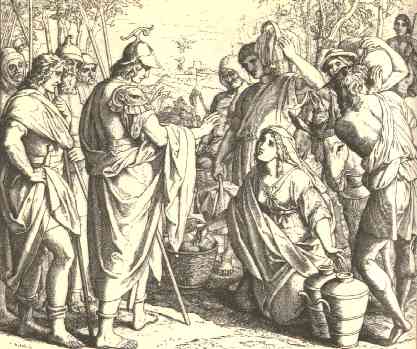
23When Abigail saw David, she hurried and got down from the donkey and fell before David on her face and bowed to the ground. 24She fell at his feet and said, “On me alone, my lord, be the guilt. Please let your servant speak in your ears, and hear the words of your servant. 25Let not my lord regard this worthless fellow, Nabal, for as his name is, so is he. Nabalc is his name, and folly is with him. But I your servant did not see the young men of my lord, whom you sent. 26Now then, my lord, as the LORD lives, and as your soul lives, because the LORD has restrained you from bloodguilt and from saving with your own hand, now then let your enemies and those who seek to do evil to my lord be as Nabal. 27And now let this present that your servant has brought to my lord be given to the young men who follow my lord. 28Please forgive the trespass of your servant. For the LORD will certainly make my lord a sure house, because my lord is fighting the battles of the LORD, and evil shall not be found in you so long as you live. 29If men rise up to pursue you and to seek your life, the life of my lord shall be bound in the bundle of the living in the care of the LORD your God. And the lives of your enemies he shall sling out as from the hollow of a sling. 30And when the LORD has done to my lord according to all the good that he has spoken concerning you and has appointed you prince over Israel, 31my lord shall have no cause of grief or pangs of conscience for having shed blood without cause or for my lord taking vengeance himself. And when the LORD has dealt well with my lord, then remember your servant.”
32And David said to Abigail, “Blessed be the LORD, the God of Israel, who sent you this day to meet me! 33Blessed be your discretion, and blessed be you, who have kept me this day from bloodguilt and from avenging myself with my own hand! 34For as surely as the LORD, the God of Israel, lives, who has restrained me from hurting you, unless you had hurried and come to meet me, truly by morning there had not been left to Nabal so much as one male.” 35Then David received from her hand what she had brought him. And he said to her, “Go up in peace to your house. See, I have obeyed your voice, and I have granted your petition.”
36And Abigail came to Nabal, and behold, he was holding a feast in his house, like the feast of a king. And Nabal’s heart was merry within him, for he was very drunk. So she told him nothing at all until the morning light. 37In the morning, when the wine had gone out of Nabal, his wife told him these things, and his heart died within him, and he became as a stone. 38And about ten days later the LORD struck Nabal, and he died.
39When David heard that Nabal was dead, he said, “Blessed be the LORD who has avenged the insult I received at the hand of Nabal, and has kept back his servant from wrongdoing. The LORD has returned the evil of Nabal on his own head.” Then David sent and spoke to Abigail, to take her as his wife. 40When the servants of David came to Abigail at Carmel, they said to her, “David has sent us to you to take you to him as his wife.” 41And she rose and bowed with her face to the ground and said, “Behold, your handmaid is a servant to wash the feet of the servants of my lord.” 42And Abigail hurried and rose and mounted a donkey, and her five young women attended her. She followed the messengers of David and became his wife.
43David also took Ahinoam of Jezreel, and both of them became his wives. 44Saul had given Michal his daughter, David’s wife, to Palti the son of Laish, who was of Gallim.
"Women, then, have engaged in significant ministries, even if those ministries were unofficial. One thinks of Abigail in 1 Samuel 25. Abigail was not a prophetess and had no other official ministry that we know of. Nevertheless, her humble and gentle advice to David persuaded him not to kill Nabal. How many unrecorded events there must be of women persuading men, humbly and gently, to pursue a more righteous course! What a good model this story is for traditionalists who think being a leader means they must always know the truth and that their opinion is always right. David was certainly the leader in this account, but his humility is evident in that he listened to Abigail and was persuaded. For women, Abigail is a model of gentle and humble persuasion. There was no stridency or imperiousness about her manner. She was winsome, yet bold."
- Thomas R. Schreiner, Recovering Biblical Manhood and Womanhood
| Scripture(s): 1 Samuel 25:23-44 | |
| Description: David is on his way to Nabals house to massacre everone there when, suddenly a woman leading a large company meets him on his way, she gets off her mount and bows herself down to the ground before him, this is quite a surprise for David as Abigail was a woman of great status and so to see her humbling herself in this way is very odd. She asks David for mercy and to lay the blame on herself, she reminds David that he is the one who goes out and fights the Lord's battles, this must have pricked Davids heart as he surely knew that what he was intending to do was not in the heart of the Lord, David by the grace of God realises what he is doing and departs praising the Lord for sending Abigail. Nabal on the other hand is totally unaware of what could have happened and is throwing a party when Abigail returns, the morning after she tells him of the previous days events and he is so shocked that he dies 10 days later. David sends fo Abigail and takes her and Ahinoam for his wives as Sauls daughter had been given to someone else. | |
This shall be no grief unto thee. 1 Sam. xxv. 31
THERE was an inimitable blending of woman's wit with worldly prudence in the words of the beautiful Abigail. Poor woman, she bad had a sorry life of it, mated to such a man as Nabal was! An ill assorted pair certainly, though probably she had had no hand in bringing about the alliance. Like so many Eastern women, she was the creature of another's act and choice. But she succeeded in averting the blow which David was hasting to inflict, by asserting her belief that the time was not far distant when he would no longer be a fugitive from his foes, and by suggesting that when that happy time came it would be a relief to feel that he had not allowed himself to be carried to all lengths by his hot passion.It was very salutary advice. Let us always look at things from the viewpoint of the future, when our passion shall have subsided, when time shall have cooled us, and especially when we review the present from the verge of the other world how then?
We can well afford to do this since God is with us, and our life is bound up with Him in the bundle of life. Abigail reminded David that God would do to him all the good of which He had spoken, and would sling out his enemies as from a sling. So God will do for us; not one good thing will fail of all that He hath promised; no weapon that is formed against us shall prosper. Within a little, Nabal was dead, and David’s wrong righted. So shall the evil that now molests us pass away. God will deal with it. Let us leave it to Him: before Him mountains shall melt like wax; and we shall have nothing to regret.
Series: Abigail: How to Live with the Fools in Your Life
Leslie Basham: It’s Tuesday, August 30th, and this is Revive Our Hearts with Nancy Leigh DeMoss.
Imagine that a group of soldiers is on their way to your house. Your husband has insulted them and treated them rudely. Would you go out to meet them while they’re on the war path? One wife did just that. Here’s Nancy.
Nancy Leigh DeMoss: We’re in the middle of a series that we’ve entitled How to Live with the Fools in Your Life, and that title comes from one of the key characters in this story. The passage is 1 Samuel 25 and it is the story of Abigail, the beautiful and wise woman and her husband, Nabal, whose name means fool. We’re seeing that Nabal really was a foolish man. He was a harsh man. He was an ill-behaved man. He’s now in a conflict with David who’s the next king of Israel, but who at the moment is a fugitive in the wilderness, fleeing from King Saul.
David has made a request of Nabal to make a provision for him and his men. Nabal has said, “No way do you get any of my goods.” Nabal is rich. He could have afforded to help out David, but he refused to. Now we are going to see the entrance of a woman who has the wisdom and the courage to defuse what could have been a deadly situation. Her name is Abigail.
Before we look at Abigail over these next several sessions, let me just say that I realize as we get into a story like this that this story does not address every possible situation that you may find yourself in. It’s not going to answer all your questions. There’s no one story in the Bible that does that. There is no one passage. You need the whole counsel of God. You need the whole of the Scripture.
But I think this story will give some insights into how to deal not just with a husband who may be a foolish person, but with someone else in your life. Maybe it’s an in-law, maybe it’s a son or daughter who is acting in very foolish ways. How do you deal with those people? We saw that David’s initial reaction to Nabal was to become a “Nabal” himself–retaliate, get even. David pulls out his sword and says, “We’re going to war.”
Now we see the entrance of a woman who says, “That’s not the right way to deal with this situation.” She’s going to demonstrate a very different way to respond. We see in verse 14 that one of the young men, one of Nabal’s servants, comes to Abigail, Nabal’s wife, and tells her the situation.
Now apparently this young man knew that Abigail would respond differently than her husband. You could reason with her. She would listen. So verse 14, “One of the young men told Abigail, Nabal’s wife.” By the way, in tension or conflict do people know that you’re a woman who can be reasoned with? Or do they stay away from you and say, “No, she’s just going to fly off the handle, just get emotional.” Or do they know that you’re a woman that they can go to, they can talk to and explain their story, and you will know what to do because you’re following the Spirit of God in that situation?
“One of the young men told Abigail, Nabal’s wife, ‘Behold, David sent messengers out of the wilderness to greet our master, and he railed at them.’” Now, that word railedliterally means he flew at them. One translation says, “He hurled insults.” He reviled them. “You want what? No way!” Nabal was abusive, verbally abusive to David and his men. We can only assume that if he was this way with strangers that he was not an easy man to live with at home. He railed at them.
So here again, we see more about Nabal’s character. He’s an arrogant man. He’s easily angered. He flies off the handle. Those are characteristics of a fool. If you find yourself responding that way in the midst of life’s circumstances, you need to stop and say, “I’m acting like a fool.” Proverbs 14:17 “A man of quick temper acts foolishly, and a man of evil devices is hated.” Proverbs 29:22, “A man of wrath stirs up strife, and one given to anger causes much transgression.”
So here’s a man, Nabal; he’s out of control. He railed at them. He flew at them. His tongue is uncontrolled. Now, this is a totally unfair and unwarranted reaction on Nabal’s part. Nobody has done anything to deserve this kind of treatment. This is not a response that was provoked. There’s no good reason.
In fact, the servant telling Abigail what happened says in verse 15, “The men were very good to us (David’s men–they treated us well), and we suffered no harm, and we did not miss anything when we were in the fields, as long as we went with them.” Nabal and his men had been protected by David and his men. David did not do anything to incite this response from Nabal.
Verse 16, the servant says, “They were a wall to us both by night and by day, all the while we were with them keeping the sheep.” So Nabal has returned evil for good. Now, verse 17, the servant says to Abigail, “Therefore know this and consider what you should do, for harm is determined against our master and against all his house.”
Remember, David had put on his sword and said, “We’re going to war.” He took four hundred men with him. “We’re going after Nabal and his men.” Harm is determined against our master. That’s Abigail’s husband. “Harm is determined against him . . . and he is such a worthless man that one cannot speak to him” (verse 17). That phrase, “worthless man,” is a phrase that literally is “the son of Belial” (2 Corinthians 6:15).
Does that ring a bell with you? Belial is one of the names in Scripture for Satan. What the servant is saying is, “Our master, your husband, Abigail, is acting like the devil.” It means hellion. He’s a scoundrel. It’s translated sometimes corrupt man or perverted man or a rebel. It is someone who is absolutely, utterly wicked.
So again you see these characteristics of fools. They refuse to listen. No one can speak to them. They are unapproachable. They won’t listen to reason. They’re stubborn. Their minds are made up.
Now, as I describe Nabal does it remind you of anyone you know? Maybe you’re thinking of someone you go to school with or you work with, maybe someone in your own household. We’re going to see from Abigail some tips, some insights into responding to a person who is a hellion, somebody who is a worthless man, somebody who is a son of Belial, somebody who’s acting like the devil.
But there is another question we need to ask and that is: Does this ever remind you of you, this kind of behavior? Now, your behavior may not be this extreme. You may not fly off the handle and throw things and scream at people and rail on them.
But what about when your child comes and asks you a question that they have already asked seventeen times that morning, and you’ve been interrupted and you’re irritated. You’re impatient. You go, “No way! Go to your room.” And you speak harshly. The child didn’t do anything to deserve that. You didn’t provoke the child. You speak without thinking. You’re easily provoked, irritated, angered. You ever find yourself reacting that way?
You may not be screaming at top decibels, but your eyes are screaming. Your tone is screaming. Your kids say, “Stop yelling, Mom.” And you go, “I’m not yelling.” But your spirit is yelling. You ever find yourself being a Nabal? We need to learn from Abigail how to respond in a way that is unlike Nabal, to defuse the anger, to protect the family in this situation.
Now, if you’re thinking about someone that you know was like this Nabal, you may be asking, “What can I do? How do I respond to this kind of person?” I think of the woman who wrote us and said, “Can you help me know how to deal with an angry husband? I get so depressed, and I want to know how God wants me to handle this. My husband,” she said, “would never abuse me physically, but he gets angry about so many things, and I am growing weary of being the peacemaker.” I know that woman speaks for a lot of our listeners, not just in regard to husbands, but in regard to other fools in our lives.
So here is Abigail caught between two proud, angry men–Nabal, her husband, and David who is going to be the next king of Israel. And Abigail is a contrast. Verse three already told us that she was discerning and beautiful. Beautiful speaks of her appearance, but discerning speaks of her heart. That word discerning means intelligent. It’s a woman of good understanding, a woman who has common sense in a crisis. You compare her with Nabal who was harsh and these are polar opposites.
Abigail’s name, by the way, means the joy of my father. She was a daddy’s girl. She was a girl whose father delighted in her, but she ended up married to a Nabal, a fool. I think this must have been an incredibly difficult marriage, though the Scripture doesn’t tell us what it was like inside the four walls of their home, you can just imagine.
Rather than getting a man like her father who delighted in her, probably through no fault of her own in an arranged marriage, she’d ended up married to a man who was impossible to live with–proud, angry, unreasonable, stingy, controlling. I think of a book title that I’ve heard called Angry Men and the Women Who Love Them. That’s what this situation was like.
So what does Abigail do? Well, we’re going to see in the next session that she responds differently to Nabal than David did. She doesn’t become a Nabal in responding to the fool, the Nabal in her life. She acts in a way that is consistent with her wise and discerning character. Her behavior, the way she handles this crisis, reveals that this woman has a wise heart.
And I want to say even before we see how Abigail responded, that in the crisis situations of life, you and I need to be women of discernment. And how do you get discernment? You ask God for it. Ask God for it before you get in the crisis. Single women, before you get married ask God for discernment to show you who you should marry.
We don’t, most of us today, live in arranged marriages. You have some choice in the matter. Ask God for wisdom. Don’t just marry the next guy who comes along because he showed an interest in you or he bought things for you. Ask God for discernment and godly counsel and wisdom.
Once you’re in a situation, pray for discernment. Then remember that you can respond differently than Nabal. You don’t have to become a Nabal. And remember that how you respond is what makes all the difference. Now, you may never change your Nabal. We’ll see that Nabal never changed. But you can be a secure, confident, godly, courageous, winsome woman even in the midst of a crisis.
I’m reminded of what my dad often told us and that is, “You’re not responsible for how others act or what they do to you. All you’re responsible for is how you respond to others.” By God’s grace we can respond in a way that is full of faith, that is appropriate, that is discerning and wise. That may make all the difference in the outcome of the situation.
http://www.reviveourhearts.com/radio/roh/today.php?pid=1042
This series continues at the above link.
Nancy Leigh DeMoss: If you’ve been listening to ReviveOur Hearts for any length of time, you may remember a year or so ago when we did a lengthy series on the Proverbs 31 woman called The Countercultural Woman. That series actually lasted about nine weeks, although we split it up into three different segments. If you have not heard it, it is available in our resource collection.
But you know when you think about Proverbs 31 and that virtuous woman, it’s easy perhaps for some women to think, “That’s easy for that woman to be virtuous. Look at the guy she’s married to. I mean, he loves her. He is an honorable man. He is a virtuous man. Anybody could be a great woman, if she was married to a man like that.”
Then I think of some of our listeners who write us, call us and send letters and emails–and I am so thankful for those letters and emails. I read as many of them as possible. So many of those women pour out their heart about some difficult or impossible situation that they feel trapped in. For some it’s their marriage, or maybe it’s a situation at work–a boss who’s impossible, somebody they just can’t please. It may be a situation in their church, someone they can’t get along with, someone who is cantankerous.
Maybe you have one of those impossible people in your life. How do you live with those kinds of people? How do you respond as a virtuous woman when you are living with someone who is an ungodly, foolish person?
Well, there’s an amazing story in the Old Testament, 1 Samuel, chapter 25. I want to ask you to turn in your Bibles to 1 Samuel, chapter 25. We’re going to be introduced to a woman in the Old Testament. She’s not as well-known as some of the other women that we’ve studied, but Abigail has become one of my favorite Old Testament characters. She is an extraordinary woman.
There’s a lot we can learn from her life. But not only from her life, but also from the two men who are the other main characters in this story. Now, let’s start with verse 1 which is the setting for this story. We are going to take our time walking through this story, probably the next couple of weeks.
In verse 1 of chapter 25, we read, “Now Samuel died. And all Israel assembled and mourned for him, and they buried him in his house at Ramah.” Now, you remember that Samuel was a man of God. He was a prophet. He lived a long, long time. He was the last of the judges. He was the one who anointed Saul to be the first King of Israel. He is also the one who anointed David to be Saul’s replacement.
Now when I think of Samuel dying, the picture that comes to my mind is a little bit like what happened when President Ronald Reagan died. He had been a great leader. He had led this nation. He was esteemed. He was respected. When President Reagan died, you remember how the flags were flown at half-mast and how thousands and thousands of people lined up to just stand and watch as the procession carrying his body drove through those streets. The nation mourned when President Reagan died. They grieved.
I think that’s a little bit what it was like when Samuel died. There was a national sense of grieving, mourning. But of all the people who were grieving when this great man of God, Samuel, died, I think that David was probably the one who mourned this loss as much as anyone else in the whole land of Israel. Remember that David had been anointed to be the next king of Israel, but King Saul was still on the throne.
King Saul was an ego-manic. He was full of himself. He was insecure. He was trying to kill David. He was jealous of David and knew that David was coming to the throne. There was this war going on between Saul and David, and Samuel the prophet had kind of been a buffer between David and Saul. And now, Samuel’s gone.
Now in the midst of that lonely, vulnerable, scared time in David’s life, we come to the next phrase in verse 1 that says, “Then David arose and went down to the wilderness of Paran.” Now David, in the context of 1 Samuel here, has been fleeing for his life from this mad man, King Saul. He’s a fugitive.
In the previous chapter, he had been in the wilderness of Engedi. He’d had an encounter with King Saul. Now Samuel dies, and David moves further south, down to the wilderness of Paran to get further away from King Saul.
As he’s headed south toward the wilderness of Paran, this story takes place. In this place David encounters a couple, a husband and a wife. A couple like many I have heard of and met today, where one of the mates is a godly person who loves and fears the Lord, and the other mate is a totally ungodly, selfish, wicked person.
Now as we’ve said, there are three main characters in this story. When you study the Bible, as you do character studies, it helps to ask yourself, whether it is the good characters or bad, “Is there an example here for me? Is there an example to follow? Is there an example to be avoided? What is this passage and what do these people teach me about the heart and the ways and the character of God?” That’s what we are going to be looking for in this story.
Now, the first character we are introduced to, and I want to just give you a quick overview today and then tomorrow we’ll jump into the story, but the first character is a man named Nabal. His name means fool–a Hebrew word for fool. In verse 25 we read about Nabal, “As his name is, so is he.” He was a wicked, foolish man.
As we study the life of Nabal, we see a lot of the characteristics of a fool. I want to encourage you between now and our next time together to read the entire chapter for the whole story in 1 Samuel 25 and see how many of those characteristics of a fool you can identify. One of the things we want to do as we go through this series is say, “How can we avoid becoming like a Nabal? How can we avoid having those characteristics in our lives?”
Now, Nabal’s foolish behavior evoked two very different kinds of responses from the other two main characters in the story. First, there was David. David’s response when he came face-to-face with this foolish man, Nabal, was to get provoked. He lost control. He was tempted to respond just the same way that Nabal had treated him.
The danger is that when you get around a fool, you may respond like a fool. In fact, as we get into the story we will see that David’s response was even worse than what Nabal had done to provoke him. We’ll see in this story that even the most godly people sometimes act in ungodly, foolish ways.
You may be married to a godly man, a man who really does love the Lord, but sometimes your husband will do foolish and ungodly things. You may be a woman who loves the Lord. But godly people can do foolish and ungodly things. That’s why we all need wise counsel. We need godly people around us who will help us see when we are being foolish and, when necessary, will confront us, will love us enough to get into our face and speak the truth to us as Abigail did to David.
We need to learn to listen to that counsel. We’re going to see in David a man who initially responded foolishly to this fool, he was willing to listen to wise counsel and to change his course, change his direction when he realized that he’d been wrong.
Now the third character, as we have already referenced, is this woman named Abigail. She models an incredible response to foolish people. There’s so much we can learn from her, whether the fool in your life is your husband, or it’s a boss, or it’s a son or daughter, or it’s an in-law. Whoever the fool is in your life, Abigail teaches how to live with and deal with the fools in your life.
She’s a woman of discretion. She’s a woman of wisdom. She’s a peacemaker. Her life changes the whole outlook of the story. Her demeanor, her spirit, her words, her behavior show us the incredible impact and power of a wise, godly woman’s life.
Now, as in every story including yours, there’s a fourth, mostly silent, character in this story, and that is God Himself. God who is always behind the scenes ruling, overruling, intervening in the affairs of men. God who is always sovereign. He is always on His throne. He is always working to achieve His purposes and fulfill His promises. We see a God in this story who is never absent, a God who is never asleep on the job.
It’s the same God who is in your story. A God who is involved in your life, who cares about the fools that you live with or work with or go to school with, there is a God who is involved. As we go through this story, we will gain a lot of practical wisdom about human relationships. I found as I studied this passage that there were a lot of passages in Proverbs that came to mind. Throughout this story I’m going to quote some of those verses for you because we’ll see the wisdom of how to deal with human relationships.
We’ll learn several other lessons in this story. Let me just summarize a few here. One is that God will judge evil, and God will judge evil-doers. You may have some people around you who are just plain evil, evil-doers. There are a lot of those in our country. But we need to remember that in the long-run God will judge all evil and all evil-doers.
God will avenge those who have been wronged. God will settle the score in the long-run. We’ll see in this story what Proverbs 29:23 says and that is that, “One’s pride will bring him low, but he who is lowly in spirit will obtain honor.” We’ll see the difference between pride and humility. If you have a proud spirit, you can count on it, God will bring you low. If you have a humble spirit, you can count on it, that God will give you honor.
I just think one huge lesson from this story is don’t try to do God’s job for Him. Wait on the Lord. Wait on the Lord, and He will act.
Series: Abigail: How to Live with the Fools in Your Life
Nancy Leigh DeMoss: Is there someone in your life who has provoked you to anger, someone who’s acting foolishly, someone who’s being cruel, harsh and ill-tempered, mean-spirited in your life? Do you want to become like that person? If you do, then keep right on your war path.
Leslie Basham: This is Revive Our Hearts with Nancy Leigh DeMoss for Monday, August 29th.
The Bible says, “Love is not provoked” (1 Corinthians 13:5). That’s easy to understand until a two year-old asks you the five hundredth question of the day, or someone cuts you off in traffic, or your husband forgets to pay the bills on time . . . again. Today, we’ll hear about a righteous man who let his guard down. He was so provoked he was ready to kill the person who offended him. Here’s Nancy.
Nancy Leigh DeMoss: We’re looking at a story in the Old Testament, the book of 1 Samuel 25. If you have your Bible, let me ask you to open it to that passage. It’s a story with three main characters. We were introduced to them over the last couple of days. We see first a man named Nabal who was a wealthy businessman, but he was a harsh, mean, ill-behaved, ill-mannered man, who acted like his name, Nabal, which means fool.
Now, as we come to verse four today, we see that, “David heard in the wilderness.” David and his six hundred men, who are fugitives with him from King Saul, are fleeing from Saul. They are out in the wilderness. “David,” verse four, “heard in the wilderness that Nabal was shearing his sheep.” Nabal is a rancher. He’s a herdsman. He has a lot of sheep and a lot of goats.
Verse five, “So David sent ten young men. And David said to the young men, ‘Go up to Carmel, and go to Nabal and greet him in my name. And thus you shall greet him: Peace be to you, and peace be to your house, and peace be to all that you have’” (verses five and six). Here’s David wanting to be a peace-loving man and being gracious and kind in the way he approaches this man who has the heart of a fool. David is going to reap some consequences from that.
Verse seven, say to Nabal, “I hear that you have shearers. Now your shepherds have been with us, and we did them no harm, and they missed nothing all the time they were in Carmel. Ask your young men, (Nabal, your workers) and they will tell you. Therefore let my young men (my workers) find favor in your eyes, for we come on a feast day. Please give whatever you have at hand to your servants and to your son David” (verses seven and eight).
Now, let’s unpack that passage a little bit and see what’s happening here. David had treated Nabal and his herdsmen honorably. In this passage we see, and we’ll see even more later in the chapter, that David and his army of six hundred men had provided protection out in the wilderness for Nabal’s men and Nabal’s herds, protecting them from thieves, from bandits and marauders.
And now, David was coming back and merely asking for what was his rightful due, compensation for services rendered. It was like a tip. This is the way things operated out in the wilderness. David and his men provided protection. They made sure that marauders stayed away from Nabal’s sheep and herdsmen, and now they are saying, there is a feast day coming, would you provide compensation for my men? It was a reasonable thing to ask.
Verse nine, “When David’s young men came, they said all this to Nabal in the name of David, and then they waited. And Nabal answered David’s servants, ‘Who is David? Who is the son of Jesse? There are many servants these days who are breaking away from their masters’” (verses nine and ten). Now, right off the bat Nabal accuses David of being disloyal to King Saul. “You’re just a servant who has run away from his master. You’re a run-away slave. No way am I going to help you.”
He goes on in verse 11, “‘Shall I take my bread and my water and my meat that I have killed for my shearers and give it to men who come from I do not know where?’” Now, it’s not surprising that a man who is harsh and badly behaved as we saw in the previous session should speak in a way that is harsh and badly behaved because as Jesus said, “Out of the depths of your heart, you speak.” What’s in your heart comes out in the way that you respond to people in life.
So Nabal is a foolish man. He’s a harsh man. He’s a badly behaved man. When David’s men come to him in peace just wanting what is his rightful due, he says, “No way!” Here’s a man who had a lot more than he needed and could well afford to share with these who have provided protection for him, but he refuses to share. We see a man who’s controlling. “I don’t mind giving if it’s my idea, but not if it’s your suggestion, not if it’s your request.”
Here’s a man who is suspicious. Verse 11, he says, “These are men who come from I do not know where.” He’s suspicious of their motives, suspicious of what they’re up to. He assumes negatively. He jumps to conclusions. He makes false accusations.
Here’s a man, Nabal, who is insensitive to the needs of others. He couldn’t care less. He is utterly, absolutely unconcerned about their welfare. You know why? Because he is utterly, absolutely obsessed with his own welfare. “My stuff. How can I get more? How can I hold on to what I have?” I think this really is a man who just really has this drive to have the upper hand. THE BOSS in big letters is what he wants on his mug. “I’m in charge. I’m in control.”
Now, we are going to learn even more about Nabal as the chapter unfolds, but first in the next verse we get a look at David’s initial response. Verse 12, “So David’s young men turned away and came back and told him all this. And David said to his men, ‘Every man strap on his sword!’” (It’s wartime.) And every man of them strapped on his sword. David also strapped on his sword. And about four hundred men went up after David, while two hundred remained with the baggage" (verses 12 and 13).
Now in this account we are going to see two very different ways to respond to provocation, two very different ways to respond to the foolish people in your life: David’s way and Abigail’s way. How did David respond? His natural reaction was what? To get even, vengeance. It was an impulsive reaction. I’m sure that David did not stop to think, and isn’t that when we get in trouble?
Somebody provokes us, somebody irks us, somebody’s rude to us, somebody cuts you off in a lane of traffic. You don’t stop and think. You just react. You know you strap on your sword. “We’re going to war. You want to fight? We’ll fight.”
But what you see here is David’s initial response to Nabal. It was to act just like Nabal. And isn’t that what our natural response is when we are provoked? Now we may not strap on literal swords, but we do it with our words. We pick up swords. Don’t we do it sometimes without even a word? Just our eyes? You can do it to your children. You can do it to your mate. You might do it to somebody who’s in the next office at work. Just our demeanor can communicate that we’ve picked up a sword. “You have hit my button, and I’m going ballistic!”
Nabal had returned evil for good to David. And now David determines to return evil for evil. Now in all fairness to David, let me say that, humanly speaking, I think this is a very understandable response. David is vulnerable. You’ve probably heard the acronym. I think I have shared it on Revive Our Hearts before–H.A.L.T. If you are hungry, angry, lonely, or tired, you need to halt before you speak. Halt before you act.
David certainly had reason to be all those things at this point. He was hungry. He said, “Our men need food.” It is not just David that is hungry, it is six hundred of his men that he was responsible to feed. He was angry. His rights had been violated. He was perhaps lonely. Samuel had died. He may have felt abandoned. He could have been tired, easily. He’s running through the wilderness from Saul. He should have halted.
But instead, he let himself respond in a Nabal-like way. His response was impulsive. It was impetuous. It was passionate. It did not demonstrate the quality of self-control. Proverbs 25:28 tells us, “A man without self-control is like a city broken into and left without walls.” If you lose self-control even in responding to the Nabals, the fools in your life, then you become like a city that is defenseless. You become vulnerable to attack from the evil one if you lose control.
There’s another verse in Proverbs that it would have been good for David to heed in this situation. Proverbs 26:4 says, “Do not answer a fool according to his folly, lest you also be like him” (New King James). So Nabal responds in a foolish way to David’s request. Here comes David answering a fool according to his folly, strapping on his sword. And what does Proverbs say? “You will become like him.”
Isn’t it amazing how we can tend to become just like the people we’re reacting to? Proverbs says, “A hot-tempered man stirs up strife, but he who is slow to anger quiets contention.” That’s Proverbs 15:18. So here David has a chance to avoid contention, and instead he stirs up strife.
You know, as I have lived with this passage over the last several weeks, and I’ve tried to put myself in David’s shoes, I’ve realized it is so much easier to see someone else’s wrongdoing than your own. That’s why David needed a wise person to come into his life as Abigail does. But in the meantime, I think David is justifying his behavior as we often do with our responses. “I wouldn’t be acting this way if this person hadn’t done this foolish thing and treated me in this way.”
Is there someone in your life who has provoked you to anger? Stop before you strap on your sword. Or if you have already strapped on your sword, stop, think about what you are doing. You want to become like that person? If you do, then just keep right on your war path. But if you want to be different, if you want to be God’s person in that situation, then stop and think and remember that “the anger of man,” according to the book of James, “never brings about the righteousness of God” (James 1:20).
http://www.reviveourhearts.com/radio/roh/today.php?pid=1041
Leslie Basham: When your husband sins against you, it’s natural to want to get him back, but you don’t have to. Here’s Nancy Leigh DeMoss.
Nancy Leigh DeMoss: You don’t have to let a harsh, badly behaved man turn you into a harsh, badly behaved woman.
Leslie Basham: This is Revive Our Hearts with Nancy Leigh DeMoss for Friday, August 26th.
When you hear a story, you identify yourself with the hero. But do you realize how often we are tempted to act like a villain? Nancy is going to tell us about a godly woman and her foolish husband. If we’re honest, we’ll find ourselves in each of them. Here’s Nancy.
Nancy Leigh DeMoss: As I mentioned in our last time together, I’m so appreciative of the women who write to Revive Our Hearts, send email or letters, and tell us how we can pray for them. We have a team that does pray through those requests, and I want to encourage you, if you’re involved in a situation like one we’re talking about in this series, How To Live With The Fools In Your Life, we want to pray for you. So let me encourage you to write or email us, and let us know how we can pray for you.
Some of those emails and letters are particularly heart-rending. I think of one woman who wrote and said, “I get so frustrated in this thirty year plus marriage. My husband is an angry man. I can’t talk to him. He won’t listen or talk, and he gets angry if I bring up counseling. I feel like my hands are tied, and I’m stuck in a no-win situation. I love the Lord, and part of me says, ‘Get a grip! God will bring the joy and strength I need in this and all circumstances.’ But part of me says, ‘I wish he’d die, suddenly in an accident, so I could just be alone and start over.’ Anything but putting up with this day in and day out.” And then she says, “I know I should be trying to work on it and love him and all that, but I have no desire to do so. My emotions just want out.” And then in big capital letters, NOW, exclamation point!
In this series we’re going to meet a woman who was married to just this kind of man. We’re in 1 Samuel, chapter 25. Let me ask you to turn there in your Bible. We saw in the last session that Samuel died and David, who has been anointed by God to be the next king of Israel, is currently fleeing for his life from King Saul, “David rose and went down to the wilderness of Paran” (verse one).
Now verse two tells us, “There was a man in Maon whose business was in Carmel. The man was very rich; he has three thousand sheep and thousand goats. He was sheering his sheep in Carmel. Now the name of the man was Nabal” (verses two and three). We said in our last session that that word Nabal is the Hebrew word for fool.
His name means fool, and we’re going to see that this is a man who really was a fool. “The name of the man was Nabal, and the name of his wife Abigail. The woman was discerning and beautiful, but the man was harsh and badly behaved; he was a Calebite” (verse three).
Now, most likely this marriage between Abigail and Nabal had been arranged by her parents. She was beautiful; he was rich. Her father may have thought he was really doing her a favor by marrying her into this rich man’s family, thought he was doing a good thing for her. A beautiful woman and a rich man, you’d think that was a great combination. But the problem was that beauty and wealth are only external characteristics. What really matters when it comes down to real life is the heart, the character, not the outward appearance or the material wealth.
Now in the case of this couple, the difference between their hearts and their character could hardly have been more extreme. It was like night and day. One author has called this story of Nabal and Abigail, Beauty and the Beast. That’s really what it is. It’s a tale of beauty and the beast. This is a totally mismatched couple when it comes to matters of the heart. He was a foolish, ungodly man; she was a wise, godly woman.
Now we don’t know if he’d always been that way, maybe she thought he was a great man when they got married. And is true of many women that I’ve heard from, they had no clue until years into our marriage what kind of man he was going to turn into.
Now, there are a couple of points of application that are pretty obvious to me already in this chapter. First is the fact that if you are godly does not necessarily guarantee that your mate will be godly or that others in your life will be godly people. Neither does it guarantee that they will change.
Sometimes people who write into us about our program say, “You know, you give me the feeling that if I just live a godly life, my husband will become a godly man.” I want to just make it clear. We are not saying that because the Scripture doesn’t say that. Now the Scripture does teach that a godly mate can have a powerful influence on an ungodly mate, but there’s no guarantee that your choosing to live God’s way will change the people around you who are fools. They may never change.
Now there’s a second application here, and that is that you don’t have to let a harsh, badly behaved man turn you into a harsh, badly behaved woman. One of the things that I love about this story is by the time we enter into it we don’t know all of what had preceded it, but we know that Abigail has been living with this harsh, badly behaved man. We know that had to affect her, she was living with the man. But it’s obvious that she has not let Nabal destroy her.
She was still a discerning, wise, godly, beautiful woman. She had not let his behavior control hers. She was still winsome, courageous, gracious, and most important, she had not lost her faith in the promises of God. Just because she was living with this wicked man who, as far as she knew, never would change and in fact, he never did change.
Now, we’re first introduced to Nabal in this story and then to David and then to Abigail. Verse two tells us that this man was very rich. He was a business man, a wealthy business man. He was influential. As you read this story, and this will unfold over the next few sessions, one of the things that is really obvious is some of the potential pitfalls of wealth. These things don’t have to be true of wealthy people, but they often are. And by the world’s standards, we are all wealthy.
So these are qualities we need to watch out for in our own lives. People who are wealthy can become independent spirited. Others need them, others are dependent on them, but they don’t need anybody. Sometimes with people who are very rich in the world’s standards and material goods, it’s hard for others to be honest with them.
In verse 17 the servant said about Nabal their master, “One cannot speak to him.” He won’t listen to anybody. No one can tell the truth to him. He’s powerful; he’s influential; he’s wealthy, and people are scared to death of him. Nobody will really speak the truth to him.
We all need mirrors in our lives. We need people who will be honest with us, who will love us enough to speak the truth, but here’s a man who, partially because of his wealth, had gotten into a position where no one would be honest with him. People were afraid to tell him the truth–afraid of losing their job. What if one of his employees spoke up and said, “Nabal, you’re wrong. You’re acting like a fool.” People were afraid of him.
Sometimes when you have a lot of wealth by the world’s standards, it’s easy to assume the worst of others, to assume negatively of others as we’ll see that Nabal did of David. Now, not only was he very rich, but verse three tells us that he was harsh. If you’re using the King James Version, you’ll have there the word churlish. It’s a word that in the Hebrew means hard, unyielding, unbending, uncontrollable. It means severe, unfeeling, cruel, inflexible, obstinate, deliberately stiffened.
Do you get the picture of this man? He’s a harsh man; he’s an abusive man. There are those men in this world, and sometimes you have to live with a fool. We’re going to see from this study that there is a way to deal with the fools in your life, and there’s a way not to deal with the fools in your life.
The Scripture says not only was he harsh, but he was badly behaved. The NIV says in that verse that “he was surly and mean in his dealings.” He was corrupt. Chances are he had gotten some of his wealth by cheating others. He was a badly behaved man. And then that phrase, “He was a Calebite.”
Now that may mean that he was a descendant of Caleb, who was a godly man from the tribe or Judah. But the word Caleb in Hebrew means dog. Some commentators suggest that rather than being a descendant of Caleb, what it’s really saying is that it’s an adjective to describe his behavior. One translation renders that, “He was snappish as a dog.” I think of a pit-bull there. He’s just going after people. He’s rough. He’s an ugly man.
His character is best described, as we’ve seen, by his name Nabal, fool. Now when we see the word fool in the scripture we need to remember that a fool is not somebody who is mentally deficient, it’s someone who is morally deficient. “The fool has said in his heart, ‘There’s no god’” (Psalm 14:1).
It’s a person who wants to live his life as if there were no God. He has no fear of God, no fear of man, no regard for what is moral, no regard for what is spiritual, and as a result he acts stupidly, foolishly, disgracefully.
Isaiah 32 verse six says “A fool speaks nonsense, and his heart inclines toward wickedness, to practice ungodliness and to speak error against the Lord, to keep the hungry person unsatisfied and to withhold drink from the thirsty” (New American Standard). And we’re going to see that Nabal the fool lived up to that description of a fool. He kept back food and water from those who were hungry and thirsty. He was a foolish man.
Now let me just say as we look at Nabal, and we’ll see more of his character in the sessions to come, but I think you can see already that your heart determines your character and your behavior. And your character and your behavior reveal your heart if you are acting foolishly, in foolish, ungodly ways, that reveals that you have a foolish heart.
Now all through this series it’s going to be easy for us as we read about Nabal to think of someone we know. But I want us as we examine this passage to let God shine the spotlight of His Spirit and His Word into our hearts and say, “Could any of this be true of me? Am I sometimes impossible to deal with? People can’t be honest with me, or I’ll blow up. I’m arrogant, proud, harsh, assume negatively of others, assume the worst of them. I answer roughly, rather than graciously.” If I act in those ways, if I speak in those ways, that tells you something about the condition of my heart. The Scripture says we’re all born fools. That’s why we need a heart transplant.
We’re born fools. We’re born going our own way, disregarding God, disregarding others. We don’t all act as foolishly as we could, but everyone one of us is born with the capacity to be a Nabal. It’s only the grace of God if there’s anything in us that’s gracious and kind or sweet-spirited in our homes, in our other relationships. That’s why we desperately need God’s grace. Apart from the grace of God everyone of us would be a Nabal, and that’s why we desperately need the grace of God.
http://www.reviveourhearts.com/radio/roh/today.php?pid=1040