
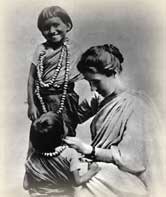
 Seventeen-year-old Amy Carmichael was on her way home from church in Belfast, When she came to a poor old woman carrying a heavy bundle-something she was not accustomed to seeing in Presbyterian Belfast. Amy, along with her two brothers, took the bundle from the woman and helped her along by the arms.
Surrounded by the “repeatable people” of the community, Amy could not help but notice her actions were being questioned. She was embarrassed. In her own words Amy described it as “a horrid moment. We were only two boys and a girl, and not at all exalted Christians. We hated doing it.” They plodded on in spite of the blushing and sense of shame for associating publicly with such a woman. The wind and rain blew in their faces. The rags of the old woman pressed against them.
Just as they passed by an ornate Victorian fountain in the street, “this mighty phrase flashed as it were through the gray drizzle: ‘Gold, silver, precious stones, wood, hay stubble – every man’s work will be made manifest; and the fire shall try every man’s work of what sort it is. If any man’s work abide…”
The words were so real, Amy turned to see who had spoken them. She saw nothing but a muddy street, people with surprised looks on their faces, and the fountain. But Amy knew this was the voice of God.
That afternoon, Amy shut the door to her room and closed herself in with God. What happened that day would change the course of her life and profoundly impact her priorities. Amy Carmichael began to understand what it means to die to self.
How did this affect her? She purposed in her heart to follow Him who had no home, no earthly possessions beyond the bare minimum. She would be “dead to the world and its applause, to all its customs, fashions, laws.” Amy had an eye for beauty and it was no small sacrifice to embrace this journey of true discipleship.
Amy began to reach out to the “shawlies” girls who worked in the mills and were too poor to by hats. They used their shawls to cover their heads, which was offensive to the proper church members. Which was worse, Amy bringing these crude “commoners” to the church or Mrs. Carmichael allowing her to go into the slums to fetch them? They couldn’t decide. Amy didn’t care about her reputation. She was dead. Christ was alive in her, loving the shawlies through her. It was a relief to the church folk when the shawlies were coming in such large numbers that Amy needed a separate building for them. This was no small challenge for a now 22 year-old girl. But Amy believed God for both the Land and the building. The invitations were sent out and the grand opening set for January 2, 1889. She invited her minister to dedicate “The Mill and Factory Girls’ Branch of the YMCA.” A banner was hung in the front with words, “That in all things HE might have the preeminence.”
Two students of D.L. Moody led the service. Amy wasn’t on the platform that night. She wasn’t on the program. Yes, it was her vision that initiated the ministry and her dream that brought about the building. But she sat inconspicuously in the middle of the audience. Amy Carmichael had died to self.
Later when God called Amy to missions, she did not question, though it saddened her to leave her loved ones. On the mission field, God again used Amy’s “mother’s heart” to minister to children. She spent fifty-three years in India setting up orphanages to rescue children from prostitution in Hindu temples and ministering to the people she met. Amy affected the lives of countless Indians, giving them a hope for a future on earth and in heaven.
While serving in India, Amy received a letter from a young lady who was considering life as a missionary, She asked Amy, “What is missionary life like?” Amy wrote back saying simply, “Missionary life is a chance to die.”
Questions and Application:
At one point in her early years Amy said, “Nothing could ever matter again but the things that were eternal.” Nothing? What is your response to that? As a youngster, Amy ejected the dark brown eyes God had given her, and longed instead for blue eyes. But with her brown eyes, she was later able to go inside the Hindu temples to rescue Children. Is there any unchangeable feature of your own body (God’s design) that you reject? Thank God for it, instead. Amy demonstrated death to self by praying for money with out telling anyone. Is there a sum of money for a specific ministry you could ask only God to provide?
One night, Amy led her oxcart driver to Christ. Later, she found out that a prayer group back home had been praying specifically on that date for a convert to be won. Pause right now and pray for a missionary.
May we all die to self in this way. “He Must become greater, I must become less”
- Things As They Are - Amy brings out the truth and reality of the mission work in India.
- From Sunrise Land: Letters from Japan (1895) - Letters by Amy while on her way to Japan, before God intervened and sent her to India instead!
- Lotus Buds - "The book has been written for lovers of children. Those who find such young life tiresome will find the story dull, and the kindest thing it can ask of them is not to read it at all."
- The Continuation of a Story
- Nor Scrip (1921) - Matthew 10:10 "Nor scrip for your journey.."
- Mimosa
- From the Fight
- A Chance to Die: The Life and Legacy of Amy Carmichael by Elisabeth Elliot
- Candles in the Dark
- God's Missionary
- Edges of His Ways
- Mountain Breezes: A Collection of Poems of Amy Carmichael
- Gold by Moonlight
- His Thoughts Said...
- Rose From Brier
- Thou Givest, They Gather
"Oh, Amma! Amma! Do not pray! Your prayers are, troubling me!" We all looked up in astonishment. We had just had our Band Prayer Meeting, when a woman came rushing into the room and began to exclaim like this. She was the mother of one of our girls, of whom I told you once before. She is still in the Terrible's den. Now the mother (A devote Hindu) was all excitement and poured out a curious story.
"When you went away last year I prayed. I prayed and prayed, and prayed again to my god to dispel your work. My daughter's heart was impressed with your words. I cried to my god to wash the words out. Has he washed them out? Oh no! And I prayed for a bridegroom for my daughter, and one came; and the cart was ready to take her away, and a hindrance occurred; the marriage fell through. And I wept till my eyes well-nigh dissolved. And again another bridegroom came, and again an obstacle occurred. And yet again did a bridegroom come, and yet again an obstacle; and I cannot get my daughter married, and the neighbors mock, and my Caste is disgraced" - and the poor old mother cried, just sobbed in her shame and confusion of face. "Then I went to my god again and said, 'What more can I offer you? Have I not given you all I have? And you reject my prayer!' Then in a dream my (demon) god appeared, and he said, 'Tell the Christians not to pray, I can do nothing against their prayers. Their prayers are hindering me!' And so, I beseech you, stop your prayers for fourteen days - only fourteen days - till I get my daughter married !" "And after she is married?" We asked. "Oh, then she may freely follow your God! I will hinder her no more!" Poor old mother! All lies are allowed where such things are concerned. We knew the proposed bridegroom came from a place three hundred miles away, and the idea was to carry the poor girl off by force as soon as she was married. We have been praying night and day to God to hinder this. And He is hindering!
If I find myself taking lapses for granted, “Oh, that’s what they always do,” “Oh, of course she talks like that, he acts like that,” then I know nothing of Calvary love.
If I can enjoy a joke at the expense of another; if I can in any way slight another in conversation, or even in thought, then I know nothing of Calvary love.
If I can write an unkind letter, speak an unkind word, think an unkind thought without grief and shame, then I know nothing of Calvary love.
If I do not feel far more for the grieved Savior than for my worried self when troublesome things occur, then I know nothing of Calvary love.
If I can rebuke without a pang, then I know nothing of Calvary love.
If my attitude be one of fear, not faith, about one who has disappointed me; if I say, “Just what I expected” if a fall occurs, then I know nothing of Calvary love.
If I am afraid to speak the truth, lest I lose affection, or lest the one concerned should say, “You do not understand,” or because I fear to lose my reputation for kindness; if I put my own good name before the other’s highest good, then I know nothing of Calvary love.
If I am content to heal a hurt slightly, saying “Peace, peace,” where there is no peace; if I forget the poignant word “Let love be without dissimulation” and blunt the edge of truth, speaking not right things but smooth things, then I know nothing of Calvary love.
If I hold on to choices of any kind, just because they are my choice, then I know nothing of Calvary love.
If I am soft to myself and slide comfortably into self-pity and self-sympathy; If I do not by the grace of God practice fortitude, then I know nothing of Calvary love.
If I myself dominate myself, if my thoughts revolve round myself, if I am so occupied with myself I rarely have “a heart at leisure from itself,” then I know nothing of Calvary love.
If, the moment I am conscious of the shadow of self crossing my threshold, I do not shut the door, and keep that door shut, then I know nothing of Calvary love.
If I cannot in honest happiness take the second place (or the twentieth); if I cannot take the first without making a fuss about my unworthiness, then I know nothing of Calvary love.
If I take offense easily, if I am content to continue in a cool unfriendliness, though friendship be possible, then I know nothing of Calvary love.
If I feel injured when another lays to my charge things that I know not, forgetting that my sinless Savior trod this path to the end, then I know nothing of Calvary love.
If I feel bitter toward those who condemn me, as it seems to me, unjustly, forgetting that if they knew me as I know myself they would condemn me much more, then I know nothing of Calvary love.
If souls can suffer alongside, and I hardly know it, because the spirit of discernment is not in me, then I know nothing of Calvary love.
If the praise of others elates me and their blame depresses me; if I cannot rest under misunderstanding without defending myself; if I love to be loved more than to love, to be served more than to serve, then I know nothing of Calvary love.
If I crave hungrily to be used to show the way of liberty to a soul in bondage, instead of caring only that it be delivered; if I nurse my disappointment when I fail, instead of asking that to another the word of release may be given, then I know nothing of Calvary love.
If I do not forget about such a trifle as personal success, so that it never crosses my mind, or if it does, is never given room there; if the cup of flattery tastes sweet to me, then I know nothing of Calvary love.
If in the fellowship of service I seek to attach a friend to myself, so that others are caused to feel unwanted; if my friendships do not draw others deeper in, but are ungenerous (to myself, for myself), then I know nothing of Calvary love.
If I refuse to allow one who is dear to me to suffer for the sake of Christ, if I do not see such suffering as the greatest honor that can be offered to any follower of the Crucified, then I know nothing of Calvary love.
If I slip into the place that can be filled by Christ alone, making myself the first necessity to a soul instead of leading it to fasten upon Him, then I know nothing of Calvary love.
If my interest in the work of others is cool; if I think in terms of my own special work; if the burdens of others are not my burdens too, and their joys mine, then I know nothing of Calvary love.
If I wonder why something trying is allowed, and press for prayer that it may be removed; if I cannot be trusted with any disappointment, and cannot go on in peace under any mystery, then I know nothing of Calvary love.
If the ultimate, the hardest, cannot be asked of me; if my fellows hesitate to ask it and turn to someone else, then I know nothing of Calvary love.
If I covet any place on earth but the dust at the foot of the Cross, then I know nothing of Calvary love.
That which I know not, teach Thou me, O Lord, my God.
From the book ‘If’ by Amy Carmichael
The tom-toms thumped straight on all night and the darkness shuddered round me like a living, feeling thing. I could not go to sleep, so I lay awake and looked; and I saw, as it seemed, this:
That I stood on a grassy sward, and at my feet a precipice broke sheer down into infinite space. I looked, but saw no bottom; only cloud shapes, black and furiously coiled, and great shadow-shrouded hollows, and unfathomable depths. Back I drew, dizzy at the depth.Then I saw forms of people moving single file along the grass. They were making for the edge. There was a woman with a baby in her arms and another little child holding on to her dress. She was on the very verge. Then I saw that she was blind. She lifted her foot for the next step . . . it trod air. She was over, and the children over with her. Oh, the cry as they went over!
Then I saw more streams of people flowing from all quarters. All were blind, stone blind; all made straight for the precipice edge. There were shrieks, as they suddenly knew themselves falling, and a tossing up of helpless arms, catching, clutching at empty air. But some went over quietly, and fell without a sound.
Then I wondered, with a wonder that was simply agony, why no one stopped them at the edge. I could not. I was glued to the ground, and I could only call; though I strained and tried, only whisper would come.
Then I saw that along the edge there were sentries set at intervals. But the intervals were too great; there were wide, unguarded gaps between. And over these gaps the people fell in their blindness, quite unwarned; and the green grass seemed blood-red to me, and the gulf yawned like the mouth of hell.
Then I saw, like a little picture of peace, a group of people under some trees with their backs turned toward the gulf. They were making daisy chains. Sometimes when a piercing shriek cut the quiet air and reached them, it disturbed them and they thought it a rather vulgar noise. And if one of their number started up and wanted to go and do something to help, then all the others would pull that one down. “Why should you get so excited about it? You must wait for a definite call to go! You haven’t finished your daisy chain yet. It would be really selfish,” they said, “to leave us to finish the work alone.”
There was another group. It was made up of people whose great desire was to get more sentries out; but they found that very few wanted to go, and sometimes there were no sentries set for miles and miles of the edge.
Once a girl stood alone in her place, waving the people back; but her mother and other relations called and reminded her that her furlough was due; she must not break the rules. And being tired and needing a change, she had to go and rest for awhile; but no one was sent to guard her gap, and over and over the people fell, like a waterfall of souls.
Once a child caught at a tuft of grass that grew at the very brink of the gulf; it clung convulsively, and it called-but nobody seemed to hear. Then the roots of the grass gave way, and with a cry the child went over, its two little hands still holding tight to the torn-off bunch of grass. And the girl who longed to be back in her gap thought she heard the little one cry, and she sprang up and wanted to go; at which they reproved her, reminding her that no one is necessary anywhere; the gap would be well taken care of, they knew. And then they sang a hymn.
Then through the hymn came another sound like the pain of a million broken hearts wrung out in one full drop, one sob. And a horror of great darkness was upon me, for I knew what it was-the Cry of the Blood.
Then thundered a voice, the voice of the Lord. “And He said, ‘What hast thou done, The voice of thy brother’s blood crieth unto me from the ground.’”
The tom-toms still beat heavily, the darkness still shuddered and shivered about me; I heard the yells of the devil-dancers and weird, wild shriek of the devil-possessed just outside the gate.
What does it matter, after all? It has gone on for years; it will go on for years. Why make such a fuss about it?
God forgive us! God arouse us! Shame us out of our callousness! Shame us out of our sin!
Psalm 4:7 Thou has put gladness in my heart, more than in the time that their corn and their wine increased.
Psalms 3 and 4 were written when David fled from Absalom; and if, as some think, Psalm 4 was written at the time of the Feast of Tabernacles, the harvest and the vintage were over, and the rich stores of corn and new wine were at Absalom’s disposal, while David had nothing or very little. It was in every way a hard time for David had nothing or very little. It was in every way a hard time for David, and it was not surprising that many said there was “no help for him in God” and “Who will show us any good?” We all know times of trial when the voices within and without talk like that. But David’s faith breaks through, and he can honestly say, Thou hast put gladness in my heart more than when corn and wine increased. It is not difficult to have gladness in our hearts when we have what we want–corn and wine may stand for whatever we most enjoy doing or possessing–but God asks for something far more than this. He wants what David offered Him when he wrote those words more than.
(Part 2) What David offered to his God was a heart that was utterly satisfied with His will. There were no private reservations, no little whispered “if”–if only I can be where I want to be, and have what I want to have, then there will be gladness in my heart; O God; he did not say that–he did not even say, By Thy grace I am glad, I am as glad as I should be if I had those stores of corn and wine. He went further, he flew right out of all the restricting thoughts that might have caged his spirit, up and up into the free air of God, and he said, Thou hast put a new kind of gladness in my heart. It does not depend on what I have, it is more than that sort of gladness. It is a joy that is entirely independent of circumstances.
(From the book Edges of His Ways)
William and Catherine were married somewhere around 1865. They both had the privilege of being raised in a godly home. They were married in an Irish Presbyterian Church. The revival fires of 1859 had brought fresh breezes of the life-giving Spirit of God into both of their lives. I guess one can never be quite the same after you have been in the midst of a visitation of God’s Spirit. When God is real, and His voice clearly heard, it is like days of heaven on earth. Thousands of souls were ushered into the Kingdom, and Amy’s parents were in the midst of it all. These revival fires also brought new life and deliverance from the more formal services of the Irish Presbyterian Church. The newly appointed preacher had been in the midst of revival as well. All these divine circumstances were ordered by God, working together to provide many streams of water for young Amy to grow up in.
William’s family, as well as Catherine’s, can be traced back several generations. You find signs of godliness and commitment to Christ on both sides of Amy’s heritage. William was known by all in the little village of Millisle for his honesty, integrity, mercy, and heart of giving. It is hard for us transient Americans to imagine that a family could settle in one place for one hundred years, but this was the case with the Carmichael’s. Amy’s father was a miller—grinding grain into flour as his forefathers did for one hundred years before him. There was a God-fearing foundation under both families. They went to church on Sunday, kept the Lord’s day holy, believed the Bible, and many other godly principles were followed. Then revival came. Everyone and everything was lifted to new heights of love and dedication. Praise God for those life-giving seasons of refreshing from the presence of the Lord. Though the village was small, and one might say the church very insignificant, there were weekly activities that stir the soul on toward God because of the revival: Bible classes during the week, evangelistic meetings on Sunday evenings, and the usual Sunday morning meeting which were now full of life and never missed.The Practical Side of Revival
The Power of Sound Teaching
Amy’s father was a man of the Word. Every day the whole family was called to worship by the ringing of a bell. William sat with open Bible, reading and expounding from the King James Version. These daily exercises are what mold the mind and heart of a child. When the children are young, their little minds are open and clear, and memorization can happen almost unknown to them. The shorter catechism was also used consistently in the home, as their father was concerned that the family be sound in the doctrines of the church. As I study these saints of old, it impresses me again and again how the father knew it was his responsibility to guide the family with the Word. Today, I am afraid that many have given this task over to the preacher, and that only once or twice a week. Amy’s father was also a lover of Spurgeon’s written sermons. In those days, they were printed weekly. He would take the family on a Sunday afternoon walk and sit under a shade tree along the way, reading the latest of these sermons to all.The Power of Firm Discipline
No one wondered what was expected of them, or where the lines were drawn in the Carmichael home. White was white, and black was black. There were few times when there was any ground in between. Many today feel that this is too strict, and it will prove to be counter-productive. Instead, we see that it brought a sense of love and security to homelife. What Mom or Dad said would always stand, and there was punishment if it was not obeyed. There were five forms of correction used, depending on the depth of the transgression. They were as follows:- To stand in the corner, with your face to the wall.
- To lose your privilege to go outside and play.
- To receive a spanking.
- To be slapped on the hand with a ruler.
- To be required to drink a mixture of substances that tasted bad.
The Power of Mother’s Love
It is always a joy to view a well balanced home, where father and mother are engaged in raising the children. The Carmichael home was one of these. This Irish lady had a heart that was set on rearing a Godly seed for the Lord. Full of tender love, and full of what I call grit, is the best way to describe her. She would not budge from doing right with the children. If the children needed a spanking, they got one right away. If it was time to drink that terrible drink, she saw it through to the end. I like that. We need some more mothers like that in America today. It is alright to get tough and have a furrowed eye-brow from time to time. It will establish your authority.On the other hand, this Irish lady was a tender, loving mother. She was one who would sit with a child in the nursery, and expound the crucifixion to her children when they were yet young. She was one who would sing to the children all through the day, placing memories in them that lasted a lifetime. It was Catherine who inspired little Amy to pray a believing prayer at three years old, asking God to change the color of her brown eyes. It was the dear mother who placed the children on her knee many a time, telling them and showing them that Jesus loved them. Oh, the childhood impressions placed there by a mother’s love. It is hard to measure this kind of influence.
The Power of Home Education
The historical records give no reason for the children being schooled at home. It seems that it was a common practice in those days. Though we do not find a reason, we can certainly see the good results of it in Amy’s life. The schooling was done by Mother, and what they called a governess. This was a young lady who lived in the home for the sole purpose of educating the children. One of these young ladies had a great impact on the children. Her name was Eleanor Milne. She was like an older sister in the home, and everyone loved her. A highly spiritual girl, she filled the children with many a story of missionaries and martyrs. The children sat in rapt attention as she told of India and the many needs that were there. Poetry, history, and geography all came alive to the children as she walked and talked with them by the sea-side.Father and Mother were also very much involved in the homeschool they had. William would take the children on long discovery walks where many a science investigation took place. How the children looked forward to these times! Books were bought—all that could be purchased in those days. The children read and were read to, often. Toys were bought—the ones that were practical and useful; but the greatest toys for Amy were the toys of God’s creation. The children had pets to love and care for. Father bought them a microscope so they could discover more of the creation and order around them. The parents tried to surround them with all that was good and beautiful and right. At the same time, they endeavored to keep all that was not good and beautiful and right away from them.
The Power of Godly Exercises
As I study the histories of how God molds His servants, even before they are converted, I stand amazed at His providence. Let us look at a few of them.1. Amy was destined to fulfill a calling to minister to the poor in India. Her mother had no idea of any of this; however, God was molding Amy through a Mother’s hands without her knowing it. When Amy was young, she remembers a common and regular practice of feeding the poor. Mother would cook a pot of soup for the old and the poor. Amy and her brother would have the opportunity to carry this soup into the village and serve it to the needy. Was this a coincidence? I don’t think so.So what does all this mean to us? God was using all of this to make Himself a choice servant. Amy didn’t know it at first. Her father and mother didn’t know it either. The point I would like to make here is simple. God is still molding his servants the same way. We have some of them in our homes, under our care. Let us be alert, and not too cautious when we see opportunities for learning experiences. Some are overly cautious about youth working in the city where sinners live. These poor and pitiful scenes were the very things that placed a burden on Amy’s heart for lost souls. What if she was never allowed to see them?
Amy was the oldest of seven children. Because of this, she often found herself caring for her siblings when they were ill. She developed skills of gentle comfort and care. She had a touch that so ministered to the ailing ones that they often called for her when sick. When Amy was seventeen, her dear Father died unexpectedly after some financial setbacks. The family was thrown into poverty, and Amy became like a second mother to the children below her. Was this just happenstance? I think not. God was molding a vessel. We must help our children to see the bigger picture.
When Amy was twelve years old, her father moved to Belfast, Ireland for business. He was a very Godly and influential man. Many preachers and church leaders stayed at his home. Guess who was sitting for hours, listening to these men talk of doctrines, of souls, of missionary exploits, and of Kingdom building?
When Amy was seventeen, she began gathering the city children together to teach them the Bible on Sunday afternoons. Her heart was being drawn out to the poor. She started a club called The Morning Watch. All who joined the club had to be willing to get up early each day to study the Bible and pray. Saturday, they would get together and share what they learned, or how they failed during the week. She also started a weekly class with the mill girls of the city. These were young factory workers. She was burdened about their purity and their souls, and she labored to salvage them from wreck and ruin. The class grew to 500 girls.
A Life like Jesus
What was the result of these fresh streams of revival that flowed through the home where Amy lived? What kind of willow tree grew up there in the Carmichael home? It was a beautiful one. It was truly a tree planted by the rivers of water, that brought forth its fruit in its season. Its leaves did not wither either, and whatsoever it did prospered. (Psalm 1) Amy served her beloved Jesus at home in Ireland till she was twenty-seven. Then she went to Japan for four years, serving there as a missionary and enrolled in the school of Christ. When she was thirty-one, she went to India, where she began her life work. She never went home on leave. She died in India, at eighty-four years of age. How can we measure her fruitfulness? An orphanage for the temple children, churches, young preachers, a hidden life of prayer the last twenty years of her life, and the books she has written. Many are still drinking from the rivers of living waters that flowed out of this life. Dear fellow parents, now it is our turn to raise up vessels for the Lord. Let us give ourselves to God continually. Let us thirst for that living water and be filled. Let us pay the price that brings the blessings that make the rivers flow through our homes. Let us trust our God for willow trees planted by the watercourse.There are times when something comes into our lives which is charged with love in such a way that it seems to open the Eternal to us for a moment, or at least some of the Eternal Things, and the greatest of these is love.
It may be a small and intimate touch upon us or our affairs, light as the touch of the dawn wind on the leaves of the tree, something not to be captured and told to another in words. But we know that it is our Lord. And then perhaps the room where we are, with its furniture and books and flowers, seems less “present” than His Presence, and the heart is drawn into that sweetness of which the old hymn sings.
The love of Jesus, what it is – None but His loved ones know.
Or it is the dear human love about us that bathes us as in summer seas and rests us through and through. Can we ever cease to wonder at the love of our companions? And then suddenly we recognize our Lord in them. It is His love that they lavish on us. O Love of God made manifest in Thy lovers, we worship Thee.
Or (not often, perhaps, for dimness seems to be more wholesome for us here, but sometimes, because our Lord is very merciful) it is given to us to look up through the blue air and see the love of God. And yet, after all, how little we see! “That ye may be able to comprehend what is the breadth and length and depth and height and to know the love of Christ which passeth knowledge” – the words are too great for us. What do we comprehend, what do we know? Confounded and abased, we enter into the Rock and hide us in the dust before the glory of the Majesty of love – the love whose symbol is the Cross.
And a question pierces then: What do I know of Calvary love?
If I have not compassion on my fellow-servant even as my Lord had pity on me, then I know nothing of Calvary love.
If I belittle those whom I am called to serve, talk of their weak points in contrast perhaps with what I think of as my strong points; if I adopt a superior attitude, forgetting “Who made thee to differ? And what has thou that thou hast not received?” then I know nothing of Calvary love.
If I can easily discuss the shortcomings and the sins of any; if I can speak in a casual way even of a child’s misdoings, then I know nothing of Calvary love.
If I find myself half-carelessly taking lapses for granted, “Oh, that’s what they always do,” “Oh, of course she talks like that, he acts like that,” then I know nothing of Calvary love.
If I enjoy a joke at the expense of another; if I can in any way slight another in conversation, or even in thought, then I know nothing of Calvary love.
If I can write an unkind letter, speak an unkind work, think an unkind thought without grief and shame, then I know nothing of Calvary love.
If I do not feel far more for the grieved Saviour than for my worried self when troublesome things occur, then I know nothing of Calvary love.
If I know little of His pitifulness (the Lord turned and looked upon Peter), if I know little of His courage of hopefulness for the truly humble and penitent (“He saith unto him, Feed My Lambs”), then I know nothing of Calvary love.
If I deal with wrong for any other reason than that implied in the words, “From His right hand went a fiery law for them. Yea, He loved the people”; if I can rebuke without a pang, then I know nothing of Calvary love.
If, in dealing with one who does not respond, I weary of the strain, and slip from under the burden, then I know nothing of Calvary love.
If I cannot bear to be like the father who did not soften the rigors of the far country; if, in this sense, I refuse to allow the law of God (the way of transgressors is hard) to take effect, because of the distress it causes me to see that law in operation, then I know nothing of Calvary love.
If I am perturbed by the reproach and misunderstanding that may follow action taken for the good of souls for whom I must give account; if I cannot commit the matter and go on in peace and in silence, remembering Gethsemane and the Cross, then I know nothing of Calvary love.
If I cannot catch “the sound of noise of rain”* long before the rain falls, and, going to some hilltop of the spirit, as near to my God as I can, have not faith to wait there with my face between my knees, though six times or sixty times I am told “there is nothing,” till at last “there arises a little cloud out of the sea,” then I know nothing of Calvary love.
If my attitude be one of fear, not faith, about one who has disappointed me; if I say, “Just what I expected,” if a fall occurs, then I know nothing of Calvary love.
If I do not look with eyes of hope on all in whom there is even a faint beginning, as our Lord did, when, just after His disciples had wrangled about which of them should be accounted the greatest, He softened His rebuke with those heart-melting words, “Ye are they which have continued with Me in My temptations,” then I know nothing of Calvary love.
If I cast up a confessed, repented, and forsaken sin against another, and allow my remembrance of that sin to color my thinking and feed my suspicions, then I know nothing of Calvary love.
If I have not the patience of my Saviour with souls who grow slowly; if I know little of travail (a sharp and painful thing) till Christ be fully formed in them, then I know nothing of Calvary love.
If I sympathize weakly with weakness, and say to one who is turning back from the Cross, “Pity thyself”; if I refuse such a one the sympathy that braces and the brave and heartening word of comradeship, then I know nothing of Calvary love.
If I cannot keep silence over a disappointing soul (unless for the sake of that soul’s good or for the good of others it be necessary to speak), then I know nothing of Calvary love.
If I can hurt another by speaking faithfully without much preparation of spirit, and without hurting myself far more than I hurt that other, then I know nothing of Calvary love.
If I am afraid to speak the truth, lest I lose affection, or lest the one concerned should say, “You do not understand,” or because I fear to lose my reputation for kindness; if I put my own good name before the other’s highest good, then I know nothing of Calvary love.
If I am content to heal a hurt slightly, saying “Peace, peace,” where is no peace; if I forget the poignant word “Let love be without dissimulation” and blunt the edge of truth, speaking not right things but smooth things, then I know nothing of Calvary love.
If I fear to hold another to the highest goal because it is so much easier to avoid doing so, then I know nothing of Calvary love.
If I hold on to choices of any kind, just because they are my choice; if I give any room to my private likes and dislikes, then I know nothing of Calvary love.
If I put my own happiness before the well-being of the work entrusted to me; if, though I have this ministry and have received much mercy, I faint, then I know nothing of Calvary love.
If I am soft to myself and slide comfortably into the vice of self-pity and self-sympathy; if I do not by the grace of God practice fortitude, then I know nothing of Calvary love.
If I myself dominate myself, if my thoughts revolve round myself; if I am so occupied with myself I rarely have “a heart at leisure from itself,” then I know nothing of Calvary love.
IF, the moment I am conscious of the shadow of self crossing my threshold, I do not shut the door, and in the power of Him who works in us to will and to do, keep that door shut, then I know nothing of Calvary love.
If I cannot in honest happiness take the second place (or the twentieth); if I cannot take the first without making a fuss about my unworthiness, then I know nothing of Calvary love.
If, when I am able to discover something which has baffled others, I forget Him who revealeth the deep and secret things, and knoweth what is in the darkness and showeth it to us; if I forget that it was He who granted that ray of light to His most unworthy servant, then I know nothing of Calvary love.
If I cannot be at rest under the Unexplained, forgetting the word, “And blessed is he whosoever shall not be offended in Me:’ of if I can allow the least shadow of misunderstanding, then I know nothing of Calvary love.
If I do not give a friend “the benefit of the doubt,” but put the worst construction instead of the best on what is said or done, then I know nothing of Calvary love.
If I take offense easily, if I am content to continue in a cool unfriendliness, though friendship be possible, then I know nothing of Calvary love.
If a sudden jar can cause me to speak an impatient, unloving word, then I know nothing of Calvary love.*
*For a cup brimful of sweet water cannot spill even one drop of bitter water however suddenly jolted.
If I feel injured when another lays to my charge things that I know not, forgetting that my Sinless Saviour trod this path to the end, then I know nothing of Calvary love.
If I feel bitterly towards those who condemn me, as it seems to me, unjustly, forgetting that if they knew me as I know myself they would condemn me much more, then I know nothing of Calvary love.
If I say, “Yes, I forgive, but I cannot forget,” as though the God who twice day washes all the sands on all the shores of all the world, could not wash such memories from my mind, then I know nothing of Calvary love.
If one whose help I greatly need appears to be as content to build in wood, hay, stubble, as in gold, silver, precious stones, and I hesitate to obey my light and do without that help because so few will understand, then, I know nothing of Calvary love.
If the care of a soul (or a community) be entrusted to me, and I consent to subject it to weakening influences, because the voice of the world – my immediate Christian world – fills my ears, then I know nothing of Calvary love.
If by doing some work which the undiscerning consider “not spiritual work” I can best help others, and I inwardly rebel, thinking it is the spiritual for which I crave, when in truth it is the interesting and exciting, then I know nothing of Calvary love.
If monotony tries me, and I cannot stand drudgery; if stupid people fret me and little ruffles set me on edge; if I make much of the trifles of life, then I know nothing of Calvary love.
If I am inconsiderate about the comfort of others, or their feelings, or even of their little weaknesses; if I am careless about their little hurts and miss opportunities to smooth their way; if I make the sweet running of household wheels more difficult to accomplish, then I know nothing of Calvary love.
If interruptions annoy me, and private cares make me impatient; if I shadow the souls about me because I myself am shadowed, then I know nothing of Calvary love.
If souls can suffer alongside, and I hardly know it, because the spirit of discernment is not in me, then I know nothing of Calvary love.
If there be any reserve in my giving to Him who so loved that He gave His Dearest for me; if there be a secret “but” in my prayer, “anything but that, Lord,” then I know nothing of Calvary love.
If I become entangled in any “inordinate affection”; if things or places or people hold me back from obedience to my Lord, then I know nothing of Calvary love.
If something I am asked to do for another feels burdensome; if, yielding to an inward unwillingness, I avoid doing it, then I know nothing of Calvary love.
If the praise of man elates me and his blame depresses me; if I cannot rest under misunderstanding without defending myself; if I love to be loved more than to love, to be served more than to serve, then I know nothing of Calvary love.
If I crave hungrily to be used to show the way to liberty to a soul in bondage, instead of caring only that it is be delivered; if I nurse my disappointment when I fail, instead of asking that to another the word of release may be given, then I know nothing of Calvary love.
If I want to be known as the doer of something that has proved the right thing, or as the one who suggested that it should be done, then I know nothing of Calvary love.
If I do not forget about such a trifle as personal success, so that it never crosses my mind, or if it does, is never given a moment’s room there; if the cup of spiritual flattery tastes sweet to me, then I know nothing of Calvary love.
If it be not simple and a natural thing to say, “Enviest thou for my sake? Would God that all the Lord’s people were prophets,” then I know nothing of Calvary love.
IF in the fellowship of service I seek to attach a friend to myself, so that others are caused to feel unwanted; if my friendships do not draw others deeper in, but are ungenerous (to myself, for myself), then I know nothing of Calvary love.
If I refuse to allow one who is dear to me to suffer for the sake of Christ, if I do not see such suffering as the greatest honor that can be offered to any follower of the Crucified, then I know nothing of Calvary love.
If I slip into the place that can be filled by Christ alone, making myself the first necessity to a soul instead of leading it to fasten upon Him, then I know nothing of Calvary love.
If my interest in the work of others is cool; if I think in terms of my own special work; if the burdens of others are not my burdens too, and their joys mine, then I know nothing of Calvary love.
If, when an answer I did not expect comes to a prayer which I believed I truly meant, I shrink back from it; if the burden my Lord asks me to bear be not the burden of my heart’s choice, and I fret inwardly and do not welcome His will, then I know nothing of Calvary love.
If I avoid being “ploughed under,” with all that such ploughing entails of rough handling, isolation, uncongenial situations, strange tests, then I know nothing of Calvary love.
If I wonder why something trying is allowed, and press for prayer that it may be removed; if I cannot be trusted with any disappointment, and cannot go on in peace under any mystery, then I know nothing of Calvary love.
If I make much of anything appointed, magnify it secretly to myself or insidiously to others; if I let them think it “hard,” if I look back longingly upon what used to be, and linger among the byways of memory, so that my power to help is weakened, then I know nothing of Calvary love.
If the love that “alone maketh light of every heavy thing, and beareth evenly every uneven thing” is not my heart’s desire, then I know nothing of Calvary love.
If I refuse to be a corn of wheat that falls into the ground and dies (“is separated from all in which it lived before”), then I know nothing of Calvary love.
If I ask to be delivered from trial rather than for deliverance out of it, to the praise of His glory; if I forget that the way of the Cross leads to the Cross and not to a bank of flowers; if I regulate my life on these lines, or even unconsciously my thinking, so that I am surprised when the way is rough, and think it strange, though the word is, “Think it not strange,” “Count it all joy,” then I know nothing of Calvary love.
If the ultimate, the hardest, cannot be asked of me; if my fellows hesitate to ask it and turn to someone else, then I know nothing of Calvary love.
If I covet any place on earth but the dust at the foot of the Cross, then I know nothing of Calvary love.
That which I know not, teach Thou me, O lord, my God.
PART III
1
I have felt these words scorching to write, but it is borne upon me that, in spite of all our hymns and prayers ( so many of them for love), it is possible to be content with the shallows of love, if indeed such shallows should be called love at all.
(Perhaps prayer often needs to be followed by a little pause, that we may have time to open our hearts to that for which we have prayed. We often rush from prayer to prayer without waiting for the word within, which says, “I have heard you, My child.”)
The more we ponder our Lord’s words about love, and the burning words the Spirit gave to His followers to write, the more acutely do we feel our deadly lack.
The Searchlight of the Spirit exposes us to ourselves, and such a discovery leaves us appalled. How can even He who is the God of all patience have patience with us? Like Job we abhor ourselves and repent in dust and ashes.
But the light is not turned upon us to rob us of our hope. There is a lifting up. If only we desire to be purged from self with its entangling nets, its subtleties, its disguises (falsehoods truly), its facile showing of brass for gold, as the Tamil says; if, hating unlove from the ground of the heart, we cry to be delivered, then our God will be to us a God of deliverances.
2
No vision of the night can show, no word declare, with what longings of love Divine love waits till the heart, all weary and sick of itself, turns to its lord and says, “Take full possession.” There is no need to plead that the love of God shall fill our heart as though He were unwilling to fill us: He is willing as light is willing to flood a room that is opened to its brightness; willing as water is willing to flow into an emptied channel. Love is pressing round us on all sides like air. Cease to resist, and instantly love takes possession. As the 15th century poem Quia amore langues says,
Long and love thou never so high,
My love is more than thine may be.
More, far more. For as His abundance of pardon passes our power to tell it, so does His abundance of love: it is far as the East is from the West, as high as the heaven is above the earth. But words fail. Love soars above them all.
To look at ourselves leads to despair. Thank God, the Blood cleanseth.
If thou be foul, I shall make thee clean,
If thou be sick, I shall heal thee,
Foundest thou ever love so real?
Never, Lord, never.
3
Sometimes, when we are distressed by past failure and tormented by fear of failure in the future should we again set our faces toward Jerusalem, nothing helps so much as to give some familiar scripture time to enter into us and become part of our being. The words “Grace for grace” have been a help to me since I read in a little old book of Bishop Moule’s something that opened their meaning. (Till then I had not understood them.)
He says “for” means simply instead: “The image is of a perpetual succession of supply; a displacement ever going on; ceaseless changes of need and demand.
“The picture before us is as of a river. Stand on its banks, and contemplate the flow of waters. A minutes passes, and another. Is it the same stream still? Yes. But is it the same water? No. The liquid mass that passed you a few seconds ago fills now another section of the channel; new water has displaced it, or if you please replaced it; water instead of water. And so hour by hour, and year by year, and century by century, the process holds; one stream, other waters, living, not stagnant, because always in the great identity there is perpetual exchange. Grace takes the place of grace (and love takes the place of love); ever new, ever old, ever the same, ever fresh and young, for hour by hour, for year by year, through Christ.”
4
There is no force strong enough to hold us together as a company, and animate all our doings, but his one force of Love; and so there is a constant attack upon the love without which we are sounding brass and tinkling cymbal.
That explains why every now and then those who want to live the life of love seem to be constrained to seek the searchings and the cleansing of the Spirit of God, first (it has happened so) in the secret of our own hearts, and then together; and we know how graciously God has answered us, so that, though our word must always be, “not as though I had already attained,” we do, by His enabling, press onward.
There is another reason why the adversary attacks love. It is this:
Far out on our uttermost rim a thing may occur which is the reflection , so to speak, of something that was nourished in the heart of one who is in the very center. I have often known it to be so. Perhaps, it was never expressed in act or word, the eye did not see it, the ear did not hear it. But spiritual influences move where sight and hearing have no place; and unlove in any one of us, or even an absence of the quality of love of which we have been thinking, is enough to cause the slow stain to spread till it reaches some soul in a moment of its weakness. And irreparable harm may result.
O Lord, forgive: Thy property is always to have mercy. Give me the comfort of Thy help again. Let it be Thy pleasure to deliver me, O Lord my God.
5
The way of love is never the easy way. If our hearts be set on walking in that way we must be prepared to suffer. “It was the way the Master went; should not the servant tread it still?” It is possible that we may be enclosed in circumstances which drain natural love, till we feel as dry as grass on an Indian hillside under a burning sun.
We have toiled for someone dear to us, but never knew it as toil. We have poured out stores of health never to be recovered, but did not know it, nor would we have cared if we had known it, so dearly did we love. And all our hope was that the one so cherished would become a minister to others. But it was not so.
And then unwillingly we become aware of a strange unresponsiveness in the one for whom nothing had seemed too much to do, of a coldness that chilled, a hardness that pushed away as with hard hands the heart that had almost broken to save that life from destruction.
Then (but only those who have gone through such a bereft hour will understand) a fear worse than any pain has us in its grip: is the love of the years slipping from us? “Father, forgive them, for they know not what they do” – is that fading from our memory? “Love never faileth” – is love failing now? Shall we find ourselves meeting lovelessness with lovelessness?
In such an hour a poem, now many years old, that expressed a desperate prayer, burned into words:
Deep unto deep, O Lord,
Crieth in me,
Gathering strength, I come,
Lord, unto Thee.
Jesus of Calvary,
Smitten for me,
Ask what Thou wilt, but give
Love to me.
Yes, ask what Thou wilt, any hopes any joys of human affection, any rewards of love, but let not love depart. Nothing ordinary is equal to this new call; nothing in me suffices for this. O Lord of Love and Lord of Pain, abound in me in love: Love through me, Love of God.
6
Our dear Lord listens to the prayer that goes not out of feigned lips, and it is written for our comfort that he causes those who love Him to inherit substance, the wonderful “substance” that is “grace instead of grace,” the perpetual gift of His fullness. This grace is no mere “impersonal substance,” but God working in us, the Lord in action in our very springs of thought and will. God is Love; so, for us, Love is this blessed “Substance” that the children of the Father are caused to inherit.
It is the river’s word again. The empty river-bed “inherits” the water that pours through it from the heights; it does not create that water, it only receives it, and its treasuries are filled, its pools overflow for the blessing and refreshment of the land. It is so with us; our treasuries of time, our years with all their months, weeks, days, hours, minutes, are filled with the flowing treasure of love that we may help others. Who could have thought of such joy for us but He whose name is Love? Now unto Him that is able to do exceeding abundantly above all that we ask or think, according to the power that worketh in us, unto Him be glory.
7
Let us end on a very simple note: Let us listen to simple words; our Lord speak simply: “Trust Me, My child,” He says. “Trust Me with a humbler heart and a fuller abandon to My will than ever thou didst before. Trust Me to pour My love through thee, as minute succeeds minute. And if thou shouldst be conscious of anything hindering that flow, do not hurt My love by going away from Me in discouragement, for nothing can hurt so much as that. Draw all the closer to Me; come, flee unto Me to hide thee, even from thyself. Tell Me about the trouble. Trust Me to turn My hand upon thee and thoroughly to remove the boulder that has choked they river-bed, and take away all the sand that has silted up the channel. I will not leave thee until I have done that which I have spoken to thee of. I will perfect that which concerneth thee. Fear thou not, O child of My love; fear not.”
And now…to gather all in one page:
Beloved, let us love.
Lord, what is love?
Love is that which inspired My life, and led Me to My Cross, and held Me on My Cross. Love is that which will make it thy joy to lay down thy life for thy brethren.
Lord, evermore give me this love.
Blessed are they which do hunger and thirst after love, for they shall be filled.
 God's Missionary
 If: What Do I Know About Calvary Love? Things As They Are: Mission Work in Southern IndiaCandles in the Dark: Letters of Hope and EncouragementRose from BrierGod's MissionaryMimosa: A True StoryI Come Quietly to Meet You: An Intimate Journey in God's Presence Edges of His Ways: Selections for Daily Reading Ponnammal: Her Story Whispers of His Power - Devotional readings.Gold by Moonlight - Sensitive lessons from a walk with pain.Mountain Breezes - Over a hundred poems by Amy Carmichael.Gold Cord: The Story of a FellowshipThou Givest They Gather: Truths gleaned from the Word of God.His Thoughts Said. . .His Father Said: Real-World Answers to the Hard Questions of Life Fragments That Remain Kohila: The Shaping of an Indian NurseFigures of the True: Devotional Thoughts Inspired by NaturePloughed Under: The Story of a Little Lover From Sunrise Land: Letters from Japan Overweights of Joy
August 25, 1894
“All along, let us remember, we are not asked to understand, but simply to obey…. On July 28, Saturday, I sailed. We had to come on board on Friday night, and just as the tender (a small boat) where were the dear friends who had come to say goodbye was moving off, and the chill of loneliness shivered through me, like a warm love-clasp came the long-loved lines–‘And only Heaven is better than to walk with Christ at midnight, over moonless seas.’ I couldn’t feel frightened then. Praise Him for the moonless seas–all the better the opportunity for proving Him to be indeed the El Shaddai, ’the God who is Enough.”’
The tom-toms thumped straight on all night, and the darkness shuddered round me like a living, feeling thing. I could not go to sleep, so I lay awake and looked; and I saw, as it seemed, this:That I stood on a grassy patch, and at my feet a ravine broke straight down into infinite space. I looked, but saw no bottom; only cloud shapes, black and furiously coiled, and great shadow-shrouded hollows, and unfathomable depths. Back I drew, dizzy at the depth.
Then I saw forms of people moving toward the edge. There was a woman with a baby in her arms and another little child holding on to her dress. She was on the very edge. She lifted her foot for the next step… Then, to my horror, I saw that she was blind. Before I could say anything she was over, and the children with her. Their cries pierced the air as they fell into the inky blackness of the ravine!
Then I saw more streams of people flowing from all quarters. All were blind, stone blind; all walked straight toward the edge. There were shrieks as they suddenly knew themselves falling, and a tossing up of helpless arms, catching, clutching at empty air. But some went over quietly, and fell without a sound.
Then I wondered, with a wonder that was sheer agony, why no one stopped them at the edge. I could not. I was glued to the ground, and I couldn’t even yell; though I strained and tried, only a whisper would come out.
Then I saw that along the edge there were sentries set at intervals.
But the intervals were too large; there were wide, unguarded gaps between. And over these gaps the people fell in their blindness, unwarned; and the green grass seemed blood-red to me, and the ravine yawned like the mouth of hell.
Then I saw, like a little picture of peace, a group of people under some trees with their backs turned towards the ravine. They were making daisy chains. Sometimes when a piercing shriek cut the quiet air and reached them, it disturbed them and they thought it was a rather crude noise. And if one of their group started up and wanted to go and do something to help, then all the others would pull that one down. “Why should you get so excited about it? You must wait for a definite call to go! You haven’t finished your daisy chain yet. It would be really selfish,” they said, “to leave us to finish the work alone.”
There was another group. It was made up of people whose great desire was to get more sentries out; but they found that very few wanted to go, and sometimes there were no sentries for miles and miles along the edge.
Once a girl stood alone in her place, waving the people back; but her mother and other relations called, and reminded her that her furlough was due; she must not break the rules. And being tired and needing a change, she had to go and rest for awhile; but no one was sent to guard her gap, and over and over the people fell, like a waterfall of souls. Once a child grabbed at a tuft of grass that grew at the very edge of the ravine; it clung convulsively, and it called - but nobody seemed to hear. Then the roots of the grass gave way, and with a cry the child went over, its two little hands still holding tight to the torn-off bunch of grass. And the girl who longed to be back in her gap thought she heard the little one cry, and she sprang up and wanted to go; at which her friends reproved her, reminding her that no one is necessary anywhere; “The gap would be well taken care of!”, they said. And then they sang a hymn.
Then through the hymn came another sound like the pain of a million broken hearts wrung out in one full drop, one sob. And a horror of great darkness was upon me, for I knew that it was “The Cry of the Blood”.
Then a voice thundered. It was the voice of the Lord, and He said, “What hast thou done? The voice of thy brother’s blood crieth unto me from the ground.”
The tom-toms still beat heavily, the darkness still shuddered and shivered about me; I heard the yells of the devil-dancers and weird, wild shrieks of the devil-possessed just outside the gate.
What does it matter, after all? It has gone on for years; it will go on for years. Why make such a fuss about it? God forgive us!
God arouse us! Shame us out of our callousness! Shame us out of our sin!
"But whoso hath the gospel of Jesus Christ, and seeth the heathen lost and dying in their sin, and shutteth up his bowels of compassion from him, how dwelleth the love of God in him?" (1 John 3:17 paraphrased/ adapted by Amy Carmichael)
O Beloved of my soul, This do I desire: Faith for the impossible, Love that will not tire. Jesus, Savior, Lover, give me Love for the unlovable, Love that will not tire.
O Beloved of my soul, Yet again I come; Give me cords of love to draw Many wanderers home. Jesus, Savior, Lover give me Love that knows no strain nor flaw– Love to lead them home.
Hast thou no scar? No hidden scar on foot, or side, or hand? I hear thee sung as mighty in the land; I hear them hail thy bright, ascendant star. Hast thou no scar?
Hast thou no wound? Yet I was wounded by the archers; spent, Leaned Me against a tree to die; and rent By ravening beasts that compassed Me, I swooned. Hast thou no wound?No wound? No scar? Yet, as the Master shall the servant be, And piercèd are the feet that follow Me. But thine are whole; can he have followed far Who hast no wound or scar?
Have we not seen Thy shining garment's hem Floating at dawn across the golden skies; Through thin blue veils at noon, bright majesties; Seen starry hosts delight to gem The splendor that shall be Thy diadem?
O Immanence, that knows no far nor near, But as the air we breathe is with us here, Our Breath of Life, O Lord, we worship Thee.
Worship and laud and praise Thee evermore; Look up in wonder, and behold a door Opened in heaven, and One set on a throne: Stretch out a hand, and touch Thine own, O Christ, our King, our Lord whom we adore.
From 'Rose From Brier'
I pray Thee hush the hurrying eager longing I pray Thee soothe the pangs of keen desire. See in my quiet places wishes thronging, Forbid them, Lord, purge, though it be with fire.
And work in me to will and do Thy pleasure. Let all within me, peaceful, reconciled, Tarry content my Wellbeloved’s leisure, At last, at last, even as a weaned child.
- O God of burning altar fire, O God of love's consuming flame, Make pure the flame of our desire To win the lost to seek Thy Name.
- There is no coldness, Lord, in Thee, Oh, keep us kindled lest we bring To our dear Lord of Calvary, Dead ashes for our offering.
- Dead ashes, husk of corn for wheat Lord of our consecration vow, We gather round Thy wounded feet, We see the thorn about Thy brow.
- Oh, by Thy cross and passion, Lord, Grant us this plea, this sovereign plea, Save us from choosing peace for sword, And give us souls to give to Thee.
Father, hear us, we are praying, Hear the words our hearts are saying, We are praying for our children.
Keep them from the powers of evil, From the secret, hidden peril, From the whirlpool that would suck them, From the treacherous quicksand, pluck them.
From the worldling’s hollow gladness, From the sting of faithless sadness, Holy Father, save our children.
Through life’s troubled waters steer them, Through life’s bitter battle cheer them, Father, Father, be Thou near them. Read the language of our longing, Read the wordless pleadings thronging, Holy Father, for our children.
And wherever they may bide, Lead them Home at eventide.
From Toward Jerusalem, by Amy Carmichael
- To Calv'ry let our eyes be turned,With Calv'ry love our hearts be burned; For there in Calv'ry's awful hour, Love conquered sin and Satan's pow'r.
- Lord, turn our gaze upon Thy Cross, Counting all else not gain but loss; For this we pray, this is our plea— Lord, keep our eyes on Calvary.
From prayer that asks that I may be
Sheltered from winds that beat on Thee,
From fearing when I should aspire,
From faltering when I should climb higher
From silken self, O Captain, free
Thy soldier who would follow Thee.
From subtle love of softening things,
From easy choices, weakenings,
(Not thus are spirits fortified,
Not this way went the Crucified)
From all that dims Thy Calvary
O Lamb of God, deliver me.
Give me the love that leads the way,
The faith that nothing can dismay
The hope no disappointments tire,
The passion that will burn like fire;
Let me not sink to be a clod;
Make me Thy fuel, Flame of God.
- Amy Carmichael
| Many crowd the Savior's kingdom,
Few receive His cross;
Many seek His consolation,
Few will suffer loss.
For the dear sake of the Master,
Counting all but dross,
For the dear sake of the Master,
Counting all but dross.
Many sit at Jesus’ table, Few will fast with Him, When the sorrow-cup of anguish Trembles to the brim. Few watch with Him in the garden, Who have sung the hymn, Few watch with Him in the garden, Who have sung the hymn. Many will confess His wisdom, Few embrace His shame. Many, should He smile upon them, Will His praise proclaim; Then, if for a while He leave them, They desert His name, Then, if for a while He leave them, They desert His name. But the souls who love Him truly, Let woe come or bliss, These will count their dearest hearts’ blood Not their own, but His. Savior, Thou who thus hast loved me, Give me love like this, Savior, Thou who thus hast loved me, Give me love like this. |
|
But the men He made to glorify Him take His Glory from Him, give it to another; that, the sin of it, the shame, calls with a low, deep under-call through all the other calls. God’s Glory is being given to another. Do we love Him enough to care? Or do we measure our private cost, if these distant souls are to be won, and, finding it considerable, cease to think or care? “Is it nothing to you, all ye that pass by? Behold and see”—”They took Jesus and led Him away. And He, bearing His cross, went forth into a place called the place of a skull . . . where they crucified Him.” . . . “Herein is love.” . . . “God so loved the world.” . . . Have we petrified past feeling? Can we stand and measure now? “I know that only the Spirit, Who counted every drop that fell from the torn brow of Christ as dearer than all the jeweled gates of Paradise, can lift the Church out of her appreciation of the world, the world as it appeals to her own selfish lusts, into an appreciation of the world as it appeals to the heart of God.” O Spirit, come and lift us into this love, inspire us by this love. Let us look at the vision of the Glory of our God with eyes that have looked at His love!
We would not base a single plea on anything weaker than solid fact. Sentiment will not stand the strain of the real tug of war; but is it fact, or is it not, that Jesus counted you and me, and the other people in the world, actually worth dying for? If it is true, then do we love Him well enough to care with the whole strength of our being, that today, almost all over the world, His Glory is being given to another? If this does not move us, is it because we do not love Him very much, or is it that we have never prayed with honest desire, as Moses prayed, “I beseech Thee, show me Thy Glory”? He only saw a little of it. “Behold there is a place by Me, and thou shalt stand upon a rock: and it shall come to pass, while My Glory passeth by, that I will put thee in a cleft of the rock, and will cover thee with My hand while I pass by.” And the Glory of the Lord passed, and Moses was aware of something of it as it passed, but “My face shall not be seen,” And yet that little was enough to mark him out as one who lived for one purpose, shone in the light of it, burned with the fire of it—he was jealous for the Glory of his God.
And we—“We beheld His Glory, the Glory as of the only begotten of the Father, full of grace and truth”; and we—we have seen “the light of the knowledge of the Glory of God in the face of Jesus Christ.”
“While My Glory passeth by I will . . . cover thee . . . My face shall not be seen.” “But we all with open face, reflecting, as in a mirror, the Glory of the Lord, are changed”—Are we? Do we? Do we know anything at all about it? Have we ever apprehended this for which we are apprehended of Christ Jesus? Have we seen the Heavenly Vision that breaks us down, and humbles us to hear the Voice of the Lord ask, “Who will go for Us?” and strengthens us to answer, “Here am I, send me,” and holds us on to obey if we hear Him saying “Go“?
“I beseech Thee, show me Thy Glory!” Shall we pray it, meaning it now, to the very uttermost? The uttermost may hold hard things, but, easy or hard, there is no other way to reach the place where our lives can receive an impetus, which will make them tell for eternity. The motive power is the love of Christ. Not our love for Him only, but His very love itself. It was the mighty, resistless flow of that glorious love that made the first missionary pour himself forth on the sacrifice and service. And the joy of it rings through triumphantly, “Yea, and if I be poured forth . . . I joy and rejoice with you all!”
Yes, God’s Glory is our plea, highest, strongest, most impelling and enduring of all pleas. But oh, by the thought of the myriads who are passing, by the thought of the Coming of the Lord, by the infinite realities of life and death, heaven and hell, by our Savior’s cross and Passion, we plead with all those who love Him, but who have not considered these things yet, consider them now!
Let Him show us the vision of the Glory, and bring us to the very end of self, let Him touch our lips with the live coal, and set us on fire to burn for Him, yea, burn with consuming love for Him, and a purpose none can turn us from, and a passion like a pure white flame, “a passion for the Glory of God!” Oh, may this passion consume us! Burn the self out of us, burn the love into us—for God’s Glory we ask it, Amen.
“Worthy is the Lamb that was slain to receive power, and riches, and wisdom, and strength, and honor, and glory, and blessing . . . Blessing, and honor, and glory, and power be unto Him.”
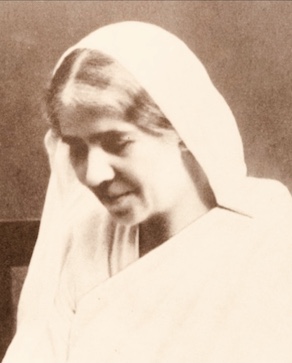
The tom-toms thumped straight on all night, and the darkness shuddered ‘round me like a living, feeling thing. I could not go to sleep, so I lay awake and looked; and I saw, as it seemed, this:
That I stood on a grassy precipice, and at my feet at crevice broke down into infinite space. I looked, but saw no bottom; only cloud shapes, black and furiously coiled, and great shadow-shrouded hollows, and unfathomable depths. Back I drew, dizzy at the depth.
Then I saw forms of people moving in single file along the grass. They were making for the edge. There was a woman with a baby in her arms and another little child holding onto her dress. She was on the very verge. Then I saw that she was blind. She lifted her foot for the next step…it trod air. She was over, and the children over with her. Oh, they cry as they went over! Then I saw more streams of people flowing from all quarters. All were blind, stone blind; and all made straight for the crevice’s edge. They were shrieks as they suddenly knew in themselves that they were falling, and a tossing up of helpless arms, catching, clutching at empty air. But some went over quietly and fell without a sound.
Then I wondered with a wonder that was simple agony, why no one stopped them at the edge. I could not, I was glued to the ground. And I could not call; though I strained and tried, only a whisper would come.
Then I saw that along the edge there were guards set at intervals. But the intervals were too great; there were wide, unguarded gaps between. And over these gaps the people fell in their blindness, quite unwarned; and the green grass seemed blood-red to me, and gulf yawned like the mouth of hell.
Then I saw, like a little picture of peace, a group of people under some trees with their backs turned towards the gulf. They were making daisy chains. Sometimes when a piercing shriek cut the quiet air and reached them, it disturbed them and they thought it a rather vulgar noise. And if one of their number started up and wanted to go and do something to help, then all the others would pull that one down. “Why should you get all excited about it? You must wait for a definite call to go! You haven’t finished your daisy chain yet. It would be really selfish,” they said, “to leave us to finish the work alone.”
There was another group. It was made up of people whose great desire was to get more guards out; but they found that very few wanted to go, and sometimes there were no guards set for miles and miles of the edge.
One girl stood alone in her place, waving the people back; but her mother and other relations called, and reminded her that her furlough was due; she must not break the rules. And being tired and needing a change, she had to go and rest for a while; but no one was sent to guard her gap, and over and over the people fell, like a waterfall of souls.
Once a child caught at a tuft of grass that grew at the very brink of the gulf; it clung convulsively, and it called — but nobody seemed to hear. Then the roots of the grass gave way, and with a cry the child went over, the two little hands still holding right to the torn-off bunch of grass. And the girl who longed to be back in her gap thought she heard the little one cry, and she sprang up and wanted to go; at which they reproved her, reminding her that no one is necessary anywhere; they gap would be well taken care of, they knew. And then they sang a hymn.
Then through the hymn came another sound like the pain of a million broken hearts wrung out in one full drop, one sob. And a horror of great darkness was upon me, for I knew what it was; the cry of the blood.
Then thundered a voice, the voice of the Lord. And he said, “What hast though done? The voice of thy brother’s blood crieth unto Me from the ground.”
The ton-toms still beat heavily, and darkness still shuddered and shivered about me. I heard the yells of the devil-dancers and weird, wild shrieks of the devil-possessed just outside the gate.
What does it matter, after all? It has gone on for years; it will go on for years. Why make such a fuss about it? — God forgive us! God arouse us! Shame us out of our callousness! Shame us out of our sin!
But whoso hath the gospel of Jesus Christ, and seeth the heathen lost and dying in their sin, and shutteth up his bowels of compassion from him, how dwelleth the love of God in him?