
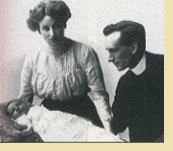
 “It is because it is felt that the author is one to whose teaching men will return, that this book has been prepared, and it is sent out with the prayer that day by day the messages may continue to bring the quickening life and inspiration of the Holy Spirit. —B. C.” - The forward in My Utmost for His Highest
“When I consider how completely and nobly you have foregone all quiet civilised influences that other women have and have been living a literal hand-to-mouth existence all transfigured by your great love for me and Him, I must bow my head in dedication and say God bless thee!” - Oswald Chambers in a note to his wife, 1916 - One year after this note was written, Biddy became a widow.
Oswald Chambers was born in Scotland in 1874 and was educated at London's Royal College of Art and the University of Edinburgh. Although gifted in the arts, he felt at the age of 22, that God was calling him to become a minister. After studying and later teaching in a small theological college in Dunoon, he moved into a preaching ministry that spanned Britain, America and Japan. In 1908, Oswald Chambers boarded a ship bound for America. He had been asked to look out for a young lady, who was also travelling to America in search of work and adventure.
Gertrude Hobbs (later to become Mrs Oswald Chambers) suffered annual bouts of bronchitis as a child. She left school early to help her mother at home, and to allow her older sister and brother to continue their education. She studied Pitman shorthand and by the time she was old enough to work full time, she could take dictation at the phenomenal rate of 250 words per minute - faster than most people talk! Now in 1908, she was on a ship bound for America and she was getting to know a man who intrigued her.
When the voyage ended, they parted company, but began to write to each other. They soon realised that they had deep feelings for each other and eventually they married in 1910.
Bible College
Although they both felt that it was God's will for them to begin a Bible College, initially it seemed that this was not to be. Oswald took many regional classes, and as Biddy (Oswald's pet name for his wife) took shorthand notes of his lectures, they realised that they could at least offer correspondence classes.
However, in early December 1910, a large house became available on Northside, Clapham Common, London. Things moved rapidly and within a very short time, Oswald and Biddy moved in, ready to welcome the first resident students.
Biddy also welcomed many missionaries and visitors to her home, which was always open to those who needed rest and recuperation. She was to continue with this ministry for most of her life.
Egypt
When World War I broke out, Oswald began to feel God was calling him to move on. He wondered how he should serve his country at that time. His prayer was "Lord, I praise You for this place I am in, but the wonder has begun to stir in me - is this Your place for me? Hold me steady doing Your will. It may be only restlessness; if so, calm me to strength that I sin not against You by doubting."
Hearing God's call on the matter, he left London to become Chaplain to the troops in Egypt in October 1915, and Biddy and their 2½ year old daughter, Kathleen, followed in December 1915.
Biddy soon took up her ministry of hospitality and Oswald continued his teaching ministry to the troops. At first sceptical, the soldiers soon began to love and respect the Chambers family.
Oswald died of complications following an operation to remove his appendix in 1917. The telegram which his wife sent home to his family in England simply read: "Oswald, in His presence." 100 men escorted the gun carriage bearing the coffin. Only officers were the bearers. All of them walked the whole funeral route with arms reversed - a special tribute to a well-loved and respected man. Biddy's chosen song at the funeral was "I to the hills will lift mine eyes."

My Utmost
Biddy returned to England with her 4 year old daughter, Kathleen. She finally settled in London and began the painstaking work of transcribing her notes - taken during her husband's lectures throughout their married life. She began to send out the transcriptions to friends and acquaintances - anyone who asked. The pamphlets were combined into book form and eventually Oswald Chambers Publications was born.
"My Utmost for His Highest" was first published in 1927, and has remained continually in print ever since. Thousands of people have been blessed and challenged as they have regularly read this daily devotional.
Biddy died in 1966, knowing that she had fulfilled the ministry which God has entrusted to her. Oswald Chambers Publications Association seeks to continue that ministry.
Searching for Mrs. Oswald Chambers by Martha Christian
Click here to watch a free documentary about Oswald and Biddy Chambers
TYNDALE HOUSE PUBLISHERS, INC.CAROL STREAM, ILLINOIS
Copyright © 2008 by Marsha Drake.
Faith
ZEITOUN, EGYPT1917
[Jesus] said, “This sickness is not unto death, but for the glory of God, that the Son of God might be glorified thereby.” JOHN 11:4, KJVBiddy Chambers brushed a wisp of hair from her forehead and tried to grasp the events leading up to her husband’s death. For a moment she sat alone on a rough wooden bench in the devotional hut in Zeitoun, Egypt. She could still see him speaking. Tired but relying on God’s strength, he offered the light and hope of Jesus Christ night after night to war-weary soldiers who needed comfort during the terrible First World War.
The cross that marked his grave stated simply “Reverend Oswald Chambers, Superintendent, Y.M.C.A., 15TH November 1917, Age 43.”Has it only been a week? Biddy pushed down the tears that threatened. She knew she had to go on. The soldiers, the volunteers, and their faithful friends believed her to be strong. They were used to her steady stride, her infectious laugh, her generosity, and her ability to endure the desert heat. Other than her long, dusty skirts and windblown hair, her tidy appearance was always the current fashion of high-neck collars, and her brown hair was swept up away from her face and piled on top of her head. Even in the driving wind and blowing sand, Biddy Chambers remained an English lady.
Looking around the familiar hut, she could hardly realize Oswald Chambers was gone. When he was alive, she hadn’t noticed the irregular, rough surfaces of the walls. Did the end of his life mean that the work was over? “We need him,” she whispered to the empty room.Biddy remembered how Oswald had always comforted her: “Poverty in brain and body and heart is blessed if it drives us to his fathomless resources.”It was true. But sometimes, through the long hours of work involved in feeding soldiers and caring for their daughter, Kathleen, Mrs. Oswald Chambers felt overwhelmed, even when her husband was beside her.
“Mrs. O. C.?” The voice seemed to come from a long way off.“Yes? Oh, yes, what is it?” Biddy stood and turned to smile at the soldier, whose face wore an expression of deep loss. He held his hat in his hands.“Will you be talking to us tonight, then?” “Oh, yes. Yes, I will.”“Thank you, then.” The war-weary Australian looked much older than his twenty years. Grief does that to people. “I’ll see you then.”“See you then,” Biddy replied. Oswald was in the presence of God. He would want her to continue the work in Egypt. She had to “do the next thing.”
“What were Oswald’s words to me?” She tried to recapture the sound of his voice, but she could not.She did, however, have something he had written to her not long after they arrived in Egypt: “When I consider how completely and nobly you have foregone all quiet civilised influences that other women have and have been living a literal hand-to-mouth existence all transfigured by your great love for me and Him, I must bow my head in dedication and say God bless thee!”
How could she, a young widow thousands of miles away from her home country of England, carry on the work of helping people? What would she say to the assembled soldiers who loved her husband’s message of God’s order in the midst of chaos? “‘God’s order in the haphazard,’” she said aloud. Her head felt heavy, and her shoulders sagged. Her heartbreak seemed too great to endure. As if living a bad dream, she sank down on the wooden bench and pressed her fingers to her forehead. Biddy knew that God’s grace was sufficient. His Word had spoken to her and sustained her through the days of Oswald’s illness. “This sickness is not unto death, but for the glory of God” was the message she felt God was telling her.She could continue because God’s Word said, “As I was with Moses, so I will be with thee. . . . Be strong and of a good courage” (Joshua 1:5-6, KJV). Biddy reached for her ever-present notepad and quickly wrote down that promise.
“Mama?” Little Kathleen was suddenly standing beside her. Her daughter’s faith in God gave her strength and comfort. Kathleen did not question God or his way. She believed Jesus always knew best.Biddy put her arm around her daughter and pulled her close.“Yes?” “What does ‘scallyway’ mean?” Kathleen patted Biddy’s arm. Mrs. Oswald Chambers smiled. “Our Little Flower of God,” she whispered against her four-year-old’s soft hair. Biddy pulled Kathleen onto her lap. “First of all, it is pronounced ‘ska-li-wag.’” She bounced her little one on her knee.“Why did Daddy call me that?”“Because he loved you very much.”“But what does it mean?”“It means it is time to get some supper ready. How many guests do you think we will have tonight?”“Lots. We always do!” Kathleen hopped onto the rough floor.“Well, then, go wash your face and tidy your hair. Your ribbon is all lopsided.” Biddy gave her daughter a gentle push toward the door.Suddenly serious, Kathleen turned questioning eyes toward her mother. “If Daddy is with God, how can he be here, too?”
The question tore through Biddy like a knife. Standing up, she straightened her long skirt and said softly, “We’ll talk about that later, but it is possible.” She smiled. “With God, all things are possible.” Mrs. O. C. was a good mother: strong, kind, and happy. She would not fail her daughter. “I’ll be along in a minute.” Once Kathleen had left the hut, Biddy allowed a few tears to fall and then noticed a fly whisk on the reading table next to her. Was this the one he always carried? She constantly fought with the insect population. The flies were especially annoying. Now Oswald would no longer surprise her by suddenly swatting them. She picked up the whisk and put it in a safe place.Later, with dinner over and “Scallyway” Kathleen put to bed for the night, Biddy returned to the empty devotional hut. She felt restless. She had managed to give a message of hope to the men who longed for home and family and who might die on the battlefield the very next morning. Biddy recalled how she had approached the place where the soldiers sat on wooden benches. She had spoken to them outside in the open air that night because of the desert heat. As she walked over to them, she had prayed quietly for God to be her strength and shield. Then, taking a deep breath, she straightened her skirt, walked briskly to where Oswald would have stood, and looked at her audience. The love of God flowed through her eyes to them, and she spoke from her heart: “When Jesus said to believe in him, it might seem like climbing a high tower where one must hang on or fall. But in reality, to believe in Jesus means we have a place of strength, and joy, and security. Belief in Jesus, not beliefs about Jesus, is what Oswald would have told you if he were here tonight. We have to go forward. As we trust God for each day, he will give us the provision of strength. We can be at peace because the light of Jesus Christ will lead us toward that perfect day when there are no more wars, or rumours of wars, and where the lamb will lie down with the lion.
”There in the hut alone, Biddy recalled the meeting that night and how she had watched their faces at full attention. “It was as if a veil had been drawn aside,” she said softly.The years at Zeitoun, Egypt, where Oswald had offered all he had out of his love for God, would have lasting impact, because God’s Word would endure forever. And Biddy knew without a doubt that Oswald’s solid foundation of teaching faith in God was not wasted when he spoke the words from Philippians 2:17: “If I be offered up on the sacrifice and service of your faith, I joy and rejoice with you all” (KJV). Oswald had not doubted God, his methods, or his way. An eagerness to do God’s will, as God made it clear, would carry those boys through the days in this life. And maybe by tomorrow, she thought, into the next life.Her heart ached not only for her husband but also for the young men, many still in their teen years, who would face the ultimate test on the battlefield—death.Holding the Bible Oswald had loved brought her comfort. Touching the books he read gave her a sense of peace. Finally alone, and away from eyes that tried to search her soul, she gathered her thoughts. She was surrounded by people who counted on her now, as they had counted on Oswald ever since he had arrived in Egypt. Was it three years ago? Biddy tried to keep her mind from wandering.“How can anyone be so alone?” She spoke quietly. One of the things she missed most was sharing the events of the day with her husband. How they had laughed together!
It had seemed to happen suddenly, his sickness, but then, time ran together just now. One day he was fine, walking briskly around the compound. The next, he was not feeling well. Then he had stomach pain. “Probably nothing,” he had assured her. “Just something I ate. Your cooking,” he teased, and he gave her a hug. But when he could barely get out of bed, even stoic Oswald knew something was wrong.“Should you go to hospital?” Biddy tried to keep her tone light and her manner offhand.“The hospital is needed for the wounded,” he replied. “I just need a bit of rest.”
Gizeh Red Cross Hospital was next, however. Biddy had trusted God while the doctors removed her husband’s appendix. Since the men back at the camp in Zeitoun were busy praying for Oswald’s recovery, she had accepted it when the medical team said the surgery was a success.
A noise outside the hut startled her, and in spite of herself, Biddy jumped. Fanning her face, she reasoned, Nothing at all.“Nothing at all” was what she thought would be the outcome of Oswald’s hospital stay. Still, she had stayed with her husband at the hospital and watched over him. And she prayed.Biddy had clung to the words from John 11:4: “This sickness is not unto death, but for the glory of God, that the Son of God might be glorified thereby” (KJV). The familiar verse of Scripture seemed deeply impressed on her soul as she went through the long, weary days of Oswald’s illness.Now, however, sitting alone in the hut, she was uncertain. Oswald was needed, not only by the war-weary soldiers but by others, too. “I need him,” she sighed. This time the tears flowed freely.
How is it, then, she thought, that he died? Biddy knew the medical diagnosis—a blood clot in the lung. Then another blood clot formed, and she watched Oswald fade before her eyes. More prayer. Oswald had miraculously improved, and little Kathleen was allowed to visit him.
Weak as he was, Oswald had opened his eyes and said, “Hello, Scalawag.”“That’s where she heard ‘scallyway.’ Now I remember.” Thinking out loud brought him closer.
He didn’t look like himself because he had lost so much weight, but Kathleen didn’t seem to notice.How could Biddy ever forget the way her husband had tried to smile when Kathleen told him all about her donkey back at the Y.M.C.A. camp at Zeitoun? The visit had ended all too soon.
Biddy knew Oswald was in God’s presence. She realized that God was in control, but now she faced a future of uncertainty as a widow and as a single mother in a time when women were usually protected by their husbands—or left to deteriorate on their own
.Biddy tiptoed to the sleeping quarters to check on her daughter. Kathleen didn’t stir when Biddy fixed her bedcovers and removed her favorite doll from her grasp. Unable to rest, she walked slowly back to the devotional hut. She could feel God’s Spirit there, but she could not breach the barrier between heaven and earth. Picking up Oswald’s Bible again, she sank onto a hard chair. “Now he is gone. I must face it.
”Biddy knew that history would record his passing as November 15, 1917, at the age of forty-three. She did not realize, however, that her own life would have an impact on future generations, even into the twenty-first century and beyond. The grave was temporary. The impact of a life of service to Jesus Christ is eternal.
Oswald had often mentioned that, rightly related to Jesus Christ, one life could be of great service to God. Biddy was unaware that hers would be one of those lives.
She opened the Bible and read, “Bring my soul out of prison, that I may praise thy name: the righteous shall compass me about, for thou shalt deal bountifully with me” (Psalm 142:7, KJV).
The Word spoke. Biddy Chambers listened.
| We all have to learn that surrender is not the surrender of the external life, but the surrender of the will to God. When that is done, all is done. If the rest of the life is not right, the reason is that the will has never really been surrendered. There are very few crises in life. What we are apt to call crises are not crises. The great crisis is where we surrender the will. God never crushes a man’s will into surrender. He never beseeches him. He waits until the man thoroughly yields up his will to Him. "If any man will come after Me, let him deny himself…" (Matthew 16:24). The surrender here is of myself to Jesus. "If you would be My disciples," Jesus is saying in effect here, "then give up your right to yourself to Me." (See Galatians 1:15-16). This is not done by praying or longing. It is done by a sharp battle where the surrender of the will takes place. After you have gone through the full surrender of the will, you will always remember the time. But do you remember how long it took God to get you there? Do you remember how you weighed up all the circumstances, and how you found that your heart or mind or body or sentiments, or other ties and friendships held you down here and there? For a time you seemed to get peace, and you thought it was all done. But the battle came back again and again, because you had not surrendered to Him the central citadel which is your will. The remainder of the life is nothing but the manifestation of that surrender. The battle for the will is the great point where Jesus Christ wins or loses in your life and mine. Once the full surrender of the will has taken place, you need not care what your circumstances are. Once you have got through the crisis of surrendering your will to God, wherever you are placed, on the home or foreign field, the Lord can rely on you, because your surrender has allowed the supernatural work of God to fully identify your life with that of the Lord Jesus Christ. A Gethsemane The surrender of your will to God has always to be made in cold blood. Beware of the surrender you make to God in an ecstasy, for you are apt to take it back. It is not a supernatural vision of God that does it. It is not being taken up on a mount of transfiguration. It is a quiet, commonplace moment when God puts the thing to you so clearly that there is no misunderstanding that He is asking of you the full surrender of your will. Some have gone through with this surrender of the will, and no matter where God places them there is no fear that they will turn back, because the central citadel of their will is possessed by God. Unless the central citadel of your will is held by the Lord, you may go down at any second, anywhere, no matter what the devotion of your heart may be. After surrender, what? The whole of the life is an aspiration – the aspiration of an unbroken life of communion with God, and it does not matter if the life is dark or bright. |