
(Translated from German)
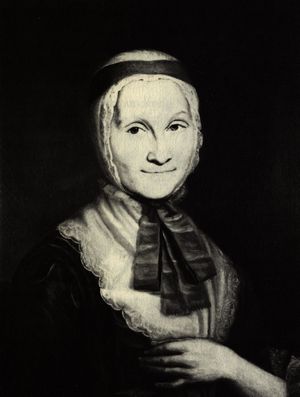
Good daughter, wife-suffering, faith strong poet, at times single, large Mother, financial manager, Mission travelers, chaplain - all that one can say of Erdmuthe Dorothea von Zinzendorf, the first Gutsverwalterin and house mother in Herrnhut.
After initially cool reserve is Komtess Erdmuthe of Reuss, the fifth child of Count Henry of Reuss and his wife Erdmuthe Benigna, 7 September 1722 Count Nicholas Ludwig von Zinzendorf in his parents' castle chapel Ebersdorf said yes. The count, 21 years as herself, is a man with perfect manners, inspiring, spirited - and pious.She has no idea on what adventure she enters into marriage with the uncomfortable, ingenious and sometimes bizarre Nikolaus Ludwig von Zinzendorf.
He had actually stopped for a fix out to Erdmuthe hand. For the woman of his dreams to him his best friend, Heinrich von Reuss had Erdmuthe brother preferred.With the deeply devout will Erdmuthe young man a "fighter lead-marriage" in which it should not be about personal happiness, but to work together for the cause of God.
The loose and immoral life of the court at the Dresden court of Augustus the Strong, the well-bred daughter of the house of Reuss for religious reasons is just as averse as the Count, who has reluctantly accepted an unpaid position as a counselor with the state government.Zinzendorf Originally from the high nobility, but by no means rich.
Three months after the wedding the couple on their way to Zinzendorf's just good Berthelsdorf acquired a fateful encounter: are there with permission from the fact established Moravian exiles. The refugees belong to the ancient Church of the Brethren in the tradition of Jan Hus and, through the Counter-Reformation became homeless.The Count pair allowed to remain Protestant religious refugees. "Herrnhut": Under the care of the Lord, they shall give their fast-growing settlement. In overcoming all state and denominational boundaries Nikolaus von Zinzendorf founded the "Brethren," a "Republic of God" to Herrnhut. What this means for the count, to be a brother among brothers - an idea for him to explain his peers to be mad. And with the "Erdmuth," as it is called in the family, find it much more difficult than it at first.
Following the example of Christian community you live together in Herrnhut. There are houses for families and shared in each case for unmarried men and women.Erdmuthe head is in the house of women. Your management task that has already worked towards equality for women, revolutionary at the time.
The establishment and continuation of the now highly controversial community has to live able and wise Countess decisive role. From the meager income from property they must Berthelsdorf an orphanage along with more new guests and housemates entertained. Because the count has no relationship to the money, leaving her the complicated economic and financial management of property and community.
Soon there are also political problems: When the Habsburg government in August the strong against the years of clandestine migration of religious refugees action lodges, as the Elector Count of the country in 1732 and ordered him to sell his goods. Zinzendorf sold to Erdmuth, but may return late 1733rd Three years later he was banned again but because of his activities from Saxony. He travels through Europe as a preacher and even - in the course of the missionary movement initiated by him - to America.
After a long separation, living apart
Many new bases of the Brethren arise during his eleven-year exile in England, where he spent nearly five years.Erdmuthe oscillates between Herrnhut and changing residences outside national borders. Added arduous journeys come to Denmark in terms of Brethren, Livonia, and Russia. From Herrnhut makes them still a thriving, beautiful artisan village. As chaplain, it is a sought-after listener and counselor.
Twelve children they bring into the world, not eight of whom survived early childhood. Their suffering and yet unshakable confidence attitude reflected in the texts of numerous songs, some of which are sung to this day.
After the death of her only surviving son Renatus 1752 in England and one caused by Count von Zinzendorf Erdmuthe financial crisis is sick and increasingly weak. The long separation of the spouses has left its mark: When the count in 1755 and returning from London, have both lived so apart that Zinzendorf moved with his followers from London to the castle after Berthelsdorf. Erdmuthe remains in Herrnhut.
On 19 June 1756 she died. For her grave stone designs her husband, who feels that he is its still a lot of guilty, later the inscription: "... a princess of God among us and" infant-nurse of Brethren Church.
Karin Vorländer
Poems/Spiritual Songs by Countess Zinzindorf (This website is in German, some browsers will translate for you.)Zinzendorf & The Moravians: Prayer Makes History by David Smithers
Count Zinzendorf Throughout the history of the Church, it has always been the most ardent lovers of Jesus who have felt the greatest need for more of His presence. Surely it is with this class of saints that Count Zinzendorf belongs. For Zinzendorf, loving fellowship with Christ was the essential manifestation of the Christian life. Throughout the Count’s life, “His blessed presence” was his all consuming theme. He had chosen from an early age as his life-motto the now famous confession; “I have one passion; it is Jesus, Jesus only.”
A Man of Prayer Flowing out of Zinzendorf’s passionate love for Christ came a life disciplined in prayer. “Count Zinzendorf had early learned the secret of prevailing prayer. So active had he been in establishing circles for prayer that on leaving the college at Halle, at 16 years of age , he handed the famous professor Franke a list of seven praying societies.” Also preceding the great Moravian revival of 1727, it was Count Zinzendorf who was used to encourage prayer for a fresh outpouring of the Holy Spirit. John Greenfield describes for us the constant prayer that followed the revival of 1727. “Was there ever in the whole of church history such an astonishing prayer meeting as that which beginning in 1727, it went on one hundred years? It was known as the ‘Hourly Intercession.’ And it meant that by relays of brothers and sisters, prayer without ceasing was made to God for all the work and wants of His church. The best antidote for a powerless Church is the influence of a praying man. The influence of Count Zinzendorf’s prayer-life did not stop with one small community. It ultimately went on to influence the whole world.
Souls For the Lamb As Zinzendorf’s passion for Jesus grew, so did his passion for the lost. He became determined to evangelize the world with a handful of saints, equipped only with a burning love for Jesus and the power of prayer. The Moravian Brotherhood readily received and perpetuated the passion of their leader. A seal was designed to express their new found missionary zeal. The seal was composed of a lamb on a crimson ground, with the cross of resurrection and a banner of triumph with the motto; “Our Lamb has conquered, let us follow Him.” The Moravians recognized themselves in debt to the world as the trustees of the gospel. They were taught to embrace a lifestyle of self-denial, sacrifice and prompt obedience. They followed the call of the Lamb to go anywhere and with an emphasis upon the worst and hardest places as having the first claim. No soldiers of the cross have ever been bolder as pioneers, more patient or persistent in difficulties, more heroic in suffering, or more entirely devoted to Christ and the souls of men than the Moravian Brotherhood.
The Moravians beautifully explain their motivation for missions in the following 1791 evangelical report. “The simple motive of the brethren for sending missionaries to distant nations was and is an ardent desire to promote the salvation of their fellow men, by making known to them the gospel of our Savior Jesus Christ. It grieved them to hear of so many thousands and millions of the human race sitting in darkness and groaning beneath the yoke of sin and the tyranny of Satan; and remembering the glorious promises given in the Word of God, that the heathen also should be the reward of the sufferings and death of Jesus; and considering His commandment to His followers, to go into all the world and preach the gospel to every creature, they were filled with confident hopes that if they went forth in obedience unto, and believing in His word, their labor would not be in vain in the Lord. They were not dismayed in reflecting on the smallness of their means and abilities, and that they hardly knew their way to the heathen whose salvation they so ardently longed for, nor by the prospect of enduring hardships of every kind and even perhaps the loss of their lives in the attempt. Yet their love to their Savior and their fellow sinners for whom He shed His blood, far outweighed all these considerations. They went forth in the strength of their God and He has wrought wonders in their behalf.”
The Moravians had learned that the secret of loving the souls of men was found in loving the Savior of men. On October 8,1732, a Dutch ship left the Copenhagen harbor bound for the Danish West Indies. On board were the two first Moravian missionaries; John Leonard Dober, a potter, and David Nitschman, a carpenter. Both were skilled speakers and ready to sell themselves into slavery to reach the slaves of the West Indies. As the ship slipped away, they lifted up a cry that would one day become the rallying call for all Moravian missionaries, “May the Lamb that was slain receive the reward of His suffering.” The Moravian’s passion for souls was surpassed only by their passion for the Lamb of God, Jesus Christ.
They Had All Things In Common Another vision of Count Zinzendorf’s was that of the restoration of Apostolic community. He labored to establish a community of saints that loved and supported one another through prayer, encouragement and accountability. To a great extent Zinzendorf’s vision became a reality in the small village of Herenhut. A deep sense of community was maintained through small groups based on common needs and interests, original and unifying hymns and continual prayer meetings. In 1738 John Wesley visited “this happy place” and was so impressed that he commented in his journal. “I would gladly have spent my life here . . . Oh, when shall this Christianity cover the earth as water covers the sea?”
He Had No Other Happiness But To Be Near Him By no means was Count Zinzendorf’s life flawless, but one cannot help but be moved by his consuming passion and pre-occupation with the person of Jesus Christ. A glimpse of his burning love for Jesus can be caught in the following letter. “Our method of proclaiming salvation is this: to point out to every heart the loving Lamb, who died for us, and although He was the Son of God, offered Himself for our sins… by the preaching of His blood, and of His love unto death, even the death of the cross, never, either in discourse or in argument, to digress even for a quarter of an hour from the loving Lamb: to name no virtue except in Him, and from Him and on His account; to preach no commandment except faith in Him, no other justification but that He atoned for us, no other sanctification but the privilege to sin no more, no other happiness but to be near Him, to think of Him and do His pleasure; no other self denial but to be deprived of Him and His blessings; no other calamity but to displease Him; no other life but in Him.”
The source of Count Zinzendorf’s success was bound up in his total allegiance and love for JESUS CHRIST! Likewise the source of the modern Church’s failure lies in her half-hearted devotion and open disregard for the Lover of their souls. As the Bride of Christ, we are in need of some old-fashioned, gut wrenching, REAL repentance. Today, Jesus, the heartbroken Bridegroom, still cries out to us, “Nevertheless I have this against you, that you have left your first love. Remember therefore from where you have fallen; repent and do the first works…” (Revelation 2:4-5).
(From the book Behold the Lamb: The Story of the Moravian Church by Peter Hoover)
For days the Neissers and young Michael Jäschke followed Christian David through the wilderness. Danger still surrounded them. Silesia, through which they had to pass, was also Roman Catholic. But weary, faint, and excited, they eventually arrived on the young landowner’s estate at Berthelsdorf in Germany.
-
The sight that met their eyes left them speechless. The young landowner, Ludwig von Zinzendorf, was not home. The man who came to show them where to settle took them to a low-lying wilderness behind the village. Parts of the land stood in water. Dense brush and brambles covered the rest.
-
Martha Neisser sat down. “Where in this wilderness shall we find bread?” was all she could think to ask.
-
But even before she asked, the Lord had prepared bread for them—and more.
-
The landowner’s grandmother, the baroness Henriette Katherina von Gersdorf, sent them a cow. With great vigour, Christian David and the brothers from Moravia set to work felling trees, building shelters, and clearing land so the women could plant grain and vegetables.
-
Then Ludwig came.
-
Just turned twenty-two, Nicholas Ludwig, the young count of Zinzendorf and Pottendorf could not have grown up in a setting more unlike that of the Moravian settlers on his land. Used to nothing but fine food and clothes, he lived in the manor house with his grandmother until she sent him to a “Pietist” boarding school in the German city of Halle.
-
As long as he could remember, Ludwig had known serious-minded Pietist brothers. At his grandmother’s invitation (his father had died and his mother married a Prussian general when he was four) they had conducted prayer meetings in her manor house at Grosz Hennersdorf (not far from Berthelsdorf). From them he first heard Johann Arndt’s simple lessons in godliness. He learned to sing with them the great Lutheran hymns, and above all he learned to pray.
-
As a very young child, Ludwig prayed earnestly to Christ. He wrote “letters to Jesus” and tossed them out the window of his upper storey room. During the Swedish invasion of 1706 when plundering soldiers burst into the manor house they stopped and turned back at the sight of Ludwig, a six-year-old, on his knees in prayer.
-
From his Pietist teachers, Ludwig learned to view contemporary Protestantism—to which he, as a German Lutheran, belonged—with deep mistrust. But he also learned not to go the way of the “sectarians.” The Pietists held the concept of ecclesiolae in ecclesia (little churches within the Church) as their ideal. They believed that through personal conversions, prayer meetings, and Bible study, they could build the “real church,” the mystical, spiritual body of Christ, far above the realm of institutional religion.
-
All this had appealed to Ludwig, and he “thought like a Pietist” until the school at Halle left him deeply disillusioned. Its teachers, fanatical in their zeal for holiness, harassed the students to no end—while the students, all pious prayers and songs notwithstanding, were a mob of fiends. That is, most of them. A few, like Georg Wilhelm von Söhlenthal, Anton Heinrich Walbaum, Johannes von Jony, and a Swiss boy, Friedrich von Watteville met with Ludwig to read the Bible and pray. They formed a society, the “Order of a Grain of Mustard Seed,” and pledged themselves to serve Christ all their lives together.
-
In spite of his disappointment with the school, Ludwig learned well. By the time he turned sixteen he spoke Latin freely. Then his family transferred him to the University of Wittenberg, and his days under Pietist influence came to an end.
-
At first Ludwig felt strange in the “worldly” atmosphere of the university—deep in the study of law, with lessons in fencing, riding horses, and dancing. But as time passed, he began to view his strict Pietist childhood more critically. He began to wonder who was the holiest—the “regular” Lutherans at Wittenberg who trusted entirely in grace to save them, or the works-conscious Pietists at Halle, forever at odds one with another on how to be a little more sanctified.
-
Determined to find the truth of the matter, Ludwig spent an hour every morning and another one, every evening, in prayer. He studied the Bible carefully, from cover to cover, in Latin and now also in Greek. Then the time came for him to finish his studies abroad.
-
In France, Ludwig witnessed the work of Catholic religious orders among the poor. The thought of remaining celibate to serve Christ appealed to him. But when he met a godly and gracious young woman, Theodore von Castell, in southern Germany, and she returned his attention, he proposed marriage. Everyone, on both sides, gave their consent. Ludwig was happy. But shortly before the wedding, he made a discovery. On his way to see Theodore, his carriage broke down near the estate of one of his best friends, Heinrich von Reuss. Stopping to make the necessary repairs, Ludwig learned that Heinrich had been interested in Theodore, but had given her up for his sake.
-
Ludwig felt terrible. “I will not take her away from you!” he declared. “Let us go and ask which one of us she prefers.”
-
It did not take long for Heinrich to get ready—nor for Ludwig to discern the truth. When he saw Theodore and Heinrich truly in love, he freely released her from the engagement. And even though it cost him an inner struggle, he served as best man and composed a song for the wedding.
-
This experience, and a visit to an art museum in the city of Düsseldorf on the Rhine, permanently changed Ludwig’s life. Even though he had “believed in Christ” for years, things did not fall into place for him until he stood before a painting showing Christ flogged, mocked, wearing a crown of thorns, and set by Pilate before the people. When Ludwig read the words underneath the picture, “I have done this for you. What have you done for me?” his heart broke. Overwhelmed before the Saviour of the world, he repented of all things human and surrendered his life to him. Far beyond self-righteous Pietism, far beyond Lutheran presumptions of free (or cheap) grace, far beyond anything he had known or felt before, Ludwig felt his soul transported into the presence of Christ. And even though he did not know it yet, out of this experience, his life’s vocation was born.
-
For the time being, it resulted in a German poem:
- Bridegroom of the soul, Lamb of God! Prove my motives and discover where they begin. Is my will sincere? Oh so let it be! Let me be crucified to self and sanctified to you. Purify my inner ways. If I go astray on dark paths, shine on me and guide me back! If the cross and sorrow trouble me, give me patience. Set my sights upon the goal. After war, victory and peace will come. The world holds little joy. Its pasture is dry. Only in Zion shall we drink undiluted wine!
- Jesus walk before me, on the way of life. I will hurry after you. Take me by the hand, to our Fatherland. Order my steps, Beloved One, as long as I live. If you lead me on rough trails, watch out for me. At the end of the way, open the door into what is yet to come!1
-
On September 7, 1722, Ludwig married Heinrich von Reuss’s sister Erdmuth Dorothea. Three months later, on the way to Berthelsdorf to see a new house being built for them on the family estate, he noticed a strange settlement beside the road. “Who lives here?” he asked.
-
“The Moravian refugees you gave permission to settle on your land!”
-
Before his surprised companions knew what was happening, Ludwig halted the carriage, found his way down the muddy trail and entered the first of the low shelters where women in simple peasant dress hastily picked up their babies and men came running to greet him.
-
Within minutes, all were kneeling on the floor to thank Christ for bringing them together.