
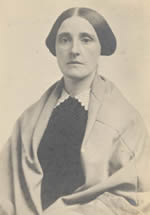
(1832-1911), Quaker Holiness author
Hanna was raised in a strict Quaker home and was given to morbid introspection that found little relief until her marriage to Robert Piersall Smith in 1851. They were both converted under Plymouth Brethren influence in 1858 and in 1867 had a new experience of faith that propelled them on a speaking tour of the United States and Europe. Their "Higher Christian Life" meetings in England were exceedingly popular, partly because of D. L. Moody's success there.They remained in England due to Robert’s declining health and observed the founding of the Keswick Convention in 1874, an outgrowth of their conferences. Trouble followed, however. Robert began to entertain notions of spiritual wifery, was criticized, and eventually claimed to be a Buddhist.
Hannah was the author of the spiritual classic, The Christian’s Secret of a Happy Life (1875) and later developed ideas on the final restitution of all things, diverted herself into social causes and writing. She produced The Unselfishness of God and How I Discovered It in 1903. A year later she was stricken with arthritis. Although confined to a wheelchair and in much pain, she maintained an optimistic spiritual outlook until her death.
She had seven children in all, but only three—Mary, Alys Pearsall, and Logan Pearsall—survived to adulthood.
Books by Hannah Whitall Smith
The Unselfishness of God and How I Discovered It; a spiritual autobiograpy (1903)
The Christian’s Secret of a Happy Life(1916)
The God of All Comfort and the Secret of His Comforting (1906)
Everyday Religion Or The Common Sense Teaching of the Bible
John M. Whitall, the story of his life (1879)
Difficulties
I had always thought of Him as loving, but now I found out that He was far more than loving: He was love, love embodied and ingrained. I saw that He was, as it were, made out of love, so that in the very nature of things He could not do anything contrary to love. Not that He would not do it, but actually could not, because love was the very essence of His being. I saw that the law of love, like he law of gravitation, is inevitable in its working, and that God is, if I may say so, under this law, and cannot help obeying it. I saw that, because He is love, He simply, in the very nature of things, must be loving. It is not a matter of choice with Him, but a matter of necessity. And I saw that, once this fact was known, to trust in this God of love would be as natural as to breathe. Every doubting question was answered, and I was filled with an illimitable delight in the thought of having been created by such an unselfish God. I saw that as a matter of course the fact of His being our creator was an absolute guarantee that He would care for us, and would make all things work together for our good. The duties of ownership blazed with tremendous illumination. Not its rights, of which I had hitherto chiefly thought, but its duties, the things ownership necessarily demands of its owner. I saw that just as in a civilized community people are compelled by public opinion, or if necessary by the law, to take proper care of things that belong to them, so our Creator, by the laws of common morality, is compelled to take proper care of the creatures He has created, and must be held responsible for their well being.
It was all so glorious that it often seemed too good to be true, that we actually did belong to such an unselfish God; that many a time, when a fresh insight into His goodness would come over me, I would be obliged to get my Bible and open it at the texts that declared we really were His property, and put my fingers on them, and read them aloud, just to reassure myself that they did actually say, without any limitations, that He was my owner.
The expression “Remember thy Creator” assumed a totally different aspect to me. I had always thought of it as a kind of threat held over us into good behaviour; but now it seemed full of the most delightful warrant and assurance that all was well for the creatures this unselfish Creator had created. I saw that God was good, not religiously good only, but really and actually good in the truest sense of the word, and that a good Creator was of course bound to make every thing go right with the creatures He had created. And the fact that nothing was hid from His eyes, which had once been so alarming, now began to seem the most delightful fact in the whole universe, because it made it certain that He knew all about us, and would therefore be able to do His best for us.
My own feelings as a mother, which had heretofore seemed to war with what I had believed of God, now came into perfect harmony.
My children have been the joy of my life. I cannot imagine more exquisite bliss than comes to one sometimes in the possession and companionship of a child. To me there have been moments, when my arms have been around my children, that have seemed more like what the bliss of Heaven must be than any other thing I can conceive of; and I think this feeling has taught me more of what are God’s feelings towards His children than anything else in the universe. If I, a human being with limited capacity, can find such joy in my children, what must God, with His infinite heart of love, feel towards His; In fact most of my ideas of the love and goodness of God have come from my own experience as a mother, because I could not conceive that God would create me with a greater capacity for unselfishness and self-sacrifice than He possessed Himself; and since this discovery of the mother heart of God I have always been able to answer every doubt that may have arisen in my mind, as to the extent and quality of the love of God, by simply looking at my own feelings as a mother. I cannot understand the possibility of any selfishness on the mother’s part coming into her relation to her children. It seems to me a mother, who can be selfish and think of her own comfort and her own welfare before that of her children, is an abnormal mother, who fails in the very highest duty of motherhood.
If one looks at what we call the lower creation, one will see that every animal teaches us this supreme duty of self-sacrifice on the part of the mother.
The tiger mother will suffer herself to be killed rather than that that harm should come to her offspring. She will starve that they may have food. Could our God do less? I speak of self-sacrifice, but I cannot truthfully call it sacrifice. Any true mother, who knows the reality of motherhood, would scorn the idea that the care of her children involved a sacrifice, in the ordinary sense of sacrifice, on her part. It may involve trouble or weariness but not what I could call sacrifice. The sacrifice would be if she were not allowed to care for them, not if she were. I know no more fallacious line of argument than that which is founded upon the idea that children ought to be grateful for the self-sacrifice on the mother’s part. Her claim to love and consideration on the part of her children depends altogether to my mind upon how true a mother she has been in the sense I describe; and I believe that thousands of disappointed mothers, who have not received the gratitude and consideration they would like, have only themselves to thank, because they have demanded it, instead of having won it. All this has taught me to understand God’s feelings towards us that what we call self-sacrifice on the part of Christ was simply the absolutely necessary expression of His love for us; and that the amazing thing would have been, not that He did it, but if He had not done it.
Since I had this insight of the mother-heart of God, I have never been able to feel the slightest anxiety for any of His children; and by His children I do not mean only the good ones, but I mean the bad ones just as much. Are we not, distinctly told that the Good Shepherd leaves the ninety and nine good sheep in order to find the one naughty sheep that is lost, and that He looks for it until He finds it? And, viewed in the light of motherhood, has not that word “lost” a most comforting meaning, since nothing can be a lost thing that is not owned by somebody, and to be lost means only, not yet found. The lost gold piece is still gold, with the image of the King upon it; the lost sheep is a sheep still, not a wolf; the lost son has still the blood of his father in his veins. And if a person is a lost sinner, it only means that he is owned by the Good Shepherd, and that the Good Shepherd is bound, by the very duties of His ownership, to go after that which is lost, and to go until He finds it. The word “lost” therefore, to my mind, contains in itself the strongest proof of ownership that one could desire. Who can imagine a mother with a lost child ever having a ray of comfort until the child is found, and who can imagine a God being more indifferent than a mother? In fact I believe that all the problems of the spiritual life, which are often so distressing to conscientious souls, would vanish like mist before the rising sun, if the full blaze of the mother-heart of God should be turned upon them.
Moreover I saw that, since it was declared we were created in the image of God, we were bound to believe that the best in us, and not the worst was the reflection of that image, and .that therefore things which to us in our best moments looked selfish, or unkind, or unjust, or self-seeking, must never, no matter what the “seeming”, be attributed to God. If He is unselfish, He must be at least as unselfish as the highest human ideal; and of course we know He must be infinitely more.
All the texts in the Bible revealing God’s goodness shone with a new meaning, and I saw that His goodness was not merely a patronizing benevolence, but was a genuinebona fide goodness that included unselfishness and consideration, and above all justice, which last has always seemed to me one of the very first elements of goodness. No unjust person could ever, in my opinion, lay the slightest claim to being good, let their outward seemings of goodness be as deceiving as they may. I had in short such an overwhelming revelation of the intrinsic and inherent goodness and unselfishness of God that nothing since has been able to shake it. A great many things in His dealings have been and still are mysteries to me; but I am sure they could all be explained on the basis of love and justice, if only I could look deep enough; and that some day I shall see, what now I firmly believe, that His loving kindness is really and truly over all His works.
I do not mean to say that all this acquaintance with God came to me at once; but I do mean to say that when I had that revelation on the tram-car in Philadelphia that day, a light on the character of God began to shine, that has never since waned in the slightest, and has only grown brighter and brighter with every year of my life. It is enough for me to say “God is” and I have the answer to every possible difficulty.
The amazing thing is that I, in company with so many other Christians, had failed, with the open Bible before me, to see this; and that all sorts of travesties on the character of God, and of libels upon His goodness, can find apparently a welcome entrance into Christian hearts. To me such things became at this time well-nigh intolerable. I could listen patiently, and even with interest, to any sort of strange or heretical ideas that did not touch the character of God, but the one thing I could not endure, and could not sit still to listen to, was anything that contained, even under a show of great piety, the least hint of a libel on His love or His selfishness.
I shall never forget a memorable occasion in our own house, when a celebrated Preacher from Boston , was visiting us. The conversation at the breakfast table turned on the subject of God’s love, and this Preacher declared that you must not count on it too much, as there were limits as to what His love could endure, just as there were limits to a mother’s love; and he went on to declare that there were certain sins a daughter could commit which the mother never could forgive, and which would forever close her heart and her home against her child, and he asserted that it was just so with God, and that he considered it was a grandmotherly religion that taught anything different.
I have no doubt his object was to combat my views on Restitution, although we were not talking on that subject; but he evidently wanted to convince me that God was not quite so foolishly loving as I thought. It was more than I could endure to hear both mothers, and the God who made mothers so maligned, and although the speaker was my guest, I broke forth into a perfect passion of indignation, and declaring that I would not sit at the table with any one who held such libelous ideas of God, I burst into tears and left the room, and entirely declined to see my guest again. I do not say this was right or courteous, or at all Christlike, but it only illustrates how overwhelmingly I felt on the subject. The honor of God seemed to me of more importance than any ordinary rules of politeness. But I see now that I might have vindicated that honor in an equally effectual but more Christlike way.
Still to this day, the one thing which I find it very hard to tolerate, is any thing which libels the character of God. Nothing else matters like this, for all our salvation depends wholly and entirely upon what God is; and unless He can be proved to be absolutely good, and absolutely unselfish, and absolutely just, our case is absolutely hopeless. God is our salvation, and, if He fails us, in even the slightest degree, we have nowhere else to turn.
From her autobiography The Unselfishness of God and How I Discovered It
Chapter 6
(From 'The Christian's Secret of A Happy Life')
The next step after consecration, in the soul’s progress out of the wilderness of Christian experience, into the land that floweth with milk and honey, is that of faith. And here, as in the first step, the enemy is very skilful in making difficulties and interposing obstacles.
The child of God, having had his eyes opened to see the fulness there is in Jesus for him, and having been made to long to appropriate that fulness to himself, is met with the assertion on the part of every teacher to whom he applies, that this fulness is only to be received by faith. But the subject of faith is involved in such a hopeless mystery in his mind, that this assertion, instead of throwing light upon the way of entrance, only seems to make it more difficult and involved than ever.
“Of course it is to be by faith,” he says, “for I know that everything in the Christian life is by faith. But then, that is just what makes it so hard, for I have no faith, and I do not even know what it is, nor how to get it.” And, baffled at the very outset by this insuperable difficulty, he is plunged into darkness, and almost despair.
This trouble all arises from the fact that the subject of faith is very generally misunderstood; for in reality faith is the plainest and most simple thing in the world, and the most easy of attainment.
Your idea of faith, I suppose, has been something like this. You have looked upon it as in some way a sort of thing, either a religious exercise of soul, or an inward gracious disposition of heart; something tangible, in fact, which, when you have got, you can look at and rejoice over, and use as a passport to God’s favor, or a coin with which to purchase His gifts. And you have been praying for faith, expecting all the while to get something like this, and never having received any such thing, you are insisting upon it that you have no faith. Now faith, in fact, is not in the least this sort of thing. It is nothing at all tangible. It is simply believing God, and, like sight, it is nothing apart from its object. You might as well shut your eyes and look inside to see whether you have sight, as to look inside to discover whether you have faith. You see something, and thus know that you have sight; you believe something, and thus know that you have faith. For, as sight is only seeing, so faith is only believing. And as the only necessary thing about seeing is, that you see the thing as it is, so the only necessary thing about believing is, that you believe the thing as it is. The virtue does not lie in your believing, but in the thing you believe. If you believe the truth you are saved; if you believe a lie you are lost. The believing in both cases is the same; the things believed in are exactly opposite, and it is this which makes the mighty difference. Your salvation comes, not because your faith saves you, but because it links you on to the Saviour who saves; and your believing is really nothing but the link.
I do beg of you to recognize, then, the extreme simplicity of faith; that it is nothing more nor less than just believing God when He says He either has done something for us, or will do it; and then trusting Him to do it. It is so simple that it is hard to explain. If any one asks me what it means to trust another to do a piece of work for me, I can only answer that it means letting that other one do it, and feeling it perfectly unnecessary for me to do it myself. Every one of us has trusted very important pieces of work to others in this way, and has felt perfect rest in thus trusting, because of the confidence we have had in those who have undertaken to do it. How constantly do mothers trust their most precious infants to the care of nurses, and feel no shadow of anxiety? How continually we are all of us trusting our health and our lives, without a thought of fear, to cooks and coachmen, engine drivers, railway conductors, and all sorts of paid servants, who have us completely at their mercy, and could plunge us into misery or death in a moment, if they chose to do so, or even if they failed in the necessary carefulness? All this we do, and make no fuss about it. Upon the slightest acquaintance, often, we thus put our trust in people, requiring only the general knowledge of human nature, and the common rules of human intercourse; and we never feel as if we were doing anything in the least remarkable.
You have done all this yourself, dear reader, and are doing it continually. You would not be able to live in this world and go through the customary routine of life a single day, if you could not trust your fellow-men. And it never enters into your head to say you cannot.
But yet you do not hesitate to say, continually, that you cannot trust your God!
I wish you would just now try to imagine yourself acting in your human relations as you do in your spiritual relations. Suppose you should begin tomorrow with the notion in your head that you could not trust anybody, because you had no faith. When you sat down to breakfast you would say, “I cannot eat anything on this table, for I have no faith, and I cannot believe the cook has not put poison in the coffee, or that the butcher has not sent home diseased meat.” So you would go starving away. Then when you went out to your daily avocations, you would say, “I cannot ride in the railway train, for I have no faith, and therefore I cannot trust the engineer, nor the conductor, nor the builders of the carriages, nor the managers of the road.” So you would be compelled to walk everywhere, and grow unutterably weary in the effort, besides being actually unable to reach many of the places you could have reached in the train. Then, when your friends met you with any statements, or your business agent with any accounts, you would say, “I am very sorry that I cannot believe you, but I have no faith, and never can believe anybody.” If you opened a newspaper you would be forced to lay it down again, saying, “I really cannot believe a word this paper says, for I have no faith; I do not believe there is any such person as the queen, for I never saw her; nor any such country as Ireland, for I was never there. And I have no faith, so of course I cannot believe anything that I have not actually felt and touched myself. It is a great trial, but I cannot help it, for I have no faith.”
Just picture such a day as this, and see how disastrous it would be to yourself, and what utter folly it would appear to any one who should watch you through the whole of it. Realize how your friends would feel insulted, and how your servants would refuse to serve you another day. And then ask yourself the question, if this want of faith in your fellow-men would be so dreadful, and such utter folly, what must it be when you tell God that you have no power to trust Him nor to believe His word; that “it is a great trial, but you cannot help it, for you have no faith”?
Is it possible that you can trust your fellow-men and cannot trust your God? That you can receive the “witness of men,” and cannot receive the “witness of God”? That you can believe man’s records, and cannot believe God’s record? That you can commit your dearest earthly interests to your weak, failing fellow-creatures without a fear, and are afraid to commit your spiritual interests to the blessed Saviour who shed His blood for the very purpose of saving you, and who is declared to be “able to save you to the uttermost”?
Surely, surely, dear believer, you, whose very name of believer implies that you can believe, will never again dare to excuse yourself on the plea of having no faith. For when you say this, you mean of course that you have no faith in God, since you are not asked to have faith in yourself, and you would be in a very wrong condition of soul if you had. Let me beg of you then, when you think or say these things, always to complete the sentence and say, “I have no faith in God, I cannot believe God”; and this I am sure will soon become so dreadful to you, that you will not dare to continue it.
But you say, I cannot believe without the Holy Spirit. Very well; will you conclude that your want of faith is because of the failure of the blessed Spirit to do His work? For if it is, then surely you are not to blame, and need feel no condemnation; and all exhortations to you to believe are useless.
But, no! Do you not see that, in taking up this position, that you have no faith and cannot believe, you are not only “making God a liar,” but you are also manifesting an utter want of confidence in the Holy Spirit? For He is always ready to help our infirmities. We never have to wait for Him, He is always waiting for us. And I for my part have such absolute confidence in the blessed Holy Ghost, and in His being always ready to do his work, that I dare to say to every one of you, that you can believe now, at this very moment, and that if you do not, it is not the Spirit’s fault, but your own.
Put your will then over on to the believing side. Say, “Lord I will believe, I do believe,” and continue to say it. Insist upon believing, in the face of every suggestion of doubt with which you may be tempted. Out of your very unbelief, throw yourself headlong on to the word and promises of God, and dare to abandon yourself to the keeping and saving power of the Lord Jesus. If you have ever trusted a precious interest in the hands of any earthly friend, I conjure you, trust yourself now and all your spiritual interests in the hands of your Heavenly Friend, and never, never, NEVER allow yourself to doubt again.
And remember, there are two things which are more utterly incompatible than even oil and water, and these two are trust and worry. Would you call it trust, if you should give something into the hands of a friend to attend to for you, and then should spend your nights and days in anxious thought and worry as to whether it would be rightly and successfully done? And can you call it trust, when you have given the saving and keeping of your soul into the hands of the Lord, if day after day and night after night you are spending hours of anxious thought and questionings about the matter? When a believer really trusts anything, he ceases to worry about that thing which he has trusted. And when he worries, it is a plain proof that he does not trust. Tested by this rule how little real trust there is in the Church of Christ! No wonder our Lord asked the pathetic question, “When the Son of Man cometh shall he find faith on the earth?” He will find plenty of activity, a great deal of earnestness, and doubtless many consecrated hearts; but shall he find faith, the one thing He values more than all the rest? It is a solemn question, and I would that every Christian heart would ponder it well. But may the time past of our lives suffice us to have shared in the unbelief of the world; and let us every one, who know our blessed Lord and His unspeakable trustworthiness, set to our seal that He is true, by our generous abandonment of trust in Him.
I remember, very early in my Christian life, having every tender and loyal impulse within me stirred to its depths by an appeal I met with in a volume of old sermons to all who loved the Lord Jesus, that they should show to others how worthy He was of being trusted, by the steadfastness of their own faith in Him. And I remember my soul cried out with an eager longing that I might be called to walk in paths so dark, that an utter abandonment of trust might be my blessed and glorious privilege.
“Ye have not passed this way heretofore,” it may be; but today it is your happy privilege to prove, as never before, your loyal confidence in the Lord by starting out with Him on a life and walk of faith, lived moment by moment in absolute and childlike trust in Him.
You have trusted Him in a few things, and He has not failed you. Trust Him now for everything, and see if He does not do for you exceeding abundantly above all that you could ever have asked or thought; not according to your power or capacity, but according to His own mighty power, that will work in you all the good pleasure of His most blessed will.
You find no difficulty in trusting the Lord with the management of the universe and all the outward creation, and can your case be any more complex or difficult than these, that you need to be anxious or troubled about his management of it. Away with such unworthy doubtings! Take your stand on the power and trustworthiness of your God, and see how quickly all difficulties will vanish before a steadfast determination to believe. Trust in the dark, trust in the light, trust at night, and trust in the morning, and you will find that the faith, which may begin by a mighty effort, will end sooner or later by becoming the easy and natural habit of the soul.
All things are possible to God, and “all things are possible to him that believeth.” Faith has, in times past, “subdued kingdoms, wrought righteousness, obtained promises, stopped the mouths of lions, quenched the violence of fire, escaped the edge of the sword, waxed valiant in fight, turned to flight the armies of the aliens”; and faith can do it again. For our Lord Himself says unto us, “If ye have faith as a grain of mustard seed, ye shall say unto this mountain, Remove hence to yonder place, and it shall remove; and nothing shall be impossible unto you.”
If you are a child of God at all, you must have at least as much faith as a grain of mustard seed, and therefore you dare not say again that you cannot trust because you have no faith. Say rather, “I can trust my Lord, and I will trust Him, and not all the powers of earth or hell shall be able to make me doubt my wonderful, glorious, faithful Redeemer!”
In that greatest event of this century, the emancipation of our slaves, there is a wonderful illustration of the way of faith. The slaves received their freedom by faith, just as we must receive ours. The good news was carried to them that the government had proclaimed their freedom. As a matter of fact they were free the moment the Proclamation was issued, but as a matter of experience they did not come into actual possession of their freedom until they had heard the good news and had believed it. The fact had to come first, but the believing was necessary before the fact became available, and the feeling would follow last of all. This is the divine order always, and the order of common-sense as well. I. The fact. II. The faith. III. The feeling. But man reverses this order and says, I. The feeling. II. The faith. III. The fact.
Had the slaves followed man’s order in regard to their emancipation, and refused to believe in it until they had first felt it, they might have remained in slavery a long while. I have heard of one instance where this was the case. In a little out-of-the-way Southern town a Northern lady found, about two or three years after the war was over, some slaves who had not yet taken possession of their freedom. An assertion of hers, that the North had set them free, aroused the attention of an old colored auntie, who interrupted her with the eager question,—
“O missus, is we free?”
“Of course you are,” replied the lady.
“O missus, is you sure?” urged the woman, with intensest eagerness.
“Certainly, I am sure,” answered the lady. “Why, is it possible you did not know it?”
“Well,” said the woman, “we heered tell as how we was free, and we asked master, and he `lowed we wasn’t, and so we was afraid to go. And then we heered tell again, and we went to the cunnel, and he `lowed we’d better stay with ole massa. And so we’s just been off and on. Sometimes we’d hope we was free, and then again we’d think we wasn’t. But now, missus, if you is sure we is free, won’t you tell me all about it?”
Seeing that this was a case of real need, the lady took the pains to explain the whole thing to the poor woman; all about the war, and the Northern army, and Abraham Lincoln, and his Proclamation of Emancipation, and the present freedom.
The poor slave listened with the most intense eagerness. She heard the good news. She believed it. And when the story was ended, she walked out of the room with an air of the utmost independence, saying as she went,—“I’s free! I’s ain’t agoing to stay with ol massa any longer!”
She had at last received her freedom, and she had received it by faith. The government had declared her to be free long before, but this had not availed her, because she had never yet believed in this declaration. The good news had not profited her, not being “mixed with faith” in the one who heard it. But now she believed, and believing, she dared to reckon herself to be free. And this, not because of any change in herself or her surroundings, not because of any feelings of emotions of her own heart, but because she had confidence in the word of another, who had come to her proclaiming the good news of her freedom.
Need I make the application? In a hundred different messages God has declared to us our freedom, and over and over He urges us to reckon ourselves free. Let your faith then lay hold of His proclamation, and assert it to be true. Declare to yourself, to your friends, and in the secret of your soul to God, that you are free. Refuse to listen for a moment to the lying assertions of your old master, that you are still his slave. Let nothing discourage you, no inward feelings nor outward signs. Hold on to your reckoning in the face of all opposition, and I can promise you, on the authority of our Lord, that according to your faith it shall be unto you.
Of all the worships we can bring our God, none is so sweet to Him as this utter self-abandoning trust, and none brings Him so much glory. Therefore in every dark hour remember that “though now for a season, if need be, ye are in heaviness through manifold temptations,” it is in order that “the trial of your faith, being much more precious than of gold that perisheth, though it be tried with fire, might be found unto praise, and honor, and glory, at the appearing of Jesus Christ.”
As time passed on the Lord graciously led me into the knowledge of much truth. My guarded education in the Society of Friends, of which I was at the time a member, had already separated me very much from the vain fashions and amusements of the world, and my chief interests were all centered around the religion of Jesus Christ, as the only object really worthy of serious thought or attention.
But my heart was ill at ease. That I grew in knowledge I could not deny; but neither could I deny that I did not grow in grace; and, at the end of eight years of my Christian life, I was forced to make the sorrowful admission that I had not even as much power over sin as when I was first converted. In the presence of temptation, I found myself weakness itself. It was not my outward walk that caused me sorrow, though I can see now that that was far from what it ought to have been; but it was the sins of my heart that troubled me – coldness, deadness, want of Christian love, intellectual apprehension of truth without any corresponding moral effects, roots of bitterness, want of a meek and quiet spirit – all those inward sins over which the children of God are so often forced to mourn.
I could not but see, that, although I was not under law, but under grace, still sin had more or less dominion over me, and I felt that I did not come up to the Bible standard. The Christian life contemplated there was a life of victory and triumph; my life was one of failure and defeat. The commands there given to be holy, to be conformed to the image of Christ, to be blameless and harmless, the sons of God without rebuke, seemed almost a mockery to me, so utterly impossible did I find it to attain to any such standard; for I made very earnest efforts after it. At times I went through agonies in my efforts to bring about a different state of things. I resolved, I prayed, I wrestled, I strove; I lashed myself up into the belief that all I held most dear in life could continue to be mine only as I attained to more faithfulness and devotedness of walk. When sickness came upon any whom I loved, many were the vows recorded in the depths of my soul that, if God would but spare their lives, I would henceforth serve Him with all my heart. But all was in vain, and, it seemed, even worse than vain “When I would do good, evil was present with me”; and I could see no hope of deliverance except in death, which, by destroying the “body of sin” to which I was chained, would thus break the yoke of my bondage.
At times some new discovery of the truth of God in the Bible would seem for a while to carry me above temptation, and to make me more than conqueror. And my heart would rejoice at the thought that now at last I had found the secret of living, and that henceforth my continued defeats would be turned into continued victories. But after a while, as the aspect of truth, in which I had been rejoicing, became familiar to me, I found to my further sorrow that it seemed to lose its power, and I was left as helpless ever, only under deeper condemnation, because of the increased responsibilities of increased knowledge.
There was also another thing that troubled me. I had been taught, and I found in the Bible, that it was my privilege to know the indwelling of the Holy Spirit as a leader and guide to my soul, and I believed that He was indeed dwelling in me, but I felt that experimentally I knew very little about His teaching, and had no actual consciousness of His presence. That it would be an inestimable blessing thus to know Him, I realized more and more, as I discovered the utter powerlessness of my own wisdom and judgment to guide me aright, and felt increasingly that, only as the Spirit accompanied and energized my service, was it ever of any avail. But here, too, all my efforts seemed worse than useless, and I found myself only involved in continually increasing perplexity and darkness.
At times the belief forced itself upon me that all Christians were not like me; that the lives of some were full of a degree of devotedness and depth of communion to which I was a stranger; and I wondered what their secret could be. But, supposing it could consist in nothing but their greater watchfulness and earnestness, I knew of no resource but to seek to redouble all my efforts, and to go through the same weary round of conflict and struggle again, only, of course, to meet with the same bitter defeat. Such was my life; and, in spite of much outward earnestness and devotedness, I felt it to be a failure. Often I said to myself that if this was all the Gospel of Christ had for me, it was bitterly disappointing. For though I never doubted the fact of my being a child of God, justified and forgiven, a possessor of eternal life, and an heir of a heavenly inheritance, still, when my heart condemned me – and this was almost continually – I could not have confidence toward God, and I was not happy. Heaven itself seemed to lose it charm to the heart that was afar off from God. I began to long after holiness; I began to groan under the bondage to sin in which I was still held. My whole heart panted after entire conformity to the will of God, and unhindered communion with Him. But so thoroughly convinced was I that no efforts, or resolutions, or prayers of my own would be of any avail, and so ignorant was I of any other way, that I was almost ready to give up in despair.
In this time of sore need (1863) God threw into, my company some whose experience seemed to be very different from mine. They declared that they had discovered a “way of holiness,” wherein the redeemed soul might live and walk in abiding peace, and might be made “more than conqueror” through the Lord Jesus Christ.
I asked them their secret, and they replied, “It is simply in ceasing from all efforts of ours and in trusting the Lord to make us holy.”
Never shall I forget the astonishment this answer gave me. “What!” I said, “do you really mean that you have ceased from your own efforts altogether, in your daily living, and that you do nothing but trust the Lord? And does He actually and truly make you conquerors?”
“Yes,” was the reply, “the Lord does it all. We abandon ourselves to Him. We do not even try to live our lives ourselves; but we abide in Him, and He lives in us. He works in us to will and to do of His good pleasure, and we hold our peace.”
Like a revelation the glorious possibilities of a life such as this flashed upon me; but the idea was too new and wonderful for me to grasp. I had never thought of Christ as being such a Saviour as I now heard Him described to be. I had known, indeed, that He gave me life in the first place as a free gift, without I myself being able to do one single thing toward obtaining it, except to believe and to receive. But that He should now live my life for me in the same way, without my being able to do any thing except believe and receive, surpassed my utmost conceptions. I had learned how to trust Him for the forgiveness of my sins; but I had always trusted myself to conquer them. I had seen the sad error of legality as regarded my redemption; but I was altogether legal in my thoughts as regarded my daily holy living. I had never dreamed of trusting the Lord for that, and I did not know how to do it.
So I went to work harder than ever. Over and over again I tried to dedicate myself to God. I sought to bind my will with chains of adamant, and to present it a holy offering before the Lord. I lay awake whole nights to wrestle in prayer that God would grant me the blessing He had granted these other Christians. I did every thing, in short, but the one thing needful. I could not believe; I did not trust; and all else was worse than useless. But perhaps not altogether useless; for it taught me very effectually one necessary lesson, and that was my own utter and absolute helplessness.
At last, however, I saw clearly that; I was indeed truly nothing; that I needed the Lord just as absolutely for my daily living as I had needed Him in the first place to give me life. I discovered that I was just as unable to govern my temper or my tongue for five minutes, as I had been long ago to convert my soul. I found out, in short, the simple truth, which I ought to have learned long before, that without Christ I could do nothing; absolutely nothing. I saw that all my efforts, instead of helping, had only hindered the work.
Then I began anew to search the Scriptures. I found that the salvation He had died to procure was declared to be a perfect salvation, and that He was able to save to the very uttermost. I found that He offered Himself to me as my life, and that He wanted to come into my heart and take full possession there and subdue all things to Himself. I felt that this was indeed a gospel to meet my utmost needs, that such a salvation as this would satisfy the widest limit of my longings, and unspeakably I desired to appropriate it as mine.
But here I was met by another enemy, whom I had thought forever slain. It seemed as if I could not trust the Lord; as if I was actually afraid to do so. Legality had been met and conquered, but unbelief still remained, and threatened to shut me out altogether from the promised land of rest. Although God had declared the Lord Jesus to be a perfect Saviour, sufficient for my daily and hourly needs I could not believe He would really prove to be so. It seemed too great a test to repose in any one, even in the divine Saviour. But in His infinite love He broke down this last remaining barrier also.
He sent to our house (in 1864) a young man whose soul was in great darkness because of doubts concerning his salvation. It was my privilege to point him to Jesus Christ as a Saviour just suited to meet his needs, and to tell him of the completeness and present reality of the salvation purchased by Him.
And as I talked to him and set forth the boundless love of Christ, and divine power to save to the uttermost all who come unto God by, Him, my heart was rebuked for my own unbelief. Could it be that the Saviour, who was willing to forgive the sins of the rebel, would be unwilling to deliver the longing soul of one who loved Him, and panted to follow Him, from the present power and dominion of sin! Was I to urge another to believe that his prayers for forgiveness were answered, when I did not believe that my prayers for conformity to the image of Christ were, or ever would be? My heart shrank back at the thought of such inconsistency, and the last barrier of unbelief was broken down. The Lord revealed Himself to me as so worthy of my utmost confidence, that I could not help trusting Him. He showed Himself to me as a perfect, and complete, and present Saviour, and I abandoned my whole self to His care; telling Him that I was utterly helpless, that I could not feel, nor think, nor act, for one moment as I ought to do, and that He must do it all for me – all. I confessed my own absolute inability to dedicate myself to His service, my powerlessness to submit my will to His; and I cast myself, as it were, headlong into the ocean of His love, to have all these things accomplished in me by His almighty working. I trusted Him utterly and entirely. I took Him for my Saviour from the daily power of sin with as naked a faith as I once took Him for my Saviour from its guilt. I believed the truth that He was my practical sanctification, as well as my justification, and that He not only could save me, and would save me, but that He did. The Lord Jesus Christ became my present Saviour, and my soul found rest at last, such a rest that no words can describe it – rest from all its legal strivings, rest from all its weary conflicts, rest from all its bitter failures. The secret of holiness was revealed to me, and that secret was Christ. Christ made unto me wisdom, and righteousness, and sanctification, and redemption.
At first my faith was but a weak and wavering one. Almost tremblingly I hung on to Christ moment by moment, saying continually in my heart, “Lord, I trust Thee, I trust Thee. Look, Lord, I am trusting Thee.” But I found to my astonishment that it was a practical reality that He did deliver me. When temptation came, I did not try to conquer it myself, but at once handed it over to Him, saying “Lord Jesus, save me from this sin. I cannot save myself, but Thou canst and wilt, and I trust Thee.” Then I left it with Him, and He fought for me, while I stood by and held my peace. And He always came off conqueror.
Thus daily my faith grew, and I was able to apprehend more and more of that for which I was apprehended of Christ Jesus. I longed to grasp the utmost limits of the deliverance from sin, purchased for me by the death of Christ. Just what this limit was I did not understand, either in its nature or extent, but I could leave it all to Him. I did not indeed know what was the meaning of that Scripture wherein we are told that the body of sin was destroyed by the crucifixion of Christ, and where we are commanded therefore to reckon ourselves dead to sin. (Romans 6) But I did know that it meant something which would enable us henceforth not to serve sin, but to bring forth fruit unto holiness; and also that it must mean something which would please and satisfy God. And, since this was God’s purpose in the death of Christ, I saw that it must be my privilege to enter into it, although in myself so vile and unworthy. And I saw, also, since Christ had finished the work God gave Him to do, that my part in it could only be to accept the gift from His hand, and that that gift, therefore, was mine the moment I trusted God for it. I did therefore trust Him definitely for this very thing; and I, even I, was enabled to “reckon myself dead indeed unto sin, but alive unto God in Jesus Christ my Lord.”
Thus that flesh, which I had discovered to be so utterly corrupt and incapable of improvement, I now found could be reckoned to be dead and consequently abandoned. Necessarily I had at first only a very imperfect comprehension of what this meant, but practically I found, from the very first, that just in proportion as by faith I did abandon the flesh or carnal nature in me, and reckon it to be dead, so also did the flesh lose its power over me to conquer or enslave.
And “according to my faith” I have found it done unto me, ever since. Whenever I, by faith, reckon myself to be dead, I find I am practically dead. In putting off the old man by faith, and putting on the new man, I find that the one is actually put off and the other actually put on. My soul has entered into that interior rest or “keeping of Sabbaths” which the apostle Paul, in Hebrews 4:9, declares “remaineth for the people of God”; and I am dwelling in the “peaceable habitations” and “quiet resting places,” promised in Isaiah 32:18. Not that there are no conflicts. Ah, no! But the battle is no longer mine, but Christ’s.
And now, if I am asked what is my life; with a deep and abiding sense of my own nothingness I can only answer that, insofar as I am faithful, Christ is now my life. Once I had truth about Him, but now I have Himself! Once I tried to live in my new nature, independent of Him, now I am joined to Him in a oneness that is indescribable, knowing that I have in truth no other life but His, and seeking more and more to live only there. Not that I never leave this blessed abiding-place, and walk in the flesh again, to my unspeakable regret. But Christ is always the same, and the way of access by faith is always open; and, thanks be unto God, He is faithful to keep that which I have committed to Him, and more and more does He confirm my soul steadfast and immovable in Him.
All the former period of my Christian course seems comparatively wasted. I was a child of God, it is true; but my growth was stinted, and my stature feeble. But when this secret of faith was revealed to me, I began to grow; and the dedication, which was before impossible to me, became the very joy of my heart.
Since the time of my entrance into this life I have gone through many “experiences” and have outgrown many “dogmas”; and in some respects my “views” have greatly changed. But, through all, my attitude of soul has remained unchanged. I have sought to keep a continual spirit of surrender and trust, and have tried to be obedient to the best light I knew. When I have failed, it has been the result of either disobedience or lack of faith, and it has needed only a return to the place of perfect surrender and entire trust, to restore my soul again to its place of rest. At every moment, when surrender and trust have been active, the Lord has never failed to respond with His wondrous grace. Moreover, He has never failed to make even my mistakes work together for my eternal good. In short, I have found it to be more and more true, every day of my life, that Christ is a complete and ever-present Saviour and that if I but commit all my interests to Him, I have as a dear child once said, nothing to do now but “just to mind.” To say “Thy will be done” seems to me, more and more, the sweetest song of the soul. The deepest longings of my whole being are met and satisfied in God. He is enough!
Believing, resting, abiding, obeying – these are my part; He does all the rest. What heights and depths of love, what infinite tenderness of care, what wise lovingness of discipline, what grandeur of keeping, what wonders of revealing, what strength in weakness, what comfort in sorrow, what light in darkness, what easing of burdens I have found; what a Saviour, no words can tell! “Whom have I in heaven but thee? And there is none upon earth that I desire beside thee.”
Hannah Whitall Smith, Philadelphia, PA., April 19, 1887
And nowhere is this more true than in the spiritual life. Again I must repeat, what I find it necessary to say so continually, that the Bible declares from beginning to end, that faith is the law of the spiritual life, and that according to our faith it always shall be and always will be unto us. Then, since faith and discouragement cannot, in the very nature of things, exist together, it is perfectly manifest that discouragement must be an absolute barrier to faith; and that, where discouragement rules, the converse to the law of faith must rule also, and it shall be to us, not according to our faith, but according to our discouragement.
An allegory that I heard very early in my Christian life has always remained in my memory, as one of those warnings to cyclists that we often see at the top of hills in country roads, “This hill is dangerous”; and it has many a time warned me away from the dangerous descent of discouragement.
The allegory declared that once upon a time Satan, who desired to entrap a devoted Christian worker, called a council of his helpers to decide on the best way of doing it, and to ask for volunteers. After the case had been explained, an imp offered himself to do the work.
“How will you do it?” asked Satan.
“Oh,” replied the imp, “I will paint to him the delights and pleasures of a life of sin in such glowing colors, that he will be eager to enter upon it.”
“That will not do,” said Satan, shaking his head. “The man has tried sin, and he knows better. He knows it leads to misery and ruin, and he will not listen to you.” Then another imp offered himself, and again Satan asked, “What will you do to win the man over?”
“I will picture to him the trials and the self-denials of a righteous life, and will make him eager to escape from them.”
“Ah, that will not do either,” said Satan,” for he has tried righteousness, and he knows that its paths are paths of peace and happiness.”
Then a third imp started up and declared that he was sure he could bring the man over.
“Why, what will you do,” asked Satan, “that you are so sure?”
“I will discourage his soul,” replied the imp triumphantly.
“That will do, that will do,” exclaimed Satan, “you will be successful. Go and bring back your victim.”
An old Quaker has this saying, “All discouragement is from the devil”; and I believe he stated a far deeper and more universal truth than we have yet fully understood. Discouragement cannot have its source in God. The religion of the Lord Jesus Christ is a religion of faith, of good cheer, of courage, of hope that maketh not ashamed. “Be discouraged,” says our lower nature, “for the world is a place of temptation and sin.” “Be of good cheer,” says Christ, “for I have overcome the world.” There cannot possibly be any room for discouragement in a world which Christ has overcome.
We must settle it then, once for all, that discouragement comes from an evil source, only and always. I know this is not the general idea, at least in the spiritual region of things. In temporal things, perhaps, we have more or less learned that discouragement is foolish, and even wrong; but, when it comes to spiritual things, we are apt to reverse the order, and make that commendable in one case, which is reprehensible in the other; and we even succeed in persuading ourselves that to be discouraged is a very pious state of mind, and an evidence of true humility.
When the word of the Lord came to Jeremiah telling him that He had ordained him to be a prophet to the nations, Jeremiah felt himself to be entirely unequal to such a work, and said, “Ah, Lord God, behold I cannot speak, for I am a child.” But the Lord answered, “Say not I am a child; for thou shalt go to all that I shall send thee, and whatever I command thee, thou shalt speak. Be not afraid of their faces, for I am with thee to deliver thee, saith the Lord.”
Gideon is another illustration. The Lord had called him to undertake the deliverance of His people from the oppression of the Midianites, and had said to him, “Go in this thy might, and thou shalt save Israel from the hands of the Midianites: have I not sent thee?” This ought to have been enough for Gideon, but he was a poor unknown man, of no family or position, and no apparent fitness for such a great mission; and, looking at himself and his own deficiencies, he naturally became discouraged, and said, “Wherewith shall I save Israel? Behold my family is poor in Manasseh, and I am the least in my father’s house.” Other men, he felt, who had power and influence, might perhaps accomplish this great work, but not one so poor and insignificant as himself. How familiar this sort of talk must sound to the victims of discouragement among my readers, and how sensible and reasonable it seems. But what did the Lord think of it? “And the Lord said unto him, Surely, I will be with thee, and thou shalt smite the Midianites as one man.” Simply and only the promise, “Surely I will be with thee.” Not one word of encouragement did He give Gideon, nor does He give us, as to our own capacities or fitness for the work required, but merely the bare statement of the fact, as being sufficient for all possible needs, “I will be with thee.” To all words of discouragement in the Bible this is the invariable answer, “I will be with thee”; and it is an answer that precludes all possibility of argument or of any further discouragement. I, thy Creator and thy Redeemer, I thy strength and thy wisdom, I thy omnipresent and omniscient God, I will be with thee, and will protect thee through everything; no enemy shall hurt thee, no strife of tongues shall disturb thee; My presence shall be thy safety and thy sure defense.
One would think that in the face of such assertions as these, not even the most faint-hearted among us could find any loophole for discouragement. But discouragement comes in many subtle forms, and our spiritual enemies attack us in many disguises. Our own especial make-up or temperament is one of the most common and insidious of our enemies. Other people, who are made differently, can be cheerful and courageous, we think, but it is right that we should be discouraged, when we see the sort of people we are, how foolish, how helpless, how unfit to grapple with any enemies. And there would indeed be ample cause for discouragement if we were to be called upon to fight our battles ourselves. We would be right in thinking we could not do it. But if the Lord is to fight them for us, it puts an entirely different complexion on the matter, and our want of ability to fight becomes an advantage instead of a disadvantage. We can only be strong in Him when we are weak in ourselves, and our weakness therefore is in reality our greatest strength.
Insurmountable Difficulties
The children of Israel can give us a warning lesson here. After the Lord had delivered them out of Egypt, and had brought them to the borders of the promised land, Moses urged them to go up and possess it. “Behold,” he said, “The Lord thy God hath set the land before thee; go up and possess it, as the Lord God of thy fathers hath said unto thee; fear not, neither be discouraged.” But the circumstances were so discouraging, and they felt themselves to be so helpless, that they could not believe God would really do all He had said; and they murmured in their tents, and declared that it must be because the Lord hated them that He had brought them out of Egypt, in order to deliver them into the hands of their enemies. “And they said, Whither shall we go up? Our brethren have discouraged our hearts, saying, the people is greater and taller than we; the cities are great and walled up to heaven; and, moreover, we have seen the sons of the Anakims there.” When we read the report of the spies we cannot be surprised at their discouragement; and we can even believe they would have felt that courage under such circumstances would be only foolhardiness. “The land through which we have gone to search it,” the spies declared, “is a land that eateth up the inhabitants thereof: and all the men that we saw in it are men of a great stature. And there we saw the giants, the sons of Anak, which come of the giants: and we were in our own sight as grasshoppers, and so we were in their sight.” Nothing could have seemed more humble than for them to look upon themselves as poor, good-for-nothing grasshoppers; and true humility would have seemed to teach that it would be the height of presumption for grasshoppers to try to conquer giants. We also often feel ourselves to be but grasshoppers in face of the giants of temptation and trouble that assail us, and we think ourselves justified in being discouraged. But the question is not, whether we are grasshoppers, but whether God is; for it is not we who have to fight these giants, but God.
In vain Moses reminded the Israelites of this. In vain he assured them that they had no need to be afraid of even the sons of the Anakims, for the Lord their God would fight for them. He even reminded them of past deliverances, and asked them if they did not remember how that “in the wilderness the Lord thy God bare thee as a man doth bear his son in all the way that ye went”; but they were still too discouraged to believe. And the result was that not one of that “evil generation” were allowed to see the promised laud, except Caleb and Joshua, who had steadfastly believed that God could and would lead them in.
Such are the fruits of giving way to discouragement, and such is the reward of a steadfast faith.
The Apostle in commenting on this story in Hebrews says, “And to whom sware He that they should not enter into His rest, but to them that believed not? So we see that they could not enter in because of unbelief.”
Is there no parallel in all this to our case? Do we not look at our weakness instead of looking at the Lord’s strength; and have we not sometimes become so discouraged as to sink into such “anguish of spirit,” that we cannot even hearken to the Lord’s own declarations that He will fight for us, and will give us the victory? Our souls long to enter into the rest the Lord has promised; but giants and cities great and walled up to heaven seem to stand in our pathway, and we are afraid to believe. So we too, like the Israelites, cannot enter in because of unbelief.
How different it would be if we only had faith enough to say with the Psalmist, “Though an host should encamp against me, my heart shall not fear; though war should rise against me, in this will I be confident. . . . For in the time of trouble He shall hide me in His pavilion: in the secret of His tabernacle He shall hide me. He shall set me up upon a rock.” How joyfully and triumphantly would we be able to enter into rest, if this were our language.
Fear of People
Another very subtle cause for discouragement is to be found in what is called the fear of man. There seems to exist in this world a company of beings called “they,” who lord it over life with an iron hand of control. What will “they” say? What will “they” think? are among the most frequent questions that assail the timid soul, when it seeks to work for the Lord. At every turn this omnipotent and ubiquitous “they” stands in our way to discourage us and make us afraid. This form of discouragement is apt to come under the subtle disguise of a due consideration for the opinion of others; but it is especially dangerous, because it exalts this “they” into the place of God, and esteems “their” opinions above His promises. The only remedy here, as in all other forms of discouragement, is simply the reiteration of the fact that God is with us. “Be not afraid of their faces; for I am with thee to deliver thee, saith the Lord.” “For He hath said, I will never leave thee nor forsake thee.” So that we may boldly say, “The Lord is my helper and I will not fear what man shall do unto me.” How can any heart, however timid, dare to indulge in discouragement, in the face of such assertions as these?
Our Failures
There is, however, one sort of discouragement that is very common, and that seems as if it must be right, even although in all other cases it may be wrong, and that is the discouragement that arises from our own failures. It was from this sort of discouragement that the children of Israel suffered after their defeat at Ai. They had “committed a trespass in the accursed thing,” and “therefore they could not stand before their enemies”; and so great was their discouragement that it is said, “wherefore the hearts of the people melted and became as water,” and “Joshua rent his clothes, and fell to the earth upon his face before the ark of the Lord, until the eventide, he and all the elders of Israel, and put dust upon their heads.” When God’s own people “turn their backs before their enemies” one might well think they ought indeed to “lie on their faces,” and “put dust on their heads,” because of the dishonor they have brought upon His great name. Discouragement and despair would seem the only proper and safe condition after such failures. But evidently the Lord thought otherwise, for He said to Joshua, “Get thee up; wherefore liest thou upon thy face?” The proper thing to do after a failure is not to abandon ourselves to utter discouragement, humble as this may appear; but at once to face the evil, and get rid of it, and afresh and immediately to consecrate ourselves again to the Lord. “Up, sanctify yourselves,” is always God’s command. “Lie down and be discouraged,” is always our temptation.
But you may ask whether a sense of sin produced by the convictions of the Holy Spirit ought not to cause discouragement. If I see myself to be a sinner, how can I help being discouraged? To this I answer that the Holy Spirit does not convict us of sin in order to discourage us, but to encourage us. His work is to show us our sin, not that we may lie down in despair under its power, but that we may get rid of it. A good mother points out the faults of her children for the purpose of helping them correct those faults; and the convictions of the Holy Spirit are in truth one of our greatest privileges, if we only had the sense to see it; for they mean, not that we are to give up in discouragement, but that we are to be encouraged to believe that deliverance is coming.
The good housewife discovers the stains on her table linen, not in order that she may have it thrown aside as no longer fit for use, but in order that she may have it cleansed for future using; and, if she has a good laundress, she will not be discouraged by the worst of stains. Surely then when God says to us, “though your sins be as scarlet, they shall be as white as snow,” it is pure unbelief on our part to allow ourselves to be discouraged at even the worst of our failures, for God’s “washing of regeneration” must be at least as effectual as the washing of any human laundress could possibly be.
Fenelon says concerning this: “It is of great importance to guard against discouragement on account of our faults. Discouragement is not a fruit of humility, but of pride, and nothing can be worse. It springs from a secret love of our own excellence. We are hurt at feeling what we are. If we become discouraged we are the more enfeebled, and from our reflections on our own imperfections, a chagrin arises that is often worse than the imperfection itself. Poor nature longs from self-love to behold itself perfect; it is vexed that it is not so, it is impatient, haughty, and out of temper with itself and with everybody else. Sad state; as though the work of God could be accomplished by our ill-humor. As though the peace of God could be attained by our interior restlessness.”
Discouragement, from whatever source it may come, produces many sad results. One of its very worst is that it leads people to “murmur,” and to “speak against God.” When the children of Israel were “discouraged because of the way,” we are told that they “spake against God,” and asked all sorts of God-dishonoring questions. And I believe, if we could examine the causes of the rebelling and murmuring thoughts that sometimes beset us, we could find that they always begin in discouragement. The truth is, that discouragement is really, in its essence, a “speaking against God,” for it necessarily implies some sort of a failure on His part to come up to that which His promises have led us to expect of Him. The Psalmist recognizes this, and says concerning the discouraging questions His people asked in the days of their wilderness wandering, “Yes, they ‘spake against God’; they said, Can God furnish a table in the wilderness?” It appears therefore that even our questions as to God’s power or willingness to help us, which perhaps seem to ourselves so reasonable and even so humble, are really a “speaking against God”; and are displeasing to Him, because they reveal the sad fact that we” believe not in Him, and trust not in His salvation.”
It is Contagious
Another grievous quality in discouragement is its contagiousness. Nothing is more catching than discouragement. When the spies sent out by Moses brought up, as we have seen, an “evil report of the promised land,” and told of the giants there, they so “discouraged the hearts of their brethren,” that the people “lifted up their voices and cried,” and utterly refused to go into the very land which the Lord had given them, and which they had started out to possess.
The “evil report,” that so many Christians bring of their failures and their disappointments in the Christian life, is one of the most discouraging things in our intercourse with one another. The hearts of many young Christians are, I believe, far too often thus discouraged by their older brethren, who have but little idea of the harm they are doing by their doleful accounts of the trials of the way.
I can never look back without shame to a time in my own life when I “discouraged the heart” of a young Christian friend, by the “evil report” I gave her of the “giants” of doubt and difficulty I had met with in my Christian pathway. And afterwards, when a stronger faith in God had delivered me from all fear of these giants, I found that my former evil report had so effectually “discouraged her heart,” that it was a long time before I could induce her to hearken to the good report I had then to bring.
So important did the Lord feel it to be that no one should discourage the heart of another, that when Moses was giving to the Israelites God’s laws concerning their methods of warfare, he said, “And the officers shall speak further unto the people, and they shall say, What man is there that is fearful and faint-hearted? let him go and return unto his house, lest his brethren’s heart faint as well as his heart.”
Discouraged people, if they must be discouraged, ought at least to keep their discouragements to themselves, hidden away in the privacy of their own bosoms, lest they should discourage the hearts of their brethren. We know from experience that courage is contagious, and that one really brave soul, in moments of danger, can save a crowd from a panic. But we too often fail to remember that the converse of this is true, and that one faint-hearted man or woman can infect a whole crowd with fear. We consequently think nothing of expressing with the utmost freedom the foolish and wicked discouragements that are paralyzing all our own courage. We even sometimes, strange to say, sing our discouragements in our hymns at Church or in prayer meetings.
What peaceful hours I then enjoyed How sweet their memory still; But now I find an aching void, The world can never fill.”
In vain we tune our formal songs In vain we strive to rise; Hosannas languish on our tongues, And our devotion dies.”
If the Church of Christ would only expurgate all the hymns of discouragement from its hymn books, and would allow none but hymns of courage and good cheer to be sung by its members, I believe the faith of Christians would go up with a mighty bound. “Be of good cheer” is the command of the Lord for His disciples, always and under all circumstances; and He founded this command on the tremendous fact that He had overcome the world, and that therefore there was nothing left for us to be discouraged about. As I have said before, if we only understood what it means that Christ has overcome the world, I believe we would be aghast at the very idea of any one of His followers ever being discouraged again.
If you had been an Israelite in those days, which would you rather have been, dear reader, the spies who brought an evil report of the land, and so discouraged the hearts of their brethren as to bring upon them the dreary forty years of wilderness wandering, or Caleb and Joshua, who “stilled the people before Moses, and said, Let us go up at once and possess the land; for we are well able to overcome it”?
Which will you be now?
In the divine review of this episode, Moses spoke of Caleb as one who had “wholly followed “the Lord; and this “wholly following” consisted simply and only in the fact that Caleb had given his brethren a good report of the land, and, when his colleagues had made the heart of the people to melt by their evil report, had encouraged them to go up and possess it.
I hardly think that this is the general interpretation of what “wholly following” means; and I fear that many, otherwise really devoted Christians, fail in this essential point, and seem to make it almost the principal mission of their lives to discourage the hearts of their brethren, by the doleful and despairing reports they bring of the difficulties and dangers of the way.
How different it would be if discouragement was looked upon in its true light, as a “speaking against God,” and only encouraging words were permitted among Christians, and encouraging reports heard. How many times would the children of Israel have failed in conquering their enemies, had there been no men of faith among them to encourage and cheer them. And, on the other hand, who can tell how many spiritual defeats and disasters thy discouragements, dear reader, may have brought about in thy own life, and in the lives of those around thee?
In one of Isaiah’s prophecies which begins with, “Comfort ye, comfort ye My people, saith your God,” he gives us a wonderful description of God as the ground of comfort, and then sets forth what His people ought to be; and says in the course of the latter, “They helped every one his neighbour, and every one his brother, Be of good courage. So the carpenter encouraged the goldsmith, and he that smootheth with the hammer him that smote the anvil.”
Shall we follow their example, and from henceforth encourage one another instead of discouraging?
Turn Away From It
If I am asked how we are to get rid of discouragements, I can only say, as I have had to say of so many other wrong spiritual habits, we must give them up. It is never worthwhile to argue against discouragement. There is only one argument that can meet it, and that is the argument of God. When David was in the midst of what were perhaps the most discouraging moments of his life, when he had found his city burned, and his wives stolen, and he and the men with him had wept until they had no more power to weep; and when his men, exasperated at their misfortunes, spake of stoning him, then we are told, “But David encouraged himself in the Lord his God”; and the result was a magnificent victory, in which all that they had lost was more than restored to them. This always will be, and always must be the result of a courageous faith, because faith lays hold of the omnipotence of God.
Over and over the Psalmist asks himself this question, “Why art thou cast down, O my soul, and why art thou disquieted within me?” And each time he answers himself with the argument of God. “Hope thou in God; for I shall yet praise Him, who is the health of my countenance, and my God.” He does not analyze his disquietude, nor try to argue it away, but he turns at once to the Lord, and by faith begins to praise Him.
It is the only way. Discouragement flies where faith appears; and, vice versa, faith flies when discouragement appears. We must choose between them, for they will not mix.
Taken from Living in the Sunshine by Hannah Whitall Smith.
Perhaps there are certain paths into which God seems to be calling you, of which your friends utterly disapprove. And these friends, it may be, are older than yourself in the Christian life, and seem to you also to be much further advanced. You can scarcely bear to differ from them or distress them; and you feel also very diffident of yielding to any seeming impressions of duty of which they do not approve. And yet you cannot get rid of these impressions, and you are plunged into great doubt and uneasiness.
There is a way out of all these difficulties to the fully surrendered soul. I would repeat fully surrendered because if there is any reserve of will upon any point, it becomes almost impossible to find out the mind of God in reference to that point; and therefore the first thing is to be sure that you really do purpose to obey the Lord in every respect. If however this is the case, and your soul only needs to know the will of God in order to consent to it, then you surely cannot doubt His willingness to make His will known, and to guide you in the right paths. There are many very clear promises in reference to this. Take, for instance, John x. 3, 4, “He calleth His own sheep by name, and leadeth them out. And when He putteth forth His own sheep He goeth before them, and the sheep follow Him, for they know his voice.” Or, John xiv. 26: “But the Comforter, which is the Holy Ghost, whom the Father will send in my name, He shall teach you all things, and bring all things to your remembrance, whatsoever I have said unto you.” Or, James i. 5, 6: “If any of you lack wisdom, let him ask of God, that giveth to all men liberally, and upraideth not; and it shall be given him.” With such passages as these, and many more like them, we must believe that Divine guidance is promised to us, and our faith must confidently look for and expect it. This is essential, for in James 1. 6, 7, we are told, “Let him ask in faith nothing wavering. For he that wavereth is like a wave of the sea, driven with the wind and tossed. For let not such a man think that he shall receive anything of the Lord.”
Settle this point then first of all, that Divine guidance has been promised, and that you are sure to have it, if you ask for it; and let no suggestion of doubt turn you from this.
Next you must remember that our God has all knowledge and all wisdom, and that therefore it is very possible He may guide you into paths wherein He knows great blessings are awaiting you, but which to the short-sighted human eyes around you seem sure to result in confusion and loss. You must recognise the fact that God’s thoughts are not as man’s thoughts, nor His ways as man’s ways; and that He who knows the end of things from the beginning alone can judge of what the results of any course of action may be. You must therefore realize that His very love for you may perhaps lead you to run counter to the loving wishes of even your dearest friends. You must learn from Luke xiv. 26—33, and similar passages, that in order—not, to be saved but—to be a disciple or follower of your Lord, you may perhaps be called upon to forsake all that you have, and to turn your backs on even father and mother, or brother or sister, or husband or wife, or it may be your own life also. Unless the possibility of this is clearly recognized, the soul will be very likely to get into difficulty, because it often happens that the child of God who enters upon this life-obedience is sooner or later led into paths which meet with the disapproval of those he best loves; and unless he is prepared for this, and can trust the Lord through it all, he will scarcely know what to do.
All this it will of course be understood, is perfectly in harmony with those duties of honor and love which we owe to one another in the various relations of life. The nearer we are to Christ, the more shall we be enabled to exemplify the meekness and gentleness of our Lord, and the more tender will be our consideration for those who are our natural guardians and counsellors. The Saviour’s guidance will always manifest itself by the Saviour’s Spirit; and where, in obedience to Christ, we are led to act contrary to the advice or wishes of our friends, we shall prove that this is our motive, by the love and patience which will mark our conduct.
But this point having been settled, we come now to the question as to how God’s guidance is to come to us, and how we shall be able to know His voice.
There are two especial ways in which He reveals Kis will to us—through the Scriptures, and by means of the direct voice of His Holy Spirit, making impressions upon our hearts and our judgments.
The first of these is the guidance to be found in the Bible. Until you have found and obeyed God’s will in reference to any subject as it is there revealed, you need not ask nor expect a separate direct personal revelation. A great many fatal mistakes are made in this matter of guidance, by the overlooking of this simple rule. Where our Father has written out for us a plain direction about anything He will not of course make an especial revelation to us about that thing. And if we fail to search out and obey the Scripture rule, where there is one, and look instead for an inward voice, we shall open ourselves to the deceptions of Satan, and shall almost inevitably get into error. No man, for instance, needs or could expect any direct revelation to tell him not to steal, because God has already in the Scriptures plainly declared His will about it. This seems such an obvious thing that I would not speak of it, but that I have frequently met with Christians who have altogether overlooked it, and have gone off into fanaticism as the result. I know the Bible does not always give a rule for every particular course of action, and in these cases we need and must expect the direct voice of the Spirit.
And yet the Scriptures are far more explicit even about details than most people think. And there are not many important affairs in life for which a clear direction may not be found in God’s book. Take the matter of dress and we have i Pet. iii. 3, 4, and I Tim. ii. g. Take the matter of conversation, and we have Eph. iv. 29, and v. 4. Take the matter of avenging injuries and standing up for your rights, and we have Rom. xii. 19, 20, 21, and Matt. v. 38-48, and 1 Pet. ii. 19-21. Take the matter of forgiving one another, and we have Eph. iv. 32, and Mark xi. 25, 26. Take the matter of conformity to the world, and we have Rom. xii. 2, and 1 John ii. 15-17, and James iv. 4. Take the matter of anxieties of all kinds, and we have Matt. vi. 2534, and Phil. iv. 6, 7.
I only give these as examples to show how very full and practical the Bible guidance is. If, therefore, you find yourself in perplexity, first of all search and see whether the Bible speaks on the point in question, asking God to make plain to you by the power of His Spirit, through the Scriptures, what is His mind. And whatever shall seem to you to be plainly taught there, that you must obey.
When we read and meditate upon this record of God’s mind and will, with our understandings thus illuminated by the inspiring Spirit, our obedience will be as truly an obedience to a present, living word, as though it were afresh spoken to us to-day by our Lord from Heaven. The Bible is not only an ancient message from God sent to us many ages ago, but it is a present message sent to us each time we read it. “The words that I speak unto you, they are spirit and they are life,” and obedience to these words now is a living obedience to a present and personal command.
Especial guidance, therefore, superseding that of the Scriptures on any point upon which the Script tures are explicit, is not to be looked for; and no guidance of the Spirit can ever be contrary to Scripture.
But if, upon searching, you do not find in the Bible any directions upon your point of difficulty, or if the directions given do not reach into all the special details of the case, then you have the right to ask and to expect direct guidance by the voice of the Spirit, speaking in your soul, and making distinct impressions upon your mind as to your duty. He will surely guide you into the right paths, and will make known to you God’s sweet will concerning you: and even you may realize not only your way, but even your very steps to be ordered by Him.
But in giving yourselves up to these impressions “of duty, there are two points very important to guard. If they are from the Spirit they will be in accordance with Scripture and with a sanctified judgment, for God has surely not revealed His will in one place to contradict it in another, and His direct promise is that the “meek He will guide in judgment.” Anything therefore which is contrary to Scripture cr to a sanctified judgment must be rejected as from Satan. For we must never forget that Satan can make impressions upon our minds as well as the blessed Spirit of God, and in this matter of guidance it is especially necessary not to be ignorant of his devices. Sometimes, under a mistaken idea of exalting the Divine Spirit, earnest and honest Christians have ignored and even violated the teachings of Scripture, and have outraged their judgments. God, who sees the sincerity of their hearts, can and does pity and forgive, but the consequences as to this life are often very sad. In nothing therefore do we so much need to realize our own helplessness and to cast ourselves in child-like trust on the Lord, telling Him our danger of being deceived and trusting Him not to permit it. Every peculiarly precious spiritual gift is always necessarily linked with some peculiar danger, and this supreme blessing of direct guidance is no exception to this rule. But with the tests I have mentioned, and with an absolute committing of the whole matter to the Lord, and a perfect confidence in Him, there is nothing to fear.
And now I have guarded the points of danger, do permit me to let myself out for a little to the blessedness and joy of this direct communication of God’s will to us. It seems to me to be the grandest of privileges. In the first place, that God should love me enough to care about the details of my life is perfectly wonderful. And then that He should be willing to tell me all about it, and to let me know just how to live and walk so as to perfectly please Him, seems almost too good to be true. We never care about the little details of people’s lives unless we love them. It is a matter of indifference to us with the majority of people we meet as to what they do or how they spend their time. But as soon as we begin to love any one, we begin at once to care. That God cares, therefore, is just a precious proof of His love; and it is most blessed to have Him speak to us about everything in our lives—about our dress—about our reading—about our friendships—about our occupations—about all that we do, or think, or say. You must know this in your own experience, dear reader, if you would come into the full joy and privilege of this life hid with Christ in God, for it is one of its most precious gifts!
God’s promise is, that He will work in us to will as well as to do of His good pleasure. This of course means that He will take possession of our will and work it for us, and that His suggestions will come to us, not so much commands from the outside, as desires springing up within. They will originate in our will; we shall feel as though we wanted to do so and so, and not as though we must. And this makes it a service of perfect liberty; for it is always easy to do what we desire to do, let the accompanying circumstances be as difficult as they may. Every mother knows that she could secure perfect and easy obedience in her child, if she could only get into that child’s will and work it for him, making him want himself to do the things she willed he should. And this is what our Father does for His children in the new dispensation,—He writes His laws on our hearts and on our minds, and we love them, and are drawn to
our obedience by our affections and judgment, not driven by our fears.
The way in which the Holy Spirit, therefore, usually works in this direct guidance is to impress upon the mind a wish or desire to do or to leave undone certain things.
The soul when engaged, perhaps, in prayer, feels a sudden suggestion made to its inmost consciousness in reference to a certain point of duty. “I would like to do this or the other,” it thinks “I wish I could.” Or perhaps the suggestion may come as a question, “I wonder whether I ought not to do so and so?” Or may be only at first in the way of a conviction that this is the right and best thing to be done.
At once the matter should be committed to the Lord, with an instant consent of the will to obey Him; and if the suggestion is in accordance with the Scriptures and a sanctified judgment, and it continues to seem right, an immediate obedience is the safest and easiest course. At the moment when the spirit speaks, it is always easy to obey: if the soul hesitates and begins to reason, it becomes more and more difficult continually. As a general rule the first impressions are the right ones in a fully-surrendered heart, for God is faithful in His dealings with us, and will cause His voice to be heard before any other voices. Such impressions, therefore, should never be met by reasoning. Prayer and trust are the only safe attitudes of the soul, and even these should be but momentary, as it were, lest the time for action should pass, and the blessing be missed.
If, however, the suggestion does not seem quite clear enough to act upon, and doubt and perplexity ensue, especially if it is something about which one’s friends differ from us, then we may need, perhaps, a time of waiting on the Lord for further light. But we must wait in faith, and in an attitude of entire surrender, saying, “Yes!” continually to the will of our Lord, let it be what it may. If the suggestion is from Him, it will continue and strengthen; if it is not from Him, it will disappear, and we shall forget we ever had it. If it continues,—if every time we are brought into near communion with the Lord it seems to return—if it troubles us in our moments of prayer, and disturbs all our peace, we may then feel sure it is from God, and we must yield to it or suffer an unspeakable loss.
I believe myself the only safe way is always to yield up the doubtful things to God, until we have clear light to take them back.
A dear lady, who had walked in a life of consecration for many years, told me that her invariable rule was to decide every doubtful matter on the self-denying side, and that she had never once had occasion to regret it. It was the secret of a life of wonderful devotedness. The Apostle gives us a rule in reference to doubtful things, which seems to me very explicit. He is speaking about certain kinds of meat-eating which were ceremonially unclean, and, after declaring his own liberty, says,— “I know and am persuaded by the Lord Jesus, that there is nothing unclean of itself. But to him that esteemeth anything unclean, to him it is unclean.” And in summing up the whole subject, he writes:— “Hast thou faith? have it to thyself before God. Happy is he that condemneth not himself in that thing which he alloweth. And he that doubteth is damned (condemned) if he eat, because he eateth not of faith: for whatsoever is not of faith is sin.” The doubtful things must all be surrendered, dear Christian, until God gives you light to know more clearly His mind concerning them. And as a general thing you will find that the very doubt has been His voice calling upon you to come into a more perfect conformity to His will.
Take all your present perplexities, then, to Jesus. Tell Him you only want to know and obey his voice, and ask Him to make it plain to you. Promise Him that you will obey, whatever it may be. Believe implicitly that He is guiding you, according to His word. Surrender all the doubtful things until you have clearer light. Look and listen for His dear voice continually, and the moment you are sure of it yield an immediate obedience. Trust Him to make you forget the impression if it is not His will, and if it continues, believe that He is faithful and would not let you be deceived.
Above everything else trust Him. Nowhere is faith more needed than here. He has promised to guide. You have asked Him to do it. And now you must believe that He does, and must take what comes as being His guidance. No earthly parent or master could guide his children or servants, if they should refuse to take his commands as being really the expression of his will. And God cannot guide those souls who never trust Him enough to believe that He is doing it.
And oh, do not be afraid of this sweet life, lived hour by hour and day by day under the guidance of thy Lord! If He seeks to bring thee out of the world and into a very close conformity to Himself do not shrink from it. It is thy most blessed privilege. Rejoice in it. Embrace it eagerly. Let everything go that it may be thine.
"Dole not thy duties out to God
But let thy hand be free: Look long at Jesus; his own blood
How was it dealt to thee?
"The perfect way is hard to flesh;
It is not hard to love: If thou wert sick for want of God,
How swiftly wouldst thou move!
"Then keep thy conscience sensitive;
No inward token miss, And go where grace entices thee;—
Perfection lies in this."
The child of God, having had his eyes opened to see the fullness there is in Jesus for him, and having been made to long to appropriate that fulness to himself, is met with the assertion on the part of every teacher to whom he applies, that this fulness is only to be received by faith. But the subject of faith is involved in such a hopeless mystery in his mind, that this assertion, instead of throwing light upon the way of entrance, only seems to make it more difficult and involved than ever.
“Of course it is to be by faith,” he says, “for I know that everything in the Christian life is by faith. But then that is just what makes it so hard, for I have no faith, and I do not even know what it is, nor how to get it.” And, baffled at the very outset by this insuperable difficulty he is plunged into darkness, and almost despair.
This trouble all arises from the fact that the subject of fairth is very generally misunderstood; for
51
in reality faith is the simplest and plainest thing in the world, and the most easy of attainment.
Your idea of faith, I suppose, has been something like this. You have looked upon it as in some way a sort of thing, either a religious exercise of soul, or an inward gracious disposition of heart, something tangible, in fact, which when you have got, you can look and rejoice over, and use as a passport to God’s favour, or a coin with which to purchase His gifts. And you have been praying for faith, expecting all the while to get something like this, and never having received any such thing, you are insisting upon it that you have no faith. Now faith, in fact, is not in the least this sort of thing. It is nothing at all tangible. It is simply believing God, and, like sight, it is nothing apart from its object. You might as well shut your eyes and look inside, and see whether you have sight, as to look inside to discover whether you have faith. You see something and thus know that you have sight; you believe something and thus know that you have faith. For as sight is only seeing, so faith is only believing. And as the only necessary thing about seeing is, that you see the thing as it is, so the only necessary thing about believing is, that you believe the thing as it is. The virtue does not lie in your believing, but in the thing you believe. If you believe the truth you are saved; if you believe a lie you are lost. The believing in both cases is the same; the things believed in are exactly opposite, and it is this which makes the mighty difference. Your salvation comes, not because your faith saves you, but because it links you cn to the Saviour who saves; and your believing is really nothing but the link.
I do beg of you to recognize, then, the extreme simplicity of faith, that it is nothing more nor less than just believing God when He says He either has done something for us, or will do it; and then trusting Him to do it. It is so simple that it is hard to explain. If anyone asks me what it means to trust another to do a piece of work for me, I can only answer that it means letting that other one do it, and feeling it perfectly unnecessary for me to do it myself. Every one of us has trusted very important pieces of work to others in this way, and has felt perfect rest in thus trusting, because of the confidence we have had in those who have undertaken to do it. How constantly do mothers trust their most precious infants to the care of nurses, and feel no shadow of anxiety? How continually we are all of us trusting our health and our lives, without a thought of fear, to cooks and coachmen, engine-drivers, railway conductors, and all sorts of paid servants, who have us completely at their mercy, and could plunge us into misery or death in a moment, if they chose to do so, or even if they failed in the necessary carefulness? All this we do, and make no fuss about it. Upon the slightest acquaintance, often we thus put our trust in people, requiring only the general knowledge of human nature, and the common rules of human intercourse; and we never feel as if we were doing anything in the least remarkable.
You have done all this yourself, dear reader, and are doing it continually. You would not be able to live in this world and go through the customary routine of life a single day, if you could not trust your fellow-men. And it never enters into your head to say you cannot.
But yet you do not hesitate to say, continually, that you cannot trust your God!
I wish you would just now try to imagine yourself acting in your human relations as you do in your spiritual relations. Suppose you should begin to-morrow with the notion in your head that you could not trust anybody, because you had no faith. When you sat down to breakfast you would say, “I cannot eat anything on this table, for I have no faith, and I cannot believe the cook has not put poison in the coffee, or that the butcher has not sent home a diseased ham.” So you would go starving away. Then when you went out to your daily avocations, you would say, “I cannot ride in the railway train, for I have no faith, and therefore I cannot trust the engineer, nor the conductor, nor the builders of the carriages, nor the managers of the road.” So you would be compelled to walk everywhere, and grow unutterably weary in the effort, besides being actualy unable to reach many of the places you could have reached in the train. Then, when your friends met you with any statements, or your business agent with any accounts, you would say, “I am very sorry that I cannot believe you, but I have no faith, and never can believe anybody.” If you opened a newspaper you would be forced to lay it down again, saying, “I really cannot believe a word this paper says, for I have no faith; I do nut believe there is any such person as the Queen, for I never saw her, nor any such country as Ireland, for I was never there. And I have no faith, so of course, I cannot believe anything that I have not actually felt and touched myself. It is a great trial, but I cannot help it, for I have no faith.”
Just picture such a day as this, and see how disastrous it would be to yourself, and what utter folly it would appear to any one who should watch you through the whole of it. Realize how your friends would feel insulted, and how your servants would refuse to serve another day. And then ask yourself the question, if this want of faith in your fellowmen would be so dreadful, and such utter folly, what must it be when you tell God that you have no power to trust Him nor to believe His word; that it is a great trial, but you cannot help it, for you have no faith?
Is it possible that you can trust your fellowmen and cannot trust your God? That you can receive the “witness of men,” and cannot receive the “witness of God?” That you can believe man’s record, and cannot believe God’s record? That you can commit your dearest earthly interests to your weak failing fellow-creatures without a fear, and are afraid to commit your spiritual interests to the blessed Saviour who shed His blood for the very purpose of saving you, and who is declared to be “able to save you to the uttermost?”
Surely, surely, dear believer, you, whose very name of believer implies that you can believe, you will never again dare to excuse yourself on the plea of having no faith. For when you say this, you mean of course that you have no faith in God, for you are not asked to have faith in yourself, and you would be in a very wrong condition of soul if you had. Let me beg of you, then, when you think or say these things always to complete the sentence, and say, “I have no faith in God, I cannot believe God;” and this, I am sure, will soon become so dreadful to you that you will not dare to continue it.
But, you say, I cannot believe without the Holy Spirit. Very well; will you conclude, then, that your want of faith is because of the failure of the blessed Spirit to do His work? For if it is, then surely you are not to blame, and need feel no condemnation, and all exhortations to you to believe are useless.
But, no! Do you not see that, in taking up this position—that you have no faith and cannot believe—you are not only “making God a liar,” but you are also manifesting an utter want of confidence in the Holy Spirit. For He is always ready to help our infirmities. We never have to wait for Him, He is always waiting for us. And I, for my part, have such absolute confidence in the blessed Holy Ghost, and in His being always ready to do His work, that I dare to say to every one of you, that you can believe now, at this very moment, and that, if you do not, it is not the Spirit’s fault but your own.
Put your will, then, over on to the believing side. Say “Lord, I will believe, I do believe,” and contiue to say it. Insist upon believing, in the face of every suggestion of doubt which Satan may bring. Out of your very unbelief, throw yourself headlong on to the word and promises of God, and dare to abandon yourself to the keeping and saving power of the Lord Jesus. If you have ever trusted a precious interest in the hands of any earthly friend, I conjure you, trust yourself now and all your spiritual interest in the hands of your heavenlj Friend, and never, never, Never, allow yourself to doubt again.
And, remember, there are two things which are more utterly incompatible than even oil and water, and these two are trust and worry. Would you call it trust, if you should give something into the hands of a friend to attend to for you, and then should spend your nights and days in anxious thought and worry as to whether it would be rightly and successfully done? And can you call it trust, when you have given the saving and keeping of your soul into the hands of the Lord, if day after day and night after night you are spending hours of anxious thought and questionings about the matter? When a believer really trusts anything, he ceases to worry about that thing which he has trusted. And when he worries it is a plain proof that he does not trust. Tested by this rule, how little real trust there is in the Church of Christ. No wonder our Lord asked the pathetic question, “When the Son of Man cometh shall He find faith on the earth?” He will find plenty of activity, a great deal of earnestness, and doubtless many consecrated hearts; but shall He find faith—the one thing He values more than all the rest? It is a solemn question, and I would that every Christian heart would ponder it well. But may the time past of our lives suffice us to have shared in the unbelief of the world, and may we every one, who know our blessed Lord and His unspeakable trustworthiness, set to our seal that He is true, by our generous abandonment of trust in Him.
I remember, very early in my Christian life, having every tender and loyal impulse within me stirred to its depths by an appeal I met with in a volume of old sermons, to all who loved the Lord Jesus, that they should show to others how worthy He was of being trusted, by the steadfastness of their own faith in Him. And I remember my soul cried out with an eager longing that I might be called to walk in paths so dark that an utter abandonment of trust might be my blessed and glorious privilege.
“Ye have not passed this way heretofore,” it may be; but to-day it is your happy privilege to prove as never before, your loyal confidence in Jesus by starting out with Him on a life and walk of faith, lived moment by moment in absolute and childlike trust in Him.
You have trusted Him in a few things, and He has not failed you. Trust Him now for everything and see if He does not do for you exceeding abundantly above all that you could ever have asked or thought, not according to your power or capacity, but according to His own mighty power, that will work in your all the good pleasure of His most blessed will.
You find no difficulty in trusting the Lord with the management of the universe and all the outward creation, and can your case be any more complex or difficult than these, that you need to be anxious or troubled about His management of it? Away with such unworthy doubtings! Take your stand on the power and trustworthiness of your God, and see how quickly all difficulties will vanish before a steadfast determination to believe. Trust in the dark, trust in the light, trust at night, and trust in the morning, and you will find that the faith, which may begin by a mighty effort, will end sooner or later by becoming the easy and natural habit of the soul.
All things are possible to God, and “all things are possible to him that believeth.” Faith has, in times past, “subdued kingdoms, wrought righteousness, obtained promises, stopped the mouths of lions, quenched the violence of fire, escaped the edge of the sword, waxed valiant in fight, turned to flight the armies of the aliens;” and faith can do it again. For our Lord Himself says unto us, “If ye have faith as a grain of mustard seed, ye shall say unto this mountain, Remove hence to yonder place and it shall remove; and nothing shall be impossible unto you.”
If you are a child of God at all, you must have at least as much faith as a grain of mustard seed, and therefore you dare not say again that you cannot trust because you have no faith. Say rather, “I can trust my Lord, and I will trust him, and not all the powers of earth or hell shall be able to make me doubt my wonderful, glorious, faithful Redeemer!”
Of all the worships we can bring Him, none is so sweet to Him as an utter self-abandoning trust. Let your faith then “throw its arms around all God has told you,” and entreat Him to give you more to believe. And in every dark hour remember that, “though now for a season, if need be, ye are in heaviness through manifold temptations,” it is in order that “the trial of your faith, being much more precious than of gold that perishetb, though it be tried with fire, might be found unto praise, and honour, and glory, at the appearing of Jesus Christ.”
When the child of God has, by entire abandonment and absolute trust, stepped opt of himself into Christ, and has begun to know something of the blessedness of the life hid with Christ in God, there is one form of difficulty which is especially likely to start up in his path. After the first emotions of peace and rest have somewhat subsided, or if, as is sometimes the case, they have never seemed to come at all, he begins to feel such an utter unreality in the things he has been passing through, that he seems to himself like a hypocrite, when he says or even thinks they are real. It seems to him that his belief does not go below the surface; that it is a mere lip-belief, and therefore of no account, and that the surrender is not a surrender of the heart, and therefore cannot be acceptable to God. He is afraid to say he is altogether the Lord’s, for fear he will be telling an untruth; and yet he cannot bring himself to say he is not, because he longs for it so intensely. The difficulty is real and very disheartening.
But there is nothing here which will not be very easily overcome, when the Christian once thoroughly understands the principles of the new life, and has learned how to live in it. The common thought is that this life hid with Christ in God is to be lived in the emotions, and consequently all the attention of the soul is directed toward them, and as they are satisfactory or otherwise, the soul rests or is troubled. Now, the truth is, that this life is not to be lived in the emotions at all, but in the will; and therefore, if only the will is kept steadfastly abiding in its centre, God’s will, the varying states of emotion do not in the least disturb or affect the reality of the life.
To make this plain, I must enlarge a little. Fenelon says, somewhere, that, “pure religion resides in thd. will alone.” By this he means that, as the will is the governing power in the man’s nature, if the will is set right, all the rest of the nature must come into harmony. By the will, I do not mean the wish of the man, or even his purpose, but the deliberate choice, the deciding power, the king, to which all that is in the man must yield obedience. It is the man, in short, the “Ego,” that which we feel to be ourselves.
It is sometimes thought that the emotions are the governing power in our nature. But I think we all of us know, as a matter of practical experience, that there is something within us, behind our emo” tions and behind our wishes, an independent self, that, after all, decides everything and controls everything. Our emotions belong to us, and are suffered and enjoyed by us, but they are not ourselves; and if God is to take possession of us, it must be into this central will or personality He enters. If, then, He is reigning there by the power cf His Spirit, all the rest of our nature must come under His sway; and as the will is, so is the man.
The practical bearing of this truth upon the difficulty I am considering is very great. For the decisions of our will are often so directly opposed to the decisions of our emotions, that, if we are in the habit of considering our emotions as the test, we shall be very apt to feel like hypocrites in declaring those things to be real which our will alone has decided. But the moment we see that the will is king, we shall utterly disregard anything that clamors against it, and shall claim as real its decisions, let the emotions rebel as they may.
I am aware that this is a difficult subject to deal with; but it is so exceedingly practical in its bearing upon the life of faith, that I beg of you, dear readers, not to turn from it until you have mastered it.
Perhaps an illustration will help you. A young man of great intelligence, seeking to enter into this new life, was utterly discouraged at finding himself the slave to an inveterate habit of doubting. To his emotions nothing seemed true, nothing seemed real; and the more he struggled, the more unreal did it all become. He was told this secret concerning the will: that if he would only put his will over on the believing side, if he would choose to believe, if, in short, he would in this Ego of his nature say, “I will believe! I do believe!” he need not then trouble about his emotions, for they would find themselves compelled, sooner or later, to come into harmony. “What!” he said, “do you mean to tell me that I can choose to believe in that bald way, when nothing seems true to me? And will that kind of believing be real?” “Yes,” was the answer; “it will. Fenelon says that true religion resides in the will alone; and he means that, since a man’s will is really the man’s self, of course, what his will does, he does. Your part then is simply to put your will, in this matter of believing, over on God’s side, making up your mind that you will believe what He says, because He says it, and that you will not pay any regard to the feelings that make it seem so unreal. God will not fail to respond, sooner or later, with His revelations to such a faith.”
The young man paused a moment, and then said solemnly, “I understand, and I will do what you say. I cannot control my emotions, but I can control my will; and the new life begins to look possible to me, if it is only my will that needs to be set straight in the matter. I can give my will to God, and I do!”
From that moment, disregarding all the pitiful clamoring of his emotions, which continually accused him of being a wretched hypocrite, this young man held on steadily to the decision of his will, answering every accusation with the continued sertion that he chose to believe, he meant to bee, he did believe; until at the end of a few days ^Saund himself triumphant, with every emotion
every thought brought into captivity to the er of the Spirit of God, who had taken possesof the will thus put into His hands. He had fast the profession of his faith without waveralthough it had seemed to him that, as the real faith itself, he had none to hold fast. At times it had drained all the will-power he possessed, to his lips, to say that he believed, so contrary was it to all the evidence of his senses or of his emotions. But he had caught the idea that his will was, after all, himself, and that if he kept that on God’s side, he was doing all he could do, and that God alone could change his emotions or control his being. The result has been one of the grandest Christian lives I know of, in its marvellous simplicity, directness, and power over sin.
The secret lies just here,—that our will, which is the spring of all our actions, has been in the past under the control of sin and self, and these have worked in us all their own good pleasure. But now God calls upon us to yield our wills up unto Him, that He may take the control of them, and may work in us to will and to do of His good pleasure. If we will obey this call, and present ourselves to Him as a living sacrifice, He will take possession of our surrendered wills, and will begin at once to work in us “that which is well pleasing in His sight, through Jesus Christ,” giving us the mind that was in Christ, and transforming us into His image (see Rom. xii. i, 2).
Let us take another illustration. A lady who had entered into this life hid with Christ, was confronted by a great prospective trial. Every emotion she had within her rose up in rebellion against it; and had she considered her emotions to be her king, she would have been in utter despair. But she had learned this secret of, the will, and knowing that, at the bottom, she herself did really choose the will of God for her portion, she did not pay the slightest attention to her emotions, but persisted in meeting every thought concerning the trial with the words, repeated over and over, “Thy will be done! Thy will be done!” asserting, in the face of all her rebelling feelings, that she did submit her will to God’s, that she chose to submit it, and that His will should be and was her delight! The result was that in an incredibly short space of time every thought was brought into captivity, and she began to find even her very emotions rejoicing in the will of God.
Again, there was a lady who had a besetting sin, which in her emotions she dearly loved, but which in her will she hated. Believing herself to be necessarily under the control of her emotions, she had fully supposed she was unable to conquer it, unless her emotions should first be changed. But she learned this secret concerning the will, and going to her closet she said, “Lord, thou seest that with my emotions I love this sin, but in my real central self I hate it. Until now my emotions have had the mastery; but now I put my will into Thy hands, and give it up to Thy working. I will never again consent in my will to yield to this sin. Take possession of my will, and work in me to will and to do of thy good pleasure.”
Immediately she began to find deliverance. The Lord took possession of the will thus surrendered to Himself, and began to work in her by His own power, so that His will in the matter gained the mastery over her emotions, and she found herself delivered, not by the power of an outward commandment, but by the inward power of the Spirit of God, “working in her that which was well pleasing in His sight.”
And now, dear Christian, let me show you how to apply this principle to your difficulties. Cease to consider your emotions, for they are only the servants; and regard simply your will, which is the real king in your being. Is that given up to God? Is that put into His hands? Does your will decide to believe? Does your will choose to obey? If this is the case, then yon are in the Lord’s hands, and you decide to believe, and you choose to obey; for your will is yourself. And the thing is done. The transaction with God is as real, when only your will acts, as where every emotion coincides. It does not seem as real to you; but in God’s sight it is as real. And when you have got hold of this secret, and have discovered that you need not attend to your emotions, but simply to the state of your will, all the Scripture commands, to yield yourself to God, to present yourself a living sacrifice to Him, to abide in Christ, to walk in the light, to die to self, become possible to you; for you are conscious that in all these your will can act, and can take God’s side; whereas, if it had been your emotions that must do it, you would, knowing them to be utterly uncontrollable, sink down in helpless despair.
When, then, this feeling of unreality or hypocrisy comes, do not be troubled by it. It is only in your emotions, and is not worth a moment’s thought. Only see to it that your will is in God’s hands, that your inward self is abandoned to His working, that your choice, your decision, is on His side; and there leave it. Your surging emotions, like a tossing vessel at anchor, which by degrees yields to the steady pull of the cable, finding themselves attached to the mighty power of God by the choice of your will, must inevitably come into captivity, and give in their allegiance to Him; and you will sooner or later verify the truth of the saying, that, “if any man will do His will, he shall know of the doctrine.”
The will is like a wise mother in a nursery; the feelings are like a set of clamoring, crying children. The mother makes up her mind to a certain course of action which she believes to be right and best. The children clamor against it and declare it shall not be. But the mother, knowing that she is mistress and not they, pursues her own course lovingly and calmly in spite of all their clamors; and the result is that the children are sooner or later won over to the mother’s course of action, and fall in with her decisions, and all is harmonious and happy. But if that mother should for a moment let in the thought that the children were the masters instead of herself, confusion would reign unchecked. And in how many souls at this very moment is there nothing but confusion, simply because the feelings are allowed to govern, instead of the will.
Remember, then, that the real thing in your experience is what your will decides, and not the verdict of your emotions; and that you are far more in danger of hypocrisy and untruth in yielding to the assertions of your feelings than in holding fast to the decision of your will. So that, if your will is on God’s side, you are no hypocrite at this moment in claiming as your own the blessed reality of belonging altogether to Him, even though your emotions may all declare the contrary.
I am convinced that throughout the Bible the expressions concerning the “heart” do not mean the emotions, that which we now understand by the word “heart,” but they mean the will, the personality of the man, the man’s own central self; and that the object of God’s dealing with man is that this “I” may be yielded up to Him, and this central life abandoned to His entire control. It is not the feelings of the man God wants, but the man himself.
But do not let us make a mistake here. I say we must “give up” our wills, but I do not mean we are to be left will-less. We are not so to give up our will as to be left like limp, nerveless creatures, without any will at all. We are simply to substitute for our foolish, misdirected wills of ignorance and immaturity, the higher, divine, nature will of God. If we lay the emphasis on the word “our,” we shall understand it better. The will we are to give up is our will, as it is misdirected, and so parted off from God’s will, not our will when it is one with God’s will; for when our will is in harmony with His will, when it has the stamp of oneness with Him, it would be wrong for us to give it up.
The child is required to give up the misdirected will that belongs to it as a child, and we cannot let it say, “I will” or “I will not;” but when its will is in harmony with ours, we want it to say “I will” or “I will not” with all the force of which it is capable.
When God is “working in us to will,” we must set our faces like a flint to carry out this will, and must respond with an emphatic “I will” to every “Thou Shalt” of His. For God can only carry out His own will with us as we consent to it, and will in harmony with Him.
Have you thus consented, dear reader, and is your face set as a flint to will what God wills? He wills that you should be entirely surrendered to Him, and that you should trust Him perfectly. Do you will the same?
Again I repeat, it is all in the will. Fenelon says, “The will to love God is the whole of religion.” If, therefore, you have in your will taken the steps of surrender and faith, it is your right to believe even now, no matter how much your feelings may clamor against it, that you are all the Lord’s, and that He has begun to “work in you to will and to do of His good pleasure.”
After this chapter was first written some years ago, the following remarkable practical illustration of its teaching was handed to me by Pasteur Theodore Monod, of Paris. It is the experience of a Presbyterian minister, which this Pasteur had carefully kept for many years:—
Newburgh, Sept. 26, 1842.
Dear Brother:—I take a few moments of that time which I have devoted to the Lord, in writing a short epistle to you, His servant. It is sweet to feel we are wholly the Lord’s, that He has received us and called us His. This is religion, a relinquishment of the principle of selfownership, and the adoption in full of the abiding sentiment, “I am not my own, I am bought with a price.” Since I last saw you I have been pressing forward, and yet there has been nothing remarkable in my experience, of which I can speak; indeed, I do not know that it is best to look for remarkable things; but strive to be holy, as God is holy, pressing right on toward the mark of the prize.
I do not feci myself qualified to instruct you; I can only tell you the way in which I was led. The Lord deals differently with different souls, and we ought not to attempt to copy the experience of others; yet there are certain things that must be attended to by every one who is seeking after a clean heart.
There must be a personal consecration of all to God; a covenant made with God that we will be wholly and forever His. This I made intellectually, without any change in my feelings, with a heart full of hardness and darkness, unbelief and sin and insensibility.
I covenanted to be the Lord’s, and laid all upon the altar, a living sacrifice, to the best of my ability. And after I rose from my knees I was conscious of no change in my feelings. I was painfully conscious that there was no change. But yet I was sure that I did, with all the sincerity and honesty of purpose of which I was capable, make an entire and eternal consecration of myself to God. I did not then consider the work as done by any means, but I engaged to abide in a state of entire devotion to God, a living perpetual sacrifice. And now came the effort to do this.
I knew also that I must believe that God did accept me, and did come to dwell in my heart. I was conscious I did not believe this, and yet I desired to do so. I read with much prayer John’s first epistle, and endeavored to assure my heart of God’s love to me as an individual. I was sensible that my heart was full of evil. I seemed to have no power to overcome pride, or to repel evil thoughts which I abhorred. But Christ was manifested to destroy the works of the devil, and it was clear that the sin in my heart was the work of the devil. I was enabled, therefore, to believe that God was working in me to will and to do, while I was working out my own salvation with fear and trembling.
I was convinced of unbelief, that it made the faithful God a liar. The Lord brought before me my besetting sins which had dominion over me, especially preaching myself instead of Christ, and indulging in self-complacent thoughts after preaching. I was enabled to make myself of no reputation, and to seek the honor which cometh from God only. Satan struggled hard to beat me back from the Rock of Ages; but thanks to God, I finally hit upon the method of living by the moment, and then I found rest.
The Lord, I think, is beginning to revive His work among my people. “Praise the Lord!” May the Lord fill you with all his fulness, and give you all the mind of Christ. Oh, be faithful! Walk before God and be perfect. Preach the Word. Be instant in season and out of season. The Lord loves you. He works with you. Rest your soul fully upon that promise, “Lo, I am with you alway, even unto the end of the world.”
Your fellow-soldier,
William Hill.
One of the first difficulties he throws in the way of such a one is concerning consecration. The seeker after holiness is told that he must consecrate himself, and he endeavours to do so. But at once he meets with a difficulty. He has done it, as he thinks, and yet he does not feel differently from before; nothing seems changed, as he has been led to expect it would be, and he is completely baffled, and asks the question almost despairingly, “How am I to know when I am consecrated?”
The one grand device of Satan which has met such a soul at this juncture is one which he never fails to employ on every possible occasion, and generally with marked success, and that is in reference to feeling. The soul cannot believe it is consecrated until it feels that it is; and because it does not feel that God has taken it in hand, it can
3?
not believe that He has. As usual, it puts feeling first and faith second. Now, God’s invariable rule is faith first and feeling second, in everything; and it is striving against the inevitable when we seek to make it different.
The way to meet this device of Satan, then, in reference to consecration, is simply to take God’s side in the matter, and to put faith before feeling. Give yourself to the Lord definitely and fully, according to your present light, asking the Holy Spirit to show you all that is contrary to God, either in your heart or life. If He shows you anything, give it to the Lord immediately, and say in reference to it, “Thy will be done.” If He shows you nothing, then you must believe that there is nothing, and must conclude that you have given Him all. Then you must believe that He takes you. You positively must not wait to feel either that you have given yourself, or that He has taken you. You must simply believe it, and reckon it to be the case.
If you were to give an estate to a friend, you would have to give it, and he would have to receive it by faith. An estate is not a thing that can be picked up and handed over to another; the gift of it and its reception are altogether a mental transaction, and therefore one of faith. Now, if you should give an estate one day to a friend, and then should go away and wonder whether you really had given it, and whether he actually had taken it
and considered it his own, and should feel it necessary to go the next day and renew the gift; and if on the third day you should still feel a similar uncertainty about it, and should again go and renew the gift, and on the fourth day go through a like process, and so on, day after day for months and years, what would your friend think, and what at last would be the condition of your own mind in reference to it? Your friend certainly would begin to doubt whether you ever intended to give it to him at all, and you yourself would be in such hopeless perplexity about it, that you would not know whether the estate was yours or his, or whose it was.
Now is not this very much the way in which you have been acting towards God in this matter of consecration? You have given yourself to Him over and over, daily perhaps for months, but you have invariably come away from your seasons of consecration wondering whether you really have given yourself after all, and whether He has taken you; and because you have not felt any differently, you have concluded at last, after many painful tossings, that the thing has not been done. Do you know, dear believer, that this sort of perplexity will last for ever, unless you cut it short by faith? You must come to the point of reckoning the matter to be an accomplished and settled thing, and leaving it there, before you can possibly expect any change of feeling whatever.
The very law of offerings to the Lord settles this as a primary fact, that everything which is given to Him becomes by that very act something holy, set apart from all other things, and cannot without sacrilege be put to any other uses. “Notwithstanding, no devoted thing that a man shall devote unto the Lord of all that he hath, both of man and beast, and of the field of his possesion, shall be sold or redeemed: every devoted thing is most holy unto the Lord.” Having once given it to the Lord, the devoted thing henceforth was reckoned by all Israel as being the Lord’s, and no one dared to stretch forth a hand to retake it. The giver might have made his offering very grudgingly and half-heartedly, but having made it, the matter was taken out of his hands altogether, and the devoted thing by God’s own law became “most holy unto the Lord.” It was not the intention of the giver that made it holy, but the holiness of the receiver. “The altar sanctifies the gift” And an offering once laid upon the altar, from that moment belonged to the Lord. I can imagine an offerer who had deposited a gift, beginning to search his heart as to his sincerity and honesty in doing it, and coming back to the priest to say that he was afraid after all he had not given it right, or had not been perfectly sincere in giving it. I feel sure that the priest would have silenced him at once with saying, “As to how you gave your offering, or what were your motives in giving it, I do not
know. The facts are that you did give it, and that it is the Lord’s, for every devoted thing is most holy unto Him. It is too late to recall the transaction now.” And not only the priest but all Israel would have been aghast at the man who, having once given his offering, should have reached out his hand to take it back. And yet, day after day, earnest-hearted Christians who would have shuddered at such an act of sacrilege on the part of a Jew, are guilty in their own experience of a similar act, by giving themselves to the Lord in solemn consecration, and then through unbelief taking back that which they have given.
Because God is not visibly present to the eye, it is difficult to feel that a trasaction with Him is real. I suppose if, when we made our acts of consecration, we could actually see Him present with us, we should feel it to be a very real thing, and would realize that we had given our word to Him and could not dare to take it back, no matter how much we might wish to do so. Such a transaction would have to us the binding power that a spoken promise to an earthly friend always has to a man of honour. And what we need is to see that God’s presence is a certain fact always, and that every act of our soul is done right before Him, and that a word spoken in prayer is really spoken to Him as if our eyes could see Him and our hands could touch Him. Then we shall cease to have such vague conceptions of our relations with Him, and shall feel the binding force of every word we say in His presence.
I know some will say here, “Ah, yes; but if He would only speak to me, and say that He took me when I gave myself to Him, I would have no trouble then in believing it.” No, of course you would not, but He does not generally say this until the soul has first proved its loyalty by believing what He has already said. It is he that believeth who has the witness, not he that doubteth. And by His very command to us to present ourselves to Him a living sacrifice, He has pledged Himself to receive us. I cannot conceive of an honorable man asking another to give him a thing which, after all, he was doubtful about taking; still less can I conceive of a loving parent acting so towards a darling child. “My son, give me thy heart,” is a sure warrant for knowing that the moment that the heart is given it will be taken by the One who has commanded the gift. We may, nay we must, feel the utmost confidence then that when we surrender ourselves to the Lord, according to His own command, He does then and there receive us, and from that moment we are His. A real transaction has taken place which cannot be violated without dishonor on our part, and which we know will not be violated by Him.
In Deut. xxvi. 17, 18, 19, we see God’s way of working under these circumstances.
“Thou hast avouched the Lord this day to be thy CONCERNING CONSECRATION. 43
God, and to walk in His ways and to keep His statutes, and His commandments, and His judgments, and to hearken unto His voice; and the Lord hath avouched thee this day to be His peculiar people, as He hath promised thee, and that thou shouldst keep all his commandments;”. . . “and that thou mayest be an holy people unto the Lord, as He hath spoken.”
When we avouch the Lord to be our God, and that we will walk in His ways and keep His commandments, He avouches us to be His, and that we shall keep all His commandments. And from that moment He takes possession of us. This has always been His principle of working, and it continues to be so. “Every devoted thing is most holy to the Lord.” This seems to me so plain as scarcely to admit of a question.
But if the soul still feels in doubt or difficulty, let me refer you to the New Testament declaration which approaches the subject from a different side, but which settles it, I think, quite as definitely. It is in i John v. 14, 15, and reads, “And this is the confidence that we have in Him, that if we ask anything according to His will, He heareth us; and if we know that He hear us, whatsoever we ask, we know that we have the petitions that we desired of Him.” Is it according to His will that you should be entirely consecrated to Him? There can be, of course, but one answer to this, for He has commanded it. Is it not also according to His will that He should work in you to will and to do of His good pleasure? This question also can have but one answer, for He has declared it to be His purpose. You know, then, that these things are according to His will, therefore on God’s own word you are obliged to know that He hears you. And knowing this much, you are compelled to go further, and know that you have the petitions that you have desired of Him. That you have, I say, not will have, or may have, but have now in actual possession. It is thus that we “obtain promises” by faith. It is thus that we have “access by faith” into the grace that is given us in our Lord Jesus Christ. It is thus, and thus only, that we come to know our hearts “purified by faith,” and are enabled to live by faith, to stand by faith, to walk by faith.
I desire to make this subject so plain and praccal that no one need have any further difficulty about it, and therefore I will repeat again just what must be the acts of your soul in order to bring you out of this difficulty about consecration.
I suppose that you have trusted the Lord Jesus for the forgiveness of your sins, and know something of what is to belong to the family of God, and to be made an heir of God through faith in Christ. And now you feel springing up in your soul the longing to be conformed to the image of your Lord. In order for this you know there must be an entire surrender of yourself to Him, that He may work in
you all the good pleasure of His will; and you have tried over and over to do it, but hitherto without any apparent success. At this point it is that I desire to help you. What you must do now is to come once more to Him in a surrender of your whole self to His will, as complete as you know how to make it. You must ask Him to reveal to you by His Spirit any hidden rebellion; and if He reveals nothing, then you must believe that there is nothing, and that the surrender is complete. This must, then, be considered a settled matter; you have abandoned yourself to the Lord, and from henceforth you do not in any sense belong to yourself; you must never even so much as listen to a suggestion to the contrary. If the temptation comes to wonder whether you have completely surrendered yourself, meet it with an assertion that you have. Do not even argue the matter. Repel any such idea instantly, and with decision. You meant it then, you mean it now; you have really done it. Your emotions may clamor against the surrender, but your will must hold firm. It is your purpose Cod looks at, not your feelings about that purpose; and your purpose, or will, is therefore the only thing ycu need to attend to.
The surrender, then, having been made, never to be questioned or recalled, the next point is to believe that God takes that which you have surrendered, and to reckon that it is His. Not that it will be at some future time, but is now; and that He has begun to work in you to will, and to do, of His good pleasure. And here you must rest. There is nothing more for ycu to do, for you are the Lord’s now, absolutely and entirely in His hands, and He has undertaken the whole care and management and forming of you, and will, according to His word, “work in you that which is well-pleasing in His sight through Jesus Christ.” But you must hold steadily here. If you begin to question your surrender, or God’s acceptance of it, then your wavering faith will produce a wavering experience, and He will not work. But while you trust He works, and the result of His working always is to change you into the image of Christ, from glory to glory, by His mighty Spirit.
Do you, then, now at this moment surrender yourself wholly to Him? You answer, Yes. Then, my dear friend, begin at once to reckon that you are His; that He has taken you, and that He is working in you to will and to do of His good pleasure. And keep on reckoning this. You will find it a great help to put your reckoning into words, and to say over and over to yourself and to your God, “Lord, I am Thine; I do yield myself up to Thee entirely, and I believe that Thou dost take ine. 1 leave myself with Thee. Work in me all the good pleasure of Thy will, and I will only lie still in Thy hands, and trust Thee.” Make this a daily definite act of your will, and many times a day recur to it, as being your continual attitude before
Him. Confess it to yourself. Confess it to your God. Confess it to your friends. Avouch the Lord to be your God continually and unwaveringly, and declare your purpose of walking in His ways and keeping His statutes; and you will find in practical experience that He has avouched you to be His peculiar people and that you shall keep all His commandments, and that you will be “an holy people unto the Lord, as He hath spoken.”
If you are a Christian, if you profess to have Christ abiding in you – then let everything else go that you might live out in a practical daily walk and observation the Christ-life you have dwelling in you. You may be the only “Bible” some will ever “read”. So live that your life will show to an unbelieving world the wonderful power of Christ to save from sin to the uttermost.
___________You are a child of God, and long to please Him. You love your divine Master, and are sick and weary of the sin that grieves Him. You long to be delivered from its power. Everything you have hitherto tried has failed to deliver you, and now, in your despair, you are asking if it can indeed be, as these happy people say, that Jesus is able and willing to deliver you.
Surely you must know in your very soul that He is—that to save you out of the hand of all your enemies is, in fact, just the very thing He came to do. Then trust Him. Commit your case to Him in an absolute unreserve, and believe that He undertakes it, and at once, knowing what He is and what He has said, claim that He does even now save you. Just as you believed at first that He delivered you from the guilt of sin because He said it, so now believe that He delivers you from the power of sin because He says it.
Let your faith now lay hold of a new power in Christ. You have trusted Him as your dying Saviour; now trust Him as your living Saviour. Just as much as He came to deliver you from future punishment, did He also come to deliver you from present bondage. Just as truly as he came to bear your stripes for you has He come to live your life for you.
You are as utterly powerless in the one case as in the other. You could as easily have got yourself rid of your own sins, as you could now accomplish for yourself practical righteousness. Christ, and Christ only, must do both for you, and your part in both cases is simply to give the thing to Him to do, and then believe that He does it.
An Obtainment, Not An Attainment
I would say, first of all, that this blessed life must not be looked upon in any sense as an attainment, but as an obtainment. We cannot earn it, we cannot climb up to it, we cannot win it; we can do nothing but ask for it and receive it. It is the gift of God in Christ Jesus.
And where a thing is a gift, the only course left for the receiver is to take it and thank the giver. We never say of a gift, “See to what I have attained,” and boast of our skill and wisdom in having attained it, but we say, “See what has been given me,” and boast of the love and wealth and generosity of the giver.
Everything in our salvation is a gift. From beginning to end, God is the giver and we are the receivers, and it is not to those who do great things, but to those who “receive abundance of grace and of the gift of righteousness,” that the richest promises are made.
In order, therefore, to enter into a practical experience of this interior life, the soul must be in a receptive attitude, fully recognizing the fact that it is God’s gift in Christ Jesus, and that it cannot be gained by any efforts or works of our own. This will simplify the matter exceedingly, and the only thing left to be considered then, will be to discover upon whom God bestows this gift, and how they are to receive it.
To this I would answer, in short, that He can bestow it only upon the fully consecrated soul, and that it is to be received by faith.
Consecration
Consecration is the first thing—not in any legal sense, not in order to purchase or deserve the blessing, but to remove the difficulties out of the way and make it possible for God to bestow it. In order for a lump of clay to be made into a beautiful vessel, it must be entirely abandoned to the potter, and must lie passive in his hands.
And similarly, in order for a soul to be made into a vessel unto God’s honor, “sanctified and meet for the Master’s use, and prepared unto every good work,” it must be utterly abandoned to Him, and must lie passive in His hands. This is manifest at the first glance.
To some minds perhaps the word “abandonment” might express this idea better than the word “consecration.” But whatever word we use, we mean an entire surrender of the whole being to God—spirit, soul and body placed under His absolute control, for Him to do with us just what He pleases. We mean that the language of our hearts, under all circumstances and in a view of every act, is to be “Thy will be done.” We mean the giving up of all liberty of choice. We mean a life of inevitable obedience.
To a soul ignorant of God, this may look hard, but to those who know Him, it is the happiest and most restful of lives. He is our Father, and He loves us, and He knows just what is best, and therefore, of course, His will is the very most blessed thing that can come to us under any circumstances.
I do not understand how it is that the eyes of so many Christians have been blinded to this ha. But it really would seem as if God’s own children were more afraid of His will than of anything else in life—His lovely, lovable will, which only means lovingkindnesses and tender mercies, and blessings unspeakable to their souls!
I wish I could show to every one the unfathomable sweetness of the will of God. Heaven is a place of infinite bliss because His will is perfectly done there, and our lives share in this bliss just in proportion as His will is perfectly done in them. He loves us—loves us, I say—and the will of love is always blessing for its loved one.
Some of us know what it is to love, and we know that could we only have our way, our beloved ones would be overwhelmed with blessings. All that is good and sweet and lovely in life would be poured out upon them from our lavish hands, had we but the power to carry out our will for them. And if this is the way of love with us, how much more must it be so with our God, who is love itself!
Could we but for one moment get a glimpse into the mighty depths of His love, our hearts would spring out to meet His will and embrace it as our richest treasure, and we would abandon ourselves to it with an enthusiasm of gratitude and joy that such a wondrous privilege could be ours.
A great many Christians seem practically to think that all their Father in heaven wants is a chance to make them miserable and to take away all their blessings. They imagine, poor souls, that if they hold on to things in their own will, they can hinder Him from doing this. I am ashamed to write the words, yet we must face a fact which is making wretched hundreds of lives.
A Christian who was in a great deal of trouble was recounting to another Christian the various efforts he had made to find deliverance, and concluded by saying, “But it has all been in vain, and there is literally nothing left for me to do now but to trust the Lord.”
“Alas!” exclaimed his friend in a tone of the deepest commiseration, as though no greater risk were possible—“Alas! has it come to that?”
A Christian lady who had this feeling was once expressing to a friend how impossible she found it to say, “Thy will be done,” and how afraid she should be to do it. She was the mother of an only little boy, who was the heir to a great fortune, and the idol of her heart. After she had stated her difficulties fully, her friend said, “Suppose your little Charley should come running to you tomorrow and say, ‘Mother, I have made up my mind to let you have your own way with me from this time forward. I am always going to obey you, and I want you to do just whatever you think best with me. I will trust your love.’
“How would you feel towards him? Would you say to yourself, ‘Ah, now I shall have a chance to make Charley miserable. I will take away all his pleasures, and fill his life with every hard and disagreeable thing that I can find. I will compel hint to do just the things that are the most difficult for him to do, and will give him all sorts of impossible commands.’”
“Oh, no, no, no!” exclaimed the indignant mother. “You know I would not. You know I would hug him to my heart and cover him with kisses, and would hasten to fill his life with all that was sweetest and best.”
“And are you more tender and more loving than God?” asked her friend.
“Ah, no!” was the reply. “I see my mistake. Of course, I must not be any more afraid of saying, ‘Thy will be done,’ to my Heavenly Father, than I would want my Charley to be of saying it to me.”
Better and sweeter than health or friends or money or fame or ease or prosperity—is the adorable will of our God. It gilds the darkest hours with a divine halo, and sheds brightest sunshine on the gloomiest paths. He always reigns who has made it his kingdom, and nothing can go amiss to him.
Surely, then, it is only a glorious privilege that is opening before you, when I tell you that the first step you must take in order to enter into the life hid with Christ in God, is that of entire consecration. I beg of you not to look at it as a hard and stern demand. You must do it gladly, thankfully, enthusiastically. You must go in on what I call the privilege side of consecration, and I can assure you, from the universal testimony of all who have tried it, that you will find it the happiest place you have ever entered yet.
Faith Is Absolutely Necessary
Faith is the next thing after surrender. Faith is an absolutely necessary element in the reception of any gift, for let our friends give a thing to us ever so fully, it is not really ours until we believe it has been given and claim it as our own. Above all, this is true in gifts which are purely mental or spiritual. Love may be lavished upon us by another without stint or measure, but until we believe that we are loved, it never really becomes ours.
I suppose most Christians understand this principle in reference to the matter of their forgiveness. They know that the forgiveness of sins through Jesus might have been preached to them forever, but it would never really have become theirs until they believed this preaching, and claimed the forgiveness as their own.
But when it comes to living the Christian life, they lose sight of this principle, and think that, having been saved by faith, they are now to live by works and efforts. Instead of continuing to receive, they are now to begin to do. This makes our declaration that the life hid with Christ in God is to be entered by faith, seem perfectly unintelligible to them. And yet it is plainly declared that “as we have received Christ Jesus the Lord, so we are to walk in Him.” We received Him by faith, and by faith alone; therefore we are to walk in Him by faith, and by faith alone.
And the faith by which we enter into this hidden life is just the same as the faith by which we were translated out of the kingdom of dark ness into the kingdom of God’s dear Son, only it lays hold of a different thing. Then we believed that Jesus was our Saviour from the guilt of sin, and according to our faith it was unto us. Now we must believe that He is our Saviour from the power of sin, and according to our faith it shall be unto us.
Then we trusted Him for forgiveness, and it became ours; now we must trust Him for righteousness, and it shall become ours also. Then we took Him as a Saviour in the future from the penalties of our sins; now we must take Him as a Saviour in the present from the bondage of our sins. Then He was our redeemer; now He is to be our Life. Then He lifted us out of the pit; now He is to seat us in heavenly places with Himself.
I mean all this, of course, experimentally and practically. Theologically and judicially I know that every believer has everything as soon as he is converted. But experimentally nothing is his until by faith he claims it.
“Every place that the sole of your foot shall tread upon, that have I given unto you.” God “hath blessed us with all spiritual blessings in heavenly places in Christ,” but until we set the foot of faith upon them, they do not practically become ours. “According to our faith,” is always the limit and the rule.
But this faith of which I am speaking, must be a present faith. No faith that is exercised in the future tense amounts to anything. A man may believe forever that his sins will be forgiven at some future time, and he will never find peace. He has to came to the now belief, and say by a present appropriating faith, “My sins are now forgiven,” before his soul can be at rest.
And similarly, no faith that looks for a future deliverance from the power of sin, will ever lead a soul into the life we are describing. The enemy delights in this future faith, for he knows it is powerless to accomplish any practical results. But he trembles and flees when the soul of the believer dares to claim a present deliverance, and to reckon itself now to be free from his power.
Perhaps no four words in the language have more meaning in them than the following, which I would have you repeat over and over with your voice and with your soul, emphasizing each time a different word:
Jesus saves me now.—It is He. Jesus saves me now.—It is His work to save. Jesus saves me now.—I am the one to be saved. Jesus saves me now.—He is doing it every moment.
To sum up, then—in order to enter into this blessed interior life of rest and triumph, you have two steps to take—first, entire abandonment; and second, absolute faith. No matter what may be the complications of your peculiar experience, no matter what your difficulties, or your surroundings, or your “peculiar temperament,” these two steps, definitely taken and unwaveringly persevered in, will certainly bring you out sooner or later into the green pastures and still waters of this life hid with Christ in God.
You may be perfectly sure of this. And if you will let every other consideration go, and simply devote your attention to these two points, and be very clear and definite about them, your progress will be rapid, and your soul will reach its desired haven far sooner than you can now think possible.
Results In The Daily Walk And Conversation
The results of a life hid with Christ in practical daily walk and conversation ought to be very marked, and the people who have entered into the enjoyment of it ought to be, in very truth, a peculiar people, zealous of good works.
My son, now with God, once wrote to a friend something to this effect: that we are God’s witnesses necessarily, because the world will not read the Bible, but they will read our lives, and that upon the report these give, will very much depend their belief in the divine nature of the religion we possess.
This age is essentially an age of facts, and all scientific inquiries are being increasingly turned from theories to realities. If therefore, our religion is to make any headway in the present time, it must be proved to be more than a theory, and we must present to the investigation of the critical minds of our age the realities of lives transformed by the mighty power of God, “working in them all the good pleasure of His will.” We are responsible to “walk worthy of the high calling” wherewith we have been called.
The standard of practical holy living has been so low among Christians, that the least degree of real devotedness of life and walk is looked upon with surprise and often even with disapprobation, by a large portion of the Church. And for the most part, the followers of the Lord Jesus Christ are satisfied with a life so conformed to the world, and so like it in almost every respect, that to a casual observer, no difference is discernible.
But we who have heard the call of our God to a life of entire consecration and perfect trust, must do differently. We must come out from the world and be separate, and must not be conformed to it in our characters or in our lives.
We must set our affections on heavenly things, not on earthly ones, and must seek first the kingdom of God and His righteousness, surrendering every thing that would interfere with this. We must walk through the world as Christ walked. We must have the mind that was in Him.
As pilgrims and strangers, we must abstain from fleshly lusts that war against the soul. As good soldiers of Jesus Christ, we must disentangle ourselves inwardly from the affairs of this life, that we may please Him who has chosen us to be soldiers.
We must abstain from all appearance of evil. We must be kind to one another, tenderhearted, forgiving one another, even as God, for Christ’s sake, has forgiven us. We must not resent injuries or unkindness, but must return good for evil, and turn the other cheek to the hand that smites us. We must take always the lowest place among our fellow men and seek, not our own honor, but the honor of others.
We must be gentle and meek and yielding, not standing up for our own rights, but for the fights of others. We must do everything not for our own glory, but for the glory of God. And to sum it all up, since He who hath called us is holy, so we must be holy in all manner of conversation, because it is written, “Be ye holy, for I am holy.”
Some Christians seem to think that all the requirements of a holy life are met when there is very active and successful Christian work, and because they do so much for the Lord in public, they feel a liberty to be cross and ugly and unChristlike in private.
But this is not the sort of Christian life I am depicting. If we are to walk as Christ walked, it must be in private as well as in public, at home as well as abroad, and it must be every hour all day long, and not at stated periods or on certain fixed occasions. We must be just as Christlike to our servants as we are to our minister, and just as “good” in our counting house as we are in our prayer meeting.
It is in daily homely living that practical piety can best show itself, and we may well question any “professions” that fail under this test of daily life.
A cross Christian, or an anxious Christian, a discouraged, gloomy Christian, a doubting Christian, a complaining Christian, an exacting Christian, a selfish Christian, a cruel, hardhearted Christian, a self-indulgent Christian, a Christian with a sharp tongue or bitter spirit, all these may be very earnest in their work and may have honorable places in the Church, but they are not Christlike Christians, and they know nothing of the realities of which this book treats, no matter how loud their professions may be.
Walk As Christ Walked
The life hid with Christ in God is a hidden life as to its source, but it must not be hidden as to its practical results. People must see that we walk as Christ walked, if we say that we are abiding in Him. We must prove that we “possess” that which we “profess;” We must, in short, be real followers of Christ, and not theoretical ones only.
And this means a great deal. It means that we must really and absolutely turn our backs on everything that is contrary to the perfect will of God. It means that we are to be a “peculiar people,” not only in the eyes of God, but in the eyes of the world around us, and that wherever we go, it will be known from our habits, our tempers, our conversation and our pursuits, that we are followers of the Lord Jesus Christ, and are not of the world even as He was not of the world.
We must no longer look upon our money as our own, but as belonging to the Lord, to be used in His service. We must not feel at liberty to use our energies exclusively in the pursuit of worldly means, but must recognize, that if we seek first the kingdom of God and His righteousness, all needful things shall be added unto us; We shall find ourselves forbidden to seek the highest places, or to strain after worldly advantages.
We shall not be permitted to make self, as heretofore, the centre of all out thoughts and all our aims. Our days will have to be spent not in serving ourselves, but in serving the Lord, and we shall find ourselves called upon to bear one another’s burdens, and so fulfill the law of Christ. And all our daily duties will be more perfectly performed than ever, because whatever we do will be done, “not with eye service, as men pleasers, but as the servants of Christ, doing the will of God from the heart” (Ephesians 6:6).
Into all this we shall undoubtedly be led by the Spirit of God, if we give ourselves up to His guidance. But unless we have the right standard of Christian life set before us, we may be hindered by our ignorance from recognizing His voice; and it is for this reason I desire to be very plain and definite in my statements.
I have noticed that wherever there has been a faithful following of the Lord in a consecrated soul, several things have, sooner or later, inevitably followed.
Meekness and quietness of spirit become in time the characteristics of the daily life. A submissive acceptance of the will of God, as it comes in the hourly events of each day, is manifested; pliability in the hands of God to do or to suffer all the good pleasure of His will; sweetness under provocation; calmness in the midst of turmoil and bustle; a yielding to the wishes of others, and an insensibility to slights and affronts; absence of worry or anxiety; deliverance from care and fear—all these, and many other similar graces, are invariably found to be the natural outward development of that inward life which is hid with Christ in God.
Then as to the habits of life: we always see such Christians sooner or later laying aside thoughts of self and becoming full of consideration for others. They dress and live in simple, healthful ways; they renounce self-indulgent habits and surrender all purely fleshly gratifications. Some helpful work for others is taken up, and useless occupations are dropped out of the life. God’s glory and the welfare of His creatures, become the absorbing delight of the soul.
The voice is dedicated to Him, to be used in singing His praises. The purse is placed at His disposal. The pen is dedicated to write for Him, the lips to speak for Him, the hands and the feet to do His bidding. Year after year such Christians are seen to grow more unworldly, more serene, more heavenly-minded, more transformed, more like Christ, until even their very faces express so much of the beautiful inward divine life, that all who look at them cannot but take knowledge of them that they live with Jesus and are abiding in Him.
This Is God’s Call To Us All
I feel sure that to each of you have come some divine intimations or foreshadowings of the life I here describe. Have you not begun to feel dimly conscious of the voice of God speaking to you, in the depths of your soul, about these things? Has it not been a pain and a distress, to you of late to discover how full your lives are of self? Has not your soul been plunged into inward trouble and doubt about certain dispositions or pursuits in which you have been formerly accustomed to indulge? Have you not begun to feel uneasy with some of your habits of life and to wish that you could do differently in certain respects? Have not paths of devotedness and of service begun to open out before you, with the longing thought, “Oh, that I could walk in them!”
All these questions and doubts and this inward yearning, are the voice of the Good Shepherd in your heart, seeking to call you out of that which is contrary to His will. Let me entreat of you not to turn away from His gentle pleadings! You little know the sweet paths into which He means to lead you by these very steps, nor the wonderful stores of blessedness that lie at their end, or you would spring forward with an eager joy to yield to every one of His requirements.
The heights of Christian perfection can only be reached by each moment faithfully following the Guide who is to lead you there, and He reveals the way to us one step at a time, in the little things of our daily lives, asking only on our part that we yield ourselves up to His guidance. Be perfectly pliable then in His dear hands, to go where He entices you, and to turn away from all from which He makes you shrink. Obey Him perfectly the moment you are sure of His will; and you will soon find that He is leading you out swiftly and easily into such a wonderful life of conformity to Himself that it will be a testimony to all around you, beyond what you yourself will ever know.
Ah, dear soul, abandon yourself to the guidance of your divine Master, and shrink from no surrender for which He may call.
“The perfect way is hard to flesh, It is not hard to love; If thou wert sick for want of God, How swiftly wouldst thou move!”
Surely you can trust Him! If some things may be called for that look to you of but little consequence, and not worthy your Lord’s attention, remember that He sees not as man sees, and that things small to you may be in His eyes the key and the clue to the deepest springs of your being. No life can be complete that fails in its little things. A look, a word, a tone of voice even, however small they may seem to human judgment, are often of vital importance in the eyes of God. Your one great desire is to follow Him fully. Can you not say then a continual, “Yes” to all His sweet commands, whether small or great, and trust Him to lead you by the shortest road to your fullest blessedness?
My dear friend, whether you knew it or not, this and nothing less than this is what your consecration meant. It meant inevitable obedience. It meant that the will of your God was henceforth to be your will, under all circumstances and at all times. It meant that from that moment you did surrender your liberty of choice, and gave yourself up utterly into the control of your Lord. It meant an hourly following of Him, whither soever He might lead you, without any turning back.
All this and far more was involved in your surrender to God, and now I appeal to you to make good your word. Let everything else go that you may live out in a practical daily walk and conversation, the Christ-life you have dwelling within you. You are united to your Lord by a wondrous tie; Walk, then, as He walked and show to the unbelieving world the blessed reality of His mighty power to save, by letting Him save you to the uttermost.
You need not fear to consent to this, for He is your Saviour and His power is to do it all. He is not asking you in your poor weakness, to do it yourself. He only asks you to yield yourself to Him, that He may work in you and through you by His own mighty power. Your part is to yield yourself, His part is to work and never, never will He give you any command that is not accompanied by ample power to obey it.
Take no thought for the morrow in this matter, but abandon yourself with a generous mist to the good Shepherd, who has promised never to call His own sheep out into any path without Himself going before them to make the way easy and sat. Take each little step as He makes it plain to you. Bring all your life, in each of its details, to Him to regulate and guide. Follow gladly and quickly the sweet suggestions of His Spirit in your soul.
Day by day you will find Him bringing you more and more into conformity with His will in all things, molding you and fashioning you as you are able to bear it, into a “vessel unto His honor, sanctified and meet for His use, and fitted to every good work” (2 Timothy 2:21). So shall be given to you the sweet joy of being an “epistle … known and read of all men” (2 Corinthians 3:3), and your light shall shine so brightly that men seeing, not you, but your good works, shall glorify, not you, but your Father which is in heaven.
In all the ordinary forms of Christian life, service is apt to have more or less of bondage in it, that is, it is done purely as a matter of duty, and often as a trial and a cross. Certain things which at first may have been a joy and a delight become after a while weary tasks, performed faithfully perhaps, but with much secret reluctance and many wishes that they need not be done at all or at least that they need not be done so often.
The soul finds itself saying, instead of the “May I?” of love, the “Must I?” of duty. The yoke which was at first easy begins to gall and the burden feels heavy instead of light….
It is altogether the way we look at things, whether we think they are crosses or not. I am ashamed to think that any Christian should ever put on a long face and shed tears over doing a thing for Christ which a worldly man would be only too glad to do for money.
What we need in the Christian life is to get believers to want to do God’s will as much as other people want to do their own will. And this is the idea of the Gospel. It is what God intended for us and it is what He has promised. In describing the new covenant in Hebrews 8:6-13, He says it shall no more be the old covenant made on Sinai–that is, a law given from the outside, controlling a man by force–but it shall be a law written within, constraining a man by love.
“I will put My laws,” He says, “into their mind, and write them in their hearts.” This can mean nothing but that we shall love His law, for anything written in our hearts we must love. “And putting it into our minds” is surely the same as God working in us to “will and to do of His good pleasure,” and means that we shall will what God wills, and shall obey His sweet commands, not because it is our duty to do so, but because we ourselves want to do what He wants us to do. Nothing could possibly be conceived more effectual than this….
What you need to do then, dear Christian, if you are in bondage in the matter of service, is to put your will over completely into the hands of your Lord. Surrender to Him the entire control of it. Say, “Yes, Lord, yes!” to everything and trust Him so to work in you to will, as to bring your whole wishes and affections into conformity with His own sweet, and lovable and most lovely will. By Hannah Whitall Smith, from The Christian’s Secret Of A Happy Life.
“But God, who is rich in mercy, for his great love wherewith he loved us, even when we were dead in sins, hath quickened us together with Christ . . . and hath raised us up together, and made us sit together in heavenly places in Christ Jesus” (Ephesians 2:4-6).
This is our rightful place, to be “seated in heavenly places in Christ Jesus,” and to “sit still” there. But how few there are who make it their actual experience! How few, indeed think even that it is possible for them to “sit still” in these “heavenly places” in the everyday life of a world so full of turmoil as this.
We may believe perhaps that to pay a little visit to these heavenly places on Sundays, or now and then in times of spiritual exaltation, may be within the range of possibility; but to be actually “seated” there every day and all day long is altogether another matter; and yet it is very plain that it is for Sundays and week-days as well.
A quiet spirit is of inestimable value in carrying on outward activities; and nothing so hinders the working of the hidden spiritual forces, upon which, after all, our success in everything really depends, as a spirit of unrest and anxiety.
There is immense power in stillness. A great saint once said, “All things come to him who knows how to trust and be silent.” The words are pregnant with meaning. A knowledge of this fact would immensely change our ways of working. Instead of restless struggles, we would “sit down” inwardly before the Lord, and would let the Divine forces of His Spirit work out in silence the ends to which we aspire. You may not see or feel the operations of this silent force, but be assured it is always working mightily, and will work for you, if you only get your spirit still enough to be carried along by the currents of its power.
–Hannah Whitall Smith
The Joy Of Obedience Is Foremost
LONG AGO I CAME ACROSS this sentence: "Perfect obedience would be perfect happiness, if only we had perfect confidence in the power we were obeying." I remember being struck with the saying as the means of a possible, though undreamed of, way of happiness. I thought of that saying often, even when full of inner rebellion. It gave me the vision of a rest and yet a vision of a possible development that would soothe and at the same time satisfy all my yearnings.Need I say that this rest has now been revealed to me, not as a vision, but as a reality. I have seen the Lord Jesus as the way to perfect rest when we yield to Him and take His yoke upon us.
Dear hesitating soul, you are missing such joy! The Master has revealed Himself to you and is calling for your complete surrender. Yet, you withdraw and hesitate. You are partially willing, and you think it is fit and proper that you should feel thus. But a complete surrender, without any reserve, seems to you to be too much. You are afraid of it. You think it involves too much and is too great a risk.
Then, too, you see other souls who seem able to walk with easy consciences in a far wider path than that which appears to be marked out for you, and you ask yourself why this is so. It seems strange that you must do what they do not have to do, and must avoid what they feel free to do.
Surrender Without Limitation
Dear Christian, this very difference between you is your privilege, though you do not yet know it. Your Lord says, “He that hath My commandments and keepeth them, he it is that loveth Me; and he that loveth Me shall be loved of My Father. and I will love him, and will manifest myself to Him.” You have His commandments. Those you envy do not have them. You know the mind of your Lord about many things. Those walking in darkness do not. Is this not a privilege? Should you regret that your soul is in such close relationship with your Master that He is able to tell you things which those less close may not know? Do you not realize the tender degree of intimacy in this?
Relationships In Life
There are many relationships in life that require little devotion. We may have pleasant friendships with one another, and yet spend a large part of our lives in separate interests and goals. When together, we may greatly enjoy one another’s company, but when we are separated we are upset or anxious. There is not enough love between the two parties to give either the right or the desire to enter into and share each other’s most private affairs. A certain degree of reserve and distance seems to be the suitable thing in this kind of relationship, but there are other relationships in life where all this is changed. The friendship becomes love. The two hearts give themselves to each other, to no longer be two, but one. A union of soul takes place, which makes all that belongs to one the property of the other. Separate interests and separate paths in life are no longer possible. Things that were acceptable before become unacceptable now, because of the nearness of the tie that binds. The reserve and distance suitable to mere friendship becomes fatal in love. Love gives all and must have all in return. The wishes of one become binding obligations to the other, and the deepest desire of each heart is that it may know every secret wish or longing of the other, in order that it may gratify it.
A Love Relationship
When this kind of love relationship exists the people involved do not complain of the yoke. They do not envy the cool, calm, reasonable friendships they see around them. They do not regret the closeness which this kind of love requires or the obligations it creates. Rather, they glory in these obligations and inwardly pity the ones who do not have such a relationship! Every fresh revelation of the wishes of the loved one is a fresh delight and privilege. No path is considered too hard for them to travel. If you have ever known this, even for a few hours in an earthly relationship, if you have ever loved any of your fellow human beings enough to find sacrifice and service on their behalf a joy, do so also with your divine Savior. If a complete surrender of your will to the will of another has ever been a blessed and longedfor privilege, then, by all the tender, longing love of your heavenly Master, I beg you to let it be so toward Christ!
He Has Given All
He loves you with more than the love of friendship. He has given you all, and He asks for all in return. The slightest reserve will grieve Him to the heart. He did not spare Himself. How can you spare yourself? For your sake He completely surrendered all that He had, and for His sake you must surrender all that you have, without limitation or measure.
Measureless Devotion To Him
Oh, be generous in your selfsurrender! Meet His measureless devotion for you with a measureless devotion to Him. Be glad and eager to throw yourself completely into His loving arms and to hand over the reins of government to Him. Whatever there is of you, let Him have it all. Give up forever everything that is separate from Him. Consent to give up, from this time forward, all freedom of choice. Glory in the close relationship with Jesus which makes this enthusiasm of devotedness not only possible, but necessary.
Separated Unto Him
Have you ever longed to lavish your love and attentions on someone who is unapproachable or who is a stranger? Have you ever strongly wanted to be surrendered and devoted to someone? Will you shrink or hesitate if you hear the loving voice of your Lord calling you into a place of nearness that will require a separation from all else and will make an enthusiastic devotion not only possible, but necessary? Will you think it harsh that He reveals to you more of His mind than He does to others and that He will not allow you to be happy in anything that separates you from Himself Do you want to go where He cannot go with you, or to have desires which He cannot share?
A Thousand Times No!
A thousand times no! You will meet His lovely will with an eager Joy. Even His slightest wish will become a binding law to you and it will break your heart to disobey it. You will glory in the paths He marks out for you and will grieve for the ones who have missed this precious joy. The obligations of love will be sweetest privileges. Surrendering all that you have to the Lord will seem to lift you into a region of unspeakable glory. The perfect happiness of perfect obedience will dawn upon your soul, and you will begin to know something of what Jesus meant when He said, “I delight to do Thy will, O My God.” From the very first your soul has cried out eagerly and gladly to all His offers, “Yes, Lord, yes!” You are more than ready to pour out all your richest treasures of love and devotion to Him. You have surrendered to Him with such enthusiasm that it may disturb and distress some moderate Christians. Your love makes a separation from the world necessary. A lesser love cannot even understand this. It is with love that you sacrifice for and serve your loved ones. The life of love gives you the right to lavish your all upon your beloved One. Your Lord claims far more from you because of your union with Him. He makes His secrets known to you. He looks for an instant response to every requirement of His love.
Let Him Have All
It is altogether wonderful. It will not matter to you if men hate you and separate themselves from you. It will not matter to you if men condemn you. If this happens for His sake, Scripture says your reward is great in heaven for if you are a partaker of His suffering, you will also be a partaker of His glory.
Your love and devotion are His precious reward for all He has done for you. It is unspeakably sweet to Him. Do not be afraid, then, to let yourself go in wholehearted devotion to the Lord. Others may not approve, but He will. That is enough. Do not be stingy with your obedience or your service. Let your heart and your hand be as free to serve Him as His heart and hand were to serve you. Let Him have all there is of you: body, soul, mind, spirit, time, talents, voice, everything. Lay your whole life open before Him so that He may control it. Say each day to Him, “Lord, enable me to regulate this day to please You! Give me spiritual insight to discover what Your will is in all the relationships of my life. Guide me regarding my desires, my friendships, my reading, my dress, my Christian work.” Do not let a day or an hour go by in which you are not consciously doing His will and following Him completely.
A Heavenly Glow
Such a personal service to your Lord will enrich the poorest life and give the most monotonous existence a heavenly glow. Have you ever grieved that the romance of youth is so soon lost in the hard realities of the world? Bring Christ into your life and into all its details, and a romance far grander than the brightest days youth could ever know will thrill your soul, and nothing will seem difficult or unbearable again.
When Christ was on earth, He declared the truth that there was no blessedness equal to the blessedness of obedience. “And it came to pass, as He spake these things, a certain woman of the company lifted up her voice, and said unto Him, Blessed is the womb that bare Thee, and the paps which Thou hast sucked. But He said, Yea rather, blessed are they that hear the word of God, and keep it’’ (Luke 11:27-28) .
It is more blessed to hear and obey His will than even to have been the earthly mother of our Lord! May our surrendered hearts reach out with an eager delight to discover and embrace the lovely will of our loving God!
The life hid with Christ in God has many aspects, and can be considered under a great many different figures. There is one aspect which has been a great help and inspiration to me, and I think may be also to some other longing and hungry souls. It is what I call the life on wings.
Our Lord has not only told us to consider the “flowers of the field” but also the “birds of the air” (Matthew 6:28; 8:20), and I have found that these little winged creatures have some wonderful lessons for us. In one of the Psalms, the Psalmist, after enumerating the darkness and bitterness of his life in this earthly sphere of trial, cries out, “Oh that I had wings like a dove! for then would I fly away and be at rest. Lo, then would I wander far off, and remain in the wilderness. I would hasten my escape from the windy storm and tempest”(Psalm 55:6-8).
This cry for “wings” is as old as humanity. Our souls were made to “mount up with wings,” and they can never be satisfied with anything short of flying. Like the captive-born eagle that feels within it the instinct of flight, and chafes and frets at its imprisonment, hardly knowing what it longs for, so do our souls chafe and fret, and cry for freedom. We can never rest on earth, and we long to “fly away” from all that so holds and hampers and imprisons us here.
This restlessness and discontent develop themselves generally in seeking an outward escape from our circumstances or from our miseries. We do not at first recognize the fact that our only way of escape is to “mount up with wings,” and we try to “flee on horses,” as the Israelites did, when oppressed by their trials (see Isaiah 30:16).
Our “horses” are the outward things upon which we depend for relief, some change of circumstances, or some help from man. We mount on these and run east or west, or north or south, anywhere to get away from our trouble, thinking in our ignorance that a change of our environment is all that is necessary to give deliverance to our souls. But all such efforts to escape are unavailing, as we have each one proved hundreds of times – for the soul is not so made that it can “flee upon horses,” but must make its flight always upon wings.
Moreover, these “horses” generally carry us, as they did the Israelites, out of one trouble, only to land us in another. It is as the Prophet says, “As if a man did flee from a lion, and a bear met him; or went into the house, and leaned his hand on the wall, and a serpent bit him” (Amos 5:19).
How often have we also run from some “lion” in our pathway only to be met by a “bear,” or have hidden ourselves in a place of supposed safety, only to be bitten by a “serpent!” No, it is useless for the soul to hope to escape by running away from its troubles to any earthly refuge, for there is not one that can give it deliverance.
Is there, then, no way to escape for us when in trouble or distress? Must we just plod wearily through it all and look for no relief? I rejoice to answer that there is a glorious way of escape for every one of us, if we will but mount up on wings, and fly away from it all to God. It is not a way east or west, or north or south, but it is a way upwards. “They that wait upon the Lord shall renew their strength; they shall mount up with wings as eagles; they shall run, and not be weary; and they shall walk, and not faint” (Isaiah 40:31).
All creatures that have wings can escape from every snare that is set for them, if only they will fly high enough, and the soul that uses its wings can always find a sure “way to escape” from all that can hurt or trouble it.
Wings of Surrender and Trust
What, then, are these wings? Their secret is contained in the words, “They that wait upon the Lord.” The soul that waits upon the Lord is the soul that is entirely surrendered to Him, and that trusts Him perfectly. Therefore we might name our wings the wings of Surrender and of Trust. I mean by this, that, if we will only surrender ourselves utterly to the Lord, and will trust Him perfectly, we shall find our souls “mounting up with wings as eagles” to the “heavenly places” in Christ Jesus, where earthly annoyances or sorrows have no power to disturb us.
The wings of the soul carry it up into a spiritual plane of life, into the “life hid with Christ in God,” which is a life utterly independent of circumstances, one that no cage can imprison and no shackles bind.
The “things above” are the things the soul on wings cares about, not the “things on the earth”; and it views life and all its experiences from the high altitude of “heavenly places in Christ Jesus.” Things look very different according to the standpoint from which we view them. The caterpillar, as it creeps along the ground, must have a widely different “view” of the world around it, from that which the same caterpillar will have when its wings are developed, and it soars in the air above the very places where once it crawled.
And similarly the crawling soul must necessarily see things in a very different aspect from the soul that has “mounted up with wings.” The mountain top may blaze with sunshine when all the valley below is shrouded in fogs, and the bird whose wings can carry him high enough, may mount at will out of the gloom below into the joy of the sunlight above.
I was at one time spending a winter in London, and during three long months we did not once see any genuine sunshine, because of the dense clouds of smoke that hung over the city like a pall. But many a time I have seen that above the smoke the sun was shining, and once or twice through a rift I have had a glimpse of a bird, with sunshine on its wings, sailing above the fog in the clear blue of the sunlit sky. Not all the brushes in London could sweep away the fog, but could we only mount high enough, we should reach a region above it all.
Wings of Faith
And this is what the soul on wings does. It overcomes the world through faith. To overcome means to “come over,” not to be crushed under. The soul on wings flies over the world and the things of it. These lose their power to hold or bind the spirit that can “come over” them on the wings of Surrender and Trust. That spirit is made in very truth “more than conqueror”(Romans 8:37).
Birds overcome the lower law of gravitation by the higher law of flight, and the soul on wings overcomes the lower law of sin and misery and bondage by the higher law of spiritual flying. The “law of the spirit of life in Christ Jesus” (Romans 8:2) must necessarily be a higher and more dominant law than the law of sin and death. Therefore the soul that has mounted into this upper region of the life in Christ cannot fail to conquer and triumph.
But it may be asked how it is, then, that all Christians do not always triumph. I answer that it is because a great many Christians do not “mount up with wings” into this higher plane of life at all. They live on the same low level with their circumstances. Instead of flying over them, they try to fight them on their own earthly plane. On this plane the soul is powerless. It has no weapons with which to conquer there. Instead of overcoming, or coming over, the trials and sorrows of the earthly life, it is overcome by them and crushed under them.
We all know, as I have said, that things look differently to us according to our “point of view.” Trials assume a very different aspect when looked down upon from above, than when viewed from their own level. What seems like an impassable wall on its own level, becomes an insignificant line to the eyes that see it from the top of a mountain. The snares and sorrows that assume such immense proportion while we look at them on the earthly plane, become insignificant little motes in the sunshine when the soul has mounted on wings to the heavenly places above them.
A friend once illustrated to me the difference between three of her friends in the following way. She said, if they should all three come to a spiritual mountain which had to be crossed, the first one would tunnel through it with hard and wearisome labor. The second would meander around it in an indefinite fashion, hardly knowing where she was going, and yet, because her aim was right, getting around it at last. But the third, she said, would just flap her wings and fly right over.
I think we must all know something of these different ways of locomotion: and I trust, if any of us in the past have tried to tunnel our way through the mountains that have stood across our pathway, or have been meandering around them, that we may from henceforth resolve to spread our wings and “mount up” into the clear atmosphere of God’s presence, where it will be easy to overcome, or come over, the highest mountain of them all.
I say, “spread our wings and mount,” because not the largest wings ever known can lift a bird one inch upward unless they are used. We must use our wings, or they avail nothing.
It is not worth while to cry out, “Oh that I had wings, and then I would flee!” – for we have the wings already. What is needed is not more wings, but only that we should use those we have. The power to surrender and trust exists in every human soul, and only needs to be brought into exercise. With these two wings we can “flee” to God at any moment, but, in order really to reach Him, we must actively use them. We must not merely want to use them, but we must do it definitely and actively. A passive surrender or a passive trust will not do.
I mean this very practically. We shall not “mount up” very high if we only surrender and trust in theory or in our especially religious moments. We must do it definitely and practically about each detail of daily life as it comes to us. We must meet our disappointments, our thwartings, our persecutions, our malicious enemies, our provoking friends, our trials and temptations of every sort – with an active and experimental attitude of surrender and trust.
We must spread our wings and “mount up” to the “heavenly places in Christ” above them all, where they will lose their power to harm or distress us. For from these high places we shall see things through the eye of Christ, and all earth will be glorified in the heavenly vision.
"The dove hath neither claw nor sting, Nor weapon for the fight; She owes her safety to the wing, Her victory to flight. The Bridegroom opens His arms of love, And in them folds the panting dove."
How changed our lives would be if we could only fly through the days on these wings of surrender and trust! Instead of stirring up strife and bitterness by trying, metaphorically, to knock down and walk over our offending brothers and sisters, we should escape all strife by simply spreading our wings and mounting up to the heavenly region where our eyes would see all things covered with a mantle of Christian love and pity.
Our souls were made to live in this upper atmosphere, and we stifle and choke on any lower level. Our eyes were made to look off from these heavenly heights, and our vision is distorted by any lower gazing. It is a great blessing, therefore, that our loving Father in Heaven has mercifully arranged all the discipline of our lives with a view to teaching us to fly.
In Deuteronomy we have a picture of how this teaching is done. “As an eagle stirreth up her nest, fluttereth over her young, spreadeth abroad her wings, taketh them, beareth them on her wings: so the Lord alone did lead him, and there was no strange god with him” (Deuteronomy 32:11-12).
The mother eagle teaches her little ones to fly, by making their nest so uncomfortable that they are forced to leave it and commit themselves to the unknown world of air outside. And just so does our God to us. He stirs up our comfortable nests, and pushes us over the edge of them, and we are forced to use our wings to save ourselves from fatal falling. Read your trials in this light, and see if you cannot begin to get a glimpse of their meaning. Your wings are being developed.
I knew a lady whose life was one long strain of trial, from a cruel, wicked, drunken husband. There was no possibility of human help, and in her despair she was driven to use her wings and fly to God. And during the long years of trial her wings grew so strong from constant flying that at last, as she told me, when the trials were at their hardest, it seemed to her as if her soul was carried over them on a beautiful rainbow, and found itself in a peaceful resting place on the other side.
With this end in view we can surely accept with thankfulness every trial that compels us to use our wings, for only so they can grow strong and large and fit for the highest flying. Unused wings gradually wither and shrink, and lose their flying powers. If we had nothing in our lives that made flying necessary, we might perhaps at last lose all capacity to fly.
But you may ask, Are there no hindrances to flying, even where the wings are strong, and the soul is trying hard to use them? I answer, Yes. A bird may be imprisoned in a cage, or it may be tethered to the ground with a cord, or it may be loaded with a weight that drags it down, or it may be entrapped in the “snare of the fowler.” Hindrances which answer to all these in the spiritual realm may make it impossible for the soul to fly until it has been set free from them by the mighty power of God.
Snares That Ground Us
One “snare of the fowler” that entraps many souls is the snare of doubt. The doubts look so plausible and often so humble that Christians walk into their “snare” without dreaming for a moment that it is a snare at all until they find themselves caught and unable to fly. There is no more possibility of flying for the soul that doubts than there is for the bird caught in the fowler’s snare.
The reason of this is evident. One of our wings, namely, the wing of trust, is entirely disabled by the slightest doubt. Just as it requires two wings to lift a bird in the air, so does it require two wings to lift the soul. A great many people do everything but trust. They spread the wing of surrender and use it vigorously and wonder why it is that they do not mount up, never dreaming that it is because all the while the wing of trust is hanging idle by their sides. It is because Christians use one wing only that their efforts to fly are often so irregular and fruitless.
Look at a bird with a broken wing trying to fly, and you will get some idea of the kind of motion all one-sided flying must make. We must use both our wings, or not try to fly at all.
It may be that for some the “snare of the fowler” is some subtle form of sin, some hidden want of consecration. Where this is the case, the wing of trust may seem to be all right, but the wing of surrender hangs idly down. It is just as hopeless to try to fly with the wing of trust alone, as the wing of surrender alone. Both wings must be used or no flying is possible.
Or perhaps the soul may feel as if it were in a prison from which it cannot escape, and consequently is debarred from mounting up on wings. No earthly bars can ever imprison the soul. No walls however high or bolts however strong can imprison an eagle so long as there is an open way upward. And earth’s power can never hold the soul in prison while the upward way is kept open and free. Our enemies may build walls around us as high as they please, but they cannot build any barrier between us and God. If we “mount up with wings,” we can fly higher than any of their walls can ever reach.
If we find ourselves imprisoned, then we may be sure of this, that it is not our earthly environment that constitutes our prison house – for the soul’s wings scorn all paltry bars and walls of earth’s making. The only thing that can really imprison the soul is something that hinders its upward flight.
The Prophet tells us that it is our iniquities that have separated between us and our God, and our sins that have hid His face from us (Isaiah 59:2). Therefore if our soul is imprisoned, it must be because some indulged sin has built a barrier between us and the Lord, and we cannot fly until this sin is given up and put out of the way.
But often where there is no conscious sin, the soul is still unconsciously tethered to something of earth and so struggles in vain to fly. Our souls are often not unmoored from earthly things. We must cut ourselves loose. As well might an eagle try to fly with a hundred-ton weight tied fast to its feet as the soul try to “mount up with wings” while a weight of earthly cares and anxieties is holding it down to earth.
When our Lord was trying to teach His disciples concerning this danger, He told them a parable of a great supper to which many who were invited failed to come because they were hindered by their earthly cares. One had bought a piece of ground, another a yoke of oxen, and a third had married a wife, and they felt that all these things needed their care (Luke 14:18-20).
Wives, or oxen or land or even very much smaller things may be the cords that tether the soul from flying or the weights that hold it down. Let us then cut every cord, and remove every barrier, that our souls may find no hindrance to their mounting up with wings as eagles to heavenly places in Christ Jesus.
We are commanded to have our hearts filled with songs of rejoicing and to make inward melody to the Lord. But unless we mount up with wings this is impossible, for the only creature that can sing is the creature that flies. When the Prophet declared that though all the world should be desolate, yet he would rejoice in God and joy in the God of His salvation, his soul was surely on wings (Habakkuk 3:17-18). Paul knew what it was to use his wings when he found himself to be “sorrowful, yet always rejoicing” (2 Corinthians 6:10). On the earthly plane all was dark to both Paul and the Prophet, but on the heavenly plane all was brightest sunshine.
Do you know anything of this life on wings, dear reader? Do you “mount up” continually to God, out of and above earth’s cares and trials to that higher plane of life where all is peace and triumph? Or do you plod wearily along on foot through the midst of your trials and let them overwhelm you at every turn?
Let us, however, guard against a mistake here. Do not think that by flying I mean necessarily any very joyous emotions or feelings of exhilaration. There is a great deal of emotional flying that is not really flying at all. It is such flying as a feather accomplishes which is driven upward by a strong puff of wind but flutters down again as soon as the wind ceases to blow.
The flying I mean is a matter of principle, not a matter of emotion. It may be accompanied by very joyous emotions but it does not depend on them. It depends only upon the facts of an entire surrender and an absolute trust. Every one who will honestly use these two wings and will faithfully persist in using them, will find that they have mounted up with wings as an eagle no matter how empty of all emotion they may have felt themselves to be before.
The promise is sure: “They that wait upon the Lord shall mount up with wings as eagles." Not “may perhaps mount up,” but “shall!” It is the inevitable result. May we each one prove it for ourselves!
From The Christian’s Secret Of A Happy Life.