
Books:
The Parables of the Christ-life
The Way of the Seven Fold Secret - A book written to reach Muslim Mystics. Also available in Arabic.
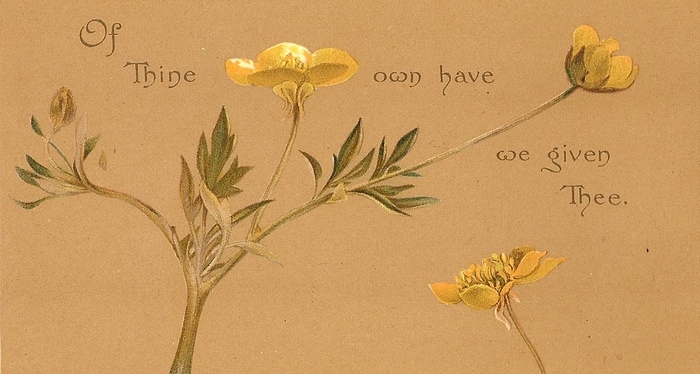
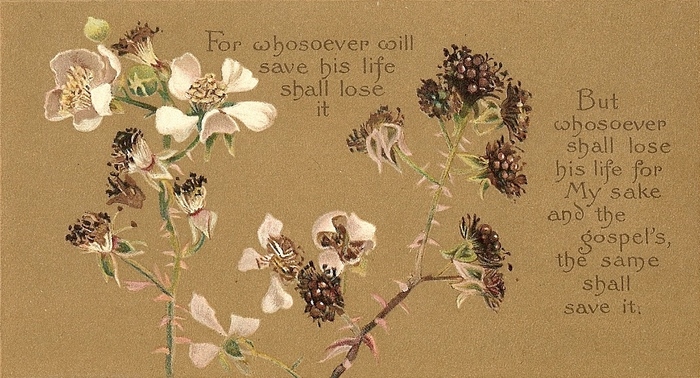
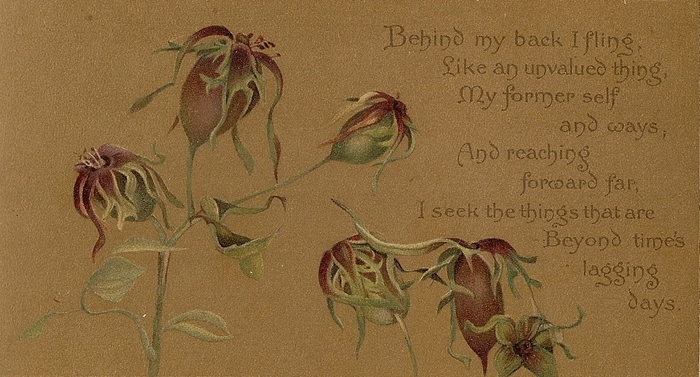
Below are two examples of her artwork, more are available in her books.


Here and there in the Bible we catch sight of a life penetrated by a strange glow. Here and there too, in this nineteenth-century world, souls cross our path, in contact with whom we feel a kindling for which, perhaps, we can hardly account. They are those to whom Christ is not merely an example, but an inspiration. There is such a thing, thank God, as a life on fire!
Let us draw near three of these glowing lives, and see if some spark may not, through God’s mercy, fall upon us. The first and second teach us their lesson in figure; the third in literal fact. “Entrust me not to leave thee, or return from following after thee; for whither thou goest I will go; and where thou lodgest I will lodge; thy people shall be my people, and thy God my God.” “Surely in that place my lord the king shall be, whether in death or life, even there also will thy servant be.” “There came a woman, having an alabaster box of ointment of spikenard, very precious, and she brake the box, and poured it on His head.” A life fired into a passion of lofe, and loyalty, and surrender; that is the picture into which the three stories blend. Let us look first at The Life of Love The story of Ruth and that of Ittani have the same outline. Both had reached a point to which duty alone had carried them, and now before each stood a choice. A new life lay stretched out, to be entered only by the narrow gate of loss; a choice, deliberate and final, must be made. To each came the generous pleading–“Stop, consider:” both persisted in their decision; and in both we watch the slow preparation of years break into a sudden flame, transforming them with a breath of glory. In Ruth’s case expecially, it was love that gave the illuminating touch. Is there a possible counterpart to this experience in our lives? Yes, a path lies with our reach, making the ordinary Christian life look cold and colourless by its contrast–a path stretching even beyond that of consecration in it lower sense; for this latter may be very subjective in tone, may hold the way of obedience chiefly as a means of rest and victory. It is to many of us distinctly fresh life when God’s Spirit leads us to the objective side, lifting our gaze from the road benearth our feet to the form of Him who goes before; rivetting it there by His radiant beauty.
“A homeless Stranger amongst us came To this land of death and mourning, He walked in a path of sorrow and shame, Though insult and hate scorning.
“A Man of sorrows, of toil and tears, An outcast Man and lonely; But He looked on me and through endless years Him must I love, Him only.
“Then from this sad and sorrowful land,– From this land of tears, He departed; But the light of His eyes, and the touch of His hand, Had left me broken-hearted.
“And I clave to Him as He turned His face From the land that was mine no longer; The land I had loved in the ancient days, Ere I knew the love that was stronger.
“And I would hide where He abode, And follow His steps for ever; His people my people, His God my God, In the land beyond the river.
“And where He died would I also die: Far dearer a grace beside Him Than a kingly place among living men, The place which they denned Him.”
*By permission from “Service of Song in the House of the Lord” by Frances Bevan. (Hatebards.)
Yes, “The love of Christ constraineth us.” The word is the same as that translated “pressed” in Acts xviii. 5, “straitened” in Luke xii. 50. It gives the thought of a mighty stream hemmed in by banks to narrow for it. Is that true concerning the love of Christ in our hearts? Have we opened them to that love till it has become a flood too strong for their poor limits, and must force our lives hither and thither at its will, to find outlets? If so, the measure of sunshine and shadow in our days will be simply in the shining or the veiling of His face; nothing on earth will make up for the slightest dimming of that light; nothing will really matter that leaves it untouched. And therefore the now cry must arise, “Whither thou goest I will go.” In the old days it was enough to say, “Come with me, Lord; leave me not, neither forsake me”; but to have His presence as a mere accompaniment of our lives will not satisfy us now. We must go His way with Him; it is the only path worth treading, when once our hearts have come under His irrestible sway. And going with Him does not simply mean a fresh stage of obedience; it means a yielding up of our hearts to glow with His triumphs and joys, and to ache with whatever pains Him, to enter eagerly into fellowship with any phase of His life that He may in His love ask us to share. And as we follow, our love will “abound in knowledge and in all perceptioin” (Phil. i. 9, Alford’s translation). It will become impossible that He should tarry behind unnoticed, as in Jerusalem of old; our hearts will grow to sensitive to lose sight of Him unconsciously. “Whither Thou goest I will go.” The external features of the path will matter little. It may be a life of plodding labour, or frittered away in ceaseless home claims, with all powers and talents seemingly buried, or worn down with ill-health, or broken by wave after wave of trouble; but it will be a life satisfied, rounded, hushed into absolute content, if it has reached this simple point, “To live is Christ.” Turn now to Ittai’s story; there is an element of fresh beauty here–the beauty of a soul kindled by the honour of standing by the king of his rejection. He comes before us as a picture of
The Life of Loyalty It is only in stormy times like his that this spirit can be developed. The loyalty called forth by a popular monarchy is but superficial; if we wish to see it on its ideal form we go to the days when it involved dishonour and contempt. We feel as we read the story of Charles the First, for instance, that the strength of his cause lay mainly in his indistinct of chivalry, roused by the loss of his rightful place. And our King stand uncrowned now, despised and rejected in His own world, and to us for a little while, comes the chance of standing there by His side. “They are not of the world, even as I am not of the world.” The world knoweth us not, because it knew Him not.” Is it true? Is our loyalty distinct enough to make “the world” uncomfortable, so far as we cross its path? Or is our witness to Christ of such a negative kind as never to cause a misgiving as to what we may say? Are we fearless as He was fearless in rebuking sin; uncompromising as He was uncompromising, in asserting God’s claims? Have we ever come so far as to be able to speak of Him by name to our acquaintances and relations! Confessing Christ is something more definite than confessing to being religious. Kedron, the brook which Ittai chose to cross with his king, signifies “obscurity”; and this points to the form that the offence of the Cross takes most commonly now. In this nineteenth century, Christ is not so much ahted as ignored. Blessed with His own blessing, in the path when loyalty brings into actual persecution and loss; but for most of us there is now such honour. A few slights and sneers are all that it will probably involve: “a narrow-minded fool” is the worst epithet likely to be flung. Be our fellowship in His rejection what it may, we will welcome it, rejoicing if we are even “counted worthy to suffer shame for His Name”: “esteeming the reproach of Christ greater riches than the treasures in Egypt”; going forth unto Him without the camp.” To some it may not be so much a departing from the camp of the openly hostile and indifferent. Their life may be cast among half-hearted, in consistent servant of the King; but none the less would loyalty involve “bearing His reproach.” Oh, for an enthusiasm for Christ that will not endure to be popular when He is unpopular; that will be fired rather than quenched when His claims are unrecognized and His word is slighted ; that will thrill us with joy if He allows us to share in any faint measure in His dishonour and loneliness; that will set every pulse throbbing with exultation as we “go forth unto Him!” Come now to the last of these three burning lives– a spirit aglow with the passionate longing to give. In Mary of Bethany, with her broken box of ointment, we see shadowed forth–
The Life of Surrender One fancies that she went into the house of Simon meaning to loosen the stopper, and empy forth all that would pour naturally; but that when, face to face with the Master, she found the flow checked, the impulse to shatter the vessel and give all that could be given, came, and was obeyed. So, in any care, it is with us. The lesson of giving, like all other lessons, is best learnt in His presence. It is as we look into His face that we grow dissatisfied with offering as we thought to offer, and rejoice in a breaking of will and spirit that sets free all restraint in the surrender. It may be in some outward act of obedience costing dear, that the breaking will begin; but it will be best perfected, at any rate, by accepting, instantly and wholly, the hourly disappointments, losses, jars, and burdens of common experience, till a practical readiness to be offered is developed.
“Measure thy life by loss, and not by gain, Not by the wine drunk, but by the wine poured forth; For love’s strength standeth in love’s sacrifice, And he who suffers most has most to give.”
Let our one aim in the matter be to find what still remains kept back; let our ideal of life be no longer a fair unbroken whole but a handful of shattered, empty fragments from which all that could be given has been lavished upon Christ. Is He not worthy? Have we learnt so to give? Have we learnt to give at all? It can hardly be called “giving” when God must plead and wait, and at last must loosen forcibly our clining grasp from the treasure. Have we even learnt the preliminary lesson of an instand blindfold “Yes, Lord,” when the Spirit points out a fresh act of sacrifice? It is only as we go on in a life of surrender that the blessed joy of pouring forth upon Him our costly things dawns on us. The giving sets free, as has been well said, a spring of conscious love, and the love, in its turn, inspires to fresh giving; and though the pain involved is still pain, such a strange sweetness becomes interwoven with it that we wonder whether heaven can be perfect without the possibility of suffering loss for Him. “To what purpose is this waste?” Oh, that the lives of His people called forth more often that accusation! There is small fear of it while giving is weighed and measured carefully, seldom reaching (even in such elementary matters as time and money) to more than a yielding of that which will never be missed. When shall we let the world see, not merely in outward symbol, Sunday by Sunday, but in literal daily practice, that it is a broken, poured-out life, wherein “by faith, with thanksgiving,” we are partakers? We have seen something of the possibilities that lie before us; something of the transfiguration that may come into our days if the glory of the Lord has risen upon us, kindling at last these slow, dull hearts. To some of us they are no more possibilities, thank God, but in some measure realities; though we need continually the breath of the Spirit and the fuel of fresh surrender, that the commant may be fulfilled–“The fire shall be ever burning upon the altar; it shall never go out.” To others the glimpse of a life that has found its centre in Christ comes as the Father’s answer to a hunger and thirst that have been deepening for long; their souls have been following hard after Him already, and they have only to open them to the Comforter who reveals Him. But some of us feel perhaps that all is misty and vague, and that some very definite change is needed, if it is to grow from dreamy sentiment into sover and literal fact. Shall we turn to one more story that seems to picture this condition and the way of escape? Come in though to the Sea of Galilee and stand with St. Peter in the stern of his boat. He is in no dreamland: his surroundings–slippery planks, creaking oars, showers of spray–are tangible enough; but he is straining his eyes on a spot where a dim and beautiful vision dawns out of the twilight. Is it real, or isit phantom? It is contrary to all experience, but the Form and Voice draw out his heart irresistably, and he cries, “Lord, if it be Thou, bid me come unto Thee on the water.” You can get so far as an echo of that cry, can you not? “Lord, if it be Thou”–this dim vision is really some fresh revelation of Thyself, unknown to me as yet–“bid me come unto Thee.” And back across all the storm, His voice will ring, “Come.” “And when Peter was come down out of the ship, he walked on the water to go to Jesus.” He stepped out, that is, into a path of uncertainties. So long as he stayed in the ship, he had solid planks under his feet; more than that, he could steer his own way. But as he swung himself overboard one uncertain foothold could only be left for another as uncertain. each step took him further from the place where he could walk by sight, and committed him more helplessly to a walk by faith. Is it not, perhaps, a consciousness of something of the kind involved in the Master’s word. “Come,” that makes you hesitate, though your heart begins to cry out for Him and will not be silenced? The old life has been a hard “toiling in rowing,” but you knew what you were about, and could after a fashion hold the helm: but this life of uncertainties, can it be ventured upon? If only you could forsee and measure the future of a life of absolute surrender and faith, you could brace yourself to it; but to yield yourself blindly to an unknown, untried issue, this is another matter. It is a binding the sacrifice to the horns of the altar, not knowing where or when the knife may strike. But this stepping out at al lrisks, with the element of unncertainty contained in it, is just where the truth of our surrender is tested, and therefore it must be faced thoroughly. So long as we reserve to ourselves the power of withdrawing to the old life if an emergency arises, there is no real progress possible. Do not, therefore, make the effort in a tentative spirit, feeling for a footing on the water before you loosen your grasp on the boat’s side; you will never find the surface grow firm under you till you let go. “When Peter was come down out of the ship, he walked on the water to go to Jesus” Leave hold of the old life of self-will and self-dependence, heedless of consequences: drop down on the way below as an irrevocable act, leaving no other resource than the one simple aim “to go to Jesus,” “to win Christ, " chance what may. The responsibility lies with Him who has said “Come”; we need a little more recklessness in our faith and obedience. We must not stay to trace the story in detail–the failure and the rescue, and the return to the ship. But let us notice this one poit: that to all the disciples came finally that immegiate personal Presence of Christ, which Peter recognized afar off, and gone forth to welcome at all hazards. To him too, therefore, the Lord would have come in time, if he had waited in the boat; but he would have missed one of the greatest experiences of his life. And to us also in the end, the King in His beauty will be revealed; but shall it be only at the last, when He comes to our ship to bid the storm cease and to bring us into the desired haven? Shall it be only when the chance of going to Him on the water is over for ever? In all the stories at which we have glanced we see the same lesson. An hour of delay on Ruth’s part, and Naomi would have gone on her journey, leaving her to return to the old life. A few weeks of hesitation, and Ittai would have seen David welcomed back by his people: the honour of holding by him in his banishment would have been missed for ever. Six days more, and Mary would have beheld the Song of Man betrayed and slain, with the sense that her opportunity for ministry had slid into the irretrievable past. So now, for each of us, a few years (far less than that, it may be) will see the last chance over–the last chance of following Him in His lonely path of standing by Him in His rejection, of pouring all that we hold precious at His feet. They lie before us now, the few remaining possibilities, counted out already in His mind and heart for us. And He stands there, watching sadly as one by one we let them slip. It is not lightly, on a mere strip of the emotional part of our being, that He would have us commit ourselves to this life of devotions; He will not take advantage of any surface impulse; He will challenge us, as Ruth and Ittai were challenged, asking “Are ye able to drink of the cup that I shall dirnk of, and to be baptized with the baptism that I am baptized with?” Tenderly He will look into our faces as He waits for the answer–an answer to be given with our wills, in all self-distrust and brokenness of spirit, but quietly and fearlessly in His strength. “We are able.” Shall He wait in vain?
“Whom have I in heaven but Thee? and there is none upon earth that I desire beside Thee.” “What things were gain to me, those I counted loss for Christ, Yea, doubtless, and I count all things but loss for the excellency of the knowledge of Christ Jesus my Lord; for Whom I have suffered the loss of all things, and do count them but dung, that I may with Christ.”
(This article was originally sent out as a tract. To download a zip file of this tract click here.)
"YOUR faith groweth exceedingly." Are not St. Paul's glad words true in a measure in these? If we look back twenty years we see how the ride has risen. We can test it as we test it on the sea-shore; marks that a wave would reach formerly, now and then, are the ordinary level now. "Exceedingly" may be a strong term, but "your faith groweth": that is true at least.
What purpose is all this faith to serve? It is the coin of the realm of heaven and we are God's stewards. A great challenge has long lain by the church, for the most part unmet--the solid phalanx of enmity to the Cross of Christ--the unconquered crescent of the one hundred and seventy-three millions of the Mohammedan world. There it lies: Arabia, Egypt, Persia, Turkey, Syria, Afghanistan, Mesopotamia, North Africa, the greater part of the Sudan; and in India and China and other eastern lands, there are Moslems interpersed among the idolaters, and harder to be won than they. Among all these lands, has there been yet such a work of the Holy Ghost as to cause a perceptible break in the enemy's ranks?
The glimmering light in which the Arab walks is not that of the dawn; it is a twilight settling into night. Banded together the souls wander away, only the bands are not to be numbered in units, but in scores of millions. And the Church of Christ, as a whole, has idly watched them and said, "there is no help for it, we must let them go." It is as though there we a spell on them from which they cannot break away, and oh, there has been a spell upon us, that we "the knights in the army of God" have not taken up the challenge and vindicated His glory.
First there are those who judge the matter from a purely human standpoint. They say, "Expereince has proved it to be useless to meddle with Moslems; their religion is suited to their ways, it is good enough for them. They worship one God, and they have a code of morality. Let them alone." We who know the glory of the light of Jesus do not need to argue this question of the excellence of their religion; we do not need to point to the icy coldness, the formalism, the corruption that lie underneath the fair-seeming exterior, the utter powerlessness of their creed to deliver them from sinning. They are "without Christ," that is enough. "And he that hath not the Son of God hath not life." If you could see them to-day, the grave intelligent men, the women with their native brightness struggling through the letters of generations of ignorance bondage, the sweet brown-skinned, dark-eyed children, the boys and girls of every intermediate age, as lovable, as full of possibilities as our boys and girls at home; you would not say that anything short of Christ was "good enough" for them!
But on the other side ( and this is the side taken by many who profess to believe in the Holy Ghost, the Lord and Giver of Life), there are those who hold that Mohammedanism is not too hopeful to be meddled with, but too hopeless! They say, "No good is ever done in these lands; it is wasting your strength to spend yourselves upon them. They are wrapped up in self-righteousness, and paralysis, and corruption; far better go to the heathen who will hear."
This is not the way an earthly soldier would look on it vantage ground of the enemy. It is not the way to come to the help of the Lord against the mighty. Take it at its very worst. They are dead lands and dead souls, blind and cold and stiff in death as no heathen are; but we who love them see the possibilities of sacrifice, of endurance, of enthusiasm, of life, not yet effaced. Does not the Son of God who died for them see these possibilities too? Do you think He says of the Mohammedan, "There is no help for him in his God?" Has He not a challenge too for your faith, the challenge that rolled away the stone from the grave where Lazarus lay?" 'Said I not unto thee, that, if thou wouldest believe, thou shouldest see the glory of God?' Then they took away the stone from the place where the dead was laid."
Let His voice sound down into our hearts till we roll away the stone of unbelief that is helping to shut down these poor souls into their prison-house. If He is doing "no mighty work" among them, the cause may be as of old. For remember, it is not the handful who are out among them that can win the battle. If it is Satan's stronghold, what is it for a few score of us to go up against, many of us weighed down with the pressure of spirit that comes on one in lands that are steeped in the power of Satan? It is you at home in the bright, free, spiritual are, who could have power with God for victory.
Will you take up the responsibility of this thing? You may not have been definately unbelieving, but have you been as definately believing as the case demands? Has the dishonour to Christ's cause ever pressed upon you? Have you done all that you can do to wipe out the stain of defeat? It is not yet past retrieving: He "strengthened the spoiled against the strong so that the spoiled shall come against the fortress." We may yet add this triumph to the roll of our King's victories before He returns!
A story of the wars of the first Napoleon has often come back to me. He was trying, in a winter campaign, to cut off the march of the enemy across a frozen lake. The gunners were told to fire on the ice and break it, but the cannon balls glanced harmlessly along the surface. With one of the sudden flashes of genius he gave the word, "Fire upwards!" and the balls crashed down full weight, shattering the whole sheet into fragments, and the day was won. You can "fire upwards" in this battle, even if you are shut out from fighting it face to face. If God calls you there in bodily presence, you will never be able to pray to any purpose, or work to any purpose either, except there; but if He does not summon you you can as truly, as effectually, as prevailingly, do your share within the four walls if your room. "Said I not unto thee, that, if thou wouldest believe, thou shouldest see the glory of God?"
To "see the glory of God"; that in its crystal clearness was the aim of Jesus. Not mere pity for the dead souls, but passion for the glory of God, is what we need to hold us through to victory. May He inspire it in us by the power of His indwelling life; then will the very "faith of the Son of God" Himself rise up within us, and the works that He did may do also. Oh, to measure God's resources as He did that day at Bethany: then we should give thanks beforehand at the answer received, "accounting God able."
One more story--a very homely one. "I am going to get you a winter jacket to-day," said my sister a while ago to her six-year-old daughter. The little fair face looked up with a demur on it. "I don't think you'd better, mother dear." "Why we were talking about it the other day, and you seemed to think it would be very nice." "Yes--but--mother, they cost a great deal. I don't think really you can afford it." My sister smiled, "Not afford a new jacket? I think I can manage it." The child flushed up. "Please, mother, I don't think you can, really. I've looked in your purse, and there was very little in it."
Do we not deal so with our Heavenly Father? We look anxiously at the tiny coins that we can see and handle, so to speak, and we know as much about the exceeding greatness of His power to us-ward who believe as my little niece knew about the bank account that lay behind the purse!
"Why should it be thought a thing incredible with you that God should raise the dead?" "Said I now unto these that, if thou wouldest believe, thou shouldest see the glory of God?" "If thou canst believe, all things are possible to him that believeth."
I.Lilias Trotter (Revised)
Can we not read our parable? How often we have had an impulse or a plan which we knew to be of God, with a flash of intuition, or with a gathering certainty: and the temptation has come to carry it straight off by ourselves, without waiting His time–the very temptation that beset the Master in the wilderness.
Oh! let us learn of Him the lesson of letting God’s seed-purposes ripen!–they can bear no fruit till they have come to their maturity: we shall but waste all He was preparing if we drag it out before its time. And only in a path in which we are learning to do nothing of ourselves but what we see the Father do, can we know when His hour is come. How accurately Jesus knew it! “I go not up yet unto this feast, for My time is not yet full come,” He said to His brethren–and yet in a day or two He was there. “Mine hour is not yet come,” He said to His mother, when it was only a question of minutes. And by what marvellous insight He recognised the dawning of that final “hour” when He was asked for by those nameless Greeks–a hint of the ingathering of the travail of His soul! God can give us the same Divine instinct, when He has weaned us from our natural energy and impatience. And when His hour has struck, the whole powers of the world to come will be set free in the tiny helpless seed. “One day is with the Lord as a thousand years.” He is a God worth waiting for!
And there is another thing closely linked with this patience in the seed-shedding. As we watch it going on in nature, we see how it is all done in cooperation with the forces at work outside itself. The wind knocks off and tosses away the dainty shutde-cocks of the scabious as they ripen one by one, and the pods wait for the hot touch of the sun to split them with the sudden contracting twist that sends the grains flying, like stones from a sling.
More wonderfully still we see this “working together” in the seeding of the cranesbill. The seeds stand together as they ripen, like arrows in a quiver, with their points downwards, and their feathered shafts straight up. When the time for action comes, the sun-heat peels them off, from below and above, so quickly that you can see them cue under your eyes, and turn into a spiral by their continued contractions. They fall, spike downward, by the weight of the seed, and the sun finishes the work he began. Closer still the gimlet winds, and as it does so it bores down into the hardest soil: and such is their strange power of penetration, as they are driven in, spite of all their weakness, that they bury themselves up to the very hilt, leaving only the last long curve flat on the surface. Then this snaps off, and leaves the head deep hidden. The spear-like grass you see opposite p. 40 follows the same rule: it is so sensitive to the heat that even the warmth of one’s hand will set it twisting and thrusting its barb in. Cannot we trust the God Who planned them, to give us arrows that will be sharp in the hearts of His enemies, and to drive them home? At each fresh adaptation of the plants to their aim, we hear an echo of the words of Jesus, “Shall He not much more clothe you, O ye of little faith?”
And the restfulness of waiting God’s hour for seed-shedding deepens as we learn to recognise the outward dealings of the Spirit as well as the inward, and watch the marked way in which He co-operates with the setting free of every seed as it ripens–how He brings across our path the soul who needs the very lesson He has just been teaching us–how the chance comes with perfect naturalness of reaching another over whom we have been longing. If our eyes are up, and our hands are off–if we learn to “wait on our ministering” like the seeds, in utter dependence on Him, we shall be able constantly to trace the Lord’s working with us, and we shall have done with all the old restless striving to makeopportunities–“We are labourers together with God.”
Yes, it all centres round that question of quietness. “Opportunity” is given to every seed in its turn, as they lie in their layers in the capsule, or side by side in the pod. Not one forces its way forward, or gets in the way of another. Look at the exquisite fitting in any seed-vessel that you pull to pieces: the seeds are as close as they will go, but fenced off from crowding on each other and hindering each other’s growth. He who packed them can be trusted, surely, with the arranging of our lives, that nothing may jostle in them, and nothing be wasted, for we are “of more value” to Him than these. If our days are a constant rush and hurry, week in and week out, there is grave reason to doubt if it is all God-given seed that we are scattering. He will give us no more to do than can be done with our spirits kept quiet and ready and free before Him.
Quiet and ready and free–that is another lesson that the seeds teach us. Off they go at a touch, at the moment when the inward preparedness and the outward opportunity coalesce. See the tiny corkscrews of the pink geranium in our meadow (a miniature of its blue brother the cranesbill). Look at the poise of them–and then at the sheaf of spears of this bit of grass, holding themselves freer still, and the downy head alongside, equally ready either to hold together or to fly with a breath … and then look at our lives and see whether that is their attitude towards the Holy Ghost. Is there a soul poise that corresponds?
Oh! the pains that God has to take to bring us to this happy, childlike “abandon,” equally ready for silence, or for saying or doing unhesitatingly the next thing He calls for, unfettered by surroundings or consequences. How much reserve and self-consciousness have to give way with some of us, before the absolute control passes into His Hands, and the responsibility with it! Then only can we know the “liberty,” the “boldness,” the “utterance” of Pentecost. “Whithersoever the Spirit was to go they went, thither was their spirit to go:” that is “the perfect law of liberty.”
Yes, and that brings us a step further in the teachings of the seed-shedding. Off they go now, “every one straight forward”–off and onward to the place appointed. Look at the golden plough of the wild oat, with every spike and hair so set that it slips forwards and will not be pushed backwards. Look at the hooks and the barbs that cling to anything and everything that passes by if only they can carry their seed away and away. Look at the balls and the wheels that roll before the wind, and the parachutes and baby shuttlecocks that sail upon it: they all have a passion for getting far off, and they only show us a few of the numberless devices by which the same end is reached in plants of all lands.
(From the book Parables of the Christ-Life)
“In that day shall there be upon the bridles (mar.) of the horses, HOLINESS UNTO THE LORD, and the pots in the Lord’s house shall be like the bowls before the altar. Yea, every pot in Jerusalem and in Judah shall be holiness unto the Lord of Hosts, and all they that sacrifice shall come and take of them and seethe therein: and in that day there shall be no more the Canaanite in the house of the Lord of hosts” (Zech. xiv. 20,21). Above and beyond the literal prophetic interpretation, do not these verses give us a divine picture of the Christian life in its maturity–a ripened life? Let us take it point by point, and let us pause over each with hearts subdued and listening, that the Holy Ghost may convict us if it is not our life. “In that day there shall be upon the bridles of the horses, HOLINESS UNTO THE LORD.” The horse seems to stand throughout the Old Testament for natural power. In each of us there is one strongest point; it may be brain power, or some faculty, as music for instance, or the power of planning, the power of influence, the power of loving. And, whatever it may be, that strong point it sure to be a point of temptation, just as their horses were a temptation to Israel. Trace the history. In spite of God’s warning (Deut. xvii. 16), they “multiplied” them (I. Kings iv. 26; x. 28) and “trusted in them” (Isa. xxxi. 1), and by this multiplying, power was put into the hands of their enemies (I. Kinds x. 29) which was afterwards turned round upon themselves for their own ruin (Jer. vi. 23; viii. 16). Can we not, some of us, read our own story between the lines? Have we not given play to these faculties, “multiplied” them so to speak, for the sake of exultant sense of growing power, not for God? Have we not trusted in out horses? In the well worked-out “subject” for instance, rather than in the Spirit’s might? Have we not brought into soul captivity by means of self-indulgence in these faculties, God-created though they are? and therefore most of us, as we go on, find that God’s hand comes down on the strongest parts of us as it came upon the horses of Israel (Zech. xii. 4; Hos. i. 7). By outward providence or by inward dealing, He brings it to the place of death, to the place where we lose our hold on it and trust in it and say with Ephraim, “We will not ride upon horses” (Hos. xiv. 3). And in that place of death God may leave it for months and years till the old glow of life has really died out of it, and the old magical charm has vanished, and it has become no effort to do without it becase life’s current has gone into the current of God’s will. Then comes the day as in Israel’s case before us, when He can give us back our horses, with “HOLINESS TO THE LORD” written on them, bridled with Christ-restraint. Where are our horses? Are we riding them in their old natural force, or are they lying stiffened and useless in the place of death, or have they been given back to us with their holy bridles? Let our souls answer and say. “And the pots in the Lord’s house shall be like the bowls before the alter.” These pots were probably the pots for oil and meal. They had done good service in the Lord’s house, but they were to be promoted now, promoted to the place of sacrifice. Has our service gone through this promotion? Is there not much of it that is very good and useful in its way but containing no element of sacrifices? Others looking on say, perhaps, “What a self-sacrficing life!” but out hearts tell us that as to outline, sacrifice has vanished, for th energies of our being have flowed into God’s work and we love it for its own sake; and that the spirit of surrender has not yet penetrated into its details. But what boundless opportunites for this “ripening” lie in those details. When our plans are thwarted, when the time that we had mapped out is frittered away by interruptions, when a cherished bit of work has to be reliquished to another; these things, and such as these, are God’s opportunities for promotion, the promotion of our service into sacrifice; they are the chances of bringing out our pots to stand like the bowls before the altar, holding up to Him the poured-out life-blood. Do our hearts rise to them with an Amen? “Yea, every pot in Jerusalem and in Judah shall be holiness unto the Lord of hosts and all they that sacrifice shall come and take of them and seethe therein.” Does not this mean that in a ripened life all the common things of life rise in the scale in like proportion, in their own degree likewise promoted to sacrifice, standing ready that this, God’s noblest end, may be fulfilled i nthem at any moment? “If on our daily course our mind Be set to hallow all we find, Now treasures still, of countless price, God will provide for sacrifice.” Here is the secret of sanctifying the common things; “Take them,” as they stand there ready to your hand, not going out of the way to look for costlier or more obviously sacred vessels, but using siltenly just the common earthern pots of everyday life and sealing them for God’s service of filling them with the spirit of sacrifice. “Yea, every pot,” there is the measure of the possibilities that God has set before us, and we use perhaps one or two in a day! “And there shall be no more the Canaanite (trafficker) in the house of the Lord.” Does not this mean that all the spirit of bargaining is to be banished from our lives as they ripen into their fruition? There are many of God’s children whose attitude towards Him is much the same as Jacob’s. “If the Lord will be with me…then shall the Lord be my God.” Take in contrast Habakkuk’s cry, “Although the fig tree shall not blossom…yet will I rejoice in the Lord.” Here is a heart from which the trafficking spirit has been banished, for it has found God. I was taking some months ago to a friend whose path had led in a very definite manner into the way of the Cross. Speaking of the course she was following, she said, “I do this thing for God, not for success in the work, or for happiness in my soul or for anything else, I am here for God.” How those words “for God” rang in my heart for weeks after. Life is grandly simple when we get there. When the spirit of calculating results and consequences, even spiritual results and consequences, has been left among the things that are behind, when obedience is the one things that matters, when God Himself, and no mere “experience” is our exceeding great reward. Are we there? “If I have served Thee Lord for hire, Hire which Thy beauty showed, Oh, let me serve Thee now for nought And only as my God.” -Faber.
It is not in the partial relaxing of grasp, with power to take back again, that this fresh victory of death is won: it is won when that very power of taking back is yielded; when our hands, like the little calyx hands of God’s buttercups, are not only taken off, but folded behind our back in utter abandonment. Death means a loosened grasp–loosened beyond all power of grasping again.
And it is no strange thing that happens to us, if God takes us at our word, and strips us for a while of all that made life beautiful. It may be outward things–bodily comfort, leisure, culture, reputation, friendships–that have to drift away as our hands refuse to clasp on anything but God’s will for us. Or it may be on our inner life that the stripping falls, and we have to leave the sunny lands of spiritual enjoyment for one after another of temptation’s battlefields, where every inch of our foothold has to be tested, where even, it may seem to give way–till no experience, no resting-place remains to us in heaven or earth but God Himself–till we are “wrecked upon God.”
Have faith, like the flowers, to let the old things go. Earn His beatitude, His “Blessed is he, whosoever shall not be offended in Me”–“the beatitude of the trusting,” as it has well been called–even if you have to earn it like John the Baptist in an hour of desolation. You have told Him that you want Him only. Are you ready to ratify the words when His emptying begins to come? Is God enough? Is it still “My God” that you cry, even as Jesus cried when nothing else was left Him?
Yes, practical death with Him to lawful things is just letting go, even as He on the Cross let go all but God. It is not to be reached by struggling for it, but simply by yielding as the body yields at last to the physical death that lays hold on it–as the dying calyx yields its flower. Only to no iron law with its merciless grasp do we let ourselves go, but into the hands of the Father: it is there that our spirit falls, as we are made conformable unto the death of Jesus.
Does all this seem hard? Does any soul, young in this life and in that to come, shrink back and say “I would rather keep in the springtime–I do not want to reach unto the things that are before if it must mean all this of pain.”
To such comes the Master’s voice: “Fear none of those things which thou shalt suffer”: You are right to be glad in His April days while he gives them. Every stage of the heavenly growth in us is lovely to Him; He is the God of the daisies and the lambs and the merry child hearts! It may be that no such path of loss lies before you; there are people like the lands where spring and summer weave the year between them, and the autumn processes are hardly noticed as they come and go. The one thing is to keep obedient in spirit, then you will be ready to let the flower-time pass if He bids you, when the sun of His love has worked some more ripening. You will feel by then that to try to keep the withering blossoms would be to cramp and ruin your soul. It is loss to keep when God says ‘give’.
For here again death is the gate of life: it is an entering in, not a going forth only; it means a liberating of new powers as the former treasures float away like the dying petals.
We cannot feel a consciousness of death: the words are a contradiction in terms. If we had literally passed out of this world into the next we should not feel dead, we should only be conscious of a new wonderful life beating within us. Our consciousness of death would be an entirely negative matter–the old pains would be unable to touch us, the old bonds would be unable to fetter us. Our actual consciousness would have passed into the new existence: we should be independent of the old.
And a like independence is the characteristic of the new flood of resurrection life that comes to our souls as we learn this fresh lesson of dying–a grand independence of any earthly thing to satisfy our soul, the liberty of those who have nothing to lose, because they have nothing to keep. We can do without anything while we have God. Hallelujah!
Nor is this all. Look at the expression of abandonment about this wild-rose calyx as time goes on, and it begins to grow towards the end for which it has had to count all things but loss: the look of dumb emptiness has gone–it is flung back joyously now, for simultaneously with the new dying a richer life has begun to work at its heart–so much death, so much life–for
Yes, there is another stage to be developed in us after the lesson of absolute unquestioning surrender to God has been learnt. A life that has been poured forth to Him must find its crown, its completion, in being poured forth for man: it must grow out of surrender into sacrifice. “They first gave their own selves to the Lord, and unto us by the will of God.”
Back to the Cross once more: if there is any place where this fresh lesson can be learnt, it is there! “Hereby perceive we the love of God, because He laid down His life for us, and we ought to lay down our lives for the brethren.” It is the very love of Calvary that must come down into our souls, “Yea, if I be poured forth upon the service of your faith I joy and rejoice with you all:” so spoke the apostle who drank most deeply into the Master’s spirit: and again–“Death worketh in us, but life in you.” “Neither count I my life dear unto myself, that I may finish . . . the ministry.”
Deeper and deeper must be the dying, for wider and fuller is the lifetide that it is to liberate–no longer limited by the narrow range of our own being, but with endless powers of multiplying in other souls. Death must reach the very springs of our nature to set it free: it is not this thing or that thing that must go now: it is blindly, helplessly, recklessly, our very selves. A dying must come upon all that would hinder God’s working through us–all interests, all impulses, all energies that are “born of the flesh”–all that is merely human and apart from His Spirit. Only thus can the Life of Jesus, in its intensity of love for sinners, have its way in our souls.
(From the book Parables of the Cross)
For if the Sun of Righteousness has risen upon our hearts, there is an ocean of grace and love and power lying all around us, an ocean to which all earthly light is but a drop, and it is ready to transfigure us, as the sunshine transfigured the dandelion, and on the same condition - that we stand full face to God. Gathered up, focussed lives, intent on one aim - Christ - these are the lives on which God can concentrate blessedness. It is “all for all” by a law as unvarying as any law that governs the material universe. We see the principle shadowed in the trend of science; the telephone and the wireless in the realm of sound, the use of radium and the ultra violet rays in the realm of light.
All these work by gathering into focus currents and waves that, dispersed, cannot serve us. In every branch of learning and workmanship the tendency of these days is to specialize - to take up one point and follow it to the uttermost.
And Satan knows well the power of concentration; if a soul is likely to get under the sway of the inspiration, “this one thing I do,” he will turn all his energies to bring in side-interests that will shatter the gathering intensity.
And they lie all around, these interests. Never has it been so easy to live in half a dozen good harmless worlds at once - art, music, social science, games, motoring, the following of some profession, and so on. And between them we run the risk of drifting about, the “good” hiding the “best” even more effectually than it could be hidden by downright frivolity with its smothered heart-ache at its own emptiness.
It is easy to find out whether our lives are focussed, and if so, where the focus lies. Where do our thoughts settle when consciousness comes back in the morning? Where do they swing back when the pressure is off during the day? Does this test not give the clue? Then dare to have it out with God - and after all, that is the shortest way. Dare to lay bare your whole life and being before Him, and ask Him to show you whether or not all is focussed on Christ and His glory. Dare to face the fact that unfocussed, good and useful as it may seem, it will prove to have failed of its purpose.
What does this focussing mean? Study the matter and you will see that it means two things - gathering in all that can be gathered, and letting the rest drop. The working of any lens - microscope, telescope, camera - will show you this. The lens of your own eye, in the room where you are sitting, as clearly as any other. Look at the window bars, and the beyond is only a shadow; look through at the distance, and it is the bars that turn into ghosts. You have to choose which you will fix your gaze upon and let the other go.
Are we ready for a cleavage to be wrought through the whole range of our lives, like the division long ago at the taking of Jericho, the division between things that could be passed through the fire of consecration into “the treasury of the Lord,” and the things that, unable to “bide the fire” must be destroyed? All aims, all ambitions, all desires, all pursuits - shall we dare to drop them if they cannot be gathered sharply and clearly into the focus of “this one thing I do”?
Will it not make life narrow, this focussing? In a sense, it will - just as the mountain path grows narrower, for it matters more and more, the higher we go, where we set our feet - but there is always, as it narrows, a wider and wider outlook, and purer, clearer air. Narrow as Christ’s life was narrow, this is our aim; narrow as regards self-seeking, broad as the love of God to all around. Is there anything to fear in that?
And in the narrowing and focussing, the channel will be prepared for God’s power - like the stream hemmed between the rock-beds, that wells up in a spring - like the burning glass that gathers the rays into an intensity that will kindle fire. It is worthwhile to let God see what He can do with these lives of ours, when “to live is Christ.”
How do we bring things to a focus in the world of optics? Not by looking at the things to be dropped, but by looking at the one point that is to be brought out.
Turn full your soul’s vision to Jesus, and look and look at Him, and a strange dimness will come over all that is apart from Him, and the Divine “attrait” by which God’s saints are made, even in this 20th century, will lay hold of you. For “He is worthy” to have all there is to be had in the heart that He has died to win.
Hath not each heart a passion and a dream, Each some companionship for ever sweet, And each in saddest skies some silver gleam, And each some passing joy, too fair and fleet, And each a staff and stay, though frail it prove, And each a face he fain would ever see?And what have I? an endless stream of love, A rapture, and a glory, and a calm, A life that is an everlasting Psalm, All, O Beloved, in Thee.
- Tersteegen
Measure thy life by loss and not by gain, Not by the wine drunk, but by the wine poured forth, For love's strength standeth in love's sacrifice, And he who suffers most has most to give.
Death to Self is the Way Out Into a Life of Sacrifice
This dandelion has long ago surrendered its golden petals, and has reached its crowning stage of dying - the delicate seed-globe must break up now - it gives and gives till it has nothing left.
What a revolution would come over the world - the world of starving bodies at home - the world of starving souls abroad - if something like this were the standard of giving; if God's people ventured on "making themselves poor" as Jesus did, for the sake of the need around; if the "I" - "me" - "mine" were practically delivered up, no longer to be recognized when they clash with those needs.
The hour of this new dying is clearly defined to the dandelion globe; it is marked by detachment. There is no sense of wrenching; it stands ready, holding up its little life, not knowing when or where or how the wind that bloweth where it listeth may carry it away. It holds itself no longer for its own keeping, only as something to be given; a breath does the rest, turning the "readiness to will" into the "performance" (2 Corinthians 8:11). And to a soul that through "deaths oft" has been brought to this point, even acts that look as if they must involve an effort, become something natural, spontaneous, full of a "heavenly involuntariness," so simply are they the outcome of the indwelling love of Christ.
Shall we not ask God to convict us as to where lies the hindrance to this self-emptying? It is not alone mere selfishness, in its ordinary sense, that prevents it; long after this has been cleansed away by the Precious Blood there may remain, unrecognized, the self-life in more subtle forms. It may co-exist with much that looks like sacrifice; there may be much of usefulness and of outward self-denial, and yet below the surface may remain a clinging to our own judgment, a confidence in our own resources, an unconscious taking of our own way, even in God's service. And these things hold down, hold in our souls, and frustrate the Spirit in His working. The latent self-life needs to be brought down into the place of death before His breath can carry us hither and thither as the wind wafts the seeds. Are we ready for this last surrender?
Do you ask, "Does God really mean the emptying to reach so far as this?" Study the inner life of Jesus. "I speak not of Myself," He says. "I can of Mine own self do nothing." "I seek not Mine own will, but the will of Him that sent Me." His human self-life, sinless though it was, was laid down that He might live by the Father; and our self-life, defiled and worthless, shall we not lay it down that we may live by Him?
But how? Again not by struggling and wrestling, but by dying to it in Jesus. "I am crucified with Christ" - I myself in the very essence of my being, I let myself go to that death; and by the mysterious power with which God meets faith, I find that He has made it true: the bonds are loosed and He can have His way with me...
Shall we not let Him have His way? Shall we not go all lengths with Him in His plans for us - not, as these "green things upon the earth" in their unconsciousness, but with the glory of free choice? Shall we not translate the story of their little lives into our own?
For all their teaching of surrender and sacrifice is no fanciful mysticism; it is a simple reality that can be tested at every turn - nay, that must be so tested. If we are apprehending Christ's death in its delivering power, our homes will not be slow to find it out.
O Jesus, the Crucified, I will follow Thee in Thy path. Inspire me for the next step, whether it leads down into the shadow or up into the light. Surely in what place my Lord the King shall be, whether in death or life, even there also will Thy servant be. Amen.
Excerpt from "Parables of the Cross" by I. Lilias Trotter. The complete book is available on this page: Parables of the Cross.

A GLIMMER of the coming down has been lighting up some passages with such an inspiring to my soul that I wan to pass it on, though to many it may be familiar thought. When it came to me I wondered why I had not seen it before. In the parables of the talents and pounds we see a two-fold purpose–to give the servants something to do for their Lord, and to train them for their future work when the Kingdom should have come. The first aspect is familiar enough; the second has been to me in a very vivid sence a new revealing of that wonderful Day. The King knew when He went away that when the Kingdom was His He would need “rulers,” and all unknowing of what was coming of it, His servants got their training, and thus they were ready for rulership when He came back. “They lived and reigned with Christ a thousand years.” This was to me a vague and intangible, but it has become very real, for it will all be indeed real, that reign. Here, down on this very earth of ours, with its mountains and deserts and woods and clouds and flowers just as they are to-day, and the same races of men with all their nations and tongues to be won to one King. Think of it! The glory of seeing Him have His glory as last; the unspeakable joy of bringing sheaf after sheaf to lay at His feet where now the seed only yields a few straggling blades. “The joy of thy Lord”–” Thou hast to Him increased the joy.” “They joy before Thee according to the joy of harvest, and as men rejoice when they divide the spoil.” Think of seeing His joy in the travail of His soul–the gladness of making God glad. Think of it till the wonderful joy of it dawns. Think of the lands, where we have toiled on–some of us–with so little fruit to be seen, sprining up with the sudden golden glory of harvest. The seed cast on th waters in journeyings oft, found after many days; desert lands, that we had left with a heart-break for the dear souls who might only have that one hearing, blossoming as the rose. Think of places beyond that our hearts have yearned over, but where the door has never opened. Would it not be like the Lord Whom we are learning to know, to let us go just there when His Kingdom comes, with resurrection bodies that will not flag or fail in any climate, with the Lord’s power triumphing gloriously instead of the weary fight, with a thousand years in which to do the work instead of these poor ten or twenty or thirty that we feel so sadly short, when we look around and see that all we can do barely touches the fringe of what is left undone. Think of the fellowship of the work–the lonely scattered workers now with little of the communion of saints here below. Think of working alongside Rutherford and Terstegen and Fletcher and all the lovely saints of all ages and nations, to say nothing of the goodly fellowship of the apostles and the noble army of martyrs. And think of all authority being on the side of Jesus. Some of us are working here against the tide–then He will berecognized over all the earth, King of kings and Lord of lords. Now take your eyes off this wonderful vista, down again to the browns and greys of “this present world.” Has not a light come on some of its mysteries? What if He sends out some of His servants to heathen lands just to die in a year or two? Do we not judge the matter as if it were really bounded by the low narrow horizon of this life? They have had their bit of training and are ready for their work, that is all. And those who whole heart is in the foreign field, but who through health or circumstances cannot go–never mind, you will be there some day, and the training is going on now. The answer will be exceeding abundantly above all you asked or thought, just as wonderful as when in answer to Moses’ longing prayer, his feet stood with Jesus on the Mount of Transfiguration. He went over ineed to the goodly mountain whose top he saw from Pisgah. God’s answers lose nothing by being kept into eternity, and you who feel powers beginning to fail and sadness creeping over you at seeing the end of the blessedness of a life spent for Jesus, oh! let us lift up our eyes, we are coming to the end of our training, and we are going to see that they who sow in tears shall reap in joy. It may be that in the fellowship of tears with Him you are having a training to make you able to bear the joy of that day. But oh! to be faithful in the time that is! Infinite is gain carried over into eternity and infinite is eternal loss. “Thy pound hath gained ten pounds.” What is the multiple of fructifying power for the gifts and probations that God has given us? Not human toil and effort, not even the spirit of faithfulness, but the Holy Ghost, the Lord and Giver of Life. Oh to enter on the life eternal, with every fibre in character and brain and capacity “alive unto God” through Him. Only so can His pound gain ten pounds. But many of us are having a mixed life of the flesh and the Spirit–much that is gold, silver, and precious stones, and much that is wood, hay, stubble; and before His Kingdom is set up on earth the fire must try every man’s work of what sort it is. God grant us to judge ourselves now that we be not judged of the Lord hereafter. I. L. Trotter. “Earth is the rehearsal for heaven. The eternal beyond is the eternal here. The street life, the home life, the business life, the city life in all the various ranges of its activity, are an apprenticeship for the City of God.” –Drummond.
Wherever there are women there are looking-glasses, from the Sherifa with her great mirror framed in carving and gilding, to the tent of the Bedouin woman, who wears a little leather-covered disc among her many ornaments.
For all women want to see what they look like – what they look like to other people. And they know that the mirror gives to their view what they themselves would never see – the form and the tint of their features and the drapery of their headgear.
So far the mirror goes, no further, it can only picture the outer person. But there is another mirror that can shew thee thy inner person. That mirror is the Holy Book. In a mirror of glass thou canst see thy face as thy neighbour see it, but in the Word of God thou canst see thy heart as God sees it.
In a mirror of glass thou canst see thy face as thy neighbour see it, but in the Word of God thou canst see thy heart as God sees it.
Our earthly mirrors sometimes shew things that make us sad. A woman may think her face still young and fair; but her mirror shews the wrinkles and grey hairs that have begun to come. It tells her the truth.
So also God’s Word tells us the truth about our hearts, that is to say that they are not good as we like to think them, but bad before Him.
For instance, thou thinkest perhaps that thou canst gossip all day long, without harm. See how that gossip appears to God. He says, “In the multitude of words there wanteth not sin.” “Every idle word that men shall speak, they shall give account thereof in the day of judgment.”
It may be, in thy mind are thoughts of pride, despising thy neighbour. Look in the mirror of God: He says, “He that despiseth his neighbour sinneth.”
It may be that thy heart harbours hatred against another, thou sayest, “I do well to be angry.” Look once more in God’s mirror and see how this hatred looks to Him: “He that hateth his brother is a murderer.”
Look, O my sister, in this mirror that tells thee the truth, and quickly thou wilt see that thou dost need a Saviour.
From: Heavenly Light on Daily Life – (a series of unpublished devotionals for Arab women) by Lilias Trotter
Can you not remember my sister, as if it were yesterday, the hour when your first born child lay in your arms, and how your heart glowed with such love and joy that all you had suffered in bearing it to life was forgotten.
And as it lay there, weak and helpless, its very need called to you all the time, so that you could not forget it for a moment because of the great fountain of loving care that had sprung up in your heart.
He loves you with the same strong tender love that He has given you for your little ones, only far more tender and strong and deep.
Even in the night you would wake at is faintest cry, and put you arms round and care for its needs. God created in you, my Sister, that wonderful Mother heart, and He loves you with the same strong tender love that He has given you for your little ones, only far more tender and strong and deep. He says in His Book, “Can a woman forget her sucking child that she should not have compassion on the son of her womb, yea they may forget, yet will not I forget thee” and again He says “As one whom his mother comforteth so will I comfort you.” So in all that love that dwells in your heart you can feel as if God stretched out His hands to your and said “That is a little like the way I love thee.”
And when your child gets a little older, your arms are still his refuge, he runs and hides his head in your lap if he is frightened and he sobs there if he is hurt.
“Ye are all the children of God by faith in Jesus Christ,” very little children and very weak, perhaps you have hardly yet learnt to speak to Him or to walk in His ways. But before your little ones knew how to speak or walk they knew how to get comforted in your arms.
So if the new life has come to you by faith in Jesus Christ you have a place of refuge in God as safe and warm and beautiful as you have ready for your child. Come and hide your head there when you are afraid of what may happen and if you are troubled bring the trouble there as your children come to you, and when Satan tempts you or the world draws you run to your refuge like your children run to you if they see danger near. And if the night of death comes before Jesus returns He will take you in His Arms and hush your soul to sleep and you will know nothing more till you wake in the new day of heaven. Amen.
From: Heavenly Light on Daily Life – (a series of unpublished devotionals for Arab women) by Lilias Trotter

“I am seeing more and more that we begin to learn what it is to walk by faith when we learn to spread out all that is against us: all our physical weakness, loss of mental power, spiritual inability – all that is against us inwardly and outwardly – as sails to the wind and expect them to be vehicles for the power of Christ to rest upon us. It is so simple and self evident – but so long in the learning!” — Lilias Trotter, August 22, 1902.
In Mary of Bethany, with her broken box of ointment, we see shadowed forth the life of surrender. . .The lesson of giving, like all other lessons, is best learnt in His presence.Let our one aim in the matter be to find what still remains kept back; let our ideal of life be no longer a fair unbroken whole but a handful of shattered, empty fragments from which all that could be given has been lavished upon Christ. Is He not worthy?
Have we learnt so to give? Have we learnt to give at all? It can hardly be called “giving” when God must plead and wait, and at last must loosen forcibly our clining grasp from the treasure. Have we even learnt the preliminary lesson of an instand blindfold “Yes, Lord,” when the Spirit points out a fresh act of sacrifice?
It is only as we go on in a life of surrender that the blessed joy of pouring forth upon Him our costly things dawns on us.It is only as we go on in a life of surrender that the blessed joy of pouring forth upon Him our costly things dawns on us. The giving sets free, as has been well said, a spring of conscious love, and the love, in its turn, inspires to fresh giving; and though the pain involved is still pain, such a strange sweetness becomes interwoven with it that we wonder whether heaven can be perfect without the possibility of suffering loss for Him.
“To what purpose is this waste?” Oh, that the lives of His people called forth more often that accusation! There is small fear of it while giving is weighed and measured carefully, seldom reaching (even in such elementary matters as time and money) to more than a yielding of that which will never be missed.
“To what purpose is this waste?” Oh, that the lives of His people called forth more often that accusation!When shall we let the world see, not merely in outward symbol, Sunday by Sunday, but in literal daily practice, that it is a broken, poured-out life, wherein “by faith, with thanksgiving,” we are partakers? We have seen something of the possibilities that lie before us; something of the transfiguration that may come into our days if the glory of the Lord has risen upon us, kindling at last these slow, dull hearts.
To some of us they are no more possibilities, thank God, but in some measure realities; though we need continually the breath of the Spirit and the fuel of fresh surrender, that the commant may be fulfilled–“The fire shall be ever burning upon the altar; it shall never go out.” To others the glimpse of a life that has found its centre in Christ comes as the Father’s answer to a hunger and thirst that have been deepening for long; their souls have been following hard after Him already, and they have only to open them to the Comforter who reveals Him.