
 "Mother of All the Peoples"
Mary Slessor was born on 2nd December 1848 in Gilcomston, a suburb of Aberdeen, the second of seven children, only four of whom survived childhood. Her father, Robert Slessor, originally from Buchan, was a shoemaker to trade. Her mother, from Oldmeldrum, was a deeply religious woman of sweet disposition, who had a keen interest in missionary work in the Calabar region of Nigeria.
In 1859, the family moved to Dundee in search of work. Mrs. Slessor became a member of the Wishart Church, named after the nearby Wishart Arch from which Protestant martyr George Wishart had reputedly preached to plague victims during the epidemic of 1544.
Mary’s father became an alcoholic and was unable to continue his shoemaking work. He finally took a job as a mill labourer. Mrs. Slessor was determined to see her children properly educated, and the young Mary not only attended Church but, at the age of eleven, began work as a “half timer” in the Baxter Brothers’ Mill. Mary spent half of her arduous day at a school provided by the mill owners, and the other half in productive employment for the company. Thus began a harsh introduction to the work ethic which was to dominate her life.
By the age of fourteen, Mary had become a skilled jute worker. The life of a weaver, no longer with the benefit of company schooling, was daunting by modern standards. Up before 5 a.m. to do the housework, Mary worked from 6 a.m. to 6 p.m. with just an hour for breakfast and lunch.
Fortunately, Mary had benefited significantly from her rudimentary education. More importantly, she developed an intense interest in religion and, when a mission was instituted in Quarry Pend (close by the Wishart Church), Mary volunteered to become a teacher. Later, the mission moved to Wishart Pend, where the Church still stands, and so began a formative period in Mary’s life during which she learned to cope with both physical and mental hardship.
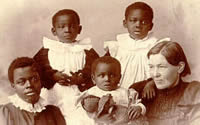
The story is told of how she stood her ground against a local gang, who swung a metal weight on a string closer and closer to her face. This stalwart young woman defied the gang by obtaining their agreement that, should she not flinch, then all her tormentors would join the Sunday School class. Mary triumphed, and gained experience which she would later exploit in her contacts with even more threatening tribes in a distant land. Strangely, although entranced by the accounts of work in Nigeria outlined in the “Missionary Record”, this courageous woman doubted her own ability to perform similar deeds, describing herself as “wee and thin and not very strong”. Eventually, however, she applied to the Foreign Mission Board of the United Presbyterian Church, effectively offering her life to the people of the Calabar region. After a brief period of training in Edinburgh, Mary set sail in the S.S. Ethiopia on 5th August 1876, and arrived at her destination in West Africa just over a month later. She was 28 years of age, red haired with bright blue eyes shining in enthusiasm for the daunting task ahead. Some of the old hands in Calabar might have been excused for questioning whether she would last her first full year. Portuguese mariners first visited the present day Nigeria in the 15th century to pursue trade with the kingdom of Benin, which straddled the land between Lagos and the Niger delta. By the year 1811, Wilberforce’s great anti-slavery reforms started to take effect, and so the slave trade, which had disrupted society and government, finally began to crumble. In 1861, Britain seized Lagos in order to preserve her trading interests, the first of a series of colonial initiatives which led to the establishment of the Nigerian Protectorate in 1914. When Mary Slessor arrived, she was to witness one of the most turbulent periods in the history of this process. The culture and customs of her new flock are well described in Charles Partridge’s book, “Cross River Natives”. Witchcraft and superstition were prevalent in a country whose traditional society had been torn apart by the slave trade. Human sacrifice routinely followed the death of a village dignitary, and the ritual murder of twins was viewed by the new missionary with particular abhorrence. Her dedicated efforts to forestall this irrational superstition were to prove a resounding success, as photographs of Mary with her beloved children testify. In this primitive society, women were treated as lower than cattle, and Mary was so successful in raising their standing in society that she may be considered as one of the pioneers of women’s rights in Africa. She also became fluent in the Efik language, so that she might use humour and sarcasm to reinforce her arguments. Unlike most missionaries, she lived in native style and became thoroughly conversant with the language, the culture and customs, and the day-to-day lives of those she served so well. Unfortunately it was dangers other than those from aggressive natives and wild animals that faced missionaries from a relatively healthy Western European environment. It was not until 1902 that Sir Ronald Ross was awarded the Nobel Prize for his work on the Anopheles mosquito and its role as a host for the deadly malarial parasite. This knowledge was too late for Mary Slessor and her colleagues. Like lambs to the slaughter, they came to a country with its river mists and overpowering heat, where diseases and infections were legion, and they succumbed in their hundreds to the very fevers from which the modern traveller is mercifully spared. Their average life expectancy was just a few years, and those who survived and returned home often endured recurring fevers and ill-health for the rest of their lives. In letters reproduced here, Mary bravely makes light of her experiences, but the horrors of forty years of debilitating suffering may be clearly discerned through the surface humour and stoicism. In the early years of the 20th century, some remedies and precautions were becoming available, and Mary provided vaccination against the dreaded smallpox, and set up mission hospitals for treating illnesses and injuries suffered by the native peoples. Mary’s dedicated work with the people and her almost total integration with them culminated in an official request by the Governor that she combine her missionary activities with an administrative position as a Member of the Itu Court. Her letters to Charles Partridge chronicle this period of colonial expansion. Roads were being driven into the interior, and military expeditions were starting to make use of motor vehicles. Untold dangers faced all those involved in these hazardous enterprises, and Mary Slessor, though ever keen to discount her own perilous situation, retained a pragmatic attitude to the dangers facing lesser mortals. In one letter she urges that the expedition should include a “Maxim” [machine gun].
She was constantly urging the Foreign Mission Board in Edinburgh to finance extensions of her work in the interior. The trading markets which she had enthusiastically encouraged attracted people from far afield, and her attempts to reach out to them were the natural consequences of these contacts. Gradually the money was forthcoming and, as new missionaries took over responsibility for the posts vacated by Mary, she was able to move ever further into the heartland. Her courage in braving the hostility provoked by these incursions is legendary.
The recurring illnesses and general hardships which she faced as a matter of course all took their toll on this redoubtable woman. By 1915, her physical strength had greatly declined, and the woman who had once thought nothing of all-night treks through the rain forest was finally reduced to travelling in a hand-cart propelled by one of her assistants. On the 13th January 1915, after an excruciating and prolonged bout of fever, Mary Slessor died. In his biography of 1980, James Buchan described her as the “Expendable Mary Slessor”. Expendable she may have been, but few have given so much of themselves to so many, and under such appalling conditions. The grave of Mary Slessor, marked by an imposing cross of Scottish granite, is in the heart of the country she served so well. She was accorded a state funeral and, in 1953, the new head of the Commonwealth, Elizabeth II, made her own pilgrimage to the graveside. Mary Slessor is still remembered in Dundee, as in her adopted homeland, and there is a growing world-wide interest in her work.
The finest tribute was from those of her own who knew her best. To them she was “Mother of All The Peoples” or, more simply, “Ma”. The collection of Books and Letters and Slessor Source Material in Dundee Central Library’s Local Studies Department and in the City Archives may be viewed during the normal opening hours of the Department. The Mary Slessor Foundation aims to continue the work of Mary Slessor, albeit in modern form.
From a letter written by Miss Slessor acknowledging a parcel of work from St. Luke’s, Montrose.
Our Administrator has just come back from Britain after furlough, and has brought with him a phonograph, a magnificent instrument, and a number of grand old hymns - e.g., “Holy, holy, holy!” “Abide with me, ” etc., and on Sunday night he gave the village a great treat by having this at the service. We also hung a sheet up, and filled the lamp, and gave an exhibition of several Scriptural slides on the screen. It was all done without any forethought, but it proved a great success; the Court House was crowded. The hymns and bits of addresses were interspersed, and I spoke into the “trumpet” the parable of the Prodigal (Luke xv.)[Note]; and it was reproduced twice over in a trumpet tone. The audience was simply electrified. That parable has gone on to be reproduced all over the Ibibio towns where our Administrator will be going on his civilising and governing tours. Is it not grand? It seems like a dream! It has opened up new ideas of means and possibilities for service. A person with means could get the Gospel carried round like that, when he or she could not speak a word of the language. It is so marvellous: every sound reproduced! Even the little halt I made to remember a word came; the people could not keep down their delight and wonder. The Administrator himself marvelled at the stride from the unbroken heathenism of this place twenty months ago to a service in which young and old took part with intelligent interest and reverence; and he added some words of instruction and advice, and recommended the Gospel to their acceptance. Oh, it was a red-letter day! I am so cheered by it all, for I had not noticed myself, being always there, the difference a stranger sees. Pray that the power of the Spirit may come to carry saving knowledge to their hearts.
Now about the new hospital at Itu. I was there three weeks ago at the Communion, and saw the hospital for the first time. It is truly a noble gift. God bless the giver! May his reward be even now in his own soul, granted according to the royal measure of God! What comfort to a weary, suffering body speaks out from each of those appliances, and from that cool, clean, quiet building! I think the doctor will keep one of the sections for white people, and I would like very well to be a patient myself for a week under such circumstances. Oh, the infinite difference and distance between Christianity and heathenism! Thank God for what the Gospel has done for the bodies as well as for souls!
GD.X.260.19xi
An account of a meeting held in the Assembly Hall, ? Edinburgh prior to Miss Slessor’s return to Calabar. A plea for more personnel to help with the mission work in Calabar, and for prayer, is made by Miss Slessor, together with Miss Peacock and Miss Reid.
From the Women’s Missionary Magazine of November 1907?
Miss Slessor’s Return to Darkest Africa.
A farewell meeting to Miss Slessor was held in the Assembly Hall on the evening of 7th October, presided over by Dr.Robson, Miss Peacock and Miss Reid being also present.
Miss Peacock told how the burden of the unreached parts of Calabar had weighed upon her and her colleagues. As the home Church held out no hope of support, Miss Slessor had offered a native house at Ikotobon, and she and Miss Reid went there last March to work among the Ibibio people, who are a race very far down, physically, morally, and spiritually. They started a school for the men and boys. One lad, Efiong, has become a new creature in Christ Jesus. On being asked how it was that he became a Christian, he replied, “I don’t know, but I heard the gospel, and God just showed me and I believed.”
Miss Reid described the sad down-trodden look in the faces of the women, and recalled to us the fact that these are our sisters. One woman, who had been helped with medicine, clasped her hand and said, “The God of Efiong bless you.” She knew nothing about the God of Abraham, but knew that the God who had changed the life of that lad must be good.
On rising to speak Miss Slessor met with a very hearty reception. She began by saying it was not a weak cause that they had come to plead. There have been sixty years of work in Old Calabar. The second chapter of the history of the Mission is to be written now. God has had to employ the British Government to do what we could not do; and the British soldiers have been humane. patient, and tactful with the natives. Had it not been for the work of the Church, they could not have done what they have; and they will never hold the country without gospel light. Itu was the slave-market and was kept by the north-country people. The soldiers penetrated beyond. All honour to our soldiers; they deserve our prayers as well as our criticism. The Governor had asked again and again, “Why don’t you move in?”
Miss Slessor went on to tell how a deputation of the natives waited upon her and said, “We are going to sit down till you come with us; we have money laid aside, and you must come.” She engaged a boy and went up to Itu. The women especially came crowding in to the worship. These women became Christians and have been true missionaries; outspoken in their devotion to Christ. There is now a congregation testifying for Christ. Miss Slessor then told of the call to Arochuku. Two missionaries went up to a village and took a boy with them. He is now the head of the Church there. From this work in Arochuku six congregations have sprung, five of them have Christian men and women, the sixth has been taken up by Miss Reid and Miss Peacock. In a country like that, women must go first, not men. Wherever a punitive expedition has been, the natives will not believe in men, they plead for women.
Miss Slessor told of a Christian man who had presented twenty-seven children of his own for baptism the day he was baptised himself. Another man came up once to Arochuku asking Miss Slessor to follow him to his home. She went up with Mr Wilkie. He took them into his semi-European house with a court, in which stood a table and chairs. They sat down, and a box was brought forward in which were some books, a Bible, catechism, an ink bottle, etc. They asked whose box it was. “My boy’s,” was the reply. “Where is your boy?” “My boy is dead. I had a son, and I thought he would bury me when I was dead. There is nothing I have left undone. I got Christian traders to come in and teach him, and I got another boy taught with him to keep him company. I want God” the man continued fiercly, “and you won’t leave me till I find Him.” Miss Slessor said, “Oh, father, God is here! He is waiting for you.” Half-an-hour later a silent company went away, but the man got God: of couse he did. Now he is a Christian. He has twins living there that he has taken in from Ibibio. The gospel is the power of God unto salvation to every one that believeth.
We hold the money and the power, and we hold everything, and what are we going to do with that great land? It is not twenty men or a score of women that we want; it is a host to take possession of it for Christ. This is a new opportunity. Something more than money is wanted, and a kneeling prayer of a few monutes twice daily. We have not learned to pray yet. If we had a praying people we would have a missionary Church and a victorious Church. The Church will have to set times apart just for praying, and keep on. The command is, “Teach them to observe all things whatsoever I have commanded you.” Teach them by prayer and by the power of the Holy Ghost. If we are in living union with Christ, the men and women and money will come. May it be that Calabar will be marvellously helped by the faith and love of the Church.
Mrs. Duncan M’Laren said Miss Slessor’s dauntless spirit was clamouring to be back in Africa. Africa claimed her, and for Africa she was eager to labour on to the end. We were there not to praise her, but to praise her Lord, the Lord who has guided her, and whose gift she is to our Church, and who has kept her through manifold dangers safe to this hour. There are times when the beckoning hand is seen, when the voice is heard distinctly, “Speak unto the children of Israel that they go forward.” There are also times when it needs the God-given vision to see the guiding hand. We feel that our friend has this vision, and she at least has not been disobedient to the heavenly vision. We all feel humbled when we hear what she and her brave colleagues have done. Do we not feel that we must make a great change in our policy after this night?
We say farewell to Miss Slessor, praying to God that it may indeed be a “faring well” with her to the end of the journey. May we so hold the ropes that when she comes again bringing her sheaves with her, we may in a humble measure rejoice with her. In God’s keeping we may safely leave her, praying that the Lord may preserve her going out from this time “even for evermore.”
Enthusiastic meetings in connection with Miss Slessor’s return to West Africa, and the forward movement there, have also been held in Glasgow and in Aberdeen.
http://www.dundeecity.gov.uk/slessor/
GD.X.260.19i
This would appear to be part of a letter by Miss Slessor telling of the unusually happy outcome after the birth of twins in a nearby town.
Article from the “Women’s Missionary Magazine”, May 1901 or 1907, page 109. It includes a photograph of “A Rescued Twin”.
Triumphing over Superstition by Miss Slessor, Okoyon
My heart has been singing, and has been so light these days that it has been like renewing my youth. Three weeks ago a messenger came from a place where I have not worked much, because it so far off, to tell me that twins had been born there, and to ask me to go and take them away. The people of that place had been the last to give up marauding and old customs. I sent Mana and Janie to try and help the mother and save the bairns; when they came back with a bonnie baby boy, and the news that the other twin, who had died, had been decently buried by the father, that the latter was sitting near the mother, and had made a comfortable place for her, and that when she was stronger, she might come to see her baby, we were all cheered.
The mother had formerly lived near our old home, and had heard the Gospel. Her husband is a young chief whose half-brother is a member of our native court of justice. He is good-looking, and evidently has a mind of his own, and is wishful to give up the ways of Okoyon, and learn the new ones. He drinks rum, but I have not come into “close grips” with him about that yet, for, from infancy, drink is to these people like their food, and only the Spirit of God can convince of sin and implant loathing for it.
My surprise, almost consternation, can be imagined, when I heard that he was at the back door with his wife, and wished me to go to him, as he did not wish to face Okoyon - my yard in front being crowded with people. When I went round I found the couple sitting in an outhouse, where Mana had taken them to rest, and, after greetings, the husband said, “Ma, I have come with Arigi to see our child, Efik Idiom, will you bring him to us?” When he was brought, the mother held out her arms, and the father rose and bent over him. I put the child into his arms, and he held him. It was not a scene for words!
The couple, their children and slaves, stayed in the outhouse, tidied it up, and improvised partitions and doors. They lived just like white Christians, and were delighted and never wearied of the bairns, and the preaching. The father stayed for four days, then went home for a day or two, and came back.
When I called for the heads of the houses to which Etok and his wife belong, we had a most interesting meeting. I spoke to them not as a white woman, but as a mother, and said that they ought to take my advice and keep their twin mothers and children, without the use of force from the Consul. I reasoned about the evils of the old customs from every point of view; the goodness of God in sending the Gospel to them before he sent the Consul; and lastly, and most strongly, about the relation of human life to God’s creating, and especially His redeeming sovereignty. When I asked them to express their opinions, there was only a silence, that became unbearable in its intensity. I broke it, and begged them to let me know what was in their hearts. I told them that I would stand by the parents and their right to take their children home, and that no one must forbid friends to visit them should they wish to do so, and that if trouble or calamity befell them, and they dared to blame the twin house-hold for it, I would stand by the innocent.
The old chief of the town and district kept his head in his hands. When I proposed to him that he should come out of the wood into the daylight, and look on the sunlight of God’s love, his face broke into a wintry sort of smile, and he said, “Ma, what can I say? I have nothing to answer you, you have given your advice and commands, and I can only obey them.”
The tension was broken, and relaxed into talk, but the old chief rose and went away without having spoken to the father or to anyone, except “goodbye” to me. The young men spoke to the father, however, but not one asked to see or speak to the mother. Her people have been taught, and they went to her, and sat outside. They said that they did not wish their woman to make strife in Okoyon, but if her husband wished to keep her, they had nothing to say, they would not cast her off or hinder her nursing the child.
Mana and Janie went home with the father, and mother, and baby, and had a little meeting with the household. I gave Etok a parcel of clothing for every wife and child in the house, as well as for Arigi and her baby. All were made alike, so that the home-going might make a break in the tension of fear and jealousy, the mingled and doubtful atmosphere of a heathen home. I had told Mana to read the 91st Psalm, and to speak about the safety of the Christian. When she came home, she said that she “was surprised till all the strength left her body,” when she saw Etok go deliberately to the altar and lift “the plates of god” and the broken dishes, etc., and carry them all to the back-yard. He said, “Now I have done with Okoyon! I will pray to the God of heaven, and, whatever comes, I have done it, and I mean to stand by it. God will help me!”
Etok and his household live near Akom. Is it her prayers that are being answered thus? “I will make all the places round about My hill a blessing.”
GD.X.260.19xiv
This is an account of a tragic occurence when two parents brought a dead child, and their intense grief, to Miss Slessor, who did her best to solace them.
An article from the Women’s Missionary Magazine of March 1909?
A Pathetic Incident by Miss Slessor
A very pathetic incident occurred the other day. A woman came asking one of my girls to “come out and see.” The girl first went to see herself, as I had a poultice on my leg and was resting it. She came and said: “Oh, ma, you come, a poor woman and her husband are here to say that one of their children died two or three days ago, and one has died this morning, and what are they to do – could they ask any one, or could it not be reversed?” As a faint is called death, I did not know for a minute how to take it, as it meant to them that witchcraft was in it. I said: “Jane, go you and speak to the poor creatures, and try to guide them to comfort and light, and come and tell me how it stands.”
She came back with tears in her eyes, saying: “Ma, come yourself, I can’t say anything; they have the baby with them. ”So I hirpled [Note] out and found as pathetic a group as can be pictured - the father, a mere lad, in the front, with a child over his shoulder, and a cloth covering it; the mother, dazed and broken, holding out both hands to me, and crying : “Ma, help us;” a group of silent men and women in the background, wiping their tears away, and looking to see whether the white woman could do anything. What could I do? I said: “Come, my child, give me your baby,” and he laid the poor, dirty, unlovely, unclothed child in my lap. No loving hand had cleansed the poor wee mouth, or taken off the various layers of “medicine” which had been plastered over the little head and face and neck. Her beads were on her waist and arms, and elsewhere. It was death, in all its natural repulsiveness, stripped of the sweetness of Christian love, and the hope of immortality, which makes “their very dust dear” to His people; and instead of the hush of the chamber at home, where all of our humiliation is hidden away, there were the glare of tropical sunshine, the presence of all and sundry, and the long six miles’ journey back again to the miserable hut, which makes all they know of home.
You can hardly realise how difficult it is to find words to meet such a sorrow to heathen parents. It is such a blank, such a gulf, and our God has no tender, loving associations with home and childhood to them, who only know of God as a demon to be placated in any way possible. I was just led to speak to them of a great sorrow I had years ago, when I lost four boys in one month; and as I told the story, and from that led them on to what was my comfort, and what alone could be theirs, we came to a point where all broke down, and Jane took the cloth and laid the baby in it and wrapped it up. The poor father said: “Thank you, Ma; thank you, our mother,” and he put his dead baby over his shoulder and turned to go, the women holding the poor mother in her agony.
How little those who lightly throw it aside realise what they owe the Gospel. May God in His mercy save us from ever becoming a Christless nation exalted to heaven! May the fate of other Churches and nations who forget God never be ours.
GD.X.260.19xiii
This article recounts the sad scene of the funeral of an African child. Her thoughts on this cause her to meditate on Revelation Chapter 21, Verse 4: “And God shall wipe away all tears from their eyes; and there shall be no more death, neither sorrow, nor crying, neither shall there be any more pain: for the former things are passed away.”
From the Women’s Missionary Magazine of July 1908?
No More Sorrow by Miss Slessor, Use, Calabar
We have to start early for the services on Sabbath morning, as we go far over the hills, and it is stony land and hard to manage - the cycle is no use then. Even before we reach our destination the sun is high. On entering the first town, we met a woman who told us, so and so’s child is dead, and there, sure enough, were the mourning women round the door, and the little grave dug at the door-step. Pushing in among the sweating, howling crowd, I asked for the mother; then the wailing ceased. I found her in a dark corner. She had fainted. After a little she recovered, and her first conscious wail was “my boy, my boy!” By-and-by the wee laddie was brought out, just held in his mat. I opened it to see him, and there was the poor emaciated body with swollen head in all the hideousness of disease and dirt, to be hidden from the sight of the people. The grave was far too short, and rather than desecrate the poor wee body, I made them make it longer, and they laid him down to do this just as if he had been a piece of goods; then they laid him in, and threw on the earth less than a foot from the top soil. There was no want of tenderness either, for the women again burst forth with wailing. His own father threw on the earth, and the women after we had gone took the poor mother away to cheer her and remove the grave from her sight. It was all they could do.
As I went from village to village the memory of this scene coloured all my outlook. It led me to take as my subject Revelation xxi, 4: no more pain, no more sorrow, no more death; God wiping the tears from all eyes. But even that great assurance could not lift the sadness, the terrible squalor, the utter hopelessness of these crowds of sister-hearts. Then there came comfort. It was if He said, “I do not wish you to be ignorant of what I am working out in all the mystery of sin and suffering. It is not My fault that you do not know, it is your own capacity that is wanting, but that too is coming. You do not need to wait for heaven, it is coming daily as your horizon widens, and day by day you will know better and more.”
Then the dark side passed out of sight, and brighter and grander things came into view. The sweetness of a summer breeze seemed to come over me, and the quiet, holy, perfumed, flower-laden atmosphere of the Christian home came before me, with all the earthly and the perishing parts transmuted into the heavenly. The valley was illumined by the Resurrection and the Life Himself, and He seemed to put His hand on me. Restfulness seemed to come then, and it covered all things and received all things into itself. The Glory even covered all that sweating, dirty, shrieking mass of womanhood I had left, and the poor, little body, with all the ravages of sin, unconcealed and unmitigated by covering and cleansing; and His voice hushed my heart into perfect trustfulness, as He seemed to say over and over again, “What I do thou knowest not now; but thou shalt know hereafter.”
GD.X.260.19v
This article gives a full description the dedication of the new church at Akani Obio, which was held with prayer, hymns, and tact and cheerfulness, and with a good collection. There was a deputation from another place begging for a church in their town, which she had visited the previous Friday. She is also planning a visit to Akani Obio where a lad from the Itu church was working.
An article from the Women’s Missionary Magazine of April 1905?
The Awakening up the Cross River, by Miss Slessor.
I have been up the creek to the farthest town. I cannot pretend to tell you about the dedication of the church at Akani Obio, up this lovely little sub- creek, because there was that subtle something which will not be caught by language and put on paper, but which is as real as one’s very personality, pervading all the service and all the atmosphere, lifting one into something like an upper chamber, separated from all the mists and wrangle of this world. All the chiefs from the district were invited, and the hospitality was so lavish, and yet so chaste and even refined - such a lesson to the heathen from one of themselves, living under the same circumstances. Grace does so much for the human as well as for the spiritual side of us! Truly there is no refinement so thorough or so true as that springing from converse with Christ.
Mine host was dressed with care, in a black suit, black silk necktie, and soft felt hat. His wife was also neat, and her yard and his house as fit for my comfort as for that of the native – that says something for a man who two years ago was a heathen, in a place which was not known to any but trader natives.
At the dedication the scholars sang, and there was prayer, and everything that there would have been in a home church under the circumstances, and yet I know that not one heathen chief felt uncomfortable or “out of it,” it was done with such tact, and cheerfulness, and meekness. It was just, “Stand still, and see the salvation of our God,” for it it was not of our doing, except in an indirect manner. If you had seen my host’s intelligent behaviour at the prayers and service, you would have been surprised. He said to me: “Some men have their women-folk dragging them back, but God has been good to me, and my women, small and big, are eager, and if they have one rod[Note 1], or if they have ten, they give it gladly to God’s work.” He is a very stern disciplinarian, too – a born ruler, and is chosen by the Consul as president of the Court.
A bottle with coins, and a paper with the names of the ruling chiefs, and the ministers in the Mission, the three missionary magazines, etc., were buried where the pulpit will be. Their collection was good, and, after I was ready to go, my host came with a Calabar friend, and, with a deal of blushing, held out a handful of florins to me, asking if I would buy some food for myself, as they did not know what kind of food I liked. But, of course, I told him to put them away, and that I had plenty of food lying at Efik.
At the service there were rows and rows of nicely- dressed women with hymn- books, though they do not know their letters, putting their “Amens” in the right place, singing every hymn heartily, and leading off in the Lord’s Prayer, as well as filling the collection plate. It was a tribute to Christianity, for they had the benches, while the men, other than chiefs, had only logs and the ground to sit upon. May all those women be won really for Christ. They need our prayers, for Satan tries hard to spoil the work. Some of their tribe do not approve at all, as no Egbo[Note 2] or funeral rites can live.
A deputation was there from a bigger town further on. Two men were begging with heart and soul for a start for God’s Word and a church in their town; but the old chiefs do not like to be second, and they would do nothing. Nevertheless, those who wanted God met Sabbath after Sabbath and held service. I sent word to them to send a canoe for me, and I went up on Friday last. The old chiefs told me in open palaver their reasons for not going in with the few young and “half slave;” and, with as much tact as possible, I tried to meet both views, with just a scintillation of blame for each: and the starting of church building is to take place at once, and, I think, on a lasting basis, but the question of a school is left over for the present. The two old men are very affectionate in their manner to me, and the church party are jubilant at the victory so easily gained. I charged them to walk and speak with meekness, and so win those without.
I also met a section of people at Akan Obio, among whom an Itu lad has been working. They were not attending church, nor caring for school; but the lad has been here to-day with a present of fish and bananas, and he says both men and women are now turning out well to meeting and church. I hope to go up there this week; they will paddle me in my own canoe.
I have had four women from beyond that same town to-day, with a complaint against it, that the people have taken their fishing grounds and farming land from them. As the case has been in the native Court I can do nothing for them. But I should like to get hold of those women for God. What crowds there are of them, and no one to teach and help them!
EDITORIAL NOTES: 1] Rod = the local currency 2] Egbo = the name of a powerful secret society
| God is never behind time.
If you play with temptation do not expect God will deliver you. A gracious woman has gracious friendships. No gift or genius or position can keep us safe or free from sin. We must see and know Christ before we can teach. Good is good, but it is not enough; it must be God. The secret of all failure is disobedience. Sin is loss for time and eternity. The smallest things are as absolutely necessary as the great things. An arm of flesh never brings power. Half the world’s sorrow comes from the unwisdom of parents. Obedience brings health. Blessed the man and woman who is able to serve cheerfully in the second rank — a big test. Slavery never pays; the slave is spoiled as a man, and the master not less so. It were worth while to die, if thereby a soul could be born again. |