
The great father of the faithful, whose history is so dear to the church in all ages, and whose faith so illustrious, as to have procured for him this most honourable title. The memoirs of this friend of God, as he is called, 2Ch 20:7 Jas 2:23 begin at Gen 9:26 and run through the whole of Scripture, like a golden thread, from end to end. The distinguishing honour put upon this man, in depositing the covenant in his seed; and the change of name thereupon both in him and his wife, are most striking events, andonevery account meriting the most particular attention. Concerning the cause of the former, we can form no certain conclusions upon it. There are indeed no grounds to form any data upon. All must be referred unto the eternal purposes of JEHOVAH, "who worketh all things after the counsel of his own will and pleasure." Concerning the latter, we can trace somewhat very sweet and interesting, of the Lord’s approbation of his servants, both in the man and his wife, by the change of name. I shall beg to offer a shortobservation upon it.
The original name of Abram was truly honourable, meaning, in the compound of the word Ab, father, and Ram, exalted; a father of eminency or exaltation. But when the Lord added the Ha to it, and made it Abraham, this became still more honourable; for his name now, in the literal sense of it, was, a father of many nations. And all this became greatly increased in point of honour, on account of the covenant entailed on Abraham’s seed, even Christ, See Gal 3:16 from whom, and in whom, all the nations of the earth were to be blessed.
But there is yet. another purpose which the Lord accomplished in the display of the riches of his grace, by this change of name: and which, if I mistake not, (the Lord pardon me if I err) seems to have been the Lord’s great design, in this act of mercy and favour shewn both to the patriarch and his wife; namely, by this alteration, or rather addition given to each; by one of the letters which form the incommunicable name of JEHOVAH. By this express act of divine grace, Abraham and Sarah, both possessed in their name aneverlasting symbol, or token of JEHOVAH’S glorious favour. And I am the more inclined to this belief, because, in the instance of Jeconiah, in an after age of the church, the Lord manifested his displeasure to this man, by taking from his name one of those distinguishing letters of JEHOVAH, and calling him Coniah, a "despised broken idol." (Compare Jer. 23. 24 - 30, with I Chron. 3: 16.) I beg the reader to observe, that I do not presume to speak decidedly on a point of so high a nature; I only propose the thought, and thatwith the most profound reverence.
May I not venture to suggest, that perhaps it was on this account, of the honour done to their father Abraham’s name, by taking into it a part of JEHOVAH’S, that the children of Abraham, in every age of the church, have been so anxious to call their descendants by names, which either took in some of the letters of JEHOVAH’S name, or had an allusion to the Lord. This is so visible a feature, in almost all the Jewish names of the Old Testament, that we meet with very few among the pious Israelites where this respect is not had, in the choice of their children’s names, through the whole Bible.
I cannot dismiss these observations on Abraham’s name until that I have requested the reader to connect with the review, the sweet consideration, that all true believers in Jesus take part in the same. They have a new name given them, as well as Abraham their father, when, like him, they are by regeneration made "new creatures in Christ Jesus." They are interested in all the rich promises of God in Christ; and being Christ’s children, by adoption and by grace: then are they "Abraham’s seed, and heirs according to the promise." I pray the reader to turn to the following Scriptures by way of confirmation. Rev. 2: 17. 2 Cor. v. 17. Gal. 3: 7 - 29. Rom. 4: 16.
I know not how to turn away from this subject, concerning our great father Abraham, who in any, and in every view, opens a constant source for improvement, without offering a short observation more, in respect to that circumstance in his life, when compelled by famine to go down into Egypt, he begged Sarah to call herself his sister, and not his wife. We have the account of it in its own beautiful simplicity related to us, Gen. x2: 9. to the end. I beg the reader to turn to the Scripture and peruse it over. And when he hath sodone I request him to attend to a short observation which I would offer upon Abraham’s conduct, in this particular.
It certainly doth, in the first view of things, appear strange, that the great father of the faithful should have had upon this occasion his faith so slender, that he became alarmed for the safety of his wife’s chastity, when he had before this, at the call of God, come out from his father’s house, "not knowing whither he went." (Heb. xi. 8.) He had strength of faith to trust God for every thing respecting himself; yea afterwards, even to the offering up his only son: and yet he could not, when driven by famine into Egypt, trust to God’swatchful care over Sarah. But we shall discover, that in this instance of danger respecting his beloved Sarah, humanly speaking, there was no possibility of her escaping with her chastity, unless the Lord accomplished her deliverance by a miracle. Sarah was exceedingly fair, we are told, and her beauty would soon be known (as we find it was) to the prince of the country, on their arrival at Egypt. Instantly she would be seized upon for Pharaoh’s haram. And this was literally the case. In vain would be abraham’s remonstrances, or the humblest petitions. If he had said, She is my wife, his death would have immediately followed. But if he said, She is my sister, his life would be spared. And in this case, even then nothing short of the Lord’s interposition could restore to him his beloved Sarah again. This therefore he hoped. And here Abraham’s faith became as illustrious as before. The patriarch had grounds to hope it. Necessity, and not choice, had driven him down into Egypt, that he might not perish by the famine. And beinginthe path of duty, and no doubt, constantly in the path of faith and prayer; the whole terminated at length to the divine glory, and to his faithful servant’s happiness. And when Sarah was taken, and separated from him: when no possibility of communication between Sarah and her husband was found: locked up in the haram of Pharaoh, from whence there could be no escape, (according to the custom of those Eastern courts, during the life of the prince, the women of the haram being confined there never to get out, )herewas a season for the exercise of faith, and for the display of the Lord’s favour to his servants. And the way the Lord wrought on the occasion, is as remarkable, in proof of his interposition, as the patriarch’s faith in exercise. "The Lord plagued Pharaoh and his house with great plagues, because of Sarah Abraham’s wife." (Gen. x2: 17.) And so the Lord overruled the visitation, as to give a voice to the rod, and cause the prince very gladly to give up Sarah, unviolated, to her husband. So that when the whole subject is properly considered and taken into one complete view, so far was the faith of the patriarch from being lessened by the exercise, as in the first blush of the history it seemed to appear, that by the means Abraham adopted, he still threw himself with confidence on the Lord, to save his beloved Sarah from ruin, and his life from danger; and without this trust in the Lord, and dependence on the Lord’s interposition, Abraham could not but well know, that whether he had called Sarah, sister, or wife, the peril was the same. If it be said, (as ithas been said) but wherefore did the great father of the faithful make use of a falsehood in this instance? might he not have told the truth, and with more confidence still looked up to God for the issue? To which I answer. Certainly, truth at all times, and upon all occasions, is most closely and faithfully to be followed up, leaving it with the Lord to make all things minister to his own glory, and to his people’s welfare. But it should be observed, that though upon this occasion, the patriarch did not tell the whole truth, he told no falsehood. Sarah was his sister, as well as his wife. If the reader will turn to the twentieth chapter of Genesis, and peruse a similar situation, into which Abraham and Sarah were afterwards brought at Gerar, he will there behold the patriarch’s modest apology for calling his beloved Sarah his sister, rather than his wife. When Abimelech, the king of Gerar, remonstrated with Abraham for calling Sarah sister, and not wife, and said, "What sawest thou, that thou hast done this thing?" Abraham answered, "Because I thought, Surelythe fear of God is not in this place; and they will slay me for my wife’s sake. And yet indeed she is my sister; she is the daughter of my father, but not the daughter of my mother: and she became my wife." (Gen. xx. 10 - 12.)
But what I am more particularly earnest to impress upon the reader’s mind, respecting this history of Abraham, (and indeed the sole purpose for which I have introduced the subject in this place) is, that the act itself was founded in faith and reliance upon the Lord. The patriarch had not recourse to mere human policy, without first throwing himself on divine aid. Abraham was well aware of his critical situation. He knew the danger to which both himself and Sarah would be exposed. He therefore used what he thought the besthuman means: but he certainly was all the while relying by ardent faith on the Lord. And let it be remembered, that in those journies the patriarch was prosecuting, they were by the Lord’s command, and not Abraham’s pleasure. So that the same faith which first prompted him, at the call of God, to leave his own country, and his father’s house, and, as the Holy Ghost testifies of him, "by faith he went out, not knowing whither he went;" (Heb. xi. 8.) the same perfect reliance upon the Lord went with him all the way. Howbeautifully the patriarch accounts for this, as well as his whole conduct in calling Sarah his sister, and she calling him brother, in the close of his apology to Abimelech! "It came to pass, when God caused me to wander from my father’s house, that I said unto her, This is the kindness which thou shalt shew unto me; At every place whither we shall come, say of me, He is my brother." (Gen. xx. 13.) What a sweet and interesting tale the whole forms! I beg the reader’s pardon, for the length I have made of it; and shall nowleave it to his own judgment, under the hope of divine teaching concerning it, from the Lord.
Ab´raham (father of a multitude), the founder of the Hebrew nation. Up to Gen 17:4-5, he is uniformly called Abram (father of elevation, or high father); and this was his original name; but the extended form, which it always afterwards bears, was given to make it significant of the promise of a numerous posterity which was at the same time made to him.
Abraham was a native of Chaldea, and descended, through Heber, in the ninth generation, from Shem the son of Noah. His father was Terah, who had two other sons, Nahor and Haran. Haran died prematurely ’before his father,’ leaving a son Lot, and two daughters, Milcah and Iscah. Lot attached himself to his uncle Abraham; Milcah became the wife of her uncle Nahor; and Iscah, who was also called Sarai, became the wife of Abraham (Gen 9:26-29) [SARAH].
Abraham was born A.M. 2008, B.C. 1996 (Hales, A.M. 3258, B.C. 2153), in ’Ur of the Chaldees’ (Gen 11:28).
Although he is, by way of eminence, named first, it appears probable that he was the youngest of Terah’s sons, and born by a second wife, when his father was 130 years old. Terah was seventy years old when the eldest son was born (Gen 11:32; Gen 12:4; Gen 20:12); and that eldest son appears to have been Haran, from the fact that his brothers married his daughters, and that his daughter Sarai was only ten years younger than his brother Abraham (Gen 17:17). Abraham was 60 years old when the family quitted their native city of Ur, and went and abode in Charran. The reason for this movement does not appear in the Old Testament; but it is mentioned in Act 7:2-4: ’The God of glory appeared to our father Abraham while he was (at Ur of the Chaldees) in Mesopotamia, before he dwelt in Charran, and said unto him, Depart from thy land, and from thy kindred, and come hither to a land which Iswill shew thee. Then departing from the land of the Chaldees, he dwelt in Charran.’ This first call is not recorded, but only implied in Genesis 12, and it is distinguished by several pointed circumstances from the second, which alone is there mentioned. Accordingly Abraham departed, and his family, including his aged father, removed with him. They proceeded not at once to the land of Canaan, but they came to Charran, and tarried at that convenient station for fifteen years, until Terah died, at the age of 205 years. Being free from his filial duties, Abraham, now 75 years of age, received a second and more pointed call to pursue his destination: ’Depart from thy land, and from thy kindred, and from thy father’s house, unto the land which I will shew thee’ (Gen 12:1). This second call required the patriarch to isolate himself, not only from his country, but from his family. He however took with him his nephew Lot, whom, having no children of his own, he appears to have regarded as his heir, and then went forth ’not knowing whither he went’ (Heb 11:8), but trusting implicitly to the Divine guidance.
When Abraham arrived in the land of Canaan, he found it occupied by the Canaanites in a large number of small independent communities, which cultivated the districts around their several towns. The country was however but thinly peopled; and, as in the more recent times of its depopulation, it afforded ample pasture-ground for the wandering pastors. In their eyes Abraham must have appeared one of that class. In Mesopotamia, though the family had been pastoral, they had dwelt in towns and houses, and had sent out their flocks and herds under the care of shepherds. But the migratory life to which Abraham had now been called, compelled him to take to the tent-dwelling form of pastoral life. The rich pastures in that part of the country tempted Abraham to form his first encampment in the vale of Moreh, which lies between the mountains of Ebal and Gerizim. Here the strong faith which had brought the childless man thus far from his home was rewarded by the grand promise from God:—’I will make of thee a great nation, and I will bless thee and make thy name great, and thou shalt be a blessing; and I will bless them that bless thee, and curse them that curse thee: and in thee shall all the families of the earth be blessed’ (Gen 12:2-3). It was further promised that to his posterity should be given the rich heritage of that beautiful country into which he had come (Gen 12:7). The implied condition on his part was, that he should publicly profess the worship of the true God, and accordingly ’he built there an altar unto the Lord, who appeared unto him.’ He soon after removed to the district between Bethel and Ai, where he also built an altar to that ’Jehovah’ whom the world was then hastening to forget. His farther removals tended southward, until at length a famine in Palestine compelled him to withdraw into Egypt, where corn abounded. Here his apprehension that the beauty of his wife Sarai might bring him into danger with the dusky Egyptians, overcame his faith and rectitude, and he gave out that she was his sister. As he had feared, the beauty of the fair stranger excited the admiration of the Egyptians, and at length reached the ears of the king, who forthwith exercised his regal right of calling her to his harem, and to this Abraham, appearing as only her brother, could offer no resistance. As, however, the king had no intention to act harshly in the exercise of his privilege, he loaded Abraham with valuable gifts, suited to his condition, consisting chiefly of slaves and cattle. These presents could not have been refused by him without an insult which, under all the circumstances, the king did not deserve. A grievous disease inflicted on Pharaoh and his household relieved Sarai from her danger, by revealing to the king that she was a married woman; on which he sent for Abraham, and, after rebuking him for his conduct, restored his wife to him, and recommended him to withdraw from the country. He accordingly returned to the land of Canaan, much richer than when he left it ’in cattle, in silver, and in gold’ (Gen 12:8; Gen 13:2).
Lot also had much increased his possessions: and soon after their return to their previous station near Bethel, the disputes between their respective shepherds about water and pasturage soon taught then: that they had better separate. The recent promise of posterity to Abraham himself, although his wife had been accounted barren, probably tended also in some degree to weaken the tie by which the uncle and nephew had hitherto been united. The subject was broached by Abraham, who generously conceded to Lot the choice of pasture-grounds. Lot chose the well-watered plain in which Sodom and other towns were situated, and removed thither [LOT], Immediately afterwards the patriarch was cheered and encouraged by a more distinct and formal reiteration of the promises which had been previously made to him, of the occupation of the land in which he lived by a posterity numerous as the dust. Not long after, he removed to the pleasant valley of Mamre, in the neighborhood of Hebron (then called Arba), and pitched his tent under a terebinth tree (Genesis 13).
It appears that fourteen years before this time the south and east of Palestine had been invaded by a king called Chedorlaomer, from beyond the Euphrates, who brought several of the small disunited states of those quarters under tribute. Among them were the five cities of the Plain of Sodom, to which Lot had withdrawn. This burden was borne impatiently by these states, and they at length withheld their tribute. This brought upon them a ravaging visitation from Chedorlaomer and four other (perhaps tributary) kings, who scoured the whole country east of the Jordan, and ended by defeating the kings of the plain, plundering their towns, and carrying the people away as slaves. Lot was among the sufferers. When this came to the ears of Abraham, he immediately armed, such of his slaves as were fit for war, in number 318, and being joined by the friendly Amoritish chiefs, Aner, Eshcol, and Mamre, pursued the retiring invaders. They were overtaken near the springs of the Jordan; and their camp being attacked on opposite sides by night, they were thrown into disorder, and fled. Abraham and his men pursued them as far as the neighborhood of Damascus, and then returned with all the men and goods which had been taken away. When the victors had reached ’the king’s dale’ on their return, they were met by several of the native princes, among whom was Melchizedek, king of Salem, which is generally supposed to have been Jerusalem. He was one of the few native princes, if not the only one, who retained the knowledge and worship of ’the Most High God,’ whom Abraham served. This circumstance created a peculiar relation between the king and the patriarch, which the former recognized by bringing forth ’bread and wine,’ and probably other refreshments to Abraham, and which the latter acknowledged by presenting to Melchizedek a tenth of the spoils. By strict right, founded on the war usages which still subsist in Arabia, the recovered goods became the property of Abraham, and not of those to whom they originally belonged. This was acknowledged by the king of Sodom, who met the victors in the valley near Salem. He said, ’Give me the persons, and keep the goods to thyself.’ But with becoming pride and disinterestedness Abraham answered, ’I have lifted up mine hand [i.e.I have sworn] unto Jehovah, the most high God, that I will not take from a thread even to a sandal-thong, and that I will not take any thing that is thine, lest thou shouldest say, I have made Abram rich’ (Genesis 14).
Soon after his return to Mamre the faith of Abraham was rewarded and encouraged, not only by a more distinct and detailed repetition of the promises formerly made to him, but by the confirmation of a solemn covenant contracted, as nearly as might be, ’after the manner of men’ [COVENANTS] between him and God. It was now that he first understood that his promised posterity were to grow up into a nation under foreign bondage; and that, in 400 years after (or, strictly, 405 years, counting from the birth of Isaac to the Exodus), they should come forth from that bondage as a nation, to take possession of the land in which he sojourned (Genesis 15).
After ten years’ residence in Canaan (B.C. 1913), Sarai, being then 75 years old, and having long been accounted barren, chose to put her own interpretation upon the promised blessing of a progeny to Abraham, and persuaded him to take her woman slave Hagar, an Egyptian, as a secondary or concubine wife, with the view that whatever child might proceed from this union should be accounted her own [HAGAR]. The son who was born to Abraham by Hagar, and who received the name of Ishmael [ISHMAEL], was accordingly brought up as the heir of his father and of the promises (Genesis 16). Thirteen years after (B.C. 1900), when Abraham was 99 years old, he was favored with still more explicit declarations of the Divine purposes. He was reminded that the promise to him was that he should be the father of many nations; and to indicate this intention his name was now changed (as before described) from Abram to Abraham. The Divine Being then solemnly renewed the covenant to be a God to him and to the race that should spring from him; and in token of that covenant directed that he and his should receive in their flesh the sign of circumcision [CIRCUMCISION]. Abundant blessings were promised to Ishmael; but it was then first announced, in distinct terms, that the heir of the special promises was not yet born, and that the barren Sarai, then 90 years old, should twelve months thence be his mother. Then also her name was changed from Sarai to Sarah (the princess); and to commemorate the laughter with which the prostrate patriarch received such strange tidings, it was directed that the name of Isaac (laughing) should be given to the future child. The very same day, in obedience to the Divine ordinance, Abraham himself, his son Ishmael, and his house-born and purchased slaves were all circumcised (Genesis 17).
Three months after this, as Abraham sat in his tent door during the heat of the day, he saw three travelers approaching, and hastened to meet them, and hospitably pressed upon them refreshment and rest. They assented, and under the shade of a terebinth tree partook of the abundant fare which the patriarch and his wife provided. From the manner in which one of the strangers spoke, Abraham soon gathered that his visitants were no other than the Lord himself and two attendant angels in human form. The promise of a son by Sarah was renewed: and when Sarah herself, who overheard this within the tent, laughed inwardly at the tidings, which, on account of her great age, she at first disbelieved, she incurred the striking rebuke, ’Is anything too hard for Jehovah?’ The strangers then addressed themselves to their journey, and Abraham walked some way with them. The two angels went forward in the direction direction of Sodom, while the Lord made known to him that, for their enormous iniquities, Sodom and the other ’cities of the plain’ were about to be made signal monuments of his wrath and of his moral government. Moved by compassion and by remembrance of Lot, the patriarch ventured, reverently but perseveringly, to intercede for the doomed Sodom; and at length obtained a promise that, if but ten righteous men were found therein, the whole city should be saved for their sake. Early the next morning Abraham arose to ascertain the result of this concession: and when he looked towards Sodom, the smoke of its destruction, rising ’like the smoke of a furnace,’ made known to him its terrible overthrow [SODOM]. Almost immediately after, Abraham removed into the territories of Abimelech, king of Gerar, where, by a most extraordinary infatuation and lapse of faith, he allowed himself to stoop to the same prevarication in denying his wife, which, twenty-three years before, had occasioned him so much trouble in Egypt [ABIMELECH].
The same year Sarah gave birth to the long-promised son; and, according to previous direction, the name of Isaac was given to him [ISAAC]. This greatly altered the position of Ishmael, and appears to have created much ill-feeling both on his part and that of his mother towards the child; which was in some way manifested so pointedly, on occasion of the festivities which attended the weaning, that the wrath of Sarah was awakened, and she insisted that both Hagar and her son should be sent away. This was a very hard matter to a loving father; and Abraham was greatly distressed; but being apprised in a dream that this demand was in accordance with the Divine intentions respecting both Ishmael and Isaac, he, with his habitual uncompromising obedience, hastened them away early in the morning, with provision for the journey. Their adventures belong to the article Hagar.
When Isaac was about 25 years old (B.C. 1872) it pleased God to subject the faith of Abraham to a severer trial than it had yet sustained, or than has ever fallen to the lot of any other mortal man. He was commanded to go into the mountainous country of Moriah (probably where the temple afterwards stood), and there offer up in sacrifice the son of his affection, and the heir of so many hopes and promises, which his death must nullify. But Abraham’s ’faith shrunk not, assured that what God had promised he would certainly perform, and that he was able to restore Isaac to him even from the dead’ (Heb 11:17-19), and he rendered a ready, however painful, obedience. Assisted by two of his servants, he prepared wood suitable for the purpose, and without delay set out upon his melancholy journey. On the third day he descried the appointed place; and informing his attendants that he and his son would go some distance farther to worship, and then return, he proceeded to the spot. To the touching question of his son respecting the victim to be offered, the patriarch replied by expressing his faith that God himself would provide the sacrifice; and probably he availed himself of this opportunity of acquainting him with the Divine command. Isaac submitted patiently to be bound and laid out as a victim on the wood of the altar, and would most certainly have been slain by his father’s up-lifted hand, had not the angel of Jehovah interposed at the critical moment to arrest the fatal stroke. A ram which had become entangled in a thicket was seized and offered; and a name was given to the place (Jehovah-Jireh—’the Lord will provide’) alluding to the believing answer which Abraham had given to his son’s inquiry respecting the victim. The promises before made to Abraham were again confirmed in the most solemn manner (comp. Heb 6:13; Heb 6:17). The father and son then rejoined their servants, and returned rejoicing to Beersheba (Gen 23:19).
Eight years after (B.C. 1860) Sarah died at the age of 120 years, being then at or near Hebron. This loss first taught Abraham the necessity of acquiring possession of a family sepulchre in the land of his sojourning. His choice fell on the cave of Machpelah [MACHPELAH], and after a striking negotiation with the owner in the gate of Hebron, he purchased it, and had it legally secured to him. This was the only possession he ever had in the Land of Promise (Genesis 23). The next care of Abraham was to provide a suitable wife for his son Isaac. It has always been the practice among pastoral tribes to keep up the family ties by intermarriages of blood-relations: and now Abraham had a further inducement in the desire to maintain the purity of the separated race from foreign and idolatrous connections. He therefore sent his aged and confidential steward Eliezer, under the bond of a solemn oath to discharge his mission faithfully, to renew the intercourse between his family and that of his brother Nahor, whom he had left behind in Charran. He prospered in his important mission [ISAAC], and in due time returned, bringing with him Rebekah, the daughter of Nahor’s son Bethuel, who became the wife of Isaac, and was installed as chief lady of the camp, in the separate tent which Sarah had occupied (Genesis 24). Sometime after Abraham himself took a wife named Keturah, by whom he had several children. These, together with Ishmael, seem to have been portioned off by their father in his lifetime, and sent into the east and south-east, that there might be no danger of their interference with Isaac, the divinely appointed heir. There was time for this: for Abraham lived to the age of 175 years, 100 of which he had spent in the land of Canaan. He died in B.C. 1822 (Hales, 1978), and was buried by his two eldest sons in the family sepulchre which he had purchased of the Hittites (Gen 25:1-10).
Father of a multitude, {\cf11 \ul Gen 17:4-5}; the great founder of the Jewish nation. He was a son of Terah, a descendant of Shem, and born in Ur, a city of Chaldea, A.M. 2008, B. C. 1996, {\cf11 \ul Gen 11:27-28}. Here he lived seventy years, when at the call of God he left his idolatrous kindred, and removed to Haran, in Mesopotamia, Mal 7:2-4, accompanied by his father, his wife Sarai, his brother Nahor, and his nephew Lot. A few years after, having buried his father, he again removed at the call of God, with his wife and nephew, and entered the land of promise as a nomad or wandering shepherd. Sojourning for a time at Shechem, he built here, as was his custom, an alter to the Lord, who appeared to him, and promised that land to his seed. Removing from place to place for convenience of water and pasturage, he was at length driven by a famine into Egypt, where he dissembled in calling his wife his sister, {\cf11 \ul Gen 12:1-}; {\cf11 \ul Gen 12:20}. Returning to Canaan rich in flocks and herds, he left Lot to dwell in the fertile valley of the lower Jordan, and pitched his own tents in Mamre, {\cf11 \ul Gen 13:1-18}. A few years after, he rescued Lot and his friends from captivity, and received the blessing of Melchizedek, {\cf11 \ul Gen 14:1-24}. Again God appeared to him, promised that his seed should be like the stars for number, and foretold their oppression in Egypt 400 years, and their return to possess the promised land, {\cf11 \ul Gen 15:1-21}. But the promise of a son being yet unfulfilled, Sarai gave him Hagar her maid for a secondary wife, of whom Ishmael was born, {\cf11 \ul Gen 16:1-16}. After thirteen years, God again appeared to him, and assured him that the heir of the promise should yet be born of his wife, whose name was then changed to Sarah. He established also the covenant of circumcision, {\cf11 \ul Gen 17:1-27}. Here, too, occurred the visit of the three angels, and the memorable intercession with the Angel-Jehovah for the inhabitants of Sodom, {\cf11 \ul Gen 18:1-33}. After this, Abraham journeyed south to Gerah, where he again called Sarah his sister. In this region Isaac was born; and soon after, Hagar and Ishmael were driven out to seek a new home, {\cf11 \ul Gen 21:1-34}. About twenty-five years after, God put to trial the faith of Abraham, by commanding him to sacrifice Isaac, his son and the heir of the promise, upon Mount Moriah, {\cf11 \ul Gen 22:1-24}. Twelve years after, Sarah died, and the cave of Machpelag was bought for a burial- place, {\cf11 \ul Gen 23:1-20}. Abraham sent his steward, and obtained a wife for Isaac from his pious kindred in Mesopotamia, {\cf11 \ul Gen 24:1-67}. He himself also married Keturah, and had six sons, each one the founder of a distinct people in Arabia. At the age of 175, full of years and honors, he died, and was buried by his sons in the same tomb with Sarah, {\cf11 \ul Gen 25:1-34}.\PAR
The character of Abraham is one of the most remarkable in Scripture. He was a genuine oriental patriarch, a prince in the land; his property was large, his retinue very numerous, and he commanded the respect of the neighboring people: and yet he was truly a stranger and a pilgrim, the only land he possessed being the burial-place he had purchased. Distinguished by his integrity, generosity, and hospitality, he was most of all remarkable for his simple and unwavering faith, a faith that obeyed without hesitation or delay, and recoiled not from the most fearful trial ever imposed upon man, so that he is justly styled "the father of the faithful," that is, of believers. No name in history is venerated by so large a portion of the human race, Mohammedans as well as Jews and Christians. As the ancestor of Christ, in whom all the nations are blessed, and as the father of all believers, the covenant is abundantly fulfilled to him: his seed are as the stars of heaven and with them he shall inherit the heavenly Canaan.\PAR
\PAR
A’braham. (father of a multitude). Abraham was the son of Terah, and founder of the great Hebrew nation. (B.C. 1996-1822). His family, a branch of the descendants of Shem, was settled in Ur of the Chaldees, beyond the Euphrates, where Abraham was born. Terah had two other sons, Nahor and Haran. Haran died before his father in Ur of the Chaldees, leaving a son, Lot; and Terah, taking with him Abram, with Sarai his wife and his grandson Lot, emigrated to Haran in Mesopotamia, where he died.
On the death of his father, Abram, then in the 75th year of his age, with Sarai and Lot, pursued his course to the land of Canaan, whither he was directed by divine command, Gen 12:5, when he received the general promise that he should become the founder of a great nation, and that all the families of the earth should be blessed in him. He passed through the heart of the country by the great highway to Shechem, and pitched his tent beneath the terebinth of Moreh. Gen 12:6. Here he received in vision from Jehovah the further revelation that this was the land which his descendants should inherit. Gen 12:7.
The next halting-place of the wanderer was on a mountain between Bethel and Ai, Gen 12:8, but the country was suffering from famine, and Abram journeyed still southward to the rich corn lands of Egypt. There, fearing that the great beauty of Sarai might tempt the powerful monarch of Egypt and expose his own life to peril, he arranged that Sarai should represent herself as his sister, which her actual relationship to him, as probably the daughter of his brother Haran, allowed her to do with some semblance of truth. But her beauty was reported to the king, and she was taken into the royal harem. The deception was discovered, and Pharaoh with some indignation dismissed Abram from the country. Gen 12:10-20.
He left Egypt with great possessions, and, accompanied by Lot, returned by the south of Palestine to his former encampment between Bethel and Ai. The increased wealth of the two kinsmen was the ultimate cause of their separation. Lot chose the fertile plain of the Jordan near Sodom, while Abram pitched his tent among the groves of Mamre, close to Hebron. Gen 13:1.
Lot with his family and possessions having been carried away captive by Chedorlaomer king of Elam, who had invaded Sodom, Abram pursued the conquerors and utterly routed them not far from Damascus. The captives and plunder were all recovered, and Abram was greeted on his return by the king of Sodom, and by Melchizedek king of Salem, priest of the most high God, who mysteriously appears upon the scene to bless the patriarch and receive from him a tenth of the spoil. Gen 14:1.
After this, the thrice-repeated promise that his descendants should become a mighty nation and possess the land in which he was a stranger was confirmed with all the solemnity of a religious ceremony. Gen 15:1. Ten years had passed since he had left his father’s house, and the fulfillment of the promise was apparently more distant than at first. At the suggestion of Sarai, who despaired of having children of her own, he took as his concubine Hagar, her Egyptian main, who bore him Ishmael in the 86th year of his age. Gen 16:1. See Hagar; Ishmael.
But this was not the accomplishment of the promise. Thirteen years elapsed, during which Abram still dwelt in Hebron, when the covenant was renewed, and the rite of circumcision established as its sign. This most important crisis in Abram’s life, when he was 99 years old, is marked by the significant change of his name to Abraham, "father of a multitude;" while his wife’s from Sarai became Sarah.
The promise that Sarah should have a son was repeated in the remarkable scene described in Genesis 18. Three men stood before Abraham as he sat in his tent door in the heat of the day. The patriarch, with true Eastern hospitality, welcomed the strangers, and bade them rest and refresh themselves. The meal ended, they foretold the birth of Isaac, and went on their way to Sodom. Abraham accompanied them, and is represented as an interlocutor in a dialogue with Jehovah, in which he pleaded in vain to avert the vengeance threatened to the devoted cities of the plain. Gen 18:17-33.
In remarkable contrast with Abraham’s firm faith with regard to the magnificent fortunes of his posterity stand the incident which occurred during his temporary residence among the Philistines in Gerar, whither he had for some cause removed after the destruction of Sodom. It was almost a repetition of what took place in Egypt a few years before. At length Isaac, the long-looked for child, was born. Sarah’s jealousy aroused by the mockery of Ishmael at the "great banquet" which Abram made to celebrate the weaning of her son, Gen 21:9 demanded that, with his mother Hagar, he should be driven out. Gen 21:10.
But the severest trial of his faith was yet to come. For a long period the history is almost silent. At length he receives the strange command to take Isaac, his only son, and offer him for a Burnt Offering at an appointed place Abraham hesitated not to obey. His faith, hitherto unshaken, supported him in this final trial, "accounting that God was able to raise up his son, even from the dead, from whence also he received him in a figure." Heb 11:19. The sacrifice was stayed by the angel of Jehovah, the promise of spiritual blessing made for the first time, and Abraham with his son returned to Beersheba, and for a time dwelt there. Gen 22:1.
But we find him after a few years in his original residence at Hebron, for there Sarah died, Gen 23:2, and was buried in the cave of Machpelah. The remaining years of Abraham’s life are marked by but few incidents. After Isaac’s marriage with Rebekah and his removal to Lahai-roi, Abraham took to wife Keturah, by whom he had six children, Zimran, Jokshan, Medan, Midian, Ishbok and Shuah, who became the ancestors of nomadic tribes inhabiting the countries south and southeast of Palestine.
Abraham lived to see the gradual accomplishment of the promise in the birth of his grandchildren Jacob and Esau, and witnessed their growth to manhood. Gen 25:26. At the goodly age of 175, he was "gathered to his people," and laid beside Sarah in the tomb of Machpelah by his sons Isaac and Ishmael. Gen 25:7-10.
Abraham ("father of a multitude".) Up to Gen 17:4-5, his being sealed with circumcision, the sign of the covenant, ABRAM (father of elevation). Son of Terah, brother of Nahor and Haran. Progenitor of the Hebrew, Arabs, Edomites, and kindred tribes; the ninth in descent from Shem, through Heber. Haran died before Terah, leaving Lot and two daughters, Milcah and Iscah. Nahor married his niece Milcah: Abraham Iscah, i.e. Sarai, daughter, i.e. granddaughter, of his father, not of his mother (Gen 20:12). Ur, his home, is the modern Mugheir, the primeval capital of Chaldaea; its inscriptions are probably of the 22nd century B.C. The alphabetical Hebrew system is Phoenician, and was probably brought by Abraham to Canaan, where it became modified. Abraham, at God’s call, went forth from Ur of the Chaldees (Gen 11:31-12).
In Haran Terah died. The statement in Gen 11:26, that Terah was 70 when he begat Abram, Nahor, and Haran, must apply only to the oldest, Haran. His being oldest appears from the fact that his brothers married his daughters, and that Sarai was only ten years younger than Abraham (Gen 17:17); the two younger were born subsequently, Abram, the youngest, when Terah was 130, as appears from comparing Gen 11:31 with Gen 12:4; Act 7:3-4; "before he dwelt in Charran
The deluge, the revelation to Noah, and the Babel dispersion had failed to counteract the universal tendency to idolatrous apostasy, obliterating every trace of primitive piety. God therefore provided an antidote in separating one family and nation to be the repository of His truth against the fullness of time when it should be revealed to the whole world. From Jos 24:2; Jos 24:14-15, it appears Terah and his family served other gods beyond the Euphrates. Silly traditions as to Terah being a maker of idols, and Abraham having been east into a fiery furnace by Nimrod for disbelief in idols, were drawn from this Scripture, and from Ur ("fire"). The second call additionally required that, now when his father was dead and filial duty had been discharged, after the stay of 15 years in Haran, he should leave his father’s house, i.e. his brother Nahor’s family, in Haran. The call was personally to himself.
He was to be isolated not only from his nation but from his family. Lot, his nephew, accompanied him, being regarded probably as his heir, as the promise of seed and the specification of his exact destination were only by degrees unfolded to him (Heb 11:8). Nicolaus of Damascus ascribed to him the conquest of Damascus on his way to Canaan. Scripture records nothing further than that his chief servant was Eliezer of Damascus; he pursued Chedorlaomer to Hobah, on the left of Damascus, subsequently (Gen 14:15), Abraham entered Canaan along the valley of the Jabbok, and encamped first in the rich Moreh valley, near Sichem, between mounts Ebal and Gerizim. There he received a confirmation of the promise, specifying "this land" as that which the original more general promise pointed to. Here therefore he built his first altar to God. The unfriendly attitude of the Canaanites induced him next to move to the mountain country between Bethel and Ai, where also he built an altar to Jehovah, whose worship was fast passing into oblivion in the world.
Famine led him to Egypt, the granary of the world, next. The record of his unbelieving cowardice there, and virtual lie as to Sarai
Fourteen years previously Chedorlaomer, king of Elam (the region S. of Assyria, E. of Persia, Susiana), the chief sovereign, with Amrephar of Shinar (Babylon), Arioch of Ellasar (the Chaldean Larissa, or Larsa, half way between Ur, or Mugheir, and Erech, or Warka, in Lower Babylonia), and Tidal, king of nations, attacked Bera of Sodom, Birsha of Gomorrah, Shinab of Admah, and Shemeber of Zeboiim, and the king of Bela or Zoar, because after twelve bears of subordination they "rebelled" (Genesis 14). Babylon was originally the predominant power; but a recently deciphered Assyrian record states that an Elamitie king, Kudur Nakhunta, conquered Babylon 2296 B.C. Kudur Mabuk is called in the inscriptions the "ravager of Syria," so that the Scripture account of Chedorlaomer (from
His disinterestedness was evinced in refusing any of the goods which Arabian war usage entitled him to, lest the king of worldly Sodom should say, "I have made Abraham rich" (compare Est 9:15-16; 2Ki 5:16; contrast Lot, Gen 13:10-11). Melchizedek, one of the only native princes who still served Jehovah, and was at once king and priest, blessed Abraham in the name of the Most High God, possessor of heaven and earth, and blessed God in Abraham’s name, by a beautiful reciprocation of blessing, and ministered to him bread and wine; and Abraham "gave him tithes of all." Immediately after Abraham had refused worldly rewards Jehovah in vision said, "I am ... thy exceeding great reward." The promise now was made more specific: Eliezer shall not be thine heir, but "he that shall come forth out of thine own bowels ... Tell if thou be able to number the stars; so shall thy seed be." His faith herein was called forth to accept what was above nature on the bore word of God; so "it (his faith) was counted to him for righteousness" (Genesis 15).
Hence he passes into direct covenant relation with God, confirmed by the sign of the burning lamp (compare Isa 62:1) passing between the divided pieces of a heifer, she goat, and ram, and accompanied by the revelation that his posterity are to be afflicted in a foreign land 400 years, then to come forth and conquer Canaan when the iniquity of the Amorites shall be full. The earthly inheritance was to include the whole region "from the river of Egypt unto the ... river Euphrates," a promise only in part fulfilled under David and Solomon (2Sa 8:3; 2Ki 4:21; 2Ch 9:26). Tyre and Sidon were never conquered; therefore the complete fulfillment remains for the millennial state, when "the meek shall inherit the land," and Psa 72:8-10 shall be realized; compare Luk 20:37. The taking of Hagar the Egyptian, Sarai’s maid, at the suggestion of Sarai, now 75 years old, was a carnal policy to realize the promise in Ishmael.
Family quarreling was the inevitable result, and Hagar fled from Sarai, who dealt hardly with her maid when that maid despised her mistress. Abraham in his 99th year was recalled to the standing of faith by Jehovah’s charge, "Walk before Me and be thou perfect" (Genesis 17). God then gave circumcision as seal of the covenant of righteousness by faith, which he had while yet uncircumcised (Romans 4). His name was changed at circumcision from Abram to Abraham (father of many nations), to mark that the covenant was not to include merely his seed after the flesh, the Israelites, but the numerous Gentile nations also, who in his Seed, Christ, should be children of his faith (Galatians 3). Sarai (my princess, or "nobility," Gesenius) became Sarah (princess) no longer queen of one family, but spiritually of all nations (Gal 3:16). The promise now advances a stage further in explicitness, being definitely assigned to a son to be born of Sarah.
Its temporal blessings Ishmael shall share, but the spiritual and everlasting with the temporal are only to be through Sarah’s son. Sarah laughed. more from joy though not without unbelief, as her subsequent laugh and God’s rebuke imply (Gen 18:12-15). Now first, Jehovah, with two ministering angels, reveals Himself and His judicial purposes (Genesis 18) in familiar intercourse with Abraham as "the friend of God" (Joh 15:15; Psa 25:14; 2Ch 20:7; Jas 2:23; Amo 3:7), and accepts his intercession to a very great extent for the doomed cities of the plain. The passionate intercession was probably prompted by feeling for his kinsman Lot, who was in Sodom, for he intercedes only for Sodom, not also for Gomorrah, an undesigned propriety, a mark of genuineness. This epiphany of God contrasts in familiarity with the more distant and solemn manifestations of earlier and later times.
Loving confidence takes the place of instinctive fear, as in man’s intercourse with God in Eden; Moses similarly (Exo 33:11; Num 12:8); Peter, James, and John on the mount of transfiguration (Matthew 17). A mile from Hebron stands a massive oak, called "Abraham’s oak." His abode was "the oaks of Mamre" (as Gen 18:1 ought to be translated, not "plains".) A terebinth tree was supposed in Josephus’ time to mark the spot. It stood within the enclosure, "Abraham’s house." Isaac’s birth, beyond nature, the type of Him whose name is Wonderful (Luk 1:35-37, and contrast Mary’s joy with Sarah’s half incredulous laugh and Zacharias’ unbelief, Luk 1:38; Luk 1:45-47; Luk 1:20), was the first grand earnest of the promise. Ishmael’s expulsion, though painful to the father who clung to him (Gen 17:18), was needed to teach Abraham that all ties must give way to the one great end. The full spiritual meaning of it, but faintly revealed to Abraham, appears in Gal 4:22-31.
When Isaac was 25 years old the crowning trial whereby Abraham’s. faith was perfected took place (Jas 2:21-23). Still it was his faith, not his work, which was "imputed to him for righteousness"; but the faith that justified him was evinced, by his offering at God’s command his son, to be not a dead but a living "faith that works by love." Paul’s doctrine is identical with James’s (1Co 13:2; Gal 5:6). The natural feelings of the father, the divine promise specially attached to Isaac, born out of due time and beyond nature, a promise which seemed impossible to be fulfilled if Isaac were slain, the divine command against human bloodshedding (Gen 9:5-6), —all might well perplex him. But it was enough for him that God had commanded; his faith obeyed, leaving confidently the solution of the perplexities to God, "accounting that God was able to raise Isaac even from the dead" (Heb 11:19), "from whence he received him in a figure." The "figure" was: Isaac’s death (in Abraham’s intention) and rescue from it (2Co 1:9-10) vividly represented Christ’s death and resurrection on the "third" day (Gen 22:4).
The ram’s substitution represented Christ’s vicarious death: it was then that Abraham saw Christ’s day and was glad (Joh 8:56). The scene was Moriah (i.e. chosen by Jehovah); others suppose Moreh, three days’ journey from Beersheba. His faith was rewarded by the original promises being now confirmed by Jehovah’s oath by Himself (Heb 6:13; Heb 6:17); and his believing reply to his son, "God will provide Himself a lamb," received its lasting commemoration in the name of that place, Jehovah Jireh, "the Lord will provide." His giving up his only and well beloved son (by Sarah) typifies the Father’s not sparing the Only Begotten Son who is in the bosom of the Father, in order that He might spare us. Sarah died at Kirjath Arba, whither Abraham had returned from Beersheba. The only possession he got, and that, by purchase from the Hittites, was a burying place for Sarah, the cave of Machpelah, said to be under the mosque of Hebron.
His care that he and his should be utterly separated from idolatry appears in his strict charge to Eliezer as to the choice of Isaac’s wife, not to take a Canaanite woman nor yet to bring his son back to Abraham’s original home. Abraham being left alone at Isaac’s marriage, and having his youthful vigor renewed at Isaac’s generation, married Keturah. The children by her, Midian and others, he sent away, lest they should dispute the inheritance with Isaac after his death. He died at 175 years, Isaac and Ishmael joining to bury him beside Sarah. Through his descendants, the Arabs, Israelites, and descendants of Midian, "children of the East," Abraham’s name is still widely known in Asia. As "father of the faithful," who left home and all at the call of God, to be a sojourner in tents, he typifies Him who at the Father’s call left His own heaven to be a homeless stranger on earth, and to sacrifice Himself, the unspeakably precious Lamb, for us: "the Word tabernacled Greek Joh 1:14 among us."
(Heb. Abraham’,
Abraham probably took the same route as Jacob afterward, along the valley of the Jabbok, to the land of Canaan, which he found thinly occupied by the Canaanites, in a large number of small independent communities, who cultivated the districts around their several towns, leaving ample pasture-grounds for wandering shepherds. In Mesopotamia the family had been pastoral, but dwelling in towns and houses, and sending out the flocks and herds under the care of shepherds. But the migratory life to which Abraham had now been called compelled him to take to the tent-dwelling as well as the pastoral life; and the usages which his subsequent history indicates are therefore found to present a condition of manners and habits analogous to that which still exists among the nomade pastoral or Bedouin tribes of south-western Asia. The rich pastures in that part of the country tempted Abraham to form his first encampment in the vale of Moreh, which lies between the mountains of Ebal and Gerizim. Here the stronger faith which had brought the childless man thus far from his home was rewarded by the grand promise: “I will make of thee a great nation, and I will bless thee and make thy name great, and thou shalt be a blessing; and I will bless them that bless thee, and curse them that curse thee: and in thee shall all the families of the earth be blessed” (Gen 12:2-3).
It was further promised that to his posterity should be given the rich heritage of that beautiful country into which he had come (Gen 12:7). It will be seen that this important promise consisted of two parts — the one temporal, the other spiritual. The temporal was the promise of posterity, that he should be blessed himself, and be the founder of a great nation; the spiritual, that he should be the chosen ancestor of the Redeemer, who had been of old obscurely predicted (Gen 3:15), and thereby become the means of blessing all the families of the earth. The implied condition on his part was that he should publicly profess the worship of the true God in this more tolerant land; and, accordingly, “he built there an altar unto the Lord, who appeared unto him.” He soon after, perhaps in consequence of the jealousy of the Canaanites, removed to the strong mountain-district between Bethel and Ai, where he also built an altar to that “JEHOVAH” whom the world was then hastening to forget. His farther removals tended southward, until at length a famine in Palestine compelled him to withdraw into Egypt, where corn abounded. Here his apprehension that the beauty of his wife Sarai might bring him into danger with the dusky Egyptians overcame his faith and rectitude, and he gave out that she was his sister (comp. Josephus, Ant. 1, 8, 1). As he had feared, the beauty of the fair stranger excited the admiration of the Egyptians, and at length reached the ears of the king, who forthwith exercised his regal right of calling her to his harem, and to this Abraham, appearing as only her brother, was obliged to submit (comp. Josephus, War, v, 9, 4). As, however, the king had no intention to act harshly in the exercise of his privilege, he loaded Abraham with valuable gifts, suited to his condition, being chiefly in slaves and cattle. These presents could not have been refused by him without an insult which, under all the circumstances, the king did not deserve. A grievous disease inflicted on Pharaoh and his household relieved Sarai from her danger by revealing to the king that she was a married woman; on which he sent for Abraham, and, after rebuking him for his conduct, restored his wife to him, and recommended him to withdraw from the country. The period of his stay in Egypt is not recorded, but it is from this time that his wealth and power appear to have begun (Gen 12:16). If the dominion of the Hyksos in Memphis is to be referred to this epoch, as seems not improbable, SEE EGYPT, then, since they were akin to the Hebrews, it is not impossible that Abram may have taken part in their war of conquest, and so have had another recommendation to the favor of Pharaoh. He accordingly returned to the land of Canaan, much richer than when he left it “in cattle, in silver, and in gold” (Gen 13:2). It was probably on his way back that his sojourn in the territories of Abimelech, king of Gerar, occurred. This period was one of growth in power and wealth, as the respect of Abimelech, and his alarm for the future, so natural in the chief of a race of conquering invaders, very clearly shows. Abram’s settlement at Beersheba, on the borders of the desert, near the Amalekite plunderers, shows both that he needed room, and was able to protect himself and his flocks. It is true, the order of the narrative seems to place this event some twenty-three years later, after the destruction of Sodom; but Sarah’s advanced age at that time precludes the possibility of her seizure by the Philistine king.
By a most extraordinary infatuation, Abraham allowed himself to stoop to the same mean and foolish prevarication in denying his wife which had just occasioned him so much trouble in Egypt. The result was also similar SEE ABIMELECH, except that Abraham answered the rebuke of the Philistine by stating the fears by which he had been actuated, adding, “And yet indeed she is my sister; she is the daughter of my father, but not the daughter of my mother; and she became my wife.” This mends the matter very little, since, in calling her his sister, he designed to be understood as saying she was not his wife. As he elsewhere calls Lot his “brother,” this statement that Sarah was his “sister” does not interfere with the probability that she was his niece. The occurrence, however, broke up his encampment there, and expedited the return of the entire party northward. Lot also had much increased his possessions; and after their return to their previous station near Bethel, the disputes between their respective shepherds about water and pasturage soon taught them that they had better separate. The recent promise of posterity to Abraham himself, although his wife had been accounted barren, probably tended also in some degree to weaken the tie by which the uncle and nephew had hitherto been united. The subject was broached by Abraham, who generously conceded to Lot the choice of pasture-grounds. Lot chose the well-watered plain in which Sodom and ether towns were situated, and removed thither. SEE LOT. Thus was accomplished the dissolution of a connection which had been formed before the promise of children was given, and the disruption of which appears to have been necessary for that complete isolation of the coming race which the Divine purpose required. Immediately afterward the patriarch was cheered and encouraged by a more distinct and formal reiteration of the promises which had been previously made to him of the occupation of the land in which he lived by a posterity numerous as the dust (see M. Weber, Proles et salus Abraham promissa, Viteb. 1787). Not long after, he removed to the pleasant valley of Mamre, in the neighborhood of Hebron (then called Arba), situated in the direct line of communication with Egypt, and opening down to the wilderness and pasture-land of Beersheba, and pitched his tent under a terebinth-tree (Gen 13:1-18). This very position, so different from the mountain-fastness of Ai, marks the change in the numbers and powers of his clan.
It appears that fourteen years before this time the south and east of Palestine had been invaded by a king called Chedorlaomer, from beyond the Euphrates, who brought several of the small disunited states of those quarters under tribute (comp. Josephus, Ant. 1, 10, 1). Among them were the five cities of the plain of Sodom, to which Lot had withdrawn. This burden was borne impatiently by these states, and they at length withheld their tribute. This brought upon them a ravaging visitation from Chedorlaomer and four other (perhaps tributary) kings, who scoured the whole country east of the Jordan, and ended by defeating the kings of the plain, plundering their towns, and carrying the people away as slaves. Lot was among the sufferers. When this came to the ears of Abraham he immediately armed such of his slaves as were fit for war, in number 318, and being joined by the friendly Amoritish chiefs, Aner, Eshcol, and Mamre, pursued the retiring invaders. They were overtaken near the springs of the Jordan; and their camp being attacked on opposite sides by night, they were thrown into disorder, and fled (see Thomson’s Land and Book, 1, 320 sq.). Abraham and his men pursued them as far as the neighborhood of Damascus, and then returned with all the men and goods which had been taken away (comp. Buckingham, Mesop. 1, 274).
Although Abraham had no doubt been chiefly induced to undertake this exploit by his regard for Lot, it involved so large a benefit that, as the act of a sojourner, it must have tended greatly to enhance the character and power of the patriarch in the view of the inhabitants at large. When they had arrived as far as Salem on their return (see Thomson, 2, 211 sq.), the king of that place, Melchizedek, who was one of the few native princes, if not the only one, that retained the knowledge and worship of “the Most High God,” whom Abraham served, came forth to meet them with refreshments, in acknowledgment for which, and in recognition of his character, Abraham presented him with a tenth of the spoils. By strict right, founded on the war usages which still subsist in Arabia (Burckhardt’s Notes, p. 97), the recovered goods became the property of Abraham, and not of those to whom they originally belonged. This was acknowledged by the king of Sodom, who met the victors in the valley near Salem, He said, “Give me the persons, and keep the goods to thyself.” But with becoming pride, and with a disinterestedness which in that country would now be most unusual in similar circumstances, he answered, “I have lifted up mine hand [i.e. I have sworn] unto Jehovah, the most high God, that I will not take from a thread even to a sandal-thong, and that I will not take any thing that is thine, lest thou shouldest say, I have made Abram rich” (Gen 14:1-24). The history of his attack on Chedorlaomer gives us a specimen of the view which would be taken of him by the external world. By the way in which it speaks of him as “Abram the Hebrew,” it would seem to be an older document, a fragment of Canaanitish history preserved and sanctioned by Moses. The invasion was clearly another northern immigration or foray, for the chiefs or kings were of Shinar (Babylonia), Ellasar (Assyria?), Elam (Persia), etc.; that it was not the first is evident from the vassalage of the kings of the cities of the plain; and it extended (see Gen 14:5-7) far to the south, over a wide tract of country. The patriarch appears here as the head of a small confederacy of chiefs, powerful enough to venture on a long pursuit to the head of the valley of the Jordan, to attack with success a large force, and not only to rescue Lot, but to roll back for a time the stream of northern immigration. His high position is seen in the gratitude of the people, and the dignity with which he refuses the character of a hireling. That it did not elate him above measure is evident from his reverence to Melchizedek, in whom he recognised one whose call was equal and consecrated rank superior to his own. SEE MELCHIZEDEK.
Soon after his return to Mamre the faith of Abraham was rewarded and encouraged, not only by a more distinct and detailed repetition of the promises formerly made to him, but by the confirmation of a solemn covenant contracted, as nearly as might be, “after the manner of men,” between him and God. SEE COVENANT. It was now that he first understood that his promised posterity were to grow up into a nation under foreign bondage; and that, in 400 years after (or, strictly, 405 years, counting from the birth of Isaac to the exode), they should come forth from that bondage as a nation, to take possession of the land in which he sojourned (Gen 14:1-24). After ten years’ residence in Canaan (B.C. 2078), Sarai being then 75 years old, and having long been accounted barren, chose to put her own interpretation upon the promised blessing of a progeny to Abraham, and persuaded him to take her woman-slave Hagar, an Egyptian, as a secondary, or concubine-wife, with the view that whatever child might proceed from this union should be accounted her own. SEE HAGAR.
The son who was born to Abraham by Hagar, and who received the name of Ishmael [ SEE ISHMAEL ], was accordingly brought up as the heir of his father and of the promises (Gen 16:1-16). Thirteen years after, when Abraham was 99 years old, he was favored with still more explicit declarations of the Divine purposes. He was reminded that the promise to him was that he should be the father of many nations; and to indicate this intention his name was now changed (see C. Iken, De mutatione nominum Abrahami et Sarce, in his Dissert. Philol. 1) from ABRAM to ABRAHAM (see Philo, Opp. 1, 588; comp. Alian. Var. Hist. 2, 32; Euseb. Proep. Ev. 11, 6; Ewald, Isr. Gesch. 1, 373; Lengerke, Ken. 1, 227). See NAME. The Divine Being then solemnly renewed the covenant to be a God to him and to the race that should spring from him; and in token of that covenant directed that he and his should receive in their flesh the sign of circumcision. SEE CIRCUMCISION. Abundant blessings were promised to Ishmael; but it was then first announced, in distinct terms, that the heir of the special prom
ises was not yet born, and that the barren Sarai, then 90 years old, should twelve months thence be his mother. Then also her name was changed from Sarai to Sarah (princess); and, to commemorate the laughter with which the prostrate patriarch received such strange tidings, it was directed that the name of Isaac (laughter) should be given to the future child. The very same day, in obedience to the Divine ordinance, Abraham himself, his son Ishmael, and his house-born and purchased slaves, were all circumcised (Gen 17:1-27), spring, B.C. 2064. Three months after this, as Abraham sat in his tent door during the heat of the day, he saw three travelers approaching, and hastened to meet them, and hospitably pressed upon them refreshment and rest (Dreist, De tribus viris Abrahamo appar. Rost. 1707). They assented, and under the shade of a terebinth, or rather an oak (q.v.) tree, partook of the abundant fare which the patriarch and his wife provided, while Abraham himself stood by in respectful attendance, in accordance with Oriental customs (see Shaw, Trav. 1, 207; comp. Iliad, 9, 205 sq.; 24, 621; Odyss. 8, 59; Jdg 6:19).
From the manner in which one of the strangers spoke, Abraham soon gathered that his visitants were no other than the Lord himself and two attendant angels in human form (see J. E. Kiesseling, De divinis Abrahami hospitibus, Lips. 1748). The promise of a son by Sarah was renewed; and when Sarah herself, who overheard this within the tent, laughed inwardly at the tidings, which, on account of her great age, she at first disbelieved, she incurred the striking rebuke, “Is any thing too hard for Jehovah?” The strangers then addressed themselves to their journey, and Abraham walked some way with them. The two angels went forward in the direction of Sodom, while the Lord made known to him that, for their enormous iniquities, Sodom and the other “cities of the plain” were about to be made signal monuments of his wrath and of his moral government. Moved by compassion and by remembrance of Lot, the patriarch ventured, reverently but perseveringly, to intercede for the doomed Sodom; and at length obtained a promise that, if but ten righteous men were found therein, the whole city should be saved for their sake. Early the next morning Abraham arose to ascertain the result of this concession; and when he looked toward Sodom, the smoke of its destruction, rising “like the smoke of a furnace,” made known to him its terrible overthrow (Gen 19:1-28). SEE SODOM.
Tradition still points out the supposed site of this appearance of the Lord to Abraham. About a mile from Hebron is a beautiful and massive oak, which still bears Abraham’s name (Thomson, Land and Book, 1, 375; 2, 414). The residence of the patriarch was called “the oaks (A. V. “plain”) of Mamre” (Gen 13:18; Gen 18:1); but the exact spot is doubtful, since the tradition in the time of Josephus (War, 4, 9, 7) was attached to a terebinth. SEE MAMRE. This latter tree no longer remains; but there is no doubt that it stood within the ancient inclosure, which is still called “Abraham’s House.” A fair was held beneath it in the time of Constantine; and it remained to the time of Theodosius (Robinson, 2, 443; Stanley, Palestine, p. 142). — The same year Sarah gave birth to the long-promised son, and, according to previous direction, the name of Isaac was given to him. SEE ISAAC.
This greatly altered the position of Ishmael, who had hitherto appeared as the heir both of the temporal and the spiritual heritage; whereas he had now to share the former, and could not but know that the latter was limited to Isaac. This appears to have created much ill-feeling both on his part and that of his mother toward the child; which was in some way manifested so pointedly, on occasion of the festivities which attended the weaning, that the wrath of Sarah was awakened, and she insisted that both Hagar and her son should be sent away. This was a very hard matter to a loving father; and Abraham was so much pained that he would probably have refused compliance with Sarah’s wish, had he not been apprised in a dream that it was in accordance with the Divine intentions respecting both Ishmael and Isaac. With his habitual uncompromising obedience, he then hastened them away early in the morning, with provision for the journey (Gen 21:1-21), B.C. 2061. (See Kitto’s Daily Bible Illust. in loc.) SEE HAGAR.
Again for a long period (25 years, Josephus, Ant. 1, 13, 2) the history is silent; but, when Isaac was nearly grown up (B.C. cir. 2047), it pleased God to subject the faith of Abraham to a most severe trial (see H. Benzenberg, Noch mehr Recensionen, Leipz. 1791, No. 5). He was commanded to go into the mountainous country of Moriah (probably where the temple afterward stood) [see MORIAH], and there offer up in sacrifice the son of his affection, and the heir of so many hopes and promises, which his death must nullify. (See Hufnagel, Christenth. Auf klar. 1, 7, 592 sq.; J. G. Greneri, Comment. Miscel. Syntag. Oldenb. 1794; Zeitschr. fur Phil. u. kath. Theol. 20.) It is probable that human sacrifices already existed; and as, when they did exist, the offering of an only or beloved child was considered the most meritorious, it may have seemed reasonable to Abraham that he should not withhold from his own God the costly sacrifice which the heathen offered to their idols (comp. Hygin. Fab. 98; Tzetzes in Lycophr. 40, ed. Canter.; see Apollodor. Bibl. 1, 9, 1; Euseb. Praep. Ev. 1, 10, p. 40). The trial and peculiar difficulty lay in the singular position of Isaac, and in the unlikelihood that his loss could be supplied. But Abraham’s faith shrunk not, assured that what God had promised he would certainly perform, and “that he was able to restore Isaac to him even from the dead” (Heb 11:17-19), and he rendered a ready, however painful, obedience. Assisted by two of his servants, he prepared wood suitable for the purpose, and without delay set out upon his melancholy journey. On the third day he descried the appointed place; and, informing his attendants that he and his son would go some distance farther to worship and then return, he proceeded to the spot. To the touching question of his son respecting the victim to be offered, the patriarch replied by expressing his faith that God himself would provide the sacrifice; and probably he availed himself of this opportunity of acquainting him with the Divine command. At least, that the communication was made either then or just after, is unquestionable; for no one can suppose that a young man could, against his will, have been bound with cords and laid out as a victim on the wood of the altar. Isaac would most certainly have been slain by his father’s uplifted hand, had not the angel of Jehovah interposed at the critical moment to arrest the fatal stroke. A ram which had become entangled in a thicket was seized and offered; and a name was given to the place (Jehovah-Jireh — “the Lord will provide”) allusive to the believing answer which Abraham had given to his son’s inquiry respecting the victim. The promises before made to Abraham — of numerous descendants, superior in power to their enemies, and of the blessings which his spiritual progeny, and especially the Messiah, were to extend to all mankind —were again confirmed in the most solemn manner; for Jehovah swore by himself (comp. Heb 6:13; Heb 6:17), that such should be the rewards of his uncompromising obedience (see C. F. Bauer, De Domini ad Abrahamum juramento, Viteb. 1746). The father and son then rejoined their servants, and returned rejoicing to Beersheba (Gen 21:19).
Sarah died at the age of 127 years, being then at or near Hebron, B.C. 2027. This loss first taught Abraham the necessity of acquiring possession of a family sepulcher in the land of his sojourning (see J. S. Semler, De patriarcharum ut in Paloestina sepelirentur desiderio, Hal. 1756). His choice fell on the cave of Machpelah (q.v.), and, after a striking negotiation [ SEE BARGAIN ] with the owner in the gate of Hebron, he purchased it, and had it legally secured to him, with the field in which it stood and the trees that grew thereon (see Thomson’s Land and Book, 2, 381 sq.). This was the only possession he ever had in the Land of Promise (Gen 23:1-20). The next care of Abraham was to provide a suitable wife for his son Isaac. It has always been the practice among pastoral tribes to keep up the family ties by intermarriages of blood-relations (Burckhardt, Notes, p. 154); and now Abraham had a further inducement in the desire to maintain the purity of the separated race from foreign and idolatrous connections. He therefore sent his aged and confidential steward Eliezer (q.v.), under the bond of a solemn oath to discharge his mission faithfully, to renew the intercourse between his family and that of his brother Nahor, whom he had left behind in Charran. He prospered in his important mission, and in due time returned, bringing with him Rebekah (q.v.), the daughter of Nahor’s son Bethuel, who became the wife of Isaac, and was installed as chief lady of the camp, in the separate tent which Sarah had occupied (Gen 24:1-67). Some time after Abraham himself took a wife named Keturah, by whom he had several children. SEE KETURAH. These, together with Ishmael, seem to have been portioned off by their father in his lifetime, and sent into the east and southeast, that there might be no danger of their interference with Isaac, the divinely appointed heir. There was time for this; for Abraham lived to the age of 175 years, 100 of which he had spent in the land of Canaan. He died B.C. 1989, and was buried by his two eldest sons in the family sepulcher which he had purchased of the Hittites (Gen 25:1-10).
II. Traditions and Literature. — The Orientals, as well Christians and Mohammedans, have preserved some knowledge of Abraham, and highly commend his character; indeed, a history of his life, though it would be highly fanciful, might easily be compiled from their traditions. Arabic accounts name his father Azar (Abulfeda, Hist. Anteisl. p. 21), with which some have compared the contemporary Adores, king of Damascus (Justin. 36, 2; see Josephus, Ant. 1, 7, 2; Bertheau, Israel. Gesch. p. 217). His mother’s name is given as Adna (Herbelot, Bib. Orient. s.v. Abraham). The Persian magi believe him to have been the same with their founder, Zerdoust, or Zoroaster; while the Zabians, their rivals and opponents, lay claim to a similar honor (Hyde, Bel. Persar. p. 28 sq.). Some have affirmed that he reigned at Damascus (Nicol. Damasc. apud Josephus, Ant. 1, 7, 2; Justin. 36), that he dwelt long in Egypt (Artapan. et Lupolem. apud Euseb. Praepar. 9, 17, 18), that he taught the Egyptians astronomy and arithmetic (Joseph. Ant. 1, 8, 2), that he invented letters and the Hebrew language (Suidas in Abraham), or the characters of the Syrians and Chaldeans (Isidor. Hispal. Orig. 1, 3), that he was the author of several works, among others of the famous book entitled Jezira, or the Creation — a work mentioned in the Talmud, and greatly valued by some rabbins; but those who have examined it without prejudice speak of it with contempt. SEE CABALA. In the first ages of Christianity, the heretics called Sethians published “Abraham’s Revelations” (Epiphan. Haeres. 39, 5). Athanasius, in his Synopsis, speaks of the “Assumption of Abraham;” and Origen (in Luc. Homil. 35) notices an apocryphal book of Abraham’s, wherein two angels, one good, the other bad, dispute concerning his damnation or salvation. The Jews (Rab. Selem, in Baba Bathra, c. 1) attribute to him the Morning Prayer, the 89th Psalm, a Treatise on Idolatry, and other works. The authorities on all these points, and for still other traditions respecting Abraham, may be found collected in Fabricii Cod. Pseudepigr. V. T. 1, 344 sq.; Eisenmenger, Entd. Judenth. 1, 490; Otho, Lex. Rabb. p. 2 sq.; Beck, ad Targ. Chron. 2, 267; Stanley, Jewish Church, p. 2 sq.
We are informed (D’Herbelot, ut sup.) that, A.D. 1119, Abraham’s tomb was discovered near Hebron, in which Jacob, likewise, and Isaac were interred. The bodies were found entire, and many gold and silver lamps were found in the place. The Mohammedans have so great a respect for his tomb, that they make it their fourth pilgrimage (the three others being Mecca, Medina, and Jerusalem). SEE HEBRON. The Christians built a church over the cave of Machpelah, where Abraham was buried, which the Turks have changed into a mosque, and forbidden Christians from approaching (Quaresm. Elmid. 2, 772). The supposed oak of Mamre, where Abraham received the three angels, was likewise honored by Christians, as also by the Jews and Pagans (see above). The Koran (4, 124) entitles him “the friend of God” (see Michaelis, Orient. Bibl. 4, 167 sq.; Withof, De Abrah. Amico Dei, Duisb. 1743; Kurtz, Hist. of Old Cov. § 51-68).
III. Typical Character. — The life and character of Abraham were in many respects typical.
1. He and his family may be regarded as a type of the Church of God in after ages. They, indeed, constituted God’s ancient Church. Not that many scattered patriarchal and family churches did not remain: such was that of Melchizedek; but a visible church relation was established between Abraham’s family and the Most High, signified by the visible and distinguishing sacrament of circumcision, and followed by new and enlarged revelations of truth. Two purposes were to be answered by this — the preservation of the true doctrine of salvation in the world, which is the great and solemn duty of every branch of the Church of God, and the manifestation of that truth to others. Both were done by Abraham. Wherever he sojourned he built his altars to the true God, and publicly celebrated his worship; and, as we learn from the Apostle Paul, he lived in tents in preference to settling in the land of Canaan, though it had been given to him for a possession, in order that he might thus proclaim his faith in the eternal inheritance of which Canaan was a type (Gal 3:16 -29).
2. The numerous natural posterity promised to Abraham was also a type of the spiritual seed, the true members of the Church of Christ, springing from the Messiah, of whom Isaac was the symbol. Thus the Apostle Paul expressly distinguishes between the fleshly and the spiritual seed of Abraham (Gal 4:22-31).
3. The faithful offering up of Isaac, with its result, was probably the transaction in which Abraham, more clearly than in any other, “saw the day of Christ, and was glad” (Joh 8:56). He received Isaac from the dead, says Paul, “in a figure” (Heb 11:19). This could be a figure of nothing but the resurrection of our Lord; and if so, Isaac’s being laid upon the altar was a figure of his sacrificial death, scenically and most impressively represented to Abraham.
4. The transaction of the expulsion of Hagar was also a type. It was an allegory in action, by which the Apostle Paul teaches us (Gal 4:22-31) to understand that the son of the bondwoman represented those who are under the law; and the child of the freewoman those who by faith in Christ are supernaturally begotten into the family of God. The casting out of the bondwoman and her son represents also the expulsion of the unbelieving Jews from the Church of God, which was to be composed of true believers of all nations, all of whom, whether Jews or Gentiles, were to become fellow heirs.”
IV. Covenant Relation. —
1. Abraham is to be regarded, further, as standing in a federal or covenant relation, not only to his natural seed, but specially and eminently to all believers. “The Gospel,” we are told by Paul (Gal 3:8), “was preached to Abraham, saying, In thee shall all nations be blessed.” “Abraham believed in God, and it was accounted to him for righteousness;” in other words, he was justified (Gen 15:6). A covenant of gratuitous justification through faith was made with him and his believing descendants; and the rite of circumcision, which was not confined to his posterity by Sarah but appointed in every branch of his family, was the sign or sacrament of this covenant of grace, and so remained till it was displaced by the sacraments appointed by Christ. Wherever that sign was, it declared the doctrine and offered the grace of this covenant-free justification by faith, and its glorious results-to all the tribes that proceeded from Abraham. This same grace is offered to us by the Gospel, who become “Abraham’s seed,” his spiritual children, with whom the covenant is established through the same faith, and are thus made “the heirs with him of the same promise.”
2. Abraham is also exhibited to us as the representative of true believers; and in this especially, that the true nature of faith was exhibited in him. This great principle was marked in Abraham with the following characters: an entire, unhesitating belief in the word of God; an unfaltering trust in all his promises; a steady regard to his almighty power, leading him to overlook all apparent difficulties and impossibilities in every case where God had explicitly promised; and habitual, cheerful, and entire obedience. The Apostle has described faith in Heb 11:1, and that faith is seen living and acting in all its energy in Abraham. (Niemeyer, Charakt. 2, 72 sq.)
V. The intended offering up of Isaac is not to be supposed as viewed by Abraham as an act springing out of the Pagan practice of human sacrifice, although this may have somewhat lessened the shock which the command would otherwise have occasioned his natural sympathies. The immolation of human victims, particularly of that which was most precious, the favorite, the first-born child, appears to have been a common usage among many early nations, more especially the tribes by which Abraham was surrounded. It was the distinguishing rite among the worshippers of Moloch; at a later period of the Jewish history, it was practiced by a king of Moab; and it was undoubtedly derived by the Carthaginians from their Phoenician ancestors on the shores of Syria. Where it was an ordinary use, as in the worship of Moloch, it was in unison with the character of the religion and of its deity. It was the last act of a dark and sanguinary superstition, which rose by regular gradation to this complete triumph over human nature. The god who was propitiated by these offerings had been satiated with more cheap and vulgar victims; he had been glutted to the full with human suffering and with human blood. In general, it was the final mark of the subjugation of the national mind to an inhuman and domineering priesthood. But the Mosaic religion held human sacrifices in abhorrence; and the God of the Abrahamitic family, uniformly beneficent, had imposed no duties which entailed human suffering, had demanded no offerings which were repugnant to the better feelings of our nature. The command to offer Isaac as a “burnt-offering” was, for these reasons, a trial the more severe to Abraham’s faith. He must, therefore, have been fully assured of the Divine command, and he left the mystery to be explained by God himself. His was a simple act of unhesitating obedience to the command of God; the last proof of perfect reliance on the certain accomplishment of the Divine promises. Isaac, so miraculously bestowed, could be as miraculously restored; Abraham, such is the comment of the Christian Apostle, “believed that God could even raise him up from the dead” (Heb 11:17).
VI. The wide and deep impression made by the character of Abraham upon the ancient world is proved by the reverence which people of almost all nations and countries have paid to him, and the manner in which the events of his life have been interwoven in their mythology and their religious traditions. Jews, Magians, Sabians, Indians, and Mohammedans have claimed him as the great patriarch and founder of their several sects; and his history has been embellished with a variety of fictions. The ethnological relations of the race of Abraham have been lately treated by Ewald (Geschichte des Volkes Israel), and by Bertheau (Geschichte der Israelten), who maintain that Abraham was the leader of tribes who migrated from Chaldea to the south-west. SEE ARABIA.
VII. For further notices, see Staudlin, Gesch. der Sittenl. Jesu, 1, 93 sq.; Eichhorn, Bibl. d. Bibl. Lit. 1, 40 sq.; Harenberg, in the Biblioth. Brem. Nov. 5, 499 sq.; Stackhouse, Hist. of the Bible, 1, 123 sq.; Hottinger, Hist. Orient. p. 50; Ewald, Isr. Gesch. 1, 385 sq.; Gesenius, in the Hall. Encycl. 1, 155 sq. See likewise Acta Sanctorum, Oct. 9; a, De Augusti et Factis Abrahami (Goth. 1730); Hebbing, Hist. of Abraham (Lond. 1746); Gilbank, Hist. of Abr. (Lond. 1773); Holst, Leben Abr. (Cherun. 1826); Michaelis, in the Biblioth. Brem. 6, 51 sq.; Goetze, De Cultu Abr. (Lips. 1702); Sourie, D. Gott Abr. (Hannov. 1806); Hauck, De Abr. in Charris
(Lips. 1776); the Christ. Month. Spect. 5, 397; Beer, Leben Abr. (Leipz. 1859); Basil, Opera, p. 38; Ephraem. Syrus, Opera, 2, 312; Philo, Opera, 2, 1 sq.; Ambrose, Opera, 1, 278 sq.; Chrysostom, Opera (Spuria), 6, 646; Cooper, Brief Expos. p. 107; Whately, Prototypes, p. 93; Rabadan, Mahometism, p. 1; Debaeza, Comment. p. 3; J. H. Heidegger, Hist. Pat. p. 2; Abramus, Pharus V. T. p. 168; Dulpin, Nouv. Bible, p. 4; Barrington, Works, 3, 61; Riccaltoun, Works, 1, 291; Robinson, Script. Characters, p. 1; Rudze, Lect. on Genesis 1, 163; Buddicom, Life of Abr. (Lond. 1839); Evans, Script. Biog. p. 1; Williams, Characters of O.T. p. 36; A. H. L., Life of Abr. (Lond. 1861); Adamson, Abraham (Lond. 1841); Blunt, Hist. of Abr. (Lond. 1856); Geiger, Ueber Abr. (Altd. 1830); Beck, Leben Abr. (Eri. 1877, 8vo).
[A’braham]
Son of Terah and grandson of Nahor, the seventh descendant from Shem. His name was at first ABRAM, ’father of elevation;’ but was altered by God into ABRAHAM, ’father of a multitude.’ In this name (Abraham) the blessing of the Gentiles is secured by God. The family dwelt in Ur of the Chaldees, and were idolaters. Jos 24:2. Abraham was the first to receive a definite call from God to leave not only the idolatrous nation to which his ancestors belonged, but to leave his kindred and his father’s house and to go into a land that God would show him. God would bless him and make him a blessing, and bless all who blessed him and would curse all who cursed him. Gen 12:1-3. He thus became the depositary of God’s promise and blessing. Abraham at first only partially obeyed the call: he left Ur and went to dwell at Haran, in Mesopotamia (Charran in Act 7:4), but with his father and kindred; and did not enter Canaan until the death of his father. When in the land God promised that unto his seed He would give the land. Abraham built an altar, and called upon the name of Jehovah. A famine occurring in the land Abraham went to sojourn in Egypt, and for want of faith he called Sarai his sister and she was taken into the house of Pharaoh, but the Lord protected her, and Abraham with his wife was sent away with a rebuke. When near Bethel he could again call on the name of the Lord. He had now become so rich in cattle that disputes arose between his herdsmen and those of Lot, and Abraham asked Lot to choose where he would sojourn, if he went to the right Abraham would go to the left; and they separated. Again Jehovah declared that as far as Abraham’s eye could reach in all directions the land should belong to his seed. The next recorded event is that Lot was taken prisoner and carried to the north. Abraham pursued the enemy and recovered all. He refused to take even a thread of the spoil from the king of Sodom: he would not be made rich from such a source; but he was blessed by Melchisedec, king of Salem, the priest of the most high God, who brought forth bread and wine: to whom Abraham gave tenths of all. See MELCHISEDEC. God now revealed Himself to Abraham as His shield and exceeding great reward.
When Abraham lamented to God that he had no son, God declared that he should have a son, and that his seed should be as the stars of the heaven for multitude. Abraham believed God, and it was counted to him for righteousness. This is the first time that faith is spoken of. Still he asked whereby should he know that his seed should possess the land, and was told to take a heifer, a she goat, and a ram, all of three years old, a turtle dove and a young pigeon. These he divided in the midst, except the birds, and laid them one against another. When the sun went down a smoking furnace and a burning lamp passed between the pieces: type of the fire that consumes the dross, and a light for the path. The same day God made a covenant with Abraham that to his seed should the land be given from the river of Egypt to the great river Euphrates : cf. Jer 34:18-19: it had been ratified in death, a type of Christ. When Abraham had fallen into a deep sleep, he was informed that his seed should be in a strange land, and be afflicted 400 years. Gen 15 See ISRAEL IN EGYPT.
Abraham had believed that God would give him a son, but now he waits not God’s time, and at Sarai’s suggestion he associates with Hagar, a bondmaid, and Ishmael is born, Gen 16. - a figure of the law, that is, man’s attempt to possess the blessing by his own effort.
God now reveals Himself to Abraham as ’the almighty God,’ a name which signifies that all resource is in God Himself. ’God talked with him,’ and made a covenant with him according to that name. It is now that his name is changed from Abram, because he was to be a father of many nations. Abraham was to walk before the Almighty God and be perfect, and was to keep the covenant by having all the males circumcised (a figure of no confidence in the flesh), which he at once put into practice. Sarai’s s name was altered to Sarah, for she was to be a princess and should have a son.
Abraham entertained three visitors: on two leaving him the third is spoken of as the Lord who asks, "shall I hide from Abraham the thing which I do?" According to Joh 15:14-15, this gives the key to Abraham being called "the friend of God." 2Ch 20:7; Isa 41:8; Jas 2:23. God opened His mind to him, and Abraham was emboldened to plead for the righteous in Sodom.
Abraham’s faith again fails him and at Gerar he once more calls Sarah his sister, which might have led to sin had not God protected her, and Abraham is again rebuked.
Isaac is born, and conflict ensues between that which is a type of the flesh and the Spirit: Hagar and her son Ishmael are cast out. Gen 21: cf. Gal 4:22-31. God then tried the faith of Abraham by telling him to offer up his son Isaac for a burnt offering. Abraham obeyed, and, but for the intervention of the angel of the Lord, would have killed his son, believing "that God was able to raise him up even from the dead." After the death and resurrection in figure of Isaac, the unconditional promise is confirmed to Abraham that in his seed - which is Christ - should all the nations of the earth be blessed. Gen 22:18; Gal 3:14-18. If any are Christ’s, they are Abraham’s seed, and heirs according to promise. Gal 3:29. The promise is sure to all the seed, "not only to that which is of the law, but to that also which is of the faith of Abraham, who is the father of us all." Rom 4:16.
Abraham was by faith so much a stranger (Heb 11:9) that, on the death of Sarah, he had to buy a piece of ground of the children of Heth, to secure a sepulchre in the land. Gen 23. He was so careful that Isaac should not marry one of the daughters of the Canaanites that he sent his servant (Eliezer perhaps) to his own kindred to seek a bride for Isaac, being convinced that God would send His angel and prosper the mission, which resulted in Rebecca being the wife of Isaac. Gen 24.
Abraham had another wife, Keturah, and concubines by whom he had sons; but to these he gave gifts and sent them eastward, so that Isaac and his seed might peacefully dwell in the promised land. Abraham died at the age of 175, and was buried with Sarah.
The history of Abraham in Genesis divides itself into three parts. a. Gen 12 - 14., his public walk and testimony as called of God. b. Gen 15 - 21., his private and domestic history with God, illustrating the growth of soul, etc. c. Gen 22 - 25. give in type a prophetical outline of events: namely, the sacrifice of Christ; the setting aside of Israel for a time; the call of the bride; and the final settlement of the nations in blessing in the end of the days.
The nation of Israel was descended from Abraham, and we know how zealously they contended for the relationship, though alas, they had not and have not the same faith. Still the land was given to them, and when God’s set time comes they will surely be brought back to their ’fatherland’ and after trial and discipline will be blessed therein.
Abraham being the father of Ishmael and the other sons sent into the East it is not to be wondered at that he is a personage of universal fame in that immense quarter of the world, and that there are numerous traditions concerning him. It can hardly be doubted that their relationship to Abraham will yet be found in their favour during the millennium when the promise that his seed should be ’as the sand of the sea shore’ will have its fulfilment.
To the Christian the life of this patriarch is worthy of the deepest attention, in view of the varied manifestations whereby God revealed Himself to him, whether in the formation of his character under those manifestations, or in the Christian’s connections with him in the way of faith, or with respect to the unconditional promises made to him as to the possession of the land of Palestine both in the past and in the future.
ABRAHAM.—It is noteworthy that while in the Synoptic Gospels references to the patriarch Abraham are comparatively frequent, and his personality and relation to Israel form part of the historical background which they presuppose, and of the thoughts and conceptions which are their national inheritance, in the Gospel of St. John his name does not appear except in ch. 8. In the Synoptists he is the great historical ancestor of the Jews, holding a unique place in their reverence and affections; he is their father, as they are each of them his children (Mat 3:9 || Luk 3:8, Luk 13:16; Luk 16:24; Luk 16:30; Luk 19:9). To this the introductory title of St. Matthew’s Gospel testifies; it is ‘the book of the generation of Jesus Christ, the son of David, the son of Abraham.’ And in the genealogical record that follows, his name stands at the head (Mat 1:2), and through equally graduated stages,—epochs marked by the name of Israel’s most famous king, and by the nation’s most bitter humiliation (Mat 1:17),—the ascent of the Christ is traced to the great fountain and source of all Jewish privilege and life. It is otherwise in the genealogy of St. Luke; and the difference indicates the different standpoints of Jewish and Gentile thought. Here the historian records no halting-places in his genealogy, but carries it back in an uninterrupted chain, of which the patriarch Abraham forms but one link (Luk 3:34), to its ultimate source in God. See art. Genealogies.
Other references in the Synoptists are on the same plane of thought, and presuppose a prevalent and accepted faith, which not only knew Abraham as the forefather and founder of their national life in the far-off ages of the past, but realized that in some sort or other he was still alive; and it was believed that to be with him, to be received into his bosom (Luk 16:22) was the highest felicity that awaited the righteous man after death. Both St. Matthew and St. Mark bear emphatic testimony to this belief, in their narrative of the incident of our Lord’s solution of the dilemma presented by the Sadducees with their tale of the seven brothers. Jesus quotes Exo 3:6 in proof of the fact of the patriarchs’ resurrection and continued existence (Mat 22:32 || Mar 12:26, Luk 20:37), inasmuch as the Divine sovereignty here asserted over Abraham, Isaac, and Jacob necessarily implies the conscious life of those who are its subjects. In the Songs of Mary and Zacharias, again (Luk 1:46-55; Luk 1:68-79), Abraham is the forefather of the race, the recipient of the Divine promises (confirmed by an oath, Luk 1:73) of mercy and goodwill to himself and his descendants (cf. Gal 3:16; Gal 3:18, Heb 6:13, Act 7:17, Rom 4:13); and his name is a pledge that the same mercy will not overlook or cease to care for his children (Luk 1:55). And, finally, to be with Abraham and his great sons, to ‘sit down with Abraham and Isaac and Jacob in the kingdom of heaven’ (Mat 8:11), is the desire and reward of the faithful Israelite. This reward, however, Christ teaches, is not confined to the Jews, the sons of Abraham according to the flesh, still less is it one to which they have any right by virtue of the mere fact of physical descent from him; it is one that will be enjoyed by ‘many’ faithful ones from other lands, even to the exclusion of the ‘sons of the kingdom,’ if they prove themselves, like His present opponents, faithless and unworthy (Luk 13:28).
The expression ‘Abraham’s bosom’ (Luk 16:22) or ‘bosoms’ (Luk 16:23)* [Note: The plural form is frequently used by the Greek Fathers, e.g. Chrys. Hom. XL in Gen.: τάντες οἱ δικαιοι … εὐχῆς ἔργον ποιοῦνται εἰς τοῦς κόλτους τοῦ τατριἀρχου καταντῆσαι.]
In conformity with the general character of St. John’s Gospel, the references to Abraham there would seem to imply a more mystical, less matter of fact and as it were prosaic manner of regarding the great patriarch. He is spoken of in the 8th chapter alone, in the course of a discussion with Jews who are said to be believers in Jesus (Joh 8:31). Here also Abraham is the father of the Jews, and they are his children, his seed (Joh 8:37; Joh 8:39; Joh 8:56); and this position they claim with pride (Joh 8:33; Joh 8:39; Joh 8:53). It is a name and position, however, which Christ declares is belied by their conduct, in that, though nominally Abraham’s seed, they do not Abraham’s works, in particular when they conceive and plot the death of an innocent man (Joh 8:39-40). To the charge itself they have no answer, except to reassert their sonship, in this instance of God Himself (Joh 8:41 f.), and to repeat the offensive imputation of demoniacal possession (Joh 8:42). But with almost startling abruptness, taking advantage of a phrase quietly introduced, which they interpret to imply freedom from physical death for those who accept Christ’s teaching, they interrupt with the assertion that Abraham died ‘and the prophets’ (Joh 8:52), in apparent contradiction to the tenor and assumption of the language which a moment before they had employed. Probably they meant no more than that he and they, like all other men, had passed through the gate of death which terminates life on earth; and were more intent on gaining a dialectic advantage than on weighing the implications of their own words. But, in spite of them, for the few moments that are left the discourse preserves the high level of other-worldliness, to which Christ’s last words have raised it; and gives occasion for one of the most striking and emphatic assertions in which He is recorded to have passed beyond the boundaries and limitations of mere earthly experience. Abraham has seen His day (Joh 8:56). And by silence He concedes and affirms the half-indignant, half-contemptuous and protesting question of the Jews; He has seen Abraham, and is greater even than their father (Joh 8:53; Joh 8:57). The climax is reached in Joh 8:58,—in a brief sentence, which, if it did not bear so evidently the stamp of simplicity and truth, would be said to have been constructed with the most consummate skill and the finest touch of artistic feeling and insight. ‘Before Abraham came into being,’—the speaker gathers up and utilizes Jewish belief in its past and reverence for its head,—‘I am.’ Abraham
It is remarkable and suggestive that in the only notice of the patriarch Jacob that is contained in the Fourth Gospel, ch. Joh 4:5 f., Joh 4:12, the same question is addressed by the woman of Samaria to Christ: ‘Art thou greater than our father Jacob,’—the Dispenser of the new water with its marvellous properties than the actual giver of the well? It was natural and inevitable that one of the questions that more particularly forced itself upon the attention of His contemporaries should be the relation of the Teacher, who had arisen in their midst and who claimed so great things, not only to the earlier prophets, but to the patriarchs and ancestors of the Jewish nation. See further art. Jacob.
The figure of Abraham, therefore, in the Gospels is idealized, and invested with a simple grandeur as the head and founder of the race in the indistinct ages of the past, to whom are owing its present privileges, and around whom gather its future hopes. There is, however, no indication of hero-worship, as in the case of the more or less mythical ancestors of other peoples. This conception, moreover, apart from St. John’s Gospel, is purely patriarchal. The characteristic Pauline presentation of Abraham as the father of the faithful in a moral and spiritual sense, as the type and pattern of all righteousness and obedience, as it is developed in the Epistles to the Romans and Galatians, is absent (cf. also Heb 11:8 ff., Jas 2:21; Jas 2:23). References to the details of his history are not indeed wanting in the remaining books of the New Testament, but they are all, as it were, with a moral and didactic purpose: Gal 4:22, the two covenants; Heb 7:1 ff., Abraham and Melchizedek; Rom 4:18 f. and Heb 11:8; Heb 11:17, faith exhibited in the abandonment of his fatherland, in the birth and offering up of Isaac; Act 7:2; Act 7:16, the same abandonment of his country and the purchase of a tomb from the sons of Emmor in Sychem; cf. 1Pe 3:6, with a possible reference to Gen 18:12.
Later Hebrew literature discussed especially this aspect of his character, and the historical view was superseded by the ethical or theological. Cf., for example, Pirke Aboth v. 4, of the ten testings or trials (
Literature.—The authorities cited above, with articles on ‘Abraham’ in Bible Dictionaries, and the Commentaries.
A. S. Geden.
By: Charles J. Mendelsohn, Kaufmann Kohler, Richard Gottheil, Crawford Howell Toy
Birth and Wanderings. —Biblical Data:
According to the Bible, Abraham (or Abram) was the father of the Hebrews. The Biblical account of the life of Abram is found in Gen. xi. 26 to xxv. 10. According to this narrative, he was the son of Terah and was born at Ur of the Chaldees. Terah, with Abram, Sarai (Abram's wife), and Lot (Abram's nephew), left Ur to go to the land of Canaan; but they tarried at Haran, where Terah died (Gen. xi. 26-32). There the Lord appeared to Abram in the first of a series of visions, and bade him leave the country with his family, promising to make of him a great nation (ib. xii. 1-3), a promise that was renewed on several occasions. Accordingly, Abram with Sarai and Lot started for Canaan; and at the site of Sichem (or Shechem) the Lord promised the land as an inheritance to the patriarch's seed. After so-journing for a while between Beth-el and Hai (or Ai), Abram, on account of a famine, went to Egypt. Here, to guard against Pharaoh's jealousy, he passed Sarai off as his sister. Pharaoh took her into the royal household, but, discovering the deception, released her and sent Abram and his family away (ib. xii. 9-20). Abram returned northward to his former place of sojourn between Beth-el and Hai. There his shepherds quarreled with those of Lot, and the uncle and nephew separated, Lot going east to Sodom, while Abram remained in Canaan (ib. xiii. 1-12). Again the Lord appeared to the patriarch, and promised him an abundant progeny which should inherit the land of Canaan (ib. xiii. 14-17).
Abram now removed to Mamre (ib. xiii. 18) inHebron, whence he made a successful expedition against Chedorlaomer, king of Elam, and his confederate kings, from whom he rescued Lot, whom Chedorlaomer had captured in the course of an attack upon Sodom and Gomorrah. On his return from this expedition, Abram was blessed by Melchizedek, king of Salem, and refused to retain the recaptured booty offered him by the king of Sodom (ib. xiv.).
Birth of Ishmael.
Once more the Lord appeared to Abram with a promise of abundant offspring, at the same time foretelling their captivity for four hundred years in a strange land and their subsequent inheritance of the land between "the river of Egypt" and the Euphrates. "And he believed in the Lord; and he counted it to him for righteousness" (ib. xv. 6). Sarai had hitherto been barren. She now gave Abram her handmaid Hagar, an Egyptian, as wife; and the latter bore a son, Ishmael, Abram being at the time eighty-six years old (ib. xvi.). Again the Lord appeared to the patriarch with the promise of a numerous posterity. At the same time, in token of the promise, Abram's name was changed to Abraham ("Father of Many Nations"), and that of Sarai to Sarah ("Princess"). The Lord also instituted the "covenant of circumcision," and promised that Sarah should bear a son, Isaac, with whom he would establish it. Abraham thereupon circumcised himself and Ishmael (ib. xvii. 1-21). Soon after, three angels in human guise were hospitably entertained by Abraham in Mamre, where the Lord again foretold Isaac's birth, and when Sarah doubted the promise, the Lord himself appeared and renewed it (ib. xviii. 1-15).
In recognition of Abraham's piety the Lord now acquainted him with His intention to destroy Sodom and Gomorrah on account of their wickedness; but, after several appeals from Abraham, He promised that Sodom should be spared if ten righteous men could be found therein (ib. xviii. 17-32). The cities were destroyed; but Lot and his family, who had been warned, fled from Sodom before its destruction. Abraham now journeyed to Gerar, between Kadesh and Shur, and for the second time passed Sarah off as his sister. Abimelech, king of Gerar, took her into his house; but, on being rebuked by God, released her precisely as Pharaoh had done (ib. xx.).
Traditional House of Abraham.(From a photograph reproduced by permission of the Palestine Exploration Fund.)
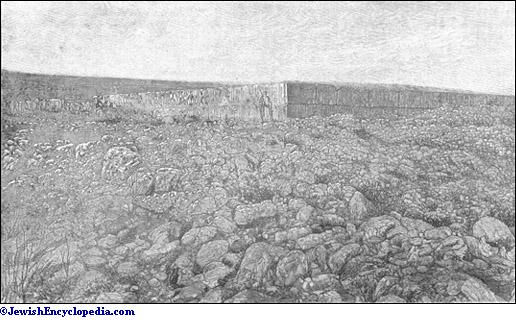
Birth and Sacrifice of Isaac.
At the appointed time Isaac was born, Abraham being a hundred years old. Soon after, Ishmael, Hagar's son, was seen "mocking" by Sarah, and at her solicitation he and his mother were banished. Hagar was comforted in the wilderness by an angel of God (ib. xxi. 1-12). Abraham was now a powerful man; and at the solicitation of Abimelech, king of Gerar, he made a covenant with that monarch at Beer-sheba in the land of the Philistines. At Beer-sheba Abraham sojourned many days (ib. xxi. 22-34).
The greatest trial of the patriarch's life came when God bade him offer up his only son as a burnt offering. Without a moment's hesitation Abraham took Isaac and proceeded to the land of Moriah, where he was just about to sacrifice him, when an angel of the Lord restrained him, once more delivering the prophecy that the patriarch's seed should be "as the stars of the heaven, and as the sand which is upon the seashore," and that in them all the nations of the earth should be blessed. Instead of Isaac a ram caught in a thicket was sacrificed (ib. xxii. 1-18). Abraham returned to Beer-sheba, and was sojourning there when Sarah died at Kirjatharba (also called Hebron and Mamre), at the age of one hundred and twenty-seven (ib. xxiii. 1, 2). Abraham went to Mamre and bought the cave of Machpelah as a burial-place; and there he buried Sarah (ib. xxiii. 3-20).
Isaac was now thirty-six years old, and Abraham sent Eliezer, his servant, to bring a wife for himfrom among Abraham's own people. Eliezer journeyed to Nahor, and returned with Rebekah, Abraham's grandniece, whom Isaac married (ib. xxiv.). Abraham now married again, taking as his wife Keturah, by whom he had several children. Before his death he "gave all that he had" to Isaac, and sent the sons of his concubines away after bestowing some gifts upon them (ib. xxv. 1-6). Abraham died at the age of one hundred and seventy-five years; and Isaac and Ishmael buried him beside Sarah in the cave of Machpelah (ib. xxv. 7-9).
Abraham and Isaac.(From the Sarajevo Haggadah.)
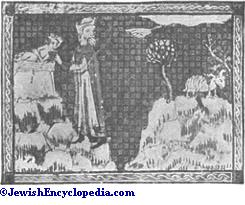
Prototype of the Jewish Race.
—In Apocryphal and Rabbinical Literature:
In the Old Testament Abraham presents the type of a simple Bedouin sheik who wanders from place to place in search of pasture for his herds, a kindhearted, righteous, and God-fearing man whom God chose on account of his faithful and righteous character to be the father of a nation peculiarly favored by Him in the possession of the coveted land of Canaan. Once he is spoken of as a "prophet" (Gen. xx. 7). Incidentally we learn that his father, Terah, was an idolater, like the rest of the Chaldeans (Josh. xxiv. 2); but how Abraham became a worshiper of the Lord, or why God singled him out and led him forth to Canaan, is left to surmise. No sooner, however, did the Jewish people come into closer contact with nations of higher culture, especially with the Greeks in Alexandria, than the figure of Abraham became the prototype of a nation sent forth to proclaim the monotheistic faith to the world while wandering from land to land. Accordingly, the divine promise (Gen. xii. 3, xxii. 18) is understood to mean: " . . . in thee [instead of "with thee"] shall all the families of the earth be blessed" (see LXX. ad loc.).
Propagator of the Knowledge of God.
In the third and second centuries B.C., Alexandrine Jews, writing under the name of Hecatæus and Berosus, and Samaritans, like Eupolemus, composed works on Jewish history, from which Josephus ("Ant." i. 7, § 8) gives the following: Abraham, endowed with great sagacity, with a higher knowledge of God and greater virtues than all the rest, was determined to change the erroneous opinions of men. He was the first who had the courage to proclaim God as the sole Creator of the universe, to whose will all the heavenly bodies are subject, for they by their motions show their dependence on Him. His opposition to astrology provoked the wrath of the Chaldeans, and he had to leave their country and go to Canaan. Afterward, when he came to Egypt, he entered into disputes with all the priests and the wise men, and won their admiration and, in many cases, their assent to his higher views. He imparted to them the knowledge of arithmetic and astronomy, which sciences came to Egypt from Chaldea only in the days of Abraham. Abraham's revolt from Chaldean astrology is spoken of in Philo ("On Abraham," xvii.), in connection with Gen. xv. 5 (compare Gen. R. xliv.).
Opposes Idolatry.
Concerning his religious awakening in his father's house, the Book of Jubilees, written probably in the time of John Hyrcanus, relates (xi.) that, in order not to participate in the idolatry practised in connection with astrology by the whole house of Nahor, Abraham, when he was fourteen years of age, left his father, and prayed to God to save him from the errors of men. Abraham became an inventor of better modes of agriculture, showing the people how to save the seeds in the field from the ravens that devoured them. He then tried to persuade his father to renounce idol-worship, but Terah was afraid of the people and told him to keep silent. Finally, when Abraham met with the opposition of his brothers also, he arose one night and set fire to the house in which the idols were kept. In an attempt to save these, his brother Haran was burned to death.
When, in the night of the new moon of Tishri (the New-year), Abraham was watching the stars to forecast the year's fertility, the revelation came to him that, in view of God's omnipotent will, all astrological predictions were valueless, and, after fervent prayer, he received word from God to leave the Chaldeans and set out on his mission to bless the nations by teaching them the higher truths. An angel of God taught him Hebrew, the language of revelation, by which he was enabled to decipher all the secrets of the ancient books (see Gen. R. xlii). Leaving his brother Nahor with his father, Abraham went to the Holy Land and observed there all the festivals and new moons (afterward prescribed to the Israelites, but already written on the heavenly tablets revealed to Enoch), besides many other customs observed by the priesthood of the second century B.C.
Abraham and Isaac.(From a tombstone in the graveyard of the Amsterdam Portuguese Congregation.)
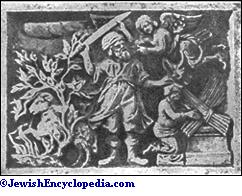
According to one opinion, Abraham attained the true knowledge of God when he was three years old; according to others, at ten; and again a more sober opinion claims that he was forty-eight years old (Gen. R. xxx).
In his warfare against the hosts of Amraphel andother kings, Abraham cast dust upon them, and it turned into swords and lances, and the stubble turned into bows and arrows (according to Isa. xli. 2). Og, the giant king of Bashan, was the one "that escaped" (ha-paliṭ), and brought him the news of the capture of Lot. Og was of the remnant of the giants that lived before the Flood (Deut. iii. 11). He cast a lustful eye upon Sarah, and hoped to see Abraham killed in the war in order that he might take her to wife.
His Birth.
Far more explicit is the story of Abraham's life in his Chaldean home as told by the Palestinian rabbis of the second century, and afterward further developed under the influence of Babylonian folk-lore. He was born in Kuta, another name for Ur of the Chaldees (B. B. 91a). On the night when he was born, Terah's friends, among whom were councilors and soothsayers of Nimrod, were feasting in his house, and on leaving late at night they observed a star which swallowed up four other stars from the four sides of the heavens. They forthwith hastened to Nimrod and said: "Of a certainty a lad has been born who is destined to conquer this world and the next; now, then, give to his parents as large a sum of money as they wish for the child, and then kill him." But Terah, who was present, said: "Your advice reminds me of the mule to whom a man said, 'I will give thee a house full of barley if thou wilt allow me to cut off thy head,' whereupon the mule replied: 'Fool that thou art, of what use will the barley be to me if thou cuttest off my head?' Thus I say to you: if you slay the son, who will inherit the money you give to the parents?" Then the rest of the councilors said: "From thy words we perceive that a son has been born to thee." "Yes," said Terah, "a son has been born to me, but he is dead." Terah then went home and hid his son in a cave for three years. When, on coming out of the cave, Abraham saw the sun rising in all his glory in the east, he said to himself: "Surely this is the Lord of the universe, and Him I will worship." But the evening came, and lo! the sun set and night befell him, and seeing the moon with her silver radiance, he said, "This, then, is the Lord of the world, and all the stars are His servants; to Him I will kneel." The following morning, when moon and stars had disappeared and the sun had risen anew, Abraham said: "Now I know that neither the one nor the other is the Lord of the world, but He who controls both as His servants is the Creator and Ruler of the whole world." Forthwith Abraham asked his father: "Who created heaven and earth?" Terah, pointing to one of his idols, replied: "This great image is our god." "Then let me bring a sacrifice to him!" said Abraham, and he ordered a cake of fine flour to be baked, and offered it to the idol, and when the idol did not eat it, he ordered a still finer meal-offering to be prepared, and offered it to the idol. But the idol did neither eat nor answer when addressed by him, and so Abraham grew angry and, kindling a fire, burned them all. When Terah, on coming home, found his idols burnt, he went to Abraham and said: "Who has burned my gods?" Abraham replied: "The large one quarreled with the little ones and burned them in his anger." "Fool that thou art, how canst thou say that he who can not see nor hear nor walk should have done this?" Then Abraham said: "How then canst thou forsake the living God and serve gods that neither see nor hear?"
Breaks Idols.
According to Gen. R. xxxviii. and Tanna debe Eliyahu, ii. 25 (probably a portion of Pirḳe R. El.), Terah was a manufacturer of idols and had them for sale. One day when Terah was absent and Abraham was left to take charge of the shop, an old, yet vigorous, man came in to buy an idol. Abraham handed him the one on top, and he gave him the price asked. "How old art thou?" Abraham asked. "Seventy years," was the answer. "Thou fool," continued Abraham, "how canst thou adore a god so much younger than thou? Thou wert born seventy years ago and this god was made yesterday." The buyer threw away his idol and received his money back. The other sons of Terah complained to their father that Abraham did not know how to sell the idols, and so Abraham was told to attend to the idols as priest. One day a woman brought a meal-offering for the idols, and, as they would not eat, he exclaimed: "A mouth have they but speak not, eyes but see not, ears but hear not, hands but handle not. May their makers be like them, and all who trust in them" (Ps. cxv. 5-8, Heb.), and he broke them to pieces and burned them. Abraham was brought before Nimrod, who said: "Knowest thou not that I am god and ruler of the world? Why hast thou destroyed my images?" Then Abraham said: "If thou art god and ruler of the world, why dost thou not cause the sun to rise in the west and set in the east? If thou art god and ruler of the world, tell me all that I have now at heart, and what I shall do in the future." Nimrod was dumfounded, and Abraham continued: "Thou art the son of Cush, a mortal like him. Thou couldst not save thy father from death, nor wilt thou thyself escape it." According to Gen. R. xxxviii, Nimrod said: "Worship the fire!" "Why not water that quenches the fire?" asked Abraham. "Very well, worship the water!" "Why not the clouds which swallow the water?" "So be it; worship the clouds!" Then Abraham said: "Rather let me adore the wind which blows the clouds about!" "So be it; pray to the wind!" "But," said Abraham, "man can stand up against the wind or shield himself behind the walls of his house." "Then adore me!" said Nimrod. Thereupon Nimrod (Amraphel; see Pesiḳ. R. § 33, 'Er. 53a) ordered Abraham to be cast into a furnace. He had a pile of wood five yards in circumference set on fire, and Abraham was cast into it. But God Himself went down from heaven to rescue him. Wherefore the Lord appeared to him later, saying: "I am the Lord who brought thee out of the fire of the Chaldeans" (Ur Kasdim, Gen. xv. 7). The legend betrays Persian influence (compare the Zoroaster legend in Windischmann, "Zoroastrische Studien," pp. 307-313). Regarding the cave in which Abraham dwelt, see ib. p. 113; compare also B. B. 10a. The dialogue with Nimrod, pointing from fire, water, the cloud, wind, and man to God, has its parallel in Hindu legend (see Benfey, "Pantschatantra," i. 376).
Abraham is thereupon commissioned by God to propagate His truth throughout the world, and he wins many souls for Him: while he wins the men, Sarah, his wife, converts the women. In this manner "they made souls in Haran" (Gen. xii. 5, Heb.). He awakens the heathen from slumber and brings them under the wings of God. He is the father of the proselytes (Gen. R. xliii; Mek., Mishpaṭim, § 18).
As a Philanthropist.
Henceforth he was to become "like a stream of blessing to purify and regenerate the pagan world." Of the manner in which he converted the heathen it is related that he had a palatial mansion built near the oaktree of Mamre or at Beer-sheba on the crossing of the roads, wherein all kinds of victuals and wine were spread on the table for the passersby, who came through the doors kept open on all sides; and when they, after having partaken of the meal, were about to offer their thanks to him beforegoing on their way, he pointed to God above, whose steward he was and to whom alone they owed thanks. Thus, by his love for man, he taught people how to worship God. Abraham's Oak, in connection with which the Midrash (to Gen. xxi. 33) relates these things, is mentioned also by Jerome (quoted in Uhlman's "Liebesthätigkeit," p. 321). This philanthropic virtue of Abraham is specifically dwelt upon in the Testament of Abraham.
Prophetic Vision.
His prophetic vision (Gen. xv.) furnished especially grateful material to apocalyptic writers, who beheld foreshadowed in the four different animals used for the covenant sacrifice the "four kingdoms" of the Book of Daniel (see also the Midrashim and Targums and Pirḳe R. El. xxviii; compare Apocalypse of Abraham, ix.).
Regarding Abraham's relation to Melchizedek, who taught him new lessons in philanthropy, see Melchizedek. Whereas the Bible speaks of only one trial that Abraham had to undergo to give proof of his faith in and fear of God (the offering of his son Isaac, Gen. xxii.), the rabbis (Ab. v. 4; Ab. R. N. xxxiii. [B. xxxvi.]; and Pirḳe R. El. xxvi. et seq.; compare also Book of Jubilees, xvii. 17, and xix. 5) mention ten trials of his faith, the offering of his son forming the culmination. Yet this was sufficient reason for Satan, or Masṭemah, as the Book of Jubilees calls him, to put all possible obstacles in his way.
Supreme Test of Faith.
When Abraham finally held the knife over his beloved son, Isaac seemed doomed, and the angels of heaven shed tears which fell upon Isaac's eyes, causing him blindness in later life. But their prayer was heard. The Lord sent Michael the archangel to tell Abraham not to sacrifice his son, and the dew of life was poured on Isaac to revive him. The ram to be offered in his place had stood there ready, prepared from the beginning of creation (Ab. v. 6). Abraham had given proof that he served God not only from fear, but also out of love, and the promise was given that, whenever the 'Aḳedah chapter was read on the New-year's day, on which occasion the ram's horn is always blown, the descendants of Abraham should be redeemed from the power of Satan, of sin, and of oppression, owing to the merit of him whose ashes lay before God as though he had been sacrificed and consumed (Pesiḳ. R. § 40 and elsewhere).
According to the Book of Jubilees (xx.-xxii.), Abraham appointed Jacob, in the presence of Rebekah, heir of his divine blessings. Jacob remained with him to the very last, receiving his instructions and his blessings. But while the same source informs us that he ordered all his children and grand-children to avoid magic, idolatry, and all kinds of impurity, and to walk in the path of righteousness, Jeremiah bar Abba (in Sanh. 91a) tells us that he bequeathed the knowledge of magic to the sons of his wife, Keturah.
Abraham's Death.
About his death rabbinical tradition has preserved only one statement—that the Angel of Death had no power over him (B. B. 17a). There is nevertheless a beautiful description of his glorious end in the Testament of Abraham (see Abraham, Testament of). The same work gives a touching picture of his love for man, while Ab. R. N. (xxxiii.) offers illustrations of his spirit of righteousness and equity. Abba Arika (Rab) even professed to know how the men of Abraham's time expressed their grief at his bier: "Alas for the ship that hath lost its captain! Alas for humanity that hath lost its leader!" (B. B. 91a, b.)
Besides the discovery of astronomy, we find ascribed to Abraham the invention of the alphabet, the knowledge of magic, and of all secret lore ('Ab. Zarah, 14b; Eusebius, "Præp. Ev."; D'Herbelot, "Bibliothèque Orientale," s.v. "Abraham"; "Sefer Yeẓirah," toward the end). All this is based on Gen. R. to Gen. xv. 5: "God lifted him above the vault of heaven to cause him to see all the mysteries of life." It is related (Tosef., Ḳid., at end) that he wore a pearl or precious stone of magic power on his neck, wherewith he healed the sick; and that all the secrets of the Law were disclosed to him, while he observed even the most minute provisions of the rabbis (Mishnah Ḳid., at end; Gen. R. lxiv.). Even in physical size he towered above the rest of men, according to Gen. R. xlix. and Soferim, xxi. 9.
True Type of Humanity.
There is a deep undercurrent of his true humanity in all the legends about Abraham. "Until Abraham's time the Lord was known only as the God of heaven. When He appeared to Abraham, He became the God of the earth as well as of heaven, for He brought Him nigh to man" (Midr. R. to Gen. xxiv. 3). Abraham, called "the One" (Isa. li. 2, Heb., and Ezek. xxxiii.), rendered the whole human family one (Gen. R. xxxix) Whosoever has a benign eye, a simple heart, and a humble spirit, or who is humble and pious, is a disciple of Abraham (Ab. v. 29, and Ber. 6b), and he who lacks kindness of heart is no true son of Abraham (Beẓah, 32a). But it is particularly Abraham, the man of faith, the "friend of God" (Isa. xli. 8), upon whom are founded alike the Synagogue (see Pes. 117b; Mek., Beshallaḥ, § 3; I Macc. ii. 52; Philo, "Who is the Heir?" xviii.-xix.), the Church (see Rom. iv. 1; Gal. iii. 6; James, ii. 23), and the Mosque (Koran, sura iii. 58-60). "Abraham was not a Jew nor a Christian, but a believer in one God [a Moslem], a hater of idolatry, a man of perfect faith" (ib. suras ii. 118, iv. 124, vi. 162, xvi. 121). When God said, "Let there be light!" He had Abraham in view (Gen. R. ii.).
Many Arabic legends concerning Abraham based on the Koran found their way back to Jewish works (see Jellinek, "B. H." i. 25, and introduction, xv.)
Bibliography:
Weil, Bibl. Legenden der Muselmänner, p. 68;
Grünbaum, Neue Beiträge zur Semitischen Sagenkunde, pp. 91-93;
B. Beer, Leben Abrahams, nach Auffassung der Jüdischen Sage, especially pp. 95-210, Leipsic, 1859 this book contains a very full account, with valuable references, of the rabbinic traditions concerning Abraham);
Hughes, Dictionary of Islam, s.v.
K.—In Mohammedan Legend:
Of all the Biblical personages mentioned in the Koran, Abraham is undoubtedly the most important. As is the case with all the Biblical material contained in the Koran, its source must be looked for not in any written documents, but in the stories, more or less tinged by midrashic additions, which Mohammed heard from his Jewish or Christian teachers and friends. Care must also be taken to distinguish the various periods in the preaching of the Arabian prophet; for in these matters Mohammed lived from hand to mouth, and his views as to the importance of Biblical personages varied with changing circumstances and changing needs. In his early preachings Mohammed shows very little knowledge of the patriarch. The only mention of him during the early Meccan period is found in sura lxxxvii. 19 (compare sura liii. 37), where Mohammed makes a passing reference to the "Suḥuf Ibrahim" (the Rolls of Abraham); these can not have reference, as Sprenger thinks ("Leben u. Lehre Mohammeds," ii. 348, 363 et seq.), to any real apocryphal books, but merely to a reminiscenceof what Mohammed had heard about the mention of Abraham in the sacred books of the Jews and Christians (Kuenen, "National and Universal Religions," p. 297, note 1, and pp. 317-323, New York, 1882). Similarly in sura liii. 37—a passage certainly not older than the end of the first Meccan period (Nöldeke, "Gesch. des Korans," p. 79)—he speaks of Abraham as of one that had fulfilled his word, giving as his reference the same Rolls of Abraham (Hirschfeld, "Beiträge zur Erklärung des Korans," p. 12; compare Gen. xxii. 16). To this later Meccan period may also belong what Mohammed has to say of Abraham as one who was oppressed for preaching the true religion and for championing his God. This part of Abraham's career appealed very strongly to Mohammed; for he saw in it a certain prototype of his own early and severe struggles with the patricians of his native city. As Mohammed is the last of the prophets, so Abraham is among the first. Abraham is evidently—though this is not directly stated—one of the seven bearers of Maṭani, the messages repeated from out of the heavenly book (sura xv. 87; compare xxxix. 24). The other six are the prophets of Ad, Thamud, and Midian, and Noah, Lot, and Moses. Abraham is a righteous man ( ) and prophet (sura xix. 42).
"Great, Greater, Greatest."
In the later suras Mohammed seems to have learned more about Abraham. In sura vi. 75 he relates how the prophet came to worship God by watching physical phenomena: "Thus did we show Abraham the kingdom of heaven and of the earth, that he should be of those who are sure. And when the night overshadowed him he saw a star and said, 'This is my Lord'; but when it set he said, 'I love not those that set.' And when he saw the moon beginning to rise he said, 'This is my Lord'; but when it set he said, 'If my Lord guides me not I shall surely be of the people who err.' And when he saw the sun beginning to rise he said, 'This is my Lord, this is the greatest of all'; but when it set he said, 'O my people, verily, I am clear of what ye associate with God; verily, I have turned my face to Him who created the heaven and the earth.'"
The name of Abraham's father is said to have been Azar, though some of the later Arab writers give the name correctly as Teraḥ. Others claim that Azar was his real name, while Teraḥ was his surname (Nawawi, "Biographical Dict. of Illustrious Men," p. 128; but see Jawaliḳi, "Al-Mu'arrab," ed. Sachau, p. 21; "Z. D. M. G." xxxiii. 214). Still a third class of authorities say that Azar means either "the old man" or "the perverse one." Modern scholars have suggested that the word is a mistake for  (B. B. 15a; see Pautz, "Mohammed's Lehre von der Offenbarung," p. 242). This Azar was a great worshiper of idols, and Abraham had hard work in dissuading him from worshiping them. The story is told in sura xxi. 53 et seq.: "And we gave Abraham a right direction before; for about him we knew. When he said to his father and to his people, 'What are these images to which ye pay devotion?' said they, 'We found our fathers serving them.' Said he, 'Both ye and your fathers have been in obvious error.' They said, 'Dost thou come to us with the truth, or art thou of those that sport?' He said, 'Nay, but your Lord is Lord of the heavens and of the earth, which He created; and I am of those who testify to this, and, by God, I will plot against your idols after ye have turned and shown me your backs.' So he brake them all in pieces, except a large one that haply they might refer it to [lay the blame upon] him. Said they, 'Who has done this with our gods? Verily, he is of the wrong-doers.' They said, 'We heard a youth speak of them, who is called Abraham.' Said they, 'Then bring him before the eyes of men; haply they will bear witness.' Said they, 'Was it thou who did this to our gods, O Abraham?' Said he, 'Nay, it was this largest of them; but ask them if they can speak. . . .' Said they, 'Burn him and help your gods if ye are going to do so.' We said, 'O fire! be thou cool and a safety for Abraham.'" In suras xxvii. and xxxix. Mohammed returns to this story, and adds the account of the messengers that came to Abraham, of the promise of a son named Isaac, and of the coming destruction of Sodom and Gomorrah. "We turned these cities upside down and rained on them stones of baked clay" (compare sura li. 34). The destruction of the two cities served Mohammed as a warning, taken from history, which he desired to impress upon his opponents in Mecca.
The 'Aḳedah, or sacrifice of Isaac, is mentioned in several places in the Koran. The following account is found in sura xxxvii. 100 et seq.: "And when he reached the age to work with him he said: 'O my boy ! verily I have seen in a dream that I should sacrifice thee; look, then, that thou seest right.' Said he, 'O my sire! do what thou art bidden; thou wilt find me, if it please God, one of the patient.' And when they were resigned and Abraham had thrown him down upon his forehead, we called to him, 'O Abraham! thou hast verified the vision; verily, thus do we reward those who do good. This is surely an obvious trial.' And we rewarded him with a mighty victim."
Prominence Given to Abraham.
Mohammed, however, went further than this, and, in order to strengthen his position against his Jewish opponents in Medina, made out of Abraham the most prominent figure in premohammedan religious history. He alleges that Abraham was the real founder of the religion that he himself was preaching; that Islam was merely a restatement of the old religion of Abraham and not a new faith now preached for the first time. Abraham is the "friend of God" (sura iv. 124), an appellation that the followers of Islam now usually apply to him, and on account of which to-day the city of Hebron is called Al-Halil (compare Isa. xli. 8; Ab. R. N. 61a). He is also said to have been an imam, or religious leader (compare suras ii. 118, xvi. 121), and perhaps also a "ḥanif"; "he was not one of the idolaters. . . . [God] chose him, and He guided him unto the right way. . . . Then we inspired thee, Follow the faith of Abraham, a ḥanif, for he was not of the idolaters." The exact meaning of "ḥanif" is uncertain; but it seems in general to designate a man who searched after the truth and despised idolatry (Kuenen, l.c. note 2, pp. 323-326; Wellhausen, "Skizzen," iii. 207).
Characteristic is the following saying: "Abraham was not a Jew nor yet a Christian, but he was a ḥanif resigned, and not of the idolaters. Verily, the people most worthy of Abraham are those that follow him and his prophets, and those that believe" (sura iii. 60). With the same theological intent Mohammed makes various references to the Millat Ibrahim ("Religion of Abraham") as the one he desires his people to follow (suras xvi. 124, ii. 124, xxii. 77).
During the latest period of Mohammed's activity in Medina he became still bolder, and, in developing his theory in regard to Abraham, left entirely the beaten track of Jewish and Christian Midrash. It had become necessary for him to break entirely with the Jews, who refused to acknowledge him as prophet. The ḳiblah, or direction of prayer, was still toward Jerusalem. As the Jews had refused to follow Mohammed it was necessary to dissociatehis religion from theirs, and to turn the faces and thoughts of his followers from Jerusalem to Mecca. In order that the change might be effected with as little friction as possible, Mohammed connected Mecca and its holy house, the Kaaba, with the history of Abraham, the real founder of his Islam. It is here that Ishmael comes for the first time prominently forward. In one of the latest suras (ii. 118 et seq.) a passage reads: "And when we made the house a place of resort unto men, and a sanctuary, and (said) take the station of Abraham for a place of prayer; and covenanted with Abraham and Ishmael, saying, 'Do ye two cleanse my house for those who make the circuit, for those who pay devotions there, for those who bow down, and for those, too, who adore. . . .' And when Abraham raised up the foundations of the house with Ishmael, 'Lord, receive it from us. Verily, Thou art hearing and Thou dost know. Lord, and make us, too, resigned unto Thee and of our seed also a nation resigned unto Thee, and show us our rites, and turn toward us; verily, Thou art easy to be turned and merciful. Lord, and send them an apostle from amongst themselves, to read to them Thy signs and teach them the Book and wisdom, and to purify them; verily, Thou art the mighty and the wise'" (compare suras iii. 90-93, xxii. 27-31).
There is no local tradition connecting Abraham with Mecca; and we are forced to put this down as a pure invention on the part of the prophet, based on political as well as on theological reasons. According to Shahrastani (Arabic text, p. 430), this Kaaba was the reproduction of the one in heaven. The "Makam Ibrahim," or Station of Abraham, is still pointed out within the sacred enclosure at Mecca; and the footsteps of the patriarch are believed by the worshipers still to be there (Snouck Hurgronje, "Het Mekkaansche Feest," p. 40; Mekka, i. 11).
Mohammedan Midrash on Abraham.
The stories in regard to Abraham, told in a few words in the Koran, naturally form the basis for further midrashic expansion among the Arabs. The likeness of the history of Abraham to certain features in the life of their own prophet made him a favorite subject in the hands of commentators and historians. Mohammedan writers had two sources from which they drew their knowledge of the Bible and of its midrashic interpretation: verbal information from the akhbar ("rabbis"), and a study of the text of the Bible itself, and occasionally of comments upon it. The former source was undoubtedly the more prolific of the two. The material is to be found in the standard commentators on the Koran—Zamakhshari, Baidawi, Tabari; but more have been incorporated in the works of Arabic historians, who commenced their histories with the earliest accounts of man, and were thus bound to have a more or less close acquaintance with the Taurat (Torah) and the Midrash upon it. Some of the historians are quite exact, as Ibn Ḳutaibah, and the first philosopher of history, Ibn Khaldun; others, however, are less critical, as Tabari, Masudi, Ḥamza, Biruni, Maḳrizi, Ibn al-Athir, Abu al-Fida (compare Goldziher, "Über Mohammedanische Polemik gegen die Ahl al-Kitab," in "Z.D.M.G." xxxii. 357). They have much to say about the trials that Abraham underwent in fighting idolatry. They dilate upon the great furnace that Nimrod had built in Kutha for this purpose, and how the furnace was changed into a garden. A Kurd named Hayun, Haizar, or Haizan, is said to have advised Nimrod to have Abraham burnt. Abraham's father is said to have been a carver of images; and Abraham, in selling his father's wares, attempted to convert the people by crying out, "Who wishes to buy that which neither hurts nor betters?" Large midrashic additions are made in order to bring Nimrod into connection with Abraham. It is said that the stargazers warned him that a boy would be born that would in the future break all the idols; that Nimrod gave orders to put to death all children born; but that when Abraham was born his mother hid him in a cave in which, during a few days, he grew to man's estate, and thus foiled the purpose of the king.
The incongruity of Mohammed's connecting Abraham with the building of the Kaaba was evidently clearly felt, and it is therefore added that his going to Mecca was due to the rupture between Sarah and Hagar. God told Abraham to take the bondmaid and her child, Ishmael, into Arabia; and it was at the Zemzem well within the sacred enclosure that the water rose up which slaked the thirst of the boy. On two occasions Abraham is said to have paid a visit to Ishmael's house in his absence; and, by the answers which each wife gave to her father-in-law, Abraham advises his son, in the one case, to send his first wife away, and in the other to keep his second wife. In the building of the Kaaba, Abraham was assisted by the Shekinah ( ); others say by a cloud or by the angel Gabriel. Abraham acted as muezzin, delivered all the necessary prayers, and made the various circuits demanded by the later ritual. It was he also who first threw stones at Iblis (the devil) in the valley of Mina, a procedure which still forms part of the ceremonies connected with the ḥajj. It is natural that in these later accretions Ishmael should take the place of Isaac. Some authors even state that it was Ishmael who was to have been offered up; and that he therefore bears the name Al-Dhabiḥ ("Slaughtered One"). The place of the 'Aḳedah is also transferred to Mina, near Mecca. The ram offered up in lieu of the son is said to have been the same as the one offered by Abel. The slaughtering of Isaac is dwelt upon at length, as well as the firmness of Abraham in resisting the enticement of Iblis, who placed himself directly in his path. This is said to have been one of the trials (sura ii. 118) which Abraham underwent. Arabic commentators, however, speak of three trials only, and not of ten, as does the Jewish Haggadah.
Many of the religious observances that are now found in Islam are referred to Abraham; parallels to which, as far as the institution of certain prayers is concerned, can be found in rabbinical literature.
Abraham is often called by Arabic authors the "father of hospitality"; and long accounts are given of the visit of the angels. He is also said to have been the first whose hair grew white. Of his death an Arabic Midrash has the following: When God wished to take the soul of Abraham He sent the Angel of Death to him in the form of a decrepit old man. Abraham was at table with some guests, when he saw an old man walking in the heat of the sun. He sent an ass to carry the man to his tent. The old man, however, had hardly sufficient strength to put the food set before him to his mouth; and even then he had the greatest difficulty in swallowing it. Now, a long time before this, Abraham had asked God not to take away his soul until he (Abraham) should make the request. When he saw the actions of this old man he asked him what ailed him. "It is the result of old age, O Abraham!" he answered. "How old are you, then?" asked Abraham. The old man gave his age as two years more than that of Abraham, upon which the patriarch exclaimed, "In two years' time I shall be like him! O God! takeme to Thyself." The old man, who was no other than the Angel of Death, then took away Abraham's soul.
Rabbinical midrashic parallels can easily be found to most of the legends referred to above: a large number are given in Grünbaum ("Neue Beiträge zur Semitischen Sagenkunde"). It is of interest to observe that these Mohammedan additions have also, in some cases, found their way into Jewish literature. They are met with in works that have been written under Arabic influence in one form or another. Abraham's visit to Ishmael is found in the Pirḳe R. El. xxx. and in the "Sefer ha-Yashar." In the "Shebeṭ Musar" of Elijah ha-Kohen there is an appendix entitled "Tale of That Which Happened to Our Father Abraham in Connection with Nimrod." Elijah lived in Smyrna at the beginning of the eighteenth century, which fact will explain the Arabic influence.
Bibliography:
Koran, suras ii. iii. iv.vi. xi. xxix. xxxvii. li. lx. (the citations above are from Palmer's translation in the Sacred Books of the East, vols. vi. ix.), and the commentators mentioned in the article;
Tabari, Annales, i. 254 et seq.;
Ibn al-Athir, Chronicon, ed. Tornberg, i. 67 et seq.;
Ibn Ḳutaibah, Handbuch der Geschichte, ed. Wüstenfeld, pp. 16 et seq.;
Masudi, Les Prairies d'Or, ed. Barbier de Meynard, ix. 105, index;
Pseudo-Masudi, Abrégé des Merveilles, tr. by Carra de Vaux, pp. 131, 322;
Wüstenfeld, Die Chroniken der Stadt Mekka, Arabic text, i. 21 et seq., German tr. iv. 7 et seq.;
Al-Yaḳubi, Historiœ, ed. Houtsma, i. 21 et seq.;
Yaḳut's Geographisches Wörterbuch, ed. Wüstenfeld, vi. 266, index.
For special histories of the prophets see Brockelmann, Gesch. der Arabischen Lit. i. 350. The traditions in the Koran and later works are collected in Al-Nawawi, Biographical Dict. of Illustrious Men, ed. Wüstenfeld, pp. 125 et seq.;
and Abu al-Fida, Historia Anteislamica, ed. Fleischer, pp. 125 et seq.
Abraham's position in the history of religion from the Mohammedan standpoint is considered by Al-Shahrastani, Kitab al-Milal wal-Naḥal, ed. Cureton, pp. 244, 247, 261 (German transl. by Haarbrücker, index, s.v.). Modern works on the subject: Geiger, Was Hat Mohammed aus dem Judenthume Aufgenommen? pp. 121 et seq.;
Hirschfeld, Beiträge zur Erklärung des Korans, pp. 43, 59;
Grimme, Mohammed, i. 60 et seq., ii. 76, 82 et seq.;
Pautz, Mohammed's Lehre von der Offenbarung, pp. 173, 228;
Smith, The Bible and Islam, pp. 68 et seq.;
Bate, Studies in Islam, pp. 60 et seq.
For the later legends see Weil, Biblische Legenden der Muselmänner, pp. 68 et seq.;
Grünbaum, Neue Beiträge zur Semitischen Sagenkunde, pp. 89 et seq.;
Bacher, Bibel und Biblische Geschichte in der Mohammedanischen Literatur, in Kobak's Jeschurun, viii. 1-29;
G. A. Kohut, Haggadic Elements in Arabic Legends, in Independent, New York, 1898, Jan. 8 et seq.;
Lidzbarski, De Profeticis, quœ dicuntur, Legendis Arabicis, Leipsic, 1893.
G.Etymology.
—Critical View:
The original and proper form of this name seems to be either "Abram" or "Abiram" (I Kings, xvi. 34; Deut. xi. 6), with the meaning, "my Father [or my God] is exalted." The form "Abraham" yields no sense in Hebrew, and is probably only a graphic variation of "Abram," the h being simply a letter, indicating a preceding vowel, a; but popular tradition explains it "father of a multitude" (ab hamon), given as a new name on the occasion of a turning-point in the patriarch's career (Gen. xvii. 5). The name is personal, not tribal; it appears as a personal name in Babylonia in the time of Apil-Sin (about 2320 B.C.; Meissner, "Beiträge zum Altbabylonischen Privatrecht," No. 111), and is not employed in the Old Testament in an ethnical sense (for example, it is not so employed in Micah, vii. 20, nor in Isa. xli. 8).
National Significance.
In the earlier so-called Jahvistic narrative, Abraham embodies particularly the conception of Israel's title to the land of Canaan. He comes from the East to Canaan, receives the promise of the land, separates from Lot (Moab and Ammon), from Ishmael (Arabian tribes), and from the sons of Keturah (other Arabian tribes), thus eliminating any possible future contention as to the title to the country. A continuous process of selection and exclusion is here exemplified, the result of which is to identify Abraham with Canaan; such was the popular conception of him as late as the time of Ezekiel (Ezek. xxxiii. 24). In the narrative which the critics regard as postexilian, or the Priestly Code, Abraham further represents the formal covenant of God (El Shaddai) with the nation, sealed by the rite of circumcision (Covenant). He stands, in a word, for the premosaic religious constitution of the people.
Character.
Abraham's singularly majestic and attractive personality, as it appears in Genesis, is in this view the outcome of generations of thought. Each age contributed to the portrait of what it held to be purest and noblest and worthiest of the first forefather. The result is a figure, solitary, calm, strong, resting unswervingly on God, and moving unscathed among men. Later he was thought of as "the friend of God" (Isa. xli. 8). Paul calls him the father of all who believe (Rom. iv.). Mohammed takes him as the representative of the absolute primitive religion, from which Judaism and Christianity have diverged, and to which Islam has returned. The character shows, however, a commingling of high and low. There are generosity (Gen. xiii.), bravery (Gen. xiv.), a fine sense of justice (Gen. xviii.). But tradition, in order to bring out God's special care of the hero, twice makes him guilty of falsehood (Gen. xii., xx.); this last fact throws light on the ethical ideas of the eighth century.
Relation to History.
Is there any historical kernel embedded in the narrative? Obviously it contains much legendary matter. The stories of Lot, Hagar, and Keturah are ethnological myths; the theophanies and the story of the destruction of the cities are legends; circumcision was not adopted by the Israelites in the way here represented; and the story of the attempted sacrifice of Isaac is a product of the regal period. Abraham's kinsfolk (Gen. xxii. 20-24) are personifications of tribes, and his predecessors and successors, from Noah to Jacob, are mythical or legendary. What is to be said of the much debated fourteenth chapter? First, it must be divided into two parts: the history of the Elamite invasion, and Abraham's connection with it. The first part may be historical, but it no more follows that the second part is historical than the reality of the miraculous rôle assigned to Moses follows from the reality of the Exodus. On the contrary, the mention of Salem and of tithes points to a postexilian origin for the paragraph. The invasion may be historical— (Chedorlaomer) and
  (Arioch) are Elamite, and a march from Babylonia to Canaan is conceivable—but no mention of it has been found in inscriptions, and it is not easy to reconcile it with known facts. If
  (Amraphel) be Hammurabi, Abraham's date is about 2300 B.C.
The biography of Abraham in Genesis is probably to be regarded as legendary; it has grown up around sacred places, ideas, and institutions. Yet there can be little doubt that the name involves some historical fact, and that this fact has to do with tribal migration: the name, though personal, not tribal, may represent a migration. By reason of the paucity of information the whole question is obscure, and any conclusions must be largely conjectural.
The text represents Abraham as coming to Canaan from the Tigris-Euphrates valley. A migration of Hebrew ancestors from that region is not necessary for the explanation of what we know of Hebrew history. But weight must be attached to the wellformed and persistent tradition, and a migration ofthis sort, as the Tell-el-Amarna inscriptions indicate, must be regarded as possible. If a motive for the movement be sought, it may be found in the wars which were constantly going on between the thickly settled and feebly organized inhabitants of the valley between the rivers. Distinct indications of an Abrahamic migration from Babylonia are found by some scholars in the similarity between Babylonian and Hebrew institutions (as the Sabbath) and myths (Creation, Flood, etc.); by others this similarity is referred to Canaanite intermediation, or to later borrowing from Assyria or Babylonia.
The supposed relation of the names "Sin" (the wilderness) and "Sinai" (the mountain, and a Canaanite tribe) to the Babylonian moon-god, Sin, is doubtful. The migrating tribes would speak Babylonian or Aramaic, but would speedily become absorbed in their new surroundings and adopt the language of the region. If such a body settled in northern Arabia, this might account for the connection of Abraham with Hagar and Keturah. The Hebrew tribes proper, coming to dwell in that region, may have found his name as that of a local hero, and may gradually have adopted it. But of the condition of things in Canaan from 2300 to 2000 B.C. nothing is known, and between Abraham and Moses there is almost an absolute blank in the history.
Bibliography:
Tomkins, Studies on the Time of Abraham, 2d ed., 1897;
W. J. Deane, Abraham: His Life and Times, New York ("Men of the Bible Series");
Kittel, Hist. of the Hebrews, i. passim;
Robertson, Early Religion of Israel, passim;
Hommel, Ancient Hebr. Tradition, v.
ABRAHAM.—Abram and Abraham are the two forms in which the name of the first patriarch was handed down in Hebrew tradition. The change of name recorded in Gen 17:5 (P
1. The account of J
In the proper Jahwistic tradition the starting-point of the Exodus was Harran in Mesopotamia, but in Gen 11:28 ff. (cf. Gen 15:7) we find combined with this another view, according to which Abraham came from Ur of the Chaldees in S. Babylonia. In passing we may note the remarkable fact that both traditions alike connect the patriarch with famous centres of Babylonian moon-worship.
Arrived in Canaan, Abraham builds altars at Shechem, where he receives the first promise of the land, and Bethel, where the separation from Lot takes place; after which Abraham resumes his southern journey and takes up his abode at Hebron (ch. 13). This connexion is broken in Gen 12:10-20 by the episode of Abraham’s sojourn in Egypt, which probably belongs to an older stratum of Jahwistic tradition representing him as leading a nomadic life in the Negeb. To the same cycle we may assign the story of Hagar’s flight and the prophecy regarding Ishmael, in ch. 16; here, too, the home of Abraham is apparently located in the Negeb. In ch. 18 we find Abraham at Hebron, where in a theophany he receives the promise of a son to be born to Sarah, and also an intimation of the doom impending over the guilty cities of the Plain. The destruction of Sodom and Gomorrah, and the deliverance of Lot, are graphically described in ch. 19, which closes with an account of the shameful origins of Moab and Ammon. Passing over some fragmentary notices in ch. 21, which have been amalgamated with the fuller narrative of E
2. Of E
3. In P
4. Such is, in outline, the history of Abraham as transmitted through the recognized literary channels of the national tradition. We have yet to mention an episode, concerning which there is great diversity of opinion,—the story of Abraham’s victory over the four kings, and his interview with Melchizedek, in ch. 14. It is maintained by some that this chapter hears internal marks of authenticity not possessed by the rest of the Abrahamic tradition, and affords a firm foothold for the belief that Abraham is a historic personage of the 3rd millennium b.c., contemporary with Hammurabi (Amraphel?) of Babylon (c
5. From the religious point of view, the life of Abraham has a surprising inner unity as a record of the progressive trial and strengthening of faith. It is a life of unclouded earthly prosperity, broken by no reverse of fortune; yet it is rooted in fellowship with the unseen. ‘He goes through life,’ it has been well said, ‘listening for the true tôrâ, which is not shut up in formal precepts, but revealed from time to time to the conscience; and this leaning upon God’s word is declared to be in Jahweh’s sight a proof of genuine righteousness.’ He is the Father of the faithful, and the Friend of God. And that inward attitude of spirit is reflected in a character of singular loftiness and magnanimity, an unworldly and disinterested disposition which reveals no moral struggle, but is nevertheless the fruit of habitual converse with God. The few narratives which present the patriarch in a less admirable light only throw into bolder relief those ideal features of character in virtue of which Abraham stands in the pages of Scripture as one of the noblest types of Hebrew piety.
J. Skinner.
(Hebrew: father of a multitude).
Patriarch, son of Thare and father of Ismael. He left Ur of the Chaldees and came to Haran, where his father died. At the command of God he took up his abode in Chanaan, the land promised to his seed. Famine forced him to Egypt. On his return, he remained in Chanaan whilst Lot chose the country about the Jordan. He rescued Lot, when taken prisoner by the King of Elam, and on his return was met by Melchisedech, King of Salem, who blessed him. God made a covenant with Abraham, changing his name from Abram to Abraham and promised him that his descendants should be as numerous as the stars of heaven. He promised him, moreover, a son by the barren Sara. Then followed the destruction of Sodom and Gomorrha, the escape of Lot, the birth of Isaac, and the covenant with Abimelech. The faith of Abraham is tried by God’s command to sacrifice his son Isaac. An angel stays. his hand, and as a reward of his unbounded confidence in God, makes known to him the greatness of his posterity. Sara died at the age of 127. Abraham then married Cetura by whom he had six children. He died at the age of 175.
The original form of the name, Abram, is apparently the Assyrian Abu-ramu. It is doubtful if the usual meaning attached to that word "lofty father", is correct. The meaning given to Abraham in Genesis 17:5 is popular word play, and the real meaning is unknown. The Assyriologist, Hommel suggests that in the Minnean dialect, the Hebrew letter Hê ("h") is written for long a. Perhaps here we may have the real derivation of the word, and Abraham may be only a dialectical form of Abram.The story of Abraham is contained in the Book of Genesis, 11:26 to 25:18. We shall first give a brief outline of the Patriarch’s life, as told in that portion of Genesis, then we shall in succession discuss the subject of Abraham from the viewpoints of the Old Testament, New Testament, profane history, and legend. A BRIEF OUTLINE OF ABRAHAM’S LIFEThare had three sons, Abram, Nachor, and Aran. Abram married Sarai. Thare took Abram and his wife, Sarai, and Lot, the son of Aran, who was dead, and leaving Ur of the Chaldees, came to Haran and dwelt there till he died. Then, at the call of God, Abram, with his wife, Sarai, and Lot, and the rest of his belongings, went into the Land of Chanaan, amongst other places to Sichem and Bethel, where he built altars to the Lord: A famine breaking out in Chanaan, Abram journeyed southward to Egypt, and when he had entered the land, fearing that he would be killed on account of his wife, Sarai, he bade her say she was his sister. The report of Sarai’s beauty was brought to the Pharao, and he took her into his harem, and honoured Abram on account of her. Later, however finding out that she was Abram’s wife, he sent her away unharmed, and, upbraiding Abram for what he had done, he dismissed him from Egypt. From Egypt Abram came with Lot towards Bethel, and there, finding that their herds and flocks had grown to be very large, he proposed that they should separate and go their own ways. So Lot chose the country about the Jordan, whilst Abram dwelt in Chanaan, and came and dwelt in the vale of Mambre in Hebron. Now, on account of a revolt of the Kings of Sodom and Gomorrha and other kings from Chodorlahomor King of Elam, after they had served him twelve years, he in the fourteenth year made war upon them with his allies, Thadal king of nations, Amraphel Kin& of Senaar, and Arioch King of Pontus. The King of Elam was victorious, and had already reached Dan with Lot a prisoner and laden with spoil, when he was overtaken by Abram. With 318 men the patri arch surprises, attacks, and defeats him, he retakes Lot and the spoil, and returns in triumph. On his way home, he is met by Melchisedech, king of Salem who brings forth bread and wine, and blesses him And Abram gives him tithes of all he has; but for] himself he reserves nothing. God promises Abram that his seed shall be as the stars of heaven, and he shall possess the land of Chanaan. But Abram does not see how this is to be, for he has already grown old. Then the promise is guaranteed by a sacrifice between God and Abram, and by a vision and a supernatural intervention in the night. Sarai, who was far advanced in years and had given up the idea of bearing children, persuaded Abram to take to himself her hand-maid, Agar. He does so, and Agar being with child despises the barren Sarai. For this Sarai afflicts her so that she flies into the desert, but is persuaded to return by an angel who comforts her with promises of the greatness of the son she is about to bear. She returns and brings forth Ismael. Thirteen years later God appears to Abram and promises him a son by Sarai, and that his posterity will be a great nation. As a sign, he changes Abram’s name to Abraham, Sarai’s to Sara, and ordains the rite of circumcision. One day later, as Abraham is sitting by his tent, in the vale of Mambre, Jehovah with two angels appears to him in human form. He shows them hospitality. Then again the promise of a son named Isaac is renewed to Abraham. The aged Sarah hears incredulously and laughs. Abraham is then told of the impending destruction of Sodom and Gomorrha for their sins but obtains from Jehovah the promise that he will not destroy them if he finds ten just men therein. Then follows a description of the destruction of the two cities and the escape of Lot. Next morning Abraham, looking from his tent towards Sodom, sees the smoke of destruction ascending to heaven. After this, Abraham moves south to Gerara, and again fearing for his life says of his wife, "she is my sister". The king of Gerara, Abimelech, sends and takes her, but learning in a dream that she is Abraham’s wife he restores her to him untouched, and rebukes him and gives him gifts. In her old age Sarah bears a son, lsaac, to Abraham, and he is circumcised on the eighth day. Whilst he is still young, Sarah is jealous, seeing Ismael playing with the child Isaac, so she procures that Agar and her son shall be cast out. Then Agar would have allowed Ismael to perish in the wilderness, had not an angel encouraged her by telling her of the boy’s future. Abraham is next related to have had a dispute with Abimelech over a well at Bersabee, which ends in a covenant being made between them. It was after this that the great trial of the faith of Abraham takes place. God commands him to sacrifice his only son Isaac. When Abraham has his arm raised and is in the very act of striking, an angel from heaven stays his hand and makes the most wonderful promises to him of the greatness of his posterity because of his complete trust in God. Sarah dies at the age of 127, and Abraham, having purchased from Ephron the Hethite the cave in Machpelah near Mambre, buries her there. His own career is not yet quite ended for first of all he takes a wife for his son Isaac, Rebecca from the city of Nachor in Mesopotamia. Then he marries Cetura, old though he is, and has by her six children. Finally, leaving all his possessions to Isaac, he dies at age 170, and is buried by Isaac and Ismael in the cave of Machpelah. VIEWPOINT OF OLD TESTAMENTAbraham may be looked upon as the starting-point or source of Old Testament religion. So that from the days of Abraham men were wont to speak of God as the God of Abraham, whilst we do not find Abraham referring in the same way to anyone before him. So we have Abraham’s servant speaking of "the God of my father Abraham" (Gen. xxiv, 12). Jehovah, in an apparition to Isaac, speaks of himself as the God of Abraham (Gen. xxvi, 24), and to Jacob he is "the God of my father Abraham" (Gen. xxxi, 42). So, too, showing that the religion of Israel does not begin with Moses, God says to Moses: "I am the God of thy fathers, the God of Abraham" etc. (Ex. iii, 6). The same expression is used in the Psalms (xlvi, 10) and is common in the Old Testament. Abraham is thus selected as the first beginning or source of the religion of the children of Israel and the origin of its close connection with Jehovah, because of his faith, trust, and obedience to and in Jehovah and because of Jehovah’s promises to him and to his seed. So, in Genesis, xv, 6, it is said: "Abram believed God, and it was reputed to him unto justice." This trust in God was shown by him when he left Haran and journeyed with his family into the unknown country of Chanaan. It was shown principally when he was willing to sacrifice his only son Isaac, in obedience to a command from God. It was on that occasion that God said: "Because thou hast not spared thy only begotten son for my sake I will bless thee" etc. (Genesis 22:16, 17). It is to this and other promises made so often by God to Israel that the writers of the Old Testament refer over and over again in confirmation of their privileges as the chosen people. These promises, which are recorded to have been made no less than eight times, are that God will give the land of Chanaan to Abraham and his seed (Genesis 12:7) that his seed shall increase and multiply as the stars of heaven; that he himself shall be blessed and that in him "all the kindred of the earth shall be blessed" (xii, 3). Accordingly the traditional view of the life of Abraham, as recorded in Genesis, is that it is history in the strict sense of the word. Thus Father von Hummelauer, S.J., in his commentary on Genesis in the "Cursus Scripturae Sacrae" (30), in answer to the question from what author the section on Abraham first proceeded, replies, from Abraham as the first source. Indeed he even says that it is all in one style, as a proof of its origin, and that the Passage, xxv, 5-ll, concerning the goods, death, and burial of Abraham comes from Isaac. It must, however, be added that it is doubtful if Father von Hummelauer still adheres to these views, written before 1895, since he has much modified his position in the volume on Deuteronomy.Quite a different view on the section of Genesis treating of Abraham, and indeed of the whole of Genesis, is taken by modern critical scholars. They almost unanimously hold that the narrative of the patriarch’s life is composed practically in its entirety of three writings or writers called respectively the Jahvist, the Elohist, and the priestly writer, and denoted by the letters J, E, and P. J and E consisted of collections of stories relating to the patriarch, some of older, some of later, origin. Perhaps the stories of J show a greater antiquity than those of E. Still the two authors are very much alike, and it is not always easy to distinguish one from the other in the combined narrative of J and E. From what we can observe, neither the Jahvist nor the Elohist was a personal author. Both are rather schools, and represent the collections of many years. Both collections were closed before the time of the prophets; J some time in the ninth century B.C., and E early in the eighth century, the former probably in the South Kingdom, the latter in the North. Then towards the end of the kingdom, perhaps owing to the inconvenience of having two rival accounts of the stories of the patriarchs etc. going about, a redactor R.JE (?) combined the two collections in one, keeping as much as possible to the words of his sources, making as few changes as possible so as to fit them into one another, and perhaps mostly following J in the account of Abraham. Then in the fifth century a writer who evidently belonged to the sacerdotal caste wrote down again an account of primitive and patriarchal history from the priestly point of view. He attached great importance to clearness and exactness; his accounts of things are often cast into the shape of formulas (cf. Genesis 1); he is very particular about genealogies, also as to chronological notes. The vividness and colour of the older patriarchal narratives, J and E, are wanting in the later one, which in the main is as formal as a legal document, though at times it is not wanting in dignity and even grandeur, as is the case in the first chapter of Genesis. Finally, the moral to be drawn from the various events narrated is more clearly set forth in this third writing and, according to the critics the moral standpoint is that of the fifth century B.C. Lastly, after the time of Ezra, this last history, P was worked up into one with the already combined narrative J.E. by a second redactor R. JEP, the result being the present history of Abraham, and indeed the present book of Genesis; though in all probability insertions were made at even a later date. VIEWPOINT OF NEW TESTAMENTThe generation of Jesus Christ is traced back to Abraham by St. Matthew, and though in Our Lord’s genealogy, according to St. Luke, he is shown to be descended according to the flesh not only from Abraham but also from Adam, still St. Luke shows his appreciation of the fruits of descent from Abraham by attributing all the blessings of God on Israel to the promises made to Abraham. This he does in the Magnificat, iii, 55, and in the Benedictus, iii, 73. Moreover, as the New Testament traces the descent of Jesus Christ from Abraham, so it does of all the Jews; though as a rule, when this is done, it is accompanied with a note of warning, lest the Jews should imagine that they are entitled to place confidence in the fact of their carnal descent from Abraham, without anything further. Thus (Luke 3:8) John the Baptist says: "Do not begin to say: We have Abraham for our father, for I say to you God is able of these stones to raise up children to Abraham." In Luke, xix, 9 our Saviour calls the sinner Zacheus a son of Abraham, as he likewise calls a woman whom he had healed a daughter of Abraham (Luke 13:16); but in these and many similar cases, is it not merely another way of calling them Jews or Israelites, just as at times he refers to the Psalms under the general name of David, without implying that David wrote all the Psalms, and as he calls the Pentateuch the Books of Moses, without pretending to settle the question of the authorship of that work? It is not carnal descent from Abraham to which importance is attached; rather, it is to practising the virtues attributed to Abraham in Genesis. Thus in John, viii, the Jews, to whom Our Lord was speaking, boast (33): "We are the seed of Abraham", and Jesus replies (39): "If ye be the children of Abraham, do the works of Abraham". St. Paul, too, shows that he is a son of Abraham and glories in that fact as in II Cor., xi, 22, when he exclaims: "They are the seed of Abraham, so am I". And again (Romans 11:50): "I also am an Israelite, of the seed of Abraham", and he addresses the Jews of Antioch in Pisidia (Acts 13:26) as "sons of the race of Abraham". But, following the teaching of Jesus Christ St. Paul does not attach too much importance to carnal descent from Abraham; for he says (Galatians 3:29): "If you be Christ’s, then you are the seed of Abraham", and again (Romans 9:6): "All are not Israelites who are of Israel; neither are all they who are the seed of Abraham, children". So, too, we can observe in all the New Testament the importance attached to the promises made to Abraham. In the Acts of the Apostles, iii, 25, St. Peter reminds the Jews of the promise, "in thy seed shall all the families of the earth be blessed". So does St. Stephen in his speech before the Council (Acts 7), and St. Paul in the Epistle to the Hebrews, vi, 13. Nor was the faith of the ancient patriarch less highly thought of by the New Testament writers. The passage of Genesis which was most prominently before them was xv, 6: "Abraham believed God, and it was reputed to him unto justice." In Romans, iv, St. Paul argues strongly for the supremacy of faith, which he says justified Abraham; ’ for if Abraham were justified by works, he hath whereof to glory, but not before God." The same idea is inculcated in the Epistle to the Galatians, iii, where the question is discussed: "Did you receive the spirit by the works of the law, or by the hearing of faith?" St. Paul decides that it is by faith, and says: "Therefore they that are of faith shall be justified with faithful Abraham". It is clear that this language, taken by itself, and apart from the absolute necessity of good works upheld by St. Paul, is liable to mislead and actually has misled many in the history of the Church. Hence, in order to appreciate to the full the Catholic doctrine of faith, we must supplement St. Paul by St. James. In ii, 17-22, of the Catholic Epistle we read: "So faith also, if it have not works, is dead in itself. But some man will say: Thou hast faith, and I have works, show me thy faith without works, and I will show thee by works my faith. Thou believest that there is one God. Thou dost well; the devils also believe and tremble. But wilt thou know, O vain man, that faith without works is dead? Was not Abraham our father justified by works, and by works faith was made perfect?"In the seventh chapter of the Epistle to the Hebrews, St. Paul enters into a long discussion concerning the eternal priesthood of Jesus Christ. He recalls the words of the 109th psalm more than once, in which it is said: "Thou art a Driest for ever according to the order of Melchisedech." He recalls the fact that Melchisedech is etymologically the king of justice and also king of peace; and moreover that he is not only king, but also priest of the Most High God. Then, calling to mind that there is no account of his father, mother, or genealogy, nor any record of his heirs, he likens him to Christ king and priest; no Levite nor according to the order of Aaron, but a priest forever according to the order of Melchisedech. IN THE LIGHT OF PROFANE HISTORYOne is inclined to ask, when considering the light which profane history may shed on the life of Abraham: Is not the life of the patriarch incredible? That question may be, and is, answered in different ways, according to the point of view of the questioner. Perhaps it will not be without interest to quote the answer of Professor Driver, an able and representative exponent of moderate critical views: Do the patriarchal narratives contain intrinsic historical improbabilities? Or, in other words, is there anything intrinsically improbable in the lives of the several patriarchs, and the vicissitudes through which they severally pass? In considering this question a distinction must be drawn between the different sources of which these narratives are composed. Though particular details in them may be improbable, and though the representation may in parts be coloured by the religious and other associations of the age in which they were written, it cannot be said that the biographies of the first three patriarchs, as told in J and E, are, generally speaking, historically improbable; the movements and general lives of Abraham Isaac, and Jacob are, taken on the whole, credible (Genesis, p. xlvi). Such is the moderate view; the advanced attitude is somewhat different." The view taken by the patient reconstructive criticism of our day is that, not only religiously, but even, in a qualified sense, historically also, the narratives of Abraham have a claim on our attention" (Cheyne, Encyc. Bib., 26). Coming now to look at the light thrown by profane history upon the stories of Abraham’s life as given in Genesis, we have, first of all, the narratives of ancient historians, as Nicholas of Damascus, Berosus, Hecateus, and the like. Nicholas of Damascus tells how Abraham, when he left Chaldea lived for some years in Damascus. In fact in Josephus he is said to have been the fourth king of that city. But then there is no practical doubt that this story is based on the words of Genesis, xiv, 15, in which the town of Damascus is mentioned. As to the great man whom Josephus mentions as spoken of by Berosus, there is nothing to show that that great man was Abraham. In the "Praeparatio Evang." of Eusebius there are extracts recorded from numerous ancient writers, but no historical value can be attached to them. In fact, as far as ancient historians are concerned, we may say that all we know about Abraham is contained in the book of Genesis.A much more important and interesting question is the amount of value to be attached to the recent archaeological discoveries of Biblical and other explorers in the East. Archaeologists like Hommel, and more especially Sayce, are disposed to attach very great significance to them. They say, in fact, that these discoveries throw a serious element of doubt over many of the conclusions of the higher critics. On the other hand, critics, both advanced as Cheyne and moderate as Driver, do not hold the deductions drawn by these archaeologists from the evidence of the monuments in very high esteem, but regard them as exaggerations. To put the matter more precisely, we quote the following from Professor Sayce, to enable the reader to see for himself what he thinks (Early Hist. of the Hebrews, 8):" Cuneiform tablets have been found relating to Chodorlahomor and the other kings of the East mentioned in the 14th chapter of Genesis, while in the Tel-el-Amarna correspondence the king of Jerusalem declares that he had been raised to the throne by the ’arm’ of his God, and was therefore, like Melchisedech, a Driest-king. But Chodorlahomor and Melchisedech had long ago been banished to mythland and criticism could not admit that archaeological discovery had restored them to actual history. Writers, accordingly, in complacent ignorance of the cuneiform texts, told the Assyriologists that their translations and interpretations were alike erroneous." That passage will make it clear how much the critics and archaeologists are at variance. But no one can deny that Assyriology has thrown some light on the stories of Abraham and the other patriarchs. Thus the name of Abraham was known in those ancient times; for amongst other Canaanitish or Amorite names found in deeds of sale of that period are those of Abi-ramu, or Abram, Jacob-el (Ya’qub-il), and Josephel (Yasub-il). So, too, of the fourteenth chapter of Genesis, which relates the war of Chodorlahomor and his allies in Palestine, it is not so long ago that the advanced critics relegated it to the region of fable, under the conviction that Babylonians and Elamites at that early date in Palestine and the surrounding country was a gross anachronism. But now Professor Pinches has deciphered certain inscriptions relating to Babylonia in which the five kings, Amraphel King of Senaar, Arioch King of Pontus, Chodorlahomor King of the Elamites, and Thadal King of nations, are identified with Hammurabi King. of Babylon, Eri-aku, Kudur-laghghamar, and Tuduchula, son of Gazza, and which tells of a campaign of these monarchs in Palestine. So that no one can any longer assert that the war spoken of in Genesis, xiv, can only be a late reflection of the wars of Sennacherib and others in the times of the kings. From the Tel-el-Amarna tab]ets we know that Babylonian influence was predominant in Palestine in those days. Moreover, we have light thrown by the cuneiform inscriptions upon the incident of Melchisedech. In Genesis, xiv, 18, it is said: "Melchisedech, the King of Salem, bringing forth bread and wine, for he was the priest of the Most High God, blessed him." Amongst the Tel-el-Amarna letters is one from Ebed-Tob, King of Jerusalem (the city is Ursalim, i. e. city of Salim, and it is spoken of as Salem). He is priest appointed by Salem, the god of Peace, and is hence both king and priest. In the same manner Melchisedech is priest and king, and naturally comes to greet Abraham returning in peace; and hence, too, Abraham offers to him as to a priest a tithe of the spoils. On the other hand, it must be stated that Professor Driver will not admit Sayce’s deductions from the inscriptions as to EbedTob, and will not recognize any analogy between Salem and the Most High God.Taking archaeology as a whole, it cannot be doubted that no definite results have been attained as to Abraham. What has come to light is susceptible of different interpretations. But there is no doubt that archaeology is putting an end to the idea that the patriarchal legends are mere myth. They are shown to be more than that. A state of things is being disclosed in patriarchal times quite consistent with much that is related in Genesis, and at times even apparently confirming the facts of the Bible. VIEWPOINT OF LEGENDWe come now to the question: how far legend plays a part in the life of Abraham as recorded in Genesis. It is a practical and important question, because it is so much discussed by modern critics and they all believe in it. In setting forth the critical view on the subject, I must not be taken as giving my own views also.Hermann Gunkel, in the Introduction to his Commentary on Genesis (3) writes: "There is no denying that there are legends in the Old Testament, consider for instance the stories of Samson and Jonah. Accordingly it is not a matter of belief or scepticism, but merely a matter of obtaining better knowledge, to examine whether the narratives of Genesis are history or legend." And again: "In a people with such a highly developed poetical faculty as Israel there must have been a place for saga too. The senseless confusion of ’ legend ’ with ’ Iying ’ has caused good people to hesitate to concede that there are legends in the Old Testament. But legends are not lies; on the contrary, they are a particular form of poetry." These passages give a very good idea of the present position of the Higher Criticism relative to the legends of Genesis, and of Abraham in particular.The first principle enunciated by the critics is that the accounts of the primitive ages and of the patriarchal times originated amongst people who did not practise the art of writing. Amongst all peoples, they say, poetry and saga were the first beginning of history; so it was in Greece and Rome, so it was in Israel. These legends were circulated, and handed down by oral tradition, and contained, no doubt, a kernel of truth. Very often, where individual names are used these names in reality refer not to individuals but to tribes, as in Genesis, x, and the names of the twelve Patriarchs, whose migrations are those of the tribes they represent. It is not of course to be supposed that these legends are no older than the collections J, E, and P, in which they occur. They were in circulation ages before, and for long periods of time, those of earlier origin being shorter, those of later origin longer, often rather romances than legends, as that of Joseph. Nor were they all of Israelitish origin; some were Babylonian, some Egyptian. As to how the legends arose, this came about, they say, in many ways. At times the cause was etymological, to explain the meaning of a name, as when it is said that Isaac received his name because his mother laughed (cahaq); sometimes they were ethnological, to explain the geographical position, the adversity, or prosperity, of a certain tribe; sometimes historical, sometimes ceremonial, as the account explaining the covenant of circumcision; sometimes geological, as the explanation of the appearance of the Dead Sea and its surroundings. AEtiological legends of this kind form one class of those to be found in the lives of the patriarchs and elsewhere in Genesis. But there are others besides which do not concern us here.When we try to discover the age of the formation of the patriarchal legends, we are confronted with a question of great complexity. For it is not merely a matter of the formation of the simple legends separately, but also of the amalgamation of these into more complex legends. Criticism teaches us that that period would have ended about the year 1200 B.C. Then would have followed the period of remodeling the legends, so that by 900 B.C. they would have assumed substantially the form they now have. After that date, whilst the legends kept in substance to the form they had received, they were modified in many ways so as to bring them into conformity with the moral standard of the day, still not so completely that the older and less conventional ideas of a more primitive age did not from time to time show through them. At this time, too, many collections of the ancient legends appear to have been made, much in the same way as St. Luke tells us in the beginning of his Gospel that many had written accounts of Our Saviour’s life on their own authority.Amongst other collections were those of J in the South and E in the North. Whilst others perished these two survived, and were supplemented towards the end of the captivity by the collection of P, which originated amidst priestly surroundings and was written from the ceremonial standpoint. Those that hold these views maintain that it is the fusion of these three collections of legends which has led to confusion in some incidents in the life of Abraham as for instance in the case of Sarai in Egypt, where her age seems inconsistent with her adventure with the Pharao. Hermann Gunkel writes (148): "It is not strange that the chronology of P displays everywhere the most absurd oddities when injected into the old legends, as a result, Sarah is still at sixty-five a beautiful woman whom the Egyptians seek to capture, and Ishmael is carried on his mother’s shoulders after he is a youth of sixteen."The collection of P was intended to take the place of the old combined collection of J and E. But the old narrative had a firm hold of the popular imagination and heart. And so the more recent collection was combined with the other two, being used as the groundwork of the whole, especially in chronology. It is that combined narrative which we now possess.-----------------------------------J. A. HOWLETT Transcribed by Tomas Hancil The Catholic Encyclopedia, Volume ICopyright © 1907 by Robert Appleton CompanyOnline Edition Copyright © 2003 by K. KnightNihil Obstat, March 1, 1907. Remy Lafort, S.T.D., CensorImprimatur. +John Cardinal Farley, Archbishop of New York
I. Name
1. Various Forms
2. Etymology
3. Association
II. Kindred
III. Career
1. Period of Wandering
2. Period of Residence at Hebron
3. Period of Residence in the Negeb
IV. Conditions of Life
1. Economic Conditions
2. Social Conditions
3. Political Conditions
4. Cultural Conditions
V. Character
1. Religious Beliefs
2. Morality
3. Personal Traits
VI. Significance in the History of Religion
1. In the Old Testament
2. In the New Testament
3. In Jewish Tradition
4. In the Koran
VII. Interpretations of the Story Other Than Historical
1. The Allegorical Interpretation
2. The Personification Theory
3. The Mythical Theory
4. The “Saga” Theory
I. Name
1. Various Forms
In the Old Testament, when applied, to the patriarch, the name appears as
2. Etymology
Until this latest discovery of the apparently full, historical form of the Babylonian equivalent, the best that could be done with the etymology was to make the first constituent “father of” (construct -i rather than suffix -i), and the second constituent “Ram,” a proper name or an abbreviation of a name. (Yet observe above its use in Assyria for a woman; compare ABISHAG; ABIGAIL). Some were inclined rather to concede that the second element was a mystery, like the second element in the majority of names beginning with
3. Association
While the name is thus not “Hebrew” in origin, it made itself thoroughly at home among the Hebrews, and to their ears conveyed associations quite different from its etymological signification. “Popular etymology” here as so often doubtless led the Hebrew to hear in
II. Kindred
Gen 11:27, which introduces Abraham, contains the heading, “These are the generations of Terah.” All the story of Abraham is contained within the section of Genesis so entitled. Through Terah Abraham’s ancestry is traced back to Shem, and he is thus related to Mesopotamian and Arabian families that belonged to the “Semitic” race. He is further connected with this race geographically by his birthplace, which is given as
III. Career
Briefiy summed up, that career was as follows.
1. Period of Wandering
Abraham, endowed with Yahweh’s promise of limitless blessing, leaves Haran with Lot his nephew and all their establishment, and enters Canaan. Successive stages of the slow journey southward are indicated by the mention of Shechem, Bethel and the Negeb (South-country). Driven by famine into Egypt, Abraham finds hospitable reception, though at the price of his wife’s honor, whom the Pharaoh treats in a manner characteristic of an Egyptian monarch. (Gressmann, op. cit., quotes from Meyer, Geschichte des Alterthums, 12, 142, the passage from a magic formula in the pyramid of Unas, a Pharaoh of the Fifth Dynasty: “Then he (namely, the Pharaoh) takes away the wives from their husbands whither he will if desire seize his heart.”) Retracing the path to Canaan with an augmented train, at Bethel Abraham and Lot find it necessary to part company. Lot and his dependents choose for residence the great Jordan Depression; Abraham follows the backbone of the land southward to Hebron, where he settles, not in the city, but before its gates “by the great trees” (Septuagint sing., “oak”) of Mamre.
2. Period of Residence at Hebron
Affiliation between Abraham and the local chieftains is strengthened by a brief campaign, in which all unite their available forces for the rescue of Lot from an Elamite king and his confederates from Babylonia. The pursuit leads them as far as the Lebanon region. On the return they are met by Melchizedek, king of Salem, priest of
3. Period of Residence in the Negeb
Removal to the South-country did not mean permanent residence in a single spot, but rather a succession of more or less temporary resting-places. The first of these was in the district of Gerar, with whose king, Abimelech, Abraham and his wife had an experience similar to the earlier one with the Pharaoh. The birth of Isaac was followed by the expulsion of Ishmael and his mother, and the sealing of peaceful relations with the neighbors by covenant at Beersheba. Even the birth of Isaac, however, did not end the discipline of Abraham’s faith in the promise, for a Divine command to sacrifice the life of this son was accepted bona fide, and only the sudden interposition of a Divine prohibition prevented its obedient execution. The death of Sarah became the occasion for Abraham’s acquisition of the first permanent holding of Palestine soil, the nucleus of his promised inheritance, and at the same time suggested the probable approach of his own death. This thought led to immediate provision for a future seed to inherit through Isaac, a provision realized in Isaac’s marriage with Rebekah, grand-daughter of Abraham’s brother Nahor and of Milcah the sister of Lot. But a numerous progeny not associated with the promise grew up in Abraham’s household, children of Keturah, a woman who appears to have had the rank of wife after Sarah’s death, and of other women unnamed, who were his concubines. Though this last period was passed in the Negeb, Abraham was interred at Hebron in his purchased possession, the spot with which Semitic tradition has continued to associate him to this day.
IV. Conditions of Life
The life of Abraham in its outward features may be considered under the following topics: economic, social, political and cultural conditions.
1. Economic Conditions
Abraham’s manner of life may best be described by the adjective “semi-nomadic,” and illustrated by the somewhat similar conditions prevailing today in those border-communities of the East that fringe the Syrian and Arabian deserts. Residence is in tents, wealth consists of flocks, herds and slaves, and there is no ownership of ground, only at most a proprietorship in well or tomb. All this in common with the nomad. But there is a relative, or rather, intermittent fixity of habitation, unlike the pure Bedouin, a limited amount of agriculture, and finally a sense of divergence from the Ishmael type - all of which tend to assimilate the seminomadic Abraham to the fixed Canaanitish population about him. As might naturally be expected, such a condition is an unstable equilibrium, which tends, in the family of Abraham as in the history of all border-tribes of the desert, to settle back one way or the other, now into the city-life of Lot, now into the desert-life of Ishmael.
2. Social Conditions
The head of a family, under these conditions, becomes at the same time the chief of a tribe, that live together under patriarchal rule though they by no means share without exception the tie of kinship. The family relations depicted in Gen conform to and are illuminated by the social features of Code of
3. Political Conditions
It is natural that the chieftain of so considerable an organism should appear an attractive ally and a formidable foe to any of the smaller political units of his environment. That Canaan was at the time composed of just such inconsiderable units, namely, city-states with petty kings, and scattered fragments of older populations, is abundantly clear from the Biblical tradition and verified from other sources. Egypt was the only great power with which Abraham came into political contact after leaving the East. In the section of Genesis which describes this contact with the Pharaoh Abraham is suitably represented as playing no political role, but as profiting by his stay in Egypt only through an incidental social relation: when this terminates he is promptly ejected. The role of conqueror of Chedorlaomer, the Elamite invader, would be quite out of keeping with Abraham’s political status elsewhere, if we were compelled by the narrative in Gen 14 to suppose a pitched battle between the forces of Abraham and those of the united Babylonian armies. What that chapter requires is in fact no more than a midnight surprise, by Abraham’s band (including the forces of confederate chieftains), of a rear-guard or baggage-train of the Babylonians inadequately manned and picketed (“Slaughter” is quite too strong a rendering of the original
4. Cultural Conditions
Recent archaeological research has revolutionized our conception of the degree of culture which Abraham could have possessed and therefore presumably did possess. The high plane which literature had attained in both Babylonia and Egypt by 2000 bc is sufficient witness to the opportunities open to the man of birth and wealth in that day for the interchange of lofty thought. And, without having recourse to Abraham’s youth in Babylonia, we may assert even for the scenes of Abraham’s maturer life the presence of the same culture, on the basis of a variety of facts, the testimony of which converges in this point, that Canaan in the second millennium bc was at the center of the intellectual life of the East and cannot have failed to afford, to such of its inhabitants as chose to avail themselves of it, every opportunity for enjoying the fruits of others’ culture and for recording the substance of their own thoughts, emotions and activities
V. Character
Abraham’s inward life may be considered under the rubrics of religion, ethics and personal traits.
1. Religious Beliefs
The religion of Abraham centered in his faith in one God, who, because believed by him to be possessor of heaven and earth (Gen 14:22; Gen 24:3), sovereign judge of the nations (Gen 15:14) of all the earth (Gen 18:25), disposer of the forces of Nature (Gen 18:14; Gen 19:24; Gen 20:17), exalted (Gen 14:22) and eternal (Gen 21:33), was for Abraham at least the only God. So far as the Biblical tradition goes, Abraham’s monotheism was not aggressive (otherwise in later Jewish tradition), and it is theoretically possible to attribute to him a merely “monarchical” or “henotheistic” type of monotheism, which would admit the coexistence with his deity, say, of the “gods which (his) fathers served” (Jos 24:14), or the identity with his deity of the supreme god of some Canaanite neighbor (Gen 14:18). Yet this distinction of types of monotheism does not really belong to the sphere of religion as such, but rather to that of speculative philosophical thought. As religion, monotheism is just monotheism, and it asserts itself in corollaries drawn by the intellect only so far as the scope of the monotheist’s intellectual life applies it. For Abraham Yahweh not only was alone God; He was also his personal God in a closeness of fellowship (Gen 24:40; Gen 48:15) that has made him for three religions the type of the pious man (2Ch 20:7; Isa 41:8, Jas 2:23, note the Arabic name of Hebron
2. Morality
As already indicated, the ethical attributes of God were regarded by Abraham as the ethical requirement of man. This in theory. In the sphere of applied ethics and casuistry Abraham’s practice, at least, fell short of this ideal, even in the few incidents of his life preserved to us. It is clear that these lapses from virtue were offensive to the moral sense of Abraham’s biographer, but we are left in the dark as to Abraham’s sense of moral obliquity. (The “dust and ashes” of Gen 18:27 has no moral implication.) The demands of candor and honor are not satisfactorily met, certainly not in the matter of Sarah’s relationship to him (Gen 12:11-13; Gen 20:2; compare Gen 12:11-13), perhaps not in the matter of Isaac’s intended sacrifice (Gen 22:5, Gen 22:8). To impose our own monogamous standard of marriage upon the patriarch would be unfair, in view of the different standard of his age and land. It is to his credit that no such scandals are recorded in his life and family as blacken the record of Lot (Gen 19:30-38), Reuben (Gen 35:22) and Judah (Gen 38:15-18). Similarly, Abraham’s story shows only regard for life and property, both in respecting the rights of others and in expecting the same from them - the antipodes of Ishmael’s character (Gen 16:12).
3. Personal Traits
Outside, the bounds of strictly ethical requirement, Abraham’s personality displayed certain characteristics that not only mark him out distinctly among the figures of history, but do him great credit as a singularly symmetrical and attractive character. Of his trust and reverence enough has been said under the head of religion. But this love that is “the fulfilling of the law,” manifested in such piety toward God, showed itself toward men in exceptional generosity (Gen 13:9; Gen 14:23; Gen 23:9, Gen 23:13; Gen 24:10; Gen 25:6), fidelity (Gen 14:14, Gen 14:24; Gen 17:18; Gen 18:23-32; Gen 19:27; Gen 21:11; Gen 23:2), hospitality (Gen 18:2-8; Gen 21:8) and compassion (Gen 16:6 and Gen 21:14 when rightly understood, Gen 18:23-32). A solid self-respect (Gen 14:23; Gen 16:6; Gen 21:25; Gen 23:9, Gen 23:13, Gen 23:16; Gen 24:4) and real courage (Gen 14:14-16) were, however, marred by the cowardice that sacrificed Sarah to purchase personal safety where he had reason to regard life as insecure (Gen 20:11).
VI. Significance in the History of Religion
Abraham is a significant figure throughout the Bible, and plays an important role in extra-Biblical Jewish tradition and in the Mohammedan religion.
1. In the Old Testament
It is naturally as progenitor of the people of Israel, “the seed of Abraham,” as they are often termed, that Abraham stands out most prominently in the Old Testament books. Sometimes the contrast between him as an individual and his numerous progeny serves to point a lesson (Isa 51:2; Eze 33:24; perhaps Mal 2:10; compare Mal 2:15). “The God of Abraham” serves as a designation of Yahweh from the time of Isaac to the latest period; it is by this title that Moses identifies the God who has sent him with the ancestral deity of the children of Israel (Exo 3:15). Men remembered in those later times that this God appeared to Abraham in theophany (Exo 6:3), and, when he was still among his people who worshipped other gods (Jos 24:3) chose him (Neh 9:7), led him, redeemed him (Isa 29:22) and made him the recipient of those special blessings (Mic 7:20) which were pledged by covenant and oath (so every larger historical book, also the historical Psa 105:9), notably the inheritance of the land of Canaan (Deu 6:10) Nor was Abraham’s religious personality forgotten by his posterity: he was remembered by them as God’s friend (2Ch 20:7; Isa 41:8), His servant, the very recollection of whom by God would offset the horror with which the sins of his descendants inspired Yahweh (Deu 9:27).
2. In the New Testament
When we pass to the New Testament we are astonished at the wealth and variety of allusion to Abraham. As in the Old Testament, his position of ancestor lends him much of his significance, not only as ancestor of Israel (Act 13:26), but specifically as ancestor, now of the Levitical priesthood (Heb 7:5), now of the Messiah (Mat 1:1), now, by the peculiarly Christian doctrine of the unity of believers in Christ, of Christian believers (Gal 3:16, Gal 3:29). All that Abraham the ancestor received through Divine election, by the covenant made with him, is inherited by his seed and passes under the collective names of the promise (Rom 4:13), the blessing (Gal 3:14), mercy (Luk 1:54), the oath (Luk 1:73), the covenant (Act 3:25). The way in which Abraham responded to this peculiar goodness of God makes him the type of the Christian believer. Though so far in the past that he was used as a measure of antiquity (Joh 8:58), he is declared to have “seen” Messiah’s “day” (Joh 8:56). It is his faith in the Divine promise, which, just because it was for him peculiarly unsupported by any evidence of the senses, becomes the type of the faith that leads to justification (Rom 4:3), and therefore in this sense again he is the “father” of Christians, as believers (Rom 4:11). For that promise to Abraham was, after all, a “preaching beforehand” of the Christian gospel, in that it embraced “all the families of the earth” (Gal 3:8). Of this exalted honor, James reminds us, Abraham proved himself worthy, not by an inoperative faith, but by “works” that evidenced his righteousness (Jas 2:21; compare Joh 8:39). The obedience that faith wrought in him is what is especially praised by the author of Hebrews (Heb 11:8, Heb 11:17). In accordance with this high estimate of the patriarch’s piety, we read of his eternal felicity, not only in the current conceptions of the Jews (parable, Lk 16), but also in the express assertion of our Lord (Mat 8:11; Luk 13:28). Incidental historical allusions to the events of Abraham’s life are frequent in the New Testament, but do not add anything to this estimate of his religious significance.
3. In Jewish Tradition
Outside the Scriptures we have abundant evidence of the way that Abraham was regarded by his posterity in the Jewish nation. The oldest of these witnesses, Ecclesiasticus, contains none of the accretions of the later Abraham-legends. Its praise of Abraham is confined to the same three great facts that appealed to the canonical writers, namely, his glory as Israel’s ancestor, his election to be recipient of the covenant, and his piety (including perhaps a tinge of “nomism”) even under severe testing (Ecclesiasticus 44:19-21). The Improbable and often unworthy and even grotesque features of Abraham’s career and character in the later rabbinical
4. In the Koran
To Mohammed Abraham is of importance in several ways. He is mentioned in no less than 188 verses of the Koran, more than any other character except Moses. He is one of the series of prophets sent by God. He is the common ancestor of the Arab and the Jew. He plays the same role of religious reformer over against his idolatrous kinsmen as Mohammed himself played. He builds the first pure temple for God’s worship (at Mecca!). As in the Bible so in the Koran Abraham is the recipient of the Divine covenant for himself and for his posterity, and exhibits in his character the appropriate virtues of one so highly favored: faith, righteousness, purity of heart, gratitude, fidelity, compassion. He receives marked tokens of the Divine favor in the shape of deliverance, guidance, visions, angelic messengers (no theophanies for Mohammed!), miracles, assurance of resurrection and entrance into paradise. He is called “Imam of the peoples” (2 118)
VII. Interpretations of the Story Other than the Historical
There are writers in both ancient and modern times who have, from various standpoints, interpreted the person and career of Abraham otherwise than as what it purports to be, namely, the real experiences of a human person named Abraham. These various views may be classified according to the motive or impulse which they believe to have led to the creation of this story in the mind of its author or authors.
1. The Allegorical Interpretation
Philo’s tract on Abraham bears as alternative titles, “On the Life of the Wise Man Made Perfect by Instruction, or, On the Unwritten Law.” Abraham’s life is not for him a history that serves to illustrate these things, but an allegory by which these things are embodied. Paul’s use of the Sarah-Hagar episode in Gal 4:21-31 belongs to this type of exposition (compare
2. The Personification Theory
As to Philo Abraham is the personification of a certain type of humanity, so to some modern writers he is the personification of the Hebrew nation or of a tribe belonging to the Hebrew group. This view, which is indeed very widely held with respect to the patriarchal figures in general, furnishes so many more difficulties in its specific application to Abraham than to the others, that it has been rejected in Abraham’s case even by some who have adopted it for figures like Isaac, Ishmael and Jacob. Thus Meyer (Die Israeliten und ihre Nachbarstamme, 250; compare also note on p. 251), speaking of his earlier opinion, acknowledges that, at the time when he “regarded the assertion of Stade as proved that Jacob and Isaac were tribes,” even then he “still recognized Abraham as a mythical figure and originally a god.” A similar differentiation of Abraham from the rest is true of most of the other adherents of the views about to be mentioned. Hence also Wellhausen says (Prolegomena6, 317): “Only Abraham is certainly no name of a people, like Isaac and Lot; he is rather ambiguous anyway. We dare not of course on that account hold him in this connection as an historical personage; rather than that he might be a free creation of unconscious fiction. He is probably the youngest figure in this company and appears to have been only at a relatively late date put before his son Isaac.”
3. The Mythical Theory
Urged popularly by Nöldeke (Im neuen Reich (1871), I, 508ff) and taken up by other scholars, especially in the case of Abraham, the view gained general currency among those who denied the historicity of Gen, that the patriarchs were old deities. From this relatively high estate, it was held, they had fallen to the plane of mere mortals (though with remnants of the hero or even demigod here and there visible) on which they appear in Gen. A new phase of this mythical theory has been developed in the elaboration by Winckler and others of their astral-theology of the Babylonian world, in which the worship of Abraham as the moon-god by the Semites of Palestine plays a part. Abraham’s traditional origin connects him with Ur and Haran, leading centers of the moon-cult. Apart from this fact the arguments relied upon to establish this identification of Abraham with Sin may be judged by the following samples: “When further the consort of Abraham bears the name Sarah, and one of the women among his closest relations the name Milcah, this gives food for thought, since these names correspond precisely with the titles of the female deities worshipped at Haran alongside the moongod Sin. Above all, however, the number 318, that appears in Gen 14:14 in connection with the figure of Abraham, is convincing because this number, which surely has no historical value, can only be satisfactorily explained from the circle of ideas of the moon-religion, since in the lunar year of 354 days there are just 318 days on which the moon is visible - deducting 36 days, or three for each of the twelve months, on which the moon is invisible” (Baentsch, Monotheismus, 60f). In spite of this assurance, however, nothing could exceed the scorn with which these combinations and conjectures of Winckler, A. Jeremias and others of this school are received by those who in fact differ from them with respect to Abraham in little save the answer to the question, what deity was Abraham (see e.g. Meyer, op. cit., 252f, 256f).
4. The “Saga” Theory
Gunkel (Genesis, Introduction), in insisting upon the resemblance of the patriarchal narrative to the “sagas” of other primitive peoples, draws attention both to the human traits of figures like Abraham, and to the very early origin of the material embodied in our present book of Genesis. First as stories orally circulated, then as stories committed to writing, and finally as a number of collections or groups of such stories formed into a cycle, the Abraham-narratives, like the Jacob-narratives and the Joseph-narratives , grew through a long and complex literary history. Gressmann (op. cit, 9-34) amends Gunkel’s results, in applying to them the principles of primitive literary development laid down by Professor Wundt in his Völkerpsychologie. He holds that the kernel of the Abraham-narratives is a series of fairy-stories, of international diffusion and unknown origin, which have been given “a local habitation and a name” by attaching to them the (ex hypothesi) then common name of Abraham (similarly Lot, etc.) and associating them with the country nearest to the wilderness of Judea, the home of their authors, namely, about Hebron and the Dead Sea. A high antiquity (1300-1100 bc) is asserted for these stories, their astonishing accuracy in details wherever they can be tested by extra-Biblical tradition is conceded, as also the probability that, “though many riddles still remain unsolved, yet many other traditions will be cleared up by new discoveries” of archaeology.
(ἈâñáÜì)
Addressing a Jewish crowd in the precincts of the Temple, St. Peter emphasizes the connexion between the Hebrew and the Christian religion by proclaiming that ‘the God of Abraham … hath glorified his servant (ðáῖäá; cf. Revised Version margin) Jesus’ (Act_3:13). This Divine title, which is similarly used in St. Stephen’s speech (Act_7:32), was full of significance. All through the OT and the NT the foundation of the true religion is ascribed neither to the Prophets nor to Moses, but to Abraham. Isaac (Gen_26:24) and Jacob (Gen_31:42) worshipped the God of Abraham, but Abraham did not worship the Elohim whom his fathers served beyond the River (Jos_24:2; Jos_24:14-15). He was the head of the great family that accepted Jahweh as their God. Jews, Muslims, and Christians are all in some sense his seed, as having either his blood in their veins or his faith in their souls. To the Jews he is ‘our father Abraham’ (Act_7:2, Rom_4:12, Jam_2:21), ‘Our forefather (ôὸí ðñïðÜôïñá) according to the flesh’ (Rom_4:1). To the Muhammadans he is the ‘model of religion’ (imâm, or priest) and the first person ‘resigned (muslim) unto God’ (Qurʾân, ii. 115, 125). To the Christians he is ‘the father of all them that believe’ (Rom_4:11), ‘the father of us all’ (Rom_4:16). Taking the word Abraham to mean (according to the popular word-play, Rom_4:17 || Gen_17:5) ‘a father of many nations,’ St. Paul regards it as indicating that Abraham is the spiritual ancestor of the whole Christian Church.
1. In the Epistles of St. Paul.-As Abraham was the renowned founder of the Jewish nation and faith, it was crucially important to decide whether the Jews or the Christians could claim his support in their great controversy on justification. The ordinary Jews regarded Abraham as a model legalist, whose faith in God (Gen_15:5 f.) consisted in the fulfilment of the Law, which he knew by a kind of intuition. According to the Jewish tradition (Bereshith Rabb. 44, Wünsche), Abraham saw the whole history of his descendants in the mysterious vision recorded in Gen_15:1 ff. Thus he is said to have ‘rejoiced with the joy of the Law’ (Westcott, St. John [in Speaker’s Com.], 140). In the philosophical school of Alexandria there was a much higher conception of faith, which was regarded as ‘the most perfect of virtues,’ ‘the queen of virtues,’ ‘the only sure and infallible good, the solace of life, the fulfilment of worthy hopes, … the inheritance of happiness, the entire amelioration of the soul, which leans for support on Him. who is the cause of all things, who is able to do all things, and willeth to do those which are most excellent’ (Philo, Quis rer. div. her. i. 485, de Abr. ii. 39). In these passages faith, in so far as it expresses a spiritual attitude towards God, does not differ much from Christian faith. Nor could anything be finer than the Rabbinic Mechilta on Exo_14:31 : ‘Great is faith, whereby Israel believed on Him that spake and the world was.… In like manner thou findest that Abraham our father inherited this world and the world to come solely by the merit of faith whereby he believed in the Lord; for it is said, and he believed in the Lord, and He counted it to him for righteousness’ (Lightfoot, Galatians, 162). But the ordinary tendency of Judaism was to give Abraham’s life a predominantly legal colour, as in 1Ma_2:52 ‘Was not Abraham found faithful in temptation, and it was reckoned unto him for righteousness?’
To St. Paul faith is the motive power of the whole life, and in two expositions of his doctrine-Romans 4, Galatians 3 -he affirms the essential identity of Abraham’s faith with that of every Christian. He does not, indeed, think (like Jesus Himself in Joh_8:56) of Abraham as directly foreseeing the day of Christ, but he maintains that Abraham’s faith in God as then partially revealed was essentially the same as the Christian’s faith in God as now fully made known in Christ. Abraham had faith when he was still in uncircumcision (Rom_4:11), faith in God’s power to do things apparently impossible (Rom_4:17-19), faith by which he both strengthened his own manhood and gave glory to God (Rom_4:20). Abraham believed ‘the gospel’ which was preached to him beforehand, the gospel which designated him as the medium of blessing to all the nations (Gal_3:8). And as his faith, apart from his works, was counted to him for righteousness, he became the representative believer, in whom all other believers, without distinction, may recognize their spiritual father. It is not Abraham’s blood but his spirit that is to be coveted (Gal_3:2); those who are of faith (ïἱ ἐê ðßóôåùò) are ‘sons of Abraham,’ are ‘blessed with the faithful Abraham’ (Gal_3:7; Gal_3:9); upon the Gentiles has come ‘the blessing of Abraham’ (Gal_3:14); all who are Christ’s, without any kind of distinction, are ‘Abraham’s sons,’ fulfilling, like him, the conditions of Divine acceptance, and inheriting with him the Divine promises.
St. Paul uses the narratives of Genesis as he finds them. Before the dawn of criticism the theologian did not raise the question whether the patriarchal portraits were real or ideal, To St. Paul Abraham is a historical person who lived 430 years before Moses (Gal_3:17), and who was not inferior to the great prophets of Israel in purity of religious insight and strength of inward piety. It is now almost universally believed that the faith ascribed to the patriarchs was itself the result of a long historical evolution. But, while the maturer conceptions of a later age are carried back to Abraham, the patriarch is not dissolved into a creation of the religious fancy. ‘The ethical and spiritual idea of God which is at the foundation of the religion of Israel could only enter the world through a personal organ of divine revelation; and nothing forbids us to see in Abraham the first of that long series of prophets through whom God has communicated to mankind a saving knowledge of Himself’ (Skinner, Genesis [International Critical Commentary , 1910], p. xxvii).
2. In the Epistle of St. James.-St. James (Jam_2:21-23) uses the example of Abraham to establish the thesis, not that ‘a man is justified by faith apart from the works of the law’ (Rom_3:28), but that ‘by works a man is justified, and not only by faith’ (Jam_2:24). While the two apostles agree that Christianity is infinitely more than a creed, being nothing if not a life, they differ in their conception of faith. The meaning which St. James attaches to the word is indicated by his suggestion of believing demons and dead faith (Jam_2:19-20). St. Paul would have regarded both of these phrases as contradictions in terms, since all believers are converted and all faith is living. Asked if faith must not prove or justify itself by works, he would have regarded the question as superfluous, for a faith that means self-abandonment in passionate adoring love to the risen Christ inevitably makes the believer Christlike. St James says in effect: ‘Abraham believed God, proving his faith by works, and it was counted to him for righteousness.’ With St. Paul righteousness comes between faith and works; with St. James works come between faith and righteousness. Had St. James been attacking either Galatians or Romans, and in particular correcting St. Paul’s misuse of the example of Abraham, his polemic would have been singularly lame. Such a theory does injustice to his intelligence. But, if he was sounding a note of warning against popular perversions of evangelical doctrine, St. Paul, who was often ‘slanderously reported’ (Rom_3:8), must have been profoundly grateful to him. See, further, article James, Epistle of.
It is interesting to note that Clement of Rome co-ordinates the doctrines of the two apostles. Taking the typical example of Abraham, he asks, ‘Wherefore was our father Abraham blessed?’ and answers, ‘Was it not because he wrought righteousness and truth through faith?’ (Ep. ad Cor. § 31). If the two types of doctrine could be regarded as complementary sets of truths, justice was done to both apostles. But the difference assumed a dangerous form in the hard dogmatic distinction of the Schoolmen between fides informis and fides formata cum caritate, the latter of which (along with the ‘epistle of straw’ on which it seemed to be based) Luther so vehemently repudiated.
3. In the Epistle to the Hebrews.-The writer of Hebrews bases on the incident of Abraham’s meeting with Melchizedek (Hebrews 7; cf. Genesis 14) an argument for a priesthood higher than the Aaronic order (Heb_7:11 ff.). To the king-priest of Salem Abraham gave tithes, and from him received a blessing, thereby owning his inferiority to that majestic figure. As Abraham was the ancestor of the tribe of Levi, the Aaronic priesthood itself may be said to have been overshadowed in that hour and ever afterwards by the mysterious order of Melchizedek. This is the conception of the writer of Psalms 110, who identifies God’s vicegerent, seated on the throne of Zion, not with the Aaronic order, but with the royal priesthood of Melchizedek. When the Maccabees displaced the house of Aaron, and concentrated in their own persons the kingly and priestly functions, they found their justification in the priestly dignity of Melchizedek, and called themselves, in his style, ‘priests of the Most High’ (charles, Book of Jubilees, 1902, pp. lix and 191). Finally, when Christ had given a Messianic interpretation of Psalms 110, it was natural that the writer of Hebrews should see the Aaronic priesthood superseded by an eternal King-Priest after the ancient consecrated order of Melchizedek.
For divergent critical views of the Abraham-Melchizedek pericope of Genesis 14 see Wellhausen, Comp.2, 1889, p. 211f.; Gunkel, Genesis, 253; Skinner, Genesis, 269f. Against Wellhausen’s theory that the story is a post-exilic attempt to glorify the priesthood in Jerusalem, Gunkel and Skinner argue for an antique traditional basis.
The writer of Hebrews illustrates his definition of faith (Heb_11:1) by three events in the life of Abraham.-(1) The patriarch left his home and kindred, and ‘went out not knowing whither he went’ (Heb_11:8). His faith was a sense of the unseen and remote, as akin to the spiritual and eternal. In obedience to a Divine impulse he ventured forth on the unknown, confident that his speculative peradventure would be changed into a realized ideal. The doubting heart says, ‘Forward, though I cannot see, I guess and fear’; the believing spirit, ‘Look up, trust, be not afraid.’-(2) Abraham remained all his life a sojourner (ðÜñïéêïò êáὶ ðáñåðßäçìïò = âֵּø åְúåֹùָׁá, Gen_23:4) in the Land of Promise (Heb_11:9). He left his home in Chaldaea, and never found another. Wherever he went he built an altar to God, but never a home for himself. He was encamped in many places, but naturalized in none. His pilgrim spirit is related to his hope of an eternal city-a beautiful conception transferred to Genesis from the literature of the Maccabaean period (En. 90.28, 29, Apoc. Bar. 32.3, 4 etc.).-(3) By faith Abraham offered up Isaac, ‘accounting that God is able to raise up, even from the dead’ (Heb_11:19). Here again the belief of a later age becomes the motive of the patriarch’s act of renunciation. The narrative in Genesis 22 contains no indication that the thought of a resurrection flashed through his agonized mind.
Literature.-F. W. Weber, Syst. der altsyn. Palästin. Theol. aus Targum, Midrasch, u. Talmud, 1880, ch. xix.; J. B. Lightfoot, Galatians, 1865, p. 158ff.; Sanday-Headlam, Romans5, 1902, p. 102ff.; W. Beyschlag, NT Theology, 1894-96, i. 364ff.; A. B. Bruce, St. Paul’s Conception of Christianity, 1896, p. 116f.; G. B. Stevens, Theology of the NT, 1901, p. 289; B. Weiss, Biblical Theology of the NT, 1882-83, i. 437ff.
James Strahan.
Gen 24:2 (c) In this passage Abraham is a type of the Father who sent His servant (the Spirit) to obtain a bride (Rebecca) for his son Isaac. The servant represents the Holy Spirit, and Isaac represents the Lord JESUS CHRIST. Of course, Abraham represents GOD the Father. Rebecca. represents the Church. The Holy Spirit knocks at the heart’s door, tells of the loveliness, the riches and the glory of the Son of GOD, and thus wins the stranger and makes him willing to leave his old haunts and companions to live for and with JESUS CHRIST, the Son.
Rom 4:3 (c) He is a type of the true believer from the standpoint of "faith."
- He was called out of idolatry by GOD, and so are we.
- He took the path of separation, and so should we.
- He obeyed GOD, and walked in a path of obedience, as we should do.
- He believed GOD about the "seed" (CHRIST), so do we.
- He was made righteous through believing in CHRIST. So are we.
GOD revealed His secrets to Abraham, the man of faith, and so He does today to those who believe His Word.
Abraham was the father of the faithful, and we too who believe GOD should have spiritual children who have faith as we have.
Originally called Abram, Abraham received his new name from God in confirmation of God’s promise that he would be father of a multitude of people (Gen 17:5-7). In fulfilment of this promise, Abraham became the physical father of the Israelite nation (Mat 3:9; Joh 8:37). Because he accepted God’s promise by faith, he is also the spiritual father of all who accept God’s promises by faith, regardless of their nationality. As God in his grace declared Abraham righteous, so he declares righteous all who trust in him (Gen 15:6; Rom 4:11).
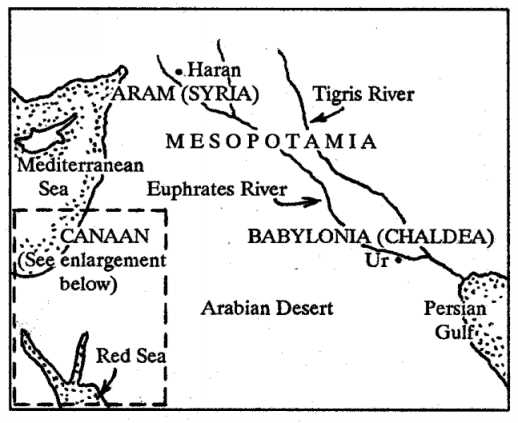
Response to God
Abraham was brought up in Mesopotamia, and the people among whom he lived were idol worshippers (Gen 11:28-31; Jos 24:2). But he worshipped the one true God (Gen 14:22; Gen 18:25; Gen 21:33). Abraham gave proof of his faith by obeying God when God told him to move out from his family group to a new land to which God would direct him (about 1925 BC; Gen 12:1; Gen 12:4; Neh 9:7; Act 7:2-4; Heb 11:8-10).
God’s purpose in choosing Abraham was to produce through him a nation (Israel; 2Co 11:22), to give that nation a land to dwell in (Canaan; Gen 12:5-7), and to bring from that nation one man (Jesus Christ; Rom 9:4-5) who would be saviour of the world. Through Abraham, people of all nations would receive the life-giving blessing that God had prepared for the world (Gen 12:1-3; Gal 3:14; Gal 3:29).
At the time of their migration to Canaan, Abraham and his wife Sarah (originally Sarai) had no children. Abraham was at that time seventy-five years of age. He and Sarah were accompanied by Abraham’s nephew, Lot, and a large household of labourers whom Abraham needed to look after his flocks, herds and working animals (Gen 12:4; Gen 12:16; Gen 14:14). A drought in Canaan convinced Abraham that he should look for better pastures in Egypt. But the Egyptian ruler found him deceitful, and Abraham was forced to leave Egypt in disgrace (Gen 12:10; Gen 12:20; Gen 13:1).
Nevertheless, Abraham and Lot continued to prosper. In fact, they became so wealthy that when they returned to Canaan, they had to settle in different parts of the land to prevent trouble between their households (Gen 13:1-2; Gen 13:6). Lot settled in the fertile region east of the Dead Sea (Gen 13:10-11). Abraham settled in the centre of Canaan, and received God’s reassuring promise that one day his descendants would possess Canaan as their national homeland (Gen 13:14-18). Later he rescued Lot from an invading army of Mesopotamians. He demonstrated his belief that God alone controlled Canaan’s affairs, when he made a sacrificial offering to God’s priest (Melchizedek) and refused to accept any reward from the Canaanite rulers (Genesis 14; cf. Heb 7:1-2; Heb 7:4; Heb 7:6).
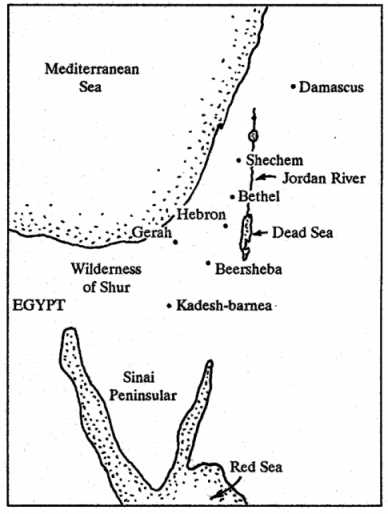
God’s covenant
God’s promise to Abraham (namely, that he would be the father of a great nation) originated entirely in the sovereign will of God. God chose Abraham, Abraham believed God’s promise, and in response God accepted Abraham as righteous (Gen 15:6). In confirmation of his promise, God told Abraham to prepare a covenant ceremony where normally the two parties to the covenant would pass between the parts of slaughtered animals. In this case, however, only God (symbolized by a smoking fire-pot and a flaming torch) passed between the animals, showing again that God alone took responsibility to fulfil the covenant promises. All that Abraham had to do was believe (Gen 15:7-10; Gen 15:17-21).
After ten years in Canaan, Sarah and Abraham had not been able to produce a son. Sarah therefore suggested that Abraham obtain his son through their slave-girl, Hagar (Gen 16:1-3). But the son born of this relationship was not the one God had promised. Abraham’s promised heir would come through his wife Sarah. It was at this time that God gave the names ‘Abraham’ and ‘Sarah’. The new names emphasized that they would yet be the parents of a multitude of people (Gen 17:1-7; Gen 17:15-19).
In further confirmation of his covenant with Abraham, God commanded Abraham and all future male descendants to make a permanent mark in their bodies. This mark, circumcision, was both a symbol of God’s faithfulness to his covenant and a sign that Abraham believed God’s promises and acted upon them. Circumcision sealed Abraham’s faith and demonstrated his obedience (Gen 17:9-11; Gen 17:23; Rom 4:9-12; Act 7:8; see CIRCUMCISION; COVENANT).
Sarah found it difficult to believe that she would yet have a child. God had just reassured Abraham (Gen 17:17-19), and now he sent heavenly messengers to reassure Sarah (Gen 18:9-14). The same messengers told Abraham that judgment was about to fall on the wicked cities of the region where Lot lived (Gen 18:16-21). Abraham hoped that God might spare the cities, but he did not realize how bad they were. The cities were destroyed, though Lot escaped (Gen 18:32; Gen 19:29).
Abraham’s heir
Upon moving with his flocks and herds into the Philistine region, Abraham again brought disgrace upon himself when he deceived the ruler in whose territory he dwelt (Gen 20:1-3). This failure of Abraham, particularly at a time so close to the birth of the promised son, showed again that God’s blessing upon Abraham depended entirely upon divine grace, not upon human good works (Rom 4:1-5).
The promised heir, Isaac, was born to Abraham and Sarah when Abraham was about one hundred years old. Abraham had accepted God’s promise by faith, in spite of the apparent impossibility of such an old couple producing children. God was faithful to his promise (Gen 21:2-3; Rom 4:17-21).
An even greater test of faith came when God told Abraham to offer his son as a human sacrifice. If Isaac was killed, God could no longer fulfil his promise of a multitude of descendants for Abraham through Isaac. Yet Abraham obeyed, believing that God could bring Isaac back to life (Gen 22:1-2; Heb 11:17-19). Abraham’s obedience proved the genuineness of his faith. Though he offered Isaac, he did not kill him. God provided a substitute, and Isaac’s life was given back, as it were, from the dead (Gen 22:13; Heb 11:19; Jas 2:21-24).
When Sarah died, Abraham bought a piece of ground within Canaan as a burial place for her. In doing so he showed once more his faith in the ultimate fulfilment of God’s promise concerning his descendants’ permanent homeland. He now legally owned part of the territory which they would one day possess (Gen 23:1-4; Gen 23:16-20; cf. Gen 49:29-33).
Since Isaac was to succeed Abraham as heir to Canaan and ancestor of the promised nation, Abraham required Isaac to remain in Canaan but not to marry one of the Canaanite women. He therefore sent his chief servant north to find a wife for Isaac among Abraham’s relatives (Gen 24:3-6).
The Genesis account of Abraham concludes with the note that he had other descendants through minor wives, but these were not part of the promised nation (Gen 25:1-6). One hundred years after first moving to the promised land, Abraham died (Gen 25:7). He was buried in the burial ground with Sarah, as a final demonstration of his faith in God’s promises (Gen 25:8-10).
Example of faith
Repeatedly, the New Testament refers to Abraham as an example of the truth that God accepts people and declares them righteous on the basis of faith. The Jews had to learn that physical descent from Abraham was no guarantee of salvation (Mat 3:9; Joh 8:39-44; Rom 9:7). The case of Abraham shows clearly that salvation has nothing to do with personal good works (Rom 4:1-5), religious rituals (Rom 4:9-12) or the law of Moses (Rom 4:13; Gal 3:16-18). It is entirely dependent upon God’s grace and is received by faith (Rom 4:16).
The promises given to Abraham find their ultimate fulfilment in Jesus Christ, through whom people of all nations are saved (Luk 1:72-73; Gal 3:8; Gal 3:14; Gal 3:16). When believers become Christ’s people, they become, through him, Abraham’s descendants also, and so share in the blessings promised to Abraham (Rom 4:16-17; Gal 3:9; Gal 3:29; Eph 3:6).
Abraham’s faith is a further example in that it is not only a faith that saves, but also a faith that the true believer lives by. Abraham’s offering of Isaac showed that faith proves its genuineness by obedience (Heb 11:17-19; Jas 2:21-23). Always Abraham looked beyond his immediate circumstances, believing that God would give him a better and more lasting dwelling place (Act 7:5; Heb 11:8-10; Heb 11:13-16).
The most respected ancestor of
the Jewish people. Through him God
promised to make a great nation and
bless all the people of the earth. Read
Gen. 12:13.