
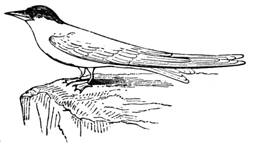
Fig. 136—Caspian Tern
Cormorant (Hebrew Salach) occurs Lev 11:17; Deu 14:17. The name is considered to have reference to darting, rushing, or stooping like a falcon. Nothing is known of it but that it was an unclean bird. Cuvier considers Gesner to be right in considering it to denote a gull, and it might certainly be applied with propriety to the black-backed gull; but although birds of such powerful wing and marine habitat are spread over a great part of the world, it does not appear that, if known at the extremity of the Mediterranean, they were sufficiently common to have been clearly indicated by either the Hebrew or Greek names, or to have merited being noticed in the Mosaic prohibition. Both the above are in general northern residents, being rarely seen even so low as the Bay of Biscay. With regard to the cormorant, birds of that genus are no doubt found on the coasts of Palestine, where high cliffs extend to the sea-shore; but all the species dive, and none of them rush flying upon their prey. We therefore conclude the salach to have been a species of ’tern,’ considered to be identical with the ’Sterna Caspica,’ so called because it is found about the Caspian Sea; but it is equally common to the Polar, Baltic, and Black Seas, and if truly the same, is not only abundant for several months in the year on the coast of Palestine, but frequents the lakes and pools far inland; flying across the deserts to the Euphrates, and to the Persian and Red Seas, and proceeding up the Nile. It is the largest of the tern or sea-swallow genus, being about the weight of a pigeon, and near two feet in length, having a large black naped head; powerful, pointed crimson bill; a white and grey body, with forked tail, and wings greatly exceeding the tips of the tail: the feet are very small, weak, and but slightly webbed, so that it swims perhaps only accidentally, but with sufficient power on land to spring up and to rise from level ground. It flies with immense velocity, darting along the surface of the sea to snap at mollusca or small fishes, or wheeling through the air in pursuit of insects; and in calm weather, after rising to a great height, it drops perpendicularly down to near the surface of the water, but never alights except on land; and it is at all times disposed to utter a kind of laughing scream. This tern nestles in high cliffs, sometimes at a very considerable distance from the sea. We figure one that was shot among a flight of these birds, some distance up the river Orontes.
A water bird about the size of a goose. It lives on fish, which it catches with great dexterity; and is so voracious and greedy, that its name has passed into a kind of proverbial use. The Hebrew word translated "cormorant" in Isa 34:11 Zep 2:14, should rather be translated, as it is in other passages, "pelican," Lev 11:17 .\par
Cormorant. The representative, in the Authorized Version, of the Hebrew words, kaath and shalac. As to the former, see Pelican, Shalac occurs only as the name of an unclean bird in Lev 11:17; Deu 14:17. The word has been variously rendered. The etymology points to some plunging bird. The common cormorant, (phalacrocorax carbo), which some writers have identified with the shalac, is unknown in the eastern Mediterranean; another species is found south of the Red Sea, but none on the west coast of Palestine.
The
There are two Hebrew words thus translated in our version. (See Bochart, Hieroz. 3:20 sq.)
1.
Its apparent Greek name, cataractes, though noticed by several authors, is not always referred to the same genus, some making it a minor gull, others a diver. Cuvier thinks Gesner right in considering it to denote a gull, and it certainly might be applied with propriety to the black-backed gull, or to the glaucous; but, although birds of such powerful wing and marine habitat are spread over a great part of the world, it does not appear that, if known at the extremity of the Mediterranean, they were sufficiently common to have been clearly indicated by either the Hebrew or Greek names, or to have merited being noticed in the Mosaic prohibition. Both the above are in general northern residents, being rarely seen even so low as the Bay of Biscay, and the species now called “Lestris cataractes” is exclusively Arctic. With regard to the cormorant; birds of that genus are no doubt found on the coasts of Palestine, where high cliffs extend to the sea-shore, such, for example, as the Phalacrocor ix pygmaeus; but all the species dive, and seldom, if ever, rush flying upon their prey, though that habit has been claimed for them by commentators, who have mixed up the natural history of “cormorants” with that of the “sula” or “gannet,” which really darts from great elevations into the sea to catch its prey, rising to the surface sometimes nearly half a minute after the plunge. But the gannet (solan goose) rarely comes further south than the British Channel, and does not appear to have been noticed in the Mediterranean. It is true that several other marine birds of the North frequent the Levant, but none of them can entirely claim Aristotle and Oppian’s characters of “cataractes;” for, though the wide throat and rather large head of the dwarf cormorant may be adduced, that bird exceeds in stature the required size of a small hawk, and fishes, it may be repeated, swimming and diving, not by darting down on the wing, and is not sufficiently numerous or important to have required the attention of the sacred legislator.
Thus reduced to make a choice where the objections are less and the probabilities stronger, we conclude the shalak to have been a species of “tern,” considered to be identical with the Sterna Caspica, so called because it is found about the Caspian Sea; but it is equally common to the Polar, Baltic, and Black Seas, and, if truly the same, is not only abundant for several months in the year on the coast of Palestine, but frequents the lakes and pools far inland, flying across the deserts to the Euphrates, and to the Persian and Red Seas, and proceeding up the Nile. It is the largest of the tern or sea-swallow genus, being about the weight of a pigeon, and near two feet in length, having a large black-naped head, powerful, pointed crimson bill, a white and grey body, with forked tail, and wings greatly exceeding the tips of the tail; the feet are very small, weak, and but slightly webbed, so that it swims perhaps only accidentally, but with sufficient power on land to spring up and to rise from level ground. It flies with immense velocity, darting along the surface of the sea to snap at mollusca or small fishes, or wheeling through the air in pursuit of insects; and in calm weather, after rising to a great height, it drops perpendicularly down to near the surface of the water, but never alights except on land; and it is at all times disposed to utter a kind of laughing scream. This tern nestles in high cliffs, sometimes at a very considerable distance from the sea. (See the Penny Cyclopaedia, s.v. Tern.)
2.
The cormorant belongs to the natural order of the Pelicanidae of Linnaeus, and the species have the characteristic habit of watching on high cliffs, and, on perceiving a fish in the water, of darting down like an arrow and seizing its prey. The “greater cormorant,” however, more frequently shoots along in a line nearly close to the surface of the water, or, sitting on the wave, dives after the prey. It is trained to fish for man’s use in China. It is common on the coasts of Syria and Palestine; Rauwolff saw numbers of them along the sea-washed crags of Acre, which he mistook for sea-eagles. The cormorant is a widely-diffused genus, and is found in almost every country in the world. (See the Penny Cyclopoedia, s.v. Pelicanidai.) The large kind weighs about seven pounds, and is nearly of the same size as the goose; it lives upon fish, and has a long, straight, and compressed bill; with the upper mandible hooked at the point, to confine the prey with the greater security; its head and neck are of a sooty blackness, more resembling in figure those of the goose than of the gull. Its distinguishing character, however, consists in its toes being united by membranes, and by the middle toe being notched like a saw, to assist it in holding its fishy prey. On the approach of winter these birds are seen dispersed along the seashore, and ascending the mouths of rivers; they are remarkably voracious, and have such a quick digestion that the appetite appears insatiable. They build their nests on the highest parts of the cliffs that overhang the sea; the female usually lays three or four eggs about the size of those of a goose, and of a pale green color. SEE BIRD.
Cormorant, the plunger, Lev 11:17; Deu 14:17, an unclean bird, like the cormorant—which is a water-bird about the size of a goose. Another Hebrew word, translated "cormorant" in Isa 34:11; Zep 2:14, A. V., should rather be translated as it is in the R. V., and in other passages of the A. V., "pelican."
In Isa 34:11 and Zep 2:14 the Hebrew is qaath, and signifies PELICAN, q.v. In Lev 11:17 and Deu 14:17 the Hebrew word is shalak, and is rightly translated Cormorant, a large bird that lives upon fish. It dashes down upon its prey, and can follow it in the water or dive after it if it descends. It is only mentioned in scripture as an unclean bird.
By: Emil G. Hirsch, Ira Maurice Price
The translation given in the Bible (Lev. xi. 17; Deut. xiv. 17) of the Hebrew word  . In these passages it is specified as one of the unclean fowls. The A. V. (Isa. xxxiv. 11; Zeph. ii. 14) gives "cormorant" as the translation of
 ; but the R. V. renders it correctly as "pelican." Tristram, Post, and others agree that the derivation of the word from a root signifying "plunger" indicates the bird known to-day as Phalacrocorax carbo, which is abundant on the Mediterranean coast of Palestine and in the valley of the Jordan. Its classification among the unclean birds is due to the fact that it feeds upon fish. Its name indicates its characteristic of plunging into the water to catch its prey. Its habits seem to be similar to those of the tern or gull of Western waters.
CORMORANT (Lev 11:17, Deu 14:17, shâlâk).—The shâlâk, as the meaning of the word implies, was some kind of plunging bird. Two varieties of cormorant, Phalacrocorax carbo and P
E. W. G. Masterman.
Cormorant. Both the prophets Isaiah and Zephaniah linked the cormorant or "the pelican" (NKJV) with the bittern to describe the ruin God brings in judgment upon man’s proud cities (Isa 34:11; Zep 2:14). The cormorant (or "the fisher owl," NKJV) was listed among the few birds the Israelites were not to eat (Lev 11:17; Deu 14:17).
Cormorants are large fish-eating birds, related to pelicans, with hooked beaks and webbed feet. They dive into the water to catch fish; they swim well; and they can stay under water for a long time.
The cormorant found in Israel has a black head, yellow-circled eyes, and green highlights in its black plumage. As the prophets suggested (Isa 34:11; Zep 2:14), the cormorant would be an unsettling sight in the swampy pools of a ruined city.
A cormorant (Phalacrocorax carbo) is a large, black bird that looks like a goose. It appears often in art from Egypt and the Holy Land. Cormorants are 48 to 102 centimeters long (19 to 40 inches). They have webbing between all four toes. Their feet are set far back on the body, which helps them swim under water to catch food. They eat fish, shellfish, and amphibians (animals such as frogs). The bill is long and curves at the tip. A small sac under the bill can hold a caught fish.
Cormorants live in large groups. They make nests of sticks and plants in trees or on rocky ledges near the sea. Each pair lays up to four eggs. Both the male and female care for the young.
In Bible times, cormorants lived in swamps near the Sea of Galilee, Lake Huleh (waters of Merom), and along the Mediterranean coast. The Hebrew name for the bird comes from its habit of “diving down” to catch prey. Cormorants dive deep and move quickly under water when hunting fish. People often thought of them as greedy birds. They were unclean for the Israelites (Leviticus 11:17; Deuteronomy 14:17).
Aquifer Open Bible Dictionary © 2026 Mission Mutual, an adaptation of the Tyndale Open Bible Dictionary © 2023 Tyndale House Publishers. Licensed under CC BY-SA 4.0.
Discussion:
Although the translation of shalak as “cormorant” has a tradition going back to the seventeenth century, there has always been considerable doubt about this translation. For one thing, the root of the word shalak means “to throw or hurl", which would indicate that the bird with this name “throws” itself down onto its prey, something cormorants do not do. They swim low in the water and dive underwater to hunt their prey. This led the late G. R. Driver to suggest the translation “fisher owl", and this has been followed by NEB and REB. However, there are problems with this suggestion too. The fisher owl, or more correctly, the Brown Fish Owl “Scotopelia ceylonensis", is not likely to have been a bird that was well known, and its fishing habits would only have been seen by fishermen on moonlit nights, and that very rarely. The Israelites were not yet a fishing people in the period of the Exodus.
In modern Hebrew shalak is the name given to the Osprey Pandion haliaetus, which is a type of fishing eagle that plunges into the water from a height and catches fish in its claws. Some Israeli scholars have suggested that it may have been the ancient name for the Smyrna Kingfisher Halcyon smyrnensis, or the Gannet Sula bassana, both of which drop down from a height onto their prey, which they catch underwater in their beaks.
Since there is so much doubt about the identification of this bird, the translation “osprey” seems to have as much, if not more, justification than “cormorant".
See also 3.15 Osprey.
Description:
The White-necked Cormorant Phala-crocorax carbo, which is the most common type of cormorant in the Middle East, is a large bird with a long slim body and a long beak that is hooked at the tip. The adults are black all over with a small yellow pouch where the throat meets the beak. They also have yellow skin on their faces. This type of cormorant is found along the sea and lake coasts, along the larger rivers, and in swampy areas. It has webbed feet like a duck and swims in the water, but with most of the body under the water. It dives and can swim quite a long way underwater hunting fish.
Like all cormorants its feathers are not waterproof, and this enables it to swim underwater easily. However, it also means that after diving or swimming for a while, a cormorant has to come out of the water to dry out its wings. Thus cormorants can often be seen perched on logs or rocks, with their wings spread out to dry.
During the daytime they can usually be found in small groups of four or five, but in the evening when they roost in trees they come together in large numbers and are very noisy. In seasons when large shoals of small fish swim near the surface, large numbers of black cormorants can often be seen flying fast and low above the water in long lines one behind the other, searching for such a shoal. When they find it, they all land on the water together and feed in great excitement.
Special significance or symbolism:
Apart from the fact that the shalak is found in the lists of unclean birds, it has no other significance in the Bible.
Translation:
If the translator chooses to identify shalak as “cormorant", it should not be difficult to find some species of cormorant locally, since cormorants are found all over the world near large bodies of water. The white-necked cormorant is in fact found not only in Israel but also near the coasts, lake shores, large rivers, and swamps throughout Europe, Asia, Australasia, Africa, and the eastern half of North America. In southern Africa a slightly different form of the white-necked cormorant is found, called the white-breasted cormorant. It has a white breast and throat and a smaller throat pouch, but has the same scientific name. Elsewhere there will be local species of cormorant, which can be identified by the habit of perching with wings spread out to dry.
Animals in the Bible © United Bible Societies. Licensed under CC BY-SA 4.0.