
I should not think it necessary to notice this article in our Concordance, but for the occasion that offers thereby of making an observation on the fig tree which the Lord Jesus blighted near Bethany. It may be proper, for the better apprehension of the subject, to remark, that the fig tree grew, in Palestine, not unfrequently in the roads, and highways, and hedges, beside those that were cultivated in. the gardens. It is plain, that this fig tree which Christ withered was of this kind; a hedge fruit, and, consequently, it was no man’sproperty. Matthew’s account of this transaction is, that when Jesus saw this fig tree in the way, he came to it, and found nothing but leaves only; and said unto it, Let no fruit grow on thee hence forward for ever: and presently the fig tree withered away." (Matt. xxi. 18.) And Mark adds to this relation, that the time of figs was not yet." (Mark xi. 13.) It is very evident from hence, that the Lord Jesus had an object of much higher moment to set forth by this action, than the mere blighting a hedge fig tree. For surely, theLord did not expect fruit out of season; neither did he mean, as some have supposed, to shew anger, to a fig tree. It is well known, that in the eastern world almost all instruction was conveyed by parable and figure. And so much did the Lord Jesus, in his divine teaching, fall in with this popular way of conveying knowledge, that at one time we are told "without a parable spake he not unto them." (Matt. 13. 34.) The question becomes exceedingly interesting to know, what particular instruction to his disciples the Lord meantto have impressed on their minds by this event.
Perhaps I may be singular in my view of the subject. But if I err, may the Lord pity and pardon my ignorance, and the reader find no injury from my statement of it. The whole stress of the subject, as it strikes me, is in the nature and quality of this fig tree. It was hedge fruit. It was in the highway; and no man’s property. Now the church is expressly compared by the Lord himself to a fig tree of his own, and planted in his vineyard. (Luke 13. 6.) And the prophet, in the Old Testament dispensation, celebrated the glories of God’sgrace to the church under a similar figure of his planting his vineyard with a choice vine. (Isa. v. 1. &c.) The fruitless fig tree of the hedge, and which at the command of Jesus withered away, according to my view of the subject, was intended by the Lord to represent the mere professors of the gospel, who to a traveller afford leaves, but no fruit. It is, indeed, without; not in the garden, the church. It cannot bring forth fruit unto God; for the Lord saith, when speaking of his church, From me is thy fruit found." (Hos. 14.8.)Jesus hath a right and property in his people. They are his, both by the Father’s gift, and by his own purchase. And he hath brought them in, and fenced them round, and they are "trees of his right hand planting." (Isa. lxi 3.)
The instant withering of the barren fig tree, at Christ’s command, became the emblem of what must ultimately follow all the way - side productions in nature, void of grace, at the great day of the Lord. And our Lord’s own comment upon the blasted tree, seems very fully to justify this view of the subject. For when the disciples remarked to Jesus how soon the fig tree was withered away, the Lord made this striking answer, "Have faith in God." As if he had said, all are but the mere leaves of profession where there is no vitalunionin me. As he said elsewhere, "I am the vine; ye are the branches." (John xv. 5.) If this be the right sense of the passage, and the Lord Jesus meant to teach his disciples thereby, that every hedge fig tree hath no part in the church, no owner in Christ by his Father’s gift or purchase, no union with him, and, consequently, no communion in his graces, but must in the hour of decision instantly wither away; then will this parable of the barren fig tree form one testimony more to the numberless other testimonies with whichthe word of God abounds, that the children of the wicked one, and the children of the kingdom, are totally separate and dissimilar from everlasting, and so must continue to everlasting. Tares can never become wheat; neither can wheat become tares. Goats must remain goats; for their nature cannot admit in them the nature of sheep. The fig tree of the hedge, never planted in the vineyard of Jesus, hath no fruit in him; and, consequently, always barren. So infinitely important is it, to be found in Christ.
2. The account of our Saviour’s denunciation against the barren fig tree, Mat 21:19; Mar 11:13, has occasioned some of the boldest cavils of infidelity; and the vindication of it has exercised the ingenuity of several of the most learned critics and commentators. The whole difficulty arises from the circumstance of his disappointment in not finding fruit on the tree, when it is expressly said, that “the time of figs was not yet.” While it was supposed that this expression signified, that the time for such trees to bring forth fruit was not yet come, it looked very unaccountable that Christ should reckon a tree barren, though it had leaves, and curse it as such, when he knew that the time of bearing figs was not come; and that he should come to seek figs on this tree, when he knew that figs were not used to be ripe so soon in the year. But the expression does not signify the time of the coming forth of figs, but the time of the gathering in of ripe figs, as is plain from the parallel expressions. Thus, “the time of the fruit,”
Mat 21:34, most plainly signifies the time of gathering in ripe fruits, since the servants were sent to receive those fruits for their master’s use. St. Mark and St. Luke express the same by the word time, or season: “At the season he sent a servant,” &c; that is, at the season or time of gathering in ripe fruit, Mar 12:2; Luk 20:10. In like manner, if any one should say in our language, the season of fruit, the season of apples, the season of figs, every one would understand him to speak of the season or time of gathering in these fruits. When, therefore, St. Mark says, that “the time or season of figs was not yet,” he evidently means that the time of gathering ripe figs was not yet past; and, if so, it was natural to expect figs upon all those trees that were not barren; whereas, after the time of gathering figs, no one would expect to find them on a fig tree, and its having none then would be no sign of barrenness. St. Mark, by saying, “For the time of figs was not yet,” does not design to give a reason for “his finding nothing but leaves;” but he gives a reason for what he said in the clause before: “He came, if haply he might find any thereon;” and it was a good reason for our Saviour’s coming and seeking figs on the tree, because the time for their being gathered was not come. We have other like instances in the Gospels, and, indeed, in the writings of all mankind, of another clause coming in between the assertion and the proof. Thus, in this very evangelist: “They said among themselves, Who shall roll away the stone from the door of the sepulchre? and when they looked, they saw the stone was rolled away; for it was very great:” Mar 16:3-4; where its being very great is not assigned as a reason of its being rolled away, but of the women’s wishing for some one to roll it away for them. St. Matthew informs us that the tree was “in the way,” that is, in the common road, and therefore, probably, no particular person’s property; but if it was, being barren, the timber might be as serviceable to the owner as before. So that here was no real injury; but Jesus was pleased to make use of this innocent miracle to prefigure the speedy ruin of the Jewish nation on account of its unfruitfulness under greater advantages than any other people enjoyed at that day; and, like all the rest of his miracles, it was done with a gracious intention, namely, to alarm his countrymen, and induce them to repent. In the blasting of this barren fig tree, the distant appearance of which was so fair and promising, he delivered one more awful lesson to a degenerate nation, of whose hypocritical exterior and flattering but delusive pretensions it was a just and striking emblem.
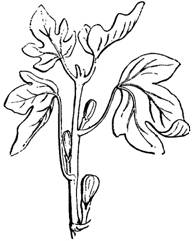
Fig. 180—Ficus carica
The fig-tree has from the earliest times been a highly esteemed fruit in the East, and its present, as well as ancient Arabic name, is teen. Though now successfully cultivated in a great part of Europe, even as far north as the southern parts of England, it is yet a native of the East, and probably of the Persian region, where it is most extensively cultivated. The climate there is such that the tree must necessarily be able to bear some degree of cold, and thus be fitted to travel northwards, and ripen its fruit where there is a sufficient amount and continuance of summer heat. The fig is still extensively cultivated in the East and in a dried state, strung upon cords, it forms an extensive article of commerce from Persia to India.
The fig is mentioned in so many passages of Scripture, that our space will not allow us to enumerate them. The first notice of it, however, occurs in Gen 3:7, where Adam and Eve are described as sewing fig-leaves together to make themselves aprons. The common fig-leaf is not so well suited, from its lobed nature, for this purpose; but the practice of sewing or pinning leaves together is very common in the East even in the present day, and baskets, dishes, and umbrellas, are made of leaves so pinned or sewn together. The fig-tree is enumerated (Deu 8:8) as one of the valuable products of Palestine, ’a land of wheat, and barley, and vines, and fig-trees, and pomegranates.’ The spies, who were sent from the wilderness of Paran, brought back from the brook of Eshcol, clusters of grapes, pomegranates, and figs. The fig-tree is referred to as one of the signs of prosperity (1Ki 4:25), ’And Judah and Israel dwelt safely, every man under his vine and under his fig-tree.’ And its failure is noted as a sign of affliction (Psa 105:33), ’He smote their fig-trees, and broke the trees of their coasts.’ The very frequent references which are made in the Old Testament to the fig and other fruit trees, are in consequence of fruits forming a much more important article of diet in the warm and dry countries of the East, than they can ever do in the cold and moist regions of the north. Figs are also used medicinally, and we have a notice in 2Ki 20:7, of their employment as a poultice.
Fig Tree. The fig tree (Ficus carica) is very common in Palestine. Deu 8:8. Mount Olivet was famous for its fig trees in ancient times, and they are still found there. To "sit under one’s own vine and one’s own fig tree" became a proverbial expression among the Jews to denote peace and prosperity. 1Ki 4:25; Mic 4:4; Zec 3:10.
The fig is a pear-shaped fruit, and is much used by the Orientals for food. The young figs are especially prized for their sweetness and flavor. The fruit always appears before the leaves; so that when Christ saw leaves on the fig tree by the wayside, Mar 11:13, he had a right to expect fruit.
The usual summer crop of fruits is not gathered till May or June; but in the sunny ravines of Olivet, fig trees could have ripe fruit some weeks earlier, (Dr. Thomson), and it was not strange so early as Easter that Christ might find the young eatable figs, although it was not the usual season for gathering the fruit.
Fig, Fig Tree. This, Ficus carica, was a tree very common in Palestine. Deu 8:8. Mount Olivet was famous anciently for fig trees; and still some are to be found there. The first notice we have of this tree is when Adam and Eve endeavored to clothe themselves with leaves. Gen 3:7. Whether the leaves they used were those of the ordinary fig tree may be questioned; but the practice of fastening leaves together for various utensils, as baskets, etc., is common in the East to the present day. Not only was the fresh fruit of the fig tree valued, but also cakes of figs are mentioned in Scripture; e.g., 1Sa 25:18; 1Sa 30:12, These were made either by simple compression, or by pounding them into a mass, sometimes together with dates. They were then cut into cakes, often similar to bricks, and hardened by keeping. Twice the fig tree is mentioned in the New Testament. Our Lord, shortly before his crucifixion, being hungry, sought fruit from a fig tree, and, finding none, condemned it. Mat 21:18-20; Mar 11:12-14; Mar 11:20. It was early in the season, not the ordinary time for figs; but yet, as the fruit precedes the leaves, and there were leaves on this tree, figs might naturally have been expected on it; and, as there were then none, there was proof enough that the pretentious tree was worthless. The parable of the fig tree spared at the intercession of the dresser of the garden, Luk 13:6-9, is full of instruction. There is, it may be added, an expressive phrase in which the fig tree is introduced; when men axe said to sit under their own vine and their own fig tree, 1Ki 4:26; Zec 3:10, a state of general peace and prosperity is indicated.
FIG-TREE (in NT
(a) The fig-tree is conspicuous in early spring by the expanding of the tips of its twigs into little green knobs called
(b) The fig-tree has two (not three) successive crops of fruit each year. The first-ripe fig (Heb.
This phenomenon of successive fruitage in the fig-tree is doubtless the source of the description of the fruit-trees of the New Jerusalem (Eze 47:12, Rev 22:2 ‘the tree of life’) as ‘bearing fruit every month.’ In the Talmud it is a symbol for the acquisition of learning, which, to be permanent, must come by little and little (Hamburger, RE [Note: E Realencyklopädie.] i. 3, s.v. ‘Feige,’ p. 360 with references). Hence the saying, ‘Whoso sees a fig-tree in his dreams, his learning shall be safe from forgetfulness’ (Berakhoth, 57). The capacity of the tree for prolongation of its bearing season leads in fact to certain representations which easily pass over into exaggerations and misunderstandings important to avoid.
Edersheim (Life and Times, bk. iv. ch. xvi. p. 246) refers to ‘a species (the Benoth Shuach) mentioned in Shebh, v. 1, of which the fruit required three years for ripening,’ but which may more reasonably be understood as simply a late-bearing variety whose fruit reached maturity only in exceptionally favourable seasons, not oftener than once in three years. So with the rhetorical passage of Josephus (BJ iii. x. 8) celebrating the delightful climate of the plain of Gennesaret. His statement that ‘it supplies the principal fruits, as grapes and figs, uninterruptedly during ten months of the year,’ cannot reasonably be made to prove more than the fact that in that semi-tropical depression, 600 ft. below sea-level, fresh fruit, including figs, could be obtained almost to the end of winter.
To explain the narrative of Mar 11:13 two other facts have been advanced of doubtful value and trust-worthiness. It is asserted that neglected relics of the autumn crop sometimes cling to the branches of the fig-tree throughout the winter; but Post (l.c. p. 6) was unable during a residence of 33 years in Syria to find, or hear of, such. The statement of Edersheim (l.e. v. ii. p. 374) that such left-over fruit about April 1 ‘would of course be edible’ becomes admissible only by inserting a ‘not’ after ‘of course.’ It is also asserted that the pag, or green fruit, was eaten, even Benzinger (PRE [Note: RE Real-Encyklopädie fur protest. Theologic und Kirche.] 3 [Note: designates the particular edition of the work referred] s.v. ‘Fruchtbäume,’ p. 304) declaring that ‘Jesus might expect to find such winter figs (the paggîm) on a tree already in leaf at the season of Passover, that is before the time of the ripening of figs.’ In the sense that the rudimentary fruit-buds would be discoverable under the leaves, upon examination (unless the tree had become sterile by reversion to the wild type, as sometimes occurs), this statement is true; the present writer has found such dry tasteless ‘figs’ at ‘Ain Far‘a near Jerusalem, on March 1, the size of an olive, though the tree was leafless. Boys sometimes nibble these buds, but to speak of the paggîm at this season as ‘winter figs’ is misleading. The evidence for the edible quality of the pag, drawn by Edersheim from the Talmud (Bk. v. ii. p. 375, referring to Shebh. iv. 7 and Jerus. [Note: Jerusalem.] Shebh. 35b, last lines) suggests only that at a later season the unripe fruit was sometimes used as a condiment ‘with bread.’ This, however, was after the paggim ‘began to assume a red colour,’ and not when the foliage had only just begun to cover the setting fruit-bud. Apart from the question whether a tree could be properly rebuked for the absence of a quite exceptional product, the alleged phenomena, whether of neglected relics of the autumn harvest, or use of the unripe fruit, have neither of them any real bearing on the difficulty that Jesus should approach a wayside fig-tree, with the intention of staying His hunger, when, as so frankly stated in the record itself, ‘it was not the season of figs.’
2. The Gospel references to the fig-tree include both parables and incidents, and make allusion to phenomena both of its leafage and its fruitage. As questions arise to how great an extent the incidents may not be symbolic, parables becoming concrete in process of repetition, or even pure symbols, it is best to consider first the two instances in which the fig-tree is made the subject of undoubted parable by our Lord.
(a) The parable of the Fig-Tree (Mar 13:28-29 = Mat 24:32-33, paraphrased and interpreted Luk 21:29-31) is based on the early verdure of the tree. Its general sense is clear from Luk 12:54 ff. (= Mat 16:2-3
(b) The parable of the Barren Fig-Tree (Luk 13:6-9) stands in the same eschatological context as the warning to read the signs of the times (Luk 12:35 to Luk 13:9 paralleled by Mar 13:33-36; Mar 13:12-13), and forms its climax. One is tempted to conjecture that the problematic ‘parable’ referred to in Mar 13:28, Mat 24:32 (
3. The cursing of the fig-tree (Mar 11:12-14; Mar 11:20-25 = Mat 21:18-22).—Parabolic symbolism is so slightly concealed under the narrative features of this story that the majority of critics are disposed to regard it as a mere endowment of the Lukan parable of the Barren Fig-tree with concrete form, just as the parable of the Good Samaritan, and others, were long treated as instances of historical fact.
In favour of this explanation are several features of the narrative and its setting.
(a) The generally admitted incorporation of Mk. by Lk. implies that the omission of Mar 11:12-14; Mar 11:20-25 was deliberate. The most natural explanation of it is that St. Luke regarded the story as a double of his parable, Luk 13:6-9. Conversely the parable does not appear in Mt. or Mark.
(b) The withering of the tree (Mar 11:20-25), a sequel of the next day after the cursing (Mar 11:12-14), occupies a different position in Mat 21:19-22, taking place ‘on the spot.’ In both Gospels this appended sequel proves itself a secondary attachment, both by its material and its language. The contents of Mar 11:20-25 consist in the main of two logia, torn from their proper context (cf. Mat 17:20, Luk 17:6, and Mat 6:14-15) and characterized by non-Markan expressions (cf. ‘your Father in heaven,’ Mar 11:25). Such loose agglomerations of stray logia are frequent in our Second Gospel (Mar 3:22-30; Mar 4:11-12; Mar 4:21; Mar 4:25; Mar 8:15; Mar 8:34-36; Mar 9:42-50; Mar 10:10-12 etc.). In Mat 21:19-22 the language is alien (
But even more fatal than the superfluousness of the sequel is its perversion of the real symbolism of the incident. Nothing is said of that which analogy (Mat 3:10; Mat 7:18-19, Luk 13:6-9) proves to be the real moral lesson; but the appended sayings are adapted to find in it mere evidence of the wonder-working power of belief. The disciples are to learn that the prayer, or even the fiat, of faith—here taken as equivalent to undoubting assurance—can set at defiance the order of nature. This, the writer understands, was the purpose of the cursing. As part of the rebuke of the disciples half-heartedness (
There remains as a historical basis for the story only the possibility that Jesus’ footsteps might be attracted by the suggestion of a possible moral lesson in the precocious leafage of a wayside tree, the discovery that it covered no promise of fruit leading Him thereupon to an utterance in the vein of prophetic symbolism. Gould (Internat. Crit. Com. ‘Mark,’ 212) finds evidence in Hos 1:1-3, Joh 4:6-11, Mat 13:10-15 that ‘such acted parables were not without precedent among the Jews.’ More apposite might be the reference of
Due consideration for all three objections leaves the question still open whether the story of Mar 11:12-14 a records a specific utterance of this symbolic kind directed against a particular tree, on a particular occasion; or whether tradition and the Evangelist together have not simply localized between Bethphage (‘Fig-town’) and Jerusalem, on occasion of the supreme visitation of the latter, a visualized version of the parable Luk 13:6-9.
In favour of the former view may be cited critics no less radical than H. J. Holtzmann (Hdkom. ad loo.) and J. Weiss (Das Aclteste Evangelium, p. 268). Still more pronounced is Schwartz in favour of connecting the fig-tree of Mar 11:12-14, and even that of Mar 13:28 as well, with some sun-bleached skeleton from the orchards of Bethphage, a lone relic of the siege of Titus, pointed to by Jerusalem Christians as the memorial of Jesus warning and promise; but Schwartz would not admit a basis of fact for this early identification by tradition of ‘the’ fig-tree, but rather such as Cheyne instances in ‘the inn’ of the Good Samaritan.
The phenomena of the text indicate, however, that the process must at least precede our text of Mark. For our Evangelist the symbolic sense has already disappeared, leaving only the work of power. Before this stage of the process could be reached the parable of the Barren Fig-tree must already have been transformed by local tradition into symbolic cursing of some given tree, and the moral lesson have been subsequently eclipsed by the purely thaumaturgic interest.
More conservative criticism, while recognizing the secondary character of Mar 11:20-25, and perhaps admitting the fundamental identity of the symbolic cursing with the parable whose lesson is so obviously the same, may still demand more evidence before it surrenders the possibility that our Second Evangelist retains a substantially trustworthy tradition of the actual site and occasion of the utterance.
4. The fig-tree of Nathanael (Joh 1:48). Symbolism admittedly enters to so large a degree into the narrative of the Fourth Gospel (cf. e.g. Joh 9:7; Joh 12:33), that it is not surprising if the more radical school of interpreters, looking upon it as the uniform product of an allegorizing fancy, should find in the unexplained reference of Joh 1:48 the suggestion of an allegorical sense, the fig-tree having the symbolic meaning of religious instruction applied in the Talmud, or even playing the part of the sacred Bo-tree (Ficus religiosa) in Buddhist legend. The fact that commentators from Schoettgen and Lightfoot (Hor. Heb. ad loc.) downwards have inferred that Nathanael was ‘aut orans, aut legens, aut meditans, aut aliquid religiosum praestans’ is proof that this mental association is natural; but it cannot be truly said that the Evangelist allegorizes. The words ‘when thou wast under the fig-tree’ are obscure, not because we fail to apply the key, but because the Evangelist has left something lacking. He utters an enigma, but gives no other clue than the recognition by Nathanael of Jesus’ supernatural knowledge. He wishes the reader to guess that Jesus had here proved Himself the
If the traditional view be maintained, the Evangelist’s reserve will be accounted for as reflecting the enigmatic nature of the actual dialogue, which, so far as bystanders were able to perceive, had no further explanation.
Literature.—Besides the works referred to in the art. the following may be consulted: Thomson, LB [Note: The Land and the Book.] , pt. ii. ch. xxiv.; Tristram. Nat. Hist. of the Bible, p. 352: Trench, Parables12 [Note: 2 designates the particular edition of the work referred] , p. 346ff.; Bruce, Parabol. Teaching, p. 427 ff.; Trench, Miracles10 [Note: 0 designates the particular edition of the work referred] , p. 466 ff.; W. M. Taylor, Mir. of Our Saviour, p. 413 ff.; Liddon, Sermons on Some Words of Christ, p. 100; Godet and Westcott, Comm. in loc.; cf. Augustine, Conf. viii. xii. 28.
B. W. Bacon.
The Bible supposes the presence of the fig-tree throughout all Palestine, and regards it as one of the characteristic products of the land (Deuteronomy 8), together with the vine, so that a land which has neither fig-tree nor vine is considered wretched (Numbers 20). Figs, with other fruit, were brought back from Palestine by the envoys of Moses to give an idea of the fertility of the land (Numbers 13). The tree loses its leaves during the winter, but these begin to grow again towards the end of March, or the beginning of April. As early as the end of February, little figs grow at the junction of the old wood and the leaves, but they develop only to the size of a cherry, are inedible, and soon fall for the most part. The few that continue to develop ripen in June, and are "the figs of the first season," described as "very good" (Jeremiah 24). In the meantime other buds grow which form the real crop, ripe in August. Figs were eaten fresh or dried, and in the latter case were pressed into solid cakes (1 Kings 25). Figs were also used for medicinal purposes as in the poultice which healed the boil of Ezechias (4 Kings 20). Both the sweet fruit and the abundant foliage, which protects from the sun, are often referred to in Scripture, in descriptions of peace and prosperity (Judges 9; 3 Kings 4). The fig-tree figures in the New Testament in the symbolic action of Our Lord (Matthew 21; Mark 11), which is a reminder of the symbolic actions of the prophets of the Old Testament. Other references in the New Testament to the fig-tree and figs are in Matthew 7 and 24; John 1; James 3; Apocalypse 6.
The parable of the Barren Fig-tree is given in Luke, 13, in connection with the call to repentance, inspired by recent misfortunes which should cause the nation of Israel to think, else destruction awaits them. The parable speaks of a fig-tree, planted in a vineyard. After a lapse of time which would allow the tree to grow to the bearing stage, the owner comes three years in succession, but finds no fruit. Disappointed by continual failure which leaves no hope for the future, the owner orders the tree cut down, but at the request of the vine dresser he consents to try again and to spare the tree for another year. The vine dresser hopes that additional care may help the tree to bear fruit. The application of the parable to the case of Israel is sufficiently clear to need no further explanation. Like the fig-tree Israel receives special care from God; the mission of Christ is the last of those proofs of the Divine love for the nation, and if the people fail to respond and to heed the call, they are doomed to destruction.
Jdg 9:10-11 (b) This is an allegory. Gideon was the fig tree. Jotham his son was the vine, Abimelech was the bramble. Jotham in speaking to Israel reminded them that while both he and his father really cared for the blessing and the good of the nation, Abimelech would not be a blessing, but would be to them a curse and would bring only sorrow and trouble to them.
1Ki 4:25 (c) This is an interesting type of general prosperity. There would be no mortgages and no debts, but each man would own his own property and be able to recline at ease in his own home. (See also Mic 4:4; Zec 3:10).
2Ki 18:31 (b) This is a promise from the King of Babylon that if the Jews would come over to him, surrender to him, and yield themselves to him, he would take them away to a fruitful land and give them their freedom. (See also Isa 36:16).
Son 2:13 (a) This is a type of the prosperity of Israel as a nation. Their fruit trees would abound in fruit, and their fields would be fertile and productive.
Isa 34:4 (a) This represents the result of GOD’s curse on the nation. He will cause all blessings to cease so that the land will be barren. (See Jer 8:13; Hab 3:17).
Nah 3:12 (b) This is a type of the curse that is to come upon Nineveh. Their riches and their treasures would fall an easy prey to the invader.
Hos 9:10 (a) GOD chose Israel in the beginning as a nation which would be full of possibilities for His glory; it would be a nation giving Him an opportunity to manifest His wisdom, His power, and His grace.
Joe 1:7 (b) The Lord uses this type to describe the action of the enemy in their damage to Israel so that she could not, and would not, bring forth fruit unto GOD. However, in Joe 2:22 GOD promises a restoration.
Hab 3:17 (b) Here we find a picture of utter desolation. The lack or the absence of flowers was certain evidence that there would be no fruit in the future. The lack of grapes on the vines indicated a present need. The efforts of the olive trees to become fine fruitful trees would fail, and there would be no oil for the use of the owner. The barren fields would tell the story of dearth and drought. The flock cut off from the fold would indicate either the invasion of the enemy who would steal the cattle, or else the prevalence of a disease which would kill off the animals. The empty stalls would assure them that there would be no milk, no meat, and no supply for their needs. In spite of this absence of all prosperity, the heart of this servant of GOD would still sing and rejoice in GOD. (See Hag 2:19).
Mat 21:19 (b) Here as usual the fig tree is a type of the nation of Israel in its political aspect. The Lord cursed the fig tree, but not an olive tree. The olive tree represents Israel from the religious viewpoint. Paul tells in his epistle that the believers are grafted into the olive tree, not into the fig tree. We do come to Israel’s GOD, but we do not become a part of the nation of Israel. You will note that this passage does not say that CHRIST expected to find figs, but it says "if haply He might find." It was not the season for figs actually, and neither was it the season for blessing in Israel, for they were slaves to Rome, and were living in rebellion and hypocrisy to GOD. The cursing of the fig tree was really not a curse. All the Saviour said was, "No fruit grow on thee." Peter considered this a curse. This was really a type of the coming destruction of the nation of Israel as a political power. This was accomplished at the time of the destruction of Jerusalem.
Mat 24:32 (a) The budding of this tree refers to the beginning of the restoration of the nation of Israel as a political power. We see these "buds" appearing today. The nation has been formed in Palestine. A good part of the country is controlled by the Jews. They have their own government, postage, coinage and educational institutions. All of this is just an evidence of the coming greatness of that great nation. One day they will conquer Jerusalem entirely, will expel all foreign influences, will destroy the Mosque of the Mohammedans, and will establish their king again upon his throne in that great city. (See also Luk 21:29).
Luk 13:6 (a) This fig tree represents Israel as a political nation. During the three years that CHRIST was preaching on the earth, He sought to bring them back to GOD by His ministry. He sought to restore the real worship of the true GOD. There was no response to these efforts of His. They repudiated Him, they rejected His Word, they renounced His claims, they refused to return to the GOD of their fathers. All the efforts He put forth, plus those of His disciples, are represented in this parable by the efforts made to fertilize the tree. Because of their failure to respond, Israel was doomed by the Lord to be dispersed among the nations.