
See Foxes
2. At the feast of Ceres, the goddess of corn, celebrated annually at Rome about the middle of April, there was the observance of this custom, to fix burning torches to the tails of a number of foxes, and to let them run through the circus till they were burnt to death. This was done in revenge upon that species of animals, for having once burnt up the fields of corn. The reason, indeed, assigned by Ovid, is too frivolous an origin for so solemn a rite; and the time of its celebration, the seventeenth of April, it seems, was not harvest time, when the fields were covered with corn, vestilos messibus agros; for the middle of April was seed time in Italy, as appears from Virgil’s Georgics. Hence we must infer that this rite must have taken its rise from some other event than that by which Ovid accounted for it; and Samson’s foxes are a probable origin of it. The time agrees exactly, as may be collected from several passages of Scripture. For instance from the book of Exodus we learn, that before the passover, that is, before the fourteenth day of the month Abib, or March, barley in Egypt was in the ear, Exo 12:18; Exo 13:4. And in Exo 9:31-32, it is said, that the wheat at that time was not grown up. Barley harvest, then, in Egypt, and so in the country of the Philistines, which bordered upon it, must have fallen about the middle of March. Wheat harvest, according to Pliny, was a month later: “In Egypto hordeum sexto a satu mense, fragmenta septimo metuntur.” [In Egypt barley is reaped in the sixth month from the time of its being sown, wheat in the seventh.] Therefore wheat harvest happened about the middle of April; the very time in which the burning of foxes was observed at Rome. It is certain that the Romans borrowed many of their rites and ceremonies, both serious and ludicrous, from foreign nations; and Egypt and Phenicia furnished them with more perhaps than any other country. From one of these the Romans might either receive this rite immediately, or through the hands of their neighbours, the Carthaginians, who were a colony of Phenicians; and so its true origin may be referred back to the story which we have been considering.
Bochart has made it probable that the
3. To give an idea of his own extreme poverty, the Lord Jesus says, Luk 9:58, “Foxes have holes, and birds of the air have nests; but the Son of man hath not where to lay his head.” And he calls Herod, the tetrarch of Galilee, a fox, Luk 13:32; thereby signifying his craft, and the refinements of his policy. In illustration of the pertinency of this allusion, we may quote a remark of Busbequius: “I heard a mighty noise, as if it had been of men who jeered and mocked us. I asked what was the matter; and was answered, ‘Only the howlings of certain beasts which the Turks call, ciagals, or jackals.’ They are a sort of wolves, somewhat bigger than foxes, but less than common wolves, yet as greedy and devouring. They go in flocks, and seldom hurt man or beast; but get their food more by craft and stealth than by open force. Thence it is that the Turks call subtle and crafty persons by the metaphorical name of ciagals.”
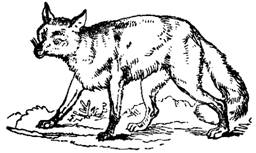
Fig. 188—Syrian Fox
Two distinct terms are in our version rendered by the word ’fox,’ although that denomination is not uniformly employed in different texts (Jdg 15:4; Neh 4:3; Psa 63:10; Son 2:15; Lam 5:18; Eze 13:4). Fox is thus applied to two or more species, though only strictly applicable in a systematic view to Taaleb, which is the Arabic name of a wild canine, probably the Syrian fox, Vulpes Thaleb or Taaleb of modern zoologists, and the only genuine species indigenous in Palestine. There is in the language of the ancients, however, a vague and often an indiscriminating use of zoological names: the name may therefore be employed as a general denomination; for, of vulpine animals, though the taaleb alone is considered indigenous, there is the so-called Turkish fox of Asia Minor, not unknown to the south as far as the Orontes, and therefore likely to be an occasional visitant at least of the woods of Libanus. There is, besides, one of a third group, namely, Thous anthus, or deeb of the Arabs, occasionally held to be the wolf of Scripture, because it resembles the species in general appearance, though so far inferior in weight, size, and powers, as not to be in the least dangerous, or likely to be the wolf of the Bible. The two first do not howl, and the third is solitary and howls seldom; but there is a fourth (Canis Syriacus) which howls, is lower and smaller than a fox, has a long ill-furnished tail, small ears, and a rufous-grey livery. This may be the jackal of Palestine. The German naturalists seem not to have considered it identical with the common jackal, which is sufficiently common along the coast, is eminently gregarious, offensive in smell; howls intolerably in complete concert with all others within hearing: burrows; is crepuscular and nocturnal, impudent, thievish; penetrates into outhouses; ravages poultry-yards more ruinously than the fox; feeds on game, lizards, locusts, insects, garbage, grapes; and leaves not even the graves of man himself undisturbed. It may ultimately turn out that Canis Syriacus is not a jackal, but a chryseus, or wild-dog, belonging to the group of Dholes, well known in India, and, though closely allied to, distinct from the jackal.
Vulpes Taaleb, or Taleb, the Syrian fox, is of the size of an English cur fox, and similarly formed; but the ears are wider and longer, the fur in general ochry-rufous above, and whitish beneath; there is a faint black ring towards the tip of the tail, and the back of the ears are sooty, with bright fulvous edges. The species burrows, is silent and solitary, extends eastward into Southern Persia, and is said to be found in Natolia. It is reputed to be very destructive in the vineyards, or rather a plunderer of ripe grapes; but he is certainly less so than the jackal, whose ravages are carried on in troops and with less fear of man.
None of the explanations which we have seen of the controverted passage in Jdg 15:4-5, relative to the foxes, jackals, or other canines, which Samson employed to set fire to the corn of the Philistines, is altogether satisfactory to our mind.
Commentators, following the reading of the Septuagint, have with common consent adopted the interpretation, that two foxes were tied together by their tails with a firebrand between them. We consider this highly improbable, and therefore understand the text to mean that each fox had a separate brand; and most naturally so, for it may be questioned whether two united would run in the same direction. They would assuredly pull counter to each other, and ultimately fight most fiercely; whereas there can be no doubt that every canine would run, with fire attached to its tail, not from choice but necessity, through standing corn, if the field lay in the direction of the animal’s burrow; for foxes and jackals, when chased, run direct to their holes, and sportsmen well know the necessity of stopping up those of the fox while the animal is abroad, or there is no chance of a chase. We therefore submit that by the words rendered ’tail to tail’ we should understand the end of the firebrand attached to the extremity of the tail. Finally, as the operation of tying 300 brands to as many fierce and irascible animals could not be effected in one day by a single man, nor produce the result intended if done in one place, it seems more probable that the name of Samson, as the chief director of the act, is employed to represent the whole party who effected his intentions in different places at the same time, and thereby insured that general conflagration of the harvest which was the signal of open resistance on the part of Israel to the long-endured oppression of the Philistine people.
Two words in Hebrew are translated "fox" in the Bible; and it is not easy in every case to determine what animal is referred to. There were several varieties of fox in Palestine, all like the common fox in form and habits. The fox is cunning, voracious, and mischievous, Eze 13:4 Luk 13:32 . He is fond of grapes, and does much harm in vineyards, Son 2:15 . The fable of the fox and the sour grapes is well known. He is solitary in his habits, and burrows a home for himself in the ground, Luk 9:58 . The jackal, at the present day, is much more numerous in Palestine, and is probably referred to in many texts where the word "foxes" occurs. It is like a medium-sized dog, with a head like the wolves, and a tail like the fox’s; of a bright yellow color. To the fierceness of the wolf it joins the impudent familiarity of the dog. It differs from the fox in its habit of hunting its prey in large packs, and in its cry-a mournful howl, mixed with barking, which they keep up all night, to the annoyance of all within hearing. They live in holes; prowl around villages; ravage poultry yards; feed upon game, lizards, insects, grapes, garbage; and when they can find nothing else, old leather and any thing that has once had animal life. They follow after caravans and armies, and devour the bodies of the dead, and even dig them up from their graves, Psa 63:10 Lam 5:18 . The incident in the life of Samson, where foxes, or perhaps jackals, are referred to, Jdg 15:4-5, has a parallel in the ancient Roman feast of Ceres, goddess of corn; when torches were bound to the tails of numbers of foxes, and they ran round the circus till the fire stopped and consumed them. This was in revenge for their once burning up some fields of corn.\par
Fox. (Hebrew, shu’al). Probably the jackal is the animal signified in almost all the passages in the Old Testament where the Hebrew term occurs.
Though both foxes and jackals abound in Palestine, the shu’alim (foxes) of Jdg 15:4 are evidently jackals and not foxes, for the former animal is gregarious, whereas the latter is solitary in its habits; and Samson could not, for that reason, have easily caught three hundred foxes, but it was easy to catch that number of jackals, which are concealed by hundreds in caves and ruins of Syria. It is not probable, however, that Samson sent out the whole three hundred at once.
With respect to the jackals and foxes of Palestine, there is no doubt that the common jackal of the country is the Canis aureus, which may be heard every night in the villages. It is like a medium-sized dog, with a head like a wolf, and is of a bright-yellow color. These beasts devour the bodies of the dead, and even dig them up from their graves.
Fond of grapes; (Son 2:15) "take us the foxes, the little foxes, that spoil the vines." The bride after awaking from her past unwatchfulness is the more jealous of subtle (fox-like) sins (Psa 139:23). In spiritual winter evil weeds as well as good plants are frozen up; in the spring of revivals these start up unperceived, crafty false teachers spiritual pride, uncharitableness (Psa 19:12; Mat 13:26; Heb 12:15). Little sins beget the greatest (Ecc 10:1; 1Co 5:6). Eze 13:4; "thy prophets are like the foxes in the deserts," where the foxes from having nothing to eat become doubly ravenous and crafty to get food. So, in Israel, once a vineyard now a moral desert, the prophets whose duty was to guard the church from being spoiled themselves spoil it, through crafty greed of gain.
So, Jesus calls Herod "that fox." The Lord had withdrawn from His plotting foes in Judea to the retired region beyond Jordan, Peraea. The Pharisees came to expedite His departure by pretending "Herod was seeking to kill Him." Herod was wishing Him to depart, feeling embarrassed how to treat Him whether to honor or persecute Him (Luk 9:7-9; Luk 13:32). It was the Pharisees themselves who wished to kill Him. But Herod lent himself to their design and so played the "fox." Tell that fox that "today and tomorrow" I remain doing works of mercy in the borders of his province, "on the third day" I begin that journey which ends in My about to be consummated sacrifice. The common jackal of Palestine is the
is the rendering in the A.V. of
This animal is one of an osculant group, with the general character of vulpes, but having the pupils of the e yes less contractile in a vertical direction, and a gland on the base of the tail marked by a dark spot. There is, besides, one of a third group, namely, Thous anthus, or deeb of the Arabs, occasionally held to be the wolf of Scripture, because it resembles the species in general appearance, though so far inferior in weight, size, and powers as not to be in the least dangerous, or likely to be the wolf of the Bible. The first two do not howl, and the third is solitary and, howls seldom; but there is a fourth (Canis Syriacus, Ehrenb. Mammal. 2) which bowls, is lower and smaller than a fox, has a long, ill-furnished tail, small ears, and a rufous-gray livery. This can hardly be the Canis aurenus, or jackal of Palestine, and certainly not the
“If the fox be at the rudder, Speak him fairly, My dear brother.”
Foxes are figured in hunting-scenes on the Egyptian monuments (Wilkinson, Anc. Egypt, 1:224, abridgm.). SEE CHASE.
None of the usual explanations of the controverted passage in Jdg 15:4-5, relative to the foxes, jackals, or other canines which Samson employed to set fire to the corn of the Philistines is altogether satisfactory. First, taking Dr. Kennicott’s proposed explanation of the case (Remarks on Select Passages in the O.T., Oxf. 1787, page 100), on the authority of seven Heb. MSS., by changing
“Cur igitur missae junctis ardentia telis Terga ferunt vulpes” —
in allusion to the fact that the Romans, at the feast in honor of Ceres, the goddess of corn, to whom they offered animals injurious to cornfields, were accustomed to turn into the circus foxes with torches so fastened to them as to burn them to death, in retaliation of the injuries done to the corn by foxes so furnished. Again, in the fable of Apthonius, quoted by Merrick, but not, as is alleged, by the brick with a bas-relief representing a man driving two foxes with fire fastened to their tails, which was found twenty- eight feet below the present surface of London (Leland, Collectanea); because tiles of similar character and execution have been dug up in other parts of England, some representing the history of Susanna and the elders, and others the four Evangelists, and therefore all derived from Biblical, not pagan sources. Commentators, following the rendering of the Sept. (
Fox. The jackal is probably meant in several passages where "fox" now occurs in Scripture. Both animals are cunning, voracious, and mischievous, Eze 13:4; Luk 13:32, are fond of grapes. Son 2:15. Both burrow in the ground or among ruins. Luk 9:58. The jackal hunts its prey in large packs. It follows after caravans and armies, and devours the bodies of the dead, and even digs them up from their graves. Psa 63:10; Lam 5:18. See 2Sa 18:17. Samson used foxes or jackals, Jdg 15:4-5, to destroy the grain of the Philistines by binding torches to the tails of the animals, and they ran round setting fire to fields of corn.
The well-known animal, that burrows in the ground. Mat 8:20. They will eat anything, and are especially fond of grapes. Son 2:15. They are very sly, and cunning in catching their prey; which accounts for Herod Antipas being called a fox by the Lord. Luk 13:32. It is supposed that the same Hebrew word, shual, includes the JACKAL, which may be intended in Psa 63:10, and indeed in other passages. The canis aureus is the common Jackal of Palestine.
FOX (
G. M. Mackie.
( ).
).
By: Emil G. Hirsch, I. M. Casanowicz
—Biblical Data:
There are at present two species of fox inhabiting Palestine: the Canis flavescens, found in the north, and the C. niloticus, common in the central and southern regions. But most of the passages of the Old Testament in which "shu'al" occurs seem to apply rather to the jackal (Canis aureus), the commonest beast of prey in Palestine. On the other hand, there are two special names for the jackal in the Old Testament, both of which are found only in the plural, "iyyim" and "tannim" (Isa. xiii. 22, xxxiv. 13 et seq., xxxv. 7; Jer. ix. 10, x. 22, xlix. 33, etc.). It may be that "shu'al" in the Old Testament is intended as a general term for the whole family or for several species of the Canidæ, while "iyyim" and "tannim" denote the jackal specifically as the "howler" (comp. the Arabic "wawi," or "ibn awa") and as the animal with the outstretched body. According to Tristram, even at the present day the two animals are commonly confounded in Syria, though the inhabitants are aware of their distinction.
Thus the catching of 300 shu'alim in the story of Samson (Judges xv. 4) seems to refer to jackals rather than to foxes, since the former are gregarious and remain in droves, while the latter prowl singly and are taken alive with difficulty. So also in Ps. lxiii. 11, the word probably applies to the jackal, as it is characteristic of the latter, but not of the fox, to feed on dead bodies. Lam. v. 18 and Neh. iii. 35 are applicable alike to the fox and the jackal, as both are in the habit of burrowing among rocks and ruins; while Ezek. xiii. 4 and Cant. ii. 15 no doubt refer to the proverbial cunning of the fox and its fondness for grapes, though the jackal is equally destructive to vineyards.
That foxes and jackals were formerly, as now, common in Palestine, may be inferred from the names derived from these animals, as "Hazar-shual" (Josh. xv. 28) and "Shalim" (I Sam. ix. 4).
—In Rabbinical Literature:
There is no ascertained reference to the jackal in the rabbinical writings, while the fox is often spoken of. The latter's term of gestation is six months; it prowls among ruins, burrows in the earth, is even found to inhabit a hollow gourd; kills poultry and young lambs and kids, and is noxious to vineyards (Bek. 8a; Mak. 24b; Ned. 81b; Ket. 111b; Ḥul. 53a; B. Ḳ. 92a; Eccl. R. 98a, etc). In proverbial expressions the cunning and treacherous fox is often contrasted with the kingly lion: "Be rather the tail [i.e., the last] among lions than the head of foxes" (Sanh. 37a; Ab. iv. 15). Of one who belied his great reputation it was said: "The lion has become a fox" (B. Ḳ. 117a; comp. also B. M. 84b; Meg. 16b; Ned. 81b; Ab. ii. 15). The "fox fables" ("mishle shu'alim"), of which 300 were known to R. Meïr (Sanh. 38b; Suk. 28a), had no doubt escapades of the fox for their themes (comp. Ber. 61b; Esth. R. iii. 1; Eccl. R. v. 14; L. Levysohn, in "Jüdisches Volksblatt," vol. iii.). See æsop's Fables Among the Jews.
The fox was also employed in the magic of the time. The tail of a fox was suspended between the eyes of the horse to protect it against the evil eye (Shab. 53a); its tooth was carried to promote or prevent sleep, according as it was taken from a live or a dead animal (Shab. 67a, Rashi); while the passing of a fox on one's left side was considered an evil omen (Sanh. 65b).
Bibliography:
Tristram, The Natural History of the Bible, p. 85;
L. Levysohn, Zoologie des Talmuds, p. 77.
FOX.—(1) shû·âl, see Jackal. (2) alôpçx (Gr.), Mat 8:20, Luk 9:58; Luk 13:32. In the NT there is no doubt that the common fox and not the jackal is intended. It is noted in Rabbinical literature and in Palestinian folklore for its cunning and treachery. It burrows in the ground (Luk 9:58). The small Egyptian fox (Vulpes nilotica) is common in S. Palestine, while the Tawny fox (V. flavescens). a larger animal of lighter colour, occurs farther north.
E. W. G. Masterman.
(
In Psa 63:9 f we have, “Those that seek my soul, to destroy it,... shall be given over to the power of the sword: they shall be a portion for foxes” (
.
Luk 13:32 (a) A type of the crafty, cunning and wicked cruelty which characterized the life of Herod.
Fox. Foxes were common predators in Bible times. Since they fed on small rodents like rats and mice, they helped to protect the grain crops. But their fondness for grapes caused farmers much grief. Sometimes they even tunneled under protective walls to feast on grapevines (Son 2:15). Foxes also settle in holes and burrows, often those abandoned by other animals. Jesus pointed out that foxes have holes, but the Son of Man had nowhere to lay His head (Mat 8:20).
Foxes have a keen sense of sight, smell, and hearing. They are also clever enough to lie in wait for prey. They may even play dead to attract a bird within striking range. When hunted, they are cunning and devious, misleading their pursuers. Jesus compared Herod, the Roman tetrarch of Galilee and Perea, to a fox, because of his crafty, devious nature (Luk 13:32).
"The land of Shual" (1Sa 13:17) may have been fox country, for shual means "fox" or "jackal." Also see Jackal.