
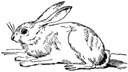
Syrian Hare
Hare occurs in Lev 11:6, and Deu 14:7, and in both instances it is prohibited from being used as food, because it chews the cud, although it has not the hoof divided. The hare however does not actually chew the cud, but has incisor teeth above and below, set like chisels, and calculated for gnawing, cutting, and nibbling, and when in a state of repose is engaged in working the incisor teeth upon each other. This practice is a necessary condition of existence, for the friction keeps them fit for the purpose of nibbling, and prevents their growing beyond a proper length. As hares do not subsist on hard substances, but on tender shoots and grasses, they have more cause, and therefore a more constant craving, to abrade their teeth; and this they do in a manner which, combined with the slight trituration of the occasional contents of the cheeks, even modern writers, not zoologists, have mistaken for real rumination. It follows therefore we should understand the original in the above passages rendered ’chewing the cud,’ as merely implying a second mastication, more or less complete. The act of ’chewing the cud’ and ’re-chewing’ being considered identical by the Hebrews, the sacred lawgiver, not being occupied with the doctrines of science, no doubt used the expression in the sense in which it was then understood. It may be added, that a similar opinion, and consequent rejection of the hare as food, pervaded many nations of antiquity.
There are two distinct species of hare in Syria: one, the Syrian hare, nearly equal in size to the common European, having the fur ochry buff; and the hare of the desert, smaller and brownish. They reside in the localities indicated by their names, and are distinguished from the common hare, by a greater length of ears, and a black tail with white fringe. There is found in Egypt, and higher up the Nile, a third species, represented in the outline paintings on ancient monuments, but not colored with that delicacy of tint required for distinguishing it from the others, excepting that it appears to be marked with the black speckles which characterize the existing species.
Of the same genus as the rabbit, prohibited to the Jews for food, Lev 11:6, because, though it "cheweth the cud," it "divideth not the hoof." No species of hare is known which strictly chews the cud. There were several varieties of the hare in Syria.\par
Hare. (Hebrew, (arnebeth.) Occurs only in Lev 11:6, and Deu 14:7, amongst the animals disallowed as food by the Mosaic law. The hare is at this day called arnel by the Arabs in Palestine and Syria. It was erroneously thought by the ancient Jews to have chewed the cud. They were no doubt misled, as in the case of the shaphfan (hyrax), by the habit these animals have of moving the jaw about.
The hare, though having a divided foot, has not a cloven hoof, which was a requisite for legal cleanness. True ruminants have four stomachs, molar teeth, and a jawbone suited for the circular movement of chewing the cud. The hare has none of these marks, and has in the upper jaw incisor teeth, which ruminants have not. But hares retain the cropped food within the hollows of their cheeks and masticate it at leisure, which in phenomenal language is "chewing the cud," and is so described by even so close an observer of nature as the poet Cowper. The ancient Britons rejected it as food. The Palestinian hare,
Hare. Deu 14:7. Of the hare, which resembles the rabbit, five species or varieties are found in Palestine. This animal was declared unclean by the Jewish law, Lev 11:6, "because he cheweth the cud, but divideth not the hoof." For popular guidance this description was better than a more scientific one, and is explained under Coney.
The Hebrew word is arnebeth, and the Arabic name for hare is ernebah ; the LXX also translate it as the hare. There can be little doubt therefore that this is the right signification. A difficulty thereupon arises in its being forbidden as unclean, because it chewed the cud but did not divide the hoof. Lev 11:6; Deu 14:7. It is now a well-known fact that the hare does not chew the cud, its teeth and stomach not being suited for such a process. Various suggestions have been made in explanation, the most probable is that as the animal appears to chew the cud it is classed with those who did so. Scripture usually speaks of things in nature is they appear to the senses of man, and not according to strict science.
The hare is almost constantly moving its jaws as if it were a ruminant. The poet Cowper kept some young hares in his house, and he says of one, "I made it my custom to carry him always after breakfast into the garden, where he hid himself generally under the leaves of a cucumber vine, sleeping, or chewing the cud, till evening." The two principal species in Palestine are the Lepus syriacus and the Lepus aegyptiacus.
( ):
By: Joseph Jacobs, I. M. Casanowicz
Animal mentioned in Lev. xi. 6 and Deut. xiv. 7 among the unclean animals, "because he cheweth the cud, but divideth not the hoof." The idea that the hare chews the cud probably arose from the constant moving of its jaws and lips. With the Arabs the flesh of the hare is considered a delicacy. There are at present five species of hare in Palestine, of which the Lepus syriacus and the Lepus œgyptiacus are the most common. The rabbit (Lepus cuniculus) is not found in Syria. The Talmud speaks of the hare as a ruminant (Ḥul.59a). The fur of the hare, termed "wool" ("ẓemer"), was used in weaving (Men. 39b).
Bibliography:
Tristram, Natural History of the Bible, p. 98;
Lewysohn, Zoologie des Talmuds, p. 109.
HARE (Lev 11:6, Deu 14:7).—Four species of hare are known in Palestine, of which the commonest is the Lepus syriacus. The hare does not really ‘chew the cud,’ though, like the coney, it appears to do so; it was, however, unclean because it did not ‘divide the hoof.’ Hares are to-day eaten by the Arabs.
E. W. G. Masterman.
Lev 11:4-7: Lev 11:4, English Versions of the Bible “camel”; Septuagint
Deu 14:7: English Versions of the Bible “camel”; Septuagint
Deu 14:8: English Versions of the Bible “swine”; Septuagint
It is evident from the above and from the meanings of
Since the word “coney,” which properly means “rabbit,” has been applied to the hyrax, so, in America at least, the word “rabbit” is widely used for various species of hare, e.g. the gray rabbit and the jack-rabbit, both of which are hares. Hares have longer legs and ears and are swifter than rabbits. Their young are hairy and have their eyes open, while rabbits are born naked and blind. Hares are widely distributed in the Northern Hemisphere, and there is one species in South America. Rabbits are apparently native to the Western Mediterranean countries, although they have been distributed by man all over the world.
Lepus syriacus, the common hare of Syria and Palestine, differs somewhat from the European hare. Lepus judeae is cited by Tristram from Northeastern Palestine, and he also notes three other species from the extreme south.
Lev 11:6 (c) This little animal may be used to represent the professing Christian whose talk is orthodox, but whose walk is heterodox. The hare of the Bible, or the rabbit, did chew the cud (the talk), but did not divide the hoof (the walk). It does not walk smoothly, nor evenly, but by jumps. Its color blends with its surroundings. So the professing Christian who is not really born again seeks to live and act as a real Christian, when he is in that environment, and vice versa. The walk and the talk must both be according to the Word of GOD, and produced by the Spirit of GOD.
Hare. Hares were plentiful in Palestine, but they are mentioned in the Bible only as forbidden food (Lev 11:6); (rabbit, NIV, NASB). They look like large rabbits with longer ears and legs. The common jackrabbit is actually a hare. Unlike rabbits, hares are born furry and able to see. Hares were mistakenly thought to chew the cud, but they were considered unclean because they did not have divided hoofs (Lev 11:6; Deu 14:7). Perhaps they were forbidden because they are rodents, but the Hebrews’ Arab neighbors did not hesitate to hunt them for food.
Hares are fast-running animals that look similar to rabbits but have longer ears and legs. Three different varieties can be found in Palestine (Lepus europaeus judaeus, Lepus capensis, and Lepus arabicus). Hares like to live in open areas, especially near farms, and in forests where trees lose their leaves. Unlike rabbits (which are not found in Palestine), hares eat only plants. Though they are not like cows that naturally chew their food twice, hares do bring food back up from their stomachs to chew it again when it is hard to digest.
Near Eastern hares have very long ears and large hind feet. Their feet are very furry. They are similar to American jackrabbits, which are true hares. Hares do not dig or live in burrows the way rabbits do. Hares are mostly awake at night. They hide in plants during the day. They eat grasses and herbaceous matter as well as twigs and young bark of woody plants. Hares breed quickly. The young reach sexual maturity at six months.
The hare is ceremonially unclean (Leviticus 11:6; Deuteronomy 14:7). This is because it seems to chew cud but lacks cloven hooves. Arabs, Chinese, and Lapps also avoid eating hares. However, many others have hunted them, both in ancient times and today. The hare's speed, high birth rate, shyness, and caution protect it from extinction.
Aquifer Open Bible Dictionary © 2026 Mission Mutual, an adaptation of the Tyndale Open Bible Dictionary © 2023 Tyndale House Publishers. Licensed under CC BY-SA 4.0.
Discussion:
Hares and rabbits both belong to the same zoological family of Leporidae. In the land of Israel and Egypt there are several species of hare, the most common being a subspecies of the European Brown Hare, Lepus europaeus, the Arabian Hare Lepus arabicus, and the African Hare, Lepus capensis. Hares and rabbits were classified as rodents until the 1950s along with mice rats and squirrels. They are now classified as “lagomorphs” since true rodents have enamel only on the front side of their long front teeth (incisors) while hares and rabbits have enamel on both sides.
Hares are found naturally in virtually every part of the world except Australasia where the European Rabbit Oryctolagus cumiculus was introduced. The main obvious differences between hares and rabbits are a) rabbits live in burrows they make themselves while hares do not although they may temporarily occupy holes made by other animals and b) rabbits live in family groups while hares are mainly solitary.
In the Law of Moses hares are forbidden food because “they chew the cud but do not have cloven hooves.” In fact hares do not chew cud but they certainly often look as if they are doing so. Among some species of hare there is a phenomenon called “refection” which has a result something like the chewing of cud in that it involves chewing the same food twice. Among these hares two different types of dropping are produced. One type consisting of partially digested food is eaten by the hares. Some writers have suggested that this is what is referred to by the biblical expression “chewing the cud". However this phenomenon has not been seen among Middle Eastern hares.
The prohibition is strictly a religious or ritual one as hares are an important food in many countries. There is nothing particularly “unclean” about hares. Their habits are certainly no less clean than those of goats.
Description:
Hares are smallish, light brown animals about half a meter (20 inches) long, with long ears and short fluffy tails. They have long hind legs and are good jumpers. They hide during the day and come out to feed on vegetation at night.
Translation:
Since hares and rabbits are found all over the world, there is usually no difficulty in finding a suitable local word. In the United States and Canada, where both rabbits and hares are found, if a specific word has to be chosen rather than a general one, the jack rabbit, or the snowshoe rabbit, would be a better choice than the cottontail rabbit, since both of the former are actually hares.
Animals in the Bible © United Bible Societies. Licensed under CC BY-SA 4.0.