
Moses places the owl among the unclean birds; but whether all, or of what species, as there are several, is not said. (Lev. xi. 17. Deut. 14. 17.) The loneliness of the owl gave occasion to the Psalmist to describe thereby his solitary state of affliction. (Ps. c2: 7.)
There are several varieties of this species, all too well known to need a particular description. They are nocturnal birds of prey, and have their eyes better adapted for discerning objects in the evening or twilight than in the glare of day.
1.
4.
A place of lonely desolation, where The screeching tribe and pelicans abide, And the dun ravens croak mid ruins drear,
And moaning owls from man the farthest hide.
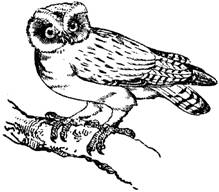
Fig. 284—Owl
There are noticed in Egypt and Syria three well known species of the genus Strix, or owl—’the great-eared owl;’ the common barn owl; and the little owl. In this list the long-eared owl, the short-eared owl, known nearly over the whole earth, and the Oriental owl of Hasselquist, are not included, and several other species of these wandering birds, both of Africa and Asiatic regions, occur in Palestine. The barn owl is still sacred in Northern Asia.
The eagle-owl, or great-eared owl, we do not find in ornithological works as an inhabitant of Syria, though no doubt it is an occasional winter visitant and the smaller species, which may be a rare but permanent resident, probably also visiting Egypt. It is not, however, we believe, that species, but the Otus ascalaphus of Cuvier, which is common in Egypt, and which in all probability is the type of the innumerable representations of an eared owl in hieroglyphical inscriptions.
Next we have the short-eared owl, likewise found in Egypt and Arabia, as well as to the north of Syria, a bold, pugnacious bird, residing in ruined buildings, mistaken by commentators for the screech-owl. The spectral species, again, confounded with the goat-sucker, is, we believe, Strix coromanda [NIGHT-HAWK], and the same as the Oriental owl of Hasselquist.
The little owl of Egypt is not likely to be the Passerine species of Europe, and probably does not occur under a distinct name in Biblical Hebrew; but that the owls which inhabited Palestine were numerous may be inferred with tolerable certainty from the abundance of mice, rats, and other vermin, occasioned by the offal and offerings at the numerous sacrifices, and consequently the number of nocturnal birds of prey that subsisted upon them, and were tolerated for that purpose.
A night bird of prey, unfit for food. Several species are found in Palestine, and are mentioned in the Bible; as in Lev 11:17 Deu 14:16 Isa 14:23 34:15 Zep 2:14 . One of the words, however, translated "owl," probably means "OSTRICH," (which see;) and another, Lev 11:17 Deu 14:16 Isa 34:11, the ibis or night heron.\par
Owl. A number of species of the owl are mentioned in the Bible, Lev 11:17; Lev 14:16; Isa 14:23; Isa 34:15; Zep 2:14, and in several other places, the same Hebrew word is used, where it is translated ostrich. Job 30:29; Jer 50:39. Some of these species were common in Palestine, and, as is well known, were often found inhabiting ruins. Isa 34:11; Isa 34:13-15.
Ostrich, the true rendering of
The Hebrew means a "cup", perhaps alluding to its concave face, the eye at the bottom, the feathers radiating on each side of the beak outward; this appears especially in the
In the passages that speak of the unclean birds "the owl . . . . the little owl . . . . and the great owl," are enumerated. Lev 11:16-17; Deu 14:15-16. The Hebrew for the first is bath yaanah. (See OSTRICH.) The second is kos: it occurs in the above two passages and in Psa 102:6; and doubtless refers to the owl. The third, yanshuph, occurs also in Isa 34:11. This in the LXX and Vulgate is the ’ibis,’ and has been supposed by some to refer to the Ib is religiosa, a sacred bird of Egypt. There is also lilith in Isa 34:14 only, translated ’screech owl,’ (margin and R.V. ’night-monster’): its reference is doubtful. Also qippoz in Isa 34:15 only, ’great owl,’ (R.V. ’arrowsnake;’ LXX and Vulgate ’hedgehog,’ reading perhaps qippod with six Hebrew MSS.) There are several well-known species of the owl, but to which of them these various words refer cannot be specified with certainty. The Athene meridionalis is the owl most common in Palestine; the Strix flammea is the white owl.
By: Emil G. Hirsch, I. M. Casanowicz
Rendering in the English versions of the following Hebrew words: "kos" (Lev. xi. 17; A. V. "little owl"); "yanshuf" (ib.; A. V. "great owl"; LXX.
"Kos," referred to in Ps. cii. 7 as living among ruins, may be identified with the Carina glaux, the emblem of Pallas Athene, and called by the Arabs "bumah," the most abundant of all owls in Palestine. "Yanshuf" is usually identified with the Bubo ascalaphus, which inhabits ruins and caves throughout Palestine, but is especially abundant around Petra, the ancient Edom (comp. Isa. xxxiv. 11). There are also found in Palestine the white owl, the great horned owl, the wood-owl (Syrnium aluco), the Indian fish-owl (Ketupa ceylonensis), and the long-eared and the short-eared owl (Strix otus and S. brachyotus).
The terms for "owl" occurring in the Talmud are:  , and
, and  . This bird was eaten in Babylon, but was forbidden as food in Meraba,where it was called
  (Ḥul. 63a). There is also
  or
or  (or
(or  ; comp. Targ. on "kos," Lev. xi. 17), described by Rashi as a bird screeching in the night, with a countenance resembling that of a cat, the cheeks of a man, and having the eyes in front (Niddah 23a; Ber. 57b). It is said that its appearance in dreams is of bad omen (ib.).
Bibliography:
Tristram, Nat. Hist. p. 191;
Lewysohn, Z. T. p. 162.
OWL
1. bath ya‘ânâh, RV
2. yanshûph, Lev 11:17, Deu 14:15, ‘great owl’; [yanshöph], Isa 34:11 owl,’ RVm
3. kôs, Lev 11:17, Deu 14:16, ‘little owl’; Psa 102:6 ‘owl.’
4. qippôz, Isa 34:15, AV
5. tinshemeth, Lev 11:18, Deu 14:15, AV
6. lîlîth, Isa 34:14, AV
Owls are very plentiful in Palestine. Most common of all is the little bömeh (Athene glaux), whose melancholy cry can be heard anywhere in the open country when twilight begins. It is a general favourite and very tame. The great Egyptian eagle-owl, the next most common species, is a large bird, nearly two feet long, with long ear tufts (see No. 5). It haunts ruins, and has a prolonged and desolate cry.
E. W. G. Masterman.
“I am like a pelican of the wilderness;
I am become as an owl of the waste places.”
Here it would appear that the bird habitual to the wilderness and the waste places, that certainly would be desert, would be the ostrich - while in any quotation referring to ruins, the owl would be the bird indicated by natural conditions.
Psa 102:6 (a) This bird represents the Lord JESUS in His solitude and loneliness. As the owl was surrounded by the barren, hot sands with only reptiles for company, so the Saviour was surrounded by wicked influences and evil enemies. As the owl had no trees in which to make its nest, and rest there, so the Saviour had no place to lay His head, and no resting place for His heart in this life.
Owl. The owl is mentioned several times in the Bible (Lev 11:16-17; Psa 102:6; Jer 50:39; Mic 1:8). The largest species native to Palestine is the great owl, sometimes called an eagle owl. Several varieties of smaller owls are also common. Among them are screech owls, whose calls and whistles bring an eerie feeling in the night.
Other varieties of owls mentioned by different translations of the Bible include the short-eared owl (Lev 11:16), (NKJV, NEB); long-eared owl (Lev 11:16), (NEB); horned owl (Lev 11:16), (NIV); little owl (Lev 11:17), (KJV, NIV, NASB); tawny owl (Lev 11:17), (NEB); fisher owl (Lev 11:17), (NKJV); desert owl (Lev 11:18), (NIV); and white owl (Lev 11:18), (NKJV, NIV, NASB).
The owl is no wiser than any other bird, but his facial features give him a thoughtful and solemn look. Owls have round faces with a circle of feathers around their heads, framing and highlighting their large eyes. These feathers also serve as a sound collector for the ears. An owl’s fluffy feathers make him appear larger than he actually is. They also enable him to fly silently, since the edges of the feathers pierce the air with little wind resistance.
Owls have good night vision, which enables them to stalk their prey at night. Unlike other birds, whose eyes are set on opposite sides of their head, the owl looks directly ahead. He navigates in the dark mostly by sound. Alerted by a noise, he plunges in toward his prey with his claws spread for the kill.
Owls serve a useful agricultural purpose, since they feed on rats, mice, and other rodents. But the Hebrew people considered the owl an unclean bird and often associated it with scenes of desolation. The scops owl may be the satyr of such verses as (Isa 13:21) and (34:14) (night creature, NKJV). It has a horned look and does a hop-like dance much like a goat.