
A person set apart for the performance of sacrifice, and other offices and ceremonies of religion. Before the promulgation of the law of Moses, the first-born of every family, the fathers, the princes, and the kings, were priests. Thus Cain and Abel, Noah, Abraham, Melchizedec, Job, Isaac, and Jacob, offered themselves their own sacrifices. Among the Israelites, after their departure from Egypt, the priesthood was confined to one tribe, and it consisted of three orders, the high-priest, priests, and Levites. The priesthood was made hereditary in the family of Aaron; and the first-born of the oldest branch of that family, if he had no legal blemish, was always the high-priest. This divine appointment was observed with considerable accuracy till the Jews fell under the dominion of the Romans, and had their faith corrupted by a false philosophy. Then, indeed, the high-priesthood was sometimes set up to sale, and, instead of continuing for life, as it ought to have done, it seems, from some passages in the New Testament, to have been nothing more than an annual office.
There is sufficient reason, however, to believe, that it was never disposed of but to some descendant of Aaron capable of filling it, had the older branches been extinct. (For the consecration and offices of the Jewish priesthood, we refer our readers to the books of Moses.) In the time of David, the inferior priests were divided into twenty-four companies, who were to serve in rotation, each company by itself, for a week. The order in which the several courses were to serve was determined by lot; and each course was, in all succeeding ages, called by the name of its original chief. It has been much disputed, whether in the Christian church there be any such officer as a priest, in the proper sense of the word. If the word priest be taken to denote a person commissioned by divine authority to offer up a real sacrifice to God, we may justly deny that there is a priest upon earth. Under the Gospel, there is but one priest, which is Christ: and but one sacrifice, that of the cross. The church of Rome, however, erroneously believe their priests to be empowered to offer up to the Divine Majesty a real proper sacrifice, as were the priests under the Old Testament. Ecclesiastical history informs us that, in the second century, some time after the feign of the emperor Adrian, when the Jews, by the second destruction of Jerusalem, were bereaved of all hopes of the restoration of their government to its former lustre, the notion that the ministers of the Christian church succeeded to the character and prerogatives of the Jewish priesthood, was industriously propagated by the Christian doctors; and that, in consequence, the bishops claimed a rank and character similar to that of the Jewish high-priest; the presbyters to that of the priests; and the deacons to that of the Levites.
One of the pernicious effects of this groundless comparison and pretension seems to have been, the introduction of the idea of a real sacrifice in the Christian church, and of sacrificing priests. In the church of England, the word priest is retained to denote the second order in her hierarchy, but we believe with very different significations, according to the different opinions entertained of the Lord’s supper. Some few of her divines, of great learning, and of undoubted protestantism, maintain that the Lord’s supper is a commemorative and eucharistical sacrifice. These consider all who are authorized to administer that sacrament as in the strictest sense priests. Others hold the Lord’s supper to be a feast upon the one sacrifice, once offered on the cross; and these, too, must consider themselves as clothed with some kind of priesthood. Great numbers, however, of the English clergy, perhaps the majority, agree with the church of Scotland, in maintaining that the Lord’s supper is a rite of no other moral import than the mere commemoration of the death of Christ. These cannot consider themselves as priests in the rigid sense of the word, but only as presbyters, of which the word priest is a contraction of the same import with elder.
See LORD’S SUPPER.
Strictly and properly speaking, there is but one priest of JEHOVAH, and he the great High Priest of his church, the Lord Jesus Christ. Every other priest, even Aaron himself, acted no higher than as the type of JEHOVAH’S High Priest. For the High Priest of JEHOVAH must be as JEHOVAH himself, a Priest for ever; whereas, (as the Holy Ghost blessedly speaks by Paul, Heb. 7: 23, 24.) those priests were not suffered to continue, by reason of death; but this man, because he continueth ever, hath an unchangeable priesthood. And how graciously the Lord adds, "Wherefore he is able also to save them to the uttermost that come unto God by him, seeing he ever liveth to make intercession for them." (Heb. 7: 25.)
In our view of the Lord Jesus as Priest, it will be necessary to consider the several features, of this high character, in order to have a proper conception of it. Nothing can be more interesting to know, in the whole offices of Jesus to his church and people, and therefore I beg the reader that he will indulge me with being somewhat more particular upon it. And first, the office and character of the priest should be considered, in order that we may discover the personal fitness and suitability for Christ in this office; and by the performance of which the Lord Jesus proves that he, and he only, became the proper High Priest for his church and. people. The Priest of JEHOVAH must be one consecrated and set apart specially and personally to this office, and this by JEHOVAH himself. And his office comprehends the offering of sacrifice, praying, and interceding for the people, and also blessing the people in JEHOVAH’S name and by his authority. He must be suited in sovereignty and power to act, by virtue of his high office, as a proper Priest and Mediator of his high office, as a proper Priest and Mediator between Him before whom and to whom the offerings are made, and the persons for whom they are made. And he must be suited in personal feeling and interest, to take part with them, and for him in whose suit he acts; so that neither party between whom he acts, as Priest and Mediator, may suffer wrong, but both parties have right and justice shewn them by his priestly administration.
From this view of the office of the priesthood, it is evident that the person undertaking and acting in this high capacity must be both God and man. It is expedient that he should be God to give merit and efficacy to his offerings, to give energy and power in the act of offering, to carry on the purposes of his priestly offices in the unceasing agency of his intercession, to become the object of faith, love, hope, adoration, and trust, to all his people, and to preserve for and give unto the objects for whom he undertook this priestly employment all the blessings purchased for his church and people by this great undertaking. And it became equally expedient that he who engaged to be JEHOVAH’S High Priest, in the purposes of redemption, should be man as well as God. Had he not been man he could not have been the suited. Surety for the representation of his people, he could not have fulfilled the law, answered the demands of justice, proved himself to be the seed of the woman, redeemed the mortgaged inheritance of his poor brother, by death overcome death, and by rising to life again become the resurrection and the life, and been suited to be the Head of his body the church, "the fulness that filleth all in all." So that in every point of view, and upon every consideration, the absolute expediency is manifested that JEHOVAH’S Priest must be both God and man. None else could suit the office, or be competent to the discharge of this high character. And such was the Lord Jesus, and him only. Indeed, so peculiarly suited was Christ as God and man in one person, for this office, that if it could be supposed any other had been, or could have been, found competent to it, it would by so much have lessened the Lord Jesus in this character. But it is the blessed consideration to the church, that the personal and peculiar fitness of the Lord Jesus, and the fulness of fitness in him, and in him only, is what endears him both to JEHOVAH and to his people in this express office of character. So much then for the office itself, and the peculiar suitability of the Lord Jesus to it. Let us next consider the authority by which he acts, and the glory he hath displayed, and still is displaying, in the unceasing and everlasting exercise of it.
The Scriptures are full of information on this most blessed point. Set up from everlasting in the council of peace, we are told that he was regularly called, consecrated and sworn into his office by virtue of the oath of JEHOVAH before all worlds. For thus the charter of grace runs; "The Lord hath sworn and will not repent, thou art a Priest for ever, after the order of Melchizedec. (Ps. cx. 4.) And this authority of JEHOVAH was indispensibly necessary to give efficacy and validity to all the acts of his priesthood; for it is not only the suitability of Christ which renders his priesthood so dear to his people, but it is the authority and appointment of JEHOVAH which gives a warrant for faith to act upon concerning him. Hence the Holy Ghost particularly caused it to be recorded for the church’s confidence and joy in this particular, that Christ "glorified not himself to be made an High Priest, but was called of God, as was Aaron. For he that said unto him, "Thou art my Son, this day have I begotten thee, said also in another place, Thou art a Priest for ever after the order of Melchizedec. (Heb. v. 4 - 6.)
Thus called, consecrated, and sworn into his office, by the oath of the almighty appointer, it is most blessed to behold how the Lord Jesus, in every point of view, comes up to this high character, and by the union of both natures carries on and perfects the gracious office of our High Priest and Intercessor. The sacrifice he once offered being of infinite value, by virtue of his infinite nature, he hath, "by that one offering of himself once offered perfected for ever them that are sanctified." (Heb. x. 14.) And as the offering itself is afulness of perfection, so the divine nature on which he offered it became the golden altar of presentation to JEHOVAH The incense Jesus presents is his own merits, and presented also from off the golden censer of his divine nature. (See Rev. 8. 3, 4.) So that the Lord Jesus is in one and the same moment every thing in himself which constitutes both priest and priesthood; for he is the Sacrifice, the Sacrificer, and the Altar on which alone all presentations are or can be made, and the only medium by which all can be offered. Hail! thou glorious, gracious, great High Priest of JEHOVAH and thy people! Be thou my New Testament altar, my sacrifice, my offering, and do thou, Lord, graciously carry on thy high priestly office still in heaven for all thy church and people, until thou hast brought home thy redeemed, "that where thou art, there they may be also!"
Having thus taken a short view of the Lord Jesus as JEHOVAH’S High Priest, and a Priest upon his throne, it may not be amiss to offer a short observation concerning the priesthood taken from among men. It will be always profitable to read the Scriptures of God concerning earthly priests, while we keep in remembrance that all and every one of them appointed by the Lord were never considered higher in all their ministry than as types of the ever - blessed Jesus. The law, with all its costly services, we have authority from the Holy Ghost to say, was but a shadow of good things to come, the body was Christ. (Heb. x. 1, &c.)
Now from the earliest ages of the church, and before the law, the patriarchs and holy men of God ministered as priests in their families. Abel, Noah, Abraham, and the fathers, offered their sacrifices, and as such acted as priests. But that the church might not err in their explanation of those things it is worthy our closest regard, that God the Holy Ghost hath expressly taught us that all these were by faith. Let the reader read the account of Abel’s offering, Gen. 4: 4; Noah’s, Gen. 8. 20, 21; and Abraham’s, Gen. 15. 17, 18; 22i; and then turn to Heb. xi. 3.7. 17; and mark the sweet truth opened and explained, as it is, by God the Holy Ghost. These holy men of old offered all their offerings by faith; faith in whom but the Lord Jesus Christ, that Lamb of God slain before the foundation of the world? (Rev. 13. 8.) Hence, therefore, every priest typified and represented Christ. Every lamb slain, every sacrifice offered, every propitiation set forth, all shadowed forth the person, work, blood - shedding, and righteousness of the Lord Jesus Christ. He, and he only, is, and was, and ever will be, JEHOVAH’S Priest. All other priests, whether Aaron or his sons, Levitical or Christian, are no otherwise priests than as they act in the Lord Jesus’s name, are ordained by his authority, and minister for his glory. He is the fountain of all order in his church; and all true believers in Christ are expressly said to be made by him both kings and priests unto God and the Father, agreeably to JEHOVAH’S ancient, promise to the true Israel: "Ye shall be unto a kingdom of priests, and an holy nation."(Exod. xix. 6. Rev. i. 5. I Pet.2: 9.)
a general name for the minister of religion. The priest under the law was, among the Hebrews, a person consecrated and ordained of God to offer up sacrifices for his own sins and those of the people, Lev 4:5-6. The priesthood was not annexed to a certain family till after the promulgation of the law of Moses. Before that time the first-born of every family, the fathers, the princes, the kings were priests. Cain and Abel, Noah, Abraham, Job, Abimelech and Laban, Isaac and Jacob, offered themselves their own sacrifices. In the solemnity of the covenant that the Lord made with his people at the foot of Mount Sinai, Moses performed the office of mediator, Exo 24:5-6; and young men were chosen from among the children of Israel to perform the office of priests. But after the Lord had chosen the tribe of Levi to serve him in his tabernacle, and the priesthood was annexed to the family of Aaron, then the right of offering sacrifices to God was reserved to the priests alone of this family. The Lord ordained, Num 16:40, that no stranger, which was not of the seed of Aaron, should come near to offer incense unto the Lord, that he might not be as Korah and his company. The punishment of Uzziah is well known, 2Ch 26:19, who, having presumed to offer incense to the Lord, was suddenly smitten with a leprosy, put out of his palace, and excluded from the administration of affairs to the day of his death.
However, it seems that, on certain occasions, the judges and the kings of the Hebrews offered sacrifices unto the Lord, especially before a constant place of worship was fixed at Jerusalem; for in 1Sa 7:8, we are told that Samuel, who was no priest, offered a lamb for a burnt-sacrifice to the Lord; and in 1Sa 9:13, it is said that this prophet was to bless the offering of the people, which should seem to be a function appropriated to the priests; lastly, 1Sa 16:5, he goes to Bethlehem, where he offers a sacrifice at the inauguration or anointing of David. Saul himself offered a burnt-offering to the Lord, perhaps as being king of Israel, 1Sa 13:9-10. Elijah also offered a burnt-offering upon Mount Carmel, 1Ki 18:33. David himself sacrificed, (at least the text expresses it so,) at the ceremony of bringing the ark to Jerusalem, and at the floor of Araunah, 2Sa 6:13. Solomon went up to the brazen altar that was at Gibeon, and there offered sacrifices, 2Ch 1:5. It is true the above passages are commonly explained by supposing that these princes offered their sacrifices by the hands of the priests; but the sacred text will by no means favour such explanations; and it is very natural to imagine, that in the quality of kings and heads of the people, they had the privilege of performing some sacerdotal functions, upon some extraordinary occasions; thus we see David clothed with the priestly ephod, and consulting the Lord; and upon another occasion we find David and Solomon pronounce solemn benedictions on the people, 2Sa 6:18; 1Ki 8:55. God having reserved to himself the first-born of all Israel, because he had preserved them from the hand of the destroying angel in Egypt, by way of exchange or compensation accepted of the tribe of Levi for the service of the tabernacle, Num 3:41. Of the three sons of Levi, Gershon, Kohath, and Merari, the Lord chose the family of Kohath, and out of this the house of Aaron, to exercise the functions of the priesthood. All the rest of the family of Kohath, even the children of Moses and their descendants, remained of the order of mere Levites. See LEVITES.
The posterity of the sons of Aaron, namely, Eleazar and Ithamar, Lev 10:1-5; 1Ch 24:1-2, had so increased in number in the time of David, that they were divided into twenty-four classes, which officiated a week at a time alternately. Sixteen classes were of the family of Eleazar, and eight of the family of Ithamar. Each class obeyed its own prefect or ruler. The class Jojarib was the first in order, and the class Abia was the eighth, 1Ma 2:1; Luk 1:5; 1Ch 24:3-19. This division of the priesthood was continued as a permanent arrangement after the time of David, 2Ch 8:14; 2Ch 31:2; 2Ch 35:4-5. Indeed, although only four classes returned from the captivity, the distinction between them, and also the ancient names, were still retained, Ezr 2:36-39; Neh 7:39-42; Neh 12:1.
Aaron, the high priest, was set apart to his office by the same ceremonies with which his sons the priests were, with this exception, that the former was clothed in his robes, and the sacred oil was poured upon his head, Exo 29:5-9; Lev 8:2. The other ceremonies were as follows. The priests, all of them with their bodies washed, and clad in their appropriate dress, assembled before the altar, where a bullock, two rams, unleavened bread, and wafers of two kinds in baskets, were in readiness. When they had placed their hands upon the head of the bullock, he was slain by Moses as a sin-offering. He touched the horns of the altar with the blood, poured the remainder of it round its base, and placed the parts which were to compose the sacrifice on its top. The remaining parts of the animal were all burned without the camp, Exo 29:10-14; Lev 8:2-3; Lev 8:14-17. They in like manner placed their hands on the head of one of the rams, which was also slain by Moses for a whole burnt- offering, the blood was sprinkled around the altar, and the parts of the ram were separated and burned upon it, Exo 29:15-18; Lev 8:18-21. The other ram, when the priests had laid their hands upon him, was likewise slain by Moses for the sacrifice of consecration. He touched with the blood the tip of the right ear of the priests, the thumb of the right hand, and the great toe of the right foot. The rest of the blood he sprinkled in part upon the bottom of the altar, and a part he mingled with the consecrated oil, and sprinkled on the priests and their garments. He anointed the high priest by pouring a profusion of oil upon his head; whence he is called the anointed, Lev 5:3; Lev 5:5; Lev 5:16; Lev 6:15; Psa 133:2. Certain parts of the sacrifice, namely, the fat, the kidneys, the haunches, the caul above the liver, and the right shoulder, also one cake of unleavened bread, a cake of oiled bread, and a wafer, were placed by Moses upon the hands of the priests, that they might offer them to God. This ceremony was called “filling the hands,” expressions which accordingly in a number of passages mean the same as consecrating, Exo 32:29; Lev 16:32; 1Ch 29:5. All the parts which have been mentioned as being placed in the hands of the priests, were at last burned upon the altar. This ceremony, which continued for eight days, for ever separated the priests from all the other Israelites, not excepting the Levites; so that there was subsequently no need of any farther consecration, neither for themselves nor their posterity, Exo 29:35-37; Lev 10:7; Rom 1:1; Eph 3:3; Act 13:2-3. That the ceremonies of inauguration or consecration, however, were practised at every new accession of a high priest to his office, seems to be hinted in the following passages, Exo 29:29; Lev 16:32; Lev 21:10; Num 20:26-28; Num 35:25.
It was not customary for the priests to wear the sacerdotal dress except when performing their official duties, Exo 28:4; Exo 28:43; Eze 42:14; Eze 44:19. The description of the dress of the priests which is given in Exodus 28, is by some thought defective, as many things are passed in silence, apparently for the reason that they were at that time sufficiently well known, without being expressly stated. Some additional information is communicated to us by Josephus; but the dress of the priests, as he describes it, may have been in some respects of recent origin. It was as follows:
1. A sort of hose, made of cotton or linen, which was fastened round the loins, and extended down so as to cover the thighs, Lev 6:10; Eze 44:18.
2. A tunic of cotton which extended, in the days of Josephus, down to the ankles. It was furnished with sleeves, and was fabricated all of one piece without being sewn, Exo 28:39; Exo 28:41; Exo 29:5; Joh 19:23.
3. The girdle. According to Josephus it was a hand’s breadth in width, woven in such a manner as to exhibit the appearance of scales, and ornamented with embroidered flowers in purple, dark blue, scarlet, and white. It was worn a little below the breast, encircled the body twice, and was tied in a knot before. The extremities of the girdle hung down nearly to the ankle. The priest, when engaged in his sacred functions, in order to prevent his being impeded by them, threw them over his left shoulder, Exo 39:27-29.
4. The mitre or turban was originally acuminated in its shape, was lofty, and was bound upon the head, Exo 28:8; Exo 28:40; Exo 29:9; Lev 8:13. In the time of Josephus the shape of the mitre had become somewhat altered; it was circular, was covered with a piece of fine linen, and sat so closely on the upper part of the head, (for it did not cover the whole of the head,) that it would not fall off when the body was bent down. The Hebrew priests, like those of Egypt and other nations, performed their sacred duties with naked feet; a symbol of reverence and veneration, Exo 3:5; Jos 5:15.
The ordinary priests served immediately at the altar, offered sacrifices, killed and flayed them, and poured the blood at the foot of the altar, 2Ch 29:34; 2Ch 35:11. They kept a perpetual fire burning upon the altar of burnt-sacrifices, and in the lamps of the golden candlestick that was in the sanctuary; they prepared the loaves of shew bread, baked them, and changed them every Sabbath day. Every day, night, and morning, a priest appointed by casting lots at the beginning of the week, brought into the sanctuary a smoking censer, and set it upon the golden table, otherwise called the altar of perfumes, Luk 1:9. The priests were not suffered to offer incense to the Lord with strange fire, Lev 10:1-2; that is, with any other fire than what should be taken from the altar of burnt- sacrifices. It is well known with what severity God chastised Nadab and Abihu for having failed in this. Those that would dedicate themselves to perpetual service in the temple were well received, and were maintained by the constant and daily offerings, Deu 18:6-8. The Lord had given no lands of inheritance to the tribe of Levi in the distribution of the land of promise. He designed that they should be supported by the tithes, the first fruits, the offerings that were made in the temple, by their share of the sin-offerings, and thanksgiving-offerings that were sacrificed in the temple, of which certain parts were appropriated to the priests. They had also a share in the wool when the sheep were shorn. All the first-born, both of man and beast, belonged to the Lord, that is, to his priests. The men were redeemed for the sum of five shekels, Num 18:15-16. The first-born of impure animals were redeemed or exchanged, but the clean animals were not redeemed; they were sacrificed to the Lord, their blood was sprinkled about the altar, and all the rest belonged to the priest, Num 18:17-19. The first fruits of trees, Lev 19:23-24, that is, those that came on the fourth year, belonged also to the priest. They gave also to the priests and Levites an allowance out of the dough that they kneaded. They had the tithe of all the fruits of the land, and of all animals which were fed under the shepherd’s crook, Lev 27:31-32. God also provided them with houses and accommodations, by appointing them forty-eight cities for their habitations, Num 35:1-3. In the precincts of these cities they possessed as far as a thousand cubits beyond the walls. Of these forty-eight cities six were appointed to be cities of refuge, for the sake of those who should commit any casual or involuntary manslaughter; the priests had thirteen of these for their share, and all the others belonged to the Levites, Jos 21:19. One of the chief employments of the priests, next to attending upon the sacrifices and the service of the tabernacle or temple, was the instruction of the people and the deciding controversies, distinguishing the several sorts of leprosy, the causes of divorce, the waters of jealousy, vows, all causes relating to the law, the uncleannesses that were contracted several ways; all these things were brought before the priests, Hos 4:6; Mal 2:7, &c; Lev 13:14; Num 5:14-15. They publicly blessed the people in the name of the Lord. In time of war their business was to carry the ark of the covenant, to consult the Lord, to sound the holy trumpets, and encourage and harangue the army.
The term priest is most properly given to Christ, of whom the high priests under the law were types and figures, he being the high priest especially ordained of God, who, by the sacrifice of himself, and by his intercession, opens the way to reconciliation with God, Hebrews 8:17; Heb 9:11-25. The word is also applied to every true believer who is enabled to offer up himself “a spiritual sacrifice acceptable to God through Christ,” 1Pe 2:5; Rev 1:6. But it is likewise improperly applied to Christian ministers, who have no sacrifices to offer; unless, indeed, when it is considered as contracted from presbyter, which signifies an elder, and is the name given in the New Testament to those who were appointed to the office of teaching and ruling in the church of God. See AARON.
Priest, High-Priest, etc. A priest may be defined as one who officiates or transacts with God on behalf of others statedly, or for the occasion (Heb 5:1).
The designation and call of Aaron and his sons to the priesthood are commanded in Exo 28:1; and holy garments to be made for Aaron, ’for glory and for beauty’ (Exo 28:2), and for his sons (Exo 28:40), by persons originally skillful, and now also inspired for the purpose (Exo 28:3), the chief of whom were Bezaleel and Aholiab (Exo 31:2-6). As there were some garments common both to the priests and the high-priest, we shall begin with those of the former, taking them in the order in which they would be put on.
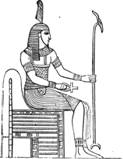
Fig. 296—Drawers and girdle
1. The first was ’linen-breeches,’ or drawers (Exo 28:42). These were to be of fine twined linen, and to reach from the loins to the middle of the thighs. Such drawers were worn universally in Egypt. No mention occurs of the use of drawers by any other class of persons in Israel except the priests, on whom it was enjoined for the sake of decency.
2. The coat of fine linen or cotton (Exo 39:27). This was worn by men in general (Gen 37:3); also by women (2Sa 13:18; Son 5:3), next to the skin. It was to be of woven work. Josephus states that it reached down to the feet, and sat close to the body; and had sleeves, which were tied fast to the arms; and was girded to the breast a little above the elbows by a girdle. It had a narrow aperture about the neck, and was tied with certain strings hanging down from the edge over the breast and back, and was fastened above each shoulder. But this garment, in the case of the priests and high-priest, was to be broidered (Exo 28:4), ’a broidered coat,’ by which Gesenius understands a coat of cloth worked in checkers or cells.
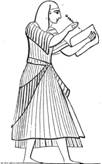
Fig. 297—Girdle and tunic
3. The girdle (Exo 28:40). This was also worn by magistrates (Isa 22:21). The girdle for the priests was to be made of fine twined linen, and blue, and purple, and scarlet, of needlework (Exo 39:29). Josephus describes it as often going round, four fingers broad, but so loosely woven that it might be taken for the skin of a serpent; and that it was embroidered with flowers of scarlet, and purple, and blue, but that the warp was nothing but linen. The mode of its hanging down is illustrated by the fig. 299, where the girdle is also richly embroidered; while the imbricated appearance of the girdle may be seen very plainly in fig. 296. The next, fig. 297, of a priestly scribe of ancient Egypt, offers an interesting specimen of both tunic and girdle.
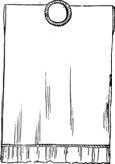
Fig. 298—Egyptian tunic
4. The bonnet, cap, or turban, (Exo 28:40). The bonnet was to be of fine linen (Exo 39:28). In the time of Josephus it was circular, covering about half the head, something like a crown, made of thick linen swathes doubled round many times, and sewed together, surrounded by a linen cover to hide the seams of the swathes, and sat so close that it would not fall off when the body was bent down (Antiq. iii. 7. 3).
The dress of the high-priest was precisely the same with that of the common priests in all the foregoing particulars; in addition to which he had
(1). A robe (Exo 28:4). This was not a mantle, but a second and larger coat without sleeves; a kind of surtout worn by the laity, especially persons of distinction (Job 1:20; Job 2:12; by kings, 1Sa 15:27; 1Sa 18:4; 1Sa 24:5; 1Sa 24:12). This garment, when intended for the high-priest, and then called ’the robe of the ephod,’ was to be of one entire piece of woven work, all of blue, with an aperture for the neck in the middle of the upper part, having its rim strengthened and adorned with a border. The hem had a kind of fringe, composed of tassels, made of blue, purple, and scarlet, in the form of pomegranates; and between every two pomegranates there was a small golden bell, so that there was a bell and a pomegranate alternately all round (Exo 28:31-35). The use of these bells may have partly been, that by the high-priest shaking his garment at the time of his offering incense on the great day of expiation, etc. the people without might be apprised of it, and unite their prayers with it (comp. Sir 45:9; Luk 1:10; Act 10:4; Rev 8:3-4). Josephus describes this robe of the ephod as reaching to the feet, and consisting of one entire piece of woven-work, and parted where the hands came out (Joh 19:23). He also states that it was tied round with a girdle, embroidered with the same colors as the former, with a mixture of gold interwoven (Antiq. iii. 7. 4). The fringe of bells and pomegranates seems to have been the priestly substitute for the fringe bound with a blue ribband, which all the Israelites were commanded to wear. Many traces of this fringe occur in the Egyptian remains.
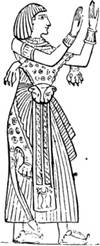
Fig. 299—Ephod and girdle
(2). The ephod (Exo 28:4). This was a short cloak covering the shoulders and breast. It is said to have been worn by Samuel while a youth ministering before the Lord (1Sa 2:18); by David, while engaged in religious service (2Sa 6:14); and by inferior priests (1Sa 22:18). But in all these instances it is distinguished as a linen ephod, and was not a sacred but honorary vestment; but the ephod of the high-priest was to be made of gold, of blue, of purple, of scarlet, and fine twined linen, with cunning work. Though it probably consisted of one piece, woven throughout, it had a back part and a front part, united by shoulder-pieces. It had also a girdle; or rather strings went out from each side and tied it to the body. On the top of each shoulder was to be an onyx stone, set in sockets of gold, each having engraven upon it six of the names of the children of Israel, according to the precedence of birth, to memorialize the Lord of the promises made to them (Exo 28:6-12; Exo 28:29). Josephus gives sleeves to the ephod (Antiq. iii. 7. 5). It may be considered as a substitute for the leopard-skin worn by the Egyptian high-priests in their most sacred duties, as in fig. 299, where the ephod appears no less plainly.
(3). Then came the breastplate, a gorget, ten inches square, made of the same sort of cloth as the ephod, and doubled so as to form a kind of pouch or bag (Exo 39:9), in which was to be put the urim and thummim, which are also mentioned as if already known (Exo 28:30). The external part of this gorget was set with four rows of precious stones; the first row, a sardius, a topaz, and a carbuncle; the second, an emerald, a sapphire, and a diamond; the third, a ligure, an agate, and an amethyst; and the fourth, a beryl, an onyx, and a jasper—set in a golden socket. Upon each of these stones was to be engraven the name of one of the sons of Jacob. In the ephod, in which there was a space left open sufficiently large for the admission of this pectoral, were four rings of gold, to which four others at the four corners of the breastplate corresponded; the two lower rings of the latter being fixed inside. It was confined to the ephod by means of dark blue ribbands, which passed through these rings; and it was also suspended from the onyx stones on the shoulder by chains of gold, or rather cords of twisted gold threads, which were fastened at one end to two other larger rings fixed in the upper corners of the pectoral, and by the other end going round the onyx stones on the shoulders, and returning and being fixed in the larger ring. The breastplate was further kept in its place by a girdle, made of the same stuff, which Josephus says was sewed to the breastplate, and which, when it had gone once round, was tied again upon the seam and hung down. It appears in fig. 301.
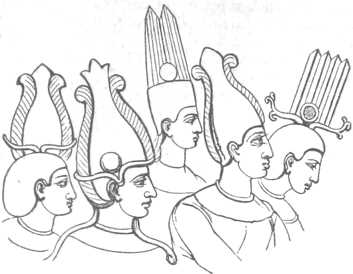
Fig. 300—Egyptian miters
(4). The remaining portion of dress peculiar to the high-priest was the miter (Exo 28:4). The Bible says nothing of the difference between this and the turban of the common priests. It is, however, called by a different name. It was to be of fine linen (Exo 28:39). Josephus says it was the same in construction and figure with that of the common priest, but that above it there was another, with swathes of blue, embroidered, and round it was a golden crown, polished, of three rows, one above another out of which rose a cup of gold, which resemble the calyx of the herb called by Greek botanists hyoscyamus. He ends a most labored description by comparing the shape of it to a poppy (Antiq. iii 7. 6). Upon comparing his account of the bonnet of the priests with the miter of the high-priests it would appear that the latter was conical. The cut, fig. 300, presents the principal forms of the miters worn by the ancient priests of Egypt, and affords a substantial resemblance of that prescribed to the Jews, divested of idolatrous symbols, but which were displaced to make way for a simple plate of gold, bearing the inscription, ’Holiness to Jehovah.’ This plate extended from one ear to the other, being bound to the forehead by strings tied behind, and further secured in its position by a blue ribband attached to the miter (Exo 28:36-39; Exo 39:30; Lev 8:9). The magnificent dress of the high priest was not always worn by him. It was exchanged for one wholly of linen, and therefore white, though of similar construction, when on the day of expiation he entered into the Holy of Holies (Lev 16:4; Lev 16:23); and neither he nor the common priests wore their appropriate dress, except when officiating. The garments of the inferior priests appear to have been kept in the sacred treasury (Ezr 2:69; Neh 7:70).
The next incident in the history is, that Moses receives a command to consecrate Aaron and his sons to the priests’ office (Exo 28:41), with the following ceremonies. They were to be washed at the door of the tabernacle of the congregation (Exo 29:4), where the altar of burnt offering stood (Exo 40:6; Exo 40:29). Aaron was then robed in his pontifical garments (Lev 16:4-6), and anointed with a profusion of oil (Lev 16:7); whence he was called ’the priest that is anointed ’(Lev 4:3, etc.; Psa 133:2). This last act was the peculiar and only distinguishing part of Aaron’s consecration; for the anointing of his sons (Exo 30:30) relates only to the unction (Exo 29:31), by a mixture made of the blood of the sacrifice and of the anointing oil, which was sprinkled upon both Aaron and his sons, and upon their garments, as part of their consecration. Hence then Aaron received two unctions. In after-times the high-priest took an oath (Heb 7:23) to bind him, as the Jews say, to a strict adherence to established customs. The other details of this ceremony of consecration are all contained in one chapter (Exodus 29), to which we must be content to refer the reader. The entire ceremony lasted seven days, on each of which all the sacrifices were repeated (Lev 8:33), to which a promise was added, that God would sanctify Aaron and his sons, that is, declare them to be sanctified, which He did, by the appearance of His glory at their first sacrifice, and by the fire which descended and consumed their burnt-offerings (Lev 9:23-24). Thus were Aaron and his sons and their descendants separated forever, to the office of the priesthood, from all other Israelites. There was consequently no need of any further consecration for them or their descendants. The first-born son of Aaron succeeded him in the office, and the elder son among all his descendants; a rule which, though deviated from in after-times, was ultimately resumed. The next successor was to be anointed and consecrated in his father’s holy garments (Exo 29:29), which he must wear seven days when he went into the tabernacle of the congregation to minister (Exo 29:30; comp. Num 20:26-28; Num 35:25), and make an atonement for all things and persons (Lev 16:32-34), and for himself (comp. Lev 16:11), besides the offering (Lev 6:20-22). The common priests were required to prove their descent from Aaron. No age was prescribed for their entrance on their ministry, or retirement from it.
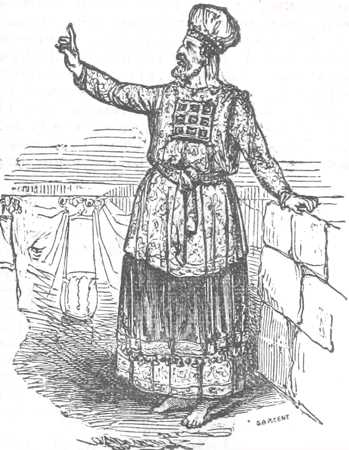
Fig. 301—High Priest
We shall now give a summary of the duties and emoluments of the high-priest and common priests respectively. Besides his lineal descent from Aaron, the high-priest was required to be free from every bodily blemish or defect (Lev 21:16-23); but though thus incapacitated, yet, his other qualifications being sufficient, he might eat of the food appropriated to the priests (Lev 21:22). He must not marry a widow, nor a divorced woman, or profane, or that had been a harlot, but a virgin Israelitess (Lev 21:14). In Ezekiel’s vision a general permission is given to the priests to marry a priest’s widow (Eze 44:22). The high-priest might not observe the external signs of mourning for any person, or leave the sanctuary upon receiving intelligence of the death of even father or mother (Lev 21:10-12; comp. Lev 10:7). Public calamities seem to have been an exception, for Joacim the high-priest, and the priests, in such circumstances ministered in sackcloth with ashes on their miters (Jdt 4:14-15; comp. Joe 1:13). He must not eat anything that died of itself, or was torn of beasts (Lev 22:8); must wash his hands and feet when he went into the tabernacle of the congregation, and when he came near to the altar to minister (Exo 30:19-21). At first Aaron was to burn incense on the golden altar every morning when he dressed the lamps, and every evening when he lighted them, but in later times the common priest performed this duty (Luk 1:8-9); to offer, as the Jews understand it, daily, morning and evening, the peculiar meat-offering he offered on the day of his consecration (Exodus 29); to perform the ceremonies of the great day of expiation (Leviticus 16); to arrange the shew-bread every Sabbath, and to eat it in the holy place (Lev 24:9); must abstain from the holy things during his uncleanness (Lev 22:1-3); also if he became leprous, or contracted uncleanness (Lev 22:4-7). If he committed a sin of ignorance he must offer a sin-offering for it (Lev 4:3-13); and so for the people (Lev 4:12-22); was to eat the remainder of the people’s meat-offerings with the inferior priests in the holy place (Lev 6:16); to judge of the leprosy in the human body or garments (Lev 13:2-59); to adjudicate legal questions (Deu 17:12). Indeed, when there was no divinely inspired judge, the high-priest was the supreme ruler till the time of David, and again after the captivity. He must be present at the appointment of a new ruler or leader (Num 27:19), and ask counsel of the Lord for the ruler (Num 27:21). Eleazar with others distributes the spoils taken from the Midianites (Num 31:21; Num 31:26). To the high-priest also belonged the appointment of a maintenance from the funds of the sanctuary to an incapacitated priest (1Sa 2:36, margin). Besides these duties, peculiar to himself, he had others in common with the inferior priests. Thus, when the camp set forward, ’Aaron and his sons’ were to take the tabernacle to pieces, to cover the various portions of it in cloths of various colors (Num 4:5-15), and to appoint the Levites to their services in carrying them; to bless the people in the form prescribed (Num 6:23-27), to be responsible for all official errors and negligences (Num 18:1), and to have the general charge of the sanctuary (Num 18:5).
Emoluments of the High-Priest.—Neither the high-priest nor common priests received ’any inheritance’ at the distribution of Canaan among the several tribes (Num 18:20; Deu 18:1-2), but were maintained with their families, upon certain fees, dues, perquisites, etc., arising from the public services, which they enjoyed as a common fund. Perhaps the only distinct prerogative of the high-priest was a tenth part of the tithes assigned to the Levites (Num 18:28; comp. Neh 10:38); but Josephus represents this also as a common fund (Antiq. iv. 4. 4).
Duties of the Priests.—Besides those duties already mentioned as common to them and the high-priests, they were required to prove their descent from Aaron, to be free from all bodily defect or blemish (Lev 21:16-23); must not observe mourning, except for near relatives (Lev 21:1-5); must not marry a woman that had been a harlot, or divorced, or profane. The priest’s daughter who committed whoredom was to be burnt, as profaning her father (Lev 21:9). The priests were to have the charge of the sanctuary and altar (Num 18:5). The fire upon the altar, being once kindled (Lev 1:7), the priests were always to keep it burning (Lev 6:13). In later times, and upon extraordinary occasions, at least, they flayed the burnt-offerings (2Ch 29:34), and killed the Passover (Ezr 6:20). They were to receive the blood of the burnt-offerings in basins (Exo 24:6), and sprinkle it round about the altar, arrange the wood and the fire, and to burn the parts of the sacrifices (Lev 1:5-10). If the burnt-sacrifice were of doves, the priest was to nip off the head with his finger-nail, squeeze out the blood on the edge of the altar, pluck off the feathers, and throw them with the crop into the ash-pit, divide it down the wings, and then completely burn it (Lev 1:15-17). He was to offer a lamb every morning and evening (Num 28:3-4), and a double number on the Sabbath (Num 28:9), the burnt-offerings ordered at the beginning of months (Num 28:11), and the same on the Feast of Unleavened Bread (Num 28:19), and on the day of the First Fruits (Num 28:26); to receive the meat-offering of the offerer, bring it to the altar, take of it a memorial, and burn it upon the altar (Leviticus 2); to sprinkle the blood of the peace-offerings upon the altar round about, and then to offer of it a burnt-offering (Leviticus 3); to offer the sin-offering for a sin of ignorance in a ruler or any of the common people (Lev 4:22-25); to eat the sin-offering in the holy-place (Lev 6:26; comp. Lev 10:16-18); to offer the trespass-offering (Lev 5:6-19; Lev 6:6-7), to sprinkle its blood round about the altar (Lev 7:2), to eat of it, etc. (Lev 7:6); to eat of the show-bread in the holy place (Lev 24:9); to offer for the purification of women after child-birth (Lev 12:6-7); to judge of the leprosy in the human body or garments; to decide when the leper was cleansed, and to order a sacrifice for him (Lev 14:3-4); to administer the rites used at pronouncing him clean (Lev 14:6-7); to present him and his offering before the Lord, and to make an atonement for him (Lev 14:10-32); to judge of the leprosy in a house (Lev 14:33-47), to decide when it was clean (Lev 14:48), and to make an atonement for it (Lev 14:49-53); to make an atonement for men cleansed from an issue of uncleanness (Lev 15:14-15), and for women (Lev 15:29-30); to offer the sheaf of First Fruits (Lev 23:10-11); to estimate the commutation in money for persons in cases of a singular or extraordinary vow (Lev 27:8), or for any devoted unclean beast (Lev 27:11-12), or for a house (Lev 27:14), or field (Lev 18:23); to conduct the ordeal of the bitter water (Num 5:12-31); to make an atonement for a Nazarite who had accidentally contracted uncleanness (Num 6:13); to offer his offering when the days of his separation were fulfilled (Num 6:13-17); to blow with the silver trumpets on all occasions appointed (Num 10:8-10), and ultimately at morning and evening service (1Ch 16:6); to make an atonement for the people and individuals in case of erroneous worship (Num 15:15; Num 15:24-25; Num 15:27); to make the ointment of spices (1Ch 9:30); to prepare the water of separation (Num 19:1-11); to act as assessors in judicial proceedings (Deu 17:9; Deu 19:17); to encourage the army when going to battle, and probably to furnish the officers with the speech (Deu 20:5-9); to superintend the expiation of an uncertain murder (Deu 21:5), and to have charge of the law (Deu 31:9).
Christians are figuratively called priests (Rev 1:6; Rev 20:6). The student will observe the important distinction, that the term ’priest,’ with which term the idea of a sacrifice was always connected in ancient times, is never applied to the pastor of the Christian church.
One who officiated in the public worship of God, especially in making expiation for sin, being "ordained for men in things pertaining to God, to offer both gifts and sacrifices for sins." In the Old Testament, the priesthood was not annexed to a certain family till after the promulgation of the law by Moses. Before that time, the firstborn of each family, the fathers, the princes, the kings, were priests in their own cities and in their own houses. Cain and Abel, Noah, Abraham, and Job, Abimelech and Laban, Isaac and Jacob offered personally their own sacrifices. In the solemnity of the covenant made by the Lord with his people, at the foot of Mount Sinai, Moses performed the office of mediator, and young men were chosen from among Israel to perform the office of priests, Exo 24:5 . But after the Lord had chosen the tribe of Levi to serve him in his tabernacle, and the priesthood was annexed to the family of Aaron, the right of offering sacrifices and oblations to God was reserved to the priests of this family, Num 16:40 . The punishment of Uzziah king of Judah is well known, who having presumed to offer incense to the Lord, was suddenly smitten with a leprosy, 2Ch 26:19 . See also the case of Saul, 1Sa 13:7-14 . However, it seems that on certain occasions the Hebrew prophets offered sacrifice to the Lord, especially before a constant place of worship was fixed at Jerusalem. See 1Sa 7:9, where Samuel, who was not a priest offered a lamb for a burnt sacrifice to the Lord. See also 1Sa 9:13 16:5 1Ki 18:31,33 .\par The Lord having reserved to himself the firstborn of Israel because he had preserved them from the hand of the destroying angel in Egypt, by way of exchange and compensation, he accepted the tribe of Levi for the service of his tabernacle, Num 3:41 . Thus the whole tribe of Levi was appointed to the sacred ministry, but not all in the same manner; for of the three sons of Levi, Gershom, Kohath, and Merari, the heads of the three great families, the Lord chose the family of Kohath, and out of this family the house of Aaron, to exercise the functions of the priesthood. Al the rest of the family of Kohath, even the children of Moses and their descendants remained among the Levites.\par The high priest was at the head of all religious affairs, and was the ordinary judge of all difficulties that belonged thereto, and even of the general justice and judgment of the Jewish nation, as being at the head of all the priests by whom this was administered, Deu 17:8-12 19:17 21:5 33:8,10 Eze 44:24. He only had the privilege of entering the sanctuary once a year, on the day of solemn expiation, to make atonement for the sins of the whole people, Lev 16:2, etc. He was to be born of one of his own tribe, whom his father had married a virgin; and was to be exempt from corporal defect, Lev 21:13 . In general, no priest who had any such defect could offer sacrifice, or enter the holy place to present the showbread. But he was to be maintained by the sacrifices offered at the tabernacle, Lev 21:17-22 . The high priest also received a tithe from the Levites, Num 18:28 .\par God also appropriated to the high priest the oracle of his truth; so that when he was habited in the proper ornaments of his dignity, and with the Urim and Thummim, he answered questions proposed to him, and God disclosed to him secret and future things. He was forbidden to mourn for the death of any of his relations, even for his father or mother; or to enter into any place where a dead body lay, that he might not contract or hazard the contraction of uncleanness, Lev 21:10-12 .\par The priests served immediately at the altar. They slew and dressed the public sacrifices, or at least it was done by the Levites under their direction. Private offerers slew their own victims, except in the case of turtledoves or young pigeons. But all offerings upon the altar, the sprinkling of blood included, were made by the priests alone. They kept up a perpetual fire on the altar of burnt sacrifices, and in the lamps of the golden candlestick in the sanctuary; they kneaded the loaves of showbread, baked them, offered them on the golden altar in the sanctuary, and changed them every Sabbath-day. Compare Exo 28:29 Lev 8:1-36 . Every day, night and morning, a priest appointed by casting of lots at the beginning of the week, brought into the sanctuary a smoking censer of incense, and set it on the golden table, otherwise called the altar of incense, Luk 1:9 .\par The sacred dress of the priests consisted of the following articles: short linen drawers; a close-fitting tunic of fine linen or cotton, of woven work, broidered, reaching to the feet, and furnished with sleeves; a girdle of fine linen. Plain linen ephods are also ascribed to them, 1Sa 22:18 ; and a bonnet or turban, also of fine linen, in many folds. The priests always officiated with uncovered feet. The high priests were nearly the same dress with the priests, and four articles in addition: an outer tunic, called the robe of the ephod, woven entire, blue, with an ornamented border around the neck, and a fringe at the bottom made up of pomegranates and golden bells: an ephod of blue, and purple, and scarlet, and fine linen, with golden threads interwoven, covering the body from the neck to the thighs; having shoulder-pieces joined on the shoulders by clasps of gold in which were set onyx-stones graven with the names of the twelve tribes of Israel; and also a girdle of fine linen, woven with blue, purple, scarlet, and gold, passed several times round the body: a breastplate, attached at its four corners to the ephod, and likewise bearing the names of the twelve tribes on twelve precious stones; and the miter, a high and ornamented turban having on the front a gold plate with the inscription, "Holiness to the Lord." Neither he nor the priests wore their sacred dresses out of the temple as we infer from Eze 42:14 44:17-19 Mal 23:5 .\par The Lord had given no lands of inheritance to the tribe of Levi, in the Land of Promise. He intended that they should be supported by the tithes, the first fruits, the offerings made in the temple and by their share of the sin offerings and thanksgiving offerings sacrificed in the temple; of which certain parts were appropriated to them. In the peace offerings, they had the shoulder and the breast, Lev 7:33,34 ; in the sin offering, they burnt on the altar the fat that covers the bowels, the liver, and the kidneys; the rest belonged to themselves, Lev 7:6,10 . The skin or fleece of every sacrifice also belonged to them. When an Israelite sacrificed any animal for his own use, he was to give the priest the shoulder, the stomach, and the jaws, Deu 18:3 . The priest had also a share of the wool when sheep were shorn, Deu 18:4 . Thus, though the priests had no lands or inheritances, their temporal wants were supplied. God provided them houses and accommodations, by appointing forty-eight cities, six were appointed as cities of refuge for those who had committed casual and involuntary manslaughter. The priests had thirteen of these cities; the others belonged to the Levites, Jos 21:10 .\par A principal employment of the priests, next to attending on the sacrifices and the temple service, was the instruction of the people and the deciding of controversies; distinguishing the several sorts of leprosy, divorce causes, the waters of jealousy, vows, causes relating to the law and uncleanness, etc. They publicly blessed the people in the name of the Lord. In time of war their duty was to carry the Ark of the Covenant, to consult the Lord, to sound the holy trumpets, and to encourage the army, Num 10:8-9 Deu 20:2 .\par The priesthood of Christ is the substance and truth, of which that of the Jews was but a shadow and figure. Christ, the everlasting priest according to the order of Melchizedek, abides forever, as Paul observes; whereas the priests according to the order of Aaron were mortal, and therefore could not continue long, Heb 7:1-28 . The Lord, to express to the Hebrews what great favors he would confer on them, says he would make them kings and priests, Exo 19:6 ; and Peter repeats this promise to Christians, or rather, he tells them that they are in truth what Moses promised to Israel, 1Pe 2:5,9 . See also Jer 1:6 . In an important sense every Christian offers himself a spiritual sacrifice, "acceptable to God through Jesus Christ;" but in the Christian church, there is no priest to make expiation for sin by a sacrifice but Christ alone, Heb 9:11-26 .\par
Priest. The English word is derived from the Greek, presbyter, signifying an "elder" (Hebrew, cohen).
Origin. -- The idea of a priesthood connects itself in all its forms, pure or corrupted, with the consciousness, more or less distinct of sin. Men feel that they have broken a law. The power above them is holier than they are, and they dare not approach it. They crave for the intervention of some one of whom they can think as likely to be more acceptable than themselves. He must offer up their prayers, thanksgivings, sacrifices. He becomes their representative in "things pertaining unto God." He may become also, (though this does not always follow), the representative of God to man.
The functions of the priest and prophet may exist in the same person. No trace of a hereditary or caste priesthood meets us in the worship of the patriarchal age. Once and once only does the word cohen meet us as belonging to a ritual, earlier than the time of Abraham. Melchizedek is "the priest of the most high God." Gen 14:18. In the worship of the patriarchs themselves, the chief of the family, as such, acted as the priest. The office descended with the birthright, and might, apparently, be transferred with it.
When established. -- The priesthood was first established in the family of Aaron, and all the sons of Aaron were priests. They stood between the high priest, on the one hand, and the Levites, on the other. See High Priest; Levites, The. The ceremony of their consecration is described in High Priest -- 1986. Exo 29:1; Lev 8:1.
Dress. -- The dress which the priests wore during their ministrations consisted of linen drawers, with a close-fitting cassock, also of linen, white, but with a diamond or chess-board pattern on it. This came nearly to the feet, and was to be worn in its garment shape. Compare Joh 19:23.
The white cassock was gathered round the body with a girdle of needle work, in which, as in the more gorgeous belt of the high priest, blue, purple and scarlet were intermingled with white, and worked in the form of flowers. Exo 28:39-40; Exo 39:2; Eze 44:17-19. Upon their heads, they were to wear caps or bonnets in the form of a cup-shaped flower, also of fine linen. In all their acts of ministration they were to be bare footed.
Duties. -- The chief duties of the priests were to watch over the fire on the Altar of Burnt Offering, and to keep it burning evermore both by day and night, Lev 6:12; 2Ch 13:11, to feed the golden lamp outside the vail with oil, Exo 27:20-21; Lev 24:2, to offer the morning and evening sacrifices, each accompanied with a meet offering and a drink offering, at the door of the Tabernacle. Exo 29:38-44. They were also to teach, the children of Israel, the statutes of the Lord. Lev 10:11; Lev 33:10; 2Ch 15:3; Eze 44:23-24.
During the journeys in the wilderness, it belonged to them to cover the Ark and all the vessels of the sanctuary, with a purple or scarlet cloth, before the Levites might approach them. Num 4:5-15. As the people started on each days march, they were to blow "an alarm" with long silver trumpets. Num 10:1-8. Other instruments of music might be used by the more highly-trained Levites and the schools of the prophets, but the trumpets belonged only to the priests.
The presence of the priests on the field of battle, 1Ch 12:23; 1Ch 12:27; 2Ch 20:21-22, led, in the later periods of Jewish history, to the special appointment at such times of a war priest. Other functions were hinted at in Deuteronomy which might have given them greater influence as the educators and civilizers of the people. They were to act, (whether individually or collectively does not distinctly appear), as a court of appeal in the more difficult controversies in criminal or civil cases. Deu 17:8-13. It must remain doubtful, however, how far this order kept its ground during the storms and changes that followed, Functions such as these were clearly incompatible with the common activities of men.
Provision for support. -- This consisted --
Of one tenth of the tithes which the people paid to the Levites, that is, one per cent on the whole produce of the country. Num 18:26-28.
Of a special tithe every third year. Deu 14:28; Deu 26:12.
Of the redemption money, paid at the fixed rate of five shekels a head, for the first-born of man or beast. Num 18:14-19.
Of the redemption money paid in like manner for men or things specially dedicated to the Lord. Lev 27:5.
Of spoil, captives, cattle and the like, taken in war. Num 31:25-47.
Of the shew-bread, the flesh of the Burnt Offerings, Peace Offerings, Trespass Offerings, Lev 6:26; Lev 6:29; Lev 7:6-10; Num 18:8-14, and, in particular, the heave-shoulder and the wave-breast. Lev 10:12-15.
Of an undefined amount of the firstfruits of corn, wine and oil. Exo 23:19; Lev 2:14; Deu 26:1-10.
On their settlement in Canaan, the priestly families had thirteen cities assigned them, with "suburbs" or pasture-grounds for their flocks. Jos 21:13-19.
These provisions were obviously intended to secure the religion of Israel, against the dangers of a caste of pauper priests, needy and dependent, and unable to bear their witness to the true faith. They were, on the other hand, as far as possible, removed from the condition of a wealthy order.
Courses. -- The priesthood was divided into four and twenty "courses," or orders, 1Ch 24:1-19; 2Ch 23:8; Luk 1:5, each of which was to serve in rotation for one week, while the further assignment of special services during the week was determined by lot. Luk 1:9. Each course appears to have commenced its work on the Sabbath, the outgoing priests taking the morning sacrifice, and leaving that of the evening to their successors. 2Ch 23:8.
Numbers. -- If we may accept the numbers given by Jewish writers as at all trustworthy, the proportion of the priesthood population of Palestine, during the last century of their existence as an order, must have been far greater than that of the clergy has ever been in any Christian nation. Over and above those that were scattered in the country and took their turn, there were not fewer than 24,000 stationed permanently at Jerusalem, and 12,000 at Jericho. It was almost inevitable that the great mass of the order, under such circumstances, should sink in character and reputation.
The reigns of the two kings, David and Solomon, were the culminating period of the glory of the Jewish priesthood. It will be interesting to bring together, the few facts that indicate the position of the priests, in the New Testament period of their history. The number scattered throughout Palestine was, as has been stated, very large. Of these, the greater number were poor and ignorant.
The priestly order, like the nation, was divided between contending sects. In the scenes of the last tragedy of Jewish history, the order passes away without honor, "dying as a fool dieth." The high priesthood is given to the lowest and vilest of the adherents of the frenzied Zealots. Other priests appear as deserting to the enemy. The destruction of Jerusalem deprived the order at one blow of all but an honorary distinction.
Hebrew
(1) chosen of God;
(2) the property of God;
(3) holy to God;
(4) he offered gifts to God, and took back gifts from God (Heb 5:1-4).
Num 16:5, "Jehovah’s ... holy ... chosen ... come near": Num 16:40, "offering incense" (symbolizing the people’s prayers, Psa 141:2; Rev 8:3) is exclusively the priest’s duty (2Ch 26:18). All Israel was originally chosen as a kingdom of "priests" to the Gentile world (Exo 19:6); but Israel renounced the obligation through fear of too close nearness to God. (Exo 20:16), and God accepted their renunciation (Deu 18:16-17; Deu 5:24-28). Moses became the mediator with God for them. The Aaronic priesthood became the temporary depository of all Israel’s priesthood, until Christ the antitypical High Priest came; and they shall hereafter resume it when they turn to the Lord and shall be "the priests of Jehovah, the ministers of our God" to the Gentile nations in Christ’s millennial kingdom (Isa 61:6; Isa 66:21). All the elect saints (not ministers as such) from Jews and Gentiles are meantime called to be priests unto God (1Pe 2:5; 1Pe 2:9), and being transfigured shall reign with Christ as king priests (Rev 1:6; Rev 5:10; Rev 20:6).
Israel, the spiritual and the literal, shall resume the priesthood which God from the first designed for His people. Thus there will be a blessed and holy series; Christ the royal High Priest, the glorified saint king-priests, Israel in the flesh mediating as king-priest to the nations in the flesh. The notion is contrary to Scripture that Christ is High Priest, and Christian ministers priests. For the other priests were but assistants to the high priest, because he could not do all. The Lord Jesus needed no assistant, so is sole representative of both high priest and priests. Aaron’s priesthood has passed away: Christ’s priesthood, which is after the order of Melchizedek, does "not pass from one to another" (Heb 7:24,
They call ministers
The genealogy, Luke 3, includes many elsewhere priests: Levi, Eliezer, Malchi, Jochanan, Mattathias, Heli (compare Zec 12:12). Augustine (Quaest. Divers., 61) writes: "Christ’s origin from David is distributed into two families, a kingly and a priestly; Matthew descending traces the kingly, Luke ascending the priestly, family; so that our Lord Jesus, our King and Priest, drew kindred from a priestly stock (he supposes Nathan married a wife of Aaronic descent), yet was not of the priest tribe." The patriarchs exercised the priesthood, delegating it to the firstborn or the favored son, to whom was given "goodly raiment" (Gen 27:15; Gen 37:3). Joseph was thus the sacerdotal, dedicated ("separated") one, the "Nazarite" (
Job (Job 1:5), Jethro (Exo 2:16; Exo 3:1), and Balaam represent the patriarchal priest (Num 23:2). At the Exodus no priest caste as yet existed. Yet sacrifices continued, and therefore some kind of priest (Exo 5:1-3; Exo 19:22). The head of the tribe, or the firstborn as dedicated to Jehovah (Exo 13:2; Num 3:12-13), had heretofore conducted worship and sacrifice. Moses, as Israel’s divinely constituted leader, appointed "young men of the children of Israel to offer burnt offerings and sacrifice peace offerings of oxen unto Jehovah" (Exo 24:5-6; Exo 24:8), and sprinkled the consecrating blood himself on the people. The targums call these young men the firstborn sons; but all that seems to be meant is, Moses officiated as priest, (Aaron not being yet consecrated), and employed young men whose strength qualified them for slaying the sacrifices. The law did not regard these acts as necessarily priestly; Lev 1:5 implies the offerer slew the sacrifice.
When the tabernacle was completed, and Aaron and his sons were made priests, Moses by Jehovah’s command performed the priestly functions of setting the shewbread, lighting the lamps, burning incense, and offering the daily sacrifice (Exo 40:23-29; Exo 40:31-32). But at the consecration of Aaron and his sons Moses officiated as priest for the last time (Lev 8:14-29; Exo 29:10-26). The "young men" (Exo 24:5; compare Jdg 17:7) represented Israel in its then national juven escence.
By laying hands on a bullock as sin offering, they typically transferred their guilt to it. Besides, with the blood of the ram of consecration Moses sprinkled the right car (implying openness to hear God’s voice, Isa 1:5; Psa 40:6, Messiah), the right hand to dispense God’s gifts, and the foot always to walk in God’s ways. Finally, Moses "filled their hands" with three kinds of bread used in ordinary life, unleavened cakes, cakes of oil bread, and oiled wafers (Lev 8:2; Lev 8:26; Exo 29:2-3; Exo 29:23), put on the fat and right shoulder, and putting his own hands under their hands (so the Jewish tradition) made them wave the whole mass to and fro, expressing the nation’s praise and thanksgiving, testified by its gifts. The whole was repeated after seven days, during which they stayed in the tabernacle, separate from the people. So essential was this ritual that to "fill the hand" means to consecrate (Exo 29:9; 2Ch 13:9 margin).
Moses, as representing God, consecrated, exercising for the time a higher priesthood than the Aaronic; so he is called priest (Psa 99:6). The consecration was transmitted from father to son without needing renewal. The dress was linen drawers "to cover their nakedness" (Exo 20:26; Exo 28:39-40; Exo 28:42), in contrast to the foul indecencies of some Egyptian rites (Herodot. 2:60), and of Baal Poor’s worship. Over the drawers was the
They laid aside these for ordinary garments outside the sanctuary (Eze 42:14). They drank no wine in ministering (Lev 10:9), that they might be free from all undue artificial excitement. No direction is given as to covering the feet. The sanctity of the tabernacle required baring the foot (Exo 3:5; Jos 5:15). The
The priest was not to marry a woman divorced or the widow of any but a priest. The high priest was to marry a virgin. As the priestly succession depended on the sureness of the genealogy, these genealogies were jealously preserved and referred to in disputed cases (Ezr 2:62; Neh 7:64); the mothers as well as the fathers were named. The priests’ duty was to keep the altar fire ever burning (Lev 6:12-13), symbolizing Jehovah’s never ceasing worship; not like the idol Vesta’s sacred fire, but connected with sacrifices. They fed the golden, candlestick (or lamp) outside the veil with oil, offered morning and evening sacrifices with a meat and drink offering at the tabernacle door (Exo 29:38-44; Exo 27:20-21; Lev 24:2; 2Ch 13:11). They were always ready to do the priestly office for any worshipper (Lev 1:5; Lev 2:2; Lev 2:9; Lev 3:11; Lev 12:6; 1Sa 2:13).
The priest administered the water of jealousy to the suspected wife and pronounced the curse (Num 5:11-31). Declared clean or unclean, and purified ceremonially, lepers (Leviticus 13; 14; Mar 1:44). Offered expiatory sacrifices for defilements and sins of ignorance (Leviticus 15). The priest as "messenger of Jehovah of hosts" taught Israel the law, and his "lips" were to "keep knowledge" (Mal 2:7; Lev 10:10-11; Deu 24:8; Deu 33:10; Jer 18:18; Hag 2:11; 2Ch 15:3; 2Ch 17:7-9; Eze 44:23-24). They covered the ark and sanctuary vessels with a scarlet cloth before the Levites might approach them (Num 4:5-15).
They blew the "alarm" for marching, with the long silver trumpets which belonged to them in a special way (Num 10:1-8); two if the multitude was convened, one if a council of elders and princes (Num 10:10); with them the priest announced the beginning of solemn days and days of gladness, and summoned all to a penitential fast (Joe 2:1; Joe 2:15). They blew them at Jericho’s overthrow (Jos 6:4) and the war against Jeroboam (2Ch 13:12; compare 2Ch 20:21-22); 3,700 joined David (1Ch 12:23; 1Ch 12:27). An appeal lay to them in controversies (Eze 44:24; 2Ch 19:8-10; Deu 17:8-13); so in cases of undetected murder (Deu 21:5). They blessed the people with the formula, Num 6:22-27.
SUPPORT. The priest had
(1) one tenth of the tithes paid to the Levites, i.e. one percent on the whole produce of the land (Num 18:26-28).
(2) A special tithe every third year (Deu 14:28; Deu 26:12).
(3) The redemption money, five shekels a head for the firstborn of man and beast (Num 18:14-19).
(4) Redemption money for men or things dedicated to Jehovah (Leviticus 27).
(5) Share of war spoil (Num 31:25-47).
(6) Perquisites: firstfruits of oil, wine, and wheat, the shewbread, flesh and bread offerings, the heave shoulder and wave breast (Num 18:8-14; Lev 6:26; Lev 6:29; Lev 7:6-10; Lev 10:12-15). Deu 18:3, "the shoulder, cheeks, and
Of the "most holy" things none but the priests were to partake (Lev 6:29). Of the rest their sons, daughters, and even home-born slaves, but not the stranger and hired servant, ate (Lev 10:14; Lev 22:10-11). Thirteen cities within Judah, Benjamin, and Simeon (whereas the Levites were scattered through Israel) with suburbs were assigned to them (Jos 21:13-19). They were far from wealthy, and were to be the objects of the people’s liberality (Deu 12:12; Deu 12:19; Deu 14:27-29; 1Sa 2:36), and were therefore tempted to "teach for hire" (Mic 3:11). Just after the captivity their tithes were badly paid (Neh 13:10; Mal 3:8-10). In David’s reign the priests were divided into 24 courses, which served in rotation for one week commencing on the Sabbath, the outgoing priest taking the morning sacrifice, the incoming priest the evening; the assignment to the particular service in each week was decided by lot (1Ch 24:1-19; 2Ch 23:8; Luk 1:5; Luk 1:9). Ithamar’s representatives were fewer than Eleazar’s; so 16 courses were assigned to the latter, eight to the former.
Only four courses returned from Babylon (Ezr 2:36-39): 973 of Jedaiah, 1,052 of Immer, 1,247 of Pashur, 1,017 of Harim. They were organized in 24 courses, and the old names restored. The heads of the 24 courses were often called" chief priests." In the New Testament when the high priesthood was no longer for life, the ex-high priests were called by the same name (
Moloch and Chiun had even a rival "tabernacle," or small portable shrine, served by priests secretly (Amo 5:26; Act 7:42-43; Eze 20:16; Eze 20:39). After the Philistine capture of the ark, and its re. moral from Shiloh, Samuel a Levite, trained as a Nazarite and called as a prophet, was privileged to "come near" Jehovah. The Nazarite vow gave a kind of priestly consecration to "stand before" Him, as in the case of the Rechabites (Amo 2:11; Jer 35:4; Jer 35:19; 1Ch 2:55). The independent order of prophets whose schools began with Samuel served as a counterpoise to the priests, who might have otherwise become a narrow caste. Under apostate kings the priests themselves fell into the worship of Baal and the heavenly hosts (Jer 2:8; Jer 8:1-2). The prophets who ought to have checked joined in the idolatry (Jer 5:31). After Shiloh Nob became the seat of the tabernacle (1Sa 21:1).
Saul’s massacre of priests there (1Sa 22:17-18) drove Abiathar to David (1Sa 23:6; 1Sa 23:9), then at Saul’s death 3,700 under Jehoiada and Zadok (1Ch 12:27-28). From all quarters they flocked to bring up the ark to Zion (1Ch 15:4). The Levites under Benaiah and Jahaziel, priests with the trumpets, ministered round it in sacred music and psalms; but the priests generally ministered in the sacrificial system at the tabernacle at Gibeon (1Ch 16:5-6; 1Ch 16:37-39; 1Ch 21:29; 2Ch 1:3). David purposed, and Solomon at length accomplished, the union of the two services in the one temple at Jerusalem. After the return from Babylon the Levites took a leading part with the priests in teaching the people (Neh 8:1-13).
The mercenary spirit, of many priests, and their low estimation as "contemptible and base before all the people," Malachi glances at (Mal 2:8-9; Mal 1:10). Their former idolatry had given place to covetousness. They had sunk so low under Antiochus Epiphanes that Jason (the paganized form of Joshua) and others forsook the law for Gentile practices. Some actually ran naked in the circus opened in Jerusalem (2Ma 4:13-14). Under the Maccabean struggle faithfulness to the law revived. At Pompey’s siege of Jerusalem they calmly carried on their ministrations in the temple, until slain in the act of sacrificing (Josephus, Ant. 14:4, section 3; B. J., 1:7, section 5). Through the deteriorating effects of Herod’s and the Roman governor’s frequently changing the high priests at will, and owing to Sadduceeism becoming the prevailing sentiment of the chief priests in the times of the Gospels and Acts (Act 4:1; Act 4:6; Act 5:17), selfishness and unscrupulous ambition and covetousness became their notorious characteristics (Luk 10:31).
In the last Roman war the lowest votaries of the Zealots were made high priests (Josephus, B. J. 4:3, section 6; 6:8, section 3; 5, section 4). From a priest Titus received the lamps, gems, and costly garments of the temple. The rabbis rose as the priests went down. The only distinction that now these receive is the redemption money of the firstborn, the right of taking the law from the chest, and of pronouncing the benediction in the synagogue. From some of the "great company of the priests" who became "obedient to the faith," the occurrences in Mat 27:51; Mat 27:62-66, the rending of the veil and the application to Pilate as to securing the sepulchre, were learned and recorded. These events doubtless tended to their own conversion.
Priest. In the sacred Scriptures priest denotes one who offers sacrifice. In patriarchal times the fathers were the priests of their own families, though perhaps a more general priestly office existed, such as that exercised by Melchizedek. The patriarchs—Noah, Abraham, and others—officiated as priests of their households. Gen 8:20; Gen 12:8. The male descendants of Aaron were priests by birthright, and the firstborn, in regular succession, was entitled to the office of high priest. Certain blemishes, however, specified in Lev 21:16-24, disqualified a man, not for the order, but for performing the functions of the office. The number of priests was at first very small. Jos 3:6; Jos 6:4; but in the time of David it had greatly increased; 3700 priests joined him at Hebron. 1Ch 12:27. He divided them into 24 courses—16 of the family of Eleazar, and eight of the family of Ithamar; and, as these courses officiated in regular succession, changing every Sabbath, 2Ch 23:8, each course would be in attendance at the sanctuary at least twice a year. During the period of the captivity this division into courses seems to have fallen into some confusion. Among the 4289 priests who accompanied Zerubbabel, only four courses were represented, Ezr 2:36-39; Neh 7:39-42, and courses are afterward mentioned which cannot be identified with any of the original ones. The duty of the priests was to prepare and offer the daily, weekly, and monthly sacrifices. In war they sounded the holy trumpets and carried the ark of the covenant. In peace they ministered as judges and expounded the law to the people. It appears, however, from 2Ch 17:7-10; 2Ch 19:8-10; Eze 44:24, etc., that the priests often neglected the judicial and teaching functions of their office. The consecration of a priest took place with great solemnity. The ceremonies, which were minutely prescribed by Moses, Exo 29:1-37; Lev. chaps. 8, 9, lasted for seven days, and consisted in sacrifices, washings, the putting on of the holy garments, the sprinkling of blood, and anointing with oil The consecration of the high priest was distinguished by pouring the sacred oil upon his head, Exo 29:7; Exo 30:22-33; Lev 8:12; Lev 21:10; Lev 21:12; Psa 133:2, in addition to the washing and the sprinkling with oil, etc., which he shared with all priests, Exo 29:4; Exo 29:20-21; Lev 8:6; Lev 8:23-24; Lev 8:30. So Christ, our great High Priest, was anointed with the Holy Spirit. Dan 9:24; Act 10:38; Joh 3:34. Peculiar garments were put upon the high priest, Exo 29:5-6; Exo 29:29-30; Lev 8:7-9, and sacrifices were offered seven days. Exo 29:1-37; Lev 8:14-36. The high priest’s sacred garments, besides the drawers, linen tunic, and girdle of other priests, were four, Exo 28:4; Exo 28:39-43; Lev 8:7-9: the robe of the ephod, Exo 28:31-35; the ephod, with its "curious girdle," Exo 28:6-12; the breast-plate, with the Urim and Thummim, vs. 15-30; and the mitre, vs. 36, 39. See the respective titles. These garments were worn only when the high priest was ministering in the sanctuary. Eze 42:14; Eze 44:17-19; Act 23:5. On the day of atonement Ms dress was of plain white linen. Lev 16:4; Lev 16:23-24. The high priest was to enter the Holy of Holies once a year on the day of atonement, to make expiation for the sins of the nation. Lev 16:1-34. The high priest was president of the Sanhedrin in our Lord’s time. Mat 26:62. The office of the priesthood was abolished when Christ died. There were to be no more offerings for sin. "Christ was once offered to bear the sins of many." Heb 9:28. "We are sanctified through the offering of Jesus Christ once." Heb 10:10. "By one offering he hath perfected forever them that are sanctified." Heb 10:14. The words priest and priesthood do not occur in the New Testament in connection with any order in the church. The only mention of them is, Christ, as our Priest, and all believers, as priests, and a priesthood. 1Pe 2:5; 1Pe 2:9; Rev 1:6; Rev 5:10; Rev 20:6.
The Hebrew name for a priest is Cohen (
The word Cohen is not confined as a title to the priests of the Levitical order. It is applied to Melchizedek, to Potipherah (Gen 41:45), to the priests of Midian (Exo 3:1), and to the priests who conducted idolatrous worship. Moses is included among God’s priests in Psa 99:6.
The verb
It is remarkable that the word
PRIEST
1. The Jewish priests.—The few passages in the Gospels where the word ‘priest’ (
2. Priesthood of Christ
(3) The essential meaning of priesthood.—In order to obtain a true idea of the priesthood of Christ, it is necessary to inquire what were the essential characteristics of priesthood. What were the functions which the priest performed as priest, those of which he had the monopoly, and which no one else could perform under any circumstances? The best definition is in Heb 5:1, where we are told that the priest was ‘appointed for men in things pertaining to God,’ that is, he represented man to God. What was included in this representation we shall see later, but meanwhile it should be clearly observed that priesthood meant the representation of man to God, and was the exact opposite and counterpart of the work of the prophet, which was to represent God to man. The priest went from man to God, the prophet went from God to man. The two ideas are seen in Heb 3:1, where Christ is called ‘Apostle and High Priest’—‘Apostle’ because sent from God to man, ‘High Priest’ because going from man to God. In this twofold capacity lies His perfect mediation. If the priest did other duties, such as teaching, receiving tithes, and blessing the people, these were superadded functions and not inherent in the priesthood. The Levites could teach and the kings could bless, but by no possibility could either do the essential duties of the priesthood in representing man to God. This specific idea is clearly taught as the essence of priesthood both in OT and NT, where the Godward aspect of priesthood is always stated and emphasized (Exo 28:1, Num 16:40, 2Ch 26:18, Eze 44:15, Heb 6:20; Heb 7:25; Heb 9:24). This essential idea of priesthood as representative of man to God carries with it the right of access to and of abiding in the presence of God. In primitive days, families were represented by the patriarch or head of a clan; but as the sense of sin grew and deepened, and as the Divine purpose of redemption was gradually unfolded, it became necessary to have men entirely separated for this office. Priesthood was thus the admission at once of the sinfulness of the race, of the holiness of God, and of the need of conditions of approach to God. It is of the utmost importance that we should define and keep clear these essential characteristics of the priesthood. They can be summed up in the general ideas of (a) drawing near to God by means of an offering, (b) dwelling near to God for the purpose of intercession (Eze 44:16, Lev 16:17, Exo 28:30; Exo 30:7-8, Luk 1:9-10).
(4) The special order of Christ’s priesthood.—The unique feature of the discussion in Hebrews is the association of Christ’s priesthood with that of Melchizedek. Three times in Scripture Melchizedek is mentioned, and each time the reference is important. (a) In Genesis 14 he appears in history in connexion with Abraham. He is termed ‘priest of God Most High.’ (b) Then in Psalms 110 he is mentioned again in a Psalm usually regarded as Messianic, and as such applied to Himself by our Lord (Mat 22:44, Mar 12:36, Luk 20:42). The underlying thought in the Psalm is of a priesthood other than that of Aaron, and suggests a consciousness, however dim, on the part of spiritually-minded Jews, of something beyond and superior to the Aaronic priesthood. The bare mention of another priesthood at all is significant and striking. (c) He appears in Hebrews as a type of Christ. The record of Genesis 14 is taken as it stands and used to symbolize and typify some of the elements of the priesthood of Christ. (
(5) The particular functions of Christ’s priesthood.—It is in connexion with the Aaronic priesthood that the work of Christ’s priesthood is considered. A contrast is made, as is shown by the recurring key word ‘better’, (Heb 7:22; Heb 8:6 et al.). Our Lord never was a priest of the Aaronic line (Heb 7:13-14, Heb 8:4), but it was necessary to use the illustration of the Aaronic priesthood to denote Christ’s priestly functions, because no characteristic priestly functions are recorded of Melchizedek. A series of comparisons between Aaron’s and Christ’s priesthood needs careful attention: (a) first generally in Heb 2:17-18 with reference to personal qualification; (b) then after bare mention in Heb 3:1, more fully in Heb 4:14-16. (c) But it is in Heb 5:1-10 that we have the first definite comparison. In Heb 5:1-5 the requirements of the Aaronic priesthood are stated in regard to (
At this point there are three questions that call for attention, (
(b) Hebrews dwells very carefully on Christ’s offering as connected with His death on the cross, and also on His entrance into heaven as connected with His Ascension. The absence of reference to the Resurrection (except in Heb 13:20) is explained by the fact that there was no place for this event in the type. Attention is therefore called to the two parts of the one priestly function of offering which was connected with the Day of Atonement, the sacrifice of the animal without the camp (Heb 13:11-12), and the entrance into the Holiest with the blood of the animal sacrificed. Stress is laid on the Ascension because that is regarded as the moment of our High Priest’s entrance into heaven on our behalf (Heb 9:12; Heb 9:24). It is the close association of these two parts that explains Heb 8:3 ‘It is of necessity that this man have somewhat also to offer.’ The view that this verse teaches that Christ is now continually offering Himself to God in heaven is clearly inconsistent with the rest of the Epistle, which lays such stress on the association of the offering with Christ’s death, and which also dwells on the uniqueness and completeness of the offering (
(c) The use of the two priesthoods, Melchizedek’s and Aaron’s, is not to be interpreted of two aspects of priesthood,—one on earth and the other in heaven successively realized by Christ,—for this would be quite opposed to Heb 7:18, Heb 8:4. It means that there is one priesthood, of which Melchizedek is used for the person, and Aaron for the work. If Christ’s death is associated with the Aaronic priesthood (against Heb 8:4), then the entrance into heaven must also be associated with Aaron (against Heb 6:20 et al.), which would leave no room at all for the Melchizedek priesthood. It is impossible for the death to be associated with one priesthood, and the ascension with the other. The order or nature of the priesthood according to Melchizedek gives validity and perpetuity to the acts which are symbolized in the Aaronic priesthood.
(6) The personal qualifications of Christ as Priest.—The practical and spiritual use made of priesthood in Hebrews gives special point to the emphasis laid on the personal qualifications of our Lord as High Priest. These are dealt with mainly from the human side up to Heb 5:9, and thenceforward from the Divine side. Both the human and the Divine are shown to be necessary. In regard to the human qualifications, we have: (a) His manhood, involving oneness with us for sympathy and help (ch. 2); (b) His perfect sympathy (Heb 4:14-16); (c) His perfect training by obedience through suffering (Heb 5:1-10). The Divine qualifications are: (a) His Divine appointment (Heb 5:10); (b) His indissoluble life (Heb 7:16), involving an uninterrupted tenure of office as contrasted with the constant deaths in the Aaronic priesthood; (c) His inviolable or intransmissible priesthood (Heb 7:24), involving the impossibility of succession or delegation (
(8) The practical uses of Christ’s priesthood.—The definitely practical purpose of the truth of priesthood is what must ever be kept in view. It is by means of the experience of Christ’s priesthood that Christians come out of spiritual infancy into spiritual maturity (Heb 6:1, Heb 10:1). Nowhere is the practical character more clearly seen than in the various statements and exhortations which have to do with the daily life of the believer. In particular, there are the associated phrases, ‘we have,’ and ‘therefore let us.’ (a) Heb 4:14 Having the High Priest, let us hold fast. (b) Heb 4:15-16 Having a sympathetic High Priest, let us come boldly, (c) Heb 10:19 Having boldness of access, let us draw near with faith; having a High Priest, let us hold fast our hope, let us consider one another in love. Then these three exhortations to faith, hope, and love are amplified respectively in ch. 11 (faith), ch. 12 (hope), ch. 13 (love). (d) Heb 12:28 Receiving a kingdom, let us have grace, (e) Heb 13:12-13 Jesus suffered; let us go forth. (f) Heb 13:14 We seek a city to come, therefore let us offer the sacrifice of praise. The Epistle thus emphasizes one truth above all others. Christianity is ‘the religion of free access’ to God (Bruce, Hebrews, p. 171). It might be summed up in the exhortations, ‘Draw nigh,’ ‘Hold fast,’ ‘Draw not back.’ It is characteristic that the word for believers is
W. H. Griffith Thomas.
By: Executive Committee of the Editorial Board., Moses Buttenwieser
Laymen as Priests. —Biblical Data:
One consecrated to the service of the sanctuary and, more particularly, of the altar. This definition, however, holds true rather for the later than for the earlier stages of Hebrew priesthood. In ancient Israel one was not required to be specially consecrated in order to perform the sacrificial functions; any one might approach the altar and offer sacrifices. Thus Gideon, of the tribe of Manasseh (Judges vi. 26 et seq.), and the Danite Manoah (ib. xiii. 16, 19) sacrificed in person at the express command of God and the angel of God respectively; similarly, David sacrificed on the altar he had built at God's command on the thrashing-floor of Araunah (II Sam. xxiv. 25); and Solomon, before the ark in Jerusalem (I Kings iii. 15). David, on the occasion of the transference of the Ark to Zion, and Solomon, at the dedication of the Temple of Jerusalem, ministered as priests (II Sam. vi. 14, 17, 18;. I Kings viii. 22, 54 el seq.); the latter continued to personally offer sacrifices on the altar of Yhwh at regular intervals (I Kings ix. 25). Similar instances, in later times, are presented by Elijah, sacrificing on Mount Carmel (I Kings xviii. 32 et seq.), and by Ahaz, in the Temple at Jerusalem (II Kings xvi. 12 et seq.).
In accordance with this usage in ancient Israel, the ordinances contained in the Book of the Covenant, the oldest code, concerning the building of altars and the offering of sacrifices are addressed not to the priest, but to the people at large (Ex. xx. 24-26). Even where there was a sanctuary with a priesthood, as at Shiloh, any layman might slaughter and offer his sacrifices without priestly aid (comp. I Sam. ii. 13-16). As access to the altar was not yet guarded in accordance with later Levitical ordinances, so the priesthood was not yet confined to one family, or even to one tribe. The Ephraimite Samuel became priest of the sanctuary at Shiloh, wearing the priestly linen coat ("efod bad") and the pallium (I Sam. ii. 18 et seq., iii. 1). The kings of Israel ordained as priest whomever they chose (I Kings xli. 31); David, too, invested his own sons, as well as the Jairite Ira, of the tribe of Manasseh, with the priestly office (II Sam. viii. 18, xx. 26).
Functions of the Priest.
If a distinct established priesthood is nevertheless found at the sanctuary of Shiloh and at that of Dan as early as the time of the Judges, it is obvious that its real office can not have been connected with the altar or the sacrifices, and that, consequently, its origin can not be looked for in the sacrificial functions. Wherein the origin of the Israelitish priest-hood really lies is sufficiently apparent from the older Biblical records of the time of the Judges and the following period. According to these, the functions of the priest were twofold: to care for and guard the sanctuary and its sacred images and palladia, and (of still greater importance) to consult the oracle. Thus the Ephraimite Micah, after having provided an ephod and teraphim (see Ephod) for his shrine, installed one of his sons as priest to take care of them, but only until he could secure a professional priest, a Levite, for the purpose, one who was qualified to consult the oracle (Judges xvii. 5-13).
It is evident that not the shrine, but the images it sheltered, were the essential thing. These it was that the migrating Danites coveted and carried off to their new home, together with the priest, who had consulted the oracle in behalf of their exploring party with auspicious results (ib. xviii.). The sacred palladium of the sanctuary at Shiloh was the ARK, over which the sons of Eli and Samuel kept guard. The former carried it when it was taken to the battle-field, while the latter, having special charge of the doors, slept nightly near it (I Sam, iii. 3, 15; iv. 4 et seq.). When, later, the ark was returned from the field of the Philistines and brought to the house of Abinadab at Kirjath-jearim, Abinadab's son Eleazar was at once consecrated guardian over it (ib. vii. 1). The bearing of the ark, with which, at Shiloh, the sons of Eli were entrusted, remained, as the frequent statements to this effect in later Biblical literature show, a specific priestly function throughout pre-exilic times (comp. Deut. x. 8, xxxi. 9; Josh. iii. 6 et seq., iv. 9 et seq., vi. 12, viii. 33; I Kings viii. 3). After the capture of its ark by the Philistines the sanctuary of Shiloh disappeared from history (its destruction is referred to in Jer. vii. 12, 14; xxvi. 6); its priesthood, however, appeared in the following period at the sanctuary of Nob, which also had an ephod (I Sam. xiv. 3; xxi. 1, 10; xxii. 9, 11).
After the massacre of the priesthood of Nob, Abiathar, who was the sole survivor, fied with the ephod to David (ib. xxiii. 6), whom thenceforward he accompanied on all his military expeditions, bearing the ephod in order to consult the oracle for him whenever occasion demanded (ib. xxiii. 9, xxx. 7). Similarly, in the campaign against the Philistines, Ahiah accompanied Saul and the Israclites, "bearing the ephod" and ascertaining for them the decisions of the oracle (ib. xiv. 3, 18, the latter verse being so read by the LXX.). The priests' duty of guarding the sanctuary and its sacred contents accounts for the use, in pre-exilic times, of "shomer hasaf,""doorkeeper" (corresponding to the Arabic "sadin"), as synonymous with "kohen" (II Kings xii. 10), and explains also how "shamar" and "sheret" became the technical terms of priestly service and were retained as such even after the nature of the service had materially changed.
Door-keepers.
To fill the office of doorkeeper no special qualification was necessary, but, as hinted above, to consult the oracle required special training, such as, no doubt, could be found only among professional priests. So, though the doorkeepers were in many cases not of priestly lineage (comp., besides the case of Samuel and of Eleazar of Kirjath-jearim, that of Obededom; II Sam. vi. 10 et seq.), those who consulted the oracle were invariably of priestly descent, a fact which makes it seem highly probable that the art of using and interpreting the oracle was handed down from father to son. In this way, no doubt, hereditary priesthood developed, as indicated by the cases of the sons of Eli at Shiloh and Nob, and of Jonathan and his descendants at Dan, both these priestly houses extending back to the very beginning of Israelitish history. The descendants of Jonathan made express claim to lineal descent from Moses (comp. I Sam. ii. 27; Judges xviii. 30; the reading "Menashshch" in Judges xviii. 30 is, as the suspended
Interpreters of the Law.
"Whosoever had to consult God went out to the tent of meeting," where Moses ascertained the will of God; and just as Moses, in his capacity of priest, was the intermediary through whom Yhwh revealed the Torah to the Israelites in the wilderness, and through whom His judgment was invoked in all difficult cases, such as could not be adjusted without reference to this highest tribunal (Ex. xviii. 16 et seq.), so the priests, down to the close of pre-exilic times, were the authoritative interpreters of the Law, while the sanctuaries were the seats of judgment.
Thus the Book of the Covenant prescribes that all dubious criminal cases "be brought before God," that is, be referred to Him by the priest for decision (Ex. xxii.7, 8). That "Elohim" here means "God" (not, as the A. V. translates, "the judges") is clear from I Sam. xiv. 36, where the same phrase, "niḳrab el Elohim" is applied to consulting the oracle by means of the Urim and Thummim (comp. the following verses, 37-42, the last two verses as read by the LXX.). The urim and thummim were employed together with the ephod in consulting the oracle, the former, as may be inferred from the description in I Sam. xiv. 41, 42, being a kind of sacred lots: in all probability they were cast before the ephod. Josh. vii. 14 and I Sam. ii. 25 may be cited in further proof of the fact that direct appeal to divine judgment was made in ancient Israel. This primitive custom is reflected even in as late a passage as Prov. xviii. 18. The Blessing of Moses proves that the sacred lots continued to be cast by the priests during the time of the monarchy, inasmuch as it speaks of the urim and thummim as insignia of the priesthood (Deut. xxxiii. 8). This document shows, as does also the Deuteronomic code, that throughout pre-exilic times the expounding of the Torah and the administration of justice remained the specific functions of the priests. It declares that the priests are the guardians of God's teachings and Law, and that it is their mission to teach God's judgments and Torah to Israel (Deut. xxxiii. 9, 10), while the Deuteronomic code decrees that all difficult criminal as well as civil cases be referred to the priests (ib. xvii. 8-11, xxi. 5). Further proof to the same effect lies in the frequent references of the Prophets to the judicial and teaching functions of the priesthood (comp. Amos ii. 8; Hos. iv. 6; Isa. xxviii. 7; Micah iii. 11; Jer. ii. 8, xviii. 18; Ezek. vii. 26).
Offering of the Sacrifices.
In addition to the duties thus far discussed, the offering of sacrifices, in the time of the monarchy, must have become the office of the priest, since the Blessing of Moses mentions it with the other priestly functions. No direct information is obtainable from the Biblical records as to the conditions and influences which brought this about, but it may be safely assumed that one of the factors leading thereto was the rise of the royal sanctuaries. In these, daily public sacrifices were maintained by the king (comp. II Kings xvi. 15), and it must certainly have been the business of the priests to attend to them. There is evidence also that among the priests of Jerusalem there were, at least in later pre-exilic times, gradations of rank. Besides the "chief priest" ("kohen ha-rosh") mention is made of the "kohen mishnch," the one holding the second place (II Kings xxv. 18 et al.).
As yet, however, it seems apparent that the priest-hood was not confined to one particular branch of the family of Levi, but, as both the Blessing of Moses and the Deuteronomic code state, was the heritage of the whole tribe (comp. Deut. x. 8, 9; xviii. 1 et seq., 5; xxxiii. 8-10; Josh. xviii, 7). This explains why, in the Deuteronomic code, the whole tribe of Levi has a claim to the altar-gifts, the first-fruits, and the like, and to the dues in kind from private sacrifices (Deut. xviii. 1-5), while in Ezekiel and the Priestly Code the Levites have no share therein. It explains also how it comes that, not only in Judges xvii. (see above), but throughout pre-exilic literature, the terms "Levite" and "priest" are used synonymously (comp. Deut. xvii. 9, 18; xviii. 1; xxi. 8; xxiv. 8; xxvii. 9; Josh. iii. 3; Jer. xxxiii. 18, 21: the only exception is I Kings viii. 4, where, however, as the parallel text, H Chron. v. 5, shows, the  is a later insertion).
Levites and Priests.
Since, in pre-exilic times, the whole tribe of Levi was chosen "to stand before Yhwh in order to minister unto Him," It is but consistent that the office "of blessing in Yhwh's name" (which in the Priestly Code is assigned to Aaron and his sons—Num. vi. 23) should, in the Deuteronomic code, pertain to all the Levites (comp. Deut. x. 8, xxi. 8). A very strong proof that all membersof the Levitical tribe were entitled to priesthood is furnished in the provision which was made by the Deuteronomic code for those Levites who were scattered through the country as priests of the local sanctuaries, and who, in consequence of the Deuteronomic reformation, had been left without any means of support. It stipulated that those Levites who desired to enter the ranks of the priesthood of Jerusalem should be admitted to equal privileges with their brethren the Levites who ministered there unto God, and should share equally with them the priestly revenues (Deut. xviii. 6-8). As a matter of fact, however, this provision was not carried out. The priests of Jerusalem were not willing to accord to their brethren of the local sanctuaries the privileges prescribed by Deuteronomy, and although they granted them support from the priestly dues, they did not allow them to minister at the altar (comp. II Kings xxiii. 8, 9). In this way the Deuteronomic reformation marks, after all, the first step toward the new development in the priesthood in exilic and post-exilic times.
The attitude of the priests of Jerusalem toward those of the local sanctuaries was sanctioned by Ezekiel. In his book (and later in II Chron. xxxi. 10) the priesthood of Jerusalem is called "bene Ẓadoḳ" or "the house of Zadok," after Zadok, who replaced Abiathar, Eli's descendant, when Abiathar, because of his partizanship for Adonijah, was deposed by Solomon (comp. I Kings ii. 27, 35). Ezekiel ordained that of all the Levite priests only the Zadokites, who had ministered to God in His legitimate sanctuary at Jerusalem, should be admitted to the service of the altar; the rest, who had defiled themselves by officiating at the local sanctuaries, should be degraded to the position of mere servants in the sanctuary, replacing the foreign Temple attendants who had heretofore performed all menial services (Ezek. xl. 46, xliii. 19, xliv. 6-16). Naturally, the altar-gifts, the tribute of the first-fruits, and the like, were to be awarded thenceforward to the Zadokites alone (xliv. 29, 30). Though Ezekiel assigns to the priests the duty of sitting in judgment in legal disputes, as before (xliv. 24), he makes their ritual functions, not their judicial functions, the essential point in his regulations governing the priests. Administering the Law, according to him, extends only to matters of ritual, to the distinctions between holy and profane, clean and unclean, and to the statutory observance of Sabbaths and festivals (xliv. 23, 24).
The Priestly Code.
Ezekiel's new regulations formed, in all essentials, the basis of the post-exilic priestly system which is formulated in detail in the Priestly Code. A striking difference between Ezekiel and the Priestly Code, however, is at once evident in that the latter betrays no idea of the historical development of things. Whereas Ezekiel records the old usage and, by virtue of his authority as a prophet, declares it abolished, the Priestly Code recognizes only the new order of things introduced by Ezekiel, which order it dates back to the time of Moses, alleging that from the very first the priest-hood had been confined to Aaron and his sons, while the mass of the Levites had been set apart as their ministers to fill the subordinate offices of the sanctuary (comp. Ex. xxviii. 1; Num. i. 48 et seq.; iii. 3-10; viii. 14, 19, 24-26; xviii. 1-7; I Chron. vi. 33 et seq.). The priestly genealogy of I Chron. v. 29-41 and vi. 35-38 was but the logical result of this transference of post-exilic conditions back to the period of the wandering in the wilderness. This genealogy, the purpose of which was to establish the legitimacy of the Zadokite priesthood, represents the Zadokites as the lineal descendants of Phinehas (the son of Eleazar, the son of Aaron), who, for his meritorious action in the case of Zimri, according to Num. xxv. 10-13, had been promised the priesthood as a lasting heritage. That this genealogy and that of I Chron. xxiv. 1-6, in which the descent of the Elite Abiathar is traced from Aaron's son Ithamar, are fictitious is evident from the fact that they conflict with the authentic records of the books of Samuel and Kings: (1) they know nothing of the priesthood of Eli; (2) Ahitub, the son of Phinehas, the son of Eli, and father of Ahimelech of Nob (comp. I Sam. xiv. 3; xxii. 9, 11), appears in them as the son of an unknown Amariah and the father of Zadok; (3) contrary to I Kings ii. 27, 35 (see above), Abiathar and his descendants remain priests at the Temple of Jerusalem.
The Priestly Orders.
Regarding the characteristic attribution of postexilic conditions to pre-exilic times, a notable example may be pointed out in Chron. xxiii.-xxvi. Both priests and Levites were, in post-exilic times, divided into twenty-four families or classes, with a chief (called "rosh" or "sar"; comp. especially I Chron. xv. 4-12; xxiii. 8 et seq.; xxiv. 5, 6, 31; Ezra viii. 29) at the head of each. The institution of this system, as well as of other arrangements, is, in the passage cited, ascribed to David.
The prominence which the ritual receives in Ezekiel reaches its culmination in the Priestly Code, where the judicial functions of the priest, formerly much emphasized, have given way altogether to the ritualistic. To minister at the altar and to guard the sanctity of Israel, which means practically the sanctity of the sanctuary, constitute from this time on the priest's exclusive office. For this purpose, it is pointed out, God chose Aaron and his sons, distinguishing them from the rest of the Levites, and bid them consecrate themselves to their office (comp. Ex. xxviii. 1, 41-43; xxix. 1, 30, 33, 37, 43-46; xxx. 20, 29 et seq.; Lev. i.-vii., xiii. et seq., xvii. 5 et seq.; Num. vi. 16 et seq., xvi. 5-11, xviii. 3-7; I Chron. xxiii. 13; II Chron. xxvi. 18). Any one not of priestly descent was forbidden, under penalty of death, to offer sacrifice, or even to approach the altar (Num. xvii. 1-5, xviii. 7). As the guardians of Israel's sanctity the priests formed a holy order (comp. Lev. xxi. 6-8), and for the purpose of protecting them against all profanation and Levitical defilement they were hedged about with rules and prohibitions. They were forbidden to come in contact with dead bodies, except in the case of their nearest kin, nor were they permitted to perform the customary mourning rites (Lev. x. 6, xxi. 1-5; Ezek. xliv. 20, 25). They were not allowed to marry harlots, nor dishonored or divorced women (Lev. xxi. 7).They were required to abstain from wine and all strong drink while performing sacerdotal duties (Lev. x. 9; Ezek. xliv. 21). Any priest having incurred Levitical defilement was excluded, under penalty of death, from priestly service and from partaking of holy food during the time of his uncleanness (Lev. xxii. 2-7, 9; Ezek. xliv. 26 et seq.). If afflicted with any bodily blemish the priest was held permanently unfit for service; such a one was, however, permitted to eat of the holy food (Lev. xxi. 17-23).
A noteworthy feature of the post-exilic priestly system is the place which the high priest occupies in it, for which see High Priest.
Bibliography:
Baudissin, Gesch. des Alttestamentlichen Priestertums, 1889;
Benzinger, Hebräische Archäologie, 1894, pp. 405-428;
Nowack. Lehrbuch der Hebräischen Archäogic. 1894, il. 87-130:
Wellhausen, Prolegomena zur Gesch. Isracls, 1899, pp. 118-165.
To Make Atonement.
—In Rabbinical Literature:
The status of the priesthood in later Judaism and the views that prevailed concerning it were in full accordance with the Priestly Code. Like the latter (comp.Ex. xxix. 42-46; Lev. ix. et seq.; xv. 15, 30-33; xvi.; Num. vi. 27; Zech. iii. 7; Mal. ii. 7), later Judaism saw in the sanctuary the manifestation of God's presence among His people, and in the priest the vehicle of divine grace, the mediator through whose ministry the sins of the community, as of the individual, could be atoned for. In Yoma 39b and Lev. R. i. (where Zech. xi. 1 is taken as referring to the Temple) the name "Lebanon" (= "white one") for the Temple is explained by the fact that through the Temple Israel is cleansed from its sins. That the chief purpose of altar and priesthood is to make atonement for, and effect the forgiveness of, sin is stated again and again in Talmud and Midrash (comp. Ber. 55a; Suk. 55b; Ket. 10b; Zeb. 85b; Lev. R. xvi. 2; Tan. to Ex. xxvii. 2; Yalḳ. ii. 565). Even the priestly garments were supposed to possess efficacy in atoning for sin (Zeb. 85b; Yalḳ. i. 108). According to the rabbinical decision, "the priests were the emissaries, not of the people, but of God"; hence, a person who had sworn that he would not accept a service from a priest might nevertheless employ him to offer sacrifices and might make atonement for sin through him (Yoma 19a; Ned. iv. 3; 35b; Ḳid. 23b).
Importance of Pedigree.
Later Judaism enforced rigidly the laws relating to the pedigrees of priests, and even established similar requirements for the women they married. Proof of a spotless pedigree was absolutely necessary for admission to priestly service, and any one unable beyond all doubt to establish it was excluded from the priesthood (comp. Ket. 13a, b, 14a, 23a, b, 27a, b; Ḳid. 73a, b; Maimonides, "Yad," Issure Biah, xx. 2, 16; Shulḥan 'Aruk, Eben ha-'Ezer, 3, 6, 7). Unless a woman's pedigree was known to be unimpeachable, a priest, before marrying her, was required to examine it for four generations on both sides, in case she was of priestly lineage; for five generations if she was not of priestly descent (Ḳid. iv. 4, 5; 77a, b; "Yad," l.c. xix. 18; Eben ha-'Ezer, 2, 3). How scrupulously such examinations were made may be seen from the observations of Josephus regarding this custom ("Contra Ap," i., § 7). In addition to the persons enumerated in Lev. xxi. 7, the Talmudic law enjoined the priest even from marrying a ḥaluẓah (see ḤALIẒAH). In a dubious case of ḥaluẓah, however, the priest was not obliged to annul his marriage, as he was in the case of a woman excluded by the Levitical law; nor were the sons born of such a marriage debarred from the priesthood (comp. Yeb. vi. 2; 54a; Soṭah iv. 1; Ḳid. iv. 6; Sifra, Emor, i. 2; "Yad," l.c. xvii. 1, 7; Eben ha-'Ezer, 6, 1). Neither might a priest marry a proselyte or a freedwoman. Regarding a daughter of such persons, opinion in the Mishnah is divided as to whether or not it was necessary that one of the parents should be of Jewish descent. The decision of later authorities was that, in case both of the woman's parents were proselytes or freed persons, a priest should not marry her, but if he had done so, then the marriage should be considered legitimate (Bik. i. 5; Yeb. vi. 5; 60a, 61a; Ḳid. iv. 7; 78b; "Yad," l.c. xviii. 3, xix. 12; Eben ha-'Ezer, 6, 8; 7, 21).
Contact with Dead Prohibited.
The Levitical law which forbids the priest to defile himself by coming in contact with a dead body is minutely defined in the Talmud on the basis of Num. xix. 11, 14-16. Not only is direct contact with the dead prohibited, but the priest is forbidden to enter any house or enclosure, or approach any spot, where is lying or is buried a dead body, or any part of a dead body—even a piece of the size of an olive—or blood to the amount of half a "log" (about a quarter of a liter); he is forbidden also to touch any one or anything that is unclean through contact with the dead (comp. Sifra, Emor, i. 1, ii. 1; Naz. vii. 2, 4; 42b, 43a, 47b, 48b, 56a, b; Yer. Naz. 56c, d; "Yad," Bi'at ha-Miḳdash, iii. 13-15; ib. Ebel, iii.; Shulḥan 'Aruk, Yoreh De'ah, 369, 371). In contradistinction to Lev. xxi. 2-4, the Talmudic law includes the wife among the persons of immediate relationship. It specifies, moreover, that it is the duty of the priest to defile himself for the sake of his deceased wife or, in fact, for any of his immediate kin, and that compulsion must be used in the case of any priest who refuses to do so, as in the case of the priest Joseph on the occasion of his wife's death (Sifra, l.c.; M. Ḳ. 20b; Yeb. 22b, 90b; Naz. 47b, 48a, b; Zeb. 100a; "Yad," Ebel, ii.; Yoreh De'ah, 373).
But even while occupied in burying a relative, the priest may not come in contact with other dead bodies ("Yad," l.c. ii. 15; Yoreh De'ah, 373, 7). The Talmud prescribes, further, that if any priest, even the high priest, finds a corpse by the wayside, and there be no one in the vicinity who can be called upon to inter it, he himself must perform the burial: the technical term referring to such a case is "met miẓwah" (comp. Sifra, Emor, ii. 1; Naz. vii. 1; 43b, 47b, 48b; "Yad," l.c. iii. 8; Yoreh De'ah, 374, 1, 2). Finally, the Talmud permits and indeed orders the priest to defile himself in the case of the death of a nasi; it relates that when Judah ha-Nasi died the priestly laws concerning defilement through contact with the dead were suspended for the day of his death (Yer. Ber. iii. 6a; Yer. Naz. vii. 56a, Ket. 103b; "Yad," l.c. iii. 10; Yoreh De'ah, 374, 11).
Bodily Defects Incapacitate.
The Talmudic law also specifies minutely what constitutes a bodily defect sufficient to render the subject unfit for priestly service. Bek. vii. and Sifra, Emor, iii. enumerate 142 cases; whether the defect is permanent or only temporary is not taken into account (comp. Zeb. xii. 1; 102a, b; "Yad," Bi'at ha-Miḳdash, vi.-viii.; Philo, "De Monarchia," ii. 5; Josephus, "Ant." iii. 12, § 2).
The division of the priests into twenty-four classes, mentioned in Chronicles, continued down to the destruction of the Second Temple, as statements to this effect by Josephus ("Ant." vii. 14, § 7; "Vita," § 1) and the Talmudic sources show. These divisions took turns in weekly service, changing every Sabbath, but on the festivals all twenty-four were present in the Temple and took part in the service. These twenty-four divisions or classes were subdivided, according to their numbers, into from five to nine smaller groups, each of which was assigned to service in turn. The main divisions were called "mishmarot," the subdivisions "batte abot" (terms which in Chronicles are used interchangeably). There was a chief at the head of each main division, and also one at the head of each subdivision (Ta'an. ii. 6, 7; iv. 2; 27a, b; Yer. Ta'an. 68a; Tosef., Ta'an. ii.; Suk. v. 6-8; 25a, b, et al.; 'Ar. 12b; Yoma iii. 9, iv. 1; Yer. Hor. iii.; 48b).
The Segan.
Besides the various chiefs, the Talmudic sources frequently mention also the "segan" as an official of high rank. As early as Tosef., Yoma, i. 6; Yoma 39a, Naz. 47b, and Soṭah 42a the view is found that the segan was appointed for the purpose of serving as substitute for the high priest on the Day of Atonement in case the high priest should incur Levitical defilement. Schürer ("Gesch." 3d ed., ii. 265) rightly points out, however, that this view is erroneous, since, according to the statement in Yoma i. 1, it was customary every year, seven days before the Day of Atonement, to appoint a priest to perform the service on that day in case the high priest should become Levitically unclean; and there would have been no need for such an appointment if, in the person of the segan, a permanent provision existed for such an emergency. (Further reference to this custom is found in Yoma 12b; Tosef., Yoma, i.) Conclusive proof of Schürer's argument may be found in the fact that in Sanh. 19a the priest appointed as the high priest's potential substitute for the Day of Atonement is called "mashuaḥ she-'abar" (anointed one that has been retired), and is clearly distinguished from the segan. The passage reads: "If the high priest offers consolation the segan and the mashuaḥ she-'abar stand at his right hand, and the chief of the 'bet ab,' with the mourners and the rest of the people, at his left hand. . . . And if he receives consolation the segan stands at his right hand, and the chief of the bet ab, with all the people, at his left; the mashuaḥ she-'abar, however, is not admitted for fear the high priest, in the excitement of his grief, might think that he looked with complacency on his bereavement."
The name "mashuaḥ she-'abar" is to be accounted for by the fact (stated in Tosef., Yoma, i.; Yer. Yoma i., 38a, and Yoma 12b, and illustrated by the case of Jose ben Illem) that a substitute who has actually taken the place of the high priest on the Day of Atonement may not thereafter perform the services of an ordinary priest; neither may he aspire to the high-priesthood. In the light of this statement it can readily be understood why Meg. i. 9 calls the temporary substitute of the high priest "Kohen she-'abar." The names "mashuaḥ she-'abar" and "Kohen she-'abar" are in themselves proof of Schürer's assertion, inasmuch as the office of the segan was a permanent one. But apart from this negative evidence, which merely shows that the segan was not identical with the mashuaḥ she'abar, there is (contrary to Schürer, l.c. ii. 264) positive evidence in the Talmudic sources to show that his real office was identical with that of the latter. Thus, in the baraita Sanh. 19a, quoted above, the title "Segan" is used to designate the "memunneh" spoken of in the preceding mishnah (ii. 1), a circumstance which would point to the conclusion drawn by the Gemara (ib.) that the segan and the memunneh were identical. This conclusion is, in fact, corroborated by Mishnah Tamid, where the titles "segan" and "memunneh" are used interchangeably. There can be no doubt that in Mishnah Tamid iii. 1-3, v. 1-2, vi. 3, vii. 3 these titles refer to one and the same official, whose office is described in great detail—the office, namely, of superintendent of the whole Temple service. Note especially vi. 3 and vii. 3, which define the duty of the superintending priest when the high priest offers incense or sacrifice: in vi. 3 this official is called" memunneh"; in vii. 3, "Segan."
It may logically be inferred from these passages that the duties ascribed to the segan on the Day of Atonement in Yoma iii. 9, iv. 1, vii. 1 were a regular part of his office as superintendent of the service. Indeed, this is borne out by Yer. Yoma iii., 41a, where, together with the Day of Atonement duties of the segan that are specified in the Mishnah, is mentioned that of waving a flag as a signal to the Levites to join in with their singing, the giving of which signal, according to Mishnah Tamid vii. 3, was a regular feature of the segan's daily official routine. The fact that the segan had to act as superintendent of the service even on the Day of Atonement fully precludes the idea that he could ever have been appointed substitute for the high priest for that day.
Considering the importance of such a position of superintendence, some weight must be attached to the statement in Yer. Yoma (l.c.) that "no one was appointed high priest unless he had previously occupied the office of segan." It substantiates, at least, the conclusion drawn by Schürer (ib.) from the fact that the segan invariably appears at the right hand of the high priest (comp. the baraita Sanh. 19a, quoted above)—the conclusion, namely, that the segan was the next in rank to the high priest. Schürer is probably correct, too, in pointing out (ib.) that the segan is identical with the
Other Officials.
Other important officials were the "gizbarim" (treasurers), who had charge of the Temple property, and the "amarkelin" (a word of Persian origin,meaning "cashier"), who probably shared the duties of the gizbarim (comp. Josephus, "Ant." xiv. 7, § 1; xv. 11, § 4; xviii. 4, § 3; Peah i. 6, ii. 8, iv. 8; Shek. ii. 1; v. 2, 6; Me'i. iii. 8; Men. viii. 2, 7; et al.). Yer. Sheḳ. v., 49c, mentions also the "ḳaṭolikin" (
According to Talmudic law, the regulations demanding an unimpeachable pedigree and relating to Levitical defilement continued to be binding on the priest, even after the Temple had been destroyed, in order that he might be fit for priestly service when, on the advent of the Messiah, the Temple would be rebuilt and the service of the altar renewed. Any one not complying with these requirements is not allowed to give the priestly blessing, the pronouncing of which remained the duty of the priest, according to Talmudic law, even after the destruction of the Temple (see Blessing, Priestly). Talmudic law prescribes further that the honor of being first called upon for the reading of the Torah should belong to the priest (comp. "Yad," Issure Biah, xx. 13; ib. Tefillah, xiv., xv.; Eben ha-'Ezer, 3, 1; Oraḥ. Ḥayyim, 128; 135, 3, 4; Soṭah 38b; Giṭ. v. 8; see, however, Hor. iii. 8).
Bibliography:
Schürer, Gesch. 3d ed., ii. 225-279;
Carpzow, Apparatus Historio-Criticus Antiquitatum Sacri Codicis;
Haneberg, Die Religiösen Altertümer der Bibel;
Lightfoot, Ministerium Templi Quale Erat Tempore Nostri Salvatoris;
Lundius. Die Alten Jüdischen Heiligtümer, Gottesdienste und Gewohnheiten, etc.:
Selden. De Successione in Pontificatum Ebrœorum;
Ugolini, Saccrdotium Hebraicum.
PRIEST (In NT).—‘Priest’ (Gr. hiereus) is employed in the NT to denote anyone whose function it is to offer a religious sacrifice. 1. It is used of a Gentile priesthood in Act 14:15 (‘the priest of Jupiter’), and also in Heb. as applied to the ‘order of Melchizedek’ (Act 5:8; Act 5:10, Act 7:1 ff.), for Melchizedek, it is evident, was not merely a pre-Aaronic but a Gentile priest.
2. It is constantly employed to denote the members of the Jewish priesthood in their various ranks and functions. The ordinary officiating priests of the Temple come before us discharging the same offices of which we read in the OT. They burn incense (Luk 1:5; Luk 1:8), present the sacrificial offerings (Mat 12:5, cf. Num 28:9-10), effect the ceremonial cleansing of the leper (Mat 8:4 = Mar 1:44 = Luk 5:14; cf. Luk 17:14). The high priest (archiereus) appears as president of the Sanhedrin (Mat 26:57 ||, Act 5:27; Act 7:1; Act 23:2 etc.), and as entering every year on the Day of Atonement into the Most Holy Place with his offering of blood (Heb 9:25). Most frequently of all the word occurs in the plural form ‘chief priests’ (archiereis), an expression that probably designates a high-priestly party consisting of the high priest proper, the ex-high priests, and the members of those privileged families from which the high priests were drawn.
3. In the Ep. to the Hebrews Christ is described as both priest and high priest, but the fact that Melchizedek (wh. see), the chosen type of His eternal priesthood, is also described by the same two terms (cf. Heb 5:6 with Heb 5:10, Heb 6:20 with Heb 7:1) shows that no distinction in principle is to be thought of, and that Christ is called a high priest simply to bring out the dignity of His priesthood. This conception of Christ as a priest is clearly stated in no other book of the NT, though suggestions of it appear elsewhere, and esp. in the Johannine writings (e.g. Joh 17:19, Rev 1:13). In Heb. it is the regulating idea in the contrast that the author works out with such elaboration between the Old and the New Covenants. He thinks of a mediating priest as essential to a religion, and his purpose is to show the immense superiority in this respect of the new religion over the old. He finds certain points of contact between the priesthood of Aaron and that of Christ. This, indeed, was essential to his whole conception of the Law as having a shadow of the good things to come (Heb 10:1), and of the priests who offer gifts according to the Law as serving ‘that which is a copy and shadow of the heavenly things’ (Heb 8:5). Christ, e.g., was Divinely called and commissioned, even as Aaron was (Heb 5:4; Heb 5:6). He too was taken from among men, was tempted like His fellows, learned obedience through suffering, and so was qualified by His own human sympathies to be the High Priest of the human race (Heb 4:15 ff., Heb 5:1 ff.). But it is pre-eminently by way of antithesis and not of likeness that the Aaronic priesthood is used to illustrate the priesthood of Christ. The priests of the Jewish faith were sinful men (Heb 5:3), while Jesus was absolutely sinless (Heb 4:15). They were mortal creatures, ‘many in number, because that by death they are hindered from continuing’ (Heb 7:23), while Jesus ‘abideth for ever,’ and so ‘hath his priesthood unchangeable’ (Heb 7:24). The sacrifices of the Jewish Law were imperfect (Heb 10:1 ff.); but Christ ‘by one offering hath perfected for ever them that are being sanctified’ (Heb 10:14). The sanctuary of the old religion was a worldly structure (Heb 9:1), and so liable to destruction or decay; but Christ enters ‘into heaven itself, now to appear before the face of God for us’ (Heb 9:24).
And this contrast between the priesthood of Aaron and the priesthood of Christ is brought to a head when Jesus is declared to be a priest—not after the order of Aaron at all, but after the order of Melchizedek (Heb 7:11 ff.). ‘Order,’ it must be kept in mind, does not here refer to ministry, but to the high priest’s personality—a fact which, when clearly perceived, saves us from much confusion in the interpretation of this Epistle. The distinctive order of Christ’s priesthood is found in His own nature, above all in the fact that He is ‘a priest for ever.’ The Melchizedek high priest is conceived of all through as performing the same kind of priestly acts as were discharged by the high priests of the house of Aaroo; but the quality of His Person is quite different, and this completely alters the character of His acts, raising them from the realm of copies and shadows to that of absolute reality and eternal validity (cf. A. B. Davidson, Hebrews, 149).
It is a mistake, therefore, to attempt, as some do, to distinguish between an Aaronic priesthood exercised by Christ on earth and a Melchizedek priesthood exercised by Him in heaven; and equally a mistake to attempt to confine His priestly ministry to a work of mediation and intercession that begins after His exaltation. No doubt it is true that His priestly work is not consummated until He enters into God’s presence in the heavenly places, but all that the writer has previously set forth as bearing upon His priesthood must be borne in mind. It was by His life on earth, by the obedience He learned and the human sympathy He gained, that Christ was qualified to be the high priest of men. Moreover, every high priest ‘must have somewhat to offer,’ and the ‘somewhat’ of Jesus was Himself, yielded up on earth in a life of perfect obedience (Heb 5:3; Heb 5:9) and an atoning death of spotless self-sacrifice (Heb 9:11-16; Heb 9:28). It was with this priestly offering of His life and death, and in virtue of it, that Jesus entered into the presence of God (Heb 9:24) as the ‘mediator of a new covenant’ (v. 15) and the ever-living Intercessor (Heb 7:25), and so secured for us our access with boldness unto the throne of grace (Heb 4:16, Heb 10:18-22).
4. According to the teaching of the NT, the Church is a priestly institution, and all believers are themselves priests. The OT idea that Israel was ‘a kingdom of priests unto God’ (Exo 19:5) is transferred in precise terms to God’s people under the New Dispensation. They are ‘a royal priesthood’ (1Pe 2:9); Christ has made them to be ‘a kingdom of priests unto God and his Father’ (Rev 1:6; Rev 5:10). Again, they are referred to by these same two writers as ‘a holy priesthood’ (1Pe 2:5), ‘priests of God and of Christ’ (Rev 20:6). And though the author of Heb. does not so describe them in set language, it follows from his way of speaking that he regards all Christ’s people as priests. When he says in the passage fast cited (Heb 10:19-22) that they have boldness to enter into the Holy Place by a new and living way through the veil, it seems evident that he is thinking of those who draw near to God, by the blood of Jesus and in fulness of faith, as a company of worshipping priests; for under the old economy, which serves him at so many points as a type of the new, it was priests alone who could pass through the curtain into the Holy Place. It is the same idea, probably, that meets us in St. Paul when he speaks of our ‘access’ (Rom 5:2), our ‘access in one Spirit unto the Father’ (Eph 2:16), our ‘access in confidence through our faith’ in Christ (Eph 3:12). And it is nothing more than a carrying out of this same conception that all believers belong to a holy priesthood, when St. Peter writes of the ‘spiritual sacrifices’ which we are called to offer up (1Pe 2:5); and St. Paul beseeches us to present our bodies a living sacrifice (Rom 12:1); and the author of Heb. bids us offer to God the sacrifice of praise (Heb 13:15), or declares that God is well pleased with such sacrifices as kindly deeds and gifts of Christian liberality (Heb 13:16); and the seer of the Apocalypse speaks of the prayers of all the saints as rising up like incense from the golden altar before the throne (Rev 8:3).
5. It is a noteworthy fact that the NT never describes the Christian ministry as a priesthood, or the individual minister as a priest, except in the general sense in which these terms are applicable to all believers—a fact which is all the more significant when we consider how frequently both the minister and the ministry are referred to. In particular, there is no trace in the NT of the later idea that in the Lord’s Supper a sacrifice of propitiation is offered to God, much less that this sacrifice is presented through the mediation of an official priesthood. The two terms ‘presbyter’ (presbyteros) and ‘priest’ (hiereus), which came to be confounded by and by, were at first kept absolutely apart. Thus, so far as the NT is concerned, it is only in an etymological sense that it can be said that ‘presbyter is priest writ large.’
J. C. Lambert.
(Greek: presbyteros, elder, presbyter)
A sacred minister who, by the sacrament of Orders, receives power to offer the Eucharistic sacrifice, to administer the sacraments, to preach, and to bless. In the exercise of his office he is dependent on his ecclesiastical superior, from whom he receives jurisdiction to forgive sins and to take care of souls. It is of faith that the priesthood was instituted by Christ; also that it is a sacrament impressing an indelible character on the soul.
This word (etymologically "elder", from presbyteros, presbyter) has taken the meaning of "sacerdos", from which no substantive has been formed in various modern languages (English, French, German). The priest is the minister of Divine worship, and especially of the highest act of worship, sacrifice. In this sense, every religion has its priests, exercising more or less exalted sacerdotal functions as intermediaries between man and the Divinity (cf. Heb., v, 1: "for every high priest taken from among men, is ordained for men in the things that appertain to God, that he may offer up gifts and sacrifices for sins"). In various ages and countries we find numerous and important differences: the priest properly so called may be assisted by inferior ministers of many kinds; he may belong to a special class or caste, to a clergy, or else may be like other citizens except in what concerns his sacerdotal functions; he may be a member of a hierarchy, or, on the contrary, may exercise an independent priesthood (e.g. Melchisedech, Hebrews 7:1-33); lastly, the methods of recruiting the ministers of worship, the rites by which they receive their powers, the authority that establishes them, may all differ. But, amid all these accidental differences, one fundamental idea is common to all religions: the priest is the person authoritatively appointed to do homage to God in the name of society, even the primitive society of the family (cf. Job 1:5), and to offer Him sacrifice (in the broad, but especially in the strict sense of the word). Omitting further discussion of the general idea of the priesthood, and neglecting all reference to pagan worship, we may call attention to the organization among the people of God of a Divine service with ministers properly so-called: the priests, the inferior clergy, the Levites, and at their head the high-priest. We know the detailed regulations contained in Leviticus as to the different sacrifices offered to God in the Temple at Jerusalem, and the character and duty of the priests and Levites. Their ranks were recruited, in virtue not of the free choice of individuals, but of descent in the tribe of Levi (especially the family of Aaron), which had been called by God to His ritual service to the exclusion of all others. The elders (presbyteroi) formed a kind of council, but had no sacerdotal power; it was they who took counsel with the chief priests to capture Jesus (Matthew 26:3). It is this name presbyter (elder) which has passed into the Christian speech to signify the minister of Divine service, the priest.The Christian law also has necessarily its priesthood to carry out the Divine service, the principal act of which is the Eucharistic Sacrifice, the figure and renewal of that of Calvary. This priesthood has two degrees: the first, total and complete, the second an incomplete participation of the first. The first belongs to the bishop. The bishop is truly a priest (sacerdos), and even a high-priest; he has chief control of the Divine worship (sacrorum antistes), is the president of liturgical meetings; he has the fullness of the priesthood, and administers all the sacraments. The second degree belongs to the priest (presbyter), who is also a sacerdos, but of the second rank ("secundi sacerdotes" Innocent I ad Eugub.); by his priestly ordination he receives the power to offer sacrifice (i.e. to celebrate the Eucharist), to forgive sins, to bless, to preach, to sanctify, and in a word to fulfil the non-reserved liturgical duties or priestly functions. In the exercise of these functions, however, he is subject to the authority of the bishop to whom he has promised canonical obedience; in certain cases even he requires not only authorization, but real jurisdiction, particularly to forgive sins and to take care of souls. Moreover, certain acts of the sacerdotal power, affecting the society of which the bishop is the head, are reserved to the latter -- e.g. confirmation, the final rite of Christian initiation, ordination, by which the ranks of the clergy are recruited, and the solemn consecration of new temples to God. Sacerdotal powers are conferred on priests by priestly ordination, and it is this ordination which puts them in the highest rank of the hierarchy after the bishop.As the word sacerdos was applicable to both bishops and priests, and one became a presbyter only by sacerdotal ordination, the word presbyter soon lost its primitive meaning of "ancient" and was applied only to the minister of worship and of the sacrifice (hence our priest). Originally, however, the presbyteri were the members of the high council which, under the presidency of the bishop, administered the affairs of the local church. Doubtless in general these members entered the presbyterate only by the imposition of hands which made them priests; however, that there could be, and actually were presbyteri who were not priests, is seen from canons 43-47 of Hippolytus (cf. Duchesne, "Origines du culte chretien", append.), which show that some of those who had confessed the Faith before the tribunals were admitted into the presbyterium without ordination. These exceptions were, however, merely isolated instances, and from time immemorial ordination has been the sole manner of recruiting the presbyteral order. The documents of antiquity show us the priests as the permanent council, the auxiliaries of the bishop, whom they surround and aid in the solemn functions of Divine Worship. When the bishop is absent, he is replaced by a priest, who presides in his name over the liturgical assembly. The priests replace him especially in the different parts of the diocese, where they are stationed by him; here they provide for the Divine Service, as the bishop does in the episcopal city, except that certain functions are reserved to the latter, and the others are performed with less liturgical solemnity. As the churches multiplied in the country and towns, the priests served them with a permanent title, becoming rectors or titulars. Thus, the bond uniting such priests to the cathedral church gradually became weaker, whereas it grew stronger in the case of those who served in the cathedral with the bishop (i.e. the canons); at the same time the lower clergy tended to decrease in number, inasmuch as the clerics passed through the inferior orders only to arrive at the sacerdotal ordination, which was indispensable for the administration of the churches and the exercise of a useful ministry among the faithful. Hence ordinarily the priest was not isolated, but was regularly attached to a definite church or connected with a cathedral. Accordingly, the Council of Trent (Sess. XXIII, cap. xvi, renewing canon vi of Chalcedon) desires bishops not to ordain any clerics but those necessary or useful to the church or ecclesiastical establishment to which they are to be attached and which they are to serve.The nature of this service depends especially on the nature of the benefice, office, or function assigned to the priest; the Council in particular desires (cap. xiv) priests to celebrate Mass at least on Sundays and holydays, while those who are charged with the care of souls are to celebrate as often as their office demands.Consequently, it is not easy to say in a way applicable to all cases what are the duties and rights of a priest; both vary considerably in individual cases. By his ordination a priest is invested with powers rather than with rights, the exercise of these powers (to celebrate Mass, remit sins, preach, administer the sacraments, direct and minister to the Christian people) being regulated by the common laws of the church, the jurisdiction of the bishop, and the office or charge of each priest. The exercise of the sacerdotal powers is both a duty and a right for priests having the care of souls, either in their own name (e.g. parish priests) or as auxiliaries (e.g. parochial curates). Except in the matter of the care of souls the sacerdotal functions are likewise obligatory in the case of priests having any benefice or office in a church (e.g. canons); otherwise they are optional, and their exercise depends upon the favour of the bishop (e.g. the permission to hear confessions or to preach granted to simple priests or to priests from outside the diocese). As for the case of a priest who is entirely free, moralists limit his obligations, as far as the exercise of his sacerdotal powers is concerned, to the celebration of Mass several times a year (St. Alphonsus Liguori, l. VI, no. 313) and to the administration of the sacraments in case of necessity, in addition to fulfilling certain other obligations not strictly sacerdotal (e.g. the Breviary, celibacy). But canonical writers, not considering such a condition regular, hold that the bishop is obliged in this case to attach such a priest to a church and impose some duty on him, even if it be only an obligatory attendance at solemn functions and processions (Innocent XIII, Constitution "Apostolici ministerii", 23 March, 1723; Benedict XIII, Const. "In supremo", 23 Sept., 1724; Roman Council of 1725, tit. vi, c. ii).As to the material situation of the priest, his rights are clearly laid down by canon law, which varies considerably with the actual condition of the Church in different countries. As a matter of principle, each cleric ought to have from his ordination to the sub-diaconate a benefice, the revenues of which ensure him a respectable living and, if he is ordained with a title of patrimony (i.e. the possession of independent means sufficient to provide a decent livelihood), he has the right to receive a benefice as soon as possible. Practically the question seldom arises in the case of priests, for clerics are ordinarily ordained with the title of ecclesiastical service, and they cannot usefully fill a remunerated post unless they are priests. Each priest ordained with the title of ecclesiastical service has therefore the right to ask of his bishop, and the bishop is under an obligation to assign him, a benefice or ecclesiastical office which will ensure him a respectable living; in this office the priest has therefore the right to collect the emoluments attached to his ministry, including the offerings which a legitimate custom allows him to receive or even demand on the occasion of certain definite functions (stipends for Masses, curial rights for burial, etc.). Even when old or infirm, a priest who has not rendered himself unworthy and who is unable to fulfil his ministry remains a charge on his bishop, unless other arrangements have been made. It is thus apparent that the rights and duties of a priest are, in the concrete reality, conditioned by his situation. (See BENEFICE; PASTOR; PARISH PRIEST; PRIESTHOOD.)----------------------------------- See bibliography to ORDERS, HOLY, and PRIESTHOOD; consult also PHILLIPS, Droit ecclesiastique (French tr., Paris, 1850), 36; MANY, Proelectiones de sacra ordinatione (Paris, 1905), n. 16; and the collections of ZAMBONI and of PALLOTTINI, s.v. Presbyteri (simplices). A. BOUDINHON Transcribed by Robert B. Olson Offered to Almighty God for Fr. Jeffrey Ingham, Fr. Joseph Mulroney, Fr. Thanh Nguyen, Fr. Richard Rohrer, and Fr. John Williams and all priests ordained into the Priesthood of Our Lord Jesus Christ The Catholic Encyclopedia, Volume XIICopyright © 1911 by Robert Appleton CompanyOnline Edition Copyright © 2003 by K. KnightNihil Obstat, June 1, 1911. Remy Lafort, S.T.D., CensorImprimatur. +John Cardinal Farley, Archbishop of New York
I. NATURE OF THE PRIESTLY OFFICE
1. Implies Divine Choice
2. Implies Representation
3. Implies Offering Sacrifice
4. Implies Intercession
II. THE TWO GREAT PRIESTS OF THE OLD TESTAMENT, MELCHIZEDEK AND AARON
III. PRIESTLY FUNCTIONS AND CHARACTER
1. A Strictly Religious Order
2. Priestism Denied
3. The High Priest’s Qualifications
4. Symbolism of Aaron’s Rod
IV. CONSECRATION OF AARON AND HIS SONS (EXODUS 29; LEVITICUS 8)
1. Symbolism of Consecration
2. Type and Archetype
LITERATURE
A priest is one who is duly authorized to minister in sacred things, particularly to offer sacrifices at the altar, and who acts as mediator between men and God. In the New Testament the term is applied to priests of the Gentiles (Act 14:13), to those of the Jews (Mat 8:4), to Christ (Heb 5:5, Heb 5:6), and to Christians (1Pe 2:9; Rev 1:6). The office of priest in Israel was of supreme importance and of high rank. The high priest stood next the monarch in influence and dignity. Aaron, the head of the priestly order, was closely associated with the great lawgiver, Moses, and shared with him in the government and guidance of the nation. It was in virtue of the priestly functions that the chosen people were brought into near relations with God and kept therein. Through the ministrations of the priesthood the people of Israel were instructed in the doctrine of sin and its expiation, in forgiveness and worship. In short, the priest was the indispensable source of religious knowledge for the people, and the channel through which spiritual life was communicated.
I. Nature of the Priestly Office.
1. Implies Divine Choice:
The Scriptures furnish information touching this point. To them we at once turn. Priesthood implies choice. Not only was the office of divine institution, but the priest himself was divinely-appointed thereto. “For every high priest, being taken from among men, is appointed for men in things pertaining to God.... And no man taketh the honor unto himself, but when he is called of God, even as was Aaron” (Heb 5:1, Heb 5:4). The priest was not elected by the people, much less was he self-appointed. Divine selection severed him from those for whom he was to act. Even our Great High Priest, Jesus Christ, came not into the world unsent. He received His commission and His authority from the fountain of all sovereignty. At the opening of His earthly ministry He said, “He anointed me.... He hath sent me” (Luk 4:18). He came bearing heavenly credentials.
2. Implies Representation:
It implies the principle of representation. The institution of the office was God’s gracious provision for a people at a distance from Him, who needed one to appear in the divine presence in their behalf. The high priest was to act for men in things pertaining to God, “to make propitiation for the sins of the people” (Heb 2:17). He was the mediator who ministered for the guilty. “The high priest represented the whole people. All Israelites were reckoned as being in him. The prerogative held by him belonged to the whole of them (Exo 19:6), but on this account it was transferred to him because it was impossible that all Israelites should keep themselves holy as became the priests of Yahweh” (Vitringa). That the high priest did represent the whole congregation appears, first, from his bearing the tribal names on his shoulders in the onyx stones, and, second, in the tribal names engraved in the twelve gems of the breastplate. The divine explanation of this double representation of Israel in the dress of the high priest is, he “shall bear their names before Yahweh upon his two shoulders for a memorial” (Exo 28:12, Exo 28:19). Moreover, his committing heinous sin involved the people in his guilt: “If the anointed priest shall sin so as to bring guilt on the people” (Lev 4:3). The Septuagint reads, “If the anointed priest shall sin so as to make the people sin.” The anointed priest, of course, is the high priest. When he sinned the people sinned. His official action was reckoned as their action. The whole nation shared in the trespass of their representative. The converse appears to be just as true. What he did in his official capacity, as prescribed by the Lord, was reckoned as done by the whole congregation: “Every high priest ... is appointed for men” (Heb 5:1).
3. Implies Offering Sacrifice:
It implies the offering of sacrifice. Nothing is clearer in Scripture than this priestly function. It was the chief duty of a priest to reconcile men to God by making atonement for their sins; and this he effected by means of sacrifice, blood-shedding (Heb 5:1; Heb 8:3). He would be no priest who should have nothing to offer. It was the high priest who carried the blood of the sin offering into the Most Holy Place and who sprinkled it seven times on and before the mercy-seat, thus symbolically covering the sins of the people from the eyes of the Lord who dwelt between the cherubim (Psa 80:1). It was he also who marked the same blood on the horns of the altar of burnt offering in the Court of the Tabernacle, and on those of the golden altar, that the red sign of propitiation might thus be lifted up in the sight of Yahweh, the righteous Judge and Redeemer.
4. Implies Intercession:
It implies intercession. In the priestly ministry of Aaron and his sons this function is not so expressly set forth as are some of their other duties, but it is certainly included. For intercession is grounded in atonement. There can be no effective advocacy on behalf of the guilty until their guilt is righteously expiated. The sprinkling of the blood on the mercy-seat served to cover the guilt from the face of God, and at the same time it was an appeal to Him to pardon and accept His people. So we read that after Aaron had sprinkled the blood he came forth from the sanctuary and blessed Israel (Lev 9:22-24; Num 6:22-27).
II. The Two Great Priests of the Old Testament, Melchizedek and Aaron:
These were Melchizedek and Aaron. No others that ever bore the name or discharged the office rank with these, save, of course, the Lord Jesus Christ, of whom they were distinguished types. Of the two, Melchizedek was the greater. There are two reasons why they are to be considered chiefs: first, because they are first in their respective orders. Melchizedek was not only the head of his order, but he had no successor. The office began and terminated with him (Heb 7:3). The ordinary priests and the Levites depended for their official existence on Aaron. Apart from him they would not be priests. Second, the priesthood of Christ was typified by both. The office is summed up and completed in Him. They were called and consecrated that they might be prophecies of Him who was to come and in whom all priesthood and offering and intercession would find its ample fulfillment. In the Epistle to the Hebrews the priesthood of both these men is combined and consummated in Christ. But let it be noted that while He is of the order of Melchizedek He exercises the office after the pattern of Aaron. He perfects all that Aaron did typically, because He is the true and the real Priest, while Aaron is but a figure.
III. Priestly Functions and Character.
1. A Strictly Religious Order:
These are minutely prescribed in the Law. In the institution of the office the Lord’s words to Moses were, “Take thou unto thee Aaron thy brother, and his sons with him, from among the children of Israel, that he may minister unto me in the priest’s office” (Exo 28:1 the King James Version). Their duties were strictly religious. They had no political power conferred upon them. Their services, their dependent position, and the way in which they were sustained, i.e. by the free gifts of the people, precluded them from exercising any undue influence in the affairs of the nation. It is true that in process of time the high office degenerated, and became a thing of barter and sale in the hands of unscrupulous and corrupt men, but as originally appointed the priesthood in Israel was not a caste, nor a hierarchy, nor a political factor, but a divinely-appointed medium of communication between God and the people.
2. Priestism Denied:
The Hebrew priests in no wise interfered with the conscience of men. The Hebrew worshipper of his own free will laid his hand on the head of his sacrifice, and confessed his sins to God alone. His conscience was quite free and untrammeled.
3. The High Priest’s Qualifications:
There were certain duties which were peculiar to the high priest. He alone could wear the “garments for glory and for beauty.” To him alone it pertained to enter the Most Holy Place and to sprinkle the blood of the sin offering on the mercy-seat. To him alone it pertained to represent the congregation before the Lord as mediator, and to receive the divine communications. He was to be ceremonially pure and holy. He must be physically perfect. Any defect or deformity disqualified a member of the priestly family from performing the duties of the office (Lev 21:17-21). The Law spoke with the utmost precision as to the domestic relations of the high priest. He could marry neither a widow, nor a divorced woman, nor one polluted, nor a harlot; only a virgin of his own people, a Hebrew of pure extraction, could become his wife (Lev 21:14, Lev 21:15). Nor was he to come in contact with death. He must not rend his clothes, nor defile himself, even for his father or his mother (Lev 21:10, Lev 21:11). His sons might defile themselves for their kin, but the high priest must not. For he was the representative of life. Death did not exist for him, in so far as he was a priest. God is the Ever-Living, the Life-Giving; and His priest, who had “the crown of the anointing oil of his God upon him,” had to do with life alone.
4. Symbolism of Aaron’s Rod:
Adolph Saphir believes there is deep significance in the miracle of Aaron’s rod that budded and bare almonds (Num 17:1-13). It was a visible sign of the legitimacy of Aaron’s priesthood and a confirmation of it, and a symbol of its vitality and fruitfulness. The twelve rods of the tribes were dead sticks of wood, and remained dead; Aaron’s alone had life and produced blossoms and fruit. It was the emblem of his office which correlated itself with life, and had nothing to do with death.
IV. Consecration of Aaron and His Sons (Exodus 29; Leviticus 8).
The process of the consecration is minutely described and is worthy of a more detailed and careful study than can here be given it. Only the more prominent features are noticed.
(1) Both the high priest and his sons were together washed with water (Exo 29:4). But when this was done, the high priest parted company with his sons. (2) Next, Aaron was arrayed in the holy and beautiful garments, with the breastplate over his heart, and the holy crown on his head, the mitre, or turban, with its golden plate bearing the significant inscription, “Holy to Yahweh.” This was Aaron’s investiture of the high office. (3) He was then anointed with the precious oil. It is noteworthy that Moses poured the oil on his head. When he anointed the tabernacle and its furniture he sprinkled the oil, but in Aaron’s case there was a profusion, an abundance in the anointing (Psa 133:2). (4) After the anointing of the high priest the appointed sacrifices were offered (Exo 29:10 ff). Up to this point in the ceremony Aaron was the principal figure, the sons having no part save in the bathing. But after the offerings had been made the sons became prominent participants in the ceremonies, sharing equally with the high priest therein.
(5) The blood of the offering was applied to the person of father and sons alike (Exo 29:20, Exo 29:21). On the tip of the right ear, on the thumb of the right hand, and on the great toe of the right foot was the consecrating blood-mark set.
1. Symbolism of Consecration:
The significance of this action should not escape the reader. The whole person and career of the priest were thus brought under power of the blood. He had a blood-stained ear that he might hear and obey the divine injunctions, that he might understand the word of Yahweh and interpret it to the people. His will was brought into subjection to the will of His Lord that he might be a faithful minister in things pertaining to God. He had a blood-stained hand that he might execute, rightly and efficiently, the services of the sanctuary and the duties of his great office. He had likewise a blood-stained foot that he might walk in the statutes and commandments of the Lord blameless, and tread the courts of the Lord’s house as the obedient servant of the Most High. Sacrificial blood, the blood of atonement, is here, as everywhere else, the foundation for saints and sinners, for priests and ministers alike, in all their relations with God.
2. Type and Archetype:
The priests of Israel were but dim shadows, obscure sketches and drafts of the one Great Priest of God, the Lord Jesus Christ. Without drawing out at length the parallelism between the type and the archetype, we may sum up in a few brief sentences the perfection found in the priestly character of Christ: (1) Christ as Priest is appointed of God (Heb 5:5). (2) He is consecrated with an oath (Heb 7:20-22). (3) He is sinless (Heb 7:26). (4) His priesthood is unchangeable (Heb 7:23, Heb 7:24). (5) His offering is perfect and final (Heb 9:25-28; Heb 10:12). (6) His intercession is all-prevailing (Heb 7:25). (7) As God and man in one Person He is a perfect Mediator (Heb 1:1-14; 2). See CHRIST, OFFICES OF, V.
Literature.
Smith, DB; HDB; P. Fairbairn, Typology of Scripture, II; Soltau, Exposition of the Tabernacle; the Priestly Garments and the Priesthood; Martin, Atonement; A.B. Davidson, Hebrews; Moorehead, Mosaic Institutions.
Much of the ambiguity of the term arises from its use even in the RV_ to represent two different Greek words. The one is ἱåñåýò, a sacrificing priest, whose services were necessary in the ritual of any such religion as that of the ancient Jews. In other cases the term represents ðñåóâýôåñïò, ‘presbyter,’ from which indeed it has been derived by a process of compressing the several syllables into one. Before our period it was in use both in Egypt and in Asia Minor to designate the members of a secular corporation, and in the former case also the members of a college of priests (Deissmann, Bible Studies, Eng. tr._, 1901, pp. 154 ff., 233 ff.), and its connotation had already come to refer to office and not to age. The implications of the word with either origin may be conveniently examined in its application in turn to Jewish officials, to Jesus Christ, to Christians generally, and to the ministry of the Church.
1. Use in regard to Jews.-The actual high priest of the day figures in Acts alone (Act_4:6; Act_7:1; Act_22:5; Act_23:4, etc.), whilst in Heb. the original and typical high priest, Aaron, is introduced for the purpose of comparison with the priest of the New Covenant. The term is used with some laxity even in Acts, as in Act_4:6, where it is applied to Annas, whose son-in-law Caiaphas was the actual holder of the office. Apparently it covered the group of ex-high-priests, whose number varied with the frequent changes of appointment made by the Roman authorities, and was the style of address of the occupant of the chair at any important meeting of the Sanhedrin. The phrase ‘chief priests,’ again confined to Acts,_ is of the same elastic kind. It included such officials probably as were ‘of the kindred of the high priest’ (Act_4:6), with such representatives of the priesthood as were prominent through ability or influence. Technically it was confined at first to the heads of the twenty-four courses; but the term was convenient and fluid, and when used loosely, embraced any priests whose character or status gave them a certain recognized authority. After the fall of Jerusalem they rapidly declined in influence through their loss of income and inability to discharge their sacrificial duties. But their priestly pedigree still remained a distinction, preserved by the incidence upon them of special prohibitions, though not investing them with any authority comparable in fact with that of the Rabbis, the masters and expounders of the Law. A sacrificial priest becomes an anachronism when his duties are in abeyance, and the opportunity for their discharge is but a hope always deferred.
2. The priesthood of Jesus Christ.-According to apostolic teaching, Jesus Christ (a) gathered to Himself all the ideas essential to the conception of a sacerdotal person or ministry; (b) particularly was the antitype, in regard alike to qualification and to function, of all the distinctive features of the Jewish institution, but stood eternally above all His predecessors, closing the line of development in Himself in such a final and complete way that no other priest is needed, and no real want of the human soul is left unmet.
(a) In the earliest times the priestly was a part of the parental function, but was so far separable from it that any adult man was held to be able to approach God for himself with offerings or prayers, and after due preparation to communicate Divine responses to others. Gradually the offices were differentiated. Access to God in aspiration and vow remained the recognized privilege of every man, while in the case of sacrificial duties, of everything that belonged to the deep religious life and to the promptings begotten of the consciousness of an actual or imminent breach in right relation with God, resort was had to an official class or family. In the course of time the members of this class were invested with a quasi-sacred dignity, and were regarded as intermediaries between God and man. On the one hand, they were the representatives of man to God, and through them only could offerings be made that would expiate sin or propitiate an offended Deity. They were the custodians of the prescribed ritual, the acknowledged mediators. On the other hand, they were the representatives of God to man; and, however this character may have been claimed or possessed by the prophets, the prophets were rather preachers of righteousness, and not directly concerned with the administration of institutional religion. The priest presented the sacrifice to God, and blessed the people ‘in the name of the Lord’ (Deu_21:5), settling difficult perplexities and sending men away from the altar with the assurance of Divine grace and help. For Jesus Christ as Priest and High Priest the NT claims this doubly representative character. The phrase ‘appointed for men in things pertaining to God’ (Heb_2:17; Heb_5:1) suggests, if it does not actually cover, ‘appointed for God in things pertaining to man.’ He offers Himself, as representing man, as a sacrifice for man. Between God and man there is only ‘one mediator, himself man’ (1Ti_2:5), who gave Himself a ransom for all, and in whom men are blessed with every spiritual blessing (Eph_1:3). As representative of God, He reveals the Father, and gives men in Himself the sum of all benediction. As representative of men, He approaches God with an adequate offering, and continues permanently to act as our Paraclete or Advocate (1Jn_2:1)-an office which includes, though it is not confined to, His priestly work.
The NT is far from silent in regard to the conditions of His appointment as Priest and Representative. He was not self-appointed, nor on the other hand was He selected and chosen by those whom He represents. The latter course was impossible in the case of a priesthood affecting generations, future and past as well as present; and the former would have been open to all the objections, and liable to all the defects, that attach to every assumption of the right to speak or act for others. The appointment was made by the Father (Heb_5:4), and the action of the Son was not that of initiation but of loving and resolute consent (Heb_10:7 ff., 1Jn_5:20). He needed no constraint, and was more than ready to undertake a priesthood that involved the pains of a life upon earth and death for men. Love, resolute from the beginning and persisted in through all difficulty and human unresponsiveness, is the explanation of the Incarnation on His part, and a fundamental qualification for priesthood.
If it be asked, What is it exactly that constitutes the representative character of Christ? or Why did the Father appoint Him and no other? apostolic thought suggests several replies, that give prominence in turn to the typical, the federal, and the immanental relation of Christ to man. He is the antitype of Adam, between whose relation to the race and that of Christ a striking parallel, with a more striking contrast, may be drawn (Rom_5:12-21, 1Co_15:21 f., 1Co_15:45 ff.). The one was the medium of sin and death, the other of redemption and life; and as the one stands for a race sinful before God, so, in virtue of what He does for the race, lifting men up to higher spiritual privileges than the unfallen Adam ever knew, the other is even a fitter representative. These typical representations of Christ’s Headship of the race have at times to be modified into His Headship of the Church on account of the different attitudes towards Him that men assume (Col_1:18, Eph_1:22 f., 1Jn_2:2), and are strengthened by various federal considerations. He brings the race into unity, especially by His priestly exercise of sympathy and brotherliness (Heb_2:10-17; Heb_4:14 f.) and creates human solidarity by the common tie of brotherhood, binding each individual to Himself (Joh_17:23). Thereby again He is qualified to act for all; and an effective motive is secured for unlimited forbearance among men and for mutual kindness and helpfulness of every degree.
But deep down at its foundations the representative character of Christ rests not so much upon His ethical qualities and their exhibition and effects, or upon typical connexions with OT beliefs, as upon what He actually is, upon His intrinsic and essential nature. He is God as well as man, and as God He is immanent in every man, and thereby naturally qualified to act as his representative. This is implied in the frequent references to the indwelling of Christ as a racial fact, which becomes when recognized a source of assurance and strength, to the universal Fatherhood and Sonship, and to the action of the Holy Spirit in leaving no man without internal witness and prevenient grace. Not only are we insphered in God (Act_17:28), but we are the shrine in which His Spirit dwells (1Co_3:16; 1Co_6:19; cf. Rom_8:9 ff.), dishonoured and powerless, or allowed to rule, and leading on to perfection. All the differentiations of the universe, personal or impersonal, were produced by Christ from an original unity, of which He was the centre (Col_1:15 ff.), just as again they will eventually be gathered up into a unity in Him (Eph_1:10). Meanwhile ‘in him all things consist,’ or hold together; and Christ is thus the secret of the world’s order and the natural representative of the race in the presence of God. In the apostolic period it was too soon to discuss at length the relations between the Divinity and the humanity of Christ, or to recover the doctrine of immanence from the pantheistic schools and apply it to the solution of the problems of Christ’s work. Yet the germs are distinctly present, and one part of St. Paul’s writings guards and completes the teaching of another. Christ as Priest is the substitute and representative of man, not by any arbitrary appointment on the part of God, still less by a legal fiction with which there is no correspondence in actual fact, but because as God He is immanent in every man, and therefore in His nature the fit and only Person to act in the behalf and stead of all. As God-Man He stands in virtue of what He is between the two parties to be brought together, and represents perfectly each to the other.
(b) Since the apostolic teaching sprang immediately out of Jewish conceptions, it was to be expected that it would represent the Priesthood of Christ specifically as a continuation of the sacerdotal ministry of the OT, and knit the two together as a preparation with the fulfilment, or as provisional with the ideal (Heb_8:5; Heb_9:23 ff.) and permanent. This it does in respect alike to the priestly qualifications and to the priestly functions of Christ. To the qualifications already referred to-(1) Divine appointment and (2) sympathy-several are added. The list begins with (3) His perfect humanity, involving oneness with the men for whom He acts, with the experience in His case as in theirs of the discipline of suffering and temptation (Heb_2:9 ff; Heb_4:15). (4) In personal character He was holy and guileless (Heb_7:26; 1Pe_3:18, Act_3:14), not only free from moral disqualification, but an example of virtue and godliness, with a personal right of access to God. (5) This freedom from limitations extends beyond the range of morality to all the infirmities to which man is subject (Heb_7:28; Heb_5:2), and lifts Christ altogether above the Aaronic order. A better comparison is suggested by the writer of the Epistle to the Hebrews: see Melchizedek. The Priesthood of Christ is royal from the beginning, and still He sits ‘on the right hand of the throne of the Majesty in the heavens’ (Heb_8:1). (6) Its timelessness and indissolubility arise from Christ’s triumph over death (Rom_6:9 f., Heb_7:23 f.), and render any delegation of His priestly duties unnecessary, and any succession to His office impossible. Because ‘he ever liveth to make intercession,’ salvation ‘to the uttermost’ (Heb_7:25) is a gift He can bestow at any moment upon the sincere and strenuous. Other priestly aids become superfluous and an encumbrance. (7) Finally, the offering He presents is perfect both in itself (Gal_1:4, Eph_5:2, Heb_9:12; Heb_9:24) and in its value and effect (Rom_5:21; Rom_6:9 f., Heb_9:25 f., Heb_10:12; Heb_10:14-18, Tit_2:14).
Of the actual priestly work of Christ two views are combined, according as it is regarded as reaching its supreme point on the Cross or as still continuing; and in either relation it may be considered under various aspects.
(1) Prominence is given in the NT to the fact that the offering of Christ was expiatory. It stands in a line with the sacrificial institutions of the OT, and even takes up into itself the meaning of each. It is a burnt-offering (Eph_5:2, Php_4:18), a sin-offering (2Co_5:21), a peace-offering (Eph_2:14, Col_1:20), and it moves easily amid the implications of the Passover and Day of Atonement (1Co_5:7 f., Heb_9:7; Heb_9:12-14; Heb_9:24 ff.). The very variety of the typical sacrifices, handled and offered by our Priest, tells of the exceeding sinfulness of sin, and of the primary need of expiation through the shedding of blood (Heb_9:22, Eph_1:7) as the ground of remission.
(2) From this idea of such a treatment of sin as destroys its offensiveness, wiping it out or neutralizing its relation to natural justice, it is but a step to that of propitiation. By linking His offering with our sin our Priest removes the necessity for a Divine reaction in our condemnation, and even propitiates God, i.e. takes away the hindrances to the manifestation of His goodwill, and enables His grace to exhibit itself in forgiveness (Rom_3:25 f., Heb_2:17, 1Jn_2:2; 1Jn_4:10; cf. Luk_18:13). As the passages show, propitiation is not regarded as a priestly act by which love is excited in God, for God devised it and arranged its method, but as an act so altering the condition of the sinner that the unchanged love is able to exhibit itself and stream out upon him. His sin, and not merely his creatureliness, is rendered inoperative and null; and the active goodwill of God is the natural response to Him who substituted Himself in sacrifice, and to those for whom He acts.
(3) Hence complete reconciliation between God and man is rightly viewed as the culmination of Christ’s priestly work upon earth. In effecting it He removes altogether the alienation in heart and will of man from God, and the alienation, under the necessities of His perfect nature, of God from sinful man. Of these two aspects of His priestly work, the one is explicit in Scripture (Rom_5:10 f., Rom_11:15, 2Co_5:18-20, Col_1:21), the other is present in frequent logical implication. Not only is reconciliation itself a mutual process, involving a changed sentiment on either side (cf. Mat_5:23, where the advice is to do everything to turn a brother’s coolness or resentment into forgiveness), but God’s attitude changes from apparent displeasure to evident pleasure (Rom_8:8; Rom_8:16 f.), from accumulating wrath to wonder-awakening grace (2Th_1:9-10). He provides the means whereby forgiveness may be granted without moral harm, and, the means being used, His unchangeable nature reacts accordingly, and the love that is outraged but not quenched by sin becomes the most assured feature of His relationship with the penitent. Thus the Priestly Mediator covers the sin of man with His sacrifice, enables a God who is compacted of all moral perfections to act without denying the legitimate rights of any of them, and, breaking down all non-moral distinctions, makes men everywhere one by making each severally in the enrichment of his faith one with God (Eph_2:14 ff., Col_1:19 f.).
(4) To this whole process from its beginning in the experience of the regenerate to the ultimate perfecting, as anticipated by St. Paul, the term ‘redemption’ is freely applied. Redemption is thus the result either of the offering by the priest of a propitiatory gift in satisfaction for a forfeited life, or of the payment of the required price for the release of a person from servitude (1Pe_1:18 f., Act_20:28). The servitude is variously represented as captivity to sin (Heb_9:26), with its accompanying curse (Gal_3:13) or with its penal liabilities [Heb_2:14 f.). The price paid by the Priest is Himself (Gal_1:4, Tit_2:14); and that is what the references to His life (Mat_20:28) and to His blood (Eph_1:7, Rev_5:9) really mean. Thereby He binds men to Himself as His property (1Co_6:20; 1Co_7:23); and to His rights of ownership, as to their obligation of devoted service, there is no limit.
(5) At His death the sacrificial part of Christ’s priestly work was completed (Heb_7:27; Heb_9:28); and after His ascension He entered (Heb_6:20, Heb_9:12; Heb_9:24, Eph_4:10) and ‘passed through the heavens’ (Heb_4:14) to the very presence of God (Heb_9:24), where from His throne on the right hand (Heb_1:3; Heb_8:1) He continues to act as the Priestly Representative of men, interceding for them (Heb_7:25, Rom_8:34), Himself the permanently valid propitiation for their sins (1Jn_2:2), and therefore the triumphant Advocate of the case of every one in fellowship with Him.
3. The priesthood of believers.-It has been seen already that, according to early belief, all sacrificial institutions and ministries were gathered up into Jesus Christ, whose Priesthood is complete, admitting no rivalry, with no residue of opportunity or work for a successor. Yet metaphorically the sacrificial term is applied to the whole Christian community, irrespective of office or any other distinction (1Pe_2:5; 1Pe_2:9), and also with implications of future enlargement (Rev_1:6; Rev_5:10; Rev_20:6). Thus the conception of Israel in Exo_19:6 is transferred to the community of believers, whose priestly rights are common and equal, whatever administrative grades are introduced with a view to efficiency and order. To all alike the priestly privilege of access to God belongs (Rom_5:2, Eph_2:18, Heb_4:16; Heb_10:19; Hebrews 10 :1Pe_3:18). All alike are called upon to offer spiritual sacrifices of praise and prayer (Rev_10:3), of body and soul (Rom_12:1, Heb_13:15), with such actual gifts in charity and helpfulness as are prompted by love to God (Heb_13:16, 2Co_9:7, Php_4:18). Nothing of this kind is an offering for sin, the virtue of that made by Christ being inexhaustible. No longer does any distinct priestly class or caste mediate between God and man; but the priestly functions and status, in a strict sense reserved entirely to the Saviour, pass over, as far as they can pass over, to the whole body of believers, each of whom has the indefeasible right of access to God through Christ alone. Of himself the individual has to give account, and no artificial system of mediation prevents him from standing in personal and incommunicable responsibility before God.
4. The priestly theory of the Christian ministry.-It follows that this theory is without direct Scriptural warrant. The word used for the office is ðñåóâýôåñïò, from which sacrificial associations are absent, and never ἱåñåýò, from which such associations are inseparable
(a) No argument can be based upon the passages in which compounds of that term or cognate expressions occur. The nearest is probably Rom_15:16 RVm_: ‘a minister of Jesus Christ unto the Gentiles, ministering in sacrifice the gospel of God.’ Here the sacrificial allusions are unquestionable but entirely figurative. St. Paul is a ëåéôïõñãüò, i.e. one who performs functions that are sacred inasmuch as they serve the needs of the community, whether viewed as an ecclesiastical (1Ch_16:4, Heb_10:11; Heb_8:2) or a social (Num_18:2, Sir_10:25, 2Co_9:10) unit. In such a sense priests may be said to minister in the house of God (2 Es 20:36), or the ‘ministers’ may be distinguished from the priests (2 Es 20:39). The word may be used of the work of prophets and teachers (Act_13:2), and even of the ministry of the rich to the poor (Rom_9:12; Rom_15:27); and its technical use in non-sacrificial connexions is well authenticated. St. Paul accordingly applies the term to himself as a minister of Christ to the Gentiles, and by a familiar figure compares his functions with those of a sacrificing priest, the offering which he presents being that of converted men. Each of them in a figure presents himself as a sacrifice (Rom_12:1), their apostle in a figure presents them all. But that the ministry of the Church is in some special sense priestly and sacrificial is not said and not to be inferred. Similarly with Php_2:17 -‘If I am offered upon the sacrifice and service of your faith’-the metaphor does not make St. Paul the priest, but the Philippians themselves, while their faith with the accompanying works is the sacrifice. So great is the Apostle’s eagerness to help them that he is ready to die for Christ’s sake in their behalf, or, as he puts it, to have his blood poured out as a libation, according to the practice in the heathen rites with which they were familiar (see Lightfoot, in loc.).
(b) This silence of Scripture in regard to the priestly character of the ministry is not relieved by an assumed identification of the ministry with the priests of Judaism or by the assumption of a parallel between them. There is no such parallel, as far as our period is concerned; for the line of typological development from the OT conception, as we have seen, runs up directly to Jesus Christ and terminates in Him, while the circle of analogy encompasses all the faithful, investing them with common privileges and the same obligations, and recognizing no distinction between the classes of clergy and of laity. All alike are priests of God, required each to present himself a living sacrifice; and the priestly work of Christ is so completely done that the intervention of any official to repair or supplement it is superfluous in regard to man and an undesigned reflexion upon the Saviour.
(c) It is the non-sacrificial term ‘presbyter’ that is consistently used in the NT as the chief and technical designation of a Christian minister. Other officials of lower rank, and, in later centuries, of higher rank, were appointed in the interest of fitness and efficiency (1Co_14:40); but to none of them did sacerdotal functions appertain. The ministers of a congregation, whether engaged in teaching or administration (1Ti_5:17), were called elders or presbyters, probably in imitation of the practice of the synagogue (Act_11:30; Act_14:23; Act_15:2). For this term ‘bishops’ was sometimes substituted in churches where Hellenistic influence was strong (Act_20:28, Php_1:1, 1Ti_3:1, Tit_1:7; 1Pe_5:1-2), the new term being familiar to the people as the title of the presiding official in their local confraternities and gilds. In NT times and afterwards the terms were interchangeable (1 Clem. 21, 42, 44), and for either substitutes could be used. The holders of the office were responsible rulers (Rom_12:8, 1Th_5:12, Heb_13:24; Heb_13:1 Clem. 1), stewards of God (Tit_1:7), messengers of the churches (2Co_8:23), ministers (1Ti_4:6), and servants (Php_1:1) of Christ Jesus; but of sacrificial duties they had none, and in sacerdotal rank they ranged with the laity, whose worship they shared and conducted, and over whose faith they watched. Of actual altar and literal sacrifice since Christ died there is no need; for even the altar of Heb_13:10 is that of Christ, on which each Christian must offer for himself the sacrifice of praise (Heb_13:15 f.) and good works. In all such things the minister should be an ensample (1Ti_4:12, Tit_2:7, 1Pe_5:3); but with the passing away of the sacrificial ritual there ceased also the need and the possibility of any sacerdotal or vicarious activities. For the sake of order, the minister still leads and represents the people, and speaks with authority when he proclaims the word of God; but he is himself one of them, separated from them by no personal quality or privilege whatever. He has no offering to make in anybody’s behalf except his own, and no immunity or personal sanctity except such as arises from his own relation to God.
(d) Nor is there any trace in the Apostolic Age of the emergence of a ministerial theory to which the sacerdotal factor was integral. (1) The apostles proper never claimed either to be or to appoint priestly officers. Their specific work was to bear the witness of their senses to the historical Christ (Act_1:21, 1Jn_1:1-3); and while they were shrewd enough to take steps for the effective organization of the little groups of disciples they attracted, they never pretended to link on to the new Church any fragments of a sacrificial system that was in their opinion outworn and spent. (2) Or, if it be assumed that the ministerial office soon began to be conceived as the result of a fusion of apostolic and presbyteral functions, as there was no priestly element in either of the original constituents, there could be none in their conflation. If, consequently, such an element subsequently appeared, its introduction must have been surreptitious, and a legitimate descent from Scriptural teaching cannot be claimed. The minister was regarded as a priest in no other sense than was every disciple. Every disciple had access through Christ to God, and was charged with the priestly function of evangelism or the establishment of real contact between man and God. When the communities became organized, suitable disciples were appointed to the various offices; and the appointment to at least the presbyterate involved three concurrent actions-the commission of God (Rom_10:5, 1Co_9:16; cf. Joh_17:18), and selection by church leaders or ‘men of repute,’ with the consent of the church (Act_14:23; Act_15:27, 1Ti_2:2, Tit_1:5; Tit_1:1 Clem. 44). But while such appointment carried the right to preside at the Eucharist and other church meetings, it added no priestly quality or prerogative to those which the minister already as a disciple possessed.
Literature.-Comm. on the passages cited, especially B. F. Westcott, Hebrews, 1889; Sanday-Headlam, Romans 5 (ICC_, 1902); J. B. Lightfoot, Philippians4, 1878, with appended dissertation on ‘The Christian Ministry.’ The principal Patristic literature is Epistle of Barnabas (a.d. 75[?]), in which, however, there is no description of ministerial qualifications or functions, and no mention of the Eucharist, but all Christians have personal access to saving knowledge; and Clement of Rome’s Ep. to Corinthians (a.d. 96 or 97), for which see J. B. Lightfoot, Apostolic Fathers, pt. i. (1890). See also W. Milligan, Ascension and Heavenly Priesthood of Our Lord, 1892; E. Hatch, Organization of the Early Christian Churches, 1881; F. J. A. Hort, The Christian Ecclesia, 1897; W. Lefroy, The Christian Ministry, 1890; T. Powell, Essay on Apostolical Succession2, 1840; C. Gore, The Ministry of the Christian Church2, 1889, and Orders and Unity, 1909; T. M. Lindsay, The Church and the Ministry in the Early Centuries, 1902; R. C. Moberly, Ministerial Priesthood2, 1907; A. E. J. Rawlinson, in Foundations, 1912, pp. 362-422; and C. H. Turner, Studies in Early Church History, 1912, pp. 1-70.
R. W. Moss.
A descendant of Aaron, charged with performing various rites in the Temple. This is not the same thing as a rabbi. See Kohein.
Luk 10:31 (c) This clergyman represents the fact that religion has no remedy for the man who has fallen among thieves in his life, and has been robbed of his peace, his joy and his soul’s welfare. The Levite represents Christian workers, so-called, who have plenty of religion to give, but no CHRIST. The Good Samaritan represents the Lord JESUS Himself who alone has the remedy for fallen men.
In ancient religions, priests were mediators between the people and their gods. They were religious officials whose duty was to pass on the instructions of the gods to the people and offer the people’s sacrifices to the gods (Gen 41:45; Gen 47:22; Exo 2:16; Exo 18:1; 2Ki 11:18; Act 14:13).
The earliest priest of the one true God that the Bible mentions is Melchizedek. He was God’s representative to whom Abraham offered gifts, and the worshippers’ representative through whom Abraham drew near to God (Gen 14:17-24). Such priests were rare, as God had not yet instituted an organized religious system. Among the ancestors of Israel, the head of the family usually acted as the family priest (Gen 8:20; Gen 22:13; Gen 31:54; Gen 46:1). Before Israel was formally established as God’s people by covenant, Moses served as the nation’s priest (Exo 3:13-15; Exo 3:18; Exo 24:2; Exo 24:6; Exo 24:8; Exo 24:12).
Aaronic (or Levitical) priesthood
At the establishment of Israel’s religious system, Aaron and his sons were the priests, Aaron being set apart as the high priest. In the generations that followed, only male descendants of Aaron could be priests. Those who belonged to the same tribe as Aaron (the tribe of Levi), but who were not of Aaron’s family, were responsible for many of the practical aspects of Israel’s religious affairs, but they were not priests (Exo 6:16-25; Exo 32:25-29; Num 3:2-3; Num 3:9-10; see LEVITE).
Priests mediated between the people and God. They presented the people’s sacrifices to God (Heb 8:3; see SACRIFICE), and passed on God’s instruction to the people (Mal 2:7). They were to be the teachers and moral guides of the nation (Deu 27:9-10; Deu 31:9-13; Deu 33:10). They also carried out daily functions in relation to the altar in the tabernacle courtyard (Lev 6:12; Lev 6:14) and the altar and lamp inside the Holy Place (Exo 27:20-21; Exo 30:7-8). Only priests could enter the Holy Place, and only the high priest could enter the Most Holy Place. Even then he could do so only once a year, on the Day of Atonement (Lev 16:2-3; Heb 9:6-7; see DAY OF ATONEMENT).
Representative functions
As religious officials representing the people, priests wore clothing that set them apart from others. An ordinary priest’s clothing was fairly plain, consisting of a full-length long-sleeved white coat and a white cap (Exo 28:40-43). The high priest’s clothing, by contrast, was both distinctive and colourful.
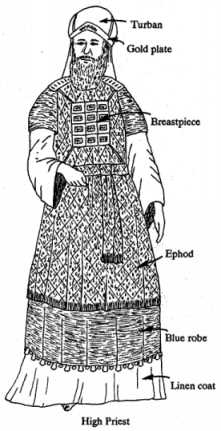
Although the high priest wore a white coat similar to that of the ordinary priests (Exo 28:39), it was largely hidden from view because of a blue robe that he wore over it (Exo 28:31-35). Over the blue robe was a multi-coloured garment called an ephod, which was the most prominent garment of the high priest’s dress (Exo 28:5-14; see EPHOD). Tied to the ephod was a flat pouch called the breastpiece, inside which were the Urim and Thummim (Exo 28:15-30; see URIM AND THUMMIM). On his head the high priest wore a turban with a gold plate declaring ‘holiness to the Lord’ (Exo 28:36-39).
The high priest’s dress was intended to display dignity and splendour (Exo 28:2). It also showed symbolically that the high priest acted not as an individual but as the representative of the whole nation. He had the names of the tribes of Israel engraved on stones on the breastpiece and on stones on his shoulder pieces, so that when he went into the presence of God he symbolically took the people with him (Exo 28:9-12; Exo 28:21; Exo 28:29).
Before the priests could begin their service, they were appointed to their position in an elaborate dedication ceremony. Since they themselves were not free from sin, they had to offer sacrifices for themselves before they could act on behalf of others (Exo 29:1-37; cf. Heb 7:27). Because they were aware of their own need for forgiveness, the priests should have had a sympathetic understanding of the weaknesses of the people on whose behalf they ministered (Heb 5:1-3).
Priests were to maintain disciplined behaviour, moral uprightness and ceremonial cleanliness (Lev 10:8-11; Lev 21:1-8; Lev 21:13-14; Lev 22:1-9). Any priests who had physical defects could not carry out representative functions for the people, though they could share in less public priestly activity (Lev 21:16-24).
The people provided the income of those who did religious work on their behalf. They gave a tithe (i.e. a tenth) of their own income to the Levites, and the Levites in turn gave a tenth to the priests (Num 18:25-28; see TITHES). The priests received further income from portions of sacrifices, animal firstlings and harvest firstfruits that were allotted to them. This income helped compensate for the priests’ lack of tribal or family land (Num 5:9-10; Num 18:8-20; Deu 18:1-5; Deu 26:1-4).
Other responsibilities
One duty of the priests was to ensure that people maintained a high level of cleanliness, whether in matters of ceremonial holiness, physical health or personal hygiene (Lev 13:3; Lev 13:10; Lev 13:20; Lev 13:30; Lev 14:2-3; Lev 14:36; Lev 14:48; Lev 15:13-15; Lev 15:28-30; Mat 8:4; see UNCLEANNESS). Priests also supervised the keeping of vows (Lev 27:1-25; Num 6:6-12; see VOWS) and assisted civil officials in giving judgments in certain moral issues (Num 5:11-31; Deu 17:8-13; Deu 19:15-21; Deu 21:1-9). They had ceremonial and practical functions in national affairs such as mobilization for war, land allocation and public celebrations (Num 10:1-10; Jos 3:14-17; Jos 14:1; Jos 19:51; 1Ch 15:24; 2Ch 13:12).
By the time of David there were too many priests for the amount of work to be done. David therefore divided the priests (and the Levites) into twenty-four sections, each of whom served for one week every six months (1Ch 24:1-6; Luk 1:8). The remaining four weeks of the year were taken up with the annual festivals, which all males were to attend and which therefore required all priests to be on duty (Exo 23:14-17).
Changing role of the priests
Throughout Israel’s history there were both good and bad priests. Many were zealous for righteousness and had a good influence on national leaders and the people as a whole (Num 25:1-13; 2Sa 15:27; 1Ki 1:8; 2Ki 12:2; 2Ch 11:13-17; Ezr 5:1-2; Neh 8:1-9; see EZRA; JEHOIADA; JOSHUA THE SON OF JEHOZADAK; PHINEHAS; ZADOK).
Some of the nation’s better kings gave priests important leadership responsibilities in an effort to reform the nation and administer it according to God’s law (2Ch 17:7-9; 2Ch 19:8-11; 2Ch 29:3-4; 2Ch 29:11; 2Ch 31:2-5; 2Ch 34:8-9; 2Ch 34:20-21; 2Ch 35:1-6; see CHRONICLES, BOOKS OF). Other priests, however, were rebellious, corrupt, immoral and idolatrous. They were among the chief causes of the nation’s ultimate destruction (Lev 10:1-2; 1Sa 2:12-17; 1Sa 3:10-14; 2Ki 16:11-16; Isa 28:7; Jer 2:8; Jer 6:13-15; Eze 22:26; Hos 6:9; Mic 3:11; Zep 3:3-4; Mal 2:7-8).
After the captivity in Babylon, the Jews moved back to their homeland and rebuilt the nation. By this time a new emphasis had developed on teaching the law of Moses, and a new group of teachers had become prominent in Israel. These were known as scribes, or teachers of the law (see SCRIBES). As the years passed, the priests became more concerned with exercising political power, though they still carried out ceremonial functions (Luk 1:8; Luk 5:14).
By New Testament times two major religious parties dominated Jewish affairs. The scribes were the main influence in the more traditionally religious party, the Pharisees, but the chief priests controlled the politically dominant party, the Sadducees (Act 5:17; see SADDUCEES). All these people, whether priests or scribes, Sadducees or Pharisees, readily cooperated to get rid of Jesus (Mat 21:15; Mat 21:45-46; Mat 22:15; Mat 22:23; Mat 26:57; Mat 27:41; Mar 11:18; Joh 11:57).
High priesthood of Jesus
The writer of the book of Hebrews pictures the life, death and present ministry of Jesus as that of a great high priest. Jesus’ high priesthood, however, belongs not to the order of Aaron (for Jesus was not a descendant of Aaron) but to the order of Melchizedek. This was a higher priesthood than Aaron’s, for it was not limited to one era, one nation, one family or one class of people. Christ’s priesthood is therefore timeless and is available to all (Heb 7:1-3; Heb 7:11-17; Heb 7:23-25).
Although Christ did not belong to the Aaronic priesthood, his priestly work followed the pattern of the Aaronic priesthood. Yet it was far superior, for it achieved perfectly what the Aaronic priesthood merely pictured. Like the Aaronic priests, Christ was appointed to his position by God. He also had a sympathetic understanding of the problems of those whom he represented before God. But, unlike the Aaronic priests, he was without sin and so had no need to offer sacrifices for his own sins before acting on behalf of others (Heb 2:17-18; Heb 4:15-16; Heb 5:1-6; Heb 7:26-28).
Aaronic priests offered sacrifices repeatedly, but the sacrifices could never make people perfect, because they could never take away sins. Christ offered himself as a sacrifice. By that one act he completed his sacrificial work and brought perfect cleansing to all believers (Heb 10:1-4; Heb 10:11-14). The Aaronic high priest could enter the Most Holy Place (God’s symbolic dwelling place) only once a year, and then only by taking with him the blood of a sacrificial animal. Christ, through his own blood, entered the actual presence of God and secured an eternal salvation (Heb 8:1-2; Heb 9:6-14; Heb 9:24-26).
Because Christ is in God’s presence as their heavenly representative, Christians can now enter God’s presence. They need no earthly priest to mediate on their behalf. Through Christ they can come to God directly and confidently, knowing that they can depend on Christ’s help in pleading for their needs before God (Heb 4:14-16; Heb 7:25; Heb 9:24; Heb 10:19-22; Rom 8:34; 1Jn 2:1; see ADVOCATE).
Christians have added confidence in Christ’s concern for them when they see the prayer that he prayed for his disciples shortly before his crucifixion (Joh 17:9-26). Furthermore, they know that Christ’s personal entrance into the presence of God is the guarantee that one day they too will personally enter the presence of God, and find there an eternal dwelling place (Heb 6:19-20).
All God’s people are priests
Although Israel’s religious system had an appointed order of priests, there was a sense (not specifically connected with the religious system) in which all the people were priests. Israel, as the chosen people of God, was a kingdom of priests, a holy nation. The people of Israel were to serve God, both by bringing him worship and by being his representatives in making him known to other nations (Exo 19:5-6; Isa 61:6).
The words recorded in Exo 19:5-6 applied to the Old Testament people of God, but in the New Testament the same words are applied to the new people of God, the Christian church. Christ’s people are now God’s chosen race, a kingdom of priests and a holy nation (1Pe 2:9-10; cf. Rev 1:6; Rev 5:9-10). They serve God by bringing him the sacrifice of worship and praise (1Pe 2:5; cf. Heb 13:15) and by making him known to the nations of the world (1Pe 2:9; cf. Rom 15:16).
A person having the ability to perform certain religious rites, sacraments. Generally, a priest stands between God and Man and administers the ceremonial rites on behalf of the individuals as an offering to God. In many churches (Catholic), the priest is below the Bishop in ecclesiastical order and rank.