
The stork’s an emblem of true piety; Because, when age has seized and made his dam
Unfit for flight, the grateful young one takes His mother on his back, provides her food, Repaying thus her tender care of him
Ere he was fit to fly.
BEAUMONT.
Who bid the stork, Columbus like, explore
Heavens not its own, and worlds unknown before?
Who calls the council, states the certain day, Who forms the phalanx, and who points the way?
POPE.
Bochart has collected several testimonies of the migration of storks. AElian says, that in summer time they remain stationary, but at the close of autumn they repair to Egypt, Libya, and Ethiopia. “For about the space of a fortnight before they pass from one country to another,” says Dr. Shaw, “they constantly resort together, from all the adjacent parts, in a certain plain; and there forming themselves, once every day, into a ‘douwanne,’ or council, (according to the phrase of these eastern nations,) are said to determine the exact time of their departure, and the place of their future abodes.” See SWALLOW.
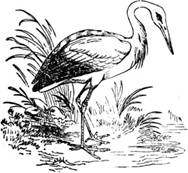
Fig. 323—Stork
The Hebrew name of this bird implied affection, from the belief general throughout all ancient Asia in the attachment of these birds to each other, and some have supposed that their English name has a similar derivation. The strength of the affection of the parent birds towards their young has been verified by the moderns, in cases where the mother bird has perished while endeavoring to save her progeny.
Storks are about a foot less in height than the crane, measuring only three feet six inches from the tip of the bill to the end of the toes, and nearly the same to the end of the tail. They have a stout, pointed, and rather long bill, which, together with their long legs, is of a bright scarlet color; the toes are partially webbed, the nails at the extremities flat, and but little pointed beyond the tips of the joints. The orbits are blackish, but the whole bird is white, with the exception of a few scapulars, the greater wing covers, and all the quills, which are deep black: they are doubly scalloped out, with those nearest the body almost as long as the very foremost in the wing. This is a provision of nature, enabling the bird more effectually to sustain its after weight in the air; a faculty exceedingly important to its mode of flight with its long neck, and longer legs equally stretched out, and very necessary to a migrating species believed to fly without alighting from the lower Rhine, or even from the vicinity of Strasburg, to Africa, and to the Delta of the Nile. The passage is performed in October, and, like that of cranes, in single or in double columns, uniting in a point to cleave the air; but their departure is seldom seen, because they start generally in the night: they rise always with clapping wings, ascending with surprising rapidity out of human sight, and arriving at their southern destination as if by enchantment. Here they reside until the last days of March, when they again depart, for the north, but more leisurely and less congregated. A feeling of attachment, not without superstition, procures them an unmolested life in all Muslim countries, and a notion of their utility still protects them in Switzerland, Western Germany, and Holland. Storks build their nests in pine, fir, cedar, and other coniferous trees, but seem to prefer lofty old buildings, towers, and ruins. With regard to the snake-eating habits of the species, the chief resort of storks, for above half the year, is in climates where serpents do not abound: and they seem at all times to prefer eels, frogs, toads, newts, and lizards; which sufficiently accounts for their being regarded as unclean. Storks feed also on field mice; but they do not appear to relish rats, though they break their bones by repeated blows of their bills.
Its Hebrew name signifies kindness or mercy, and its Greek name natural affection, probably because of the tenderness which it is said to manifest towards its parents-never, as is reported, forsaking them, but feeding and defending them in their decrepitude. In modern times, parent storks are known to have perished in the effort to rescue their young from flames; and it has been a popular, but perhaps ill-founded opinion, that in their migratory flights, the leader of the flock when fatigued is partially supported by others as he falls into the rear. In Jer 8:7, allusion is made to the unerring instinct of the stork as a bird of passage, and perhaps to its lofty flight: "the stork in the heavens knoweth her appointed times." Moses places it among unclean birds, Lev 11:19 Deu 14:18 . The psalmist says, "As for the stork, the fir-trees are her house," Psa 104:17 . In the climate of Europe, she commonly builds her nest on some high tower or ruin, or on the top of a house; but in Palestine, where the coverings of the houses are flat, she builds in high trees.\par The stork has the beak and legs long and red; it feeds on field mice, lizards, snakes, frogs, and insects. Its plumage would be wholly white, but that the extremities of its wings, and some small part of its head and thighs, are black. It sits for the space of thirty days, and lays but four eggs. Storks migrate to southern countries in August, and return in the spring. They are still the objects of much veneration among the common people in some parts of Europe and Asia.\par
Stork. (Hebrew, chasidah). A large bird of passage of the heron family; one of the largest and most conspicuous of land birds, standing nearly four feet high, the jet black of its wings and its bright red beak and legs contrasting finely with the pure white of its plumage. Zec 6:9. In the neighborhood of man, it devours readily all kinds of offal and garbage. For this reason, doubtless, it is placed in the list of unclean birds by the Mosaic law. Lev 11:19; Deu 14:18.
The range of the white stork extends over the whole of Europe, except the British isles, where it is now a rare visitant, and over northern Africa and Asia, as far at least as Burmah. The black stork, (Ciconia nigra), though less abundant in places, is scarcely less widely distributed, but has a more easterly range than its congener. Both species are very numerous in Palestine. While the black stork is never found about buildings, but prefers marshy places in forests and breeds on the tops of the loftiest trees, the white stork attaches itself to man, and, for the service which it renders in the destruction of reptiles and the removal of offal, it has been repaid from the earliest times by protection and reverence.
The derivation of chasidah, (from chesed, "kindness"). Points to the paternal and filial attachment of which the stork seems to have been a type, among the Hebrews, no less than the Greeks and Romans. It was believed that the young repaid the care of their parents by attaching themselves to them for life, and tending them in old age. That the parental attachment of the stork is very strong has been proved on many occasions, Few migratory birds are more punctual to the time of their reappearance than the white stork. The stork has no note, and the only sound it emits is that caused by the sudden snapping of its long mandibles.
Four feet high, with jet black wings and bright red beak and legs (Zec 5:9).
In the burning of Delft formerly, and more lately in the battle of Friedland, a mother stork, having vainly tried to extricate her young, perished in the flames herself. The stork punctually observes "her appointed times" of migration at the end of March and beginning of April; in Holland she remains until October. Storks’ nests, unless disturbed, are rebuilt for generations on the same site (Jer 8:7). Regularly they return every spring from their winter abodes in sunnier climes, but God’s people will not return to Him even when "the winter" of His wrath is past and He invites them back to "the spring" of His favor. They build their large nests in lofty trees, in the absence of lofty towers and ruins, to which their liking for man’s society attracts them (Psa 104:17). (On Job 39:13, sSee OSTRICH.)
Stork, the pious. A bird of passage, much like the crane, but larger. It feeds on insects, snails, frogs, and offal, and was reckoned among unclean birds. The common stork (Ciconia alba) stands nearly four feet high, and is white except the extremities of the wings, which are black. Its long legs enable it to seek its food in the water as well as on the land, and its bill is so formed as to retain its slippery prey. In Palestine it builds its nest on trees. Psa 104:17. "The beauty and power of the stork’s wings are seized on as an illustration by Zechariah:’The wind was in their wings, for they had wings like the wings of a stork.’ Zec 5:9. The black pinions of the stork, suddenly expanded from their white body, have a striking effect, having a spread of nearly seven feet, and the bird on the wing, showing its long, bright-red bill and steering itself by its long red legs, stretched out far behind its tail, is a noble sight. The stork has no organs of voice, and the only sound it emits is caused by the sharp and rapid snapping of its bill, like the rattle of castanets."—Tristram.
chasidah. There are three particulars mentioned in scripture respecting this bird.
1. It makes its nest in the fir trees. Psa 104:17. This agrees with the stork; it is a large bird, and selects a tree that is high and yet one that will well support its nest.
2. It is represented as in the heaven. Jer 8:7. The stork flies very high, especially when migrating.
3. It has powerful wings. Zec 5:9. This also agrees with the stork, its wings extending to more than six feet. The same Hebrew word occurs in Job 39:13; see margin.
The word chasidah is kindred to the word translated ’merciful,’ and the bird is remarkable for its tender care, not only of its young, but of the aged. In the Levitical list it is classed among the unclean birds. Lev 11:19; Deu 14:18. This we might expect, as it feeds upon mice, snakes, and other reptiles, etc.
Both the black stork (ciconia nigra ), and the white stork (c. alba ) are numerous in Palestine. The former associate together in secluded and marshy districts, often in flocks. White storks prefer the habitations of man, where they roam about the streets, devouring the offal. They are much respected, and it would fare ill with any one who would injure them. In some places they are of much value on account of their attacks upon the serpents.
("ḥasidah"):
By: Emil G. Hirsch, I. M. Casanowicz
Unclean bird (Lev. xi. 19; Deut. xiv. 18). The name (comp. Latin, "pia avis") alludes to the filial piety and devotion attributed by the ancients to the stork (comp. Aristotle, "Historia Animalium," ix. 14, 1). Both the white and black storks (Ciconia alba and Ciconia nigra) occur in Palestine: the former is a migrant, passing through in April (comp. Jer. viii. 7); the latter is especially abundant in the neighborhood of the Dead Sea.
The Talmud considers "dayyah lebanah" to be the proper name of the stork, and "ḥasidah" to be an epithet applied to it because it lovingly shares its food with its fellows (Ḥul. 63a). The gall of the stork cures the bite of the scorpion (Ket. 50a; comp. Pliny, "Historia Naturalis," xxix. 5, 33).
Bibliography:
Tristram, Nat. Hist. p. 244;
Lewysohn, Zoologie des Talmuds, p. 171.
STORK (chăsîdâh, Lev 11:19, Deu 14:18, Job 39:13, Psa 104:17, Jer 8:7, Zec 5:9).—The stork (Arab
E. W. G. Masterman.
The stork first appears among the birds of abomination, and it is peculiar that the crane does not, for they are closely related. But the crane eats moles, mice, lizards and smaller animals it can capture, also frogs and fish. To this same diet the stork adds carrion and other offensive matter, and the laws of Moses, as a rule, are formulated with good reason. Yet at one time, storks must have been eaten, for Pliny quoted Cornelius Nepos, who died in the days of Augustus Caesar, as saying that “in his time storks were holden for a better dish at board than cranes.” Pliny adds: “Yet see, how in our age now, no man will touch a stork if it be set before him on the board, but everyone is ready to reach into the crane and no dish is more in request.” He also wrote that it was a capital crime in Thessaly to kill storks, because of their work in slaying serpents. This may have been the beginning of the present laws protecting the bird, reinforced by the steady growth of respect and love for its tender, gentle disposition. The Hebrew word
There is a smaller stork having a black neck and back, that homes in Palestine, but only in small numbers as compared with the white. These birds flock and live in forests around the borders of waste and desert places, and build in trees. The young of both species remain a long time in the nest and are tenderly cared for, so much so indeed that from their performances and love of building on housetops arose the popular tradition that the stork delivers newly born children to homes. The birds first appear in Lev 11:19 and Deu 14:18. Jeremiah noticed that the stork was migratory; see Jer 8:7: “Yea, the stork in the heavens knoweth her appointed times; and the turtle-dove and the swallow and the crane observe the time of their coming; but my people know not the law of Yahweh.” The Psalmist referred to their nesting in the cedars of Lebanon, for in Palestine these birds could not build on housetops, which were flat, devoid of chimneys and much used by the people as we use a veranda today; see Psa 104:17: “Where the birds make their nests: As for the stork, the fir-trees are her house.”
Stork. This goose-sized bird looks ungainly in flight, with its legs dangling and its wings slowly flapping. But people in Palestine were always glad to see the storks on their yearly migration from Europe to Africa. Storks had the reputation of bringing good luck. If they were numerous, surely crops would be good. Farmers welcomed storks because they helped their crops by eating insects.
Both black and white storks were often seen in Palestine. White storks nest as high as possible-- often on chimneys. But since houses in the Holy Land had low, flat roofs, they nested instead in the fir trees (Psa 104:17). In spite of their commendable features, storks were considered unclean (Lev 11:19; Deu 14:18).
A stork is a large, long-legged wading bird (genus Ciconia) with strong wings and black flight feathers. When it flaps its wings, the sound is loud and rushing. Skin between the toes keeps the bird from sinking into mud. Its long, sharp red bill helps it catch and lift prey from the water. Storks are mute (they do not have a voice box).
Storks pass through the Holy Land during their migration in September as they travel to central and southern Africa. They return in the spring to northern Israel, Syria, and Europe. They travel in large flocks during the day, often spread across the sky.
Storks are known for caring well for their young and for returning to the same nesting place every year. They add to their nests each year. Some nests are more than 100 years old and over a meter (about 3 feet) high.
Two species of storks frequent the Holy Land. The white stork (Ciconia alba) is 101.6 centimeters (40 inches) tall. Its wingspread is 1.8 meters (6 feet). This enables it to move with a slow, sustained flight or to soar. In folklore the white stork is sometimes considered to be a sign of good fortune.
The black stork (Ciconia nigra) lives mainly around the Dead Sea valley and nests in trees. It may be the tree-dwelling bird in Psalm 104:17.
Storks in the Bible
The Hebrew word for “stork” means “kingly one” or “loyal one,” likely because of its care for its young. The stork was ceremonially unclean because it ate water creatures, refuse, small animals, birds, and reptiles (Leviticus 11:19; Deuteronomy 14:18). Jeremiah wrote about the stork’s instinctive knowledge of migration times (Jer 8:7). Zechariah described a vision that included storks with large wings (Zec 5:9).
See also Birds.
Aquifer Open Bible Dictionary © 2026 Mission Mutual, an adaptation of the Tyndale Open Bible Dictionary © 2023 Tyndale House Publishers. Licensed under CC BY-SA 4.0.
References:
Discussion:
There is almost complete agreement that chasidah is the stork. There are two species of stork that pass over Israel, where they stay for a few days as they migrate from Europe to Africa and vice versa. These are the White Stork Ciconia ciconia and the Black Stork Ciconia nigra.
Description:
Both of these storks are large birds with long legs and long necks. They are heavier than most herons or cranes. The white stork has a white body, black wings, and a red beak and legs. The black stork is a glossy brownish black color with a white belly. It also has a red beak and legs. These storks migrate from central and eastern Europe to East and Central Africa, occasionally reaching Zimbabwe and parts of South Africa in good rainy seasons. Both types spend most of the time on the ground or in shallow water searching for food. The white stork eats mainly locusts, grasshoppers, and other insects, as well as frogs, lizards, and the chicks of ground-nesting birds. The black stork prefers fish and frogs but also eats the same things as the white stork.
When storks are about to move to another feeding ground, they usually soar around in upward currents of air called thermals, reaching great heights, and then they soar off in the direction they have chosen, conserving their energy by only occasionally beating their wings.
Special significance or symbolism:
It is possible that the name chasidah is derived from the word chesed, meaning “kindness” or “faithfulness", perhaps a reference to the fact that they seem to take especially good care of their young when nesting.
Translation:
Storks of various species are found in most parts of the world, and many of them have migrating habits. There are species of stork that migrate from Europe to India and the Far East, some that migrate from Southeast Asia to Australia, and one, the Abdim’s Stork Ciconia abdimii, which migrates from Ethiopia to Zimbabwe and Botswana, signaling the arrival of the rainy season wherever it goes.
In the few areas where storks are not known, a borrowed word or a transliteration can be used, perhaps with a footnote to indicate that this is a big bird that migrates long distances over Israel.
JOB 39:13: The Hebrew of this verse is difficult to interpret. The reading supported by most commentaries is “The wings of the ostrich beat rapidly or, joyfully, but they certainly are not comparable to the wings of a stork.” Some, however, suggest that chasidah be corrected to read chaserah (which looks very similar in Hebrew), and then the verse would mean “The wings of an ostrich beat quickly, but they lack flight feathers.” Whichever interpretation is reflected in the text, the alternative should be given in a footnote.
Animals in the Bible © United Bible Societies. Licensed under CC BY-SA 4.0.