
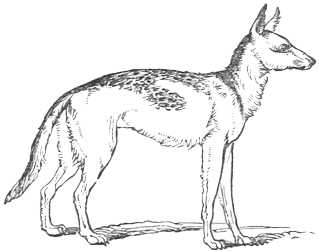
Fig. 344—Egyptian Wolf
Wolf (Gen 49:27; Isa 11:6; Isa 65:25; Jer 5:6, etc.; Mat 7:15; Mat 10:16; Luk 10:3; Joh 10:12; Act 20:29; Sir 13:17), a fierce carnivorous animal, very nearly allied to the dog, and so well known in Europe as to require no particular description; but the identity of the species in Palestine, though often asserted, is by no means established; for no professed zoologist has obtained the animal in Syria, while other travelers only pretend to have seen it. Unquestionably a true wolf, or a wild canine with very similar manners, was not infrequent in that country during the earlier ages of the world, and even down to the commencement of our era. The prophets, as well as the Messiah, allude to it in explicit language. At this day the true wolf is still abundant in Asia Minor, as well as in the gorges of Cilicia, and from the traveling disposition of the species, wolves may be expected to reside in the forests of Libanus; but there is no satisfactory evidence that this is at present the case. It may be, as there are no forests to the south of Lebanon, that these ravenous beasts, who never willingly range at a distance from cover, have forsaken the more open country.
A ferocious wild animal, the Canis Lupus of Linnaeus, belonging to the dog genus. Indeed, it closely resembles the dog; and it is only by a few slight differences of shape that they are distinguished. Wolves never bark, but only howl. They are cruel, but cowardly animals; they fly from man, except when impelled by hunger; in which case they prowl by night in great droves through villages, and destroy any persons they meet, Jer 5:6 Eze 22:27 Hab 1:8 .\par They are swift of foot, strong enough to carry off a sheep at full speed, and an overmatch for ordinary dogs. In severe winters, wolves assemble in large troops, join in dreadful howlings, and make terrible devastation. They are the peculiar object of terror to shepherds, as the defenselessness and timidity of the sheep render it an easy prey to wolves, Luk 10:3 Joh 10:12 . So persecutors and false teachers have been "grievous wolves" to the flock of Christ, Mat 10:16 Mal 20:29 . The wolf inhabits the continents of Europe, Asia, Africa, and America. Driven in general from the populous parts of the country, he is yet everywhere found in large forests and mountainous regions.\par
Wolf. There can be little doubt that the wolf of Palestine is the common Canis lupus, and that this is the animal so frequently mentioned in the Bible.
(The wolf is a fierce animal of the same species as the dog, which it resembles. The common color is gray with a tinting of fawn, and the hair is long and black. The Syrian wolf is of lighter color than the wolf of Europe it is the dread of the shepherds of Palestine. -- Editor).
Wolves were doubtless far more common in biblical times than they are now, though they are occasionally seen by modern travellers. The following are the scriptural allusions to the wolf:
Its ferocity is mentioned in Gen 49:27; Eze 22:27; Hab 1:8; Mat 7:15,
its nocturnal habits, in Jer 5:6; Zep 3:3; Hab 1:8,
its attacking sheep and lambs, Mat 10:16; Luk 10:3; Joh 10:12,
Isaiah Isa 11:6; Isa 65:25, foretells the peaceful reign of the Messiah under the metaphor of a wolf dwelling with a lamb:
cruel persecutors are compared with wolves. Mat 10:16; Act 20:29.
Wolf. The Hebrew zeeb, "wolf," was so called from its tawny color. It is the common Canis lupus, still found in some parts of Palestine. Isa 11:6; Isa 65:25; Jer 5:6; Hab 1:8. It is of an unsated appetite; and often indiscriminately killing sheep and goats, apparently rather to satisfy its fierce nature than its hunger. Zep 3:3; Mat 7:15; Joh 10:12. Persecutors are compared to wolves. Mat 10:16; Act 20:29. The peaceful reign of the Messiah is spoken of under the metaphor of the wolf dwelling with the lamb. Isa 11:6; Isa 65:25.
The well-known animal, described in scripture as ’ravening,’ and seeking its prey in the evening. They are very destructive among the sheep, worrying and destroying more than they can eat. This makes the wolf a fit emblem of the wicked, who molest the sheep and lambs of God’s flock, and even creep in among them. How great will be the change in the millennium is denoted, among other things, by the wolf and the lamb dwelling together. Gen 49:27; Isa 11:6; Isa 65:25; Jer 5:6; Eze 22:27; Hab 1:8; Zep 3:3; Mat 7:15; Mat 10:16; Luk 10:3; Joh 10:12; Act 20:29. The Hebrew is zeeb, Arabic dhib, the common Canis lupus.
WOLF.—See Animals in vol. i. p. 65a.
(Hebr. "ze’eb"; for the rendering of "iyyim," Isa. xiii. 22, and "tannim," Lam. iv. 3, see Fox):
By: Emil G. Hirsch, I. M. Casanowicz
The wolf (Canis lupus) is still found in Palestine, where the animals prowl in pairs or droves about sheepfolds at night. As a type of boldness, ferocity, and bloodthirstiness, it is mentioned in Gen. xlix. 27; Isa. xi. 6, lxv. 25; Jer. v. 6; Ezek. xxii. 27; Hab. i. 3; and Zeph. iii. 3.
According to the Talmud, the wolf ( , and
, and  [= Greek
Bibliography:
Tristram, Nat. Hist. p. 152;
Lewysohn, Z. T. p. 81.
WOLF.—
In AV
The wolf of Palestine is a variety of Canis tupus, somewhat lighter in colour and larger than that of N. Europe. It is seldom seen to-day, and never goes in packs, though commonly in couples; it commits its ravages at night, hence the expression ‘wolf of the evening’ (Jer 5:6, Zep 3:3); it was one of the greatest terrors of the lonely shepherd (Joh 10:12); persecutors are compared to wolves in Mat 10:18, Act 20:29.
E. W. G. Masterman.
While the wolf is surpassed in size by some dogs, it is the fiercest member of the dog family (Canidae), which includes among others the jackal and the fox. Dogs, wolves and jackals are closely allied and will breed together. There is no doubt that the first dogs were domesticated wolves. While there are local varieties which some consider to be distinct species, it is allowable to regard all the wolves of both North America, Europe, and Northern Asia (except the American coyote) as members of one species, Canis lupus. The wolf of Syria and Palestine is large, light colored, and does not seem to hunt in packs. Like other wolves it is nocturnal. In Palestine it is the special enemy of the sheep and goats. This fact comes out in two of the seven passages cited from the Old Testament, in all from the New Testament, and in the two from Apocrypha. In Gen 49:27 Benjamin is likened to a ravening wolf. In Eze 22:27, and in the similar Zep 3:3, the eiders of Jerusalem are compared to wolves. In Jer 5:6 it is a wolf that shall destroy the people of Jerusalem, and in Hab 1:8 the horses of the Chaldeans “are swifter than leopards, and are more fierce than the evening wolves.” Babylon and Edom (Isa 13:22; Isa 34:14; Jer 50:39) are to be the haunts of
The name of Zeeb, prince of Midian (Jdg 7:25; Jdg 8:3), has its parallel in the Arabic,
Eze 22:27 (a) It was a most unhappy situation that existed when the leaders became beasts to destroy the people over whom they were supposed to rule beneficently. The wicked rulers of Israel were suppressing, robbing and injuring the people whom they should have been protecting and preserving. (See also Zep 3:3).
Mat 7:15 (a) This animal represents religious leaders of the present day, who pretend to be GOD’s servants, but who rob the people of their faith, their peace, and their money.
Mat 10:16 (a) The Lord knew that His disciples would be subject to persecution wherever they went. The people who prosecuted and sought to execute the servants of the Saviour are described as these wild beasts. (See also Luk 10:3).
Act 20:29 (a) The wolf is used in this case to represent wicked, cruel leaders who, in the name of Christianity and the Church, will burn, maim, torture, kill and seek to destroy GOD’s people and GOD’s testimony. History reveals that this is the course pursued by the great apostate church.
Wolf. Wolves were a menace to the sheep farmers of Palestine. Man’s first dogs were probably tamed wolf pups. Perhaps this kinship enabled wolves to lurk near sheepfolds and gain their reputation for treachery.
Of his youngest son, the patriarch Jacob said: "Benjamin is a ravenous wolf" (Gen 49:27). The Hebrew word translated ravenous means "to rip and tear," indicating the bloodthirsty nature of the wolf. Wolves seem particularly cruel because they seek out the weak, old, and defenseless as victims. The flow of blood incites them to rip and tear even more with their powerful jaws.
In many Bible references, wolves represent ruthless enemies. Jesus warned of false prophets "who come... in sheep’s clothing, but inwardly... are ravenous wolves" (Mat 7:15).