
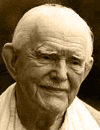
Forget The Way And Drive On It
Norman Grubb teaches that true Christian life is found by embracing the ultimate reality of God as the one living Spirit who expresses Himself spontaneously through us, urging believers to forget the path and simply live in the freedom of being united with Him.
In this profound teaching, Norman Grubb explores the ultimate reality of life as found in God, the one living Spirit who expresses Himself through all creation and especially through human beings. He challenges believers to move beyond mere striving and law-keeping to a spontaneous, joyful living in union with God. By unpacking the paradox of being both God and individual, Grubb offers a fresh perspective on Christian freedom and identity. This sermon invites listeners to embrace their true nature and live confidently in the Spirit's power.
Full Transcript
All through these years, really, I've been a kind of underground investigator. On the surface, ceasing to fulfill my calling. Beneath, really living.
Thank God, in this kind of search, searching is finding. It isn't searching and remaining with a question mark. It's searching and putting the question mark out.
So in a sense, my sort of calling has been to put a structure to the whole meaning of life. It's cost me something. I've had to pass from faith to atheism and back to faith again.
Which is a good way for all of you to go. You're far better if you have some healthy doubts. And I have always sought, and this makes enlarging investigations and enlarging question marks a comprehensive answer.
Not an answer which just answers something for me. But something which can include the universe as far as we know the universe anyhow. We haven't got to the galaxies yet, as far as we know about it.
So what I'm saying is largely the outcome of putting a jigsaw puzzle together. We're sticking this piece and this piece until there's a whole picture. And so insofar as I've been given the privilege of these sessions, I want to then to be investigating sessions.
Not what you call devotional sessions. My heart's been pulled right out of me already this morning, in the early effects. So I'll put your heart back, let it dry up a bit inside.
So they're investigating sessions. Seek to be structural sessions. As far as I understand, we only give what comes out.
But I seek that what comes out has first come through this, in. I sought to base all on God's revealed word. And what can be interpretations of the spirit to me.
That's all I can share from that word to you. I hadn't chosen the title that Annie gave out, the deep things of God. But of course it took me back to where that says that in the Bible.
It says they're revealed to us. Because that comes in the first print of the second chapter. Where it says, I have not seen nor ear heard, neither entered into the heart of man, the things which God has prepared for them that love him.
But God hath revealed them unto us. So we should know. God hath revealed them unto us by his spirit.
So it's the spirit, through the word, into us and then out again. But God hath revealed them unto us by his spirit. For the spirit searches all things, yea, the deep things of God.
So we're entitled to say therefore he reveals to us the deep things of God, the ultimates, ultimates. And I've not been able to live except on ultimates. I want to come out in the end with those ultimates.
You must forgive me speaking proper English. I have to leave you behind there. I'm not always understood.
Whose fault is that? We didn't change the language. As I say, we are different in languages. Some may not, what we're saying here, may not be what you need.
I'm one who has felt, if I know the secure path under my feet, I'll deviate from it often, but I know at least where to come back to. I know what the path is. I felt the need of that.
And the Bible speaks of the truth as the way. Well, a way is something you have and forget and drive on it. You don't keep looking for potholes all the time.
You've got your way, you forget it and drive on it. A Christianity is something which you have, forget and live it. And in between you forget it.
The reason being that this life is not becoming the being. If I gave another basic statement, to put it at the background of what we're saying these days, I'd take that remark, that startling remark of John in his letter. John takes us to the very summit in his letter.
Paul tells you how to get there. John tells you what kind of person you are when you do get there. And John links the becoming to the being.
And John simply says in 1 John 4, 17, as he is, so are we in this world. Not ought to be, not are not, but are. That's positive, isn't it? As he is, so are we in this world, that is in 1 John 17.
Now that's being. You become to be. But you leave the becoming behind and forget the becoming and get being.
And that's why I say in a sense in which you find the way, get settled on the way, forget the way and drive on it. And the way is the becoming. And then we get going on it.
So there's a kind of background. What I've thought on and dug into, I trust has come into some settlement in one's understanding, has fallen into in a recent year or two, the answer to three questions which to me about cover all I want to ask. And therefore as far as I'm able to, I'd like in these sessions to cover them.
One is what is life? Pretty big question. If we know what life is, how do we live it? A pretty big question. If we know how to live it, why do we live it? What is life? If we know what life is, how do we live it? If we know how to live it, why do we live it? I know in an audience like this, thank God, I'm speaking to many, many who are taught of the Spirit.
So I'm not thinking that I'm bringing some new things. There are no new things. This bold man again, John, says we have an anointing of the Holy One and know all things.
That's a big statement. In other words, truth registers when truth is in us. You hear that? That's it.
That's it. So all you can do is sort of to help each other. That's it, that's it.
Or that isn't. We help each other. This is too big an audience for me to dare to say, interpose your questions, for you'd soon slay me.
I'd like to say that. I like dialogue. But how can you dialogue with this bunch? So we have to leave that, I suppose, but I'm only too glad to tackle points that arise.
If you come and speak to me or give me a bit of paper or something, I'll carefully avoid answering them if you say something. But I like that. So that's it.
So we're really seeking to move into these three questions. What is life? How do we live it? Why do we live it? Because to me it about covers all I want to ask. Down in the Alchemists, of course, there's the application, and that's included to some extent also.
So it starts at the beginning. What I'm saying has been to me, to some extent, a reorientation of some facts of life, a larger understanding of some facts of life. I prefer to use the segment facts of life because it's truth you can argue about.
Facts is facts. Speak good English. So I like that.
What is life? Now the answer, of course, the Bible gives as far as life is concerned, there's only one person who is life. Jesus Christ said, I am the life. Jesus Christ was God, taking human form, as was so marvelous of a day to us this morning.
John said the same. He said, I'll talk to you about that eternal life. He said, that eternal life's a person.
That's what one John was. Talk to you about the eternal life, have we seen, touched, handled, heard it, and it's not an it at all, it's a he. It's this one.
But Jesus Christ, who is God, who was God in the flesh and is still God in the spirit, and in his resurrected flesh. So I'm starting by what to me is a very big statement, a very big comment I see, very comprehensive, that there is only one person in the universe. Life is he.
Therefore all life is he, and there's only one person in the universe. And we don't begin to get life into focus until we find there's only one person in the universe and every single thing is a derivative of him. Evil as well as good is involved there.
There's only one person in the universe, we've got to fit evil into there as well as good. Fit the whole lot, there's only one person. I say again, I'm saying a big thing.
To me, if I have any other basis to life, I get into confusion. If it's he and this and that and him, where do they fit? If it's he by this, by that, by him, where do they fit? Negative as well as positive. Evil as well as good.
So I'm saying that as a basis. The only one who ever dared and could use the statement, I am. He gave that name to himself, what, five thousand years ago or something, to Moses.
Now you can't say that. If your name is Bill, then the best you can say is, I am Bill. Or if your name is Jane, all you can say is, I am Jane, because that's how you are, just a little scrap called Jane, a little scrap called Bill, that's all you are.
But there's one who's all the scraps put together. So he has just, I am, stick what you like after that one. The whole lot goes in there.
I am illimitable. Some of these things we say at the beginning may not apparently fit too close at first. We're sort of digging up foundations that make you build them together.
So some of these things may be, perhaps, mean much at once. This means that we're here, I say we're here. The next revelation I find from God's Word, which begins, which to me is the best revelation.
Of who, of what kind of person this I am is. What kind of person this one life in the universe is. One person only, one person, beside me there's no other, that's a quotation.
It's Jesus' statement concerning him. What we reciprocate to him is the final authority on him. And Jesus made one very simple three word statement, God is spirit.
Now he didn't say that to some profound theologian like Nicholas Davis. He said that to the woman of the well. So it meant for the simple to happen.
God is spirit. Now I'm getting a little closer down to what this means. Who this person is, what kind of person is he, why? Because spirit is the within person.
Spirit is the within person. What do I mean by that? Well the simple evidence of that is the Bible also calls us spirits. In the twelfth chapter of Hebrews it says he fathers our spirits.
In a sense he cleansed our souls and bodies but came out from the very fatherhood our spirits. So a spirit, in other words a spirit is an inner self which is inaccessible and inexplicable. You try to explain yourself, you take a long time.
All you can say is I am, you try. All you can do is affirm yourself, you're too deep for yourself. Your inner self just is, there you are.
Paul puts it to me when he says what man knows the things of a man except the spirit of a man which is in him. So the spirit is that knower within which knows. What's the point of saying this? This is the point.
A spirit is inaccessible and meaningless unless it is a means of expression. Just to say I am is meaningless unless you have a means of expression. And even in saying I am you've got to use your means of expression.
In other words our utter form, our souls which consist of our emotions and reasons, and our bodies are the means of expressing the inner self. And the inner spirit is meaningless, inaccessible, unless it has a spontaneously attached to it a means of expression. Underline the word spontaneously.
Life is only livable if I'm in, I have such a relationship, I to myself as it were, and I just go ahead and live and speak and hear and act. I am spontaneous in my body. It's part spontaneous, part of me, I'm part of it.
We just do it together. This is where we come down. Life is utterly spontaneous.
When you and God are so much one person you can forget him and live. Isn't that right? This is spontaneity. We'll explain that by about Friday.
Now, why is that important? Because if we're saying that the spirit is this inner inaccessible, inexplicable self, just yourself, but it's meaningless and inaccessible, as I say, unless it has spontaneously attached to it a means of expression, same with God. God is spirit. He'd be meaningless, inaccessible, as though I were saying he is, unless he had a means of expression.
The universe is his expression. The universe is this person expressing himself. Now, that altered my concept of creation.
See, our whole difficulty is, we're three-dimensional people, and we've got to talk about four-dimensional things. Three-dimensional are what we live in, height, length, breadth. This is all this separation.
Height, length, breadth. This is our world. And we have to interpret things in those terms.
When we begin to talk about God, we're talking about a person whose being is a unification, not a separation. That's the dimension of the unification. That's why the Bible says we should all come to a perfect man.
We're not a perfect man now. We're lots of happy-looking men and women. But we're going to be all in Christ one, and we're moving into another dimension which is only dimly conceived.
The fourth dimension. We can catch a glimpse of it. And the Bible, and of all truth, is how to put into three-dimensional language, fourth-dimensional facts.
And so, for instance, creation. Immediately you think of creation, you think of somebody outside making something here. You see a table.
We don't say, there's the carpenter. You say, the carpenter made the table. As a matter of fact, in some sense, the carpenter is there.
But you have to recognize that. Of course, the breakup of matter today through science into the atom is very helpful. We begin to get a little deeper there.
It can help us in our faith. But we use those three-dimensional terms. What I'm saying, therefore, is that the secret is, God isn't a person up there who made things down here.
He is the things he makes. Everything is a form of himself. The form of himself.
By which he expresses himself. This is the means by which this invisible person expresses himself. So it says that God may be all in all.
If God's all in all, then there isn't very much left. Christ is all. That's Bible expression.
And the whole earth is full of his glory. The apostle Paul said that the non-Christian could be held responsible because he could see the invisible God by the visible universe which expresses Godhead. That's the expression of him.
He said that in Romans 1. When I say that everything is he in a certain form, the nearest likeness I can give, or analogy I can give, again, is to get back, say, to ourselves and our bodies. Now, you're not quite your body. You're deeper.
Yet you're very much part of me when I see you. I think of God as you. Which isn't quite you.
Your body isn't quite you. You're deeper. But it's so much you, when I look at you, I say, that's you.
In that sense, everything's God. Open your eyes. Every single thing is God in a tree form.
In a celestial form. It's not something he makes. It's something he is by which he expresses himself.
We'll see a little further evidence of that in a moment. That's why the Bible starts with the Spirit moving in. The second verse of the Bible says, Spirit, God, and Spirit, the inner person, the inner person, moving in through.
You see, our life is at ours if we've got to connect with the person you're not quite sure where he is up there. It's quite another thing if we open up and find that we're all part of the one. We've got to find how we fit in.
That's quite another thing. You have to go very far to find it because there's nothing else which isn't him. So you can't go very far to find him.
But the next important fact to me, which I would add to that, is this. If I accept, as we do here, the fundamental revelation of the Bible that the basis of the universe is a person, I am a person. A living person.
The one, only living person in the universe. No other. Or any other form is only a derivative by which it's a means of expression, that's all.
If it's a person, a person can't express the infinite potential of personality through things. Because each thing is limited to its expression, personality is unlimited. So an unlimited person called God cannot express his unlimited self through limited things.
A tree can only be a tree and express God in its tree form. An atom can only be an atom. It has to be a means of expression, certainly, the way it runs about.
But it can only express itself in its various atomic forms. How can a thinking, willing, acting, unpredictable person express himself? A person can only express himself through a person. If it has the same type of personality, if the one person is to express his personality, he being the invisible one must have the means of expression.
There you get person. In other words, I'm coming out here. Humanity is not humanity unless it's a spontaneous expression of deity.
And you as a human and I as a human are not a real human unless I'm a spontaneous expression of deity. But if it's such a relationship, it's spontaneous. You cannot live by essence.
You can't live by law. We heard we're not even allowed to keep our Sabbaths this morning. You can't live by hanging on to things.
You've got to live by being hung on to. And then you live. So it's got to be a relationship which is so easy to forget, in a certain sense, and live.
So I'm presenting to you, to me, an alternative life. A human is not a real human unless he's a spontaneous expression of God. Unless he's God in his human form.
And the alternative human, I say again, if your name's Bill, you're Christ in Bill's form. If your name is Jane, you're Christ in Jane's form. Or you're the Jane form of Christ, or the Bill form of Christ, or the Tom form of Christ.
That's all. That's all. And yet, the infinite delicacy, which we have to reach into bit by bit, is the delicacy of the paradox, which preserves the true individuality of the individual.
This is the paradox. There will be at one time, not we at all, but he. And at another time, we are we and not he.
So that's the paradox. To be he, not we, and to be we, not he. You try that one out.
That's the paradox of life. It is the freedom from the tension of life. You see, life, life must include all we mean by life.
We mean by life, fun, enjoyment, fulfilment, gaiety, appreciation, purpose. Life is that. That's what God is.
It must be full of followers, life, gaiety. And this is what we're talking about. A life that is free, full, gay, purposeful, serious, funny at the same time, as it was this morning.
All in one. Something that blows, blows over, pours out, blows up. This is life.
And to talk about a relationship, a God-man relationship, which isn't that, we're still missing the mark. If a human is only a true human, if he's a professional deity, he must be an enjoying human, and a gay human, and a full human, and a purposeful human, and there's something by which he expresses life itself. So I'm laying down letters.
What I understand is the foundation. There is only one person in the universe. And the whole universe is being in which he expresses himself.
Now we needn't go farther. As I said, we haven't got to galaxies yet. We'll get up there in a few years' time, maybe.
We'll see about that, as Tommy said this morning. We exist in humanity. That's all we've got to the end.
Although we're trying to jump at the moment of the present, but leave that out. Apparently there is dust there anyhow. But all we are interested in is humanity, how humanity functions.
That's what I'm interested in, how humanity functions, how I function, how you function, how we inter-function. That's all. And this is worth discussing.
It's discussing how humanity is true humanity. So we're not going to sit around deities, we're going to sit around humanity. And this book too, this is a book of man.
How man came into being, how man missed the way, how man restored, how man lives, what man's destiny is. So we're starting there. And we're saying, this person being the only person in the universe, but being spirit, and we understand what spirit is, the invisible person, is meaningless unless he has his means of expression.
There may be much of his other means of expression, but we're down here. And we know his means of expression down here is what we call our Earth, if you like, our universe. Every single thing, a form he takes, some expression of it, actual treasure, not something he makes, something he is.
That's why you find in the Bible, for instance, give a typical instance, the different relationship between father and son. Now in three-dimensional terms, we speak of father and son, I've got sons, but I don't say I am in my sons. I say, well I'm here, my son's there.
That's three-dimensional. When Jesus talks about father, he would describe the father as in him. That's four-dimensional.
He even speaks about those who are the children of the devil, because the devil's in them. That's getting us over a four-dimensional relationship, one in the other. Now if we take that first step into what we're saying, I might have thrown it out for your investigation.
But thank God we're free to disagree. So if you want to throw the book at me, come and do it after this. If you want to dig, I might try to share what I've got, that's all.
If you can correct what I've got, I'm very happy, because I wanted to relate to this. Can you hear behind here? I'm turning my back politely on you. Now, the next question I ask is this.
That's fine. There's room in front of you, I can step on your toes here if you like. Oh, fine, that's very sensible.
Fine. We're better there, yes. We're better there.
The next... Are you getting it towards the back up there? Oh, wonderful. The next question I ask is this. The next question I find I must ask, having asked this one what is life, I find the answer to be life is only one person.
Never has been only one person. Only one person in the universe. That's why all other life is merely a derivative form of this one.
It's not something he makes. Something is. An expression of the actual person.
So every human being, whether redeemed or unredeemed, is an expression of the actual person. You're going to fit that in a little later on. Everybody, everything.
Including the devil. That's fine. Oh, that's fine.
That's too theological for me. All the God I need to know is that one. Thomas has beautifully expressed this this morning.
This is our glory. God can live in a human person. And we in that sense are an extension of the Incarnation, with certain limitations put on it.
And that's all the God we need to know. Marvelous God. He's a mighty common God.
He can live in you. That's all there is. So that's all I can say.
I keep saying, if there's more to follow, I'll wait till you get there. When I float up there, I'll find out. I'm down here at the moment.
And we can't live with the unlimited. Of course we can't. Thank you.
Now, as I'm saying, if we, at least my goal is to be accepting that as our basis. Only one person, and every single person is an expression of this One. We've got to find out where we fit.
A very important question then arises to my mind. If He's the only person in the universe, I'd better find out what kind of person He is. It's rather important.
If He's all there is, what kind of person is He? Well, of course, we get as complete an answer as that. As we got to Jesus' expression of He's the inner person, the spirit, the inner person. The person with the inner expression of that comes true.
And the answer, of course, is also three-word. If Jesus said God is spirit, John said God is love. But I tell you all of it, I've found that you all have.
We take it on. As we go on, we see things, not new things, we see things in a more complete sense, maybe. And we shall find why they always die is only to dip our big toes in the ocean.
We've got a long time before we should bathe fully in it. In the unsearchable riches of Christ. The love that passes knowledge.
The peace which passes on saving. It's a good way to get there. To search out the unsearchable.
And know the unknowable. So, are we just dipping our big toes in, that's all? When we think we know lots, that's all we've got. Just little wet toes, that's all we've got.
But we pass on what we've got. Now, God is love. Now, when I began to... I said, what does that really mean? We've got all sorts of... Interpretations of the word love, haven't we? Very convenient, some of them.
Or inconvenient. All sorts these days. What is love? Well, I go back to the Bible, and I find again an absolute, an ultimate.
And in the end, I suggest it's going to be very important, doesn't it? When I go back to love, I must go back to Jesus Christ. When I go back to Jesus Christ, what do I find? He tried to explain himself. He had to use three-dimensional terms to explain the post-dimensional facts.
And so he used different illustrations and analogies. There are a number of them in John. Interesting, the different way God uses personalities, isn't he? John all the time saw what Matthew, Mark, and Luke couldn't see.
They were meant to. They were the pragmatics. And they could see Jesus more in the outward, in different forms.
John's were right inside, and he'd keep picking up. His way of things was inside. He kept picking up things from the inside of Jesus.
We need both. And we're all made like that. Some are extroverts, some are introverts.
Et cetera. And so, John interested me for that reason. Now, therefore, John picked up these illustrations and their significance.
If I were to say two of them for simplicity, Jesus saying he's bread and water. He said, I'm the living bread that came down from heaven. He said, the Buddha, Samaria, I'm the living water.
Well, as a matter of fact, we all recognize that. But what's bread? Bread is something which is pleased to have its own life in society as you. That's love.
Absolutely. Bread once lived in the cornfield, now it lives in you. The meaning of bread's life is to be something you eat and you live by it.
That's love. Love is being other people. Love is where our real life is other people.
And that's where God is. That's why I've lost a God up here, and finally God walks me back here. That's so inconvenient.
Because it's much nicer if God up there is like you. You see, unfortunately, you're a form of God. So I don't love you, I don't love him.
That's a nasty one. Avoid that if I could. Because he's nice, you're nasty.
I don't love you. But you see the ultimate? You know how we interpret love. You see, what happens to us in our broken, broken relationship? What we call our fallen relationship.
We aren't really apart from God. The freedom of man is so great, we act as if we're always apart from God. And we act like that forever.
That's the seriousness of freedom. We haven't stopped being here. But in this apparently broken away relationship, in which we try just to be ourselves and run our own lives, those two words are too hot for us.
We cool them down a little. So we cool love down in light of self-interest. And we say, well, I'll give you a sum, as long as it doesn't inconvenience me too much.
I'll give you a sum and I might as well keep plenty. I'll just give you what I don't want, maybe, because you'll be sure I'll keep plenty. I divide the work in half.
I'll give you a sum, as long as it doesn't hurt me too much, I'll keep plenty. Love carries, I am you. And traditionally, the meaning of life is, I am others.
Because I'm bread. Bread is you. It's real life, it's inside you.
Same with water. Water starts in streams and rivers and what not, it ends in us. The meaning of water for us is something we can, by which we can participate, a vegetation can participate, then you can live.
And it follows right through. I'm the light of the world. Light comes out from the sun and gives itself to us, gives its life to us and we live by it.
All this beauty and glory is light given to us, isn't it? Become part of us. I'm the door. Well, the door doesn't live for itself, it's the door for sheep.
Goes through. And Jesus defines a shepherd as a person who gives his life to the sheep. His life is living the sheep's life.
This is God. If it's God, it's we. As he is, so are we.
This is my point. If it's God, it's we. Because we come up with this when God and you are identified, what you are, he is.
When I say God, personally, I don't mind. To me, he's the one person. So I don't personally mind whether I call him Father, Son, Spirit, Jesus Christ, God.
To me, there are different ways it may appear to different ones of us. For the same person. So generally speaking, I just think of the person.
You needn't, it's just as you like. As a proof of what I mean, or evidence of what I mean, for instance, the Apostle Paul in Romans 8. He'll make this statement. If any man is not the Spirit of Christ, he's none of his.
The very next sentence, he says, is Christ being you? He's changed the name Spirit of Christ to Christ. If any man is not the Spirit of Christ, he's none of his. Is Christ being you? So and so and so and so and so.
So to him, the Spirit of Christ and Christ are interchangeable. So don't hit me too hard, if you don't like me talking about God, when I mean Christ. But I do, they're all one.
So I just speak like that. So I'm saying, you see, what we're talking about is such a life of naturalness in the relation between us, which we haven't discussed yet, that what he is, you are, as he is so you. Not by effort.
If you're following by effort, you have hard work. This life isn't imparted, it isn't imitation, it's impartation. It's identification.
And all the Bible's full of tricks. God's full of tricks. Because God always tricks you by catching up where you are, thinks of harder.
So he calls you to see the Bible this way, to find out what works, so you may see it this way. You'll find out about the commands. You try to keep the commands of God, you're in for hard work.
When you've got somebody inside who speaks them for you, you've got a nice life. That's it. So as he is, so are we, because God winks his eyes, says, what I really need, I've been assigned to do the job.
But there's got to be a spontaneity. There's not got to be a lot of hanging out the hip. The circles I'm moving put so much emphasis on that.
No, it's a miserable life and you've got to be so occupied and hanging on to God, you've got no time to do anything else. And so anxious, unless you're slipping away, you've got no time to do anything else. No, I'm not hung on to him, he's hung on to me and I can't escape.
I spent 45 years trying to run away. I can't, I can't. I can't do anything about it.
That's it, then you're free. That's what we get. But we see the implication.
Now I go back a moment. I said I'd seek for you a little evidence that came to me of what may not be for you. Because as I say, I know many people who have gone and talked to many people, and many Bible believers, they can't take it.
Oh, it's the Antichrist or something said, that is a form of God. Putting the three-dimensional difference in thought, mental things. I say this, a very simple evidence is this.
This person is nothing but love. I'll explain it a little further later on. Love is, his existence is others.
The real meaning of existence isn't himself in a cornfield, it's in your stomach. Love is that. Look around this bookshelf.
Every single thing we have is something which has given up its individual life to be something real. I don't know if there are first tables of wood, there once was a tree. They're now a table for me.
Every single thing you've got here is something which had its own life, which has its own life, is something for me. That is love. So the whole world preaches this one and the same all the time.
This is this person. I'm an expression of this person. Therefore everything that exists is a convenience for others.
It's something in which others can live. This is God. The only God there is.
So, this is the first foundation I'm throwing out of your consideration. And I have to continue this, because to me, if I move away from this, I get later on into confusion. If I divide up, if something is God and something isn't God, I'm in for trouble.
That's the trouble poor desperate folks have, who question, how can God do a thing? You don't start by fitting God into a situation. You start by fitting the situation into God. You don't say, how could God allow those children to be killed in a disaster in Wales or something.
You don't ask questions like that. You say, one thing is certain, God is God and God is love. I must fit this into that.
If I don't quite understand how, I'm just waiting for them to find out. But I'm not going to move from God is God. That was Job's problem.
Job never moved from God. He was loyal to God. He couldn't make God fit his own situation.
And so he had to learn how to fit his situation into God. He howled and moaned and cried, because he tried to fit God into the situation. Why does God do this to me? He had to come back and say, God knows his own business, I'm part of him.
When he found out, I want to stop so you can get some interesting facts out of it. When he found out, he found out something which made a new Job. And new people who are products of Job too.
So this is the key. You cannot get an answer to life and say, could God do so to me? Never ask that. The sin of the universe is unbelief, which is not believing God to what he says he is.
That's the sin. Jesus says only once, that's the sin. Therefore, if some terrible decapitator says, how can God do it to whose love I am? That's the sin.
The sin is what happens. The sin is my abuse. I must never say that.
I must say, I can't make sense of that, but I stick to this one thing. God is God and God is love. Somewhere this will fit in.
Then life is in it. Focus. Everything.
Part of this, him in action. I'm going to say some things you want to go with later on. I'm going to say God doesn't permit things, he directs them.
Including you. Amen. Ooh, thanks.
I've got as good as Tommy's hallelujahs. Say that again. Yes, but I've got to prove it till later on.
So don't chase me now. I'll put it later on. One of the great teachings of God is God doesn't permit things, he directs things, including evil.
He directs things including evil. You don't have to prove that to me. I know that.
Thank you. I hug you. Thank you.
But many don't see it. But I must bring fair proof for it. It's not easy to see that one.
I must bring fair proof. But not now. I'm saying that for a gain.
I only know one focus. I can only find firm ground on my feet. If there's nothing but God, everything God does is love.
And I've got to fit things into him. Not him into them. It takes a little time to fit the devil into that one.
But he fits in all right. All right now, we go there. And we've seen this other point coming up which is so important for us.
If we... And we of course do. No. By our spirits, thank God.
I don't need to say technicalities. This one is a person. He's a living person.
And a person can only be expressed by persons. That's how it comes. So now we move along.
Not too long because I won't go on too long. Excuse me if something's for you. I'll begin and then scratch along with it any who come tomorrow.
To fit personality into this. Human personality. Now this is an infinitely delicate thing.
The delicacy is you can never touch freedom. That's what Hitler has to learn. Stalin has to learn.
Napoleon has to learn. All of them have to learn. You can't touch freedom.
In the end you can't touch it. And the only art of the universe is how to win people free to be what you want them to be. That's God's art.
That's why it takes a long time. Because he's no fool. He knows if he forces you, you'll blow out the gate anyhow.
So he's going to waste his time forcing you. He's going to get you until the blowout has sort of been resolved into a stream of love. So he's got to win.
This infinitely delicate thing. I love to be. I love to be God's slave and because I love to be I'm free as a slave.
I'm free as a slave if I love to be a slave. I'm not free as a slave if I do as far as I must do it. So God's got to win me because I'm a slave and I love to be a slave.
And there I find also something as well. This is the art. To win a delighting freedom to be not only he wants me to be but what I want to be.
And I say it can be anyhow. It's none of his business. That's the art.
So it centers around freedom. Now I've just touched for a moment and if it needs further I've got to stop a little way in I'm afraid here. I've had to consider this word freedom somewhat.
And I'll share with you what it means to me. Well I couldn't see freedom. Freedom looks like being anything.
But life isn't being anything. Oh he flirts about. If a person could be anything and do anything it doesn't work too long.
He's used that shit. Someone's seen he's done the wrong thing. Life isn't being anything.
He doesn't flirt about being anything. Life's coming down to being something. How does that fit freedom? I've had to understand this.
Freedom means the capacity of intelligent choice. A life is built by intelligent choice. A free person, a conscious person to a free person, the meaning of personality is the capacity to intelligent choice.
We have capacities animals have not. They have little capacities not much. We have a marvelous capacity for choice.
Now personality is meaningless unless there's choice. I'll show you later on how God made the choice. Why? Because if there's nothing but one thing, well there's no question you just are a part of it.
If there's nothing but one thing, you're a part of it. Well, I mean if there's nothing but life you couldn't choose either. So there's not much to choose.
See you can only choose if there's, I say either or. You rather say either or I'm sure. It's either one or the other.
All life is one or the other. So the whole basis of life is the capacity for intelligent choice and we have the right choice. And then freedom is the development of that choice.
This is very important, very important. Take it down to earth to start with. Now all of us here in some way or another have settled into life.
It's easier perhaps to speak from a man's point of view to start with anyhow, a profession. A young fellow chooses to be a doctor, a lawyer, an electrician or whatever you like. Well here's an intelligent, we trust intelligent choice.
Now he may spend five years or seven years being trained as a doctor. Now from that time onwards probably all his freedom is his development of medicine. He doesn't go and be a carpenter or a plumber or an electronics man or a computer man.
He's a doctor. And he naturally develops his freedom on that level is in the development of his medical practice, medical investigation. And everything is the same.
A housewife is the same. A parent is the same. A mother is the same.
Her freedom is mainly the development of her children and so on and so on. Marriage is the same. Marriage is meant to be intelligent choice.
It's a capacity making choice. Now we know what is the tragedy of today. That we haven't understood that intelligent choice is a fixation on each level.
And then your freedom is in development of choice. And all sex activities, family life and so on, it should be, its freedom should be fully expressed in the development of the family choice. Not outside.
That's what I'm talking about. So freedom is a limited fact. It's a limited, unlimited, hyphen.
It's limited because it's limited to your choice. The unlimited is, there's no entity how you can develop that choice. But the development of choice is based on the primary choice of all life itself.
You were here. Well, you made a choice to come here. Whether by hesitation or not, you came.
All right, you made your choice. Now you're here and your freedom has to be to put up with what you get here now. The development of our activities here is the same idea.
Now, perhaps the last thing I'll say before I close. It helped me very greatly when I understood this was in the basis of the nature of God. I'm talking about the one person now.
When I discovered that all we, in a kind of loose way, say God is unlimited. As a matter of fact, the Bible says he's limited. Because the Bible specifically says there's something God cannot do.
That's what it says, right? You get that in the second verse of the letter to Titus. God cannot lie. Now notice, it didn't say didn't lie, or shouldn't lie, or hadn't lie.
It says he can't lie. There's something God can't do. And the writer of the Hebrews, whoever he was, repeats it again in the sixth chapter.
He says, well, it is impossible for God to lie. So there's something God can't do. Why? Because the whole basis of life is a choice.
Now, the ultimate basis of a personality, we're a personality, we know. The ultimate, we're made to desire. Everything's made to love.
Love is a desire. Desire to have, desire to give. Desire to love.
So life is loving ourselves and desiring to be ourselves. Quite right. We all can be that all the time.
We love ourselves and desire to be ourselves. Now, what's our choice? I can love myself and desire to be myself and say, every single thing is here for me. The whole world's for me, including you.
Or I can desire to be, I'm for you. I'm for everything. So the basic desire is, is everything for me, or am I for everything? Do I express my desires in unlimited self-gratification, or in unlimited self-giving? This is the basic choice of a self.
How do I express my desiring, loving, self-affirming self? Is it, I'd love to be a self-getter, or I'd love to be a self-giver? This is God. Now, a lie is a form of self-getting. A lie is a form of self-protection.
If you lie, I secure myself at your expense. No one has a view. I'm going to secure myself.
And so a lie is a form of self-security, self-meditation, self-seeking. This tremendous cat comes out of the mouth and says, God cannot be that. God cannot be a self-lover.
He cannot be a self-gratifier. He cannot be a self-giver. He can only be a self-giver.
He cannot be a self-seeker. He can only be a self-giver. He's fixed.
So what I'm getting at is this, choice is a fixation. It's a fixation. Now, in life, it isn't exactly.
For instance, a doctor can become a lawyer. So you can't say, in human terms, it's pretty near a fixation. Not many doctors do become lawyers.
Not many lawyers do become computer engineers or something. In the main, we do stick, if we've got a profession, to our profession. But of course, we could change.
But it's a somewhat human example of a fixation. As I say, marriage is supposed to be a fixation. The tragedy is, some is coming into it these days doesn't make it a fixation.
In my days, of course, I'm of a vast age, some of you aren't quite so far on, we didn't know it, but we also know vocabulary. We never heard of it. We took marriage at granted.
I won't discuss that now as a burning question. But you see the meaning. But when we're talking on the infinite basis, we're talking about a fixation of the nature, of the character.
Based on a free choice. And so there's a fixation in God. He cannot be the other.
He's, as a free person, as a free self, he's made equivalent to a choice. We can't really say God makes a choice. It's eternal.
You have to get into two three-dimensional terms. But it is. The nearest we can say that God makes a choice.
And all God now, all God's attributes are only one. They're a development of self-conceiving love. Nothing else.
Every single, God's whole freedom now is a development of his choice. His choice is self-conceiving love. So it can be nothing but self-conceiving love.
This is God. Now, where the human fix is, how we can be brought to ask this same fixation of a compartment. This is the output for us.
Now God's been up here, I've been down here. Many of us are there already. Many of us are there without understanding it.
There's so much mis-teaching over the whole Christian development that many of us have got much more within we have. The devil's very busy saying he hasn't got anything. He likes to tell us that.
So condemnation of guilt. You're on the curses of Christian progress. Now again, I come to you, dear people, here, and I sense in your group, sir, you know less of that than most.
You're more delivered from condemnation of guilt than many of the kind of people I know. Because, as I say, I'm talking very much your language. But I'm saying, therefore, actually, far more people have a basic fixation than they realise they have.
They don't quite know how to fit into it because of certain deviations. We've got to learn how the deviations do fit in. They fit in too.
Of course, Tommy usually touches on a bit of it this morning. I don't see a point in my speaking. Tommy says it's all for a start.
So there we are. So I think we'll leave it at that. Now, any of us who are coming next, Thomas, move on.
All right. If the basis of the universe is one person, he's fixed. He can only be love.
Love is nothing but self-giving. He cannot be a self-seeker. His joy can only be in giving himself.
Yes? Well, it's meant by the statement, I am a jealous God. Yes. Be jealous.
I get on with this. I wanted for us to go deeper into love. The whole point of love is it exists for other people's needs.
Now, God is jealous because we are going, not for himself, but because of ourselves. By going the wrong way and going off the rock after the island, we are killing ourselves. And God is jealous for us to save us from the wrong way.
Not to save himself. This is the season. This is how love ends.
This is the season. All right, now. We'll go.
I think. We'll pick up next time.
Sermon Outline
-
I. The Nature of Life and God
- Life is found only in one Person: Jesus Christ, the eternal Life
- God is Spirit, the inner, inaccessible self who expresses through creation
- All creation is an expression of God’s personality
-
II. The Paradox of Human and Divine Expression
- Humans are spontaneous expressions of deity
- The paradox: to be fully God and fully individual human
- True life is freedom from tension by living this paradox
-
III. Forgetting the Way and Living the Reality
- Christianity is a way to be known and then forgotten as we live it
- Becoming is the path; being is the settled reality
- Live spontaneously in union with God, not by law or effort
-
IV. The Implications for Daily Living
- Life is full, purposeful, joyful, and free
- Our bodies and souls are means of expressing the inner spirit
- We must embrace the Spirit’s spontaneous expression in us
Key Quotes
“God is spirit. He'd be meaningless, inaccessible, as though I were saying he is, unless he had a means of expression.” — Norman Grubb
“A human is not a real human unless he's a spontaneous expression of deity.” — Norman Grubb
“The way is the becoming. And then we get going on it. Forget the way and drive on it.” — Norman Grubb
Application Points
- Trust in the spontaneous expression of your inner spirit rather than relying on legalistic efforts.
- Embrace your identity as a unique expression of God’s personality, living freely in that truth.
- Forget constant self-examination and simply live in the reality of your union with Christ.