
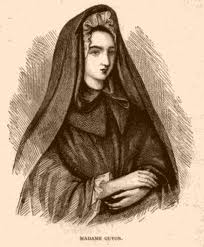
 "From her tenderest Years, she in a very particular manner consecrated herself to God, and was so affected with Divine Things, that when she heard or read of the Sufferings of the Saints and Martyrs, She would wish to be such an one herself. But when she grew more a Woman, the Follies incident to Youth, but chiefly Pride and Vanity, had Predominance over her, though she often felt secret rebukes in her Heart for them, and would bewail her Failings and Transgressions bitterly."
Books by Madame Guyon
A Short and Easy Method of Prayer
Song of Songs of Solomon
Spiritual Progress - A collection of five works, two of which are by Fenelon.Dissertation on Pure Love by Madame Guyon & Archbishop Fenelon -The Archbishop of Cambray’s dissertation on pure love, with an account of the life and writings of the lady, for whose sake the archbishop was banish’d from court.
Poems Translated from the French of Madame de la Mothe Guion
Articles by Madame Guyon- Madame Guyon when she was about 20 years old.
Madam Guyon (pronounced Gay-yo), the celebrated French Mystic, was one of the greatest Christian leaders of all time. What Savonarola was to Italy, Madam Guyon was to France. Not only was her influence felt throughout her native land of France, but also all over Europe and throughout the world. Fenelon, John Wesley, and other great spiritual leaders have acknowledged that they were greatly indebted to Madam Guyon for the deep spiritual lessons learned from her life and writings. Although a Roman Catholic, Madam Guyon very much resembled the modem Quakers, or Friends, in her teachings. She has been termed. 'A Quaker born out of due time;' and Dr J. Rendel Harris, one of the most eminent Friends, says, "No society has been so influenced by Madam Guyon as the Quakers have been.” She was the center of the great spiritual movement known as "Quietism,” which was perhaps the greatest spiritual movement that ever originated within the Roman Catholic Church. In its emphasis on the work of the Holy Spirit, the "Quietist ” movement very much resembled the Quaker movement; and the original Friends were often classed as “Quietists” on this account. The name "Quietists” refers to their quiet submission to the will of God and to the promptings of the Holy Spirit.
As a girl, Madam Guyon was religiously inclined, but as a young woman, she became a vain, proud, society "butterfly,” with few thoughts about God, or the world to come.
Living in fashionable Paris, in the corrupt and profligate times of Louis XIV., it was very easy for her to be carried away by the worldliness surrounding her. The rule of Louis XIV. was perhaps the most pleasure-loving, corrupt, and dissolute that ever cursed the sunny land of France; and the great talents and beauty of Madam Guyon, or Mademoiselle De La Mothe - as her maiden name was, made her peculiarly susceptible to the influences of fashionable society. But her proud heart was gradually subdued by the destruction of her beauty through an attack of smallpox, and by the loss of everything that was dearest to her in this world. Her vanity and pride were completely crushed, and she became, "a vessel unto honour, sanctified, and meet for the Master’s use ” (2 Timothy 2:21). Perhaps of no other person except Job could it be said as truly that they were made "perfect through sufferings” (Hebrews 2:10), the sufferings of our Divine Saviour not being considered as the sufferings of a human being. Jeanne Marie Bouvieres de la Mothe was born at Montargis, France, about fifty miles north of Paris, on April 13, 1648; about a century after the beginning of the great Protestant Reformation. Her parents, belonging to the aristocracy of France, were highly respected, and religiously inclined, as were their forefathers for many generations. Her father bore the title of Seigneur, or Lord, de la Mothe Vergonville. In infancy, Jeanne was afflicted with a sickness which caused her parents to despair for her life. She rallied, however, and, at the age of two and a half, was placed in the Ursuline Seminary in her own town, to be educated by the nuns. After a short time, she was taken home, where she remained for some time, but her mother left her chiefly to the care of servants. During this period her education was neglected. In the year 1651, the Duchess of Montbason came to Montargis to reside with the Benedictine nuns established there, and she asked Jeanne’s father to allow his little daughter, then four years of age, to keep her company. While in the House of the Benedictines, at an early stage in life, she had some religious impressions - she was brought to realize her need for a Saviour through a dream she had, concerning the future misery of impenitent sinners; and she definitely yielded her heart and life to God, and she even vowed her willingness to become a martyr for God. The nuns pretended that they thought God really wanted her to become a martyr, and made her believe that they were going to put her to death. She said her prayers, and then they led her to a room prepared for the purpose, and caused her to kneel on a cloth they had spread. One of the older girls then appeared as executioner and raised a cutlass over her head. But at this critical moment, Jeannie cried out that she was not at liberty to die without her father’s permission. The nuns afterwards told her that she was not willing to die for Christ, and that she had made an excuse on that account. They made the little girl believe that she had denied the Lord, and it brought great darkness to her mind. While with the Benedictines, she was generally treated kindly, but her health was very poor and she was again taken home, and again left, most of the time, to the care of servants. Her two half-sisters had entered the Ursuline Convent, and after she was at home for a short period, Jeannie returned to the Ursuline Convent in order to be with them. She was then seven years of age. Her fraternal half-sister took special care of her, and under her supervision, Jeanne made rapid progress in learning and piety. When Jeanne was eight years of age, Henrietta Maria, Queen of England, fled to her native land of France to take refuge from the Civil War in England. She visited the De La Mothe family, and was so charmed by the learning and beauty of little Jeanne that she entreated Lord De La Mothe to allow her to take the child with her, promising to make her Maid of Honor to the Princess; but her father would not consent. At ten years of age, Jeanne was again taken home, but in a short time she was placed in the Dominican Convent at the request of the prioress, who seemed to have a great affection for her. Here she remained for eight months, and made much improvement, though her health was very poor. Here she found a Bible, which in some unknown way had been left in her chamber. Young as she was, she became deeply absorbed in reading it. "I spent whole days,” she says, "in reading it, giving no attention to other books or other subjects from morning to night. And having great powers of recollection, I committed to memory the historical parts entirely.” This study of the Scriptures doubtless laid the foundations of her wonderful life of devotion and piety. After eight months in the Dominican Convent, she returned to her home. She purposed to take the sacrament at twelve years of age, but for some time previously, she had been very remiss in her religious duties. A feeling of melancholy entered her mind, and she gave up what religious profession and practises she had. Later in life she intimated that her religion at that time was chiefly in appearance, and that the love of God was not at the bottom of it. Her father again placed her in the Ursuline Seminary, and through the influence of her pious and prayerful half-sister she was led to think of "giving herself to God in good earnest.” She partook of the sacrament, but still her heart was not reached. She grew tall, and her features began to develop into the beauty which afterwards distinguished her. Her mother, pleased with her appearance, indulged her in dress. The world gained full sway over her, and Christ was almost forgotten. Such changes frequently occurred in her early experience. Some days she had serious thoughts and good resolutions, and on other days, they were shattered, and gaiety and worldliness filled her life. A devout young man, a cousin of hers, named De Tossi, was going as a missionary to Cochin, China, and in passing through Montargis, called to see the family. His visit was short, but it made a deep impression on Jeanne, although she was out walking at the time and did not see him. When told of his sanctity and consecration, her heart was so touched that she cried the rest of the day and throughout the night. She was touched by the thought of the contrast between her own worldly life and the pious life of her cousin. Her whole soul was now aroused to a sense of her true spiritual condition. She tried to give up her worldliness, to bring herself into a religious frame of mind, and to obtain forgiveness from all those whom she had wronged in any way. She visited the poor, gave them food and clothing, and taught them the Catechism, and spent much time in private reading and prayer. She read devotional books like the Life of Madame de Chantal, and the works of Thomas a Kempis and Francis de Sales. She even thought of becoming a nun. But she had not yet learned the lesson of finding peace, and rest of soul through faith in Christ. Perhaps God allowed her to go through many struggles and trials to find salvation, so that she might be the better fitted to teach others the way of salvation through faith, after she herself discovered it. After about a year spent in earnestly seeking after God, she fell deeply in love with a young man, a near relative of hers, though she was only fourteen years of age. Her mind was so occupied with thoughts of him that she neglected prayer, and began to seek in him the pleasure she had formerly sought in God. She still kept up religious appearances, but in her heart, religion became a matter of indifference. She read romances, spent much time before the mirror, and became very vain. The world thought highly of her, but her heart was not right with God. In the year 1663, the La Mothe family moved to Paris, a step not calculated to benefit them spiritually. Paris was a gay, worldly, pleasure-loving city, especially during the reign of Louis XIV., and Mademoiselle La Mothe’s vanity swelled and increased, and she and her parents were led into worldliness by the society in which they now found themselves. The world now seemed to her the one object worth conquering and possessing. Her beauty, intellect, and brilliant powers of conversation made her a favorite of Parisian society. Her future husband, M. Jaques Guyon, a man of great wealth, and numerous others sought her hand in marriage. Although she had no great affection for M. Guyon, her father arranged the marriage, and she yielded to his wishes. The wedding took place in 1664. Jeanne had nearly completed her sixteenth year, while her husband was thirty-eight. She soon discovered that the home to which he took her would be "a house of mourning” to her. Her mother-in-law, a woman without education or refinement, governed it with a rod of iron. Her husband had good qualities and had considerable affection for her, but physical infirmities and sufferings to which he was subject, the great difference between his age and that of his young wife, and the temper of her mother-in-law made life a burden to the young bride. Her great intellect and sensibilities made her sufferings all the more keen. Her earthly hopes were blasted. She did not know that God had permitted her to be placed under such circumstances for a purpose, nor did she realize His power to alter those circumstances whenever it suited His purposes to do so. But she believed, afterwards, that everything had been ordered in mercy to call her from her life of pride and worldliness. God seems to have allowed her to go through the furnace of affliction that the dross might be purged out, and that she might come forth as a vessel of pure gold. "Such was the strength of my natural pride," said she, "that nothing but some dispensation of sorrow would have broken down my spirit, and turned me to God.” Later, she says: "Thou hast ordered these things, O my God, for my salvation! In goodness Thou hast afflicted me. Enlightened by the result, I have since clearly seen that these dealings of Thy providence were necessary, in order to make me die to my vain and haughty nature." Although she ate the bread of sorrow and mingled drink with her tears, all these things inclined her mind towards God, and she began to look to Him for comfort in her sorrow. About a year after her marriage, a little son was born to her, and then she felt the need of looking to God for his sake, as well as for her own. One calamity after another now befell Madam Guyon. Soon after the birth of her son, her husband lost a great part of his enormous wealth, and this greatly embittered her avaricious mother-in-law. In the second year of her marriage, she fell sick, and it seemed that she would die, but her sickness was a means of causing her to think more of spiritual things. Her beloved half-sister died, and then her mother. Great as these trials were, they worked for her "a far more exceeding and eternal weight of glory” (2 Cor. 4:17). Bitterly had she learned that she could find rest nowhere except in God, and she now sought Him in earnest, and found Him, and never again did she forsake Him.
From the works of A Kempis, De Sales, and the life of Madame Chantal, and from her conversations with a pious English lady, Madam Guyon had learned much about spiritual things. After an absence of four years, her cousin returned from Cochin China, and his visit was a great help to her spiritually. A humble Franciscan monk felt led by God to visit her home, and he also helped her much in spiritual things. It was this Franciscan who first led her to see clearly the need of seeking Christ through faith, and not through outward works alone, as she had been doing. Through his instruction, she was led to see that true religion was a matter of the heart and soul, rather than a mere routine of ceremonial duties and observances, as she had supposed. With regard to certain words spoken by this Franciscan concerning salvation through faith, she says: " Having said these words, the Franciscan left me. They were to me like the stroke of a dart, which pierced my heart asunder. I felt, at this instant, deeply wounded with the love of God - a wound so delightful that I desired it never might be healed. These words brought into my heart what I had been seeking so many years; or rather they made me discover what was there, and which I did not enjoy for want of knowing it.” Later, she says: "I told this good man that I did not know what he had done to me; that my heart was quite changed; that God was there; for from that moment He had given me an experience of His presence in my soul - not merely as an object intellectually perceived by the application of the mind, but as a thing really possessed after the sweetest manner. I experienced those words in the Canticles: 'Thy name is as a precious ointment poured forth; therefore do the virgins love Thee.’ For I felt in my soul an unction, which, as a salutary perfume, healed in a moment all my wounds. I slept not all that night, because Thy love, O my God, flowed in me like delicious oil, and burned as a fire which was going to destroy all that was left of self in an instant. I was all of a sudden so altered, that I was hardly to be known either to myself or others." Madam Guyon was twenty years of age when she received this definite assurance of salvation through faith in Christ. This event occurred on July 22, 1668. After this experience, she says: "Nothing was more easy to me now than to practise prayer. Hours passed away like moments, while I could hardly do anything else but pray. The fervency of my love allowed me no intermission. It was a prayer of rejoicing and of possession, wherein the taste of God was so great, so pure, so unblended and uninterrupted, that it drew and absorbed the powers of the soul into a profound recollection, a state of confiding and affectionate rest in God, existing without intellectual effort.” Sometime later she said to the Franciscan, "I love God far more than the most affectionate lover among men loves the object of his earthly attachment.” "This love of God,” says she, ”occupied my heart so constantly and strongly, that it was very difficult for me to think of anything else. Nothing else seemed worth attention.” Later she says: "I bade farewell forever to assemblies which I had visited, to plays and diversions, to dancing, to unprofitable walks, and to parties of pleasure. The amusements and pleasures which are so much prized and esteemed by the world now appeared to me dull and insipid - so much so, that I wondered how I ever could have enjoyed them.” A second son was born to Madam Guyon in 1667, a year before she was led into the remarkable experience; and her time was now occupied in caring for her children, and in visiting and ministering to the poor and needy. She caused many beautiful but poor young girls to be taught a trade so that they would be less tempted to lead a life of sin. She also did much to rescue those who had already fallen into sin. With her means, she often assisted poor tradesmen and mechanics to get a start in business. But she did not neglect prayer. She says: "So strong, almost insatiable, was my desire for communion with God that I arose at four o’clock to pray.” Prayer was the greatest pleasure of her life. Worldly people were astonished to see one so young, so beautiful and so intellectual, wholly given up to God. Pleasure-loving society felt condemned by her life and sought to persecute and ridicule her. Even her own relatives did not enter fully into her feelings, and her avaricious mother-in-law sought to make her life more miserable than ever, and succeeded to some extent, in alienating the affections of her husband and of her eldest son. But trials did not trouble her now as they did formerly, as she now regarded them as permitted by the Lord to keep her humble. A third child, a daughter, was born to her in 1669. This little girl was a great comfort to her, but was destined soon to leave her. For about two years, Madam Guyon’s religious experience continued to be a mountain-top one, and then she was drawn away, to some extent, into worldly conformity. On a visit to Paris, she neglected prayer, and conformed too much to the worldly society with whom she formerly associated. Realizing this, she hastened away to her home, outside of Paris, and her anguish for her short-comings "was like a consuming fire.” During a journey through many parts of France with her husband in 1670, she also felt tempted by the old life of worldly pleasure. Her sorrow was so great that she even felt that she would be glad if the Lord, by some sudden stroke of His providence, should take her out of this world of temptation and sin. Her chief temptations were on the line of worldly dress and conversation. But the reproaches of her conscience were like a fire burning within her, and the sense of her short-comings filled her with bitterness and tears. For three months she did not enjoy her former communion with God. As a result, her mind turned to the question of holy living. She yearned for someone to instruct her on how to live a more spiritual life, how to have a closer walk with God, and how to be "more than conqueror” over the world, the flesh, and the devil. Although these were the days of Nicole and Amauld, of Pascal and Racine, Christians of deep spiritual insight were scarce in France. But in Genevieve Grainger, Madam Guyon found a friend in a Benedictine prioress who helped her much in spiritual things. As already mentioned, she also obtained much spiritual help from reading the works of A Kempis, Francis de Sales, and the life of Madame Chantal. One day, as she was walking across one of the bridges of the River Seine in Paris, on her way to Notre Dame Church, accompanied by her footman, a poor man in religious garb suddenly joined them and entered into religious conversation. "This man,” says she, “spoke to me in a wonderful manner of God and divine things.” He seemed to know all about her history, her virtues, and her faults. "He gave me to understand,” says she, "that God required not merely a heart of which it could only be said it is forgiven, but a heart which could properly, and in some real sense, be designated as holy, that it was not sufficient to escape hell, but that He demanded also the subjection of the evils of our nature, and the utmost purity and height of Christian attainment.” Concerning the effect of this conversation, Madam Guyon says: "The Spirit of God bare witness to what he said. The words of this remarkable man, whom I never saw before, and whom I have never seen since, penetrated my very soul. Deeply affected and overcome by what he had said, I had no sooner reached the church than I fainted away.” Having already felt her weakness and her need of a deeper spiritual experience, and having received so direct a message through the providence of God, Madam Guyon resolved that day, before leaving the Church, to give herself to the Lord anew. Taught by sad experience the impossibility of serving both God and the world, she resolved: "From this day, this hour, if it be possible, I will be wholly the Lord’s. The world shall have no portion in me.” Two years later she drew up and signed her historic Covenant of Consecration; but the real consecration seems to have been completed that day when she visited Notre Dame Church. She yielded herself, without reserve, to the will of God, and almost immediately her consecration was tested by a series of overwhelming afflictions which served to purge out the dross that was in her nature. Her idols were destroyed one after the other until all her hopes and joys and ambitions were centered in the Lord, and then He began to use her mightily in the building up of His Kingdom. Her beauty had been the greatest cause of her pride and worldly conformity, and that was the first of her idols to be smitten. On October 4, 1670, when she was little more than twenty-two years of age, the blow came upon her like lightning from heaven. She was stricken with the small-pox, in a most virulent form, and to a very great extent, her beauty was destroyed. But the devastation without was counterbalanced by peace within. Says she, "My soul was kept in a state of contentment, greater than can be expressed. Reminded continually of one of the causes of my religious trials and falls, I indulged the hope of gaining my inward liberty by the loss of that outward beauty which had been my grief. This view of my condition rendered my soul so well satisfied and so united to God, that it would not have exchanged its condition for that of the most happy prince in the world. Everyone thought that she would be inconsolable. But she says: "As I lay in my bed, suffering the total deprivation of that which had been a snare to my pride, I experienced a joy unspeakable. I praised God with profound silence.” She also says: "When I was so far recovered as to be able to sit up in my bed, I ordered a mirror to be brought, and indulged my curiosity so far as to view myself in it. I was no longer what I was once. It was then I saw my heavenly Father had not been unfaithful in His work, but had ordered the sacrifice in all reality.” The next of her most loved idols to be removed was her youngest son, to whom she was most fondly attached. "This blow,” says she, "struck me to the heart. I was overwhelmed; but God gave me strength in my weakness. I loved my young boy tenderly; but though I was greatly afflicted at his death, I saw the hand of the Lord so clearly, that I shed no tears. I offered him up to God; and said in the language of Job, ‘The Lord gave and the Lord hath taken away. Blessed be His name.’" In 1672, her beloved father died, and her beautiful little three-year-old daughter died the same year. The death of her friend and counsellor, Genevieve Grainger, followed soon after, so that she no longer had any arm of flesh to lean upon in her spiritual trials and difficulties. In 1676, her husband, who had become reconciled to her, was taken away in death. Like Job, she lost everything that was dearest in this world; but she believed that the Lord allowed all these things for the humbling of her proud heart and will. She saw the hand of God so clearly in them that she exclaimed: “Oh, adorable conduct of my God! There must be no guide, no prop for the person whom Thou art leading into the regions of darkness and death. There must be no conductor, no support to the man whom Thou art determined to destroy to the entire destruction of the natural life.” By the "destruction of the natural life,” she meant the destruction of carnality and selfishness. Great as were the trials already mentioned, Madam Guyon had yet to pass through one of her greatest and most prolonged trials. In 1674, she entered upon what she afterwards called her “state of privation, or desolation,” which lasted seven years. During all that period she was without religious joy, peace, or emotions of any kind, and she had to walk by faith alone. She continued her devotions and her works of charity, but without the pleasure and satisfaction she had previously felt. She seemed to be left without God, and she made the mistake of imagining that God had really forsaken her. She had yet to learn how to walk by faith instead of by feeling. True joy and peace come from living by faith, without regard to feelings. We are filled with all joy and peace in believing (Romans 15:13), but when we look at our feelings and take our eyes off the Lord, then all true joy and peace leave us. Madam Guyon seems to have made this great mistake, and for seven years she kept looking for feelings and emotions before she learned to live above feelings, and by simple faith in God. Then she found that the life of faith is much higher, holier, and happier than the life governed by feelings and emotions. She had been thinking more about her emotions than about the Lord, more about the gift than the Giver; but at last her faith rose triumphantly above circumstances and feelings. Almost seven years after she lost her joy and emotion, she began to correspond with Father La Combe, an eminent Superior of the Bamabite order, whom she had been the means of leading into the light of salvation through faith some years previously. He was now the instrument of leading her out into the clear light and sunshine of Christian experience. He showed her that God had not forsaken her, as she was so often tempted to believe, but that He was crucifying the self-life in her. The light began to dawn upon her, and gradually the darkness was driven away. She appointed the 22d of July 1680 as a day in which Father La Combe should pray especially for her, if her letter should reach him in time, Although he was a long way off, her letter providentially reached him in time, and both he and Madam Guyon spent the day in fasting and prayer. It was a day to be long remembered in her history. God heard, and answered their prayers. The clouds of darkness lifted from her soul, and floods of glory took their place. The Holy Spirit opened her eyes to see that her afflictions were God’s mercies in disguise. They were like the dark tunnels which are shortcuts through mountains of difficulties into the valleys of blessing beyond. They were God’s chariots bearing her upwards toward heaven. The vessel had been purified and fitted for His abode, and the Spirit of God, the heavenly Comforter, now took up His abode in her heart. Her whole soul was now flooded with His glory, and everything seemed full of joy. She describes her experience as follows: "On the 22d of July 1680, that happy day, my soul was delivered from all its pains. From the time of the first letter from Father La Combe, I began to recover a new life. I was then indeed, only like a dead person raised up, who is in the beginning of his restoration, and raised up to a life of hope rather than of actual possession; but on this day I was restored, as it were, to perfect life, and set wholly at liberty. I was no longer depressed, no longer borne down under the burden of sorrow. I had thought God lost, and lost forever; but I found Him again. And He returned to me with unspeakable magnificence and purity. "In a wonderful manner, difficult to explain, all that which had been taken from me, was not only restored, but restored with increase and new advantages. In Thee, O my God, I found it all, and more than all, The peace I now possessed was all holy, heavenly, inexpressible. What I had possessed some years before, in the period of my spiritual enjoyment, was consolation, peace - the gift of God rather than the Giver; but now, I was brought into such harmony with the will of God, that I might now be said to possess not merely consolation, but the God of consolation; not merely peace, but the God of peace. This true peace of mind was worth all that I had undergone, although it was only in its dawning.” In Torrents, describing the experience she now enjoyed, she says: "I had a deep peace which seemed to pervade the whole soul, and resulted from the fact that all my desires were fulfilled in God. I feared nothing; that is, considered in its ultimate results and relations because my strong faith placed God at the head of all perplexities and events. I desired nothing but what I now had, because I had full belief that, in my present state of mind, the results of each moment constituted the fulfilment of the Divine purposes. As a sanctified heart is always in harmony with the Divine providences, I had no will but the Divine will, of which such providences are the true and appropriate expression.” In another place, she says: "One characteristic of this higher degree of experience was a sense of inward purity. My mind had such a oneness with God, such a unity with the Divine nature, that nothing seemed to have power to soil it and to diminish its purity. It experienced the truth of that declaration of Scripture, ‘to the pure all things are pure. '” Again, she says: "From this time, I found myself in the enjoyment of liberty. My mind experienced a remarkable facility in doing and suffering everything which presented itself in the order of God’s providence. God’s order became its law.” Madam Guyon’s life was now characterized by great simplicity and power. After she had found the way of salvation through faith, she was the means of leading many in France into the experience of conversion, or regeneration. And now, since she had received a deeper, richer, fuller experience herself, she began to lead many others into the experience of sanctification through faith, or into an experience of, "victory over the self life,” or, "death to the self-life," as she was fond of calling it. Her soul was all ablaze with the unction and power of the Holy Spirit, and everywhere she went she was besieged by multitudes of hungry and thirsty souls who flocked to her for the spiritual meat that they failed to get from their regular pastors. Revivals of religion began in almost every place visited by her; and all over France, earnest Christians began to seek the deeper experience taught by her. Father La Combe began to spread the doctrine with great unction and power. Then the great Archbishop Fenelon was led into a deeper experience through the prayers of Madam Guyon, and he too began to spread the teaching all over France. So many were led to renounce their worldliness and sinfulness, and to consecrate their lives wholly to God, that worldly priests and professors felt condemned. They then began to persecute Madam Guyon, Father La Combe, Fenelon, and all who held to the doctrine of "pure love,” or, "entire death to the self-life.” Father La Combe was thrown into prison, and so cruelly tortured that his reason became affected. Finally the corrupt and dissolute King Louis XIV. imprisoned Madam Guyon in the Convent of St. Marie. But she had learned how to suffer, and she bore her persecutions patiently, and grew stronger and stronger spiritually. Her time in prison was spent in prayer, praise, and writing, although she was sick, part of the time, because of the poor air and on account of other inconveniences in her little cell. After eight months in prison, her friends secured her release. Her enemies tried to poison her while she was in prison, and she suffered seven years from the effects of the poison. Her writings were now sold and read all over France, and in many other parts of Europe, and in this way multitudes were brought to Christ and into a deeper spiritual experience through her teachings. In 1695, she was again imprisoned by order of the King, and this time was placed in the Castle of Vincennes. The following year she was transferred to a prison at Vaugiard. In 1698 she was placed in a dungeon in the Bastille, the historic and dreaded prison of Paris. For four years she was in this dungeon, but so great was her faith in God, her prison seemed like a palace to her. In 1702 she was banished to Blois, where she spent the remainder of her life in her Master’s service. She died in perfect peace, and without a cloud on the fullness of her hopes and joy, in the year 1717, at 69 years of age. Madam Guyon left behind her about sixty volumes of her writings. Many of her sweetest poems, and some 61 of her most helpful books were written during her imprisonment. Some of her poems were translated into English by the poet Cowper. Some of her hymns are very popular, and her writings have been a mighty influence for good, in this world of sin and sorrow. Perhaps her own Christian experience is best described in the following words from her own pen:
"To me remains nor place nor time ;
My country is in every clime ;
I can be calm and free from care
On any shore since God is there.”
(Misspellings corrected by A. Goonetilleke)
 1. Banished from the presence of my Beloved, my Bridegroom, how could I be happy! I could not find access to Him, and I certainly could not find rest out of Him. I knew not what to do. I was like the dove out of the ark, which, finding no rest for the sole of its foot, was constrained to return again, but, finding the window shot, could only fly about without being able to enter.
ATTRIBUTED TO
PERE LA COMBE,
AT ONE TIME SPIRITUAL DIRECTOR OF MADAME GUYON.
“Whom shall he teach knowledge? and whom shall he make to understand doctrine? them that are weaned from the milk and drawn from the breasts.”–Isa. xxviii. 9.
SPIRITUAL MAXIMS.
1. To rob God of nothing; to refuse Him nothing; to require of Him nothing; this is great perfection. [11]
2. In the commencement of the spiritual life, our hardest task is to bear with our neighbor; in its progress, with ourselves, and in its end, with God.
3. He that regards self only with horror, is beginning to be the delight of God.
4. The more we learn what humility is, the less we discover of it in ourselves.
5. When we suffer aridity and desolation with equanimity, we testify our love to God; but when He visits us with the sweetness of his presence, He testifies his love to us.
6. He that bears the privations of the gifts of God and the esteem of men, with an even soul, knows how to enjoy his Supreme Good beyond all time and above all means.
7. Let no one ask a stronger mark of an excellent love to God, than that we are insensible to our own reputation.
8. Would you exert all your powers to attain Divine Union? Use all your strength for the destruction of self.
9. Be so much the enemy of self as you desire to be the friend of God.
10. How are we directed in the law to love ourselves? In God with the same love that we bear to God; because as our true selves are in Him, our love must be there also.
11. It is a rare gift to discover an indescribable something, which is above grace and nature; which is not God, but which suffers no intermediate between God and us. It is a pure and unmixed emanation of a created being who is immediately connected with the Uncreated Original, from whom he proceeds. It is a union of essence with essence, in which nothing that is neither can act the part of an intermediate.
12. The ray of the creature is derived from the Sun of the Divinity; it cannot, however, be separated from it; and if its dependence upon its divine principle is essential, its union is not less so. O wonder! The creature which can only be by the power of God, cannot exist without Him, and the root of its being, that nothing can come between or cause the slightest separation. This is the common condition of all creatures; but it is only perceived by those whose purified faculties can trace the grandeur of their centre, and whose interior, freed from the defilement that covered it, begins to return to its origin.
13. Faith and the cross are inseparable: the cross is the shrine of faith, and faith is the light of the cross.
14. It is only by the death of self that the soul can enter into Divine Truth, and understand in part what is the light that shineth in darkness.
15. The more the darkness of self-knowledge deepens about us, the more does the divine truth shine in the midst.
16. Nothing less than a divine operation can empty us of the creature and of self, for whatever is natural tends constantly to fill us with the creature, and occupy us with ourselves. This emptiness without anything distinct, is, then, an excellent sign, though it exist surrounded by the deepest and, I may say, the most importunate temptations.
17. God causes us to promise in time of peace what He exacts from us in time of war; He enables us to make our abandonments in joy, but He requires the fulfilment of them in the midst of much bitterness. It is well for thee, O Love! to exercise thy rights; suffer as we may, we will not return to self, or if we suffer because we have done so, the remedy for the evil is to devote ourselves afresh with an enlarged abandonment. Strange malady, the cure of which is only to be found in a worse! O Lord, cause me to do whatever Thou wilt, provided I do only thy will? [12]
18. How hidden is the theology of Love! O Love, Thou sulliest to excess what Thou wouldst raise to the heights of purity! Thou profanest thine own sanctuary; there is not left one stone upon another that is not cast into the dirt. And what shall be the end? Thou knowest it from the beginning; it is worthy of so great a Workman that his work should be hidden, and that while He seems to destroy, He should accomplish it the most effectually.
19. Ah Lord! who seest the secrets of the heart, Thou knowest if I yet expect anything from myself, or if there be anything which I would refuse to Thee!
20. How rare is it to behold a soul in an absolute abandonment of selfish interests, that it may devote itself to the interests of God!
21. The creature would willingly cease to be creature if it could become God; but where shall we find one willing that God should resume everything He has bestowed without receiving anything in return? I say everything, and everything without reserve, even to our own righteousness, which is dearer to man than his existence, and to our rest, by which we enjoy self and the gifts of God in self, and in which we place our happiness, without knowing it. Where shall we find an abandonment that is as comprehensive as the will of God, not only when accompanied by delights, illumination, and feeling, but under all circumstances and in fact? O it is a fruit of Paradise that can scarce be found upon the earth!
22. God is infinitely more honored by the sacrifices of death than by those of life; by the latter we honor Him as a great Sovereign, but by the former, as God, losing all things for his glory. This is the reason why Jesus Christ made many more sacrifices of death than of life; and I suspect no one will gain all without having lost all.
23. Reason should not undertake to comprehend the last destructions; they are ordained expressly to destroy our reason.
24. God has means more efficient, more conducive to his own glory, and more edifying for souls, but they are less sanctifying. These great and dazzling gifts are very gratifying to nature, even when it seems to give way beneath their weight, and thus nourish its secret life; but distresses, continual dyings, and unprofitableness for any good, crucify the most vital parts of the soul, which are those which prevent the coming of the kingdom of God.
25. In our solemn feasts, some strive to do something for Thee, O my God! and others, that Thou mayest do something for them; but neither of these is permitted to us. Love forbids the one and cannot suffer the other.
26. It is harder to die to our virtues than to our vices; but the one is just as necessary as the other for perfect union. Our attachments are the stronger as they are more spiritual.
27. What is a help to perfection at one time, is a hinderance at another; what formerly helped you in your way to God, will now prevent your reaching Him; the more wants we have, the further we are from God, and the nearer we approach him, the better can we dispense with everything that is not Himself. When we have come there, we use everything indifferently, and have no more need but of Him.
28. Who can say to what extent the divine abandonment will carry the poor soul that is given up to it? or rather, to whom can we describe the extremity of sacrifice which God exacts from his simple victim? He raises him by degrees, and then plunges him into the abyss; he discovers new points to him day by day, and never ceases until he has sacrificed everything God wills, putting no other bounds to his abandonment than God does to his decrees. He even goes further, submitting to everything that God could do, or his sovereign will ordain. Then every selfish interest is given up; all is surrendered to the Author of All, and God reigns supreme over his nothingness.
29. God gives us gifts, graces, and natural talents, not for our own use, but that we may render them to Him. He takes pleasure in giving and in taking them away, or in so disposing of us, that we cannot enjoy them; but their grand use is to be offered in a continual sacrifice to Him; and by this He is most glorified.
30. Naked faith keeps us in ignorance, uncertainty, and oblivion of everything in reference to ourselves; says everything, excepts nothing, neither grace nor nature, virtue nor vice; it is the darkness concealing us wholly from ourselves, but revealing so much the more of the Divinity and the greatness of his works; an obscurity that gives us an admirable discernment of spirits, and dislodges the esteem and love of self from its most secret recesses. Pure love reigns underneath, notwithstanding; for how can a soul go about to consider its own interest, when it cannot so much as look at itself? Or, how could it be pleased to look at what it cannot see? It either sees nothing, or nothing but God, who is All and in all, and the more it is blinded to self, the more it beholds of Him.
31. There are but few men who are led by their reason, most of them are fewer, indeed, who act from an illuminated faith, or from reason enlightened by faith; but shall we find a single one who admits no guide but a blind faith, which, though it leads him straight to God by the short road of abandonment, seems, nevertheless, to precipitate him into abysses from which he has no hope of ever escaping? There are, however, some such souls, who have noble trust enough to be blindfolded, and led they know not whither. Many are called, but few are willing to enter, and they who have most fully surrendered themselves to the sway of their senses, their passions, their reason, and the distinct illuminations of faith, are they who have the greatest difficulty in plunging into the gulf of the blindest and most naked faith; whereas the simple souls enter with ease. It is the same as with the shipwrecked; those who know how to swim, or who have perhaps seized a plank of the ship, struggle and contend for a long while before they drown; but those who cannot swim, and who have nothing to sustain them, are instantly submerged, and, sinking without a struggle beneath the surface, die and are delivered from their suffering.
32. The spirituality of most spiritual persons is nothing but presumption. When the Divine Truth penetrates to their centre, it discovers many a theft from God in their course, and teaches them that the only way to secure themselves is by an abandonment without reserve to God, and submission to his guidance; for, whenever we endeavor to bring about our own perfection, or that of others, by our own efforts, the result is simply imperfection.
33. The soul that is destined to have no other support but God himself, must pass through the strangest trials. How much agony and how many deaths must it suffer before losing the life of self! It will encounter no purgatory in the other world, but it will feel a terrible hell in this; a hell not only of pain–that would be a small matter–but also of temptations its own resistance to which it does not perceive; this is the cross of crosses, of all sufferings the most intolerable, of all deaths the most despairing.
34. All consolation that does not come from God is but desolation; when the soul has learned to receive no comfort but in God only, it has passed beyond the reach of desolation.
35. By the alternations of interior union and desertion, God sometimes makes us feel what He is, and sometimes gives us to perceive what we are. He does the latter to make us hate and die to ourselves, but the former to make us love Him, and to exalt us into union.
36. It is in vain for man to endeavor to instruct man in those things which the Holy Spirit alone can teach.
37. To take and receive all things not in ourselves, but in God, is the true and excellent way of dying to ourselves and living only to God. They who understand the practice of this, are beginning to live purely; but, outside of this, nature is always mingled with grace, and we rest in self instead of permitting ourselves no repose, except in the Supreme Good, who should be the center of every movement of the heart, as He is the final end of all the measures of love.
38. Why should we complain that we have been stripped of the divine virtues, if we had not hidden them away as our own? Why should we complain of a loss, if we had no property in the thing lost? or why does deprivation give us so much pain, except because of the appropriation we had made of that which was taken away?
39. When thou canst not find thyself, nor any good, then rejoice that all things are rendered unto God.
40. O monster justly abhorred of God and man! after being humiliated in so many ways, I cannot become humble, and I am so pampered with pride, that when I most endeavor to be humble, I set about my own praises!
41. Some saints have been sanctified by the easy and determined practice of all the virtues, but there are others who owe their sanctification to having endured with perfect resignation the privation of every virtue.
42. If we do not go so far as to be stopped by nothing short of the power of God, we are not entirely free from presumption; and if our abandonment is bounded by anything short of the possible will of God, we are not yet disengaged from appropriation; and presumption and appropriation are impurities.
43. I have never found any who prayed so well as those who had never been taught how. They who have no master in man, have one in the Holy Spirit.
44. He who has a pure heart will never cease to pray; and he who will be constant in prayer, shall know what it is to have a pure heart.
45. God is so great and so independent, that He can find means to glorify Himself even by sin.
46. While our abandonment blesses or spares us, we shall find many to advise it; but let it bring us into trouble, and the most spiritually-minded will exclaim against it.
47. It is easy enough to understand the course of such as go on from virtue to virtue, but who can comprehend the decrees that send some dashing from one precipice to another, and from abyss to abyss? or who shall bring aid and comfort to these hidden favorites of God, whom He gradually deprives of every stay, and who are reduced to an inability to know or help themselves as utter as their ignorance of what sustains them?
48. Who can comprehend the extent of that supreme homage which is due to the will of God?
49. Those who are abandoned are cast from one precipice to another, and from one abyss to another, as if they were lost.
50. The harmlessness of the dove consists in not judging another; the wisdom of the serpent in distrusting ourselves.
51. Self-seeking is the gate by which a soul departs from peace; and total abandonment to the will of God, that by which it returns.
52. Alas! how hard it is to will only the will of God, and yet to believe that we do nothing but what is contrary to that will! to desire nothing so much as to do His will, and not even to know what it is! to be able to show it with great confidence to others, but not to find it for ourselves! When we are full of His will, and everywhere penetrated by it, we no longer know it. This is, indeed, a long and painful martyrdom, but one which will result in an unchangeable peace in this life, and an incomprehensible felicity in the next!
53. He who has learned to seek nothing but the will of God, shall always find what he seeks.
54. Which is the harder lot for a soul that has known and loved God, not to know whether it loves God, or whether God loves it?
55. Which of the two would the perfect soul choose, if the choice were presented, to love God, or to be loved by Him?
56. Tell me, what is that which is neither separated from God nor united to God, but which is inseparable from Him?
57. What is the state of a soul which has neither power nor will? and what can it do, and not do?
58. Who shall measure the extent of the abandonment of a soul that is no longer self-possessed in anything, and which has an absorbing sense of the supremity of the power and will of God?
59. Who can take in the extent of the interior sacrifices of Jesus Christ, except him to whom He shall manifest them?
60. How can they be delivered from the life of self, who are not willing to abandon all their possessions? How can they believe themselves despoiled of all, who possess the greatest treasure under heaven? Do not oblige me to name it, but judge, if you are enlightened; there is one of them which is less than the other, which is lost before it, but which those who must lose everything have the greatest trouble in parting with.
THE END.
[11] To appropriate nothing to ourselves, either of God’s grace or glory, but to refer it all to Him; to yield up everything to Him with a cheerful and delighted heart the moment He asks for it; and to be so absolutely content with his will, as to be able to confine our petitions to the simple prayer, “thy will be done,” which, in truth, contains all prayer–this is, indeed, great perfection!–Editor.
[12] A proviso which the truly abandoned soul will not find necessary, or rest easy under.–Editor.
And in the first place, I would observe that a person in the responsible and solemn situation to which you are called, should never preach ostentatiously. In other words, be careful never to preach with the purpose of showing your intellectual power, your learning, and eloquence. Preach in a plain, simple manner; and let me add, that the matter is still more important than the manner. Be careful what you preach, as well as how you preach. Preach nothing but the gospel - the gospel of the kingdom of God. And permit me to say further, it is exceedingly desirable, that you should preach it as a kingdom near at hand; as something, not a great way off, but to be received and realized now. Aim at the heart. If men seek the kingdom of God within them, in the exercise of faith and in right dispositions instead of seeking it in outward ceremonies and practices, they will not fail to find it.
Another remark I have to make is this: Always remember that the soul of man was designed to be the temple of the living God. In that temple, framed for eternity, He desires to dwell much more than in temples made with human hands. He Himself built it. And when, in the exercise of faith, we permit him to enter, He exercises there a perpetual priesthood. God, therefore, is ready to come and take up His abode in the heart, if men are desirous of it. But men themselves have something to do. Teach those to whom you preach to disengage their minds from the world, to be recollected and prayerful, and with sincerity and uprightness to seek, in the language of the Psalmist, “the Lord and His strength, to seek His face evermore.”
Again, to render your preaching truly effective, it must be the product of love, and of entire obedience to the Spirit of God, flowing from a real, inward experience, from the fullness of a believing and sanctified heart. And, if this be the case, your sermons will not, I think, partake of a controversial spirit, which is much to be avoided. Man who are controversial, led away by strong party feelings, are apt to utter falsehoods, when they think they are uttering truth. Besides, nothing, so far as I can perceive, so much narrows and dries up the heart as controversy.
Shall I be permitted to make one other suggestion? It is very desirable, in the earlier part of your ministry, especially that you should spend a portion of your time, and that perhaps not a small portion, in communion with God in retirement. Let your own soul first be filled with God’s Spirit; and then, and not otherwise, will you be in a situation to communicate of that divine fullness to others. No man can give what he has not; or if a man has grace, but has it in a small degree, he may, in dispensing to others, impart to them what is necessary for himself. Let him first make himself one with the great Fountain, and then he may always give, or be the instrument of giving without being emptied.
How wonderful, how blessed are the fruits, when the preacher seeks the divine glory alone, and lets himself be moved by the Spirit of God! Such a preacher can hardly fail of gaining souls to Him who has redeemed them with His blood. Preach in this manner, and you will find that your sermons will be beneficial to yourself, as well as to others. Far from exhausting you, they will fill you more and more with God Who loves to give abundantly, when, without seeking ourselves, and desirous of nothing but the promotion of His own glory, we shed abroad what He gives us upon others.
And on the other hand, how sad are the effects, when men preach with other views, and on the other principles: – men who honor God with their lips when their hearts are far from Him. And they are not more injurious to others than they are miserable in themselves. God has created them on purpose to make them infinitely happy by possessing Him, but they make themselves utterly miserable by striving to possess all things out of Him.
I close with simply adding my supplication, that God may not only instruct you in the things which I have mentioned, but moreover, may place you in a situation which will be most accordant with the divine glory and your own good.
Nothing can be purer nor simpler than water. Certainly nothing on all this earth has a greater range of uses. Why? Because of its fluidity. Is has no sensible qualities of its own. It is ready to receive all sorts of impressions and be contented. It is tasteless in itself but can carry infinite variety of tastes. It is not correct to say that water in itself possesses qualities of color and scent. These qualities are impressed upon the water by that which is put within the water! It is the very capacity to be free from taste and color, to be pure, to be simple that allows water to exhibit such a great variety and abundance of applications!
If you ask water, “What are you properties?” the water will reply, “My properties are to have no property at all. I am inert.” “But,” you may reply, “I see you have a read color.” “I dare say,” the water will answer, “but I, nonetheless, am not red by nature, nor do I question what is done with me, either in imparting to me flavor or color.”
Furthermore, water treats form the same way it treats color. It is fluid and yielding. It instantly and exactly assumes the form of the vessel in which it is placed. If water had consistency and properties which it firmly held on to, it would not be able to take every form that is called upon to yield to. . .just as it would not be able to give the appearance of every tint and hue.
So it is also with the indwelling Holy Spirit; so it is also with the human will. . .when the will is in a state of simplicity and purity. Water has no flavor nor color derived from its own self. Just as water owes its scent or tint to what dwells within it, so it is with the human will abandoned to God! God is the author of whatever is manifest.
I see this to be the proper state of the believer’s will. The soul no longer distiguishes or takes knowledge of anything of itself; the will sees nothing as belonging to itself. There is its purity. Everything that comes to it from the Lord, it receives. Nor does it withhold any part for its own self.
What personal loss that is! But behold the gain! What loss there would be to all if there were not this loss! How much water teaches us!
After you have been meditating in the Word and praying it out to God for some time, you will gradually find how easy it is to come into His presence. You will remember other Scriptures with less difficulty. Prayer has now become easy, sweet, and delightful.
You have now found, dear one, the true way of finding God and that His “name is as ointment poured forth” (Song of Solomon 1:3)
Now, I want you to pray a little differently. You must now begin to use your faith and courage without being disturbed at the difficulties you may encounter.
First, as soon as you come in the presence of God, remain in respectful silence for a little while.
Remain there in His divine presence without being troubled about a subject for prayer. Simply enjoy God.
When you feel a release, you may proceed in prayer. If, however, there remains a tender tug at your Spirit to simply stay quiet in His presence, by all means do so. Cease all activity, lest God’s presence is diminished by your activity.
Then I would recommend to all of you, when you have finished in prayer, remain a while longer in respectful silence.
Seek nothing from God during these quiet moments except to love Him and please Him. A servant who places diligence in his work only for the reward is unworthy of any recompense.
Then go to your place of prayer not only to enjoy spiritual delights, but simply to please the Father.
It will keep your spirit in tranquility and consolation.
From the book Experiencing God Through Prayer by Madame Guyon