
See under ROE.\par
a term apparently corrupted from the epithet “antholops” (Gr.
A subgenus of the antelope family is the gazella, of which one or more species appear to be designated in Scripture by the terms
By: Gerson B. Levi
One of a variety of ruminants resembling the deer in many respects. The Revised Version of the Bible has the word "Antelope" twice as a translation for " " (Deut. xiv. 5, Isa. li. 20); but this translation can not be justified. For want of other sources tradition alone can establish the identity of the animal; and tradition translates teo as wild ox (Tosef., Kil. i. 9; Ḥul. 80a).
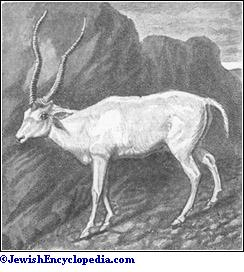
Antelope (Oryx Addax).(From a photograph.)
,
The slightly different form
The accompanying illustration is from a photograph of a well-grown female oryx in the zoological gardens at Cairo, which is 35 inches high at the shoulder and whose horns are 21 inches long. An adult male measures 40 inches at the shoulders, 59 inches from tip of nose to root of tail, and the longest horns known measure 27 1/4 inches. The color is pure white with dark brown or black markings. It is a powerful animal and its horns may inflict dangerous wounds. It inhabits the deserts of Arabia and its remarkably large hoofs seem well adapted to traversing the sands. It feeds upon grasses and upon certain succulent roots, and the Bedouin declare that never drinks. Under its name of
Antelope. Antelope are cud-chewing, hollow horned animals related to goats. Early European Bible translators were not acquainted with antelope, which roam the grassy plains and forests of Asia and Africa; so they called the antelope deer instead. Antelope are listed among clean wild game (Deu 14:5), and among King Solomon’s table provisions (1Ki 4:23).
When threatened, antelope flee in breathtaking leaps. So speedy were they that hunters in Bible times sometimes needed nets to catch them (Isa 51:20). Sometimes a grazing herd of antelope is joined by other animals that profit from their ability to spot an enemy or smell water at a great distance.
Various Bible translations mention three types of antelopes. The addax is a large, light-colored antelope with spiral horns. The oryx is a large African antelope, whose long horns are nearly straight. Most familiar to Bible writers was the gazelle, which stands less than a yard (approximately one meter) high at the shoulders.
The word gazelle is Arabic for "affectionate." Young gazelles were taken as pets. Poets made much of their dark, liquid eyes and delicate beauty. King David’s soldier, Asahel, gifted with both speed and endurance, was "as fleet of foot as a wild gazelle" (2Sa 2:18). The woman of good works whom Peter raised to life was called Tabitha (Hebrew for gazelle), or Dorcas (Act 9:36). The dorcas gazelle, once common, almost became extinct. Protected by the modern nation of Israel, it is now an agricultural nuisance.
A fast-running animal that looks similar to a deer.
Several antelope-like creatures are referred to in the Scriptures. One seems to be the white oryx (Oryx leucoryx), referred to as "antelope" in Deuteronomy 14:5 and Isaiah 51:20. The oryx was probably the antelope. Its long horns made it easy to catch. So, it was a common food source.
Another antelope mentioned in the Bible is the addax (Addax nasomaculatus). It is probably the “antelope” of Deuteronomy 14:5 ("pygarg" in the King James Version). It lives in North Africa. It has grayish-white hind parts, a white patch on its forehead, and twisted, ringed horns. The word “pygarg” comes from a Greek word meaning “white rump.” The addax is about the size of a donkey. Its body is closely covered with short hair. It has a short mane on the underside of its neck that makes the head look somewhat like that of a goat. The hooves are broad and flat, and the tail resembles that of a donkey. It is common in Africa and in Arabia, where Arabs hunt it with falcons and dogs.
Antelopes are very graceful and run with their heads held high. Both sexes have long, permanent, hollow horns. Oryx horns go straight back while addax horns twist into rings. Antelope are alert, skittish, and perceptive. They are usually found in herds of from two to a dozen. If injured or cornered, an antelope attacks with its head down. Its sharp horns point forward. Antelopes feed on grasses and shrubs, drinking from streams and water holes. When there is not much water, they eat melons and juicy bulbs. Both addax and oryx were clean in Jewish law.
Aquifer Open Bible Dictionary © 2026 Mission Mutual, an adaptation of the Tyndale Open Bible Dictionary © 2023 Tyndale House Publishers. Licensed under CC BY-SA 4.0.
Reference:"
Discussion:
The Septuagint renders this word as pugargos (transliterated as “pygarg” by the King James Version [KJV ]) which means “white rump.” This Greek name could refer to an antelope of the Kobus family which includes the Waterbuck, the Defassa Waterbuck Kobus defassa and the White-eared Kob Kobus megaceros all of which have a white ring around their rump. The latter two species were well known in biblical times. Most types of gazelle also have a white rump.
However it has become almost a tradition to associate the name with another antelope Addax nasomaculatus which strangely enough does not have a white rump (compare New American Bible [NAB ]). The addax is a northwest African species and there is no firm evidence that it has ever existed in the wild anywhere east of Libya. There is a good possibility however that the addax was kept in herds by the Egyptians in a way similar to the way deer are kept in deer parks in Europe but for sacrificial purposes as well as for food. Solomon may also have kept them like this.
Many scholars relate the name dishon to the Hebrew, root d-w-sh which would make the name mean something like “plodder.” This would fit the addax which has large hooves for its size and moves generally at a rhythmic walk. Some scholars suggest with some supporting evidence that dishon is Oryx leucoryx the Arabian or White Oryx. Linguistic support for this identification comes from the Akkadian name for the oryx, da-as-su, the root of which is said to be close to the Hebrew root d-sh-n. However another Hebrew word te’o is also interpreted by zoologists as “oryx.” Since this word also occurs in the list of clean animals in this verse it is unlikely that the word dishon also means “oryx.” The choice seems to be between the addax and the kobus antelope neither having overwhelming support (see also 2.7 Bubal hartebeest).
Description:
The Kobus antelopes are fairly large, about 1.3 meters (4 feet) at the shoulder, with fairly long fur. The males have horns what grow out at about forty-five degrees from the horizontal at the base then curve upward and forward. The horns are often over half a meter (20 inches) in length. The waterbuck and defassa are gray to grayish fawn, while the kobs are reddish. They live in small herds (the kobs often in large herds) in the vicinity of rivers or swamps. They are grazers, eating grass and waterweeds.
The addax has spiral horns and broad hoofs and is a pale brown color in winter but almost white in summer. They are about the size of donkeys.
Special significance or symbolism:
It is included in the list of clean animals.
Translation:
. The list of clean animals in DEU 14:5 includes seven names. Today’s English Version (TEV) has reduced this to four, “deer, wild sheep, wild goats, or antelopes.” These are cover terms that do not actually include all that is mentioned in the original. Gazelles, for example, are omitted. In settings where it is difficult to find seven names, this may be a solution.
In sub-Saharan Africa where waterbuck, lechwe, defassa, or kobs are known, the name for one of these could be used. Antelope similar to the addax include the Greater and Lesser Kudu, Strepsiceros strepsiceros and Strepsiceros imberbis.
On the Indian sub-continent the nearest equivalent would be the Nylghaie Boselaphus tragocamelus.
Elsewhere a phrase such as “white-rumped antelope” or a transliteration could be used.
Animals in the Bible © United Bible Societies. Licensed under CC BY-SA 4.0.