
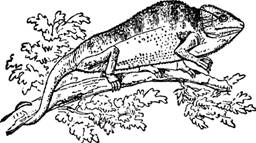
Fig. 123—Chameleon Africanus
Chameleon, a small species of lizard, celebrated for the faculty it has of changing the color of its skin. This property, however, has no reference to the substance it may be placed on, as generally asserted, but is solely derived from the bulk of its respiratory organs acting upon a transparent skin, and on the blood of the animal. The chameleons form a small genus of Saurians, easily distinguished by the shagreened character of the skin, and the five toes on the feet, divided differently from those of most other animals, there being, if the expression may be allowed, two thumbs opposed to three fingers. Their eyes are telescopic, move separately, and can be directed backwards or forwards. Chameleons are slow, inoffensive, and capable of considerable abstinence from food; which consists solely of flies, caught by the rapid protrusion of a long and viscous tongue. Among themselves they are irascible, and are then liable to change their colors rapidly; dark yellow or grey is predominant when they are in a quiescent state, but, while the emotions are in activity, it passes into green, purple, and even ashy black. The species found in Palestine and all Northern Africa, is the common African chameleon, and is that referred to in Lev 11:30, where unclean animals are mentioned.
Lev 11:30, a kind of lizard. Its body is about six inches long: its feet have five toes each, arranged like two thumbs opposite to three fingers: its eyes turn backwards or forwards independently of each other. It feeds upon files, which it catches by darting out its long, viscous tongue. It has the faculty of inflating itself at pleasure with air; and of changing its color, from its ordinary gray to green, purple, and even black when enraged.\par
Chameleon. A species of lizard. The reference in Lev 11:30 is to some kind of an unclean animal, supposed to be the lizard, known by the name of the "monitor of the Nile," a large, strong reptile common in Egypt and other parts of Africa.
A kind of large lizard, called
a reptile belonging to the saurian or lizard-like order. In the original of Lev 11:30, occur the words ko´äch (
Chameleon. Lev 11:30. A kind of lizard, of singular habits and appearance. Its body is about six inches long; its feet have five toes each, arranged like two thumbs opposite to three fingers; its eyes turn backwards or forwards independently of each other. It feeds upon flies, which it catches by darting out its long, viscous tongue. It has the faculty of inflating itself at pleasure with air, and thus changing its color from its ordinary gray to green, purple, and even black when enraged. The eyes project out of the head, and can be moved in any direction, and each eye can be moved independently of the other, so that the animal can see ahead with one eye, and at the same instant see behind with the other eye.
The Hebrew word is koach, Lev 11:30, and is thought to refer to a species of lizard. There are chameleons in Palestine, but they are unfit for food, whereas the lizards are eaten. The lizard was classed among the unclean animals.
By: Emil G. Hirsch, Henry Hyvernat
An animal of the genus Chamœleon, the only genus of the tribe Dendrosaura (also Chamœleonida, Rhiptoglossa, Vermilinguia), of the Chamœleontidœ or Chamœleonidœ family, of which it is the type. Some sixty species of the genus are known to exist, the most common of which, Chamœleon vulgaris, is frequently found in Egypt and the Holy Land. The word "chameleon" is taken from the Greek  ("little camel"). This conjecture he bases on the name "jamal al-Yahud" ("camel of the Jews"), which the Arabs give to the chameleon on account of the hump on its back.
In the A. V. "chameleon" is the rendering of the Hebrew  (koaḥ), which occurs only once (in Lev. xi. 30), in a list of five unclean animals, where it occupies the second place. This rendering, appatently, has the support of the Septuagint and the Vulgate, which may, however, be due to the fact that the animals are not arranged in the same order in the LXX. as in the Hebrew. The same can be said of the rendering "ḥulda" of the Peshiṭta. The koaḥ is presumably a species of monitor, as the ḥulda is of the Mole. It is now commonly thought that the chameleon is to be identified with the fifth animal on the list,
 (tinshemet), in the R. V. This identification is based principally on the etymology of the word
 ("the breather," "inhaler"),from the root
 ("to blow," "to breathe"). The chameleon is remarkable for its habit of inflating itself, which, combined with its power of fasting, led the ancients to believe that it lived on air (see Bochart, l.c., quoting Ḳimḥi). In reality it lives on insects, which it captures by darting at them its long and viscid tongue. The little animal, six or seven inches long, or, with the tail, eleven to twelve inches, lives almost exclusively upon trees, where it finds itself quite at home, thanks to its prehensile tail and feet.
Another peculiarity of the chameleon is its ability to change its color, supposedly in accordance with that of the objects with which it comes in contact. Whatever be the occasion of the phenomenon, its possibility is due to the presence in the skin of contractile cells, both clear and pigment-bearing, placed at various depths, and so arranged that, under the control of the nervous system, the one or the other only, or both kinds in various proportions, will come to the surface.
The tinshemet of Lev. xi. 30 must not be confounded with a bird of the same name mentioned in Lev. xi. 18.
Bibliography:
A. B. Tristram, The Natural History of the Bible;
J. G. Wood, Bible Animals;
S. Bochart, Hierozoicon;
Kamal al-Din al-Damiri, Ḥayyat al-Haiwan, see under ḥirba.
CHAMELEON.—The chameleon (Chamœleonvulgaris) is a very common Palestine lizard. It may be found on hot days clinging with its bird-like feet and prehensile tail to the trees, or passing with slow and deliberate walk over the ground. It is remarkable for its marvellous protective gift of changing the colour of its skin to resemble its surroundings, and for its eyes which, moving Independently, one looking backwards while the other looks to the front, give it an unusual range of vision. Even to-day it is supposed by the ignorant, as in olden times, to live upon air. In reality it lives on small insects, catching them by means of its long sticky tongue, which it can protrude and withdraw with extraordinary quickness. Two words in Lev 11:30 are rendered ‘chameleon’ in the Eng. versions. In the A V kôach is so translated, but in the RV
E. W. G. Masterman.
The word
The common chameleon is abundant in Palestine, being found also in North Africa and in Spain. The other species of chameleons are found principally in Africa and Madagascar. It is not only a harmless but a decidedly useful creature, since it feeds upon insects, especially flies. Its mode of capturing its prey is most interesting. It slowly and cautiously advances until its head is from 4 to 6 inches from the insect, which it then secures by darting out its tongue with great rapidity. The pigment cel ls in its skin enable it to change its color from pale yellow to bright green, dark green and almost black, so that it can harmonize very perfectly with its surroundings. Its peculiar toes and prehensile tail help to fit it for its life in the trees. Its prominent eyes with circular lids, like iris diaphragms can be moved independently of each other, and add to its striking appearance. See LAND CROCODILE; MOLE; SWAN; HORNED OWL; PELICAN.
See Lizard
A kind of lizard known for being able to change color quickly. Chameleons can move their eyes separately, so one eye can look up while the other looks down. They live in trees and bushes and use their long tails to hold onto branches.
In the Old Testament, chameleons are listed as ceremonially unclean animals. This means the Israelites were not allowed to eat them (Leviticus 11:30). The Hebrew word translated as “chameleon” may come from a word that means "to pant." This might be because of the way the animal breathes. Some ancient people believed lizards lived by breathing air alone.
See also Lizard.
Aquifer Open Bible Dictionary © 2026 Mission Mutual, an adaptation of the Tyndale Open Bible Dictionary © 2023 Tyndale House Publishers. Licensed under CC BY-SA 4.0.
Reference:"
Discussion:
This word appears in the list of unclean birds as well as in the list of lizards, and it seems quite clear that an owl and a reptile had the same name. Giving quite different creatures the same name is a common phenomenon in many languages. For instance, in English the word “cob” is used for a male swan as well as for a type of riding horse, and “sable” is the name of a small carnivorous animal as well the name of a large antelope; in Dutch “duiker” is the name of both the cormorant (a bird) and a type of antelope.
The Hebrew name tinshemeth is derived from a verb that means “to pant or to breathe loudly". This makes it very likely that the reference is to the chameleon. When annoyed, hurt, or in danger, the chameleon turns black, inflates its large lungs, making itself look bigger, and then opens its mouth, puffing and hissing like a snake. See also 3.17.8 Tinshemeth, a type of owl.
Description:
The Chameleon Chamaeleo chamaeleon is a very interesting lizard. It lives in vegetation. It is basically green but can change color to match its environment. It can become brown, pale yellow, or gray, and can vary the shade at different points of its body so as to become mottled or to have patches of dark and light color. This gives it good camouflage in vegetation. It is slow moving, often moving only one limb at a time in a series of wavering movements, mimicking the movement of twigs in the breeze. It has opposed claws on each foot, enabling it to hold very tight and to walk along thin twigs.
It has small scales and many small wart-like lumps on its tough skin. It has a row of pointed scales down its spine. Some species of chameleon have horn-like protrusions on their heads and faces.
The chameleon’s eyes are unique. It has an eyelid that completely covers the eye except for a small hole for the chameleon to see through. The chameleon can move this aperture around with each eyelid working independently of the other, and this enables it to look in two directions at once. It feeds on insects by catching them with its long, sticky, elastic tongue, which it flicks at the prey. The chameleon is also able to use its tail to wrap around twigs and other things to support itself when the wind blows or when climbing at a steep angle. It can hang by this tail from a twig or small branch and often uses this technique to move from a higher branch to a lower one.
Special significance or symbolism:
It is listed as an unclean animal.
Translation:
Chameleons are found all over Africa except in desert areas, and in some parts of tropical Asia. Where chameleons are not known, it may be necessary to borrow a word from the dominant language of the area, or from Hebrew, as JB has done. A phrase such as “slow lizard” or “puffer lizard” is another option.
Animals in the Bible © United Bible Societies. Licensed under CC BY-SA 4.0.