
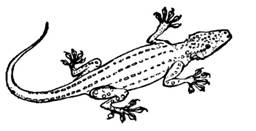
Fig. 249—Lizard—Lacerta Stellio
Under this denomination the modern zoologist places all the cold-blooded animals that have the conformation of serpents with the addition of four feet. Thus viewed, as one great family, they constitute the Saurians, Lacertinae, and Lacertidae of authors; embracing numerous generic divisions, which commence with the largest, that is, the crocodile group, and pass through sundry others, a variety of species, formidable, disgusting, or pleasing in appearance—some equally frequenting the land and water, others absolutely confined to the earth and to the most arid deserts; and though in general harmless, there are a few with disputed properties, some being held to poison or corrode by means of the exudation of an ichor, and others extolled as of medical use in pharmacy; but these properties in most, if not in all, are undetermined or illusory. Of some genera, such as the crocodile and chameleon, we have already made mention [CHAMELEON; CROCODILE; DRAGON; LEVIATHAN], and therefore we shall confine our present remarks to the lizards that are inhabitants of Western Asia and Egypt, and to those more particularly noticed in the Bible. Of these commentators indicate six or seven species, whereof some indeed may be misapprehended; but when it is considered that the regions of Syria, Arabia, and Egypt are overrun with animals of this family, there is every reason to expect allusion to more than one genus in the Scriptures, where so many observations and similes are derived from the natural objects which were familiar to the various writers. In Lev 11:29 mention is made of a species called tzab, which Bochart refers to one of the group of Monitors or Varanus, the Nilotic lizard. Like the other of this form, it is possessed of a tail double the length of the body, but is not so well known in Palestine, where there is only one real river (Jordan), which is not tenanted by this species. We have already shown that the true crocodile frequented the shores and marshes of the coast down to a comparatively late period; and therefore it may well have had a more specific name than Leviathan—a word apparently best suited to the dignified and lofty diction of the prophets, and clearly of more general signification than the more colloquial designation. Jerome was of this opinion; and it is thus likely that tzab was applied to both, as waran is now considered only a variety of, or a young, crocodile. There is a second of the same group, Lacerta Scincus of Merrem (Varanus Arenarius), Waran-el-hard, also reaching to six feet in length; and a third, not as yet clearly described, which appears to be larger than either, growing to nine feet, and covered with blight cupreous scales. This last prefers rocky and stony situations. It is in this section of the Saurians that most of the gigantic fossil species, the real ’children of the giants,’ are found to be located; and of the existing species some are reported to possess great strength. One of the last-mentioned pursues its prey on land with a rapid bounding action, feeds on the larger insects, and is said to attack game in a body, sometimes destroying even sheep. The Arabs, in agreement with the ancients, assert that this species will do fierce and victorious battle with serpents.
We come next to the group of lizards more properly so called, which Hebrew commentators take to be the letaah, a name having some allusion to poison and adhesiveness. The word occurs only once (Lev 11:30), where Saurians alone appear to be indicated. If the Hebrew root were to guide the decision, letaah would be another name for the gecko or anakah, for there is but one species which can be deemed venomous; and with regard to the quality of adhesiveness, though the geckos possess it most, numerous common lizards run up and down perpendicular walls with great facility. We, therefore, take chomet, or the sand lizard of Bochart, to be the true lizard, several (probably many) species existing in myriads on the rocks in sandy places, and in ruins in every part of Palestine and the adjacent countries. There is one species particularly abundant and small, well known in Arabia by the name of Sarabandi. We now come to the Stelliones, which have been confounded with the noxious geckos and others from the time of Aldrovandus, and thence have been a source of inextricable trouble to commentators. They are best known by the bundles of starlike spines on the body.
Next we place the Geckotians, among which comes anakah,in our versions denominated ferret, but which is with more propriety transferred to the noisy and venomous abu-burs of the Arabs. The particular species most probably meant is the lacerta gecko of Hasselquist, the gecko lobatus of Geoffry, distinguished by having the soles of the feet dilated and striated like open fans, from whence a poisonous ichor is said to exude, inflaming the human skin, and infecting food that may have been trod upon by the animal. Hence the Arabic name of abu-burs, or ’father-leprosy,’ at Cairo.
To these we add the Chameleons, already described [CHAMELEON]; and then follows the Scincus.
Of the species of Seps, that is, viviparous serpent lizards, having the body of snakes, with four weak limbs, a species, with only three toes on each foot, appears to extend to Syria.
A cold-blooded animal, with much resemblance to the serpent, but having four feet. Large numbers are found in Syria, varying greatly in size, appearance, and place of abode; some dwelling partly in water, and others on the rocks of the desert, or among old ruins. Lizards were unclean by the Levitical law, Lev 11:30 .\par
Li’nus. (that which clings to the ground). (Hebrew, letaah). Lev 11:30. Lizards of various kinds abound in Egypt, Palestine and Arabia. The lizard denoted by the Hebrew word is probably the fan-foot lizard (Ptyodactylus gecko) which is common in Egypt and in parts of Arabia, and perhaps, is found also in Palestine. It is reddish brown spotted with white. The gecko lives on insects and worms, which it swallows whole. It derives its name from the peculiar sound which some of the species utter.
letaah. This occurs only in Lev 11:30 among the creatures not to be eaten. Lizards of different species abound in Palestine. They feed upon insects and small reptiles.
By: Emil G. Hirsch, I. M. Casanowicz
A saurian or lacertilian reptile. About forty species and twenty-eight genera of lizards found in Palestine have been enumerated, the most common of which are the green lizard (Lacerta viridis) and its varieties, and the wall-lizard belonging to the genus Zootoca. It is therefore generally agreed that besides "leṭa'ah," traditionally rendered by "lizard," the following terms, enumerated among the "creeping things that creep upon the earth" (Lev. xi. 29 et seq.), also denote some kinds of lizard: "zab" (Arabic, "ḍabb"), identified with the Uromastix spinipes (A. V. "tortoise"; R. V. "great lizard"); "anaḳah" with the gecko, of which six species are found in Palestine (A. V. "ferret"; R. V. "gecko"; see Ferret); "koaḥ" (Vulgate and Ḳimḥi, "stellio") with the monitor (A. V. "chameleon"; R. V. "land-crocodile; see Chameleon); "ḥomeṭ" with the sand-lizard (A. V. "snail"; R. V. "sand-lizard"); "tinshemet," by reason of the etymology of the name (= "breathing," "blowing"), with the chameleon (A. V. "mole"; R. V. "chameleon"; see Chameleon); "semamit" (Prov. xxx. 28), the same word which the Targum Yerushalmi uses for "leṭa'ah," and the Samaritan version for "anaḳah," the meaning of the passage being that the lizard may be held in the hand with impunity (A. V. "spider"; R. V. "lizard").
In the Talmud "leṭa'ah" is the general term for the Lacertilia. It is described as having a thick but soft and separable skin (Shab. 107a, b; Ḥul. 122a), and its eggs have the white and yolk unseparated ('Ab. Zarah 40a [Rashi]). A case of resuscitation of an apparently dead lizard by pouring cold water on it is related in Pes. 88b. In Shab. 77b the semamit is mentioned as inspiring terror in the scorpion and also as serving as a cure for its bite, with which may be compared Pliny, "Historia Naturalis," xxix. 4, 29. In Sanh. 103b it is related that King Amon, after abolishing the Temple service, placed a semamit upon the altar. The chameleon is considered to be intended by "zeḳita" in Shab. 108b. This may be connected with "ziḳa" (= "wind"), meaning properly "the windy," the ancients believing the chameleon to live on air (comp. Pliny, l.c. viii. 33, 35).
LIZARD
(1) lětâ’âh, a generic name for ‘lizard.’
(2) tsâb (cf. Arab
(3) ’ănâqâh, tr.
(4) kôach, tr.
(5) chômet, tr.
(6) tinshemeth, tr.
All these names occur in Lev 11:29-30, as ‘unclean’ animals; most of them are very uncertain.
(7) sěmâmîth (Pro 30:28), tr.
Lizards are ubiquitous and exceedingly plentiful in Palestine: over 40 species have been identified. The most common is the green lizard (Lacerta viridis). The Palestinian gecko (Ptyodactylus Hasselquistii) is common in all native houses; it is able to walk up the walls and along the ceilings by means of the disc-like suckers at the ends of its toes. If sçmâmîth was, as many scholars claim, a lizard, then probably the gecko is the special species indicated. The dabb is a large lizard (Uromastix spinipes), with a long spiny tail. The sandlizards or skinks are common on soft, sandy soil; seven species are found in Palestine. The ‘land crocodile,’ known to the Arabs as the warrel, is a large lizard, sometimes five feet long; two species have been found in the Jordan valley—the Psammosaurus scineus and the Monitor niloticus. The chameleon is dealt with in a separate article.
E. W. G. Masterman.
1. Names:
(1)
Since (1), (3), (4), (5), (6) and (7) occur as names of animals only in this passage, and as the philological evidence available is in most cases not very convincing, their determination is difficult and uncertain. the Revised Version margin to “gecko” (Lev 11:30) has “Words of uncertain meaning, but probably denoting four kinds of lizards.”
2. Lizards of Palestine:
Among the many lizards of Palestine, the monitor and thorny-tailed lizard are remarkable for their size, and the chameleon for its striking appearance and habits. On etymological grounds,
The commonest lizard of Palestine is the rough-tailed agama, Agama stellio, Arabic
The gecko, Ptyodactylus lobatus, is common in houses. By means of adhesive disks on the under sides of its toes, it clings with ease to smooth walls which other lizards cannot scale. Although perfectly harmless, it is believed to be poisonous, and is much feared. It is called
Various species of the genus Lacerta and its allies, the true lizards, may always be found searching for insects on trees and walls. They are scaly, like all lizards, but are relatively smooth and are prettily colored, and are the most attractive members of the group which are found in the country. They are called by the Arabs
The skinks include Scincus officinalis, and allied species. Arabic
3. Identifications:
“The lizard taketh hold with her hands,
Yet is she in kings’ palaces.”
The Septuagint has
For none of the names in Lev 11:29, Lev 11:30 have we as many data for identification as for
There seems to be little evidence available for deciding the identity of
We have thus more or less tentatively assigned various words of the list to the monitor, the thorny-tailed lizard, the chameleon, the gecko and the skink, but we have done nothing with the rough-tailed agama and the Lacertae, or true lizards, which are the commonest lizards of Palestine, and this fact must be reckoned against the correctness of the assignment. The translation of the Revised Version (British and American) has this to commend it, that it gives two small mammals followed by six lizards, and is therefore to that extent systematic. It is, however, neither guided in all cases by etymological considerations, nor does it follow Septuagint.
As none of the etymological arguments is very cogent, the writer can see no harm in consistently following Septuagint, understanding for (1)
Neither of these lists has the systematic arrangement of that of the Revised Version (British and American), but we must remember that the Biblical writers were not zoologists, as is seen in the inclusion of the bat among birds (Lev 11:19; Deu 14:18), and of the hare and coney among ruminants (Lev 11:5, Lev 11:6; Deu 14:7).
Lizard. Lizards receive little attention in the Bible, although they are common in Palestine. They appeared on the list of unclean animals (Lev 11:30) and were thus forbidden as food to the Israelites.
The lizard comes in many species. Some of the small lizards often pass for snakes, while larger versions of this animal resemble the crocodile. All lizards are cold-blooded reptiles. Since their body temperature depends on their surroundings, they thrive in the tropics and in deserts. But when the sun gets too hot even for them, they lie in the shade or burrow into the sand. One species is even called a sand lizard (Lev 11:30); (skink, NIV).
Lizards are ingenious in the different ways they move. Some unfurl skin-like sails and soar from tree to tree. Monitor lizards (probably the Bible’s great lizard, (Lev 11:29), RSV, NIV) swim well. They can also climb trees. Many lizards scamper rapidly across the ground. Others have poorly developed legs or no legs at all. But the little gecko (translated ferret in KJV, (Lev 11:30) can walk across a plaster ceiling upside down or cling to a pane of glass. His toes end in a pad made of hundreds of tiny hooks, capped with a hidden claw. This enables him to get a foothold on smooth surfaces. Geckos are abundant in Palestine.
Most lizards eat insects. Larger species of this reptile also eat small animals or plants. The chameleon’s sticky tongue, nearly as long as his body, whips out to catch insects. Chameleons are also common in Palestine. They are so narrow they look as if they have been squashed, and their bulging eyes can see in opposite directions. They have a long tail that can grasp a branch or coil into a spiral when at rest. Chameleons move at a slow, deliberate pace.
The chameleon is known for its ability to change its color to match its surroundings. Actually, this is a common protective trait for most species of lizards. Another defensive tactic is the use of tricks or bluffs. The glass snake, a type of lizard, escapes capture by shedding its wiggling tail. Other lizards hiss, puff up, or use their tails as whips.
A lizard is a small reptile with scaly skin, four legs, and a long tail. Lizards belong to a group of reptiles called Lacertilia. Many lizards eat insects and worms. Like other reptiles, most lizards lay eggs. Their eggs usually have softer shells than bird eggs. Lizards cannot control their own body temperature. Their body temperature changes with the temperature around them. For this reason, lizards become less active when the weather is cold.
Lizards live well in dry areas that have little plant life. In the Near East, many lizards can be found in the Arabian Desert, Sinai Peninsula, and Judean wilderness. The Holy Land may have as many as 44 different kinds of lizards.
The Dabb lizard lives in the Negev Desert and grows up to 61 centimeters (24 inches) long. Its scientific name is genus Uromastyx. Unlike most lizards that eat insects, this lizard eats both plants and animals. It has tough, rough skin that is green with brown spots. It has a short, rounded head and a strong tail. The tail has spines along it, and the lizard uses it as a weapon to protect itself.
Lizards in the Bible and Jewish Law
Lizards are ceremonially unclean in Jewish law (Leviticus 11:29–31). Lizards crawl on their bellies, which makes them unclean. Therefore, contact with a dead lizard made a law-abiding Jew ceremonially unclean (Leviticus 11:32–36). The Berean Standard Bible translates the "lizards" of Leviticus 11 as:
"the great lizard,"
"the gecko,"
"the monitor lizard,"
"the common lizard,"
"the skink," and
"the chameleon."
The monitor lizard is a large lizard that lives in the deserts of southern Palestine, Sinai, and Egypt. It is up to 1.4 meters (55 inches) long with a long snout and sharp teeth.
Other translators and Bible scholars translate the original Hebrew words in many different ways. These include:
“tortoise,”
“ferret,”
“lizard,”
“snail,”
“mole,” and even
“water hen.”
Most of these Hebrew words appear only once in the Bible. This makes it very difficult to know which animals the words describe.
Aquifer Open Bible Dictionary © 2026 Mission Mutual, an adaptation of the Tyndale Open Bible Dictionary © 2023 Tyndale House Publishers. Licensed under CC BY-SA 4.0.
Discussion:
There is a reasonably strong consensus among scholars that leta’ah refers to the lacertid and agama lizards, both of which are common and fairly obvious in Israel. The lacertids are soft-skinned lizards that live in close proximity to roads and houses. One of the more colorful is the Syrian Green Lizard Lacerta trilineata, which lives in orchards and woods. The most common of the agamas is the Rainbow Agama Agama stellio, which is very common around houses and on walls and rocks.
Most scholars agree that tsav is the name for the dab or thorn-tailed lizards of which there are many species in Israel. Two of the most common are the Egyptian Thorn-tailed Lizard Uromastyx aegyptia and the Colored Thorn-tailed Lizard Uromastyx ornata. The name “dab” is an English version of their Arabic name dhubb or dhabb, which is reflected in the Hebrew tsav.
Description:
Lacertid lizards (leta’ah) are fairly small, about 15–20 centimeters (6–8 inches) long, and they have a shiny smooth skin. Syrian green lizards have dark green spots on a lighter green background, with a yellow-green belly. They feed on flies, gnats, mosquitoes, and ants.
The rainbow agama is much larger, reaching 50–60 centimeters (20–24 inches) in length. In the breeding season the male develops bright colors, with a blue tail, green body, and bright orange or bright green head, dependent on the subspecies. The females and non-breeding males are a dull gray color. All agamas are characterized by the fact that they bob their heads vigorously by doing “push-ups” with their front legs. They have long, fairly stiff tails, which they raise when they run. They feed on a wide variety of insects and also prey on smaller lizards. In most of the Arab-speaking world they are known as hardoun lizards. Some agamas have the ability to change color to match their surroundings in the same way that chameleons do.
The thorn-tailed lizards (tsav) are relatively large desert lizards with a length of about 65 centimeters (26 inches). They have a fairly thick, squat appearance and have a thick short tail covered with sharp spikes, which are actually cone-shaped scales. They use this tail for defense. They often crawl into holes or cracks in rocks and then block the entrance with their thorny tail. They are vegetarian, eating various succulent desert plants. Even though they are on the list of unclean foods, they are commonly eaten by Arabs and Bedouin, who keep them in cages and fatten them.
Special significance or symbolism:
They are listed as unclean.
Translation:
Agamas are found throughout Africa and in tropical Asia. Lacertids are found all over Europe. Elsewhere a general word for lizard can be used.
For tsav a phrase, such as “big thorny lizard” or “big lizard with a thorny tail", is usually the best option. Where languages differentiate between smaller lizards and monitor lizards, “thorny monitor” or “monitor with a thorny tail” will better convey the idea of large size.
Animals in the Bible © United Bible Societies. Licensed under CC BY-SA 4.0.