
See Beast
Proud Nimrod first the bloody chase began, A mighty hunter, and his prey was man.
Isaiah, describing the happy state of the reign of Messiah, says, “The leopard shall lie down with the kid,” Isa 11:6. Even animals shall lose their fierceness and cruelty, and become gentle and tame. Jer 5:6, mentions the artful ambuscades of this animal; and in Jer 13:23, alludes to his spots: “Can a Cushite change his skin; or a leopard his spots? Then may ye prevail with them to do good who are habituated to do evil;” and Hab 1:8, refers to its alertness.
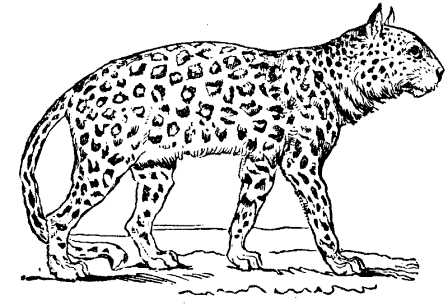
Fig. 243—Leopard
Leopard (Son 4:8; Isa 11:6; Jer 5:6; Jer 13:23; Hos 13:7; Hab 1:8; Dan 7:6; Rev 13:2; Sir 28:23). Though zoologists differ in opinion respecting the identity of the leopard and the panther, and dispute, supposing them to be distinct, how these names should be respectively applied, and by what marks the animals should be distinguished, nevertheless there can be no doubt that the leopard of the Bible is that great spotted feline which anciently infested the Syrian mountains, and even now occurs in the wooded ranges of Libanus. The variety of leopard, or rather panther, of Syria, is considerably below the stature of a lioness, but very heavy in proportion to its bulk. Its general form is so well known as to require no description beyond stating, that the spots are rather more irregular, and the color more mixed with whitish, than in the other pantherine felinae, excepting the Felis Uncia, or Felis Irbis, of High Asia, which is shaggy and almost white. It is a nocturnal, catlike animal in habits, dangerous to all domestic cattle, and sometimes even to man. In the Scriptures it is constantly placed in juxtaposition with the lion or the wolf; which last, if the hyena be intended, forms a natural association. There is in Asia Minor a species or variety of panther, much larger than the Syrian, not infrequent on the borders of the snowy tracts even of Mount Ida, above ancient Troy; and the group of these spotted animals is spread over the whole of Southern Asia to Africa. From several names of places, it appears that, in the earlier ages of Israelitish dominion, it was sufficiently numerous in Palestine. Leopard skins were worn as a part of ceremonial costume by the superiors of the Egyptian priesthood, and by other personages in Nubia; and the animal itself is represented in the processions of tributary nations.
A fierce wild beast of the feline genus, beautifully spotted with a diversity of colors; it has small eyes, wide jaws, sharp teeth, round ears, a large tail; five claws on the fore feet, and four on those behind. It is swift, craft, and cruel; dangerous to all domestic cattle, and even to man, Jer 5:6 13:23 Da 10:6 Hos 13:7 Hab 1:8 . Its name, leopard, implies that it has something of the lion and of the panther in its nature. It seems from Scripture that the leopard could not be rare in Palestine. Its Hebrew name occurs significantly in several names of places; as Beth-nimrah, the haunt of leopards, Num 32:36 . So in Nimrah, Nimrim, and perhaps Nimrod the mighty hunter. Isaiah, describing the happy reign of the Messiah, says, Isa 11:6, "The leopard shall lie down with the kid, and the calf and the young lion and the fatling together." The spouse in the Canticles speaks of the mountains of the leopards, Son 4:8 ; that is to say, such as Lebanon and Hermon, where wild beasts dwelt.\par
Leopard. (Hebrew, namer). Leopard is invariably given, by the Authorized Version, as the translation of the Hebrew word, which occurs in the seven following passages: Son 4:8; Isa 11:6; Jer 5:6; Jer 13:23; Dan 7:6; Hos 13:7; Hab 1:8. Leopard occurs also in Sir. 28:23 and in Rev 13:2.
From Son 4:8, we learn that the hilly ranges of Lebanon were, in ancient times, frequented by these animals. They are now not uncommonly seen in and about Lebanon and the southern maritime mountains of Syria. Under the name namer, which means "spotted", it is not improbable that another animal, namely the cheetah (Gueparda jubata), may be included; which is tamed by the Mohammedans of Syria, who employ it in hunting the gazelle.
Famed for swiftness and agility (Hab 1:8); "you would fancy it was flying" (Oppian Cyneg., iii. 76); it climbs trees, and can crawl along the ground. Hence the symbol for Greece and Alexander’s rapid victories (Dan 7:6; Rev 13:2). The prevalence of leopards anciently in Palestine is marked by the many places named from them (
Leopard. Isa 11:6. An animal of the cat tribe, which is often mentioned by the sacred writers. The Hebrew name is nimrah. Num 32:8. Beth-nimrah, Num 32:36, means the house of the leopards; and in Son 4:8, are mentioned the mountains of the leopards. Allusions are made in the Bible to its manner of watching for its prey, Jer 5:6; Hos 13:7; its fleetness, Hab 1:8; its fierceness and cruelty, Isa 11:6, and in Dan 7:6 it is made the emblem of power.
The Hebrew word, namer, signifies a ’spotted’ animal. This well-known wild animal is introduced by the prophet as an illustration: as the leopard cannot change its spots, no more can rebellious man change his nature. Jer 13:23. The leopard is also represented as lying in wait and watching its prey, and acting with swiftness. Jer 5:6; Hos 13:7; Hab 1:8. The Grecian kingdom was compared to a leopard with four wings, Dan 7:6; and it answered to this in the rapidity of its conquests. The future Roman empire is symbolically likened to a leopard, but having the feet of a bear, and the mouth of a lion: that is, like no known beast, but symbolically uniting the characteristics of the three former powers. Rev 13:2. In the millennium "the leopard shall lie down with the kid." Isa 11:6. The common leopard is the Leopardus varius.
(Heb. "namer"):
By: Emil G. Hirsch, I. M. Casanowicz
A ferocious carnivorous mammal. Several allusions are found in the Old Testament to this animal and its characteristics; e.g., its fierceness, Isa. xi. 6; its agility and swiftness, Hab. i. 8; its cunning, Jer. v. 6 and Hos. xiii. 7; its unchangeable spots as a type of immutability, Jer. xiii. 23; as an emblem of one of the "great monarchies," Dan. vii. 6. The leopard (Felis pardus) is still met with in the forest of Gilead, round the Dead Sea, and in the mountains; the chetah (Gueparda jubata) is of less frequent occurrencein Palestine. The former frequency of the leopard there may perhaps be inferred from the place-names "Beth-nimrah" (Num. xxxii. 3, 36) and "Nimrim" (Jer. xlviii. 34), the latter perhaps identical with the modern Nimerah (comp. also the "mountains of leopards," Cant. iv. 8).
In the Talmud the namer is classed with the wolf, lion, etc., for dangerousness and ferocity (Sanh. 2a and parallels). Following the ancient conception of the leopard as a hybrid between a panther or pard and the lioness (hence the name "leo-pardus"), some of the rabbis believed it to be the issue of the boar and lioness (comp. Bartenora to the admonition of Ab. v. 5: "Be firm like a leopard to do the will of thy Father in heaven"). The namer is a type of immodesty (Ḳid. 70a). Its term of gestation is said to be three years (Bek. 8a).
Bibliography:
Tristram, Nat. Hist. p. 111;
Lewysohn, Z. T. p. 71;
comp. also W. R. Smith, Kinship and Marriage in Early Arabia, p. 204.
LEOPARD (nâmçr).—This animal (Felis pardus, Arab.
E. W. G. Masterman.
In the Bible “leopard” occurs mainly in figurative expressions, as a large and fierce beast. The leopard is mentioned with the lion and bear in Dan 7:6; Hos 13:7; Rev 13:2; with the lion, wolf and bear in Isa 11:6; with the lion and wolf in Jer 5:6; with the lion alone in Ecclesiasticus 28:23; with the wolf alone in Hab 1:8. The leopard is smaller than the lion and the tiger, but is more active than either. Its swiftness is referred to in Hab 1:8: “Their horses also (of the Chaldeans) are swifter than leopards.” The spots of the leopard are referred to in Jer 13:23: “Can the Ethiopian change his skin, or the leopard his spots?”
The Greek
(ðÜñäáëéò)
The Greek word seems to have been used indiscriminately by the classical writers to designate ‘leopard,’ ‘panther,’ or ‘ounce.’ The only NT reference to the ‘leopard’ is in Rev_13:2, where it occurs in the description of ‘the Wild Beast from the sea’-‘the beast which I saw was like unto a leopard.’ The concrete reality, of which the Wild Beast was the abstract emblem, was of course the Roman Empire. To the mind of the Seer, the attitude adopted by Rome towards the early Christian Church was that of a leopard. She exhibited the same agility (cf. Hab_1:8) and cunning (cf. Hos_13:7), as well as the same ruthless cruelty, as that much-dreaded inhabitant of Palestine and the East.
The leopard (Felis pardus, Arab. nimr, Heb. nâmçr) is still found round the Dead Sea, in Gilead and Bashan, and also occasionally in Lebanon and the wooded districts of the west; but, judging from the numerous allusions in the OT and the occurrence of the word in place-names (e.g. ‘Beth-Nimrah’ or ‘Nimrah’), it is reasonable to suppose that it was more common in early times. It usually lurks near wells or watering-places (cf. ‘waters of Nimrim,’ Isa_15:6, Jer_48:34), and in the outskirts of villages (cf. Jer_5:6), to pounce at night upon cattle and dogs. The beautifully spotted skins are often sold in the markets and are used as rugs and saddle-covers, while sometimes they are worn as an article of clothing.
The Felis pardus is found over the whole of Africa, S. Asia, China, Japan, and the islands of the Malay Archipelago.
Another animal of the leopard tribe, the well-known cheeta or hunting-leopard of India (Felis jubatus), is sometimes found in the hills of Galilee and in the neighbourhood of Tabor, but its occurrence is rare. It is much tamer than the Felis pardus, and in India it is often domesticated and kept for hunting antelopes and other animals.
Literature.-H. B. Tristram, SWP [Note: WP Memoirs of Survey of Western Palestine.] vii. [1884], p. 18f., The Natural History of the Bible10, 1911, pp. 111-114; H. B. Swete, The Apocalypse of St. John2, 1907, p. 162; Hastings’ Single-vol. Dictionary of the Bible 540f.; Hasting's Dictionary of the Bible (5 vols) iii. 95; Encyclopaedia Biblica iii. 2762f.; W. M. Thomson, The Land and the Book, 1864, p. 444f.
P. S. P. Handcock.
Jer 5:6 (b) This animal which is so quick in its actions and so swift in its pursuit is a picture of the swift destroyers mentioned in the passage. They would come suddenly with fierceness and attack with cruelty.
Jer 13:23 (a) The spots on the leopard are from birth. It is an inherent marking. So the sinner is born with evil and wicked tendencies which are permanent in his life. He cannot change them nor obliterate them in any way. Only a divine power could remove them. The sinner is helpless in his sins. Only the divine Son of GOD can change him and make him whiter than snow. This animal represents also the sinner who admits he has "spots of sin" on him, but thinks there is lots of good in him. GOD will not save him, until he admits he is all bad.
Hos 13:7 (a) In this passage the lion represents power, the leopard represents swiftness, the bear represents silence and certainty, and these are characteristics of the GOD whom they abandoned.
Rev 13:2 (a) This animal represents the antichrist, who though pretending to be a man of peace will really be a cruel monster, killing all his enemies, violating his oath and showing swift and certain vengeance on those who belong to JESUS CHRIST.
Leopard. The huge cats known as leopards were familiar in Palestine, and the Hebrews had good reason to fear them. Smaller and lighter than lions, leopards are better hunters. They are swift, wary, and intelligent; and they can climb trees as easily as a domestic cat. A leopard is also strong enough to drag his prey to a tree branch, where he can devour it out of reach of lions or hyenas. Although leopards do not usually attack human beings, Jeremiah portrayed them symbolically as an instrument of God’s judgment: "A leopard will watch over their cities. Everyone who goes out from there shall be torn in pieces" (Jer 5:6).
The books of Daniel and Revelation use the leopard as a symbol of swiftness in cruelty (Dan 7:6; Rev 13:2). Isaiah suggested that a day of peace would come when the savage leopard would not harm a young goat (Isa 11:6).
A leopard (Panthera pardus tulliana) is a large, spotted wild cat that lives in both rocky and forested areas, known for its hunting skills. It is the most common of all the large wildcats. In rocky areas, it lives in caves. In forested regions, it lives in thick vegetation. In Old Testament times, many lived in the vicinity of Mount Hermon (Song of Solomon 4:8).
Leopards are smaller than tigers. A leapoard can grow up up to 1.5 meters (five feet) long with a tail of about 0.8 meters (30 inches). Its body is more proportionate than the tiger's. Leopards ambush their prey silently. They often hide near villages or watering holes, waiting for long periods. The leopard is a quick runner (Habakkuk 1:8), climber, and is very graceful in general. Its color is yellowish speckled with black spots (Jeremiah 13:23). Daniel and John saw visions in which leopards were symbols of world powers (Daniel0 7:6; Revelation 13:2).
The leopard is a cautious and clever animal. It is powerful and fierce (Jeremiah 5:6; Hosea 13:7; compare Isaiah 11:6). The leopard is dangerous to both pets and people. Its spotted coat helps it blend into its surroundings. This makes it almost impossible to see in the changing light and shadows of forests. The Israelites feared leopards because they attacked their sheep and goats. Place names like Nimrah, Beth-nimrah, and Nimrim suggest that leopards lived nearby. These places, along with a region northeast of the Dead Sea, reflect this connection. Remarkably, leopards have survived in Israel and Palestine into the 20th century. A few still roam near Mount Tabor and Mount Carmel.
Aquifer Open Bible Dictionary © 2026 Mission Mutual, an adaptation of the Tyndale Open Bible Dictionary © 2023 Tyndale House Publishers. Licensed under CC BY-SA 4.0.