
The Hebrews were very partial to trees; and it is not to be wondered at, for those trees which formed shades, by their long growing and wide spreading branches, must have been highly grateful in sheltering them from the heat. The plane tree is supposed to have been the chesnut spoken of Gen. xxx. 37. The word Harmon, or Ormon, is so rendered in that Scripture. We have a lofty description of Pharaoh, king of Egypt, under the similitude of those elegant tress of the forest. (Ezek. xxxi. 8.) But when the reader hath pondered over these beauties of nature, I beg him to observe how, in a yet far higher degree, the Holy Ghost is pleased to make use of them in setting forth the glories of grace, when describing the Lord Jesus under the similitude of the wide spreading branches of the trees of the wood, to represent the shelter he affords to his people. Hence the church sings of sitting under "his shadow with great delight, and his fruit becoming sweet to her taste." (Song 2: 3.) Hence the prophet describes Jesus as a strength to the poor, a strength to the needy in distress, a refuge from the storm, a shadow from the heat, when the blast of the terrible ones is as a storm against the wall." (Isa. xxv. 4.) And in many other parts of Scripture the same figures are beautifully chosen by way of representing the Lord Jesus as both a protecting power from every danger, and a source of refreshment in all good. Jesus is all this, and infinitely more; for like the wide spreading branches of some rich and fruitful tree of the desert, he forms every thing that is lovely to our view, and both shelters from the heat, and refresheth our thirst by his fruit in this desert of our nature, when from under his shadow "we revive as the corn, and grow as the vine, and his scent is more fragrant than the wine of Lebanon." (Hos. 14. 7.)
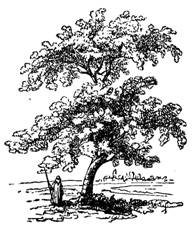
Fig. 294—Platanus Orientalis—Plane-tree
The tree called in Hebrew Armon is named thrice in the Scriptures. It occurs among the ’speckled rods’ which Jacob placed in the watering-troughs before the sheep (Gen 30:37, chestnut): its grandeur is indicated in Eze 31:8, as well as in Sir 24:14: it is noted for its magnificence, shooting its high boughs aloft. This description agrees well with the plane-tree which is adopted by all the ancient translators, to which the balance of critical opinion inclines, and which actually grows in Palestine. The beech, the maple, and the chestnut have been adopted, in different modern versions, as representing the Hebrew Armon; but scarcely any one now doubts that it means the plane-tree. It may be remarked that this tree is in Genesis associated with others—the willow and the poplar—whose habits agree with it; they are all trees of the low grounds, and love to grow where the soil is rich and humid.
The plane tree is a large spreading tree that has a wide trunk and scaly bark. It is native to the region of Palestine. This tree belongs to a family with bell-shaped fruit clusters. Usually, its outer bark flakes off in patches or strips. The references in Genesis 30:37 and Ezekiel 31:8 are apparently not to the chestnut tree, which does not naturally grow in Palestine. These are references to the oriental plane tree, Platanus orientalis.
The plane tree is a massive tree that can grow 18.3 meters (60 feet) or more in height. Its trunk is often very thick, sometimes reaching around 12.2 meters (40 feet) in circumference. The outer bark peels off in sheets or scales, revealing a smooth whitish or yellowish inner bark underneath.
This tree is common throughout Lebanon, Syria, and the region of Palestine. It can grow even in high mountain regions. However, it is mainly found in plains and lowlands, growing alongside streams and lakes and in wet, marshy places.
See also Plants.
Aquifer Open Bible Dictionary © 2026 Mission Mutual, an adaptation of the Tyndale Open Bible Dictionary © 2023 Tyndale House Publishers. Licensed under CC BY-SA 4.0.