
We now distinguish this tribe of creatures into
The ancient Egyptians are said to have worshipped apes; it is certain that they are still adored in many places in India. Maffeus describes a magnificent temple dedicated to the ape, with a portico for receiving the victims sacrificed, supported by seven hundred columns.
“With glittering gold and sparkling gems they shine, But apes and monkeys are the gods within.”
Figures of apes are also made and reverenced as idols, of which we have several in Moore’s “Hindoo Pantheon;” also in the avatars, given in Maurice’s “History of India,” &c. In some parts of the country the apes are held sacred, though not resident in temples; and incautious English gentlemen, by attempting to shoot these apes, (rather, perhaps, monkeys,) have been exposed, not only to all manner of results and vexations from the inhabitants of the villages, &c, adjacent, but have even been in danger of their lives.
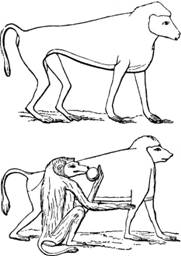
Fig. 44—Apes from Egyptian Monuments
The word is in the Hebrew Koph, and it occurs only in 1Ki 10:22 and 2Ch 9:21, as among the curiosities in natural history brought back by Solomon’s ships from their distant voyages to Ophir. The name seems to have been introduced along with the animals, for in Sanscrit and Malabaric kapi is the name for an ape. We cannot of course attempt to determine the species brought into Palestine on the occasion indicated; and the probability indeed is, that the name is a general one for all or any of the quadrumana of which the Hebrews had any knowledge. When we consider the mode in which these animals were introduced, it is curious to compare this with the scene in the tomb of Thothmes III at Thebes, where the presents and tributes of various distant nations are represented as being brought to the king. Among these are several living animals, including six quadrumanous animals. The smallest and most effaced may be apes; but the others, and in particular the three here copied, are undoubtedly Macaci or Cynocephali, that is, a species of the genus baboon, or baboon-like apes. The association renders these figures interesting; but it is impossible to say that the animals brought to Solomon were of these kinds, or indeed to say to what species they should be referred [SATYR].
An animal rudely resembling the human race. The tribe may be familiarly distinguished as monkeys, apes, and baboons. Solomon imported them from Ophir, 1Ki 10:22 2Ch 9:21 . They were at one time worshipped in Egypt; and still are adored in some parts of India, where one traveller describes a magnificent temple dedicated to the monkey. There may be an allusion to large apes or baboons, literally "hairy ones," in Lev 17:7 Isa 13:21 34:13.\par
They are represented as tailless animals, climbing rocks, eating worms and ants, and protecting themselves from the attack of lions by casting sand into their eyes. Apes also occur in the lately discovered Assyrian sculptures, both in bas-reliefs on slabs (Layard, Nineveh, 1, 118), and of various species on an obelisk at Nimroud (ib. 2, 330). The Koph of Scripture, named only twice (1Ki 10:22; 2Ch 9:21), is in both cases, associated with
Ape. King Solomon brought apes from tropical and semi-tropical regions of the ancient world to Israel. Solomon’s zoo probably contained a variety of apes, monkeys, and baboons (1Ki 10:22; 2Ch 9:21). Some commentators suggest that Isaiah’s reference to the "satyrs" who "dance" and "cry to [their] fellow [s]" (Isa 13:21; Isa 34:14), (KJV) would fit the dog-faced baboon honored by the Egyptians. Also see Monkey.
Apes are large, tailless primates. Apes, or perhaps other monkeys and baboons, were imported to Israel by King Solomon (1 Kings 10:22; 2 Chronicles 9:21).
There are two references to apes in the Old Testament (1 Kings 10:22; 2 Chronicles 9:21). They discuss Solomon's importing the apes on his trading ships, with other treasures. There is some question about where those primates came from. Some believe the mention of "ivory" suggests they were apes from East Africa. Others, believing they came from India or Ceylon, suggest that they were actually monkeys.
Baboons (genus Papeio) were considered sacred to the god Thoth. Males of that genus were kept in temples, and the more tame females were often kept as house pets. Such baboons often had some of their teeth removed or ground down to reduce the risk of their biting. Mummified baboons found in Egypt show they were highly regarded.
See also Animals.
Aquifer Open Bible Dictionary © 2026 Mission Mutual, an adaptation of the Tyndale Open Bible Dictionary © 2023 Tyndale House Publishers. Licensed under CC BY-SA 4.0.