
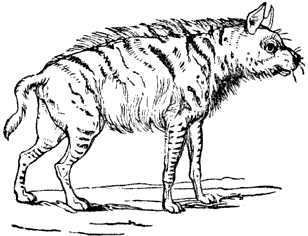
Hyena
Hyena (Tzeboa), (Sir 13:18). Excepting in Ecclesiasticus just noted, the word does not occur in the English Bible, although there are several passages in the Hebrew canonical books, where Tzeboa, ’streaked’ or ’variegated,’ is assumed to designate the hyena. The most noted of these is Jer 12:9, where the words which the Septuagint render ’the cave of the hyena,’ are rendered in our version ’a speckled bird.’ But Bochart and the continuator of Calmet vindicate what we take to be the true reading, ’the striped rusher,’ i.e. the hyena, turning round upon his lair, introduced after an allusion in the previous verse to the lion calling to the beasts of the field (other hyenas and jackals) to come and devour. This allusion, followed up as it is by a natural association of ideas, with a description of the pastor, feeder, or rather consumer or devourer of the vineyard, treading down and destroying the vines, renders the natural and poetical picture complete; for the hyena seeks burrows and caverns for a lair; like the dog it turns round to lie down; howls, and occasionally acts, in concert; is loathsome, savage, insatiable in appetite, offensive in smell; and will in the season, like canines, devour grapes, as the writer has himself ascertained by actual experiment.
Tzeboa, therefore, we consider proved to be generically, the hyena. The striped species is one of three or four—all, it seems, originally African; and, by following armies and caravans, gradually spread over Southern Asia to beyond the Ganges, though not as yet to the east of the Bramapootra. It is now not uncommon in Asia Minor, and has extended into Southern Tartary; but this progress is comparatively so recent, that no other than Semitic names are well known to belong to it. The head and jaws of all the species are broad and strong; the muzzle truncated; the tongue like a rasp; the teeth 34 instead of 42, as in the canidæ, but robust, large, and eminently formed for biting, lacerating, and reducing the very bone; the neck stiff; the body short and compact; the limbs tall, with only four toes on each foot; the fur coarse, forming a kind of semi-erectile mane along the back; the tail rather short, with an imperfect brush, and with a fetid pouch beneath it. In stature the species varies from that of a large wolf to much less. Hyenas are not bold in comparison with wolves, or in proportion to their powers. They do not in general act collectively; they prowl chiefly in the night; attack asses, dogs, and weaker animals; feed most willingly on corrupt animal offal, dead camels, etc.; and dig into human graves that are not well protected with stakes and brambles. The striped species is of a dirty ashy buff, with some oblique black streaks across the shoulders and body, and numerous cross-bars on the legs; the muzzle and throat are black, and the tip of the tail white.
There is reason to believe that the deeb,or Scriptural wolf, when represented as carrying off a lamb, is no other than the hyena, unless the real wolf has been extirpated; for zoologists have not found the wolf in Syria.
Jer 12:9, "speckled bird." But Septuagint "the hyena," in parallelism to the "lion" in Jer 12:8;
By: Emil G. Hirsch, I. M. Casanowicz
—Biblical Data:
The translation by the Septuagint of "ẓabua'" (Jer. xii. 9); the rendering of the Vulgate being "avis tincta," and that of the English versions "speckled bird." The rendering of the LXX., which is adopted by most commentators, is supported not only by the Arabic "ḍabu'," but also by the parallel passage (ib. xii. 8), which implies that by "ẓabua'" some strong, fierce animal, similar to the lion, is intended (comp. Ecclus. [Sirach] xiii. 18). The striped hyena (Hyæna striata) is common in every part of Palestine; and its former frequency is perhaps indicated by the place-name "Zeboim" (I Sam. xiii. 18; Neh. xi. 34; comp. also the personal name "Zibeon," Gen. xxxvi. 20).
—In Rabbinical Literature:
The Talmud has, besides "ẓabua'," three other names for the hyena, "bardales," "napraza," and "appa"; and this variety of names has its counterpart in a variety of metamorphoses, each lasting seven years, through which the male hyena passes, namely, of a bat, an "'arpad" (i.e., some other form of bat), a nettle, a thistle, and lastly an evil spirit ("shed"; B. Ḳ. 16a). A similar popular fable, about the hyena changing its sex every year, is found in Pliny, "Historia Naturalis," viii. 30, 44; Ælianus, "De Animalium Natura," i. 25. As regards dangerousness, the hyena is placed in the same category as the wolf, lion, bear, leopard, and serpent (B. Ḳ. 15b); Yer. B. Ḳ. 2, 6).
Bibliography:
Tristram, Natural History of the Bible, p. 107;
Lewysohn, Zoologie des Talmuds, p. 76.
The hyena of Palestine is the striped hyena (Hyaena striata) which ranges from India to North Africa. The striped, the spotted, and the brown hyenas constitute a distinct family of the order of Carnivora, having certain peculiarities of dentition and having four toes on each foot, instead of four behind and five in front, as in most of the order. The hyena is a nocturnal animal, rarely seen though fairly abundant, powerful but cowardly, a feeder on carrion and addicted to grave-robbing. The last habit in particular has won it the abhorrence of the natives of the countries which it inhabits. In the passage cited in Ecclus, it is to be noted that it is to the hyena that the rich man is compared. The jaws and teeth of the hyena are exceedingly strong and fitted for crushing bones which have resisted the efforts of dogs and jackals. Its dens are in desolate places and are littered with fragments of skeletons. “Is my heritage unto me as a speckled bird of prey?” (Jer 12:9) becomes a more striking passage if the Septuagint is followed, “Is my heritage unto me as a hyena’s den?”
The name of Zibeon the Horite (Gen 36:2, etc.) is more doubtfully connected with “hyena.”
Hyena. Hyenas were plentiful in Bible times. "Doleful creatures" (KJV) and "beasts of the field" (Isa 13:21; Jer 12:9) may refer to hyenas. The place name Zeboim (1Sa 13:18; Neh 11:34) means "hyena." A member of the dog family, hyenas have square snouts and powerful jaws. They run down prey and may even attack human beings. The Israelites hated hyenas and considered them unclean because they are scavengers. Sometimes they would even dig up and devour dead bodies. Hyenas hunt at night. Their eerie howls sound like demented laughter. A reference by the prophet Isaiah to the hyena is also translated as jackal (Isa 13:22), (RSV). Also see Jackal.
A hyena (Hyaena hyaena) is a dog-like wild animal with rough fur and a stiff mane along its neck and back. They have long hairs on their neck and back. These animals live in holes among rocks and banks. Mainly, they are active at night. Usually, they are quiet and not aggressive. However, their cry is a strange, unpleasant sound.
Hyenas are scavengers that mainly feed on dead animals left behind by other predators. They use their strong jaws to crush bones. If there are few dead animals around, they will hunt small animals like sheep and goats. When threatened, they growl and raise their mane. But, they rarely engage in fights. Hyenas are sturdy, with longer forelegs than hind legs.
In Africa, hyenas are called scavengers. They eat village waste. In Palestine, the striped hyena hunts in rocky areas and tombs. Known for raiding graves, hyenas prompted Israelites to protect their tombs with heavy stones. This was to keep hyenas away. Absalom, King David's son, was killed by Joab. To protect his body, he was buried under a large pile of stones (2 Samuel 18:17).
Aquifer Open Bible Dictionary © 2026 Mission Mutual, an adaptation of the Tyndale Open Bible Dictionary © 2023 Tyndale House Publishers. Licensed under CC BY-SA 4.0.
References:
Discussion:
The word tsavu‘a occurs only twice in the Bible one of them being in the phrase ‘ayit tsavu‘a (JER 12:9). The word ‘ayit is usually taken to mean a screamer and in GEN 15:11 it is obviously a bird hence the interpretation “bird of prey” (see 3.8 Eagle vulture). tsavu‘a is taken to mean “speckled blotched". Thus the “speckled screamer” is taken by some scholars to mean “speckled bird of prey” (RSVNIV) and by others to mean “hyena” (REBNEB). However, there are also scholars who relate ‘ayit to a different Hebrew root that means “to attack greedily” and take ‘ayit to mean “prey” or even “carrion". These latter scholars interpret ‘ayit tsavu‘a to mean “prey for hyenas” or “carrion for hyenas” (compare NAB, New Revised Standard Version). It is recommended that this exegesis be followed. Another possible rendering of the phrase could even be a place of scavenging hyenas.
There is considerable doubt about the meaning of the Hebrew word tsiyim and different translations have marmots, wild animals, wild cats, desert animals and even sharks and dolphins. It is clear that the word refers to a specific dangerous wild animal (possibly which lives in the desert) often associated with destruction and with jackals. Although not mentioned at all in the English versions there are many scholars zoologists among them who interpret this word as referring to the hyena.
The uncertainty surrounding the word relates to the fact that nobody is sure what other Hebrew words tsiyim is related to. Some relate it to a word for “desert", thus “desert creature". This interpretation does not exclude the hyena and in fact since the references seem to be to a specific animal rather than to desert animals in general the contexts would all fit “hyena” well. The trend among scholars today is to associate it with a word that disappeared early from Hebrew meaning “to wail or yelp". The fairly obvious conclusion from this would be that the word means “the wailer", that is the hyena.
The translations “shark", “dolphin” and “marmot” can be dismissed as very doubtful, especially “marmot", which is an animal that lives in high mountain environments and has never lived in the land of Israel.
The Striped Hyena Hyaena hyaena has been a very well-known and common animal in the Middle East since time immemorial. One would expect to find references to it in the Bible.
Description:
Hyenas emerge at night from holes and hollows under logs. They are best known as scavengers. They eat carcasses and bones of all kinds and forage in refuse dumps around cities, towns, and villages. However, they also hunt and are opportunistic, killing young goats, sheep, and baby gazelles. They often occupy abandoned houses or tombs.
Their weird calls at night vary from loud whoops and howls when they mark territory and contact family members to moans when they chase away rival scavengers and to yelps and wails when they are frightened away by humans or other predators.
The striped hyena is also found in northeast Africa the Arabian Peninsula and India. Like all hyena species it looks like a big dog with a large head. Its front legs are longer than its back legs and it has a stiff upright mane that stretches from between its ears all the way down its back to the end of its tail. It is a brownish gray color with dark indistinct stripes that become spots and blotches on its neck.
Special significance or symbolism:
Since we cannot be one hundred percent sure that tsiyim refers to hyenas neither can we be sure of the connotations of the word. However from what is known about hyenas and their significance to other Semitic peoples we can draw some conclusions. As scavengers that eat carcasses hyenas thrive in times of famine or war. They are thus associated with both types of catastrophe. Their weird noises at night are often associated with demons and stories abound of ghosts that return in the form of hyenas. And finally probably because they are known to eat human corpses that have not been properly buried most people view them with repugnance. Anywhere in the Middle East to call someone a hyena is a terrible insult.
Translation:
A different, but very similar species of hyena, the Spotted Hyena Crocuta crocuta, is found throughout eastern, central, and southern Africa. Another species, the Brown Hyena Hyaena brunnea, is found in southwestern Africa. In these areas, therefore, a word for hyena will be easy to find. In most Bantu languages in these areas, the word for hyena is related either to fisi (fitsi, pisi, and other forms) or to bere (mbere, mvere, and other forms).
In areas where some kind of wild scavenging dog or wolf is known, the name for this animal can be used. Elsewhere one may use a phrase like “wild dog” or a transliteration and give a fuller description in the glossary or word list.
The place called “Valley of Tsevo‘im in 1SA 13:18 means “The Valley of Hyenas", and can either be translated as such, or the name can be transliterated from Hebrew.
PSA 72:9: In this difficult verse the word tsiyim is used as a parallel to a word meaning “enemies". Thus, if “hyenas” was intended, it was as a metaphor for “enemies". The verse would then mean something like “His enemies [those hyenas] will bow before him; his foes will lick the dust.” Others, however, taking tsiyim to mean “desert creatures", understand this to be a metaphorical reference to desert tribes and interpret the text to mean “Desert tribes will bow before him; his enemies will lick the dust.” It is entirely possible that a word play was intended and that both meanings are included: “Desert tribes [those hyenas] will bow before him. … "
PSA 74:14: A literal translation of the Hebrew would be:
You crushed the heads of Leviathan,
And gave him as food to people, to tsiyim.
Most English translations render this as:
You crushed the heads of Leviathan,
And gave his carcass to desert creatures to eat.
However, very old Jewish traditions, which have this verse as their basis, tell how God will kill the monster Leviathan and then hold a feast for his people, with Abraham as the host. There will be so much meat from this huge animal that even after all the people are fed, they will have to throw away vast amounts of meat, which the hyenas will eat. This would indicate that from ancient times there have been people who have interpreted the repetition of the Hebrew prepositional phrase (see literal translation above) to mean “to [his] people and to hyenas."
ISA 13:21; ISA 13:22: In these verses there are four words for howling wild animals that inhabit deserted buildings: tsiyim, ’ochim, ’iyim, tanim. All except tsiyim probably mean “jackals"; however, to maintain the parallelism of the Hebrew poem, it is better to translate both tsiyim and ’iyim as “hyenas":
Wailing hyenas will settle there;
Howling jackals will fill their houses …
. … . … . … . … .
Hyenas will wail in their fortresses,
And jackals howl in their luxurious palaces.
ISA 34:14: This verse probably should be interpreted as “Hyenas will meet with jackals. … "
JER 50:39: This probably should be interpreted as “Hyenas and jackals will live there. … "
Animals in the Bible © United Bible Societies. Licensed under CC BY-SA 4.0.