
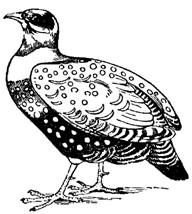
Fig. 288—Partridge
Partridge (1Sa 26:20; Jer 17:11; Sir 11:30). Late commentators state that there are four species of the tetrao (grouse) of Linnæus abundant in Palestine: the francolin (T. francolinus), the katta (T. alchata), the red-legged or Barbary partridge (T. petrosus), and the Greek partridge (T. saxatilis). In this now obsolete classification there are included not less than three genera, according to the more correct systems of recent writers, and not one strictly a grouse occurs in the number, though the real T. Urogallus, or cock of the woods, is reported to frequent Asia Minor in winter, and in that case is probably no stranger in Libanus. There is, however, the genus Pterocles, of which the P. alchata is the katta, ganga, cata, and pin-tailed grouse of authors, a species very common in Palestine, and innumerable in Arabia; but it is not the only one, for the sand-grouse of Latham (P. arenarius) occurs in France, Spain, Barbary, Arabia, Persia, and on the north side of the Mediterranean, or all round Palestine. P. Arabicus, and probably P. exustus, or the Arabian and singed gangas, occur equally in the open districts of the south, peopling the desert along with the ostrich. All are distinguished from other genera of Tetraonidæ by their long and powerful wings, enabling them to reach water, which they delight to drink in abundance; and by this propensity they often indicate to the thirsty caravan in what direction to find relief. They feed more on insects, larvae, and worms than on seeds, and none of the species having a perfect hind toe, that reaches the ground, they run fast: these characteristics are of some importance in determining whether they were held to be really clean birds, and consequently could be the selav of the Israelites, which our versions have rendered ’quail’ [QUAIL; UNCLEAN BIRDS].
The Francolin forms a second genus, whereof the common tree-partridge is the Syrian species best known, though most likely not the only one of that country. It is larger than the ganga; the male is always provided with one pair of spurs (though others of the genus have two), and has the tail longer than true partridges. This species is valued for the table, is of handsome plumage, and common from Spain and France, on both sides of the Mediterranean, eastward to Bengal.
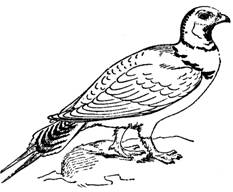
Fig. 289—Partridge
The partridge is a third genus, reckoning in Syria the two species before named, both red-legged and furnished with orange and black crescents on the sides; but the other markings differ, and the Barbary species is smaller than the Greek. They are inferior in delicacy to the common partridge, and it is probable that Perdix rufa, and the Caspian partridge, both resembling the former in many particulars, are no strangers in Syria.
The expostulation of David with Saul, where he says, ’The king of Israel is come out to seek a flea, as when one doth hunt a partridge on the mountains,’ is perfectly natural; for the red-legged partridges are partial to upland brush-wood, which is not an uncommon character of the hills and mountains of Palestine; and the koria sitting on her eggs and not hatching them (Jer 17:11), we take to allude to the liability of the nest being trodden under foot, or robbed by carnivorous animals, notwithstanding all the care and interesting maneuvers of the parent birds to save it or the brood; for this genus is monogamous, nestles on the ground, and both male and female sit and anxiously watch over the safety of their young.
A well-known bird, three varieties of which are found in Palestine. Saul’s hunting of David like a partridge upon the mountain, 1Sa 26:20, may be illustrated by an occasional practice of the Arabs, who, observing that this bird becomes languid on being started several times in quick succession, at length rush suddenly in upon it and knock it over with their clubs. In Jer 17:11, we may best render, as the partridge gathereth eggs which she hath not laid; the meaning being that she loses her toil since the young birds, when hatched, forsake her.\par
Partridge. (Hebrew, kore) Partridge occurs only 1Sa 26:20 and Jer 17:11. The "hunting this bird upon the mountains," 1Sa 26:20, entirely agrees with the habits of two well-known species of partridge, namely, Caccabis saxatilis, the Greek partridge, (which is the commonest partridge of the Holy Land), and Ammoperdix heyii. Our common partridge, Perdix cinerea, does not occur in Palestine.
(The Greek partridge somewhat resembles our red-legged partridge in plumage, but is much larger. In every part of the hill country, it abounds, and its ringing call noted, in early morning, echoes from cliff to cliff alike amid the barrenness of the hills of Judea, and in the glens of the forest of Carmel. -- Tristram’s Natural History of the Bible. The flesh of the partridge and the eggs are highly esteemed as food, and the search for the eggs at the proper time of the year is made a regular business. -- Editor).
This is Jeremiah’s reference, or rather to its nest being on the ground, liable to be trodden under foot or robbed by carnivorous animals, notwithstanding all the beautiful maneuvers of the parent bird to save the brood. Jehoiakim’s covetous grasping acts are here glanced at.
The word qone signifies ’caller’ and this suits the common Palestine partridge because of its loud ringing call. Two things are said of this bird. David, when pursued by Saul, compares himself to a partridge hunted on the mountains. 1Sa 26:20. This agrees with the way in which the partridges are taken: they are chased on the mountains till they are tired out. The other passage, Jer 17:11, says, "as the partridge sitteth on eggs and hatcheth them not; so he that getteth riches and not by right, shall leave them in the midst of his days, and at his end shall be a fool." In the margin it reads, she "that gathereth young which she hath not brought forth." This rendering is confirmed by the LXX and Vulgate and is supposed to refer to the partridge sitting upon eggs she has not laid, such eggs being left in her nest on the ground by other birds. When hatched the young birds desert her. This agrees with the context. The Caccabis saxatilis and Ammoperdix Heyii are known in Palestine.
PARTRIDGE (qôrç’, 1Sa 26:20, Jer 17:11).—Two kinds of partridge abound in Palestine. The chukar or rock partridge (Caccabis chukar) is the commonest of game birds. Its cry may be heard all over the land, and large coveys may be encountered in the autumn. It is distinguished by its red legs. It is excellent eating. Hey’s sand partridge (Ammoperdix heyi) occurs in enormous numbers around the Dead Sea. It is probably the partridge referred to in Isa 26:20: its short flights from place to place when hunted; Its hiding, trusting to its invisibility on account of its colour being so like the environment; its quick run from danger before taking to wing; and its final capture when too wearied to fly—must form a very suitable image of a poor human fugitive remorselessly pursued. The reference in Jer 17:11 is hard to understand; it may perhaps refer to the fact that when disturbed from their nests such birds sometimes never return. In Sir 11:30 the heart of a proud man is compared to a decoy partridge in a cage. It is still customary in Palestine to hunt the red-legged partridge by the aid of such decoys.
E. W. G. Masterman.
The first reference to it is found in 1Sa 26:20: “Now therefore, let not my blood fall to the earth away from the presence of Yahweh: for the king of Israel is come out to seek a flea, as when one doth hunt a partridge in the mountains.” David in this dialogue with Saul clearly indicates that if he did not hunt the partridge himself, he knew how it was done. The birds were commonly chased up the mountains and stunned or killed with “throw sticks.” David knew how deft these birds were at hiding beside logs and under dry leaves colored so like them as to afford splendid protection; how swiftly they could run; what expert dodgers they were; so he compared taking them with catching a flea. The other reference is found in Jer 17:11: “As the partridge that sitteth on eggs which she hath not laid, so is he that getteth riches, and not by right; in the midst of his days they shall leave him, and at his end he shall be a fool.” If this reference is supposed to indicate that partridges are in the habit of brooding on the nest of their kind or of different birds, it fails wholly to take into consideration the history of the bird. Partridges select a location, carefully deposit an egg a day for from 10 to 15 days, sometimes 20, and then brood, so that all the young emerge at one time. But each bird knows and returns to its nest with unfailing regularity. It would require the proverbial “Philadelphia lawyer” to explain this reference to a “partridge sitting on eggs she had not laid.” No ornithologist ever could reconcile it to the habits or characteristics of the birds. the King James Version translated these lines, “As the partridge sitteth on eggs, and hatcheth them not.” This was easy to explain clearly. The eggs of the partridge were delicious food, and any brooding bird whose nest was discovered after only a few days of incubation did not hatch, because she lost her eggs. Also the eggs frequently fall prey to other birds or small animals. Again, they are at the mercy of the elements, sometimes being spoiled by extremely wet cold weather. Poultry fanciers assert that a heavy thunder storm will spoil chicken eggs when hatchingtime is close; the same might be true with eggs of the wild. And almost any wild bird will desert its nest and make its former brooding useless, if the location is visited too frequently by man or beast.
There is also a partridge reference in the Book of Ecclesiasticus 11:29 ff the Revised Version (British and American)): “Bring not every man into thine house; for many are the plots of the deceitful man. As a decoy partridge in a cage, so is the heart of a proud man; and as one that is a spy, he looketh upon thy falling. For he lieth in wait to turn things that are good into evil; and in things that are praiseworthy he will lay blame.” The reference is to confining a tame partridge in a hidden cage so that its calls would lure many of its family within range of arrows or “throw sticks” used by concealed hunters.
1Sa 26:20 (a) David compares his weakness and helplessness, to the condition of the partridge or the quail which has no power against the hunter, nor the wolf.
Jer 17:11 (a) This is a type of man’s work wherein he partly succeeds and partly fails. The quail hatches her eggs in her nest, but the nest is so deep, and there are so many eggs in it that the lower ones in the bottom row may not receive the heat of her body and therefore do not hatch. It is so in Christian work. Some will be successful, and some will fail. There will always be some who believe and some who do not. No work done by man is completely successful. It also means, as given by Moffatt, "like a partridge hatching eggs it never laid, so is the man who makes money unfairly; it leaves him ere his life is over, and in the end he proves himself a fool."
Partridge. From early times, the partridge has been a game bird. They were among the birds which could be eaten as clean food by the Jewish people. Two species, the sand partridge (Isa 34:15), (NEB) and the chukar, are common in Palestine.
Partridges live in fields, feeding on grain and insects. They usually travel in coveys of 12 to 30 birds. Their meat is tasty, and the bird is clever enough to give the hunter a fine chase. It takes sharp eyes to spot the mottled feathers of a partridge. When alarmed, the bird will hide in a hole, crouch among loose stones, or fly from tree to tree with loudly whirring wings. David compared himself to a partridge when he was fleeing from Saul (1Sa 26:20).
The prophet Jeremiah compared the person who gathered riches by unrighteous means to a partridge that gathers a brood of young birds which she has not hatched (Jer 17:11).
A partridge is the most common game bird in the Holy Land. It looks like a chicken but has a slimmer body and a longer tail.
Two kinds of partridge live in the Holy Land:
Sand partridge (Ammoperdix heyi) — Found near the Dead Sea, in the Jordan River valley, and in the Sinai Desert. It is medium-sized with yellow feet. The male has sandy-buff feathers with brown bars on the upper tail and a chestnut and white underside. The female is grayish buff.
Chukar partridge (Alectoris graeca) — Similar to the French partridge of Europe. It is about 40.6 centimeters (16 inches) long and has bright, colorful feathers.
Patridges in the Bible
The partridge was hunted for food. People caught it by chasing until it was too tired to run (1 Samuel 26:20). It could also be caught with snares (Psalm 91:3) or by hunters hiding in a shelter. Although it can run quickly and jump up steep cliffs, it is still easy to catch when tired. Its brownish-green feathers help it hide among bushes.
The bird lays many eggs, which keeps it from becoming extinct despite heavy hunting. Sometimes the female lays two groups of eggs: one for herself and one for the male to keep warm. This may explain the saying in Jeremiah 17:11 about a bird gathering eggs it did not hatch. This was used as a picture of someone taking credit for work they did not do.
See also Birds.
Aquifer Open Bible Dictionary © 2026 Mission Mutual, an adaptation of the Tyndale Open Bible Dictionary © 2023 Tyndale House Publishers. Licensed under CC BY-SA 4.0.
Discussion:
Partridges have been hunted and trapped for millennia. In the land of Israel there are three common types of partridge which are still found today: the Rock Partridge Alectoris graeca (also known in the Middle East as the Chukar Alectoris chukar), the Black Francolin Francolinus francolinus, and the Sand Partridge Ammoperdix heyi. In modern Hebrew the sand partridge is still called qore’, but in biblical times all three types of partridge were probably referred to by this name. The name means “the caller", a reference to the ringing crowing of the males, typically while standing on top of a rock.
Partridges were hunted with stones, slings, and throwing sticks, and were also caught in snares. In 1SA 26:20 David likens himself to a partridge being hunted. This is a very apt simile, since he had been moving from one refuge to another, just as a partridge flies short distances from cover to cover when being chased. He had also been hiding in the same rocky hills that partridges inhabit near En Gedi.
In SIR 11:30 there is reference to “a decoy partridge in a cage". This refers to a practice still common in many parts of the world. A male partridge is captured and the caged bird is left in an area where it is known there are partridges, or it is taken from the cage and tethered to a bush by its leg. Grain is scattered around and slip noose snares are set. Toward sundown the captive partridge begins to call, and this attracts other partridges, which begin to feed on the grain and are snared. See also The Works of Their Hands, 1.4.3 Cage
Partridge eggs were also an important part of the ancient diet, and many Bedouin tribes still collect these eggs regularly. Up until the twentieth century partridges of all three types were abundant throughout Palestine. Today they still exist but in much smaller numbers.
Description:
The three partridges mentioned above live in slightly different habitats. The rock partridge, as its name suggests, frequents rocky hill terrain. It is found all over Israel, where it makes good use of the broken terrain to remain hidden. The black francolin prefers denser vegetation in wadis or river valleys. The presence of both these partridges is usually known from their calls rather than from actual sightings of the birds. The sand partridge frequents the Judean Desert and can still be seen coming to drink at pools in wadis along the Dead Sea.
All three types of partridge, in spite of their different markings and the fact that the sand partridge is smaller than the other two, are typical of the partridge family. They live in small flocks called coveys, lay a great many eggs, and prefer to run when in danger, flying only when necessary. Even when they take flight they fly for only a short distance before dropping back to the ground. They also have the ability to squat absolutely still, almost in a trance. With their natural camouflage this ability usually means that the birds will not be seen even by someone passing very near them.
The rock partridge is about 35 centimeters (14 inches) in length and has striking white cheeks with a black band running from its brow, through its eyes, down its neck, and curving around its breast. It also has striking black and chestnut stripes on its flanks. Its back and wings are gray. The beak and legs are red. Both sexes look alike.
The black francolin is about the same size but has a slightly shorter tail. The male has a black breast and flanks. The female is a speckled brown.
The sand partridge is the color of the local sand and is about half the size of the other two types.
Special significance or symbolism:
See the notes in the Translation subsection below.
Translation:
Partridges or their close relatives the button quails and pheasants are found all over the world, and finding a local equivalent should not prove difficult. In Asia the Bamboo Partridge Alectoris orientalis is found from Pakistan to China and down through Southeast Asia. In Australia the Brown Quail Coturnix australis and the Stubble Quail Coturnix pectoralis are probably the closest equivalents, rather than the mallee fowl or the scrub fowl, which are mound builders, a very specialized type of bird.
In Africa any of the francolins are a good equivalent. They are found all over Africa.
JER 17:11: There are a number of problems connected with the exegesis of the first half of this verse, as can be seen from the following English versions:
"Like a partridge that gathers into its nest eggs which it has not laid” (NEB);
"As the partridge sitteth on eggs and hatcheth them not” (KJV);
"Like a partridge that hatches eggs it did not lay” (NIV; compare JB, REB, TEV);
"Like the partridge that gathers a brood which she did not hatch” (RSV; compare NAB).
In trying to arrive at a well-motivated interpretation of this verse, two Hebrew words are crucial: dagar and yalad.
Dagar is a word found only twice in the Bible, here in JER 17:11 and in ISA 34:15. Since the word is not a common one, it is only the contexts of these two verses that provide clues to its meaning. It is the Isaiah passage that gives the most contextual clues, but even there, there are some words with very obscure meaning. Most commentaries and translations agree about the first two verbs but about little else in the verse. If we transliterate rather than translate the disputed Hebrew words in , a fairly literal translation of the first half of the verse reads:
There a qipoz will nest, will lay eggs, will break open, and dagrah under her shadow.
All English versions translate bak‘ah ("break open") as “hatch them", and this leads some to translate dagrah as “gather her brood". However, it should be noted that this interpretation involves a change of implied object from “eggs” to “chicks” or “brood".
If the translation of dagar were done consistently, one would expect that the Jeremiah passage would be translated:
a) As a partridge cares for/gathers chicks it did not hatch. …
Only RSV, NAB, and NEB in fact do this. In place of this most of the others have:
b) Like a partridge that sits on eggs ("hatches” in NIV, TEV, and JB) it did not lay. …
Most versions thus translate dagar in two different ways even though the contexts of both passages seem very similar.
The Hebrew word yalad is a much more common word, and in other contexts it means “give birth to” or “bring forth". JER 17:11 is the only place where this verb is used with a bird. This would seem to indicate two possible translations of the verb in this verse. The first is “lay eggs". This is what leads to interpretation b) above and to the two very different interpretations being given for dagar in what are basically identical contexts. However, the noun form yeled, when used of birds, does not refer to their eggs but to their chicks (compare JOB 38:41), and this would justify the second possible translation, namely “to hatch chicks".
Interpretation b) is supported by Jewish Midrashic traditions and by most commentaries and Bible dictionaries. These sources usually contain a reference to “a popular but incorrect belief that partridges steal eggs from other birds.” However, in the course of the research for this Handbook, this assumption was found to be very dubious. Many scholars now question its validity. The major problem with the traditional interpretation is that the only supporting evidence for the “popular but erroneous belief” is this one possible translation of JER 17:11. The argument is thus circular: JER 17:11 must be interpreted in the light of a myth; the source for the myth is JER 17:11.
In trying to provide some hypothetical basis for the “popular but erroneous belief,” reference is made to the fact that most partridges indigenous to the land lay twelve or more eggs in a clutch, and this might have led to the belief that partridges collect eggs from each other. However, as mentioned above, there is no independent evidence at all for such a belief. Partridges and their eggs were, and are, a regular and important food source, and it is hard to believe that the ancient prophets did not know where the eggs came from.
There are three possible alternative interpretations of JER 17:11, none of which corresponds to interpretation b) above.
The first alternative results from an interpretation of dagar as meaning “to sit in a broody state while incubating eggs.” This is the meaning given as a gloss in Abraham Even-Shoshan’s A New Concordance of the Old Testament. Yalad is taken to mean “lay eggs". The verse can then be translated:
c) “Like a partridge that sits brooding but has not laid eggs ...."
This could then be taken as a reference to the habit partridges have of sitting motionless in the shade, or as one of their means of defence. In situations of danger from eagles or hawks, they make use of their fantastic camouflage and sit absolutely still for long periods in what is almost a state of trance. When sitting like this one can approach to within a few feet of the bird. The point of the simile would be that the man who has become rich by unjust means is like a partridge that only appears to be productive. No commentator that I know of has raised this possible interpretation, probably because it is difficult to relate to the last half of the verse, which is literally “they will leave him half-way through his life."
In ISA 34:15 the last phrase would then be translated as “sits brooding in the shade.” (In response to the suggestion that the Hebrew should be altered to read betseyha “her eggs” instead of betsilah “in/under her shade", it has been pointed out by many scholars that the sequence of verbs which then results is improbable. The existing text yields “makes a nest ... lays ... hatches ... sits brooding her eggs.")
The second possible alternative interpretation follows the same understanding of dagar, but yalad is taken to mean “hatch chicks":
d) “Like a partridge that sits brooding on eggs but does not get to hatch them ...."
This would refer to the fact that a large percentage of the numerous eggs that a partridge lays were, and are, collected by people or stolen by other animals such as jackals and mongooses, birds such as crows, or monitor lizards. It is interesting that Canon Tristram mentions finding a partridge nest containing twenty-eight eggs, and that a particular Bedouin camp he was associated with collected over eight hundred partridge eggs in a single breeding season. The collecting of eggs is mentioned in ISA 10:14, and it is likely that partridge eggs were the most common and easiest to find.
Rendering d) is the interpretation adopted by KJV. The point of the comparison would then seem to be that getting rich by dishonest means is as futile as a partridge laying eggs that others steal. The inference seems to be that ill-gotten wealth will be taken away, either by the authorities or perhaps by God. This is the interpretation preferred by a growing number of scholars. It relates fairly well to the last half of the verse.
The third possible alternative interpretation is that followed by RSV and NAB. It involves interpreting dagar as “to gather or mother chicks like a hen does", and yalad as “to hatch chicks":
e) “Like a partridge that gathers chicks it did not hatch ...."
The reference would then be to the fact that in a flock or covey of rock partridges the hens do not differentiate between their own chicks and the other chicks in the flock. (This is not true of some of the other partridge species). Rock partridge hens can be seen caring for as many as fifty chicks at a time. As the chicks grow, their ties with the hens weaken considerably, and when the expanding flock divides up into smaller flocks the offspring often move away. Thus the imagery in JER 17:11 is carried by this interpretation right through the whole verse, and the clause “they will leave him halfway through his life” is very pertinent.
ISA 34:15 can then be interpreted consistently as “There the qipoz will make her nest, lay eggs, hatch them, and gather her chicks under her protecting shade.” Of the options e) seems to be the best, suiting the contexts and resulting in a consistent translation of the two occurrences of dagar. However, a footnote explaining the behavior of rock partridge hens seems necessary in order to convey the inference.
In JDG 15:19 the place name En-Haqore [Hakkore] should be taken to mean “Well of the Caller” rather than “Well of the Partridge", since the name commemorates Samson’s calling to God for help.
Animals in the Bible © United Bible Societies. Licensed under CC BY-SA 4.0.