
See HINNOM.\par
Gehen’na. See Hinnom.
(
The word Gehennameans the valley of Hinnom (lit. Gai-Hinnom), immediately outside Jerusalem (see Jos 15:8) in 2Ki 23:10, 2Ch 28:3; 2Ch 33:6, it is the scene of degraded idolatrous customs; and in Jer 19:1-15. it is described as not only a centre of iniquity, but also a place of retribution in this sense it was used by the Jews in our Lord’s time (see e.g. Pirko Aboth), and the Lord Himself takes it as the place or condition of punishment. It is only used by Him (Mat 5:22; Mat 5:29-30; Mat 10:28; Mat 18:9; Mat 23:15; Mat 23:33; Mar 9:43; Mar 9:47; Luk 12:5) and in Jas 3:6.
[Gehen’na] See HELL.
GEHENNA.—The Heb. name Hinnom is generally preceded in the OT by the word Gç-, ‘valley’ (Jos 15:8 ff.), thus Gç-hinnôm, or ‘Valley of Hinnom,’ whence the NT word
‘The pleasant vale of Hinnom, Tophet thence,
And black Gehenna called, the type of hell’ (Par. Lost, i. 404).
Opinions differ as to the identification of the valley; but most authorities, including Robinson, Stanley, Buhl, and many others, as well as modern Arab tradition, identify it with the valley on the W. and S. side of the Holy City, the upper portion of which is called in Arabic Wâdy er-Rabâbi; the lower, Wâdy Gehennam, or ‘Valley of Hell.’ It is a ‘deep and yawning gorge’ (Wilson), and ‘never contains water’ (Socin), its descent from its original source to Bir Eyyub being approximately 670 ft. At the lower extremity are found numerous rock-tombs, for here seems to have been the potter’s field for the burial of pilgrims, which was purchased with the ‘30 pieces of silver,’ and known as Akeldama, or field of blood (Mat 27:3-8, Act 1:18-19). On the other hand, the Arab writer Edrisi of the 12th cent. a.d., followed by Sir C. Warren in an extended and somewhat convincing article on ‘Hinnom (Valley of)’ in Hasting’s Dictionary of the Bible , identifies it with the Kidron on the E. of Jerusalem, including also its continuation below the junction of the Eastern and Western valleys at Bir Eyyub; the whole of the valley in its descent toward the Dead Sea being known to the Arabs as Wâdy en-Nâr, ‘Valley of Fire.’ Still another identification is that advocated by Sayce, R. Smith, Birch, and others, who locate it between the Temple area and the City of David, identifying it with the valley known since Josephus’ day as the Tyropœon; but the first identification is, on the whole, the most probable.
Literature.—Robinson, BRP [Note: RP Biblical Researches in Palestine.] i. 353, 402 ff.; Stanley, SP [Note: P Sinai and Palestine.] 239, 571; Barclay, City of the Great King, 89, 90; Wilson, Recovery of Jerusalem, 6, 19, 307, Lands of the Bible, i. 403 ff.; Tristram, Bible Places, 152, 162; Couder, Handbook to the Bible, 329 f.; Baedeker-Socin, Pal. [Note: Palestine, Palestinian.] 99; Barrows, Sacred Geog. and Antiquity, 94–96; Ritter, Geog. of Pal. [Note: Palestine, Palestinian.] iv. 164 ff.; artt. ‘Gehenna’ and ‘Hinnom (Valley of) in Hasting’s Dictionary of the Bible ; ‘Hinnom (Valley of)’ in Encyc. Bibl.; Swete, Com. on St. Mark, ad 9:45; Riehm, HWB [Note: WB Handwörterbunch.] ; Rosenmüller, Biblisch. Geog. ii. 156, 164; Smith’s DB [Note: Dictionary of the Bible.] , art ‘Hinnom (Valley of).’
George L. Robinson.
(Hebr.  ; Greek,
By: Kaufmann Kohler, Ludwig Blau
Nature and Situation.
The place where children were sacrificed to the god Moloch was originally in the "valley of the son of Hinnom," to the south of Jerusalem (Josh. xv. 8, passim; II Kings xxiii. 10; Jer. ii. 23; vii. 31-32; xix. 6, 13-14). For this reason the valley was deemed to be accursed, and "Gehenna" therefore soon became a figurative equivalent for "hell." Hell, like paradise, was created by God (Soṭah 22a); according to Gen. R. ix. 9, the words "very good" in Gen. i. 31 refer to hell; hence the latter must have been created on the sixth day. Yet opinions on this point vary. According to some sources, it was created on the second day; according to others, even before the world, only its fire being created on the second day (Gen. R. iv., end; Pes. 54a). The "fiery furnace" that Abraham saw (Gen. xv. 17, Hebr.) was Gehenna (Mek. xx. 18b, 71b; comp. Enoch, xcviii. 3, ciii. 8; Matt. xiii. 42, 50; 'Er. 19a, where the "fiery furnace" is also identified with the gate of Gehenna). Opinions also vary as to the situation, extent, and nature of hell. The statement that Gehenna is situated in the valley of Hinnom near Jerusalem, in the "accursed valley" (Enoch, xxvii. 1 et seq.), means simply that it has a gate there. It was in Zion, and had a gate in Jerusalem (Isa. xxxi. 9). It had three gates, one in the wilderness, one in the sea, and one in Jerusalem ('Er. 19a). The gate lies between two palm-trees in the valley of Hinnom, from which smoke is continually rising (ib.). The mouth is narrow, impeding the smoke, but below Gehenna extends indefinitely (Men. 99b). According to one opinion, it is above the firmament, and according to another, behind the dark mountains (Ta'an. 32b). An Arabian pointed out to a scholar the spot in the wilderness where the earth swallowed the sons of Korah (Num. xvi. 31-32), who descended into Gehenna (Sanh. 110b). It is situated deep down in the earth, and is immeasurably large. "The earth is one-sixtieth of the garden, the garden one-sixtieth of Eden [paradise], Eden one-sixtieth of Gehenna; hence the whole world is like a lid for Gehenna. Some say that Gehenna can not be measured" (Pes. 94a). It is divided into seven compartments (Soṭah 10b); a similar view was held by the Babylonians (Jeremias, "Hölle und Paradies bei den Babyloniern," pp. 16 et seq., Leipsic, 1901; Guthe, "Kurzes Bibel-wörterb." p. 272, Tübingen and Leipsic, 1903).
Because of the extent of Gehenna the sun, on setting in the evening, passes by it, and receives from it its own fire (evening glow; B. B. 84a). A fiery stream ("dinur") falls upon the head of the sinner in Gehenna (Ḥag. 13b). This is "the fire of the West, which every setting sun receives. I came to a fiery river, whose fire flows like water, and which empties into a large sea in the West" (Enoch, xvii. 4-6). Hell here is described exactly as in the Talmud. The Persians believed that glowing molten metal flowed under the feet of sinners (Schwally, "Das Leben nach dem Tode," p. 145, Giessen, 1892). The waters of the warm springs of Tiberias are heated while flowing past Gehenna (Shab. 39a). The fire of Gehenna never goes out (Tosef., Ber. 6, 7; Mark ix. 43 et seq.; Matt. xviii. 8, xxv. 41; comp. Schwally, l.c. p. 176); there is always plenty of wood there (Men. 100a). This fire is sixty times as hot as any earthly fire (Ber. 57b). There is a smell of sulfur in Gehenna (Enoch, lxvii. 6). This agrees with the Greek idea of hell (Lucian,
It is assumed that there is an angel-prince in charge of Gehenna. He says to God: "Put everything into my sea; nourish me with the seed of Seth; I am hungry." But God refuses his request, telling him to take the heathen peoples (Shab. 104). God says to the angel-prince: "I punish the slanderers from above, and I also punish them from below with glowing coals" ('Ar. 15b). The souls of the sons of Korah were burned, and the angel-prince gnashed his teeth at them on account of their flattery of Korah (Sanh. 52a). Gehenna cries: "Give me the heretics and the sinful [Roman] power" ('Ab. Zarah 17a).
Judgment.
It is assumed in general that sinners go to hell immediately after their death. The famous teacher Johanan b. Zakkai wept before his death because he did not know whether he would go to paradise or to hell (Ber. 28b). The pious go to paradise, and sinners to hell (B. M. 83b). To every individual is apportioned two shares, one in hell and one in paradise. At death, however, the righteous man's portion in hell is exchanged, so that he has two in heaven, while the reverse is true in the case of sinners (Ḥag. 15a). Hence it would have been better for the latter not to have lived at all (Yeb. 63b). They are cast into Gehenna to a depth commensurate with their sinfulness. They say: "Lord of the world, Thou hast done well; Paradise for the pious, Gehenna for the wicked" ('Er. 19a).
There are three categories of men; the wholly pious and the arch-sinners are not purified, but only those between these two classes (Ab. R. N. 41). A similar view is expressed in the Babylonian Talmud, which adds that those who have sinned themselves but have not led others into sin remain for twelve months in Gehenna; "after twelve months their bodies are destroyed, their souls are burned, and the wind strews the ashes under the feet of the pious. But as regards the heretics, etc., and Jeroboam, Nebat's son, hell shall pass away, but they shall not pass away" (R. H. 17a; comp. Shab. 33b). All that descend into Gehenna shall come up again, with the exception of three classes of men: those who have committed adultery, or shamed their neighbors, or vilified them (B. M. 58b). The felicity of the pious in paradise excites the wrath of the sinners who behold it when they come from hell (Lev. R. xxxii.). The Book of Enoch (xxvii. 3, xlviii. 9, lxii. 12) paraphrases this thought by saying that the pious rejoice in the pains of hell suffered by the sinners. Abraham takes the damned to his bosom ('Er. 19a; comp. Luke xvi. 19-31). The fire of Gehenna does not touch the Jewish sinners because they confess their sins before the gates of hell and return to God ('Er. 19a). As mentioned above, heretics and the Roman oppressors go to Gehenna, and the same fate awaits the Persians, the oppressors of the Babylonian Jews (Ber. 8b). When Nebuchadnezzar descended into hell, all its inhabitants were afraid that he was coming to rule over them (Shab. 149a; comp. Isa. xiv. 9-10). The Book of Enoch also says that it is chiefly the heathen who are to be cast into the fiery pool on the Day of Judgment (x. 6, xci. 9, et al.). "The Lord, the Almighty, will punish them on the Day of Judgment by putting fire and worms into their flesh, so that they cry out with pain unto all eternity" (Judith xvi. 17).
Valley of Ge-Hinnom.(From a photograph by Bonfils.)
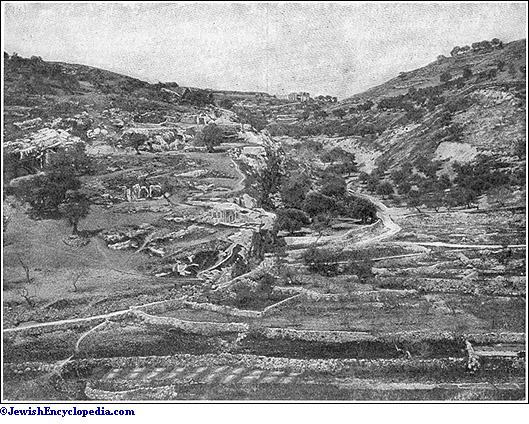
The sinners in Gehenna will be filled with pain when God puts back the souls into the dead bodies on the Day of Judgment, according to Isa. xxxiii. 11 (Sanh. 108b). Enoch also holds (xlviii. 9) that the sinners will disappear like chaff before the faces of the elect. There will be no Gehenna in the future world, however, for God will take the sun out of its case, and it will heal the pious with its rays and will punish the sinners (Ned. 8b).
Sin and Merit.
It is frequently said that certain sins will lead man into Gehenna. The name "Gehenna" itself is explained to mean that unchastity will lead to Gehenna ( ; 'Er. 19a); so also will adultery, idolatry, pride, mockery, hypocrisy, anger, etc. (Soṭah 4b, 41b; Ta'an. 5a; B. B. 10b, 78b; 'Ab. Zarah 18b; Ned. 22a). Hell awaits one who indulges in unseemly speech (Shab. 33a; Enoch, xxvii.); who always follows the advice of his wife (B. M. 59a); who instructs an unworthy pupil (Ḥul. 133b); who turns away from the Torah (B. B. 79a; comp. Yoma 72b). For further details see 'Er. 18b, 101a; Sanh. 109b; Ḳid. 81a; Ned. 39b; B. M. 19a.
On the other hand, there are merits that preserve man from going to hell; e.g., philanthropy, fasting, visiting the sick, reading the Shema' and Hallel, and eating the three meals on the Sabbath (Giṭ. 7a; B. B. 10a; B. M. 85a; Ned. 40a; Ber. 15b; Pes. 118a; Shab. 118a). Israelites in general are less endangered (Ber. 10a) than heretics, or, according to B. B. 10a, than the heathen. Scholars (Ḥag. 27a; comp. Men. 99b and Yoma 87a), the poor, and the pious (Yeb. 102b) are especially protected. Three classes of men do not see the face of hell: those that live in penury, those suffering with intestinal catarrh, and those that are pressed by their creditors ('Er. 41b). It would seem that the expressions "doomed to hell" and "to be saved from hell" must be interpreted hyperbolically. A bad woman is compared to Gehenna in Yeb. 63b. On the names of Gehenna see 'Er. 19a; B. B. 79a; Sanh. 111b; et al.
Bibliography:
Winer, B. R. i. 491;
Hamburger, R. B. T. i. 527-530;
Hastings, Dict. Bible, ii. 343-346;
H. Guthe, Kurzes Bibelwörterb. pp. 271-274, Tübingen and Leipsic, 1903;
G. Brecher, Das Transcendentale, etc. pp. 69-73, Vienna, 1850;
A. Hilgenfeld, Jüdische Apocalyptik, Index, Jena, 1857;
F. Weber, Jüdische Theologie, pp. 336 et seq.;
E. Stave, Der Einfluss des Parsismus auf das Judenthum, pp. 153-192 et seq., Haarlem, 1898;
James, Traditional Aspects of Hell, London, 1903.
GEHENNA.—A word derived from Ge-Hinnom, the valley on the west of Jerusalem. In this valley it is possible that Molech and Tammuz were worshipped (2Ki 23:18, 2Ch 28:3; 2Ch 33:6, Jer 7:31; Jer 32:35). The recollection of this terrible worship gave to the valley a sinister character, and led to its being defiled by Josiah (2Ki 23:6; 2Ki 23:10), for the purpose of preventing these rites. Thereafter it became the place for the burning of the refuse of the city, along with dead animals and the bodies of criminals. It was natural, therefore, that the name should become a synonym of hell (cf. Mat 5:29; Mat 10:28). In its eschatological force Gehenna was the place of punishment. It generally was conceived of as being under the earth, but it was very much vaster in extent than the earth. It was believed to be filled with fire intended for the punishment of sinners, who apparently went there immediately after death. Late Rabbinic thought would seem to imply that men who are neither great saints nor great sinners might be purified by the fire of Gehenna. Only those who had committed adultery or shamed or slandered their neighbours were believed to be hopelessly condemned to its fires, while the Jews were not to be permanently injured by them. According to the later belief, Gehenna was to be destroyed at the final consummation of the age. There is no clear evidence that Gehenna was regarded as a place for the annihilation of the wicked, although there are some passages which give a certain support to this opinion. No systematic eschatological statement has, however, been preserved for us from Jewish times, much less one which may be said to represent a general consensus of opinion. The NT writers employ the word in its general force as a synonym for the idea of endless punishment for sinners, as over against ‘heaven’—the synonym of endless bliss for those who have enjoyed the resurrection. They attempt, however, no description of suffering within its limits further than that implied in the figures of fire and worms.
Shailer Mathews.
The modified name of a valley, the site of which is sought to the west and south of Jerusalem. It became the scene of idolatrous rites by fire as well as, it is thought, the place for burning refuse and the corpses of outcasts. The name is used invariably by Our Lord to designate Hell, the abode of the damned, where "the fire is not extinguished" (Mark 9).
See Hell.
Originally, a location southwest of Jerusalem where children were burned as sacrifices to the god Molech. It later became a garbage dump with a continuous burning of trash. Therefore, it was used biblically, to illustrate the abode of the damned in Christian and Jewish theology. Gehenna is mentioned in Mar 9:43ff and Mat 10:28 as the place of punishment of unquenchable fire where both the body and soul of the wicked go after death. It is apparently the future abode of Satan and his angels (Mat 25:41).
“Gehenna” is the English spelling of a Greek word that comes from Aramaic. The word originally meant “the Valley of [the son(s) of] Hinnom” in Hebrew. This was a deep valley that marked the border between the lands of two ancient Israelite tribes: Benjamin and Judah (Joshua 15:8; 18:16). Today, people think this valley is the same as Wadi el-Rababi, a deep valley that runs south of the Old City of Jerusalem, starting near its western wall.
Gehenna in the Old Testament
The place became known for worshiping other gods when some of Judah’s kings ruled there. Kings Ahaz and King Manasseh allowed people to worship false gods like Molech and even kill babies (2 Kings 16:3; 21:6; 2 Chronicles 28:3; 33:6; Jeremiah 19:6; 32:35).
King Josiah ended these evil acts (2 Kings 23:10). The prophet Jeremiah talked about this valley when he warned people about God’s judgment (Jeremiah 2:23; 7:30–32; 19:5–6).
Later, the valley appears to have been used for disposing of the bodies of criminals. A longstanding tradition also connects the site with the burning of refuse, though ancient sources do not clearly confirm this.
Some people think Judas, who betrayed Jesus, killed himself near this valley. Some people also identify the Potter’s Field, a burial place bought with the money Judas received for betraying Jesus, with the south side of the valley.
Because of all the evil things that happened there, people began to use the name “Gehenna” to mean a place where bad people are punished after they die (1 Enoch 18:11–16; 27:1–3; 54:1; 56:3–4; 90:26; 2 Esdras 7:36; compare Isaiah 30:33; 66:24; Daniel 7:10).
Gehenna in the New Testament
Jesus used this word to talk about where people who do not follow God will go when they die (Matthew 5:22; 10:28; 18:9). Since Gehenna is a place of fire (Mark 9:43), it is also called the lake of fire (Matthew 13:42, 50; Revelation 20:14–15). This is the place where evil people will be sent (Matthew 23:15, 33). Satan and his devils will also be sent there forever (Matthew 25:41; Revelation 19:20; 20:10).
It is important to understand that Gehenna is different from other words about what happens after death. In the Old Testament, “Sheol” is the place where people go right after they die before the last Day of Judgment. The New Testament name for this place is ”Hades.” “Gehenna” is the final place where people will be punished forever (compare Psalms 49:14–15 with Matthew 10:28). The Greek form “Tartarus” is only used once in the Bible (2 Peter 2:4). It refers to a special place where God sent some angels who rebelled against him a very long time ago. These angels were part of the first rebellion against God that happened before human history began.
See also Dead, Place of the; Death; Hades; Hell; Sheol.
Aquifer Open Bible Dictionary © 2026 Mission Mutual, an adaptation of the Tyndale Open Bible Dictionary © 2023 Tyndale House Publishers. Licensed under CC BY-SA 4.0.