
Is the dissolution of marriage, or separation of man and wife. Divorce a mensa et thoro, 1:e. from bed and board,
in this case the wife has a suitable maintenance allowed her out of her husband’s effects. Divorce a vinculo matrimonii, 1:e. from the bonds of matrimony, is strictly and properly divorce. this happens either in consequence of criminality, as in the case of adultery, or through some essential impediment; as consanguinity, or affinity within the degrees forbidden, pre-contract, impotency, &c. of which impediments the canon law allows no less than 14. In these cases the woman receives again only what she brought. Sentences which release the parties a vinculo matrimonii, on account of impuberty, frigidity, consanquinity within the prohibited degrees, prior marriage, or want of the requisite consent of parents or guardians, are not properly dissolutions of the marriage contract, but judicial declarations that there never was any marriage; such impediment subsisting at the time as rendered the celebration of the marriage rite a mere nullity.
And the rite itself contains an exception of these impediments. The law of Moses, says Dr. Paley, for reasons of local expediency, permitted the Jewish husband to put away his wife; but whether for every cause, or for what cause, appears to have been controverted amongst the interpreters of those times. Christ, the precepts of whose religion were calculated for more general use and observation, revokes his permission as given to the Jews for their hardness of heart, and promulges a law which was thenceforward to confine divorces to the single cause of adultery in the wife, Mat 19:9. Inferior causes may justify the separation of husband and wife, although they will not authorize such a dissolution of the marriage contract as would leave either at liberty to marry again; for it is that liberty in which the danger and mischief of divorces principally consist. The law of this country, in conformity to our Saviour’s injunction, confines the dissolution of the marriage contract to the single case of adultery in the wife; and a divorce even in that case can only be brought about by an act of parliament, founded upon a previous sentiment in the spiritual court, and a verdict against the adulterer at common law; which proceedings taken together, compose as complete an investigation of the complaint as a cause can receive.
See Paley’s Mor. and Pol. Philosophy, p. 273; Doddridge’s Lectures, lect. 73.
As the ancient Hebrews paid a stipulated price for the privilege of marrying, they seemed to consider it the natural consequence of making a payment of that kind, that they should be at liberty to exercise a very arbitrary power over their wives, and to renounce or divorce them whenever they chose. This state of things, as Moses himself very clearly saw, was not equitable as respected the woman, and was very often injurious to both parties. Finding himself, however, unable, to overrule feelings and practices of very ancient standing, he merely annexed to the original institution of marriage a very serious admonition to this effect, viz. that it would be less criminal for a man to desert his father and mother, than without adequate cause to desert his wife, Gen 2:14, compared with Mal 2:11-16. He also laid a restriction upon the power of the husband as far as this, that he would not permit him to repudiate the wife without giving her a bill of divorce. He farther enacted in reference to this subject that the husband might receive the repudiated wife back, in case she had not in the meanwhile been married to another person; but if she had been thus married, she could never afterward become the wife of her first husband; a law, which the faith due to the second husband clearly required, Deu 24:1-4, compare Jer 3:1, and Mat 1:19; Mat 19:8. The inquiry, “What should be considered an adequate cause of divorce,” was left by Moses to be determined by the husband himself. He had liberty to divorce her, if he saw in her any thing naked, any thing displeasing or improper, any thing so much at war with propriety, and a source of so much dissatisfaction as to be, in the estimation of the husband, sufficient ground for separation. These expressions, however, were sharply contested as to their meaning in the later times of the Jewish nation. The school of Hillel contended, that the husband might lawfully put away the wife for any cause, even the smallest. The mistake committed by the school of Hillel in taking this ground was, that they confounded moral and civil law. It is true, as far as the Mosaic statute or the civil law was concerned, the husband had a right thus to do; but it is equally clear, that the ground of just separation must have been, not a trivial, but a prominent and important one, when it is considered, that he was bound to consult the rights of the woman, and was amenable to his conscience and his God. The school of Shammai explained the phrase, nakedness of a thing, to mean actual adultery. Our Lord agreed with the school of Shammai as far as this, that the ground of divorce should be one of a moral nature, and not less than adultery; but he does not appear to have agreed with them in their opinion in respect to the Mosaic statute. On the contrary, he denied the equity of that statute, and in justification of Moses maintained, that he permitted divorces for causes below adultery, only in consequence of the hardness of the people’s hearts, Mat 5:31-32; Mat 18:1-9; Mar 10:2-12; Luk 16:18. Wives, who were considered the property of their husbands, did not enjoy by the Mosaic statutes a reciprocal right, and were not at liberty to dissolve the matrimonial alliance by giving a bill of divorce to that effect. In the latter periods, however, of the Jewish state, the Jewish matrons, the more powerful of them at least, appear to have imbibed the spirit of the ladies of Rome, and to have exercised in their own behalf the same power that was granted by the Mosaic law only to their husbands, Mar 6:17-29; Mar 10:12.
Divorce [MARRIAGE]
Was tolerated by Moses for sufficient reasons, Deu 24:1-4 ; but our Lord has limited it to the single case of adultery, Mat 5:31,32 .\par
Divorce. Divorce is "a legal dissolution of the marriage relation". The law regulating this subject is found in Deu 24:1-4, and the cases in which the right of a husband to divorce his wife was lost are stated. Deu 22:19; Deu 22:29.
The ground of divorce is a point on which the Jewish doctors of the period of the New Testament differed widely; the school of Shammai seeming to limit it to a moral delinquency in the woman, whilst that the Hillel extended it to trifling causes, for example, if the wife burnt the food she was cooking for her husband.
The Pharisees wished, perhaps, to embroil our Saviour with these rival schools by their question, Mat 19:3, by his answer to which, as well as by his previous maxim, Mat 5:31, he declares that he regarded all the lesser causes than "fornication" as standing on too weak ground, and declined the question of how to interpret the words of Moses.
Deu 24:1-4 permits the husband to divorce the wife, if he find in her "uncleanness," literally, "matter of nakedness," by giving her "a bill of divorcement," literally, a book of cutting off. Polygamy had violated God’s primal law joining in one flesh one man to one woman, who formed the other half or converse side of the male. Moses’ law does not sanction this abnormal state of things which he found prevalent, but imposes a delay and cheek on its proceeding to extreme arbitrariness. He regulates and mitigates what he could not then extirpate. The husband must get drawn up by the proper authorities (the Levites) a formal deed stating his reasons (Isa 50:1; Jer 3:8), and not dismiss her by word of mouth. Moses threw the responsibility of the violation of the original law on the man himself; tolerating it indeed (as a less evil than enforcing the original law which the people’s "hardness of heart" rendered then unsuitable, and thus aggravating the evil) but throwing in the way what might serve as an obstacle to extreme caprice, an act requiring time and publicity and formal procedure.
The school of Shammai represented fornication or adultery as the "uncleanness" meant by Moses. But (Lev 20:10; Joh 8:5) stoning, not merely divorce, would have been the penalty of that, and our Lord (Mat 19:3; Mat 19:9, compare Mat 5:31) recognizes a much lower ground of divorce tolerated by Moses for the hardness of their heart. Hillel’s school recognized the most trifling cause as enough for divorce, e.g. the wife’s burning the husband’s food in cooking. The aim of our Lord’s interrogators was to entangle Him in the disputes of these two schools. The low standard of marriage prevalent at the close of the Old Testament appears in Mal 2:14-16. Rome makes marriage a sacrament, and indissoluble except by her lucrative ecclesiastical dispensations.
But this would make the marriage between one pagan man and one pagan woman a "sacrament," which in the Christian sense would be absurd; for Eph 5:23-32, which Rome quotes, and Mar 10:5-12 where even fornication is not made an exception to the indissolubility of marriage, make no distinction between marriages of parties within and parties outside of the Christian church. What marriage is to the Christian, it was, in the view of Scripture, to man before and since the fall and God’s promise of redemption. Adulterous connection with a third party makes the person one flesh with that other, and so, ipso facto dissolves the unity of flesh with the original consort (1Co 6:15-16). The divorced woman who married again, though the law sanctions her remarriage (Deu 24:1-4), is treated as "defiled" and not to be taken back by the former husband. The reflection that, once divorced and married again, she could never return to her first husband, would check the parties from reckless rashness.
Divorce. A dissolution of the marriage relation. The law on this subject is found in Deu 24:1-4, and the cases in which the right of a husband to divorce his wife was lost are stated in Deu 22:19; Deu 22:29. The ground of divorce is a point on which the Jewish doctors of the New Testament era differed widely; the school of Shammai seeming to limit it to a moral delinquency in the woman, whilst that of Hillel extended it to trifling causes, e.g., if the wife burnt the food she was cooking for her husband. The Pharisees wished perhaps to entangle our Saviour with these questions in their rival schools, Mat 19:3; but by his answer to them, as well as by his previous maxim. Mat 5:31-32, he declares that he regarded all the lesser causes than "fornication" as standing on too weak ground, and set forth adultery as the proper ground of divorce, Mat 5:32; Mat 19:9; Mar 10:11-12; Luk 16:18.
This was explained by the Lord. Moses had suffered a man to put away his wife for any cause, as we see in Deu 24:1; Deu 24:3; but the Lord maintained God’s original ordinance that what God had joined together, man had no right to put asunder, therefore a man must not put away his wife except for fornication, when she herself had broken the bond. Mat 5:31-32; Mat 19:3-9. A BILL OF DIVORCEMENT must be given to the woman, the drawing up of which, and having it witnessed, was some little check upon a man’s hasty temper.
Divorce is used symbolically to express God’s action in putting away Israel, who had been grossly unfaithful, and giving her a bill of divorcement. Isa 50:1; Jer 3:8.
Not Getting Divorced
1Co_7:10-11.
The Requirements Of Divorcement
Deu_24:1-4.
Those Who Get Divorced And Remarry Again
Mat_5:31-32; Mat_19:9; Mar_10:11-12.
Why Moses Allowed Divorce
Mat_19:7-8; Mar_10:2-6.
DIVORCE.—The teaching of Christ on this subject in the earliest Gospel, that of St. Mark, is clear and decisive. It is given in Mar 10:1; Mar 10:12. The Pharisees came to Him with the question, Is it lawful for a husband to divorce a wife? The Pharisees themselves could have had no doubt upon the point thus broadly stated. Divorce was, as they believed, sanctioned and legalized by Deu 24:1-2. But they debated about the scope and limits of divorce (cf. Bab. [Note: Babylonian.] Gittin, 90a, where the views of the Schools of Hillel and of Shammai are given. The former allowed divorce for trivial offences, the latter only for immoral conduct). In putting the question to Christ, the Pharisees therefore had an ulterior object. They came, says St. Mark, ‘tempting him,’ knowing probably from previous utterances of His that He would reply in words which would seem directly to challenge the Mosaic Law (cf. His criticism of the distinctions between ‘clean’ and ‘unclean’ meats, Mar 7:14-23). Christ answers with the expected reference to the Law, ‘What did Moses command?’ They state the OT position: Moses sanctioned divorce. Notice how nothing is said as to grounds or reasons for divorce. Christ at once makes His position clear. The law upon this point was an accommodation to a rude state of society. But a prior and higher law is to be found in the Creation narrative, ‘Male and female he created them’ (Gen 1:27 LXX Septuagint ), i.e. God created the first pair of human beings of different sexes that they might be united in the marriage bond. Further, it was afterwards said that a man should leave his father and mother and cleave to his wife, and that he and his wife should be one flesh. In other words, married couples were in respect of unity, as the first pair created by God, destined for one another. The marriage bond, therefore, which may be said to have been instituted by God Himself, must be from an ideal standpoint indissoluble. ‘What God joined, let not man sunder.’
In answer to a further question of His disciples, the Lord enforces this solemn pronouncement. A man who puts away his wife and marries another commits adultery. A woman who puts away her husband and marries another commits adultery. Upon this point Christ’s teaching passes beyond the ordinary conditions of Jewish society. No woman could divorce her husband by Jewish law. But that is no reason why the Lord should not have expressed Himself as Mk. records. There were exceptional cases of divorce by women in Palestine (cf. Salome, Josephus Ant. xv. vii. 10: ‘She sent him [Costobar] a bill of divorce, and dissolved her marriage with him, though this was against the Jewish laws’). And there is no reason why He may not have been acquainted with the possibility of divorce by women in the West, or why, even if He had not this in view, He may not have wished to emphasize His point by stating the wrongfulness of divorce, on either side, of the marriage bond.
With this earliest record of Christ’s teaching the fragment in the Third Gospel (Luk 16:18) is in agreement: ‘Every one who puts away his wife and marries another commits adultery, and he who marries a divorced woman commits adultery.’ That is to say, the marriage bond is indissoluble. The husband who divorces his wife and remarries commits adultery. And the man who marries a divorced wife commits adultery, because she is ideally the wife of her still living (first) husband.
In the First Gospel, however, we find this plain and unambiguous teaching, that divorce is inconceivable from an ideal standpoint, modified in a very remarkable way. In Mat 5:32 occurs a saying parallel in substance to Luk 16:18, but with the notable addition of the words, ‘except for the sake of unchastity’ (
Literature.—Hasting’s Dictionary of the Bible , art. ‘Marriage’; Dykes, Manifesto of the King, 255 ff.; Newman Smyth, Christian Ethics, 410 ff.; Expositor, iv. vii. [1893] 294.
W. C. Allen.
By: Solomon Schechter, David Werner Amram
Dissolution of marriage. The origin of the Jewish law of divorce is found in the constitution of the patriarchal family. The fundamental principle of its government was the absolute authority of the oldest male ascendent; hence the husband, as the head of the family, divorced the wife at his pleasure. The manner in which Hagar was dismissed by Abraham illustrates the exercise of this authority (Gen. xxi. 9-14). This ancient right of the husband to divorce his wife at his pleasure is the central thought in the entire system of Jewish divorce law. It was not set aside by the Rabbis, though its severity was tempered by numerous restrictive measures. It was not until the eleventh century that the absolute right of the husband to divorce his wife at will was formally abolished.
Hebrew Bill of Divorce, or Get, from the Cairo Genizah, Dated 1400 Seleucid Era = 1088 C.E.(In the New York Public Library.)
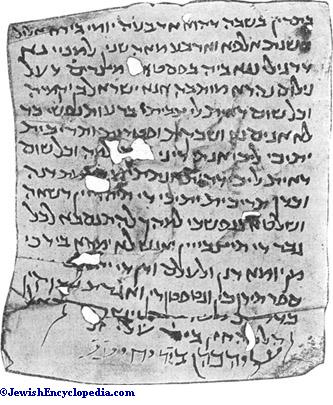
The earliest restrictions of this right are found in the Deuteronomic code. In two cases the law provided that the husband "shall not be at liberty to put her away all his days": (1) if he falsely accused her of antenuptial incontinence (Deut. xxii. 13-19); (2) if he had ravished her before marriage (Deut. xxii. 28, 29). In the Mishnaic period the theory of the law that the husband could divorce his wife at will was challenged by the school of Shammai. It interpreted the text of Deut. xxiv. 1 in such amanner as to reach the conclusion that the husband could not divorce his wife except for cause, and that the cause must be sexual immorality (Git. ix. 10; Yer. Soṭah i. 1, 16b). The school of Hillel, however, held that the husband need not assign any reason whatever; that any act on her part which displeased him entitled him to give her a bill of divorce (Giṭ. ib.). The opinion of the school of Hillel prevailed. Philo of Alexandria ("Of Special Laws Relating to Adultery," etc., ch. v.; English ed., ii. 310, 311) and Josephus ("Ant." iv. 8) held this opinion. Jesus seems to have held the view of the school of Shammai (Matt. xix. 3-9).
Modifications.
Although not overthrown, the ancient theory of the husband's unrestricted right was still further modified by the Mishnah. To the two restrictions mentioned in Deuteronomy the Mishnah, adds three others. It provides that the husband can not divorce his wife, (1) when she is insane (Yeb.xiv. 1), (2) when she is in captivity (Ket. iv. 9), or (3) when she is a minor, so young as to be unable to understand or to take care of her get, or bill of divorce (ib.). The Mishnah furthermore modified the right of the husband indirectly by making the divorce procedure difficult, and bristling with formalities in ordering, writing, attesting, and delivering the get. The matter required the assistance of one learned in the law (Ḳid. 6a), whose duty it became to attempt to reconcile the parties, unless sufficient reason appeared for the divorce.
Another check on the exercise of the theoretical right of the husband to divorce his wife was the law compelling him to pay her the dowry or the amount of her Ketubah. Rabban Gamaliel deprived the husband of the power to "annul" his geṭ (see Cancelation of Documents) (Giṭ. iv. 2). If the husband was insane, he could not divorce his wife; and if he was temporarily deranged or delirious, or intoxicated, he was for the time being incapable of performing this as well as other legal acts (Yeb. xiv. 1; Giṭ. vii. 1, 67b). A deaf-mute could not divorce his wife unless he had married her after he had become a deaf-mute (Yeb. xiv. 1). These many qualifications of the theoretical right of the husband to give a geṭ to his wife at his pleasure, resulted in gradually eliminating from the popular mind the notion that such a right existed. The views of the moralists were opposed to divorce (Giṭ. 90b), and finally (as stated above), in the eleventh century, by a decree of Rabbi Gershon of Mayence, this theoretical right of the husband was formally declared to be at an end. The substance of this famous decree is thus stated (Responsa "Asheri," xlii. 1): "To assimilate the right of the woman to the right of the man, it is decreed that even as the man does not put away his wife except of his own free will, so shall the woman not be put away except by her own consent." Where either of the parties, however, shows good cause for divorce the marriage will be dissolved against the will of the guilty party (Shulḥan 'Aruk, Eben ha-'Ezer, 119, 6, gloss).
Hebrew Bill of Divorce, or Geṭ.(From Bodenschatz, "Kirchliche Verfassung," 1748.)
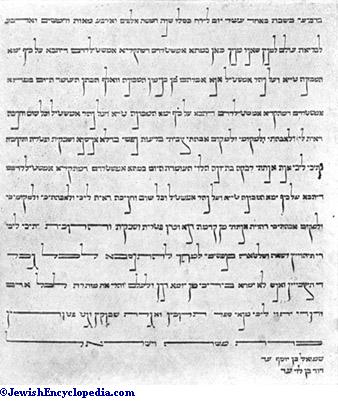
The wife's right to sue for divorce was unknown to the Biblical law. There is a germ of this right in Ex. xxi. 11, but it was not until the Mishnah that this right was established. The wife never obtained the right to give her husband a geṭ, but when the court decided that she was entitled to be divorced from him, he was forced to give her a geṭ. During the reign of the Herodians, under the influence of Roman practise, cases are recorded in which women sent bills of divorce to their husbands (Josephus, "Ant." xv. 11, xviii. 7). These were recognized as breaches of the law, and never became precedents. The following causes are recognized as entitling the wife to demand a bill of divorce from her husband: refusal of conjugal rights (Ket. v. 6); impotence (Ned. xi. 12); when the husband has some loathsome disease, or leprosy, or is engaged in some malodorous business (Ket. vii. 9); the husband's refusal to support her (Ket. 77a); cruel treatment anddeprivation of her lawful liberty of person (Ket. vii. 2-5, v. 5); wife-beating (Eben ha-'Ezer, 154, 3, gloss); the husband's apostasy (Maimonides, "Yad," Ishut, iv. 15)—in the last-named case the Jewish courts, having lost their authority over him, could appeal to the courts of the Gentiles to carry out their mandate ("Bet Joseph," 134); the husband's licentiousness (Eben ha-'Ezer, 154, 1, gloss).
Remarriage After Divorce.
After the parties had been divorced, the law favored their remarriage ('Eduy. iv. 7). But if the wife had married another man after her divorce, she could never be remarried to her first husband (Deut. xxiv. 1-5). To this Biblical law forbidding remarriage of the parties, the Mishnah adds five other cases. They can not remarry after a divorce (1) if the woman has been divorced upon suspicion of adultery; (2) if she was divorced because she had subjected herself to the obligation of certain vows (Giṭ. iv. 7); (3) if she was divorced because of her barrenness (Giṭ. iv. 11); (4) if a third person had guaranteed the payment of her ketubah; the reason in this case being that a scheme to defraud might result through collusion of the husband and wife against the guarantor of the ketubah; she might receive the divorce, collect the amount of the ketubah from the guarantor, and then remarry her husband to enjoy the benefit of the fraud with him (B. B. x. 9); (5) if the husband has consecrated all his property to religious uses subject to his wife's ketubah ('Ar. vi. 2).
In some cases the courts will compel the separation of the husband and wife on grounds of public policy, against the will of both parties. Among these cases are the following: the marriage of persons within the prohibited degrees enumerated in Lev. xviii.; the marriage of a Jew and a non-Jew ('Ab. Zarah 36b); the marriage with a "mamzer" or a "natin" (Yeb. viii. 3); the marriage of an adulteress and her paramour (Soṭah v. 1; Yeb. ii. 8). The same rule applies if one of the parties becomes afflicted with leprosy (Ket. 77b); or if they have been married for ten years and no children are born to them (ib.), although the practise of enforcing separation in the latter case fell into abeyance (Eben ha-'Ezer 1, 3, gloss 154, 10).
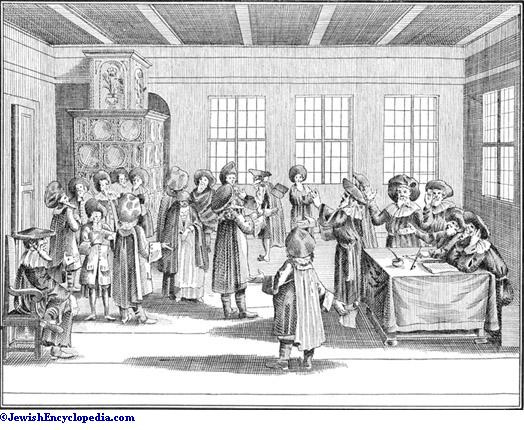
Divorce Scene in Germany.(From Kirchner, "Jüdisches Ceremoniel," 1726.)
Scenes at Divorce.1. Writing the get. 2. Reading it aloud. 3. Throwing the geṭ to the husband. 4. Husband throwing the geṭ to the wife.(From Balenschatz, "Kirchliche Verfassung," 1748.)
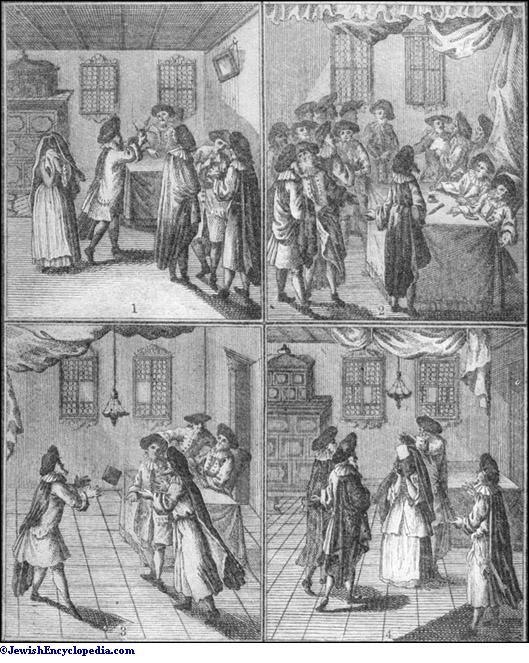
The divorced woman was "sui juris," and could give herself in marriage to whom she pleased, with certain exceptions. She could not marry the man suspected of having committed adultery with her (Yeb. ii. 8), nor the messenger who brought her the geṭ from her husband (ib. 9). She was not permitted to be remarried within three months after her divorce, in order that the paternity of the child with which she might be pregnant might not be in doubt (Yeb. iv. 10).
The children of the divorced woman remained in her custody; but the custody of the boys could be claimed by the father after their sixth year (Ket. 65b, 102b). According to later decisions, however, the court awarded the custody of the children according to its discretion (Eben ha-'Ezer, 82, 7, gloss).
For further information concerning the bill of divorce, its preparation, attestation, and delivery, see GeṬ.
Bibliography:
Mielziner, The Jewish Law of Marriage and Divorce, Cincinnati, 1884;
Amram, The Jewish Law of Divorce, Philadelphia, 1896;
Bergel, Die, Eheverhältnisse der Alten Juden, Leipsic, 1881;
Buchholz, Die Familie, Breslau, 1867;
Duschak, Das Mosaisch-Talmudische Eherecht, Vienna, 1864;
Frankel, Grundlinien des Mosaisch-Talmudischen Ehercchts, Breslau, 1860.
DIVORCE.—See Marriage.
A legal separation of married persons. It is of three kinds: from the bond of matrimony, which is called an absolute divorce; from the bed, which makes lawful the denial of the marriage debt; from bed and board, which denies the rights of cohabitation. The last two do not cause the cessation of the bond of marriage, and are self-explanatory. For a release from the bond of matrimony in the case of a non-consummated Christian marriage, see dissolution of a marriage and for the dissolving of the bond of a marriage contracted validly by unbaptized persons, one of whom afterwards was baptized in the Catholic Church, see Pauline privilege. Except in these special cases, the matrimonial bond, once validly contracted, is indissoluble except by death. The State, the civil power, has no right whatever to grant divorces. It has the power to regulate marriages by license, registration, etc., but it has no authority to annul a valid marriage. Statistics prove that the number of divorces is increasing.
See Marriage.
Judaism has always accepted divorce as a fact of life, albeit an unfortunate one, and permits divorce for any reason, but discourages divorce. See Divorce; Marriage.
God’s plan for marriage was that it be a permanent union between one man and one woman – a union broken only by death. Divorce was something God hated (Gen 2:24; Mal 2:16; Mat 19:3-6; Rom 7:2-4). From earliest times, however, people on the whole rejected God, and polygamy and divorce became common practices (Gen 6:1-8; Rom 1:20-27; see MARRIAGE).
Examples from Bible times
Among the Israelites of Moses’ time, marriage disorders had become so widespread that Moses set out special laws designed to deal with the problem. In particular he wanted to stop easy divorce and protect women from unjust treatment.
For instance, if a man tried to find an excuse for divorcing his wife by accusing her (falsely) of sexual immorality before marriage, he was fined for his cruel accusation and prevented from divorcing her (Deu 22:13-19). He could divorce her only if there was a valid reason, and only if he gave her divorce documents that protected her rights should she want to marry someone else. He could not take her back if he later changed his mind, and she could not go back to him if her second marriage came to an end (Deu 24:1-4).
Moses’ decision to permit divorce in certain circumstances was not because he approved of divorce. Rather he was trying to reduce divorce and restore some moral order to society. When Jews of later times quoted Moses’ law as approval for divorce, Jesus referred them back to God’s original standard. According to that standard, to divorce and remarry was adultery (Mar 10:2-12; Luk 16:18; 1Co 7:10-11). The only exception that Jesus allowed was the case where a person’s adultery was already destroying the marriage (Mat 5:31-32; Mat 19:3-9; see ADULTERY; FORNICATION).
A difficult situation arose in New Testament times when one partner in a non-Christian marriage later became a Christian. The Christian was not to divorce the non-Christian partner, but was to do everything possible to make the marriage work harmoniously. If the non-Christian partner was not willing to continue the marriage and departed, the Christian partner had to let it be so and consider the marriage at an end. The statement that in such cases the Christian partner was ‘no longer bound’ seems to mean that he or she was free to remarry (1Co 7:12-15).
A universal problem
In any society where there is a widespread breakdown of marriage, the result will be an increasing number of social and family problems. The Creator knows what is best for his creatures, and where people reject the plan he has laid down, they will have troubles (cf. Deu 10:13).
There is often no clear-cut solution to the complications that arise because of divorce and remarriage. In some cases, no matter what is done, some ideal will be broken. Moses accepted less than the best because of the people’s ‘hardness of heart’, which suggests that the right course of action may at times mean choosing the lesser of two evils (Mat 19:8).
Repentant sinners can receive God’s merciful forgiveness for divorce and adultery as they can for other sins (2Sa 12:13; Psalms 51; Psa 145:14; Isa 43:25). Whatever people might have been guilty of previously, when God forgives them the church must also forgive them (1Co 6:9-11; cf. Mat 6:14-15). Although Christians must, like Jesus, uphold God’s standards when others want to destroy them (Mat 19:3-9), they must also, like Jesus, give help to those who, having broken God’s law, are later repentant (Luk 7:36-50; Joh 8:1-11; cf. Hos 14:4).
The Bible's rules about divorce are connected to how marriage was understood at different times as God revealed his plan. These rules changed as God showed more of his plan to his people.
In the story of creation in Genesis, God created marriage as a union where two people become "one flesh" (Genesis 2:24). This happened in a world without sin. In such a perfect world, it was impossible to think about ending a marriage. Later, during his time teaching on earth, Jesus supported this original plan for marriage. He taught that when two people become “one flesh,” they are no longer separate but joined together in a bond that cannot be broken (Matthew 19:6).
The Old Testament’s View on Divorce
When sin entered the world, it deeply damaged the relationship between men and women. Before sin, they depended on God first. After sin, they each became controlled by what they were made from. The man became bound to working the ground he was made from (Genesis 2:7; 3:19). The woman became controlled by the man she was made from (2:22; 3:16). Before the fall (when humans first sinned), men and women were equal. They both shared God's image (Genesis 1:27). They were both partners in the mandate God gave humanity to take care of creation (verse 28). After the fall, men ruled over women (Genesis 3:16).
After sin came, men gained power over women that they did not have before. This damaged the “one flesh” relationship. Men who ruled could now have multiple wives. This led to some men having more than one wife at a time (a practice called "polygamy," Genesis 4:19; 16:3; 29:30). It also led to serial monogamy, where men would divorce one wife to marry another (Deuteronomy 24:1–4).
Divorce became common because men ruled over women. Neither men ruling over women nor divorce was part of God's original plan for marriage. God allowed divorce in the law of Moses because people were living in a broken, sinful world (Matthew 19:8). Only men had the right to divorce. Women could not divorce their husbands. This meant women were victims when their husbands chose to divorce them.
The divorce rules in Deuteronomy were meant to give some protection to women. A husband had to give a reason for divorcing his wife by pointing out something wrong about her. He had to give her a written divorce document that showed she had been married to him (Deuteronomy 24:1). Also, if a divorced woman married someone else, her first husband could not marry her again. This was because his act of divorcing her was seen as defiling her (Deuteronomy 24:4).
God allowed divorce in the law of Moses because people's hearts were stubborn and unwilling to follow his plan. But the Old Testament clearly states that God hates divorce (Malachi 2:16). Divorce was only allowed because sin had made men rule over women. God's original design for the marriage of man and woman was still the perfect standard—two people becoming “one flesh."
Jesus’s Teaching on Divorce
Jesus came to restore God's original plan for creation. This meant the old rules about divorce no longer applied to Christians. Jesus pointed his followers back to God's first design for marriage. He said the divorce rules in Moses's law were only given because people were stubborn, adding "it was not this way from the beginning” (Matthew 19:8). Jesus rejected what sin had done and supported God's original plan.
In Matthew 5:31–32, Jesus rejected the old law that let men divorce their wives. He saw divorce as harming women. When men divorce their wives to marry others, they shame these women and treat them like objects. Anyone who marries a divorced woman takes part in this wrong treatment. Both the man who divorces and the man who marries the divorced woman are guilty of adultery.
Jesus took away men's power to divorce their wives whenever they wanted. He brought back God's original plan for marriage as a lifelong "one flesh" union. His disciples understood what this meant. But they were so used to men having special rights that they said being single was better than committing to one marriage for life (Matthew 19:10).
Jesus confirmed that the "one flesh" union was still God's plan for Christians. The New Testament strengthens this by comparing marriage to the relationship between Christ and the church (Ephesians 5:25).
Even though the New Testament strongly supports lifelong marriage, it allows divorce in two cases to protect an innocent spouse: when their partner commits adultery or abandons them. Jesus said a person could divorce an unfaithful spouse (Matthew 5:32; 19:9). The wronged spouse can choose to stay married if they want. But Scripture makes clear they are not required to stay married to or take back an unfaithful spouse.
The New Testament allows divorce for a second reason: when a spouse abandons the marriage. 1 Corinthians 7:15 talks about an unbelieving spouse leaving. The Bible says that a believer who abandons their family should be treated like an unbeliever (1 Timothy 5:8). Any behavior that amounts to abandoning the marriage breaks the marriage commitment and falls under the rule in 1 Corinthians 7:15.
In cases of adultery or abandonment, the wronged spouse can seek a divorce. After the divorce, they are considered single again. If the couple cannot restore their marriage through forgiveness and coming back together, the wronged spouse is free from the marriage. Scripture says someone who is free can marry again, but only to another Christian (1 Corinthians 7:39).
If a single person struggles with being alone, they should marry (1 Corinthians 7:9). This applies to people who became single through a proper biblical divorce. However, Jesus taught that believers should not divorce just to marry someone else (Mark 10:11–12; Luke 16:18). Using divorce this way is adultery.
Marriage often fails for many reasons. Churches should handle each divorce and remarriage case individually. God can forgive sins and heal broken lives. The Bible's rules about divorce do not apply to marriages that ended before someone became a Christian. When someone becomes a Christian, God forgives their past sins and makes them new in Christ.
See also Adultery; Civil Law and Justice; Marriage, Marriage Customs; Sex, Sexuality.
Aquifer Open Bible Dictionary © 2026 Mission Mutual, an adaptation of the Tyndale Open Bible Dictionary © 2023 Tyndale House Publishers. Licensed under CC BY-SA 4.0.
The legal dissolution of a marriage. Though not part of God's original intention for marriage, divorce is permitted under certain circumstances, especially marital unfaithfulness. In general, properly divorced parties are free to remarry.
Dictionary of Bible Themes © 1999 Martin H. Manser. Licensed under CC BY-SA 4.0.