
SEE SHITTAH-TREE.
By: John P. Peters, Kaufmann Kohler
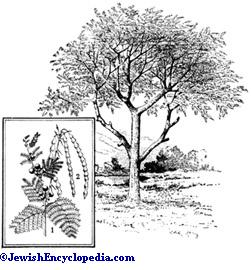
A hard and durable but light wood; at first yellowish, but gradually turning very dark, like ebony. Of this the Ark and its altars, with their staves, and the bars of the Tabernacle were made (Ex. xxxv. 7; Deut. x. 3). The Acacia-tree is called in Hebrew shiṭṭah (for shintah), plural shiṭṭim;  , Arabic, sanṭ; an Egyptian loan-word. It is the Spina Ægyptiaca of the ancients (Mimosa Nilotica, Linn.). It is a large, spreading, thorny tree with many branches, found in Africa and Arabia. The name of this tree (shiṭṭim) is found in various locality names mentioned in the Bible: Shittim (Num. xxxv. 1); Abel-Shiṭṭim (ibid. xxxiii. 49); Beth-Shittah (Judges, vii. 22). It appears to have been highly prized (Isa. xli. 19).
The Acacia.1. Flowering branch. 2. Seed-pod.
Bibliography:
Jablonsky, Opuscula, ed. te Water, i. 260;
Rosenmüller, Handbuch der Bibl. Alterthumskunde, iv. part i. p. 272;
Robinson, Bibl. Researches in Palestine, ii. 249;
Imanuel Löw, Aramäische Pflanzennamen, p. 59; p. 197 (for the meaning of shiṭṭah = sanṭ = Acacia, Acacia Nilotica), p. 388 (for the meaning of toranita = cypress).
—In Rabbinical Literature:
R. H. 23a, referring to Isa. xli. 19, counts the shiṭṭah (explained as toranita = "cypress-tree" according to Löw,"Pflanzennamen," p. 388; according to others = "pine") among the ten kinds of cedar-trees; so also B. B. 80b; but Yer. Ket. vii. 31d; Tan., Terumah, § 9; Ex. R. xxxv., mention twenty-four cedar-trees, seven of which are derived from Isa. xli. 19 (compare the fourteen trees in Enoch, iii. and Book of Jubilees, xxi. 12, where, instead of shaḳed (almond), shiṭṭah (Acacia) was most likely the original reading; see Dillman, "Das Buch Henoch," p. 91, where reference is made to Isa. xli. 19, lv. 13, lx. 13; compare also "Geoponica," xi. 1, where fourteen evergreen trees are enumerated). See Tan. l.c.: "Of all these the shiṭṭim-wood alone was selected in order to atone for the sin that Israel was to commit in Shittim [Num. xxv. 1 et seq.]. Indeed, while Phinehas assuaged the divine wrath [Num. xxv. 7], the Holy One—blessed be He!—said: 'I shall in the future heal the plague of Shittim: A fountain shall come forth from the house of the Lord, and shall water the valley of Shittim'"; see Joel, iv. 18, Heb. (Tan. l.c.).
"Acacia trees without any knots or fissures were cut by Jacob the patriarch in Migdal Ẓebo'aya, Palestine, and were taken down by him to Egypt to be preserved by his children for future use in the wilderness; wherefore we read (Ex. xxxv. 24): 'Every man with whom was found shiṭṭim [R. V. acacia] wood.' R. Hananiah was asked regarding the Acacia-trees that were still growing there whether it was right that people should refrain from using them for common purposes in order that the wood might be consecrated solely for the Ark, to which he replied: 'By all means remain true to the custom of your fathers,'" which was not to use Acacia for such purposes (Gen. R. xciv.; Cant. R. i. 12; Yer. Pes. iv. 30d; see also Testament of the Patriarchs, Simeon, § 8).
ACACIA.—See Shittim Tree.
(In Hebrew shíttah, plural shíttîm; Theod. pyxos; Vulgate, spina, thorn). The Hebrew shíttah is probably a contraction of Shinttah, and thus identical with the Egyptian shent; the Coptic shonte, thorn; the Arabic sunt. Hence the Greek name akantha, thorn, the Latin, acanthus for the Egyptian acacia. Acacia wood is designated, "incorruptible wood", in the Septuagint, and lignum setim, "setim-wood" in the Vulgate. The Biblical Acacia belongs to the genus Mimosa, and is no doubt identical with the Acacia seyal (Del.) or the Acacia tortilis (Hayne); both are called seyyal, or torrent trees, sayl meaning torrent. They grow in the desert wadis, or torrent valleys, of Sinai. The wood is light, hard, and durable, and grows almost as black as ebony with age. The ark of the covenant, the table of the loaves of proposition, the altar of holocausts, the altar of incense, the wooden parts of the tabernacle, were made of setim-wood (Ex. xxv, 5). (See PLANTS OF THE BIBLE.)----------------------------------- VIGOUROUX, in Dict. de la Bible (Paris, 1895); CHAPMAN in HASTINGS, Dictionary of the Bible, art. Shittah Tree (New York, 1902). A.J. MAAS The Catholic Encyclopedia, Volume ICopyright © 1907 by Robert Appleton CompanyOnline Edition Copyright © 2003 by K. KnightNihil Obstat, March 1, 1907. Remy Lafort, S.T.D., CensorImprimatur. +John Cardinal Farley, Archbishop of New York
Acacia. A large thorny tree with rough gnarled bark. The orange-brown wood was hard-grained, and it repelled insects. It bore long locust-like pods with seeds inside and produced round, fragrant clusters of yellow blossoms. Many species of acacia grew in the desert of Sinai, in southern Palestine, and in Egypt.
Acacia wood was used to build the ark of the covenant and the first tabernacle ( Exo 36:20; Exo 37:1). The acacia is called shittim and shittah in the KJV ( Exo 25:5; Exo 25:10; Isa 41:19).
Any tree or shrub of the mimosa family that grows in warm regions. The plant called "shittah" (singular) or "shittim" (plural) in the King James Version of the Bible is certainly the acacia tree. This was the only timber tree of significant size that grew in the Arabian desert. Acacia wood was used in the building of the ark of the covenant (Exodus 25:10).
Acacia tortilis is the largest and most common tree in the desert where the Israelites wandered for 40 years. It is especially noticeable on Mount Sinai and was probably the type of wood used for making the tabernacle furnishings.
Acacia seyal is less common today. It can grow as tall as 7.6 meters (25 feet). It has yellow flowers on twisted branches. The wood is close-grained, heavy, and hard. It has an orange-brown color and was highly valued for making cabinets. The ancient Egyptians used acacia wood to seal shut their mummy coffins.
See Plants.
Aquifer Open Bible Dictionary © 2026 Mission Mutual, an adaptation of the Tyndale Open Bible Dictionary © 2023 Tyndale House Publishers. Licensed under CC BY-SA 4.0.
References:
Discussion:
The plural form of shittah (shittim) is used sometimes as a place name (NUM 25:1; NUM 33:49; JOS 2:1; JOS 3:1; HOS 5:2; JOL 4:18; MIC 6:5), which is evidence of the wide distribution of this tree in Sinai and southern Palestine. The acacia referred to in the Bible was of two kinds, the Umbrella Thorn Acacia Acacia tortilis and the Common Acacia Acacia raddiana.
The Acacia tortilis is found in the hot Arabah Valley, whereas the Acacia raddiana tends to be found in cooler conditions throughout Sinai. A third variety (Acacia albida) is found in lowland Israel, the Sharon Plain, and lower Galilee. The common acacia was the only tree available to the Israelites for construction of the Tabernacle. Hareuveni discusses the problem of getting enough acacia trees in the wilderness for all the Tabernacle furniture including the 15 meter (50 foot) pole that ran the length of the side wall. He assures us that although most acacias are smaller, there are some that reached 15 meters in height. But would there be a piece straight enough even in a 15 meter acacia to use as a side pole? I doubt it. Then again, they could have joined short pieces to make a long one. Indeed, a collapsable pole would have made transport easier. According to Herodotus, boats on the Nile were made of acacia wood. (See also the discussion in The Works of Their Hands [WTH ] 3.15.2.3 Tabernacle construction - 3.15.2.3.9.1 Band, ring, rod, especially 3.15.2.3.5 Bar, pole.
Description:
Both types of acacia are short, reaching 3–5 meters (10–17 feet) tall, but having a wide crown. As members of the Mimosa family, they have sharp spines, finely divided leaves, and tiny pale yellow flowers arranged in drooping bunches. The bean pod they produce is twisted and looped when dry.
Translation:
Since the acacia is widespread in dry areas of Africa, Arabia, India and Australia, translators in those areas should be able to use a local word. Palgrave lists forty-three species in southern Africa alone. Hausa (Nigeria, Chad, Niger) has at least twelve words referring to acacias. In such languages a local species should be used, especially one that is used for building. Elsewhere, if none of these is available, the translator can transliterate from Hebrew (shittah) or from a major language, for example, sunt or talh (Arabic), akasiya (English/French/Spanish via Latin). West African translators need to beware of confusing “acacia” and “cassia,” a common tree with yellow flowers.
Plants and Trees in the Bible © United Bible Societies. Licensed under CC BY-SA 4.0.