
a charm or supposed preservative against diseases, witchcraft, or any other mischief. They were very frequent among the Jews, the Greeks, and the Romans, and were made of stone, metal, animal substances, or, in short, any thing which a weak imagination suggested. The Jews were very superstitious in the use of amulets, but the Mishna forbids them, unless received from some person of whose cures, at least, three instances could be produced. The phylacteries worn by the Pharisees and others of the Jewish nation were a sort of amulets.
Amulets among the Greeks were called,
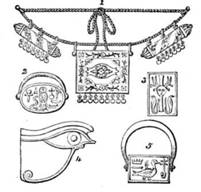
Fig. 35—Amulets. 1. Modern Oriental. 2, 3, 4, 5. Ancient Egyptian
Amulet (Isa 3:20). From the earliest ages the Orientals have believed in the influences of the stars, in spells, witchcraft, and the malign power of the evil eye; and to protect themselves against the maladies and other evils which such influences were supposed to occasion, almost all the ancient nations wore amulets. These amulets consisted, and still consist, chiefly of tickets inscribed with sacred sentences, and of certain stones or pieces of metal. Not only were persons thus protected, but even houses were, as they still are, guarded from supposed malign influences by certain holy inscriptions upon the doors.
The previous existence of these customs is implied in the attempt of Moses to turn them to becoming uses, by directing that certain passages extracted from the law should be employed (Exo 13:9; Exo 13:16; Deu 6:8; Deu 11:18). The door-schedules being noticed elsewhere, we here limit our attention to personal amulets. By this religious appropriation the then all-pervading tendency to idolatry was in this matter obviated, although in later times, when the tendency to idolatry had passed away, such written scrolls degenerated into instruments of superstition.
The earrings (Authorized Version) of Isa 3:20, it is now allowed, denote amulets, although they served also the purpose of ornament. They were probably precious stones, or small plates of gold or silver, with sentences of the law or magic formulae inscribed on them, and worn in the ears, or suspended by a chain round the neck. It is certain that earrings were sometimes used in this way as instruments of superstition, and that at a very early period (Gen 35:4), and they are still used as charms in the East. Augustin speaks strongly against earrings that were worn as amulets in his time.
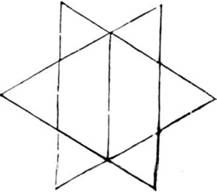
Fig. 36—Shield of David
Some have supposed that these amulets were charms inscribed on silver and gold similar to those ornamental little cases for written charms which are still used by Arab women. This is represented in the first figure of the above cut (fig. 35). The writing is covered with waxed cloth, and enclosed in a case of thin embossed gold or silver, which is attached to a silk string, or a chain, and generally hung on the right side, above the girdle, the string or chain being passed over the left shoulder. Amulets of this shape, or of a triangular form, are worn by women and children; and those of the latter shape are often attached to children’s head-dress.
The superstitions connected with amulets grew to a great height in the later periods of the Jewish history. ’There was hardly any people in the whole world,’ says Lightfoot, ’that more used or were more fond of amulets, charms, mutterings, exorcisms, and all kinds of enchant-merits…. The amulets were either little roots hung about the neck of sick persons, or, what was more common, bits of paper (and parchment), with words written on them, whereby it was supposed that diseases were either driven away or cured. They wore such amulets all the week, but were forbidden to go abroad with them on the Sabbath, unless they were “approved amulets,” that is, were prescribed by a person who knew that at least three persons had been cured by the same means. In these amulets mysterious names and characters were occasionally employed, in lieu of extracts from the law. One of the most usual of these was the cabalistic hexagonal figure known as the “shield of David” and “the seal of Solomon.”’
(Lat. amauletum, from amolior, to avert evil; French amulette; according to others, originally from the Arabic hamail, a locket suspended from the neck). From the earliest ages the Orientals have believed in the influences of the stars, in spells, witchcraft, and the malign power of envy; and to protect themselves against the maladies and other evils which such influences were supposed to occasion, almost all the ancient nations wore amulets (Plin. Hist. Nat. 30, 15). These consisted, and still consist, chiefly of tickets inscribed with sacred sentences (Shaw, 1:365; Lane’s Mod. Egypt. 2, 365), and of certain stones (comp. Plin. Hist. Nat. 37, 12, 34) or pieces of metal (Richardson, Dissertation; D’Arvieux, 3, 208; Chardin, 1, 243 sq,; 3, 205 sq.; Niebuhr, 1, 65; 2, 162). Not only were persons thus protected, but even houses were, as they still are, guarded from supposed malign influences by certain holy inscriptions upon the doors. The previous existence ofthese customs is implied in the attempt of Moses to turn them to becoming uses by directing that certain passages extracted from the law should be employed (Exo 13:9; Exo 13:16; Deu 6:8; Deu 11:18). The door-schedules being noticed elsewhere SEE DOOR-POSTS, we here limit our attention to personal amulets. By this religious appropriation the then all-pervading tendency to idolatry was in this matter obviated, although in later times, when the tendency to idolatry had passed away, such written scrolls degenerated into instruments of superstition (q.v.).
The “ear-rings” in Gen 35:4 (
The
The superstitions connected with amulets grew to a great height in the later periods of the Jewish history. “There was hardly any people in the whole world,” says Lightfoot (Hor. Hebr. ad Matthew 24, 24), “that more used or were more fond of amulets, charms, mutterings, exorcisms, and all kinds of enchantments … . The amulets were either little roots hung about the neck of sick persons, or, what was more common, bits of paper (and parchment) with words written on them, whereby it was supposed that diseases were either driven away or cured. They wore such amulets all the week, but were forbidden to go abroad with them on the Sabbath, unless they were
‘approved amulets;’ that is, were prescribed by a person who knew that at least three persons had been cured by the same means. In these amulets mysterious names (especially the tetragrammaton, or sacred name,
Many of the Christians of the first century wore amulets marked with a fish, as a symbol of the Redeemer. SEE ICHTHUS. Another form is the pentangle (or pentacle, vide Scott’s Antiquary), which “consists of three triangles intersected, and made of five lines, which may be so set forth with the body of man as to touch and point out the places where our Savior was wounded” (Sir Thos. Brown’s Vulg. Errors, 1, 10). Under this head fall the “curious arts” (
See, generally, Hubner, Amuletorum historia (Hal. 1710); Schwabe, Ueb. e. teutsches Amulet, in Meusel’s Geschichtsforscher, 1, 121; Schumacher, De amuleto quodam Gnostico (Guelph. 1774); Emele, Ueber Amulete (Mainz, 1827); Kopp, Paleographia crit. 3, 15. SEE SUPERSTITION.
By: Ludwig Blau
Origin of the Word.
The word "Amulet" used to be considered as derived from an imaginary Arabic word "hamalet" (something hung on); but it is in reality an ancient Latin word of unknown etymology. It is found several times in Pliny, "Naturalis Historia," xxviii. 38, xxx. 2, and elsewhere (Pauly-Wissowa, "Realencyklopädie der Classischen Altertumswissenschaft," i.1984). Amulets are referred to in the Bible, but without any technical designation. In Talmudic literature the specific term ḳemi'a is found, from a root meaning "to bind." A ḳemi'a is therefore something bound on or around, so that the supposititious etymology for the word Amulet as "something hung on" would be correct as concerns the Jewish form. But this designation refers simply to the Amulet's external application, and indicates nothing of its purpose or contents. Biblical, Talmudical, and post-Talmudical passages supply information on both of these points.
Amulets were employed to protect man, or his possessions, such as houses, cattle, etc., from the evil influences of witches, demons, and other mischievous powers likely to be encountered, or to counteract misfortune, illness, and damage of various kinds already being endured. The Amulet is found both in the Orient and in the West, among wild tribes and among civilized nations down to the present day. Assyrians and Egyptians, Greeks and Romans, Jews and Christians, fostered this ancient superstition, and, in varying degrees, foster it to-day. Among the Israelites, therefore, the Amulet has a history extending over several thousand years, and it may conveniently be considered under the heads of the Biblical, Talmudical, and post-Talmudical periods.
Biblical Age.
All ornaments worn on the person seem to have been originally amulets. The majority of them derived their supposed power from the fact that they either bore the images of idols or were consecrated to idols. The patriarch Jacob buried "all the strange gods which were in their [his household's] hand, and all their earrings which were in their ears" (Gen. xxxv. 4). Seeing that the weak were more likely to suffer from the evil influence of witchcraft and demons than the strong, it was usually only the women and children who wore such means of protection. Aaron said to the men (Ex. xxxii. 2), "Break off the golden earrings, which are in the ears of your wives, of your sons, and of your daughters," whereupon "all the people brake off the golden earrings which were in their ears." The Midianite kings wore crescents and earrings; even their camels had chains about their necks, evidently as amulets (Judges, viii. 26). Jewelry was worn by the women and maidens not only for ornament, but also for protection and as charms. Among the twenty-four ornaments of the daughters of Zion, referred to in Isa. iii. 18, mention is made of leḥashim. This word usually denotes magic, but here evidently signifies an ornament intended to counteract magic and at the same time perhaps to exert magical influence itself. The lover says (Song of Solomon, iv. 9), "Thou hast ravished my heart, my sister, my spouse; thou hast ravished my heart with one of thine eyes, with one chain of thy neck." The adulterous wife puts on her earrings and jewels before she goes after her lovers (Hosea, ii. 13). In Prov. xvii. 8 a bribe is compared to a favor-giving precious stone, whose owner prospereth whithersoever he turneth. That  here denotes a magical stone is evident; and so, too, in Nahum, iii. 4, something of the same kind is alluded to with regard to "the well-favored harlot, the mistress of witchcrafts." The Book of Proverbs, which was written for the people, and mirrors popular views of life, also makes reference to prevailing conceptions about amulets when it says of wisdom, it "shall be an ornament of grace unto thy head, and chains about thy neck" (Prov. i. 9). Similarly, when it says (ib. vi. 21), concerning the admonitions of father and mother: "Bind them continually upon thine heart, and tie them about thy neck. When thou goest, it shall lead thee; when thou sleepest, it shall keep thee." Parental precepts protect, like an Amulet worn upon the heart and neck. In many passages of Scripture which speak figuratively of a necklace, an ornamental crown, or of the protection afforded by the Law, the popular conception of the power of amulets is constantly referred to (Ps. lxxiii. 6, ciii. 4, Prov. iii. 22, iv. 9, xiii. 5). Especially significant is Prov. iv. 22, where it is said "they [my words] are life unto those that find them, and health to all their flesh." But amulets were sometimes hidden; carried upon the body, that they might not beexposed to the counter-influence of other amulets, and were thus supposed to be even more potent. Amulets were found upon the bodies of Jewish warriors; they had come from the heathen temple in Jamnia (II Macc. xii. 40). The signet-ring, carried over the heart or upon the arm (Song of Solomon, viii. 6, Jer. xxii. 24, Hag. ii. 23), served as an Amulet, either owing to the material of which it was composed or frequently from the inscription upon it.
Talmudical Age.
The use of amulets was very extensive in the rabbinical period; that is, from about the first century B.C. until about 600 of the common era; consequently there are copious details concerning them in literary sources. The Mishnah repeatedly considers ḳemi'ot from its particular juridical standpoint. They were worn sometimes with covering and sometimes without. The Amulet itself, it appears, might consist either of an article inscribed with the name of God, with a Scripture passage or the like, or of the root of some herb. Grains of wheat wrapped in leather sometimes served as amulets. Particularly potent were chips or splinters of the wood of an Asherah, or of anything offered to an idol; and therefore such things were regularly made into ḳemi'ot. The most frequent form of amulets, however, was a small metal plate suitably inscribed. Around the neck of oxen was tied a pearl wrapped in leather. To protect a horse from evil influence, a fox's tail or a crimson plume was fastened between its eyes. Children, owing to their feeble powers of resistance, were held to be much exposed to the danger of magic fascination; they were, therefore, protected by means of knots, written parchments, etc., tied round their necks. Furniture and household belongings were protected by inscribing the name of God upon foot-rests and handles. Usually, at least among men, amulets were worn on the arm; but exceptionally they were carried in the hand. Women and children wore them especially on neck-chains, rings, or other articles of jewelry. An Amulet would sometimes be placed in a hollow stick, and would be all the more efficacious because no one would suspect its presence; it was a species of concealed weapon. Figuratively the Torah is said to be such an Amulet for Israel. The priestly benediction (Num. vi. 24-26) protected Israel against the evil eye. Distinctions were drawn between amulets which had cured once and those that had cured twice or thrice; between those which had healed three different people once each and those which had healed one person three times. In short, there were approved amulets and amulets not approved; a distinction made likewise as to Amulet-makers. Besides the common people in daily life, physicians in their professional practise also used amulets: the Amulet was thought to banish the demon causing the ailment if his name were written upon the ḳemi'a.
Foreign and Domestic Amulets.
Every nation in turn seems to have held that the magical arts of other nations were superior to its own; and therefore it is easy to understand why the greater portion of the amulets described in Talmud and Midrash are of foreign extraction, as evidenced by their foreign appellations or by other indications. Genuinely Jewish, however, were those talismans which consisted of strips of parchment bearing the name of God, or various permutations of its letters, Scripture passages, or the like. An important quotation concerning these is found in a Baraita (Shab. 115b): "Talismans and amulets, although containing in their letters the name of God or sundry passages out of the Torah, may not be saved on Sabbath from a conflagration; let them burn where they are." By letters of God's name are meant anagrams and transpositions of the same; see Abraxas. Upon an Amulet, said to be potent in curing the bite of a mad dog, was written  "Yah, Yah, Lord of Hosts" (Yoma, 84a). As stated above, medicine did not disdain the use of amulets. Abraham wore a jewel on his neck which healed every sick person he looked upon. A "stone of preservation" (

 ) was said to protect women from miscarriage. The egg of a grasshopper was said to protect against earache; the tooth of a living fox against sleepiness, and of a dead one against sleeplessness. A nail from a gallows protected against wounds. The sages of the Talmud, however, forbade the use of all such remedies, as being "heathen practise." Tefillin (phylacteries) and mezuzot (inscriptions on door-posts) are designated by the Targum on Song of Solomon (viii. 6), as permissible amulets, preserving Israel from the power of demons. Sources and citations concerning the use of amulets in Talmudical times may be found in Blau, "Das Altjüdische Zauberwesen," pp. 86, 146; Strasburg, 1898.
Post-Talmudical Age.
Jewish thought and action in the Middle Ages were dominated completely by the Talmud. Since this authority did not forbid the use of written amulets, the Jews were entirely exposed both to the growth of this superstition among themselves and to the overwhelming inroads of the superstitious practises of the nations among whom they dwelt. It is therefore not surprising that the Amulet superstition grew apace among them. It flourished most in the Orient, the ancient home of all magic and superstition. Hai Gaon, the enlightened head of the Pumbedita Academy, wrote (about 1000), "Sorcery and amulets sprang from the Sura Academy, because that lies near to Babylonia and to the house of Nebuchadnezzar." He denies the powers of amulets, as, for instance, that a papyrus or an olive-leaf inscribed with the mystic name of God would put robbers to flight; or if the same were written upon a new tile, that it would calm the sea; or, if thrown upon a man, would kill him. He admits, however, that amulets may be effective as means of cure and protection. All depends upon the writer and upon the moment of application; for at certain times the best are ineffectual (Ashkenazi, "Ta'am Zeḳenim," 56b).
That in the Middle Ages the Jews were influenced by the Babylonian magic especially, and not by the Egyptian—the latter distinguished twenty different sorts of amulets (see Budge, "Egyptian Magic," p. 25, London, 1899)—is shown by the Jewish-Aramaic charm-inscriptions upon Babylonian clay bowls which possibly served as a protection for the utensils; that is, as amulets (Wohlstein, "Dämonenbeschwörungen aus Nachtalmudischer Zeit," Berlin, 1894; Stübe, "Jüdisch-Babylonische Zaubertexte," Halle, 1895; Schwab, "Les Coupes Magiques," etc., in "Proceedings of the Society of Biblical Archeology," April, 1890; idem, "Coupes à Inscriptions Magiques," ib. June, 1891). In Gaster's edition of "The Sword of Moses" (London, 1896)—a work evidently written under Egyptian influence, but Oriental in its origin and said to belong, according to its editor, to the fourth century—a whole series of ḳemi'ot is given as protective against various ailments and evils. These consist of transpositions of the names of God, quite unintelligible to the modern mind, written upon paper or engraved upon metal plates, and thus resembling the magic papyri of the Greeks. Exactly as with Egyptian amulets, the requisite color and material ofthese are sometimes indicated; thus one charm was to be written on a red plate, another on a silver plate, and so on. By the employment of these amulets, paralysis, sciatica, eye and ear ailments, leprosy; and other evils were to be cured. With a certain plate fastened around the thigh, a man might enter a fiery furnace and come out unscathed. Material and inscription of the Amulet varied according to its purpose. By its means fish could be caught; the love of a woman secured and retained; the sea crossed dry-shod; wild animals slain; terror diffused through the world; communion had with the dead; a sword obtained which would fight automatically for its owner; one's enemies set to tearing each other to pieces; oneself rendered invisible; springs of water found; cleverness attained; and many similarly wonderful things accomplished. In one passage a device that is frequently met with in Babylonian and Egyptian magic is mentioned; namely, the preparation of an image and working the charm desired by its medium. The prescription runs:
"If thou desirest to cause any one to perish, take clay from two river banks and make an image therewith; write upon it the man's name; then take seven stalks from seven date-trees and make a bow [here follows the word  with horsehair (?); set up the image in a convenient place, stretch thy bow, shoot the stalks at it, and with every one say the prescribed words, which begin with
 and end with
 , adding, 'Destroyed be N., son of N.!'"
Gaster (l.c. pp. 12-19) explains why these means were thought to be effective. It appears that every angel and demon is bound to appear and obey when he hears a certain name uttered (p. 25, lines 2-10). Even Hai Gaon ("Responsen der Geonim," ed. Harkavy, 373, p. 189) says, "Amulets are written, and the divine name is spoken, in order that angels may help." But a great deal was made to depend upon using the right name at the right time, a condition likewise frequently insisted on in the Egyptian and Babylonian magical works.
Cabala.
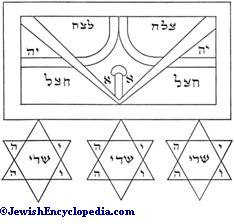
"Practical Cabala," or the art of employing the knowledge of the hidden world in order to attain one's purpose, is founded upon the mysticism developed in the "Sefer Yeẓirah" (Book of Creation). According to this work, God created the world by means of the letters of the alphabet and particularly those of His name,  , which He combined in the most varied ways. If one learns these combinations and permutations, and applies them at the right time and in the right place, one may thus easily make himself master of creation, since God Himself not only permits but desires this; for these formulæ all proclaim monotheism. The Egyptians held a similar view (Budge, l.c. xiii.). The mystic book "Raziel" (eleventh century), in so far as it is to be considered here, is also of Oriental origin, and reflects similar views. Instructions are given for the preparation of amulets; and particular days and hours are indicated as suitable for the manufacture (ed. Amsterdam, 42b). As samples, the two ḳemi'ot in the next column may serve.
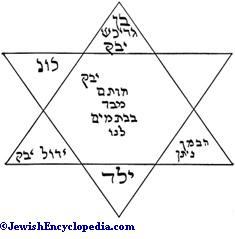
In Europe. This Amulet, on which  from Psalm xlv. 5 is permuted, contains space for a short prayer to be written in, expressive of the particular object to be obtained, and is recommended for use in furthering all business enterprises. It contains the usual shield of David with
 . It must be written upon parchment, and worn on the left side.
In Europe, Spain comes most prominently into view in the consideration of amulets, that country being a hotbed of superstition and Cabala. NaḦmanides and Adret permit the employment of a metal plate with the image of a lion as a remedy against a painful cough (Adret, "Responsa," 1st ed., 167, 413). This superstition was a universal one, and is mentioned also by Manasseh ben Israel of Amsterdam (seventeenth century), who remarks that Leone Soavio recommended it to Paracelsus as a cure for stomach-pain ("Nishmat Ḥayyim," third treatise, chap. xxv.). Other amulets were written upon parchment, on the skin of a fetus or of a deer (Adret, ib.), but were of avail only when the writer and the chosen time were propitious. Adret also forbids such charms as are clearly useless ("Novellæ" on Shab. 67). In Germany, red cords with corals were worn as protection against the evil eye. Christians employed Jews to make amulets for them; for these had the reputation of being "wise folk." Strangely enough, in the later Middle Ages, Jews attached to their arms, where the phylacteries were applied, amulets containing the names of Christ and the three holy kings (Berliner, "Aus dem Leben der Deutschen Juden im Mittelalter," pp. 97, 101). Insanity or epilepsy was cured by hanging beets around the patient's neck. People were warned, however, that the preparation of these amulets would irritate demons. Against miscarriage women carried a stone around the neck, called  , a word evidently derived from the French enceinte; a hole was pierced through it; it was as large and as heavy as a hen's egg. These stones, which had a glazed appearance, were found in the fields, and were esteemed of priceless value. A similar purpose was served in antiquity as well as in the Middle Ages by actites. For lightening labor, both Jewish and Christian women wore a piece of a man's vest, girdle, or other clothing. Luther relates that a Jew presented Duke Albert of Saxony with a button, curiously inscribed, which would protect against cold steel, stabbing, or shooting. The duke made the experiment on the Jew, hanging the button around his neck and then slashing him with a sword (Güdemann," Gesch. des Erziehungswesens und der Cultur der Juden in Frankreich und Deutschland," pp. 205, 207, 214, 226, Vienna, 1880). The Italian coin, with its abracadabra-like inscription, described by Güdemann ("Gesch. d. Erz. und der Cultur der Jud. in Italien," p. 335), was probably of Jewish, and not of Christian, origin.
The medallion bears on the one side the words below, theHebrew transliteration of "Majestas YHWH regis domini mei animum benignum mihi foveat" (May the majesty of YHWH foster a kindly disposition in my lord the king toward me).

Upon the other side is "Majestas YHWH animum mei regis ad me inclinet" (May the majesty of YHWH incline the king's soul to me).

The Eibenschütz Controversy.
The expulsion of the Jews from Spain in 1492 caused the dissemination of the Cabala far and wide through the East and the West. Their unexampled sufferings served to foster their mystic bent more than ever. The Holy Land, as far as repeopled by Spanish exiles (notably Safed), became the hot-bed of the most abstruse secret lore, which favored, among other things, the employment of amulets. From Turkey on the one side, and from Italy on the other, the Cabala spread to Poland and lands adjacent; Ḥasidism arose there and flourishes there today. This mysticism also prepared the ground for amulets, so that there are whole books devoted exclusively to ḳemi'ot still extant in manuscript (compare Benjacob, "Oẓar ha-Sefarim," p. 530). This socalled "practical Cabala" recommended a number of talismans, a description of which must be omitted here in order to describe a celebrated ḳemi'a contest of the middle of the eighteenth century. Jonathan Eibenschütz, remembered by Jews to-day as an eminent Talmudist, prepared a number of amulets. He issued them in Metz, where he was rabbi, and later in Hamburg, Altona, and Wandsbeck, over the united communities of which he presided as chief rabbi. He made them for sick children, for expectant mothers, also as remedies against nose-bleed, epilepsy, and the evil eye. He furnished one that would banish "croaking demons" from a house; upon digging into the foundations, the demons would then be found in the shape of veritable croaking frogs. To find the body of one drowned, he provided a charm in the shape of a written parchment to be laid on the bank of the river or pond. He claimed to have been particularly successful with his amulets in helping women in various emergencies; and statistics were said to support his statements that since he had officiated as rabbi in Hamburg scarcely one Jewish woman had died in childbirth, while in the year preceding his arrival "God's wrath had raged widely" in such cases. The congregational Ḥebrah Ḳadisha (burial society) confirmed this claim officially. All of this became matter of public discussion when Jacob Emden, then residing in Altona, and Jacob Joshua Falk, chief rabbi of Frankfort-on-the-Main, both learned and respected men, openly charged Eibenschütz with invoking as Savior in his amulets the false Messiah, Shabbethai Ẓebi. The contest waged furiously; the scholars and communities of Germany, Holland, Italy, Turkey, the Holy Land, Poland, Lithuania, Hungary, and elsewhere took active part in a most vehement discussion. Even the temporal authorities were appealed to by Eibenschütz's opponents, application being made to the City Council of Hamburg, and to the king of Denmark. The charge was based particularly upon five amulets issued by Eibenschütz while officiating in Metz, and which were certified to by the congregational officials, as having been written by him.
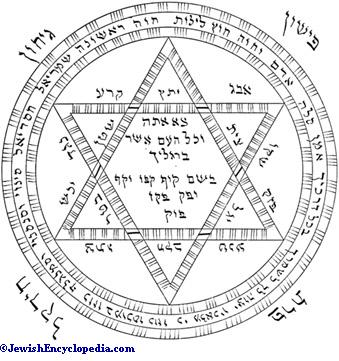
This Amulet is claimed to be well approved, and protects the lying-in mother and her child against witchcraft, the evil eye, and demons, and is given in "Raziel," with explicit directions for use. Its authorship is ascribed to Adam. The four words outside of the circle are the names of the four rivers issuing out of paradise, Gen. ii. 10. In the circle are Psalm, xci. 11; the names of Adam and Eve; also  , which is equivalent to
 , Eve (in the
 system, see At-bash,
 ); then
 , probably a misprint for
 , the female demon mentioned in Isaiah xxxiv. 14; then come "the first Eve," and names of angels and of God (
 : in this permutation each letter is represented by the next succeeding letter of the alphabet, thus
 etc.). Outside of the shield of David stand the initial letters of the well-known prayer by Neḥunia b. ha-Ḳana,
 , also the words,
 , "May Satan be torn asunder!" The innermost space finally contains words from Ex. xi. 8, and permutations of
 , a mystical name of God.In Modern Times.
It is a curious fact that in all the voluminous discussion, the only point at issue was the employment of the false Messiah's name in these amulets; not a voice was raised against the folly of amulets in general. The common impression probably was that they could do no harm and might serve as spiritual stimulants in the way of the wearer's reassurance and mental comfort. This widespread discussion, however, marks the turning-point in the history of the medieval faith in amulets; since then it has gradually diminished and may now be said topractically extinct except in the Orient. The "Shulḥan 'Aruk" does not forbid amulets (see "Oraḥ Ḥayyim," § 301, 24-27; § 305, 17; § 334, 14; "Yoreh De'ah," § 179, 12). It is important to note the fact that the Jews, the "people of the Scripture," employed mainly written parchments for such purposes, not bits of wood, bone, stone, or other natural objects.
Modern Judaism of course approves the sentiments of Maimonides, who pronounced against them; he denies them all potency or virtue whatever ("Moreh," iii. 37), and speaks of the "craziness of the amulet-writers, who hope to accomplish miracles by permutations of the Divine Name" (ib. i. 61, end).
This Amulet is "for protection in childbirth."In five corners of the six-cornered "Shield of David," the Hebrew letters of the verse (Isa. ix. 5),  , "For unto us a child is born," etc., are scattered promiscuously, interspersed with the letters of Neḥunyah ben ha-Ḳana's prayer (
 ). The word
 in the interior space was claimed to be equivalent by permutation to Shabbethai's name (
 ) together with the initials
 ; that is,
 , "King Messiah."
Bibliography:
On the Eibenschütz controversy, see the collected pamphlets  , Lemberg, 1877;
Eibenschütz's own defense,  , Altona, 1755;
Grätz, Gesch. d. Juden, vii. note 7.
(Latin: amuletum, a charm)
An object of stone, metal, parchment, etc., worn as protection against disease, witchcraft, and other ills. Their use was common among early Egyptians, from whom the Romans adopted them. They were gradually repudiated by Christians as superstitions, and emblems and pious images were substituted, not, as the Council of Trent insists, because of any divinity or virtue inherent, but because they refer us to the persons or things represented.
(Gr., phylakterionLat., amuleta).An object generally inscribed with mysterious formulæ and used by pagans as a protection against various maladies, as well as witchcraft. Pliny (XXIX, 4,19) is the earliest writer who mentions amulets (veneficiorum amuleta). The derivation of the word is doubtful, but it probably comes from the Arabic hamala, "to carry", amulets being borne on the person. The Oriental peoples were especially addicted to superstitious practices, and with their absorption into the Roman Empire the use of amulets became equally common in the West. Following the example of Moses, who sought to turn the minds of the Jews from the superstitious emblems to which they were accustomed in Egypt, by substituting for them symbols of an elevating character, the Church, while forbidding amulets, permitted the use of emblems which would remind the bearers of some doctrine of Christianity. Thus St. Clement of Alexandria (Pæd., III, 3) recommended the use of such symbols as the fish, the dove, and the anchor on seals and rings. A devotional medal of lead, attributed to the fourth century, represents a martyr extended on a gridiron; one of the fifth or sixth century bears the monogram of Christ and a cross between the letters and ; while a third represents the sacrifice of Abraham, and on the reverse a father offering his son before the confessio of a martyr. Pope St. Gregory the Great sent the Lombard queen, Theodolinda, on the occasion of the birth of her son, two phylacteria, one of which contained a fragment of the wood of the True Cross, the other a sentence of the Gospel. The custom of carrying portions of the Sacred Scriptures as phylacteries is mentioned by St. Jerome and St. John Chrysostom (St. Jerome, in Matthew 4:24; St. John Chrys., in Matthew hom., 73). But, especially from the fourth century, when imperial favour brought large numbers into the Church, superstitious abuses in the use of devotional emblems became so common that the ecclesiastical authorities were obliged frequently to inveigh against the use of amulets. The Council of Laodicea (latter half of fourth century) prohibited ecclesiastics from making amulets and made the penalty for wearing them excommunication (canon 36). St. John Chrysostom, preaching at Antioch, denounced as a species of idolatry the wearing of amulets, which seems to have been common among his auditors. St. Augustine also denounced the numerous charlatans who dispensed charms, and a collection of canons made by St. Cæsarius of Arles (d. 542), formerly supposed to have been canons of the Fourth Council of Carthage, imposed the penalty of excommunication on those who patronized augurs (can. 89; see Hefele, Conciliengesch., II, 76). From one of the sermons (P.L., XXXIX, 2272) of St. Cæsarius it appears that the dispensing of amulets was a regular profession; each disease had its appropriate amulet. These and similar superstitious practices survived to some extent, in one form or another, through the Middle Ages, and their suppression has always been a difficulty with which the Church has had to cope. The most ancient Christian amulet known, from Beirût, is attributed to the second century. it is made of gold and has a ring by which it was attached to the neck. The inscription on it, which is of more than ordinary interest, reads: "I exorcise thee, Satan (O cross purify me) in the name of the Lord the living God, that thou mayest never leave thy abode. Pronounced in the house of her whom I have anointed". Leclercq sees in this invocation proofs "(1) of belief in the virtue of the sign of the cross to put demons to flight, (2) of the conferring of extreme unction, (3) and of the use of exorcisms", whereof we have here a formula. A favourite Christian amulet in the Orient during the fourth and fifth centuries bore on one side the image of Alexander the Great. St. John Chrysostom, in one of his Antioch instructions (Ad Illumin., Cat., II, 5), censures the use by Christians of amulets with the portrait of the Macedonian conqueror. Several amulets of this class, in the Cabinet of Medals at Paris, show, on one side, Alexander in the character of Hercules, and, on the other, a she-ass with her foal, a scorpion, and the name of Jesus Christ. An amulet in the Vatican Library with the picture of Alexander, bears on the reverse the monogram of Our Lord. Magic nails, also, with inscriptions were interred with the dead; one of them for Christian use has the legend "ter dico, ter incanto, in signv Deo et signv Salomonis et signv de nostrâ Art(e) mix". The Gnostics were especially notable for their employment of amulets; the names found most frequently in their invocations are Adonai, Sabaoth, Jao, Michael, Raphael, Souriel (Uriel), and Gabriel.-----------------------------------LECLERCQ in Dict. darch. chrét. (Paris, 1905), I, 1783-1859; KRAUS, Realencyklopädie (Freiburg, 1882), I, 49-51; PLUMPTRE in Dict. Christ. Antiq. (London, 1875), I, 78, sqq.;Realencyklopädie für prot. Theologie u. Kirche (Leipzig, 1896), 1, 467-476.MAURICE M. HASSETT Transcribed by W.S. French, Jr. The Catholic Encyclopedia, Volume ICopyright © 1907 by Robert Appleton CompanyOnline Edition Copyright © 2003 by K. KnightNihil Obstat, March 1, 1907. Remy Lafort, S.T.D., CensorImprimatur. +John Cardinal Farley, Archbishop of New York
1. Classes of Amulets
The substances out of which amulets have been made and the forms which they have taken have been various.
(1) The commonest have consisted of Amulets of pieces of stone or metal, strips of parchment with or without inscriptions from sacred writings (Bible, Koran, etc.). The earliest Egyptian amulets known are pieces of green schist of various shapes - animal, etc. These were placed on the breast of a deceased person in order to secure a safe passage to the under-world. When a piece of stone is selected as an amulet it is always portable and generally of some striking figure or shape (the human face, etc.). The use of such a stone for this purpose is really a survival of animism.
(2) Gems, rings, etc. It has been largely held that all ornaments worn on the person were originally amulets. (3) Certain herbs and animal preparations; the roots of certain plants have been considered very potent as remedies and preservatives.
The practice of wearing amulets existed in the ancient world among all peoples, but especially among Orientals; and it can be traced among most modern nations, especially among peoples of backward civilization. Nor is it wholly absent from peoples of the most advanced civilization of today, the English, Americans, etc. Though the word charm (see CHARM) has a distinct meaning, it is often inseparably connected with amulets, for it is in many cases the incantation or charm inscribed on the amulet that gives the latter its significance. As distinguished from talisman (see TALISMAN) an amulet is believed to have negative results, as a means of protection: a talisman is thought to be the means of securing for the wearer some positive boon.
2. Amulets in the Bible
Though there is no word in the Hebrew or Greek Scriptures denoting “amulet,” the thing itself is manifestly implied in many parts of the Bible. But it is remarkable that the general teaching of the Bible and especially that of the Old Testament prophets and of the New Testament writers is wholly and strongly opposed to such things.
(1) The Old Testament
The golden ear-rings, worn by the wives and sons and daughters of the Israelites, out of which the molten calf was made (Exo 32:2 f), were undoubtedly amulets. What other function could they be made to serve in the simple life of the desert? That the women’s ornaments condemned in Isa 3:16-26 were of the same character is made exceedingly likely by an examination of some of the terms employed. We read of moonlets and sunlets (Isa 3:18), i.e. moon and sun-shaped amulets. The former in the shape of crescents are worn by Arab girls of our own time. The “ear-drops,” “nose-rings,” “arm chains” and “foot chains” were all used as a protection to the part of the body implied, and the strong words with which their employment is condemned are only intelligible if their function as counter charms is borne in mind. In Isa 3:20 we read of
At Bethel, Jacob burned not only the idols (“strange gods”) but also the ear-rings, the latter being as much opposed to Yahwism as the former, on account of their heathen origin and import.
In Pro 17:8 the Hebrew words rendered “a precious stone” (Hebrew “a stone conferring favor”) mean without question a stone amulet treasured on account of its supposed magical efficacy. It is said in Pro 1:9 that wisdom will be such a defense to the one who has it as the head amulet is to the head and that of the neck to the neck. The words rendered in the Revised Version (British and American) “a chaplet of grace unto thy head” mean literally, “something bound to the head conferring favor,” the one word for the latter clause being identical with that so rendered above (
We have reference to the custom of wearing amulets in Pro 6:21 where the reader is urged to “bind them (i.e. the admonitions of father and mother) ... upon thy heart” and to “tie them about thy neck” - words implying a condemnation of the practice of trusting to the defense of mere material objects.
Underneath the garments of warriors slain in the Maccabean wars amulets were found in the shape apparently of idols worshipped by their neighbors (2 Macc 12:40). It is strange but true that like other nations of antiquity the Jews attached more importance to amulets obtained from other nations than to those of native growth. It is probable that the signet ring referred to in Son 8:6; Jer 22:24; Hag 2:23 was an amulet. It was worn on the heart or on the arm.
(2) The Phylacteries and the Mezuzah
There is no distract reference to these in the Old Testament. The Hebrew technical term for the former (
It is quite certain that the practice of wearing phylacteries has no Biblical support, for a correct exegesis and a proper understanding of the context put it beyond dispute that the words in Exo 13:9, Exo 13:16, Deu 6:8 f; Deu 11:18-20 have reference to the exhortations in the foregoing verses: “Thou shalt bind them (the commands previously mentioned) for a sign upon thy hand, and they shall be for frontiers between thy eyes. And thou shalt write them upon, the door-posts of thy house, and upon thy gates” (Deu 6:8 f). The only possible sense of these words is that they were to hold the precepts referred to before their minds constantly as if they were inscribed on their arms, held in front of their eyes, and written on the door-posts or gate-posts which they daily passed. That the language in Exo 13:9, Exo 13:16 does not command the use of phylacteries is obvious, and that the same is true of Pro 3:3; Pro 6:21; Pro 7:3 where similar words are used is still more certain. Yet, though none of the passages enjoin the use of phylacteries or of the
It is quite evident that phylacteries have a magical origin. This is suggested by the Greek name
Literature
In addition to the literature given in the course of the foregoing article, the following may be mentioned. On the general subject see the great works of Tyler (Early History of Mankind, Primitive Culture) and Frazer, Golden Bough; also the series of articles under “Charms and Amulets” in Hastings’ Encyclopedia of Religion and Ethics and the excellent article “Amulet” in the corresponding German work, Die Religion in Geschichte und Gegenwart. See further the article “Amulet” in Jewish Encyclopedia, and on Egyptian amulets, Budge, Egyptian Magic, 25ff.
An amulet is a small object worn by an individual, usually around the neck. It is used as a charm or means of protection against evil, witchcraft, disease, or other physical and spiritual threats.
The word "amulet" is probably derived from either a Latin or Arabic term meaning “to carry.” Amulets are also known as talismans. They have been made of various substances and come in many forms. Pieces of metal or strips of parchment (thin sheets of treated animal skin) are used with portions of sacred writings (even Scriptures). Herbs and animal preparations have also been used. Semiprecious gems (valuable stones) were often inscribed with a magical formula.
No Hebrew or Greek word in the Bible is translated “amulet” with certainty. The practice of wearing amulets is sometimes implied. It is generally used with disapproval. Some consider the gold earrings worn by the Israelites escaping from Egypt amulets (Exodus 32:2–4). Aaron fashioned these into a golden calf. The prophet Isaiah condemned the ornaments worn by the women of his day (Isaiah 3:16–23).
Most scholars regard the phylacteries and mezuzahs used by the Jews as forms of amulets. Phylacteries are small boxes that hold written Scripture verses. They have leather straps that are used to wear phylacteries during prayer. Likewise, mezuzahs are small containers that hold written Scripture verses and are placed on doorposts. Both are ways of living out the commands in Deuteronomy 6:4–9.
See Phylactery; Magic; Frontlet.
Aquifer Open Bible Dictionary © 2026 Mission Mutual, an adaptation of the Tyndale Open Bible Dictionary © 2023 Tyndale House Publishers. Licensed under CC BY-SA 4.0.