
The tribe of Manasseh was one of the tribes of Israel, descended from Joseph's elder son Manasseh. The Popular Cyclopedia of Biblical Literature reports that it numbered 32,200 adult males at the Exodus from Egypt (Numbers 1:34-35) and grew to 52,700 during the wilderness period (Numbers 26:34). Bridgeway Bible Dictionary notes that Manasseh and Ephraim, Joseph's two sons, were each given tribal status by Jacob. Aquifer Open Bible Dictionary describes Manasseh as the largest tribe, uniquely divided into two half-tribes on either side of the Jordan River, with the western half-tribe being the more important.
Manas´seh, Tribe of. When the tribe of Manasseh departed from Egypt, it numbered 32,200 adult males (Num 1:34-35), being 8300 less than the tribe of Ephraim, the younger son of Joseph. This was the lowest number of adult males in any tribe at that period; but if we add the two together, the tribe of Joseph, composed of these two tribes, reached to 72,700, which was more than any other tribe contained, except Judah. During the sojourn in the wilderness, the tribe of Manasseh rose to 52,700 (Num 26:34), being an increase of 20,500. This gave it rank in point of population as the sixth of the tribes, Judah, Issachar, Zebulon, Dan, and Asher only being more numerous. In the same period Ephraim had declined to nearly the same position which Manasseh had previously occupied, its numbers being reduced to 32,500. Yet the prophecy of Jacob was fulfilled, and, when settled in Canaan, Ephraim became superior in wealth, power and population, not only to Manasseh, but to all the tribes except Judah. One circumstance tending to weaken Manasseh may have been the division which took place in it on entering Palestine. The pastoral half of the tribe was allowed to establish itself with Reuben and Gad, on the east of the Jordan, where it occupied the northernmost portion, consisting of Argob and Bashan, from the Jabbok to Mount Hermon (Num 32:39; Num 34:14: Deu 3:3; Jos 12:6; Jos 13:7; 1Ch 5:23), while the other half was provided for with the rest of the tribes in Canaan proper, west of the Jordan, where it had a fine tract of country extending from that river to the Mediterranean, with the kindred tribe of Ephraim on the south, and Issachar on the north (Jos 16:9; Jos 17:7-11). The half-tribe west of the river was not, however, for some time able to expel the former inhabitants of the territory, so as to obtain the exclusive possession of it (Jos 17:12; Jdg 1:27). The tribe of Manasseh makes no figure in the history of the Hebrews.
Among the tribes of Israel there were two, Ephraim and Manasseh, that took their names not from Jacob’s sons but from his grandsons. Ephraim and Manasseh were the sons of Joseph.
When Jacob determined to give the firstborn’s blessing to Joseph instead of to Reuben (for Reuben had disqualified himself by raping one of his father’s concubines; Gen 35:22; Gen 49:3-4; 1Ch 5:1-2), he raised Joseph’s two sons to the same status as Joseph’s brothers (Gen 48:5-6). As a result Joseph, through his two sons, received two tribes, but each of his brothers received only one. Though Manasseh was born before Ephraim, Ephraim’s tribe was senior to Manasseh’s (Gen 48:12-20).
Manasseh differed from all other tribes in Israel in that it was divided into two portions. Half the tribe lived in Canaan (the area between the Jordan River and the Mediterranean Sea) and the other half lived in the area east of Jordan (Jos 22:7). In all there were nine and a half tribes in Canaan and two and a half east of Jordan.
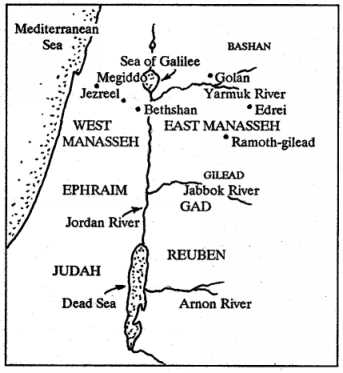
The two tribes that settled east of Jordan with half of Manasseh were Reuben and Gad (Num 32:1-5; Num 32:33; Jos 13:8-33). (For an outline of the settlement and history of the eastern tribes see REUBEN.) The land occupied by the eastern half of Manasseh was the most northern of these three tribal areas. Its northern part was commonly known as Bashan, and included the towns Golan and Edrei (Jos 13:29-31; Jos 22:7; see BASHAN). Its southern part was sometimes known as Gilead, a name commonly applied to the neighbouring tribe Gad, and even to the entire region east of Jordan. Ramoth-gilead was an important frontier town where Gilead bordered Gentile territory to the east (1Ki 22:3; see GILEAD; RAMOTH-GILEAD).
West of Jordan the other half of Manasseh occupied good land to the north of the tribe of Ephraim (Jos 17:1-12). Although Ephraim and Manasseh between them received one of the largest and best portions of Canaan, they still complained that they had not enough land. Joshua gave them no more, but told them to make better use of the land they already had. They could do this by clearing the forest and driving out the remaining Canaanites (Jos 17:14-18). Within the northern part of this territory was part of the Plain of Esdraelon, site of many of Israel’s battles (see PALESTINE). (For the important towns of West Manasseh see BETHSHAN; JEZREEL; MEGIDDO.)
Geographically, the largest of the 12 tribes of Israel, and unique in having two territories, a half-tribe in each. Isolated from each other by the Jordan River valley, they developed separately. The half-tribe west of the Jordan was more important, both in OT and NT times, because it was the main tribe of the northern kingdom of Israel (931–722 BC) and one of the main ancestral stocks of the Samaritans.
Early History
Its Roots
Its families traced their origins back to Joseph’s elder son Manasseh, to Manasseh’s son Makir or grandson Gilead, or to later descendants such as Zelophehad and Jair. A fair harmony can be constructed from the biblical genealogical data in Gn 48:5–6; Nm 26:28–34; Jos 17:1–3; 1 Chr 2:21–23; and 7:14–19, a text corrupted by several copyists’ errors. The mention of Asriel in 1 Chronicles 7:14 seems to be a copyist’s mistake; otherwise, the accounts are capable of being reconciled, even if each list preserved different data and none is complete in itself.
Its Size
One year after the exodus, Manasseh had the smallest army, according to Moses’ first census (Nm 1:34–35). On the eve of the conquest of Canaan, after wandering 38 years in the Sinai wilderness and then conquering Transjordan, it had the sixth largest fighting force, according to a second census (Nm 26:28–34)—52,700 men.
Its First Settlements
The soldiers of the eastern half-tribe of Manasseh settled their families in Gilead, which they captured under Moses’ leadership from the Amorite king Og (Nm 21:32–35; 32:39–42; Dt 3:1–15). Then, under Joshua, they crossed the Jordan to help the other tribes conquer Canaan (Nm 32:1–32; Jos 1:12–18). Subsequently, the western half-tribe received its allotment and began to settle in the central hill country (Jos 16:1–9; ch 17). After the remaining tribes received their shares of land, the army from the eastern half-tribe returned home (22:1–9). En route to their families in Gilead, they helped to build an altar by the Jordan River. This act was intended to preserve national unity, but it nearly started a civil war (vv 10–34).
The Eastern Half-Tribe
Its Territory
Moses allotted the eastern half-tribe nearly 3,000 square miles (7,770 square kilometers) of territory in three geographical regions (northern Gilead, Bashan, and Mt Hermon), but it succeeded in controlling only about 800 square miles (2,072 square kilometers)—the half of Gilead north of the Jabbok River (and south of the Yarmuk River)—despite successful initial conquests (Nm 32:39–42; Dt 3:12–15; Jos 13:8–13) and gradual northern expansion much later (1 Chr 5:23).
The territory occupied was mostly a high plateau with a mountainous center. It was watered well by rains in winter and by a heavy dew in summer. Olive trees, grapevines, and wheat thrived, and goats and sheep could find adequate pasture on the eastern slopes, which merged gradually into the desert to the east.
People and Places
Prominent citizens of the eastern half-tribe included the “judges” Jair and Jephthah (Jgs 10:3–5; 11:6–12) and David’s benefactor Barzillai (2 Sm 19:31–39). Principal cities were Jabeth-gilead and Ramoth-gilead, a city of refuge and a Levitical city, respectively (originally in Gad—Jos 20:8; 21:38).
The eastern territory was usually called simply “the half-tribe of Manasseh,” until David (c. 1000–961 BC) made it an administrative district (1 Chr 27:21). Solomon (970–930 BC) divided and incorporated it into two new districts (1 Kgs 4:13–14). Under Jeroboam I (930–909 BC), it joined, on equal terms, with eight other tribes and with the western half-tribe, to form a confederacy of ten tribes—the northern kingdom of Israel—in 930 BC. Syria and Assyria both held eastern Manasseh temporarily, in the ninth and eighth centuries BC (cf. 2 Kgs 10:32–33; 13:7 with 14:25; and 2 Kgs 15:29 with 2 Chr 34:6–7). King Tiglath-pileser III (745–727 BC) of Assyria invaded the area, conquered it, deported its people, and scattered them throughout his empire (1 Chr 5:26; cf. 2 Kgs 15:29) about ten years before the rest of the northern kingdom fell to the Assyrians in 722 BC. Most of the western Manassites who were left behind intermarried with the foreigners, began to worship pagan gods, and became ancestors of the Samaritans (2 Kgs 17:24–41). Subsequently, the region was known as Gilead. By NT times the region was partly in the Decapolis and partly in Perea.
Aquifer Open Bible Dictionary © 2026 Mission Mutual, an adaptation of the Tyndale Open Bible Dictionary © 2023 Tyndale House Publishers. Licensed under CC BY-SA 4.0.