
a title of Christ, assumed by himself in his humiliation, Joh 1:51 .\par It was understood as a designation of the Messiah, according to Old Testament predictions, Psa 80:17 Dan 7:13,14 ; but appears to indicate especially his true humanity or oneness with the human race. It is applies to him more than eighty times in the New Testament.\par
Others are "sons of men" (Job 25:6; Psa 144:3; Psa 146:3; Isa 51:12; Isa 56:2). God addresses Daniel (Dan 8:17) once, Ezekiel so about 80 times, to remind him of his human lowliness and frailty, as "man lower than the angels," though privileged to enjoy visions of the cherubim and of God Himself, "lest he should be exalted through the abundance of the revelations" (2Co 12:7). The divine Son appeared to him "as the appearance of a man above upon the throne" (Eze 1:26). As others are "sons of God," but He "the Son of God," so others are "sons of man" (Eze 2:1; Eze 2:3) but He "the Son of man" (Mat 16:13), being the embodied representative of humanity and the whole human race; as on the other hand He is the bodily representative of "all the fullness of the Godhead" (Col 2:9). Ezekiel, as type of "the Son of man" whose manifestation he records, is appropriately designated "son of man."
The title "the Son of man" implies at once Messiah’s lowliness and His exaltation in His manifestations as THE REPRESENTATIVE MAN respectively at His first and second comings; His humiliation on the one hand (Psa 8:4-8; Mat 16:13; Mat 20:18; Mat 20:28) and His exaltation on the other hand, just "because He is the Son of man": Dan 7:13-14, Hebrew not
The kingdom shall be "under the whole heaven," on earth (Dan 7:18; Dan 7:27); He shall reign with them as the Son of man, Head of the new creation, and Restorer of man’s lost inheritance. Because as man He established His and the saints’ title to the kingdom at the cost of His own blood, as man He shall judge and reign. It is fit that He who as the Son of man was judged by the world should judge the world. Rev 5:9-10; Psa 8:4-8; Heb 2:6-8; 1Co 15:21-22; 1Co 15:28; 1Co 15:45; 1Co 15:47. The title "the Son of man" in the New Testament Jesus alone uses, and of Himself, except Stephen in dying, "I see the Son of man standing on the right hand of God," referring not to His humiliation on earth but to His heavenly exaltation (compare Joh 12:23; Joh 12:34; Joh 6:62; Joh 3:13; Act 7:56); standing to assist, plead for (Psa 109:31), and receive the dying martyr.
Stephen speaking "full of the Holy Spirit" repeats Jesus’ prophecy before the council, foretelling His exaltation as the Son of man; only there it is "sitting on the right hand of power," because there majestic repose, here rising to His servant’s help, is the thought. Stephen’s assertion stirred their rage, that Jesus who had been crucified for claiming to be "the Son of God" stands at God’s right hand as being "the Son of man." Another exception is John so calls Him in apocalyptic vision (Rev 1:13; Rev 14:14), corresponding to the Old Testament apocalypse (Dan 7:13). The Son of God in eternity became the Son of man in time, whose manhood shall be glorified with His Godhead to eternity. The two titles together declare the whole truth as to His one Person, "whom do men say that I, the Son of man, am? ... Thou art the Christ, the Son of God. ... Blessed art thou, Bar-Jona" ("son of Jonah"), etc.
As truly as thou art son of Jonah I am at once "the Son of man" and "the Son of God" (Mat 16:28). The two are again combined in Caiaphas’ question as to His being the Son of God, and His affirmative answer and further revelation, "nevertheless, besides ... ye shall see the Son of man sitting on the right hand of power," etc. (Mat 26:63-64; Mat 24:30; Mat 25:31-32; Mar 14:61-62). As the Son of man He was Lord of the Sabbath, "for the Sabbath was made for man" whose Representative Head He is (Mar 2:28). As the Son of man He suffered for sin (Mat 17:12), and as the Son of man He hath power on earth to forgive sins (Mat 9:6). As the Son of man He had not where to lay His head (Mat 8:20); as the Son of man "He hath on His head a golden crown" (Rev 14:14).
Every eye shall see Him (Rev 1:7), but only "the pure in heart shall see God" (Mat 5:8). "The Son of God became the Son of man that you who were sons of men might be made sons of God" (Augustine, Serm. 121). Jesus is one of our race, yet above the whole race, the One Man in whom mankind finds its unity, the turning point of history at the close of the old and the beginning of the new era. His absolute relation to mankind requires an absolute relation to God. He could be the Son of man only because He is the Son of God. He alone fully realizes the ideal of man, as well as that of God, combining too in His manhood all the exquisite graces of woman with the powers of man.
Son of Man. Mat 8:20. This title is given to our Saviour 80 times in the New Testament. See also Dan 7:13. The Jews perfectly understood it to denote the Messiah. He calls himself not a son of man (among other children of men), but the Son of man (above all others)—the ideal, the universal, the perfect Man. So, on the other hand, he calls himself not a, but the Son of God—the only-begotten and eternal Son of the Father. Comp. such passages as Joh 1:51; Joh 3:13; Joh 6:53; Mat 9:6; Mat 12:8; Mar 2:10; Mar 2:28. See Jesus Christ. The term son of man is applied to Ezekiel and Daniel, meaning merely "man," as it does in Num 23:19; Job 25:6; Psa 8:4, etc.
SON OF MAN
1. Occurrences of the expression in the NT
(a) In the Gospels it is found in the following passages—eighty-one in all: Mat 8:20; Mat 9:6; Mat 10:23; Mat 11:19; Mat 12:8; Mat 12:32; Mat 12:40; Mat 13:37; Mat 13:41; Mat 16:13; Mat 16:27-28; Mat 17:9; Mat 17:12; Mat 17:22; Mat 19:28; Mat 20:18; Mat 20:28; Mat 24:27; Mat 24:30, bis Mat 24:37; Mat 24:39; Mat 24:44; Mat 25:31; Mat 26:2; Mat 26:24, bis. Mat 24:45; ,Mat 26:64—[30 times]; Mar 2:10; Mar 2:28; Mar 8:31; Mar 8:38; Mar 9:9; Mar 9:12; Mar 9:31; Mar 10:33; Mar 10:45; Mar 13:26; Mar 14:21, bis. Mar 14:41; Mar 14:62—[14 times]; Luk 5:24; Luk 6:5; Luk 6:22; Luk 7:34; Luk 9:22; Luk 9:26; Luk 9:44; Luk 9:58; Luk 11:30; Luk 12:8; Luk 12:10; Luk 12:40; Luk 17:22; Luk 17:24; Luk 17:26; Luk 17:30; Luk 18:8; Luk 18:31; Luk 19:10; Luk 21:27; Luk 21:36; Luk 22:22; Luk 22:48; Luk 22:69; Luk 24:7—[25 times]; Joh 1:51; Joh 3:13-14; Joh 6:27; Joh 6:53; Joh 6:62; Joh 8:28; Joh 9:35 (Revised Version margin) 12:23, 34 bis 13:31—[12 times]. It is obvious to remark that these eighty-one passages do not by any means represent as many different occasions on which the phrase is reported to have been used. Thus of the thirty passages cited from Mt. it will be found on examination that nine have direct parallels in both Mk. and Lk.; that four have parallels in Mk. only, and eight in Luke only; while the remaining nine are peculiar to Matthew (see the tables provided by Driver in Hasting’s Dictionary of the Bible iv. 579, Schmidt, EBi
(b) Apart from the Gospels ‘the Son of Man’ is found only in Act 7:56 (cf. Luk 22:69). in Rev 1:13; Rev 14:14 the expression used, though akin, is not the same: it is ‘one [sitting] like unto a son of man,’ which is a precise reproduction of the phrase in Dan 7:13.
With but one exception the name as found in the Gospels is used only by our Lord Himself. The exception is Joh 12:34, and even there it is presupposed that Jesus had spoken of Himself as ‘the Son of Man.’ ‘The multitude therefore answered him, We have heard out of the law that the Christ abideth for ever; and how sayest thou, The Son of Man must be lifted up? Who is this Son of Man?’ The multitude are familiar with the title ‘the Son of Man’; to them it is a designation of the Messiah; their difficulty is to reconcile Messiahship with exaltation through death. The impression derived from this passage, that the title under discussion was by no means new upon the lips of our Lord,—however great the access of content it received from His employment of it,—is confirmed by the significant fact that throughout the Gospel narratives there is not a trace that disciples, or the wider public, were in any wise perplexed by the designation. This fact, it may be remarked in passing, has not been allowed its due weight by those who, like Westcott (Gospel of St. John, p. 33 ff., ‘It was essentially a new title’), regard the designation as originating with our Lord; or who, like B. Weiss (NT Theol. i. 73), explain the employment of it by Jesus on the supposition that, if not new, it was not one of the current Messianic titles. If new, or unfamiliar, the frequent use of such a self-designation must have occasioned remark, and called for explanation, which would surely have found record in one or other of the Evangelic narratives. If then the Gospels, both by what they say and by what they leave unsaid, favour the view that ‘Son of Man’ was already known, prior to the ministry of Jesus, as a Messianic title, it becomes needful to trace, in so far as we may, its history. Next, we must try to ascertain at what period in His ministry this title was assumed by our Lord, and why He used it with such marked preference; and, finally, we must seek an explanation of the absence of the name in NT writings other than the Gospels.
2. Source of the title.—Baldensperger, writing in 1900 (Theol. Rundschau, p. 201 ff.), regards it as one of the ‘fixed points’ gained in the course of recent discussion, that the origin of the NT phrase, and in large part its explanation, are to be sought in the OT, and especially in Dan 7:13. Previous discussion had been limited too exclusively to the Gr. expression
‘I saw in the night visions, and, behold, there came with the clouds of heaven one like unto a son of man, and he came even to the ancient of days, and they brought him near before him. And there was given to him dominion, and glory, and a kingdom, that all the peoples, nations, and languages should serve him: his dominion is an everlasting dominion, which shall not pass away, and his kingdom that which shall not be destroyed.’
It will be noted that in this more accurate rendering (that of the Revised Version NT 1881, OT 1885 ) the phrase which is of most moment in the subject now under discussion is quite indefinite: ‘one like unto a son of man,’—i.e. one with human attributes in contrast to the ferocity of ‘the beasts.’ The question at once arises, Whom are we to understand by the ‘one like unto a son of man’? The answer most commonly given has been—the Messiah; and there is much to be said for that answer yet, in spite of the dissent of a large number of more recent exegetes. They point to the fact that when Daniel receives the interpretation of his vision (Dan 7:17-27), not a word is said about the ‘one like unto a son of man,’ but with threefold iteration (Dan 7:18; Dan 7:22; Dan 7:27) it is asserted that after judgment upon the beasts, dominion will be given to ‘the saints of the Most High.’ Hence it is said that on the testimony of the text of Daniel itself, the ‘one like unto a son of man’ does not denote a person, but ‘the glorified and ideal people of Israel’ (see, e.g., Driver, Com. on Daniel, p. 102; Drummond, Jewish Messiah, p. 229). So strongly indeed has this view impressed itself upon the minds of some, that they apply the impersonal interpretation of the phrase in Dan 7:13 as a test to the passages in which our Lord is represented by the Evangelists as using the words ‘the Son of Man.’ Thus J. Estlin Carpenter (The Synoptic Gospels, pp. 372, 388), regarding the phrase in Daniel as ‘emblematic and collective,’ and maintaining that Jesus used it in its original meaning, arrives at the conclusion that ‘wherever … the term is individualized and used Messianically, we have evidence of the later influence of the Church. Jesus never used it to designate Himself.’ It is obvious that the application of such a canon would have far-reaching results. But is the interpretation upon which it is based quite sure? The writer of Daniel does not regard ‘the saints of the Most High’ as coming down from heaven. They are already upon the earth, suffering the oppression of the tyrant symbolized by the ‘little horn,’ and awaiting deliverance and reversal of condition, which come when the Most High sits for judgment. It would surely be somewhat incongruous to symbolize the saints passing from the depths of misery to exaltation by one who descends from heaven to earth. On the other hand, it accords entirely with the conception which dominates Daniel 7 of a complete change of conditions, if by ‘one like a son of man’ we understand a Divinely empowered Ruler sent from on high to reign where the ‘four kings,’ the ‘great beasts,’ whose origin had been of the earth (Dan 5:17), had borne sway.
If it be urged that had the writer of Daniel 7 intended the Messiah in Dan 5:13, he could not have omitted mention of Him when he goes on to interpret the vision, and could not have spoken so unreservedly of the bestowal of ‘kingdom and dominion’ upon the saints of the Most High, it may be replied that it is quite in harmony with what may be discerned in other prophetic writings, if the thought of the author of Daniel is found to dwell more on the glories of the Kingdom of the latter days and the felicity of those who have part in it, than upon the Messianic King. Large sections of prophecy, so far as they seek to portray the better future, omit all direct reference to the Messiah. There is no warrant, therefore, as Driver (who, however, holds that ‘the title … does not in Daniel directly denote the Messiah,’ op. cit. p. 104) points out, for saying that ‘the Kingdom is not to be thought of without its King.’ And there is also no sufficient warrant to assume that if in the recital of a vision there is mention of the Messianic King, He, rather than His subjects, must have mention when the vision is interpreted. It is through failure to make allowance for this that N. Schmidt (EBi
In order to discover how Jewish readers of the Book of Daniel in the time shortly preceding and shortly following our Lord’s ministry interpreted that figure, which was presented so suddenly, to be so speedily withdrawn, we turn to the evidence of the Similitudes of the Book of Enoch and of 2 Esdras. Both books are quite certainly of Jewish origin, and both afford unmistakable testimony as to the deep impression made by the apocalyptic teaching of Daniel, which would carry with it familiarity with the concept of ‘one like a son of man.’ The date of the Book of Esdras is undisputed; it belongs to the closing decades of the first century of our era, approximately to a.d. 81. The date of the Similitudes—a later portion of the Book of Enoch—is more open to doubt. R. H. Charles (Book of Enoch, p. 29) holds them to have been written between b.c. 94–79, or b.c. 70–64. Schürer (HJP
In ch. 46, Enoch is represented as saying, when relating his vision of the Judgment: ‘And there I saw One who had a Head of Days, and His head was white like wool, and with Him was another being whose countenance had the appearance … like one of the holy angels. And I asked the angel who went with me and showed me all the hidden things, concerning that Son of Man, who he was, and whence he was, and why he went with the Head of Days? And he answered and said unto me, This is the Son of Man who hath righteousness, with whom dwelleth righteousness, and who reveals all the treasures of that which is hidden, because the Lord of Spirits hath chosen him, and his lot before the Lord of Spirits hath surpassed everything in uprightness for ever. And this Son of Man whom thou hast seen will arouse the kings and the mighty ones from their couches, and the strong from their thrones, and will loosen the reins of the strong and grind to powder the teeth of the sinners. And he will put down the kings from their thrones and kingdoms, because they do not extol and praise him, nor thankfully acknowledge whence the kingdom was bestowed upon them.’ In ch. 62 we read: ‘And thus the Lord commanded the kings and the mighty and the exalted, and those who dwell on the earth, and said, Open your eyes and lift up your horns if ye are able to recognize the Elect One. And the Lord of Spirits seated him (i.e. the Messiah) on the throne of His glory, and the spirit of righteousness was poured out upon him, and the word of his mouth slew all the sinners, and all the unrighteous were destroyed before his face. And there will stand up in that day all the kings, and the exalted, and those who hold the earth, and they will see and recognize him how he sits on the throne of his glory, and righteousness is judged before him, and no lying word is spoken before him.… And one portion of them will look on the other, and they will be terrified and their countenance will fall, and pain will seize them when they see that Son of Man sitting on the throne of his glory. And the kings … will glorify and bless and extol him who rules over all, who was hidden. For the Son of Man was hidden before Him, and the Most High preserved him in the presence of His might, and revealed him to the elect.’ See also 69:27 ‘And he sat on the throne of his glory, and the sum of judgment was committed unto him, the Son of Man, and he caused the sinners and those who have led the world astray to pass away and be destroyed from off the face of the earth.’ These passages leave no room to question how the author of the Similitudes interpreted Daniel’s ‘one like unto a son of man.’ To him the phrase characterized no symbolic figure, but a celestial person, Divinely endowed with world-wide dominion, and appointed to be the judge of all men. The descriptive expression is in process of becoming a title; passing through demonstrative stages—‘this Son of Man,’ ‘that Son of Man,’—it emerges as ‘the Son of Man.’
In 2 Esdras 13 there is no such development of the phrase, ‘one like unto a son of man,’ as we find in the Similitudes, but the dependence upon Daniel and the Messianic interpretation of Dan 7:13 is not less clear. Esdras is represented as recounting a dream, in which he saw coming ‘up from the midst of the sea as it were the likeness of a man; and I beheld [he proceeds], and, lo, that man flew with the clouds of heaven: and when he turned his countenance to look, all things trembled that were seen under him.… And after this, I beheld, and, lo, there was gathered together a multitude of men, out of number, from the four winds of heaven, to make war against the man that had come out of the sea.’ This multitude he destroys by the mere breath of his mouth, and then he is seen to ‘call unto him another multitude which was peaceable.’ When Esdras seeks the interpretation of the dream, he is told: ‘Whereas thou sawest a man coming up from the midst of the sea, the same is he whom the Most High hath kept a great season, which by his own self shall deliver his creatures: and he shall order them that are left behind.… Behold, the days come when the Most High will begin to deliver them that are upon the earth.… and it shall be when these things shall come to pass, and the signs shall happen that I showed thee before, then shall my Son be revealed, whom thou sawest as a man ascending.… And this my Son shall rebuke the nations which are come for their wickedness.… And he shall destroy them without labour by the law, which is likened unto fire.’ The ‘peaceable multitude is further explained to be Israel, of whom this ‘son’ of the Most High is not the symbol, but the Saviour.
The writings of Enoch and Esdras are, it is reasonable to assume, only the survivors of other Apocalypses of the same period, which in like manner founded themselves on the vision of Daniel, and sought to supply in their own way what the prophet had left untold concerning ‘one like unto a son of man.’ If so, that phrase would also inevitably turn in the popular mind into a definite Messianic title, calling for no question when it was heard from the lips of Jesus, unless it were as to His right to appropriate it. It is suggestive to find that later on a more subordinate expression in Dan 7:13 was adopted in similar fashion, and that
In 1896, H. Lietzmann published a brochure—Der Menschensohn—in which, after a review of previous opinions, he enters into a discussion of ‘Son of Man’ in Aramaic, with the result that he declares the expression to have been in Galilaean Aramaic, ‘the most colourless and indeterminate designation of a human individual’—one that might be used as an indefinite pronoun (p. 38). The use of
In 1899, Wellhausen returned to this subject (Skizzen und Vorarbeiten, Sechstes Heft), and in the main declared his adoption of Lietzmann’s conclusion that Jesus, speaking Aramaic, could not make the difference which is made in Greek between
On the other hand, Dalman (Die Worte Jesu, 1898 [English translation 1902]) and Schmiedel (Protestant. Monatshefte, 1898, Hefte 7 and 8) called in question the linguistic premises of Lietzmann and Wellhausen, and contested their conclusions. They both maintain that Jesus did certainly call Himself ‘the Son of Man,’ using the title in a Messianic sense, and with direct reference to Dan 7:13, though both hold the primary sense of ‘a son of man,’ in that verse, to be collective, and not personal. Dalman adduces evidence to show that ‘the Jewish Palestinian Aramaic of the earlier period possessed the term
In 1901, P. Fiebig published the result of a fresh and very thorough examination of the linguistic evidence on the matter at issue. The main contribution in his dissertation (Der Menschensohn) is a demonstration that
The above linguistic discussion has demonstrated considerable diversity of opinion, as could hardly fail to be the case in the absence of any contemporary example of the dialect spoken in Galilee at the time of our Lord’s earthly ministry. In their estimate of probabilities afforded by cognate dialects, or by later usage, scholars are sure to differ somewhat. Nevertheless, the whole investigation has been fruitful in suggestion to the NT critic. But the attempt made in connexion with it to account for the presence in the Gospels of ‘the Son of Man’ on some other grounds than that it represents a self-designation employed by our Lord, can only be characterized as an elaborate failure. Wellhausen’s invocation of hypothetical Apocalypses to explain the presence in the records of Jesus, and in those records not in the apocalyptic passages alone, of a title which (ex hypoth.) He did not use, removes no difficulty, but only calls aloud itself for explanation how such a thing could be. The belief that the title is the genuine utterance of Jesus is left unshaken.
3. When did our Lord adopt the title ‘Son of Man’?—There can be but one answer, if we are justified in assuming that ‘the Son of Man’ was already a Messianic title before our Lord employed it. He can have adopted it only subsequently to St. Peter’s confession of His Messiahship at Caesarea Philippi. But do the Gospels lend colour to any such limitation? Turning to the earliest of the Synoptics,—and we may confine our attention just now to the Synoptics,—we are met by the significant fact that St. Mark has the phrase only twice (Mar 2:10; Mar 2:28) prior to the Caesarean incident; St. Luke has it four times (Luk 5:24; Luk 6:5; Luk 6:22; Luk 7:34), and St. Matthew nine times (Mat 8:20; Mat 9:6; Mat 10:23; Mat 11:19; Mat 12:8; Mat 12:32; Mat 12:40; Mat 13:37; Mat 13:41). Thus, in by far the greatest number of cases the title occurs subsequent to Peter’s confession. What, then, is to be said as to its occurrence in such cases as are prior to that confession? No one answer will suffice. Certainly it will not do to resort to the expedient of saying that the title was but little known, and that its Messianic application might be missed until our Lord Himself, late in His ministry, brought it into direct relation to Daniel’s prophecy; or to adopt the alternative offered by Holtzmann (NT Theol. vol. i. p. 264) of saying that ‘the son of man’ or ‘man’ was used by Jesus at first in its ordinary significance, and then, by reason of the stress He laid on it, came to be to the disciples an enigmatic word, which brought them to see that their Master was a man not as others, but with a unique calling, and at length to find in Him the Messiah. Either supposition would leave unexplained how the adoption of the title, whether unfamiliar or familiar, could have passed unchallenged, and not have called forth questions as to the sense in which Jesus was using the words. As little is help to be found in Fiebig’s suggestion that one reason why our Lord chose this title (‘the Man,’ according to Fiebig), was that men would find in it a meaning, though they might fail to apprehend the meaning with which Jesus employed it (op. cit. p. 120). Here, again, allowance is not made for the extreme difficulty of supposing that a speaker could apply a title to himself unless it were with an obvious purpose, which his hearers would certainly discern. There is not the least ground for supposing that it was a more usual thing in Aramaic than it is in our own language for any one to speak of himself in the third person. Such a form of speech might lend itself to more definite self-revelation, but clearly it was in no wise calculated to secure self-concealment. Wrede, in a note in ZNTW
Taking first the passages in St. Mark, with their parallels in the other Synoptics, and turning to Mar 2:10 (cf. Luk 5:24, Mat 9:6), we are confronted at once with the representation that quite early in His ministry, when in the presence of hostile scribes, Jesus definitely identifies Himself with the ‘Son of Man.’ ‘… that ye may know that the Son of Man hath power on earth to forgive sins … I say unto thee, Arise.’ It is, of course, possible that the incident is not here in its due chronological position—that it properly belongs to a much later time in the Evangelical narrative. But there is no reason, unless it be the presence of the phrase now in question, to think so. More likely is it that in this case the ambiguity of the Aramaic is accountable for the presence of the title in the Greek rendering. The scribes were charging Jesus with blasphemy because He assumed to pronounce the forgiveness of sins, that being, as they held, in the power of God only, and not in that of any man. Jesus responds by undertaking to afford a convincing sign that even ‘a man [meaning Himself] hath authority,’ etc. Such a reconstruction of the passage finds support in Mat 9:8, where we read that the multitudes who stood by ‘glorified God, which had given such authority unto men’—the multitudes understanding our Lord to have employed no title, and taking the expression He used in its collective sense.
In Mar 2:28 (cf Luk 6:5, Mat 12:8) our Lord’s argument in regard to the observance of the Sabbath seems to demand that ‘man’ should be substituted where we now read ‘the Son of Man.’ He is vindicating’ the action of His disciples, and asserting for all others the same freedom in regard to the use of the Sabbath as they had exercised. Jesus is not concerned to assert His own personal rights, but those of His followers, and of all who suffered from restrictions which threatened to turn that which was given for man’s benefit into a bondage. ‘The Sabbath was made for man … so that man is lord [or rather “owner”—
Taking next the two remaining pre-Caesarean occurrences of ‘the Son of Man’ in St. Luke, the earlier of the two, Luk 6:22, presents little difficulty. It is an obvious case of an editorial insertion of the title. Where St. Luke has ‘for the Son of Man’s sake,’ Mat 5:11 has, ‘for my sake’—the latter being clearly the earlier form of the saying. Luk 7:34 (cf. Mat 11:19) is quite conceivably another case of the reverent substitution by tradition of the title in place of a pronoun. Our Lord is contrasting His action with that of the Baptist. What more likely than that He should say, ‘John the Baptist is come … I am come’? The title can be deemed here in no wise essential.
It remains to glance at six passages in the First Gospel besides those already mentioned, in which ‘the Son of Man’ is found prior to Peter’s confession. Taking these cases in order of their occurrence in the Gospel, it is sufficient as to the first, Mat 8:20, to note that its parallel is Luk 9:58—i.e. according to St. Luke the incident of the scribe who volunteered to follow Jesus was subsequent to Peter’s confession. There is no reason to suspect here any misconception of our Lord’s words on the part of His translators. He cannot have said that in contrast to beasts and birds ‘man’ hath not where to lay his head. The contrast drawn is between such creatures and Himself, the Messianic ‘Son of Man.’ If even He had no resting-place, His followers might know thereby what hardship they must be prepared to undergo. Mat 10:23 is quite clearly not in its true chronological order; it belongs to a later time than the first mission of the Twelve, and to a connexion in which a larger work was contemplated than that with which they were then entrusted. But the Evangelist, following his preference for topical arrangement, has linked these later words to the instructions given to the Twelve when they were about to set out on their earliest missionary expedition.
Mat 12:32, when compared with Luk 12:10 and with Mar 3:28, is found to be a combination of two different reports of our Lord’s saying as to blasphemy against the Holy Spirit. Mar 3:28 has no mention of ‘the Son of Man,’ but it has the expression, quite unique in the Gospels, ‘the sons of men.’ It runs thus: ‘All their sins shall be forgiven unto the sons of men, and their blasphemies … but whosoever shall blaspheme against the Holy Spirit.…’ In the parallel in St. Luke, the unwonted phrase ‘the sons of men’ disappears, and its place is taken by the familiar expression ‘the Son of Man,’ and the entire saying is modified in accordance therewith. That St. Mark has the utterance in its genuine form is unquestionable. Whether it properly belongs to the period before the incident at Caesarea, or, as St. Luke suggests, was later than it, it did not contain the title ‘the Son of Man.’
Mat 12:40 (cf. Luk 11:30). It is sufficient to point out that St. Luke places this saying in order of time considerably later than does St. Matthew, and as before, preference must be given to St. Luke in a matter of chronological order.
Finally, the parable of the Tares, in the explanation of which the title appears twice (Mat 13:37; Mat 13:41), may, with good reason, be said to belong to a late period in our Lord’s ministry. It owes its present position to St. Matthew’s desire to bring it into the collection of parables comprised in his 13th chapter.
Thus, of the instances in which our Lord’s self-designation appears in the Synoptic Gospels prior to their recital of Peter’s confession at Caesarea Philippi, there is not one which can, on examination, be held to afford proof that this Messianic title was used by Him before His follower had declared Him to be the Messiah, or to invalidate the assumption that the use of the title by our Lord began at the time of that declaration, not earlier.
In St. Matthew’s account of the incident at Caesarea there are remarkable additions, both to our Lord’s question and to Peter’s answer. In Mat 16:13 we read: ‘Who do men say that the Son of Man is?’ The answer is given: “Thou art the Christ, the Son of the living God.’ In Mar 8:27 the question is: ‘Who do men say that I am?’ The answer is simply: ‘Thou art the Christ.’ St. Luke (Mar 9:18; Mar 9:20) agrees, with but slight variations, with St. Mark. He has: ‘Who do the multitudes say that I am?… The Christ of God.’ We have here another case—the most notable of all such cases—in which the title has been substituted for the pronoun which our Lord employed. It is possible that in this case the additional clause was first appended to Peter’s answer, and that the substitution in our Lord’s question was occasioned by it—a substitution which represents the desired answer as already provided in the statement of the question. Holtzmann may be right in suggesting that doctrinal interests are answerable for such a result. He says (op. cit. vol. i. p. 258) that ‘the First Evangelist appears as the theologian, who sees in the “Son of Man” the obverse of the “Son of God,” and so prepares the way for the doctrine of the two natures.’ Whether the clauses in question are to be ascribed to St. Matthew himself, or whether they may be due to the theological tendency of a later hand, may be regarded as an open question.
For other instances than those already cited of this variation—the title appearing in one Gospel, but not in the parallel passage in another, or in the other two—see Luk 12:8 as compared with Mat 10:32; Mat 16:28, cf. Mar 9:1, and Luk 9:27; Mar 10:45, and Mat 20:28, cf. Luk 22:27; Mar 8:31, and Luk 9:22, cf. Mat 16:21.
As to the occurrence of ‘the Son of Man’ in the earlier chapters of the Fourth Gospel, it need here only be pointed out that such occurrence is in entire accord with the representation of St. John, that from their earliest association with Him our Lord’s followers knew that He was the Divine Christ. The declaration of Messiahship and the use of the title are concurrent in the Fourth Gospel as in the Synoptics. This agreement is to be emphasized here: the reconciliation of the view, which represents our Lord’s Messiahship as declared from the outset of His ministry, with the threefold testimony that such declaration followed only when disciples had received prolonged training in the course of that ministry, does not come within the scope of our present purpose. The first occurrence of the self-designation in St. John’s Gospel affords a striking parallel to our Lord’s use of it in response to Peter’s confession (Mar 8:29; Mar 8:31). Nathanael declares Jesus to be ‘the Son of God … king of Israel,’ and to that confession Jesus responds With the promise: ‘Ye shall see the heaven opened and the angels of God ascending and descending upon the Son of Man’ (Joh 1:51). Similarly in Joh 3:13, it is when Jesus has declared to Nicodemus that He has Himself descended from heaven and can therefore tell of heavenly things, that He goes on to designate Himself ‘the Son of Man,’ and to foretell His suffering on behalf of man. Here it may be noted that in the Fourth Gospel, precisely as in the Synoptics, not a hint is given that the title was unfamiliar and one that called for explanation. Nicodemus was not indisposed to ask questions; but St. John leaves us to infer that as to this designation he found no difficulty. Three times in ch. 6 (Joh 6:27; Joh 6:53; Joh 6:62), in connexion with the discourse in which Jesus speaks of Himself as ‘the bread which came down out of heaven,’ the title occurs, accompanying and used to emphasize an open declaration of our Lord’s claims as to His Person and Work.
The later occurrences of the title in the Fourth Gospel all, with the exception of Joh 9:35 (if
4. Why did our Lord adopt this in preference to any other Messianic title?—Nowhere does He tell us in precise terms; but His usage leaves no room to doubt that its attraction lay in its freedom from the limitations which beset other Messianic names.
(a) First and foremost, it permitted the blending of the conception of the Suffering Servant with that of the Messianic King. That was the great enlargement which Jesus gave, in His use of it, to the title He adopted. True, there was nothing in Daniel’s delineation of ‘one like unto a son of man’ to suggest such a blending, but there was also nothing to preclude it. Whether the coming of the heavenly Son of Man in glory, and for universal dominion, was to be preceded by a coming in humiliation and a reascension through suffering, the writer of Daniel did not tell. But what the prophet failed to disclose, Jesus revealed. He was indeed the son of man, whom Daniel beheld, but passing through a phase of existence anterior to that of which the seer had a glimpse, and a phase which none were anticipating. Jesus was indeed the Messiah; but the expectations which gathered about that name made no allowance for that which was foremost in the purpose for which He came to earth. Hence, no sooner did His disciple exclaim ‘Thou art the Christ,’ than ‘he began to teach them [the disciples] that the Son of Man must suffer many things, and be rejected by the elders and the chief priests and the scribes, and be killed, and after three days rise again.’ Put even so,—as a fresh disclosure concerning the Son of Man,—the teaching was not easy of reception, as Peter’s remonstrance showed; but to have said at that juncture that the ‘Son of David,’ or ‘the Christ,’ must suffer and be killed, had been to make the teaching yet harder of reception.
As Dalman says (op. cit. p. 265): ‘The name Messiah denoted the Lord of the Messianic age in His capacity as Ruler; in reality it was applicable only when His enthronement had taken place, not before it. Suffering and death for the actual possessor of the Messianic dignity are, in fact, unimaginable according to the testimony of the prophets. When Jesus attached to the Messianic confession of Peter the first intimation of His violent death He did so in order to make it clear that the entrance upon His sovereignty was still far distant.… But the “one like unto a son of man” of Dan 7:13 has still to receive the sovereignty. It was possible that he should also be one who had undergone suffering and death.’
Hence, in reiterated statements to the disciples concerning the death toward which He moved, the invariable self-designation on the lips of our Lord is ‘the Son of Man.’ See Mar 9:9; Mar 9:12; Mar 9:31; Mar 10:33; Mar 14:21; Mar 14:41, and the parallels in St. Matthew and St. Luke. Only when the Crucifixion and the Resurrection were accomplished facts, in the light of which His disciples might discern how false and misleading had been their narrow conception of what Messiahship could be, does Jesus speak to them of Himself in other terms: ‘Behoved it not the Christ to suffer these things?’ and again: ‘Thus it is written that the Christ should suffer’ (Luk 24:26; Luk 24:46).
(b) If ‘the Son of Man’ was a title capable of being associated with suffering and death, it was a title already associated with the glorious coming of One who should have everlasting rule over a world in which the powers of evil should no more have sway. That was the form of expectation present to the mind of Jesus as He passed on His way to the baptism of suffering, and that was the form of Messianic hope which He sought to strengthen in His followers as He spoke to them, with growing frequency, of the coming of ‘the Son of Man.’ The utterances concerning the return of ‘the Son of Man’ in glory, and the predictions that ‘the Son of Man’ must suffer and die, are in strict correlation (see Bousset, Jesus, p. 92 ff.). It is this coming from heaven, this realization of the Kingdom of heaven upon earth, to which Jesus looks forward. Wholly unlike the anticipations entertained by men around Him concerning the Davidic Messiah, the vision of Daniel is that which Jesus again and again calls to mind. He will come ‘in the glory of the Father with the holy angels’ (Mar 8:38); ‘They shall see the Son of Man coming in clouds with great power and glory’ (Mar 13:26; see also Mar 14:62); ‘When the Son of Man shall come in his glory and all the angels with him, then shall he sit on the throne of his glory: and before him shall be gathered all the nations: and he shall separate them one from another …’ (Mat 25:31 ff.). This function of separation, of judgment, is not in the Danielic sketch of ‘the son of man’; it is a feature added by our Lord. In Daniel the judgment is effected by the Most High. It is significant of much, that Jesus, while adopting and citing that prophecy, does not hesitate to modify it in this important particular, and to declare that it is He who will come to be our Judge (cf. Joh 5:27).
(c) If ‘the Son of Man,’ telling of descent from heaven, spoke of a closer association with God than did any other current Messianic title, so did it speak also of closer association with man—with the race. All narrow particularism falls away. He who bears this title is no mere ‘Son of David,’ or ‘King of Israel.’ Especially when regard is had to the idiomatic use of
5. Why did our Lord’s followers, with the exception of Stephen, not apply this title to Him?—The fact that a designation which meets us so frequently in the Gospels is, with the single exception of Act 7:56, wholly absent from the rest of the NT, is remarkable and significant. But of what? Wellhausen and Lietzmann answer, of this: that it was unknown to St. Paul and the other writers of the Epistles and to the author of the Apocalypse that such a title was employed by Jesus, and that the presumption is that only after their day was it introduced into the Gospels. But how this could be done, and how such an important modification of the most cherished records of the Church could be carried out with such enduring success, there is nothing to show. Certainly it is not safe to conclude that St. Paul and other NT writers did not know that this was our Lord’s self-designation because they make no direct reference to it. Schmiedel (l.c. p. 260 f.) points to Heb 2:6 ff. as affording evidence that the name was not unknown to the writer of that Epistle. Similarly, he holds that St. Paul in 1Co 15:27 makes his reference to Psalms 8 because of the presence in that psalm of the terms which he associated with his Lord—‘the Son of Man.’ Schmiedel is on firmer ground when he goes on to rebut the contention, that had St. Paul known of the title he must have cited it in such a verse as 1Co 15:47. He urges that it should be borne in mind that St. Paul wrote for Greeks, who would not, like the Jews, understand by ‘the son of man’ simply ‘man,’ but would take ‘son’ quite literally. To this may be added that, apart from the suggestion of a purely human parentage, which Gentiles might receive from the title, its use would for them lay an undue, and therefore a misleading, stress on our Lord’s humanity. To the Jew ‘the Son of Man’ suggested the Lord from heaven; not so to the Gentile. Where the association of the name with heavenly origin and majesty could not be assumed, there the Apostles and early exponents of Christianity adopted other terms as they spoke or wrote of their risen and ascended Lord, and proclaimed Him as ‘the Christ, the Son of God’ (Joh 20:31). To use the words of Dalman (op. cit. p. 266), ‘the Church was quite justified in refusing, on its part, to give currency to the title; for in the meantime “the Son of Man” had been set upon the throne of God, and was, in fact, no longer merely a man, but a Ruler over heaven and earth, “the Lord,” as St. Paul in the Epistles to the Thessalonians, and the Teaching of the Apostles in its apocalyptic statement, rightly designate Him who comes with the clouds of heaven.’
In short, the absence of the title ‘the Son of Man’ from other early Christian records than the Gospels, is significant of the widening range of the Church’s appeal beyond the confines of Judaism; its retention in the Gospels is no less significant of the fidelity with which the words of Jesus were preserved by His followers.
Literature.—For a summary of various interpretations of ‘the Son of Man,’ see articles by Driver in Hasting’s Dictionary of the Bible ; N. Schmidt in EBi
George P. Gould.
By: Emil G. Hirsch
In Contrast to Deity.
The rendering for the Hebrew "ben adam," applied to mankind in general, as opposed to and distinct from non-human relationship; expressing also the larger, unlimited implications of humanity as differentiated from limited (e.g., national) forms and aspects of human life. Thus, contrasted with the "sons of God" ("bene Elohim") are the "daughters of man" ("benot ha-adam"), women taken by the former, non-human or super-human, beings as wives (Gen. vi. 2 et seq.). As expressing difference from God, the term occurs in the blessing of Balaam: "God is not a man, that he should lie; neither the son of man, that he should repent" (Num. xxiii. 19). Similarly, David appealing to Saul puts Yhwh over and against the children of men (I Sam. xxvi. 19). The punishment of God, also, is contrasted with that of the "children of men," the former being much more severe, as appears from the promise solemnly given to David (II Sam. vii. 14). God alone knows the heart of the "children of man" (II Chron. vi. 29 et seq.). In the prayer in which this thought is expressed, "man" is used in distinction to the "people of Israel"; indeed, "children of men" appears to mark a contrast to "children of Israel" in the Song of Moses (Deut. xxxii. 8, R. V.).
"Son of man" is a common term in the Psalms, used to accentuate the difference between God and human beings. As in Ps. viii. 4 (A. V. 5), the phrase implies "mortality," "impotence," "transientness,"as against the omnipotence and eternality of God. Yhwh looks down from His throne in heaven upon the "children," or "sons," of "man" (Ps. xi. 4, xxxiii. 13). The faithful fail among them (Ps. xii. 2 [A. V. 1]); the seed of Yhwh's enemies will not abide among the "children of men" (Ps. xxi. 10). "Children of men" is thus equivalent to "mankind" (Ps. xxxvi. 8 [A. V. 7], lxvi. 5).
"Sons of men," or "children of men," designates also the slanderers and evil-doers in contrast to the righteous, that is, Israel (Ps. lvii. 5 [A. V. 4], lviii. 2 [A. V. 1]). It occurs most frequently, however, as a synonym for "mankind," "the human race" (Ps. xc. 3, cvii. 8, cxv. 16, cxlv. 12); it has this sense also in the passage in which wisdom is said to delight with the "sons of men" (Prov. viii. 31). Job(xvi. 21) employs the expression in the passionate plea for his rights while he is contending against God and against his neighbors. But Bildad insists that the "son of man," who is a mere worm, can not be justified with God (Job xxv. 4-6). In the same spirit the prophet (Isa. li. 12) censures Israel for being afraid of "the son of man which shall be made as grass" when Yhwh is their Comforter; but in Isa. lvi. 2-3 the Sabbath is extolled as making the "son of man" (i.e., any man, regardless of birth) blessed; indeed, God has His eyes "open upon all the ways of the sons of men: to give every one according to his ways" (Jer. xxxii. 19).
The meaning of the term as employed in these passages admits of no doubt; it connotes in most cases the mortality of man, his dependence upon God, while in only a few it serves to differentiate the rest of the human race from Israel.
In Ezekiel, Daniel, and Enoch.
In Ezekiel the term occurs in Yhwh's communications as the prevailing form of address to the prophet (ii. 1; iii. 1, 4, 10, 17; iv. 1 et al.; in all about 90 times). It has been held that it conveyed the special idea that a wide chasm stood between God, the speaker, and the prophet so addressed, but that it implied at the same time that Ezekiel was considered to be the ideal man. This view must be abandoned as unwarranted. The term "ben adam" is merely a cumbersome but solemn and formal substitute for the personal pronoun, such substitution being due, perhaps, to the influence of Assyro-Babylonian usage (see Delitzsch, "Wörterbuch," s.v. "Amelu"; comp. "zir amiluti" in the Babylonian myth concerning Adapa).
Similarly in Aramaic, "son of man" is the usual designation for "man," and occurs in the inscriptions in Syriac, Mandaic, Talmudic, and other dialects (see Nathanael Schmidt in Cheyne and Black, "Encyc. Bibl." iv. 4707-4708). In Dan. vii. 13, the passage in which it occurs in Biblical Aramaic, it certainly connotes a "human being." Many see a Messianic significance in this verse, but in all probability the reference is to an angel with a human appearance, perhaps Michael.
"Son of man" is found in the Book of Enoch, but never in the original discourses. It occurs, however, in the Noachian interpolations (lx. 10, lxxi. 14), in which it has clearly no other meaning than "man," if, indeed, Charles' explanation ("Book of Enoch," p. 16), that the interpolator misused the term, as he does all other technical terms, is untenable. In that part of the Book of Enoch known as the "Similitudes" it is met with in the technical sense of a supernatural Messiah and judge of the world (xlvi. 2, xlviii. 2, lxx. 27); universal dominion and preexistence are predicated of him (xlviii. 2, lxvii. 6). He sits on God's throne (xlv. 3, li. 3), which is His own throne. Though Charles does not admit it, these passages betray Christian redaction and emendation.
Among Jews the term "son of man" was not used as the specific title of the Messiah. The New Testament expression
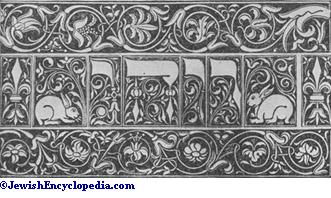
Head-Piece Employed by the Soncinos.(From the Earlier Prophets, printed in 1485.)
In the New Testament.
In the Gospels the title occurs eighty-one times. Most of the recent writers (among them being II. Lietzmann) have come to the conclusion that Jesus, speaking Aramaic, could never have designated himself as the "son of man" in a Messianic, mystic sense, because the Aramaic term never implied this meaning. Greek translators coined the phrase, which then led, under the influence of Dan. vii. 13 and the Logos gospel, to the theological construction of the title which is basic to the Christology of the Church. To this construction reference is made in Abbahu's controversial saying in Ta'an. 65b. Indeed, examination of many of thepassages shows that in the mouth of Jesus the term was an equivalent for the personal pronoun "I."
This term occurs 82 times in the Gospel and, except on one occasion, is always used by Our Lord. There can be no doubt that the term is genuine, and that by it Our Lord meant to designate Himself. But why did He by preference call Himself the Son of Man? Some critics have thought that in the Aramaic of those days the speaker used to designate himself in this manner (as the Spaniards use usted, or vuestra merced, to designate the person spoken to; but after Dalman’s thoroughgoing research this view is no longer tenable. Rather, Our Lord adopted the title both to reveal and to hide His messiasship. It was regarded by the Jews as messianic, and hence by applying it to Himself Our Lord to all appearances claimed to be the Messias; on the other hand, it did not bear that sinister anti-Roman meaning which the Jews had then given to other messianic titles.
In the Old Testament "son of man" is always translated in the Septuagint without the article as anthropou. It is employed (1) as a poetical synonym for man, or for the ideal man, e.g. "God is not as a man, that he should lie nor as a son of man, that he should be changed" (Numbers 23:19). "Blessed is the man that doth this and the son of man that shall lay hold on this" (Isaiah 56:2). "Let thy hand be upon the man of thy right hand: and upon the son of man whom thou hast confirmed for thyself" (Psalm 79:18).(2) The Prophet Ezechiel is addressed by God as "son of man" more than ninety times, e.g. "Son of man, stand upon thy feet, and I will speak to thee" (Ezekiel 2:1). This usage is confined to Ezechiel except one passage in Daniel, where Gabriel said: "Understand, O son of man, for in the time of the end the vision shall be fulfilled" (Daniel 8:17).(3) In the great vision of Daniel after the appearance of the four beasts, we read:"I beheld therefore in the vision of the night, and lo, one like a son of man came with the clouds of heaven, and he came even to the Ancient of days: and they presented him before him. And he gave him power, and glory, and a kingdom: and all peoples, tribes, and tongues shall serve him: his power is an everlasting power that shall not be taken away: and his kingdom shall not be destroyed" (7:13 sq.).The person who appears here as son of man is interpreted by many non-Catholics as representing the Messianic kingdom, but there is no thing to prevent the passage from being taken to represent not only the Messianic kingdom, but par excellence the Messianic king. In the explanation, verse 17, the four beasts are "four kings" R.V., not "four kingdoms" as translated by D.V., though they appear to signify four kingdoms as well for the characteristics of oriental kingdoms were identified with the characters of their kings. So when it is said in verse 18: "But the saints of the most high God shall take the kingdom: and they shall possess the kingdom for ever and ever", the king is no more excluded here than in the case of the four beasts. The "son of man" here was early interpreted of the Messias, in the Book of Henoch, where the expression is used almost as a Messianic title, though there is a good deal in Drummond’s argument that even here it was not used as a Messianic title notwithstanding the fact that it was understood of the Messias. It has to be added that in the time of Christ it was not very widely, if at all, known as a Messianic title.The employment of the expression in the Gospels is very remarkable. It is used to designate Jesus Christ no fewer than eighty-one times -- thirty times in St. Matthew, fourteen times in St. Mark, twenty-five times in St. Luke, and twelve times in St. John. Contrary to what obtains in the Septuagint, it appears everywhere with the article, as ho huios tou anthropou. Greek scholars are agreed that the correct translation of this is "the son of man", not "the son of the man". The possible ambiguity may be one of the reasons why it is seldom or never found in the early Greek Fathers as a title for Christ. But the most remarkable thing connected with "the Son of Man" is that it is found only in the mouth of Christ. It is never employed by the disciples or Evangelists, nor by the early Christian writers. It is found once only in Acts, where St. Stephen exclaims: "Behold, I see the heavens opened, and the Son of Man standing on the right hand of God" (7:55). The whole incident proves that it was a well-known expression of Christ’s. Though the saying was so frequently employed by Christ, the disciples preferred some more honorific title and we do not find it at all in St. Paul nor in the other Epistles. St. Paul perhaps uses something like an equivalent when he calls Christ the second or last Adam. The writers of the Epistles, moreover, probably wished to avoid the Greek ambiguity just alluded to.The expression is Christ’s, in spite of the futile attempts of some German Rationalists and others to show that He could not have used it. It was not invented by the writers of the Gospels to whom it did not appear to be a favourite title, as they never use it of Christ themselves. lt was not derived by them from what is asserted was a false interpretation of Daniel, because it appears in the early portions of the public ministry where there is no reference to Daniel. The objection that Christ could not have used it in Aramaic because the only similar expression was bar-nasha, which then meant only "man" -- bar having by that time lost its meaning of "son" -- is not of much weight. Only little is known of the Aramaic spoken in Palestine in the time of Christ and as Drummond points out special meaning could be given to the word by the emphasis with which it was pronounced, even if bar-nasha had lost its primary meaning in Palestine, which is not at all proved. As the same writer shows, there were other expressions in Aramaic which Christ could have employed for the purpose, and Sanday suggests that He may have occasionally spoken in Greek.The early Fathers were of the opinion that the expression was used out of humility and to show Christ’s human nature, and this is very probable considering the early rise of Docetism. This is also the opinion of Cornelius a Lapide. Others, such as Knabenbauer, think that He adopted a title which would not give umbrage to His enemies, and which, as time went on, was capable of being applied so as to cover His Messianic claims -- to include everything that had been foretold of the representative man, the second Adam, the suffering servant of Jehovah, the Messianic king.-----------------------------------Jésus Messie et Fils de Dieu (Paris, 1906); ROSE, Studies on the Gospels (London, 1903), DRUMMOND, The Jour. of Theol. Studies, Il (1901), 350, 539; HARTL, Anfang und Ende des Titels "Menchensohn" in Bibl. Zeitschrift (Freiburg, 1909), 342.C. AHERNE Transcribed by Scott Anthony Hibbs The Catholic Encyclopedia, Volume XIVCopyright © 1912 by Robert Appleton CompanyOnline Edition Copyright © 2003 by K. KnightNihil Obstat, July 1, 1912. Remy Lafort, S.T.D., CensorImprimatur. +John Cardinal Farley, Archbishop of New York
The only instance in the NT outside the Gospel records of a direct reference to Jesus as ὁ õἱὸò ôïῦ ἀíèñþðïõ occurs in the speech of Stephen before the Jewish Sanhedrin (Act_7:56). Assuming its genuineness, it is significant that the expression is used by a Hellenistic Jew recently converted to Christianity. Even on the assumption that the speech is largely the composition of the author of Acts, the same significance attaches to its employment here. Not only is it evidence that the gospel tradition was, in the main, correct as to its use by Jesus of Himself, but it shows how early the consciousness of the Church awoke to the claims which the designation involves. The strange hesitation of primitive Christianity in using this title proves the sturdinèss of the growth and development of independent thought within the Church of the Apostolic Age. The rage of Stephen’s audience, on hearing the words of the speaker, is accounted for only on the supposition that ‘the Son of man’ was recognized as the Jesus whom they had so recently done to death, and who now is described as occupying the transcendent position, and discharging the functions, of Messiah. The great and final synthesis-the Suffering Servant and the Eternal Judge-had received its justification in the alleged exaltation of the Crucified to the right hand of God. Now, no less than in the days of His humiliation, His sympathies were active for the despised and the suffering. It is, perhaps, too much to say that ‘He is revealed to the eyes of His first martyr, that Christians may learn that that which is begun in weakness shall be completed in eternal majesty’ (B. F. Westcott, The Speaker’s Commentary, ‘St. John and the Acts,’ London, 1880, p. 35), but St. Luke’s use of the term in this connexion shows how profoundly its implicates had affected the Christology of the primitive Church (note the word ἑóôῶôá; cf. ἐêÜèéóåí, Mar_16:19, and êÜèïõ, Psa_110:1).
The absence of the phrase ὁ õἱὸò ôïῦ ἀíèñþðïõ from the general body of NT writings cannot, therefore, be explained as entirely due to a reverent or superstitious disinclination to use a title which Jesus had appropriated to Himself. If the details of the martyrdom of James the Just given by Hegesippus and quoted by Eusebius be accepted, we have the designation used of the glorified Jesus Messiah. On being asked concerning Jesus who was crucified, he answered in a loud voice, ‘Why do ye ask me about Jesus the Son of Man? He is now sitting in the heavens, on the right hand of the great Power, and is about to come on the clouds of heaven’ (Historia Ecclesiastica (Eusebius, etc.) ii. 23). According to Jerome, the Gospel according to the Hebrews stated that Jesus had revealed Himself to James after His resurrection as ‘the Son of man’ (‘filius hominis’ [Vir. Ill. 2]), and we may conjecture that the expression in Hegesippus is a reminiscence of that event. It may be readily accepted that the words of James the Just are ‘of the nature of a quotation.’ It is not, however, so easy to see why the same should be said of ‘the use of the phrase by the martyr Stephen in the Acts and the martyr James the Just in Eusebius and by the angels in Luke after the Resurrection’ (E. A. Abbott, The Son of Man, Cambridge, 1910 [3317]; cf. note on [3317a]). The vision of Stephen gives a wider and deeper significance to the Messianic activities of the ascended Jesus. ‘The Son of man’ stands on the right hand of God ready to express His feelings of love and sympathy with the sons of the race to which He belongs.
There are two passages in the NT where the words ὅìïéïí õἱὸí ἀíèñþðïõ are found (Rev_1:13; Rev_14:14) both in descriptive accounts of the Seer’s visions. Quite obviously the references are to Jesus as the glorified Messiah (see, on the other hand, H. Lietzmann, Der Menschensohn, Tübingen, 1896, p. 56), and evidently are allusions to the apocalyptic language of Daniel (7:13). According to G. Dalman, the origin of the expression is to be discovered not in Dan_7:13 but in 10:5f. (The Words of Jesus, Edinburgh, 1902, p. 251). The peculiar phraseology of the NT apocalyptist shows that, although he may have known and even been thinking of Jesus’ self-designation, his eschatological doctrine had its roots in the soil of Judaistic transcendentalism, moving in a plane higher than that of grammatical construction (cf. ὅìïéïé ÷áëêïëéâÜíῳ, 1:15, etc.), and that we cannot equate his expression with the èåùñῶ … ôὸí õἱὸí ôïῦ ἀíèñþðïõ of Stephen (see H. B. Swete, The Apocalypse of St. John 2, London, 1907, p. 15). The use of ὅìïéïò as an adverb in both passages may have been due to the translation he was accustomed to use, but in any case the above conclusion is not affected (ὅìïéïò õἱüò = ὡò õἱüò).
There seems, indeed, no reason to doubt that this designation was well known to the writers and teachers of the apostolic period in spite of non-usage. We need not stay to inquire into the ultimate origin of the idea underlying the term or whether it is to be traced to the Persian doctrine of the Primal Man (see C. Clemen, Primitive Christianity and its Non-Jewish Sources, Edinburgh, 1912, p. 150 ff.). The expression has become native to Palestinian thought and was a terminus technicus of Jewish eschatological speculation. The use of the 8th Psalm by St. Paul in 1Co_15:27 and his discussion as to the relative appearances in time of the ‘earthy’ (÷ïúêüò) and the ‘heavenly’ (ἐðïõñÜíéïò) man suggest his acquaintance with the term ὁ õἱὸò ôïῦ ἀíèñþðïõ. The same may be said of the writer of the Epistle to the Hebrews. Jesus’ superiority in rank to the angelic beings, notwithstanding the fact that He is õἱὸò ἀíèñþðïõ, is insisted on. The author of the Epistle to the Ephesians not only quotes this Psalm (ðÜíôá ὑðÝôáæåí, Eph_1:22), but does so as if its highest application is discovered in the eternal exaltation of Jesus (ὑðåñÜíù ðÜóçò ἀñ÷ῆò, êôë.) ‘the Lord,’ and in His session (êáèßóáò) at the right hand of God in the heavenly regions (ἐí äåîéᾷ áὐôïῦ ἐí ôïῖò ἐðïõñáíßïéò; see J. Moffatt’s translation in The Historical New Testament2, Edinburgh, 1901, p. 232; cf. the use of the Danielic visions in 2Es_13:3 ff.).
Widely different reasons are given by scholars to explain the absence of the term ‘the Son of man’ in the writers of the apostolic period. All the Greek-speaking leaders of Christian thought from Ignatius and Justin Martyr to Chrysostom agree in teaching that the title has a special reference to the human nature of Jesus, the human side in His descent. So also do Tertullian, Cyprian, Augustine, and Ambrose. For them its importance and significance were mainly dogmatic and theological, less suitable for the exigencies of practical instruction and life. For whatever reason, it did not then, and it never has, become a popular designation of Jesus by the Church (see Dict. of Christ and the Gospels ii. 664a).
J. R. Willis.
(John 1)
- This title is found only a few times in the Old Testament, except in the case of the apocalyptic book of Ezekiel. In the New Testament, it is frequently used in the Gospels by Jesus to describe himself, and just once or twice each by the writers of Acts, Hebrews, and Revelations
Of all the titles commonly used of Jesus in the New Testament, ‘Son of man’ was the one most used by Jesus himself and least used by others. It hardly occurs at all outside the Gospels (Act 7:56; Rev 1:13; Rev 14:14), and inside the Gospels is used almost solely by Jesus. By using this unusual title for himself, Jesus made people think carefully about who he was and what his mission involved (Joh 12:34; Joh 13:31-32).
A heavenly figure
The title ‘son of man’ comes from a vision recorded in the Old Testament book of Daniel. In this vision a person like a son of man came into the heavenly presence of God and received from him a universal and everlasting kingdom (Dan 7:13-14). The idea of the son of man was tied up with that of the kingdom of God, and this provided the background to Jesus’ reference to himself as the Son of man.
With the coming of Jesus, the kingdom of God came visibly into the world. The world is under the power of Satan (2Co 4:4; 1Jn 5:19), but Jesus delivered diseased and demonized people, showing that the rule and authority of God’s kingdom can release people from Satan’s power (Mat 4:23-24; Mat 12:28; Luk 10:9; Luk 10:17-18; Luk 17:20-21; see KINGDOM OF GOD). God’s kingdom will reach its fullest expression when Jesus returns at the end of the age to punish evil, remove Satan and reign in righteousness (Dan 7:13-14; Mat 13:41-43; Mat 24:30-31; Mar 8:38).
The vision in Daniel shows, however, that the Son of man shares the kingdom with his people (Dan 7:14; Dan 7:27). Jesus therefore promised those who followed him that they would share with him in the final triumph of his kingdom (Mat 19:28; Mat 25:31-34; cf. 2Ti 2:11-12; Rev 3:12; Rev 3:21; Rev 20:4).
An earthly figure
In addition to this particular usage, the expression ‘son of man’ could be used in ordinary speech to apply to any man. It could be simply a poetic way of saying ‘a person’, and at times Jesus may have used it simply to mean ‘I’ or ‘me’ (Num 23:19; Psa 8:4; Eze 2:1; Eze 2:3; Eze 2:8; Mat 11:19).
The twofold meaning of ‘son of man’ was especially appropriate as a title for Jesus. It pointed to his deity (he was the heavenly Son of God; Joh 3:13; Joh 6:62) and to his humanity (he was a man, a member of the human race; Mat 8:20). The Son of man was the embodiment of God. In his unique person he carried the authority of God into the world (Mar 2:10; Mar 2:28; cf. Joh 5:27; see JESUS CHRIST; SON OF GOD).
Jesus’ use of ‘Son of man’ in relation to the kingdom of God likewise combined heavenly and earthly aspects. The heavenly Son of man was in fact an earthly figure born in the royal line of David and having claim to the messianic throne. Because of the Jews’ selfish nationalistic ideas of the Messiah and his kingdom, Jesus rarely spoke of himself specifically as the Messiah (see MESSIAH). By using the title ‘Son of man’, he was claiming to be the Messiah without actually using the title ‘Messiah’. He knew the title ‘Son of man’ could be puzzling, but he wanted people to think about it. He wanted them to consider the evidence of his life and work, and discover for themselves the true identity of this one who called himself the Son of man (Mat 16:13-16; Joh 9:35-36; Joh 12:34).
When the Jewish leaders finally understood Jesus’ usage of the title (namely, that he claimed to be both the Davidic Messiah and the supernatural heavenly Messiah of Dan 7:13-14), they accused him of blasphemy and had him crucified (Mar 14:61-64). This did not take Jesus by surprise, for he knew that the heavenly Son of man had also to become the suffering servant. He had to suffer and die before he could receive the kingdom (Mar 8:31; Mar 9:12; Mar 10:45; Joh 3:13-14; Joh 8:28; see SERVANT OF THE LORD).
If, however, the crucified Son of man was to receive an eternal kingdom, his death had to be followed by resurrection (Mar 9:31; Mar 10:33-34). Therefore God, in a triumphant declaration of the perfection of all that Jesus had done through his obedient life and sacrificial death, raised him up and gave him glory (1Pe 1:21). The full revelation of that glory will take place when the Son of man returns in the triumph of his kingdom (Mar 8:38; Mar 13:26; Mar 14:62).
The name that Jesus most often
used for himself. The phrase in Hebrew
or Aramaic means “human being” or
“mankind,” but in Dan. 7:13–14 it is used
of a future savior and king, and this was
later understood to be the Messiah, the
one God would send to save his people.
Messianic title used by Jesus to express his heavenly origin, earthly mission, and glorious future coming. It does not refer just to his human nature or humanity, as some church fathers or contemporary scholars believe. Rather, it shows the heavenly origin and divine dignity of Jesus; the mystery of his manifestation in human form; and his earthly mission that took him to the cross and then into glory.
The background of the term “Son of Man” is found in the OT. It is mostly found in the book of Ezekiel, since this prophet was referred to as “son of man” 90 times. For example, God addressed him, “Son of man, stand upon your feet, and I will speak with you” (Ez 2:1). Jesus’s use of the term “Son of Man” and many themes from Ezekiel suggest he wanted to identify himself as the end-time prophet who, like Ezekiel (chs 4, 7, 10, 22, 40–48), had the last word about the destruction of Jerusalem and the restoration of the kingdom of God to Israel (Mt 23–24; Acts 1:6–8).
The specific source of the term is Daniel 7:13–14, where Daniel has a vision of one “like a son of man” who “comes with the clouds” into the presence of “the Ancient of Days,” who gives him the universal and eternal kingdom of God. Jesus repeatedly quoted parts of this text in teaching about his second coming (Mt 16:27; 19:28; 24:30; 25:31; 26:64). Clearly, Jesus understood this passage as prophetic about himself and portraying his incarnation, ascension, and inheritance of the kingdom of God.
In the Gospels, the term “Son of Man” is used by Jesus about 80 times as a hidden, indirect way of speaking about himself (Mt, 32 times; Mk, 14 times; Lk, 26 times; Jn, 10 times). In all these texts, Jesus was always the speaker, and no one ever addressed him as “Son of Man.” In some texts the reference is so mysterious that some interpreters insist that Jesus was speaking about another person. Such doubt about it is recorded in only one text in John, where the crowd asks Jesus, “Who is this ‘Son of Man’?” (Jn 12:34). In most texts, the identification with Jesus is clear. In some it is explicit: “Who do men say that the Son of Man is?”—followed by, “Who do you say that I am?” (Mt 16:13, 15). The conclusion generally drawn is that Jesus used the term as a messianic title for himself, so that he could speak modestly about his person and mission yet communicate the important fact that he wished to reveal about himself. He could do this with originality because the term was not filled with popular misconceptions concerning the Messiah.
The term occurs only four other times in the NT. In Acts 7:56, Stephen says, “Look, I see the heavens opened and the Son of Man standing in the place of honor at God’s right hand!” Hebrews 2:6 applies Psalm 8:4 to Jesus. Finally, Revelation 1:13 and 14:14 depict visions of someone “like a son of man,” who is undoubtedly the glorified Jesus.
In the synoptic Gospels, the first theme related to Jesus’s use of the title “Son of Man” is that of his coming to earth to accomplish his messianic mission. Jesus compared his earthly condition with his previous heavenly glory by saying “Foxes have holes, and birds of the air have nests; but the Son of Man has nowhere to lay his head” (Mt 8:20; see Lk 9:58). This indicates that the Son of Man gave up his heavenly home to suffer all the humiliations of his earthly ministry (Phil 2:5–11).
Jesus used the title to claim divine privileges, saying, “The Son of Man is Lord of the sabbath” (Mt 12:8; Mk 2:28; Lk 6:5). The Sabbath, a divine institution, may not be revised by ordinary men. But since Jesus is the Son of Man from heaven, he is free to rule as Lord even of the Sabbath, because he is the same Lord who instituted the Sabbath (Gn 2:2; Ex 20:8–11). After healing the paralytic at Capernaum, Jesus claimed that “the Son of Man has authority on earth to forgive sins” (Mt 9:6; Mk 2:10; Lk 5:24). Previously, forgiveness of sins came from heaven and from God, but now forgiveness is given on earth by Jesus.
The second aspect of Jesus’s use of the title “Son of Man” concerns his suffering, death, and glorious resurrection as the mysterious way to fulfill his earthly mission as the Son of Man. Jesus developed the theme of his suffering after Peter confessed him to be Messiah and Son of God (Mt 16:16). Jesus’s prediction of his suffering as the Son of Man begins in Mark 8:31–32 and is repeated in several other texts. The Gospels expand the theme to include mockery and scourging (Mt 17:12; 20:18; Mk 8:31; Lk 9:22), betrayal by Judas (Mt 17:22; 26:24–25; Mk 14:21, 41), rejection by the Jewish leaders (Mt 20:18), death by crucifixion (Mt 20:19; Mk 9:12, 31; 10:33), burial for three days (Mt 12:40; Lk 11:30), and resurrection (Mt 17:22–23; Mk 8:31).
In the famous text “The Son of Man did not come to be served, but to serve, and to give his life as a ransom for many” (Mt 20:28; Mk 10:45), Jesus teaches that his death was a substitute sacrifice for the salvation of his people. This idea comes from Jesus’s understanding of himself as the suffering Servant of the Lord (Is 53).
Jesus also used the “Son of Man” title to teach about his second coming. As the Son of Man, Jesus will return to earth from heaven in the glory of his Father with the angels (Mt 16:27; Mk 8:38; Lk 9:26). First, he will be seated at the right hand of God, and then he will come again (Mt 26:64; Mk 14:62; Lk 22:69) with the clouds (Mt 24:30; Mk 13:26; Lk 21:27). This coming will be unexpected (Mt 24:27; Lk 12:40), like a flash of lightning or the flood of Noah (Mt 24:37; Lk 17:24). His coming will be for the gathering of the elect; the judgment of all the nations of the earth (Mt 19:28; 25:32); and the restoration of final righteousness in the world (19:28; 25:46).
In these passages, Jesus shifts the focus from the provisional victory in his suffering and resurrection to the final victory of the Son of Man at his second coming. Again, the highlight is on the heavenly origin and divine privileges of the Son of Man. This man Jesus, the Son of Man, will be the final judge (cf. Acts 17:31).
The Gospel of John has its own distinctive material concerning the Son of Man. The angels are said to ascend and descend on the Son of Man (Jn 1:51), thus signifying that he is a person who existed before time and has come from heaven to earth (3:13; 6:62). His being lifted up (by crucifixion) will bring eternal life for all who believe in him (3:14). The Son of Man (3:14) is also the Son of God (3:16), God’s one and only Son (1:18; 3:18). Quite simply, in John’s Gospel, the “Son of Man” title is equivalent to the title “Son of God.” It reveals his divinity, existence before time, heavenly origin, and divine privileges. It affirms his present earthly condition for revelation and suffering, and his future end-time glory. The Father has given the Son of Man authority to raise the dead and to judge the world (5:25–27).
See also Christology; Jesus Christ, Teachings of; Messiah; Son of God.
Aquifer Open Bible Dictionary © 2026 Mission Mutual, an adaptation of the Tyndale Open Bible Dictionary © 2023 Tyndale House Publishers. Licensed under CC BY-SA 4.0.
A Hebrew and Aramaic term, often used to mean a human being in general. In the Gospels Jesus Christ uses it to refer to himself in his earthly ministry and his future death, exaltation and coming as judge and Saviour.
Sons of men as a term for humanity in general
Human beings are inferior to God
PSA 115:16 The Hebrew term here translated “man” literally means “sons of men”. Many of the OT references cited in this theme follow this pattern. See also PSA 11:4, PSA 33:13–33:14, PSA 45:2
Human beings are dependent on God's care
PSA 8:4 See also PSA 36:7, PSA 80:17, PSA 107:8, PSA 107:15, PSA 107:21, PSA 107:31
Human beings are mortal
ECC 9:3 See also ECC 3:18–3:19; EZK 31:14
Human beings are sinful and untrustworthy
PSA 146:3 See also PSA 14:2–14:3 parallel PSA 53:2–53:3; MIC 5:7
Son of Man as a term for individual men
The sons of Adam
GEN 4:1–4:2 “a man” is literally “son of Adam” in Hebrew; ; GEN 5:3–5:4
Ezekiel
EZK 2:1 Ezekiel is called “son of man” 93 times, though this form of address is unique to him in the OT. It may emphasise his remoteness or his humanity. See also EZK 2:3, EZK 2:6, EZK 2:8, EZK 3:1
Other people
A son of man as a ruler of God's future kingdom
DAN 7:13 The Aramaic “one like a son of man” stresses this person's humanity and mysterious identity; DAN 7:13–7:14 He enters God's presence and is given final authority over God's kingdom; DAN 7:27 He shares the kingdom with God's people. See also DAN 7:18 “saints of the Most High” have sometimes been interpreted as angels
Son of Man as a title for Jesus Christ
Used by Jesus Christ to emphasise his humanity and authority
MRK 2:10–2:11 parallels MAT 9:6, LUK 5:24MRK 8:31 parallel LUK 9:22
The Son of Man receives God's kingdom
ACT 7:56 See also DAN 7:13; MRK 14:62 parallels MAT 26:64, LUK 22:69; HEB 2:6–2:9; PSA 8:4–8:6
Dictionary of Bible Themes © 1999 Martin H. Manser. Licensed under CC BY-SA 4.0.