
the art of foretelling future events, from the aspects, positions, and influences of the heavenly bodies. The word is compounded of
(
ASTROLOGY was an important element of all ancient astronomy. The scientific observation of the positions and movements of the heavenly bodies was closely associated with the belief in their Divine character, and their influence upon the destinies of men, and formed the basis of calculations and predictions of future events. Babylonia was the earliest home of this study, which continued to be prosecuted in that part of the world with special diligence, so that in later times the word ‘Chaldaean’ was equivalent to ‘Eastern astrologer.’ It is to this class that we must refer the Magi or Wise Men from the East, who are mentioned in Mat 2:1 ff. They had seen in their own home the rising (for so perhaps we should understand the words
The first two chapters of the First Gospel are recognized as being taken from another source than the rest of the book, and different views have been held as to their historic value. But so far as the astrological references in ch. 2 are concerned, no difficulty need be felt about the narrative. The Evangelist, it is true, does not raise any question as to the reality of the connexion between the ‘star’ and the birth of Jesus. On the possibility of such a connexion, no doubt he shared the common beliefs of his time. But we may accept his statement of the facts without being compelled to admit that there is any truth in astrological theories. The famous calculation of Kepler shows that an unusual conjunction of Mars, Jupiter, and Saturn took place about b.c. 7, and it is quite conceivable that this or some similar phenomenon may in God’s providence have led the Wise Men, even through the mistaken principles of their science, actually to visit Palestine about the time when Jesus was born. See further, artt. Magi and Star.
James Patrick.
By: Marcus Jastrow, Ludwig Blau, Kaufmann Kohler
—Biblical. See Astronomy, Biblical.Terminology. —In the Apocrypha and in the Talmud:
Neither  (Isa. xlvii. 13), which the Greek translation renders "astrologers," nor
 (Dan. ii. 27 et seq.), the technical designation for the Chaldean casters of horoscopes, nor
 (Dan. iii. 27), explained "astrologers" (Cant. R. to vii. 9), is found in ancient Jewish traditions. Even the Hebraic name
 , "star-gazer" (Isa. xlvii. 13), occurs only in the commentaries on the Talmud. The customary names are
 ("astrologer") in Palestinian and
 ("Chaldeans") in Babylonian sources—expressions originating in the Greco-Roman world, where
 and the appellation
 , or
 , a word used in connection with the Egyptian rulers (
 , Soṭah 12b) and identical in meaning, can not be definitely ascertained. The art itself goes by the name of
 (Astrologia).
Distribution.
These foreign terms suffice to show that the "Chaldean science" was not introduced into Judea directly, but through the medium of syncretic Hellenism, wherein, in the course of centuries, it met with an ever-widening acceptance. The Sibylline Books praise the Jewish nation because it "does not meditate on the prophecies of the fortune-tellers, magicians, and conjurers, nor practise Astrology, nor seek the oracles of the Chaldeans in the stars" (iii. 227); and Josephus censures the people for ignoring the visible signs and indications foreshadowing the destruction of the Temple ("B. J." vi. 5, § 3). There were actually no Jewish astrologers either in the Holy Land or in Babylonia; and the art, together with those who practised it, was condemned, although its reality was as little questioned then as it was by the rest of the world up to the seventeenth century. It was indeed considered of celestial origin, and as having been revealed to mankind by the rebellious angels. Baraḳel (Raḳiel: Greek text) taught star-gazing; Kokabel (the Star of God), Astrology; SheḦaḳeel, the science of the clouds; Arḳiel (the Earth of God), the signs of the earth; Samsiel (the Sun of God), the signs of the sun; and Scuriel, Sahriel (the Moon of God), the signs of the moon (Enoch viii. 3).
Chronology and Astrology.
The admiration for Astrology was due not so much to its importance for reckoning times and seasons—although as such held in high esteem—as to its supposed power of forecasting the future. Enoch ordained the jubilees, year-weeks ("Jahrwochen"), months, Sabbaths (weeks), and days, and "all that was, that is, and that will be he saw as in a vision, even the destiny of the children of man from generation to generation to the Judgment Day: everything he foresaw and apprehended, inscribing his testimony upon the earth for the benefit of mankind and all their posterity" (Jubilees iv. 19). According to the same book (viii. 3), such prediction is inscribed upon the rocks. The same view, with a Jewish monotheistic coloring, is expressed in the rabbinical legend, according to which God showed to Adam all the future generations, including their scribes, scholars, and leaders ('Ab. Zarah 5a). Abraham, the Chaldean, bore upon his breast a large astrological tablet on which the fate of every man might be read; for which reason—according to the haggadist—all the kings of the East and of the West congregated every morning before his door in order to seek advice. It is to this tablet that the words (Gen. xxiv. 1), "the Lord had blessed Abraham in all things," are said to allude (Tosef., Ḳid. v. 17; B. B. 16b). Abraham himself saw in it that he would have no second son, but God said unto him, "Away with your astrology; for Israel there is no planet!" (Shab. 156a). Elsewhere it is declared that Abraham was not an astrologer at all, but a prophet, inasmuch as only those beneath the stars could be subject to their influence; but that Abraham was above them (Gen. R. xliv. 12). It is also stated that Joab refused to join the conspiracy of Absalom, because he had seen David's favorable nativity (Sanh. 49a and elsewhere).
Astrology in the Roman Empire.
Like the Assyrio-Babylonian monarchs, who received from their astrologers a monthly forecast of coming events (Isa. xlvii. 13 and cuneiform inscriptions; e.g., Rawlinson, "Cuneiform Inscriptions of Western Asia," iii. 51), the Roman emperors believed in the all-powerful influence of the stars upon the destinies of man and nature. Tiberius was a master in the art of casting a horoscope, and regulated all his actions in accordance with his astrological deductions (Josephus, "Ant." xviii. 6, § 9). The Roman empire boasted a complete system of Chaldeo-Greek literature, which was zealously cultivated by the members of theastrological schools; all public and private life being under the influence of these pseudo-prophets, who received substantial rewards in gold.
These conditions are reflected in the parables of the Talmud, which vividly illuminate the astrological belief from every point of view. Jethro advises Moses (Mek., Yitro, 'Amalek, 2) to select the men whom he wishes to cooperate with him by means of the mirror into which the kings are accustomed to gaze.
(Gen. R. i. 4).
"A king who had no son said to his attendants, 'Buy pen and ink for my son': and the people took the king to be a great astrologer; for how could he have ordered pen and ink for his son, had he not beheld beforehand that he was to have one? The same applies to God, who foresaw that He would, at some future time, give Israel the Torah"
(Pirḳe R. El. xli.).
"The question is asked, 'Why did God proclaim His law amid fire and darkness (Deut. v. 20), and not by the light of day'? And the answer is given in the form of a parable: 'A king, who was a great astrologer, gave his son in marriage, and hung black curtains before the bridal chamber, saying, "I know that my son will not abide by his nuptial promises longer than forty days; let not the people, in days to come, say that an astrologer such as I did not know what was to happen to his son."' The astrologer is God, his son is Israel; and the bride is the Torah, by which Israel abode no longer than forty days (from the revelation to the making of the golden calf)"
(Lev. R. xxxvi. 4).
"A ruler sentenced a man to death by fire; but when he perceived by means of astrology that the condemned would beget a daughter destined to become the king's wife, he said, 'This man must be saved for his daughter's sake.' Thus did God save Abraham from the fiery furnace, because of Jacob"
(Deut. R. iv 5, referring to Gen. xxi. 10-12).
"A man to whom a son was born was met by an astrologer who, on seeing the child, declared that he was destined to become a bandit-chief (
Court Astrologers.
When Pharaoh made Joseph vice-regent, his astrologers asked, "Would you elevate this slave, purchased for twenty pieces of silver, to be ruler over us?" and Pharaoh answered, "I see the colors of rulership in him" (Soṭah 36b). Here, as elsewhere, colors play an important part in Astrology.
In reference to a request of King Solomon for laborers on the Temple, Pharaoh directed his astrologers to select workmen who were to die within the year, and send them to the Jewish monarch, who, however, seeing the ruse through the medium of the Holy Spirit, sent them back again clad in shrouds (Pesiḳ. iv. 34a).
Mesha, king of Moab, asked his astrologers, "Why am I unable to vanquish the Jews?" and they answered, "Because of the merit of Abraham, who was ready to sacrifice his own son"; whereupon the king did likewise (ib. ii. 13a).
Astrological Errors.
When a pagan wanted to buy a slave, he first consulted an astrologer. It was through this art that the wife of Potiphar learned that she was to have a son by Joseph; and it was for this reason that she regarded him with favor. It was an error, however; for the prognostication referred to her daughter, who subsequently became Joseph's wife (Gen. R. lxxxv. 2, lxxxvii. 4).
Pharaoh's astrologers perceived that the mother of the future redeemer of Israel was with child, and that this redeemer was destined to suffer punishment through water. Not knowing whether the redeemer was to be an Israelite or an Egyptian, and being desirous to prevent the redemption of Israel, Pharaoh ordered that all children born henceforth should be drowned; but when the Egyptians remonstrated against this edict, he restricted it to Israelitish infants. But the astrologers erred in their deductions; for the reference was to the waters of Meribah (Num. xx. 13), and not to the Nile (Ex. R. i. 18; Sanh. 101b; compare also Ber. 4a).
The conviction that the astrologers could control the planets prevailed everywhere among the nations of antiquity. Thus Haman regulated the time for the extinction of the Jews by means of astrological calculations (Pirḳe R. El. l.). A barber, who was also an astrologer, perceived that the Jews would shed his blood; consequently he murdered 80 or, according to some, 300 of those who visited him professionally. But he erred; for the reference was to the blood which he was to lose at circumcision on his conversion to Judaism (Yer. 'Ab. Zarah ii. 41a).
Special Features.
The astrologers were wont to sit at the entrance to the harbors and predict how every parcel of merchandise would be disposed of (Eccl. R. i. 14; Midr. Panim AḦerim. to Esth. iii. 7, ed. Buber, p. 46). They could determine by lot under what planet and in what month and on what day a people was to be attacked (Sanh. 95a). On one occasion they prophesied to a non-Hebrew that his fortune would fall into the hand of a pious Jewish Sabbath observer. The fortune was thereupon invested in a diamond and worn by the possessor; but it fell into the water and was later found by a Jew in the stomach of a fish that he had bought for the Sabbath meal (Shab. 119a). An astrologer predicted of a new-born male infant that he was destined to become a thief; for which reason the mother always kept the head of the child covered in order that "the fear of the heaven be upon him," and admonished him constantly to pray for divine grace. In spite of all, the covering fell from his head upon one occasion, after he had grown to manhood and had attained to the dignity of a teacher of the Law, and he fulfilled the sinister prediction by plucking and devouring the fruit of a tree which did not belong to him (Shab. 156b). Another teacher of the Law declined the proffered position of head of the school because a Chaldean had predicted that he should occupy the chair for only two years; and this proved true, when he finally accepted the position twenty-two years later (Ber. 64a). Two students of the Talmud went out to fell timber, and an astrologer declared that they would never return; but they were saved because of a benevolent action which they performed (Yer. Shab. vi. 8d). An astrologer became a proselyte and consequently abandoned his art; but he relied on God, and in a critical moment he was saved (ib.).
Talmudists and Astrology.
To resist the influence of the "Wisdom of the Orient" was not an easy task. Nevertheless there was but one teacher of the Talmud, Samuel of Babylonia (about 250), who became an adept in Astrology, and even he, quoting the words (Deut. xxx. 12), "It [the Law] is not in the heavens," says, "Torah can not go together withthe art that studies the heavens" (Deut. R. viii. 6). A similar remark is made by the Babylonian Jose of Huẓal: "We are not permitted to appeal to the Chaldeans, for it is written (Deut. xviii. 13), 'Thou shalt be perfect with the Lord thy God'" (Pes. 113b). In accordance with Jer. x. 2 is another declaration by R. Johanan, the Palestinian amora, to the effect that "there are no planets for Israel, but only for the nations which recognize the validity of astrology." This opinion is shared by Rab (Abba Arika, Shab. 156a). These utterances, however, do not go undisputed; and it may be added that, more particularly during the fourth century, the belief in the influence of the constellations at conception and birth was general (ib.). Every person had a particular star as a guardian spirit, with which his fate was closely interwoven. The stars of the proselytes were already witnesses of the revelation on Sinai (Shab. 146a). Animals have no stars, and are therefore more liable to injury (Shab. 53b). On the other hand, every blade of grass has its own particular star which bids it grow (Gen. R. x. 6). Causeless fear in man is a sign that his star sees danger (Meg. 3a). The first day of illness is concealed from mankind in order that the influence of one's star may not be weakened; and the setting of one's star betokens that one's death is near (Ber. 55b). Raba (lived 350) says, "Duration of life, progeny, and subsistence are dependent upon the constellations" (M. Ḳ. 28a). God tells Eleazar ben Pedat, an indigent teacher of the Talmud, that He would have to overturn the world, were He to release him from poverty, he having been born in an unlucky hour (Ta'an. 25a).
Selection of Days.
The most popular form of astrological superstition—and one which still survives among uncultured people—is the selection of propitious days. According to it, certain periods, years, months, days, and hours are regarded as lucky or unlucky. Akiba contends against the superstition that the year before the jubilee is exceptionally blessed. The belief is also condemned that no business should be begun on the new moon, on Friday, or on Sabbath evening (Sifre, Deut. 171; Sifra, Ḳedoshim, vi.; Sanh. 65). Despite these authoritative doctrines, however, an announcement is found to the effect that it is dangerous to drink water on Wednesday and Friday evenings (Pes. 112a). Samuel, teacher of the Law, physician, and astrologer, taught that it was dangerous to bleed a patient on Monday, Tuesday, or Thursday, because on the last-mentioned day Mars reigns at the even-numbered hours of the day, when demons have their play. It was considered equally dangerous to undergo this operation on a Wednesday falling on the fourth, the fourteenth, or the twenty-fourth of the month, or on a Wednesday occurring within less than four days of the new moon. The new moon was likewise regarded as an unfavorable season for bleeding, as were also the third of the month and the day preceding a festival (Shab. 129b).
Two Horoscopes.
In consequence of religious anti-Biblical influences, some of these pagan views gradually acquired a Hebraic tinge. Of two horoscopes which have been preserved, however, only the earlier bears a Jewish stamp. On Joshua b. Levi's "tablets" (third century) it is stated that men born on Sunday will be distinguished, on Monday wrathful, on Tuesday wealthy and sensual, on Wednesday intelligent and enlightened, on Thursday benevolent, and on Friday pious; while those born on Saturday are destined to die on that day. Only four of these predictions are based upon the days of Creation; from which it would appear that the conclusions here are not those of Joshua b. Levi, but originated rather with Amoraim, who add other remarks. Rabbi Ḥanina said to his pupils: "Go to the son of Levi, and tell him that the fate of a person is not decided by the constellations of the day, but by those of the hour"—in other words, it is not the birthday, but the natal hour, that decides. Those born while the sun rules in the heavens have a brilliant career before them, and they will eat and drink of their own substance; but their secrets will be divulged, and they will never prosper by theft. Those born under the dominion of Venus are destined to wealth and sensual enjoyment, because fire is suspended on this star; while birth under the planet Mercury foretokens intelligence and enlightenment, Mercury being the scribe of the sun. The hapless born under the reign of the moon, however, will suffer much sorrow; they will build and demolish, demolish and build, and they will eat and drink not of their own substance; but their secrets will be safe, and should they steal, they will escape detection. The plans of those born under the reign of Saturn will be destroyed; while the righteous or the charitable ("ẓaddiḳim") are born under the reign of Jupiter ("Ẓedeḳ"), and the shedder of blood under Mars; but this prognosticon, says Ashi, may also refer to surgeons and butchers (Shab. 156a).
When the vernal equinox occurs during the hour of Jupiter, the power of the fruit-trees is broken; and when the winter solstice falls within this hour, the seeds of the field dry up. In this case, however, it is necessary also that the new moon should appear during the moon or Jupiter hour ('Er. 56a). An eclipse of the sun is an evil omen for the nations, while an eclipse of the moon is a particular fatality for Israel, Jewish reckoning of time being based upon the phases of this planet (Mek., Bo, i.; Suk. 29a; G. Brecher, "Das Transcendentale, Magie und Magische Heilarten im Talmud," p. 157, Vienna, 1850).
Bibliography:
G. Brecher, as above;
L. Löw, Die Astrologie bei den Juden, in Ben Chananja, 1863, vi. 401-408, 431-435;
idem, Gesammelte Schriften, ed. T. Löw, ii. 115-131, Szegedin, 1890.
—In Medieval Times:
Astrology, called "Ḧokmat ha-nissayon" (wisdom of prognostication), in distinction from "Ḧokmat ha-Ḧizzayon" (wisdom of star-seeing, or astronomy), was practised by Jews throughout the Middle Ages, both as a professional art and as a science. Coming from the East, they were looked upon as heirs and successors of the Chaldeans, and, probably for this reason, were regarded by the Occidental world as skilful masters of the art of Astrology; their supposed power over destiny filling the multitudes with awe and fear (Bédarride, "Les Juifs en France," pp. 49, 454, note 21; Basnage, "Histoire des Juifs," iv. 1212; P. Cassel, "Juden," in Ersch and Gruber's "Encyc."pp. 16, 17; 52, note 78; 67, notes 50 and 51; 115, 171, 224).
Masters in Astrology.
Jewish cosmology in the Middle Ages, therefore, accords to Astrology a, distinct place, as may be learned from the "Sefer Yeẓirah," v. 4, vi. 2-4, where the zodiac and the dragon as "the king" are represented as cosmic factors; and from the astrological Baraita of Samuel, belonging to the beginning of the ninth century (Zunz, in Steinschneider, "Hebr. Bibl." 1862, pp. 15 et seq.). Afterward, the Cabala, in the Zohar and in the Book of Raziel, exhibits a thorough knowledge of Astrology; and liturgical poetry, through Kalir and Ibn Gabirol ("Keter Malkut"), gives it recognition (S. Sachs, "Ha-Yonah," i. 59-93; M. Sachs, "Die Religiöse Poesie," 1845, p. 250). Indeed, in the eighth and ninth centuries, Jews were the foremost masters in Astrology. Jacob ibn Tarik, called by Ibn Ezra an astrological authority, is recorded by the same writer as having imported the astronomical tables of the Hindus to Bagdad under Almanṣur in 777 ("Z. D. M. G." xxiv. 332-354). His contemporary was Mashallah, the famous court astrologer of Almanṣur and Mamun (about 800), some of whose works Ibn Ezra translated from the Arabic into Hebrew (Steinschneider, "Hebr. Uebers." pp. 599-603). Another Jewish astrologer of note was Sahl b. Bishr al-Israeli in 820, called also Rabban al-Ṭabari, "rabbi of Tabaristan," whose astrological works still exist partly in the original, and were translated into Hebrew and Latin (ib. pp. 603-607; idem, in "Jew. Quart. Rev." xiii. 108-109). Ibn Ezra mentions also as the greatest Jewish astrologer Andruzagar ben Zadi Faruk, probably a Persian (Steinschneider, in "Monatsschrift." 1884, p. 479; idem, "Hebr. Uebers." p. 854, note 54b). As a matter of fact, most of the works on Astrology composed by Mohammedan scholars—those ascribed to Ptolemy, and those of Abu Maashar, Al-Kabiṣi, and Abu al-Rijal—were translated by Jews into Hebrew and partly into Spanish (Steinschneider, "Hebr. Uebers." pp. 525-578), or they composed compendiums of such, writing under their own names as "Astrologers."
Thus, Shabbethai Donolo, 913-970, acquired fame both as physician and astrologer; and his commentary on the "Sefer Yeẓirah" is declared by him to be the result of extensive astrological studies (Grätz, "Gesch. der Juden," iii. 292 et seq.). Abraham b. Ḥiyya, the great mathematician and astronomer of Barcelona, of the twelfth century, was also a believer in Astrology, and intended to write a work on it; though, on account of its hypothetical character, he would not accord it the rank of a science (see his "Ẓurat ha-Areẓ," Introduction, and Freimann's Introduction to "Hegyon ha-Nefesh").
An Astrolabe.(From "Ma'ase Tobia," 1707.)
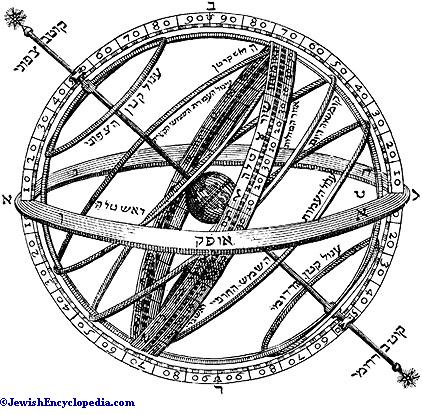
The Basis of Messianic Calculations.
Abraham ibn Ezra was the most enthusiastic follower and propagandist of Astrology, which he calls "a sublime science." Besides translating Mashallah's "Questions" and another work of this author on the eclipse of the moon from the Arabic into Hebrew, he wrote "Nativity," "Elections," "Sentences of the Constellations," "Reshit ḤokmaḦ" (Beginning of Wisdom), "Book of the World," a treatise on the "Planets," a treatise on the "Luminaries," one on the "Causes" ('Ha-Ṭe'amim'), and finally a horoscope, see Steinschneider, "Berlin Cat. Hebr. MSS." pp. 136-150; "Hebr. Uebers." pp. 600 et seq.; Rosin, in "Monatsschrift," 1898, p. 250). He often refers to Astrology in his Bible commentaries. To him heaven with its constellations is "the book of life," in which man's destiny is written, and against which there is recourse to God as "the Almighty," who overrules all these influences (commentary to Ps. lxix. 29; Gen. xvii. 9; Ex. vi. 3, xxxiii. 21; Rosin, l.c. p. 251; Zunz, "G. S." iii. 93). Abraham ben David of Posquières, in his critical notes to Maimonides' "Yad," Teshubah, v. 5, also asserts the influence of the stars upon destiny, while contending that by faith in God man may overcome this influence. Judah ha-Levi ("Cuzari," iv. 9), Abraham ibn Daud ("Emunah Ramah," p. 86; see Kaufmann, "Geschichte der Attributenlehre in der Jüdischen Religionsphilosophie des Mittelalters," p. 247), and Albo ("Iḳḳarim,"iv. 4) could not free themselves altogether from the belief in the "decrees of the stars"; nor could NaḦmanides (commentary to Gen. i. 16; Lev. xxiii. 24, and elsewhere), Isaac Arama ("Aḳedat YiẓḦaḳ," xxxiv., Introduction to Ex.), Solomon b. Adret (Responsa, No. 652), and others. Astrology was made the basis of Messianic calculations in almost every century (see Ibn Ezra to Dan. xi. 29; Abravanel, "Mashmia' Yeshu'ah"; Azariah dei Rossi, "Meor Enayim," ch. xliii.; Zunz, l.c.; Steinschneider, "Jüdische Literatur," in Ersch and Gruber's "Encyc." p. 441, notes 80, 81).
Opposed by Maimonides.
Maimonides was the only authority that opposed Astrology energetically. He found it forbidden by the Law in the verse, "Ye shall not observe times" ("lo te'onenu") Lev. xix. 26, in accordance with R. Akiba, Sanh. 68b ("Yad," 'Akkum, xi. 8), and declared it, Talmudical utterances notwithstanding, to be bordering on idolatry, "a disease, not a science, a tree under the shadow of which all sorts of superstitions thrive, and which must be uprooted in order to give way to the tree of knowledge and the tree of life" ("Letter to the Men of Marseilles"; Steinschneider, "Cat. Bodl." col. 1903; idem, "Hebr. Uebers." p. 931). However, the belief was too deeply rooted to be abandoned by the great majority of thinkers (see Löw, in "Ben Chananja," 1863, pp. 430-434). As the last important prominent follower of Astrology may be mentioned David Gans, the astronomer and historian, and friend of Tycho de Brahe, the contemporary of Wallenstein, whose historical work, "ẒemaḦ David" (see introduction to vol. ii.), lays great stress upon the influence of the constellations upon history.
Modern science has abolished Astrology. Only the formula of congratulations, "Mazzal ṭob" (Good luck), is a survival of the old belief, as is the rejection of certain days in the week or the month for weddings or new ventures (see ShulḦan 'Aruk, Yoreh De'ah, 179, 2).
Bibliography:
Steinschneider, Jüdische Literatur, in Ersch und Gruber's Encyc. pp. 441-442;
idem, Die Hebräischen Uebersetzungen des Mittelalters, pp. 186, 501-649, 666, 846, 856-858, 931;
idem, in Jew. Quart. Rev. xiii. 107-109;
Zunz, G. S. iii. 93-95;
Schmiedl, Studien über Jüdische Religionsphilosophie, pp. 299-316, Vienna, 1869;
L. Löw, Die Astrologie in der Biblischen, Talmudischen und Nachtalmudischen Zeit, in Ben Chananja, 1863, pp. 401, 431 et seq.;
idem, Gesammelte Schriften, ii.;
Rosin, Die Ethik des Maimonides, 1876, pp. 65 et seq.;
idem, in Monatsschrift, 1898, pp. 447 et seq.;
Senior Sachs, Ha-Yonah, i. 59-93, Berlin, 1851.
(Greek: astron, star; logos, knowledge)
A pseudo-science dealing with the influence of the stars on human fate, or on the weather. The former is termed mundane or judicial astrology, and its predictions rely upon the planets positions, at the time of a human being’s birth, in the twelve houses into which the heavens are divided. The houses symbolize such factors as riches, success, children, etc. The signs of the zodiac, each of which rules over a certain part of the human body, exercise a particular influence on the bodily health of an individual and the position of the sun in the zodiac at the moment of birth is a vital factor in determining his fate. The calculations essential to the settling of these positions are called casting the horoscope. The second division, termed natural astrology, predicts weather variations as effected by the positions of the planets, especially the moon. The Assyrians and Babylonians were the leading exponents of this science among the ancients, while the Egyptians developed it approximately to its present condition. The Assyro-Babylonian and Egyptian priests expounded these astrological views to the Greek astrologers, whence knowledge of it came to the profane world and to Rome where for about five hundred years it ruled public life. The advent of Christianity and its active antagonism to astrological teachings, as illustrated by Constantine’s edict of death to the Chaldeans, Magi, and other astrologers, dealt a severe blow to it, effective for several centuries. Early Christian legend distinguished between astronomy and astrology and Saint Augustine (De Civitate Dei, VIII, xix) vigorously opposed the amalgamation of the two. During the Middle Ages, owing to Jewish scholars, astrology became important again and numbered emperors and popes among its votaries, including the Emperors Charles IV and V and Popes Sixtus IV, Julius II, Leo X, and Paul III. Petrarch conintially attacked it, and it met successful antagonists in the Catholic scientists and philosophers, Pico della Mirandola and Paolo Toscanelli, and, in the later Renaissance, the Franciscan, Nas. The victory of the Copernican system, the recognition of the moral and psychical dangers of astrology and the progress of experimental science reduced it to the status of a superstition, a position it still occupies, in spite of the recent revival of occultism.
The supposed science which determines the influence of the stars, especially of the five older planets, on the fate of man (astrologia judiciaria; mundane, or judicial astrology) or on the changes of the weather (astrologia naturalis; natural astrology) according to certain fixed rules dependent upon the controlling position of stars (constallations aspects ) at the time under consideration. Judicial astrology--more important branch of this occult art--depended for its predictions upon the position of the planets in the "twelve houses " at the moment of the birth of a human being. The calculations necessary to settle these positions were casting the horoscope or the diagram of the heavens (thema coeli) at the nativity. Starting with the point that was rising just at the moment of birth, the celestical equator was divided into twelve equal parts, six above, and six below the horizon, and circles were drawn through these points and the intersecting points of the horizon and the meridian. Thus the heavens were divided into twelve houses. The first house (horoscopus) begins with the point of the ecliptic that is just rising (ascendens). The twelve houses are divided into cardinal houses, also called anguli, succeeding houses (succedentes, anaphora) and declining or cadent houses (cadentes, cataphora). The houses symbolize respectively: life, personal property, consanguinity, riches, children and jewels, health, marriage and course of life, manner of death and inheritance, intellect and disposition (also long journeys), position in life and dignities, friends and success, enemies and misfortune. In the horoscope all these symbolic meanings are considered in their relation to the newly born. A Latin hexameter thus sums up the meaning of the twelve houses: Vita, lucrum, fratres, genitor, nati, valetudo, Uxor, mors, sapiens, regnans benefactaque, daemon. The position of the planets and the sun and moon in the twelve houses at the moment of birth is decisive. The planets vary as to meaning. They are divided into day-stars (Saturn, Jupiter, and also the sun) and night-stars (the moon, Mars, and Venus); Mercury belongs both to day and night. The sun, Jupiter, and Mars are masculine; the moon and Venus are feminine, Mercury belongs both to day and night. The sun, Jupiter, and Mars are masculine; the moon and Venus are feminine, Mercury belonging again to both classes. Jupiter (fortuna major) and Venus (fortuna minor) are good planets; Saturn (infortuna major) and Mars (infortuna minor) are malignant planets. The sun, moon, and Mercury have a mixed character. Each of the planets known to antiquity, including sun and moon, ruled a day of the week; hence the names still used to designate the various days. Judicial astrology also took into consideration the position of the sun in the zodiac at the moment of birth; the signs of the zodiac also had a special astrological significance in respect to the weal and woe of the newborn, particularly his health. In medical astrology every sign of the zodiac ruled some special part of the body, as for example: Aries, the Ram, the head: its diseases; Libra, the Balance, the intestines. Judicial astrology postulates the acceptance of the earth as the centre of the solar system. Natural astrology predicts the weather from the positions of the planets, especially the moon. Many of its theories are not to be rejected a priori, since the question of the moon’s meteorological influence still awaits a solution which must depend upon the progress of human knowledge as to ether waves and cognate matters. HISTORYThe history of astrology is an important part of the history of the development of civilization, it goes back to the early days of the human race. The unchangeable, harmonious course of the heavenly bodies, the profound impression made on the souI of man by the power of such heavenly phenomena as eclipses, the feeling of dependence on the sun, the giver of daylight--all these probably suggested in the early ages of the human race, the question whether the fate of man was not dependent on these majestic manifestations of Divine power. Astrology was, therefore the foster-sister of astronomy, the science of the investigation of the heavens. From the start astrology was employed for the needs and benefit of daily life; the astrologers were astronomers only incidentally and in so far as astronomy assisted astrology in the functions which the latter had to perform in connection with religious worship. According to the belief of the early civilized races of the East, the stars were the source and at the same time the heralds of everything that happened, and the right to study the "godlike science" of astrology was a privilege of the priesthood. This was the case in Mesopotamia and Egypt, the oldest centres of civilization known to us in the East. The most ancient dwellers on the Euphrates the Akkado-Sumerians were believers in judicial astrology which was closely Interwoven with their worship of the stars. The same is true of their successors, the Babylonians and Assyrians, who were the chief exponents of astrology in antiquity. The Babylonians and Assyrians developed astrology, especially judicial, to the status of a science, and thus advanced in pure astronomical knowledge by a circuitous course through the labyrinth of astrological predictions. The Assyro-Babylonian priests (Chaldeans) were the professional astrologers of classic antiquity. In its origin Chaldaic astrology also goes back to the worship of stars; this is proved by the religious symbolism of the most ancient cuneiform texts of the zodiac. The oldest astrological document extant is the work called "Namar-Beli" (Illumination of Bel) composed for King Sargon I (end of the third millennium B.C.) and contained in the cuneiform library of King Asurbanipal (668-626 B.C.). It includes astronomical observations and calculations of solar and lunar eclipses combined with astrological predictions, to which the interpretation of dreams already belonged. Even in the time of Chaldean, which should be called Assyrian, astrology, the five planets, together with the sun and moon, were divided according to their character and their position in the zodiac as well as according to their position in the twelve houses. As star of the sun, Saturn was the great planet and ruler of the heavens. The weather, as far back as this time, was predicted from the colour of the planets and from their rising and setting. Classical antiquity looked upon Berosus, priest of the temple of Bel at Babylon, as the oldest writer on astrology; and according to Vitruvius Berosus founded a school of astrology at Cos. Seneca says that a Greek translation, made by Berosus, of the "Namar-Beli " from the library the Asurbanipal was known to classical antiquity. The Egyptians and Hindus were as zealous astrologers as the nations on the Euphrates and Tigris. The dependence of the early Egyptian star (sun) worship (the basis of the worship of Osiris) upon early Chaldaic influences belongs to the still unsettled question of the origin of early Egyptian civilization. But undoubtly the priest of the Pharaohs were the docile pupils in astrology of the old Chaldean priests. The mysterious Taauth (Thoth), the Hermes Trismegistus of antiquity, was regarded the earliest teacher of astrology in Egypt. He is reputed to have laid the foundation of astrology in the "Hermetic Books"; the division of the zodiac into the twelve signs is also due to him. In classic antiquity many works on astrology or on occult sciences in general were ascribed to this mythical founder of Egyptian astrology. The astrological rule of reckoning named after him, "Trutina Hermetis" made it possible to calculate the position of the stars at the time of conception from tbe diagram of the heavens at the time of birth. The Egyptians developed astrology to a condition from which it varies but little today. The hours of the day and night received special planets as their rulers, and high and low stood under the determinative influence of the stars which proclaimed through the priestly caste the coming fate of the land and its inhabitants. It is significant that in ancient Egypt astronomy, as well as astrology, was brought to an undoubtedly high state of cultivation. The astoundingly daring theories of the world found in the Egyptian texts, which permit us to infer that their authors were even acquainted with the helio-centric conception of the universe, are based entirely on astrologico-theosophic views. The astrology of the ancient inhabitants of India was similar, though hardly so comptetely developed; they also regarded the planets as the rulers of the different hours. Their division of the zodiac into twenty-eight houses of the moon is worthy of notice; this conception like all the rest of the fundamental beliefs of Hindu astrology, is to be found in the Rig-Veda. In India both astrology and the worship of the gods go back to the worship of the stars. Even today, the Hindus, especially the Brahmins, are considered the best authorities on astrology and the most skilful casters of horoscopes.India influenced and aided the development of astrology in ancient China, both India and Mesopotamia that of the Medes and Persians. The Assyro-Babylonian and Egyptian priests were the teachers of the Greek astrologers. Both of these priestly castes were called Chaldeans, and this name remained the designation of all astrologers and astronomers in classic antiquity and in the period following. It speaks well for the sound sense of the early Grecian philosophers that they seperated the genuine astronomic hypotheses and facts from the confused mass of erroneous astrological teaching which the Egyptian priests had confided to them. At the same time it was through the old Hellenic philosophers that the astrological secrets of the Oriental priestly castes reached the profane world. The earliest mention of the art of astrological prediction in early classical literature is found in the "Prometheus Vinctus" of Æschylus (line 486 sqq.) a comparatively late date. The often quoted lines of the Odyssey (Bk. XVIII, 136 sqq.) have nothing to do with astrology. Astrology was probably cultivated as an occult science by the Pythagorean school which maintained the exclusiveness of a caste. The teaching of Pythagoras on the "harmony of the spheres" points to certain astrological hypotheses of the Egyptian priests. It is a striking fact that Greek astrology began to flourish when the glory of the early classical civilization had begun to wane. It was in the age of Euripides, who refers to astrological predictions in a little comedy, that the belief in astrology began to grow popular in Greece. After the overthrow of the Assyro-Babylonian Empire, the priests of those regions found refuge in Greece and spread their astrological teachings by word of mouth and writing. In this way astrology lost the characler of occult science. Astronomy and astrology remained closely united, and both sciences were represented by the so-called Chaldeans, Mathematici, and Genethliacs. Astrology proper, from the time of Posidonius, was called apotelesmatika (rendered into English, "apotelesmatics" in order to indicate more clearly the influence of the stars upon man’s final destiny; apo, "from", and telos, "end"). Astrology soon permeated the entire philosophical conception of the nature among the Greeks, and rapidly attained a commanding position in religious worship. Plato was obliged to take astrology into consideration as a "philosophical doctrine", and his greatest disciple, Aristotle, was the first to separate the science of astrology from that of meteorology, which was reserved for the phenomena of the atmosphere. The Stoics who encouraged all forms of divination were active promoters of astrology. The more plainly the influence of Oriental teaching manifested itself in Greek civilization, and the more confused the political conditions and religious ideas of the Greek States became, the greater was the influence of astrologers in public, and the more mischievous their activity in private life. Every professional astronomer was at the same time an astrologer. Eudoxus of Cnidles, the author of the theory of concentric spheres, was perhaps the first to write in Greek on purely astrological topics, being led to select this subject by his studies in Egypt. Most of the Greek astronorners known to us followed in his footsteps, as, for instance, Geminus of Rhodes whose most important work treating of astronomy and astrology Eisagoge eis ta Phainomena (Introduction to Phenomena) was commented on even by Hipparchus. About 270 B.C. the poet Aratus of Soli in his didactic poem, "Phænomena", explained the system of Eudoxus, and in a poem called "Diosemeia", which was appended to the former, he interprets the rules of judicial and natural astrology that refer to the various changes of the stars. The poem of Aratus was greatly admired by both the Greeks and the Romans; Cicero translated it into Latin, and Hygius, Ovid’s friend, wrote a commendary on it. In this age astrology was as highly developed as in its second period of prosperity, at the Renaissance. Medical astrology had also at this date secured a definite position. Hippocrates of Cos in his work "De Aere, Aqua et Locis", which shows the influence of the Pythagoreans, discusses at length the value of astrology and its prognostications for the whole domain of medicine. In the Alexandrine school of medicine, astrological prognosis, diagnosis, and hygiene soon covered with their rank growths the inherited scientific teachings that had been tested by practice. In this way "astrological" cures grew in favour. These forms of the art of healing are not without interest both for the history of suggestion and for that of human error. The diseases of the more important bodily organs were diagnosed according to the influence of the sign of the zodiac at the time, and a medicine applied which either acted by suggestion, or was wholly inoperative. In the division of the zodiac according to its medical effect on the different parts of the body the first sign taken was the Ram (Aries), which ruled the head, and the last of the series was the Fishes (Pisces) which controlled the health or ailments of the feet. As the appetite of the Greeks for the mysterious wisdom of astrology grew keener, the Egyptian and Chaldean astrologers continually drew out still more mystical but, at the same time, more dubious treasures from their inexhaustible store-house. The newly founded city of Alexandria, where the later Hellenic culture flourished was a centre for all astrologers and practitioners of the occult arts. From time to time books appeared here, professing to have had their origin in the early days of Egytian civilization, which contained the secret knowledge pertaining to astrological and mystical subjects. These writings seems to meet the aspirations of ordinary men for the ideal, but all they offered was a chaotic mass of theories concerning astrology and divination, and the less they were understood they more they were applauded. In the Renaissance these pseudo-scientific works of antiquity were eagerly studied. It suffices here to mention the books of Nechopso-Petosiris which were believed by the neo-Platonists to be most the ancient Egyptian authority on astrology but which, probably were written in Alexandria about 150 B.C. About this same time, in all probability, Manetho, an Egyptian priest and traveller mentioned by Ptolemy, wrote on astrology. In order to meet the exigencies which arose, each degree of the heavens in late Egyptian astrology was assigned to some special human activity and some one disease. Besides this, the "heavenly spheres", which play so important a part in the history of astronomy, were increased to 54, and even a higher number, and from astrological calculations made from the complicated movements of these spheres the fate both of men and nations was predicted. Thus arose in late classic times the sphoera barbarica (foreign sphere) which in the Middle Ages also had a controlling influence over astrology.It was to be expected that the sober-minded, practical Romans would soon be dissatisfied with the mystical and enigmatical doctrines of Alexandrian astrology. Cato uttered warnings against the mischievous activity of the Chaldeans who had entered Italy along with Greek culture. In the year 139 B.C. the Praetor Cneius Cornelius Hispallus drove all astrologers out of Italy; but they returned, for even the Roman people could not begin an important undertaking without the aid and auspices. It is only necessary to recall the greatest man of ancient Rome, Julius Caesar. Cicero, who in his younger days had busied with astrology, protested vigorously, but without success, against it in his work "De Divinatione". The Emperor Augustus, on the other hand, believed in astrology and protected it. The first Roman work on astrology was dedicated to him; it was the "Astronomica" written about 45 B.C. by Marcus Manilius, who was probably a Chaldean by birth. In five books this poem gives an outline of the astrology of the zodiac and constellations. The fifth book is devoted to the sphoera barbarica. It is a curious fact that the poem does not take up the astrology of the planets. In spite of repeated attempts to suppress it, as in the reigns of Claudius and Vespasian, astrology maintained itself in the Roman Empire as one of the leading forms of culture. The lower the Romans sank in religion and morals the more astrology became entwined with all action and belief. Under Tiberius and Nero the two astrologers named Thrasyllus who were father and son held high political positions. The most distinguished astronomer of antiquity, Claudius Ptolemaeus, was also a zealous astrologer. His "Opus Quadripartitum, seu de apotelesmatibus et judiciis astrorum, libri IV" is one of the chief treatises on astrology of earlier times and is a detailed account of astrological teachings. This work occupied in astology as important a position as that which the same author’s Megale Euntaxis (also called "Almagest"), held in the science of astronorny before the appearance of the Copernican theory. It is a striking fact that Ptolemy sought, in the second book of the "Opus Quadripartitum" to bring the psychical and bodily differences of the various nations into relation with the phyical conditions of their native lands, and to make these conditions, in their turn, depend on the positions of the stars. The Roman astrologers wrote their manuals in imitation of Ptolemy, but with the addition of mystic phantasies and predictions. After the death for Marcus Aurelius, the Chaldeans were always important personages at the imperial court. As late as the time of Constantine the Great the imperial notary Julius Firmius Maternus, who later became a Christian, wrote on "Mathematics, or the power and the influence of the stars" eight books which were the chief authority in astrology until the Renaissance. With the overthrow of the old Roman Empire and the victory of Christianity, astrology lost its importance in the centres of Christian civilization in the West. The last known astrologer of the old world was Johannes Laurentius (sometimes called Lydus) of Philadelphia in Lydia, who lived A.D. 490-565. ASTROLOGY UNDER CHRISTIANITYFrom the start the Christian Church strongly opposed the false teachings of astrology. The Fathers energeticaly demanded the expulsion of the Chaldeans who did so much harm to the State and the citizens by employing a fantastic mysticism to play upon the ineradicable impulses of the common people, keeping their heathen conceptions alive and fostering a soul-perplexing cult which, with its fatalistic tendencies created difficulties in the discernment of right and wrong and weakened the moral foundations of all human conduct. There was no room in the early Christian Church for followers of this pseudo-science. The noted mathematician Aguila Ponticus was expelled from the Christian communion about the year 120, on account of his astrological heresies. The early Christians of Rome, therefore, regarded the astrological as their bitterest and, unfortunately, their too powerful enemies; and the astrologers probably did their part in stirring up the cruel persecutions of the Christians. As Christianity spread, the astrologers lost their influence and reputation, and gradually sank to the position of mere quacks. The conversion of Constantine the Great put an end to the importance of this so-called science, which for five hundred years had ruled the public life of Rome. In 321 Constantine issued an edict threatening all Chaldeans, Magi, and their followers with death. Astrology now disappeared for centuries from the Christian parts of Western Europe. Only the Arabic schools of learning, especially those in Spain after the Moors had conquered the Iberian peninsula, accepted this dubious inheritance from the wisdom of classic times, and among Arabs it became incentive to pure Astronomical research. Arabian and Jewish scholars were the representatives of astrology in the Middle Ages, while both Church and State in Christian countries rejected and persecuted this false doctrine and its heathen tendencies. Unfortunately, at the same time the development of astronony was checked, excepting so far as it was needed to establish certain necessary astronomic principles and to calculate the date of Easter. Yet early Christian legend dstinguished between astronomy and astrology by ascribing the introduction of the former to the good angels and to Abraham, while the latter was ascribed to Cham. In particular, St. Augustine ("De civitate Dei", VIII, xix, and in other places) fought against astrology and sought to prevent its amalgamation with pure natutal science. Once more the East prepared a second period of prosperity for astrology. The Jews, very soon after they were driven into Western Europe, busied themselves with astrological questions, being stimulated thereto by Talmud. Jewish scholars had, moreover, a knowlege of the most important works of classic times on astrology and they became the teachers of the Arabs. These latter, after the rapid spread of Mohammedanism in Western Asia and North Africa, and their defeat in Western Europe by Charles Martel, began to develop a civilization of their own. The mystical books which appeared in Jewish literature after the time of the Talmud, that is, the books called the "Sefer Zohar" and the "Sefer Yezirah" (Book of Creation), are full of rules of divination dealing especially with astrological meanings and calculations. The high reputation of the Talmud and Cabbala among the Jews in the Middle Ages explains their fondness for astrological speculations; but at a very early date, it should be noted, they distinguished between astronomy, "the science of reading the stars", and astrology, "the science of divination".Caliph Al-Mansur, the builder of Bagdad, was, like his son, the famous Harun-al-Rashid, a promoter of learning. He was the first caliph to call Jewish scholars around him in order to develop the study of the mathematical sciences, especially astronomy, in his empire. In the year 777 the learned Jew Jacob ben Tarik founded at Bagdad a school for the study of astronomy and astrology which soon had a high reputation; among those trained here was Alchindi (Alkendi), a noted astronomer. It was one of Alchindi’s pupils, Abumassar (Abu Mashar), from Bath in Chorassan, born about the year 805, whom the Middle Ages regarded as of greatest of Arabian astrologers. Astrology being regarded by the caliphs as the practical application of astronomy, all the more important Arabic and Jewish astronomers who were attached to that court, or who taught in the Moorish schools were also astrologers. Among the noteworthy Jewish astrologers may be mentioned Sahl ben Bishr al-Israel (about 820); Rabban al-Taban, the well-known cabbalist and Talmudic scholar; Shabbethai Donalo (913-970), who wrote a commentary on the astrology of the "Sefer Yezirah" which Western Europe later regarded as a standard work; and, lastly, the Jewish lyric poet and mathematician Abraham ibn Ezrah. Among the noted Arabic astronomers were Massah Allah Albategnius, Alpetragius, and others. The Arabo-Judaic astrology of the Middle Ages pursued the path indicated by Ptolemy, and his teachings were apparently the immovable foundation of all astronomical and astrological activity. At the same time the "Opus Quadripartitum" of the great Alexandrian was corrupted with Talmudic subtleties and overlaid with mystical and allegorical meanings, which were taken chiefly from the Jewish post -Talmudic belief conceming demons. This deterioration of astrology is not surprising if we bear in rnind the strong tendency of all Semitic races to fatalism and their blind belief in an inevitable destiny, a belief which entails spiritual demoralization. The result was that every conceivable pursuit of mankind every disease and indeed every nation had a special "heavenly regent", a constellation of definitely assigned position from the course of which the most daring prophecies were deduced.Up to the time of the Crusades, Christian countries in general were spared any trouble from a degenerate astrology. Only natural astrology, the correctness of which the peasant thought he had recognized by experience secured a firm footing in spite of the prohibition of Church and State. But the gradually increasing influence of Arabic learning upon the civilization of the West, which reached its highest point at the time of the Crusades was unavoidably followed by the spread of the false theories of astrology. This was a natural result of the amalgamation of the teachings of pure astronomy with astrology at the Mohammedan seats of learning. The spread of astrology was also furthered by the Jewish scholars living in Christian lands, for they considered astrology as a necessary part of their cabalistic and Talmudic studies. The celebrated didactic poem "Imago Mundi", written by Gauthier of Metz in 1245, has a whole chapter on astrology. Pierre d’Ailly, the noted French theologian and astronomer, wrote several treatises on the subject. The public importance of astrology grew as the internal disorders of the Church increased and the papal and imperial power declined. Towards the close of the Middle Ages nearly every petty prince, as well as every ruler of importance, had his court astrologer upon whose ambiguous utterances the weal and the woe of the whole country often depended. Such a person was Angelo Catto, the astrologer of Louis XI of France. The revival of classical learning brought with it a second period of prosperity for astrology. Among the civilized peoples of the Renaissance period, so profoundly stirred by the all-prevailing religious, social and political ferment, the astrological teaching which had come to light with other treasures of ancient Hellenic learning found many ardent disciples. The romantic trend of the age and its highly cultivated sensuality were conditions which contributed to place this art in a position far higher than any it had attained in its former period of prosperity. The forerunners of Humanism busied themselves with astrology, and but few of them perceived the dangerous psychical effect of its teachings upon the masses. Towards the end of the thirteenth century the Florentines employed Guido Bonatti as their official astrologer, and , although Florence then stood alone in this respect, it was scarcely a hundred years later when astrology had entered in earnest upon its triumphant course, and a Cecco d’Ascoli was already its devoted adherent. In Petrarch’s day the questionable activity of the astrologers at the Italian courts had made such progress that this clear-sighted Humanist (De remed. utr. fortm. I , iii, sqq; Epist. rer. famil., III; 8, etc.) again and again attacked astrology and its representatives with the keenest weapons of his wit, though without success, and even without any following except the weak objections of Villani and the still more ineffectual polemics of Salutato in his didactic poem "De fato et fortunâ". Emperors and popes became votaries of astrology-- the Emperors Charles IV and V, and Popes Sixtus IV, Julius II, Leo X, and Paul III. When these rulers lived astrology was, so to say, the regulator of official life; it is a fact characteristic of the age, that at the papal and imperial courts ambassadors were not received in audience until the court astrologer had been consulted. Regiomontanus, the distinguished Bavarian mathematician, practised astrology, which from that time on assumed the character of the bread-winning profession, and as such was not beneath the dignity of so lofty an intellect as Kepler. Thus had astrology once more become the foster-mother of all astronomers. In the judgment of the men of the Renaissance -- and this was the age of a Nicholas Copernicus--the most profound astronomical researches and theories were only profitable in so far as they aided in the development of astrology. Among the zealous patrons of the art were the Medici. Catharine de’ Medici made astrology popular in France. She erected an astrological observatory for herself near Paris, and her court astrologer was the celebrated "magician" Michel de Notredame (Nostradamus) who in 1555 published his principal work on astrology--a work still regarded as authoritative among the followers of his art. Another well-known man was Lucas Gauricus, the court astrologer of Popes Leo X and Clement VII, who published a large number of astrological treatises. ln Germany Johann Stöffler, professor of mathematics at Tübingen, Matthias Landenberg, and, above all, Philip Melanchthon were zealous and distinguished defenders of astrology. In Pico della Mirandola (Adversus Astrologos libri XII) and Paolo Toscanelli astrology encountered its first successful antagonists; later in the Renaissance Johann Fischart and the Franciscan Nas were among its opponents (Cf. Philognesius, Practicarum, Ingolstadt, 1571).Gabotto’s charming essay, "L’astrologia nel quattrocento" in "Rivisto di filosofia scientica", VIII, 378, sq., gives much information concerning astrology in the fifteenth century. A. Graf’s "La fatalita nelle credenze del medio evo" (in "Nuovo Antologia", 3rd series, XXVIII, 201,sqq.) is also of value for astrology at the turning point of the Middle Ages. Some of the late Roman astrologers, among whom was probably Firmicus Maternus, thought to reform astrology by idealizing it and raising its moral tone. The same purpose animated Paolo Toscanelli, called Maistro Pagollo, a physician greatly respected for the piety of his life, who belonged to the learned and artistic circle which gathered around Brother Ambrosius Camaldulensis in the Monastery of the Angels. There were special professors of astrology, besides those for astronomy, at the Universities of Pavia, Bologna, and even at the Sapienza during the pontificate of Leo X, while at times these astrologers outranked the astronomers. The three intellectual centres of astrology in the most brilliant period of the Renaissance were Bologna, Milan, and Mantua. The work of J.A. Campanus, published at Rome in 1495, and often commented on, namely, "Oratio initio studii Perugiae habita" throws a clear light on the lack of comprehension shown by the Church Fathers in their attitude towards pagan fatalism. Among other things it is here said: "Quanquam Augustinus, sanctissimus ille vir quidem ac doctissimus, sed fortassis ad fidem religionemgue propensior, negat quicquam vel mali astrorum necessitate contingere".In the Renaissance, religion, also, was subordinated to the dictation of astrology. The hypothesis of an astrological epoch of the world for each religion was widely believed by Italian astrologers of the time, who obtained the theory from Arabo-Judaic sources. Thus it was said that the conjunction of Jupiter with Saturn permitted the rise of the Hebrew faith; that of Jupiter with Mars, the appearance of the Chaldaic religion; of Jupiter with the sun, the Egyptian religion; of Jupiter with Venus, Mohammedanism; and of Jupiter with Mercury, Christianity. At some future day the religion of Antichrist was to appear upon the conjunction of Jupiter with the moon. Extraordinary examples of the glorification of astrology in Italy during the Renaissance are the frescoes painted by Miretto in the Sala della Ragione at Pavia, and the frescoes in Borso’s summer palace at Florence. Petrarch, as well, notwithstanding his public antagonism to astrology, was not, until his prime, entirely free from its taint. In this connection his relations with the famous astrologer, Mayno de Mayneri, are significant (Cf. Rajna, Giorn. stor., X, 101, sq.).Even the victorious progress of the Copernican system could not at once destroy confidence in astrology. The greatest astronomers were still obliged to devote their time to making astrological predictions at princely courts for the sake of gain; Tycho Brahe made such calculations for the Emperor Rudolph II, and Kepler himself, the most distinguished astronomer of the age, was the imperial court astrologer. Kepler was also obliged to cast horoscopes for Wallenstein, who later came completely under the influence of the alchemist and astrologer Giambattista Zenno of Genoa, the Seni of Schiller’s "Wallenstein". The influence of the Copernican theory, the war of enlightened minds against pseudo-prophetic wisdom and the increasing perception of the moral and psychical damage wrought by astrological humbug at last brought about a decline in the fortunes of astrology, and that precisely in Wallenstein’s time. At the same period astrological tracts were stil being written by the most celebrated of English astrologers, William Lilly of Diseworth, Leicestershire, who received a pension of 100 pounds from Cromwell’s council of state, and who, in spite of some awkward incidents, had no little political influence with Charles II. Among his works was a frequently republished "Christian Astrology". Shakespeare (in King Lear) and Milton were acquainted with and advocated astrological theories, and Robert Fludd was a representative of the art at the royal court. Francis Bacon, it is true, sought to win adherents for a purified and reformed astrology in order to destroy the existing form of the art. It was Jonathan Swift who in his clever satire, "Prediction for the Year 1708 by Isaac Bickerstaff, Esq", which deserves to be read even at the present day, gave the deathblow to the belief of English society in astrology. The last astrologer of importance on the Continent was Jean-Baptiste Marin, who issued "Astrologia Gallica" (1661). The greatly misunderstood Swiss naturalist Theophrastus Paracelsus was an opponent of astrology, and not its advocate, as was formerly inferred from writings erroneously attributed to him. The rapid growth of experimental investigation in the natural sciences in those countries which had been almost ruined, socially and politically; by the Thirty Years War completely banished the astrological parasites from society. Once more astrology fell to the level of a vulgar superstition, cutting a sorry figure among the classes that still had faith in the occult arts. The peasant held fast to his belief in natural astrologist and to this belief the progress of the art of printing and the spread of popular education contributed largely. For not only were there disseminated among the rural poor "farmer’s almanacs", which contained information substantiated by the peasant’s own experience, but the printing-presses also supplied the peasant with a great mass of cheap and easily understood books containing much fantastic astrological nonsense.The remarkable physical discoveries of recent decades, in combination with the growing desire for an elevated philosophico-religious conception of the world and the intensified sensitiveness of the modern cultured man -- all these together have caused astrology to emerge from its hiding place among paltry superstitions. The growth of occultistic ideas, which should, perhaps, not be entirely rejected, is reintroducing astrology into society. This is especially true of judicial astrology, which, however, by its constant encouragement of fatalistic views unsettles the belief in a Divine Providence. At present Judicial astrology is not justified by any scientific facts. To put forward the theory of ether waves as an argument for astrological assertions is not in accord with the methods of sober science. Judicial astrology, therefore, can claim a place only in the history of human error, while, however, as an historical fact, it reflects much light upon the shadowy labyrinth of the human soul. ASTROLOGY AMONG THE ANCIENT JEWSThe Bible is free from any base admixture of astrological delusions. There is no reason for dragging the passage Josue x, 12, into historito-astrological discussions; the facts there related --the standing still of the sun in the valley of Gabaon and of the moon in the valley of Ajalon--are of purely astronomical interest. Only a few indicators in the Old Testament suggest that, notwithstanding the Divine prohibition (Exodus 22:18, Deuteronomy 18:10, etc.), the Jews, especially after they were exposed to the influence of Egyptian and BabyIonian errors, may have practised astrology in secret, along with other superstitions. The Prophets warned the people against the pernicious ascendancy of soothsayers and diviners of dreams (Jeremiah 29:8; Zechariah 10:1-2), among whom astrologers were included. Thus in the Book of Wisdom (xiii, l-2) it is said: "All men are vain . . . who . . . have either . . . the swift air, or the circle of stars, or the great water, or the sun and the moon, to be the gods that rule the world." The Book of Job, a writing of importance in the history of astronomy and star nomenclature, is also free from astrological fatalism. But to this fatalism the Jews had a natural predisposition, when Hellenism gained footing in the Holy Land it was accompanied by the spread of astrology, largely among the learned, the "philosophers", at whom even in an ealier age the passage in Wisdom had probably been aimed. Again, Isaias (xlvii, 13-14) derides the Babylonian astrologers ( Let now the astrologers, stand and save thee, they that gazed at the stars . . . Behold they are as stubble fire hath burnt them"), and Jeremias exclaims (x, 2): "Be not afraid of the signs of heaven, which the heathen fear".After the Exile, however, astrology spread so rapidly, above all among the educated classes of Israel, that as early as the Hellenistic era a Jewish astrological literature existed, which showed a strong Persico-Chaldean influence. The prophets had been opponents of astrology and of a relapse into fatalism. If, when they were phophesying of the great events to come, the contemplation of nature, and especially of the stars, filled them with sympathetic enthusiasm, by reason of their poetic inspiration and power of divination, this had nothing to do with astrology. On the other hand it does not appear impossible that in Daniel’s time exiled Jews practised astrology. Judging from Daniel, v, 7, 11, it is possible that the prophet himself held a high rank among the astrologers of the Babylonian court. After the Exile an attempt was made to separate astrology from sorcery and forbidden magical arts, by denying a direct Biblical prohibition of astrology and by pretending to find encouragement for such speculations in Genesis, i, 14. It is a characteristic fact that in ancient Israel astrology received no direct encouragement, but that its spread was associated with the relapse of many Jews into the old Semitic star-worship which was aided by Persico-Chaldean influence. For this Jeremias is a witness (vii, 18; xix, 13; xliv, 17-19, 25). Co-incident with the spread of old astrology in old Israel and the decline of the nation was the diffusion of demonology. The Jewish prayers to the planets, in the form in which they are preserved with others in Codex Paris, 2419 (folio 277r), came into existence at the time when Hellenism first flourished in the East, namely, the third and second centuries B.C. In these prayers special angels and demons are assigned to the different planets; the greatest and most powerful planet Saturn having only one angel, Ktetoel, and one demon, Beelzebub. These planetary demons regulated the destiny of men.The most notable witness for astrological superstitions in the era of the decadence of Israel is the apocryphal "Book of the Secrets of Henoch", which, notwithstanding its perplexing phantasies, is a rich treasure-house of information concerning cosmological and purely astronomical problems in the Hellenic East. The author of "Henoch" is said by a Samaritan writer to be the discoverer of astronomy, and the book contains valuable explanations in regard to astronomy and astrology at the time of the Machabean dynasty. The evidences for astrologic demonology in ancient Israel, when the nation was affected by Hellenism and Babylonian decadence, are found in the latter part of the "Book of the Secrets of Henoch"-- the "Book of the Course of the Lights of Heaven"-- as also previously in the fourth section which treats of Henoch’s wanderings "through the secret the places of the world". This latter is perhaps the archetype of Dante’s "Divine Comedy". According to the "Book of Henoch" the human race derived its knowledge of astrology and "lunar sorceries", together with all other forms of magic, from the seven or eight spirits from whom come the chief sins of mankind (Henoch, i, 8). It is, moreover, worthy of note that the "Book of Henoch" must be regarded as a witness to Jewish national prophecy. It does not betray the ascendancy of Hellenism in any such degree as do the verses of the "Sibylline Oracles", which were recorded in the old Ionic dialect during the reign of Ptolemy Physcon (145-112 B.C.) by Jewish scholars in Egypt, and probably at a later date in the Holy Land itself.The astrological demonology of the Jews was continually fed from Egyptian and Babylonian sources, and formed in its turn the basis for the astrology of certain neo-Platonic sects. Together with the Parsee astrology, it was the Gnostics and Priscillianists. The influence of Hellenistic Judaism is also plainly visible in the philosophic system of the Harranites, or Sabeans. It is only necessary to mention here the high honour paid by the Sabeans to the seven planetary gods who regulate the fate of man. According to the belief of the every planet is inhabited by a spirit as star-soul, and the deciphering of the figures of the conjunction and opposition of the planets made the prediction of future destiny possible. Other elements of late Judaic astrology were adopted by the earliest known Christian writer on astrology, the Byzantine court-astrologer, Hephaestion of Thebes. The didactic astrological poem of Johanes Kamteros (about the middle of the twelfth century), which was dedicated to the Byzantine Emperor Manual I, appears to have heen drawn from Judaeo-Gnostic sources. It is a striking fact that as "demonized astrology" gained ground in ancient Israel -- and this was a branch of astrology in great favour among the Jewish scholars of the age of the Ptolemies, and much practised by them--the worship of the stars ventured once more to show itself openly. It was not until the appearance of Christianity that the preposterous, and, in part, pathologically degenerate, teachings of the Judaic astrology were swept away.The lower the Jewish nation sank in the scale of religion and civilization the greater was the power gained by the erratic doctrines of astrology and the accompanying belief in demonology. The earthly labours of the Saviour purified this noxious atmosphere. The New Testament is the opponent of astrology, which, by encouraging an apathetic fatalisrn, prevents the development of and elevating and strengthening trust in a Divine Providence. The "Star of the Wise Men" (Matthew 2:2, 7, 9, sq.) cannot be identified by astronomy; perhaps, according to Ideler (Handbuch der mathemat. und techn. Chron.), the conjunction of the planets Jupiter and Saturn is meant. But this hypothesis, which would be of decisive importance in settling the year of the birth of Christ, still lacks convincing proof. It finds a curious support in Abrabanel’s comment that, according to Jewish astrologers, a conjunction of Jupiter and Saturn was a sign of the Messias. It must, however, remain questionable whether and to what extent a prediction of Jewish astrologers, or Kere schamajim, is to be considered as realized in the "Star of the Wise Men" (Matthew 2:2, etc). The first heralds of Christianity, the Twelve Apostles, at once began a bold war against the rank growths of superstition. They also battled with the propensity of the people for astrology and in its stead planted in the hearts of men a belief in the power and goodness of God. Supported by the teachings of the Scriptures, the Church Fathers became powerful opponents of astrology and attacked with determination the bewildering and demoralizing ascendancy of its devotees. The assertion therefore justified that the Book remained free from the taint of astrological delusion. The passion for astrology evinced by decadent Judaism, and preserved in the Bible, is only one more proof of the propensity of Semitic nations for fatalistic superstitions and of the purifying victorious power of the ethics of Christianity.Campbell Thompson’s monumental work, "The Reports of the Magicians and Astrologers of Nineveh and Babylon" (London, 1902), may be consulted for the valuable facts which throw light upon the dependence of the astrology of the ancient Jews on the that of Babylon. "A special branch of astrology which was zealously cultivated in Babylon was medical astrology, or the astrological prognosis of disease." Medical astrology is important in regard to the question of astrology in the Bible. It was greatly favoured by the spread of empirical treatment of disease among the astrologers. The Bible itself gives very little information concerning this form of the science, but subordinate Jewish sources, above all the Talmud, allow conclusions to be drawn as to its importance. Medical astrology, derived from Arabo-Judaic sources, flourished again at the time of the Renaissance. Its professional representatives were then called "Iatromathematicians", after the mathernatical mode of arriving at conclusions in their "art of healing". [Cf. Karl Sudhoff, Jatromathematiker, vornehml. des XV. und XVI. Jahrhund., in Abhand. zur Geseh. der Medizin (Breslau, 1902), pt. II; Wilh. Ebstein, Die Medizin im Alten Testament (Stuttgart, 1901); Gideon Precher, Das Tranzendentae, Magie im Talmud ((Vienna, 1850); Trasen, Sitten der alten Hebräer (Breslau, 1853).]The Babylonians, chiefly in relation to medical astrology, distinguished between a spherical method of calculation (from the point of view of the observer to the stars, i.e. subjectively), and a cosmical method (from the relative position of the stars, i.e. objectively). The former was used in the prognosis deduced from the observation of the twelve houses of the heavens; the latter in that drawn from the twelve signs of the Zodiac.-----------------------------------MAX JACOBI Transcribed by Joseph P. Thomas The Catholic Encyclopedia, Volume IICopyright © 1907 by Robert Appleton CompanyOnline Edition Copyright © 2003 by K. KnightImprimatur. +John M. Farley, Archbishop of New York
I. The Desire to Forecast the Future
1. Methods of Soothsaying
2. Divination
3. Looking in the Liver
4. The Astrologers, or Dividers of the Heavens
5. The Stargazers, or Seers of the Constellations
6. The Monthly Prognosticators, or Men Who Knew the Omens of the New Moon
II. The Worship of the Heavenly Bodies: The Form of Idolatry to Which the Israelites were Most Prone
1. Chiun, Certainly the Planet Saturn
2. Saturn or Moloch Worship
3. Mazzaloth, or Planet Worship
4. Gadh and Meni or Star Worship
5. Lucifer, the Shining Star
III. Systems or Astrology
1. Names of the Week-Days, Due to an Astrological System
2. Origin of Modern Astrology
3. “Curious Arts” of Ephesus
Literature
I. The Desire to Forecast the Future
The desire to penetrate the future and influence its events has shown itself in all lands and ages. But it is clear that a knowledge of the future does not lie within the scope of man’s natural powers; “divination” therefore has always been an attempt to gain the help of beings possessing knowledge and power transcending those of man. The answer of the Chaldeans to King Nebuchadnezzar when he demanded that they should tell his dream was a reasonable one: “There is not a man upon the earth that can show the king’s matter:... there is no other that can show it before the king, except the gods, whose dwelling is not with flesh” (Dan 2:10, Dan 2:11). “Divination,” therefore, in all its forms is but an aspect of polytheism.
It was for the twofold reason that the arts of divination were abominable in themselves, and gave to their votaries no knowledge of the will of God, that such arts were forbidden in the Law (Deu 18:9-15). Israel was to be perfect with God and He would reveal to them His will perfectly through that prophet like unto Moses whom He would send. Keil and Delitzsch in commenting on this passage well remark: “Moses groups together all the words which the language contained for the different modes of exploring the future and discovering the will of God, for the purpose of forbidding every description of soothsaying, and places the prohibition of Molochworship at the head, to show the inward connection between soothsaying and idolatry, possibly because februation, or passing children through the fire in the worship of Moloch, was more intimately connected with soothsaying and magic than any other description of idolatry” (Commentary on the Pentateuch, III, 393).
1. Methods of Soothsaying
The forms of soothsaying mentioned in this catalogue are as follows: “One that practiceth augury” (
It will be seen that these forms of soothsaying are allied to the arts which in modern times bear the names of hypnotism and mediumship. They are more briefly referred to in Isa 8:19, “When they shall say unto you, Seek unto them that have familiar spirits and unto the wizards, that chirp and that mutter: should not a people seek unto their God? on behalf of the living should they seek unto the dead?” Here again mediumship and spiritism are connected with the ventriloquial whispers and mutterings, which are supposed to be characteristic of the utterances of the dead.
2. Divination
But the first term in the catalogue, “one that useth divination” (
3. “Looking in the Liver”
“Looking in the liver” is one of the most venerable forms of divination. Here again it was a question of “division.” Each of the various parts of the liver, its lobes, the gall bladder, the ducts and so forth, had a special significance allotted to it, theory, apparently, being that the god to whom the animal was sacrificed revealed his will by the way in which he molded the organ which was supposed to be the seat of the victim’s life.
It will be noted that no explicit mention is made of astrology in this catalogue of the modes of soothsaying. But astrology was, as will be shown, closely connected with Moloch-worship, and was most directly a form of “divination,” that is of division. Morris Jastrow the Younger indeed considers that astrology rose from hepatoscopy, and points out that, the common designation for “planet” amongst the Babylonians is a compound ideograph, the two elements of which signify “sheep” and “dead.” He considers that the sacrificial sheep was offered to the deity specially for the purpose of securing an omen. Hence, when the planets were used as omens, this name of “slain sheep” was naturally applied to them, even as “augury,” divination by the flight of birds, came to represent amongst the Romans all kinds of divination. “On the famous bronze model of a liver found near Piacenza and which dating from about the 3rd century bc was used as an object-lesson for instruction in hepatoscopy, precisely as the clay model of a liver dating from the
Three well-marked classes of astrology, that is to say of divination by the heavenly bodies, are mentioned in Isa 47:13, as being practiced in Babylon. “Let now the astrologers, the star-gazers, the monthly prognosticators, stand up, and save thee.”
4. The Astrologers, or Dividers of the Heavens
The astrologers are the “dividers of the heavens” (
The same principle of “division” was applied to the moon itself for the purpose of drawing omens from its eclipses. Thus in R. C. Thompson’s Reports of the Magicians and Astrologers of Nineveh and Babylon we read in No. 268, “The omens of all lands. The right of the moon is Akkad, the left Elam, the top Aharru, the bottom Subartu.” The constellations of the zodiac also had omens allotted to them in a similar manner.
5. The Star-Gazers, or Seers of the Constellations
The astrologers mentioned in the Book of Daniel (
At a later date we find a complete system of astrology based upon the constellations of the zodiac which happen to be rising at the moment when the stars were consulted. Examples of this form of divination are found in the works of Zeuchros of Babylon, who flourished about the beginning of our era. By his day the system had received a considerable development. Twelve signs did not give much scope for prediction, so each sign had been divided into three equal portions or “decans”; each decan therefore corresponding nearly to the part of the ecliptic which the sun would pass through in a decade or “week” of 10 days of the Egyptians. A yet further complexity was brought about by associating each one of the 36 decans with one of the 36 extra-zodiacal constellations, and a further variety was obtained by associating each zodiacal constellation with its
6. The Monthly Prognosticators, or Men Who Knew the Omens of the New
Moon:
The monthly prognosticators were the men who knew the omens of the new moon (
II. The Worship of the Heavenly Bodies: The Form of Idolatry to Which The Israelites Were Most Prone
As we should naturally expect, the earliest astrological tablets relate chiefly to omens dependent upon the two great lights, the sun and moon. There is no evidence at present available to fix the date when the planets were first recognized as distinct from the fixed stars. Probably this discovery was intimately connected with the formation of the constellations; it cannot have been long delayed after it. Certainly planet-worship, and as connected with it, planetary divination, prevailed in the Euphrates valley at a very early period.
1. Chiun, Certainly the Planet Saturn
One planet is certainly mentioned in Old Testament, and we may safely infer that the other four were known, since this particular planet is the least conspicuous both in brightness and in motion, and was therefore probably the last to be discovered. The reference to Saturn occurs in Amo 5:25, Amo 5:26: “Did ye bring unto me sacrifices and offerings in the wilderness forty years, O house of Israel? Yea, ye have borne the tabernacle of your king (the King James Version Moloch) and the shrine of (the King James Version Chiun) your images, the star of your god, which ye made to yourselves.” This passage was quited from Septuagint by Stephen in his defense, “And they made a calf in those days, and brought a sacrifice unto the idol, and rejoiced in the works of their hands. But God turned, and gave them up to serve the host of heaven; as it is written in the book of the prophets,
“Did ye offer unto me slain beasts and sacrifices
Forty years in the wilderness, O house of Israel?
And ye took up the tabernacle of Moloch,
And the star of the god Rephan,
The figures which ye made to worship them” (Act 7:41-43).
The difference between the names Chiun and Rephan, is due either to Rephan being local Egyptian name for the planet Saturn, and therefore used by the Septuagint as its equivalent, or to an actual error of transcription in the text from which they were translating: the initial of the word being taken as
2. Saturn or Moloch Worship
The difficulty of the passage is that both Amos and Stephen appear to represent the worship of the golden calf as identical with the worship of Moloch and of the planet Saturn; yet though
And Moloch the king, the idol of the Ammonites and Phoenicians, was intimately connected both with the solar bull and the planet Saturn. According to the rabbins, his statue was of brass, with a human body but the head of an ox. On the Carthaginian worship of Moloch or Saturn, Diodorus (book xx, chapter i) writes: “Among the Carthaginians there was a brazen statue of Saturn putting forth the palms of his hands bending in such a manner toward the earth, as that the boy who was laid upon them, in order to be sacrificed, should slip off, and so fall down headlong into a deep fiery furnace. Hence it is probable that Euripides took what he fabulously relates concerning the sacrifice in Taurus, where he introduces Iphigenia asking Orestes this question: ’But what sepulchre will me dead receive, shall the gulf of sacred fire me have?’ The ancient fable likewise that is common among all the Grecians, that Saturn devoured his own children, seems to be confirmed by this law among the Carthaginians.” The parallelism of the text therefore is very complete. The Israelites professed to be carrying the tabernacle of Yahweh upon which rested the Shekinah glory; but in spirit they were carrying the tabernacle of the cruelest and most malignant of all the deities of the heathen, and the light in which they were rejoicing was the star of the planet assigned to that deity.
Moloch then was the sun as king, and especially the sun as he entered upon what might be considered his peculiar kingdom, the zodiac from Taurus to Serpens and Scorpio, the period of the six summer months. The connection of the sun with Saturn may seem to us somewhat forced, but we have the most direct testimony that such a connection was believed in by the Babylonians. In Thompson’s Reports, obverse of No. 176 reads: “When the sun stands in the place of the moon, the king of the land will be secure on his throne. When the sun stands above or below the moon, the foundation of the throne will be secure.” The “sun” in this inscription clearly cannot be the actual sun, and it is explained on the reverse as being “the star of the sun,” the planet Saturn. No. 176 rev. reads: “Last night Saturn drew near to the moon. Saturn is the star of the sun. This is the interpretation: it is lucky for the king. The sun is the king’s star.” The connection between the sun and Saturn probably arose from both being taken as symbols of Time. The return of the sun to the beginning of the zodiac marked the completion of the year. Saturn, the slowest moving of all the heavenly bodies, accomplished its revolution through the signs of the zodiac in about 30 years, a complete generation of men. Saturn therefore was in a peculiar sense the symbol of Time, and because of Time, of Destiny.
3. Mazzaloth, or Planet Worship
The connection between the worship of the golden calves, of the heavenly host and of Moloch, and of these with divination and enchantments, is brought out very clearly in the judgment which the writer of the Book of Ki pronounces upon the apostate ten tribes: “They forsook all the commandments of Yahweh their God, and made them molten images, even two calves, and made an Asherah, and worshipped all the host of heaven, and served Baal. And they caused their sons and their daughters to pass through the fire, and used divination and enchantments” (2Ki 17:16, 2Ki 17:17). The sin of apostate Judah was akin to the sin of apostate Israel. In the reformation of Josiah, he put down the idolatrous priests that “burned incense unto Baal, to the sun, and to the moon, and to the planets (
The word translated “planets” in 2Ki 23:5 is
4. Gadh and Meni or Star Worship
The references in Old Testament to the planets other than Saturn are not so clear. In Isa 65:11 two deities are apparently referred to: “Ye that forsake Yahweh, that forget my holy mountain, that prepare a table for Fortune (Gad), and that fill up mingled wine unto Destiny (Meni); I will destine you to the sword, and ye shall all bow down to the slaughter.” It is clear that Gad and Meni are the titles of two closely associated deities, and Gesenius identifies them with Jupiter and Venus, the Greater and Lesser Good Fortunes of the astrologers; But as I have suggested in the Astronomy of the Bible (133, 217), if any of the heavenly bodies are here intended (which cannot as yet be considered certain), it is more probable that they are the two beautiful starclusters that stand on the head and the shoulder of the Bull at the old commencement of the zodiac, as if they marked the gateway of the year - the Hyades and Pleiades. Both groups were considered traditionally as composed of seven stars; and the two names
5. Lucifer, the Shining Star
The planet Venus is more distinctly referred to in Isa 14:12: “How art thou fallen from heaven, O Lucifer, son of the morning!” (the King James Version). The word here rendered Lucifer, that is, “light-bearer,” is the word
Mars and Mercury, the two remaining planets, are not mentioned as such in Old Testament, but the deities connected with them, Nergal = Mars (2Ki 17:30) and Nebo = Mercury (Isa 46:1), both occur.
III. Systems of Astrology
1. Names of the Week-Days, Due to an Astrological System
In astrology the planets were regarded as being 7 in number, but the idea that the number 7 derived its sacredness from this fact is an inversion of the true state of the case. It was that 7 being regarded as a sacred number, the number of the planets was artificially made to correspond by including in the same class as the five wandering stars, bodies that differed so widely from them in appearance as the sun and moon. So artificial a classification cannot have been primitive, and it is significant that in Gen 1:14 the sun and moon are presented as being (as indeed they appear to be) of an altogether different order from the rest of the heavenly bodies. Yet there is one feature that they have in common with the five planets: all move among the stars within the band of the zodiac; each of the seven makes the circuit of the
We owe the names of the days of the week to this astrological conception of the planets as being 7 in number, and some writers (e.g. R. A. Proctor in his 7Myths and Marvels of Astronomy, 43-47) have supposed that the week of 7 days owed its origin to this astrological conception and that the 7th day - Saturn’s Day - became the Sabbath, the Day of Rest, because Saturn was the planet of ill-omen and it was then unlucky to undertake any work. The way in which the allotment of the planets to the days of the week was arrived at was the following. The Greek astronomers and mathematicians concluded that the planet Saturn was the most distant from the earth and that the others followed in the descending order of Jupiter, Mars, Sun, Venus, Mercury, Moon. In the progress of astrology there came a time when it was found necessary to assign a planet to every hour so as to increase the number of omens it could afford. Starting then with Saturn as presiding over the first hour of the first day, each planet was used three times over on that day, and three planets were used a fourth time. The sun, the fourth planet, took therefore the first hour of the second day, and gave it its name, so that Sunday followed Saturday. In like manner the third day became the moon’s day, and so on with the other planets which followed in the order Mars, Mercury, Jupiter, Venus, and again Saturn. This idea of the relative distances of the planets was that arrived at by the astronomers of Alexandria, and was necessarily subsequent to the reduction of the planetary motions to a mathematical system by Eudoxus and his successors. The division of the day implied was one of 24 hours, not of 12; the Egyptian division, not the Babylonian. But the Egyptian week was one of 10 days, the 7-day week was Semitic, and the week implied in the system is the free week, running on continuously, the Jewish week, not the Babylonian. For the Babylonians, though they paid some attention to the 7th day, began their reckoning afresh at the beginning of each month. This particular astrological system therefore owed its origin to four distinct nationalities. The conception of the influence of the planets was Babylonian; the mathematical working out of the order of the planets was exclusively Gr; the division of the day into 24 hours was Egyptian; the free continuous 7-day week was particularly Jewish. These four influences were brought together in Alexandria not very long before the Christian era. Here therefore and at this time, this particular system of astrology took its origin.
This form of astrology was readily adopted by the Jews in their degenerate days, as we find from references in Talmud. Thus, Rabbi Chanena said to his disciples, “Go and tell Ben Laive, the planetary influence does not depend upon days but hours. He that is born under the influence of the sun (no matter on what day) will have a beaming face”; and so the rabbi went through the whole list of the planets
2. Origin of Modern Astrology
It was from Alexandrian astrology that modern astrology immediately derived its form; but the original source of all astrology in the ancient world lay in the system of planetary idolatry prevalent in the Euphrates valley, and in the fact that this idolatry was practiced chiefly for the purpose of divination. At one time it was supposed that a real astronomy was cultivated at an early time in Babylonia, but Jastrow, Kugler and others have shown that this idea is without basis. The former writes, “The fact however is significant that, with perhaps some exceptions, we have in the library of Ashurbanipal representing to a large extent copies from older originals, no text that can properly be called astronomical ... It is certainly significant that the astronomical tablets so far found belong to the latest period, and in fact to the age following on the fall of the Babylonian empire. According to Kugler the oldest dated genuinely astronomical tablet belongs to the 7th year of Cambyses, i.e. 522 bc” (“Hepatoscopy and Astrology in Babylonia and Assyria,” in Proc. Amer. Phil. Soc., 667).
The conquests of Alexander the Great brought into close connection with each other the Babylonian and Greek systems of thought, and Babylonian astrology was introduced to the Greeks by Berosus the Chaldean priest. In Greek hands, astrology was changed from its character of an oriental religion into the appearance of a science. In Babylonia the stars had been consulted for the benefit of the king as representing the state; amongst the Greeks, with their strong individualistic tendency, the fortunes of the individual became the most frequent subject of inquiry, and the idea was originated of determining the character and fortune of a man from the position of the stars at his birth - genethlialogy - a phase of astrology which never existed in the Euphrates valley. This extension rendered it necessary to increase greatly the complexities of the omens, and the progress which the Greeks had made in mathematics supplied them with the means of doing so. Thus came into existence that complex and symmetrical system of divination of which we have the earliest complete exposition in the writings of Claudius Ptolemy about 130 ad; a system which, though modified in details, is in effect that in use today.
3. “Curious Arts” of Ephesus
Since this mathematical astrology did not come into existence until about the commencement of the Christian era, it is clear that there could not be any reference to its particular form in the Old Testament. We may probably see one reference in the New Testament (Act 19:19). Of the converts at Ephesus it is written, “Not a few of them that practiced magical arts brought their books together and burned them in the sight of all; and they counted the price of them, and found it 50,000 pieces of silver.” Books of magical incantations and prescriptions were certainly included, but it is also likely that the almanacs, tables and formulas, essential to the astrologer for the exercise of his art, were also in the number. It was of course impossible then, as now, for the convert to Christianity to consult astrologers or to practice astrological divination. Partly because it was an absurdity, for the divisions of the heavens upon which the predictions are based, are purely imaginary; the “signs” of the zodiac, and the “houses” have nothing whatsoever correspending to them in Nature; such division is exactly that denounced by the prophets of old as
Literature
Franz Boll, Sphaera: Neue griechische Texte und Untersuchungen zur Geschichte der Sternbilder, 1903; Kugler, Kulturhistorische Bedeutung der babylonischen Astronomie, 1907; Sternkunde und Sterndienst in Babel; E. W. Maunder, Astronomy of the Bible, 1908; The Bible and Astronomy, Annual Address before the Victoria Institute, 1908; E. W. Maunder and A. S. D. Maunder, “Note on the Date of the Passage of the Vernal Equinox from Taurus into Aries,” in Monthly Notices of the Royal Astronomical Society, LXIV, 488-507; also three papers on “The Oldest Astronomy” in Journal of the British Astronomical Association, VIII, 373; IX, 317; XIV, 241; R. A. Proctor, Myths and Marvels of Astronomy; R. C. Thompson, Reports of the Magicians and Astrologers of Nineveh and Babylon; G. V. Schiaparelli, Astronomy in the Old Testament; also two papers, “I Primordi” and “I Progressi dell’ Astronomia presso i Babilonesi,” in Rivista di Scienzia, 1908; C. Virolleaud, L’astrologie chaldéenne. Le livre intitulé “Enuma Anu Bel,” 1908, 1909.
A system of divination using the positions of stars, planets, and the moon, in the twelve Zodiac signs, as a means to predict the future. One’s birth date falls into a Zodiac sign and this is used in determining predictive events in relation to the astral body positions. Astrology is very prominent in the New Age.
A belief system about how stars and planets affect people's lives. Astrology is not a real science. It claims that the position of the sun, moon, and planets can influence a person's character and future.
Astrologers (people who practice astrology) use a map of the sky called the "zodiac." The zodiac is divided into 12 parts, each named after a group of stars called a constellation. As the sun and planets move across the sky, they pass through different parts of the zodiac. Astrologers look at these movements and try to interpret what they mean for people's lives.
The 12 segments of the zodiac are called "houses," and each house is associated with a constellation or "sign" (for example, Leo, Virgo, Sagittarius). A person's birth date determines their sign.
An astrologer makes a detailed sky map called a "horoscope" for a person. This is a complex process. The horoscope shows where the sun, moon, and planets were when the person was born. Astrologers think that the positions of planets in different signs, or how the sun and moon line up, can show good or bad things that might happen.
The oldest known record of astrology comes from ancient Sumer. Sumer was a region near the Euphrates River, which is in modern-day Iraq. The story is found on clay cylinders from Sumer. These cylinders tell about a dream that King Gudea had. In the dream, a goddess named Nidaba came to him holding a tablet that showed a map of the sky. The dream suggested it was a good time for King Gudea to build the temple called "Eninnu."
Astrology became very popular in ancient Babylon. Priests there played a big role in its growth. They studied the sky seriously, but also looked for signs or messages in it. The Babylonians were very superstitious, often looking for special meanings in everyday things. So, it makes sense that they tried to find messages in the movements of the sun, moon, planets, and stars.
As far as we know, the Babylonians created the zodiac. They also made a monthly calendar. This calendar showed days they thought were good for doing things, as well as days when they thought people should do very little. They believed doing too much on certain days might make their gods angry. Once they made this monthly pattern, they used it for the whole year.
In the fourth century BC, ideas about astronomy and astrology from Babylon spread to Greece. The Greeks became very interested in astrology for two main reasons:
They loved science and studying nature.
Their religion believed in many gods. This made it easy for them to think that stars and planets could be gods or have special powers.
As Greek culture spread, astrology reached Egypt. It became very popular there and lasted a long time. Herodotus, an early Greek writer who studied history, wrote that the Egyptians used birth dates tto try to predict what that person would be like and kept careful records of unusual events. They used these records to try to predict what might happen if similar events occurred again. The Egyptians added new ideas to Greek astrology, such as dividing the sky into 36 sections, each with its own god, and dividing the day into 24 hours, which is still used today.
Greek astrology also spread to Rome and became very important there. A Roman astrologer named Nigidius was influenced by Greek ideas. He made predictions that were clever but also quite vague.
We don't know much about other Roman astrologers, but astrology was a big part of Roman life:
They created a system of lucky and unlucky days.
They named the days of the week after planets, which were named after gods. This practice probably started in the Hellenistic period.
The Romans improved the calendar, which made it easier for regular people to use astrology.
For example, in 46 BC, they started using a calendar with 365 days called the Julian calendar. This made it simpler to do astrological calculations.
Some claim that the Bible contains astrological references. For example, Jacob's blessings on his 12 sons have been linked to the signs of the zodiac. Some people think that descriptions of space and stars in end-of-the-world stories (called "apocalyptic imagery") have astrological meanings. However, these ideas are just guesses. There is no solid proof that these descriptions are actually about astrology.
The Old Testament did not allow people to try and predict the future by asking false gods, mediums (people who claim to talk to spirits), or using objects. To do so ignores God as the true source of revelation (knowledge about the future). People like Daniel, who could interpret dreams, did so with God’s help (Daniel 2:17–23).
Isaiah 47:12–13 specifically mentions information about astrology. This part of Isaiah is talking about the fall of Babylon, a powerful empire. Isaiah describes some things that were common in Babylon:
They used magic spells.
They practiced sorcery (magic).
They had astrologers (people who study the stars to predict the future).
Isaiah mentions that the Babylonians divided the sky into parts (probably the zodiac). He also says they made predictions at each new moon. Isaiah mocks the Babylonians and tells them to keep using these practices as if they might help. But what Isaiah really means is that Babylon will be destroyed, and even their famous astrologers will not be able to save it.
The prophet Jeremiah warned the Israelites not to be afraid of signs in the sky (Jeremiah 10:1–3) These "signs" were probably unusual things people saw in the sky, like:
eclipses (when the sun or moon is blocked)
comets (bright objects with tails that move across the sky)
planets appearing close together
In ancient times, many people were scared of these events. They thought these signs showed what would happen in the future. But Jeremiah said God's people should not think these sky events had magical power or use them to try to predict the future (Jeremiah 10:3). Jeremiah taught that trying to tell the future from things in the sky was useless.
The book of Daniel mentions a group of people called "soothsayers" ("magicians" in the Berean Standard Bible; Daniel 2:27; 5:11). Many think these were astrologers. The meaning of the word, however, is not clear. The word comes from an Aramaic word that means "to cut" or "divide." These soothsayers are listed along with other people who tried to predict the future. This makes it likely that they were indeed astrologers. The important point in Daniel is that these people, who use different methods to try to tell the future, are not effective.
The magi, who visited Jesus at his birth, might have been astrologers, but the word "magi" can mean many things (Matthew 2:1–16). When Jesus was born, some planets might have looked very close together in the sky. The magi might have thought this unusual sight meant a new Jewish king had been born. The magi might have known about Jewish beliefs in two ways:
They could have read the book of Daniel in the Bible. Daniel was a Jewish prophet who lived in Babylon and Persia long ago.
They might have talked to Jewish people who worked for the Persian government. Many Jews were living in Persia at that time.
These sources could have taught the magi about the Jewish hope for a special king (called the Messiah) who would come one day.
A tradition may have developed from Numbers 24:17 that a star would appear when the Messiah was born. However, it is very important to understand that this story in the Bible does not support astrology. The Bible is not saying that reading the stars can tell us about the future.
See also Astronomy; Calendars, Ancient and Modern.
Aquifer Open Bible Dictionary © 2026 Mission Mutual, an adaptation of the Tyndale Open Bible Dictionary © 2023 Tyndale House Publishers. Licensed under CC BY-SA 4.0.
The study of the stars and planets, based on the pagan assumption that they exercise a decisive influence over human destinies. Scripture rejects such beliefs, insisting upon the total sovereignty of God over his entire creation.
Astrology is to be rejected
The worship of heavenly bodies is forbidden
DEU 4:19; 2KI 17:16 See also 2KI 21:3–21:5 parallel 2CH 33:3–33:5; 2KI 23:4, 2KI 23:11; JOB 31:26–31:28; EZK 8:16–8:18; ZEP 1:5
The consultation of stars is condemned
Astrology at the time of Daniel
DAN 2:1–2:13, DAN 4:1–4:7, DAN 5:1–5:8
Astrologers came to worship the newborn Jesus
Dictionary of Bible Themes © 1999 Martin H. Manser. Licensed under CC BY-SA 4.0.