
By: Emil G. Hirsch
One of the so-called minor prophetical books of the Old Testament. It contains four addresses. The first (i. 2-11), dated the first day of the sixth month of the second year of Darius Hystaspes (520 B.C.), described as directed against, or to, Zerubbabel the governor and Joshua the high priest (i. 1), is designed to arouse the people from their indifference to the rebuilding of the Temple, an indifference in glaring contrast to the care taken to secure comfortable and well-appointed private dwellings (i. 4); drought and dearth are announced as a penalty (i. 5-6, 10-11). Their failure to rebuild the Temple is the cause of their disappointment (i. 9). This brief discourse has the desired effect (i. 12). Haggai announces that Yhwh is with them. In the twenty-fourth day of the sixth month (520) work on the Temple begins.
The Four Discourses.
The second address is dated the twenty-first day of the seventh month, and strikes the note of encouragement. It seems that many had again become despondent; the prophet assures these that God's spirit, in accordance with the covenant made at the time of the exodus from Egypt, is with them. Yet a little while, and Yhwh's power will become manifest. All the nations will bring tribute to make this house glorious. What the nations now call their own is in fact Yhwh's. Thus the glory of the later house will be greater than that of the earlier, which so many despair of equaling. Peace will reign in the Second Temple (ii. 1-9).
The third discourse is dated the twenty-fourth day of the ninth month of Darius. It is prefaced by questions addressed to the priests concerning certain applications of the law of Levitical purity. The answers of the priests to his questions furnish the text for his exposition of the people's sin in not erecting the Temple. These shortcomings are the reason for the dearth. Their removal, therefore, will bring Yhwh's blessing (ii. 10-19).
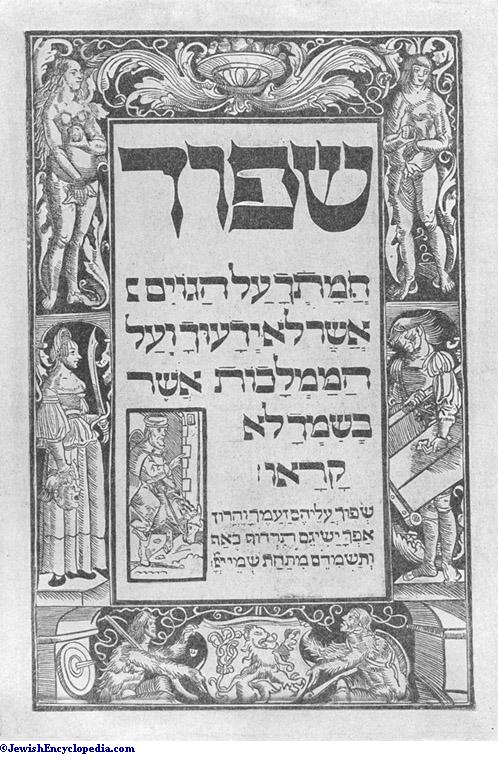
Page from the First Illustrated Printed Haggadah, Prague, 1526.
On the same day (the twenty-fourth of the ninth month) Haggai addresses another (the fourth) discourse to Zerubbabel, announcing Yhwh's determination to bring to pass great political upheavals, resulting in the dethroning of kings and the defeating of their armies. In consequence of these wonderful reversals of the prevailing political conditions, Zerubbabel will become the "signet" as the one chosen of Yhwh; that is, Zerubbabel will be crowned as the independent (Messianic) king of independent Judea (ii. 20-23).
Haggai's Style.
Contrasted with the flow and fervor of the utterances of other prophets, Haggai's style certainly justifies the rabbinical observation that he marks the period of decline in prophecy (Yoma 9b). He scarcely ever rises above the level of good prose. The critics have found in this a confirmation of the assumption that Haggai wrote and spoke only after having reached a very ripe old age. Certain turns of phraseology are characteristically affected by him:  (i. 5, 7; ii. 15, 18a, b);
 = "and now," introducing an appeal (i. 5; ii. 4, 15). Repetitions of words are frequent:
 (i. 7, 8); [
 (ii. 4a, b, c, 6, 7, 8a, b, 14, 17, 23a, b, c);
 (ii. 22, twice);
 (ii. 4, thrice). Haggai loves to recall in one final word the preceding idea: i. 2b, 12b; ii. 5b (
 ), 19b (

 ).
"Variæ Lectiones."
The text is in good condition, and the versions do not exhibit important variants. The Septuagint has additions in ii. 10-15, and several omissions, one (ii. 5) very extensive. "Be-mal'akut" (i. 13) is represented by  should be read
 ("now"), or, still better, corrected into
 ("as yet"); the versions omit i. 10.
 is probably a dittogram of the preceding
 . For
 ("their God") in i. 12, the Septuagint, the Peshiṭta, and the Vulgate present
 ("unto them"), which is preferable. Ch. i. 13 is held to be suspicious as a later gloss (Böhme, in Stade's "Zeitschrift," vii. 215; Nowack, "Die Kleinen Propheten," in "Handkommentar zum Alten Testament," p. 305, Göttingen, 1897). Ch. ii. 5a is grammatically of difficult construction; the Revised Version inserts "remember"; the Septuagint omits it. It is in all likelihood an interpolation (see Nowack, l.c. p. 306).
 (ii. 6) is doubtful; the Septuagint reads
 instead of
 . Wellhausen's observation ("Die Kleinen Propheten," ad loc.), that the verse combines two originally distinct readings, one as the Septuagint has it and the other that of the Masoretic text, with
 omitted, is probably based on fact. In verse 8
 has been taken to refer to the Messiah (comp. the name "Mohammed"); but the allusion is distinctly to the "precious possessions" of the nations; perhaps it should be vocalized "ḥamudot." For ii. 9 the Septuagint has a much more complete text, probably originally included (see Wellhausen, l.c., ad loc.). The Septuagint addition to ii. 14 is partly taken from Amos v. 10, and the whole looks like a gloss. In ii. 16 something seems to have dropped out of the text (see Nowack, l.c. p. 309).

 (ii. 17) is clearly corrupt;
 is the better reading proposed (Nowack, l.c.). In ii. 18, from
 to
 must be considered as an explanatory gloss by a later reader. At the end of verse 22 some verb seems to be required. Wellhausen supplies "shall fall." Instead of
 , in reference to the horses' undoing, Grätz ("Emendationes," ad loc.) proposes
 ("tremble").
The authenticity of ii. 20-23 has been impugned by Böhme (Stade's "Zeitschrift," vii. 215 et seq.) on the ground that (a) differences of expression indicate a different authorship, and that (b) their contents merely repeat Haggai's former assurances; yet this conclusion is not warranted. The concluding discourse is marked in the text as addressed to Zerubbabel alone. This accounts for the repetitions, if there be any; the differences in style are not so striking as to be incompatible with Haggai's authorship.
The Historical Background.
It is clear that in 520 B.C., according to Haggai's explicit statement, the reerection of the Temple had not begun. This is contrary to the common opinion that the work of rebuilding the Temple had been undertaken immediately after the return under Cyrus. Ezra iii. (and iv. 1-5) names the second year after the return as the date when the machinations of the Samaritans brought the enterprise to a standstill. For this reason Haggai has been held to plead merely for the "resumption," not for the "undertaking," of the (interrupted) building operations. Still, neither in Haggai nor in Zechariah is there any indication to justify this modification. Haggai is silent concerning the previous laying of a corner-stone. Far from laying the blame to foreign interference, he is emphatic in denouncing, as the sole cause of the deplorable state of affairs, the indifference and despondency of the Jews. In ii. 18 the laying of the corner-stone is described, either by himself or by a glossarist (see above), as taking place in his own time (Winckler, in Schrader, "K. A. T." 3d ed., p. 293, does not take this view, urging against it Haggai ii. 3, "how do ye see it now"). Probably on the return of the exiles only an altar was set up. Ezra iii. and iv., written much later, ascribe the later occurrences to an earlier date. W. H. Koster ("Het Herstel," 1894, German ed. 1895) argues, partly on these grounds, that no exiles returned under Cyrus, and that the Temple was built by Jews who had been left at Jerusalem (see against him Wellhausen, "Die Rückkehr der Juden," 1895, and Eduard Meyer, "Die Entstehung des Judentums," 1896). This extreme view is inadmissible. But Haggai makes it evident that the Temple was erected only in his time (during Darius Hystaspes' reign, not that of Cyrus), and that its erection was largely due to his and Zechariah's efforts.
Rebuilding of the Temple.
Haggai's description reveals the difficulties with which the small community had to contend; drought and dearth (i. 9 et seq., ii. 15) were among them; and the population must have been small. Under these disheartening circumstances, what encouraged the prophet to urge his people to the enterprise? The conditions of the Persian empire furnish a clue to the answer (comp. Isa.lx.); in the impending disruption of the Persian power he sees Yhwh's purpose to reestablish Judea's independence under the (Messianic) king Zerubbabel.
In the large Behistun inscription, Darius has left the record of these disturbances, caused by the assassination of pseudo-Smerdis in 521. While Darius was busy fighting the Babylonian usurper Nidintubal, Persia, Susiana, Media, Assyria, Armenia, and other provinces, under various leaders, rose in rebellion against him. These campaigns kept Darius engaged during 520-519, the period of Haggai's first appeals (see Ed. Meyer, "Die Entstehung des Judentums"). Nevertheless, Nowack contends that the predictions in Haggai concerning the great upheavals which, while troubling and overturning all other nations, will result in establishing permanent peace in Jerusalem (ii. 9), are of the nature of eschatological apocalyptic speculations. Haggai, according to him, was the first to formulate the notion of an ultimate opposition between God's rule and that of the heathen nations. The rôle clearly assigned to Zerubbabel in the prediction of Haggai does not seem to be compatible with this assumption. He is too definite and too real a historical personage in the horizon of Haggai to admit of this construction. The "ideal" Messiah is always central in apocalyptic visions.
Bibliography:
W. A. Böhme, in Stade's Zeitschrift, vii. 215 et seq.;
Dillmann, Jesaja, Leipsic, 1898;
Duhm, Die Theologie der Propheten, Bonn, 1875;
Hitzig, Die Kleinen Propheten, Leipsic, 1881;
Eugene Hühn, Die Messianischen Weissagungen, Freiburg-im-Breisgau, 1899;
A. Köhler, Die Weissagungen Haggai's, Erlangen, 1860;
Koster, Het Herstel van Israel in het Perzische Tijdvak, Leyden, 1894;
Ed. Meyer, Die Entstehung des Judentums, Halle, 1895;
Nowack, Kleine Propheten, Göttingen, 1897;
W. Pressel, Kommentar zu den Schriften der Propheten Haggai, etc., Gotha, 1870;
T. T. Perowne, Haggai and Zechariah, Cambridge, 1888;
Reinke, Der Prophet Haggai, Münster, 1868;
Sellin, Serubbabel, Leipsic, 1898;
George Adam Smith, The Book of the Twelve Prophets, New York, 1901;
Wellhausen, Skizzen und Vorarbeiten, 2d ed., vol. v., Berlin, 1893.
The tenth book in a collection of twelve short books at the end of the Old Testament. These books contain messages from prophets.
Preview
Who Wrote the Book of Haggai? When Was It Written?
Why Was the Book of Haggai Written?
What Does the Book of Haggai Teach Us?
What Happens in the Book of Haggai?
Who Wrote the Book of Haggai? When Was It Written?
Haggai was one of the Jewish settlers in Jerusalem in 520 BC when his prophetic words were written down (Ezra 5:1–2; 6:14). The Lord gave Haggai four messages for specific people. The first message was for Zerubbabel the governor and Joshua the high priest (Haggai 1:1). The second message was for Zerubbabel, Joshua, and the remaining people (Haggai 2:2). The third message was for the priests (Haggai 2:11). The final message was only for Zerubbabel (Haggai 2:21).
Why Was the Book of Haggai Written?
The key phrase in Haggai’s prophecies is “Consider carefully your ways” or “Consider” (Haggai 1:5, 7; 2:15, 18). God sent messages to help the Jewish leaders and people understand they had neglected their duties to God. There were two groups who needed to change: true believers who had stopped following God's commands, and people who only followed God for rewards
True believers needed a reminder of God’s mercy. They could fix the situation, even if they thought their ancestors' sins were unforgivable. People who pretended to be faithful among the Judeans only wanted the blessings God promised. They replaced one form of idolatry with another. When God did not bless them, they felt disappointed.
The main message was that today does not predict what God will do tomorrow. You cannot judge God's fulfillment of promises by appearances. Haggai's message had two parts: correction and encouragement. The settlers needed to be scolded for their lack of concern and comforted during their troubles.
What Does the Book of Haggai Teach Us?
Haggai is a practical book about serving God. When God's people delay doing his work or stop caring about it, this causes harm. This has happened many times throughout history. God values when people act promptly and take his work seriously (Romans 13:11–14).
God's presence inspires courage and helps people not feel discouraged (Matthew 28:19–20; Ephesians 3:8–21; Hebrews 13:5–6).
All believers must separate from negative influences and sin (2 Corinthians 6:14–7:1). Without living this way, a believer cannot be ready for God's service (2 Timothy 2:19226). A disobedient child of God can expect to lose blessings and be disciplined by God (Hebrews 12:3–13; James 4:1–3).
The message about God's judgment of sin and the creation of the messianic kingdom brings hope to New Testament believers and the Jews in Haggai's time (Romans 15:4–13; 2 Peter 3:10–18).
The key phrase in Haggai, "consider your ways," is similar to messages in 1 Corinthians 11:28 and 2 Corinthians 13:5. His writings also discuss the impact of sin and God's blessings, as seen in Jude 1:1–25.
In the book of Haggai, God is called the "Lord of hosts" or "Lord Almighty" 14 times. This title is common in the prophetic books written after the exile to Babylon, including Haggai, Zechariah, and Malachi. This title is used over 80 times. It shows that God is all-powerful and rules over all spiritual beings in heaven and all creatures on earth.
Haggai shows that Scripture is inspired by God and has divine authority. The prophet repeatedly states that God spoke to him and is the source of these messages, mentioning this at least 25 times in 28 verses.
What Happens in the Book of Haggai?
First Message
Haggai received his first message for the Judeans on the first day of the month (Haggai 1:1). On this day, Jews were to bring special offerings to the sanctuary (Numbers 28:11–15). God chose this important time to reveal the people's sin related to the unfinished sanctuary.
The Lord first addressed the leaders of the Judeans (Haggai 1:1). Zerubbabel was the governor, and Joshua was the high priest. Together, they were responsible for the actions of God's people.
The word of the Lord exposed the people's procrastination (Haggai 1:2). They had not finished God's temple because they decided, "The time has not yet come." The people used their energy and money selfishly for their own homes (Haggai 1:4).
“Now” (Haggai 1:5) the Jews to pay attention to what God wanted them to do, because they had stopped caring about his work. They needed to reflect on their spiritual and material state: “Consider carefully your ways.” This key phrase in Haggai’s prophecies literally means “Set your heart on your ways” or “Lay your ways to your heart.” When they looked at their actions, they would see their delays in rebuilding had brought them many problems, not just wasted time (16 years).
Haggai 1:6 shows the poverty the Jews faced due to God's punishment for their sin. God withdrew his blessings according to his covenant (see Deuteronomy 28:15–29:1).
After urging them again to "consider" their ways (Haggai 1:7), the Lord revealed the solution to the Jews' cursed state: "build the house" (Haggai 1:8). Their failure to complete the temple caused their poverty (Haggai 1:9–11).
The leaders and the people responded positively. Restarting the temple construction showed their belief in God's word (Haggai 1:12). Their quick obedience also showed they accepted Haggai's role as "the messenger of the LORD" delivering "the message of the LORD" (Haggai 1:13).
Second Message
About one month later, the Lord called Haggai again (Haggai 2:1). The second message continued to encourage, just like the first one ended. The builders might have started feeling the pressure of their work. Old doubts and discouragements might have troubled their faith again. Enemies had returned to cause problems (Ezra 5:3–6:12). Haggai's second message was like Ezra's claim that "the eye of their God was on the elders of the Jews" (Ezra 5:5). The Lord not only sees his servants' needs but also sends help and encouragement.
The second message came on the last day of the Feast of Tabernacles (Leviticus 23:33–43). This reminder of God's presence with their ancestors in the wilderness might have made their current situation more discouraging. So, the Lord spoke to everyone, not just the leaders (Haggai 2:2).
Was there anyone from before the exile who had seen God's glory in Solomon's temple (1 Kings 8:1–11; Ezekiel 9:1–11:23)? Was the current temple insignificant in comparison (Haggai 2:3)? The Babylonian Talmud (an important text of Jewish law and tradition) mentioned five things missing in the new temple that were in Solomon's temple:
The ark of the covenant
The sacred fire
The shekinah glory
The Holy Spirit
The Urim and Thummim
The word "now" highlights God's solution. The command "be strong" is repeated three times (Haggai 2:4). Each time, it addresses a recipient of God's message (Haggai 2:2). The final command was "work." The reason for their strength and action was God's presence. The Holy Spirit might seem absent from the temple, but he would stay with the people: "This is the promise I made to you" (Haggai 2:5).
To further motivate the workers, God revealed the future glory of His house (Hosea 2:6–9). This glory would appear after a period of judgment (Haggai 2:6–7a) when the treasures of all nations arrive (Haggai 2:7b). The exact meaning of this verse has different interpretations. The views focus on two translations:
"The desire of all nations shall come" (King James Version)
"The nations… will come with all their treasures" (Berean Standard Bible)
The arguments for the messianic interpretation based on the first translation can be summarized as follows:
Most Christian and Jewish interpreters see this phrase as referring to the Messiah (God's chosen one).
The abstract noun "desire" can mean the one who is desirable.
Although the Hebrew verb is plural, it can agree with the second noun "nations" in a genitive relationship (showing possession or close association).
The timing fits because God has just judged the nations, and Christ's coming is near.
An alternative translation addresses the grammatical issues but keeps the messianic meaning: "They [the nations] have come to the desire of all the nations."
Despite strong arguments for the first view, the second translation and view seem better. The reasons are:
Most early Christian and Jewish interpreters rely on the Latin Vulgate translation, which was written around AD 400, while the second translation matches the Greek Septuagint from around 300 BC.
The singular "desire" can be a collective noun for "features" or "wealth."
Hebrew grammar allows the noun "nations" to agree with the verb, but this is rare in poetic books. It is unlikely Haggai would use such phrasing without explaining it clearly in the context.
The immediate context clarifies by stating that the silver and gold belong to the Lord (2:8).
The kingdom context of these verses aligns well with similar passages like Isaiah 60:5, 11, and Revelation 21:24.
The message of encouragement concludes that the future temple's glory will surpass that of Solomon's temple. The divine presence will return, and the building will be very beautiful. God will also bring peace to his kingdom during this time of the future glorious temple.
Third Message
About two months later, Haggai received a third message from God (Haggai 2:10). This message focused on encouragement and was directed only to the priests (Haggai 2:11). Haggai asked questions about the law of Moses to teach the priests about how sin can contaminate. Something clean or holy cannot make something else holy (Haggai 2:12). However, something unholy can make something clean impure (Haggai 2:13; see also Leviticus 22:4–6; Numbers 19:11).
This principle was clear for the Judeans: God did not accept their offerings during their disobedience because Judah was unclean (Haggai 2:14).
By reminding them of past disobedience and punishment, God urged the Jews to always think about (Haggai 2:15, 18) the consequences of disobedience. This reflection should prevent future spiritual indifference. The message concluded with a reminder of God's blessing on those who obey (Haggai 2:19).
Fourth Message
On the same day, Haggai received another message from God (Haggai 2:20). This message was for Zerubbabel (Haggai 2:21), who was to be encouraged by the lasting nature of his inherited Davidic position (see Haggai 1:1; 2 Samuel 7:4–17; 1 Chronicles 3:1, 5, 10, 17–20). The gentile nations would face judgment, and the kingdoms of the world would be overthrown (Haggai 2:6–7, 21–22). This would prepare for God's rule (see Revelation 11:15–18).
The promise to Zerubbabel in Haggai 2:23 showed that God's promises to David were still valid after the 70-year Babylonian captivity and the 16-year pause among the Judeans who returned to Jerusalem. God appointed Zerubbabel, "My signet ring." A signet was a personal seal, like a ring or cylinder, used to show the authenticity of a signature. Kings used them to identify their decrees (Esther 3:10; 8:8–10) and to confirm the authority of their deputies (Genesis 41:42). By appointing Zerubbabel "as a signet ring," God meant that Zerubbabel would be God's seal of authority on the continuation of the Davidic line, from which the Messiah would come and reign (see Matthew 1:12; Luke 3:27).
See also Haggai (Person); Israel, History of; Postexilic Period; Prophecy; Prophet, Prophetess.
Aquifer Open Bible Dictionary © 2026 Mission Mutual, an adaptation of the Tyndale Open Bible Dictionary © 2023 Tyndale House Publishers. Licensed under CC BY-SA 4.0.