
The passage of Scripture in which our Lord says, “It is easier for a camel to go through the eye of a needle, than for a rich man to enter into the kingdom of heaven,” Mat 19:24, has been the occasion of much criticism. Some assert that near Jerusalem was a low gate called “the needle’s eye,” through which a camel could not pass unless his load was taken off. Others conjecture that
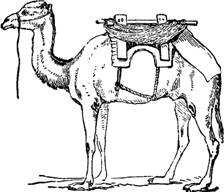
Fig. 110—Arabian Camel: baggage
The genus Camelus, as constituted by modern naturalists, comprises two species positively distinct, but still possessing the common characters of being ruminants without horns, without muzzle, with nostrils forming oblique slits, the upper lid divided, and separately movable and extensile, the soles of the feet horny, with two toes covered by unguiculated claws, the limbs long, the abdomen drawn up, and the neck, long and slender, is bent down and up, the reverse of that of a horse, which is arched. Camels have thirty-six teeth in all. They have callosities on the breast-bone and on the flexures of the joints. Of the four stomachs, which they have in common with other animals chewing the cud, the paunch is provided with membranous cells to contain an extra provision of water, enabling the species to subsist for four or more days without drinking. But when in the desert, the camel has the faculty of smelling it afar off, and then, breaking through all control, he rushes onwards to drink, stirring the element previously with a fore foot until quite muddy. Camels are temperate animals, being fed on a march only once in twenty-four hours, with about a pound weight of dates, beans, or barley, and are enabled in the wilderness, by means of their long flexible necks and strong cuspidate teeth, to snap as they pass at thistles and thorny plants. They are emphatically called the ships of the desert; having to cross regions where no vegetation whatever is met with, and where they could not be enabled to continue their march but for the aid of the double or single hunch on the back, which, being composed of muscular fiber, and cellular substance highly adapted for the accumulation of fat, swells in proportion as the animal is healthy and well fed, or sinks by absorption as it supplies the want of sustenance under fatigue and scarcity. Now, when to these endowments are added a lofty stature and great agility; eyes that discover minute objects at a distance; a sense of smelling of prodigious acuteness—ever kept in a state of sensibility by the animal’s power of closing the nostrils to exclude the acrid particles of the sandy deserts; a spirit, moreover, of patience, not the result of fear, but of forbearance, carried to the length of self-sacrifice in the practice of obedience, so often exemplified by the camel’s bones in great numbers strewing the surface of the desert; when we perceive it furnished with a dense wool, to avert the solar heat and nightly cold, while on the animal, and to clothe and lodge his master when manufactured, and know that the female carries milk to feed him—we have one of the most incontrovertible examples of Almighty power and beneficence in the adaptation of means to a direct purpose, that can well be submitted to the apprehension of man; for, without the existence of the camel, immense portions of the surface of the earth would be uninhabitable, and even impassable. Surely the Arabs are right, ’Job’s beast is a monument of God’s mercy!’ The two species are—1. The Bactrian camel, which is large and robust; naturally with two hunches, and originally a native of the highest table-lands of Central Asia, where even now, wild individuals may be found. The species extends through China, Tartary, and Russia, and is principally imported across the mountains into Asia Minor, Syria, and Persia.
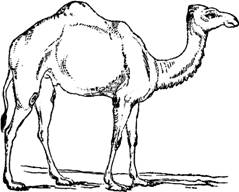
Fig. 111—Arabian Camel: saddle
2. The Arabian camel or dromedary, which has naturally but one hunch, and may be considered as of Western-Asiatic or of African origin, although no kind of camel is figured on any monument of Egypt. We find, however, camels mentioned in Genesis 12; but being placed last among the cattle given by Pharaoh to Abraham, the fact seems to show that they were not considered as the most important part of his donation. This can be true only upon the supposition that only a few of these animals were delivered to him, and therefore that they were still rare in the valley of the Nile; though soon after there is abundant evidence of the nations of Syria and Palestine having whole herds of them fully domesticated.
Of the Arabian species two very distinct races are noticed; those of stronger frame but slower pace used to carry burdens, varying from 500 to 700 weight, and traveling little more than twenty-four miles per day; and those of lighter form bred for the saddle with single riders, whereof the fleetest serve to convey intelligence, etc. and travel at the rate of 200 miles in twenty-four hours.
All camels, from their very birth, are taught to bend their limbs and lie down to receive a load or a rider. They are often placed circularly in a recumbent posture, and together with their loads form a sufficient rampart of defense against robbers on horseback. The milk of she-camels is still considered a very nutritive cooling drink, and when turned it becomes intoxicating. Their dung supplies fuel in the desert, and in sandy regions where wood is scarce; and occasionally it is a kind of resource for horses when other food is wanting in the wilderness. Their flesh, particularly the hunch, is in request among the Arabs, but was forbidden to the Hebrews, more perhaps from motives of economy, and to keep the people from again becoming wanderers, than from any real uncleanness. Camels were early a source of riches to the patriarchs, and from that period became an increasing object of rural importance to the several tribes of Israel, who inhabited the grazing and border districts, but still they never equaled the numbers possessed by the Arabs of the desert. On swift dromedaries the trotting motion is so hard that to endure it the rider requires a severe apprenticeship; but riding upon slow camels is not disagreeable, on account of the measured step of their walk; ladies and women in general are conveyed upon them in a kind of wickerwork sedan.
With regard to the passage in Mat 19:24, ’It is easier for a camel to go through the eye of a needle,’ etc. and that in Mat 23:24, ’Ye strain at a gnat, and swallow a camel’ it may be sufficient to observe, that both are proverbial expressions, similarly applied in the kindred languages of Asia.
Carrier, A beast of burden very common in the East, where it is called "the land-ship," and "the carrier of the desert." It is six or seven feet high, and is exceedingly strong, tough, and enduring of labor. The feet are constructed with a tough elastic sole, which prevents the animal from sinking in the sand; and on all sorts of ground it is very sure-footed. The Arabian species, most commonly referred to in Scripture, has but one hump on the back; while the Bactrian camel, found in central Asia, has two. While the animal is well fed, these humps swell with accumulated fat, which is gradually absorbed under scarcity and toil, to supply the lack of food. The dromedary is a lighter and swifter variety, otherwise not distinguishable from the common camel, Jer 2:23 . Within the cavity of the stomach is a sort of paunch, provided with membranous cells to contain an extra provision of water: the supply with which this is filled will last for many days while he traverses the desert. His food is coarse leaves, twigs, thistles, which he prefers to the tenderest grass, and on which he performs the longest journeys. But generally, on a march, about a pound weight of dates, beans, or barley, will serve for twenty-four hours. The camel kneels to receive its load, which varies from 500 to 1,000 or 1,200 pounds. Meanwhile it is wont to utter loud cries or growls of anger and impatience. It is often obstinate and stupid, and at times ferocious; the young are as dull and ungainly as the old. Its average rate of travel is about two and one third miles an hour; and it jogs on with a sullen pertinacity hour after hour without fatigue, seeming as fresh at night as in the morning. No other animal could endure the severe and continual hardships of the camel, his rough usage, and his coarse and scanty food. The Arabians well say of him, "Job’s beast is a monument of God’s mercy."\par This useful animal has been much employed in the East, from a very early period. The merchants of those sultry climes have found it the only means of exchanging the products of different lands, and from time immemorial long caravans have traversed year after year the almost pathless deserts, Gen 37:25 . The number of one’s camels was a token of his wealth. Job had 3,000, and the Midianites’ camels were like the sand of the sea,\par Jdg 7:12 ; 1Ch 5:21 ; Job 1:3 . Rebekah came to Isaac riding upon a camel, Gen 24:64 ; the queen of Sheba brought them to Solomon, and Hazael to Elisha, laden with the choicest gifts, 1Ki 10:2 ; 2Ki 8:9 ; and they were even made serviceable in war, 1Sa 30:17 . The camel was to the Hebrews an unclean animal, Lev 11:4 ; yet its milk has ever been to the Arabs an important article of food, and is highly prized as a cooling and healthy drink. Indeed, no animal is more useful to the Arabs, while living or after death. Out of its skin they make for corn. Of its skin they make huge water bottles and leather sacks, also sandals, ropes, and thongs. Its dung, dried in the sun, serves them for fuel.\par CAMELS’ HAIR was woven into cloth in the East, some of it exceedingly fine and soft, but usually coarse and rough, used for making the coats of shepherds and camel-drivers, and for covering tents. It was this that John the Baptist wore, and not "soft raiment," Mat 11:8 . Modern dervishes wear garments of this kind and this appears to be meant in 2Ki 1:8 .\par The expression, "It is easier for a camel to go through the eye of a needle," etc., Mat 19:24, was a proverb to describe an impossibility. The same phrase occurs in the Koran; and a similar one in the Talmud, respecting an elephant’s going through a needle’s eye. See also the proverb in Mat 23:24, which illustrates the hypocrisy of the Pharisees by the custom of passing wine through a strainer. The old versions of the New Testament, instead of, "strain at" a gnat, have, "strain out," which conveys the true meaning.\par
Camel. The species of camel, which was in common use among the Jews and the heathen nations of Palestine, was the Arabian or one-humped camel, Camelus arabicus. The dromedary is a swifter animal than the baggage-camel, and is used chiefly for riding purposes; it is merely a finer breed than the other. The Arabs call it the heirie.
The speed of the dromedary has been greatly exaggerated, the Arabs asserting that it is swifter than the horse. Eight or nine miles an hour is the utmost it is able to perform; this pace, however, it is able to keep up for hours together. The Arabian camel carries about 500 pounds.
"The hump on the camel’s back is chiefly a store of fat, from which the animal draws as the wants of his system require; and the Arab is careful to see that the hump is in good condition before a long journey.
Another interesting adaptation is the thick sole which protects the foot of the camel from the burning sand. The nostrils may be closed by valves against blasts of sand. Most interesting is the provision for drought made by providing the second stomach with great cells, in which water is long retained. Sight and smell is exceedingly acute in the camel." -- Johnson’s Encyclopedia.
It is clear from Gen 12:16, that camels were early known to the Egyptians. The importance of the camel is shown by Gen 24:64; Gen 37:25; Jdg 7:12; 1Sa 27:9; 1Ki 19:2; 2Ch 14:15; Job 1:3; Jer 49:29; Jer 49:32, and many other texts. John the Baptist wore a garment made of camel hair, Mat 3:4; Mar 1:6, the coarser hairs of the camel; and some have supposed that Elijah was clad in a dress of the same stuff.
The dromedary (
(a word found in essentially the same form in all the Shemitic languages [Hebrews
1. The Bactrian camel (camelus Bactrianus of authors) is large and robust; naturally with two hunches, and originally a native of the highest table- lands of Central Asia, where even now wild individuals may be found. The species extends through China, Tartary, and Russia, and is principally imported across the mountains into Asia Minor, Syria, and Persia. It is seldom seen at Aleppo (Russel, N. H. Aleppo, 2:170). One appears figured in the processions of the ancient Persian satrapies among the bas-reliefs of Chehel Minar, where the Arabian species is not seen. It is also this species which, according to the researches of Burckhardt, constitutes the brown Taous variety of single-hunched Turkish or Turki camels commonly seen at Constantinople, there being a very ancient practice among breeders, not, it appears, attended with danger, of extirpating with a knife the foremost hunch of the animal soon after birth, thereby procuring more space for the pack-saddle and load. It seems that this mode of rendering the Bactrian cross-breed similar to the Arabian camel or dromedary (for Burckhardt misapplies the last name) is one of the principal causes of the confusion and contradictions which occur in the descriptions of the two species, and that the various other intermixtures of races in Asia Minor and Syria, having for their object either to create greater powers of endurance of cold or of heat, of body to carry weight, or to move with speed, have still more perplexed the question. From these causes a variety of names has arisen, which, when added to the Arabian distinctions for each sex, and for the young during every year of its growth, and even for the camels nursing horsefoals, has made the appellatives exceedingly numerous. We notice only —
2. The Arabian camel or dromedary (camelus dronmedarius or Arabicus of naturalists,
It is likely the word
All camels, from their very birth, are taught to bend their limbs and lie down to receive a load or a rider. They are often placed circularly in a recumbent posture, and, together with their loads, form a sufficient rampart of defense against robbers on horseback. The milk of she-camels is still considered a very nutritive cooling drink (Aristot. Hist. Anim. 6:25, 1; Pliny, NV. H. 11:41; 28:9), and when turned it becomes intoxicating (such, according to the Rabbins [Rosenmüller, Not. ad Hieroz. 1:10], was the drink offered [Jdg 4:19] by Jael to Sisera [comp. Josephus, Ant. 5:5,4]). Their dung supplies fuel in the desert and in sandy regions where wood is scarce; and occasionally it is a kind of resource for horses when other food is wanting in the wilderness. Their flesh, particularly the hunch, is in request among the Arabs (comp. Prosp. Alp. H. N. AEg. 1:226), although forbidden to the Hebrews, more perhaps from motives of economy, and to keep the people from again becoming wanderers, than from any real uncleanness. Camels were early a source of riches to the patriarchs, and from that period became an increasing object of rural importance to the several tribes of Israel, who inhabited the grazing and border districts, but still they never equalled the numbers possessed by the Arabs of the desert. In what manner the Hebrews derived the valuable remunerations obtainable from them does not directly appear, but it may be surmised that by meansof their camels they were in possession of the whole trade that passed by land from Asia Minor and Syria to the Red Sea and Egypt, and from the Red Sea and Arabia toward the north and to the Phoenician sea-ports. On swift dromedaries the trotting motion is so hard that to endure it the rider requires a severe apprenticeship; but riding upon slow camels is not disagreeable, on account of the measured step of their walk; ladies and women in general are conveyed upon them in a kind of wicker-work sedan, known as the takht-ravan of India and Persia. In some cases this piece of female equipage presents almost a formidable appearance! The camels which carried the king’s servants or guests, according to Philostratus, were always distinguished by a gilded boss on the forehead. The camel, being a native of Asia, from the earliest ages to the present day has been the chief means of communication between the different regions of the East, and from its wonderful powers of endurance in the desert has enabled routes to be opened which would otherwise have been impracticable. “Their home is the desert; and they were made, in the wisdom of the Creator, to be the carriers of the desert. The coarse and prickly shrubs of the wastes are to them the most delicious food, and even of these they eat but little. So few are the wants of their nature, that their power of going without food, as well as without water, is wonderful. Their well-known habit of lying down upon the breast to receive their burdens is not, as is often supposed, merely the result of training; it is an admirable adaptation of their nature to their destiny as carriers. This is their natural position of repose, as is shown, too, by the callosities upon the joints of the legs, and especially by that upon the breast. Hardly less wonderful is the adaptation of their broad cushionedfoot to the and sands and gravelly soil which it is their lot chiefly to traverse... As the carriers of the East, the ‘ships of the desert,’ another important quality of the camel is their sure-footedness” (Robininson, Researches, 2:632-635). The present geographical distribution of the camel extends over Arabia, Syria, Asia Minor to the foot of the Caucasus,the south of Tartary, and part of India. In Africa it is found in the countries extending from the Mediterranean to the Senegal, and from Egypt and Abyssinia to Algiers and Morocco. A number of camels have lately been imported into the United States, designed for transportation in the and plains of the extreme southwestern territories; but the result of the experiment is yet doubtful (Marsh, The Canel, etc. Bost. 1856). (For a farther view of the natural history of the camel, see the Penny Cyclopcedia, s.v.) SEE DROMEDARY.
The camel is frequently mentioned in Holy Scripture. It was used not only in Palestine, but also in Arabia (Jdg 7:12), in Egypt (Exo 9:3), in Syria (2Ki 8:9), and in Assyria, as appears from the sculptures of Nineveh (see Layard, Nineveh and Bab. p, 582). It was used at an early date both as a riding animal and as a beast of burden (Gen 24:64; Gen 37:25). It was likewise used in war (1Sa 30:17; Isa 21:7; comp. Pliny, N. H. 8:18; Xenoph. Cyrop. 7:1, 27; Herod. 1:80; 7:86; Livy, 37:40). Of its hair coarse garments were manufactured (Mat 3:4; Mar 1:6). The Jews were not allowed to eat its flesh (Lev 11:4; Deu 14:7). The prophet Isaiah foretells the great increase and flourishing state of the Messiah’s kingdom, by the conversion and accession of the Gentile nations, by comparing the happy and glorious concourse to a vast assemblage of camels (Isa 60:6). He also predicts the march of the army of Cyrusto the conquest and destruction of Babylon by an allusion to a chariot of camels (Isa 21:7); and the folly and presumption of those is remarked upon (Isa 30:6) who, in the time of their trouble, carried treasures on camels into Egypt to purchase the assistance of that people, and acknowledged not the Lord their God, who alone could save and deliver them.
In the history of the Hebrews, however, the camel was used only by nomad tribes. This is because the desert is the home of the Arabian species, and it cannot thrive in even so fine a climate as that of the valley of the Nile in Egypt. The Hebrews in the patriarchal age had camels as late as Jacob’s journey from Padan-aram, until which time they mainly led a very wandering life. With Jacob’s sojourn in Palestine, and, still more, his settlement in Egypt, they became a fixed population, and thence forward their beast of burden was the ass rather than the camel. The camel is first mentioned in a passage which seems rather to tell of Abraham’s wealth (Gen 12:16, as Gen 24:35), to which Pharaoh doubtless added, than to recount the king’s gifts. If the meaning, however, is that Pharaoh gave camels, it must be remembered that this king was probably one of the shepherds who partly lived at Avaris, the Zoan of Scripture; so that the passage would not prove that the Egyptians then kept camels, nor that they were kept beyond a tract, at this time, and long after, inhabited bystrangers. The narrative of the journey of Abraham’s servant to fetch a wife for Isaac portrays the habits of a nomad people, perhaps most of all when Rebekah, like an Arab damsel, lights off her camel to meet Isaac (Genesis 24).; Jacob, like Abraham, had camels (Gen 30:43): when he left Padan-aram he “set his sons and his wives upon camels” (Gen 31:17); in the present he made to Esau there were “thirty milch camels with their colts” (Gen 32:15). In Palestine, after hisreturn, he seems no longer to have kept them. When his sons went down to Egypt to buy corn, they took asses. Joseph sent wagons for his father and the women and children of his house (Gen 45:19; Gen 45:27; Gen 46:5). Afterthe conquest of Canaan, this beast seems to have been but little used by the Israelites, and it was probably kept only by the tribes bordering on the desert. It is noticeable that an Ishmaelite was overseer of David’s camels (1Ch 27:30). On the return from Babylon the people had camels, perhaps purchased for the journey to Palestine, but a far greater number of asses (Ezr 2:67; Neh 7:69). There is one distinct notice of the camel being kept in Egypt. It should be observed, that when we read of Joseph’s buying the cattle of Egypt, though horses, flocks, herds, and: asses are spoken of (Gen 47:17), camels do not occur: they are mentioned as held by the Pharaoh of the exodus (Exo 9:3), but this may only have been in the most eastern part of Lower Egypt, for the wonders were wrought in the field of Zoan, at which city this king then doubtless dwelt. It is in the notices of the marauding nomad tribes that wandered to the east and south of Palestine that we chiefly read of the camel in Scripture.
In the time of Jacob there seems to have been. a regular traffic between Palestine, and perhaps Arabia, and Egypt, by camel caravans, like that of the Ishmaelites or Midianites who bought Joseph (Gen 37:25; Gen 37:28). In the terrible inroad of the Midianites, the Amalekites, and the Bene-Kedem, or children of the East, “both they and their camels were without number; and they entered into the land todestroy it” (Jdg 6:5; comp. Jdg 7:12). When Gideon slew Zebah and Zalmunna, kings of Midian, he “took away the ornaments [or “little moons”] that [were] on their camels’ necks” (Jdg 8:21), afterward mentioned, with neck-chains (see Kitto, Phys. Hist. of Pal. p. 391; comp. Stat. Thebaid, 9:687), both probably of gold (Jdg 6:26). We also find other notices of the camels of the Amalekites (1Sa 15:3; 1Sa 30:17), and of them and other and probably kindred peoples of the same region (1Sa 27:8-9). In the account of the conquest by the Reubenites, the Gadites, and the half tribe of Manasseh, of the Hagarites beyond Jordan, we read that fifty thousand camels were taken (1Ch 5:18-23). It is not surprising that Job, whose life resembles that of an Arab of the desert, though the modern Arab is not to be taken as the inheritor of his character, should have had a great number of camels (Job 1:3; Job 42:12; comp. Aristot. Hist. Anim. 9:37, 5). The Arabian Queen of Sheba came with a caravan of camels bearing the precious things of her native land (1Ki 10:2; 2Ch 9:1). We read also of Benhadad’s sending a present to-Elisha “of every good thing of Damascus, forty camels’ burden” (2Ki 8:9). Damascus, be it remembered, is close to the desert. In the prophets, likewise, the few mentions of the camel seem torefer wholly to foreign nations, excepting where Isaiah speaks of their use, with asses, in a caravan bearing presents from the Israelites to the Egyptians (Isa 30:6). He alludes to the camels of Midian, Ephah, and Sheba, as in the future to, bring wealth to Zion (Isa 60:6). The “chariot of camels” may be symbolical (Isa 21:7), or it may refer ,to the mixed nature of the Persian army. Jeremiah makes mention of the camels of Kedar, Hazor, and the Bene-Kedem (Jer 49:28-33). Ezekiel prophesies that the Berie Kedem should take the land of the Ammonites, and Rabbah itself should be “a resting-place for camels” (Eze 25:1-5; see Buckingham, Tray. p. 329). SEE CARAVAN.
The camel is classed by Moses among unclean animals (Lev 11:4), “because he cheweth the cud, but divideth not the hoof.” Michael is justly remarks, that in the case of certain quadrupeds a doubt may arise whether they do fully divide the’ hoof or ruminate. “In such cases,” he says, “to prevent difficulties, a legislator must authoritatively decide; by which I do not mean that he should prescribe to naturalists what their belief should be, but only to determine, for the sake of expounders or judges of the law, what animals are to be regarded as ruminating or parting the hoof.” This doubt arises in the case of the camel, which does ruminate, and does in some sort divide the-hoof; that is, the foot is divided into two toes, which are very disctintly marked above, but below the division is limited to the anterior portion of the foot, the toes being cushioned upon and confined by the elastic pad upon which the camel goes. This peculiar conformation of the foot renders the division incomplete, and Moses, for the purposes of the law, therefore decides that it divides not the hoof. Perhaps in this nicely balanced question he determination against the use of the camel ‘for’ food was made with the view of keeping the Israelites distinct from the other descendants of Abraham, with whom their connection and coincidence in manners were otherwise so close.
The interdiction of the camel, and, of course, its milk, was well calculated to prevent them from entertaining any desire to continue in Arabia, or from again devoting themselves to the favorite occupation of nomad herdsmen, from which it was obviously the intention of many of the laws to wean them. In Arabia a people would be in a very uncomfortable condition who could neither eat camel’s flesh nor drink its milk. Of the constant use of its milk by the Arabs travelers frequently speak; and if we wanted a medical reason for its interdiction, it might be found in the fact that to its constant use is attributed the obstructions and indurations of the stomach, which form one of the most common) complaints of the Arabs. They do not kill the camel, or any other animal, for ordinary food; but when a camel happens to be lamed in a caravan, it is killed, and a general feast is made on its flesh. Camels are also killed on great festival occasions, and sometimes to give a large entertainment in honor of a distinguished guest. Sometimes also a manvows to sacrifice a camel if he obtain this or that blessing, as, for instance, if his mare brings forth a female; and in that case he slaughters the animal, and feasts his friends on the flesh. Burckhardt (Notes on the Bedouins) mentions the rather remarkable fact that the Arabs know no remedy against the three most dangerous diseases to which camels are subject; but they believe that the Jews in their sacred books have remedies mentioned, which they withhold through hatred and malice. The flesh of the camel is coarse grained, but is rather juicy and palatable when the animal is young and not poorly fed. It is inferior to good beef, although at first it might readily be mistaken for beef; but it is at least equal, if not superior, to horse-flesh (Kitto, Pict. Bible, note in loc.).
To pass a camel through the eye of a needle was a proverbial expression which our Lord employed in his discourse to the disciples to show how extremely difficult it is for a rich man to forsake all for his cause and obtain the blessings of salvation (Mat 19:24; Mar 10:25; Luk 18:25; see the treatises on this passage, in Latin, of Clodius [Viteb. 1665], Pfeiffer [Regiom. 1679], Fetzlen [Viteb. 1673]). Many expositors are of opinion that the allusion is not to the camel, but to the cable by which an anchor is made fast to the ship, changing
Another proverbial expression occurs in Mat 23:24 : “Strain at (
Camel. Gen 12:16. There are two species: the Bactrian and the Arabian camel. The latter was used by the Israelites, and is the one commonly referred to in Scripture. It was used both for riding and for carrying loads, as at present. Gen 24:64; 2Ki 8:9. Camel’s furniture is mentioned, Gen 31:34, perhaps a kind of litter or canopied seat; and it is not improbable that the panniers or baskets, which are suspended on both sides of the animal, were employed anciently as now. The dromedary, Isa 60:6, was the same species, but of a finer breed. The camel is ill-tempered, vindictive, and obstinate; but its value to man may be estimated by what has been said. The ordinary strong working animal will go 24 miles a day, while the higher-bred and better-trained, or dromedary, will it is said, travel 200 miles in 24 hours. This quadruped was forbidden as food to the Hebrews, Lev 11:4; Deu 14:7; the flesh, however, especially the hump, is now liked by the Arabs; the milk is considered a cooling, nutritious drink, and the dung is much used for fuel. The camel was well known in early ages. Gen 12:16; Gen 24:64; Gen 37:25. It was used in war, at least by predatory bands, Jdg 6:6; 1Sa 30:17; and coarse garments were made of its hair. Mat 3:4; Mar 1:6. The word occurs in various proverbial expressions, as in Mat 19:24; similar to which are some used in the Talmud; also in 23:24, where the early English versions and the R. V. have very properly "strain out."
The well-known domestic animal of the East was the gamal with one hump; the word ’bunches’ in Isa 30:6 seems to refer to the humps. Camels are very suited in their construction for the country in which they are used, their feet being especially fitted for the deserts, and their powers of endurance enabling them to travel without frequently drinking. They need as much water as other animals, but God has given them receptacles in which they stow away the water they drink, and use it as they need it. Cases have been known of a camel being killed for the sake of the water that could be found in it when its owner was dying of thirst. They feed upon the coarse and prickly shrubs of the desert.
They form an important item in Eastern riches. Job had 3,000 camels. They are used for riding as well as for beasts of burden, a lighter breed being used for riding and for carrying the mails. Gen 24:10-64. In Isa 21:7 we read of a ’chariot of camels.’ Camels were not thus used in Palestine, but the prophecy refers to messengers coming from Babylon and there another species of camel was common, called the Bactrian Camel, with two humps; these were at times linked in pairs to rude chariots. Perhaps the same species is alluded to in Est 8:10-14, that occurrence being also in the far East: the Hebrew word there is achashteranim. The camel was by the Levitical law an unclean animal.
The DROMEDARY may be said to be the same animal as the camel, the former name being applied to those of a lighter and more valuable breed. They are used for the same purposes as the camel. 1Ki 4:28; Est 8:10; Isa 60:6; Jer 2:23.
The proverb of a camel being swallowed when a gnat was scrupulously strained out, Mat 23:24, is to show how the weightier precepts of God may be neglected along with great attention to trivial things. Another proverb is that "it is easier for a camel to go through the eye of a needle than for a rich man to enter into the kingdom of God." Mat 19:24. This has been thought to refer to the camel squeezing through a small gate, which it could do with difficulty; but the Lord’s explanation refers it to what was impossible in the nature of things, yet was possible with God. In grace the new creation overcomes all difficulties.
By: Morris Jastrow, Jr., Samuel Krauss
The well-known ruminant, native in Asia and Africa. The word "camel" (Hebrew,  , gamal) is the same in the Assyrian, Samaritan, Aramaic, Syriac, Arabic, Egyptian, and Ethiopic languages. Together with the knowledge of the animal, its name was introduced into Greek (
 ); in traveling across wide stretches of desert the treasures were packed upon the humps of camels (Isa. xxx. 6). King David had a special officer over his camels; named Obil (I Chron. xxvii. 30; compare Arabic abîl).
Otherwise the camel is mentioned as a possession only in post-exilic times among the Israelites (Ezra ii. 67). In olden times the camel was also used in war; in Isa. xxi. 7, camel-riders were part of the force of the Elamites. The Israelites were forbidden to eat the camel (Lev. xi. 4; Deut. xiv. 7; see Bochart, "Hierozoicon," i. 11); it was the opinion of the Arabs that Jacob forbade it as food because it produced sciatica. As in Arabic, so also in Hebrew, the expressions "beker" ( , Isa. lx. 6) and "bikrah" (
 , Jer. ii. 23) denote the young, vigorous animals. In the first passage Targ. Yer. has "hognin" (
 ), a word that also in the Talmud and in Arabic means a young camel; in the second passage
 must, according to Bochart, be changed to
 , which in the Talmud and in Arabic means the female camel (see "'Aruk," ed. Kohut, v. 378). The swift camel, or the dromedary, is called in the Talmud (Macc. 5a; Yeb. 116a) the "flying" camel.
The camel is also subject to rabies (see the Talmud Ber. 56a). Ḥul. 59a speaks of the distinctive teeth of the full-grown and of the young camel. The fat hump of a camel that has never carried burdens tastes like the meat itself (Mishnah and Gem. Ḥul. 122a). Camel's hair was made into clothing (Shab. 27a); but it must not be mixed with sheep's wool (Mishnah Kil. ix. 1). John the Baptist was clothed in a coarse garment of camel's hair (Matt. iii. 4; Mark i. 6).
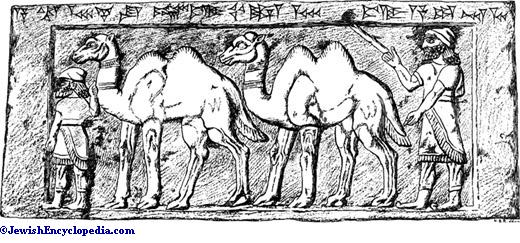
Camels Led as Tribute to Shalmaneser.(From the Black Obelisk in the British Museum.)
On the Sabbath it was forbidden to tie camels together, because of the workaday appearance (Mishnah and Cem. Shab. 54a). Camel-drivers, who often formed entire caravans (Mishnah Sanh. x. 5; B. B. 8a), are frequently mentioned together with mule-drivers; Abba Judan gave much of his time to his camels (Yer. Hor. iii. 48a). The Talmud shows great familiarity with the characteristics of the camel: it has a short tail because it eats thorns (Shab. 77b); it mates in a modest manner (Midr. on Gen. xxxii. 16); in rutting-time it becomes dangerous (Sanh. 37b; compare Jer. ii. 24, where the same is said of the wild ass). The name "gamal" is also supposed to signify etymologically that the animal becomes easily enraged and is then vindictive.
A number of Aramaic proverbs about the camel are found in the Talmud. For instance, "In Media the camel can dance on a bushel-basket" (Yeb. 45a), meaning that in Media everything is possible; "as the camel, so the burden" (Soṭah 13b); "the camel asked to have horns, so his ears were cut short" (Sanh. 106a); "there are many old camels who must bear the burdens of the young ones" (ib. 52a). It has been suggested that the word "camel" (
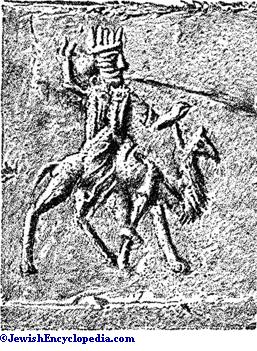
Camel on an Assyrian Cylinder.(From Hommel, "Aufsätze und Abhandlungen.")
CAMEL.—The bones of camels are found among the remains of the earliest Semitic civilization at Gezer, b.c. 3000 or earlier, and to-day camels are among the most common and important of domesticated animals in Palestine. They have thus been associated with every era of history in the land. Two species are known: the one-humped Camelus dromedarius, by far the more common in Bible lands; and the Bactrian, two-humped Camelus bactrianus, which comes from the plateau of Central Asia. This latter is to-day kept in considerable numbers by Turkomans settled in the Jaulan, and long caravans of these magnificent beasts may sometimes be encountered coming across the Jordan into Galilee or on the Jericho-Jerusalem road. The C. dromedarius is kept chiefly for burden-bearing, and enormous are the loads of corn, wood, charcoal, stone, furniture, etc., which these patient animals carry: 600 to 800 lbs. are quite average loads. Their owners often ride on the top of the load, or on the empty baggage-saddle when returning; Moslem women and children are carried in a kind of palanquin—the camel’s furniture of Gen 31:34. For swift travelling a different breed of camel known as hajîn is employed. Such a camel will get over the ground at eight to ten miles an hour, and keep going eighteen hours in the twenty-four. These animals are employed near Beersheha, and also regularly to carry the mails across the desert from Damascus to Baghdad. They may be the ‘dromedaries’ of Est 8:10.
Camels are bred by countless thousands in the lands to the E. of the Jordan, where they form the most valuable possessions of the Bedouin, as they did of the Midianites and Amalekites of old (Jdg 7:12). The Bedouin live largely upon the milk of camels (Gen 32:15) and also occasionally eat their flesh, which was forbidden to the Israelites (Deu 14:17, Lev 11:4). They also ride them on their raids, and endeavour to capture the camels of hostile clans. The fellahin use camels for ploughing and harrowing.
The camel is a stupid and long-enduring animal, but at times, especially in certain months, he occasionally ‘runs amok,’ and then he is very dangerous. His bite is almost always fatal. The camel’s hair which is used for weaving (Mar 1:6, Mat 3:4) is specially taken from the back, neck, and neighbourhood of the hump: over the rest of the body the ordinary camel has his hair worn short. His skin is kept anointed with a peculiar smelling composition to keep off parasites. The special adaptation of the camel to its surroundings lies in its compound stomach, two compartments of which, the rumen and the reticulum, are especially constructed for the storage of a reserve supply of water; its hump, which though useful to man for attachment of burdens and saddles, is primarily a reserve store of fat; and its wonderful fibrous padded feet adapted to the softest sandy soil. The camel is thus able to go longer without food and drink than any other burden-bearing animal, and is able to traverse deserts quite unadapted to the slender foot of the horse and the ass. On slippery soil, rock or mud, the camel is, however, a helpless flounderer. The camel’s food is chiefly tibn (chopped straw), kursenneh, beans, oil-cake, and occasionally some grain. There seems, however, to be no thorn too sharp for its relish.
In the NT references to the camel it is more satisfactory to take the expressions ‘swallow a camel’ (Mat 23:24) and ‘It is easier for a camel to go through the eye of a needle,’ etc. (Mat 19:24||), as types of ordinary Oriental proverbs (cf. the Talmudic expression ‘an elephant through a needle’s eye’) than to weave fancied and laboured explanations. The present writer agrees with Post that the gate called the ‘needle’s eye’ is a fabrication.
E. W. G. Masterman.
The Arabian camel is often compared with justice to the reindeer of the Esquimaux. It furnishes hair for spinning and weaving, milk, flesh and leather, as well as being an invaluable means of transportation in the arid desert. There are many Arabic names for the camel, the commonest of which is
There are three references to the camel in New Testament: (1) to John’s raiment of camel’s hair (Mat 3:4; Mar 1:6); (2) The words of Jesus that “it is easier for a camel to go through a needle’s eye, than for a rich man to enter into the kingdom of God” (Mat 19:24; Mar 10:25; Luk 18:25); (3) The proverb applied to the Pharisees as blind guides, “that strain out the gnat, and swallow the camel” (Mat 23:24). Some manuscripts read
There are a few unusual words which have been translated “camel” in text or margin of one or the other version. (See list of words at beginning of the article)
Isa 60:6 (b) This animal is used to describe in picture the business, the activity, the merchandising and the prosperity that should come upon Israel when that nation is restored again to her place in the world.
Eze 25:5 (a) This is a type of the destruction and desolation which would come upon the Ammonites under the wrath of GOD. Their busiest city was to become a place for stabling animals on their journey and a grazing place for flocks.
Mat 19:24 (a) The camel is a literal one and the eye of the needle is a literal eye of a literal needle. This is no figure of speech. The parable reveals the impossibility of a sinner to enter into Heaven by any works or wealth of his own.
Mat 23:24 (a) Our Lord compares a small, insignificant story to a gnat, and a great and preposterous yarn to a camel. People doubt and question the truth of GOD, but will readily believe any kind of a statement by any kind of religious teacher no matter how absurd the statement is. Jacob readily believed the lie told to him by his ten sons about the death of Joseph. He refused to believe the truth that these same men brought to him informing him that Joseph was alive. (See also Mar 10:25; Luk 18:25).
Camel. Although it is an ugly beast, the camel is prized in desert countries. From the time of Abraham, the Bible mentions camels frequently, mostly in lists of possessions. Large herds of camels were a sign of wealth.
Jeremiah spoke of the "swift dromedary" (Jer 2:23), a camel raised for riding and racing. Jesus talked of "blind guides, who strain out a gnat and swallow a camel!" (Mat 23:24), and predicted, "It is easier for a camel to go through the eye of a needle than for a rich man to enter the kingdom of God" (Mat 19:24).
Camels are bad-tempered, prone to spit and grumble when they take on a load. But they are well suited for harsh desert life. With a heavy coat as insulation, this animal perspires little; and his well-balanced system does not require much liquid. He can go for weeks or even months without water. When he does drink, he takes only enough to replace lost moisture. Each one of his three stomachs can hold 23 liters (5 gallons) of water. In the hump on his back the camel stores fat for times when food is scarce. Then the hump shrinks when his body draws on that reserve.
The camel stands 20 meters (6 feet) or higher at the shoulder. He is trained to kneel on his leathery knees to take on a load. He holds his head high with what seems to be a haughty air, but he is merely peering out from under bushy eyebrows. Like his tightly closing lips and nostrils, his eyebrows protect him against desert sand storms. His tough feet are ideal for walking through sharp rocks and hot sands.
The Hebrew people used camels primarily as pack animals. They were indispensable for traveling the desert routes, carrying several hundred pounds on their backs. The Jews also rode camels and milked them, although they considered camels unclean and did not eat them (Lev 11:4).
The Arabs, however, let no part of a camel go to waste. They ate camel meat and wove the soft fur into warm, durable cloth. John the Baptist was clothed in a garment of camel’s hair (Mat 3:4). The tough hide made good leather for sandals and water bags, and camel-dung chips served as fuel. Even the dried bones of camels were carved like ivory.
Desert tribes rode camels to war (Jdg 7:12), and camels were seized as spoils of war.
A large animal that lives in desert areas. Camels can go for many days without drinking water. People have trained camels to be work animals. They use camels for travel and to carry heavy loads across the Middle East
The camel (Camelus dromedarius) has special features that help it live in the desert. It has been called the "ship of the desert" because, like ships that carry cargo across oceans, camels carry heavy loads across vast desert areas. Its feet have thick elastic pads of fibrous tissue that allow it to walk on hot desert sands. It can go without water for long periods and can live on plants growing on the salty sand. The camel can close its pinched nostrils to keep out sand in violent sandstorms.
Camels are used for transporting both goods and people. A person riding a camel can cover from 96.5 to 121 kilometers (60 to 75 miles) in a day. A camel can carry a load weighing 272 kilograms (600 pounds) or more. Camels were vital in the spice trade (Genesis 37:25). They traveled in camel trains between Arabia, Egypt, and Assyria. They were also ridden in time of war (Judges 6:5). Farmers can even hitch a camel to a plow in areas where they farm.
The hair shed by camels during the early spring is kept and used in making cloth and tents. One camel can make as much as 4.5 kilograms (ten pounds) of hair. A rough cloak of camel’s hair, as worn by John the Baptist (Matthew 3:4), is still worn by people who live in the desert. A camel’s hair garment was also the sign of a prophet (Zechariah 13:4).
There are two types of one-humped camels: the slow, burden-bearing camel from Genesis 37:25 and the fast racing camel mentioned in 1 Samuel 30:17. The racing camel can be up to 2.1 meters (seven feet) tall and 2.7 meters (nine feet) long. Its stomach holds 14.2 to 28.4 liters (15 to 30 quarts) of liquid. This camel can go without water for five days in summer or 25 days in winter. Its hump stores fat, allowing it to survive on little food during desert trips.
Another species of camel lives in the holy land, the Bactrian camel (Camelus bactrianus). It has two humps. It is heavier, bigger, and has longer hair than the one-humped camel and is slower than the fast racing camel. Isaiah 21:7 may refer to the Bactrian camel. Both kinds of camel are referred to in Esther 8:10. In ancient times, camels were as important as sheep, cattle, and donkeys. The Bible mentions camels 66 times. One third of these references list camels alongside other animals.
Camels chew the cud, but do not have cloven hooves. So, they were unclean, forbidden by the Israelites to eat (Leviticus 11:4; Deuteronomy 14:7). They are eaten by Arabs, however, who also drink their milk (see Genesis 32:15).
According to the Bible, Abraham had camels when he traveled to Egypt (Genesis 12:16). At first, Job had 3,000 camels, and after his recovery, 6,000 (Job 1:3; 42:12). Most people began using camels around 1000 BC (Judges 6:5). But, Sumerian texts from the Old Babylonian period show people had trained camels even earlier. Archaeologists have found camel bones and figurines at various eastern sites dating from well before 1200 BC.
See also Travel.
Aquifer Open Bible Dictionary © 2026 Mission Mutual, an adaptation of the Tyndale Open Bible Dictionary © 2023 Tyndale House Publishers. Licensed under CC BY-SA 4.0.