
See HOLY GHOST.
Being Filled With The Spirit
Eph_5:18.
GOD Giving Us The Holy Spirit
Neh_9:16-20; Joh_14:9-18; Rom_5:5; 1Co_12:3-7; 2Co_5:5; Eph_3:14-16; 1Th_4:8; 2Ti_1:7; 1Jn_3:21-24; 1Jn_4:12-13.
GOD The Father Anointing Jesus Christ With The Holy Spirit
Isa_11:1-2; Isa_42:1; Isa_61:1-3; Luk_4:14-19; Act_10:37-38.
Not Quenching The Spirit
1Th_5:19.
Jesus Christ Baptizing With The Holy Spirit
Mat_3:11-14; Mar_1:7-9; Luk_3:15-21; Joh_1:29-34; Act_1:5; Act_11:16; Act_19:4-6.
The Descention Of The Holy Spirit
Mat_3:16-17; Mar_1:9-11; Luk_3:21-22; Joh_1:32-34.
The Fruit Of The Spirit
Gal_5:22-24; Eph_5:9-10.
The Holy Spirit Being Sent By GOD
Psa_104:24-30; Luk_24:44-49; Joh_14:23-26; Joh_15:26-27; Joh_16:1-7; Gal_4:6-7; 1Pe_1:12.
The Holy Spirit Speaking Through People
Isa_50:4-5; Isa_51:15-16; Isa_59:21; Mat_10:19-20; Mar_13:11; Luk_12:11-12; Luk_21:12-15; Act_2:4; 1Co_12:3; 2Pe_1:19-21.
The Holy Spirit Teaching
Neh_9:16-20; Luk_12:11-12; Joh_14:23-26; Joh_16:13-14; 1Co_2:12-14.
The Holy Spirit Witnessing
Joh_15:1-27; Act_5:30-32; Act_20:22-23; Rom_8:16; Eph_3:1-5; Heb_10:15; 1Jn_5:5-7.
The LORD Pouring Out His Spirit
Isa_44:1-3; Joe_2:27-29; Zec_12:8-10; Act_2:17-18; Act_10:44-48.
The Place Where The Spirit Of The LORD Is
2Co_3:14-17.
There Being One Spirit
1Co_12:3-7; Eph_4:4-6.
Those That Are Born Of The Spirit
Joh_3:3-8.
Those That Do Not Have The Spirit Of Christ
Rom_8:9.
Those That Follow After The Spirit
Rom_8:1-5; Rom_8:14; Gal_5:16-18.
Those That Have The Spirit Of GOD Dwelling In Them
Rom_8:9-11.
Those That Sin Against The Holy Spirit
Mat_12:31-32; Mar_3:28-29; Luk_12:10; Heb_6:4-8; Heb_10:26-29; 1Jn_5:16-17.
Those That Sow To The Spirit
Gal_6:8.
Walking In The Spirit
Gal_5:25.
What Can Be Accomplished Through The Power Of The Holy Spirit
Act_1:6-8; Rom_15:13; 1Co_6:9-11; 2Co_3:14-18.
What Is Contrary To The Spirit
Gal_5:16-17.
What Occurs When The Holy Spirit Comes Upon You
1Sa_10:6.
What The Holy Spirit Does
Joh_15:1-26; Joh_16:1-14; Rom_8:26-28; 1Co_2:9-10; 2Co_3:4-6; Eph_4:30; 1Jn_5:6.
What The Holy Spirit Is
Joh_14:23-26; Joh_15:26-27; Act_5:30-32; Heb_10:15; 1Jn_5:6.
Where The Holy Spirit Dwells
Eze_11:19; Eze_36:22-27; Eze_37:12-14; Joh_14:9-18; 1Co_3:16-17; 1Co_6:19-20; 2Co_6:16; 1Pe_1:10-11.
Who Does Not Have The Holy Spirit
Jud_1:17-19.
Who The Holy Spirit Is Given To
Luk_11:9-13; Joh_7:37-39; Act_2:38; Act_5:30-32; Act_15:6-8.
Why The World Cannot Receive Nor Know The Spirit Of GOD
Joh_14:9-19; 1Co_2:14-16.
HOLY SPIRIT.—With the exception of the 2nd and 3rd Epistles of John, every book in the NT mentions the Spirit. On a comprehensive view, indeed, it may be said that to understand what is meant by the Spirit is to understand these two things—the NT and the Christian Church. Not that the two can be precisely co-ordinated; yet in them and in their mutual relations we have the only adequate witness to what the Spirit means for Christians. To the men who wrote the NT and to those for whom they wrote, the Spirit was not a doctrine but an experience: they did not speak of believing in the Holy Spirit, but of receiving the Holy Spirit when they believed (Act 19:2). In some sense this covered everything that they included in Christianity. The work of the Christ was summed up in the words: ‘He shall baptize with holy spirit’ (Mar 1:8). The acceptance of the gospel is the subject of the question: ‘Was it by works of law or by the hearing of faith that you received the Spirit?’ (Gal 3:2). The entire equality of Jews and Gentiles in the Christian community is asserted in the words: ‘God who knows the heart bore them witness in that he gave the Holy Spirit to them even as he did to us’ (Act 15:8). After this, there was no more to be said. Yet the very fact that all who speak to us in the NT are familiar with experiences of the Holy Spirit does not always make it easier for us to understand them. It is clear that, very various experiences are described in this way, and sometimes we cannot refrain from asking whether experiences which one writer recounts without any reference to the Spirit would not have been explained as ‘pneumatic’ by another; or vice versa, whether experiences ascribed to the Spirit by one writer would not in another have found a different interpretation. Further, there is the difficulty raised by the fact that while the experiences thus explained are represented, broadly speaking, as the work of the Risen Saviour, and as dependent somehow on His death and resurrection, the Spirit appears also in His life on earth. Was this the same thing? When we read that Jesus was baptized with the Holy Spirit, are we to suppose that He had experiences in consequence which were analogous to those of Christians in the Apostolic age? The purpose of this article is to bring out the facts as they are presented in the oldest Gospel to begin with, and to show from later stages in the history the relation between the Spirit and Jesus the Christ.
1. The earliest reference to the Spirit is in the preaching of the Baptist. To the end John was conscious of the impotence and inadequacy of all his efforts: the true Helper of Israel, whatever else he might be, must be ‘One mightier than I.’ ‘I baptize you with water, he shall baptize you with holy spirit’ (Mar 1:8). A Christian Evangelist, like the author of the Gospel, might interpret such words in the light of his own post-Pentecostal experiences; and when we find the later Evangelists (Mat 3:11, Luk 3:16) add to ‘holy spirit’ the words ‘and lire,’ it is nearly certain that they have done so.* [Note: The reference of the ‘fire’ in this connexion to the fire of Gehenna seems to the present writer (in spite of Mat 3:12, Luk 3:17) simply incredible. The true key to it is Act 2:3, and the many passages in which the same or a similar figure recurs, e.g. 1Th 5:19, Rom 12:11, Act 18:25.] But it is not clear that for the Baptist the Holy Spirit of which he spoke was so clearly defined. He had not the Christian experience to put meaning into his words, and he can only have intended something which could be understood through its OT antecedents, or through experiences with which he had been in contact at an earlier period. The earliest form of the Gospel says nothing of such experiences, and when we look backward we cannot but be struck by the almost total disappearance of the Spirit from the apocalyptical literature of Judaism. ‘First and Second Maccabees and Daniel are each in a different way witnesses for a very profound religious feeling of exactly the sort that in other ages, either earlier or later, would have been ascribed to the Spirit’ (Wood, The Spirit of God in Biblical Literature, p. 71; cf. Gunkel, Die Wirkungen des heiligen Geistes, p. 50 f.). Yet the Spirit is not appealed to in explanation. When we come to the Hebrew OT, however, the one idea which is dominant in connexion with the Spirit is the one which is wanted here to explain the prophecy of the Baptist—the idea of power as opposed to impotence. The inability of Egypt to help Israel is expressed by Isaiah in the words: ‘The Egyptians are men and not God, and their horses flesh and not spirit’ (Isa 31:3). Men and flesh are the impotent things, in contrast with the omnipotent, God and spirit. As A. B. Davidson puts it (Theology of the OT, 126), ‘the Spirit of God ab intra is God active, showing life and power … the Spirit of God ab extra is God in efficient operation, whether in the cosmos or as giving life, reinforcing life, exerting efficiency in any sphere.’ John the Baptist was a worker for God, but he never claims for himself either to have the Spirit or to be able to give it; he has the sense, however, that when the Mightier than himself comes, He will lie distinguished in precisely these ways. He will baptize with ‘holy spirit’ in virtue of being full of the Spirit himself.
2. When Jesus comes to be baptized in Jordan, the remarkable phenomenon is that what for others is a baptism with water coincides for Him with a baptism in the Holy Spirit. According to Mar 1:10, as Jesus ascends from the water, He sees the heavens cleaving and the Spirit as a dove descending upon Him. In the earliest Evangelist this is the experience of Jesus only: it is He who sees the Spirit descending, He to whom the heavenly voice is addressed. The later Evangelists may have conceived it otherwise, and extended the vision and the hearing of the voice to John the Baptist or even to the bystanders: it is indifferent here. All agree that on this occasion Jesus received the Holy Spirit, and in it the attestation of His Sonship, the call to His unique task, and the endowments needed to discharge it.
Critics have suggested that the curiously indirect way in which the baptism of Jesus and the descent of the Spirit are mentioned in Luk 3:21 f. is due to the writer’s desire to slur over something which is really inconsistent with his account of Jesus’ birth; but even if Luke had difficulty in adjusting these two things, as the Fourth Evangelist may have had difficulty in adjusting the incarnation of the Eternal Logos in Jesus with the descent of the Spirit upon Him in manhood, it is clear that for both the baptism was so securely fixed in the Gospel testimony that they had no alternative but to set it unambiguously down (cf. Joh 1:31-34).
Have we any means of saying what is meant by such words as the Evangelists employ in this connexion? Can we interpret Jesus’ experience by what we read of spiritual gifts or states in the Primitive Church? Is it right to look in His life for such phenomena as we find, e.g., in Acts or in 1 Cor. ascribed to the Spirit? May we look for such sudden accesses of feeling as we connect with scenes like Act 2:4; Act 4:31; Act 13:9? Can there be such a thing as the rapture or ecstasy which seems to be meant by being ‘in the Spirit’ in Rev 1:10; Rev 4:2; Rev 17:3; Rev 21:10? These are not questions to be answered a priori. There must have been something in the life of Jesus as determined by the great experience of His baptism akin to the experiences which Christians subsequently ascribed to the Spirit, or they would hardly have traced both to the same source; and the more closely we look into the Gospels, the less does the emotionally colourless Saviour of popular art seem to correspond to the historical reality. The experiences of Jesus at the Baptism and the Transfiguration were not those of everyday life; they belong to ‘pneumatic’ as contrasted with normal conditions. So again it might be said that if the cleansing of the temple (Mar 11:15 ff.), the cursing of the fig-tree (Mar 11:14), the excitement (apparently) with which, on the way to Jerusalem, Jesus took the lead of His disciples, to their bewilderment and fear (Mar 10:32), had been told of anybody else, that other would have been described, on each occasion, as ‘filled with the Holy Spirit.’ However this may be (see J. Weiss, Die Predigt Jesu vom Reiche Gottes, p. 54 n. [Note: note.] ; O. Holtzmann, War Jesus Ekstatiker?), the Evangelist makes no reference to the Spirit in this connexion. He leaves us to infer from the life which Jesus lived in the Spirit what the Spirit itself was. But it may fairly be said that some of the ideas which Christians subsequently connected with their own baptism were not without relation to the baptism of Jesus and to the interpretation which they put upon it. It was the facts of His baptism which led them to believe (a) in a normal coincidence of baptism with the Spirit and water baptism, instead of in the displacement of the latter by the former; (b) in the Spirit received in baptism as specifically the spirit of sonship; and (c) in that same Spirit as one consecrating them to God and to service in His kingdom.
3. The first light is thrown on the nature of the Spirit as received by Jesus in the narrative of the Temptations. It is the Spirit which sends Him out to the wilderness, there to engage in conflict with the power of evil. The word
4. St. Luke tells us that Jesus returned from the Jordan ‘in the power of the Spirit’ into Galilee (Luk 4:14), and St. Peter in Ac (Act 10:38 f.) tells how God anointed Him (in the Baptism) ‘with holy spirit and power’; and it is under these conditions that the Evangelists conceive His whole ministry to he fulfilled. If they do not mention the Spirit at every step, it is because they think of Him as in full possession of it continually. It probably agrees, e.g., with the Evangelist’s own idea, to say that the passage in Mk. which immediately succeeds the Temptations illustrates first by Jesus’ power over men (Mar 1:16-20), next by His power or authority in teaching (Mar 1:21 f.), and, finally, by His power over demons (Mar 1:23 ff.), what is involved in His possession of the Spirit. A Divine power accompanied all His words and deeds, and made them effective for God and for His kingdom. The allusion in Mar 1:35 to His rising early and going away to a desert place to pray suggests that, Divine as this power was, it wrought in, and in accordance with the laws of, a human nature which was capable of spiritual exhaustion, and had to recruit its strength with God. We do not find till we come to Mar 3:21 (‘they said, He is beside himself,’
5. The main interest of the passage Mar 3:20-35 lies in the word of Jesus Himself about the Holy Spirit: ‘Verily I say unto you, All things shall be forgiven to the sons of men, the sins and the blasphemies, all that they have blasphemed: but whoso shall have blasphemed the Holy Spirit hath never forgiveness, but is guilty of eternal sin: because they said, He hath an unclean spirit’ (Mar 3:28 f.). It is hardly doubtful that this is the true form of this much discussed saying of Jesus. The Holy Spirit is not here set in any contrast with Jesus, as though to blaspheme Jesus were a venial fault, but to blaspheme the Spirit an unpardonable one; on the contrary, the Holy Spirit is blasphemed when malignant hearts harden themselves to say of Jesus, ‘He has an unclean spirit.’ The Divine power which works through Jesus with such intensity, healing all who are under the tyranny of the devil, is in point of fact God’s supreme and final appeal to men. It is such an exercise of power as is possible only for one who has already vanquished Satan, and is engaged in liberating his captives (Mar 3:27). No person with any sense for God in him can help being attracted by it to begin with. But if the other manifestations of this power should happen to provoke resentment,—if its ethical demands (as in the teaching of Jesus) should threaten seriously the reputation or the self-complacency of the insincere,—it is fearfully possible that they may set themselves against it, and so resist the Holy Spirit. Such resistance, once begun, may go to any length, even to the length of defiantly misinterpreting the life of Jesus, and affirming it to be from beneath, not from above. This is the sin against the Holy Spirit. In principle, it is the everyday sin of finding bad motives for good actions; carried to its unpardonable height, it is the sin of confronting the Divine holy power which wrought so irresistibly and so intensely in Jesus, and saying anything—the maddest, most wanton, most malignant thing—rather than acknowledge it for what it is. The people who said, ‘He has Beelzebul’ (Mar 3:22), ‘He has an unclean spirit’ (Mar 3:30), were not giving expression to their first, but to their last thoughts of Christ. This was the depth which malignity in them had reached. The Holy Spirit receives here a certain interpretation from being contrasted with an ‘unclean’ spirit. ‘Unclean’ is a religious rather than an ethical word; the unclean spirit is one which has not and cannot have relations with God: it can only be excluded from His presence, as it excludes those who are possessed by it. The Holy Spirit is specifically God’s; it brings Him in His power to men, it is the very token and reality of His presence with them. But it is interpreted more precisely—and this is the point of Jesus’ argument as it is brought out in the parallel passage in Mt. and Lk.—by the works which it does. ‘If I in the spirit of God am casting out the demons, then the kingdom of God has come upon you’ (Mat 12:28, cf. Luk 11:20, where for
6. The expulsion of evil spirits from the possessed is regarded in the Gospel as a chief manifestation of the possession by Jesus of the Holy Spirit. But all His miracles are to be understood in this connexion. Without going so far as to say that in the Temptation narratives He is represented as tempted to put to selfish uses the power just conferred through the Spirit in baptism for the ends of God’s kingdom, it is a mark of historicity in the canonical Gospels that until He is baptized with the Spirit, Jesus works no miracle. It is the Spirit in which the power is given for all His mighty works (
If, then, we try to sum up the oldest Evangelic representation, we can hardly say more than that the Holy Spirit is the Divine power which from His baptism onward wrought in Jesus, making Him mighty in word and deed—a power the character of which is shown by the teaching and by the saving miracles of Jesus—a power to which the sanctity of God attached, so that it is Divine also in the ethical sense, and to blaspheme it is the last degree of sin—a power in which Jesus enabled His disciples to some extent to share, and which He promised would be with them in the emergencies of their mission—a power, however, which (contrary to what we might have anticipated) the Evangelist does not bring into prominence at any of the crises or intense moments of Jesus’ life. It takes nothing less than that life itself, from beginning to end, to show us what the Spirit means. If the last Evangelist tells us that the Spirit interprets Jesus, the inference from the first is that Jesus also interprets the Spirit, and that only through Him can we know what it means.
7. If we turn from Mark to the other Evangelic source common to Mt. and Lk., we find little to add to this. Both our First and our Third Evangelists have everything which Mk. has, and their variations (e.g. Mat 3:11, Luk 3:16 as opp. Mar 1:8; Mat 12:31 f., Luk 12:10 as opp. Mar 3:28 f.; Mat 10:20, Luk 12:12; Luk 21:15 as opp. Mar 13:11) have been noticed already, or are of no consequence. But when we look at what is peculiar to Mt. and to Lk. respectively, there is more to say. Omitting for the moment the first two chapters in each, we notice these points.
(a) It is a mark of historicity in Mt. that in recording the Sermon on the Mount he nowhere alludes to the distinction of ‘letter’ and ‘spirit’ which occurs so spontaneously to the modern interpreter of the words of Jesus. On the other hand, in Mat 7:22 we have an utterance of Jesus reproduced in terms which have almost certainly been influenced by post-Pentecostal experiences of the Spirit. It was only then that men ‘prophesied’ in the name of Jesus, etc., and till they had done so, such language as this could not have been used. Comparison with Luk 13:25 ff. justifies us in saying that we have here the word rather than the words of the Lord. But in any case, the idea that the most amazing gifts of the Spirit are worthless apart from common morality—the idea expanded in 1 Corinthians 13—is here traced back to Jesus Himself. It is difficult to understand a Divine power, the action of which, so to speak, elevates and reinforces the nature, without raising the character; yet this is undeniably what is contemplated both by Jesus and by St. Paul. Perhaps the underlying truth is that the moral nature is the deepest and the hardest to penetrate by the Divine power, and may remain unaffected by it when other elements of our being have been subdued to its service. The unnaturalness of such a result is reflected on by Jesus in Mat 11:21 f., where woes are pronounced on the cities which had seen so many of His mighty works, yet had not repented. It is implied that these mighty works, the works of the Spirit in Him, were of such a character—that is, so holy and gracious—that they ought to have evoked penitence, and brought a new moral life into being. An interesting light is thrown on the Evangelist’s own conception of the Spirit in relation to Jesus, by his application to our Lord of the prophecy in Isa 42:1-4 ‘I will put my spirit upon him, and he shall bring forth judgment to the Gentiles,’ etc. (Mat 12:18-21). Here not only the power of Jesus, which gives Him assurance of final victory (Mat 12:20), but His method and His temper—His meekness, patience, constancy—are ascribed to the Spirit. The presence and power of God are felt in His superhuman renunciation of the ordinary ways and tempers of men as much as in the superhuman resources which He wielded. It is again a mark of historicity in Mt. that we find no mention of the Spirit where in a writer dominated by the consciousness of a later time we should certainly have expected it—that is, in the passages which speak of what are sometimes called ecclesiastical prerogatives or functions (Mat 16:18 ff; Mat 18:15-20). Contrast with these Joh 20:22 f., Act 15:28. The Trinitarian baptismal formula, however it be explained, throws no light on the Spirit as an experience in the life of Jesus (Mat 28:19).
(b) St. Luke’s interest in the Spirit, as the most conspicuous phenomenon in primitive Christianity, is well known, and it is apparent in his Gospel. Thus he describes Jesus, as the result of His baptism, as
If the reading of the TR [Note: R Textus Receptus.] in Luk 9:55 (
One of the most interesting singularities in Lk. is his reference to the Spirit in Luk 10:21 || Mat 11:25 ‘In that hour Jesus rejoiced in the Holy Spirit, and said, I thank thee, O Father,’ etc. Both Evangelists, in giving the one passage in the Synoptic tradition which has the Johannine ring, are conscious of its peculiar elevation of thought and feeling, but only Lk. interprets it in this way. The authority on which he depended must have preserved for him the remembrance of a joyful excitement thrilling Jesus as He spoke. The context, too, favours this. The Seventy return to Jesus (Luk 10:17) exulting that even the demons are subject to them in His name. In a sudden flash Jesus reveals to them what He had seen in their absence, and through their little successes:
8. From the life of Jesus, as covered by the Apostolic testimony (Act 1:12 f.), we now turn to the chapters of Mt. and Lk. which tell the story of His birth. If Mk. is the earliest form of the Evangelic tradition, it is natural to say (whatever the Evangelist’s own Christology may be) that the Divine sonship of Jesus was originally connected with His baptism. It was there He received the Holy Spirit and heard the heavenly voice which said, ‘Thou art my Son.’ It would be all the more natural for Christians to say this who read in their Gospel of Luke (Luk 3:22), with Codex Bezae, ‘Thou art my Son, this day have I begotten thee.’ But as soon as reflexion woke, it would be apparent that Jesus could not suddenly, at the age of thirty or thereabouts, begin to be what He had in no sense been, or been destined and prepared for, before. This is the conviction which—not to speak of historical evidence—sustains the stories of the birth of Christ. He must always have been what Christians eventually knew Him in their own experience to be: He must always have been Son of God. If it is the Spirit which makes Him Son, then behind the baptism with the Spirit must lie a birth in which the Spirit is equally important: not only the equipment of this personality, but its origination, must be traced directly to God. And it is the origination of the personality of Jesus with which both Mt. and Lk. are concerned. Neither of them betrays any idea that the Son of God pre-existed, and that they are only narrating the mode in which He came from another order of being into this; and, difficult as it may be to understand how a companion and friend of St. Paul could ignore such an idea, we must abide by the facts as they are before us. No act of man, but only the power of God, lies behind and explains the existence of Jesus Christ in the world. In Mt. the story is told simply and briefly: Mary was found with child
10. In the Synoptic Gospels, what is said of the Spirit no doubt bears the impress, here and there, of experiences which were familiar to the writers under that name, but these experiences do not come independently into view. It is otherwise when we pass beyond the Synoptics. Writers like St. Luke in Acts, and St. Paul in many of his Epistles, deal directly and formally with this subject. In the Gospel of John there is reached even a stage of conscious reflexion upon it which may almost be called a doctrine of the Spirit. And everywhere in the NT there are casual lights thrown upon it in which we can see its place in Christian thought and life. It is not intended here to follow out these in detail, but to indicate in outline the main features of the post-Pentecostal experience and conception of the Spirit, keeping especially in view their relation to Christ and the Gospels.
11. Although there might be reasons for beginning with St. Paul, it is more convenient to follow up Lk.’s Gospel by Acts. The first reference of this book to the Spirit is one of the most singular: Jesus is spoken of as having ‘given commandment through the Holy Spirit unto the apostles whom he had chosen’ (Act 1:2). Though Jesus in the Gospel speaks and acts from beginning to end as one anointed with Holy Spirit and power, there is no parallel to this expression. It seems to suggest that with the Resurrection the dispensation of the Holy Spirit began, and that the disciples were conscious, as they listened to the new and final charge of their Lord, that they were in contact, as they had never been before, with the powers of the world to come (Heb 6:5), the Divine inspiration of the Messianic age. This power with which the Risen Saviour is invested He bids the disciples themselves expect within a few days (Act 1:5). It is the promise of the Father: ‘Ye shall receive power when the Holy Spirit is come upon you, and ye shall be my witnesses’ (Act 1:8). This promise was made good at Pentecost, when ‘all were filled with the Holy Spirit, and began to speak with other tongues as the Spirit gave them utterance’ (Act 2:4). The representation of the tongues in Acts 2 as foreign languages has to be controlled by St. Paul’s description in 1 Corinthians 14. The miracle of Pentecost is not that the disciples spoke in foreign languages, which, in spite of the narrator, is meaningless and incredible, but that they spoke at all, that they spoke with tongues of fire, and that their speech was a testimony to Jesus, delivered with overwhelming Divine power. The whole Pentecostal phenomenon, including the emotional disturbance which suggested drunkenness (Act 2:13), and expressed itself in joyful if inarticulate thanksgivings (Act 2:11, cf. 1Co 14:16), has the character of a testimony to Jesus. The central thought of the whole is that of Act 2:33 ‘Having received from the Father the promise of the Holy Spirit, he hath poured forth this which ye both see and hear.’ Pentecost, or the gift and possession of the Spirit, is the proof to the world of the exaltation of Jesus. It is His Divine power which is behind this incalculable elevation and reinforcement of the natural life. This is the NT point of view throughout. There is such a thing as a spirit which is not of God, but the Spirit which Christians have and of which they speak is never anything else than the Spirit of Jesus. It is never an undefined impulse or stimulus—a vague excitement originating anyhow and tending anywhither: it is always referred specifically to Jesus, and it is fundamentally a token that He is there in power (Act 5:32). That there is an abnormal or pathological side to speaking with tongues need not be questioned; the equilibrium of a weak and sinful nature may easily be disturbed by the sudden irruption into it of such incalculable realities as the resurrection of Jesus, the redeeming love and the coming judgment of God; but any degree of disturbance is better than in difference and insensibility. The only question is how the disturbance is to settle—whether men are to rise out of it into the balance of a renewed nature at a higher level, or to sink out of it into the old torpor again. The disturbance itself is the work of God through His Spirit—the Spirit of the Risen Saviour—whatever the issue be. For other references in Acts to speaking with tongues as the most conspicuous sign of having the Spirit, see Act 10:46, Act 19:6: probably this is what is meant when we read of the Spirit falling on (
One point of interest in Acts is the relation of the Spirit to baptism. The gift of the Spirit is itself represented beforehand as a baptism (Act 1:5 ‘ye shall be baptized with holy spirit not many days hence’). After Pentecost, instead of displacing and annulling water-baptism, as we might have anticipated, the baptism with the Spirit is regarded as normally coincident with the other: ‘Repent and be baptized … and ye shall receive the gift of the Holy Spirit’ (Act 2:38, cf. Act 9:17 ff.). When people believed and were baptized, and the Holy Spirit did not fall on any of them, it was abnormal and disconcerting,—at least on St. Luke’s theory (Act 8:14-17),—and steps were taken to remedy it. It must be remembered that the only baptism spoken of in Acts is that of adult penitent believers, and that for such persons the public confession of their faith, in a ritual act, was naturally the occasion of profoundly moving experiences—experiences which, as rising into higher ranges of thought and feeling than usual, were ascribed by the early Church to the Spirit. To find in Act 8:14-17 or Act 19:1-7 an analogue of ‘confirmation,’ a sacrament supplementary to baptism, and capable of being conferred only by an Apostle or by a bishop as his successor, is an anachronism. The gifts of the Holy Spirit bestowed on these two occasions when Apostles prayed and laid their hands on the baptized, were what may be called spiritual gifts falling within the sphere of the senses; ‘they spoke with tongues Land prophesied’ (Act 19:6). In confirmation, this is neither asked nor wanted, but this and nothing else is what is desiderated by St. Luke. The emotional stimulation, which liberates the hidden powers of human nature, is itself the gift of the Holy Spirit in virtue of which people become glossolalists or prophets. But though, for the reason already stated, the gift of the Spirit is the normal accompaniment of baptism, the order of the two things may be reversed. Cornelius and his household are baptized, not in order to receive, but because they have received, the Spirit (Act 10:44-48). And more important than any single observation is the fact that in Acts, as elsewhere in the NT, the reception of the Spirit is the whole of Christianity. ‘They received the Holy Spirit even as we did’ (Act 10:47, Act 11:15, Act 15:8 f.). All that makes a man a Christian is in this, and where this is there can be no distinction of Jew or Gentile more. The Church is one in the unity of the Spirit.
12. In St. Paul’s Epistles the Holy Spirit is mentioned nearly 120 times, and may be said to have a prominence and importance which it has nowhere else in the NT. It is impossible to discuss it in detail here. On the one hand, we have representations of the Spirit, and of the effects produced by its reception, entirely similar to those in Acts: St. Paul’s whole ministry, in word and deed, has been accomplished in the power of the Holy Spirit (Rom 15:13 f.); those who receive his gospel receive the Spirit; the chief
Without going into details, it is pertinent to point out the connexions between this Pauline conception of the Spirit and what we find in the life of Jesus. (a) To begin with, the Spirit is for St. Paul specifically Christian. It is not the power or the life of God simpliciter, but the power or the life of God as God has been manifested in Christ, and especially in His resurrection and exaltation. He calls it expressly the Spirit of Christ (Rom 8:9); it is an epistle of Christ that is written on men’s hearts by the Spirit of the living God (2Co 3:3); he even goes so far as to say, the Lord is the Spirit (2Co 3:17), and he who is joined to the Lord is one spirit (1Co 6:17). The presence of the Spirit is, it may be said, the spiritual presence of the Lord; it is not an indefinite power of God, but the last Adam who has become life-giving spirit (1Co 15:45). When a criterion of ‘spiritual’ utterances is sought, it is found in Jesus (1Co 12:3): to say Jesus is anathema proves that it is not God’s Spirit in which one speaks; but only in the Holy Spirit can one say ‘Jesus is Lord.’ To confess the exaltation, not of an unknown person, but of Jesus, and to live in the acknowledgment of Jesus at the right hand of the Father, is to be a genuine Christian. Passages like these prove that if there was any danger in the Pauline churches of an ecstatic enthusiasm doing less than justice to the historical character of Christianity, it was a danger to which St. Paul was alive from the first, and which he did his best to obviate. That St. Paul and the members of his churches had such an acquaintance with the historical tradition of Jesus as gave definite meaning to His name, the writer has no doubt.—(b) A further point in St. Paul’s conception of the Spirit, which connects it essentially with Jesus, is seen in this: it is a spirit of adoption or sonship, breaking out in the loud and joyful cry, ‘Abba, Father.’ All who are led by it are sons of God. Because they are sons, God has sent forth the Spirit of His Son into their hearts (Rom 8:14 ff., Gal 4:6). It is not a spirit of
The passages in which the Spirit is regarded by St. Paul as a source of knowledge or revelation are among the most difficult in his writings, and have nothing analogous to them in the Synoptic words of Jesus. Besides 1Co 12:8 (where the ‘word of wisdom’ and the ‘word of knowledge’ are mediated through the Spirit) and 1Co 14:26 (where it explains
13. The NT books which were written under Pauline influence scarcely call for independent consideration. Hebrews has one reference (Heb 2:4) and perhaps a second (Heb 6:4) to the ‘gifts’ of the Spirit, the first alluding to them as God’s testimony to Christ; elsewhere it refers to the Spirit only as the speaker in the OT (Heb 3:7, Heb 9:8, Heb 10:15). In 1Pe 1:2 the striking expression
14. The Johannine books cover all the literary forms known to the NT,—Gospel, Epistle, Apocalypse,—and the Spirit is prominent in all. To understand them it is necessary to remember that all the experience of the Pauline churches lies behind them, and that the circumstances in which they originated have exercised a decided influence on their presentation of the facts and ideas with which they deal.
(a) To begin with the Apocalypse, the writer speaks four times of being, or being carried off,
(b) Proceeding to the Gospel of John, we find, as in the Synoptics, that the Spirit is first mentioned in connexion with the baptism of Jesus. ‘I have seen,’ says the Baptist, ‘the Spirit descending as a dove out of heaven, and it abode upon him. And I did not know him, but he who sent me to baptize in water, the same said unto me, On whomsoever thou seest the Spirit descending and abiding on him, the same is he who baptizeth in holy spirit. And I have seen and borne witness that this is the Son of God’ (Joh 1:32 ff.). What strikes us here is the assumption that every reader will know what is meant by ‘the Spirit’ or by ‘holy spirit.’ The Gospel is meant for Christians to whom the Spirit is an experience, an experience which they owe to Jesus (for it is He who baptizes with holy spirit); an experience, however, which Jesus in His turn had had (He had been baptized with holy spirit).
It is often said that this idea to the descent of the Spirit on Jesus is only a piece of the Christian tradition, too firmly established for the Evangelist to be able to discard it, but really inconsistent with the conception of Christ in the Prologue. The Word incarnate (it is argued) cannot need to be baptized with the Holy Spirit. To say so is to assume that we know what is meant by the ‘Word incarnate’ without looking at the story of Jesus. The assumption cannot be justified. A great spiritual experience, according to all the Gospels, is connected with the baptism of Jesus; according to all the Gospels, also, it is the experience of receiving the Holy Spirit. If the Evangelist sets this down without embarrassment side by side with his prologue, the presumption is that he felt no inconsistency between them, and that there is none. His idea may rather be that it is the measureless gift of the Spirit in virtue of which Jesus is the Word incarnate. If He had not had this experience at His baptism, and all that flowed from it, He would not have been (or been recognizable as) the Son of God (Joh 1:33), as God manifest in the flesh, Immanuel.
Possibly part of the Evangelist’s interest in the baptism of Jesus lay in this, that in it the symbol and the thing signified coincided. Ordinarily, in the Baptist’s preaching, water and the Spirit are contrasted: here the one accompanies the other. This is the type of the Christian baptism with which the author and his readers are familiar. In it water and the Spirit normally coincide. This may seem a not very real idea to us; but we have to consider that even within the first century Christianity was assuming some of the features of a sacramental system, that much in the mental sympathies of the early centuries found this congenial, and that it might seem not unimportant to find at the very beginning of its history its fundamental rite undergone by the Founder, and proved to be not only a form, but a power.
The turning of the water into wine is no doubt a symbol of the whole work of Jesus,—the raising of religion to a higher power, or, more specifically, the elevation of water-baptism into baptism with holy spirit. The Spirit, however, is not mentioned in this connexion, and we get into closer quarters with the subject in ch. 3. There the decisive word is Joh 3:5 ‘Except a man be born
At the close of ch. 3 we revert, apparently in words of the Baptist, really in words of the Evangelist, to the idea of the Spirit as bestowed on Jesus by God. He whom God sent speaks the words of God; He does this, and can do it, because God gives not the Spirit by measure to Him (Joh 3:34). Here the idea is like that in 1Co 2:11: ‘As no man knows the things of a man save the spirit of a man which is in him, even so the things of God no man knows, but the Spirit of God.’ It is in virtue of having this Spirit, not partially but completely, that Jesus speaks the words of God; in distinction from those who had only partial and transient illumination, He has received the Spirit in its fulness and is the Word incarnate. To have the Spirit in this sense and measure, to be the Word made flesh, and to have all things put into His hand by the Father (Joh 3:34 f., Joh 5:20), are one and the same thing.
The absence of any allusion to the Spirit in ch. 4 (where Jesus offers the ‘living water’) and in ch. 5 (where we are told that the Son gives life to whom He will: with
One of the most characteristic passages on the Spirit is Joh 7:37 ff. On the last day of the Feast of Tabernacles, Jesus stands in the Temple and cries, ‘If any man thirst, let him come unto me and drink.’ The words are on a level with those in ch. 4, in which He promises the living water to the woman at the well. But here Jesus goes further. ‘He that believeth in me,’ He adds, ‘as said the Scripture, Out of his belly shall flow rivers of living water.’ Without discussing the reference to ‘Scripture,’ what does this mean? The Evangelist himself interprets the words: ‘This he said of the Spirit which those who believed on him were to receive, for as yet there was no Spirit (
The Johannine conception of the Spirit comes out most fully in chs. 14–16. The Spirit may be said to be the main subject in the discourses in which Jesus prepares the disciples for His departure. All the difficulties connected with the words of Jesus in the Fourth Gospel have to be allowed for here; to draw the line between what was literally said by Jesus at the moment and what is due to the commentary of experience interpreting His remembered words, might have seemed to the Evangelist himself not only unreal but unspiritual. The following points may be noted.
(1) The first hint of the future suggests the surpassing greatness of the experiences which the Spirit was to bring. ‘He that believeth on me, the works that I do shall he do also; and greater works than these shall he do; because I go to the Father. And whatsoever ye shall ask in my name, that will I do, that the Father may be glorified in the Son’ (Joh 14:12 f.). The Spirit is not yet named, but we can see that it is in the writer’s mind. The overwhelming experiences of the Apostolic age, the great movement then inaugurated, the new sense of the power of prayer as it takes hold of the name of Jesus, cast beforehand the shadow of their coming in these amazing words. This is a promise of the Spirit, though the name is not mentioned; and indeed nothing short of their fulfilment in the Apostolic age could have enabled the writer to recall such words, or to believe them, or to have any idea of what they might mean.
(2) Immediately after, the language becomes more precise, and the Spirit is expressly mentioned Joh 14:15 ff. ‘If you love me, you will keep my commandments. And I will ask the Father, and he shall give you another Comforter, that he may be with you for ever; even the Spirit of truth; which the world cannot receive, because it does not see or know it (
(3) The next reference to the Spirit (Joh 14:26) is still more definite. ‘The Paraclete, the Holy Spirit, which the Father shall send in my name, he (
(4) In Joh 15:26 many have sought for more than it contains. Here it is the Son who sends the Spirit from the Father, and the Spirit is described as that which proceeds from the Father. To pretend that we can distinguish between the ‘procession’ of the Spirit from the Father and the ‘generation’ of the Son by the Father, is only to invite Gibbon’s sneer about ‘the science, or rather the language of metaphysics.’ The really important point here is that which has already emerged in Rev 19:10 (see above):
(5) The climax of our Lord’s teaching in this line is reached in Joh 16:7 ff. Here Jesus announces the paradoxical truth that it is expedient for the disciples that He should leave them, because the coming of the Paraclete is dependent on His departure. There are natural analogies to this: often there is a truer appreciation, even of a person who has been intimately known and loved, after death than before, a more adequate possession in memory than there was in actual intercourse. But more is meant here than that the disciples will get a better view of Jesus from a distance. It is Jesus Himself who is to send them the Paraclete, and He can do it, as He has already said (Joh 7:39), only on the ground of His death and exaltation. When He does do it, they have not lost Him, they really possess Him in the power in which He lives and reigns. The functions of the Spirit are here twofold, according as they have for their object (
(c) The Spirit in the First Epistle of John does not call for separate treatment. One important passage has been already mentioned (Joh 4:2): another (Joh 5:6-8) in which the Spirit and the sacraments are again mentioned in conjunction is to be interpreted on the analogy of ch. 3 and ch. 6 in the Gospel (see the present writer’s Death of Christ, p. 277 ff.).
The NT hardly invites to any discussion of the metaphysics of the Spirit. Of course, it is the Spirit of God, and Divine. It is part of the one Divine causality which—as Father, Son, and Spirit—confronts the sinful world, and works in unison for its redemption. It belongs unmistakably to the sphere of the Divine, not of the human. Yet there is something in man which is akin to it, and it is through it that God dwells in man, and makes him partaker of the Divine nature. As the Spirit of God, it cannot be truly thought of as impersonal, and yet it is far more frequently spoken of in a way which is satisfied by the conception of a Divine impulsion to or stimulation of human thought, feeling, oraction, than as a distinct personality. This is so even in writers who, like St. Paul (1Co 12:11) and St. John (Joh 16:14), distinctly have the latter mode of representing the Spirit. Certainly the Spirit is not so unmistakably thought of as a person as is the Father or the Son. We never, for example, find the Spirit in the salutations of the Epistles: ‘Grace to you and peace from God the Father and the Lord Jesus Christ’ is never supplemented by ‘and from the Holy Spirit.’ Neither do we ever find the Spirit united with the Father and the Son in prayer, as, e.g., in 1Th 3:11 ‘Now our God and Father himself and our Lord Jesus Christ direct our way to you.’ Even in the Apostolic benediction (2Co 13:14) it may fairly be questioned whether the Spirit is conceived as personally as the Lord Jesus Christ and God. As for attempts to distinguish within the Trinity the relation of the Spirit to the Father from that of the Son to the Father as ‘procession’ from ‘generation,’ the present writer can only repeat that they have no reality which he can apprehend. But the NT and Christian experience are at one in teaching that the Christian conception of God includes all that is meant by Father, Son, and Spirit; and as the omission of what is meant by any of these terms leaves the Christian conception unsatisfied, it may fairly be said that the doctrine of the Trinity is the fundamental doctrine of our faith. The Father, the Son, and the Spirit in their unity constitute the God whom we know as the God of our salvation.
Literature.—Gloel, Der heilige Geist in der Heilsverkündigung des Paulus, 1888; Gunkel, Die Wirkungen des heiligen Geistes2 [Note: designates the particular edition of the work referred] , 1899; Irving P. Wood, The Spirit of God in Biblical Literature, 1904; Weinel, Die Wirkungen des Geistes u. der Geister, 1899; Kahler, Dogmatische Zeitfrogen, i. 167 ff.; Schmiedel, art. ‘Spiritual Gifts’ in Encyc. Bibl.; the books on NT Theology; also literature mentioned under ‘Holy Spirit’ in Hasting’s Dictionary of the Bible .
James Denney.
(Hebr.  ; Greek,
By: Joseph Jacobs, Ludwig Blau
The most noticeable difference between sentient beings and dead things, between the living and the dead, is in the breath. Whatever lives breathes; whatever is dead does not breathe. Aquila, by strangling some camels and then asking Hadrian to set them on their legs again, proved to the emperor that the world is based on "spirit" (Yer. Ḥag. 41, 77a). In most languages breath and spirit are designated by the same term. The life-giving breath can not be of earthly origin, for nothing is found whence it may be taken. It is derived from the supernatural world, from God. God blew the breath of life into Adam (Gen. ii. 7). "The Spirit of God hath made me, and the breath of the Almighty hath given me life" (Job xxxiii. 4; comp. ib. xxvii. 3). God "giveth breath unto the people upon it [the earth], and spirit to them that walk therein" (Isa. xlii. 5). "In whose hand is the soul of every living thing, and the breath of all mankind" (Job xii. 10). Through His spirit all living things are created; and when He withdraws it they perish (ib. xxxiv. 14; Ps. civ. 29, 30). He is therefore the God of the spirits of all flesh (Num. xvi. 22, xxvii. 16). The breath of animals also is derived from Him (Gen. vi. 17; Ps. civ. 30 [A. V. 29]; Eccl. iii. 19-21; Isa. xlii. 5). The heavenly' bodies likewise are living beings, who have received their spirit from God (Job xxvi. 13; Ps. xxxiii. 6). God's spirit hovered over the form of lifeless matter, thereby making the Creation possible; and it still causes the most tremendous changes (Gen. i. 2; Isa. xxxii. 15).
Hence all creatures live only through the spirit given by God. In a more restricted sense, however, the spirit of God is not identical with this life-giving spirit. He pours out His own spirit upon all whom He has chosen to execute His will and behests, and this spirit imbues them with higher reason and powers, making them capable of heroic speech and action (Gen. xli. 38; Ex. xxxi. 3; Num. xxiv. 2; Judges iii. 10; II Sam. xxiii. 2). This special spirit of God rests upon man (Isa. xi. 2, xlii. 1); it surrounds him like a garment (Judges vi. 34; II Chron. xxiv. 20); it falls upon him and holds him like a hand (Ezek. xi. 5, xxxvii. 1). It may also be taken away from the chosen one and transferred to some one else (Num. xi. 17). It may enter into man and speak with his voice (II Sam. xxiii. 2; Ezek. ii. 2; comp. Jer. x. 14). The prophet sees and hears by means of the spirit (Num. xxiv. 2; I Sam. x. 6; II Sam. xxiii. 2; Isa. xlii. 1; Zech. vii. 12). The Messianic passage in Joel ii. 28-29, to which special significance was subsequently attached, is characteristic of the view regarding the nature of the spirit: "And it shall come to pass afterward, that I will pour out my Spirit upon all flesh; and your sons and your daughters shall prophesy, your old men shall dream dreams, your young men shall see visions: And also upon the servants and upon the handmaids in those days will I pour out my Spirit."
The Divine Spirit.
What the Bible calls "Spirit of Yhwh" and "Spirit of Elohim" is called in the Talmud and Midrash "Holy Spirit" ("Ruaḥ ha-Ḳodesh." never "Ruaḥ Ḳedoshah," as Hilgenfeld says, in "Ketzergesch." p. 237). Although the expression "Holy Spirit" occurs in Ps. li. 11 (LXX.
Nature of the Holy Spirit.
Although the Holy Spirit is often named instead of God (e.g., in Sifre, Deut. 31 [ed. Friedmann, p. 72]), yet it was conceived as being something distinct. The Spirit was among the ten things that were created on the first day (Ḥag. 12a, b). Though the nature of the Holy Spirit is really nowhere described, the name indicates that it was conceived as a kind of wind that became manifest through noise and light. As early as Ezek. iii. 12 it is stated, "the spirit took me up, and I heard behind me a voice of a great rushing," the expression "behind me" characterizing the unusual nature of the noise. The Shekinah made a noise before Samson like a bell (Soṭah 9b, below). When the Holy Spirit was resting upon him, his hair gave forth a sound like a bell, which could be heard from afar. It imbued him with such strength that he could uproot two mountains and rub them together like pebbles, and could cover leagues at one step (ib. 17b; Lev. R. viii. 2). Similarly Acts ii. 2 reads: "And suddenly there came a sound from heaven as of a rushing mighty wind, and it filled all the house where they were sitting" (it must be noted that this happened at Pentecost, i.e., the Feast of Revelation). Although the accompanying lights are not expressly mentioned, the frequently recurring phrase "he beheld ["heẓiẓ"] in the Holy Spirit" shows that he upon whom the spirit rested saw a light. The Holy Spirit gleamed in the court of Shem, of Samuel, and of King Solomon (Gen. R. lxxxv. 12). It "glimmered" in Tamar (Gen. xxxviii. 18), in the sons of Jacob (Gen. xlii. 11), and in Moses (Ex. ii. 12), i.e., it settled upon the persons in question (see Gen. R. lxxxv. 9, xci. 7; Lev. R. xxxii. 4, "niẓoẓah" and "heẓiẓ"; comp. also Lev. R. viii. 2, "hitḥil le-gashgesh"). From the day that Joseph was sold the Holy Spirit left Jacob, who saw and heard only indistinctly (Gen. R. xci. 6). The Holy Spirit, being of heavenly origin, is composed, like everything that comes from heaven, of light and fire. When it rested upon Phinehas his face burned like a torch (Lev. R. xxi., end). When the Temple was destroyed and Israel went into exile, the Holy Spirit returned to heaven; this is indicated in Eccl. xii. 7: "the spirit shall return unto God" (Eccl. R. xii. 7). The spirit talks sometimes with a masculine and sometimes with a feminine voice (Eccl. vii. 29 [A. V. 28]); i.e., as the word "ruaḥ" is both masculine and feminine, the Holy Spirit was conceived as being sometimes a man and sometimes a woman.
In the Form of a Dove.
The four Gospels agree in saying that when Jesus was baptized the Holy Spirit in the shape of a dove came down from the opening heaven and rested upon him. The phraseology of the passages, especially in Luke, shows that this description was not meant symbolically, as Conybeare ("Expositor," iv., ix. 455) assumes, following Alexandrian views (comp. Matt. iii. 16; Mark i. 10; Luke iii. 22; John iv. 33; and Hastings, "Dict. Bible," ii. 406a). This idea of a dove-like form is found in Jewish literature also. The phrase in Cant. ii. 12, "the voice of the dove" (A. V. "turtle"), is translated in the Targum "the voice of the Holy Spirit." The passage in Gen. i. 2, "And the Spirit of God moved upon the face of the waters," is interpreted by Ben Zoma (c. 100) to mean, "As a dove that hovers above her brood without touching it" (Ḥag. 15a). As the corresponding passage in the Palestinian Talmud (Ḥag. 77b, above) mentions the eagle instead of the dove, the latter is perhaps not named here with reference to the Holy Spirit. A teacher of the Law heard in a ruin a kind of voice ("bat ḳol") that complained like a dove: "Wo to the children, because of whose sins I have destroyed my house" (Ber. 3a, below). Evidently God Himself, or rather the Holy Spirit, is here referred to as cooing like a dove (comp. Abbot, "From Letter to Spirit," pp. 106-135). See Dove.
Dissemination of the Holy Spirit.
The Holy Spirit dwells only among a worthy generation, and the frequency of its manifestations is proportionate to the worthiness. There was no manifestation of it in the time of the Second Temple (Yoma 21b), while there were many during the time of Elijah (Tosef., Soṭah, xii. 5). According to Job xxviii. 25, the Holy Spirit rested upon the Prophets in varying degrees, some prophesying to the extent of one book only, and others filling two books (Lev. R. xv. 2). Nor did it rest upon them continually, but only for a time. The stages of development, the highest of which is the Holy Spirit, are as follows: zeal, integrity, purity, holiness, humility, fear of sin, the Holy Spirit. The Holy Spirit conducts Elijah, who brings the dead to life (Yer. Shab. 3c, above, and parallel passage). The pious act through the Holy Spirit (Tan., Wayeḥi, 14); whoever teaches the Torah in public partakes of the Holy Spirit (Cant. R. i. 9, end; comp. Lev. R. xxxv. 7). When Phinehas sinned the Holy Spirit departed from him (Lev. R. xxxvii. 4; comp. Gen. R. xix. 6; Pesiḳ. 9a).
In Biblical times the Holy Spirit was widely disseminated, resting on those who, according to the Bible, displayed a propitious activity; thus it rested on Eber and, according to Josh. ii. 16, even on Rahab (Seder 'Olam, 1; Sifre, Deut. 22). It was necessary to reiterate frequently that Solomon wrote his three books, Proverbs, Canticles, and Ecclesiastes, under the inspiration of the Holy Spirit (Cant. R. i. 6-10), because there was a continual opposition not only to the wise king personally, but also to his writings. A teacher of the Law says that probably for this reason the Holy Spirit rested upon Solomon in his old age only (ib. i. 10, end).
Holy Spirit and Prophecy.
The visible results of the activity of the Holy Spirit, according to the Jewish conception, are the books of the Bible, all of which have been composed under its inspiration. All the Prophets spoke "in the Holy Spirit"; and the most characteristic sign of the presence of the Holy Spirit is the gift of prophecy, in the sense that the person upon whom it rests beholds the past and the future. With the death of the last three prophets, Haggai, Zechariah, and Malachi, the Holy Spirit ceased to manifest itself in Israel; but the Bat Ḳol was still available. "A bat ḳol announced twice at assemblies of the scribes: 'There is a man who is worthy to have the Holy Spirit rest upon him.' On one of these occasions all eyes turned to Hillel; on the other, to Samuel the Lesser" (Tosef., Soṭah, xiii. 2-4, and parallels). Although the Holy Spirit was not continually present, and did not rest for any length of time upon any individual, yet there were cases in which it appeared and made knowledge of the past and of the future possible (ib.; also with reference to Akiba, Lev. R. xxi. 8; to Gamaliel II., ib. xxxvii. 3, and Tosef., Pes. i. 27; to Meïr, Lev. R. ix. 9; etc.).
The Holy Spirit rested not only on the children of Israel who crossed the Red Sea (Tosef., Soṭah, vi. 2), but, toward the end of the time of the Second Temple, occasionally on ordinary mortals; for "if they are not prophets, they are at least the sons of prophets" (Tosef., Pes. iv. 2). The Holy Spirit is at times identified with the spirit of prophecy (comp. Seder 'Olam, 1, beginning; Targ. Yer. to Gen. xli. 38, xliii. 14; II Kings ix. 26; Isa. xxxii. 15. xl. 13, xliv. 3; Cant. R. i. 2). Sifre 170 (to Deut. xviii. 18) remarks: "'I will put My words into his mouth,' means 'I put them into his mouth, but I do not speak with him face to face'; know, therefore, that henceforth the Holy Spirit is put into the mouths of the Prophets." The "knowledge of God" is the Holy Spirit (Cant. R. i. 9). The division of the country by lot among the several tribes was likewise effected by means of the Holy Spirit (Sifre, Num. 132, p. 49a). On "inspiration" see Jew. Encyc. iii. 147, s.v. Bible Canon, § 9; especially Meg. 7a; and Inspiration. It may simply be noted here that in rabbinical literature single passages are often considered as direct utterances of the Holy Spirit (Sifre, Num. 86; Tosef., Soṭah, ix. 2; Sifre, Deut. 355, p. 148a, six times; Gen. R. lxxviii. 8, lxxxiv. 12; Lev. R. iv. 1 [the expression "and the Holy Spirit cries" occurs five times], xiv. 2, xxvii. 2; Num. R. xv. 21; xvii. 2, end; Deut. R. xi., end).
Gentiles and the Holy Spirit.
The opposite of the Holy Spirit is the unclean spirit ("ruaḥ ṭum'ah"; lit. "spirit of uncleanliness"). The Holy Spirit rests on the person who seeks the Shekinah (God), while the unclean spirit rests upon him who seeks uncleanness (Sifre, Deut. 173, and parallel passage). Hence arises the contrast, as in the New Testament between
In the New Testament.
The doctrine that after the advent of the Messiah the Holy Spirit will be poured out upon all mankind explains the fact that in the New Testament such great importance is assigned to the Holy Spirit. The phrase
In the Apocrypha.
It is noteworthy that the Holy Spirit is less frequently referred to in the Apocrypha and by the Hellenistic Jewish writers; and this circumstance leads to the conclusion that the conception of the Holy Spirit was not prominent in the intellectual life of the Jewish people, especially in the Diaspora. In I Macc. iv. 45, xiv. 41 prophecy is referred to as something long since passed. Wisdom ix. 17 refers to the Holy Spirit which God sends down from heaven, whereby His behests are recognized. The discipline of the Holy Spirit preserves from deceit (ib. i. 5; comp. ib. vii. 21-26). It is said in the Psalms of Solomon, xvii. 42, in reference to the Messiah, the son of David: "he is mighty in the Holy Spirit"; and in Susanna, 45, that "God raised up the Holy Spirit of a youth, whose name was Daniel." Josephus ("Contra Ap." i. 8) expresses the same view in regard to prophetic inspiration that is found in rabbinical literatur (comp. Jew. Encyc. iii. 147b, s.v. Bible Canon; Josephus, "Ant." iv. 6, § 5; vi. 8, § 2; also Sifre, Deut. 305; Ber. 31b, above; Gen. R. lxx. 8, lxxv. 5; Lev. R. vi.; Deut. R. vi.—the Holy Spirit defending Israel before God; Eccl. R. vii. 23; Pirḳe R. El. xxxvii., beginning). See also Hosanna; Inspiration; Ordination; Tabernacles, Feast of.
Bibliography:
F. Weber, Jüdische Theologie, 2d ed., pp. 80 et seq., 190 et seq., and Index, s.v. Geist, Leipsic, 1897;
Herzog-Hauck, Real-Encyc. 3d ed., vi. 444-450 (with full bibliography);
Hastings, Dict. Bible, iii. 402-411;
Bacher, Ag. Tan. passim;
idem, Ag. Pal. Amor. passim;
E. A. Abbot, From Letter to Spirit, ch. vii. et passim, London, 1903;
E. Sokolowsky, Die Begriffe Geist und Leben bei Paulus, Göttingen, 1903;
H. Weinel, Die Wirkungen des Geistes und der Geister (his quotations [pp. 81, 131, 164, 190] from Christian writers are interesting from a Jewish point of view).
HOLY SPIRIT.—The Christian doctrine of the Holy Spirit arises out of the experience of the Church, as it Interprets, and is itself interpreted by, the promise of the Comforter given by Jesus to His disciples (Joh 14:1-31; Joh 15:1-27; Joh 16:1-33). This appeal to experience follows the method adopted by St. Peter in his Pentecostal sermon (Act 2:33). The teaching may briefly be stated as follows: The Holy Spirit is God; a Person within the Godhead; the Third Person, the knowledge of whom depends on the revelation of the Father and the Son, from both of whom He proceeds. He was in the world, and spoke by the prophets before the Word became flesh, and was Himself the agent in that creative act. Through Him the atonement was consummated. He is the life-giving presence within the universal Church, the Divine agent in its sacramental and authoritative acts; communicating Himself as a presence and power to the individual Christian; mediating to him forgiveness and new birth; nourishing, increasing, and purifying his whole personality; knitting him into the fellowship of saints; and finally, through the resurrection of the body, bringing him to the fulness of eternal life. The purpose of this article is to justify this teaching from Scripture.
1. The promise of Christ.—It is unnecessary to discuss the historical character of the Last Discourses as presented in John, because the fact of the promise of the Spirit is sufficiently attested by St. Luke (Luk 24:49, Act 1:4-5; Act 1:8; Act 2:33), and its significance corroborated by the whole tenor of the NT. The specific promise of the Paraclete (Joh 14:16-17; Joh 14:26; Joh 15:26; Joh 16:7-15) must be read in view of the wider promise of the Abiding Presence, which is its background (Joh 14:2-3; Joh 14:18-23, Joh 15:4-11). The first truth to be grasped by the Christian disciple is that to see Jesus is to see the Father (Joh 14:9, cf. Joh 12:45), because the Son abides in the Father (Joh 12:10 f., Joh 17:21; Joh 17:23). Next he must realize the true meaning of the comfort and peace he has found in Christ as the way through which he attains his own true end, which is to come to the Father and abide in Him (Joh 14:6-9, Joh 17:21; cf. Heb 7:25; Heb 10:19-20). So the promise takes, first, the form of a disclosure. If Jesus is not only to embody God but to be the channel through which the faithful have communion with Him, He must Himself depart to prepare abiding-places in the Father’s house (Joh 14:2), that He may lift men to the sphere of His own eternal life, and that where He is they too may be (Joh 14:5, cf. Heb 12:26). It is necessary, therefore, not only that the disciple should behold Jesus (Joh 16:16-17; Joh 16:19) as the Apostles did with their eyes (1Jn 1:1, Joh 19:35) and as later believers do through the Apostolic word (Joh 17:20, Luk 1:2), but that he should abide in Him (Joh 15:4). Thus the purpose of the Incarnation is fulfilled in the linking up of the chain—the Father in the Son; the Son in the Father; the believer in the Son; mankind in God.
The method by which Jesus is to consummate this reconciling work is declared in the promise of the Paraclete. (For the question whether the word Paraklçtos is to be translated ‘Comforter,’ or ‘Advocate,’ see art. Advocate.) Having promised another ‘Comforter,’ the Lord proceeds to identify Him with the Spirit (Joh 14:17), which enables Him to give to the Person, of whom He speaks, the name of ‘the Holy Spirit’ (Joh 14:26, the Greek having the definite article before both ‘Spirit’ and ‘Holy’). Only once in His previous teaching is He reported to have employed this title (Mar 3:29 ||). Mar 12:36; Mar 13:11 appear to supply other instances, but comparison should be made with the parallel passages in either case (Mat 22:43, Mat 10:20, Luk 21:15). And there is something abnormal in the warning concerning the unpardonable sin, being one of the hard sayings fully interpreted only in the light of subsequent events) cf. Mar 8:34, Joh 6:58). But ‘Spirit’ and ‘Holy Spirit’ occur as used by Christ in the Synoptics (Mat 12:28, Luk 11:13; Gr. no definite article) and in John (Luk 3:8). Too much cannot be made of this argument, as we are at best dealing with a Greek tr.
2. The Spirit in OT
(1) General. The OT never uses the phrase ‘the Holy Spirit.’ In two passages the epithet ‘holy’ is applied to the Spirit, but in each it is still further qualified by a possessive pronoun (Psa 51:11 ‘thy,’ Isa 63:10 ‘his’). But the conception of the ‘Spirit of God’ is characteristic, being closely related to the Word (Schultz, OT Theol. il. 184). The distinction between them is that between the breath and the voice, the latter being the articulate expression of thought, the former the force by which the word is made living. The Spirit is the life of God, and, as such, is life-giving. The account of creation in Genesis puts us in possession of the root idea (Gen 1:2-3). ‘It was no blind force inherent in nature which produced this beautiful world, but a divine Thinker’ (Cheyne, OP, p. 322). The Spirit is the life of God communicated by a ‘word’ (cf. Psa 33:6; Psa 51:11; Psa 104:30; Psa 139:7). This creative principle, which animates the universe, finds a special sphere of activity in man (Gen 2:7, Job 27:3; Job 33:4), who by its operation becomes not only a living soul, but a rational being created in the image of God and reproducing the Divine life (Gen 1:27). Thus the Spirit is the source of the higher qualities which manhood develops—administrative capacity in Joseph (Gen 41:38), military genius in Joshua (Num 27:18), judicial powers in the seventy elders (Num 11:17), the craftsman’s art in Bezalel and Oholiab (Exo 31:2; Exo 31:6). So far there is nothing directly moral in its influence. But above all it is the Spirit that reproduces in man the moral character of God (Psa 51:11; Psa 143:10, Isa 30:1, Neh 9:20), though this aspect is by no means so clearly presented as might have been expected. Wickedness grieves His Spirit (Isa 63:10), which strives with the rebellious (Gen 6:3, Neh 9:30). This comprehensive dealing, affecting alike intellect, affections, and will, arises out of the central conception, stated in the Book of Wisdom, that God made man ‘an image of his own proper being’ (Wis 2:23).
(2) The Chosen Race. The epithet ‘holy’ as applied in the OT to the Spirit, though it may include positive righteousness and purity, arises in the first instance out of the negative meaning primarily attaching to holiness in Scripture; namely, separation to Him whose being is not compassed by human infirmity and mortal limitations. The Spirit, therefore, in its more general bearing, is the indwelling influence which consecrates all things to the fulfilment of the universal purpose. But Israel believed that God had a particular purpose, which would be accomplished through His presence in the Chosen Nation. A special consecration rested upon Jacob, in view of which the Gentiles might be regarded as aliens, sinners, who were outside the purpose (Gal 2:15, Eph 2:12; Eph 4:18). Thus the presence of God’s good or holy Spirit is the peculiar endowment of the Hebrew people (Neh 9:20, Isa 63:11), which becomes the organ of the Divine self-manifestation, the prophetic nation (Psa 105:15, cf. Isa 44:1 etc.). The term ‘prophet’ is also applied to those who were representative leaders—to Abraham (Gen 20:7), Moses (Deu 18:15), Miriam (Exo 15:20), Deborah (Jdg 4:4), and Samuel. The Spirit ‘came upon’ David not only as the psalmist (2Sa 23:2) but as the ideal king (1Sa 16:13). The instruments of God’s ‘preferential action’—Israel, and those who guided its destiny—became the channel of revelation, the ‘mouth’ (Exo 4:16) through which the message was delivered. More directly still, God ‘spake by the mouth of his holy prophets’ (Luk 1:70; cf. Isa 51:16, Jer 1:9), who hear the word at His mouth (Eze 3:17, 1Sa 3:11).
(3) Prophecy. This brings us to the yet more definite sphere of the Spirit’s action in the OT. ‘It appears to the earlier ages mainly as the spirit of prophecy’ (Schultz). Among the later Jews also the Holy Spirit was equivalent to the spirit of prophecy (Cheyne). From Samuel onwards prophecy takes its place alongside the monarchy as an organized function of the national life. From the visions of seers (1Sa 9:9, 2Sa 24:11, 2Ch 9:29) and the ecstatic utterance of the earlier nebi’im (1Sa 10:6-10; 1Sa 19:23-24, 2Ki 3:15; cf. Num 11:25) to the finished literature of Isaiah and Jeremiah, revelation is essentially a direct and living communication of the Spirit to the individual prophet (Deu 34:10, Amo 3:8, Mic 3:8). Though the Spirit is still an influence rather than a personality, yet as we rise to the higher plane of prophecy, where the essential thought is that of God working, speaking, manifesting Himself personally, we approach the NT revelation. ‘The Lord God hath sent me, and his spirit’ (Isa 48:16, cf. Mat 10:20).
(4) The Spirit and Messiah. The point of contact between the OT and NT is the expectation of a special outpouring of the Spirit in connexion with the establishment of Messiah’s Kingdom (Eze 39:29, Joe 2:28-29, Zec 12:10; cf. Is 35, Jer 31:7-9). This was to distribute itself over the whole nation, which was no longer to be by representation from among its members the prophetic medium of Jehovah’s messages, but universally the organ of the Spirit. The diffusion of the gift to ‘all flesh’ corresponds with that extension of the Kingdom to include all nations in the people of God which is characteristic of later Hebrew prophecy (Isa 56:7 etc., Psa 87:1-7, Luk 2:32). But it is on Messiah Himself that the Spirit is to rest in its fulness (Isa 11:1-5). Its presence is His anointing (Isa 61:1). This is the connexion in which the relation of the Spirit to the manifestation of righteousness is most clearly shown (Isa 11:5, Psa 45:4-7). So when Jesus of Nazareth begins His work as the Anointed One of Hebrew expectation, there lights upon Him what to the outward eye appears as a dove (Mar 1:10 ||), emblem of that brooding presence (cf. Gen 1:2) which was to find its home in the Messiah (Joh 1:33 ‘abiding’); in the power of which He was to ‘fulfil all righteousness’ (Mat 3:15); to be driven into the wilderness for His fight with temptation (Mat 4:1); to return to His ministry in Galilee (Luk 4:14); to work as by the finger of God (Luk 11:20, cf. ||); and to accomplish His destiny in making the Atonement (Heb 9:14).
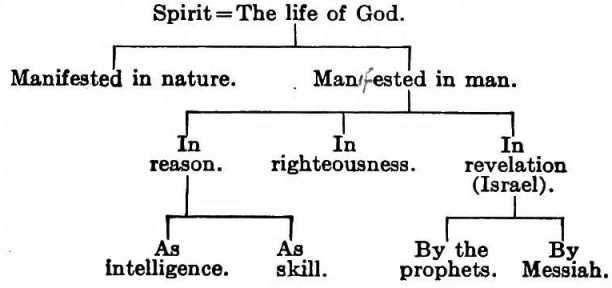
3. Theology of the Holy Spirit.—These two elements, namely, the promise of a Paraclete to the disciples, based on their experience of Himself, and the identification of that Paraclete with the Spirit of God, based on the older revelation, combine to produce that language in which Jesus expressed the Divine Personality of the Holy Spirit, and upon which the Christian theology of the subject is founded. When first the Holy Spirit is mentioned, Jesus says ‘whom the Father will send in my name’ (Joh 14:26). At the next stage of the revelation of the Comforter, it is ‘whom I will send unto you from the Father’ (Joh 15:26). Then it is the Spirit Himself coming (Joh 16:7; Joh 16:13), guiding (Joh 16:18), declaring truth (Joh 16:13), and glorifying the Son (Joh 16:14).
(1) He is from the Father. The revelation of Jesus Christ is primarily a showing of the Father (Joh 14:8-9). The principle of Jehovah’s life thus becomes in the NT the Holy Spirit who proceeds from the Father (Joh 15:26). This relation is consistently preserved even when the Spirit is represented as Christ’s own gift (Joh 16:15). Just as the Son is spoken of as God only in relation to the Father, and as subordinate to, in the sense of deriving His being from, Him, so there is no independent existence or even revelation of the Spirit. The technical term ‘proceeding,’ as adopted in the creeds, is taken from Joh 15:26, which, while it refers immediately to the coming of the Spirit into the world, is seen, when the proportions of Scripture are considered, to follow a natural order inherent in the Divine Being (cf. Rev 22:1). Already in His teaching the Lord had spoken of the ‘Spirit of your Father (Mat 10:20). And the special relation of the Spirit to the Father is prominent in St. Paul. By the Spirit God raised up Jesus and will quicken men’s mortal bodies (Rom 8:11). in the Spirit the disciple is justified (1Co 6:11) and enabled to realize his redeemed sonship and address God as Father (Rom 8:14-16, Eph 2:18). His relation to God (i.e. the Father) is further asserted in many places (e.g. 1Co 2:10-12, 2Co 1:22; 2Co 5:5, Eph 4:30).
(2) This is, however, not inconsistent with, but rather results in, a dependence upon the Son (Joh 15:26; Joh 16:15; cf. Joh 15:15) which enables the Spirit to become the organ, whereby is applied to mankind the redemptive efficacy of the Incarnate Life (Joh 14:17-18; Joh 14:21; Joh 14:23; Joh 14:26, Joh 16:13-14). Jesus speaks of the Spirit as His own gift (Joh 15:26). As Christ came in the Father’s name, so will the Spirit come in Christ’s name (Joh 14:26, cf. Joh 5:43). His office is to be the witness and interpreter of Christ (Joh 15:26, Joh 16:14). The testimony of the disciples is to reflect this witness (Joh 15:27). The dependence of the Spirit on the Son, both in His eternal being and in His incarnate life, is fully horne out by the language of the NT generally. He is the Spirit of God’s Son (Gal 4:6), of the Lord [Jesus] (2Co 3:17), of Jesus (Act 16:7 RV
(3) The operations of the Spirit thus bestowed are all personal in character. He teaches (Joh 14:26), witnesses (Joh 15:26), guides and foretells (Joh 16:13), and glorifies the Son (Joh 16:14). So in the Acts He forbids (Act 16:7), appoints (Act 13:2), decides (Act 15:28). To Him the lie of Ananias is told (Act 5:3). And the testimony of the Epistles coincides (1Co 2:10; 1Co 3:16; 1Co 6:19, Rom 8:1-39 passim, etc.). The fellowship of the Holy Spirit is parallel with the grace of Christ and the love of God in 2Co 13:14. To the world His presence is not power, but condemnation. He is to convict the world (Joh 16:8) by carrying on in the life and work of the Church the testimony of Jesus (Joh 15:26-27, 1Co 12:3, 1Jn 5:7, Rev 19:10), in whom the prince of this world is judged (Joh 12:31; Joh 14:30). The witness, the power, and the victory of Christ are transferred to the society of His disciples through the Spirit.
4. Work of the Spirit in the Church
(1) While anticipated by His work in the world (Psa 139:7, Wis 1:7) and foreshadowed by His special relations with Israel, the presence of the Spirit is yet so far a new experience for Christians that St. John, speaking of the age before Pentecost, can say that ‘the Spirit was not yet [given]’ (Joh 7:39 RV
Whether the tongues were foreign languages, as the narrative of Acts taken by itself would suggest (Act 2:6), must, in the light of 1Co 14:1-19, where the gift is some form of ecstatic speech needing the correlative gift of interpretation, he regarded as at least doubtful; see also Act 10:46; Act 11:15. But that it enabled those who were not Palestinian Jews (Act 11:8-11) to realize ‘the mighty works of God’ (Act 11:11) is certain. The importance attached to it in the Apostolic Church was due, perhaps, to the peculiar novelty of the sign as understood to have been foretold by Christ Himself (Mar 16:17), more certainly to the fact that it was a manifestation characteristic of the Christian community. See, further, Tongues, Gift of.
Though, by the time that St. Paul wrote to the Corinthians, prophecy was already attaining higher importance as a more useful and therefore greater gift (1Co 12:28-31; 1Co 14:1), the memory of the Impression created at Pentecost, as of the arrival in the world of a new and unparalleled power, united to the spiritual exaltation felt by the possessor of the gift, was still living in the Church. Nor can the Pentecostal preaching of St. Peter, with its offer of the Holy Spirit to those that repented and were baptized (Act 2:38), be regarded otherwise than as evidence, alike in the Apostles and in those who were ‘added to them’ (Act 2:47), that they were dealing with a new experience. That this was a transfer of the Spirit which dwelt in Christ from His baptism (Mar 1:10||), carrying with it the fulness of the Incarnate Life (Joh 1:16, Eph 3:14-19; Eph 4:13), was attested by the miracles wrought in His name (Act 3:6-7; Act 4:30 etc.), the works which He had done and which His disciples were also to do (Joh 14:12), bearing witness to a unity of power.
(2) The Incarnation. That the presence of the Holy Spirit was not only a new experience for themselves, but also, as dwelling in the Incarnate Son, a new factor in the world’s history, was recognized by the primitive Christians in proportion as they apprehended the Apostolic conception of the Person of Christ. One of the earliest facts in Christian history that demands explanation is the separation from the Apostolic body of the Jewish party in the Church, which, after the fall of Jerusalem, hardened into the Ebionite sects. The difference lies in the perception by the former of that new element in the humanity of Jesus which is prominent in the Christology of the Pauline Epistles (Rom 1:4; Rom 5:12-21, 1Co 15:20-28, 2Co 8:9, Gal 4:4, Php 2:5-11, Col 2:9).
It is all but certain that this language depends upon the acceptance of the Virgin Birth, which the sects above mentioned, because they had no use for it, tended to deny. The Apostles were enabled through a knowledge of this mystery to recognize Jesus as the second Adam, the quickening spirit, the beginning of the new creation of God (Rev 3:14; cf. Rev 21:5-6). If the narrative of the Annunciation in Luke (Luk 1:35) be compared with the Prologue of John (Rev 1:1-18) and with the account of Creation in Gen 1:1-31, the full import of this statement becomes apparent. The Spirit overshadows Mary as He brooded upon the face of the waters. The manifestation of the Messiah was, therefore, no mere outpouring of the spirit of prophecy even in measure hitherto unequalled, but God visiting and redeeming His people through the incarnation of His image (Heb 1:1-3, Col 1:15).
St. Paul’s protest, therefore, against Judaic Christianity, which, in spite of temporary misgivings on the part of St. Peter and St. James (Gal 2:11-12), received the assent of the Apostolic witnesses, resulted from a true interpretation of his experience of that Holy Spirit into which he had been baptized (Act 9:17-18). The Gentiles, apart from circumcision (Gal 5:2, cf. Act 15:1-41), were capable of the Holy Spirit as well as the Jews, by the enlargement of human nature through union with God in Christ, and by that alone (Gal 4:5-6; Gal 6:15, 2Co 3:17-18; cf. Rom 8:29, 1Co 15:49). Thus, though the Apostolic preaching was the witness to Jesus and the Resurrection, beginning from the baptism of John (Act 1:21-22), the Apostolic record is necessarily carried back to the narratives of the Infancy. The ministry of reconciliation, though fulfilled in the power of the baptismal Spirit (Luk 4:14), depended for its range on the capacity of the vessel already fashioned by the same Spirit (Luk 1:35) for His habitation—God was in Christ (2Co 5:19).
(3) Union with Christ. What, therefore, the Apostolic community claimed to possess was not merely the aptitude for inspiration, as when the Spirit spoke in old times by the mouth of the prophets, but union with the life and personality of their Master (Joh 17:23), through the fellowship of a Spirit (2Co 13:14, Php 2:1) which was His (Php 1:19). The Acts is the record of the Spirit’s expanding activity in the organic and growing life of the Christian Church. The ‘things concerning the kingdom’ (Php 1:3), of which Christ spoke before His Ascension, are summed up in the witness to be given ‘unto the uttermost part of the earth’ (Php 1:8) and in the promise of power (Php 1:8). The events subsequently recorded are a series of discoveries as to the potentialities of this new life. The Epistles set before us, not systematically, but as occasion serves, the principles of the Spirit’s action in this progressive experience, corporate and individual.
(4) Spiritual gifts. The NT teaching with regard to spiritual gifts (wh. see) springs out of the conception of the Church as the mystical body of Christ (Eph 1:22; Eph 2:16-20; Eph 4:16, 1Co 12:12). The Holy Spirit is the living principle distributed throughout the body (1Co 12:13, Eph 2:18; Eph 4:4). The point of supreme importance to the Christian is to have the inward response of the Spirit to the Lordship of Christ (1Co 12:3). This life is universally manifested in love (ch. 13), to strive after which is ever the ‘more excellent way’ (1Co 12:31). But, though bestowed on all Christians alike, it is distributed to each ‘according to the measure of the gift of Christ’ (Eph 4:7). The principle of proportion is observed by Him who has ‘tempered the body together’ (1Co 12:24). The same gifts or manifestations of the Spirit are not, therefore, to be expected in all believers or in all ages. They are given that the whole body may profit (1Co 12:7). They are correlative to the part which each has to fulfil in the organic structure of the whole (1Co 12:14-20, Eph 4:16). The desire for them, though not discouraged (1Co 12:31; 1Co 14:1), must be regulated by consideration of the needs of the Church (1Co 14:12) and the opportunities of service (Rom 12:1-6, cf. 1Pe 5:5). ‘Each “gifted” individual becomes himself a gift’ (Gore).
Nowhere do we find any attempt to make a complete enumeration of spiritual gifts. In Eph 4:11, where the completion of the structure of Christ’s body is the main thought (Eph 4:12), four classes of ministerial function are named. In Rom 12:6-8, where a just estimate of the individual’s capacity for service is prominent, the list is promiscuous, exceptional gifts like prophecy, ministerial functions like teaching, and ordinary graces like liberality, being mentioned indifferently. Local circumstances confine the lists of 1Co 12:8-10; 1Co 12:28 to the ‘greater gifts’ (1Co 12:31), those granted for more conspicuous service, most of which are tokens of God’s exceptional activity. The object of the Apostle in this catalogue is to show that tongues are by no means first in importance. ‘Faith’ in 1Co 12:9 is not to be confused with the primary virtue of 1Co 13:13, but is interpreted by 1Co 13:2 (cf. Mat 17:20).
(5) Inspiration. It is in this connexion that inspiration as applied to the Bible must be brought into relation with the doctrine of the Holy Spirit. No theory, as applying to the whole Canon, is in the nature of the case to be expected in the NT itself. But prophecy is one of the gifts of the Spirit (1Co 12:10; 1Co 12:28), and it is clear that the prophets were recognized as a distinct order in the Apostolic Church (Act 11:27; Act 13:1; Act 21:10; cf. 1Ti 1:18; 1Ti 4:14), though there was nothing professional in this ministry (Act 19:6; Act 21:9). The type was undoubtedly that of the OT prophets (see above), and a distinct link with the ancient line is found in St. Peter’s reference to the words of Joel as fulfilled at Pentecost (Act 2:16-18). Agabus prophesies by the Spirit (Act 11:28). He adopts the method of signs (Act 21:11) and the phrase ‘Thus saith the Holy Spirit’ (cf. OT ‘Thus saith the Lord’). Here, then, we have a gift that was conceived as perpetuating the mouthpiece whereby the will of God was revealed to the fathers (H Act 1:1). The inspiration of the OT Scriptures as understood in the 1st cent. of the Christian era was undoubtedly regarded as an extension of the prophetic gift. They were the oracles of God (Act 7:38, Rom 3:2, Heb 5:12), and as such ‘the sacred writings’ (2Ti 3:15), profitable because inbreathed by God for spiritual ends (2Ti 3:16). The connexion with prophecy is explicitly drawn out in 2Pe 1:20-21, the same Epistle showing the process by which the writings of Apostles were already beginning to take similar rank (2Pe 3:15-16, cf. Eph 3:5). That the Bible is either verbally accurate or inerrant is no more a legitimate deduction from this principle than is ecclesiastical infallibility from that of the Abiding Presence in the Church. In either case the method of the Spirit’s activity must be judged by experience. Nor, in face of the express declaration of St. Paul, that ‘the spirits of the prophets are subject to the prophets’ (1Co 14:32), may we tolerate any theory which impairs the freedom of human personality.
(6) The laying on of hands in the ministration of the Spirit seems to have been adopted by a spontaneous impulse in the primitive community, and to have become immediately an established ordinance. The place accorded to the practice in Heb 6:2, as belonging to the alphabet of gospel knowledge, attests the importance attached to it. Like baptism, its roots are in the OT, where it is found as an act of dedication (Num 8:9-10; Num 8:12; Num 27:18-23; see Schultz, OT Theol. i. 391) or benediction (Gen 48:14-15). Christ uses it in blessing the children (Mar 10:16). The Apostles adopt it as the sign, joined with prayer, for the anointing of the Holy Spirit, by which they effected consecration to an office or function (Act 6:6; cf. 1Ti 4:14; 1Ti 5:22 (? see below), 2Ti 1:6), or conferred blessing on the baptized (Act 8:14-24; Act 19:5-6). The offer of money to Peter at Samaria (Act 8:18) shows that the rite might be, and in this case was, followed by exceptional manifestations, like those which appeared at Pentecost; and that the fallacy which awakened Simon’s covetousness was the identification of the gift with these effects. Though associated with the bestowal of the Spirit, the laying on of hands has not yet been reduced to a technical rite in a crystallized ecclesiastical system. Ananias uses it in the recovery of Saul’s sight (Act 9:12; Act 9:17); the Antiochene Church, not probably in ordaining Barnabas and Saul, but in sending them forth to a particular mission (Act 13:3). In Mar 16:18 and Act 28:8 it is a symbol of healing (cf. Mar 1:41; Mar 5:23; Mar 6:5; Mar 8:23, Rev 1:17, also Jas 5:14-15); in 1Ti 5:22 not improbably of absolution (see Hort, Ecclesia, p. 214). According to 2Ti 1:6, it was used by St. Paul in conveying spiritual authority to his representative at Ephesus; or, if the reference be the same as in 1Ti 4:14, in the ordination of Timothy to a ministerial function. The symbolism is natural and expressive, and its employment by the Christian Church was immediately justified in experience (e.g. Act 19:6). Its connexion with the bestowal of specific gifts, like healing, or of official authority, like that of the Seven (Act 6:6), is easily recognized.
A more difficult question to determine is its precise relation to baptism, where the purpose of the ministration is general. The Holy Spirit is offered by St. Peter to such as repent and are baptized (Act 2:38, cf. 1Co 12:13); while of those whom Philip had baptized at Samaria (Act 8:12) it is expressly asserted that He had ‘fallen upon none of them’ (Act 8:16). It may have been that the experience of the Apostles, as empowered first by the risen Christ (Joh 20:22), and then by the Pentecostal descent (Act 2:4), led them to distinguish stages in the reception of the Spirit, and that the apparent discrepancy would be removed by a fuller knowledge of the facts. But this uncertainty does not invalidate the positive evidence which connects the ministration of the Spirit with either ordinance. See also Laying on of Hands.
J. G. Simpson.
(Anglo-Saxon: gast)
The Third Person of the Blessed Trinity. He is the Spirit of the Father and of the Son and proceeds alike from Both, as from one common principle. He is the personal infinite term of the eternal act of mutual love of the Father and the Son; hence His name of Spirit or Holy Ghost, as the issue or term of God’s eternal love or act of will. He is also called the Spirit of Truth, the Creator Spirit, the Sanctifier, as the gifts of creation (or recreation, or regeneration), of revelation, and of sanctification are the outpourings of God’s love, and so appropriated to the Spirit of Love, though all eternal Divine effects belong to the common or united action of the Three Divine Persons. He is called Dove, as in this form He descended visibly upon Christ at the Jordan (Mark 1), the dove being a symbol of innocence and of peace. Jesus promised that the Spirit of Truth would "teach you all things and bring all things to your mind, whatsoever I shall have said to you." (John 14) See also:
fruits of the Holy Ghost
gifts of the Holy Ghost
novena to the Holy Ghost
I. SYNOPSIS OF THE DOGMAThe doctrine of the Catholic Church concerning the Holy Ghost forms an integral part of her teaching on the mystery of the Holy Trinity, of which St. Augustine (De Trin., I, iii, 5), speaking with diffidence, says: "In no other subject is the danger of erring so great, or the progress so difficult, or the fruit of a careful study so appreciable". The essential points of the dogma may be resumed in the following propositions: The Holy Ghost is the Third Person of the Blessed Trinity. Though really distinct, as a Person, from the Father and the Son, He is consubstantial with Them; being God like Them, He possesses with Them one and the same Divine Essence or Nature. He proceeds, not by way of generation, but by way of spiration, from the Father and the Son together, as from a single principle. Such is the belief the Catholic faith demands. II. CHIEF ERRORSAll the theories and all the Christian sects that have contradicted or impugned, in any way, the dogma of the Trinity, have, as a logical consequence, threatened likewise the faith in the Holy Ghost. Among these, history mentions the following: In the second and third centuries, the dynamic or modalistic Monarchians (certain Ebionites, it is said, Theodotus of Byzantium, Paul of Samosata, Praxeas, Noëtus, Sabellius, and the Patripassians generally) held that the same Divine Person, according to His different operations or manifestations, is in turn called the Father, the Son, and the Holy Ghost; so they recognized a purely nominal Trinity. In the fourth century and later, the Arians and their numerous heretical offspring: Anomans or Eunomians, Semi-Arians, Acacians, etc., while admitting the triple personality, denied the consubstantiality. Arianism had been preceded by the Subordination theory of some ante-Nicene writers, who affirmed a difference and a gradation between the Divine Persons other than those that arise from their relations in point of origin. In the sixteenth century, the Socinians explicitly rejected, in the name of reason, along with all the mysteries of Christianity, the doctrine of Three Persons in One God. Mention may also be made of the teachings of Johannes Philoponus (sixth century), Roscellinus, Gilbert de la Porrée, Joachim of Flora (eleventh and twelfth centuries), and, in modern times, Günther, who, by denying or obscuring the doctrine of the numerical unity of the Divine Nature, it reality set up a triple deity. In addition to these systems and these writers, who came in conflict with the true doctrine about the Holy Ghost only indirectly and as a logical result of previous errors, there were others who attacked the truth directly: Towards the middle of the fourth century, Macedonius, Bishop of Constantinople, and, after him a number of Semi-Arians, while apparently admitting the Divinity of the Word, denied that of the Holy Ghost. They placed Him among the spirits, inferior ministers of God, but higher than the angels. They were, under the name of Pneumatomachians, condemned by the Council of Constantinople, in 381 (Mansi, III, col. 560). Since the days of Photius, the schismatic Greeks maintain that the Holy Ghost, true God like the Father and the Son, proceeds from the former alone. III. THE THIRD PERSON OF THE BLESSED TRINITYThis heading implies two truths: The Holy Ghost is a Person really distinct as such from the Father and the Son; He is God and consubstantial with the Father and the Son. The first statement is directly opposed to Monarchianism and to Socinianism; the second to Subordinationism, to the different forms of Arianism, and to Macedonianism in particular. The same arguments drawn from Scripture and Tradition may be used generally to prove either assertion. We will, therefore, bring forward the proofs of the two truths together, but first call particular attention to some passages that demonstrate more explicitly the distinction of personality.A. Scripture. In the New Testament the word spirit and, perhaps, even the expression spirit of God signify at times the soul or man himself, inasmuch as he is under the influence of God and aspires to things above; more frequently, especially in St. Paul, they signify God acting in man; but they are used, besides, to designate not only a working of God in general, but a Divine Person, Who i&neither the Father nor the Son, Who is named together with the Father, or the Son, or with Both, without the context allowing them to be identified. A few instances are given here. We read in John, xiv, 16, 17: "And I will ask the Father, and he shall give you another Paraclete, that he may abide with, you for ever. The spirit of truth, whom the world cannot receive"; and in John, xv, 26: "But when the Paraclete cometh, whom I will send you from the Father, the Spirit of truth, who proceedeth from the Father, he shall give testimony of me." St. Peter addresses his first epistle, i, 1-2, "to the strangers dispersed . . . elect, according to the foreknowledge of God the Father, unto the sanctification of the Spirit, unto obedience and sprinkling of the blood of Jesus Christ". The Spirit of consolation and of truth is also clearly distinguished in John 16:7, 13-15, from the Son, from Whom He receives all He is to teach the Apostles, and from the Father, who has nothing that the Son also does not possess. Both send Him, but He is not separated from Them, for the Father and the Son come with Him when He descends into our souls (John 14:23).Many other texts declare quite as clearly that the Holy Ghost is a Person, a Person distinct from the Father and the Son, and yet One God with Them. In several places St. Paul speaks of Him as if speaking of God. In Acts 28:25, he says to the Jews: "Well did the Holy Ghost speak to our fathers by Isaias the prophet"; now the prophecy contained in the next two verses is taken from Isaias 6:9-10, where it is put in the mouth of the "King the Lord of hosts". In other places he uses the words God and Holy Ghost as plainly synonymous. Thus he writes, I Corinthians 3:16: "Know you not, that you are the temple of God, and that the Spirit of God dwelleth in you?" and in 6:19: "Or know you not, that your members are the temple of the Holy Ghost, who is in you . . . ?" St. Peter asserts the same identity when he thus remonstrates with Ananias (Acts 5:3-4): "Why hath Satan tempted thy heart, that thou shouldst lie to the Holy Ghost . . . ? Thou hast not lied to men, but to God." The sacred writers attribute to the Holy Ghost all the works characteristic of Divine power. It is in His name, as in the name of the Father and of the Son, that baptism is to be given (Matthew 28:19). It is by His operation that the greatest of Divine mysteries, the Incarnation of the Word, is accomplished (Matthew 1:18, 20; Luke 1:35). It is also in His name and by His power that sins are forgiven and souls sanctified: "Receive ye the Holy Ghost. Whose sins you shall forgive, they are forgiven them" (John 20:22-23); "But you are washed, but you are sanctified, but you are justified in the name of our Lord Jesus Christ, and the Spirit of our God" (1 Corinthians 6:11); "The charity of God is poured forth in our hearts, by the Holy Ghost, who is given to us" (Romans 5:5). He is essentially the Spirit of truth (John 14:16-17; 15:26), Whose office it is to strengthen faith (Acts 6:5), to bestow wisdom (Acts 6:3), to give testimony of Christ, that is to say, to confirm His teaching inwardly (John 15:26), and to teach the Apostles the full meaning of it (John 14:26; 16:13). With these Apostles He will abide for ever (John 14:16). Having descended on them at Pentecost, He will guide them in their work (Acts 8:29), for He will inspire the new prophets (Acts 11:28; 13:9), as He inspired the Prophets of the Old Law (Acts 7:51). He is the source of graces and gifts (1 Corinthians 12:3-11); He, in particular, grants the gift of tongues (Acts 2:4; 10:44-47). And as he dwells in our bodies sanctifies them (1 Corinthians 3:16; 6:19),so will and them he raise them again, one day, from the dead (Romans 8:11). But he operates especially in the soul, giving it a new life (Romans 8:9 sq.), being the pledge that God has given us that we are his children (Romans 8:14-16; 2 Corinthians 1:22; 5:5; Galatians 4:6). He is the Spirit of God, and at the same time the Spirit of Christ (Romans 8:9); because He is in God, He knows the deepest mysteries of God (1 Corinthians 2:10-11), and He possesses all knowledge. St. Paul ends his Second Epistle to the Corinthians (13:13) with this formula of benediction, which might be called a blessing of the Trinity: "The grace of our Lord Jesus Christ, and the charity of God, and the communication of the Holy Ghost be with you all." -- Cf. Tixeront, "Hist. des dogmes", Paris, 1905, I, 80, 89, 90,100,101.B. Tradition. While corroborating and explaining the testimony of Scripture, Tradition brings more clearly before us the various stages of the evolution of this doctrine.As early as the first century, St. Clement of Rome gives us important teaching about the Holy Ghost. His "Epistle to the Corinthians" not only tells us that the Spirit inspired and guided the holy writers (viii, 1; xlv, 2); that He is the voice of Jesus Christ speaking to us in the Old Testament (xxii, 1 sq.); but it contains further, two very explicit statements about the Trinity. In c. xlvi, 6 (Funk, "Patres apostolici", 2nd ed., I,158), we read that "we have only one God, one Christ, one only Spirit of grace within us, one same vocation in Christ". In lviii, 2 (Funk, ibid., 172), the author makes this solemn affirmation; zo gar ho theos, kai zo ho kyrios Iesous Christos kai to pneuma to hagion, he te pistis kai he elpis ton eklekton, oti . . . which we may compare with the formula so frequently met with in the Old Testament: zo kyrios. From this it follows that, in Clement’s view, kyrios was equally applicable to ho theos (the Father), ho kyrios Iesous Christos, and to pneuma to hagion; and that we have three witnesses of equal authority, whose Trinity, moreover, is the foundation of Christian faith and hope.The same doctrine is declared, in the second and third centuries, by the lips of the martyrs, and is found in the writings of the Fathers. St. Polycarp (d. 155), in his torments, thus professed his faith in the Three Adorable Persons ("Martyrium sancti Polycarpi" in Funk op. cit., I, 330): "Lord God Almighty, Father of Thy blessed and well beloved Son, Jesus Christ . . . in everything I praise Thee, I bless Thee, I glorify Thee by the eternal and celestial pontiff Jesus Christ, Thy well beloved Son, by whom, to Thee, with Him and with the Holy Ghost, glory now and for ever!"St. Epipodius spoke more distinctly still (Ruinart, "Acta mart.", Verona edition, p. 65): "I confess that Christ is God with the Father and the Holy Ghost, and it is fitting that I should give back my soul to Him Who is my Creator and my Redeemer."Among the apologists, Athenagoras mentions the Holy Ghost along with, and on the same plane as, the Father and the Son. "Who would not be astonished", says he (Legat. pro christian., n. 10, in P.G., VI, col. 909), "to hear us called atheists, us who confess God the Father, God the Son and the Holy Ghost, and hold them one in power and distinct in order [. . . ten en te henosei dynamin, kai ten en te taxei diairesin]?"Theophilus of Antioch, who sometimes gives to the Holy Ghost, as to the Son, the name of Wisdom (sophia), mentions besides (Ad Autol., lib. I, n. 7, and II, n. 18, in P.G., VI, col. 1035, 1081) the three terms theos, logos, sophia and, being the first to apply the characteristic word that was afterwards adopted, says expressly (ibid., II, 15) that they form a trinity (trias).Irenæus looks upon the Holy Ghost as eternal (Adv. Hær., V, xii, n. 2, in P.G., VII, 1153), existing in God ante omnem constitutionem, and produced by him at the beginning of His ways (ibid., IV, xx, 3). Considered with regard to the Father, the Holy Ghost is his wisdom (IV, xx, 3); the Son and He are the "two hands" by which God created man (IV, præf., n. 4; IV, xx, 20; V, vi, 1). Considered with regard to the Church, the same Spirit is truth, grace, a pledge of immortality, a principle of union with God; intimately united to the Church, He gives the sacraments their efficacy and virtue (III, xvii, 2, xxiv, 1; IV, xxxiii, 7; V, viii, 1).St. Hippolytus, though he does not speak at all clearly of the Holy Ghost regarded as a distinct person, supposes him, however, to be God, as well as the Father and the Son (Contra Noët., viii, xii, in P.G., X, 816, 820).Tertullian is one of the writers of this age whose tendency to Subordinationism is most apparent, and that in spite of his being the author of the definitive formula: "Three persons, one substance". And yet his teaching on the Holy Ghost is in every way remarkable. He seems to have been the first among the Fathers to affirm His Divinity in a clear and absolutely precise manner. In his work "Adversus Praxean" lie dwells at length on the greatness of the Paraclete. The Holy Ghost, he says, is God (c. xiii in P.L., II, 193); of the substance of the Father (iii, iv in P.L., II, 181-2); one and the same God with the Father and the Son (ii in P.L., II, 180); proceeding from the Father through the Son (iv, viii in P.L., II, 182, 187); teaching all truth (ii in P.L., II, 179).St. Gregory Thaumaturgus, or at least the Ekthesis tes pisteos, which is commonly attributed to him, and which dates from the period 260-270, gives us this remarkable passage (P.G., X, 933 sqq.): "One is God, Father of the living Word, of the subsisting Wisdom. . . . One the Lord, one of one, God of God, invisible of invisible. . .One the Holy Ghost, having His subsistence from God. . . . Perfect Trinity, which in eternity, glory, and power, is neither divided, nor separated. . . . Unchanging and immutable Trinity."In 304, the martyr St. Vincent said (Ruinart, op. cit., 325): "I confess the Lord Jesus Christ, Son of the Father most High, one of one; I recognize Him as one God with the Father and the Holy Ghost."But we must come down towards the year 360 to find the doctrine on the Holy Ghost explained both fully and clearly. It is St. Athanasius who does so in his "Letters to Serapion" (P.G., XXVI, col. 525 sq.). He had been informed that certain Christians held that the Third Person of the Blessed Trinity was a creature. To refute them he questions the Scriptures, and they furnish him with arguments as solid as they are numerous. They tell him, in particular, that the Holy Ghost is united to the Son by relations just like those existing between the Son and the Father; that He is sent by the Son; that He is His mouth-piece and glorifies Him; that, unlike creatures, He has not been made out of nothing, but comes forth from God; that He performs a sanctifying work among men, of which no creature is capable; that in possessing Him we possess God; that the Father created everything by Him; that, in fine, He is immutable, has the attributes of immensity, oneness, and has a right to all the appellations that are used to express the dignity of the Son. Most of these conclusions he supports by means of Scriptural texts, a few from amongst which are given above. But the writer lays special stress on what is read in Matthew 28:19. "The Lord", he writes (Ad Serap., III, n. 6, in P.G., XXVI, 633 sq.), "founded the Faith of the Church on the Trinity, when He said to His Apostles: ’Going therefore, teach ye all nations; baptizing them in the name of the Father, and of the Son, and of the Holy Ghost.’ If the Holy Ghost were a creature, Christ would not have associated Him with the Father; He would have avoided making a heterogeneous Trinity, composed of unlike elements. What did God stand in need of? Did He need to join to Himself a being of different nature? . . . No, the Trinity is not composed of the Creator and the creature."A little later, St. Basil, Didymus of Alexandria, St. Epiphanius, St. Gregory of Nazianzus, St. Ambrose, and St. Gregory of Nyssa took up the same thesis ex professo, supporting it for the most part with the same proofs. All these writings had prepared the way for the Council of Constantinople which, in 381, condemned the Pneumatomachians and solemnly proclaimed the true doctrine. This teaching forms part of the Creed of Constantinople, as it is called, where the symbol refers to the Holy Ghost, "Who is also our Lord and Who gives life; Who proceeds from the Father, Who is adored and glorified together with the Father and the Son; Who spoke by the prophets". Was this creed, with these particular words, approved by the council of 381? Formerly that was the common opinion, and even in recent times it has been held by authorities like Hefele, Hergenröther, and Funk; other historians, amongst whom are Harnack and Duchesne, are of the contrary opinion; but all agree in admitting that the creed of which we are speaking was received and approved by the Council of Chalcedon, in 451, and that, at least from that time, it became the official formula of Catholic orthodoxy. IV. PROCESSION OF THE HOLY GHOSTWe need not dwell at length on the precise meaning of the Procession in God. (See TRINITY.) It will suffice here to remark that by this word we mean the relation of origin that exists between one Divine Person and another, or between one and the two others as its principle of origin. The Son proceeds from the Father; the Holy Ghost proceeds from the Father and the Son. The latter truth will be specially treated here.A. That the Holy Ghost proceeds from the Father has always been admitted by all Christians; the truth is expressly stated in John, xv, 26. But the Greeks, after Photius, deny that He proceeds from the Son. And yet such is manifestly the teaching of Holy Scripture and the Fathers.(1) In the New Testament(a) The Holy Ghost is called the Spirit of Christ (Romans 8:9), the Spirit of the Son (Galatians 4:6), the Spirit of Jesus (Acts 16:7). These terms imply a relation of the Spirit to the Son, which can only be a relation of origin. This conclusion is so much the more indisputable as all admit the similar argument to explain why the Holy Ghost is called the Spirit of the Father. Thus St. Augustine argues (In Joan., tr. xcix, 6, 7 in P.L., XXXV, 1888): "You hear the Lord himself declare: ’It is not you that speak, but the Spirit of your Father that speaketh in you’. Likewise you hear the Apostle declare: ’God hath sent the Spirit of His Son into your hearts. Could there then be two spirits, one the spirit of the Father, the other the spirit of the Son? Certainly not. Just as there is only one Father, just as there is only one Lord or one Son, so there is only one Spirit, Who is, consequently, the Spirit of both. . . Why then should you refuse to believe that He proceeds also from the Son, since He is also the Spirit of the Son? If He did not proceed from Him, Jesus, when He appeared to His disciples after His Resurrection, would not have breathed on them, saying: ’Receive ye the Holy Ghost’. What, indeed, does this breathing signify, but that the Spirit proceeds also from Him?" St. Athanasius had argued in exactly the same way (De Trinit. et Spir. S., n. 19, in P.G., XXVI, 1212), and concluded: "We say that the Son of God is also the source of the Spirit."(b) The Holy Ghost receives from the Son, according to John 16:13-15: "When he, the Spirit of truth, is come he will teach you all truth. For he shall not speak of himself; but what things soever he shall hear, he shall speak; and the things that are to come, he shall shew you. He shall glorify me; because he shall receive of mine, and shall shew it to you. All things whatsoever the Father hath, are mine. Therefore I said, that he shall receive of mine, and shew it to you." Now, one Divine Person can receive from another only by Procession, being related to that other as to a principle. What the Paraclete will receive from the Son is immanent knowledge, which He will afterwards manifest exteriorly. But this immanent knowledge is the very essence of the Holy Ghost. The latter, therefore, has His origin in the Son, the Holy Ghost proceeds from the Son. "He shall not speak of Himself", says St. Augustine (In Joan., tr. xcix, 4, in P.L., XXXV, 1887), "because He is not from Himself, but He shall tell you all He shall have heard. He shall hear from him from whom He proceeds. In His case, to hear is to know, and to know is to be. He derives His knowledge from Him from Whom He derives His essence." St. Cyril of Alexandria remarks that the words: "He shall receive of mine" signify "the nature" which the Holy Ghost has from the Son, as the Son has His from the Father (De Trinit., dialog. vi, in P.G., LXXV, 1011). Besides, Jesus gives this reason of His assertion: "He shall receive of mine": "All things whatsoever the Father hath, are mine Now, since the Father has with regard to the Holy Ghost the relation we term Active Spiration, the Son has it also; and in the Holy Ghost there exists, consequently, with regard to both, Passive Spiration or Procession.(2) The same truth has been constantly held by the FathersThis fact is undisputed as far as the Western Fathers are concerned; but the Greeks deny it in the case of the Easterns. We will cite, therefore, a few witnesses from among the latter. The testimony of St. Athanasius has been quoted above, to the effect that "the Son is the source of the Spirit", and the statement of Cyril of Alexandria that the Holy Ghost has His "nature" from the Son. The latter saint further asserts (Thesaur., assert. xxxiv in P.G., LXXV, 585); "When the Holy Ghost comes into our hearts, He makes us like to God, because He proceeds from the Father and the Son"; and again (Epist., xvii, Ad Nestorium, De excommunicatione in P.G., LXXVII, 117): "The Holy Ghost is not unconnected with the Son, for He is called the Spirit of Truth, and Christ is the Truth; so He proceeds from Him as well as from God the Father." St. Basil (De Spirit. S., xviii, in P.G., XXXII, 147) wishes us not to depart from the traditional order in mentioning the Three Divine Persons, because "as the Son is to the Father, so is the Spirit to the Son, in accordance with the ancient order of the names in the formula of baptism". St. Epiphanius writes (Ancor., viii, in P. G., XLIII, 29, 30) that the Paraclete "is not to be considered as unconnected with the Father and the Son, for He is with Them one in substance and divinity", and states that "He is from the Father and the Son"; a little further, he adds (op. cit., xi, in P.G., XLIII, 35):" No one knows the Spirit, besides the Father, except the Son, from Whom He proceeds and of Whom He receives." Lastly, a council held at Seleucia in 410 proclaims its faith "in the Holy Living Spirit, the Holy Living Paraclete, Who proceeds from the Father and the Son" (Lamy, "Concilium Seleuciæ", Louvain, 1868).However, when we compare the Latin writers, as a body, with the Eastern writers, we notice a difference in language: while the former almost unanimously affirm that the Holy Ghost proceeds from the Father and from the Son, the latter generally say that He proceeds from the Father through the Son. In reality the thought expressed by both Greeks and Latins is one and the same, only the manner of expressing it is slightly different: the Greek formula ek tou patros dia tou ouiou expresses directly the order according to which the Father and the Son are the principle of the Holy Ghost, and implies their equality as principle; the Latin formula expresses directly this equality, and implies the order. As the Son Himself proceeds from the Father, it is from the Father that He receives, with everything else, the virtue that makes Him the principle of the Holy Ghost. Thus, the Father alone is principium absque principio, aitia anarchos prokatarktike, and, comparatively, the Son is an intermediate principle. The distinct use of the two prepositions, ek (from) and dia (through), implies nothing else. In the thirteenth and fourteenth centuries, the Greek theologians Blemmidus Beccus, Calecas, and Bessarion called attention to this, explaining that the two particles have the same signification, but that from is better suited to the First Person, Who is the source of the others, and through to the Second Person, Who comes from the Father. Long before their time St. Basil had written (De Spir. S., viii, 21, in P.G., XXXII, 106): "The expression di ou expresses acknowledgment of the primordial principle [ tes prokatarktikes aitias]"; and St. Chrysostom (Hom. v in Joan., n. 2, in P.G., LIX, 56): "If it be said through Him, it is said solely in order that no one may imagine that the Son is not generated": It may be added that the terminology used by the Eastern and Western writers, respectively, to express the idea is far from being invariable. Just as Cyril, Epiphanius, and other Greeks affirm the Procession ex utroque, so several Latin writers did not consider they were departing from the teaching of their Church in expressing themselves like the Greeks. Thus Tertullian (Contra Prax., iv, in P.L., II, 182): "Spiritum non aliunde puto quam a Patre per Filium"; and St. Hilary (De Trinit., lib., XII, n. 57, in P.L., X, 472), addressing himself to the Father, protests that he wishes to adore, with Him and the Son "Thy Holy Spirit, Who comes from Thee through thy only Son". And yet the same writer had said, a little higher (op. cit., lib. II, 29, in P.L., X, 69), "that we must confess the Holy Ghost coming from the Father and the Son", a clear proof that the two formulæ were regarded as substantially equivalent.B. Proceeding both from the Father and the Son, the Holy Ghost, nevertheless, proceeds from Them as from a single principle. This truth is, at the very least insinuated in the passage of John, xvi, 15 (cited above), where Christ establishes a necessary connection between His own sharing in all the Father has and the Procession of the Holy Ghost. Hence it follows, indeed, that the Holy Ghost proceeds from the two other Persons, not in so far as They are distinct, but inasmuch as Their Divine perfection is numerically one. Besides, such is the explicit teaching of ecclesiastical tradition, which is concisely put by St. Augustine (De Trin., lib. V, c. xiv, in P.L., XLII, 921): "As the Father and the Son are only one God and, relatively to the creature, only one Creator and one Lord, so, relatively to the Holy Ghost, They are only one principle." This doctrine was defined in the following words by the Second Ecumenical Council of Lyons [Denzinger, "Enchiridion" (1908), n. 460]: "We confess that the Holy Ghost proceeds eternally from the Father and the Son, not as from two principles, but as from one principle, not by two spirations, but by one single spiration." The teaching was again laid down by the Council of Florence (ibid., n. 691), and by Eugene IV in his Bull "Cantate Domino" (ibid., n. 703 sq.).C. It is likewise an article of faith that the Holy Ghost does not proceed, like the Second Person of the Trinity, by way of generation. Not only is the Second Person alone called Son in the Scriptures, not only is He alone said to be begotten, but He is also called the only Son of God; the ancient symbol that bears the name of Saint Athanasius states expressly that "the Holy Ghost comes from the Father and from the Son not made not created, not generated, but proceeding ". As we are utterly incapable of otherwise fixing the meaning of the mysterious mode affecting this relation of origin, we apply to it the name spiration, the signification of which is principally negative and by way of contrast, in the sense that it affirms a Procession peculiar to the Holy Ghost and exclusive of filiation. But though we distinguish absolutely and essentially between generation and spiration, it is a very delicate and difficult task to say what the difference is. St. Thomas (I, Q. xxvii), following St. Augustine (Do Trin., XV, xxvii), finds the explanation and, as it the were, the epitome, of the doctrine in principle that, in God, the Son proceeds through the Intellect and the Holy Ghost through the Will. The Son is, in the language of Scripture, the image of the Invisible God, His Word, His uncreated wisdom. God contemplates Himself and knows Himself from all eternity, and, knowing Himself, He forms within Himself a substantial idea of Himself, and this substantial thought is His Word. Now every act of knowledge is accomplished by the production in the intellect of a representation of the object known; from this head, then the process offers a certain analogy with generation, which is the production by a living being of a being partaking of the same nature; and the analogy is only so much the more striking when there is question of this act of Divine knowledge, the eternal term of which is a substantial being, consubstantial within the knowing subject. As to the Holy Ghost, according to the common doctrine of theologians, He proceeds through the will. The Holy Spirit, as His name indicates, is Holy in virtue of His origin, His spiration; He comes therefore from a holy principle; now holiness resides in the will, as wisdom is in the intellect. That is also the reason why He is so often called par excellence, in the writings of the Fathers, Love and Charity. The Father and the Son love one another from all eternity, with a perfect ineffable love; the term of this infinite fruitful mutual love is Their Spirit Who is co-eternal and con-substantial with Them. Only, the Holy Ghost is not indebted to the manner of His Procession precisely for this perfect resemblance to His principle, in other words for His consubstantiality; for to will or love an object does not formally imply the production of its immanent image in the soul that loves, but rather a tendency, a movement of the will towards the thing loved, to be united to it and enjoy it. So, making every allowance for the feebleness of our intellects in knowing, and the unsuitability of our words for expressing the mysteries of the Divine life, if we can grasp how the word generation, freed from all the imperfections of the material order may be applied by analogy to the Procession of the Word, so we may see that the term can in no way befittingly applied to the Procession of the Holy Ghost. V. FILIOQUEHaving treated of the part taken by the Son in the Procession of the Holy Ghost, we come next to consider the introduction of the expression Filioque into the Creed of Constantinople. The author of the addition is unknown, but the first trace of it is found in Spain. The Filioque was successively introduced into the Symbol of the Council of Toledo in 447, then, in pursuance of an order of another synod held in the same place (589), it was inserted in the Niceno-Constantinopolitan Creed. Admitted likewise into the Symbol Quicumque, it began to appear in France in the eighth century. It was chanted in 767, in Charlemagne’s chapel at Gentilly, where it was heard by ambassadors from Constantine Copronymnus. The Greeks were astonished and protested, explanations were given by the Latins, and many discussions followed. The Archbishop of Aquileia, Paulinus, defended the addition at the Council of Friuli, in 796. It was afterwards accepted by a council held at Aachen, in 809. However, as it proved a stumbling-block to the Greeks Pope Leo III disapproved of it; and, though he entirely agreed with the Franks on the question of the doctrine, he advised them to omit the new word. He himself caused two large silver tablets, on which the creed with the disputed expression omitted was engraved to be erected in St. Peter’s. His advice was unheeded by the Franks; and, as the conduct and schism of Photius seemed to justify the Westerns in paying no more regard to the feelings of the Greeks, the addition of the words was accepted by the Roman Church under Benedict VIII (cf. Funk, "Kirchengeschichte", Paderborn, 1902, p. 243).The Greeks have always blamed the Latins for making the addition. They considered that, quite apart from the question of doctrine involved by the expression, the insertion was made in violation of a decree of the Council of Ephesus, forbidding anyone "to produce, write, or compose a confession of faith other than the one defined by the Fathers of Nicæa". Such a reason will not bear examination. Supposing the truth of the dogma (established above), it is inadmissible that the Church could or would have deprived herself of the right to mention it in the symbol. If the opinion be adhered to, and it has strong arguments to support it, which considers that the developments of the Creed in what concerns the Holy Ghost were approved by the Council of Constantinople (381), at once it might be laid down that the bishops at Ephesus (431) certainly did not think of condemning or blaming those of Constantinople. But, from the fact that the disputed expression was authorized by the Council of Chalcedon, in 451, we conclude that the prohibition of the Council of Ephesus was never understood, and ought not to be understood, in an absolute sense. It may be considered either as a doctrinal, or as a merely disciplinary pronouncement. In the first case it would exclude any addition or modification opposed to, or at variance with, the deposit of Revelation; and such seems to be its historic import, for it was proposed and accepted by the Fathers to oppose a formula tainted with Nestorianism. In the second case considered as a disciplinary measure, it can bind only those who are not the depositaries of the supreme power in the Church. The latter, as it is their duty to teach the revealed truth and to preserve it from error, possess, by Divine authority, the power and right to draw up and propose to the faithful such confessions of faith as circumstances may demand. This right is as unconfinable as it is inalienable. VI. GIFTS OF THE HOLY GHOSTThis title and the theory connected with it, like the theory of the fruits of the Holy Ghost and that of the sins against the Holy Ghost, imply what theologians call appropriation. By this term is meant attributing especially to one Divine Person perfections and exterior works which seem to us more clearly or more immediately to be connected with Him, when we consider His personal characteristics, but which in reality are common to the Three Persons. It is in this sense that we attribute to the Father the perfection of omnipotence, with its most striking manifestations, e.g. the Creation, because He is the principle of the two other Persons; to the Son we attribute wisdom and the works of wisdom, because He proceeds from the Father by the Intellect; to the Holy Ghost we attribute the operations of grace and the sanctification of souls, and in particular spiritual gifts and fruits, because He proceeds from the Father and the Son as Their mutual love and is called in Holy Writ the goodness and the charity of God.The gifts of the Holy Ghost are of two kinds: the first are specially intended for the sanctification of the person who receives them; the second, more properly called charismata, are extraordinary favours granted for the help of another, favours, too, which do not sanctify by themselves, and may even be separated from sanctifying grace. Those of the first class are accounted seven in number, as enumerated by Isaias (11:2-3), where the prophet sees and describes them in the Messias. They are the gifts of wisdom, understanding, counsel, fortitude, knowledge, piety (godliness), and fear of the Lord. The gift of wisdom, by detaching us from the world, makes us relish and love only the things of heaven. The gift of understanding helps us to grasp the truths of religion as far as is necessary. The gift of counsel springs from supernatural prudence, and enables us to see and choose correctly what will help most to the glory of God and our own salvation. By the gift of fortitude we receive courage to overcome the obstacles and difficulties that arise in the practice of our religious duties. The gift of knowledge points out to us the path to follow and the dangers to avoid in order to reach heaven. The gift of piety, by inspiring us with a tender and filial confidence in God, makes us joyfully embrace all that pertains to His service. Lastly, the gift of fear fills us with a sovereign respect for God, and makes us dread, above all things, to offend Him.As to the inner nature of these gifts, theologians consider them to be supernatural and permanent qualities, which make us attentive to the voice of God, which render us susceptible to the workings of actual grace, which make us love the things of God, and, consequently, render us more obedient and docile to the inspirations of the Holy Ghost.But how do they differ from the virtues? Some writers think they are not really distinct from them, that they are the virtues inasmuch as the latter are free gifts of God, and that they are identified essentially with grace, charity, and the virtues. That opinion has the particular merit of avoiding a multiplication of the entities infused into the soul. Other writers look upon the gifts as perfections of a higher order than the virtues; the latter, they say, dispose us to follow the impulse and guidance of reason; the former are functionally intended to render the will obedient and docile to the inspirations of the Holy Ghost. For the former opinion, see Bellevüe, "L’uvre du Saint-Esprit" (Paris, 1902), 99 sq.; and for the latter, see St. Thomas, I-II, Q. lxviii, a. 1, and Froget, "De l’habitation du Saint-Esprit dans les âmes justes" (Paris, 1900), 378 sq.The gifts of the second class, or charismata, are known to us partly from St. Paul, and partly from the history of the primitive Church, in the bosom of which God plentifully bestowed them. Of these "manifestations of the Spirit", "all these things [that] one and the same Spirit worketh, dividing to every one according as he will", the Apostle speaks to us, particularly in I Corinthians 12:6-11; I Corinthians 12:28-31; and Romans 12:6-8.In the first of these three passages we find nine charismata mentioned: the gift of speaking with wisdom, the gift of speaking with knowledge, faith, the grace of healing, the gift of miracles, the gift of prophecy, the gift of discerning spirits, the gift of tongues, the gift of interpreting speeches. To this list we must at least add, as being found in the other two passages indicated, the gift of government, the gift of helps, and perhaps what Paul calls distributio and misericordia. However, exegetes are not all agreed as to the number of the charismata, or the nature of each one of them; long ago, St. Chrysostom and St. Augustine had pointed out the obscurity of the question. Adhering to the most probable views on the subject, we may at once classify the charismata and explain the meaning of most of them as follows. They form four natural groups: Two charismata which regard the teaching of Divine things: sermo sapientiæ, sermo scientiæ, the former relating to the exposition of the higher mysteries, the latter to the body of Christian truths. Three charismata that lend support to this teaching: fides, gratia sanitatum, operatio virtutum. The faith here spoken of is faith in the sense used by Matthew 17:19: that which works wonders; so it is, as it were, a condition and a part of the two gifts mentioned with it. Four charismata that served to edify, exhort, and encourage the faithful, and to confound the unbelievers: prophetia, discretio spirituum, genera linguarum, interpretatio sermonum. These four seem to fall logically into two groups; for prophecy, which is essentially inspired pronouncement on different religious subjects, the declaration of the future being only of secondary import, finds its complement and, as it were, its check in the gift of discerning spirits; and what, as a rule, would be the use of glossololia -- the gift of speaking with tongues -- if the gift of interpreting them were wanting? Lastly there remain the charismata that seem to have as object the administration of temporal affairs, amid works of charity: gubernationes, opitulationes, distributiones. Judging by the context, these gifts, though conferred and useful for the direction and comfort of one’s neighbour, were in no way necessarily found in all ecclesiastical superiors. The charismata, being extraordinary favours and not requisite for the sanctification of the individual, were not bestowed indiscriminately on all Christians. However, in the Apostolic Age, they were comparatively common, especially in the communities of Jerusalem, Rome, and Corinth. The reason of this is apparent: in the infant Churches the charismata were extremely useful, and even morally necessary, to strengthen the faith of believers, to confound the infidels, to make them reflect, and to counterbalance the false miracles with which they sometimes prevailed. St. Paul was careful (I Corinthians 12, 13, 14) to restrict authoritatively the use of these charismata within the ends for which they were bestowed, and thus insist upon their subordination to the power of the hierarchy. Cf. Batiffol, "L’Eglise naissante et le catholicisme" (Paris, 1909), 36. (See CHARISMATA.) VII. FRUITS OF THE HOLY GHOSTSome writers extend this term to all the supernatural virtues, or rather to the acts of all these virtues, inasmuch as they are the results of the mysterious workings of the Holy Ghost in our souls by means of His grace. But, with St. Thomas, I-II, Q. lxx, a. 2, the word is ordinarily restricted to mean only those supernatural works that are done joyfully and with peace of soul. This is the sense in which most authorities apply the term to the list mentioned by St. Paul (Galatians 5:22-23): "But the fruit of the Spirit is, charity, joy, peace, patience, benignity, goodness, longanimity, mildness, faith, modesty, continency, chastity." Moreover, there is no doubt that this list of twelve -- three of the twelve are omitted in several Greek and Latin manuscripts -- is not to be taken in a strictly limited sense, but, according to the rules of Scriptural language, as capable of being extended to include all acts of a similar character. That is why the Angelic Doctor says: "Every virtuous act which man performs with pleasure is a fruit." The fruits of the Holy Ghost are not habits, permanent qualities, but acts. They cannot, therefore, be confounded with the virtues and the gifts, from which they are distinguished as the effect is from its cause, or the stream from its source. The charity, patience, mildness, etc., of which the Apostle speaks in this passage, are not then the virtues themselves, but rather their acts or operations; for, however perfect the virtues may be, they cannot be considered as the ultimate effects of grace, being themselves intended, inasmuch as they are active principles, to produce something else, i.e. their acts. Further, in order that these acts may fully justify their metaphorical name of fruits, they must belong to that class which are performed with ease and pleasure; in other words, the difficulty involved in performing them must disappear in presence of the delight and satisfaction resulting from the good accomplished. VIII. SINS AGAINST THE HOLY GHOSTThe sin or blasphemy against the Holy Ghost is mentioned in Matthew 12:22-32; Mark 3:22-30; Luke 12:10 (cf. 11:14-23); and Christ everywhere declares that it shall not be pardoned. In what does it consist? If we examine all the passages alluded to, there can be little doubt as to the reply.Let us take, for instance, the account given by St. Matthew which is more complete than that of the other Synoptics. There had been brought to Christ "one possessed with a devil, blind and dumb: and he healed him, so that he spoke and saw". While the crowd is wondering, and asking: "Is not this the Son of David?", the Pharisees, yielding to their wonted jealousy, and shutting their eyes to the light of evidence, say: "This man casteth not out devils but by Beelzebub the prince of the devils." Jesus then proves to them this absurdity, and, consequently, the malice of their explanation; He shows them that it is by "the Spirit of God" that He casts out devils, and then He concludes: "therefore I say to you: Ever sin and blasphemy shall be forgiven men, but the blasphemy of the Spirit shall not be forgiven. And whosoever shall speak a word against the Son of man, it shall be forgiven him: but he that shall speak against the Holy Ghost, it shall not he forgiven him, neither in this world, nor in the world to come."So, to sin against the Holy Ghost is to confound Him with the spirit of evil, it is to deny, from pure malice, the Divine character of works manifestly Divine. This is the sense in which St. Mark also defines the sin question; for, after reciting the words of the Master: "But he that shall blaspheme against the Holy Ghost shall never have forgiveness", he adds at once: "Because they said: He hath an unclean spirit." With this sin of pure downright malice, Jesus contrasts the sin "against the Son of man", that is the sin committed against Himself as man, the wrong done to His humanity in judging Him by His humble and lowly appearance. This fault, unlike the former, might he excused as the result of man’s ignorance and misunderstanding.But the Fathers of the Church, commenting on the Gospel texts we are treating of, did not confine themselves to the meaning given above. Whether it be that they wished to group together all objectively analogous cases, or whether they hesitated and wavered when confronted with this point of doctrine, which St. Augustine declares (Serm. ii de verbis Domini, c. v) one of the most difficult in Scripture, they have proposed different interpretations or explanations.St. Thomas, whom we may safely follow, gives a very good summary of opinions in II-II, Q. xiv. He says that blasphemy against the Holy Ghost was and may be explained in three ways. Sometimes, and in its most literal signification, it has been taken to mean the uttering of an insult against the Divine Spirit, applying the appellation either to the Holy Ghost or to all three Divine persons. This was the sin of the Pharisees, who spoke at first against "the Son of Man", criticizing the works and human ways of Jesus, accusing Him of loving good cheer and wine, of associating with the publicans, and who, later on, with undoubted bad faith, traduced His Divine works, the miracles which He wrought by virtue of His own Divinity. On the other hand, St. Augustine frequently explains blasphemy against the Holy Ghost to be final impenitence, perseverance till death in mortal sin. This impenitence is against the Holy Ghost, in the sense that it frustrates and is absolutely opposed to the remission of sins, and this remission is appropriated to the Holy Ghost, the mutual love of the Father and the Son. In this view, Jesus, in Matthew 12 and Mark 3 did not really accuse the Pharisees of blaspheming the Holy Ghost, He only warned them against the danger they were in of doing so. Finally, several Fathers, and after them, many scholastic theologians, apply the expression to all sins directly opposed to that quality which is, by appropriation, the characteristic quality of the Third Divine Person. Charity and goodness are especially attributed to the Holy Ghost, as power is to the Father and wisdom to the Son. Just, then, as they termed sins against the Father those that resulted from frailty, and sins against the Son those that sprang from ignorance, so the sins against the Holy Ghost are those that are committed from downright malice, either by despising or rejecting the inspirations and impulses which, having been stirred in man’s soul by the Holy Ghost, would turn him away or deliver him from evil. It is easy to see how this wide explanation suits all the circumstances of the case where Christ addresses the words to the Pharisees. These sins are commonly reckoned six: despair, presumption, impenitence or a fixed determination not to repent, obstinacy, resisting the known truth, and envy of another’s spiritual welfare.The sins against the Holy Ghost are said to be unpardonable, but the meaning of this assertion will vary very much according to which of the three explanations given above is accepted. As to final impenitence it is absolute; and this is easily understood, for even God cannot pardon where there is no repentance, and the moment of death is the fatal instant after which no mortal sin is remitted. It was because St. Augustine considered Christ’s words to imply absolute unpardonableness that he held the sin against the Holy Ghost to be solely final impenitence. In the other two explanations, according to St. Thomas, the sin against the Holy Ghost is remissable -- not absolutely and always, but inasmuch as (considered in itself) it has not the claims and extenuating circumstance, inclining towards a pardon, that might be alleged in the case of sins of weakness and ignorance. He who, from pure and deliberate malice, refuses to recognize the manifest work of God, or rejects the necessary means of salvation, acts exactly like a sick man who not only refuses all medicine and all food, but who does all in his power to increase his illness, and whose malady becomes incurable, due to his own action. It is true, that in either case, God could, by a miracle, overcome the evil; He could, by His omnipotent intervention, either nuillify the natural causes of bodily death, or radically change the will of the stubborn sinner; but such intervention is not in accordance with His ordinary providence; and if he allows the secondary causes to act, if He offers the free human will of ordinary but sufficient grace, who shall seek cause of complaint? In a word, the irremissableness of the sins against the Holy Ghost is exclusively on the part of the sinner, on account of the sinner’s act.----------------------------------- On the dogma see: ST. THOMAS, Summa Theol., I, Q. xxxvi-xliii; FRANZELIN, De Deo Trino (Rome, 1881); C. PESCH, Pælectiones dogmaticæ, II (Freiburg im Br., 1895) POHLE, Lehrbuch der Dogmatik, I (Paderborn, 1902); TANQUEREY, Synop. Theol. dogm. spec., I, II (Rome, 1907-8). Concerning the Scriptural arguments for the dogma: WINSTANLEY, Spirit in the New Testament (Cambridge, 1908); LEMONNYER, Epîtres de S. Paul, I (Paris, 1905). Concerning tradition: PETAVIUS, De Deo Trino in his Dogmata theologica; SCHWANE, Dogmengeschichte, I (Freiburg im Br., 1892); DE REGNON, Etudes théologiques sur la Sainte Trinité (Paris, 1892); TIXERONT, Hist. Des dogmes, I (Paris, 1905); TURMEL, Hist. de la théol. positive (Paris, 1904).J. FORGET Transcribed by W.S. French, Jr. The Catholic Encyclopedia, Volume VIICopyright © 1910 by Robert Appleton CompanyOnline Edition Copyright © 2003 by K. KnightNihil Obstat, June 1, 1910. Remy Lafort, S.T.D., CensorImprimatur. +John Cardinal Farley, Archbishop of New York
I. Old Testament Teachings as to the Spirit
1. Meaning of the Word
2. The Spirit in Relation to the Godhead
3. The Spirit in External Nature
4. The Spirit of God In Man
5. Imparting Powers for Service
(1) Judges and Warriors
(2) Wisdom for Various Purposes
(3) In Prophecy
6. Imparting Moral Character
7. The Spirit in in the Messiah
8. Predictions of Future Outpouring of the Spirit
II. The Spirit in the Non-Canonical Literature
1. The Spirit in Josephus
2. The Spirit in the Pseudepigrapha
3. The Spirit in the Wisdom of Solomon
4. The Spirit in Philo
III. The Holy Spirit in the New Testament
1. In Relation to the Person and Work of Christ
(1) Birth of Jesus
(2) Baptism of Jesus
(3) Temptation of Jesus
(4) Public Ministry of Jesus
(5) Death, Resurrection and Pentecostal Gift
2. The Holy Spirit in the Kingdom of God
(1) Synoptic Teachings
(2) In the Writings of John
(3) In Acts
(4) In Paul’s Writings
(a) The Spirit and Jesus
(b) In Bestowing Charismatic Gifts
(c) In the Beginnings of the Christian Life
(d) In the Religious and Moral Life
(e) In the Church
(f) In the Resurrection of Believers
(5) The Holy Spirit in Other New Testament Writings
Literature
The expression Spirit, or Spirit of God, or Holy Spirit, is found in the great majority of the books of the Bible. In the Old Testament the Hebrew word uniformly employed for the Spirit as referring to God’s Spirit is
I. Old Testament Teachings as to the Spirit
1. Meaning of the Word
At the outset we note the significance of the term itself. From the primary meaning of the word which is “wind,” as referring to Nature, arises the idea of breath in man and thence the breath, wind or Spirit of God. We have no way of tracing exactly how the minds of the Biblical writers connected the earlier literal meaning of the word with the Divine Spirit. Nearly all shades of meaning from the lowest to the highest appear in the Old Testament, and it is not difficult to conceive how the original narrower meaning was gradually expanded into the larger and wider. The following are some of the shades of Old Testament usage. From the notion of wind or breath,
No doubt the Biblical writers thought of man as made in the image of God (Gen 1:27 f), and it was easy for them to think of God as being like man. It is remarkable that their anthropomorphism did not go farther. They preserve, however, a highly spiritual conception of God as compared with that of surrounding nations. But as the human breath was an invisible part of man, and as it represented his vitality, his life and energy, it was easy to transfer the conception to God in the effort to represent His energetic and transitive action upon man and Nature. The Spirit of God, therefore, as based upon the idea of the
2. The Spirit in Relation to the Godhead
We consider next the Spirit of God in relation to God Himself in the Old Testament. Here there are several points to be noted. The first is that there is no indication of a belief that the Spirit of God was a material particle or emanation from God. The point of view of Biblical writers is nearly always practical rather than speculative. They did not philosophize about the Divine nature. Nevertheless, they retained a very clear distinction between spirit and flesh or other material forms. Again we observe in the Old Testament both an identification of God and the Spirit of God, and also a clear distinction between them. The identification is seen in Psa 139:7 where the omni-presence of the Spirit is declared, and in Isa 63:10; Jer 31:33; Eze 36:27. In a great number of passages, however, God and the Spirit of God are not thought of as identical, as in Gen 1:2; Gen 6:3; Neh 9:20; Psa 51:11; Psa 104:29 f. Of course this does not mean that God and the Spirit of God were two distinct beings in the thought of Old Testament writers, but only that the Spirit had functions of His own in distinction from God. The Spirit was God in action, particularly when the action was specific, with a view to accomplishing some particular end or purpose of God. The Spirit came upon individuals for special purposes. The Spirit was thus God immanent in man and in the world. As the angel of the Lord, or angel of the Covenant in certain passages, represents both Yahweh Himself and one sent by Yahweh, so in like manner the Spirit of Yahweh was both Yahweh within or upon man, and at the same time one sent by Yahweh to man.
Do the Old Testament teachings indicate that in the view of the writers the Spirit of Yahweh was a distinct person in the Divine nature? The passage in Gen 1:26 is scarcely conclusive. The idea and importance of personality were but slowly developed in Israelite thought. Not until some of the later prophets did it receive great emphasis, and even then scarcely in the fully developed form. The statement in Gen 1:26 may be taken as the plural of majesty or as referring to the Divine council, and on this account is not conclusive for the Trinitarian view. Indeed, there are no Old Testament passages which compel us to understand the complete New Testament doctrine of the Trinity and the distinct personality of the Spirit in the New Testament sense. There are, however, numerous Old Testament passages which are in harmony with the Trinitarian conception and prepare the way for it, such as Psa 139:7; Isa 63:10; Isa 48:16; Hag 2:5; Zec 4:6. The Spirit is grieved, vexed, etc., and in other ways is conceived of personally, but as He is God in action, God exerting power, this was the natural way for the Old Testament writers to think of the Spirit.
The question has been raised as to how the Biblical writers were able to hold the conception of the Spirit of God without violence to their monotheism. A suggested reply is that the idea of the Spirit came gradually and indirectly from the conception of subordinate gods which prevailed among some of the surrounding nations (I.F. Wood, The Spirit of God in Biblical Literature, 30). But the best Israelite thought developed in opposition to, rather than in analogy with, polytheism. A more natural explanation seems to be that their simple anthropomorphism led them to conceive the Spirit of God as the breath of God parallel with the conception of man’s breath as being part of man and yet going forth from him.
3. The Spirit in External Nature
We consider next the Spirit of God in external Nature. “And the Spirit of God moved (was brooding or hovering) upon the face of the waters” (Gen 1:2). The figure is that of a brooding or hovering bird (compare Deu 32:11). Here the Spirit brings order and beauty out of the primeval chaos and conducts the cosmic forces toward the goal of an ordered universe. Again in Psa 104:28-30, God sends forth His Spirit, and visible things are called into being: “Thou sendest forth thy Spirit, they are created; and thou renewest the face of the ground.” In Job 26:13 the beauty of the heavens is ascribed to the Spirit: “By his Spirit the heavens are garnished.” In Isa 32:15 the wilderness becomes a fruitful field as the result of the outpouring of the Spirit. The Biblical writers scarcely took into their thinking the idea of second causes, certainly not in the modern scientific sense. They regarded the phenomena of Nature as the result of God’s direct action through His Spirit. At every point their conception of the Spirit saved them from pantheism on the one hand and polytheism on the other.
4. The Spirit of God in Man
The Spirit may next be considered in imparting natural powers both physical and intellectual. In Gen 2:7 God originates man’s personal and intellectual life by breathing into his nostrils “the breath of life.” In Num 16:22 God is “the God of the spirits of all flesh.” In Exo 28:3; Exo 31:3; Exo 35:31, wisdom for all kinds of workmanship is declared to be the gift of God. So also physical life is due to the presence of the Spirit of God (Job 27:3);. and Elihu declares (Job 33:4) that the Spirit of God made him. See also Eze 37:14 and Eze 39:29. Thus man is regarded by the Old Testament writers, in all the parts of his being, body, mind and spirit, as the direct result of the action of the Spirit of God. In Gen 6:3 the Spirit of God “strives” with or “rules” in or is “humbled” in man in the antediluvian world. Here reference is not made to the Spirit’s activity over and above, but within the moral nature of man.
5. Imparting Powers for Service
The greater part of the Old Testament passages which refer to the Spirit of God deal with the subject from the point of view of the covenant relations between Yahweh and Israel. And the greater portion of these, in turn, have to do with gifts and powers conferred by the Spirit for service in the ongoing of the kingdom of God. We fail to grasp the full meaning of very many statements of the Old Testament unless we keep constantly in mind the fundamental assumption of all the Old Testament, namely, the covenant relations between God and Israel. Extraordinary powers exhibited by Israelites of whatever kind were usually attributed to the Spirit. These are so numerous that our limits of space forbid an exhaustive presentation. The chief points we may notice.
(1) Judges and Warriors
The children of Israel cried unto Yahweh and He raised up a savior for them, Othniel, the son of Kenaz: “And the Spirit of Yahweh came upon him, and he judged Israel” (Jdg 3:10). So also Gideon (Jdg 6:34): “The Spirit of Yahweh came upon (literally, clothed itself with) Gideon.” In Jdg 11:29 “the spirit of Yahweh came upon Jephthah”; and in Jdg 13:25 “the Spirit of Yahweh began to move” Samson. In Jdg 14:6 “the Spirit of Yahweh came mightily upon him.” In 1Sa 16:14 we read “the Spirit of Yahweh departed from Saul, and an evil spirit from Yahweh troubled him.” In all this class of passages, the Spirit imparts special endowments of power without necessary reference to the moral character of the recipient. The end in view is not personal, merely to the agent, but concerns theocratic kingdom and implies the covenant between God and Israel. In some cases the Spirit exerts physical energy in a more direct way (2Ki 2:16; Eze 2:1 f; Eze 3:12).
(2) Wisdom for Various Purposes
Bezalel is filled with the Spirit of God in wisdom and in understanding to work in gold, and silver and brass, etc., in the building of the tabernacle (Exo 31:2-4; Exo 35:31); and the Spirit of wisdom is given to others in making Aaron’s garments (Exo 28:3). So also of one of the builders of Solomon’s temple (1Ki 7:14; 2Ch 2:14). In these cases there seems to be a combination of the thought of natural talents and skill to which is superadded a special endowment of the Spirit. Pharaoh refers to Joseph as one in whom the Spirit of God is, as fitting him for administration and government (Gen 41:38). Joshua is qualified for leadership by the Spirit (Num 27:18). In this and in Deu 34:9, Joshua is represented as possessing the Spirit through the laying on of the hands of Moses. This is an interesting Old Testament parallel to the bestowment of the Spirit by laying on of hands in the New Testament (Act 8:17; Act 19:6). Daniel is represented as having wisdom to interpret dreams through the Spirit, and afterward because of the Spirit he is exalted to a position of authority and power (Dan 4:8; Dan 5:11-14; Dan 6:3). The Spirit qualifies Zerubbabel to rebuild the temple (Zec 4:6). The Spirit was given to the people for instruction and strengthening during the wilderness wanderings (Neh 9:20), and to the elders along with Moses (Num 11:17, Num 11:25). It thus appears how very widespread were the activities of the redemptive Spirit, or the Spirit in the covenant. All these forms of the Spirit’s action bore in some way upon the national life of the people, and were directed in one way or another toward theocratic ends.
(3) In Prophecy
The most distinctive and important manifestation of the Spirit’s activity in the Old Testament was in the sphere of prophecy. In the earlier period the prophet was called seer (
There are quite perceptible stages in the development of the Old Testament prophecy. In the earlier period the prophet was sometimes moved, not so much to intelligible speech, as by a sort of enthusiasm or prophetic ecstasy. In 1 Sam 10 we have an example of this earlier form of prophecy, where a company with musical instruments prophesied together. To what extent this form of prophetic enthusiasm was attended by warnings and exhortations, if so attended at all, we do not know. There was more in it than in the excitement of the diviners and devotees of the surrounding nations. For the Spirit of Yahweh was its source.
In the later period we have prophecy in its highest forms in the Old Testament. The differences between earlier and later prophecy are probably due in part to the conditions. The early period required action, the later required teaching. The judges on whom the Spirit came were deliverers in a turbulent age. There was not need for, nor could the people have borne, the higher ethical and spiritual truths which came in later revelations through the prophets Isaiah, Jeremiah and others. See 2Sa 23:2; Eze 2:2; Eze 8:3; Eze 11:24; Eze 13:3;. Mic 3:8; Hos 9:7.
A difficulty arises from statements such as the following: A lying spirit was sometimes present in the prophet (1Ki 22:21 f); Yahweh puts a spirit in the king of Assyria and turns him back to his destruction (Isa 37:7); because of sin, a lying prophet should serve the people (Mic 2:11); in Micaiah’s vision Yahweh sends a spirit to entice Ahab through lying prophets (1Ki 22:19); an evil spirit from Yahweh comes upon Saul (1Sa 16:14; 1Sa 18:10; 1Sa 19:9). The following considerations may be of value in explaining these passages. Yahweh was the source of things generally in Old Testament thought. Its pronounced monotheism appears in this as in so many other ways. Besides this, Old Testament writers usually spoke phenomenally. Prophecy was a particular form of manifestation with certain outward marks and signs. Whatever presented these outward marks was called prophecy, whether the message conveyed was true or false. The standard of discrimination here was not the outward signs of the prophet, but the truth or right of the message as shown by the event. As to the evil spirit from Yahweh, it may be explained in either of two ways. First, it may have referred to the evil disposition of the man upon whom God’s Spirit was acting, in which case he would resist the Spirit and his own spirit would be the evil spirit. Or the “evil spirit from Yahweh” may have referred, in the prophet’s mind, to an actual spirit of evil which Yahweh sent or permitted to enter the man. The latter is the more probable explanation, in accordance with which the prophet would conceive that Yahweh’s higher will was accomplished, even through the action of the evil spirit upon man’s spirit. Yahweh’s judicial anger against transgression would, to the prophet’s mind, justify the sending of an evil spirit by Yahweh.
6. Imparting Moral Character
The activity of the Spirit in the Old Testament is not limited to gifts for service. Moral and spiritual character is traced to the Spirit’s operations as well. “Thy holy Spirit” (Psa 51:11); “his holy spirit” (Isa 63:10); “thy good Spirit” (Neh 9:20); “Thy Spirit is good” (Psa 143:10) are expressions pointing to the ethical quality of the Spirit’s action. “Holy” is from the verb form (
7. The Spirit in the Messiah
In both the first and the second sections of Isaiah, there are distinct references to the Spirit in connection with the Messiah, although the Messiah is conceived as the ideal King who springs from the root of David in some instances, and in others as the Suffering Servant of Yahweh. This is not the place to discuss the Messianic import of the latter group of passages which has given rise to much difference of opinion. As in the case of the ideal Davidic King which, in the prophet’s mind, passes from the lower to the higher and Messianic conception, so, under the form of the Suffering Servant, the “remnant” of Israel becomes the basis for an ideal which transcends in the Messianic sense the original nucleus of the conception derived from the historic events in the history of Israel. The prophet rises in the employment of both conceptions to the thought of the Messiah who is the “anointed” of Yahweh as endued especially with the power and wisdom of the Spirit. In Isa 11:1-5 a glowing picture is given of the “shoot out of the stock of Jesse.” The Spirit imparts “wisdom and understanding” and endows him with manifold gifts through the exercise of which he shall bring in the kingdom of righteousness and peace. In Isa 42:1, the “servant” is in like manner endowed most richly with the gifts of the Spirit by virtue of which he shall bring forth “justice to the Gentiles.” In Isa 61:1 occur the notable words cited by Jesus in Luk 4:18 f, beginning, “The Spirit of the Lord is upon me” etc. In these passages the prophet describes elaborately and minutely the Messiah’s endowment with a wide range of powers, all of which are traced to the action of God’s Spirit.
8. Predictions of Future Outpouring of the Spirit
In the later history of Israel, when the sufferings of the exile pressed heavily, there arose a tendency to idealize a past age as the era of the special blessing of the Spirit, coupled with a very marked optimism as to a future outpouring of the Spirit. In Hag 2:5 reference is made to the Mosaic period as the age of the Spirit, “when ye came out of Egypt, and my Spirit abode among you.” In Isa 44:3 the Spirit is to be poured out on Jacob and his seed; and in Isa 59:20 a Redeemer is to come to Zion under the covenant of Yahweh, and the Spirit is to abide upon the people. The passage, however, which especially indicates the transition from Old Testament to New Testament times is that in Joe 2:28, Joe 2:32 which is cited by Peter in Act 2:17-21. In this prophecy the bestowal of the Spirit is extended to all classes, is attended by marvelous signs and is accompanied by the gift of salvation. Looking back from the later to the earlier period of Old Testament history, we observe a twofold tendency of teaching in relation to the Spirit. The first is from the outward gift of the Spirit for various uses toward a deepening sense of inner need of the Spirit for moral purity, and consequent emphasis upon the ethical energy of the Spirit. The second tendency is toward a sense of the futility of the merely human or theocratic national organization in and of itself to achieve the ends of Yahweh, along with a sense of the need for the Spirit of God upon the people generally, and a prediction of the universal diffusion of the Spirit.
II. The Spirit in Non-Canonical Jewish Literature
In the Palestinian and Alexandrian literature of the Jews there are comparatively few references to the Spirit of God. The two books in which the teachings as to the Spirit are most explicit and most fully developed are of Alexandrian origin, namely, The Wisdom of Solomon and the writings of Philo.
In the Old Testament Apocrypha and in Josephus the references to the Spirit are nearly always merely echoes of a long-past age when the Spirit was active among men. In no particular is the contrast between the canonical and noncanonical literature more striking than in the teaching as to the Spirit of God.
1. The Spirit of Josephus
Josephus has a number of references to the Holy Spirit, but nearly always they have to do with the long-past history of Israel. He refers to 22 books of the Old Testament which are of the utmost reliability. There are other books, but none “of like authority,” because there has “not been an exact succession of prophets” (Josephus, Against Apion I, 8). Samuel is described as having a large place in the affairs of the kingdom because he is a prophet (Ant., VI, v, 6). God appears to Solomon in sleep and teaches him wisdom (ibid., VIII, ii); Balaam prophesies through the Spirit’s power (ibid., IV, v, 6); and Moses was such a prophet that his words were God’s words (ibid., IV, viii, 49). In Josephus we have then simply a testimony to the inspiration and power of the prophets and the books written by them, in so far as we have in him teachings regarding the Spirit of God. Even here the action of the Spirit is usually implied rather than expressed.
2. The Spirit in the Pseudepigrapha
In the pseudepigraphic writings the Spirit of God is usually referred to as acting in the long-past history of Israel or in the future Messianic age. In the apocalyptic books, the past age of power, when the Spirit wrought mightily, becomes the ground of the hopes of the future. The past is glorified, and out of it arises the hope of a future kingdom of glory and power. Enoch says to Methuselah: “The word calls me and the Spirit is poured out upon me” (En 91:1). In 49:1-4 the Messiah has the Spirit of wisdom, understanding and might. Enoch is represented as describing his own translation. “He was carried aloft in the chariots of the Spirit” (En 70:2). In Jubilees 31:16 Isaac is represented as prophesying, and in 25:13 it is said of Rebekah that the “Holy Spirit descended into her mouth.” Sometimes the action of the Spirit is closely connected with the moral life, although this is rare. “The Spirit of God rests” on the man of pure and loving heart (XII the Priestly Code (P), Benj. 8). In Simeon 4 it is declared that Joseph was a good man and that the Spirit of God rested on him. There appears at times a lament for the departed age of prophecy (1 Macc 9:27; 14:41). The future is depicted in glowing colors. The Spirit is to come in a future judgment (XII the Priestly Code (P), Levi 18); and the spirit of holiness shall rest upon the redeemed in Paradise (Levi 18); and in Levi 2 the spirit of insight is given, and the vision of the sinful world and its salvation follows. Generally speaking, this literature is far below that of the Old Testament, both in moral tone and religious insight. Much of it seems childish, although at times we encounter noble passages. There is lacking in it the prevailing Old Testament mood which is best described as prophetic, in which the writer feels constrained by the power of God’s Spirit to speak or write. The Old Testament literature thus possesses a vitality and power which accounts for the strength of its appeal to our religious consciousness.
3. The Spirit in the Wisdom of Solomon
We note in the next place a few teachings as to the Spirit of God in Wisd. Here the ethical element in character is a condition of the Spirit’s indwelling. “Into a malicious soul wisdom shall not enter: nor dwell in the body that is subject unto sin. For the holy spirit of discipline will flee deceit, and will not abide when unrighteousness cometh in” (The Wisdom of Solomon 1:4 f). This “holy spirit of discipline” is evidently God’s Holy Spirit, for in 1:7 the writer proceeds to assert, “For the Spirit of the Lord filleth the world,” and in 1:8, 9 there is a return to the conception of unrighteousness as a hindrance to right speaking. In The Wisdom of Solomon 7:7 the Spirit of Wisdom comes in response to prayer. In 7:22-30 is an elaborate and very beautiful description of wisdom: “In her is an understanding spirit, holy, one only, manifold, subtle, lively, clear, undefiled, plain, not subject to hurt, loving the thing that is good, quick, which cannot be letted, ready to do good, kind to man, steadfast, sure,” etc. “She is the brightness of the everlasting light, the unspotted mirror of the power of God, and the image of his goodness,” etc. No one can know God’s counsel except by the Holy Spirit (9:17). The writer of The Wisdom of Solomon was deeply possessed of the sense of the omnipresence of the Spirit of God, as seen in 1:7 and in 12:1. In the latter passage we read: “For thine incorruptible spirit is in all things.”
4. The Spirit in Philo
In Philo we have what is almost wholly wanting in other Jewish literature, namely, analytic and reflective thought upon the work of the Spirit of God. The interest in Philo is primarily philosophic, and his teachings on the Spirit possess special interest on this account in contrast with Biblical and other extra-Biblical literature. In his Questions and Solutions, 27, 28, he explains the expression in Gen 8:1: “He brought a breath over the earth and the wind ceased.” He argues that water is not diminished by wind, but only agitated and disturbed. Hence, there must be a reference to God’s Spirit or breath by which the whole universe obtains security. He has a similar discussion of the point why the word “Spirit” is not used instead of “breath” in Gen in the account of man’s creation, and concludes that “to breathe into” here means to “inspire,” and that God by His Spirit imparted to man mental and moral life and capacity for Divine things (Allegories, xiii). In several passages Philo discusses prophecy and the prophetic office. One of the most interesting relates to the prophetic office of Moses (Life of Moses, xxiii ff). He also describes a false prophet who claims to be “inspired and possessed by the Holy Spirit” (On Those Who Offer Sacrifice, xi). In a very notable passage, Philo describes in detail his own subjective experiences under the influence of the Holy Spirit, and his language is that of the intellectual mystic. He says that at times he found himself devoid of impulse or capacity for mental activity, when suddenly by the coming of the Spirit of God, his intellect was rendered very fruitful: “and sometimes when I have come to my work empty I have suddenly become full, ideas being, in an invisible manner, showered upon me and implanted in me from on high; so that through the influence of Divine inspiration I have become greatly excited and have known neither the place in which I was, nor those who were present, nor myself, nor what I was saying, nor what I was writing,” etc. (Migrations of Abraham, vii).
In Philo, as in the non-canonical literature generally, we find little metaphysical teaching as to the Spirit and His relations to the Godhead. On this point there is no material advance over the Old Testament teaching. The agency of the Holy Spirit in shaping and maintaining the physical universe and as the source of man’s capacities and powers is clearly recognized in Philo. In Philo, as in Josephus, the conception of inspiration as the complete occupation and domination of the prophet’s mind by the Spirit of God, even to the extent of suspending the operation of the natural powers, comes clearly into view. This is rather in contrast with, than in conformity to, the Old Testament and New Testament conception of inspiration, in which the personality of the prophet remains intensely active while under the influence of the Spirit, except possibly in cases of vision and trance.
III. The Holy Spirit in the New Testament
In the New Testament there is unusual symmetry and completeness of teaching as to the work of the Spirit of God in relation to the Messiah Himself, and to the founding of the Messianic kingdom. The simplest mode of presentation will be to trace the course of the progressive activities of the Spirit, or teachings regarding these activities, as these are presented to us in the New Testament literature as we now have it, so far as the nature of the subject will permit. This will, of course, disturb to some extent the chronological order in which the New Testament books were written, since in some cases, as in John’s Gospel, a very late book contains early teachings as to the Spirit.
1. In Relation to the Person and Work of Christ
(1) Birth of Jesus
In Mat 1:18 Mary is found with child “of the Holy Spirit” (
It is clear from the foregoing that the passages in Matthew and Luke mean to set forth, first, the supernatural origin, and secondly, the sinlessness of the babe born of Mary. The act of the Holy Spirit is regarded as creative, although the words employed signify “begotten” or “born” (
In Heb 10:5 the writer makes reference to the sinless body of Christ as affording a perfect offering for sins. No direct reference is made to the birth of Jesus, but the origin of His body is ascribed to God (Heb 10:5), though not specificallya to the Holy Spirit.
(2) Baptism of Jesus
The New Testament records give us very little information regarding the growth of Jesus to manhood. In Luk 2:40 a picture is given of the boyhood, exceedingly brief, but full of significance. The “child grew, and waxed strong, filled with wisdom (m “becoming full of wisdom”): and the grace of God was upon him.” Then follows the account of the visit to the temple. Evidently in all these experiences, the boy is under the influence and guidance of the Spirit. This alone would supply an adequate explanation, although Luke does not expressly name the Spirit as the source of these particular experiences. The Spirit’s action is rather assumed.
Great emphasis, however, is given to the descent of the Spirit upon Jesus at His baptism. Mat 3:16 declares that after His baptism “the heavens were opened unto him, and he saw the Spirit of God descending as a dove, and coming upon him.” Mar 1:10 repeats the statement in substantially equivalent terms. Luk 3:22 declares that the Spirit descended in “bodily form, as a dove” (
We gather from these passages that at the baptism there was a new communication of the Spirit to Jesus in great fullness, as a special anointing for His Messianic vocation. The account declares that the dovelike appearance was seen by Jesus as well as John, which is scarcely compatible with a subjective experience merely. Of course, the dove here is to be taken as a symbol, and not as an assertion that God’s Spirit assumed the form of a dove actually. Various meanings have been assigned to the symbol. One connects it with the creative power, according to a Gentile usage; others with the speculative philosophy of Alexandrian Judaism, according to which the dove symbolized the Divine wisdom or reason. But the most natural explanation connects the symbolism of the dove with the brooding or hovering of the Spirit in Gen 13. In this new spiritual creation of humanity, as in the first physical creation, the Spirit of God is the energy through which the work is carried on. Possibly the dove, as a living organism, complete in itself, may suggest the totality and fullness of the gift of the Spirit to Jesus. At Pentecost, on the contrary, the Spirit is bestowed distributively and partially at least to individuals as such, as suggested by the cloven tongues as of fire which “sat upon each one of them” (Act 2:3). Joh 3:34 emphasizes the fullness of the bestowal upon Jesus: “For he whom God hath sent speaketh the words of God: for he giveth not the Spirit by measure.” In the witness of the Baptist the permanence of the anointing of Jesus is declared: “Upon whomsoever thou shalt see the Spirit descending, and abiding” (Joh 1:33).
It is probable that the connection of the bestowal of the Spirit with water baptism, as seen later in the Book of Acts, is traceable to the reception of the Spirit by Jesus at His own baptism. Baptism in the Spirit did not supersede water baptism.
The gift of the Spirit in fullness to Jesus at His baptism was no doubt His formal and public anointing for His Messianic work (Act 10:38). The baptism of Jesus could not have the same significance with that of sinful men. For the symbolic cleansing from sin had no meaning for the sinless one. Yet as an act of formal public consecration it was appropriate to the Messiah. It brought to a close His private life and introduced Him to His public Messianic career. The conception of an anointing for public service was a familiar one in the Old Testament writings and applied to the priest (Exo 28:41; Exo 40:13; Lev 4:3, Lev 4:5, Lev 4:16; Lev 6:20, Lev 6:22); to kings (1Sa 9:16; 1Sa 10:1; 1Sa 15:1; 1Sa 16:3, 1Sa 16:13); sometimes to prophets (1Ki 19:16; compare Isa 61:1; Psa 2:2; Psa 20:6). These anointings were with oil, and the oil came to be regarded as a symbol of the Spirit of God.
The anointing of Jesus with the Holy Spirit qualified Him in two particulars for His Messianic office. (a) It was the source of His own endowments of power for the endurance of temptation, for teaching, for casting out demons, and healing the sick, for His sufferings and death, for His resurrection and ascension. The question is often raised, why Jesus, the Divine one, should have needed the Holy Spirit for His Messianic vocation. The reply is that His human nature, which was real, required the Spirit’s presence. Man, made in God’s image, is constituted in dependence upon the Spirit of God. Apart from God’s Spirit man fails of his true destiny, simply because our nature is constituted as dependent upon the indwelling Spirit of God for the performance of our true functions. Jesus as human, therefore, required the presence of God’s Spirit, notwithstanding His Divine-human consciousness. (b) The Holy Spirit’s coming upon Jesus in fullness also qualified Him to bestow the Holy Spirit upon His disciples. John the Baptist especially predicts that it is He who shall baptize in the Holy Spirit (Mat 3:11; Mk 18; Luk 3:16; see also Joh 20:22; Acts 15). It was especially true of the king that He was anointed for His office, and the term Messiah (
(3) Temptation of Jesus
The facts as to the temptation are as follows: In Mat 4:1 we are told that Jesus was led by the Spirit into the wilderness to be tempted of the devil. Mar 1:12 declares in his graphic way that after the baptism “straightway the Spirit driveth (
(4) Public Ministry of Jesus
Here we can select only a few points to illustrate a much larger truth. The writers of the Gospels, and especially Luke, conceived of the entire ministry of Jesus as under the power of the Holy Spirit. After declaring that Jesus was “full of the Holy Spirit” and that He was led about by the Spirit in the wilderness forty days in Luk 4:1, he declares, in Luk 4:14, that Jesus “returned in the power of the Spirit into Galilee.” This is followed in the next verse by a general summary of His activities: “And he taught in their synagogues, being glorified of all.” Then, as if to complete his teaching as to the relation of the Spirit to Jesus, he narrates the visit to Nazareth and the citation by Jesus in the synagogue there of Isaiah’s words beginning, “The Spirit of the Lord is upon me,” with the detailed description of His Messianic activity, namely, preaching to the poor, announcement of release to the captives, recovering of sight to the blind, and to proclaim the acceptable year of the Lord (Isa 61:1 f). Jesus proclaims the fulfillment of this prophecy in Himself (Luk 4:21). In Mat 12:18 a citation from Isa 42:1-3 is given in connection with the miraculous healing work of Jesus. It is a passage of exquisite beauty and describes the Messiah as a quiet and unobtrusive and tender minister to human needs, possessed of irresistible power and infinite patience. Thus the highest Old Testament ideals as to the operations of the Spirit of God come to realization, especially in the public ministry of Jesus. The comprehensive terms of the description make it incontestably clear that the New Testament writers thought of the entire public life of Jesus as directed by the Spirit of God. We need only to read the evangelic records in order to fill in the details.
The miracles of Jesus were wrought through the power of the Holy Spirit. Occasionally He is seized as it were by a sense of the urgency of His work in some such way as to impress beholders with the presence of a strange power working in Him. In one case men think He is beside Himself (Mar 3:21); in another they are impressed with the authoritativeness of His teaching (Mar 1:22); in another His intense devotion to His task makes Him forget bodily needs (Joh 4:31); again men think He has a demon (Joh 8:48); at one time He is seized with a rapturous joy when the 70 return from their successful evangelistic tour, and Luke declares that at that hour Jesus rejoiced in the Holy Spirit (Luk 10:21; compare Mat 11:25). This whole passage is a remarkable one, containing elements which point to the Johannine conception of Jesus, on which account Harnack is disposed to discredit it at certain points (Sayings of Jesus, 302). One of the most impressive aspects of this activity of Jesus in the Spirit is its suppressed intensity. Nowhere is there lack of self-control. Nowhere is there evidence of a coldly didactic attitude, on the one hand, or of a loose rein upon the will, on the other. Jesus is always an intensely human Master wrapped in Divine power. The miracles contrast strikingly with the miracles of the apocryphal gospels. In the latter all sorts of capricious deeds of power are ascribed to Jesus as a boy. In our Gospels, on the contrary, no miracle is wrought until after His anointing with the Spirit at baptism.
A topic of especial interest is that of blasphemy against the Holy Spirit. Jesus cast out demons by the power of God’s Spirit. In Mat 12:31; Mar 3:28 f; Luk 12:10, we have the declaration that blasphemy against the Holy Spirit is an unpardonable sin. Mark particularizes the offense of the accusers of Jesus by saying that they said of Jesus, “He hath an unclean spirit.” The blasphemy against the Spirit seems to have been not merely rejection of Jesus and His words, which might be due to various causes. It was rather the sin of ascribing works of Divine mercy and power-works which had all the marks of their origin in the goodness of God - to a diabolic source. The charge was that He cast out devils by Beelzebub the prince of devils. We are not to suppose that the unpardonable nature of the sin against the Holy Spirit was due to anything arbitrary in God’s arrangements regarding sin. The moral and spiritual attitude involved in the charge against Jesus was simply a hopeless one. It presupposed a warping or wrenching of the moral nature from the truth in such degree, a deep-seated malignity and insusceptibility to Divine influences so complete, that no moral nucleus remained on which the forgiving love of God might work. See BLASPHEMY.
(5) Death, Resurrection and Pentecostal Gift
It is not possible to give here a complete outline of the activities of Jesus in the Holy Spirit. We observe one or two additional points as to the relations of the Holy Spirit to Him. In Heb 9:14 it is declared that Christ “through the eternal Spirit offered himself without blemish unto God,” and in Rom 1:4, Paul says He was “declared to be the Son of God with power, according to the spirit of holiness, by the resurrection from the dead” (compare also Rom 8:11).
As already noted, John the Baptist gave as a particular designation of Jesus that it was He who should baptize with the Holy Spirit, in contrast with his own baptism in water. In Joh 20:22, after the resurrection and before the ascension, Jesus breathed on the disciples and said “Receive ye the Holy Spirit.” There was probably a real communication of the Spirit in this act of Jesus in anticipation of the outpouring in fullness on the day of Pentecost. In Act 1:2 it is declared that He gave commandment through the Holy Spirit, and in Act 1:5 it is predicted by Him that the disciples should “be baptized in the Holy Spirit not many days hence”; and in Act 1:8 it is declared, “Ye shall receive power, when the Holy Spirit is come upon you.”
It is clear from the preceding that in the thought of the New Testament writers Jesus is completely endued with the power of the. Holy Spirit. It is in large measure the Old Testament view of the Spirit; that is to say, the operation of the Spirit in and through Jesus is chiefly with a view to His official Messianic work, the charismatic Spirit imparting power rather than the Spirit for holy living merely. Yet there is a difference between the Old Testament and New Testament representations here. In the Old Testament the agency of the Spirit is made very prominent when mighty works are performed by His power. In the Gospels the view is concentrated less upon the Spirit than upon Jesus Himself, though it is always assumed that He is acting in the power of the Spirit. In the case of Jesus also, the moral quality of His words and deeds is always assumed.
2. The Holy Spirit in the Kingdom of God
Our next topic in setting forth the New Testament teaching is the Holy Spirit in relation to the kingdom of God. Quite in harmony with the plenary endowment of Jesus, the founder of the kingdom, with the power of the Spirit, is the communication of the Spirit to the agents employed by Providence in the conduct of the affairs of the kingdom. We need, at all points, in considering the subject in the New Testament to keep in view the Old Testament background. The covenant relations between God and Israel were the presupposition of all the blessings of the Old Testament. In the New Testament there is not an identical but an analogous point of view. God is continuing His work among men. Indeed in a real sense He has begun a new work, but this new work is the fulfillment of the old. The new differs from the old in some very important respects, chiefly indeed in this, that now the national and theocratic life is wholly out of sight. Prophecy no longer deals with political questions. The power of the Spirit no longer anoints kings and judges for their duties. The action of the Spirit upon the cosmos now ceases to receive attention. In short, the kingdom of God is intensely spiritualized, and the relation of the Spirit to the individual or the church is nearly always that which is dealt with.
(1) Synoptic Teachings
We consider briefly the synoptic teachings as to the Holy Spirit in relation to the kingdom of God. The forerunner of Jesus goes before His face in the Spirit and power of Elijah (Luk 1:17). Of Him it had been predicted that He should be filled with the Holy Spirit from His mother’s womb (Luk 1:15). The Master expressly predicts that the Holy Spirit will give the needed wisdom when the disciples are delivered up. “It is not ye that speak, but the Holy Spirit” (Mar 13:11). In Luk 12:12 it is also declared that “The Holy Spirit shall teach you in that very hour what ye ought to say.” Likewise in Mat 10:20, “It is not ye that speak, but the Spirit of your Father that speaketh in you.” In Luk 11:13 is a beautiful saying: If we who are evil give good gifts to our children, how much more shall the “heavenly Father give the Holy Spirit to them that ask him.” This is a variation from the parallel passage in Mt (Mat 7:11), and illustrates Luke’s marked emphasis upon the operations of the Spirit. In Mat 28:19, the disciples are commanded to baptize in the name of the Father, the Son and the Holy Spirit. This passage has been called in question, but there is not sufficient ground for its rejection. Hitherto there has been almost no hint directly of the personality of the Spirit or the Trinitarian implications in the teaching as to the Spirit. Here, however, we have a very suggestive hint toward a doctrine of the Spirit which attains more complete development later.
(2) In the Writings of John
In the Gospel of John there is a more elaborate presentation of the office and work of the Holy Spirit, particularly in Jn 14-17. Several earlier passages, however, must be noticed. The passage on the new birth in Joh 3:5 we notice first. The expression, “except one be born of water and the Spirit,” seems to contain a reference to baptism along with the action of the Spirit of God directly on the soul. In the light of other New Testament teachings, however, we are not warranted in ascribing saving efficacy to baptism here. The “birth,” in so far as it relates to baptism, is symbolic simply, not actual. The outward act is the fitting symbolic accompaniment of the spiritual regeneration by the Spirit. Symbolism and spiritual fact move on parallel lines. The entrance into the kingdom is symbolically effected by means of baptism, just as the “new birth” takes place symbolically by the same means.
In Joh 6:51 we have the very difficult words attributed to Jesus concerning the eating of His flesh and the drinking of His blood. The disciples were greatly distressed by these words, and in Joh 6:63 Jesus insists that “it is the spirit that giveth life; the flesh profiteth nothing.” One’s view of the meaning of this much-discussed passage will turn largely on his point of view in interpreting it. If he adopts the view that John is reading back into the record much that came later in the history, the inference will probably follow that Jesus is here referring to the Lord’s Supper. If on the other hand it is held that John is seeking to reproduce substantially what was said, and to convey an impression of the actual situation, the reference to the Supper will not be inferred. Certainly the language fits the later teaching in the establishment of the Supper, although John omits a detailed account of the Supper. But Jesus was meeting a very real situation in the carnal spirit of the multitude which followed Him for the loaves and fishes. His deeply mystical words seem to have been intended to accomplish the result which followed, namely, the separation of the true from the false disciples. There is no necessary reference to the Lord’s Supper specifically, therefore, in His words. Spiritual meat and drink, not carnal, are the true food of man. He Himself was that food, but only the spiritually susceptible would grasp His meaning. It is difficult to assign any sufficient reason why Jesus should have here referred to the Supper, or why John should have desired to introduce such reference into the story at this stage.
In Joh 7:37 we have a saying of Jesus and its interpretation by John which accords with the synoptic reference to a future baptism in the Holy Spirit to be bestowed by Jesus: “He that believeth on me, as the scripture hath said, from within him shall flow rivers of living water.” John adds: “But this spake he of the Spirit, which they that believed on him were to receive: for the Spirit was not yet given; because Jesus was not yet glorified.” No doubt John’s Gospel is largely a reproduction of the facts and teachings of Jesus in the evangelist’s own words. This passage indicates, however, that John discriminated between his own constructions of Christ’s teachings and the teachings themselves, and warns us against the custom of many exegetes who broadly assume that John employed his material with slight regard for careful and correct statement, passing it through his own consciousness in such manner as to leave us his own subjective Gospel, rather than a truly historical record. The ethical implications of such a process on John’s part would scarcely harmonize with his general tone and especially the teachings of his Epistles. No doubt John’s Gospel contains much meaning which he could not have put into it prior to the coming of the Spirit. But what John seeks to give is the teaching of Jesus and not his own theory of Jesus.
We give next an outline of the teachings in the great Jn 14 to 17, the farewell discourse of Jesus. In Joh 14:16 Jesus says, “I will pray the Father, and he shall give you another Comforter” (
In Joh 16:7-15 we have a very important passage. Jesus declares to the anxious disciples that it is expedient for Him to go away, because otherwise the Spirit will not come. “He, when he is come, will convict the world in respect of sin, and of righteousness, and of judgment” (Joh 16:8). The term translated “convict” (
We may sum up the teachings as to the Spirit in these four chapters as follows: He is the Spirit of truth; He guides into all truth; He brings to memory Christ’s teachings; He shows things to come; He glorifies Christ; He speaks not of Himself but of Christ; He, like believers, bears witness to Christ; He enables Christians to do greater works than those of Christ; He convicts the world of sin, of righteousness, and of judgment; He comes because Christ goes away; He is “another Comforter”; He is to abide with disciples forever.
These teachings cover a very wide range of needs. The Holy Spirit is the subject of the entire discourse. In a sense it is the counterpart of the Sermon on the Mount. There the laws of the kingdom are expounded. Here the means of realization of all the ends of that kingdom are presented. The kingdom now becomes the kingdom of the Spirit. The historical revelation of truth in the life, death, resurrection and glorification of Jesus being completed, the Spirit of truth comes in fullness. The gospel as history is now to become the gospel as experience. The Messiah as a fact is now to become the Messiah as a life through the Spirit’s action. All the elements of the Spirit’s action are embraced: the charismatic for mighty works; the intellectual for guidance into truth; the moral and spiritual for producing holy lives. This discourse transfers the kingdom, so to speak, from the shoulders of the Master to those of the disciples, but the latter are empowered for their tasks by the might of the indwelling and abiding Spirit. The method of the kingdom’s growth and advance is clearly indicated as spiritual, conviction of sin, righteousness and judgment, and obedient and holy lives of Christ’s disciples.
Before passing to the next topic, one remark should be made as to the Trinitarian suggestions of these chapters in John. The personality of the Spirit is clearly implied in much of the language here. It is true we have no formal teaching on the metaphysical side, no ontology in the strict sense of the word. This fact is made much of by writers who are slow to recognize the personality of the Holy Spirit in the light of the teachings of John and Paul. These writers have no difficulty, however, in asserting that the New Testament writers hold that God is a personal being (see I. F. Woods, The Spirit of God in Biblical Literature, 256, 268). It must be insisted, however, that in the New Testament, as in the Old Testament, there is little metaphysics, little ontological teaching as to God. His personality is deduced from the same kind of sayings as those relating to the Spirit. From the ontological point of view, therefore, we should also have to reject the personality of God on the basis of the Biblical teachings. The Trinitarian formulations may not be correct at all points, but the New Testament warrants the Trinitarian doctrine, just as it warrants belief in the personality of God. We are not insisting on finding metaphysics in Scripture where it is absent, but we do insist upon consistency in construing the popular and practical language of Scripture as to the second and third as well as the first Person of the Trinity.
We add a few lines as to John’s teachings in the Epistles and Revelation. In general they are in close harmony with the teachings in his Gospel and do not require extended treatment. The Spirit imparts assurance (1Jn 3:24); incites to confession of Christ (1Jn 4:2); bears witness to Christ (1Jn 5:6). In Rev 1:4 the “seven Spirits” is an expression for the completeness of the Spirit. The Spirit speaks to the churches (1Jn 2:7, 1Jn 2:11; 1Jn 3:6). The seer is “in the Spirit” (1Jn 4:2). The Spirit joins the church in the invitation of the gospel (Rev 22:17).
(3) In Acts
The Book of Acts contains the record of the beginning of the Dispensation of the Holy Spirit. There is at the outset the closest connection with the recorded predictions of the Holy Spirit in the Gospels. Particularly does Luke make clear the continuity of his own thought regarding the Spirit in his earlier and later writing. Jesus in the first chapter of Acts gives commandment through the Holy Spirit and predicts the reception of power as the result of the baptism in the Holy Spirit which the disciples are soon to receive.
The form of the Spirit’s activities in Acts is chiefly charismatic, that is, the miraculous endowment of disciples with power or wisdom for their work in extending the Messianic kingdom. As yet the work of the Spirit within disciples as the chief sanctifying agency is not fully developed, and is later described with great fullness in Paul’s writings. Some recent writers have overemphasized the contrast between the earlier and the more developed view of the Spirit with regard to the moral life. In Acts the ethical import of the Spirit’s action appears at several points (see Act 5:3, Act 5:9; Act 7:51; Act 8:18 f; Act 13:9; Act 15:28). The chief interest in Acts is naturally the Spirit’s agency in founding the Messianic kingdom, since here is recorded the early history of the expansion of that kingdom. The phenomenal rather than the inner moral aspects of that great movement naturally come chiefly into view. But everywhere the ethical implications are present. Gunkel is no doubt correct in the statement that Paul’s conception of the Spirit as inward and moral and acting in the daily life of the Christian opens the way for the activity of the Spirit as a historical principle in subsequent ages. After all, this is the fundamental and universal import of the Spirit (see Gunkel, Die Wirkungen des heiligen Geistes, etc., 76; compare Pfleiderer, Paulinismus, 200).
We now proceed to give a brief summary of the Holy Spirit’s activities as recorded in Acts, and follow this with a discussion of one or two special points. The great event is of course the outpouring or baptism of the Holy Spirit at Pentecost followed by the completion of the baptism in the Holy Spirit by the baptism of the household of Cornelius (Act 2:1; 10:17-48). Speaking with tongues, and other striking manifestations attended this baptism, as also witnessing to the gospel with power by the apostles. See BAPTISM OF THE HOLY SPIRIT. This outpouring is declared to be in fulfillment of Old Testament prophecy, and the assertion is also made that it is the gift of the exalted Lord Jesus Christ (Act 2:17, Act 2:33). Following this baptism of the Holy Spirit the disciples are endued with miraculous power for their work. Miracles are wrought (Act 2:43), and all necessary gifts of wisdom and Divine guidance are bestowed. A frequent form of expression describing the actors in the history is, “filled with the Holy Spirit.” It is applied to Peter (Act 4:8); to disciples (Act 4:31); to the seven deacons (Act 6:3); to Stephen (Act 6:5; Act 7:55); to Saul who becomes Paul (Act 13:9).
The presence of the Spirit and His immediate and direct superintendence of affairs are seen in the fact that Ananias and Sapphira are represented as lying to the Holy Spirit (Act 5:3, Act 5:9); the Jews are charged by Stephen with resisting the Holy Spirit (Act 7:51); and Simon Magus is rebuked for attempting to purchase the Spirit with money (Act 8:18 f).
The Holy Spirit is connected with the act of baptism, but there does not seem to be any fixed order as between the two. In Act 9:17 the Spirit comes before baptism; and after baptism in Act 8:17 and Act 19:6. In these cases the coming of the Spirit was in connection with the laying on of hands also. But in Act 10:44 the Holy Spirit falls upon the hearers while Peter is speaking prior to baptism and with no laying on of hands. These instances in which the order of baptism, the laying on of hands and the gift of the Spirit seem to be a matter of indifference, are a striking indication of the non-sacramentarian character of the teaching of the Book of Acts, and indeed in the New Testament generally. Certainly no particular efficacy seems to be attached to the laying on of hands or baptism except as symbolic representations of spiritual facts. Gunkel, in his excellent work on the Holy Spirit, claims Act 2:38 as an instance when the Spirit is bestowed during baptism (Die Wirkungen des heiligen Geistes, etc., 7). The words of Peter, however, may refer to a reception of the Spirit subsequent to baptism, although evidently in immediate connection with it. The baptism of the Holy Spirit clearly then was not meant to supplant water baptism. Moreover, in the strict sense the baptism of the Holy Spirit was a historical event or events completed at the outset when the extension of the kingdom of God, beginning at Pentecost, began to reach out to the Gentile world. See BAPTISM OF THE HOLY SPIRIT.
In Acts the entire historical movement is represented by Luke as being under the direction of the Spirit. He guides Philip to the Ethiopian and then “catches away” Philip (Luk 8:29, Luk 8:39). He guides Peter at Joppa through the vision and then leads him to Cornelius at Caesarea (Luk 10:19 f; Luk 11:12 f). The Spirit commands the church at Antioch to separate Saul and Barnabas for missionary work (Luk 13:2). He guides the church at Jerusalem (Luk 15:28). He forbids the apostle to go to Asia (Luk 16:6 f). The Spirit enables Agabus to prophesy that Paul will be bound by the Jews at Jerusalem (Luk 21:11; compare also Luk 20:23). The Spirit appointed the elders at Ephesus (Luk 20:28).
One or two points require notice before passing from Acts. The impression we get of the Spirit’s action here very strongly suggests a Divine purpose moving on the stage of history in a large and comprehensive way. In Jesus that purpose was individualized. Here the supplementary thought of a vast historic movement is powerfully suggested. Gunkel asserts that usually the Spirit’s action is not conceived by the subjects of it in terms of means (Mittel) and end (Zweck), but rather as cause (Ursache) and activity (Wirkung) (see Die Wirkungen des heiligen Geistes, etc., 20). There is an element of truth in this, but the idea of purpose is by no means confined to the historian who later recorded the Spirit’s action. The actors in the spiritual drama were everywhere conscious of the great movement of which they as individuals were a part. In some passages the existence of purpose in the Spirit’s action is clearly recognized, as in His restraining of Paul at certain points and in the appointment of Saul and Barnabas as missionaries. Divine purpose is indeed implied at all points, and while the particular end in view was not always clear in a given instance, the subjects of the Spirit’s working were scarcely so naïve in their apprehension of the matter as to think of their experiences merely as so many extraordinary phenomena caused in a particular way.
We note next the
(4) In Paul’s Writings
The teachings of Paul on the Holy Spirit are so rich and abundant that space forbids an exhaustive presentation. In his writings the Biblical representations reach their climax. Mr. Wood says correctly that Paul grasped the idea of the unity of the Christian life. All the parts exist in a living whole and the Holy Spirit constitutes and maintains it (Wood, The Spirit of God in Biblical Literature, 268). In fact a careful study of Paul’s teachings discloses three parallel lines, one relating to faith, another to Christ, and the third to the Holy Spirit. That is to say, his teachings coalesce, as it were, point by point, in reference to these three subjects. Faith is the human side of the Divine activity carried on by the Holy Spirit. Faith is therefore implied in the Spirit’s action and is the result of or response to it in its various forms. But faith is primarily and essentially faith in Jesus Christ. Hence, we find in Paul that Christ is represented as doing substantially everything that the Spirit does. Now we are not to see in this any conflicting conceptions as to Christ and the Spirit, but rather Paul’s intense feeling of the unity of the work of Christ and the Spirit. The “law” of the Spirit’s action is the revelation and glorification of Christ. In his Gospel, which came later, John, as we have seen, defined the Spirit’s function in precisely these terms. Whether or not John was influenced by Paul in the matter we need not here consider.
(a) The Spirit and Jesus
We begin with a brief reference to the connection in Paul’s thought between the Spirit and Jesus. The Holy Spirit is described as the Spirit of God’s Son (Rom 8:14; Gal 4:6), as the Spirit of Christ (Rom 8:9). He who confesses Jesus does so by the Holy Spirit, and no one can say that Jesus is anathema in the Holy Spirit (1Co 12:3). Christ is called a life-giving Spirit (1Co 15:45); and in 2Co 3:17 the statement appears, “Now the Lord is the Spirit.” All of this shows how completely one Paul regarded the work of Christ and the Spirit, not because they were identical in the sense in which Beyschlag has contended, but because their task and aim being identical, there was no sense of discord in Paul’s mind in explaining their activities in similar terms.
(b) In Bestowing Charismatic Gifts
The Spirit appears in Paul as in Acts imparting all kinds of charismatic gifts for the ends of the Messianic kingdom. He enumerates a long list of spiritual gifts which cannot receive separate treatment here, such as prophecy (1Th 5:19 f) ; tongues (1 Cor 12-14); wisdom (1Co 2:6); knowledge (1Co 12:8); power to work miracles (1Co 12:9 f); discerning of spirits (1Co 12:10); interpretation of tongues (1Co 12:10); faith (1Co 12:9); boldness in Christian testimony (2Co 3:17 f);
In the above manifestations of the Spirit, as enumerated in Paul’s writings, we have presented in very large measure what we have already seen in Acts, but with some additions. In 1 Cor 14 and elsewhere Paul gives a new view as to the charismatic gifts which was greatly needed in view of the tendency to extravagant and intemperate indulgence in emotional excitement, due to the mighty action of God’s Spirit in the Corinthian church. He insists that all things be done unto edification, that spiritual growth is the true aim of all spiritual endowments. This may be regarded as the connecting link between the earlier and later New Testament teaching as to the Holy Spirit, between the charismatic and moral-religious significance of the Spirit. To the latter we now direct attention.
(c) In the Beginnings of the Christian Life
We note the Spirit in the beginnings of the Christian life. From beginning to end the Christian life is regarded by Paul as under the power of the Holy Spirit, in its inner moral and religious aspects as well as in its charismatic forms. It is a singular fact that Paul does not anywhere expressly declare that the Holy Spirit originates the Christian life. Gunkel is correct in this so far as specific and direct teaching is concerned. But Wood who asserts the contrary is also right, if regard is had to clear implications and legitimate inferences from Paul’s statements (op. cit., 202). Rom 8:2 does not perhaps refer to the act of regeneration, and yet it is hard to conceive of the Christian life as thus constituted by the “law of the Spirit of life” apart from its origin through the Spirit. There are other passages which seem to imply very clearly, if they do not directly assert, that the Christian life is originated by the Holy Spirit (1Th 1:6; Rom 5:5; Rom 8:9; 1Co 2:4; 1Co 6:11; Tit 3:5).
The Holy Spirit in the beginnings of the Christian life itself is set forth in many forms of statement. They who have the Spirit belong to Christ (Rom 8:9). We received not the Spirit of bondage but of adoption, “whereby we cry, Abba, Father” (Rom 8:15). “The Spirit himself beareth witness with our spirit, that we are children of God” (Rom 8:16). The Spirit is received by the hearing of faith (Gal 3:2). See also Rom 5:5; Rom 8:2; 1Co 16:11; Gal 3:3, Gal 3:14; Eph 2:18. There are two or three expressions employed by Paul which express some particular aspect of the Spirit’s work in believers. One of these is “first-fruits” (Rom 8:23,
(d) In the Religious and Moral Life
Paul gives a great variety of expressions indicating the presence and activity of the Holy Spirit in the religious and moral life of the Christian. In fact at every point that life is under the guidance and sustaining energy of the Spirit. If we live after the flesh, we die; if after the Spirit, we live (Rom 8:6). The Spirit helps the Christian to pray (Rom 8:26 f). The kingdom of God is righteousness and peace and joy in the Holy Spirit (Rom 14:17). Christians are to abound in hope through the Holy Spirit (Rom 15:13). “The fruit of the Spirit is love, joy, peace, longsuffering, kindness, goodness, faithfulness, meekness, self-control” (Gal 5:22). Christians are warned to grieve not the Holy Spirit (Eph 4:30), and are urged to take the sword of the Spirit (Eph 6:17). The flesh is contrasted with the Spirit at a number of points in Paul’s writings (e.g. Rom 8:5 f; Gal 5:17). The Spirit in these passages probably means either the Spirit of God or man’s spirit as under the influence of the Spirit of God. Flesh is a difficult word to define, as it seems to be used in several somewhat different senses. When the flesh is represented as lusting against the Spirit, however, it seems equivalent to the “carnal mind,” i.e. the mind of the sinful natural man as distinct from the mind of the spiritual man. This carnal or fleshly mind is thus described because the flesh is thought of as the sphere in which the sinful impulses in large part, though not altogether (Gal 5:19), take their rise.
Paul contrasts the Spirit with the letter (2Co 3:6) and puts strong emphasis on the Spirit as the source of Christian liberty. As Gunkel points out, spirit and freedom with Paul are correlatives, like spirit and life. Freedom must needs come of the Spirit’s presence because He is superior to all other authorities and powers (Die Wirkungen des heiligen Geistes, etc., 95). See also an excellent passage on the freedom of the Christian from statutory religious requirements in DCG, article “Holy Spirit” by Dr. James Denney, I, 739.
(e) In the Church
Toward the end of his ministry and in his later group of epistles, Paul devoted much thought to the subject of the church, and one of his favorite figures was of the church as the body of Christ. The Holy Spirit is represented as animating this body, as communicating to it life, and directing all its affairs. As in the case of the individual believer, so also in the body of believers the Spirit is the sovereign energy which rules completely. By one Spirit all are baptized into one body and made to drink of one Spirit (1Co 12:13). All the gifts of the church, charismatic and otherwise, are from the Spirit (1Co 12:4, 1Co 12:8-11). All spiritual gifts in the church are for edification (1Co 14:12). Prayer is to be in the Spirit (1Co 14:15). The church is to preserve the unity of the Spirit in the bond of peace (Eph 4:3). Love (Col 1:8); fellowship (Php 2:1); worship (Php 3:3) are in the Spirit. The church is the habitation of the Spirit (Eph 2:22). The church is an epistle of Christ written by the Spirit (2Co 3:3). Thus the whole life of the church falls under the operation of the Holy Spirit.
(f) In the Resurrection of Believers
The Spirit also carries on His work in believers in raising the body from the dead. In Rom 8:11 Paul asserts that the present indwelling in believers of the Spirit that raised up Jesus from the dead is the guarantee of the quickening of their mortal bodies by the power of the same Spirit. See also 1Co 15:44 f; Gal 5:5.
We have thus exhibited Paul’s teachings as to the Holy Spirit in some detail in order to make clear their scope and comprehensiveness. And we have not exhausted the material supplied by his writings. It will be observed that Paul nowhere elaborates a doctrine of the Spirit, as he does in a number of instances his doctrine of the person of Christ. The references to the Spirit are in connection with other subjects usually. This, however, only serves to indicate how very fundamental the work of the Spirit was in Paul’s assumptions as to the Christian life. The Spirit is the Christian life, just as Christ is that life.
The personality of the Spirit appears in Paul as in John. The benediction in 2Co 13:14 distinguishes clearly Father, Son and Spirit (compare also Eph 4:4). In many connections the Spirit is distinguished from the Son and Father, and the work of the Spirit is set forth in personal terms. It is true, references are often made to the Holy Spirit by Paul as if the Spirit were an impersonal influence, or at least without clearly personal attributes. This distinguishes his usage as to the Spirit from that as to Christ and God, who are always personal. It is a natural explanation of this fact if we hold that in the case of the impersonal references we have a survival of the current Old Testament conception of the Spirit, while in those which are personal we have the developed conception as found in both Paul and John. Personal attributes are ascribed to the Spirit in so many instances, it would seem unwarranted in us to make the earlier and lower conception determinative of the later and higher.
In Paul’s writings we have the crowning factor in the Biblical doctrine of the Holy Spirit. He gathers up most of the preceding elements, and adds to them his own distinctive teaching or emphasis. Some of the earlier Old Testament elements are lacking, but all those which came earlier in the New Testament are found in Paul. The three points which Paul especially brought into full expression were first, the law of edification in the use of spiritual gifts, second, the Holy Spirit in the moral life of the believer, and third, the Holy Spirit in the church. Thus Paul enables us to make an important distinction as to the work of the Spirit in founding the kingdom of God, namely, the distinction between means and ends. Charismatic gifts of the Spirit were, after all, means to ethical ends. God’s kingdom is moral in its purpose, “righteousness and peace and joy in the Holy Spirit.” Christianity is, according to Paul, inherently and essentially supernatural. But its permanent and abiding significance is to be found, not in extraordinary phenomena in the form of “mighty works,” “wonders,” “tongues” and other miracles in the ordinary sense, but in the creation of a new moral order in time and eternity. The supernatural is to become normal and “natural” in human history, therefore, in the building up of this ethical kingdom on the basis of a redemption that is in and through Jesus Christ, and wrought out in all its details by the power of the Holy Spirit.
(5) The Holy Spirit in Other New Testament Writings
There is little to add to the New Testament teaching as to the Holy Spirit. Paul and John practically cover all the aspects of His work which are presented. There are a few passages, however, we may note in concluding Our general survey. In He the Holy Spirit is referred to a number of times as inspiring the Old Testament Scriptures (Heb 3:7; Heb 9:8; Heb 10:15). We have already referred to the remarkable statement in Heb 9:14 to the effect that the blood of Christ was offered through the eternal Spirit. In Heb 10:29 doing “despite unto the Spirit of grace” seems to be closely akin to the sin against the Holy Spirit in the Gospels. In Heb 4:12 there is a very remarkable description of the “word of God” in personal terms, as having all the energy and activity of an actual personal presence of the Spirit, and recalls Paul’s language in Eph 6:17. In 1 Pet we need only refer to Eph 1:11 in which Peter declares that the “Spirit of Christ” was in the Old Testament prophets, pointing forward to the sufferings and glories of Christ.
Literature
I. F. Wood, The Spirit of God in Biblical Literature; article “Spiritual Gifts” in EB; Gunkel, Die Wirkungen des heiligen Geistes; Gloel, Der heilige Geist in der Heilsverkündigung des Paulus; Wendt, Die Begriffe Fleisch und Geist im biblischen Sprachgebrauch; Weinel, Die Wirkungen des Geistes und der Geister; Dickson, Paul’s Use of the Terms Flesh and Spirit; Smeaton, Doctrine of the Holy Spirit; Walker, The Spirit and the Incarnation; Denio, The Supreme Leader; Moberly, Administration of the Holy Spirit in the Body of Christ; Hutchings, Person and Work of the Holy Spirit; Owen,
The community brought together by the disciples of Jesus was sustained by the conviction that it possessed the Spirit of God, and in that possession it saw the peculiar feature which distinguished its members alike from the Greeks and from the Jews. This is a fact of fundamental importance for the entire subsequent history of Christianity.
I. The Presuppositions of the conviction
1. The Jewish doctrine of Scripture as the sole medium of the Spirit.-The term ‘Holy Spirit,’ øåּçַ äַ÷ֹּøָùׁ, was coined by the theology of the Palestinian Synagogue. The adjunct ‘holy’ was rendered necessary the fact that the word ‘spirit’ was also applied to the force from which emanated man’s inward life generally. The addition of the adjective ‘holy’ signifies that the spirit so distinguished belongs to God. The phrase derives its content from what the prophets say regarding the nature of their prophetic experience, which they ascribe to their being moved by the Spirit of God. Hence the tradition of the Synagogue associates the conception with the writings by which the message of the prophet is mediated to the community. By the time the Church of the Now Testament took its rise, the doctrine of Inspiration was already formulated as a dogma, and dominated the whole religions life of Judaism. The expression ‘Holy Spirit,’ in its connexion with the written word, was at once taken over by Christianity (Mar_12:36, Mat_22:43, Act_1:16; Act_28:25, Heb_3:7; Heb_9:8; Heb_10:15, 1Ti_3:16, 2Pe_1:21). The absolute bondage of the Synagogue to the Scriptures had the result that the Holy Spirit was assigned only to the prophets of past times, and not to persons then living. As the community now possessed no prophets, but was wholly dependent upon Scripture, its tradition included the principle that ‘the Holy Spirit had been taken away from it.’ But as the communion of God with His people had not been broken off, that principle did not exclude the possibility that the Holy Spirit might be bestowed upon individuals (cf. Luk_2:25)-at times, namely, when the gift of prophecy was vouchsafed to them-or that the conduct of the people as a whole might be directed by the Holy Spirit (cf. the saying of Hillel, Tôsephtâ Pìsâḥîm, iv. 2). The actual scope of this idea, however, was circumscribed by the fact that the nation’s portion in God was based upon the Law. It was therefore necessary that the individual should learn God’s will from Scripture, and practise obedience thereto by his own effort. This excludes the idea of a Divine work manifesting itself in the inner life of man. Hence even the teachers of the Law abstained from tracing their learning to the action of the Spirit, and based their authority upon the experience which they had derived from their knowledge of the Law and tradition. When Scripture proved inadequate to the clear ascertainment of the Divine will, recourse was had to signs, and especially to voices coming from above. Those facts show clearly how far the primitive Church’s belief that it was guided by the Spirit of God transceaded the prevailing religious ideas of contemporary Judaism.
2. The Messiah as the new vehicle of the Spirit.-The second presupposition of the Christian conviction regarding the Spirit lay in the fact that, in accordance with the promises, the Messiah was expected to be the vehicle of the Spirit. Since it was His function to bring perfection to His people, the gift that distinguished the earlier servants of God was His in a superlative degree. Accordingly He has the Spirit ‘not by measure’ (Joh_3:34), By the Spirit He is one with God, and is able to work the work of God in men. This principle is common to the Messianic hope, the preaching of John the Baptist, the witness of Jesus to Himself, and the message of His disciples in all its various forms. The conviction was intensified by the culminating events of the life of Jesus, since, as the Risen One, He reveals in Himself the work of the Spirit; the Spirit giveth life. Then, as He still maintains in His state of exaltation His intercourse with His disciples, and does this in such a way that, like God, He is present with them and reigns over thorn, the Spirit becomes the medium by which He consummates His work. Thus the avowal of the Messiahship of Jesus involved the doctrine that the Spirit of God is effectively operative in man. The man whom Christ rules is guided by the Spirit, and he who is united with Christ partakes of the Spirit.
3. The prophetic idea that the Spirit would be given to all.-The conception of the perfected community connoted also the idea-derived from prophecy-that in it the Spirit would be vouchsafed to all. This idea likewise was ratified by the life of Jesus, inasmuch as He placed His relation to His disciples wholly under the law of love. Between Himself and them He established a perfect communion, and thus all that belonged to Him passed over to them. His filial relation to God made them children of God; His Word, with full authority to do wonders, was imparted to them too; His passion called them to suffering and death; His risen life and His coming dominion invested them also with glory. The perfect character of the fellowship which Jesus instituted between Himself and His disciples involved the conviction that they likewise should receive the Spirit of God, even as it had been imparted to Him. Thus the events of Easter by which that fellowship was consummated after His death were directly linked with the velief that now the disciples also had become possessed of the Spirit; the breath of the Risen Lord imparts the Spirit to them (Joh_20:22).
II. The coming of the Spirit to the disciples of Jesus
1. A fact of historical experience.-In the primitive community’s recollections of its beginnings it stands out as a significant fact that the descent of the Spirit is regarded as a particular experience, taking place on a particular day, and associated with the founding of the Church (Acts 2). The doctrine of the Spirit thus becomes more than a theological inference from the character of God or of Christ, and does not remain a mere hope derived from the utterances of Scripture or of Jesus; on the contrary, it expresses, for the religious consciousness of the primitive Church, something that it had actually experienced, and it possesses the certitude of historical fact. The type of tradition given in Acts 2 appears also in St. Paul, in the fact, namely, that he regards the sending of the Spirit, no less than that of the Son, as a work of God-as the work, indeed, by which the Advent of the Son was fully realized (Gal_4:4-6). The same idea appears in St. John, who speaks of the descent of the Spirit as the act of the Exalted Christ (Joh_7:39; Joh_14:16; Joh_14:26; Joh_16:13). This interpretation of religious history was fraught with most important consequences, inasmuch as it dissociated the conception of the Spirit from the subjective religious states of the individual Believers were now convinced that their possession of the Spirit was not dependent upon their purely personal experience. The message of the Spirit’s presence came to all men as a historical fact no less secure than the message of the Advent of Christ Himself. It is true, of course, that the individual could recognize the effects of the Spirit’s, presence in his personal experience, and ho might accordingly be asked whether be bad on his part received the Spirit (Act_19:2; cf. 1Co_3:16), but his certainty in the matter did not rest wholly upon, his inward condition. Hence the assertion of the Spirit’s operation still remained unshaken oven when an individual or a community proved unsteadfast; the belief that they were partakers of the Spirit was safeguarded against every doubt (cf. Gal_3:2; Gal_5:16, 1Co_3:16 with 1Co_3:3, 1Co_6:19). That belief flowed directly from the Christology of the primitive Church, and could become liable to doubt only by the dissolution of the union between the community and Christ.
2. Connexion with the inauguration of apostolic work.-It was, again, a matter of the utmost importance for the religious experience of the primitive community that it associated the coming of the Spirit with the beginnings of apostolic labour. The day of Pentecost was not, indeed, included in the Easter period, though with the glorified life of Jesus was associated the conviction that the Spirit had now laid hold of the disciples too. But the occurrences which manifested to the disciples the descent of the Spirit were distinguished from the events of Easter: the latter perfected the fellowship of Jesus with His disciples, while the former inaugurated their apostolic work and laid the foundation of the Church. In the NT doctrine of the Spirit this continues to manifest itself in the fact that the Spirit is always associated with the task imposed upon the Church. The Spirit equips the Church to witness for Jesus, and endows it with power for its Divinely-given work. The conception of the Spirit is not associated with the personal blessings which the individual craves for, as, e.g., with his progress in knowledge, his felicity, or his moral growth and perfection; what was expected from the Spirit was rather the equipment for the effective work necessary to the preaching of Christ and the institution of the Church Hence the apostles were regarded as in a supreme degree the mediators of the Spirit (cf. Act_8:15 f., Act_19:6, 1Co_12:28, 2Co_3:6), this pre-eminence extending also to such as were actively engaged in the evangelization of the nations (1Pe_1:12, 2Ti_2:6 f., 1Ti_4:14). In sending forth evangelists and in defining their spheres of labour (Act_13:2; Act_16:6 f.), in the judicial procedure by which, they withstood sin (Act_5:3, Joh_20:22 f.), in prescribing the moral regulations which were to prevail in the community (Act_15:28), their action was at once appropriate and effective in virtue of the Spirit’s guidance. But this did not involve any opposition between them and the community at large, as the latter was called to full and complete fellowship with them as partakers of the Divine grace. Thus the possession of the Spirit was not the exclusive privilege of an official class, but was granted to the entire community entrusted with the service of God, and baptism is accordingly offered to all in view of the promise of the Spirit (Act_2:38; Act_19:2 f., 1Co_6:11).
3. The Spirit sent by Christ.-The community believed that the sender of the Spirit was Christ (Act_2:33). Accordingly it sought to prove the Messiahship of Jesus by the fact that the Spirit was revealed in the community (Act_5:32; of. article Paraclete). This made it impossible to separate the doctrine of the Spirit from the doctrine of Christ, or to regard the former as superseding or transcending the latter. On the contrary, the statements which set forth the operations of the Spirit serve in reality to enunciate the presence and work of Christ. The Spirit who animates the community is the Spirit of Christ (Rom_8:9, 2Co_3:17, Act_16:7). This inseparable union between Christ and the Spirit, making it impossible for anyone to receive the Spirit except in personal connexion with Christ, is clearly formulated by St. Paul in the words: ‘the Lord is the Spirit’ (2Co_3:17). This point of view bad two closely inter-related consequences: first, that primitive Christian faith continued to base itself upon the earthly life of Jesus; and, secondly, that it did not consist merely of recollections of that life, but developed into fellowship with the Exalted Christ. Had the Spirit occupied a position independent of Christ, the primitive faith would inevitably have acquired that mystical tendency which finds the evidences of Divine grace exclusively in the inner life of man. But, as it is the Spirit’s function to lead men to Christ, the message which makes known Christ’s life and death is the foundation-stone of the community. Thus the conviction that one was living in the Spirit involved no disdain of the body, no opposition to nature and history; on the contrary, the sure token of the Spirit’s influence was not the belief which separated Christ, as the mere semblance of a heavenly being, from nature and history, but the confession that He had truly come in the flesh (1Jn_4:2 f., 2Jn_1:7). Nor, again, did the believer’s relation to Christ consist merely in his knowledge of the Saviour’s earthly career; and, in point of fact, that consciousness of unlimited fellowship with Christ which forms one of the essential characteristics of the NT Epistles is based upon the belief that the earthly work of Jesus is still carried on in the operations mediated by the Spirit.
4. The Spirit Imparted to the community by God.-The doctrine that the Spirit reveals Christ implies another, viz. that it is God who imparts the Spirit to the community, and that He Himself dwells with it in the Spirit. That theological type of Christology according to which Christ is the Son who is one with God in the sense that God works through Him passes over into the doctrine of the Spirit. The formulae which speak of the work of Christ as a manifestation of Divine power are therefore applied also to the work of the Spirit. The Spirit is conceived, not as a substitute for the action of God, but as its medium; nor is it regarded as a power installed between God and man; its function, rather, is to bring to man the very presence of God Himself. Thus the community and its individual members are spoken of as the Temple of God-as the place in which He dwells (1Co_3:16, 2Co_6:16, Eph_2:21, 1Ti_3:15, 1Pe_2:5, 1Co_6:19). In this we can trace the root of the Trinitarian conception of God. Christ and the Spirit are regarded co-ordinately as the two agents through whom the grace of God completes its work in man, and through both the one will expressive of the Divine grace is realized. Thug the work of Christ and that of the Spirit are in complete harmony with each other and with the work of the Father. It is this formulation of the Trinitarian conception with which St. Paul introduces his enumeration of the gifts of the Spirit (1Co_12:4-6; cf. 1Co_13:13, Eph_4:4-6); and it appears also in the account of what Jesus said to Nicodemus (Joh_3:3-21), where the sequence is the new birth duo to the Spirit, belief in the Son, and the deeds ‘wrought in God.’ Essentially the same formulation is found in the salutation of 1 Peter (1Pe_1:2), and in a like sense we must interpret the baptismal formula in Mat_28:19, where the one Name into which the nations are to be baptized embraces the Son and the Spirit as well as the Father, because the work of calling man to God and of bringing him within the Divine grace is effected by Christ through the medium of the Spirit.
It is supposed by many, indeed, that in Mat_28:19 we have a formula from a later theology, dating from the post-apostolic period, and interpolated into the Gospel. We must bear in mind, however, that the teaching of Jesus certainly contained the statement that He would work through the Spirit, and that He would do so by imparting the Spirit to His people. It is inconceivable that in primitive Christian times there could have been a form of baptism in which the Spirit was not named. Moreover, even if in that age the Gosper still clung closely to the Jewish expectation of the Messiah, dissociating the working of the Spirit from the present, and assigning it wholly to the coming dispensation-the idea being that the Spirit would raise from the dead all who had been baptized into Christ-yet, even on that hypothesis, the preaching of Christ must still have embraced the promise of the Spirit.
Of a formulistic use of the Trinitarian designation of God the NT shows no trace. Thus, when the Christian community is questioned regarding the nature of its Deity, it may give a complete answer by saying that beside the one Father it sets the one Lord (1Co_8:6); and in baptism it was only necessary to invoke the name of Christ (Rom_6:3, 1Co_1:13, Gal_3:27). But in such cases it is always implied that Jesus manifests Himself to men as Lord by acting upon them through, the Spirit (cf. Act_2:38; Act_8:16; Act_10:46; Act_19:5;). Primitive Christianity, however, felt the overt recognition of the Spirit to be of the utmost importance, because it saw the crowning work of Divine grace, not in its general action upon human beings through the invisible government of God, or in its manifestation in the earthly work of Christ, but rather in its operations in man himself-in its quickening of his thoughts and his love, and in its enrichment of the inner life.
5. The relation of the Holy Spirit to the human spirit.-The relation of the Holy Spirit to the spirit of man is not dealt with separately in the NT. The principles which here guided the thoughts of the apostles sprang directly from the distinctive characteristics of Divine action. The intense desire to clothe the knowledge of God in clear and pregnant words never tempted them to seek to solve the mystery that veils the creative operations of God. Hence, too, they never tried to explain how the Spirit of God acts upon the human spirit, how it enters into and becomes one with it. St. John, in intentionally placing near the beginning of his Gospel Christ’s reference to birth from the Spirit as an insoluble mystery (Joh_3:8), is but adhering to a principle which the apostles in their teaching never departed from. But the Divine action has the further characteristic that it frames its perfect designs with absolute certainty. Hence the action of the Spirit likewise is set forth in unconditional statements. The Spirit endows man with no mere isolated gifts, but creates him anew. The Spirit gives life; by it men are born of God (Joh_3:5; Joh_7:39, 1Co_15:45, Tit_3:5). Man’s knowledge is guided by the Spirit in the way of perfect truth (1Co_2:10; 1Co_2:15, 1Jn_2:27). The faith, hope, and love which the Spirit bestows are enduring gifts (1Co_13:13). As the Spirit makes the human will perfectly obedient to the Divine will, the entire demand Which is set before believers may be summed up in the precept, ‘Walk by the Spirit’ (Gal_5:16). Thus the operation of the Spirit is not restricted to any particular function, as, e.g., the increase of knowledge, or the arousing of joy, or the strengthening of the will. On the contrary, the Spirit lays hold upon human life in its entire range, and brings it as a whole into conformity with the ideal: it gives man power and knowledge, the word and the work, faith and love, the ability to heal the sick, to raise the fallen, to institute and regulate fellowship. It is in virtue of the efflux of the Divine action out of the Divine grace that the work of the Spirit reveals itself in the endowment which raises man to his true life and true autonomy. Thus the thought of the Spirit is associated with the idea of freedom (2Co_3:17, Rom_8:2, Gal_5:18), inasmuch as man receives from the Spirit a power and a law that are really his own. It is this that distinguishes the operations of the Spirit from morbid processes, which impede the proper functions of the soul. The mental disturbances and the suspension of rational utterance which may be conjoined with experiences wrought by the Spirit are not regarded as the crowning manifestation of the Spirit. Its supreme work consists not in rendering the human understanding unfruitful, but in endowing it with Divine truth, and permeating the human will with Divine love (1Co_14:14 f., Rom_12:2; Rom_5:5).
Hence the apostolic doctrine of the Spirit involved no violation of human reason, as would have been the case had it absolved the intellectual processes from the laws of thought; nor did it assign a mechanical character to the will, as it would have done if the prompting of the Spirit had superseded personal decision. The Spirit gives man the power of choice, makes his volition elective, and induces him to bring his will into subjection to the Divine Law. The thought of the Spirit does not do away with the sense of responsibility, but rather intensifies it, and the Law now lays upon the soul a sterner obligation. As ‘the conscience bears witness in the Holy Spirit’ (Rom_9:1), its authority is inviolable. Those who live in the Spirit are therefore required to walk after in Spirit by submitting to its guidance (Rom_8:4; Romans 13, Gal_5:25). Nor does the Spirit lift one above the possibility of falling away. If man receives the gifts of the Spirit in vain, refusing its guidance, and in selfish desire applying these gifts to his own advantage, his sin is all the greater (Eph_4:30, Heb_6:4-6). To this line of thought attaches itself quite consistently the fact that the community suffers no loss of liberty through the doings of those who speak and act in the Spirit. The Spirit gives no man the right to assume despotic power in the community. Hence the injunction not to quench the Spirit is conjoined with the counsel to test all the utterances that flow from the Spirit (1Th_5:19-22, 1Co_14:29-31, 1Jn_4:1).
As the government of God, the Creator, embraces both the external and the internal, the operation of the Spirit finally extends also to the body. From the Spirit man receives the new, incorruptible, and immortal body (Rom_8:11, 1Co_15:44-46). This manifestation, however, does not take place in the present age, but is connected with the revelation of Christ yet to come. As regards the present, the experience of the Spirit generates the conviction that the goal has not yet been reached, and that the perfect is not yet come, for meanwhile the Spirit makes manifest the Divine grace only in the inner life of man. It is true that in the propositions setting forth the action of the Spirit, the Divine grace finds supreme expression. In them the consciousness of being reconciled to God is clearly set forth. Man’s antagonism to God is at an end, and his separation from Him has been overcome. Fellowship with God has been implanted in the inner life, and this determines man’s whole earthly career and his final destiny. At the same time, however, the doctrine of the Spirit lays the foundation of hope, and sets the existing Church in the great forward movement that presses towards the final consummation. For it is but in the inner man, and not in the body, or in that side of our being which nature furnishes, that our participation in the Divine grace is realized. Hence the Spirit is called the first-fruits, and the earnest that guarantees the coming gift of God (Rom_8:23, 2Co_1:22; 2Co_5:5). Thus from the apostolic experience of the Spirit, side by side with faith there arises hope; and, as both have the same source, they reinforce each other.
Here again, therefore, there was a profound cleavage between the Christian doctrine of the Spirit and the pre-Christian ideas regarding it. The former dissociated itself not only from the mantic phenomena that occupy a prominent place in polytheistic cults, but also from the ideas with which the Jewish Rabbis explained the operations of the Spirit in the prophetic inspiration of Scripture. The intervention of the Spirit had been universally represented as the suppression of human personality. This view was founded upon the assumption that a revelation of God could be given only in the annulment of the human, that the voice of God became audible only when man was dumb or asleep, and that the operations of God were visible only when man was deprived of volition by an overpowering impulse. Such notions are far remote from the propositions expressive of the Spirit’s work among Christians, although they may to some extent survive in the early Christian view of the OT Scriptures, and the exegetical tradition with which these were read. The profound revolution of thought seen here was not the result of any merely psychological change, or of fresh theories regarding the nature and action of the human or the Divine Spirit, but was due to the transformation wrought in the conception of God by the earthly career of Jesus. The faith that found its object in Jesus penetrated all the ideas by which the Christian community interpreted the government of God, and subordinated them to its recollections of Jesus. The figure of Jesus became the pattern to which all its thoughts about the Holy Spirit were conformed. The disciples had seen in Him a human life marked by a clear certainty, a solemn vocation, and a power of freedom, which were quite individual and personal. Yet that life was wholly given to the service of God, at once revealing His character and fulfilling His will, because the will of God manifested itself in the life of Jesus as grace. This fact did away with the idea that the Spirit of God operates in man only as a force that lays hold of and overpowers him-a view which could seem the sole possible one only so long as the unreconciled mind regarded God as an enemy to be feared. Similarly, there was now no place for the thought that the Spirit of God acted only upon the human understanding, simply endowing the mind with ideas. This view, again, rested upon the belief that the will of man as such was evil, and incapable of being used in the service of God. But Jesus had implanted faith and love in the hearts of His disciples, and their sense of being reconciled to God transformed their thoughts about the Holy Spirit. No longer did they think of the Spirit as annulling the human functions of life, for they now realized that the Holy Spirit made it possible for man to live, not from and for himself, but from and for God.
6. The Spirit given in a special measure to some.-With the belief that the Spirit lays hold of all who accept Jesus was connected the fact that some were regarded as in a special sense ‘spiritual’ (ðíåõìáôéêïß). That the Divine love mode all men equal was an ideal quite alien to the Apostolic Church. It was expected that the Spirit would establish the fellowship of believers in such a way that each member should retain his own individual type. The fact that the same Spirit operated in all guaranteed the unity of the Christian body. That unity, however, did not degenerate into uniformity, for, since the Spirit works in all as a life-giving power, the community combined in itself an infinite profusion of national, social, and individual diversities. From the one Spirit, accordingly, proceeds the ‘one body’ (1Co_12:12 f., Rom_12:5, Eph_4:4), and this implies that the many who compose the community have not all the same power and function, but differ from one another in their gifts and vocations. Hence, besides the continuous activities which constitute the stable condition of the Christian life-besides faith, love, repentance, knowledge, etc.-there are special and outstanding occasions on which the individual or even an assembly is ‘filled with the Holy Spirit’ (Act_4:8-31; Act_13:9). Similarly, certain individuals stand forth from the mass as in a peculiar sense the vehicles of the Spirit, and as making its presence and operations known to the community.
To the link with Israel and the acknowledged validity of the OT was due the fact that the highest position among the ðíåõìáôéêïß was assigned to the prophet. The paramount gift for which the community besought God was the Word, and the prophet was one in whom the Word asserted itself in such manner as to be clearly distinguishable from his own thoughts, and to give him the conviction that he spoke as one charged with a Divine commission. We have here the remarkable fact that prophecy once more arose with extraordinary power in connexion with the founding of the Church. It burst forth in Jerusalem-in Barnabas, Agabus, Judas Barsabbas, Silas, the daughters of Philip-and this fact shows conclusively that the pneumatic character of the Church was not a result of the Apostle Paul’s work, but was inherent in itself from the first. In the Gentile communities too, however, prophecy manifested itself immediately upon their foundation; thus we find it in Antioch (Act_13:1), probably also in Lystra (1Ti_1:18), in Thessalonica (1Th_5:19 f., 2Th_2:2), in Corinth (1 Corinthians 14), in Rome (Rom_12:6), in the Churches of Asia (Act_20:23); women likewise had the prophetic gift (1Co_11:5). As the prophet did not receive the word for himself alone, but was required to make the Divine will known to all, or to certain individuals (1Co_14:24 f.), he came to occupy a position in the community that had the dignity of an office. To his utterances was ascribed the authority of a Divine commandment binding upon all. Still, the term ‘office’ can be applied to the position of the prophet only under one essential restriction, viz. that his function stood apart from anything in the nature of judicial administration, being based upon an inner experience which was independent alike of his own will and the decrees of the community. Thus, besides the vocations of the prophets and the ðíåõìáôéêïß, certain special offices-the episcopate and the diaconate-were created for the discharge of functions necessary to the life of the community-offices which did not demand any peculiar charismatic gift, but only an efficient Christian life (1 Timothy 3). From this development of ecclesiastical order, however, it must not be inferred that there was any secret antagonism to the prophets, or any lack of confidence in the leading of the Spirit. On the contrary, the procedure of the apostles and the communities in instituting these offices simply gave expression to the feeling that special provision must be made for the activities which are indispensable to spiritual fellowship. With that procedure was conjoined gratitude for the prophetic gift which on special occasions helped the community to form decisions without misgiving. The Apostle Paul assisted his communities alike in securing prophetic instruction and in instituting offices (Rom_16:1, Php_1:1).
Correlative with the word which came from God and was audible in the community was the worship offered by the community; and here, again, besides the thanksgiving that united all before God, there was a special form of prayer, which flowed from a particular operation of the Spirit and was given only to some. This was that form of religious worship for which the community framed the expression ‘speaking with a tongue.’ It took its rise in Palestine (Act_2:4; Act_10:46), and manifested itself also in the Gentile communities, as in Corinth and Ephesus (1 Corinthians 14, Act_19:6). This kind of prayer was specially valued because it directed the speaker’s mind towards God with powerful emotion (1Co_14:2; 1Co_14:28), and because its singular mode of utterance broke through the ordinary forms of speech. As on high the angels praise God with angelic tongues, so the earthly Church worships Him not only with human tongues, but with new tongues-the tongues of angels (1Co_13:1). With this was associated the further idea that the utterance given by the Spirit united mankind in the worship of God, those who were meanwhile kept apart by the diversity of tongues being made one in faith and prayer (Acts 2).
As belief in the Spirit involves the idea that it manifests the power of God, a place beside the prophet and the ‘speaker with a tongue’ was assigned also to the worker of miracles. The special manifestations of the Spirit include that singular intensification of trust in God which brings help to those in special distress, and, in particular, to the sick and those possessed with demons (1Co_12:9 f.). The belief of the community regarding this aspect of the Spirit’s work was moulded by its memories of the life of Jesus, and in part also by its ideas regarding the OT prophets. The ‘sign’ was an essential element in the equipment of the prophet. This appears from the fact that in the miraculous narratives of the NT miracles are not represented as every-day events that may occur in the experience of all believers, but are valued as a peculiar provision for the work of those who bear a special commission. The Gospels, the Book of Acts, and the utterances of St. Paul regarding his ‘signs’ (2Co_12:12), all show distinctly that miracles were intimately related to the apostolic function.
Further, the ðíåõìáôéêïß as a special class bring out the difference between the religious life of the Christian Church and that of the Synagogue. The prophet was then unknown in the latter, and the Divine word came to it exclusively through the Scriptures. Now, however, the prophetic word taken over from Israel was supplemented in the Church by an operative utterance of God. And just as the Rabbis did not arrogate to themselves the inspiration of prophecy, so they disclaimed the power of working miracles. They did, however, always recognize a supernatural factor in the ordering of human affairs, and in prayer, in dreams, in times of distress, the thoughts of the devout often dwelt upon the Divine omnipotence. On the other hand, the need of ascertaining the Divine will from signs, of interpreting dreams, of listening for Divine utterances, of inferring from one’s feelings in prayer that the prayer was heard, of deducing the eternal destiny of the dying from their last words-of all this the NT knows nothing, and that not in spite of, but precisely in virtue of, its doctrine of the Holy Spirit. Inasmuch as the Spirit brings men into conscious union with God, there is no further need for signs-such need having a place in religion only so long as men bow before an unknown God and an inscrutable will. The certitude of the NT worker of miracles who felt that he had a right to invoice the aid of Omnipotence forms the counterpart to the certitude of the prophet who was convinced that lie spoke under a Divine compulsion, and it sprang from a conviction that held good for all, viz. that God had revealed Himself in Christ in such a way that the personal life of the believer was rooted in His perfect grace.
III. Different types of the doctrine of the Spirit in the NT period
1. The Pauline.-The considerations by which St. Paul was led towards his new and distinctive theology prompted him also to frame a doctrine of the Spirit.
(a) The Spirit and the Law.-For St. Paul the religious problem had assumed the form: Either the Law or Christ; and he effected his union with Jesus by a resolute turning away from the Law. A religious life based upon the Law forms a clear antithesis to life in the Spirit, for a law externally enjoined upon man-the transgression of which was guilt, and obedience to which was desert-excludes the idea that God Himself acts upon man inwardly. The Law, in short, sets man at a distance from God, making him the creator of his own volition and the originator of his own sin and righteousness. In this fact the Apostle, as a Christian, saw the plight of the Jews, and of mankind in general; for righteousness can he won, not by any performance of the Law, but only by a manifestation of the righteousness of God. Thus from man’s own spiritual state arises the problem of how he is to be brought into that relationship with God which is grounded in God’s own work and the gift of His grace. The gift of His grace cannot consist merely in a change of man’s external condition, as if he had only to look forward to a transformation of nature and a re-organization of the world. To seek for help in that direction would be to deny the Law, the holiness of which consists precisely in this, that it makes obedience to God the condition of His fellowship with man. Hence the grace of God must move man from within, and must so act upon him as to make him obedient to God. That operation of God in man in virtue of which man surrenders himself to God the Apostle finds in the work of the Holy Spirit (Rom_8:1-4, Gal_5:22 f.). Subjection to the Law is thus superseded by subjection to the Spirit (Rom_7:6), and legal worship gives place to worship offered through the Spirit (Php_3:3). Christians are thus absolved from the Law in such a way that the Law is really fulfilled.
(b) The Spirit and the Scriptures.-The obedience rendered by the Jews was based upon their belief that the Divine will had been revealed to them in the Scriptures. The knowledge of God was therefore to be obtained by study of the holy writings delivered to them. The Law produced the scribe, the theological investigator (1Co_1:20). As a Christian, St. Paul, however, rejected this method of seeking the knowledge of God as decisively as he rejected the meritorious character of Pharisaic works. How is man to become possessed of the knowledge of God? He knows God only when he is known by Him. But how is he to acquire a knowledge of Cod that does not come to him through Scripture or tradition, but is given by the Divine leading of his inner life? The knowledge of God is shed forth in man by the Spirit (1Co_2:11, 2Co_2:14; cf. 2Co_3:3). Here we have the root of that vital contrast between the letter and the spirit which forms one of the distinctive features of the Pauline theology (Rom_7:6, 2Co_3:6).
(c) The Spirit and the flesh.-St. Paul uses the term ‘flesh’ to denote man’s incapacity to bring his desires into conformity with the Divine Law. The Apostle thereby gives expression to the idea that the inner life of man is dependent upon bodily processes. In deriving the evil State of man from that dependence he was not simply thinking of the impulses which are directly subservient to the needs of the body, but he also recognized in the dimness of man’s consciousness of God and the meagreness of his religious experience that despotism of the flesh to which our whole inner life lies in subjection. From ancient times ‘flesh’ had been used as the correlative of ‘spirit.’ How is man to rise above himself, and be delivered from the thraldom of sensuous impressions and bodily appetites? The power that sets men free from selfish desire-natural though such desire may be-and turns him towards the Divine purposes, is the Spirit (Rom_8:5-8).
(d) The Spirit and the work of Christ.-St. Paul recognized in the Death and Resurrection of Jesus the factor which determined the relation of all men to Jesus Himself. That the Messiah had been crucified and raised again from the dead was, in the Apostle’s view, the good tidings of God. What St. Paul saw here was riot Law, which dooms man to death, but Love, which dies for man; nor was it the separation of the guilty from God, but rather the proffer of such fellowship with Him as takes sin away by forgiveness; it was not the preservation of the flesh, but the complete surrender of it-the judgment of the Divine Law upon the flesh, and the beginning of a new life, a life no longer subject to natural conditions, but one that makes manifest the glory of God. By what means, then, can Christ carry on in man the experience which He had consummated in His own person, and so effect the due issue of His Death and Resurrection? For St. Paul the only answer that could be given to that question was that Christ reveals Himself through the Spirit. Love asks for the fellowship that rests upon an inward foundation, and draws men to Christ not by force but through their own volition. Thus love rises supreme above the interests of the flesh, and is directed to an end that wholly transcends nature. Man now becomes a mirror of Christ’s glory (2Co_3:18), and his end is to know Christ as the power which raises him from the dead (Php_3:10 f.).
(e) The Spirit and faith.-Once St. Paul had come to recognize a revelation of God in the Death and Resurrection of Jesus, it was for him a fact beyond dispute that man’s participation in the Divine grace rests upon faith. Man’s need of the Divine forgiveness, as well as his actual experience of it, finds its consummation in the fact that he gives his trust to God, and possesses righteousness in faith alone. This attitude implies, however, that he is now delivered from self-centred desire, and has renounced all the cravings of the flesh. But the act of thus committing oneself wholly to the Divine grace is the work of the Spirit. Only in virtue of that work can our faith become our righteousness. The very fact that faith has a source lying above human nature makes it possible for faith to influence our thoughts and desires, so that we can now act by faith, as those who no longer commit sin, but do the will of God.
(f) The Spirit and the Church.-St. Paul, in regarding the Church as the fellowship of faith, thereby made the Church free-the sanctuary of the perfect sincerity which safeguards each from undue accommodation to others, and the home of that perfect love which actuates each to labour with all his capacity on behalf of the common fellowship. St. Paul’s confident belief that the communities maintain their unity, even though that community is not protected by external force or strengthened by an outward bond, could have its source only in his conviction that the unity of the Church was rooted in the Spirit. Because he believed in the one Spirit he believed in the one body.
Thus all the lines which exhibit the characteristic tendencies of the Apostle’s thought converge in his doctrine of the Spirit. As St. Paul aspired to a righteousness apart from the Law, and to a knowledge of God apart from the wisdom of the world; as he sought to secure the victory over evil by emancipation from the flesh; as he drew from the Cross the conviction that Jesus binds men to Himself in a perfect union, and as he thus came to have faith, and found fellowship with all through faith, he could not make his gospel complete without the doctrine that the Spirit of God dwells in man. Apart From that principle, his doctrine of sin becomes a torment, his opposition to the Law would be antinomianism, his union with the Crucified an illusion, his idea of the righteousness of faith a danger to morality, and his doctrine of the Church a fanaticism. For the vindication of his gospel it was therefore necessary that his Churches should exhibit the workings of the Spirit; only in that way could they become the Epistles of Christ and set their seal upon the Apostle’s commission (2Co_3:3; 2Co_11:4, Gal_3:2).
The structure of St. Paul’s theology renders it unlikely that his doctrine of the Spirit was materially affected by his intercourse with philosophically-minded Greeks. Nowhere in St. Paul do we find concrete parallels either to the Platonic repudiation of sense in favour of reason, or to the Cynic protest against culture, or to the mystical teachings which implied that the soul is an alien sojourner in the body. It is certainly possible, perhaps even probable, that the forceful way in which he made use of the antithesis between flesh and spirit as a means of evoking faith and repentance was in some manner related to the dualistic ideas which prevailed in Greek metaphysics and ethics. But his conscious and successful rejection of all the Hellenistic forms of doctrine in that field is clearly seen in the remarkable fact that there is not a single passage in his letters which would go to prove that the antithesis between the materiality of nature and the immateriality of God, between the concrete image of sense and the pure idea, had any meaning for him at all.
2. The primitive type of the doctrine and its relation to the Pauline type.-It would be altogether erroneous to think that the conviction of the Spirit’s indwelling in believers was first introduced into the Church by St. Paul. Every single document of primitive Christianity implies that the possession of the Spirit is the distinctive feature of the Christian society. When Christians spoke of themselves as ‘saints,’ and thus indicated the difference between them and the Jews, they had in mind not the measure of their moral achievements, but the fact that they were united to God through their knowledge of Christ. Their union with God, however, was rendered effective and manifest precisely in virtue of the Spirit’s work in their lives. But while St. Paul relates every phase of the Christian life to the Spirit, so that believers may learn to think of their entire Christian experience as life in the Spirit, and so that the Church may recognize the working of the Spirit in all that it does, the leaders of the Church in Jerusalem keep the thought of the Spirit apart from their own self-consciousness. It is certainly the case that here the Church’s relation to God is conceived as determined by the new covenant which the coming of the Spirit has brought to all. The individual believer, however, was not encouraged to find the basis of that belief in the work of the Spirit which he could trace in his own experience; on the contrary, each found the adequate ground of his conviction in that manifestation of the Spirit which is apparent to all. In the eyes of the Church the apostles are those who teach in the Spirit, perform miracles in the Spirit, and administer judgment in the Spirit, and beside them stand prophets who make manifest to all the reality of the new Divine covenant. The conception of the Spirit, however, was not thereby rendered particularistic, nor was its action regarded as restricted to the special class of the ðíåõìáôéêïß. It was, in fact, impossible for those who confessed Christ, the Perfecter of the community, to divide the community into two groups-those who know God and those who know Him not, or those who obey Him and those who resist Him. Only in the indwelling of the Spirit as shared by all was it made certain that the members of the Church were members of the Kingdom of God. When all is said, however, the consciousness of believers in which they know that they are under the influence of Divine grace is much more vigorously developed in the Epistles of St. Paul than in the documents bearing the Palestinian stamp, viz. the writings of James, Matthew, Peter, and John.
(a) The Epistle of James.-St. James assures those who draw near to God with sincere repentance that God will draw near to them (Jam_4:8). But he does not describe how the presence of God becomes an experience in the penitent. The wisdom that produces pride he reproves as sensual (øõ÷éêÞ [Jam_3:15]); the true wisdom, on the contrary, is spiritual; but he is content to say of it simply that it comes from above. To one who is in perplexity as to his course, St. James gives the promise that he shall receive wisdom in answer to prayer (Jam_1:5). Here too, therefore, a work of God is said to take place in the inner life-a Divine operation regulating the thoughts and desires of man. That directing power of God acting from within is just what St. Paul calls Spirit, but this term is not used here. Again, man is born of God, through the word of truth (Jam_1:18), and the doer of the Law is brought into the state of liberty (Jam_1:25). Both of these assertions approximate to what is expressed elsewhere in Scripture by statements referring to the Spirit. We thus see that the exhortations of the Epistle are nowhere based upon the legalistic point of view. The injunction of Scripture or the precept of the teacher is never regarded as taking the place of one’s own ethical knowledge. Casuistry is set aside, as is also the idea of merit. The individual is called upon to submit to God in his own knowledge and love. But the writer does not deal with the manner in which this autonomous turning of the will towards God is brought about.
(b) Matthew.-An obvious parallel to this appears in St. Matthew. Here baptism into the Spirit implies that, besides the work of the Father and the Son, that of the Spirit likewise avails for all who are called to follow Jesus (Mat_28:19). Except in this connexion, however, the Spirit is only once referred to, viz. as a special support to those who have to proclaim the message of Jesus before the secular powers (Mat_10:20).* [Note: It is true that in Mat_12:31 f. Christ and the Spirit are conjoined as the revealers of Divine grace, and in such a way as to imply that the offer of Divine grace is consummated through the Spirit, so that the guilt of those who speak against it is irreversible. Yet it is not distinctly said here that the Spirit will become manifest also after the earthly mission of Jesus. The primary reference of the passage is to the revelation of God which is effected by the works of Jesus.] Nevertheless, the vocation of the disciples, in all its grandeur and its solemn obligation, is realized with extraordinary vividness and most impressively depicted in the First Gospel. The disciples are the light of the world, the stewards of the treasure committed to them by Jesus, the loyal husbandmen through whose labours the vineyard yields fruit for God, the fishers of men who must cast out the net, the sowers to whose exertions the harvest is due. But the Gospel does not show how Christians are to acquire the inward provision for their task. In the conviction that they are the guardians of the commission of Jesus lies also their glad confidence that they are able to discharge it.
(c) First Epistle of Peter.-As Matthew concludes with a distinct reference to the Trinity, so the First Epistle of peter opens with one (1Pe_1:2). The sequence of the Persons here-God the Father, the Spirit, Jesus Christ-which finds a parallel in the salutation at the beginning of Revelation (1Pe_1:4), is probably to be explained by the fact that Jesus is quite unmistakably represented as man, even when He is associated with the Father and the Spirit. The same fact appears also in the statement that His blood and His obedience are the means by which the sanctification imparted by the Spirit is won, in accordance with the foreknowledge of God. The mention of Jesus, accordingly, follows that of the Spirit through whom the humanity of Jesus was endowed with Divine power and grace, just as believers are enabled to participate in what the Cross of Christ secures for them in virtue of the sanctification bestowed upon them by the Spirit. In 1 Pet. the Spirit is spoken of also as constituting the endowment of those who had carried the gospel to Asia Minor (1Pe_1:12), and as thus setting them beside the prophets in whom the Spirit of Christ spoke (1Pe_1:11). Since the new birth is effected by the Word (1Pe_1:23), it is not surprising that the community should be called the Temple. The sacrifices which it offers bear the impress of the Spirit (1Pe_2:5). Those who are brought before secular tribunals for Christ’s sake are assured that the Spirit of God rests upon them (1Pe_4:14), and here the promise which Jesus gave to His disciples is extended to the Church at large. Those who after death obtain the gift of life receive it through the Spirit (1Pe_4:6), just as Jesus Himself, after being put to death, was quickened by the Spirit (1Pe_3:18). We thus see that this hortatory Epistle proceeds upon the idea that it is the Spirit of God that secures for the Church its portion in the Divine grace. But the Epistle furnishes nothing that can compare with the great utterances of St. Paul regarding the operations of the Spirit, as e.g. in Romans 8, Galatians 5, 1Co_2:12, 2 Corinthians 3. Its exhortations appeal to the ethical knowledge and the power of volition which reside in believers themselves.
(d) The Johannine writings
(1) Revelation.-A similar representation is given in the Revelation of St. John. That Jesus governs the Christian society through the Spirit is attested here by its having received the gift of prophecy. What the Apocalypse speaks of figuratively as a writing of Jesus to the angels of the Churches it also designates literally as a speaking of the Spirit to the Churches (Rev_2:7, etc.; cf. Rev_19:10). When consolation is given to those who are dying in the Lord, or when the Church prays for the Coming of Jesus, it is the Spirit that speaks (Rev_14:13, Rev_22:17). As every prophet receives the Spirit in such wise as to possess Him individually, the Spirit is also referred to as plural: God is the Lord of the spirits of the prophets (Rev_22:6; cf. 1Co_14:32). The relation of the Spirit to Christ is set forth in the assertion that the Lamb has seven eyes, which are the seven spirits of God (1Co_5:6): the Spirit gives Jesus the power of vision by which He surveys the world from the throne of God. The Spirit’s relation to God is expressed in the figurative statement that the seven spirits burn as lamps before the throne (1Co_4:5, cf. 1Co_1:4): the Spirit is the light of heaven. These figures do not imply, however, that St. John regarded the Spirit as broken up into seven independent and co-ordinate beings. That no such idea was in his mind is evident from the fact that he ascribes these seven Spirits to God and Christ, in whom the unity of personal life is inviolable. Whether the metaphor was in some way suggested by astronomical conceptions, as e.g. the seven heavens, or the seven planets, it is impossible to determine, as other metaphors of the Apocalypse speak only of a single heaven, and never refer to the planets at all. On the other hand, it is clear that the form of the metaphor was in some way influenced by the Messianic interpretation of Zec_4:10.
The Spirit, however, is not nearly so prominent in St. John’s prophetic visions as are the angels. While the Spirit is the source of knowledge-of the omniscience of Jesus and God, and of the certitude of the Christian which surveys the Last Things-yet, when the catastrophic interventions of Divine power in the world’s history are to be portrayed, it is the angels who appear as the agents of the Divine purposes. Still St. John summons Christ’s people to that heroic conflict and that service of perfect love in which they are ready to die for Christ’s sake, and to stand against the world even when, under a single head, it concentrates all its force to make war upon Christ. In this, however, their eyes are not bent upon their own spiritual standing; rather they are turned away from man towards the higher realm where the Lamb seated upon the throne of God rules all things.
(2) Gospel.-The great theme of St. John’s Gospel is the Divine sonship of Jesus; the faith of the disciples finds its object in Him, and their love is service to Him. His credentials consist in His possession of the Spirit (Joh_1:32; Joh_3:34). The Spirit is the medium through which Jesus accomplishes His work. Hence the two metaphors with which St. John expresses the work of Jesus, viz. ‘life’ and ‘light,’ apply also to the work of the Spirit. The Spirit is one with the word of Jesus, and makes that word the source of life (Joh_6:63). It is associated with baptism in such wise that the water initiates the new life in man (Joh_3:5); it works in the flesh and blood of Jesus, so that they can be eaten and drunk, and thus give life to believers (Joh_6:63). After the departure of Jesus, moreover, the Spirit is the power by which the disciples complete their task, for the truth dwells in them through the Spirit (cf. article Paraclete). The Spirit institutes the new type of worship in the community (Joh_4:23). In the Fourth Gospel, therefore, the Spirit is in its Divine pre-eminence exalted above the human consciousness. It is manifested only in its work, and this is simply the Christian life-the faith directed to Jesus, and the love tendered Him; for the Spirit does not reveal itself, but glorifies Christ.
(3) First Epistle.-According to the First Epistle of St. John, again, it is the Spirit that bestows the word-not only the word of prophecy, but also that of confession (1Jn_4:1-6). The Spirit becomes manifest in leading men to confess Jesus. Hence it is conjoined with the water and the blood as the power that generates faith in Christ (1Jn_5:8), and therefore it is also that gift which manifests and safeguards the perfect fellowship of Jesus with believers (1Jn_3:24). It keeps the community from the seduction of error, for it teaches and reveals the truth (1Jn_2:21; 1Jn_2:27). The community must have absolute confidence in the guidance of the Spirit; by its possession of the Spirit it secures fellowship with the apostle, since the Spirit makes it submissive to him (1Jn_4:6), and at the same time it secures its independence, since it discovers knowledge for itself, and is not fettered to the apostle. The designation here applied to the Spirit, viz. ‘oil of anointing’ (÷ñßóìá [1Jn_2:27]), reminds the readers of what imparted the Spirit to them: they possess Him as the property of the Anointed (×ñéóôüò), who consummates His fellowship with them, and shares with them His chrism, in the fact that the Spirit leads them to knowledge and certitude.
The references to the Spirit in all the three documents just dealt with reveal their specifically Johannine colouring in their speaking of the Spirit as the source of knowledge. As the Christian life consists in the knowledge of God, it is the Spirit also that brings about the new birth from God.
That point of view common to all the Palestinian teachers, which distinguishes their utterances regarding the Spirit from the Pauline doctrine, is clearly related, both positively and negatively, to the religious attitude of the Jews. From that attitude sprang the Christian sense of being under obligation to God, and the Christian estimate of obedience as the chief element in religion. The promise of the Spirit did not lead the Christians of Palestine to observe its work in themselves, to find their joy therein, and to enrich and perfect their spiritual life thereby; it prompted them, rather, to do the will of God in obedience to Jesus. It was therefore enough for them that the work of the Spirit should be manifest in the existence of the Church and the word that sustained it. Simultaneously, however, their controversy with the Jews wrought with profound effect upon the religious standpoint of the Christians. The Jew, in virtue of his Divine calling, acquired a proud self-consciousness, and, after every religious effort he put forth, he was inclined to display and admire it. Thus the apostolic preaching came to be a ceaseless striving against religious vainglory. Might not the conviction that the Church possesses the Spirit engender pride? Must it not prove positively baneful that man should discern the workings of Divine grace in the movements of his thought and will? With a humble but bold sincerity the leaders of the Palestinian Church sought to prevent believers from dwelling upon their personal experiences of the Spirit, and discountenanced introspection except as a means of maintaining their union with Jesus in penitence and obedience. In this attitude we see also the strength of the hope which turned their longings towards the coming world and the coming Christ: in that consummation the work of the Spirit will at length be fully manifested in those whom it raises from the dead.
3. Hellenistic-Jewish tendencies.-The tendencies introduced into the Gentile Churches by Hellenized Jews were fraught with important consequences. The issues are seen with special clearness in the Epistles to the Corinthians, but it is evident from Philippians 3 that similar phenomena had emerged in Rome and Macedonia, while the Pastoral Epistles and the Johannine writings show that they had appeared also in Asia Minor. In this Gentile soil the gift of the Spirit was accounted the supreme prerogative of Christians. But the idea of perfection was taken over from the Greek and Jewish religious tradition, and fused with faith in the Spirit. In Corinth this led to the zealous cultivation of glossolalia-partly because of the state of devout exaltation to which the gift raised the speaker and in which he experienced a strange delight, partly because of the admiration which its striking manifestations evoked. That one who prays should be exalted above reason by the Spirit was regarded as something eminently desirable. Here too, however, Christianity simultaneously acquired an intellectualistic tendency. The Spirit endows man with knowledge, and sets him among the wise who can interpret the work of God. In his conduct, again, the ðíåõìáôéêüò attests his privilege by the daring which enables him to do what for others would be a sin. He enters heathen temples without fear (1Co_8:10); he does not need to shun impurity (1Co_6:13), and he can even contract a marriage revolting to ordinary human feeling (1Co_5:1). In Corinth, likewise, the possession of the Spirit was supposed to be attested by contempt for the natural, and this in turn gave rise to ascetic tendencies (1Co_7:1). As the perfectionist finds complete satisfaction in the communion with God bestowed upon him by the Spirit, his hope for the future dies away (1Co_15:12, 2Ti_2:18); for naturally such a religious attitude could have no final ideal standing supreme above present attainment. It thus tended to arrest that forward process into which St. Paul had brought his churches (Philippians 3). Moreover, the link with the earthly career of Jesus was dissolved. The moral intensity of His call to repentance was not realized, and, accordingly, His Death upon the Cross lost all significance. The Exaltation of Jesus could, therefore, no longer be based upon the self-humiliation in which He became obedient to the death of the Cross (Php_2:5-11). The immediate outcome of these views was a division of the Church into distinct groups, since the ðíåõìáôéêïß had sought to institute a spiritual despotism over it (1Co_3:5-23, 2Co_11:20), treating the rest-those who did not possess the characteristic tokens of the Spirit-as spiritual minors. These facts explain the manner in which the later Epistles of St. Paul speak of the Spirit; and, with regard to the Johannine writings as well, we must take into consideration not only their relation to the Palestinian type of Christianity, but also their opposition to the ðíåõìáôéêïß who made the Spirit subservient to religious egotism. Similar considerations must be kept in view in our interpretation of the Epistle to the Hebrews. This Epistle does not treat of the doctrine of the Spirit with anything like the elaboration we find in its Christology; it says very little of the Spirit’s work in the Church. It refers to it once as the power which lends authority to the words of those who preach Jesus (Heb_2:4); and, again, it brings out the awful degree of guilt incurred by those who fall away, by pointing to the greatness of the gift they have despised (Heb_6:4; Heb_10:29).
The apostles sought to maintain the purity of their views regarding the Spirit and to prevent its being made a mere tool of religious egotism by making the Church subordinate to Jesus, and engaging it in the practical tasks necessary to the formation of pure and perfect fellowship within its own circle and in all the natural relations of life. It was the operation of that ideal that led to the ranking of faith above knowledge, and to the expulsion of the egoistic tendency from the religious life of the Church. The preaching of the Resurrection of Jesus as the act of God that procures life for the world (1 Corinthians 15); the concentration of personal volition on the one aim of knowing Christ (Philippians 3); the Johannine representation of the unity of Jesus with the Father as that which exalts Him above all; the portrayal of Jesus in Hebrews as the One Priest, who, having Himself been made perfect through sufferings, has also made us perfect-all these converge in a single point: they show that the essential element of the Christian life is faith in Jesus Christ. Perfectionism with its egotistic tendency is thus overcome, for faith turns us away from ourselves, and looks to the grace of Christ as the source of our righteousness and of our spiritual life. In this way the Christian society maintains its place in the great forward process which presses towards the realization of the perfect in the future age.
And with faith in Jesus the apostles co-ordinated the commandment of love, calling upon the Church to engage in the tasks that arise out of our intercourse with one another. This, again, meant not only the overcoming of the intellectualistic tendency which would have made the Church the arena of theological disputation, but also the repudiation of all opposition to the natural relations of human life, for love becomes perfect only when it takes account of our neighbour’s situation as a whole, and cares for his natural as well as his spiritual needs. Thus the labours and controversies of the Apostolic Age had as their outcome the establishment of the principle that the Spirit of God manifests His work in man by endowing him with faith and love (cf. 1Ti_1:5).
Literature.-I. (a) For the Jewish tradition: P. Volz, Der Geist Gottes, Tübingen, 1911; (b) for the conceptions current in Hellenism, H. Weinel, Die Wirkungen des Geistes und der Geister im nachapostolischen Zeitalter bis auf Irenaeus, Freiburg i. B., 1899. II. H. Gunkel, Die Wirkungen des heiligen Geistes3, Göttingen, 1909; M. Kähler, Dogmatische Zeitfragen, i., Leipzig, 1898: ‘Das schriftmässige Bekenntnis zum Geiste Christi,’ p. 137; H. H. Wendt, Die Begriffe Fleisch und Geist im biblischen Sprachgebrauch, Gotha, 1878. III. J. Gloël, Der heilige Geist in der Heilsverkündigung des Paulus, Halle, 1888; H. B. Swete, The Holy Spirit in the NT, London, 1909; F. von Hügel, Eternal Life, Edinburgh, 1912.
A. Schlatter.
There is only one God, and this God has always existed in a trinity of Father, Son and Holy Spirit. Our understanding of the Holy Spirit is therefore tied up with our understanding of the Trinity, and that in turn is tied up with the life and ministry of Jesus Christ. Yet, though the revelation reaches its climax in Christ, its origins are in the Old Testament.
The Old Testament period
When people of Old Testament times saw some remarkable demonstration of the power of God, they called that power by the Hebrew word ruach. This word was used in everyday speech without any particular reference to God and could have the meaning of wind (1Ki 18:45), breath (Gen 7:15; Gen 7:22) or spirit (in the sense of a person’s life or feelings) (Gen 41:8; Gen 45:27).
In relation to God, ruach could apply to the wind that God used to direct the course of nature (Gen 8:1; Exo 10:19), to the breath of God’s ‘nostrils’ or ‘mouth’, by which he did mighty deeds (Psa 18:15; Psa 33:6), or to his spirit, through which he had power, actions and feelings as a living being (Gen 1:2; Gen 6:3). The ruach of God indicated to the Hebrews something that was powerful and irresistible. It was not only full of life itself but was also life-giving (Jdg 6:34; 2Ki 2:16; Job 33:4; Psa 104:30; Eze 37:14).
On certain occasions this Spirit of God, or power of God, came upon selected people for specific purposes. It may have resulted in victorious leadership (Jdg 3:10; Jdg 6:34; Zec 4:6), superhuman strength (Jdg 14:6; Jdg 14:19; Jdg 15:14; Jdg 16:20) or artistic ability and knowhow (Exo 31:3-5). Frequently it produced unusual behaviour (Num 11:25-29; 1Sa 10:6; 1Sa 10:10-11; 1Sa 19:23-24). Always it was on the side of right and opposed to wrong (Psa 51:10-12; Isa 32:15-16; Isa 63:10; Mic 3:8). Prophets who received God’s messages and passed them on to his people did so through the activity of God’s Spirit upon them (2Sa 23:2; 2Ch 24:20; Neh 9:30; Isa 61:1; Zec 7:12; see PROPHECY, PROPHET).
God promised that a day was coming when not merely selected people, but all God’s people, regardless of status, sex or age, would have God’s Spirit poured out upon them (Joe 2:28-29; cf. Num 11:29; Eze 36:27). And the one upon whom God’s Spirit would rest in a special way was the Messiah (Isa 11:1-5; see MESSIAH).
In spite of all this, it is probably still true to say that when the Old Testament people spoke of the Spirit of God, they were thinking more of the living and active power of God than of a person within a trinity. They probably had no more understanding of the Spirit of God as a person within a triune Godhead than they had of the Son of God as a person within a triune Godhead.
These Old Testament believers, however, did not regard the Spirit as simply an impersonal force. They identified the Spirit with a personal God, yet at the same time they made some distinction between God the Almighty and his Spirit (Gen 1:1-2; 1Sa 16:13; Eze 37:26). It was all a preparation for the fuller revelation of the Trinity that came through the life and work of Jesus Christ.
The coming of Jesus
With the coming of Jesus came a much clearer revelation concerning the Spirit of God. People may not always have realized it, but every work ever done in people’s hearts, whether in turning them initially to God or in creating new character within them, was the work of God’s unseen Spirit. In more spectacular demonstrations of God’s working, the Spirit of God had come upon selected people for certain tasks, but Jesus had the Spirit without limit. He lived his life and carried out his work through the unlimited power of God’s Spirit working through him unceasingly (Isa 11:1-5; Isa 42:1-4; Mat 1:18; Mat 3:16-17; Mat 12:28; Luk 4:1; Luk 4:14; Luk 4:18; Joh 3:34-35; Act 10:38).
Through Jesus people now began to have a new understanding of the Spirit. As Jesus’ baptism showed, God the Father was in heaven, God the Son was on earth, and God the Spirit had come from the Father to rest upon the Son (Mat 3:16-17). Through Jesus it was shown that the Spirit was more than merely the power of God. Certainly, the Spirit demonstrated the power of God, but people now began to see that the Spirit was a person – someone distinct from Father and Son, yet equal with them and inseparably united with them (Mat 28:19; Joh 14:15-17; Joh 16:13-15; Act 5:30-32; 1Co 12:4-6; see TRINITY).
Unlike the Son, the Spirit did not become flesh, but he was still a person, having knowledge, desires and feelings (Act 16:6; Rom 8:27; Rom 15:30; 1Co 2:11; 1Co 2:13; Eph 4:30). Nor was the Spirit merely a ‘part’ of God. He was God himself (Act 5:3-4; 1Co 3:16; 1Co 6:19-20).
The Spirit always had been fully God and fully personal, even in Old Testament times. The difference between Old and New Testament times was not that there was some change or development in the Holy Spirit (for since he is God, he is eternal and unchanging; Heb 9:14). There may have been a change in the way the Spirit worked, and there was a development in how people understood the Spirit, but the Spirit himself did not change.
With the coming of Jesus and the events that followed in the early church, people now had a better understanding of what God had been doing during the pre-Christian era. They now saw more in Old Testament references to the Spirit of God than the Old Testament believers themselves understood (cf. Joe 2:28-29 with Act 2:16-18; cf. Zec 7:12 with Act 7:51; Act 28:25; 1Pe 1:11).
Once God had come into the world in the person of Jesus, Jesus became the means by which God gave his Spirit to others (Joh 1:33; Joh 20:22). Jesus became the one mediator between God and the human race. No one could come to the Father except through Jesus, and no one could receive God’s Spirit except through Jesus (Joh 14:6; Joh 14:16-17; Joh 14:26; Joh 15:26; Act 2:33).
Jesus’ promise to his disciples
During his earthly life Jesus accepted the limitations of time and distance that apply to people in general. Consequently, the work that the Holy Spirit was doing in the world through him was limited to those times and places where Jesus worked. The Spirit was, so to speak, tied to Jesus.
Jesus, however, would not remain in the world indefinitely. After he had completed the work his Father had given him to do (a work that could be completed only through his death and resurrection), he would return to his Father, leaving his followers to carry on his work upon earth. To enable them to do this work satisfactorily, the Father would give them the same Spirit as had worked through Jesus (Joh 14:16-18; Joh 15:26; Joh 16:13-15).
This was why Jesus told his disciples that once he had returned triumphantly to his Father, they would do greater works than he had done. The power of the Spirit had previously been limited to the few years of one man’s ministry in one place; but now that power would be poured out on all Jesus’ disciples, and they would carry on his work in all countries, till the end of the age (Joh 14:12; Joh 14:16). In view of this, it was to the disciples’ advantage that Jesus leave them and return to his Father; for then they too would be indwelt by God’s Holy Spirit (Joh 14:17; Joh 16:7).
The Holy Spirit is the Spirit of Christ
Although the Holy Spirit is a separate person from the Son, he is inseparably united with the Son, as the Son is with the Father (Joh 5:43; Joh 14:26). The Holy Spirit is the Spirit of Jesus Christ. He bears the stamp of Jesus’ character, as Jesus bore the stamp of his Father’s character (Act 16:6-7; Rom 8:9; Gal 4:6; Php 1:19; 1Pe 1:11; cf. Heb 1:3).
Through the Holy Spirit, Jesus continues to abide with his disciples, even though physically he is no longer in the world (Joh 14:18; Gal 2:20; Col 1:27). The Spirit is called the Counsellor or Helper, for he gives Jesus’ followers the same counsel or help as Jesus gave them when he was physically with them. Through the Holy Spirit, the presence of Jesus, previously limited to first century Palestine, becomes timeless and worldwide (Joh 14:16; Joh 14:18; Joh 14:26; Joh 15:26; Joh 16:7).
It is impossible, therefore, to have the Spirit without having Christ. Equally it is impossible to have a relationship with God through the Spirit but not through Christ (Act 2:38; Rom 8:9-11). The Spirit does not exalt himself above Christ, for the Spirit’s task is to direct people to Christ (Joh 15:26; 1Co 12:3).
There is no competition between the Spirit and Christ, for the Spirit is the Spirit of Christ. Life ‘in Christ’ is life ‘in the Spirit’ and vice versa (Rom 8:1; Rom 8:9; 2Co 3:14-18). Just as Jesus received his authority from the Father, glorified the Father and taught people about the Father, so the Spirit receives his authority from Christ, glorifies Christ and teaches people about Christ (cf. Joh 8:28 with Joh 16:13; cf. Joh 17:4 with Joh 16:14; cf. Joh 17:8 with Joh 14:26; Joh 16:15).
The Spirit and the early church
Because Jesus was to be the channel through whom God would give the Holy Spirit to believers in general, Jesus had to complete the work given him by his Father before believers could receive the Spirit. Moreover, the Father wanted to show his satisfaction with Christ’s work by raising him from the dead and giving him glory. Only after such a triumphant conclusion to Christ’s earthly ministry would the Father give the Spirit to others (Joh 7:39; 1Pe 1:21).
Jesus therefore told his disciples to wait in Jerusalem after his ascension and they would receive the Holy Spirit as he had promised (Act 1:4-5). The fulfilment of this promise came on the Day of Pentecost. Just as there were unusual happenings when God poured out the Spirit on Jesus, so there were when he poured out the Spirit on Jesus’ disciples (Act 2:1-4; Act 2:33; cf. Mat 3:16-17; Joh 1:33; for details see BAPTISM WITH THE SPIRIT). The new age had dawned. God had promised to pour out his Spirit on all believers, regardless of status, sex or age, and that promise was now fulfilled (Joe 2:28-29; Act 2:16-18; Act 2:33; Act 2:39).
Having received the Holy Spirit, the disciples then carried on the work of Jesus. Jesus had begun that work during the time of his earthly ministry (Act 1:1-2), and he continued to do the work through his followers (Act 3:6; Act 4:10; Act 4:27-30; Act 5:12; cf. Luk 4:18).
Jesus was working through his disciples by the power of the Holy Spirit whom he had given them. Through that Spirit the disciples were bearing witness to Jesus, whose life, death and resurrection had changed the course of history. Jesus had made forgiveness available to the repentant, but judgment certain for the unrepentant. As the disciples made known this message, they presented their hearers with the alternatives of forgiveness and judgment (Joh 16:7-11; Joh 20:22-23; Act 1:8; Act 5:32).
All this may be summarized by saying that the Holy Spirit is the one who equips God’s people for the task of spreading the gospel of Jesus, making disciples of Jesus and establishing the church of Jesus (Act 1:8; Act 9:31; Act 13:2; Act 20:28). He gives different abilities to different people to enable the church to function harmoniously and fruitfully. These abilities are called gifts of the Spirit (1Co 12:4-7; see GIFTS OF THE SPIRIT).
Examples from the early church show that the Holy Spirit works in both spectacular and unspectacular ways. He gives Christians boldness in the face of opposition (Act 4:8; Act 6:10; Act 13:9-10), but also the quiet ability to organize church affairs smoothly (Act 6:3). He guides Christians through inner promptings and visions (Act 8:29; Act 8:39; Act 10:19; Act 11:28), but also through reasoned discussion (Act 15:28). He directs Christian activity by opening new opportunities (Act 13:4), but also through closing others (Act 16:6-7). (See also CHURCH; PROPHECY; TONGUES.)
Salvation through the Spirit
By nature all people are dead in sin and under God’s judgment, with no way of saving themselves. Only by the work of the Holy Spirit can they be cleansed from sin and given spiritual life (Joh 3:5; Joh 6:63; Joh 16:7-11; 1Co 6:11; Eph 2:1-4; Tit 3:3-6; see REGENERATION). (Concerning the sin against the Holy Spirit see BLASPHEMY.) The Holy Spirit, having given believers new life, remains with them in an unbroken union. The Spirit dwells within them permanently (Rom 8:9-11; 1Co 6:19; 2Ti 1:14; 1Jn 3:24; 1Jn 4:13).
Christians, then, may be described as those who are ‘in the Spirit’ (Rom 8:9), who ‘have the Spirit’ (Rom 8:9), who are ‘led by the Spirit’ (Rom 8:14) and who ‘live by the Spirit’ (Gal 5:25). The Spirit is God’s seal, God’s mark of ownership, upon them. He gives them the inner assurance that God has made them his sons, and he guarantees to them that they will inherit his eternal blessings (Rom 8:15-17; 2Co 1:22; Gal 4:6; Eph 1:13-14; Eph 4:30; Heb 10:15-17).
Christian life and conduct
There is a constant conflict in the lives of believers, because the old sinful nature (the flesh) fights against the Spirit of God who has now come and dwelt in them (Rom 8:5-7; Gal 5:17; Eph 4:29-32). They triumph over the sinful desires of the flesh not by putting themselves under a set of laws, but by allowing God’s Spirit to direct their lives (Gal 3:3; Gal 5:16-25).
Because of their union with Christ, believers have died to the law. The Spirit has given them life and freedom – not a freedom to do as they like, but a freedom from the bondage that the law brings (Rom 7:6; Gal 5:1). Through the Spirit they now have the freedom, and the power, to develop the righteousness that the law aimed at but could never produce (Rom 8:1-4; 2Co 3:6; 2Co 3:17; Gal 5:5; see FLESH; FREEDOM; LAW).
This change in the behaviour of believers does not happen automatically as a result of the Spirit’s dwelling within them. It requires self-discipline and effort (Rom 12:9-13; 1Co 9:27; Gal 6:7-10; Eph 6:11-18; 2Ti 2:1-6; see SELF-DISCIPLINE). But if the Spirit of Christ has control in their lives and is directing their self-discipline and effort, the result will be a quality of character that is like that of Christ himself (Rom 14:17; 2Co 3:18; Gal 5:22-23; see LOVE).
Such Christlike character is what the Bible calls the fruit of the Spirit (Gal 5:22). The production of spiritual fruit, not the exercise of spiritual gift, is the evidence of the Spirit’s working in people’s lives. Even those who are unspiritual can exercise abilities given them by the Spirit, but they cannot produce the character that only the Spirit of God can create (cf. 1Co 1:7; 1Co 3:1-4; 1Co 12:1-3).
A constant helper
Christians should not think that the Spirit-controlled life will be without disappointment, hardship or sorrow. If Jesus suffered, his followers can expect to suffer also (Mat 10:24-25; 2Ti 3:12), but the Spirit of Jesus within them will help them maintain joy and peace through their sufferings (Joh 14:18; Joh 14:26; Joh 16:33; Act 13:52; Act 20:23; 1Th 1:5-6; 1Pe 4:13-16; see JOY; PEACE).
When believers allow God’s Spirit within them to have full control in their lives, they are said to be filled with the Spirit. This filling of the Spirit is not a once-for-all event, but the constant spiritual state of all who live in a right relationship with God and with others (Act 6:3; Act 6:5; Act 11:24; Eph 4:16; Eph 5:18-21).
A person full of the Spirit is, in other words, a spiritual person (as someone full of wisdom is a wise person, or someone full of joy a joyful person; Act 6:3; Act 6:5; Act 6:8; Act 9:36; Act 11:24; Rom 15:13-14). Yet this Spirit-filled person may receive additional ‘fillings’ in certain circumstances. That is, the person who truly lives by the Spirit can be assured of the Spirit’s added help when special needs arise (cf. Act 6:5 with 7:55; cf. Act 9:17 with 13:9-11). Often the Spirit gives such special help to enable believers to have boldness when facing opposition because of their allegiance to Jesus Christ (Act 2:4; Act 4:8-12; Act 4:31; Act 7:55; Act 13:50-52).
Just as believers who allow God to control their lives are said to be filled with the Spirit, so those who allow the old sinful nature to control their lives are said to grieve the Spirit (Eph 4:29-32; cf. Act 5:9; 1Th 5:15-19). Obedience and faith are as necessary for enjoying the Spirit’s power as they are for receiving the Spirit in the first place (Act 5:32; Gal 3:2).
Worship, prayer and the Word
The Holy Spirit creates unity and fellowship among Christians (1Co 12:12-13; 2Co 13:14; Eph 4:3-4; Php 2:1-2; see FELLOWSHIP). When Christians join together in worship, the Holy Spirit is the one who unites them in a common purpose and directs their worship (Act 13:2; 1Co 12:7-8). In fact, they can worship God acceptably only as the Spirit works in their thoughts and words (Joh 4:24; Php 3:3; see WORSHIP).
True prayer, like true worship, is an activity that believers can carry out only through the activity of the Holy Spirit in them (Eph 6:18; Jud 1:20). Jesus Christ is their mediator in heaven (Rom 8:34; Heb 7:25), and the Spirit of Jesus Christ is within them on earth (Rom 8:9). As believers pray, the Spirit helps them and brings their real desires before God. This is particularly so when they themselves cannot find the right words to express those desires (Rom 8:26-27; Eph 2:18; see PRAYER).
Not only the believer’s word to God, but also God’s word to the believer involves the activity of the Spirit. Just as a person’s own spirit, and no one else’s, knows what is going on inside that person, so the Spirit of God, and no one else, knows what is going on within God. Therefore, only those who have the Spirit of God can properly understand the Word of God or teach it to others (1Co 2:10-13). Christian teachers or preachers, while they are careful to make sure that the hearers understand their message, must nevertheless rely upon the working of God’s Spirit for that message to be effectual (Act 4:8; 1Co 2:3-5; see PREACHING).
God’s Spirit and God’s Word are inseparable, because each works through the other. The Old Testament Scriptures were written by the inspiration of God’s Spirit upon the writers (2Ti 3:16; 2Pe 1:20-21; see INSPIRATION). This same Spirit worked in his fulness through Jesus, and enlightened Jesus’ followers by applying and developing his teachings (Joh 14:26; Joh 16:12-15; 1Pe 1:12). Through the work of the Holy Spirit in those men, the New Testament Scriptures came into being. As people read those Scriptures, the Spirit continues to bear witness to Jesus (Joh 15:26).
Also called the Spirit of God,
the Spirit of Christ, and the Comforter.
In union with God and Christ, he does
God’s work among people in the world.
One of the distinctive, powerful personalities of the three-fold Godhead. His responsibilities include convicting us of our sin, leading us to Christ, and helping us grow in character, faith, and knowledge after conversion. (For further study, turn to "Who Is the Holy Spirit?")
—New Believer’s Bible Glossary
The Holy Spirit is God's Spirit and the third person of the Trinity. This divine person is also called the Spirit of God, and in older Bible translations, the Holy Ghost. The Holy Spirit lives in believers, guides them, and helps them understand God's truth.
See Spirit of God.
Aquifer Open Bible Dictionary © 2026 Mission Mutual, an adaptation of the Tyndale Open Bible Dictionary © 2023 Tyndale House Publishers. Licensed under CC BY-SA 4.0.
- 3005: Holy Spirit, qualities of
- 3100: Holy Spirit, titles and descriptions of
- 3200: Holy Spirit, ministry and work of
Dictionary of Bible Themes © 1999 Martin H. Manser. Licensed under CC BY-SA 4.0.