
Of the music of the Old Testament Scripture it is no easy matter to form a right apprehension. That the Hebrews were fond of music is readily admitted. And that they excelled in the art, can as readily be allowed; since we find upon record, strong testimonies of the power and effect upon the mind, both from the strength and charm of the melody, and the skill of the performer. David’s harp quieted the disturbed state of Saurs mind. (1 Sam. 16. 14. to the end.) And in like manner, we find other testimonies of the influence ofmusic. When Saul sent messengers to seize David, the melody of the prophets so affected their minds that they joined the chorus. And when other messengers were sent, the same effect followed. Yea, Saul himself felt the contagion, and for the moment his passion of anger subsided. (See 1 Sam. xix. 19. to the end.) But, while all possible allowance is made to this view of the music of the Hebrews, we cannot conceive that all that is said of musical instruments in the Old Testament Scriptures means literally so to be received.The antiquity of music, no doubt, gave birth, very early, to the invention. Jubal, before the deluge, is said to have been "the father of all that play on the (kinnor) harp, and (hugab) organ." (Gen. 4: 21.) Indeed, the very sound of the human voice is musical, and must have given rise very early in the world to the invention. But after all, it is not to be supposed, that every instrument of flute, harp, sackbut, psaltry, and dulcimer, literally mean those things which we take them for. In numberless instances we may conclude, that they rather mean stringed instruments of the heart. See the hundred and fiftieth Psalm and the like. Hence the great variety of the names we meet with at the head of numberless Psalms, can never be supposed to refer to such things. Whether we comprehend their meaning or not, common sense might suppose that somewhat higher is intended.
is probably nearly coeval with our race, or, at least, with the first attempts to preserve the memory of transactions. Before the invention of writing, the history of remarkable events was committed to memory, and handed down by oral tradition. The knowledge of laws and of useful arts was preserved in the same way. Rhythm and song were probably soon found important helps to the memory; and thus the muses became the early instructers of mankind. Nor was it long, we may conjecture, before dancing and song united contributed to festivity, or to the solemnities of religion. The first instruments of music were probably of the pulsatile kind; and rhythm, it is likely, preceded the observation of those intervals of sound which are so pleasing to the ear. The first mention of stringed instruments, however, precedes the deluge. Tubal, the sixth descendant from Cain, was “the father of all such as handle the harp and the organ.” About five hundred and fifty years after the deluge, or B.C. 1800, according to the common chronology, both vocal and instrumental music are spoken of as things in general use: “And Laban said, What hast thou done, that thou hast stolen away unawares to me, and carried away my daughters, as captives taken with the sword? Wherefore didst thou flee away secretly, and steal away from me; and didst not tell me, that I might have sent thee away with mirth and with songs, with tabret and with harp?” Gen 31:26-27.
Egypt has been called the cradle of the arts and sciences, and there can be no doubt of the very early civilization of that country. To the Egyptian Mercury, or Thoth, who is called Trismegistos, or “thrice illustrious,” is ascribed the invention of the lyre, which had at first only three strings. It would be idle to mention the various conjectures how these strings were tuned, or to try to settle the chronology of this invention. The single flute, which they called photinx, is also ascribed to the Egyptians. Its shape was that of a horn, of which, no doubt, it was originally made. Before the invention of these instruments, as Dr. Burney justly observes, “music could have been little more than metrical, as no other instruments except those of percussion were known. When the art was first discovered of refining and sustaining tones, the power of music over mankind was probably irresistible, from the agreeable surprise which soft and lengthened sounds must have occasioned.” The same learned writer has given a drawing, made under his own eye, of an Egyptian musical instrument, represented on a very ancient obelisk at Rome, brought from Egypt by Augustus. This obelisk is supposed to have been erected at Heliopolis, by Sesostris, near four hundred years before the Trojan war. The most remarkable thing in this instrument is, that it is supplied with a neck, so that its two strings were capable of furnishing a great number of sounds. This is a contrivance which the Greeks, with all their ingenuity, never hit upon. “I have never been able,” says the doctor, “to discover in any remains of Greek sculpture, an instrument furnished with a neck; and Father Montfaucon says that in examining the representations of near five hundred ancient lyres, harps, and citharas, he never met with one in which there was any contrivance for shortening the strings during the time of performance, as by a neck and finger board.” From the long residence of the Hebrews in Egypt, it is no improbable conjecture that their music was derived from that source. However that may be, music, vocal and instrumental, made one important part of their religious service. If the excellence of the music was conformable to the sublimity of the poetry which it accompanied, there would be no injustice in supposing it unspeakably superior. to that of every other people; and the pains that were taken to render the tabernacle and temple music worthy of the subjects of their lofty odes, leaves little doubt that it was so. That the instruments were loud and sonorous, will appear from what follows; but as the public singing was performed in alternate responses, or the chorus of all succeeded to those parts of the psalm which were sung only by the appointed leaders, instruments of this kind were necessary to command and control the voices of so great a number as was usually assembled on high occasions.
The Hebrews insisted on having music at marriages, on anniversary birth days, on the days which reminded them of victories over their enemies, at the inauguration of their kings, in their public worship, and when they were coming from afar to attend the great festivals of their nation, Isa 30:29. In the tabernacle and the temple, the Levites were the lawful musicians; but on other occasions any one might use musical instruments who chose. There was this exception, however: the holy silver trumpets were to be blown only by the priests, who, by the sounding of them, proclaimed the festival days, assembled the leaders of the people, and gave the signal for the battle and for the retreat, Num 10:1-10. David, in order to give the best effect to the music of the tabernacle, divided the four thousand Levites into twenty-four classes, who sung psalms, and accompanied them with music. Each of these classes was superintended by a leader, placed over it; and they performed the duties which devolved upon them, each class a week at a time in succession, 1Ch 16:5; 1Ch 23:4-5; 1Ch 25:1-31; 2Ch 5:12-13. The classes collectively, as a united body, were superintended by three directors. This arrangement was subsequently continued by Solomon after the erection of the temple, and was transmitted till the time of the overthrow of Jerusalem. It was indeed sometimes interrupted, during the reign of the idolatrous kings, but was restored by their successors, 2Ch 5:12-14; 2Ch 29:27; 2Ch 35:15. It was even continued after the captivity, Ezr 3:10; Neh 12:45-47; 1Ma 4:54; 1Ma 13:51. It should be remarked, however, that neither music nor poetry attained to the same excellence after the captivity as before that period.
There were women singers as well as men in the temple choir; for in the book of Ezra, among those who returned from the Babylonish captivity, there are said to have been two hundred, Ezr 2:65; and in Neh 7:67, we read of two hundred and forty-five singing men and women. The Jewish doctors will, indeed, by no means admit there were any female voices in the temple choir; and as for those
The harp,
but in Psa 92:3, it is distinguished from it. Josephus assigns to it twelve strings, which, taken in connection with the fact above stated, leaves us to conclude that it sometimes had ten and sometimes twelve strings. It was not played with a bow or fret, but with the fingers: the act of playing it is expressed in Hebrew by the word
It seems probable that music is the oldest of all the fine arts. It is more than any other an immediate work of nature. Hence we find it among all nations, even those which are totally ignorant of every other art. Some instruments of music are in Scripture named even before the deluge, as being invented by Jubal, one of Cain’s descendants (Gen 4:21); and some will regard this as confirmed by the common opinion of the Orientals. Chardin relates that the Persians and Arabians call musicians and singers Kayne, or ’descendants from Cain.’ The instruments invented by Jubal seem to have remained in use after the flood, or at least the names were still in use, and occur in the latest books of the Old Testament. Music, in practical use, is almost constantly mentioned in connection with the song and the dance (Gen 31:27; Exo 15:20), and was doubtless employed to elevate the former and regulate the latter. Women especially are seen to have employed it in this connection from the earliest times (Exo 15:20; Jdg 11:34; 1Sa 18:6). At a later period we trace the appearance of foreign girls in Palestine, as in Greece and Italy, who visited the towns like the Bayaderes of the present day (Isa 23:16). Music was also through all periods used in social meetings, and in public rejoicings (1Ki 1:40; Isa 5:12; Isa 14:11; Isa 24:8; Amo 6:5; Dan 5:1-4; 1Ma 9:39; Jdt 3:8). By David music was variously and conspicuously connected with the temple worship (1Ch 25:1); in particular, the Levites, in their several choirs, performed their music divided into different classes at the great sacrifices (2Ch 29:25; 2Ch 30:21; 2Ch 35:15). The prophets also appear to have regarded music as necessary to their services (1Sa 10:5); and they used it sometimes for the purpose, apparently, of bringing their minds into the frame suited for prophetic inspirations (2Ki 3:15). In the case of David playing before Saul, we have marked and interesting evidence that the effect of music in soothing the perturbations of a disordered intellect was well known among the Hebrews (1Sa 16:16).
With respect to the nature of the Hebrew music, it was doubtless of the same essential character as that of other ancient nations, and of all the present Oriental nations; consisting not so much in harmony (in the modern sense of the term) as in unison or melody.
The old, the young, maidens, etc., appear to have sung one part. The instruments by which, in singing, this melody was accompanied, occupied the part of a sustained base; and, if we are disposed to apply in this case what Niebuhr has told us, the beauty of the concerts consisted in this—that other persons repeated the music which had just been sung, three, four, or five notes, lower or higher. Such, for instance, was the concert which Miriam held with her musical fellows, and to which the ’toph,’ or tabret, furnished the continued base. To this mode of performance belongs to Psalms 24, which rests altogether upon the varied representation; in like manner, also, Psalms 20; Psalms 21. This was all the change it admitted; and although it is very possible that this monotonous, or rather unisonous music, might not be interesting to ears tuned to musical progressions, modulations, and cadences, there is something in it with which the Orientals are well pleased.
A music of this description could easily dispense with the compositions which mark the time by notes; and the Hebrews do not appear to have known anything of musical notation; for that the accents served that purpose is a position which yet remains to be proved. At the best the accent must have been a very imperfect instrument for this purpose, however high its antiquity.
The Hebrew music is judged to have been of a shrill character; for this would result from the nature of the instruments—harps, flutes, and cymbals—which were employed in the temple service.
The manner of singing single songs was, it seems, ruled by that of others in the same measure, and it is usually supposed that many of the titles of the Psalms are intended to indicate the names of other songs according to which these were to be sung [PSALMS, BOOK OF].
The allusions to music in the Scriptures are so incidental and concise, that it will never be possible to form out of them a complete or connected view of the state of musical science among the ancient Hebrews. The little knowledge which has been realized on the subject has been obtained chiefly through the patient labors and minute investigations of Calmet, Forkel, Pfeiffer, Jahn, Winer, DeWette, and other authors.
It is less difficult to determine the general character of the Hebrew instruments of music, than to identify the particular instruments which are named in the Hebrew Scriptures. We see certain instruments different from our own in use among the modern Orientals, and we infer that the Hebrew instruments were probably not unlike these. When, however, we endeavor to identify with these a particular instrument named by the Hebrews, our difficulty begins; because the Hebrew names are seldom to be recognized in those which they now bear, and because the Scripture affords us little information respecting the form of the instruments which it mentions.
The matter naturally arranges itself under the following heads—
Stringed Instruments
Wind Instruments
Stringed Instruments
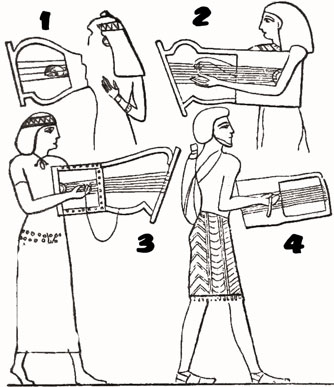
Fig. 259—Egyptian figures of lyres. 1, 2, played without, and 3, 4, with the plectrum; 4 is the supposed Hebrew lyre
1. At the head of the Stringed Instruments we must place the kinnor, which is rendered ’harp’ in the Authorized Version. The invention and first use of this instrument are ascribed to Jubal (Gen 4:21); and Laban names it among the instruments which should have celebrated the departure of his son-in-law (Gen 31:27). In the first ages the kinnor was consecrated to joy and exultation; hence the frequency of its use by David and others in praise of the Divine Majesty. It is thought probable that the instrument received some improvements from David (comp. Amo 6:5). In bringing back the Ark of the Covenant (1Ch 16:5), as well as afterwards, at the consecration of the temple, the kinnor was assigned to players of known eminence, chiefly of the family of Jeduthun (1Ch 25:3). The sorrowing Jews of the captivity, far removed from their own land and the shadow of the sanctuary, hung their kinnors upon the willows by the waters of Babylon, and refused to sing the songs of Zion in a strange land (Psa 137:2). Many other passages of similar purport might be adduced in order to fix the uses of an instrument, the name of which occurs so often in the Hebrew Scriptures. They mostly indicate occasions of joy, such as jubilees and festivals. Of the instrument itself the Scripture affords us little further information than that it was composed of the sounding parts of good wood, and furnished with strings. David made it of the berosh wood; Solomon of the more costly algum (2Sa 6:5: 1Ki 10:12); and Josephus mentions some composed of the mixed metal called electrum. He also asserts that it was furnished with ten strings, and played with a plectrum (Antiq. vii. 12. 3); which however is not understood to imply that it never had any other number of strings, or was always played with the plectrum. David certainly played it with the hand (1Sa 16:23; 1Sa 18:10; 1Sa 19:9), and it was probably used in both ways, according to its size.
That this instrument was really a harp, is now very generally denied; some writers on the subject conclude that it was a kind of guitar, and there is little room to doubt that this instrument was known to the Hebrews, and probably in use among them. It has been suggested, however, by the editor of the Pictorial Bible (on Psa 43:4) that the lyre, in some of its various kinds, was denoted by the word kinnor; and subsequent inquiry has tended to establish this conclusion as firmly perhaps as the nature of the subject admits.
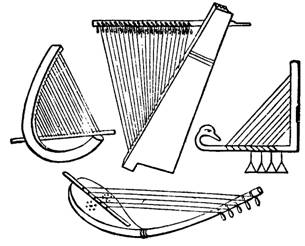
Fig. 260—Egyptian triangular instruments
2. The Nebel is the next instrument which requires attention. The word is rendered ’psaltery’ in the Authorized Version. As to when this instrument was invented, and when it came into use among the Hebrews, nothing can be determined with certainty. The first mention of it is in the reign of Saul (1Sa 10:5), and from that time forward we continue to meet with it in the Old Testament. The use of the instrument prevailed particularly in the public worship of God. It was played upon by several persons in the grand procession at the removal of the ark (1Ch 15:16; 1Ch 16:5); and in the final organization of the temple music it was entrusted to the families of Asaph, Heman, and Jeduthun (1Ch 25:1-7). Out of the worship of God, it was employed at festivals and for luxurious purposes (Amo 6:5). In the manufacture of this instrument a constant increase of splendor was exhibited. The first we meet with were made simply of the wood of the berosh(2Sa 6:5; 1Ch 13:8), others of the rarer algum tree (1Ki 10:12; 2Ch 9:11); and some perhaps of metal (Josephus, Antiq. i. 2. 2), unless the last is to be understood of particular parts of the instrument.
Conjectures respecting the probable form of this instrument have been exceedingly various. Passing by the eccentric notion that the nebel was a kind of bagpipe, we may assume from the evident tendency of the Scriptural intimations, and from the general bearing of other authorities, that it was composed of strings stretched over a wooden frame. This being assumed or granted, we must proceed to seek some hint concerning its shape; and we find nothing more tangible than the concurrent testimony of Jerome, Isidorus, and Cassiodorus, that it was like the Greek letter 
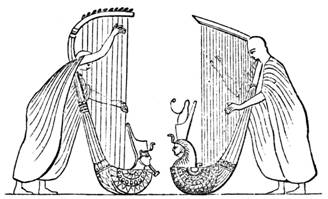
3. Asor occurs as an instrument in only a few-places, and never but in connection with the nebel This has given rise to the conjecture that the two instruments may have differed from each other only in the number of their strings, or the openings at the bottom. We see no reason to dissent from this conclusion.
4. Gittith is a word which occurs in the titles to Psalms 8, 81, 84, and is generally supposed to denote a musical instrument. From the name it has been supposed to be an instrument which David brought from Gath; and it has been inferred from Isa 16:10, that it was in particular use at the vintage season. If an instrument of music, it is remarkable that it does not occur in the list of the instruments assigned by David to the temple musicians; nor even in that list which appears in Psa 81:1-2, in the title of which it is found. The supposition of Gesenius, that it is a general name for a stringed instrument, obviates this difficulty.
5. The word Minnim, which occurs in Psa 45:8, and Psa 150:4, is supposed by some to denote a stringed instrument, but it seems merely a poetical allusion to the strings of any instrument.
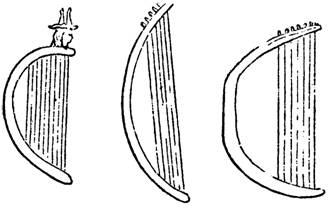
Fig. 262—Bow-shaped Egyptian Instruments
6. The Sabeca is the instrument rendered ’sackbut,’ in Dan 3:5; Dan 3:7; Dan 3:10; Dan 3:15. It seems to have been a species of harp or lyre, and, as some think, was only a species of the nebel, distinguished by the number of its strings.
7. The Pesanterin is the psaltery of the Greeks: it occurs only in Dan 3:7; Dan 3:10; Dan 3:15, where it is supposed to represent the Hebrew nebel.
8. The word Machalath, which occurs in the titles of Psalms 53, 88, is supposed by Gesenius and others to denote a kind of lute or guitar, which instrument others find in the minnim above noticed. There can be little doubt that the Hebrews were in possession of instruments of this kind, although we cannot say with certainty that these are the precise words by which they are denoted.
Wind Instruments
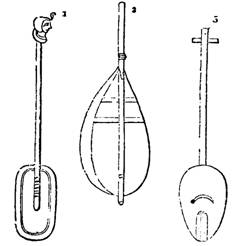
Fig. 263—Egyptian Instruments of the Lute kind
There is, happily, less difficulty with respect to instruments of this class than with respect to stringed instruments. The most ordinary division of these is into trumpets and pipes, of which the Hebrews had both, and of various kinds.
1. The word Keren, ’horn,’ sometimes, but not often, occurs as the name of a musical instrument (Jos 6:5; 1Ch 25:5; Dan 3:5; Dan 3:7; Dan 3:10; Dan 3:15). Of natural horns, and of instruments in the shape of horns, the antiquity and general use are evinced by every extensive collection of antiquities. It is admitted that natural horns were at first used, and that they at length came to be imitated in metal, but were still called horns. This use and application of the word are illustrated in our ’cornet.’ It is generally conceived that rams’ horns were the instruments used by the early Hebrews; and these are, indeed, expressly named in our own and many other versions, as the instruments used at the noted siege of Jericho (Jos 6:5); and the horns are those of the ram which Josephus assigns to the soldiers of Gideon (Antiq. v. 6. 5; comp. Jdg 7:16).
2. The name Shophar, which is a far more common word than keren, is rendered ’trumpet’ in the Authorized Version. This name seems, first, to denote horns of the straighter kind, including, probably, those of neat cattle, and all the instruments which were eventually made in imitation of and in improvement upon such horns. It is, however, difficult to draw a distinction between it and the keren, seeing that the words are sometimes used synonymously. Upon the whole, we may take the shophar, however distinguished from the keren, to have been that kind of horn or horn-shaped trumpet which was best known to the Hebrews. The name shophar means bright or clear, and the instrument may be conceived to have been so called from its clear and shrill sound, just as we call an instrument a ’clarion’ and speak of a musical tone as ’brilliant’ or ’clear.’ In the service of God this shophar or trumpet was only employed in making announce merits, and for calling the people together in the time of the holy solemnities, of war, of rebellion, or of any other great occasion (Exo 19:13; Num 10:10; Jdg 3:27; 1Sa 13:3; 2Sa 15:10; 2Ch 15:14; Isa 18:3).
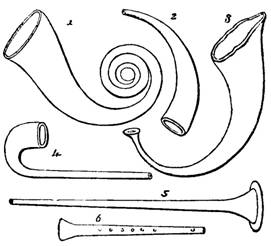
Fig. 264—1, 2, 3, 4, Ancient horns and curved trumpets; 5, straight trumpet; 6, pipe
3. The Chatzozerah was the straight trumpet, different from the shophar, which was more or less bent like a horn. There has been various speculation on the name; but we are disposed to assent to the conclusion of Gesenius, that it is an onomatopoetic word, imitating the broken pulse-like sound of the trumpet, like the Latin taratantara. Among the Israelites these trumpets were a divine regulation, Moses having been expressly directed how to make then (Num 10:2). They were of pure beaten silver, but the particular form does not appear in Scripture. They are figured, however, on the arch of Titus, among the other spoils of the Jewish Temple (fig. 264, No. 5), and they correspond with the description which Josephus, who, as a priest, could not in this matter be mistaken, has given: ’Moses,’ he says, ’invented a kind of trumpet of silver; in length it was little less than a cubit, and it was somewhat thicker than a pipe; its opening was oblong, so as to permit blowing on it with the mouth; at the lower end it had the form of a bell, like the horn.’ The tone of this trumpet, or rather the noise made by blowing on it, was very variable, and is distinguished by different terms in Scripture.
4. Jobel. There has been much speculation concerning the term, and it seems now to be agreed that the word does not denote a separate instrument, but is an epithet applied to the trumpets with which the jubilees were proclaimed, i.e. the ’jubilee-trumpet;’ and as the same trumpets were used for signals and alarms, ’the alarm-trumpet, the alarm-horn.’ This name for the sound of music is supposed to be derived from Jubal, the inventor of instruments of music.
Wind instruments of softer sound next require attention. The first and principal of these is the

Fig. 265—Egyptian Reed Pipes
5. Chalil; the meaning of which is bored through, denotes a pipe, perforated and furnished with holes. There are but five places where it occurs in the Old Testament (1Sa 10:5; 1Ki 1:40; Isa 5:12; Isa 30:29; Jer 48:36); but would seem to have come rather late into use among the Hebrews, and probably had a foreign origin. The passages to which we have referred will indicate the use of this instrument or class of instruments; but of the form we can only guess by reference to those of the ancient Egyptians, which are very similar to those still in use in Western Asia. The pipe is, however, rarely introduced in the Egyptian sculptures, and does not seem to have been held in much estimation. The principal are the single and double pipes. The single pipe of the Greeks is allowed to have been introduced from Egypt, from which the Jews probably had theirs. It was a straight tube, without any increase at the mouth, and when played was held with both hands. It was usually of moderate length, about eighteen inches, but occasionally less, and sometimes so exceedingly long, and the holes so low that the player was obliged to extend his arms to the utmost. Some had three holes, others four, and actual specimens made of common reed have been found.
The double pipe was formed with two of such tubes, of equal or unequal lengths, having a common mouth-piece, and each played with the corresponding hand. They were distinguished as the right and left pipes, and, the latter, having but few holes and emitting a deep sound, served as a base; the other had more holes and gave a sharp sound: this pipe is still used in Palestine.
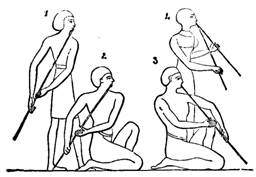
Fig. 266—1, 2, 3, Single pipes; 4, double pipe
From the references which have been given it will be seen that the pipe was, among the Jews, chiefly consecrated to joy and pleasure. So much was this the case that in the time of Judas Maccabeus the Jews complained ’that joy was taken from Jacob, and the pipe with the harp ceased’ (1Ma 3:45). It was particularly used to enliven the periodical journeys to Jerusalem to attend the great festivals (Isa 30:29); and this custom of enlivening with music the tedium of traveling is common in the East at this day. Athenæus tells us of a plaintive pipe which was in use among the Phoenicians. This serves to illustrate Mat 9:23, where our Savior, finding the flute-players with the dead daughter of the ruler, orders them away, because the damsel was not dead; and in this we also recognize the regulation of the Jews, that everyone, however poor he might be, should have at least two pipes at the death of his wife.
6. The word Mishrokitha occurs four times in Daniel (Dan 3:5; Dan 3:7; Dan 3:10; Dan 3:15), but nowhere else, and appears to be the Chaldean name for the flute with two reeds, of which we have already spoken.
7. Ugab is the word rendered ’organ’ in our version. This and the kinnor are the instruments whose invention is ascribed to Jubal (Gen 4:21), and higher antiquity cannot therefore be claimed for any instrument. There are only three other places in which it is mentioned in the Old Testament; two in the book of Job (Job 21:12; Job 30:31), and one in the Psalms (Psa 150:4). The name is taken from the term organon, employed by the Septuagint, which simply denotes a double or manifold pipe; and hence in particular the Pandean or shepherd’s pipe, which is at this day called a ’mouth organ’ among ourselves. Formerly it was called simply ’organ,’ and ’mouth’ has been added to distinguish it from the comparatively modern instrument which has usurped the more simple designation of ’organ.’ The Pandean pipe is an instrument of such antiquity that the profane writers do not know to whom to ascribe it. This antiquity corresponds with the Scriptural intimation concerning the ugab, and justifies us in seeking for the syrinx among the more ancient instruments of the Orientals, especially as it is still common in Western Asia. Niebuhr saw it in the hands of a peasant at Cairo; and Russell says that ’the syrinx or Pan’s pipe is still a festival instrument in Syria; it is known also in the city, but very few performers can sound it tolerably well. The higher notes are clear and pleasing, but the longer reeds are apt, like the dervise flute, to make a hissing sound, though blown by a good player. The number of reeds of which the syrinx is composed varies in different instruments from five to twenty-three.’ The classical syrinx is usually said to have had seven reeds, but we find some in the monuments with a greater number, and the shepherd of Theocritus had one of nine reeds.
III. Instruments of Percussion—or such as give forth their sounds on being struck or shaken.
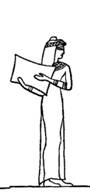
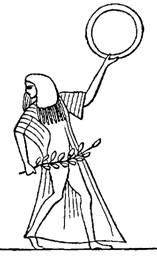
Fig. 267—Angular and Circular Tambourines
1. The word Toph seems to have denoted primarily the tambourine, and generally all instruments of the drum kind which were in use among the Israelites. There is not the slightest doubt about this instrument. All the translations and lexicons agree in this one point; and we have, besides, the actual evidence of existing instruments of this kind among the Arabians, bearing the same name in the forms of doff and adufe. The tophwas known to the Jews before they departed from Syria (Gen 31:27); it is also mentioned by Job (Job 21:12), and it is the first instrument named after the exode, being that with which Miriam led the dances with which the daughters of Israel celebrated the overthrow of Pharaoh (Exo 15:20). It was employed by David in all the festivities of religion (2Sa 6:5). Isaiah adduces it as the instrument of voluptuaries, but left in silence amid wars and desolations (Isa 24:8). The occasions on which it was used were mostly joyful, and those who played upon it were generally females (Psa 68:25), as was the case among most ancient nations, and is so at the present day in the East. It is nowhere mentioned in connection with battles or warlike transactions.
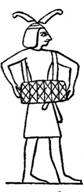
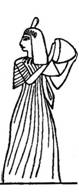
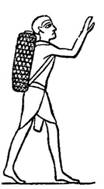
Fig. 268—Ancient Egyptian drums
Whether the Israelites had drums or not does not clearly appear, and in the absence of evidence pro or con it is useless to speculate on the subject. If they had, they must be included under the general name of toph. The ancient Egyptians had a long drum, very similar to the tom-toms of India (fig. 268, persons 1 and 3). It was about two feet or two feet and a half in length, and was beaten with the hand. The case was of wood or copper, covered at both ends with parchment or leather, and braced with cords extended diagonally over the exterior of the cylinder. It was used chiefly in war. There was another larger drum, less unlike our own; it was about two feet and a half long by about two feet broad, and was shaped much like a sugar-cask (fig. 269). It was formed of copper, and covered at the ends with red leather, braced by catgut springs passing through small holes in its broad margin. This kind of drum was beaten with sticks. It does not appear on the monuments, but an actual specimen was found in the excavations made by D’Atbanasi, in 1823, and is now in the museum at Paris.
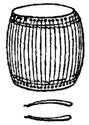
Fig. 269—Large Egyptian drum and sticks
Another species of drum is represented in the Egyptian paintings, and is of the same kind which is still in use in Egypt and Arabia, under the name of the darabooka drum. It is made of parchment stretched over the top of a funnel-shaped case of metal, wood, or pottery (fig. 270). It is beaten with the hand, and when relaxed, the parchment is braced by exposing it for a few moments to the sun, or the warmth of a fire. This kind of drum claims particular attention from its being supposed to be represented on one of the coins ascribed to Simon Maccabeus.
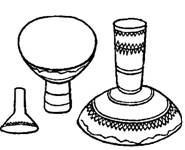
Fig. 270—Modern Oriental drums
2. The word Phaamon denotes the small golden appendages to the robe of the high-priest (Exo 28:33; Exo 39:25), which all versions agree in rendering ’bells,’ or ’little bells.’
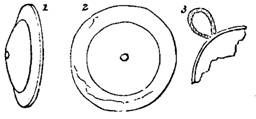
Fig. 271—Cymbals-Egyptian
3. The words Tzeltzelimm, Metzilloth, and Metzilthaim, are translated cymbals in most versions, except in Zec 14:20, where they are rendered ’bells’—the ’bells of the horses.’ If the words, however, denote cymbals in other places, they cannot well denote a different thing there. There is an important passage (Psa 150:5), ’Praise him with the clear cymbal, praise him with the resounding cymbal,’ which clearly points to two instruments under the same name, and leaves us to conclude that the Hebrews had both hand-cymbals and finger-cymbals (or castanets), although it may not in all cases be easy to say which of the two is intended in particular texts. Cymbals figure in the grand procession at the removal of the ark (1Ch 13:8): other instances occur of their being used in the worship of God (Neh 12:27; Psa 150:5; 1Ch 15:16); and the illustrious Asaph was himself a player on the cymbal (1Ch 16:5). The sound of these instruments is very sharp and piercing, but it does not belong to fine, speaking, expressive music.
4. The name Shalishim occurs but once, viz. in 1Sa 18:6, and is there uncertainly rendered, in the Authorized Version, ’instruments of music,’ and in the margin ’three-stringed instruments.’ The word is plural, and means ’threes.’ Most writers, proceeding upon this interpretation, identify it with the triangle, which Athenæus (iv. 23) alleges to have been a Syrian invention.
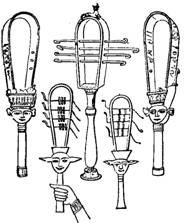
Fig. 272—Sistra—various Egyptian specimens
5. Menaaneim is another word which occurs but once in Scripture (2Sa 6:5), where our version translates it by ’cymbals,’ although it has appropriated another word to that instrument. It is now more generally thought to denote the sistrum. The sistrum was generally from eight to sixteen or eighteen inches in length, and entirely of bronze or brass. It was sometimes inlaid with silver, gilt, or otherwise ornamented, and being held upright was shaken, the rings moving to and fro upon the bars. The last were frequently made to imitate snakes, or simply bent at each end to secure them from slipping through the holes. Several actual specimens of these instruments have been found, and are deposited in the British, Berlin, and other museums. They are mostly furnished with sacred symbols, and were chiefly used by the priests and priestesses in the ceremonies of religion, particularly in those connected with the worship of Isis.
The ancient Hebrews had a great taste for music, which they used in their religious services, in their public and private rejoicing, at their weddings and feasts, and even in their mourning. We have in Scripture canticles of joy, of thanksgiving, of praise, of mourning; also mournful elegies or songs, as those of David on the death of Saul and Abner, and the Lamentations of Jeremiah on the destruction of Jerusalem; so, too, songs of victory, triumph, and gratulation, as that which Moses sung after passing the Red Sea, that of Deborah and Barak, and others. The people of God went up to Jerusalem thrice a year, cheered on their way with songs of joy, Psa 84:12 Isa 30:29 . The book of Psalms comprises a wonderful variety of inspired pieces for music, and is an inexhaustible treasure for the devout in all ages.\par Music is perhaps the most ancient of the fine arts. Jubal, who lived before the deluge, was the "father" of those who played on the harp and the organ, Gen 4:21 31:26-27. Laban complains that his sonin-law Jacob had left him, without giving him an opportunity of sending his family away "with mirth and with songs, with tabret and with harp." Moses, having passed through the Red Sea, composed a song, and sung it with the Israelitish men, while Miriam, his sister, sung it with dancing, and playing on instruments, at the head of the women, Exo 15:20-21 . He caused silver trumpets to be made to be sounded at solemn sacrifices, and on religious festivals. David, who had great skill in music, soothed the perturbed spirit of Saul by playing on the harp, 1Sa 16:16,23 ; and when he was himself established on the throne—seeing that the Levites were not employed, as formerly, in carrying the boards, veils, and vessels of the tabernacle, its abode being fixed at Jerusalem-appointed a great part of them to sing and to play on instruments in the temple, 1Ch 25:1-31 . David brought the ark to Jerusalem with triumphant and joyful music, 1Ch 13:8 15:16-28; and in the same manner Solomon was proclaimed king, 1Ki 1:39-40 . The Old Testament prophets also sought the aid of music in their services, 1Sa 10:5 2Ki 3:15 .\par Asaph, Heman, and Jeduthun were chiefs of the music of the tabernacle under David, and of the temple under Solomon. Asaph had four sons, Jeduthun six, and Heman fourteen. These twenty-four Levites, sons of the three great masters of the temple-music, were at the head of twenty-four bands of musicians, which served in the temple by turns. Their number there was always great, but especially at the chief solemnities. They were ranged in order about the altar of burnt-sacrifices. As the whole business of their lives was to learn and to practice music, it must be supposed that they understood it well, whether it were vocal or instrumental, 2Ch 29:25 .\par The kings also had their music. Asaph was chief master of music to David. In the temple, and in the ceremonies of religion, female musicians were admitted as well as male; they generally were daughters of the Levites. Ezra, in his enumeration of those whom he brought back with him from the captivity, reckons two hundred singing men and singing women, 2Sa 19:35 Ezr 2:65 Neh 7:67 .\par As to the nature of their music, we can judge of it only by conjecture, because it has been long lost. Probably it was a unison of several voices, of which all sung together the same melody, each according to his strength and skill; without musical counterpoint, or those different parts and combinations which constitute harmony in our music. Probably, also, the voices were generally accompanied by instrumental music. If we may draw any conclusions in favor of their music from its effects, its magnificence, its majesty, and the lofty sentiments contained in their songs, we must allow it great excellence. It is supposed that the temple musicians were sometimes divided into two or more separate choirs, which, with a general chorus, sung in turn responsive to each other, each a small portion of the Psalm. The structure of the Hebrew Psalms is eminently adapted to this mode of singing, and very delightful and solemn effects might thus be produced. Compare Psa 24:10,10,10 .\par Numerous musical instruments are mentioned in Scripture, but it has been found impossible to affix heir names with certainty to specific instruments now in use. By a comparison, however, of the instruments probably held in common by the Jews with the Greeks, Romans, and Egyptians, a degree of probability as to most of them has been secured. They were of three kinds:\par A. Stringed instruments:\par 1. KINNOR, "the harp," Gen 4:21 . Frequently mentioned in Scripture, and probably a kind of lyre.\par 2. NEBEL, "the psaltery," 1Sa 10:5 . It appears to have been the name of various large instruments of the harp kind.\par 3. ASOR, signifying ten-stringed. In Psa 92:4, it apparently denotes an instrument distinct from the NEBEL; but elsewhere it seems to be simply a description of the NEBEL as ten-stringed. See Psa 33:2 144:9.\par 4. GITTITH. It occurs in the titles of Psa 8:1 81:1 84:1. From the name, it is supposed that David brought it from Gath. Others conclude that it is a general name for a string instrument.\par 5. MINNIM, strings, Psa 150:4 . Probably another kind of stringed instrument.\par 6. SABECA, "sackbut," Dan 3:5,7,10,15 . A kind of lyre.\par 7. PESANTERIN, "psaltery," occurs Dan 3:7, and is supposed to represent the NEBEL.\par 8. MACHALATH. Found in the titles of Psa 53:1 88:1; supposed to be a lute or guitar.\par B. Wind instruments:\par 9. KEREN, "horn," Jos 6:5 . Cornet.\par 10. SHOPHAR, "trumpet," Num 10:10 . Used synonymously with KEREN.\par 11. CHATZOZERAH, the straight trumpet, Psa 98:6 .\par 12. JOBEL, or KEREN JOBEL, horn of jubilee, or signal trumpet, Jos 6:4 . Probably the same with 9 and 10.\par 13. CHAIL, "pipe" or "flute." The word means bored through, 1Sa 10:5 .\par 14. MISHROKITHA, Dan 3:5, etc. Probably the Chaldean name for the flute with two reeds.\par 15. UGAB, "organ" in our version Gen 4:21 . It means a double or manifold pipe, and hence the shepherd’s pipe; probably the same as the syrinx or Pan’s pipe; or perhaps resembling the bagpipe.\par C. Instruments which gave out sound on being struck:\par 17. TOPH, Gen 31:27, the tambourine and all instruments of the drum kind.\par 18. PHAAMON, "bells," Exo 28:33 . Attached to the hem of the high priest’s garment.\par 19. TZELITZELIM, "cymbals," Psa 150:5 . A word frequently occurring. There were probably two kinds, hand-cymbals.\par 20. SHALISHIM, 1Sa 18:6 . In our version, "instruments of music." "Three-stringed instruments." Most writers identify it with the triangle.\par 21. MENAANEIM, "cymbals," 2Sa 6:5 . Probably the sistrum. The Hebrew word means to shake. The sistrum was generally about sixteen or eighteen inches long, occasionally inlaid with silver, and being held upright, was shaken, the rings moving to and fro on the bars.\par Further particulars concerning some of these may be found under the names they severally bear in our English Bible.\par
Music.
1. The most ancient music. -- The inventor of musical instruments, like the first poet and the first forger of metals, was a Cainite. We learn from Gen 4:21, that Jubal, the son of Lamech, was "the father of all such as handle the harp and organ," that is, of all players upon stringed and wind instruments.
The first mentioned of music, in the times after the deluge, is in the narrative of Laban’s interview with Jacob, Gen 32:27, so that, whatever way it was preserved, the practice of music existed in the upland country of Syria, and of the three possible kinds of musical instruments, two were known and employed to accompany the song.
The three kinds are alluded to in Job 21:12. On the banks of the Red Sea, Moses and the children of Israel sang their triumphal song of deliverance from the hosts of Egypt; and Miriam, in celebration of the same event, exercised one of her functions, as a prophetess, by leading a procession of the women of the camp, chanting in chorus, the burden of the song of Moses.
The song of Deborah and Barak is cast in a distinctly metrical form, and was probably intended to be sung, with a musical accompaniment as one of the people’s songs. The simpler impromptu with which the women from the cities of Israel greeted David, after the slaughter of the Philistines was apparently struck off on the spur of the moment, under the influence of the wild joy with which they welcomed their national champion, "the darling of the sons of Israel." 1Sa 18:6-7.
Up to this time, we meet with nothing like a systematic cultivation of music, among the Hebrews, but the establishment of the schools of the prophets appears to have supplied this want. Whatever the students of these schools may have been taught, music was an essential part of their practice. Professional musicians soon became attached to the court.
2. The golden age of Hebrew music. David seems to have gathered round him, "singing men and singing women." 2Sa 19:35. Solomon did the same, Ecc 2:8, adding to the luxury of his court by his patronage of art, and obtaining a reputation himself as no mean composer. 1Ki 4:32. But the Temple was the great school of music, and it was consecrated to its highest service in the worship of Jehovah.
Before, however, the elaborate arrangements had been made by David for the Temple choir, there must have been a considerable body of musicians, throughout the country. 2Sa 6:5. (David chose 4000 musicians from the 38,000 Levies in his reign, or one in ten of the whole tribe. Of these musicians, 288 were specially trained and skillful. 1Ch 26:6-7. The whole number was divided into 24 courses, each of which would, thus, consist of a full band of 154 musicians, presided over by a body of 12 specially-trained leaders, under one of the twenty-four sons of Asaph, Heman or Jeduthun as conductor.
The leaders appear to have played on the cymbals, perhaps to make the time. 1Ch 15:19; 1Ch 16:5. All these joined in a special chant which David taught them, and which went by his name. 1Ch 23:5 Women also took part in the Temple choir. 1Ch 13:8; 1Ch 25:5-6 These great choirs answered one to another in responsive singing; thus the Temple music most have been grand and inspiring beyond anything known before that time.
3. Character of Hebrew music. -- As in all Oriental nations, the music of the Hebrews was melody, rather than harmony, which latter was then unknown. All old and young, men and maidens, singers and instruments, appear to have sung one part only in or in octaves. "The beauty of the music consisted altogether in the melody;" but this, with so many instruments and voices, was so charming that "the whole of antiquity is full of the praises of this music. By its means, battles were won, cities conquered, mutinies quelled, diseases cured." -- Editor).
4. Uses of music. -- In the private, as well as in the religious, life of the Hebrews, music held a prominent place. The kings had their court musicians, 2Ch 35:25; Ecc 2:8, and in the luxurious times of the later monarchy, the effeminate gallants of Israel amused themselves, with devising musical instruments, while their nation was perishing, ("as Nero fiddled while Rome was burning").
But music was also the legitimate expression of mirth and gladness. The bridal processions, as they passed through the streets, were accompanied with music and song. Jer 7:34. The music of the banquets was accompanied with song and dancing. Luk 15:26. The triumphal processions which celebrated victory were enlivened by minstrels and singers. Exo 15:1; Exo 15:20; Jdg 5:1; Jdg 11:34.
There were also religious songs. Isa 30:29; Jas 5:13. Love songs are alluded to; in Psa 45:1, title, and in Isa 5:1. There were also, the doleful songs of the funeral procession, and the wailing chant of the mourners. The grape-gatherers sang at their work, and the women sang as they toiled at the mill, and on every occasion, the land of the Hebrews, during their national prosperity, was a land of music and melody.
(For illustrations, see DANCE; DAVID; FLUTE; HARP; JEDUTHUN.) Its invention is due to a Cainite, Jubal son of Lamech, "father (first teacher) of all such as handle the harp (lyre) and organ" (pipe). "The lyre and flute were introduced by the brother of a nomadic herdsman (Jabal); it is in the leisure of this occupation that music is generally first exercised and appreciated" (Kalisch: Gen 4:21). "Mahalaleel," third from Seth, means "giving praise to God," therefore vocal music in religious services was probably earlier than instrumental music among the Cainites (Gen 5:12). Laban the Syrian mentions "songs, tabret (tambourine), and harp" (Gen 31:27); Job (Job 21:12) "the timbrel (tambourine), harp, and organ (pipe)". Instead of "they take," translated "they lift up (the voice)," as in Isa 42:11, to accompany "the tambourine," etc. (Umbrett.) Thus the "voice," stringed and wind instruments, include all kinds of music. The Israelite men led by Moses sang in chorus, and Miriam led the women in singing the refrain at each interval, accompanied by tambourine and dances (Exo 15:21).
Music rude and boisterous accompanied the dances in honor of the golden calf, so that Joshua mistook it for "the noise of war," "the voice of them that shout for the mastery and that cry for being overcome" (Exo 32:17-18). The triumphant shout of the foe in the temple is similarly compared to the joyous thanksgivings formerly offered there at solemn feasts, but how sad the contrast as to the occasion (Lam 2:7). The two silver trumpets were used by the priests to call an assembly, and for the journeying of the camps, and on jubilant occasion (Num 10:1-10; 2Ch 13:12). (On the rams’ (rather Jubilee) horns of Joshua 6, see HORNS.) The instruments at Nebuchadnezzar’s dedication of his golden image were the "cornet," like the French horn; "flute" or pipe blown at the end by a mouthpiece; "sackbut," a triangular stringed instrument with short strings, in a high sharp key; "psaltery," a kind of harp; "dulcimer," a bagpipe, emitting a plaintive sound, a Hebraized Greek word,
The schools of the prophets cultivated music as a study preparing the mind for receiving spiritual influences (1Sa 10:5; 1Sa 19:19-20): at Naioth; also at Jericho (2Ki 2:5; 2Ki 2:7), "when the minstrel among Jehoshaphat’s retinue played, the hand of Jehovah came upon Elisha" (2Ki 3:15); Gilgal (2Ki 4:38); Jerusalem (2Ki 22:14). "Singing men and women" were at David’s court (2Sa 19:35), also at Solomon’s (Ecc 2:8; Gesenius translated for "musical instruments and that of all sorts,"
Music was often introduced at banquets (Isa 5:12), "the harp and viol" (
As David elevated music to the praise of God, so the degenerate Israelites of Amos’ time degraded it to the service of their own sensuality (like Nero fiddling when Rome was in flames), yet they defended their luxurious passion for music by his example. Solomon’s songs were a thousand and five (1Ki 4:32). In the procession accompanying the ark to Zion, the Levites led by Chenaniah, "master of the song," played cornets, trumpets, cymbals, psalteries, and harps, accompanying David’s psalm composed for the occasion (1 Chronicles 15; 16; 2Sa 6:5). Of the 48,000 in the tribe 4,000 praised Jehovah on David’s instruments (1Ch 23:5-6). Heman led the Kohathites, Asaph the Gershonites, and Ethan or Jeduthun the Merarites (1Ch 15:17; 1Ch 25:1-8). The "cunning" or skilled musicians were 288: 24 courses, 12 in each, headed by the 24 sons of Heman, Asaph, and Jeduthun.
The rest of the 4,000 were "scholars." David’s chant (1Ch 16:34; 1Ch 16:41) was used for ages, and bore his name: at the consecration of Solomon’s temple (2Ch 7:6); before Jehoshaphat’s army when marching against the Ammonite invaders, to the thanksgiving is attributed God’s giving of the victory, "when they began to sing and to praise, Jehovah set ambushments against ... Ammon" (2Ch 20:21-22), compare in Abijah’s victory over Jeroboam the priests’ sounding of trumpets (2Ch 13:12-24); at the laying the second temple’s foundation (Ezr 3:10-11). Heman, Asaph, and Ethan played with cymbals of brass to mark the time the more clearly, while the rest played on psalteries and harps (1Ch 15:19; 1Ch 16:5).
The "singers" went first, "the damsels with timbrels" in the middle, "the players on (stringed) instruments followed after" (Psa 68:25). In intelligent worship the word has precedence of ornamental accompaniments (1Co 14:15); music must not drown but be subordinate to the words and sense. Amos (Amo 8:3) foretells the joyous "songs of the temple" should be changed into "howlings." In Psa 87:7 translated "the players on pipes" or "flutes" (Gesenius), but Hengstenberg, "dancers" (
As the temple, altar, and sacrifices were Jehovah’s palace, table, and feasts, so the sacred music answers to the melody usual at kings’ banquets. The absence of music such as accompanied bridal processions is made a feature of a curse being on the land (Isa 24:8-9; Jer 7:34; Eze 26:13). Judah’s captors in vain called on her singers to sing her national melodies, "songs of Zion," in Babylon. She hung her harp on the willows of that marshy city, and abjured "mirth in a strange land" (Psa 137:2-4). Away from Zion, God’s seat, they were away from joy. Love songs (Psalm 45 title) as well as professional mourners’ (Amo 5:16) dirges were composed. Harlots attracted men by songs to the guitar (Isa 23:15-16).
Music, instrumental and vocal, was all in unison, not harmony, which was unknown to the ancients; the songs were all melodies, choral and antiphonal, as Moses’ and Miriam’s song, and Nehemiah’s musicians in two responsive choirs at the dedication of the wall (Neh 12:40-42). For "instruments of music" (Dan 6:18) translated "concubines." Xenophon’s picture of Darius as addicted to wine and women, without self control, accords with Daniel’s mention of his abstinence as something extraordinary. In Psa 45:8 Gesenius translated for "whereby" (
Music. 1Sa 18:6; Isa 30:29. The practice of music was not restricted to any one class of persons. 1Ch 13:8; 1Ch 15:16. The sons of Asaph, Heman, and Jeduthun were set apart by David for the musical service. They were divided, like the priests, into 24 courses, which are enumerated. 1Ch 25:1-31. Of the 38,000 Levites, "four thousand praised the Lord with the instruments." 1Ch 23:5. Each of the courses or classes had 154 musicians and three leaders, and all were under the general direction of Asaph and his brethren. Each course served for a week, but upon the festivals all were required to be present, or four thousand musicians. Heman, with one of his leaders, directed the central choir, Asaph the right, and Jeduthun the left wing. These several choirs answered one another, as is generally supposed, in that kind of alternate singing which is called "antiphonal," or responsive. The priests, in the meantime, performed upon the silver trumpets. 2Ch 5:11-14; Num 10:2.
MUSIC.—The Jews cultivated music from the earliest times, perhaps the more because sculpture and painting were practically forbidden (Exo 20:4). It gave expression to all their emotions, and found a place in all the chief events of public and private life (cf. OT, passim).
1. References in the Gospels are few and indirect, (a) Song: Mat 26:30 ||, Luk 15:25 (?) seem to be the only instances. (b) Instruments: Mat 9:23; Mat 11:17 || pipe (wh. see) or flute (see Flute-players); Mat 24:31 trumpet (wh. see), probably the curved trumpet as in Exo 19:16. In Dan 3:5; Dan 3:15 (LXX Septuagint )
2. The general character of Jewish music in the time of Christ is wholly a matter of inference. There were no theoretical writers, as among the Greeks; of their instruments sculpture portrays the silver trumpet alone; and, notation not having been invented, specimens of their music contemporaneously committed to writing do not exist. Yet within definable limits inference amounts to certainty, (a) As to rhythmical structure, all ancient music was of the free form, in contrast to the measured form of modern music: ‘time,’ in our sense, was then unknown. (b) The variety and combination of instruments employed, together with the musical arrangements generally (e.g. 1Ch 15:16-22), imply at least some definite system whereby the intervals of melodic progression were regulated. The existence of scales or modes, of some sort, cannot therefore be questioned, (c) They seem to have been in accord with those in use at Babylon (Psa 137:1-3). Moreover, habitual contact with Greek influences in Alexandria and elsewhere probably produced (or at least goes to prove) an affinity with the Greek modes. (d) The ‘traditional melodies’ now used in Jewish synagogues are, in some cases, similar in kind to the music that we may infer to have existed in the time of Christ. Tradition might preserve melodies down to the invention of notation, much as it preserved the vowel-system down to the invention of ‘points.’ But the Jews themselves seem to have discontinued the Temple melodies after its destruction; so that the synagogue melodies, whatever their origin, would not be those of the Temple. It may be supposed that Jewish Christians imported some of their Temple melodies into the Christian Church. Perhaps it was they who introduced antiphonal singing: and even Greek liturgies are held to have been largely ‘affected by Mosaic rites’ (Swainson, Gr. Liturgies). It is therefore not impossible that a Jewish element still survives in some of the ancient ecclesiastical plainsong. But no one can say for certain that this is so, or identify any particular instance.
Literature.—Chappell, History of Music; Stainer, The Music of the Bible; Edersheim, The Temple, etc.; art. ‘Music’ in Hasting’s Dictionary of the Bible ; Helmore, Plainsong, etc. The traditional Jewish melodies can be seen in E.
F. S. Ranken.
I. IMPORTANCE
1. The Sole Art Cultivated
2. A Wide Vocabulary of Musical Terms
3. Place in Social and Personal Life
4. Universal Language of Emotions
5. Use in Divine Service
6. Part at Religious Reformations
II. THEORY OF MUSIC
1. Technical Terms, ’alamoth, sheminith, selah
2. Not Necessarily Unimpressive
III. MUSICAL INSTRUMENTS
1. Strings: kinnor, nebhel, ’asor, gittith, shalishim, sabbekha’
2. Winds: ’ughabh, halil, nehiloth, mashrokitha’, sumponyah, shophar, keren, hacocerah
3. Percussion: toph, meciltayim, celcelim, mena’an’im
LITERATURE
I. Its Importance
That the Hebrews were in ancient times, as they are at the present day, devoted to the study and practice of music is obvious to every reader of the Old Testament. The references to it are numerous, and are frequently of such a nature as to emphasize its importance. They occur not only in the Psalter, where we might expect them, but in the Historical Books and the Prophets, in narratives and in declamations of the loftiest meaning and most intense seriousness. And the conclusion drawn from a cursory glance is confirmed by a closer study.
1. The Sole Art Cultivated
The place held by music in the Old Testament is unique. Besides poetry, it is the only art that Art seems to have been cultivated to any extent in ancient Israel. Painting is entirely, sculpture almost entirely, ignored. This may have been due to the prohibition contained in the Second Commandment, but the fidelity with which that was obeyed is remarkable.
2. Vocabulary
From the traces of it extant in the Old Testament, we can infer that the vocabulary of musical terms was far from scanty. This is all the more significant when we consider the condensed and pregnant nature of Hebrew. “Song” in our English Versions of the Bible represents at least half a dozen words in the original.
3. Place in Social Life
The events, occasions, and occupations with which music was associated were extremely varied. It accompanied leave-taking with honored guests Gen 31:27; celebrated a signal triumph over the nation’s enemies Exo 15:20; and welcomed conquerors returning from victory Jdg 11:34; 1Sa 18:6. It was employed to exorcise an evil spirit 1Sa 18:10, and to soothe the temper, or excite the inspiration, of a prophet 2Ki 3:15. The words “Destroy not” in the titles of four of the Psalms (compare Isa 65:8) most probably are the beginning of a vintage-song, and the markedly rhythmical character of Hebrew music would indicate that it accompanied and lightened many kinds of work requiring combined and uniform exertion. Processions, as e.g. marriages (1 Macc 9:39) and funerals 2Ch 35:25, were regulated in a similar way. The Psalms headed “Songs of Degrees” were probably the sacred marches sung by the pious as they journeyed to and from the holy festivals at Jerusalem.
4. Emotional Range
It follows from this that the range of emotion expressed by Hebrew music was anything but limited. In addition to the passages just quoted, we may mention the jeering songs leveled at Job Job 30:9. But the music that could be used to interpret or accompany the Psalms with any degree of fitness must have been capable of expressing a great variety of moods and feelings. Not only the broadly marked antitheses of joy and sorrow, hope and fear, faith and doubt, but every shade and quality of sentiment are found there. It is hardly possible to suppose that the people who originated all that wealth of emotional utterance should have been without a corresponding ability to invent diversified melodies, or should have been content with the bald and colorless recitative usually attributed to them.
This internal evidence is confirmed by other testimony. The Babylonian tyrants demanded one of the famous songs of Zion from thor Jewish captives Psa 137:3, and among the presents sent by Hezekiah to Sennacherib there were included male and female musicians. In later times Latin writers attest the influence of the East in matters musical. We need only refer to Juvenal iii. 62 ff.
5. Place in Divine Service
By far the most important evidence of the value attached to music by the Hebrews is afforded by the place given to it in Divine service. It is true that nothing is said of it in the Pentateuch in connection with the consecration of the tabernacle, or the institution of the various sacrifices or festivals. But this omission proves nothing. It is not perhaps atoned for by the tradition (Wisd 18:9) that at the first paschal celebration “the fathers already led the sacred songs of praise,” but the rest of the history makes ample amends. In later days, at all events, music formed an essential part of the national worship of Yahweh, and elaborate arrangements were made for its correct and impressive performance. These are detailed in 1 Chronicles. There we are told that the whole body of the temple chorus and orchestra numbered 4,000; that they were trained and conducted, in 24 divisions, by the sons of Asaph, Heman and Jeduthun; and that in each group experts and novices were combined, so that the former preserved the correct tradition, and the latter were trained and fitted to take their place. This is, no doubt, a description of the arrangements that were carried out in the Second Temple, but it sheds a reflex, if somewhat uncertain, light on those adopted in the First.
6. In Religious Reformations
We are told by the same authority that every reformation of religion brought with it a reconstruction of the temple chorus and orchestra, and a resumption of their duties. Thus when Hezekiah purged the state and church of the heathenism patronized by Ahaz, “he set the Levites in the house of Yahweh with cymbals, with psalteries, and with harps” 2Ch 29:25. The same thing took place under Josiah 2 Chr 34. After the restoration - at the dedication of the Temple Ezr 3:10 and of the walls of Jerusalem Neh 12:17 - music played a great part. In Nehemiah’s time the descendants of the ancient choral guilds drew together, and their maintenance was secured to them out of the public funds in return for their services.
II. Musical Theory
1. Dearth of Technical Information
It is disappointing after all this to have to confess that of the nature of Hebrew music we have no real knowledge. If any system of notation ever existed, it has been entirely lost. Attempts have been made to derive one from the accents, and a German organist once wrote a book on the subject. One tune in our hymnals has been borrowed from that source, but it is an accident, if not worse, and the ingenuity of the German organist was quite misdirected. We know nothing of the scales, or tonal system of the Hebrew, of their intervals or of their method of tuning their instruments. Two terms are supposed by some to refer to pitch, namely, “upon,” or “set to
2. Not Necessarily Unimpressive
Our knowledge is, therefore, very meager and largely negative. We need not, however, suppose that Hebrew music was necessarily monotonous and unimpressive, or, to those who heard it, harsh and barbarous. Music, more than any other of the arts, is justified of her own children, and a generation that has slowly learned to enjoy Wagner and Strauss should not rashly condemn the music of the East. No doubt the strains that emanated from the orchestra and chorus of the temple stimulated the religious fervor, and satisfied the aesthetic principles of the Hebrews of old, precisely as the rendering of Bach and Handel excites and soothes the Christian of today.
III. Instruments
The musical instruments employed by the Hebrews included representatives of the three groups: string, wind, and percussion. The strings comprised the
1. Strings
(1) When Used
The chief of these instruments were the
(2) Materials
We have no exact information as to the materials of which these instruments were made. In 2Sa 6:5 the King James Version, mention is made of “instruments made of fir wood” (the English Revised Version “cypress”), but the text is probably corrupt, and the reading in 1Ch 13:8 is preferable. According to 1Ki 10:11, Hiram’s fleet brought from Ophir quantities of
We have no trace of metal strings being used by the ancients. The strings of the Hebrew (
(a) The Kinnor
The Old Testament gives us no clue to the form or nature of the
The most ancient copy of a
The evidence furnished by Jewish coins must not be overlooked. Those stamped with representations of lyre-shaped instruments have been assigned to 142-135 BC, or to 66-70 AD. On one side we have a
One objection raised by Wellhausen to the identification of the
Since the ancient VSS, then, render
(b) The Nebhel
The
The supposition that the
This is not conclusive. The word
Harps of various sizes are very numerous on the Egyptian monuments. There is the large and elaborate kind with a well-developed sound-box, that served also as a pediment, at its base. This could not be the
All the evidence points to the
(c) Nebhel ’Asor
In Psa 33:2; Psa 144:9, “the psaltery of ten strings” is given as the rendering of
(d) Gittith
The word
(e) The Shalishim
(f) The Sabbekha’
Among the instruments mentioned in Dan 3:5, Dan 3:7, Dan 3:10 occurs the
(g) Neghinoth
The word
2. Winds
(1) The ’Ughabh
The first mention of a wind instrument occurs in Gen 4:21, where we are told that Jubal was the “father of all such as handle the harp and pipe.” The Hebrew word here translated “pipe” is
(2) The Halil
The
As we should expect from the simplicity of its construction, and the commonness of its material, the flute or pipe was the most ancient and most widely popular of all musical instruments.
Reeds, cane, bone, afterward ivory, were the materials; it was the easiest thing in the world to drill out the center, to pierce a few holes in the rind or bark, and, for the mouthpiece, to compress the tube at one end. The simple rustic pattern was soon improved upon. Of course, nothing like the modern flute with its complicated mechanism was ever achieved, but, especially on the Egyptian monuments, a variety of patterns is found. There we see the obliquely held flute, evidently played, like the Arabic nay, by blowing through a very slight paring of the lips against the edge of the orifice of the tube. Besides this, there are double flutes, which, though apparently an advance on the single flute, are very ancient. These double flutes are either of equal or unequal length, and are connected near the mouth by a piece of leather, or enter the frame of the mouthpiece.
Though the flutes of the East and West resembled each other more closely than the strings, it is to the Assyrian monuments that we must turn for the prototypes of the
(3) Nehiloth
(4) Nekebh
In Eze 28:13 the King James Version, the Revised Version (British and American),
(5) The Mashrokitha’
(6) The Sumponyah
(7) The Shophar Keren
The
The
(8) The Hacoceroth
We are told (Num 10:2 ff) that Moses was commanded to make two silver trumpets which should serve to summon the people to the door of the tabernacle; give the signal for breaking up the camp; or call to arms. These instruments were the
3. Percussion Instruments
(1) The Toph
The principal percussion instrument, the
Other drums are shown on the Egyptian and Assyrian monuments. In the Kouyunjik bas-relief the second last performer beats with his hands a small, barrel-like drum fixed at his waist. In the Old Testament the drum is used on festive occasions; it is not mentioned in connection with Divine service. It was generally played by women, and marked the time at dances or processions Exo 15:20; Jdg 11:34; 1Sa 18:6; Jer 31:4; Psa 150:4. At banquets Isa 24:8; Isa 30:32; Job 21:12 and at marriages (1 Macc 9:39) it accompanied the
(2) Meciltayim, Celcelim
In 1Ch 15:19 we read that “Heman, Asaph, and Ethan, were appointed, with cymbals of brass to sound aloud.” These cymbals are the
Cylindrical staves slightly bent at one end were also used in Egyptian processions. Villoteau, quoted by J. Weiss, describes a bas-relief in which three musicians are seen, of whom one plays the harp, a second the double flute, while a third appears to be marking time by striking two short rods together; this was a method of conducting practiced regularly by other ancient nations.
(3) Mena’an’im
Lastly in 2Sa 6:5 we meet with a word that occurs nowhere else, and whose meaning is quite uncertain. the King James Version translates “cornets,” the Revised Version (British and American) “castanets,” and in the margin “sistra.” The
Literature
Pfeiffer, Uber die Musik der alten Hebraer; Saalschutz, Form der heb. Poesie, etc.; Leyrer in Realencyklopadie fur protestantische Theologie und Kirche; Riehm, Handwort. des bibl. Alterthums; Histories of Music by Fetis, Ambros, Rowbotham, Naumann, and Chappell; Wilkinson, Ancient Egypt; Wettstein in Del. Commentary on Isaiah; Lane, Modern Egyptians; Stainer, The Music of the Bible; Edersheim, The Temple, etc.; Wellhausen, “The Pss” in Polychrome Bible; Benzinger, Hebraische Archaologie (Benzinger; Nowack); Nowack, Hebraische Archaologie (Benzinger; Nowack); J. Weiss, Die mus. Instr. des Altes Testament; C. Engel, Music of the Most Ancient Nations; Vigoureux, Les instruments de musique de la Bible; Driver, Joel and Amos; Cornill, Music in the Old Testament; and the various Bible Dictionaries.
See Praise, and articles on various Musical Instruments.
See The Music of Pesach (Passover); Chanukkah Music; Yiddish Music.
In the early days of the human race, music was one of the first expressions of artistic and cultural development (Gen 4:21). It soon became widely used, along with singing and dancing, to celebrate special occasions, whether private or public, domestic or national, secular or sacred (Gen 31:27; Exo 15:20-21; 2Sa 6:14-15; 2Ch 20:28-29; Psa 92:1-3; Psa 144:9; Isa 5:12; Amo 6:5; Dan 3:4-5; see also DANCING; SINGING). At other times people played or listened to music purely for relaxation or enjoyment (1Sa 16:16-17; 1Sa 16:23; 1Sa 18:10; Job 21:11-12; Eze 26:13; Eze 33:31-32; Lam 5:14; Rev 18:22). Music also accompanied mourning and singing at funerals (Mat 9:23; Luk 7:32; see FUNERAL).
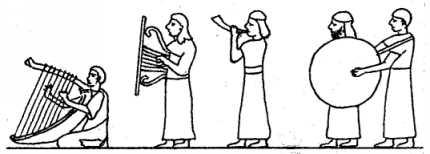
Hebrew musical instruments were of three kinds – stringed, wind and percussion. Chief among the stringed instruments were the harp (1Sa 10:5; 2Sa 6:5; 1Ki 10:12; Isa 5:12) and the lyre (Gen 4:21; Gen 31:27; 1Sa 10:5; 1Sa 16:23; 2Sa 6:5). The main wind instruments were the flute (Isa 5:12; Jer 48:36; Mat 9:23), the pipe (Gen 4:21; 1Ki 1:40; Job 21:12; Mat 11:17), the horn (2Sa 6:15) and the trumpet (Num 10:2; Num 31:6; Amo 3:6; Mat 24:31). Percussion instruments included cymbals (2Sa 6:5; Psa 150:4; 1Co 13:1), tambourines (Gen 31:27; 1Sa 10:5; 2Sa 6:5; Job 21:12) and timbrels (Exo 15:20; Jdg 11:34; Psa 150:4). In the music that David organized for Israel’s temple worship, the main instruments were harps, lyres and cymbals (1Ch 15:16; 1Ch 15:19-21; 1Ch 16:5).
Music is a natural human expression that probably began with speech-singing and developed into songs. Musical instruments as accompaniment followed. Music as we know it has become quite complex, a luxury and entertainment. Music in ancient times was more of a practical expression of daily life, work, and worship.
The phrase "sing to the LORD" is common to the Old Testament (Exodus 15:21; 1 Chronicles 16:9; Psalms 68:32; 96:1–2; Isaiah 42:10; Jeremiah 20:13). But this phrase was not unique to the Jewish nation. All religions draw on the natural human impulse to sing. The command to "sing to the LORD" was a signal for the people to express their praise in song.
The Bible is limited in its treatment of music in ancient Israel. There was no written musical notation. The primary historical record of music is a collection of texts, including the psalms, and a few musical instructions. The biblical writers were not writing a history of their culture, but of a relationship with God. The biblical documents cover a long span of history and are grouped by category rather than in chronological order. Their comments about music are not critical. This makes it difficult to order the development of musical style with precision. Finally, there is the problem of understanding the biblical descriptions of music and its performance. Only since the 20th century have scholars been able to interpret the information provided in the Bible in terms of Eastern music systems.
Music in the Old Testament
The first musician mentioned in the Bible is "Jubal; he was the father of all who play the harp and flute" (Genesis 4:21). It is important to note that Jubal's profession is equal in importance to those of his brothers Jabal, the herdsman, and Tubal-cain, the smith. Music making is among the earliest professions of nomadic peoples. The name Jubal is believed to be a derivative from the Hebrew word for "ram." The ram’s horn (shophar) was an early instrument of the Jewish people. The shophar was and is significant in signaling important events.
The music described in early biblical history was largely of a functional nature. Music gained special significance as it became an important part of temple worship. Many of the descriptions of music making in ancient Israel before David’s time are quite practical. There are accounts of music at times of:
farewell (Genesis 31:27),
rejoicing and feasting (Exodus 32:17–18; Isaiah 5:12; 24:8–9),
military victories (2 Chronicles 20:27–28), and
for work (Numbers 21:17, the song of the well diggers; Is 16:10; Jeremiah 48:33).
Most of this music was probably rather basic and simple in nature. The music associated with military advances, for example, was meant to terrify the enemy (Judges 7:17–20). The music and dancing that greeted Moses as he descended from the mountain was described as if it sounded like "war in the camp" (Exodus 32:17–18).
In the early history of the Jewish people, women played an important part in the performance of music. The image of women dancing and singing for joy accompanied by percussion instruments is repeated several times:
Miriam led the women in a hymn of thanksgiving after the deliverance from the Red Sea (Exodus 15).
Jephthah’s daughter welcomed her father in his victory (Judges 11:34).
Deborah joined with Barak in singing a song of victory (Judges 5).
Women hailed David after his defeat of the Philistines (1 Samuel 18:6–7).
There is little mention of women as musicians following the establishment of the temple in Jerusalem. There are a few allusions to female participation in singing and dancing. For example, male and female singers are mentioned when the Jews returned from exile in Babylon (Nehemiah 7:67). This confirms that women still took part in musical performance at times.
As Jerusalem became the religious center of the Hebrew people between 950 and 850 BC, the role of the professional musician became more important. The women’s songs became insignificant compared to the formal ceremonies associated with the temple and the royal court. Levitical singers (belonging to the priestly group called the Levites) took most of the musical responsibility at the temple. But the people to joined in on responses in the singing of psalms as antiphonal singing (back-and-forth singing between two groups) developed.
Musical Style and Use
The Jewish people seem to have been especially musical. Other ancient cultures were influential, but there is evidence that Jews were in demand as musicians by other peoples. An Assyrian document shows King Hezekiah giving many male and female Jewish musicians in tribute to King Sennacherib. The Babylonians demanded that the captive Jews sing and entertain them (compare Psalm 137:3).
The Old Testament’s purpose was to tell the story of the relationship between the Jewish nation and God. In this context, most music references deal with music's function in worship. Evidence shows that there was also a large body of non-religious musical literature. There may have been groups of poets and singers early in Jewish history.
The kinds of songs recorded in the early part of the Old Testament represent a folklike poetry. The song of thanksgiving to the Lord by Moses and the people of Israel after their escape at the Red Sea is a stirring national song. Many descriptions of the biblical writers reflect the spirit of storytelling through song. This would be logical, as these stories were meant to be passed on. Marching songs (2 Chronicles 20:27–28), and songs of triumph (Judges 5) also indicate a secular body of music.
Music in Worship
The singers and musicians for the temple worship were chosen from the tribe of Levi. King David assembled the Levites for a census, and out of the total of 38,000 men over the age of 30, 4,000 were chosen as musicians. These 4,000 were later given specific jobs. "David and the commanders of the army set apart some of the sons of Asaph, Heman, and Jeduthun to prophesy with the accompaniment of lyres, harps, and cymbals…Together with their relatives, who were all trained and skillful in the songs of the LORD, they numbered 288" (1 Chronicles 25:1, 7). The singers were further divided into 24 groups of 12 singers. These groups rotated in participating in the weekday, Sabbath, and high holy day services.
A later source shows there were minimum and maximum numbers of singers and instrumentalists required at each service. The minimum number of singers was twelve, the maximum was unlimited. At each service, these instruments had to be included:
at least two harps but no more than six
at least two flutes but no more than twelve
a minimum of two trumpets with no maximum
a minimum of nine lyres with no maximum
one player with a pair of cymbals
A singer was admitted to the Levitical choir at the age of thirty following a five-year apprenticeship (1 Chronicles 23:3). Five years is a relatively short time considering the amount of material these singers had to memorize (there was no written notation). They also had to memorize and master worship practice. Singers may have been in some level of training from childhood.
Levites lived in villages outside the city wall. They may have been actively involved in the musical education of their children (Nehemiah 12:29). The Levites performed other duties connected with the sacred service. Singers were excused from all other duties because they were on duty day and night (1 Chronicles 9:33). Their skills were an important part of the temple worship, so they were able to devote their entire life to developing their musical ability. A singer served in the choir for 20 years, from age 30 to 50. The music was of a high quality due to strict discipline and continuous practice and performance.
From the beginning of Jewish formal worship connected with the tabernacle, music and sound was important. The descriptions of Aaron's robe in Exodus 28:34–35 includes bells attached to the lower hem to sound as he entered the Holy Place.
The first music related to worship mentioned in the Old Testament is found in 2 Samuel 6 in the descriptions of the transfer of the ark of God. David and the Israelites sang, played instruments, and danced to the glory of the Lord. This music was very different from the formal ceremony described later in Solomon’s temple.
In 2 Chronicles 7:6, David is recognized for inventing the musical instruments used in the temple. Post-exile, Levitical singers are mentioned as the descendants of Asaph, the "singing master" appointed by David (Ezra 2:41; Nehemiah 7:44; 11:22–23). Passages like these indicate that worship music and organization came from David’s time.
The ceremonies in the Jewish temple were organized around the sacrifice. Singing formed an essential part of the sacrificial service and was necessary to make the sacrificial action official. There were special musical settings for each sacrifice. Daily burnt offerings, offerings for forgiveness of sin, praise offerings, and drink offerings each had individual ceremonies.
Particular psalms became associated with certain sacrifices as well as with certain days of the week. The psalm of the day was sung as the high priest started to pour out the drink offering. The psalm was divided into three sections, each signaled by the blowing of the trumpets. At the trumpet sound, the people would prostrate themselves. This is the only time the trumpets were used together with the other instruments in orchestral fashion on solemn occasions (2 Chronicles 5:12–13).
Music in the Psalms
Musical Psalm Titles
The collection of 150 lyric poems known as the book of Psalms contains the most information on music making in ancient Israel. The Psalter contains not only religious songs but also songs that have their roots in secular or popular songs. Work songs, love songs, and wedding songs may have influenced the Psalms. The majority are songs of praise, thanksgiving, prayer, and repentance. There are also historic odes (formal poems) that relate great national events. Psalm 30 is "a song for the dedication of the temple." Psalm 137 portrays the sufferings of the Jews in captivity.
The psalms were an important part of all the services of the temple. The Psalter became the hymnal used in Israelite worship practices. Worship included an appointed psalm for each day of the week:
On the first day of the week, the people sang Psalm 24 in remembrance of the first day of creation.
On the second day of the week, Psalm 48.
On the third day of the week, Psalm 82.
On the fourth day of the week, Psalm 94.
On the fifth day of the week, Psalm 81.
On the sixth day of the week, Psalm 93.
On the seventh day of the week, the Sabbath, they sang Psalm 92.
After the sacrificial offerings, Psalm 105:1–5 was sung at the morning service and Psalm 96 at the evening service. The Hallel psalms (Psalms 113–118, 120–136, 146–148) were sung during the offering of the paschal lamb at the Passover feast.
Most of the worship music was performed by Levites. But texts of the psalms suggest that there was also congregational participation. Both synagogue and church chant forms can be traced to the poetic text of the psalms.
There are several types of psalmody:
Plain psalmody is sung by one person (for example, Psalms 3–5, 46).
Responsorial psalmody means the soloist is answered by the choir (for example, Psalms 67:1–2; the soloist sang verse 1 and the choir answered with verse 2).
Antiphonal psalmody involves two groups singing alternately (for example, Psalms 103:20–22). The congregation would chant a refrain such as appears in Psalms 80: "Restore us, O God, and cause Your face to shine upon us, that we may be saved" appears often throughout the psalm.
Even though the synagogue had no altar for sacrifice, psalm singing retained an important place. When the Romans destroyed the temple, the worship heritage of the Jews was at risk of being lost. Translating customs of temple worship like music to synagogue worship kept the worship heritage intact.
The part of the psalms most difficult to understand are the headings that are not part of the poetic text. The first question is whether these should even be considered as superscripts. Greek, Latin, Hebrew, and other ancient languages were written so that text did not include chapter or paragraph breaks between. Verses and even the division of the psalms themselves were partially made by copyists, chiefly the Masoretes (ancient Jewish scholars who preserved the Hebrew text of the Old Testament).
There is some question about which psalms the texts that are not part of the poem belong with. They may be subscripts (notes at the beginning) instead of superscripts (notes at the end). Sumerian and Babylonian poetry listed information like the name of the author, the musical instrument used for accompaniment, the tune, the purpose, at the end of the poem. Hence, some of the headings may be endings.
The notes at the beginning of a psalm are grouped into three categories:
musical terms giving direction for the actual performance
musical cues designating the tune to which the psalm would be sung
comments indicating the function of the psalm.
These terms have been interpreted in various ways.
Originally, these headings may have been marginal notes for the choir leaders. Realizing that these terms were not related to the psalm text, early biblical scribes may not have been careful with their placement in the text. This may explain some of the discrepancies among the early manuscripts. Certain words are left out in some and some terms assigned to only a few psalms may originally have been indicated on more of them.
All but 50 of the psalms contain a proper name in the heading. These names possibly indicate the author. Other commentators interpret the preposition appearing before the names to mean "for." This would mean that the names represent dedication instead of authorship. Thus, the title would be "A Psalm for David," not "A Psalm of David."
This may be the case with the names of Asaph, Heman, Ethan, and especially the sons of Korah. It would make better sense for the psalm to be written for rather than by the family. Seventy-three psalms have David’s name in the heading, hence the common reference to the Psalter as the Psalms of David. Twelve include the name of Asaph, eleven include the children of Korah, two include Solomon, and one each contains Moses, Heman, and Ethan.
Musical Terms in the Psalm Titles
Many musical terms are included in the superscriptions. These cue the kind of instrumental accompaniment, mood, and style of performance for the psalm.
Alamoth is one of the most controversial terms found in the psalm headings. It appears at the beginning of Psalms 46 and also in 1 Chronicles 15:20. One meaning for the Hebrew word is "maiden." Some musicologists interpret this as an instruction that the psalm should be sung in the range of the female singing voice. The reference in Chronicles is to harps in the range of women’s voices. This interpretation does not seem to fit Psalms 46, but it becomes more logical if we look at the preceding psalm and read the term as a subscript. Psalm 45 is a song of love, actually a nuptial ode, so it would be natural for women to sing the second half (verses 10–17).
There is little mention of women singing in the temple, but young boys in training may have sung along with the Levitical singers. Also, this may be a case where the term appears only once in the modern text but may have been used more often in the original. Another possible meaning for alamoth is "flutes." This meaning would describe the kind of musical accompaniment for the performance of the psalm.
Gittith is a term found in the superscriptions of Psalms 8, 81, and 84. It may be a musical cue, indicating a mood for the performance of these psalms. But a more common explanation is that it is a collective term for the stringed instruments that would have accompanied them.
Mahalath has been left in its original Hebrew form by early translators and is found in the headings of Psalms 53 and 88. It may have roots in the Hebrew mahaleh "sickness" or mahot "dance," though neither of these words can be related to the psalm texts. Another explanation is a musical one. Mahalath may come from the word halal meaning "to pierce," implying that the psalm was to be accompanied with pipes.
Maskil (or "Maschil" in the King James Version) appears in the headings of 13 psalms (Psalms 32, 42, 44–45, 52–55, 74, 78, 88–89, 142). The term is probably derived from the verb sakal, "to have insight or comprehension," but there is no agreement among commentators. The instructive nature and the structure of stanzas and refrains in the psalms themselves leads musicologists to conclude the term represents a song of praise. It may have been sung by a soloist with participation by the choir.
Menazzeah appears in the heading of 55 psalms. It appears 52 times in the first three books of Psalms (Psalms 1–89), not at all in book four (Psalms 90–106), and 3 times in book five (Psalms 107–150).
The most common modern translations are:
"to the choirmaster" (Berean Standard Bible, Revised Standard Bible),
"to the choir director" (New American Standard Bible, New Living Translation),
"to the director of music” (New International Version), and
"to the chief Musician" (King James Version, New King James Version).
The word is derived from the Hebrew verb nazzah, appearing in 1 Chronicles 23:4 and Ezra 3:8–9 in the sense of "administering." In 1 Chronicles 15:21 the word is found in relation to leading or directing song in the temple. Menazzeah relates to the choirmaster and represents the singer chosen to lead the music. This person was probably involved in rehearsing and instructing.
It is now assumed that menazzeah indicates the psalm was to be sung partially or entirely by a soloist. In some texts, this shows when there is a change in person, from "I" for the soloist to "we" for the choir or congregation. Psalm 5 is an example of a text divided for solo and choral singing:
verses 1–3 solo;
verses 4–6 choral;
verses 7–8 solo;
verses 9–10 choral; and
verses 11–12 end the psalm with the combined soloist and choir.
Miktam (or "Michtam" in the King James Version) is another term that has no clear musical meaning, due mainly to the fact that its origin is unknown. It occurs in Psalms 16 and 56–60, all of which have a character of lamentation (expressing sorrow) or supplication (asking for help). In a musical sense, it probably meant that a certain well-known tune was to be selected as the melody of the psalm.
Mizmor (a Hebrew word meaning a song sung to instrumental accompaniment) is found nowhere else in the Bible. It is included in the superscriptions of 57 psalms. Mizmor probably indicated a song accompanied by melodic instruments. This would be in contrast to a dance song accompanied by rhythmic instruments.
Neginah appears in the superscriptions of Psalms 4, 6, 54–55, 61, 67, and 76. The term neginah and its plural neginoth are found in Psalm 77:7, Lamentations 5:14, Isaiah 38:20, and Habakkuk 3:19. Neginah comes from the Hebrew root naggen, "to touch the strings." This note instructs stringed instruments to accompany the singing.
Nehiloth is found only in the introduction to Psalm 5 (King James Version). The origin of the word is problematic. It could come from the verb nahal, "to possess or inherit," or more possibly from halal, meaning "to pierce." The latter implies the idea of a pierced instrument (the flute or pipe) to be used for accompaniment.
Sheminith appears in Psalms 6 and 12 and also in 1 Chronicles 15:21. The Hebrew word means literally "over the eighth." Some scholars feel it had something to do with an octave. But the Hebrew musical language probably did not include a musical unit divided into eight parts.
Other scholars interpret sheminith as meaning an eight-stringed instrument. A more logical interpretation comes from examining its use in 1 Chronicles. In 15:20 the instructions are for musicians to play the harps according to alamoth and in verse 21 to play the lyres according to sheminith.
Here the terms alamoth and sheminith seem to be used in opposition. If alamoth implies a register of the female voice, then sheminith would imply a lower register. Thus, it may have been an instruction to use a lower pitched instrument for accompaniment.
Psalm Varieties in the Titles
Some of the notes in the psalm headings are indications of the type or variety of psalm.
Hazkir is found in the headings of Psalms 38 and 70. According to the Targum (an ancient Aramaic paraphrase of the Hebrew Bible), this is an indication that the psalm was sung at the sacrificial rite called askara. The word is then translated "for a memorial offering."
Lammed appears in the superscription of Psalm 60 in the phrase le-lammed, translated "to teach." According to tradition, this was a psalm, though undoubtedly not the only one, taught to young people as part of their education. This is another example of a term that may have been omitted from other psalms in later versions of the Psalter.
Shiggaion is in the heading of Psalm 7 and also in Habakkuk 3:1. The word probably comes from the Hebrew verb shagah, "to wander." It may also be connected with the Assyrian worship term shigu, which represented a sad song in several stanzas. Biblical scholars have assumed shiggaion, plural shigionoth, was a lament or a song expressing sorrow for wrongdoing.
Shir is the simplest word for "song" and was probably used in the headings at an early stage of the Psalter; it is usually found with mizmor (13 times). Fifteen psalms have this heading. It was probably the term for a specific type of praise song, usually performed by the choir.
Shir Hamaalot and Shir Lamaalot occur in the headings of Psalms 120–134, which are often referred to as the Psalms of Ascent (King James Version "Psalms of Degrees"). Most explanations offered relate to the fact that the temple was situated on high ground.
Often these 15 psalms are associated with the 15 steps leading from the Court of the Women to the Court of the Israelites. But most modern scholars believe the idea of "going up" referred to the pilgrims’ journey to Jerusalem to worship at the temple. These psalms are short, with popular appeal, making them appropriate for singing during the journey.
Shir Hanukkat Habayit is found only in the heading of Psalm 30. This phrase tells that the psalm was to be used for the dedication or rededication of the house of God.
Shir-yedidot appears only in Psalm 45. It refers to a love song that was probably sung at wedding ceremonies.
Tefillah is a common term for "prayer" and appears in the headings of Psalms 17, 86, 90, 102, and 142, and also in Habakkuk 3:1. The word probably refers to a specific form of poetic prayer.
Selah is one of the most frequently used, but most mysterious, terms found in the book of Psalms. It occurs in 39 psalms, appearing a total of 71 times in the Psalter. Selah occurs 67 times within the text and 4 times at the end of a psalm. It is most frequent in the first three books:
In the first book selah appears in 9 psalms.
In the second book, 17 psalms.
In the third book, 11 psalms.
In the fourth book it is not found at all.
In the fifth book it appears in only two psalms.
Thirty-one of these psalms also include the term menazzeah in their superscriptions. This implies that they were sung by a soloist and choir.
Most commonly, selah is interpreted as a signal for a break in the singing and possibly for an instrumental interlude. It never appears at the beginning of a psalm but only in the middle of the text or at the end. The regularity of its appearance within a psalm is not consistent. In only a few instances do these divisions break the psalm into equal sections.
Because of the random placement of the term, some scholars believe that, like the headings, selah was not always carefully copied into the text. It may have been a note appearing only in the texts of the musicians, which would explain this inconsistency.
An explanation of selah is found in the Talmudic tradition: "Ben Azra clashed the cymbal and the Levites broke forth into singing. When they reached a break in the singing they blew upon the trumpets and the people prostrated themselves. At every break there was a blowing of the trumpet and at every blowing of the trumpet a prostration. This was the rite of the daily whole offering in the service of the House of our God." Selah, then, would be an instruction for the musicians that the singing was to stop and the instrumentalists were to play.
The term higgaion selah appears once, in Psalm 9:16. The word higgaiaon comes from the root hagah, "to murmur, to growl, to produce a low sound." This may have been an instruction for the interlude to be more subdued than a normal selah.
Ancient Melodies in the Titles
Many psalms contain headings that are not direct musical references. They are cue words to suggest well-known tunes. These references probably refer either to names or the first words of popular secular songs (makams) whose melodic patterns were used in singing the psalm. Biblical scholars have sometimes tried to find hidden meaning in these headings. Most musicologists believe these are simply references or introductions to melodies.
Aijeleth Shahar, in Psalm 22 (King James Version), is translated "To the tune of 'The Doe of the Dawn'" (Berean Standard Bible), "according to The Hind of the Dawn" (Revised Standard Version), and "To the tune of ‘The Doe of the Morning’" (New International Version).
Al-taschith, in Psalms 57–59 and 75 (King James Version), is translated "To the tune of 'Do Not Destroy!'" (Berean Standard Bible).
Jonath-elem-rechokim, in Psalm 56 (King James Version), is translated "according to The Dove on Far-off Terebinths" (Revised Standard Version), and "To the tune of 'A Dove on Distant Oaks'" (Berean Standard Bible).
Mahalath Leannoth, in Psalm 88, is translated "To the tune 'The Suffering of Affliction'" (New Living Translation).
Muthlabben, in Psalm 9, is translated "To the tune of 'The Death of the Son'" (Berean Standard Bible).
Shoshannim, in Psalms 45 and 69 (King James Version), is translated "To the tune of 'Lilies'" (Berean Standard Bible).
Shoshannim-Eduth, in Psalm 80 (King James Version), is translated "To the tune of 'The Lilies of the Covenant'" (Berean Standard Bible).
Shushan-eduth, in Psalm 60, is translated "To the tune of 'The Lily of the Covenant'" (Berean Standard Bible).
These melody types appear only in the first three books of the Psalter. This may imply that these popular makams had stopped being used by the time the final books of the Psalter were written. Other makam-types had probably become popular. The authors, realizing the relatively short life of a popular tune, did not include them in the headings of the Psalms. They left the choice up to the performer.
Music in the New Testament
First-Century Influences: The Synagogue
By the time of Christ, the synagogue had become the chief place of worship for the Jewish people. It began as a place for study of the law but gradually became the center of worship for Jews unable to attend the temple.
The worship service of the temple could not be duplicated in the synagogue as there was no sacrificial rite. The music could not be exactly reproduced without trained Levitical singers. Scholars do not agree about the amount of continuity between the music of the temple and the music of the synagogue. But there is evidence that certain musical practices did remain constant between the two places of worship.
Information on the customs and rituals of the synagogue come from Talmudic writings. The musical elements of worship in the synagogue were the chanting of Scripture and the singing of psalms and spiritual songs. The choral singing of the temple was replaced by a single cantor (song leader).
The cantor was a layman who, according to tradition, had to have the following qualifications: "He had to be well educated, gifted with a sweet voice, of humble personality, recognized by the community, conversant with Scripture and all the prayers; he must not be a rich man, for his prayers should come from his heart." A cantor's most important job was the cantillation (musical chanting) of the Law and the Prophets. A series of accents and punctuations, early musical notation, were indications for the cantor in the musical interpretation of the Scripture.
Psalm singing was gradually transplanted from the temple to the synagogue. This practice influenced the early Christian church. Gregorian psalm tones have their roots in Hebrew singing of psalms.
First-Century Influences: Greek and Roman Cultures
Both the temple and the synagogue were familiar to the early Christians (Acts 2:46–47; 3:1; 5:42; 9:20; 18:4; and so forth). But the Greek and Roman cultures also played a major part in shaping the young church. Greek influences by the time of Christ had long been felt in the Middle East. Some Jewish leaders strongly opposed this influence, but the Greek arts had permeated Jewish culture.
Greek philosophers considered music an emotionally cleansing force. They thought it could lead humans into spiritual knowledge. This understanding led to the belief that music had a moral substance that could influence people to either good or evil. If this philosophy had effectively transferred into Judeo-Christian thought, certainly Paul would have encouraged the use of music to spread the gospel. Paul’s omission of this theory implies that the Judeo-Christian world at that time had rejected the Greek ideal, at least in part.
Jewish rabbis considered music an art form for the praise of God. Greek philosophers thought of it as a powerful moral force in creation. The Romans considered music mainly as entertainment. The music of the Roman games was neither religious nor philosophic. From the accounts of witnesses, it was not technically exceptional. In the Roman Empire musicians were given a lower status and looked on as mere entertainers. One reason the early church did not include instrumental music in their worship was in reaction to the secular use of instruments by the Romans.
In the New Testament Writings
One of the few mentions of instruments in the New Testament is the use of flutes at a wake (Matthew 9:23). As in the Old Testament, music is associated with feasting and merrymaking (for example, the return of the prodigal son, Luke 15:25). Five passages mention music metaphorically (Matthew 6:2; 11:17; Luke 7:32; 1 Corinthians 13:1; 14:7–8). The most well-known of these is Paul’s celebration of love in 1 Corinthians 13. The denunciation of the gong and cymbals must be understood because of the attitude of the early Christians toward the music of the Pharisees. Here the signal instruments of the temple were used to represent pompous display of religious devotion.
Most references to music are found in the visions and prophetic passages about the end times. These are found in many places in the New Testament, most frequently in the book of Revelation (also Matthew 24:31; 1 Corinthians 15:52; 1 Thessalonians 4:16; Hebrews 12:19). Many of these descriptions are associated with musical references in the Old Testament (for example, the use of harps and trumpets and the singing of the Hallelujah). But the value of many of the passages in Revelation comes from their literary style. These passages that praise God and resemble psalms were probably spontaneous "spiritual songs" created by the early church (for example, Revelation 5:9–10).
The passages that mention religious or worship music are often more abstract than literal. Two parallel passages describing the Last Supper (Matthew 26:30; Mark 14:26) mention that Christ and his disciples sang a hymn. This is the only direct account of Jesus singing. It is probable that when he read in the synagogue he did so in the accepted vocal style (Luke 4:16–20). Despite controversy surrounding the actual events at the Last Supper, it is a safe assumption that the hymn sung was a traditional Jewish hymn, probably associated with the Passover.
From the account in Acts 16:25 we know that Paul and Silas sang hymns while in jail. Paul gives instruction for music making in 1 Corinthians 14:15, 26 in terms of a balance between rationalism (logical thinking) and emotion. And, as with all the gifts of the Spirit, Paul asks that singing be done for edification (helping other believers learn and grow spiritually).
In two similar passages (Ephesians 5:19; Colossians 3:16) Paul groups together three musical terms:
psalms,
hymns, and
spiritual songs.
The singing of psalms was an obvious continuation from the synagogue. Early Christian psalm singing probably followed the Jewish style.
The term for "hymns" probably refers to poetic texts. These songs were probably modeled after the psalms, but praise Christ. "Spiritual songs" may refer to a spontaneous, ecstatic form of musical prayer, possibly wordless (perhaps related to speaking in tongues). There is evidence that this style was popular in mystical Judaism, too. These outbursts of song were probably melismatic (sung on one tone) and are perhaps the early examples of the later Alleluia chant.
Hymnody in the New Testament
It can be assumed that the early Christians composed hymns in praise of Christ. Most New Testament hymns are based on Hebrew poetic psalm forms, but there is Greek and Latin influence also. The hymns from the Gospel of Luke have become well-known canticles (psalm-like songs) used by the church:
the Magnificat (Luke 1:46–55),
the Benedictus (Luke 1:68–79),
the Gloria (Luke 2:14), and
the Nunc Dimittis (Luke 2:29–32).
These songs are written like the psalms in the Old Testament. They express strong trust in Jesus as savior and show excitement about his promised return. Other hymns about Christ found in the New Testament include the introduction to the Gospel of John, Ephesians 2:14–16, Philippians 2:6–11, Colossians 1:15–20, 1 Timothy 3:16, Hebrews 1:3, and 1 Peter 3:18–22.
Aquifer Open Bible Dictionary © 2026 Mission Mutual, an adaptation of the Tyndale Open Bible Dictionary © 2023 Tyndale House Publishers. Licensed under CC BY-SA 4.0.
Music played a major role in the lives of people in biblical times. It was used in both sacred and secular activities and was most often associated with joy and celebration.
Music comes from God
God's presence inspires music
It is a gift of God
Music was closely associated with praise and worship
PSA 33:2 See also JDG 5:3; NEH 12:27; PSA 27:6, PSA 57:7, PSA 81:1–81:2, PSA 87:7, PSA 92:3, PSA 95:2, PSA 98:4, PSA 108:1, PSA 144:9, PSA 147:7, PSA 149:3, PSA 150:1–150:6; EPH 5:19–5:20; COL 3:16
Music was employed extensively in the tabernacle and the temple
1CH 25:6–25:7 See also 1CH 6:31–6:32, 1CH 25:1; 2CH 5:12–5:14, 2CH 35:15; EZR 2:65
Music and the psalms
Many psalms are dedicated to the ``director of music''
PSA 11:0 See also PSA 13:0, PSA 31:0, PSA 42:0, PSA 49:0, PSA 77:0, PSA 139:0; HAB 3:19
The titles of some psalms probably give an indication of melody
PSA 9:0 See also PSA 22:0, PSA 45:0, PSA 56:0, PSA 57:0, PSA 58:0, PSA 59:0, PSA 60:0, PSA 69:0, PSA 75:0, PSA 80:0
The titles of some psalms indicate specific musical accompaniment
PSA 4:0 See also PSA 5:0, PSA 6:0, PSA 54:0, PSA 55:0, PSA 61:0, PSA 67:0, PSA 76:0; HAB 3:19
Uses of music
To celebrate victory
2CH 20:27–20:28 See also EXO 15:1–15:21; JDG 5:1–5:31; 1SA 18:6–18:7; ISA 30:32
At times of celebration
GEN 31:27 See also JOB 21:12; ISA 16:10; LAM 5:14; EZK 26:13; LUK 15:25; REV 18:22
At banquets
ISA 5:12 See also AMO 6:4–6:6
As an expression of joy
1SA 18:6–18:7 See also 2SA 6:5; 1KI 1:40; JOB 21:12; JAS 5:13
For pleasure
For divine inspiration
To relieve depression
1SA 16:23 See also 1SA 16:16–16:18
At times of mourning
2SA 1:17–1:18; MAT 9:23 See also JOB 30:31, JOB 35:10; JER 48:36
Prophets sometimes prophesied to musical accompaniment
1SA 10:5–10:6 See also 2KI 3:14–3:19
Lack of music is a sign of judgment
Music in pagan worship
DAN 3:5 See also DAN 3:7, DAN 3:10, DAN 3:15
Music played by prostitutes
The misuse of music
PSA 69:12 See also PSA 137:3; DAN 3:4–3:7; AMO 5:23, AMO 6:5
Dictionary of Bible Themes © 1999 Martin H. Manser. Licensed under CC BY-SA 4.0.