
The antiquity of agriculture is intimated in the brief history of Cain and Abel (Gen 4:2-3). But of the actual state of agriculture before the deluge we know nothing. Whatever knowledge was possessed by the old world was doubtless transmitted to the new by Noah and his sons; and that this knowledge was considerable is implied in the fact that one of the operations of Noah, when he ’began to be a husbandman,’ was to plant a vineyard, and to make wine with the fruit (Gen 9:20). There are few agricultural notices belonging to the patriarchal period, but they suffice to show that the land of Canaan was in a state of cultivation, and that the inhabitants possessed what were at a later date the principal products of the soil in the same country. In giving to the Israelites possession of a country already under cultivation, it was the Divine intention that they should keep up that cultivation, and become themselves an agricultural people; and in doing this they doubtless adopted the practices of agriculture which they found already established in the country.
As the condition of the seasons lies at the root of all agricultural operations, it should be noticed that the variations of sunshine and rain, which with us extend throughout the year, are in Palestine confined chiefly to the latter part of autumn and the winter. During all the rest of the year the sky is almost uninterruptedly cloudless, and rain very rarely falls. The autumnal rains usually commence at the latter end of October or the beginning of November, not suddenly, but by degrees, which gives opportunity to the husbandman to sow his wheat and barley. The rains continue during November and December, but afterwards they occur at longer intervals; and rain is rare after March, and almost never occurs as late as May. The cold of winter is not severe; and as the ground is never frozen, the labors of the husbandman are not entirely interrupted. Snow falls in different parts of the country, but never lies long on the ground. In the plains and valleys the heat of summer is oppressive, but not in the more elevated tracts. In such high grounds the nights are cool, often with heavy dew. The total absence of rain in summer soon destroys the verdure of the fields, and gives to the general landscape, even in the high country, an aspect of drought and barrenness. No green thing remains but the foliage of the scattered fruit-trees, and occasional vineyards and fields of millet. In autumn the whole land becomes dry and parched; the cisterns are nearly empty; and all nature, animate and inanimate, looks forward with longing for the return of the rainy season. In the hill country the time of harvest is later than in the plains of the Jordan and of the sea-coast. The barley harvest is about a fortnight earlier than that of wheat. In the plain of the Jordan the wheat harvest is early in May; in the plains of the coast and of Esdraelon it is towards the latter end of that month; and in the hills, not until June. The general vintage is in September, but the first grapes ripen in July; and from that time the towns are well supplied with this fruit.
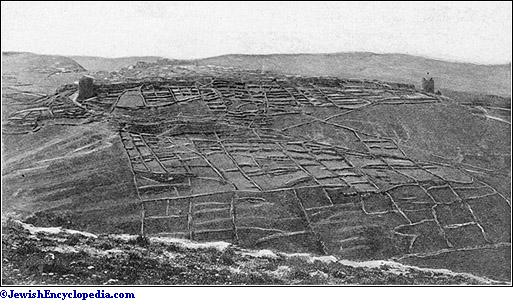
Soil, etc.—The geological characters of the soil in Palestine have never been satisfactorily stated; but the different epithets of description which travelers employ enable us to know that it differs considerably, both in its appearance and character, in different parts of the land; but wherever soil of any kind exists, even to a very slight depth, it is found to be highly fertile. As parts of Palestine are hilly, and hills have seldom much depth of soil, the mode of cultivating them in terraces was anciently, and is now, much employed. A series of low stone walls, one above another, across the face of the hill, arrested the soil brought down by the rains, and afforded a series of levels for the operations of the husbandman. This mode of cultivation is usual in Lebanon, and is not infrequent in Palestine, where the remains of terraces across the hills, in various parts of the country, attest the extent to which it was anciently carried.
In such a climate as that of Palestine, water is the great fertilizing agent. The rains of autumn and winter, and the dews of spring, suffice for the ordinary objects of agriculture; but the ancient inhabitants were able, in some parts, to avert even the aridity which, the summer droughts occasioned, and to keep up a garden-like verdure, by means of aqueducts communicating with the brooks and rivers (Psa 1:3; Psa 65:10; Pro 21:1; Isa 30:25; Isa 32:2; Isa 32:20; Hos 12:11). Hence springs, fountains, and rivulets were as much esteemed by husbandmen as by shepherds (Jos 15:19; Jdg 1:15). The soil was also cleared of stones, and carefully cultivated; and its fertility was increased by the ashes to which the dry stubble and herbage were occasionally reduced by burning over the surface of the ground (Pro 24:31; Isa 7:23; Isa 10:17; Isa 32:13; Isa 47:14; Mat 3:12; Luk 3:17). The dung, and, in the neighborhood of Jerusalem, the blood of animals, were also used to enrich the soil (2Ki 9:37; Psa 83:10; Isa 25:10; Jer 9:22; Luk 14:34-35).
That the soil might not be exhausted, it was ordered that every seventh year should be a sabbath of rest to the land. There was to be no sowing or reaping, no pruning of vines or olives, no vintage or gathering of fruits; and whatever grew of itself was to be left to the poor, the stranger, and the beast of the field (Lev 25:1-7). But such an observance required more faith than the Israelites were prepared to exercise. It was for a long time utterly neglected (Lev 26:34-35; 2Ch 36:21), but after the Captivity it was more observed. By this remarkable institution the Hebrews were also trained to habits of economy and foresight, and invited to exercise a large degree of trust in the bountiful providence of their Divine King.
Fields
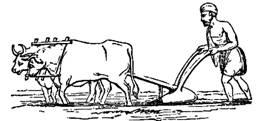
Fig. 9—Modern Syrian Plow
Syria, including Palestine, was regarded by the ancients as one of the first countries for corn. Wheat was abundant and excellent; and there is still one bearded sort, the ear of which is three times as heavy, and contains twice as many grains, as our common English wheat. Barley was also much cultivated, not only for bread, but because it was the only kind of corn which was given to beasts; for oats and rye do not grow in warm climates. Hay was not in use; and therefore the barley was mixed with chopped straw to form the food of cattle (Gen 24:25; Gen 24:32; Jdg 19:19, etc.). Other objects of field culture were millet, spelt, various kinds of beans and peas, pepperwort, cummin, cucumbers, melons, flax, and, perhaps, cotton. Many other articles might be mentioned as being now cultivated in Palestine; but, as their names do not occur in Scripture, we cannot with certainty know which of them were grown there in the ancient times.
Anciently, as now, in Palestine and the East the arable lands were not divided by hedges into fields, as in this country. The ripening products therefore presented an expanse of culture unbroken, although perhaps variegated, in a large view, by the difference of the products grown. The boundaries of lands were therefore marked by stones as landmarks, which, even in patriarchal times, it was deemed a heinous wrong to remove (Job 24:2); and the law pronounced a curse upon those who, without authority, displaced them (Deu 19:14; Deu 27:17). The walls and hedges which are occasionally mentioned in Scripture belonged to orchards, gardens, and vineyards.
Agricultural Operations
Of late years much light has been thrown upon the agricultural operations and implements of ancient times, by the discovery of various representations on the sculptured monuments and painted tombs of Egypt. As these agree surprisingly with the notices in the Bible, and, indeed, differ little from what is still employed in Syria and Egypt, it is very safe to receive the instruction which they offer.
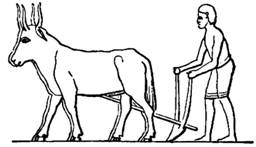
Fig. 10—Ancient Egyptian Plow
Plowing—This has always been a light and superficial operation in the East. At first, the ground was opened with pointed sticks; then, a kind of hoe was employed; and this, in many parts of the world, is still the substitute for a plow. But the plow was known in Egypt and Syria before the Hebrews became cultivators (Job 1:14). In the East, however, it has always been a light and inartificial implement. At first, it was little more than a stout branch of a tree, from which projected another limb, shortened and pointed. This, being turned into the ground, made the furrows; while at the farther end of the larger branch was fastened a transverse yoke, to which the oxen were harnessed. Afterwards a handle to guide the plow was added. Thus the plow consisted of—1. the pole; 2. the point or share; 3. the handle; 4. the yoke. The Syrian plow is, and doubtless was, light enough for a man to carry in his hand. We annex a figure of the ancient Egyptian plow, which had the most resemblance to the one now used (as in the figure of the Modern Syrian Plow), and the comparison between them will probably suggest a fair idea of the plow which was in use among the Hebrews. The following cut (from Sir Charles Fellows’ work on Asia Minor) shows the parts of a still lighter plow used in Asia Minor and Syria, with but a single handle, and with different shares according to the work it has to execute.
Fig. 11—Plow Parts
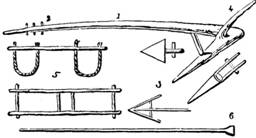
1. The plow 2. The pole 3. Shares (various)
4. Handle 5. Yokes 6. Ox-goad
The plow was drawn by oxen, which were sometimes impelled by a scourge (Isa 10:26; Nah 3:2); but oftener by a long staff, furnished at one end with a flat piece of metal for clearing the plow, and at the other with a spike for goading the oxen. This ox-goad might be easily used as a spear (Jdg 3:31; 1Sa 13:21). Sometimes men followed the plow with hoes to break the clods (Isa 28:24); but in later times a kind of hammer was employed, which appears to have been then, as now, merely a thick block of wood, pressed down by a weight, or by a man sitting on it, and drawn over the plowed field.
Sowing—The ground, having been plowed as soon as the autumnal rains had mollified the soil, was fit, by the end of October, to receive the seed; and the sowing of wheat continued, in different situations, through November into December. Barley was not generally sown till January and February. The seed appears to have been sown and harrowed at the same time; although sometimes it was plowed in by a cross furrow.
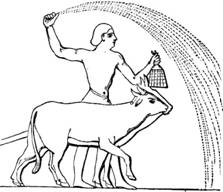
Fig. 12—Sowing, Ancient Egyptian
Plowing in the Seed—The Egyptian paintings illustrate the Scriptures by showing that in those soils which needed no previous preparation by the hoe (for breaking the clods) the sower followed the plow, holding in the left hand a basket of seed, which he scattered with the right hand, while another person filled a fresh basket. We also see that the mode of sowing was what we call ’broad-cast,’ in which the seed is thrown loosely over the field (Mat 13:3-8). In Egypt, when the levels were low, and the water had continued long upon the land, they often dispensed with the plow altogether; and probably, like the present inhabitants, broke up the ground with hoes, or simply dragged the moist mud with bushes after the seed had been thrown upon the surface. To this cultivation without plowing Moses probably alludes (Deu 11:10), when he tells the Hebrews that the land to which they were going was not like the land of Egypt, where they ’sowed their seed and watered it with their foot as a garden of herbs.’ It does not seem that any instrument resembling our harrow was known; the word rendered to harrow, in Job 39:10, means literally to break the clods, and is so rendered in Isa 28:24; Hos 10:11: and for this purpose the means used have been already indicated. The passage in Job is, however, important. It shows that this breaking of clods was not always by hand, but that some kind of instrument was drawn by an animal over the plowed field, most probably the rough log which is still in use.
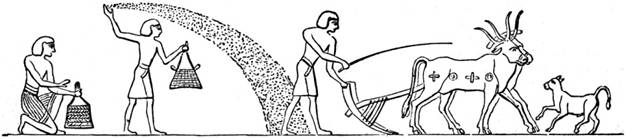
Fig. 13—Plowing and Sowing, Ancient Egyptian
Harvest—It has been already indicated that the time of the wheat harvest in Palestine varies, in different situations, from early in May to late in June; and that the barley harvest is about a fortnight earlier than that of wheat. Among the Israelites, as with all other people, the harvest was a season of joy, and as such is more than once alluded to in Scripture (Psa 126:5; Isa 9:3).
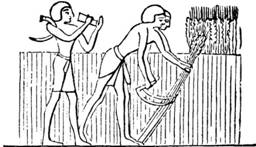
Fig. 14—Reaping
Reaping—Different modes of reaping are indicated in Scripture, and illustrated by the Egyptian monuments. In the most ancient times, the corn was plucked up by the roots, which continued to be the practice with particular kinds of grain after the sickle was known. In Egypt, at this day, barley and dhurah (maize) are pulled up by the roots. ’Wheat, as well as barley in general,’ says Russell, ’does not grow half as high as in Britain; and is therefore, like other grain, not reaped with the sickle, but plucked up by the roots with the hand. In other parts of the country, where the corn grows ranker, the sickle is used.’ When the sickle was used, the wheat was either cropped off under the ear or cut close to the ground. In the former case, the straw was afterwards plucked up for use; in the latter, the stubble was left and burnt on the ground for manure. As the Egyptians needed not such manure, and were economical of straw, they generally followed the former method; while the Israelites, whose lands derived benefit from the burnt stubble, used the latter; although the practice of cutting off the ears was also known to them (Job 24:24). Cropping the ears short, the Egyptians did not generally bind them into sheaves, but removed them in baskets. Sometimes, however, they bound them into double sheaves; and such as they plucked up were bound into single long sheaves. The Israelites appear generally to have made up their corn into sheaves (Gen 37:7; Lev 23:10-15; Rth 2:7; Rth 2:15; Job 24:10; Jer 9:22; Mic 4:12), which were collected into a heap, or removed in a cart (Amo 2:13) to the threshing-floor. The carts were probably similar to those which are still employed for the same purpose.
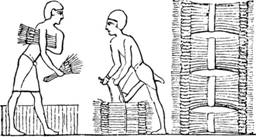
Fig. 15—Binding Sheaves
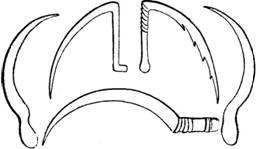
Fig. 16—Sickles
With regard to the sickles, there appear to have been two kinds in use as among the Egyptians. The figures of these Egyptian sickles probably mark the difference between them. One was very much like our common reaping-hook, while the other had more resemblance in its shape to a scythe, and in the Egyptian examples appears to have been toothed. The reapers were the owners and their children, men-servants and women-servants, and day-laborers (Rth 2:4; Rth 2:6; Rth 2:21; Rth 2:23; Joh 4:36; Jas 5:4). Refreshments were provided for them, especially drink, of which the gleaners were allowed to partake (Rth 2:9). So in the Egyptian harvest-scenes, we perceive a provision of water in skins, hung against trees, or in jars upon stands, with the reapers drinking, and gleaners applying to share the draught. Among the Israelites, gleaning was one of the stated provisions for the poor: and for their benefit the corners of the field were left unreaped, and the reapers might not return for a forgotten sheaf. The gleaners were however to obtain in the first place the express permission of the proprietor or his steward (Lev 19:9-10; Deu 24:19; Rth 2:2; Rth 2:7).
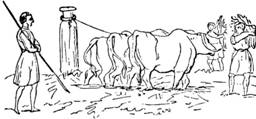
Fig. 17—Egyptian Harvest Scene
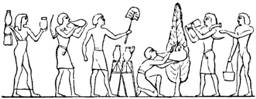
Fig. 18—Threshing by Cattle
Threshing—The ancient mode of threshing, as described in Scripture and figured on the Egyptian monuments, is still preserved in Palestine. Formerly the sheaves were conveyed from the field to the threshing-floor in carts; but now they are borne, generally, on the backs of camels and asses. The threshing-floor is a level plot of ground, of a circular shape, generally about fifty feet in diameter, prepared for use by beating down the earth till a hard floor is formed (Gen 50:10; Jdg 6:37; 2Sa 24:16; 2Sa 24:24). Sometimes several of these floors are contiguous to each other. The sheaves are spread out upon them; and the grain is trodden out by oxen, cows, and young cattle, arranged five abreast, and driven in a circle, or rather in all directions, over the floor. This was the common mode in the Bible times; and Moses forbade that the oxen thus employed should be muzzled to prevent them from tasting the corn (Deu 25:4; Isa 28:28). Flails, or sticks, were only used in threshing small quantities, or for the lighter kinds of grain (Rth 2:17; Isa 28:27). There were, however, some kinds of threshing-machines, which are still used in Palestine and Egypt. One of them, represented in the annexed figure, is very much used in Palestine. It is composed of two thick planks, fastened together side by side, and bent upwards in front. Sharp fragments of stone are fixed into holes bored in the bottom. This machine is drawn over the corn by oxen, a man or boy sometimes sitting on it to increase the weight. It not only separates the grain, but cuts the straw and makes it fit for fodder (2Ki 13:7).
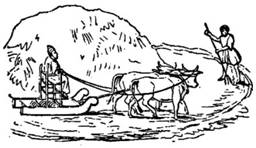
Fig. 19—Syrian Corn-Drag
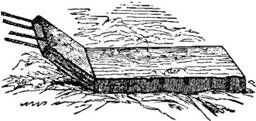
Fig. 20—Threshing by the Noreg
This is, most probably, the ’corn-drag,’ which is mentioned in Scripture (Isa 28:27; Isa 41:15; Amo 1:3, rendered ’threshing instrument’), and would seem to have been sometimes furnished with iron points instead of stones. The Bible also notices a machine called a Moreg (2Sa 24:22; 1Ch 21:23; Isa 41:15), which is unquestionably the same which bears in Arabic the name of Noreg. This machine is not now often seen in Palestine; but is more used in some parts of Syria, and is common in Egypt. It is a sort of frame of wood, in which are inserted three wooden rollers, armed with iron teeth, etc. It bears a sort of seat or chair, in which the driver sits to give the benefit of his weight. It is generally drawn over the corn by two oxen, and separates the grain, and breaks up the straw even more effectually than the drag. In all these processes, the corn is occasionally turned by a fork; and, when sufficiently threshed, is thrown up by the same fork against the wind to separate the grain, which is then gathered up and winnowed.
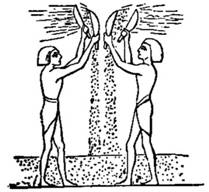
Fig. 21—Winnowing
Winnowing—This was generally accomplished by repeating the process of tossing up the grain against the wind with a fork (Jer 4:11-12), by which the broken straw and chaff were dispersed, and the grain fell to the ground. The grain afterwards passed through a sieve to separate the bits of earth and other impurities. After this, it underwent a still further purification, by being tossed up with wooden scoops or short-handled shovels, such as we see in Egyptian paintings.
Agriculture. This was little cared for by the patriarchs. The pastoral life, however, was the means of keeping the sacred race, whilst yet a family, distinct from mixture and locally unattached, especially whilst in Egypt. When grown into a nation, it supplied a similar check on the foreign intercourse, and became the basis of the Mosaic commonwealth.
"The land is mine," Lev 25:23, was a dictum which made agriculture, likewise, the basis of the theocratic relation. Thus, every family felt its own life with intense keenness, and had its divine tenure which it was to guard from alienation. The prohibition of culture in the Sabbatical Year formed a kind of rent reserved by the divine Owner. Landmarks were deemed sacred, Deu 19:14, and the inalienability of the heritage was insured by its reversion to the owner in the Year of Jubilee; so that only so many years of occupancy could be sold. Lev 25:8-16; Lev 25:23-35.
Rain. -- Water was abundant in Palestine from natural sources. Deu 8:7; Deu 11:8-12. Rain was commonly expected soon after the autumnal equinox. The period denoted by the common scriptural expressions of the "early" and the "latter rain," Deu 11:14; Jer 5:24; Hos 6:3; Zec 10:1; Jas 5:7, generally reaching from November to April, constituted the "rainy season," and the remainder of the year the "dry season."
Crops. -- The cereal crops of constant mention are wheat and barley, and more rarely rye and millet (?). Of the two former, together with the vine, olive and fig, the use of irrigation, the plough and the harrow, mention is made in the book of Job 31:40; Job 15:33; Job 24:6; Job 29:19; Job 39:10. Two kinds of cumin (the black variety called fitches), Isa 28:27, and such podded plants as beans and lentils may be named among the staple produce.
Ploughing and Sowing. -- The plough was probably very light, one yoke of oxen usually sufficing to draw it. Mountains and steep places were hoed. Isa 7:25. New ground and fallows, Jer 4:3; Hos 10:12, were cleared of stones and of thorns, Isa 5:2, early in the year, sowing or gathering from "among thorns" being a proverb for slovenly husbandry. Job 5:5; Pro 24:30-31.
Sowing also took place without previous ploughing, the seed being scattered broad cast and ploughed in afterwards. The soil was then brushed over with a light harrow, often of thorn bushes. In highly-irrigated spots, the seed was trampled by cattle. Isa 32:20.
Seventy days before the Passover was the time prescribed for sowing. The oxen were urged on by a goad like a spear. Jdg 3:31. The proportion of harvest gathered to seed sown was often vast; a hundred fold is mentioned, but in such a way as to signify that it was a limit rarely attained. Gen 26:12; Mat 13:8. Sowing a field with divers seed was forbidden. Deu 22:9.
Reaping and Threshing. -- The wheat etc., was reaped by the sickle or pulled by the roots. It was bound in sheaves. The sheaves or heaps were carted, Amo 2:13, to the floor -- a circular spot of hard ground, probably, as now, from 50 to 80 or 100 feet in diameter. Gen 1:10-11; 2Sa 24:16; 2Sa 24:18.
On these, the oxen, etc., forbidden to be muzzled, Deu 25:4, trampled out the grain. At a later time, the Jews used a threshing sledge called a morag, Isa 41:15; 2Sa 24:22; 1Ch 21:23, probably resembling the noreg, still employed in Egypt -- a stage with three rollers ridged with iron, which, aided by the driver’s weight crushed out, often injuring, the grain, as well as cut or tore the straw, which thus became fit for fodder. Lighter grains were beaten out with a stick. Isa 28:27. The use of animal manure was frequent. Psa 83:10; 2Ki 9:37; Jer 8:2, etc.
Winnowing. -- The shovel and fan, Isa 30:24, indicate the process of winnowing -- a conspicuous part of ancient husbandry. Psa 35:5; Job 21:18; Isa 17:13. Evening was the favorite time, Rth 3:2, when there was mostly a breeze. The fan, Mat 3:12, was perhaps a broad shovel which threw the grain up against the wind. The last process was the shaking in a sieve to separate dirt and refuse. Amo 9:9.
Fields and floors were not commonly enclosed; vineyard mostly were, with a tower and other buildings. Num 22:24; Psa 80:13; Isa 5:5; Mat 21:33, compare Jdg 6:11. The gardens also and orchards were enclosed, frequently by banks of mud from ditches. With regard to occupancy, a tenant might pay a fixed money rent, Son 8:11, or a stipulated share of the fruits. 2Sa 9:10; Mat 21:34. A passerby might eat any quantity of corn or grapes, but not reap or carry off fruit. Deu 23:24-25; Mat 12:1.
The rights of the corner to be left, and of gleaning, see Corner; Gleaning, formed the poor man’s claim on the soil for support. For his benefit, too, a sheaf forgotten in carrying to the floor was to be left; so also with regard to the vineyard and the olive grove. Lev 19:9-10; Lev 24:19.
While the patriarchs were in Canaan, they led a pastoral life, and little attended to tillage; Isaac and Jacob indeed tilled at times (Gen 26:12; Gen 37:7), but the herdsmen strove with Isaac for his wells not for his crops. The wealth of Gerar and Shechem was chiefly pastoral (Gen 20:14; Gen 34:28). The recurrence of famines and intercourse with Egypt taught the Canaanites subsequently to attend more to tillage, so that by the time of the spies who brought samples of the land’s produce from Eshcol much progress had been made (Deu 8:8; Num 13:23). Providence happily arranged it so that Israel, while yet a family, was kept by the pastoral life from blending with and settling among idolaters around. In Egypt the native prejudice against shepherds kept them separate in Goshen (Gen 47:4-6; Gen 46:34). But there they unlearned the exclusively pastoral life and learned husbandry (Deu 11:10), while the deserts beyond supplied pasture for their cattle (1Ch 7:21).
On the other hand, when they became a nation, occupying Canaan, their agriculture learned in Egypt made them a self subsisting nation, independent of external supplies, and so less open to external corrupting influences. Agriculture was the basis of the Mosaic commonwealth; it checked the tendency to the roving habits of nomad tribes, gave each man a stake in the soil by the law of inalienable inheritances, and made a numerous offspring profitable as to the culture of the land. God claimed the lordship of the soil (Lev 25:23), so that each held by a divine tenure; subject to the tithe, a quit rent to the theocratic head landlord, also subject to the sabbatical year. Accumulation of debt was obviated by prohibiting interest on principal lent to fellow citizens (Lev 25:8-16; Lev 25:28-87). Every seventh, sabbatic year, or the year of Jubilee, every 50th year, lands alienated for a time reverted to the original owner.
Compare Isaiah’s "woe" to them who "add field to field," clearing away families (1 Kings 21) to absorb all, as Ahab did to Naboth. Houses in towns, if not redeemed in a year, were alienated for ever; thus land property had an advantage over city property, an inducement to cultivate and reside on one’s own land. The husband of an heiress passed by adoption into the family into which he married, so as not to alienate the land. The condition of military service was attached to the land, but with merciful qualifications (Deuteronomy 20); thus a national yeomanry of infantry, officered by its own hereditary chiefs, was secured. Horses were forbidden to be multiplied (Deu 17:16). Purificatory rites for a day after warfare were required (Num 19:16; Num 31:19). These regulations, and that of attendance thrice a year at Jerusalem for the great feasts, discouraged the appetite for war. The soil is fertile still, wherever industry is secure. The Hauran (Peraea) is highly reputed for productiveness.
The soil of Gaza is dark and rich, though light, and retains rain; olives abound in it. The Israelites cleared away most of the wood which they found in Canaan (Jos 17:18), and seem to have had a scanty supply, as they imported but little; compare such extreme expedients for getting wood for sacrifice as in 1Sa 6:14; 2Sa 24:22; 1Ki 19:21; dung and hay fuel heated their ovens (Eze 4:12; Eze 4:15; Mat 6:30). The water supply was from rain, and rills from the hills, and the river Jordan, whereas Egypt depended solely on the Nile overflow. Irrigation was effected by ducts from cisterns in the rocky sub-surface. The country had thus expansive resources for an enlarging population. When the people were few, as they are now, the valleys sufficed to until for food; when many, the more difficult culture of the hills was resorted to and yielded abundance.
The rich red loam of the valleys placed on the sides of the hills would form fertile terraces sufficient for a large population, if only there were good government. The lightness of husbandry work in the plains set them free for watering the soil, and terracing the hills by low stone walls across their face, one above another, arresting the soil washed down by the rams, and affording a series of levels for the husbandman. The rain is chiefly in the autumn and winter, November and December, rare after March, almost never as late as May. It often is partial. A drought earlier or later is not so bad, but just three months before harvest is fatal (Amo 4:7-8). The crop depended for its amount on timely rain. The "early" rain (Pro 16:15; Jas 5:7) fell from about the September equinox to sowing time in November or December, to revive the parched soil that the seed might germinate. The "latter rain" in February and March ripened the crop for harvest.
A typical pledge that, as there has been the early outpouring of the Spirit at Pentecost, so there shall be a latter outpouring previous to the great harvest of Israel and the Gentile nations (Zec 12:10; Joe 2:23; Joe 2:28-32). Wheat, barley, and rye (and millet rarely) were their cereals. The barley harvest was earlier than the wheat. With the undesigned propriety that marks truth, Exo 9:31-32 records that by the plague of hail "the flax and the barley were smitten, for the barley was in the ear, and the flax was bolled i.e. in blossom, but the wheat and the rye were not smitten, for they were not grown up." Accordingly, at the Passover (just after the time of the hail) the barley was just fit for the sickle, and the wave sheaf was offered; and not until Pentecost feast, 50 days after, the wheat was ripe for cutting, and the firstfruit loaves were offered. The vine, olive, and fig abounded; and traces everywhere remain of former wine and olive presses.
Cummin (including the black "fitches," Isa 28:27), peas, beans, lentils, lettuce, endive, leek, garlic, onion, melon, cucumber, and cabbage also were cultivated. The Passover in the month Nisan answered to the green stage of produce; the feast of weeks in Sivan to the ripe; and the feast of tabernacles in Tisri to the harvest home or ingathered. A month (Veader) was often intercalated before Nisan, to obviate the inaccuracy of their non-astronomical reckoning. Thus the six months from Tisri to Nisan was occupied with cultivation, the six months from Nisan to Tisri with gathering fruits. The season of rains from Tisri equinox to Nisan is pretty continuous, but is more decidedly marked at the beginning (the early rain) and the end (the latter rain). Rain in harvest was unknown (Pro 26:1).
The plow was light, and drawn by one yoke. Fallows were cleared of stones and thorns early in the year (Jer 4:3; Hos 10:12; Isa 5:2). To sow among thorns was deemed bad husbandry (Job 5:5; Pro 24:30-31). Seed was scattered broadcast, as in the parable of the sower (Mat 13:3-8), and plowed in afterward, the stubble of the previous crop becoming manure by decay. The seed was trodden in by cattle in irrigated lands (Deu 11:10; Isa 32:20). Hoeing and weeding were seldom needed in their fine tilth. Seventy days sufficed between sowing barley and the wave sheaf offering from the ripe grain at Passover. Oxen were urged on with a spearlike goad (Jdg 3:31). Boaz slept on the threshingfloor, a circular high spot, of hard ground, 80 or 90 feet in diameter, exposed to the wind for winnowing, (2Sa 24:16-18) to watch against depredations (Rth 3:4-7). Sowing divers seed in a field was forbidden (Deu 22:9), to mark God is not the author of confusion, there is no transmutation of species, such as modern skeptical naturalists imagine. Oxen unmuzzled (Deu 25:4) five abreast trod out the grain on the floor, to separate the grain from chaff and straw; flails were used for small quantities and lighter grain (Isa 28:27).
A threshing sledge (
the art or profession of cultivating the soil. SEE FARM; SEE TILLAGE.
I. History. — The antiquity of agriculture is indicated in the brief history of Cain and Abel, when it tells us that the former was a "tiller of the ground," and brought some of the fruits of his labor as an offering to God (Gen 4:2-3), and that part of the ultimate curse upon him was, “When thou tillest the ground, it shall not henceforth yield to thee her strength" (Gen 4:12). Of the actual state of agriculture before the Deluge we know nothing. SEE ANTEDILUVIANS.
Whatever knowledge was possessed by the Old World was doubtless transmitted to the New by Noah and his sons; and that this knowledge was considerable is implied in the fact that one of the operations of Noah, when he “began to be a husbandman," was to plant a vineyard, and to make wine with the fruit (Gen 9:2). There are few agricultural notices belonging to the patriarchal period, but they suffice to show that the land of Canaan was in a state of cultivation, and that the inhabitants possessed what were at a later date the principal products of the soil in the same country. It is reasonable, therefore, to conclude that the modes of operation were then similar to those which we afterward find among the Jews in the same country, and concerning which our information is more exact. SEE ARABIA.
Agriculture was little cared for by the patriarchs; more so, however, by Isaac and Jacob than by Abraham (Gen 26:12; Gen 37:7), in whose time probably, if we except the lower Jordan valley (Gen 13:10), there was little regular culture in Canaan. Thus Gerar and Shechem seem to have been cities where pastoral wealth predominated. The herdmen strove with Isaac about his wells; about his crop there was no contention (Gen 10:14; Gen 34:28). In Joshua’s time, as shown by the story of the "Eshcol" (Num 13:23-24), Canaan was found in a much more advanced agricultural state than when Jacob had left it (Deu 8:8), resulting probably from the severe experience of famines, and the example of Egypt, to which its people were thus led. The pastoral life was the means of keeping the sacred race, while yet a family, distinct from mixture and locally unattached, especially while in Egypt. When, grown into a nation, they conquered their future seats, agriculture supplied a similar check on the foreign intercourse and speedy demoralization, especially as regards idolatry, which commerce would have caused. Thus agriculture became the basis of the Mosaic commonwealth (Michaelis, 37-41). It tended to check also the freebooting and nomad life, and made a numerous offspring profitable, as it was already honorable by natural sentiment and by law. Thus, too, it indirectly discouraged slavery, or, where it existed, made the slave somewhat like a son, though it made the son also somewhat of a slave. Taken in connection with the inalienable character of inheritances, it gave each man and each family a stake in the soil, and nurtured a hardy patriotism. "The land is Mine" (Lev 25:23) was a dictum which made agriculture likewise the basis of the theocratic relation. Thus every family felt its own life with intense keenness, and had its divine tenure which it was to guard from alienation. The prohibition of culture in the sabbatical year formed, under this aspect, a kind of rent reserved by the Divine Owner. Landmarks were deemed sacred (Deu 19:14), and the inalienability of the heritage was insured by its reversion to the owner in the year of jubilee; so that only so many years of occupancy could be sold (Lev 25:8-16; Lev 25:23-35). The prophet Isaiah (Isa 5:8) denounces the contempt of such restrictions by wealthy grandees who sought to “add field to field," erasing families and depopulating districts. SEE LAND.
In giving to the Israelites possession of a country already under cultivation, it was the Divine intention that they should keep up that cultivation, and become themselves an agricultural people; and in doing this they doubtless adopted the practices of agriculture which they found already established in the country. This may have been the more necessary, as agriculture is a practical art; and those of the Hebrew who were acquainted with the practices of Egyptian husbandry had died in the wilderness; and even had they lived, the processes proper to a hot climate and alluvial soil, watered by river inundation, like that of Egypt, although the same in essential forms, could not have been altogether applicable to so different a country as Palestine. SEE EGYPT.
II. Weather, etc. — As the nature of the seasons lies at the root of all agricultural operations, it should be noticed that the variations of sunshine and rain, which with us extend throughout the year, are in Palestine confined chiefly to the latter part of autumn and the winter. During all the rest of the year the sky is almost uninterruptedly cloudless, and rain very rarely falls. The autumnal rains usually commence at the latter end of October or beginning of November, not suddenly, but by degrees, which gives opportunity to the husbandman to sow his wheat and barley. The rains continue during November and December, but afterward they occur at longer intervals, and rain is rare after March, and almost never occurs as late as May. The cold of winter is not severe; and as the ground is never frozen, the labors of the husbandman are not entirely interrupted. Snow falls in different parts of the country, but never lies long on the ground. In the plains and valleys the heat of summer is oppressive, but not in the more elevated tracts. In these high grounds the nights are cool, often with heavy dew. The total absence of rain in summer soon destroys the verdure of the fields, and gives to the general landscape, even in the high country, an aspect of drought and barrenness. No green thing remains but the foliage of the scattered fruit-trees, and occasional vineyards and fields of millet. In autumn the whole land becomes dry and parched, the cisterns are nearly empty, and all nature, animate and inanimate, looks forward with longing for the return of the rainy season. In the hill-country the time of harvest is later than in the plains of the Jordan and of the seacoast. The barley harvest is about a fortnight earlier than that of wheat. In the plain of the Jordan the wheat harvest is early in May; in the plains of the coast and of Esdraelon, it is toward the latter end of that month, and in the hills not until June. The general vintage is in September, but the first grapes ripen in July; and from that time the towns are well supplied with this fruit. — Robinson, Biblical Researches, 2, 96-100. See PALESTINE.
The Jewish calendar (q.v.), as fixed by the three great festivals, turned on the seasons of green, ripe, and fully-gathered produce. Hence, if the season was backward, or, owing to the imperfections of a non-astronomical reckoning, seemed to be so, a month was intercalated. This rude system was fondly retained long after mental progress and foreign intercourse placed a correct calendar within their power; so that notice of a Veadar, i.e., second or intercalated Adar, on account of the lambs being not yet of a paschal size, and the barley not forward enough for the Abib (green sheaf), was sent to the Jews of Babylon and Egypt (Ugol. de Re Rust. Isa 5:22) early in the season. SEE TIME. The year, ordinarily consisting of twelve months, was divided into six agricultural periods, as follows (Mishna, Tosaphta Taanith, ch. 1):
(1.) SOWING TIME.
Tisri, latter half beginning about autumnal equinox. Early rain due.
Marchesvan......................... Early rain due
Fasleu, former half ................ Early rain due
(2.) UNRIPE TIME
Kisleu, latter half.
Tebeth.
Sebat, former half.
(3.) COLD SEASON.
Sebat, latter half ................... Latter rain due
Adar ............ ............, Latter rain due.
[Veadar]……. Latter rain due
Nisan, former half ................. Latter rain due
(4.) HARVEST TIME.
Nisan, latter half ..................( Beginning about vernal equinox. Barley green. Passover.)
Ijar. .......... Wheat ripe....... Pentecost
Sivan, former half .......... Wheat ripe....... Pentecost.
(5.) SUMMER.
Sivan, latter half.
Tammuz.
Ab, former half.
(6.) SULTRY SEASON.
Ab, latter half.
I lul.
Tisri, former half. ................... Ingathering of fruits.
Thus the six months from mid Tisri to mid Nisan were mainly occupied with the process of cultivation, and the rest with the gathering of the fruits. Rain was commonly expected soon after the autumnal equinox, or mid Tisri; and if by the first of Kisleu none had fallen, a fast was proclaimed (Mishna, Taanith, ch. 1).
The common Scriptural expressions of the “early" and the "latter rain" (Deu 11:14; Jer 5:24; Hos 6:3; Zec 10:1; Jas 5:7) are scarcely confirmed by modern experience; the season of rains being unbroken (Robinson, 1, 41, 429; 3, 96); though perhaps the fall is more strongly marked at the beginning and the end of it. The consternation caused by the failure of the former rain is depicted in Joel 1, 2; and this prophet seems to promise that and the latter rain together "in the first month," i. c. Nisan (2, 23). SEE RAIN.
Its plenty of water from natural sources made Canaan a contrast to rainless Egypt (Deu 8:7; Deu 11:8-12). Nor was the peculiar Egyptian method of horticulture alluded to in Deu 11:10 unknown, though less prevalent in Palestine. That peculiarity seems to have consisted in making in the fields square shallow beds, like our salt-pans, surrounded by a raised border of earth to keep in the water, which was then turned from one square to another by pushing aside the mud, to open one and close the next, with the foot. Robinson, however, describes a different process, to which he thinks this passage refers (Res. 1, 542; 2, 351; 3, 21), as still in use likewise in Palestine. There irrigation (including under the term all appliances for making the water available) was as essential as drainage in our region; and for this the large extent of rocky surface, easily excavated for cisterns and ducts, was most useful. Even the plain of Jericho is watered not by canals from the Jordan, since the river lies below the land, but by rills converging from the mountains. In these features of the country lay its expansive resources to meet the wants of a multiplying population. The lightness of agricultural labor in the plains set free an abundance of hands for the task of terracing and watering, and the result gave the highest stimulus to industry. SEE IRRIGATION.
III. Soil, etc. — The Israelites probably found in Canaan a fair proportion of woodland, which their necessities, owing to the discouragement of commerce, must have led them to reduce (Jos 17:18). But even in early times timber seems to have been far less used for building material than among Western nations; the Israelites were not skillful hewers, and imported both the timber and the workmen (1Ki 5:6; 1Ki 5:8). No store of wood-fuel seems to have been kept; ovens were heated with such things as dung and hay (Eze 4:12; Eze 4:15; Malachi 4:13); and, in any case of sacrifice on an emergency, some, as we should think, unusual source of supply is constantly mentioned for the wood (1Sa 6:14; 2Sa 24:22; 1Ki 19:21; comp. Gen 22:3; Gen 22:6-7). All this indicates a nonabundance of timber, and implies that nearly all the arable soil was under culture, or, at least, used for pasturage. SEE FOREST.
The geological characters of the soil in Palestine have never been satisfactorily stated; but the different epithets of description which travelers employ, enable us to know that it differs considerably, both in its appearance and character, in different parts of the land; but wherever soil of any kind exists, even to a very slight depth, it is found to be highly fertile. As parts of Palestine are hilly, and as hills have seldom much depth of soil, the mode of cultivating them in terraces was anciently, and is now much employed. A series of low stone walls, one above another, across the face of the hill, arrest the soil brought down by the rains, and afford a series of levels for the operations of the husbandman. This mode of cultivation is usual in Lebanon, and is not unfrequent in Palestine, where the remains of terraces across the hills, in various parts of the country, attest the extent to which it was anciently carried. This terrace cultivation has necessarily increased or declined with the population. If the people were so few that the valleys afforded sufficient food for them, the more difficult culture of the hills was neglected; but when the population was too large for the valleys to satisfy with bread, then the hills were laid under cultivation. SEE VINEYARD.
In such a climate as that of Palestine, water is the great fertilizing agent. The rains of autumn and winter, and the dews of spring, suffice for the ordinary objects of agriculture; but the ancient inhabitants were able, in some parts, to avert even the aridity which the summer droughts occasioned, and to keep up a garden-like verdure, by means of aqueducts communicating with the brooks and rivers (Psa 1:3; Psa 65:10; Pro 21:1; Isa 30:25; Isa 32:2; Isa 32:20; Hos 12:11). Hence springs, fountains, and rivulets were as much esteemed by husbandmen as by shepherds (Jos 15:19; Jdg 1:15). The soil was also cleared of stones, and carefully cultivated; and its fertility was increased by the ashes to which the dry stubble and herbage were occasionally reduced by being burned over the surface of the ground (Pro 24:31; Isa 7:23; Isa 32:13). Dung and, in the neighborhood of Jerusalem, the blood of animals were also used to enrich the soil (2Ki 9:37; Psa 83:10; Isa 25:10; Jer 9:22; Luk 14:34-35). A rabbi limits the quantity to three heaps of ten half-cors, or about 380 gallons, to each seah (q.v.) of grain, and wishes the quantity in each heap, rather than their number, to be increased if the field be large (Mishna, Shebiith, 3, 2). Nor was the great usefulness of sheep to the soil unrecognised (ib. 4), though, owing to the general distinctness of the pastoral life, there was less scope for it. SEE MANURE.
That the soil might not be exhausted, it was ordered that every seventh year should be a sabbath of rest to the land: there was then to be no sowing or reaping, no pruning of vines or olives, no vintage or gathering of fruits; and whatever grew of itself was to be left to the poor, the stranger, and the beasts of the field (Lev 25:1-7; Deu 15:1-10). But such an observance required more faith than the Israelites were prepared to exercise. It was for a long time utterly neglected (Lev 26:34-35; 2Ch 36:21), but after the captivity it was more observed. By this remarkable institution the Hebrew were also trained to habits of economy and foresight, and invited to exercise a large degree of trust in the bountiful providence of their Divine King. SEE SABBATICAL YEAR.
A change in the climate of Palestine, caused by increase of population and the clearance of trees, must have taken place before the period of the N.T. A further change, caused by the decrease of skilled agricultural labor, e.g. in irrigation and terrace-making, has since ensued. Not only this, but the great variety of elevation and local character in so small a compass of country necessitates a partial and guarded application of general remarks (Robinson, 1, 507, 553, 554; 3, 595; Stanley, Palestine, p. 118-126). Yet wherever industry is secure, the soil still asserts its old fertility. The Hauran (Peraea) is as fertile as Damascus, and its bread enjoys the highest reputation. The black and fat, but light soil about Gaza, is said to hold so much moisture as to be very fertile with little rain. Here, as in the neighborhood of Beyrut, is a vast olive-ground, and the very sand of the shore is said to be fertile if watered. SEE WATER.
IV. Crops and Fields. — Under the term
The rights of the corner (q.v.) to be left, and of gleaning (q.v.), formed the poor man’s claim on the soil for support. For his benefit, too, a sheaf forgotten in carrying to the floor was to be left; so, also, with regard to the vineyard and the olive-grove (Lev 19:9-10; Deu 24:19). Besides, there seems a probability that every third year a second tithe, besides the priests’, was paid for the poor (Deu 14:28; Deu 26:12; Amo 4:4; Tob 1:7; Joseph. Ant. 4, 8, 22). On this doubtful point of the poor man’s tithe (
V. Agricultural Operations and Implements.—Of late years much light has been thrown upon the agricultural operations and implements of ancient times, by the discovery of various representations on the sculptured monuments and painted tombs of Egypt, and (to some degree) of Assyria. As these agree surprisingly with the notices in the Bible, and, indeed, differ little from what we still find employed in Syria and Egypt, it is very safe to receive them as guides on the present subject (see also Corse’s Assyria, p. 560).
1. Ploughing has always been a light and superficial operation in the East. At first, the ground was opened with pointed sticks; then a kind of hoe was employed; and this, in many parts of the world, is still used as a substitute for the plough. But the plough was known in Egypt and Syria before the Hebrew became cultivators (Job 1:14). At first it was little more than a stout branch of a tree, from which projected another limb, shortened and pointed. This, being turned into the ground, made the furrow; while at the farther end of the larger branch was fastened a transverse yoke, to which the oxen were harnessed. Afterward a handle to guide the plough was added. The Syrian plough is, and doubtless was, light enough for a man to carry in his hand (Russell’s Nat. Hist. of Aleppo, 1, 73). The plough, probably, was like the Egyptian, and the process of ploughing like that called scarificatio by the Romans ("Syria tenui suico arat," Pliny 18:47), one yoke of oxen mostly sufficing to draw it. Mountains and rough places were hoed (Isa 7:5; Maimon. ad Mishn. 6 2; Robinson, 3, 595, 602-
3). The breaking up of new land was performed, as with the Romans, in "early spring" (vere novo). Such new ground and fallows, the use of which latter was familiar to the Jews (Jer 4:3; Hos 10:12), were cleared of stones and of thorns (Isa 5:2; Gemara Hierosol ad loc.) early in the year, sowing or gathering from “among thorns" being a proverb for slovenly husbandry (Job 5:5; Pro 24:30-31; Robinson, 2, 127). Virgin land was ploughed a second time. The proper words are
Occasionally, however, the sowing was by patches only in well-manured spots, a process called
5. Reaping. — In the most ancient times the corn was plucked up by the roots, which continued to be the practice with particular kinds of grain after the sickle was known. In Egypt, at this day, barley and “doorra" are pulled up by the roots. The choice between these modes of operation was probably determined, in Palestine, by the consideration pointed out by Russell (N. H. of Aleppo, 1, 74), who states that “wheat, as well as barley in general, does not grow half as high as in Britain; and is therefore, like other grain, not reaped with the sickle, but plucked up by the roots with the hand. In other parts of the country, where the corn grows ranker, the sickle is used." When the sickle was used, the wheat was either cropped off under the ear or cut close to the ground. In the former case, the straw was afterward plucked up for use; in the latter, the stubble was left and burned on the ground for manure. As the Egyptians needed not such manure, and were economical of straw, they generally followed the former method; while the Israelites, whose lands derived benefit from the burned stubble, used the latter, although the practice of cutting off the ears was also known to them (Job 24:24). Cropping the ears short, the Egyptians did not generally bind them into sheaves, but removed them in baskets. Sometimes, however, they bound them into double sheaves; and such as they plucked up were bound into single long sheaves. The Israelites appear generally to have made up their corn into sheaves (Gen 37:7; Lev 23:10-15; Rth 2:7; Rth 2:15; Job 24:10; Jer 9:22; Mich. 4:12), which were collected into a heap, or removed in a cart (Amo 2:13) to the threshing-floor. The carts were probably similar to those which are still employed for the same purpose. SEE WAGON.
The sheaves were never made up into shocks, as with us, although the word occurs in our translation of Jdg 15:5; Job 5:26; for the original term signifies neither a shock composed of a few sheaves standing temporarily in the field, nor a stack of many sheaves in the home yard, properly thatched, to stand for a length of time; but a heap of sheaves laid loosely together, in order to be trodden out as quickly as possible, in the same way as is done in the East at the present day (Brown, Antiq. of the Jews, 2, 591). Such heaps were sometimes fancifully arranged in the form of helmets (
Flails, or sticks, were only used in threshing small quantities, or for the lighter kinds of grain (Rth 2:17; Isa 28:27). There were, however, some kinds of threshing instruments, such as are still used in Egypt and Palestine. One of them is composed of two thick planks, fastened together side by side, and bent upward in front. Sharp fragments of stone are fixed into holes bored in the bottom. This machine is drawn over the corn by oxen — a man or boy sometimes sitting on it to increase the weight. It not only separates the grain, but cuts the straw and makes it fit for fodder (2Ki 13:7). This is, most probably, the
AGRICULTURE.—The influence of the physical and climatic characteristics of a land upon the character of its people has been a favourite theme with many writers. But we are more concerned here with another marked feature—the profound influence exerted by the occupations of a people on their manner of thought and their modes of expressing it. Nowhere was this subtle influence more manifest than in the case of the Hebrews. Their occupations were largely determined by the characteristics of the land they inhabited, but their thought and the language that was its vehicle were equally moulded by their occupations.
1. The place of Agriculture in the life and thought of the Hebrews.—From the first the Hebrews were a pastoral, and from very early times an agricultural people; and these twin employments have lent their colour and tone to their literature, and shaped their profoundest thoughts and utterances regarding God and man. God is the Shepherd of Israel (Psa 80:1); Israel is ‘the people of his pasture, and the sheep of his hand’ (Psa 95:7, cf. Psa 74:1, Psa 79:13, Psa 100:3). God is the Husbandman; Israel is His vineyard (Isa 5:1 ff.). God is the Ploughman; Israel is the land of His tillage (Isa 28:25 ff.; cf. 1Co 3:9).
When we turn to the Gospels we find the same stream of thought in full flow. The highest Christian virtue is enforced by appeal to Him who ‘maketh his sun to rise on the evil and on the good, and sendeth rain on the just and on the unjust’ (Mat 5:45). The kingdom of God is set forth under such emblems as the sower going forth to sow (Mat 13:3 ff.), the wheat and the tares growing together until the harvest (Mat 13:24 ff.), the lord of the vineyard going out early in the morning to hire labourers (Mat 20:1 ff.), or sending to demand its fruits (Mat 21:33 ff.). Christ compares Himself to the shepherd who seeks his lost sheep until he finds it (Luk 15:4), or lays down his life for the sheep (Joh 10:11). The multitude are, to His compassionate eye, as ‘sheep I not having a shepherd’ (Mat 9:36, Mar 6:34). The world appears to Him as a great field ‘white unto harvest’ (Joh 4:35), and awaiting the labour of the reapers (Mat 9:37 f.). His relation to His disciples is expressed under the figure of the vine and its branches (Joh 15:1 ff.) See also art. Husbandman.
Noteworthy also is the place assigned by Biblical writers to the cultivation of the soil. It is represented as the duty of the first man. Adam, placed in the Garden of Eden, is ‘to dress it and to keep it’ (Gen 2:15); driven from it, he is sent ‘to till the ground from whence he was taken’ (Gen 3:23). To Noah the promise is given that ‘while the earth remaineth, seedtime and harvest … shall not cease’ (Gen 8:22). The land of promise is ‘a land of wheat and barley’ (Deu 8:8). The Golden Age will be a time when men ‘shall beat their swords into ploughshares, and their spears into pruning-hooks,’ and ‘they shall sit every man under his vine and under his fig-tree’ (Isa 2:4, Mic 4:3-4). The gladness of the Messianic age is ‘joy according to the joy in harvest’ (Isa 9:3).
Nor was it only in their conception of the past and their anticipation of the future that the influence of agriculture made itself felt: it was the very foundation of their national and religious life. A pastoral age, it is true, preceded the agricultural, and the patriarchs are represented, for the most part, as herdsmen rather than cultivators (Gen 37:12; Gen 47:3); and even as late as the beginning of the settlement in Canaan, the trans-Jordanic tribes are said to have had a great multitude of cattle (Num 32:1). But, on the other hand, we learn that Isaac, who had gone to Gerar, ‘sowed in that land, and found in the same year an hundredfold’ (Gen 26:12); while the first dream of Joseph shows that if he did not actually follow, he was at least familiar with, agricultural pursuits (Gen 37:5-7). But it was not till after their conquest of the Land of Promise that the Hebrews became an agricultural people on any large scale. Prior to that time, however, agriculture was highly developed among the Canaanites (Deu 8:8); and it may have been from the conquered race that they acquired it. Once learned, it became the staple industry of the country.
The Mosaic legislation presupposes a people given to agricultural pursuits. That is sufficiently attested by the laws anent the three annual festivals (Exo 23:14-16), the septennial fallow (Exo 23:11), the gleanings of the harvest field (Lev 19:9), Lev 19:10 the year of Jubilee (Lev 25:10 ff., Lev 27:17 ff.), and many others. Further attestation of the same fact is found in the blessings that were to attend the faithful observance of the Law, and the curses that would follow disobedience (Lev 26:3-5; Lev 26:14-20, Deu 28:1-5; Deu 28:15-18).
2. The soil of Palestine.—The fertility of the soil of Palestine was remarkable, as is testified by Josephus (c. Apion. i. 22; BJ ii. 3) and others (Diod. xl. 3, 7; Tac. Hist. v. 6). The soil varies in character. In the Jordan Valley and the maritime plains it consists of a very rich alluvial deposit; in the regions lying at a higher elevation it has been formed from decomposing basaltic rock and cretaceous limestone. This, however, was greatly enriched by the system of ‘terracing,’ low walls of ‘shoulder-stones’ being built along the mountain slopes, and the ledges behind them filled with the alluvial soil of the valleys. These walls gave protection against the heavy rains, and prevented the soil from being washed away. It was to this system that districts such as Lebanon, Carmel, and Gilboa owed the wonderful fertility that formerly characterized them.
All parts were not, of course, equally productive. Thus we find the Mishna (Gittin, v. 1) enumerating several classes of soil according to their quality or the degree of moisture. Such a classification is quite distinct from that of the parable of the Sower, where the wayside, the rocky places, etc., are all within the limits of a single field (Mat 13:5, Mar 4:3, Luk 8:5). It may be noted here that ground which yielded thorns was considered specially good for wheat-growing, while that which was overrun with weeds was assigned to barley. The most productive fields were often marked by the presence of large stones, some of which were beyond a man’s own strength to remove. Their presence was regarded as a token that the soil was fertile. Smaller stones, which were also plentiful, were often used for making rude walls along the side of the fields. In some districts they were so numerous that they had to be removed every year after ploughing had taken place.
3. Agricultural operations, etc.—The work of preparing the land for cultivation was the first concern of the farmer. Where virgin soil had to be reclaimed, a beginning was made by clearing it of timber, brushwood, or stones (Jos 17:18, Isa 5:2). It was then ready to receive the plough (which see).
(a) Ploughing began immediately after the ‘early rain’ had softened the ground, i.e. towards the end of September or beginning of October, and went on right through the winter, provided the soil had not become too wet and, therefore, too heavy. Usually a single ploughing sufficed, but if the soil was very rough it was ploughed twice.
In some cases the hoe or mattock took the place of the plough. That is the common practice in modern times where there is a rocky bottom and only a sparse covering of earth. In ancient times the same course was followed where hillsides were brought under cultivation (Isa 7:25). The same implement was employed for breaking up large clods of earth (Isa 28:24, Hos 10:11), but whether the reference includes the clods upturned by the plough, or merely those occurring in ‘stony ground,’ is not quite certain.
(b) Dung was employed for increasing the productiveness of fruit trees (Luk 13:8), but not, as a rule, for grain fields. The most common forms were house and farmyard refuse mixed with straw (Isa 25:10), withered leaves, oil-scum, and wood-ashes. The blood of slaughtered animals was also used for this purpose.
(c) The principal crops were wheat, barley, spelt, millet, beans, and lentils (see articles on the first two of these). Oats were little cultivated. From Jos 2:6 we learn that flax was grown. It was sometimes sown as an experiment for testing the quality of the soil, for a field which had yielded good flax was regarded as specially suitable for wheat-growing.
(d) The sowing season began in the early days of October. A beginning was made with pulse varieties, barley came next, and wheat followed. Millet was sown in summer, the land being prepared for it by irrigation. When the winter set in cold and wet, barley was not sown till the beginning of February.
The sower carries the seed in a basket or bag, from which he scatters it broadcast. Where a single ploughing suffices, the seed is sown first and then ploughed in. When it is sown on ploughed ground, the usual course is also to plough it in, but sometimes a light harrow (not infrequently a thorn-bush) is used to cover it. Seed that falls on the footpath or ‘wayside’ cannot be covered owing to the hardness of the ground, and is picked up by the birds (Mat 13:4 and parallels).
(e) The crops thus sown were exposed, as they grew, to various dangers, such as the inroads of roaming cattle, the depredations of birds, or the visitation of locusts; and also to such adverse natural and climatic influences as drought, east wind, and mildew. Some of these will be separately treated, and need not be dwelt upon now. But it may be convenient to say a few words at this stage regarding—
(f) The water supply of the country.—Unlike Egypt, which owed its fertility exclusively to the Nile, Palestine had its time of rain (Deu 11:10-11; Deu 11:14, Jer 5:24 etc.). The ‘early rain’ (
The threshing-floor is simply a circle of level ground which has been carefully cleaned and beaten hard, and is enclosed with a row of big stones to prevent the straw from being too widely scattered. The spot selected always stood higher than the surrounding ground, so that it should be open to the air currents, and that rain, if it occurred, though it was rare in harvest time (1Sa 12:17), might run off without doing injury. The sheaves were unbound and scattered over the floor, till a heap was formed about a foot high. Cattle (Hos 10:11) were then driven over it repeatedly, or a threshing wain drawn by cattle. The Pentateuchal law provided that the cattle engaged in this operation should not be muzzled (Deu 25:4). It was also the custom to blindfold them, as otherwise, moving continually in a circle, they became dizzy (Talmud, Kelim xvi. 7). Certain crops, however, were threshed by being beaten with a stick (Isa 28:27).
Two kinds of threshing machines were employed, the drag and the waggon. The drag (
The sifted grain was collected in large heaps, and, pending its removal to the granary, the owner, to guard against thieving, slept by the threshing-floor (Rth 3:7). In the Gospels there is one reference to sifting (Luk 22:31).
(k) Storage.—In the NT a granary is called
Literature.—Ugolinus. Thesaurus, vol. xxix.; Benzinger, Heb. Arch. 207 ff.; Nowack, Lehrbuch der Heb. Archaologie, i. 228 ff.; Vogelstein, Die Landwirthschaft in Palastina zur Zeit der Mischna; Stade, Geschichte d. Volkes Israel, i. vii.; Wilkinson, Ancient Egyptians, passim; Thomson, The Land and the Book; van Lennep, Bible Lands and Customs; ZDPV [Note: DPV Zeitschrift des Deutschen Palästina-Vereins.] ix.; PEFSt [Note: EFSt Quarterly Statement of the same.] , passim; Ungewitter, Die landwirthschaftlichen Bilder und Metaphern i. d. poet. Buch. d. Alt. Test.; Hasting’s Dictionary of the Bible , and Encyc. Bibl. s.v. ‘Agriculture.’
Hugh Duncan.
By: Kaufmann Kohler, Frederick de Sola Mendes
—Historical Aspects: Israel Originally Pastoral.
Agriculture was the basis of the national life of the Israelites; state and Temple in Palestine were alike founded on it. At the outset the Hebrews are represented as a pastoral tribe. "A roaming Aramean was my father," said the Israelite when offering his first-fruits as a thanksgiving before the Lord (Deut. xxvi. 5, Heb.). The Patriarchs are mainly herdsmen, pasturing their sheep and cattle on commons, without generally cultivating the soil: at the same time Isaac "sowed in that land [Gerar], and received in the same year a hundredfold" (Gen. xxvi. 12); and Joseph's dream of sheaves of corn in the field (Gen. xxxvii. 6, 7) seems to betoken familiarity with agricultural life. But Jacob and his sons enter Egypt as shepherds only (Gen. xlvii. 3); and this pastoral life was adhered to until even a later period by the tribes of Reuben, Gad, and by half of the tribe of Manasseh, inhabiting the trans-Jordanic plain (Num. xxxii. 1), and by the clans dwelling in the highlands of western Palestine (I Sam. xxv. 2). A certain dislike to agricultural life was, however, manifested among the sons of Rechab (Jer. xxxv. 7). The entire Mosaic legislation was conditioned upon Israel's possession of Canaan as the land promised to Abraham. The Sabbath had chief significance to a people that had passed the pastoral stage and that employed man and beast in agricultural labor (Ex. xxxiv. 21). Still more closely connected with agricultural life were the three festivals of the year (Ex. xxiii. 14-16). The system of public provision for the poor was based upon agricultural life: the Law claimed the gleanings of the harvest, of the vineyard, and of the olive-grove for the poor and the stranger (Lev. xix. 9, 10; Deut. xxiv. 19-21). The Sabbatical year of release—the produce of which was reserved for the poor, the stranger, and the cattle (Ex. xxiii. 11)—and the Jubilee year, with its restitution of the ancestral possessions (Lev. xxv. 28), were based upon an agricultural economy (see Agrarian Laws; Land Tenure; Sabbatical Year).
Direct Relations with God.
The whole conception of God as the bountiful giver, as well as that of His retributive justice—dealing blessings to the observer of the Law, and sorrows or "curses" to the transgressor—is founded altogether upon the fact of Israel's agricultural enjoyment of Canaan (Ex. xxiii. 25; Lev. xxvi. 3-6, 10, 20, 26; Deut. viii. 7-10, xxviii. 3-5, 12, etc.). Canaan was totally dependent for its fertility upon the rain of heaven, which God would grant or withhold according as Israel was faithful or unfaithful (see Driver, "Commentary on Deut." pp. 129 et seq.). The impression which Palestine—with its brooks and fountains, its valleys and hills, its fields of wheat and barley, its plantations of vines and figtrees and pomegranates—made upon the Israelites, unaccustomed as they were to Agriculture, is vividly portrayed in the episode of the spies (Num. xiii. 23 et seq.). It appears that when the magnificent fruit of the country was shown to the people, far from awakening a desire to take possession of the land that "flowed with milk and honey," it filled them with fear by reason of its very size, just as did the uncommonly tall men and strong cities that the spies had seen. Canaanite agricultural development presented to the Hebrew shepherd-tribes a superiority from which they shrank with a self-depreciating awe.
Agriculture Learned from the Canaanites.
Centuries had to elapse before Judah and Israel could dwell safely "every man under his vine and under his fig-tree, from Dan even to Beer-sheba" (I Kings, iv. 25), and before the Hebrew farmer could feel that it was his God who instructed him how to plow and to sow and to cast in the wheat and the barley and the rye (Isa. xxviii. 26). The subjugated Canaanites no doubt were made to initiate their Israelitish conquerors into the practises of agricultural life. The land hitherto held to be watered and made fruitful by the Canaanite gods, Baal and Astarte, was conceived to be henceforth under the tutelage of the national deity of Israel, but the art of its cultivation had to be learned from its former owners, and here was a fruitful cause for the people's continual lapses into Canaanite idolatry. The unbridled joy of the harvest and the vintage filled the land with songs and dancing (Judges, ix. 27); and the "high places," as centers of idolatrous worship, continued to exert a baneful spell upon the farming population settledin the vicinity. This was in the main the contest between Baal and YHWH in the time of the early prophets; and Hosea (ii. 10) complained that Israel did not know that it was God, and not Baal, who gave the corn and wine and oil. Only when the name of Baal should no longer be mentioned (ib. 18) would the blessings of Agriculture have no admixture of loss and suffering. "Baal" remained the name for the fructifying rain down to the time of the Mishnah (see Sheb. ii. 9, and elsewhere; compare bet Baal, the expression for a field watered by rain; see below).
That the Israelites practised Agriculture with success is learned from the statement that Solomon sent to Hiram annually 40,000 kor (about 440,000 bushels) of wheat and barley and 40,000 baths (340,000 gallons) of oil (I Chron. ii. 9 [A. V. 10]). In Ezekiel's time Judah traded extensively with Tyre; sending thither wheat, honey, oil, and balm (Ezek. xxvii. 17). On the other hand, in the time of the Judges, the Midianites and Amalekites regularly destroyed the produce of the soil when the sowing-time had passed (Judges, vi. 2, 3); and in King Saul's time there was no smith found in the land to sharpen the plowshares, because the Philistines would not allow the Israelites to furnish themselves with weapons of war (I Sam. xiii. 19, 20). The great stride forward made during the reign of Solomon indicates that a very large class of the Canaanite population must have been subjugated to perform the main labor of farming for Israel.
Estimation of Agriculture in the Bible.
The cultivation of the soil is described by the Bible as the destiny and duty of man from the beginning. Adam is placed in the Garden of Eden to dress it and keep it; and when expelled he is sent forth to till the ground (Gen. ii. 15, iii. 23; Ps. civ. 14). The millennium of peace will see a people given only to agricultural pursuits (Isa. ii. 4; Jer. xxxi. 11; Hosea, xiv. 7; Amos, ix. 13; Micah, iv. 4; Mal. iii. 11; Ps. lxxxi. 17 [A. V. 16]). The blessings of the Patriarchs and the Prophets were founded upon agricultural life (Gen. viii. 22, xxvii. 28; Deut. xxxiii. 13, 16, 28). Judges, prophets, and kings (Judges, vi. 11; I Kings, xix. 19; I Sam. xi. 5) are called from the plow to be leaders in Israel. King Uzziah is especially mentioned as a lover of husbandry (II Chron. xxvi. 10). If at times the cultivation of the soil was regarded as a curse (Gen. iii. 17, iv. 12), it was because the blessing of God was withdrawn from the soil for man's sin. If it was not always an easy task, all the greater was the joy of the harvest that rang through their psalms (Ps. lxv., lxxii.; Isa. xvi. 9, 10)—a joy which expressed itself in gratitude to God and in making the needy to be sharers in His gifts (Deut. xvi. 11-15, xxvi.11). "He that tilleth his land shall have plenty of bread," says the Book of Proverbs (xii. 11, R. V.). "The king himself is served by the field" (Eccl. v. 8).
Division of Fields in Modern Palestine.(From a photograph by Bonfils.)
In Post-exilic Times.
The love for Agriculture became so ingrained in the Jew that he contemptuously gave the trader the name of "Canaanite" (Zech. xiv. 21; compare Hosea, xii. 8 [A. V. 7]). This attachment to the soil and its cultivation increased rather than diminished during the Babylonian Exile. "Houses and fields and vine-yards shall be possessed again in this land"—this was the divine message sent to the people through the prophet Jeremiah before the catastrophe came upon the land (Jer. xxxii. 15). In fact, it was only because the land did not have its Sabbath years of rest, as the Law prescribed, that the people were delivered into the hands of the enemy, according to the warning of Lev. xxvi. 34, 43. Every prophetic vision of the future contained the promise of great agricultural prosperity for the exiled Jew (Amos, ix. 13 et seq.; Isa. xxxv.1; Ezek. xxxiv. 26 et seq.). Not only those who wandered into Babylonian captivity, but those also who were left in Judea, became peaceful tillers of the soil (Jer. xxix. 5; II Kings, xxv. 12). The words of Neh. xiii. 15 give us an insight into the wine and fruit production of the Judean colony, which was considerable enough to induce the Tyrians to erect markets in Jerusalem, wherethe Jews exchanged their produce with them even on the sacred Sabbath.
We have an excellent description of the fertility of the soil by a non-Jewish observer in the Letter of Aristeas (§§ 107-114), written in the second century b.c., and in Hecatæus, fragments of which are preserved by Diodorus, xl. 3, 7. Josephus ("Contra Apionem," i. 22) says: "Unlike other cities which, having a large population, neglect agriculture, the inhabitants of the highland of Samaria and the neighborhood of Idumæa devote great labor to the cultivation of the soil. The land has large plantations of olive-trees, of wheat, barley, and other cereals, and an abundance of wine, dates, and other fruit. It is well adapted both for agriculture and commerce." In the same work (i. 12) he says: "We neither inhabit a maritime country nor do we delight in merchandise; having a fruitful country for our habitation, we take pains in cultivating that only." In his "B. J." ii. 3, §§ 2-4, he describes Galilee as "exceedingly fertile, full of plantations of trees of all sorts, no part of it lying idle; its many villages full of people owing to the richness of the soil." So Perea, "in spite of its rougher soil, is richly planted with fruit-trees, chiefly the olive, the vine, and the palm-tree." "Still more fruitful are the hills and valleys of Samaria and Judea. Besides their abundance of trees, they are full of autumnal fruit, both such as grow wild and such as require cultivation." Especially of the Ḥasidim or Essenes we are told by Philo ("On the Virtuous Being Free," xii., and in the fragment preserved by Eusebius, "Præp. Ev." viii. 10) that they devoted all their energy and skill to the cultivation of the soil as a truly peaceable pursuit of life. Indeed, it required no small share of self-sacrifice and piety to live as a farmer and observe the Mosaic laws concerning the tithes and other gifts claimed by priest and Levite, the altar and the poor, the Sabbatical year of release and similar precepts, while at the same time many a year's produce was spoiled by locusts and drought or other irresistible cause. What such a calamity meant for the nation may be learned from the Book of Joel and from Megillat Ta'anit. But, unlike the Israelites during the First Temple, the Jews of the second commonwealth conscientiously observed the seventh year of release (see Josephus, "Ant." xii. 9, § 5; xiv. 10, § 5). Still the rural population ('am ha areẓ) was not as strict in these matters as the doctors of the law wished them to be, and they were consequently treated with suspicion. All the more rigorous were the Ḥasidim or Pharisees in their exclusivism. It is chiefly owing to this feature that we find agricultural life so extensively treated of in the Mishnah, the whole first section, Zera'im (with the exception of the first treatise), being devoted to it.
In the East.
Love for Agriculture was assiduously inculcated by the Jewish sages. "Hate not toilsome occupation and husbandry appointed by the Most High" (Ecclus. [Sirach], vii. 15, Greek). In Vita Adæ et Evæ, 22, it is the archangel Michael who instructs Adam in paradise how to sow and to plant. In the Book of Jubilees, xi. Abraham is represented as the inventor of an improved method of plowing the field so as to protect the seeds against birds. In Ex. R. xxxix. we are told that the faithful observance of the agricultural seasons by the inhabitants of Palestine induced Abraham to make his stay there. In the Testaments of the Patriarchs it is Issachar, the model of Essene piety (compare Gen. R. xcviii. xcix.; Targ. Gen. xlix. 15), who says (Testament of Issachar, iii. 5): "I became a husbandman for my parents and brethren, and brought in the fruits of the field according to the season, and my father blessed me, for he saw that I walked in simplicity. . . . Keep therefore the Law of God, my children, and get simplicity. Bow down your back unto husbandry and labor in tillage of the ground in all manners of husbandry, offering gifts unto the Lord with thanksgiving, for with the first-fruit of the earth did the Lord bless me, even as He blessed all the saints from Abel even until now." Accordingly, many prominent rabbis in Judea and in Babylonia were industrious cultivators of the soil, notwithstanding Ecclus. xxxviii. 25: "How can he get wisdom that holdeth a plow?" (compare Ber. 35b); many instances in the Talmud (Peah, ii. 6; Shab. 150b; Ḥul.105a) illustrate this fact. Rabba's pupils were exempted from attending his lectures in the months of Nisan and Tishri, as these sowing and harvest seasons required their presence in the field (Ber. 35b).
Plowing and Hoeing.(From Wilkinson, "Ancient Egyptians.")
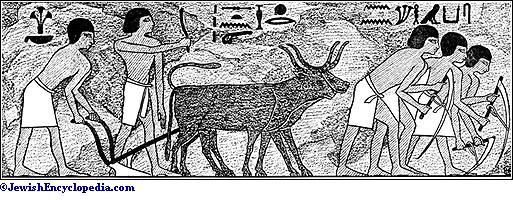
The Jews were probably the chief producers of wine and oil also in Syria and all the lands colonized by them, or otherwise the rabbinical prohibition of the wine and oil prepared by the heathen (Shab. 17b) could hardly have been adhered to. In Africa also the Jewish colonists produced wine, oil, and wheat, and the strange identification of the Egyptian god Serapis with Joseph made by both Jews ('Ab. Zarah, 43a; Tos., 'Ab. Zarah, v. [vi.] 1) and Christians (see "Vita Saturnini," quoted by Mommsen, "Römische Geschichte," v. 585, and King, "Gnostics," p. 161) probably owes its origin to the fact that the wheat exported from Alexandria was shipped to the Serapeum in Ostia under the symbolic tutelageof Serapis, the god with a measure on his head, which suggested resemblance to Joseph, the seller of corn in ancient Egypt (Mommsen, ibid. v. 577; Suidas, s.v. "Serapis"). The Alexandrian Jews owned ships and were mariners themselves, undoubtedly owing to their living near the seashore and their being made exporters of corn by the Jewish farmers throughout Africa (see Grätz, "Gesch." i. 387, note 3). That the Jews of Alexandria were both farmers and shipowners we learn from Philo ("Contra Flaccum," viii.). But Herzfeld ("Handelsgeschichte des Jüdischen Alterthums," pp. 76-102) has shown that the Jews in Palestine, too, from the time of the Maccabees until the destruction of the state, exported, partly in their own ships, their produce of crops, oil, and wine, of balsam, honey, spices, and of drugs of all kinds, and that the Jews remained tillers of the soil in all parts of the Roman empire, while pursuing other trades as well, as may be learned from the fact that they bought slaves and converted them to Judaism until they were forbidden to do so by Constantius in 339 and by Theodosius in 393 ("Codex Theodos." xvi. 8, §§ 4, 9).
In Arabia the Jews of Yemen were in the time of Mohammed thrifty farmers. The Jewish colonists of Ḥaibar especially were very successful in the cultivation of wheat and of palm-trees, before their wholesale slaughter by Mohammed.
The Jews of Abyssinia have always been farmers, and the Ten Tribes are described as agriculturists in the mythical story of Eldad ha-Dani.
In Western Europe.
The Jews of southern France pursued an agricultural life and were possessed of ships for their wine trade from the sixth to the ninth century (Cassel, article "Juden" in Ersch and Gruber, "Encyklopädie," xxvii. 61, 64; Grätz, "Gesch." v. 56, after Gregory of Tours. See also Stobbe, "Juden in Deutschland," p. 7). In Languedoc many were owners of the vineyards (J. Bédarride, "Les Juifs en France," p. 87; see Saige, "Les Juifs du Languedoc Antérieurement au XIVe Siècle, 1881," p. 70). In the time of Charlemagne, Jews used to farm large tracts of land for their Christian neighbors who had no experience in agricultural life, but the legislative measures of the king, intended to render the Jews as a merchant class more serviceable to the state, prohibited this (Bédarride, l.c., p. 75). It was especially the wine trade which they controlled (Depping, "Die Juden im Mittelalter," p. 53).
In Spain, in the early Middle Ages, the Jews were the chief agriculturists, and remained such, notwithstanding Visigoth legislation prohibiting them from working in the field on Sunday, and buying slaves and the like (see Grätz, "Gesch. der Juden," v. 70, 168). Under Egica, in 694, they were forbidden to own land and carry trade in their own ships, but in 711 the Arabs, after the invasion under Al-Tarik, restored the rights of the Jews, and the latter were quick to learn from their Moorish neighbors how to improve the method of irrigating the soil by hydraulic machines and the like (see Bédarride, l.c., p. 94 and note 24 on p. 463). The great silk industry of the Spanish Jews (see Grätz, "Gesch. der Juden," v. 396 et seq.) makes it probable that they had also plantations of mulberry-trees, or perhaps the Sicilian Jews provided them with the raw material.
In Portugal the Jews were always allowed to cultivate the land and produce wine, while they were forbidden to do so in Spain under Christian rulers (see Kayserling, "Gesch. d. Juden in Portugal," p. 58).
In Greece the Jews during the twelfth century, says Hertzberg in his "Gesch. Griechenlands," were most prosperous as agriculturists. Benjamin of Tudela found Jews inhabiting the vicinity of Mount Parnassus occupied in tilling the soil ("Travels," ed. Asher, p. 16). In Italy the Jews were encouraged by Pope Gregory V. to be owners of land, though he would not countenance their having Christian slaves (Güdemann, "Gesch. d. Jüd. Cultur in Italien," p. 30). The Jews, first of Greece, then of Italy, devoted particular care to the culture of silk, which involved the plantation of mulberry-trees, and helped toward the improvement of land and commerce (see Grätz, "Gesch." v. 272, note 4; and Güdemann, "Gesch. d. Jüd. Cultur in Italien," p. 240).
In his "Gesch. d. Jüd. Cultur in Italien," p. 52, Güdemann calls attention to the warnings of the work PirḲe Rabbi Eliezer against the wandering life of the trader, wherein occurs this sentence, A. ii.: "God particularly promised fertility of the land to the Israelites in order that they might lead a contented and quiet domestic life, and not be required to travel about from town to town."
In Central and Eastern Europe.
In Germany the Jews, being compelled by the Jewish law, which forbids the use of non-Jewish wine, to manufacture their own, produced sufficient to sell some of their own wine to non-Jews also. A decree of Henry IV. permitted the Jews to sell their own wine and drugs—revoking thereby one of Charlemagne forbidding the sale of the same (see Stobbe, "Gesch. d. Juden in Deutschland," p. 231, note 90). Henry IV. also permitted the Jews of Speyer to own vineyards and gardens, which fact makes it probable that they superintended the work themselves. The Jews of Silesia, Austria, Switzerland, and Frankfort-on-the-Main likewise possessed vineyards (see the quotation in Stobbe, "Gesch. d. Juden in Deutschland," pp. 177, 276, note 171).
In modern Europe the Jews—partly under the impulse of the governments, partly of their own free will—have endeavored to reawaken their ancient love for agricultural pursuits. The Jewish communities of Warsaw and Kalish in 1842, in response to a memorandum by Prince Paskyevitch, organized societies for the promotion of Agriculture with apparently great success, for the time (see Jost, "Neuere Gesch." ii. 293-313; Cassel, article "Juden," in Ersch and Gruber, p. 139). Still greater was the success of such efforts made in Bavaria (Scheidler, "Juden Emancipation," in Ersch and Gruber, p. 307, note 5, where reference is made to statistics showing that more than 20 per cent of the Jewish population of Bavaria were devoting themselves in 1844 to agricultural and artisan pursuits).
Among the Jews in the Caucasus many were formerly large owners of orchards and vineyards; some produced wine, others a species of tobacco (Andree, "Zur Volkskunde der Juden," p. 281). According to J. J. Benjamin ("Eight Years in Asia and Africa," 2d ed., 1858, pp. 96 et seq.), the more prosperous Jews in Kurdistan are farmers; they go with their wives and children to the fields and the vineyards in the morning, and return only in the evening. They literally observe the law of leaving the corners of the field and some of the grapes for the widows and orphans (Lev. xix. 9, 10).
In America.
On the virgin soil of America the Jews were among the pioneers of Agriculture. While Louis de Torres introduced tobacco into use for civilized mankind (Kayserling, "Columbus," p. 95), Jews transplanted the sugar-cane from Madeira to Brazil in 1548 (according to Fishell; see M. J. Kohler "Publ. Am. Jew. Hist. Soc." ii. 94) or in 1531 (Lindo, in G. A. Kohut's article, ibid. iii. 135; compare Joseph ha-Kohen, in R. Gottheil's translation, ibid. ii. 133). During the seventeenthcentury the sugar industry was monopolized by the Jews, and with their expulsion from Brazil it was transplanted to the West Indies, where, in 1663, David de Mercato's invention of new sugar-mills benefited the sugar-trade in Barbados. The Jews in Georgia, chief among them Abraham de Lyon, transplanted vine and silk culture from Portugal to America ("Publ. Am. Jew. Hist. Soc." i. 10). But while De Lyon cherished great expectations in that direction, the Jews of Georgia in general found the production of indigo, rice, corn, tobacco, and cotton more profitable (ibid. p. 12). In fact, the cotton-plantations in many parts of the South were wholly in the hands of the Jews, and as a consequence slavery found its advocates among them.
K.In Rabbinical Literature.
The following pithy sentences, culled from rabbinical literature, will serve to show the estimation in which Agriculture was held in the latter days of Jewish national life: "In time to come all handicrafts-men will turn to the working of the soil: for the soil is the surest source of sustenance to those that work it; and such occupation brings with it, moreover, health of body and case of mind" (Yeb. 63a). "He that owns no land is no man" (ib.). "The verse, Deut. xxviii. 66, is to be thus expounded: 'Thy life shall hang in doubt before thee': this refers to him that buys his food-supplies from year to year; 'thou shalt fear day and night': this refers to him that buys them from week to week; 'thou shalt have none assurance of thy life': this refers to him that depends upon the store-keeper" (Men. 103b; Yer. Shab. viii. 11a; Yer. SheḲ. viii. 51a; Esther R., introduction). "He that toils and strives after money, the while he has no land of his own, what enjoyment hath he from all his travail?" (Lev. R. xxii.). "Although trading gives greater profits, these may all be lost in a moment; therefore, never hesitate to buy land." "Sow, but do not buy grain, even though grain be cheap and thy land be poor" (Yeb. 63a). "A man may not sell his field and put the money in his purse, or buy a beast, or furniture, or a house, except he be a poor man" (Sifra, Behar, 5). "When a man sold a field out of his patrimony, his relatives would bring barrels filled with cabbage-stalks and nut-shells and break them before him; the children would gather up the contents and shout, 'N.N. has cut himself off from his inheritance!'; and when he took it back again they did the same, shouting, 'N. N. has got back his patrimony'" (Yer. Ket. ii. 26d). "He that hath a little garden of his own, and fertilizes it, digs it, and enjoys its produce, is far better off than he that works a large garden upon shares" (Lev. R. iii.). "Hast thou a field? work it with all thy might: if a man make himself a slave unto his field, he will be satisfied with bread" (Sanh. 58b). "He that inspects his field every day will find a stater [Greek coin] in it" (Ḥul. 105a). In Eccl. R. ii. 20, a story is told of a very old man who labored early and late at planting trees, though, as the emperor Hadrian taunted him, he could not expect to enjoy their fruit: the moral of the interesting narrative being that every man is bound to till the ground, even though he may not expect to reap the fruit of his labor; for when he came into the world, he found that other men had subdued and cultivated it for him: therefore shall he not allow his portion to run wild or lie barren; for there are others that shall come after him.
Plowing in Palestine.(After Benzinger, "Hebräische Archäologie.")
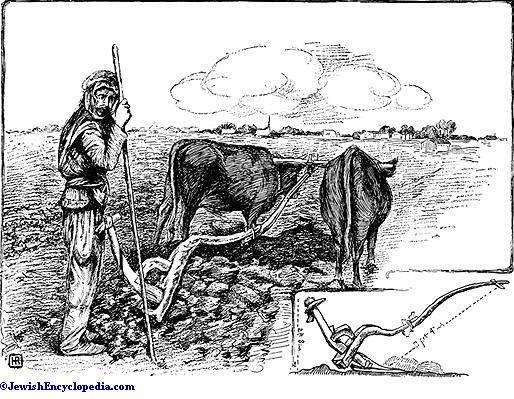
—Physical Aspects:
The various Physical Aspects of Agriculture among the Jews may properly be treated in their natural order of consideration: first as to the soil and climate; next as to the operations necessary to produce and secure crops.
Soil Conditions.
The soil of Palestine is of a most varied character and composition, consisting of alluvial deposits in the maritime plains and in the Jordan valley, and of the products of cretaceous limestone and basaltic rocks in the more elevated regions. The natural fertility of the former districts was carried into mountain regions by building low walls of "shoulder-stones" (Mishnah Sheb. iii. 9), and filling in the rock-ledges behind them with the inexhaustible alluvial earth of the valleys (ib. iii. 8). In this manner the mountainous districts of Samaria, Gilboa, Carmel, and other ranges were celebrated in ancient times for their fertility. But such artificial arrangements needed constant attention to keep them in condition and to protect them against heavy rains (see Anderlind, in "Zeit. Deutsch. Paläst. Ver." ix. 37); so that warfare and the subsequent depopulation have considerably diminished the productiveness of such regions. The lofty plain between Lake Gennesaret on the west and the Hauran range on the east, with its underlying volcanic substratum, proved a most fertile soil for wheat, as many as two and three crops a year being gathered. The most fertile fields, however, were liable to be more or less thickly strewn with boulders (Matt. xiii. 5 and parallels; Mishnah Kil. ii. 10, vii. 1), the Mishnah mentioning that occasionally these were too large for a man's unaided strength to remove (Sheb. iii. 7). The easiest and best use that could be made of the troublesome smaller stones which abounded in rich, rocky soil was to lay them up in fence-rows, as protection against roaming cattle: such stone-rows were numerous in the extreme —if one may judge from the fields of to-day (see illustration on p. 263). In some regions stones were so abundant that they had to be removed after each annual plowing (see Vogelstein, "Die Landwirtschaft in Palästina," p. 10, note 14).
In Mishnaic times various kinds of soil were distinguished and classified, such as 'idit, soil of first quality; benonit, medium; and zibburit, poor soil (Giṭ. v. 1); also according to degree of moisture, "dry," "middling," and "arable" (Baraita, Ta'anit, 25b). Stones were held to show the fertility of the soil: if they were hard and flint-like (ẓunama), the soil was good; if of clayey consistency (ḥarsit), it was likely to be poor, forming hard clods and baking in the sun (Num. R. xvi.; Tan. Shelaḥ Leka, 12). Land which naturally produced thorn-bushes was good for wheat: if it grew weeds, it was fit for barley only (YalḲuṭ, Job, § 918; compare Jer. xii. 13). A soil which had produced a crop of flax was held to be excellent for wheat; and land was sometimes tested by sowing a small piece in flax (Kil. ii. 7). A southern exposure was found to be beneficial; but such land required irrigation (Josh. xv. 19, Men. 85a).
Climate.
In contrast with Egyptian agriculture (which depended solely upon the river Nile), in Canaan the "first rains and the latter rains" became necessarily matters of especial importance and significant blessing (Lev. xxvi. 3-5; Deut. xi. 13, 14). The first (autumn) rains began in the middle of November (Ḥeshwan, or Kislew) and were called yoreh or moreh (Deut. xi. 14, Jer. v. 24). These were succeeded by the heavy and continuous winter rains, and, finally, by the malḲosh, or spring showers, in the month of Nisan (Joel, ii. 23; Ta'anit, 6a). So important was the rain after the long Syrian summer of extreme heat had parched the land, that the blessing asked for in the formula of Deut. xxvi. 15 was interpreted as a petition for rain and dew—prayers for which were likewise interpolated in the daily ritual (Mishnah Ta'anit, i. 1). Fast-days were appointed in times of drought (ib. 4-7). The fall rains were considered requisite to soften the ground preparatory to plowing and seeding; and the spring rains were equally necessary for the filling up of the grain in the ear, as expressed by the fellahin's proverb of to-day: "A shower in April is worth more than a plow and a yoke of oxen" (Klein, in "Zeit. Deutsch. Paläst. Ver." iv. 72, quoted by Vogelstein, l.c. 4, note 23). The transition from the rainy period of spring to the drought of summer is gradual, the showers growing lighter and less frequent. The mountain streams, however, continue to run high for a brief period, and then gradually slacken and dry up entirely. From Nisan to Tishri a rainstorm is a rarity, moisture being furnished by the heavy night-dews, which sometimes wet the ground to such an extent as to give it the appearance of having been rained upon.
Water-wheel in Palestine.(From a photograph by Bonfils.)
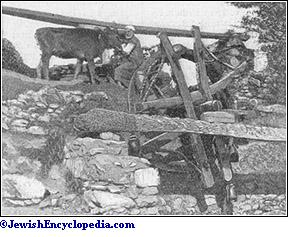
Crops.
Of all the crops planted wheat (ḥiṭṭah) was the most important in Palestine as elsewhere: so great was the fertility of the land that more wheat was produced than was required for home consumption; and it was exported in considerable quantities (I Kings, v. 25; Ezra, iii. 7; Ezek. xxvii. 17; Acts, xii. 20). Two kinds were distinguished, light and dark (B. B. v. 6). Barley (se'orah) was used for bread mainly by the poorer classes (Ruth, iii. 15; Mishnah Neg. xiii. 9), and was also used for feed for animals (Tosef., Soṭah iii. 4). Spelt (kusemet), an intermediate grain between wheat and barley, was customarily sown in the borders of fields. Oats (shifon) were not much grown. Millet (doḥan), beans (pol), and lentils ('adashim) were also widely cultivated for food (II Sam. xvii. 28, Ezek. iv. 9). Flax (pishtah) was certainly grown (Josh. ii. 6), and possibly cotton (karpas). See Barley, Beans, Lentils, Millet, Spelt, and Wheat.
The first crops planted were the pulse varieties, early in Ḥeshwan (October); barley followed a few days later, and wheat last of all. A noteworthystatute prohibited the sowing of a field "with mingled seed" (kilayim, Lev. xix. 19), an operation which in one harvest might exhaust the soil of all its fertile chemical constituents. Alongside of this may be placed the various humanitarian laws, reserving the corners of the harvest-field for the poor and the stranger (Lev. xix. 9), concerning the forgotten sheaf (Deut. xxiv. 19), and other similar regulations. The harvesting seasons were Nisan (April) for barley, Siwan (early June) for wheat, Tishri (September) for fruits. Concerning these latter, see the articles Fig, Olive, Sycamore, and Vine.
Clearing and Preparing the Land.
The various processes in Agriculture may now be considered. To cultivate land for the first time, it was necessary to clear it either of forest timber (Josh. xvii. 18) or of stones (Isa. v. 2). When thus cleared it was ready for plowing, variously called in Hebrew nir, ḥarash (to cut into), palaḥ (to cleave asunder), pataḥ (to open), etc. If the soil was clayey, the resulting clods were broken up with mattock or hoe; for in the subsequent harrowing (sadad, Job, xxxix. 10) only a light harrow, probably a thorn-bush, was employed. Manure was used: it consisted of wood-ashes (Mishnah Sheb. ii. 4), leaves (ib. 'Ab. Zarah, iii. 8), the blood of slaughtered animals (ib. Yoma, v. 6; Yer. Sheb. iii. 34), oil-scum, or of the usual house and farmyard refuse, into which straw or other litter had been trodden by cattle (Isa. xxv. 10); but whether it was applied before or after plowing does not appear. Manuring is referred to in Ps. lxxxiii. 10; Jer. viii. 2, and ix. 21. It was applied to trees, about their roots, to preserve them and to stimulate them into fruitfulness (B. ḳ. iii. 3). The passages Isa. v. 24 and xlvii. 14 refer rather to clearing the field of standing stubble by fire than to the direct use of ashes as a fertilizer. The institution of the seventh-year fallow was also a valuable factor in maintaining the fertility of the soil.
The implements used in the subsequent processes were the plow, the hoe or mattock, and a harrow of some kind. The hoe ('eder) was used to break up fields too steep or too cramped for plowing. The plow, which was of wood, usually oak, was of the simplest and lightest construction, being carried to and from the field on a man's shoulder. Its essential feature was the upright J-shaped timber, shod sometimes with iron at the point (I Sam. xiii. 20), and with a short crosshead at the top to serve as a guiding handle. This upright passed through a hole in a horizontal beam, which consisted of two stout poles lashed together, to the further end of which the yoke was secured. Consisting of so many pieces (see illustration p. 266), and these connected not strictly in the direct line of draft, the work can not have been very perfectly done: no greater depth of soil than four or five inches being penetrated and torn up. For stony or rooty ground it was of course altogether useless; such had to be "picked" with a heavy hoe (Isa. vii. 25). This was shaped something like the American corn-knife, but, the blade being set at a very acute angle to the handle, it was possible to reenforce it for its rough work by a thong or rope, as shown in the illustration (p. 264).
While the farmer's right hand grasped the handle of the plow, the team (ẓemed) of oxen (Amos, vi. 12), of cows (Job, i. 14, Heb.), or, sometimes, of asses (Deut. xxii. 10, Isa. xxx. 24), was urged onward with a goad (malmad, dorban)—a staff some eight feet long, provided with a sharp point for that purpose at one end, and at the other with a flat blade for cleaning the plow-point (Mishnah Oholot, xvii. 2) or for breaking chance clods—held in the plowman's left hand. As many as twelve teams were employed in the same field at one time; each, no doubt, in its own "land" or section (I Kings, xix. 19).
In Isa. xxviii. 25 three words are used for the act of sowing: namely, hefiẓ (to scatter) for sowing "fitches"; zaraḲ (to scatter) for sowing cumin; and sum (to place) for wheat and barley; the first two expressions evidently referring to broadcast sowing, the latter to drilling in the furrows. After sowing, the seed was plowed or brushed in with the light harrow to protect it from birds, mice, ants, and from the scorching sunshine. Sometimes the seed was sown broadcast before plowing, and covered in at one operation.
Egypt depended for irrigation upon Nile water lifted into elevated reservoirs, whence it was distributed to the fields through channels closed or opened by a hillock of earth, pushed into place by the foot (Deut. xi. 10). Palestine, on the contrary, had an abundance of brooks and rock-springs, ("fountains"); and was blessed with copious rains. From all these sources water was collected in cisterns, to guard against dry seasons when rain would be scarce and brooks and springs be dried up. An idea of the machinery used in Bible times may be obtained from that employed to raise the water from wells or springs in Palestine to-day. It consists of a horizontal wheel of roughly framed timbers, turned by a bullock or other animal tied to a sweep beneath it. This wheel connects directly with a vertical one of equally rude construction, carrying earthen jars, or other receptacles, fastened to its periphery. As these jars rise to the top they turn over and empty their contents into the conducting channels.(See illustration, p. 267.)
In addition, systems of channels and gutters were arranged to catch the heavy rains on inclined ground, and to distribute the water slowly and evenly over the soil. Such an artificially watered field was called bet ha-shelaḥin (place of pouring; see Job, v. 10, Heb.), while a field watered by rain was called bet ha-ba'al (place of rain; see B. B. iii. 1).
Crops ripe for harvesting were sometimes pulled up by the roots (Mishnah Peah, iv. 10), particularly pulse. Grain was sometimes dug up with the hoe, thus preparing the field for the next sowing (ib. Peah, iv. 4; B. M. ix. 1), but was more frequently cut with a ḥermesh(Deut. xvi. 9, xxiii. 26), or a maggal, or sickle (Joel, iii. Heb., iv. 13; Jer. l. 16). Iron sickles of the earliest times have been found in the Tell el-Hesy excavations, as also some set with a cutting edge composed of flakes of flint (Mishnah Sheb. v. 6; see illus.). Barley was harvested at Nisan, Pass-over-time (Tosef., Suk. 3, 18); wheat and spelt a few weeks later (Tan., Wayḥi, 15; see also Ex. ix. 32); and grain-harvesting was finished by Pentecost (Siwan; Tosef., Suk. ib.).
Modern Sickle.(From Benzinger, "Hebräische Archäologie.")
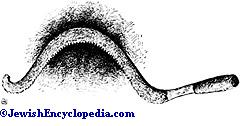
The single handfuls (ẓebatim, Ruth, ii. 16) were tied into sheaves (alummim or alummot, Gen. xxxvii. 7; Ps. cxxvi. 6) by their own straw, were piled intoheaps ('omer, Lev. xxiii. 10; Job, xxiv. 10) and in due course were transported to the barns (mezawim, Ps. cxliv. 13) or the threshing-floor (goren), possibly in wagons (Amos, ii. 13), or, when in smaller quantity, in baskets or in panniers on asses, as in Egypt to-day.
Threshing and Winnowing.
There were two methods of threshing: ḥabaṭ (to beat out with a stick) and dush (to trample); the former evidently referring to the primitive practise of beating the full ears (or pods of pulse) with a rod or fiail to extract the grain from the husks; the latter, to the trampling of them by cattle upon a hard and level floor (goren, Num. xv. 20, xviii. 27, 30; Ruth, iii. 2; II Sam. xxiv. 16). Sometimes the ears alone may have been stricken off the straw by the sickle and thrown upon the threshing-floor (Job, xxiv. 24); but the usual method was to scatter the loosened bundles of grain-bearing straw, as they came from the barn, upon the goren, to be threshed out, either by oxen, driven over them repeatedly (Hosea, x. 11)—therebytrampling them with their hoofs—or by causing cattle to draw certain heavy implements over the mass with the same result. These implements were the ḥaruẓ (Isa. xxviii. 27; Job, xli. 22) and the morag (Isa. xli. 15, I Chron. xxi. 23), both of which, to judge from their modern representatives, were heavy wooden drags, weighted additionally with large stones or with the driver's person; see illustration. The driver to-day not infrequently reposes at full length upon the drag, and even slumbers, while the docile oxen follow their monotonous round over the straw. The under side of these drags was fortified either with revolving metal disks, or, more commonly, with projecting teeth of stone (Isa. xli. 15)—little blocks of basalt, the size of a walnut in thickness—securely inserted in holes in the drag, and protruding a couple of inches (see Jastrow, "Dict." s v. , p. 526, for citations).
These instruments are referred to figuratively in Amos, i. 3 and II Kings, xiii. 7. The humane legislation of the Pentateuch in Deut. xxv. 7 forbids the muzzling of the oxen while treading out the corn; and the Talmud (Kelim, xvi. 7) similarly enjoins that they be blindfolded as a safeguard against dizziness.
Threshing in Palestine.
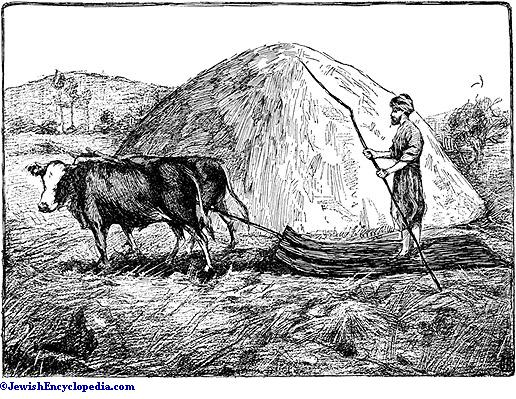
The result of so crude a system of threshing naturally was a large amount of worthless straw, torn into short lengths by the weighted teeth of the morag. Winnowing, as a consequence, became a very necessary and tedious operation. When sufficiently trampled and torn to pieces, the resultant mass of mingled grain, chaff, and short straw was tossed into the air with the mizreh (from zarah, to scatter; A. V. "fan," Isa. xxx. 24, Jer. xv. 7) and the raḥat (connected with ruaḥ = wind), properly a fork or a shovel: implements under these names are used in Palestine to-day. When a shovelful of the mingled mass upon the floor was lifted and thrown against the wind, the chaff () was blown away (Ps. i. 4); the short straw would collect some distance away on the outer edge of the heap, and was used for provender (teben; Isa. xi. 7); while the heavier grain would fall at the winnower's feet ('aremah, Ruth, iii. 7; Cant. vii. 2). This grain was still further cleansed from ears which still held kernels, and from stubble, by being shaken through a sieve (kebarah, Amos, ix. 9). It is doubtful whether the word nafah(Isa. xxx. 28; A. V. "sieve") means a sieve at all. The mesh of the Palestinian sieve of today is made of slips of dried camel-hide, and is fine enough to pass the kernels and to hold the unthreshedears which are then collected and again thrown upon the threshing-floor.
Various names for storehouses or barns are given: maabus, Jer. 1. 26; asam, Deut. xxviii. 8, Prov. iii. 10; mammegurot, Joel, i. 17; mezawim, Ps. cxliv. 13; miskenot, Ex. i. 11; I Kings, ix. 19; in rabbinical writings also oẓar, goren, megurah, and apoteki, N. T.
For a description of the various adverse influences to which the growing crops used to be exposed see Drought, East Wind, Locusts, Mildew.
Bibliography:
Ugolino, Commentarius de Re Rustica Veterum Hebrœorum, in his Thesaurus Antiquitatum Sacrarum, 1765, xxix. 1-518;
Stade, Gesch. d. Volkes Israel, i. 7;
Nowack, Lehrbuch der Hebräischen Archäologie, s.v. Ackerbau;
Benzinger, Hebräische Arch. i. B, 1894, pp. 207-213;
Thomson, The Land and the Book (popular ed., 1880), under Manners and Customs, on Harvest, Irrigation, Planting, Plowing;
Zeit. Deutsch. Paläst. Ver. ix.: Ackerbau und Viehzucht;
Quarterly Statements of the Pal. Explor. Fund (see indexes);
H. Vogelstein, Die Landwirtschaft in Palästina zur Zeit der Mischnah, Berlin, 1894;
Adler and Casanowicz, Biblical Antiquities, p. 1005.
AGRICULTURE.—Throughout the whole period of their national existence, agriculture was the principal occupation of the Hebrews. According to the priestly theory, the land was the property of J″
Of the wide range of topics embraced by agriculture in the wider significance of the term, some of the more important will be treated in separate articles, such as Cart, Flax, Food, Garden, Olive, Ox, Thorns, Vine, etc. The present article will deal only with the more restricted field of the cultivation of the principal cereals. These were, in the first rank, wheat and barley; less important were the crops of millet and spelt, and those of the pulse family—lentils, beans, and the like.
1. The agricultural year began in the latter half of October, with the advent of the early rains, which soften the ground baked by the summer heat. Then the husbandman began to prepare his fields for the winter seed by means of the plough. From the details given in post-Biblical literature, it is evident that the Hebrew plough differed but little from its modern Syrian counterpart (see PEFSt
The prevailing mode of sowing was by hand, as in the parable of the Sower, the seed being immediately ploughed in. It was possible, however, to combine both operations by fixing a seed-box to the plough-tail. The seed passed through an aperture at the bottom of the box and was conducted by a pipe along the tail. It thus fell into the drill behind the share and was immediately covered in. The patriarch Abraham was credited by Jewish legend with the invention of this form of seeding-plough (Bk. of Jubilees 11:23ff.). This mode of sowing is probably referred to in Isa 28:25 (‘the wheat in rows’ RV
2. During the period of growth the crops were exposed to a variety of risks, such as the delay or scanty fall of the spring rains (the ‘latter rain’ of the OT, Amo 4:9), blasting by the hot sirocco wind, mildew, hail—these three are named together in Hag 2:17; cf. Deu 28:22, Amo 4:9—and worst of all a visitation of locusts. The productiveness of the soil naturally varied greatly (cf. Mat 13:8). Under favourable conditions, as in the Hauran, wheat is said to yield a hundredfold return.
3. Owing to the wide range of climatic conditions in Palestine, the time of the harvest was not uniform, being earliest in the semi-tropical Jordan valley, and latest in the uplands of Galilee. The average harvest period, reckoned by the Hebrew legislation (Lev 23:15, Deu 16:9) to cover seven weeks, may be set down as from the middle of April to the beginning of June, the barley ripening about a fortnight sooner than the wheat.
The standing corn was reaped with the sickle (Deu 16:9 RV
For small quantities the ears were stripped by beating with a stick (Rth 2:17, Jdg 6:11 RV
After the threshing came the winnowing. By means of a five- or six-pronged fork, the ‘fan’ of the OT and NT, the mass of grain, chaff, and chopped straw is tossed into the air in the western evening breeze. The chaff is carried farthest away (Psa 1:4, the light morsels of straw to a shorter distance, while the heavy grains of wheat or barley fall at the winnower’s feet. After being thoroughly sifted with a variety of sieves (Amo 9:9, Isa 30:28), the grain was stored in jars for immediate use, and in cisterns (Jer 41:8), or in specially constructed granaries, the ‘barns’ of Mat 6:26.
4. Of several important matters, such as irrigation, the terracing of slopes, manuring of the fields, the conditions of lease, etc.—regarding which Vogelstein’s treatise Die Landwirtschaft in Palästina is a mine of information for the Roman period—there is little direct evidence in Scripture. Agriculture, as is natural, bulks largely in the legislative codes of the Pentateuch. Some of the provisions have already been cited. To these may be added the solemn injunction against removing a neighbour’s ‘landmarks,’ the upright stones marking the boundaries of his fields (Deu 19:14; Deu 27:17), the humanitarian provision regarding strayed cattle (Exo 23:4, Deu 22:1 ff.), the law that every field must lie fallow for one year in seven (Exo 23:10 f.; see, for later development, Sabbatical Year), the law forbidding the breeding of hybrids and the sowing of a field with two kinds of seed (Lev 19:19 RV
The fact that no department of human activity has enriched the language of Scripture, and in consequence the language of the spiritual life in all after ages, with so many appropriate figures of speech, is a striking testimony to the place occupied by agriculture in the life and thought of the Hebrew people.
A. R. S. Kennedy.
I. Development of Agriculture
II. Climatic Conditions and Fertility
III. Agricultural Pursuits
1. Growing of Grain
(1) Plowing and Sowing
(2) Reaping
(3) Threshing
2. Care of Vineyards
3. Raising of Flocks
I. Development of Agriculture
One may witness in Syria and Palestine today the various stages of social progress through which the people of Bible times passed in which the development of their agriculture played an important part. To the East the sons of Ishmael still wander in tribes from place to place, depending upon their animals for food and raiment, unless by a raid they can secure the fruits of the soil from the peoples, mostly of their own blood, who have given up wandering and are supporting themselves by tilling the ground. It is only a short step from this frontier life to the more protected territory toward the Mediterranean, where in comparatively peaceful surroundings, the wanderers become stationary. If the land which they have come to possess is barren and waterless, they become impoverished physically and spiritually, but if they have chosen the rarer spots where underground streams burst forth into valleys covered with alluvial deposits (Exo 3:8), they prosper and there springs up the more complicated community life with its servants, hirelings, gardeners, etc. A division of labor ensues. Some leave the soil for the crafts and professions but still depend upon their farmer neighbors for theft sustenance. (1Ki 5:11) Such was the variety of life of the people among whom Jesus lived, and of their ancestors, and of the inhabitants of the land long before the children of Israel came to take possession of it. Bible history deals with the Hebrews at a period when a large proportion of that people were engaged in agrarian pursuits, hence we find its pages filled with references to agricultural occupations.
II. Climatic Conditions and Fertility
With climatic conditions and fertility so varied, the mode of cultivation, seedtime and harvest differed even in closely adjacent territory. On the coastal plains and in the low Jordan valley the soil was usually rich and the season was early, whereas the mountainous regions and high interior plains the planting and reaping times were from two weeks to a month later. To make use of the soil on the hillsides, terracing was frequently necessary. Examples of these old terraces still exist. On the unwatered plains the crops could be grown only In the winter and spring, i.e. during the rainy season. These districts dried up in May or June and remained fallow during the rainless summer. The same was true of the hilly regions and valleys except where water from a stream could be diverted from its channel and spread over the fields. In such districts crops could be grown irrespective of the seasons. See IRRIGATION.
III. Agricultural Pursuits
To appreciate the many references in the Bible to agricultural pursuits and the frequent allusions of our Lord to the fields and their products, we must remember how different were the surroundings of the farmers of that day from those among which most of us live or with which we are acquainted. What knowledge we have of these pursuits is drawn from such references as disclose methods bearing a close similarity to those of the present day. The strong tendency to resist change which is everywhere manifest throughout the country and the survival of ancient descriptive words in the language of today further confirm our belief that we now witness in this country the identical operations which were used two thousand or more years ago. It would be strange if there were not a variety of ways by which the same object was accomplished when we remember that the Hebrew people benefited by the experience of the Egyptians, of the Babylonians, of the inhabitants of the land of their adoption, as well as of its late European conquerors. For this reason the drawings found on the Egyptian monuments, depicting agricultural scenes, help us to explain the probable methods used in Palestine.
Three branches of agriculture were more prominent than the others; the growing of grain, the care of vineyards (Num 18:30), and the raising of flocks. Most households owned fields and vineyards and the richer added to these a wealth of flocks. The description of Job’s wealth (in Job 1) shows that he was engaged in all these pursuits. Hezekiah’s riches as enumerated in 2Ch 32:27, 2Ch 32:28 suggest activity in each of these branches.
1. Growing of Grain
In this and following descriptions, present-day methods as far as they correspond to ancient records will be dealt with.
(1) Plowing and Sowing
On the plains, little or no preparation for plowing is needed, but in the hilly regions, the larger stones, which the tilling of the previous season has loosened and which the winter’s rains have washed bare, are picked out and piled into heaps on some ledge, or are thrown into the paths, which thus become elevated above the fields which they traverse. (See FIELD.) If grain is to be planted, the seed is scattered broadcast by the sower. If the land has not been used for some time the ground is first plowed, and when the seed has been scattered is plowed again. The sower may keep his supply of seed in a pocket made by pulling up his outer garment through his girdle to a sufficient extent for it to sag down outside his girdle in the form of a loose pouch. He may, on the other hand, carry it in a jar or basket as the sowers are pictured as doing on the Egyptian monuments. As soon as the seed is scattered it is plowed in before the ever-present crows and ravens can gather it up. The path of the plow in the fields of the hilly regions is a tortuous one because of the boulders jutting out here and there (Mat 13:3) or because of the ledges which frequently lie hidden just beneath the surface (the rocky places of Christ’s parable). When the plowman respects the footpaths which the sufferance of the owner has allowed to be trodden across his fields or which mark the boundaries between the lands of different owners, and leaves them unplowed, then the seed which has fallen on these portions becomes the food of the birds. Corners of the field where the plow cannot reach are hoed by hand. Harrowing-in as we know it is not practiced today, except on some of the larger plains, and probably was not used in Palestine in earlier times. See HARROW.
(2) Reaping
After the plowing is over, the fields are deserted until after the winter rains, unless an unusually severe storm of rain and hail (Exo 9:25) has destroyed the young shoots. Then a second sowing is made. In April, if the hot east winds have not blasted the grain (see BLASTING) the barley begins to ripen. The wheat follows from a week to six weeks later, depending upon the altitude. Toward the end of May or the first week in June, which marks the beginning of the dry season, reaping begins. Whole families move out from their village homes to spend the time in the fields until the harvest is over. Men and women join in the work of cutting the grain. A handful of grain is gathered together by means of a sickle held in the right hand. The stalks thus gathered in a bunch are then grasped by the left hand and at the same time a pull is given which cuts off some of the stalks a few inches above ground (see STUBBLE) and pulls the rest up by the roots. These handfuls are laid behind the reapers and are gathered up by the helpers (see GLEANING), usually the children, and made into piles for transporting to the threshing-floor.
(3) Threshing
The threshing-floors are constructed in the fields, preferably in an exposed position in order to get the full benefit of the winds. If there is a danger of marauders they are clustered together close to the village. The floor is a level, circular area 25 to 40 ft. in diameter, prepared by first picking out the stones, and then wetting the ground, tamping or rolling it, and finally sweeping it. A border of stones usually surrounds the floor to keep in the grain. The sheaves of grain which have been brought on the backs of men, donkeys, camels, or oxen, are heaped on this area, and the process of tramping out begins. In some localities several animals, commonly oxen or donkeys, are tied abreast and driven round and round the floor. In other places two oxen are yoked together to a drag, the bottom of which is studded with pieces of basaltic stone. This drag, on which the driver, and perhaps his family, sits or stands, is driven in a circular path over the grain. In still other districts an instrument resembling a wheel harrow is used, the antiquity of which is confirmed by the Egyptian records. The supply of unthreshed grain is kept in the center of the floor. Some of this is pulled down from time to time into the path of the animals. All the while the partly threshed grain is being turned over with a fork. The stalks gradually become broken into short pieces and the husks about the grain are torn off. This mixture of chaff and grain must now be winnowed. This is done by tossing it into the air so that the wind may blow away the chaff (see WINNOWING). When the chaff is gone then the grain is tossed in a wooden tray to separate from it the stones and lumps of soil which clung to the roots when the grain was reaped. The difference in weight between the stones and grain makes separation by this process possible (see SIFT). The grain is now poled in heaps and in many localities is also sealed. This process consists in pressing a large wooden seal against the pile. When the instrument is removed it leaves an impression which would be destroyed should any of the grain be taken away. This allows the government offers to keep account of the tithes and enables the owner to detect any theft of grain. Until the wheat is transferred to bags some one sleeps by the pries on the threshing-floor. If the wheat is to be stored for home consumption it is often first washed with water and spread out on goats’ hair mats to dry before it is stored in the wall compartments found in every house (see STOREHOUSES). Formerly the wheat was ground only as needed. This was then a household task which was accomplished with the hand-mill or mortar (see MILL).
2. Care of Vineyards
No clearer picture to correspond with present-day practice in vine culture (see VINE) in Palestine could be given than that mentioned in Isa 5:1, Isa 5:6. Grapes probably served an important part in the diet of Bible times as they do at present. In the season which begins in July and extends for at least three months, the humblest peasant as well as the richest landlord considers grapes as a necessary part of at least one meal each day. The grapes were not only eaten fresh but were made into wine (see WINEPRESS). No parallel however can be found in the Bible for the molasses which is made by boiling down the fresh grape juice. Some writers believe that this substance was meant in some passages translated by wine or honey, but it is doubtful. The care of the vineyards fitted well into the farmer’s routine, as most of the attention required could be given when the other crops demanded no time.
3. Raising of Flocks
The leaders of ancient Israel reckoned their flocks as a necessary part of their wealth (see SHEEP TENDING). When a man’s flocks were his sole possession he often lived with them and led them in and out in search of pasturage (Psa 23:1-6; Mat 18:12), but a man with other interests delegated this task to his sons (1Sa 16:11) or to hirelings. Human nature has not changed since the time when Christ made the distinction between the true shepherd and the hireling (Joh 10:12). Within a short time of the writing of these words the writer saw a hireling cursing and abusing the stray members of a flock which he was driving, not leading as do good shepherds.
The flock furnished both food and raiment. The milk of camels, sheep and goats was eaten fresh or made into curdled milk, butter or cheese. More rarely was the flesh of these animals eaten (see FOOD). The peasant’s outer coat is still made of a tawed sheepskin or woven of goats’ hair or wool (see WEAVING). The various agricultural operations are treated more fully under their respective names, (which see).
See FARMING.
Agriculture is the work of growing crops and raising animals for food and other useful products. In biblical times, agriculture in Palestine was organized into three main forms, similar to how it is today. The focus on each type of agriculture varied based on the society’s social and technological development.
Preview
Herding
Raising livestock is one of the earliest jobs mentioned in the Bible. Abel (Genesis 4:2) and Jabal (Genesis 4:20) were shepherds or had cattle. This job suited their seminomadic lifestyle (moving from place to place), providing both food and clothing with only basic techniques and equipment.
The patriarchs Abraham, Isaac, and Jacob were mainly herdsmen, grazing their sheep and cattle on common land and generally not farming the soil. Jacob and his sons came to Egypt as shepherds (Genesis 47:3). Later, this way of life continued among the tribes of Reuben, Gad, and the half-tribe of Manasseh in Transjordan (Numbers 32:1) as well as in some tribes living in the western hills of Palestine (1 Samuel 25:2).
Even after settling down, herding remained a part of Hebrew life because the animals could graze on less productive land and because of traditional practices, including the sacrifices made in the temple.
Field Cropping
Most experts believe that the Israelites learned how to farm from the Canaanites because they were in contact with them when they settled in the promised land. Although growing grain was known to have existed before then, with Cain being a farmer or “tiller of the soil” (Genesis 4:2), it is unclear what exactly he grew.
Archaeologists have found evidence of grain farming dating back to around 6800 BC in the Near East. Isaac sowed grain in Gerar (Genesis 26:12), and Joseph dreamed of sheaves of grain (Genesis 37:6–7). Joseph likely learned more about grain farming from the Egyptians, who grew it on the rich soils of the Nile.
However, it was the Canaanites who taught the Israelites how to grow grain. Joshua and Caleb reported the productivity of Canaan at Kadesh-barnea (Numbers 13:26), and the conquered Canaanites probably helped their conquerors learn farming techniques. This interaction may have also contributed to the Israelites' repeated lapses into idolatry (Judges 9:27).
The speed at which they transitioned from a nomadic lifestyle is not clear. Some tribes remained nomadic, but by the time of the kings, many Israelites were farming the land (2 Samuel 14:30).
Wheat was one of the most important crops. Solomon sent large amounts of wheat, along with barley and oil, to Hiram (2 Chronicles 2:10), and it continued to be a major export (Ezekiel 27:17). Barley was the second most important crop. It was the main ingredient in bread early on (Judges 7:13). Later became a significant food for poorer people (John 6:9, 13). It was also used as feed for cattle.
Other field crops included beans and lentils (2 Samuel 17:28), which were ground into meal and sometimes used to make bread (Ezekiel 4:9). Leeks, garlic, and onions were grown for flavoring, while cumin, coriander, dill, mint, rue, and mustard were used as spices. Flax was important (Joshua 2:6). Some cotton was grown (Isaiah 19:9). Wool was used to supplement fiber supplies. By Roman times, cotton had become more important than flax.
Fruit Raising
Once the Israelites settled down, they began planting orchards and vineyards, which became symbols of prosperity. Vineyards produced wine for drinking, while olive orchards provided oil used in cooking, cosmetics, and medicine. They also grew figs and pomegranates. Growing these crops required more skill and equipment compared to earlier farming practices.
Cultivating
Throughout biblical times, much of the farming work was done by the farmers themselves. To start planting, they had to clear the land of forests (Joshua 17:18), stones (Isaiah 5:2), weeds, and thorns. Sometimes they terraced hilly land or used irrigation. These tasks limited farm sizes, so only wealthy individuals like Job and Boaz could have large farms.
To till the land, farmers used oxen or cows to pull very basic plows (Judges 14:18; Amos 6:12). Occasionally donkeys was used (Deuteronomy 22:10). They broke up clods with a hoe or a goad, and smoothed the surface by dragging a simple harrow, which might have been a thornbush or a stoneboat. Seeds were sown by hand, either carefully in furrows or spread over the surface and then lightly covered with the harrow or stoneboat. Weeds were controlled with the plow, harrow, or hoe.
Farm tools changed little during biblical times. The plow was a simple J-shaped piece of hardwood attached to oxen at one end and held by the driver at the other end. This basic tool could only break up four to five inches (10 to 13 centimeters) of soil. After the Exodus, iron was used for the plow tip (1 Samuel 13:20), which mainly helped reduce wear.
Fertilizer use was very limited on Palestinian farms. The law required fields to lie fallow every seventh year to help replenish the soil's water and nutrients. Manuring fields was uncommon because dung was primarily used as fuel. However, the Bible mentions some use of dung around trees (Luke 13:8). The Mishnah notes the use of wood ashes, leaves, animal blood, and oil scum as fertilizers.
Harvesting
Seeding was done at the start of the rainy season, and harvesting began at the end. Harvesting typically lasted at least seven weeks. Some crops, like pulses, were pulled up by the roots, while others, like some grains, were dug with a hoe. Most crops, however, were cut with a sickle. Archaeologists have found iron sickles, some with flint flakes set into the cutting edges. The harvested grain was tied into sheaves (Psalm 126:6) and stacked into heaps to be taken to the threshing floor. Barley was harvested first, followed by wheat.
Small quantities of grain, dill, cumin, and other small crops were beaten out with a flail (Judges 6:11; Ruth 2:17). Most grain was threshed on a floor elevated to let the wind blow away the chaff. The common method involved spreading the loosened straw on the floor and driving oxen over it to release the grains. Sometimes heavy tools weighted with stones were drawn over the straw (Isaiah 28:27; 41:15). These tools were ridden by the driver.
The resulting chaff was separated from the grain through a process called winnowing, where the mixture was tossed into the air with a fork or shove (Isaiah 30:24; Jeremiah 15:7). The lighter chaff was blown away, while the heavier grain fell to the ground. The chaff was either burned or used as animal feed. The grain was sifted (Amos 9:9), gathered into heaps, and later stored in covered pits in the field (Jeremiah 41:8). Sometimes it was stored in granaries (Deuteronomy 28:8).
See also Plants; Harvest; Palestine; Vines, Vineyard; Food and Food Preparation.
Aquifer Open Bible Dictionary © 2026 Mission Mutual, an adaptation of the Tyndale Open Bible Dictionary © 2023 Tyndale House Publishers. Licensed under CC BY-SA 4.0.
The science of cultivation. The task, given to humanity, of cultivating the land is a reflection of God's own care for his creation.
A major activity for humanity
GEN 2:15 See also GEN 3:23, GEN 4:2, GEN 4:12, GEN 9:20, GEN 47:19; DEU 8:7–8:8; 1KI 19:19; 2CH 26:10; ISA 37:30
Growth is according to the sovereign will of God
He has established the seasons
GEN 8:22; ACT 14:17 See also LEV 26:4; JER 5:24
He provides for the growth of the crops
PSA 65:9 See also PSA 104:14, PSA 107:37–107:38, PSA 147:8; EZK 34:26–34:27; ZEC 8:12; MAT 6:30; 2CO 9:10
OT laws for agriculture showed how to co-operate with God
LEV 19:19 See also LEV 19:23, LEV 25:3–25:4; DEU 22:10
Harvest festivals were for thanking God for his provision
EXO 34:22 See also LEV 23:10, LEV 23:39–23:41; DEU 16:10, DEU 16:13
Cultivation was affected by the fall
GEN 3:17 See also GEN 3:18–3:19, GEN 4:12, GEN 5:29; ROM 8:20
Agricultural images of God's action among his people
ISA 5:7; MAT 9:37; JHN 12:24 See also ISA 17:5–17:6, ISA 24:13; JER 8:20, JER 50:16, JER 51:33; HOS 6:11; MAT 13:3–13:8 parallels MRK 4:3–4:8, LUK 8:5–8:8; MAT 13:18–13:23 parallels MRK 4:13–4:20, LUK 8:11–8:15; MAT 13:24–13:30; MRK 4:26–4:29; JHN 4:35–4:38
Dictionary of Bible Themes © 1999 Martin H. Manser. Licensed under CC BY-SA 4.0.