
The Book of Isaiah is one of the four great collections of Hebrew prophecy, formed by bringing together smaller and earlier collections, and it contains prophecies from many prophets across different periods, with Isaiah's own prophecies being the best-known part. The prophet is described as the son of Amoz, who prophesied during the reigns of Uzziah, Jotham, Ahaz, and Hezekiah, kings of Judah, a span dated from about 765 to 700 B.C. The book is marked by variety of tone, style, thought, and historical background. Its opening verse presents the prophecy as concerning Judah and Jerusalem, and it treats largely of the failures of the nation of Judah.
Nothing more is known of the ancestors of Isaiah than that he was the son of Amoz. He prophesied in the days of Uzziah, Jotham, Ahaz, and Hezekiah, all kings of Judah. From the closing years of Uzziah to the death of Hezekiah would be from about B.C. 765 to 700, embracing a period of 65 years. The first verse says that the vision was concerning Judah and Jerusalem. Had due attention been paid to this, it would have prevented many things being ascribed in the headings of the chapters to the church, and the prophecy would have been the better understood. In few words the prophecy may be said to treat of the failures of the nation of Judah and the judgements upon it. Assyria is used as God’s rod to punish them, and is then destroyed. Judgements are pronounced against the nations around the promised land that had been enemies to God’s people. The Messiah is prophesied of and His rejection, and universal blessing is spoken of.
The following seven divisions are distinctly marked:
Isa. 1 - Isa. 12: The sinful condition of the people as still in possession of the land; various pleadings and chastisements culminating in the Assyrian; the introduction of Immanuel; ends with a song.
Isa. 13 - Isa. 27: Judgements on Babylon and the nations where Israel was captive and outcast; ends in deliverance from their outcast condition and worship at Jerusalem.
Isa. 28 - Isa. 35: Five woes on unfaithful Israel; ends with deliverance from the Assyrian and the confederacy of nations, and the joy of the kingdom.
Isa. 36 - Isa. 39: Historical, but typical; the way of blessing for Jerusalem and the house of David.
Isa. 40 - Isa. 48: Controversy of God with Israel on account of idolatry. Cyrus (type of Christ) the deliverer.
Isa. 49 - Isa. 57: Controversy of God with Israel on account of the rejected suffering Messiah.
Isa. 58 - Isa. 66: Final results; the remnant delivered and blessed.
Isa. 1 - Isa. 4. are introductory. The ’sinful nation’ was completely corrupt, and had been sorely chastised; there was no soundness from head to foot; though chastened, there was no contrition, and God’s judgements must still follow. There is also grace in store for the latter days: Zion will be a centre of blessing, and a remnant will be saved.
Isa. 5. Israel was God’s vineyard and the men of Judah His pleasant plant: the people were judged in view of the care God had bestowed on them, no remnant is mentioned: cf. Mat 21:33-41.
Isa. 6. The people were unfit for their Messiah, but will be judged in view of His coming glory: a remnant is acknowledged.
Isa. 7. Immanuel, Son of David, is introduced as a sign for faith, when unbelief was seeking a confederacy. The house of David after the flesh is judged: still there is hope. See IMMANUEL.
Isa. 8 - Isa 9:7. The Assyrians overrun the land, and the confederacy of nations is to be brought to nought. A remnant, ’my brethren,’ is attached to Immanuel, who is a stone of stumbling to the unbelieving nation, but a light amid the darkness until He is received in power and glory.
Isa 9:8 - Isa 10. The national history is resumed from the end of Isa. 5. Various judgements from the Lord are detailed until the last judgement by means of the Assyrian, who is used as a rod by God, and then is punished for his pride in the last days.
Isa. 11. Messiah, the ’Branch,’ and His reign the source of millennial blessing.
Isa. 12. Israel’s song of triumph in that day: compare with Exo 15.
Isa. 13 - Isa. 24. ’Burdens’ are pronounced. They are judgements on Babylon and the nations, especially on those who were in relationship with Israel. Moab, Damascus, "the land shadowing with wings which is beyond the rivers of Ethiopia," Egypt, "the desert of the sea," Dumah, Arabia, "the valley of vision" (Jerusalem), Tyre, "the earth [or land] made empty and waste, and turned upside down;" and finally the hosts on high and kings on the earth punished.
Isa. 25, Isa. 26. A song in which God’s intervention is celebrated, even to the swallowing up of death in victory.
Isa. 27. The power of Satan, "leviathan, the piercing serpent, even leviathan that crooked serpent" is destroyed, and worship established in Jerusalem.
Isa. 28 - Isa. 35. give details of all that will happen to the Jews in the last days. They make a covenant with death and with hell, but their covenant will be disannulled. Security is in the Stone laid in Zion, all else will perish.
Isa. 29. Judgements are pronounced against Jerusalem under the name of Ariel, ’lion of God’; deliverance comes when at the last extremity, but a far worse judgement, a spirit of blindness, rests on the people. In the day of deliverance the remnant will come to understanding, the scorner being consumed.
Isa. 30, Isa. 31. They seek counsel of and trust in Egypt instead of in God.
Isa. 32. Christ will reign in righteousness: desolation is followed by restoration.
Isa. 33. The attack of a spoiler in the character of Gog (Ezek. 38), but the Lord, having filled Zion with judgement and righteousness, arises and the enemy is destroyed, and Zion is in peace.
Isa. 34, Isa. 35. Final judgement pronounced upon Idumaea and other nations (cf. Psa 83); and the blessings that will succeed the judgement.
Isa. 36 - Isa. 39. treat of Hezekiah and Sennacherib. Waiting upon the Lord is enforced. The deliverance wrought is figurative of the outward deliverance there will be from the Assyrian for Jerusalem and the house of David in the last days. Hezekiah’s personal history is appended to this, as figurative of the nation’s sense of the judgement of God upon them, leading to repentance and recovery, and inward or moral deliverance.
Isa. 40 - 43. begin another part of the book. The Messiah is but little introduced: it is rather a question of God and idols. There is comfort for those who have an opened ear. The Lord Jesus, Jehovah’s servant and His elect, shall bring forth judgement to the Gentiles.
Isa. 44. Jehovah reasons with Jacob and Jesurun: cf. Deu 32:15; Deu 33:26-27; Israel, embracing the twelve tribes.
Isa. 45 - 47. Cyrus is God’s servant, and He would subdue nations before him. God would keep open the two-leaved gates (of Babylon, which were left open in their festivity). The idols of Babylon could not save her: she should be brought to shame for her pride.
Isa. 48. God pleads with Israel.
Isa. 49 - Isa. 57. introduce Christ, and show the people’s guilt in respect to Him.
Isa 50:1-9. Israel had been as divorced, but Messiah had come to them suitably, to instruct them and take up their cause. Who would contend with Him?
Isa 50:10 - Isa. 51. The character of the remnant: they are owned as ’my people’ by the Lord God, and He will comfort and redeem them.
Isa 52:1-12. Zion is called to awake and put on her strength, the feet of messengers with glad tidings were beautiful.
Isa 52:13 - Isa. 53. These refer to the work of Christ in a five-fold way, including the atonement.
Isa. 54, Isa. 55. Jerusalem is called upon to sing: through the sure mercies of David there are blessings in store for her, and full free grace to every one that thirsts.
Isa. 56, Isa. 57. Exhortations follow in view of the restoration of Israel; and those, even of Israel, are denounced that walk contrary to God’s will.
Isa. 58, Isa. 59. Indignation of the Spirit at the condition of Israel at the time the prophecy was uttered, but goes on to the end, when the Redeemer shall come to Zion.
Isa. 60. The glory of Jerusalem in the times of blessing.
Isa. 61, Isa. 62. Christ, in the full grace of His person, is concerned in the blessing of Israel.
Isa. 63, Isa. 64. Christ returns from the judgements of Isa. 34 with garments stained with the slaughter of His enemies; followed by the intercessions of the Spirit of prophecy.
Isa. 65. God’s answer to those pleadings.
Isa. 66. Judgements introducing the millennium, ending with these solemn words: "They shall go forth, and look upon the carcasses of the men that have transgressed against me: for their worm shall not die, neither shall their fire be quenched; and they shall be an abhorring unto all flesh."
This prophecy embraces a very large field. The condition of the people was sinful when the prophecy was written, and though God had long patience with it, yet the condition was such that judgement must be executed upon it unless there was true repentance. Judgement did follow, but the consummation of evil was not reached until their Messiah had come, and had been rejected ; indeed Antichrist will yet be received. Judgement followed the rejection of their Messiah, but the great tribulation is yet to come.
Quotations from Isaiah in the N.T. (nearly forty in number) show that his words applied to the times that then were; such as the condition of the people; the unprofitableness of the rites and ceremonies; and that grace to the Gentiles had been foretold. The climax of Israel’s sin, and of their judgement, and of God’s blessing are still future. Christ coming in humiliation is revealed in the prophet as well as His glory; indeed, all the ways of God in dealing with His people Israel, on to the end - though some subjects are expanded elsewhere - are to be found in this comprehensive prophecy: clearly it could only have been written under the inspiration of the Holy Spirit.
By: Emil G. Hirsch, Thomas Kelly Cheyne
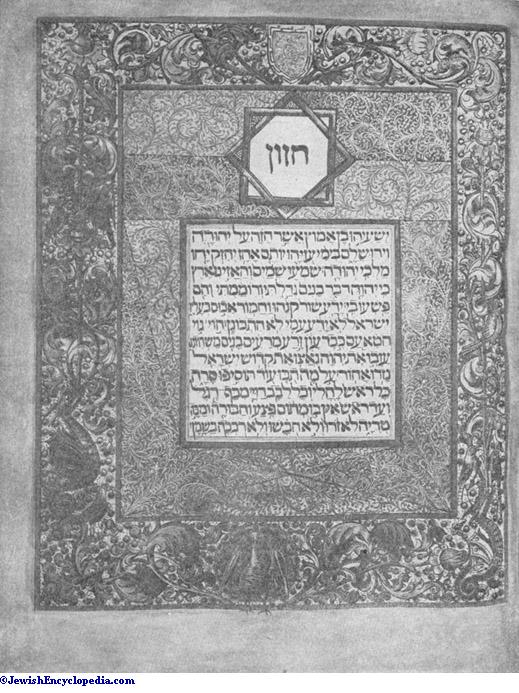 Illuminated Page of Isaiah from a Manuscript Bible, Said to Be of the Twelfth Century.(Lately in the possession of Henriques de Castro, Amsterdam.)
The chief note of the Book of Isaiah is variety—variety of tone, of style, of thought, and of historical background. The first step in the study of Isaiah is to realize this variety by taking a survey of the contents. The heading (i. 1) prepares the reader to expect a collection of closely related prophecies (hence called a "vision," in the singular) concerning Judah and its capital. It is plain, therefore, that ch. xiii.-xxiii. were only inserted as an afterthought; for, with the exception of ch. xxii., they all relate to foreign nations; ch. xiv. 24-27, xvii. 12-14, xxii. 1-14, and 15-25 (which relate to Judah or Jerusalem) may be regarded as fragments which would have perished if an editor had not thought of inserting them in this group. Ch. xxiv.-xxvii., also, can only have been admitted through an extension of the original plan, for they speak primarily of a judgment upon the earth at large, and when they do digress to Israel it is in obscure language, which the men of "Judah and Jerusalem" could not generally have understood. Similarly, ch. xxxiv.-xxxv. can have formed no part of the original vision, for the larger part (xxxiv.) is concerned, not with Judah, but with Edom. Ch. xxxvi.-xxxix. speak of Isaiah in the third person, and largely coincide with II Kings xviii. 13-xx. 19. Ch. xl.-lxvi. have for their background, at any rate to a considerable extent, Jerusalem in ruins and her people in captivity. In following, therefore, that instinct of order, which is, of course, not the same thing as criticism, but is at least one element in it, the first impressions of Isaiah must be obtained from ch. i.-xii. and xxviii.-xxxiii.
Ch. i.: One of the finest specimens of prophetic rhetoric known. It is in its present form a general prophecy, full of edification for all periods of Israel's history, thòugh the prominence given in verses 29, 30 to the heathen worship practised in the recesses of gardens would not have seemed perfectly natural in the later period of strict religious purity. There are four leading ideas: Israel's ingratitude to its God; the false repentance of oblations; the true repentance of a changed life; purification from without, failing purification from within.
Ch. ii.-iv.: A series of denunciations of the national corruption enclosed between two pictures of the ideal age. Here Isaiah goes into greater detail, both as to the nature of Judah's sin and as to the inevitable punishment. Like a thunder-storm the wrath of God will overthrow the proud, and sweep away the heathenish luxury of the grandees of the land; all classes will be disturbed from their pleasant security; the ablest citizens will go into captivity, for theirs is the greatest guilt; nor shall the women of Jerusalem escape (comp. Amos iv. 1-3).
Ch. v.: A briefer utterance with similar scope. It begins with a bright parable on the vineyard of God, the moral of which is the danger of Judah's ingratitude; then follows a series of "wos" on the chief national sins, and a weird, mysterious announcement of terrible invaders.
The Call of the Prophet.
Ch. vi.: This chapter might well have stood at the head of the whole book. It describes the call of the prophet. A vision, such as all prophets may expect to have (though abundance of visions is no proof of the goodness of a "man of God"), came to Isaiah, and in this vision—the sum of which was the glorified and idealized Temple—God and Isaiah interchanged these words: "Whom shall I send?" "Send me." No passage is so important as is this one for the true biography of Isaiah.
Ch. vii.-ix. 7: Partly historical, partly prophetical. It is unfortunate that this precedent is not followed more frequently. It is now known that Isaiah sought to influence Ahaz, but was repelled by the king. Judah was in sore peril from the invaders Pekah and Rezin (not the invaders to whom he pointed so mysteriously in v. 26 et seq.), and there was a conflict between the two principles—reliance on outside human help and implicit trust in Israel's God. Ahaz stood for the first, Isaiah for the second. One result there was which Ahaz could never have anticipated: the sign of Immanuel has supplied material for controversy to the present hour. It might be thought that it was a promise of safety. But Isaiah could not "speak peace when there was no peace." It is desolation, and not deliverance, which the unbelief of Ahaz will ultimately bring on his unhappy country (vii. 17-25). In ch. viii. 1-4 Isaiah reaffirms his declaration (vii. 7-9) of a judgment swiftly coming to Damascus and Samaria. But will Judah escape? No, but the kernel of the nation will escape. Judgment will bring about purification. A deliverer already exists in the counsels of God, and he will restore the kingdom of David in an idealized form (ix. 1-7).
Ch. ix. 8-x. 4: A highly poetical picture of the approaching ruin of the Northern Kingdom, though there are also glances at Judah. The rivalry of factions in the state and the fall of the incompetent rulers on the field of battle are graphically described.
Reliance on Assyria.
Ch. x. 5-xii. 6: There is more religious thought, however, in the discourses contained in these chapters. The variety of imagery, too, is highly remarkable. Assyria (that is, its king; comp. the use of "France" and "England" in Shakespeare) is the staff or the ax in God's hand. Its army is like a forest. Assyria's lust of conquest is like the sport of bird-nesting. See the astonishingly rapid march of the armed hosts! Some with their leader "shake their hands" at the sacred mountain. The Davidic kingdom will, as it seems, be cut down. But so, too, Assyria will be cut down; and while a "shoot" (R. V.) will "come forth out of the stock of Jesse," no such prospect is held out for Assyria. Not to Babylon, but to Jerusalem, will the nations repair. Not in Assyria, but in the land of Israel, will the peace of paradise be exemplified. Thither will all Israel's exiles be brought back, singing psalms of devout and grateful joy.
Ch. xxviii.-xxxiii.: These chapters also are full of variety. From the first the prophet alternates between judgment and salvation. The proud crown of the drunkards (princely drunkards!) of Ephraim is trodden down; for the residue there is a crown of glory (Samaria fell 722 B.C.). But there are drunkards (priestly drunkards!) in Judah too, trusting in a "refuge of lies" instead of in the "sure foundation" stone (xxviii. 15-17). At another time the teacher seems to have adopted a different tone. A few, perhaps, became dejected by Isaiah's frequent reference to destruction. Would this plowing and thrashing go on forever? No; an earthly husbandman is too wise for that; and the heavenly husbandman knows best of all that destruction is justified only by the object of sowing some useful plant when the soil has been prepared (xxviii. 23-29).It is true, as ch. xxix. shows, the great majority were quite otherwise impressed by Isaiah's preaching. A deep lethargy clouded the senses of the rulers (verses 10-12). But the crash of thunder will awaken them. Within a year Jerusalem will be besieged, and in the midst of the siege God Himself will fall upon Jerusalem and punish her (1-4, 6). But fear not; the foe will suffer most; God will not permit the nations to destroy Mount Zion (5, 7, 8). Wo to the formalists and to the unbelieving politicians of Judah! (13-15). But all the best blessings are to the poor and the meek.
Alliance with Egypt.
The cause of Isaiah's wrath against the politicians was an alliance with Egypt which was being planned in secret. This is shown by ch. xxx. Isaiah predicts the disappointment which awaits the ambassadors, and the terrible results which willfollow from this short-sighted statecraft. But here again the usual contrast is introduced. Storm and sunshine compete with each other. The Golden Age will yet come; Nature will participate in the happiness of regenerate Judah. Assyria will be crushed, and meantime the Jews will sing, as in the night of the feast-day (the vigil of the Passover; comp. Ex. xii. 42). In ch. xxxi.-xxxii. 8 the prophet still hovers about the same theme, while in xxxii. 9-20 the careless security of the women is chastised (comp. iii. 16 et seq.), the desolation soon to be wrought by the invader is described, and, as a cheering contrast, the future transformation of the national character and of the physical conditions of life are once more confidently announced. Ch. xxxiii. is one of the most singular of the extant specimens of prophetic writing. There is no apparent arrangement, and some of the verses seem to be quite isolated. It is a kind of vision which is described. The land is being laid waste. O Lord, help! But see! the hostile hordes suddenly disappear; Zion's God is her security. Alas! not yet. The highways still lie waste. The whole country from Lebanon to Sharon mourns. Yes, it is God's time to arise. He has, in fact, arisen, and the "godless" (the converted Jews) tremble, while the righteous are assured of salvation. How happy will the retrospect of their past troubles make them! (verse 18). Then, too, it will be plain that Zion's load of guilt has been removed.
Book of Judgments.
The idea which pervades the first of the five lesser books (ch. xiii.-xxiii., xxiv.-xxvii., xxxiv.-xxxv., xxxvi.-xxxix., and xl.-lxvi.) which still await consideration may be expressed in Isaiah's own words (they are taken here provisionally to be Isaiah's): "This is the purpose that is purposed upon the whole earth: and this is the hand that is stretched out upon all the nations" (xiv. 26). It is, in fact, a Book of Judgments on the nations, except that four passages have found admission into it which relate, not to the world outside, but to the little people which, as Isaiah may have thought, out-weighed in the eyes of God all the other nations put together. These four passages are as follows:
Ch. xiv. 24-27 is a short prophecy declaring the purpose of Israel's God to tread Assyria under foot upon the "mountains" of Judah, to which is appended a solemn declaration, part of which is quoted above (verses 26, 27). In ch. xvii. 12-14 there is a graphic prophecy of the destruction of the "many nations" which attack Jerusalem (comp. viii. 9, 10; xxix. 7, 8); no special nation is singled out. In ch. xxii. 1-14 there is an indignant rebuke of the people of Jerusalem, who are in no degree sobered by the danger, just now removed, from the Assyrians; instead of examining into their ways, ceasing to do evil, and learning to do well, they indulge in wild revelry. In ch. xxii. 15-25 an invective against the vizier of the day (Shebna) is followed by a promise of his office to a worthier man (Eliakim), to which an appendix is attached announcing this second vizier's fall.Of the judgments upon definite nations, other than the Jewish, the first (ch. xiii.) declares the doom of Babylon, and to it is appended a fine, artistic ode of triumph on the King of Babylon (xiv. 4b-21). Observe that the prophet distinctly speaks as if the Medes were already mustering for the march on Babylon. Is it to be supposed that Isaiah was at the time in an ecstasy? Ch. xiv. 22-23 is a prophecy, summing up Babylon's doom in more prosaic style.
Ch. xiv. 28-32 contains the doom of the Philistines, who are in premature exultation at the "breaking" of some terrible "rod." Ch. xv.-xvi. 12 are highly dramatic; they begin with a picture of the consternation of the Moabites at the havoc wrought by an invader, describe the flight' of the people in much detail, mention how an appeal to Mount Zion for help was rejected, make sympathetic references to the lamentations of the Moabites over their ruined vines, and then, without any apparent connection, assert that no appeal to Chemosh for aid will be effectual. To this is added (verses 13, 14) a solemn declaration that the prophecy which had been delivered at some previous period shall be fulfilled within three years.
Ch. xvii. 1-11 is directed against Damascus (that is, Syria) and Ephraim (that is, Israel). These two powers have set themselves against the true God, and must suffer the same doom. However, the few who are left in Israel will turn to the holy God, and give up lower forms of worship.
Ch. xviii. was apparently intended to be an address to Ethiopia. But already (verse 3) the prophet turns to the world at large, and bids men take heed of the signs of the divine approach. When the power hostile to God is ripe for destruction, it will be cut off. Then will the Ethiopians send presents to Jerusalem. The doom, therefore, is really confined to verses 4-6.
Ch. xix. describes the utter collapse of Egypt, owing to its conquest by a "cruel lord" (verse 4). The main interest, however, lies in verses 18-24, which apparently contain circumstantial predictions of the establishment of Jewish colonies in five cities of Egypt, including the "city of the sun"; of the erection of a sanctuary in Egypt to Israel's God; of the deliverance of the Jews (?) in Egypt in their sore distress; of the conversion of the Egyptians; and of the providential discipline of Egypt, which henceforth will be a member of a sacred triad of closely connected nations—Egypt, Assyria, and Israel.The prophecy in ch. xx. gives a second judgment upon Egypt, and a perfectly new judgment on Ethiopia. It stands in marked contrast both to ch. xviii. and to ch. xix. Its possession of a historical introduction would have led to its being grouped with ch. vii.-ix. 7 and ch. xxxvi.-xxxix.; but doubtless it was too short to stand alone.
Ch. xxi. contains three "burdens" (or oracles)— that of the "wilderness of the sea" (R. V.), relative to the destruction of Babylon by Elam and Media (contingents in the assailing army?), that of Dumah (that is, Edom), and that of the "Dedanites" (R. V.), entitled by the early editors of the Hebrew text "in Arabia," words apparently derived from the opening words "in the forest in Arabia." The oracles in ch. xxi. contain great textual difficulties.The only remaining prophecy in this section is that on Tyre. It has a strongly elegiac character, and its reference is much disputed. Here, again,textual problems have to be settled before any attempts at exegesis. But it is clear that the standpoint of verses 15-18 is not that of verses 1-14. It is an epilogue, and expresses a much more hopeful spirit than the original prophecy. Tyre will one day be of importance to the people of Jerusalem; its prosperity is therefore to be desired. Here, then, the note of variety or contrast is as strongly marked as in any part of Isaiah.Still more remarkable is the variety in the contents of the second of the lesser books (ch. xxiv.-xxvii.). It is observed by R. G. Moulton that, dramatic as this fine passage is, one looks in vain for temporal succession, and finds instead "the pendulum movement dear to Hebrew imagination, alternating between judgment and salvation." However, the parts of this "rhapsody" can not safely be distributed among the dramatis personæ, for it is no literary whole, but a "rhapsody" in a sense not intended by Moulton, a collection of fragments, large or small, stitched, as it were, together. It might also be called a "mosaic," and, since very little, if any, attempt has been made to fuse the different elements, one might, with much advantage, read this composite work in the following order:(1) xxiv. 1-23: The Last Judgment.(2) xxv. 6-8: The Feast of Initiation into communion with God, spread not only for Israel, but for all peoples.(3) xxvi. 20, 21: Summons to the Jews to shut themselves up, while God carries out the awful doom of the wicked (comp. Ex. xii. 22b, 23).(4) xxvii. 1, 12: Mystic prophecy of the Leviathan's doom, and the restoration of the entire body of dispersed Jews.(5) xxvii. 7-11: Conditions of salvation for the Jews.(6) xxvi. 1-19: Song of praise for the deliverance of the Righteous, which passes into a meditative retrospect of recent events, and closes with a prophecy of the resurrection of those who have been faithful unto death.(7) xxv. 1-5: Song of praise for the destruction of an insolent city.(8) xxv. 9-12: Praise for deliverance, and anticipations of the downfall of Moab.(9) xxvii. 2-5: Song concerning God's vineyard, Israel.
Ch. xxxiv.-xxxv. show the same oscillation between judgment and salvation which has been previously noted. The judgment upon all nations (especially Edom) is depicted in lurid tints; upon this, with no link of transition, follows a picture of salvation and of the restoration of the Jewish exiles.
Ch. xxxvi.-xxxix. are a mixture of narrative, prophecy, and poetry. The great deliverance from Assyria under Hezekiah, in which Isaiah plays an important part, is related. An ode on the fall of the King of Assyria (recalling xiv. 4b-21) shows Isaiah (if it be Isaiah) to be a highly gifted poet (xxxvii. 21b-29); and a kind of psalm (see xxxviii. 20), ascribed to Hezekiah, tells how the speaker had recovered from a severe illness, and recognized in his recovery a proof of the complete forgiveness of his sins. A historical preface elucidates this. Both the ode in ch. xxxvii. and the psalm in ch. xxxviii. are accompanied with circumstantial prophecies, not in a poetic style, addressed to Hezekiah. Ch. xxxix. contains a prediction of a Babylonian captivity, also addressed to Hezekiah, and a historical preface.
The Question of Ch. xl.-lxvi.
There still remain ch. xl.-lxvi., which follow abruptly on ch. xxxvi.-xxxix., though a keen eye may detect a preparation for "Comfort ye, comfort ye," in the announcement of the spoiling of Jerusalem and the carrying away of Hezekiah's sons to Babylon in ch. xxxix. Ch. xl.-lxvi. are often called "The Prophecy of Restoration," and yet it requires no great cleverness to see that these twenty-seven chapters are full of variety in tone and style and historical background. A suggestion of this variety may be presented by giving a table of the contents. Alike from a historical and from a religious point of view, these chapters will reward the most careful study, all the more so because controversy is rendered less acute respecting these prophecies than respecting the prophecies in ch. i-xxxix. The word "prophecies," however, has associations which may mislead; they are better described as "unspoken prophetic and poetical orations."
(1) Good news for the Exiles (xl. 1-11).
(2) Reasoning with the mental difficulties of Israel (xl. 12-31).
(3) The Lord, the only true God, proved to be so by the prophecy concerning Cyrus (xli. 20).
(4) Dispute between the true God and the false deities (xli. 21-29).
(5) Contrast between the ideal and the actual Israel, with lofty promises (xlii. 1-xliii. 7).
(6) How Israel, blind as it is, must bear witness for the true God, who is the God of prophecy: the argument from prophecy is repeatedly referred to (xliii. 8-13).
(7) The fall of Babylon and the second Exodus (xliii. 14-21).
(8) The Lord pleads with careless Israel (xliii. 22-xliv. 5).
(9) Once more, the argument for the true God from prophecy, together with a sarcastic description of the fabrication of idols (xliv. 6-23).
(10) The true object of the victories of Cyrus—Israel's deliverance (xliv. 24-xlv. 25).
(11) The deities of Babylon contrasted with the God of Israel (xlvi. 1-13).
(12) A song of derision concerning Babylon (xlvii. 1-15).
(13) The old prophecies (those on Cyrus' victories) were great; the new ones (those on Israel's restoration) are greater (xlviii.).
(14) Israel and Zion, now that they are (virtually) restored, are the central figures in the divine work (xlix. 1-13).
(15) Consolations for Zion and her children (xlix. 14-l. 3).
(16) The true servant of the Lord, at once confessor and martyr, soliloquizes (l. 4-11).
(17) Exhortation and comfort, with a fervid ejaculatory prayer (li. 1-16).
(18) Words of cheer to prostrate Zion (li. 17-lii. 12).
(19) The martyrdom of the true servant of the Lord, and his subsequent exaltation (lii. 13-liii. 12).
(20) Further consolations for Zion, who is once more the Lord's bride, under a new and everlasting covenant (liv.).
(21) An invitation to the Jews of the Dispersion to appropriate the blessings of the new covenant, followed by more prophecies of deliverance (lv.).
(22) Promises to proselytes and to believing eunuchs (lvi. 1-8).
(23) An invective against the bad rulers of Jerusalem and against the evil courses of heretical or misbelieving persons, with promises to humble-minded penitents (lvi. 9-lvii. 21).
(24) Practical discourse on fasting and Sabbath-observance (lviii.).
(25) Partly denunciation of immorality, partly confession of sins (lix. 1-15a).
(26) A vision of deliverance, with a promise of the permanence of regenerate Israel's mission (lix. 15b-21).
(27) A poetic description of glorified Zion (lx.).
(28) The true servant of the Lord, or, perhaps, the prophetic writer, soliloquizes concerning the gracious message entrusted to him, and the Lord confirms his word (lxi. 1-12).
(29) Vision of the divine warrior returning from Edom (lxiii. 1-6).
(30) Exhausted and almost despairing, Israel complains to the Lord (lxiii. 7-lxiv. 12).
(31) Threatenings to the heretical and misbelieving faction, and promises to the faithful (lxv.).
(32) Polemic against those who would erect a rival temple to that of Jerusalem (lxvi. 1-4).
(33) The fates of Jerusalem and all her opponents contrasted (lxvi. 5-24).
The Critical Problem.
The reader who has not shrunk from the trouble of the orderly perusal of Isaiah which is here recommended will be in a position to judge to some extent between the two parties into which, as it may strike one who is not an expert, the theological world is divided. The study of criticism, as it is commonly called, apart from exegesis, is valueless; he is the best critic of Isaiah who knows the exegetical problems best, and to come into touch with the best critics the student must give his days and nights to the study of the text of this book. An attempt will now be made to give some idea of the main critical problem. Many persons think that the question at issue is whether ch. i.-xxxix. were (apart from slight editorial insertions) written by Isaiah, and ch. xl.-lxvi. by some other writer of a much later age. This is a mistake. A series of prophetic announcements of deliverances from exile is interspersed at intervals throughout the first half of Isaiah, and the date of these announcements has in each case to be investigated by the same methods as those applied to the different parts of Isa. xl.-lxvi. The "parts" of Isa. xl.-lxvi. are referred to because here again there exists a widely prevalent error. That the second part of Isaiah has no literary unity will be obvious to any reader of the preceding synopsis. To argue the question whether the so-called Book of Isaiah has one or two authors is to beat the air. If there was more than one Isaiah, there must have been more than two, for the same variety of idea, phraseology, and background which is by so many scholars taken to prove that "Comfort ye, comfort ye my people, saith your God" (xl. 1) was not written by Isaiah can be taken to prove that "Cry aloud, spare not, lift up thy voice like a trumpet, and declare unto my people their transgressions" (lviii. 1, R. V.) was not written by the author of "Comfort ye, comfort ye my people."
The "Variety" of Isaiah.
By "variety" is not, of course, meant total, absolute difference. It stands to reason that a great prophet like Isaiah would exert considerable influence on subsequent prophetic writers. There is no justification, therefore, for arguing that because the phrases "the Holy One of Israel" and "the Mighty One of Israel" occur in both halves of Isaiah (the second phrase, however, is varied in Isa. xl. et seq. by the substitution of "Jacob" for "Israel"), the same prophet must have written both portions. A correspondence of isolated phrases which is not even uniformly exact is of little value as an argument, and may be counterbalanced by many phrases peculiar to the disputed prophecies. Still more unwise would it be to argue, from a certain general likeness between the idea of God in the prophecies of the two parts of Isaiah, that the two parts had the same prophetic author, especially now that the extent of Isaiah's contributions to the first half of the book is being so keenly debated. Most unwise of all would it be to attach any weight to a tradition of Isaiah's authorship of the whole book which goes back only to Ecclesiasticus (Sirach) xlviii. 24, 25: "By a spirit of might he saw the end, and comforted the mourners of Zion, forever he declared things that should be, and hidden things before they came" (Hebr.).
Two eminent Jewish rabbis, Abraham ibn Ezra and Isaac Abravanel, were the first who showed a tendency to disintegrate the Book of Isaiah, but their subtle suggestion had no consequences. Practically, the analytic criticism of Isaiah goes back to Koppe, the author of the notes to the German edition of Bishop Lowth's "Isaiah" (1779-81). The chief names connected with this criticism in its first phase are those of Hitzig, Ewald, and Dillmann; a new phase, however, has for some time appeared, the opening of which may perhaps be dated from the article "Isaiah" in "Encyc. Brit." (1881) and two articles in "J. Q. R." (July and Oct., 1891), all by T. K. Cheyne; to which may be added the fruitful hints of Stade in his "Gesch. des Volkes Israel" (1889, vol. i.), and the condensed discussions of Kuenen in the second edition of his "Investigations into the Origin and Collection of the Books of the Old Testament" (part ii., 2d ed., 1889). To these add Duhm's and Marti's recent commentaries, and the "Introduction" (1895) by T. K. Cheyne. Prof. G. A. Smith's two volumes on Isaiah reflect the variations of opinion in a candid mind, influenced at first, somewhat to excess, by the commentary of Dillmann. For a convenient summary of the present state of criticism the reader may consult Kautzsch's "Outline of the History of the Literature of the Old Testament" (1898), translated by John Taylor, and "Isaiah," in Cheyne-Black, "Encyc. Bibl." (1901). The former work shows how much light is thrown on the different parts of the Book of Isaiah by reading them as monuments of definite historical periods. For a much less advanced position Driver's "Life and Times of Isaiah" (1st ed., 1888) may be consulted; for an impartial sketch of different theories consult the sixth edition of the same writer's "Introduction to the Literature of the Old Testament."
Periods of the Prophecy.
It must suffice here to give a few hints as to the probable periods of the chief prophecies. Three great national crises called forth the most certainly genuine prophecies of Isaiah—the Syro-Israelitish invasion (734), the siege and fall of Samaria (722), and the campaign of Sennacherib (701). Among the non-Isaian prophecies, there are two exilic prophecies of the fall of Babylon (xiii. 1-xiv. 23, and, as most suppose, xxi. 1-10); a probably post-exilic prophecy, or elegy, on the ruin of Moab (xv.-xvi.); prophecies on Egypt and on Tyre, both post-exilic, and the former furnished with a late appendix belonging to the Greek period. The strange and difficult work here called a "rhapsody" or a "mosaic" (ch. xxiv.-xxvii.) belongs at earliest to the fall of the Persian and the rise of the Greco-Macedonian empire. Ch. xxxiv.-xxxv. are so weak that it is not worth while to dogmatize on their date, which is certainly very late. The Prophecy of Restoration is, of course, a late exilic work; it is disputed whether it closes properly at ch. xlviii. or at ch. lv. The subsequent prophecies are additions, belonging presumably to the times of Nehemiah and Ezra. The latest editor of ch. xl.-lxvi. seems to have given a semblance of unity to thevarious prophecies by dividing the entire mass into three nearly equal books, the two former of which close with nearly the same words (xlviii. 22, lvii. 21).
Bibliography: I. Commentaries, Translations, and Critical Editions:
G. D. Luzzatto, Il Profeta Isaia, Padua, 1855 (Jewish);
R. Lowth, Isaiah, a new translation with preliminary dissertation and notes, London, 1778;
E. Henderson, Book of the Prophet Isaiah, 2d ed. ib. 1840;
J. A. Alexander, Commentary, Edinburgh, 1865;
T. K. Cheyne, The Book of Isaiah Chronologically Arranged, London, 1870;
idem, Prophecies of Isaiah, a new translation, with commentary and appendixes, ib. 1880-82;
G. A. Smith, Isaiah, in Expositor's Bible, ib. 1888-90;
J. Skinner, Isaiah, in Cambridge Bible for Schools and Colleges, Cambridge, 1896-98;
H. G. Mitchell, Isaiah, a Study of Chapters i.-xii. New York, 1897;
T. K. Cheyne, Isaiah, translation and notes, in S. B. O. T. New York and London, 1898 (Hebrew ed. with notes, Leipsic, 1899);
Ed. König, The Exiles' Book of Consolation, Edinburgh, 1899;
Camp. Vitringa, Commentary, 2 vols., Leeuwarden, 1714-1720;
J. C. Döderlein, Esaias (translation with notes), Nuremberg, 1789;
E. Reuss, Les Prophètes, 1876;
W. Gesenius, Der Prophet Jesaja Uebersetzt; mit einem Vollständigen Philologischen, Kritischen, und Historischen Commentar, Leipsic, 1820-21;
F. Hitzig, Der Prophet Jesaja, Heidelberg, 1833;
H. Ewald, Die Propheten des Alten Bundes, Tübingen, 1810-41 (2d ed. Göttingen, 1867-68; Eng. transl. by J. F. Smith, 1875-81);
A. Knobel, Der Prophet Jesaja, Leipsic, 1843 (3d ed. 1861);
Franz Delitzsch, Biblischer Commentar über das Buch Jesaja, Leipsic 1866 (4th ed. entirely recast, 1889; Eng. transl. 1892);
C. J. Bredenkamp, Der Prophet Jesaja Erläutert, Erlangen, 1887;
Conrad von Orelli, Die Propheten Jesaja und Jeremias, Nördlingen, 1887 (Eng. transl. by Banks, 1889);
Aug. Dillmann, Der Prophet Jesaja, Leipsic. 1890;
Duhm, Das Buch Jesaja, Göttingen, 1892;
Aug. Klostermann, Deuterojesaia, Munich, 1893 (a critical edition of ch. xl.-lxvi.);
H. Guthe and V. Ryssel, Jesaja, in Kautzsch, Die Heilige Schrift, vol. xv., Freiburg-im-Breisgau and Leipsic, 1894;
K. Marti, Das Buch Jesaja, Tübingen, 1900.
II. Illustrative and Comprehensive Notes: S. R. Driver and Ad. Neubauer, The 53d Chapter of Isaiah According to Jewish Interpretations (with introduction by E. B. Pusey), Oxford, 1876-77;
G. Vance Smith, The Prophecies Relating to Nineveh and the Assyrians, London, 1857;
R. Payne Smith, The Authenticity and Messianic Interpretation of the Prophecies of Isaiah Vindicated, Oxford and London, 1862 (the lines of Jewish interpretations are well sketched);
Sir E. Strachey, Jewish History and Politics in the Times of Sargon and Sennacherib, 2d ed. London, 1874;
T. K. Cheyne, Introduction, to the Book of Isaiah, ib. 1895;
W. Robertson Smith, The Prophets of Israel, Edinburgh, 1882 (2d ed. London, 1896);
A. H. Sayce, Life of Isaiah, London, 1883;
C. H. H. Wright, Pre-Christian Jewish Interpretations of Isaiah liii. in The Expositor (London), May, 1888;
S. R. Driver, Isaiah, His Life and Times, and the Writings Which Bear His Name, London, 1888;
J. Kennedy, Argument for the Unity of Isaiah, ib. 1891;
C. H. H. Wright, Isaiah, in Smith's Dict. of the Bible, 2d ed. 1893;
G. Douglas, Isaiah One and His Book One, London, 1895;
C. F. Kirkpatrick, Doctrine of the Prophets, ib. 1892;
Max L. Keliner, The Prophecies of Isaiah, an Outline Study in Connexion with the Assyrian-Babylonian Records, Cambridge, Mass., 1895;
J. F. McCurdy, History, Prophecy, and the Monuments, New York and London, 1894;
F. H. Krüger, Essai sur la Théologie d'Esaie xl.-lxvi. Paris, 1861;
C. P. Caspari, Beiträge zur Einleitung in das Buch Jesaja, Berlin, 1848;
idem, Ueber den Syrisch-Ephraimit. Krieg Unter Jotham und Ahaz, Christiania, 1849;
L. Seinecke, Der Evangelist des Alten Testaments, Leipsic, 1870;
H. Guthe, Das Zukunftsbild, des Jesaja, ib. 1885;
Fr. Giesebrecht, Beiträge zur Jesaiakritik, Göttingen, 1890;
M. Schian, Die Ebed-Jahwe Lieder, Halle, 1895);
H. Lane, Die Ebed-Jahwe Lieder, Wittenberg, 1898;
E. Sellin, Serubbabel, Leipsic, 1898;
A. Bertholet, Zu Jesaja liii.: Ein, Erklärungsversuch, Freiburg-im-Breisgau, 1899;
H. Winckler, Alttestamentliche Untersuchungen, Leipsic, 1897;
idem, Altorientalische Forschungen, ib. 1897;
J. Meinhold, Jesaja und Seine Zeit, Freiburg-im-Breisgau, 1898;
idem, Die Jesajaerzählungen, Jesaja xxxvi.-xxxix. Göttingen, 1898. See also the various histories of Israel, introductions to the Old Testament, and Old Testament theologies.
ISAIAH, BOOK OF.—The Book of Isaiah is one of the four great collections of Hebrew prophecies. Like the book of ‘The Twelve Prophets’—another of these great collections (see Micah [Book of])—it was formed by incorporating with one another smaller and earlier collections, and contains prophecies of many prophets living at different periods; with the exception of Isaiah’s, the prophecies contained in the collection are anonymous, the term ‘Deutero-Isaiah,’ applied to the author of chs. 40–66 (or 40–55), being of course nothing more than a modern symbol for one of these anonymous writers.
1. Composition and literary history of the present book.—The Book of Isaiah, substantially as we now have it, probably dates, like the ‘Book of the Twelve Prophets,’ from towards the end of the 3rd cent. b.c. But the external evidence is scanty and some of it ambiguous; and the internal evidence of certain sections is differently interpreted; if, as the interpretation of Duhm and Marti would require us to infer, ch. 33 and ch. 34f. were not written till towards the middle of the 2nd cent., and chs. 24–27 not until after b.c. 128, it is obvious that the collection which contains these sections did not attain its present form and size till some (possibly considerable) time later than b.c. 128.
The most important piece of external evidence is contained in Sir 48:22-24. In this passage the author, writing about b.c. 180, refers to Isaiah as one of the godly men of Israel, worthy of praise, and, as afterwards (Isa 49:6-8) In the case of Ezekiel and of Jeremiah, he cites, or alludes to, certain sections which now stand in the book that bears the prophet’s name. Thus he says: Isa 49:22 ‘For Hezekiah did that which was pleasing to the Lord, and was strong in the ways of David his father, which Isaiah the prophet commanded, who was great and faithful in his vision’; Isa 49:23 ‘In his days the sun went backward; and he added life to the king’; Isa 49:24 ‘By a spirit of might be saw the end, and comforted the mourners in Sion’; Isa 49:25 ‘For ever he declared the things that should be, and hidden things before they came.’ Possibly the last clause of Isa 49:22 refers to the title ‘The vision of Isaiah’ (Isa 1:1); certainly Isa 1:23 refers to the narrative of Is 38 (= 2Ki 20:1-21), and Isa 1:24 f. shows familiarity with the recurrent arguments from prophecy in Is 44–48 (see e.g. Isa 41:21-24, Isa 43:9, Isa 46:9, Isa 48:4 ff.), while 48:24b is somewhat clearly reminiscent of the actual phraseology of Isa 40:1, Isa 61:2-3. Though it would be possible to invent somewhat different explanations of these facts, much the most probable inference is that, by the beginning of the 2nd cent. b.c., some (if not all) of the prophecies in chs. 1–35 had already been brought into a book, and to these had been appended, not necessarily or even probably at the same time, (a) chs. 36–39, (b) chs. 40–66 (or the most part thereof), and that the whole book at this time was attributed to Isaiah. Actual citations from the Book of Isaiah by name, which would help to prove the extent of the book at given periods, are not numerous before the 1st cent. a.d., when we find several in the NT: Isa 1:9 is cited in Rom 9:29; Isa 6:9 f. in Mat 13:14 f., Joh 12:40, Act 28:25 f.; Isa 9:1 f. in Mat 4:14 ff; Mat 10:22 f. in isa 9:27 f.; Rom 11:10 in isa 15:12; 29:13 in Mar 7:6 f.; Isa 40:3-5 in (Mar 1:3) Mt 3:3; 42:1–4 in Mt 12:17–21; 53:1, 4, 7f. in Rom 10:16, Mat 8:17, Act 8:30; Act 8:32 f.; Isa 61:1 f. in Luk 4:17-19; Isa 65:1 f. in Rom 10:20 f. There are also some twenty-five unnamed citations in NT (Swete, Introd. to OT in Greek, 385 f.), some of which, like the unnamed citations from the Greek text of Isa 3:10; Isa 44:20 in Wis 2:12; Wis 15:10 (about b.c. 50), are, taken in conjunction with the named citations, not without significance. Still, rigorous proof that the Book of Isaiah contained all that it now contains much before the final close of the Canon (see Canon of OT), is wanting. The general considerations which, taken in conjunction with the proof afforded by Sir 48:17-25 that (most or all of) chs. 40–66 ranked as Isaiah’s as early as b.c. 180, make it wisest, failing strong evidence to the contrary, to reckon with the probability that by about that time the book was substantially of the same extent as at present, are (a) the history of the formation of the Canon (see Canon of OT), and (b) the probability, created by the allusions in the prologue (about b.c. 132) to Sirach to translations of prophecies, that our present Greek version dates from before 132. This version appears to proceed from a single age or hand, and yet it is, apart from brief glosses, of the same extent as the present Hebrew text of the book.
If we may adopt the most natural inference from 2Ch 36:22 f. = Ezr 1:1 f., external evidence would go far to prove that chs. 40–66 were not included in the Book of Isaiah much before the close of the 3rd cent. b.c. For the Chronicler here attributes the prophecy of Cyrus, which forms so conspicuous a feature of Is 40–48 (see Isa 41:1 f., Isa 43:24 to Isa 45:7, and esp. compare 2Ch 36:23 with Isa 43:28), not to Isaiah but to Jeremiah, which he would scarcely have done if in his time (not earlier than b.c. 300) these anonymous chapters were already incorporated in a book entitled Isaiah. If we reject this inference, we are thrown back entirely on the evidence of the Book of Isaiah itself for the determination of the earliest date at which it can have been compiled.
Turning then to the internal evidence, we note first the structure of the book: (a) chs. 1–35—prophecies, some of which are attributed to Isaiah (Isa 1:1; Isa 2:1 etc.), interspersed with narratives by or about Isaiah (chs. 6, 7, 8, 20); (b) chs. 36–39—historical narratives of the life and times of Isaiah, identical in the main with 2Ki 18:1-37; 2Ki 19:1-37; 2Ki 20:1-21; (c) chs. 40–66—anonymous prophecies. Comparison with the Book of Jeremiah, which concludes with a chapter (52) about the times of Jeremiah derived from 2Ki 24:18 ff., suggests that our present book has resulted from the union of a prophetic volume, consisting (in the main) of prophecies by or attributed to Isaiah, with an historical appendix and a book of anonymous prophecies. This union, as we have seen above, took place before b.c. 180: if any parts of chs. 1–39 are later than this, their presence in the book is due to subsequent interpolation.
If it were possible to write a full history of the literary process which culminated in the Book of Isaiah as we now have it, it would be necessary to trace in detail first the growth of chs. 1–39, then that of chs. 40–66, and lastly the causes which led to the union of the two. But this is not possible; in particular, we do not know whether chs. 40–66 were added to chs. 1–39 owing to the triumph of an Isaianic theory over the Jeremianic theory or tradition of the origin of these chapters (2Ch 36:22 f.; see above), or whether, as some have supposed, they were added to make the Book of Isaiah more nearly equal in size to the other prophetic collections—Ezekiel, Jeremiah, and the Twelve—with the result that as early as b.c. 180 these chapters came to be attributed to Isaiah; or whether something else, which we cannot conjecture, was the real cause of this union. But, apart from internal evidence pointing to the different periods in which different sections originated, certain indications of the complexity of the literary process do exist, particularly in the case of chs. 1–39; these we may consider. (1) The matter is not arranged chronologically: the call (cf. Eze 1:1-28, Jer 1:1-19) of Isaiah, which naturally preceded any of his prophecies, is recorded not in ch. 1, but in ch. 6. Similarly, in the Koran the record of Mohammed’s call does not occur till Sura 96; in this case the reason is that the editors of the Koran followed the rather mechanical principle of arranging the suras according to their size. The cause of the order in the case of the Book of Isaiah may in part be found in the fact that (2) the occurrence of several titles and indications of different principles of editorial arrangement points to the fact that chs. 1–35 (39) is a collection of material, some of which had previously acquired a fixed arrangement; in other words, chs. 1–35 is a book formed not entirely, or perhaps even mainly, by the collection and free re-arrangement of prophetic pieces, but rather by the incorporation whole of earlier and smaller books. Following these clues, we may first divide these chapters thus: (1) ch. 1 with title (Isa 5:1), probably intended to cover the larger collection; (2) chs. 2–12 with title Isa 2:1; (3) chs. 13–23 with title Isa 13:1 naming Isaiah, and corresponding sub-titles not mentioning Isaiah, in Isa 15:1, Isa 17:1, Isa 19:1, Isa 21:1; Isa 21:11; Isa 21:13, Isa 22:1, Isa 23:1 (cf. elsewhere Isa 30:6); (4) chs. 24–27, distinguished from the preceding sections by the absence of titles, and from the following by the absence of the opening interjection; (5) chs. 28–31 (33)—a group of woes; see Isa 28:1, Isa 29:1 (RV
It is impossible to enter into details here as to the dates when these several booklets first appeared, or as to the various processes of union or re-arrangement or interpolation or other modifications. Merely to state theories which have been put forward, without adducing proof or offering criticism, would require more space than is available. And from the nature of the case it would be impossible to offer any complete theory that would not be in many respects uncertain. It is more important to appreciate the general fact, which is clear, that the Book of Isaiah is the result of a long and complex literary history, than to be ready to subscribe to any particular theory of this history. But two points may be briefly touched on. (1) Much of the literary process just referred to lies after the Exile. As will he shown below, chs. 40–55 were not written till the last years of the Exile; chs. 56–66 are certainly of no earlier, and probably of later, origin. The union of chs. 1–39 and 40–66 cannot therefore fall before the close of the Exile, and, as shown above, it need not, so far as the external evidence is concerned, fall much before b.c. 180. But even 1–39 was not a volume of pre-exilic origin; for the appendix 36–39 is derived from Kings, which was not completed till, at the earliest, b.c. 561 (cf. 2Ki 25:27), or even in what may be regarded as its first edition (cf. Driver, LOT
But how far, if not in the order in which he spoke or wrote them, have the words of Isaiah reached us substantially as he spoke them. The question is not altogether easy to answer, particularly in one respect. Isaiah was pre-eminently a prophet of judgment; but intermingled with his warnings are many passages of promise: see e.g. Isa 2:2-4 and Isa 4:2-6, enclosing Isa 2:7 to Isa 4:1, Isa 9:1-6 concluding the warnings of ch. 8, and the constant interchange of warning and promise in chs. 28–31. Are these passages of promise Isaiah’s, or the work of some later writers with which later editors sought to comfort as well as to exhort their readers? These questions in general, and in detail with reference to each particular passage, are still far from settled. The general question of Messianic prophecy in Isaiah is briefly referred to in preceding art.; for details see Cheyne’s Introd. to the Book of Isaiah, or commentaries such as those of Duhm and Marti, or, on a smaller scale and in English, of Whitehouse. Here this alone can be said: the period over which and down to which the history of the growth of the Book of Isaiah extends, and the complexity of that growth, would easily allow of these passages being incorporated as suggested by the theory; and we have the presumption created, for example, by the absence of the last clause of ch. 6 from the Greek text, that short consolatory annotations were still being made as late as the 2nd cent. b.c. Once the significance of the complexity of the Book of Isaiah is grasped, this at least should become clear, that the question, is such and such a passage authentic? meaning, Was it written by Isaiah? proceeds from a wrong point of view. The proper question is this: To what period does such and such a passage in this collection of prophecies, made certainly after the Exile and probably not much before the close of the 3rd cent. b.c., belong?
The presence of explanatory annotations is now generally recognized. For example, in Isa 7:20 Isaiah speaks figuratively of Jahweh using a razor; an editor added a note, which has intruded into the text, that by ‘razor’ we are to understand the king of Assyria. As to the number of such annotations scholars differ.
2. Summary.—The following summary of the Book of Isaiah and of the periods at which its several parts appear, or have been supposed, to have been written, must be used in the light of the foregoing account of the origin of the book. In the clearer cases the evidence of date is briefly indicated; in others one or two theories are mentioned. But for the evidence, such as it is, the reader must turn to larger works; it would require more space than the scope of the article allows, even to summarize it here. Again, in the majority of cases no attempt is made to indicate the smaller annotations of which an example is given in the preced. paragraph. For a synthesis (in part) of those sections of the book which consist of Isaiah’s prophecies, see Isaiah; and in connexion with chs. 40–55, consult art. Servant of the Lord.
Isa 1:1. Title.—Probably prefixed by an editor who brought together a considerable collection of Isaiah’s prophecies. ‘The days of Uzziah, Jotham, Ahaz, and Hezekiah’ describe the entire period of Isaiah’s activity.
Isa 1:2-31. Till comparatively recently this was generally regarded as a single discourse, constituting, as Ewald terms it, the ‘great arraignment.’ But there was no agreement as to the period of Isaiah’s lifetime to which it belonged,—some scholars referring it to the period of the Syro-Ephraimitish War (cf. ch. 7), almost at the beginning, others to the time of Sennacherib’s invasion at the close, of Isaiah’s career. If, as is really probable, this is not a single discourse, these differences are in part accounted for. The chapter falls into these sections—(a) Isa 1:2-17, which may perhaps itself consist of two distinct pieces, Isa 1:2-9 and Isa 1:10-17; (b) Isa 1:18-20, perhaps consisting of distinct sayings, namely, Isa 1:18 and Isa 1:19-20; (c) Isa 1:21-26; (d) Isa 1:27-31, which again, as some think, are two fragments—Isa 1:27 f. and Isa 1:29-31. Of these sections (a) and (c) are distinct prophetic poems of Isaiah complete in themselves, (a) dating probably from 701, since the terms of Isa 1:6-7 are better accounted for by the Assyrian invasion of that year than by that of the Syro-Ephraimitish army in 735; (c) perhaps from about 705. The short sayings of (b) and the fragment (d) are more difficult to date; (d) has been regarded by some as a denunciation of the Northern Kingdom, and therefore delivered before b.c. 722; by others as a post-exilic passage of promise (Isa 1:27).
Isa 2:1. Title of a collection of Isaianic prophecies.
Isa 2:2 to Isa 4:6. The main body of this section, consisting of a poem announcing the near advent of the ‘day of Jahweh against’ ‘everything proud and lifted up’ (Isa 2:6-21), another (Isa 3:1; Isa 3:15) describing the imminent social disintegration of Judah, and tracing its cause to the moral condition of the nation, and a third denouncing the light and luxurious ladies of Jerusalem Isa 3:16 to Isa 4:1, the catalogue in prose of Isa 3:18-23 being perhaps an interpolation), appears to preserve the earlier teaching of Isaiah. It has been thought that in Isa 2:6-21 Isaiah writes with the experience of the great earthquake (Zec 14:5) of Uzziah’s time fresh in mind, and that Isa 3:12 contains an allusion to Ahaz (died? 728) as the reigning king. The section, like the Book of Amos (Amo 9:8-15), was provided by an editor (cf. Isa 4:4 and Isa 3:16), as many think, rather than by Isaiah himself, with a consolatory conclusion. The opening poem (Isa 2:2-4), if not, as some still consider, Isaiah’s, was incorporated by an editor. It is also included in the Book of the Twelve (Mic 4:1-4; see Micah).
Ch. 5. Of independent origin are Isa 5:1-6; Isa 5:8-24; Isa 5:25-30.
Isa 5:1-7. The parabolic song of the vineyard pointing to the coming rejection by Jahweh of unworthy and ungrateful Judah. The song is Isaiah’s, but whether composed early or late in his career is disputed. Isa 5:8-13: six, perhaps originally seven, ‘Woes’—some of them fragments. These cannot easily be dated, nor are they necessarily all of the same date; they may owe their present arrangement to an editor rather than to Isa 5:25-30: the refrain of Isa 5:25 b connects this with Isa 9:8 to Isa 10:4, of which poem it probably formed the last strophe.
Ch. 6. Isaiah’s own record of his call in the year of Uzziah’s death (b.c. 740±), written perhaps some years later.
Isa 7:1 to Isa 8:15. Narratives (in part, and originally perhaps wholly, autobiographical) relating to prophecies delivered during the Syro-Ephraimitish War in b.c. 734. In detail: Isa 7:1-16, Isaiah’s interview with Ahaz; the sign of Immanuel (Isa 7:14); Isa 7:15, perhaps interpolated; Isa 7:17-25, somewhat fragmentary, and probably not the immediate continuation of Isa 7:1-16; Isa 8:1-4, two signs indicating that Syria and Ephraim will perish before Assyria; Isa 8:6-8, Judah, not having trusted in Jahweh, will also suffer, and (Isa 8:9-10) so will the nations that oppose Judah; Isa 8:11-15, Jahweh the only real and true object of fear; Isa 8:16-18, the conclusion—his disciples are to preserve and witness to what he has said.
Isa 8:19 to Isa 9:7. In spite of the link between Isa 8:20 and Isa 8:16, it is very doubtful whether this section was originally attached to the preceding, which seemed to reach a very definite conclusion in Isa 8:16-18. If not, its date is very uncertain. It consists of an obscure fragment or fragments (Isa 8:19-22) describing a period of great distress, a statement in prose of an imminent change of fortune (Isa 9:1), and a Messianic poem (Isa 9:2-7) celebrating the restoration, triumph, and prosperity of the people under their mighty Prince. Those who deny in toto the existence of Messianic passages in Isaiah’s prophecies naturally treat this poem as a later product, some assigning it to about b.c. 500. The positive defence of Isaianic authorship is rendered difficult by its isolation and by the absence (not unnatural in a poem dealing entirely with the ideal future) of direct allusions of Isaiah’s age.
Isa 9:8 to Isa 10:4 with Isa 5:25-30. A carefully constructed poem of five strophes of nearly (and perhaps in its original form of exactly) equal length, marked off from one another by the refrain in Isa 9:12; Isa 9:17; Isa 9:21, Isa 10:4 (Isa 5:25). It belongs to Isaiah’s early period (about b.c. 735), and deals with the collapse of the Northern Kingdom, Ephraim, before the Assyrians, who, without being named, are vigorously described in Isa 5:26-30.
Isa 10:5-27. Assyria will be punished for its pride and misunderstanding of the purpose for which Jahweh used it. Date much disputed; probably only in part the work of Isaiah.
Isa 10:28-32. A dramatic idyll portraying an (imaginary) Assyrian descent on Jerusalem. The period in Isaiah’s lifetime to which it could best he referred is 701.
Isa 10:33-34. Appended to the preceding poem, and pointing out that Assyria will perish just outside the city on which it has descended.
Ch. 11. Messianic prophecies: (a) Isa 10:1-9, description of the new prince of the house of Jesse (David), and of the ideal conditions that will exist under his reign; (b) Isa 10:9; (c) Isa 10:11-16, the restoration of Jewish exiles. The last section clearly seems to be post-exilic; for it presupposes the exile on an extensive scale not only of Israelites, which might be explained by the events of b.c. 722, but also of Jews, which can be satisfactorily explained only by the captivity of 597 and 586. The first section must also date from after 586, if the figure of the felled tree in Isa 10:1 implies that the Davidic monarchy has ceased.
Ch. 12. A psalm of thanksgiving. If most of the psalms in the Psalter (see Psalms) are later in origin than the age of Isaiah, this psalm probably is so likewise.
13–23. The ‘Book of Oracles’ (AV
Isa 13:1 to Isa 14:23. The fall of Babylon (Isa 13:19, Isa 14:3; Isa 14:22). The section contains two poems (Isa 13:2-22 and Isa 14:4-21) in the same rhythm as is used in the elegies of the Book of Lamentations; between the poems, and at the close of the second, are short prose passages (Isa 14:1-4 a, Isa 14:22 f.). The section throughout presupposes conditions resembling those presupposed in chs. 40–55, and is, as certainly as that section, to be referred not to Isaiah, but to a writer living after 586, when Jerusalem was destroyed by the Chaldæans (cf. Isa 13:19), whose king was king of Babylon (cf. Isa 14:4). To the Assyrians, who play so conspicuous a part in Isaiah’s prophecies, there is naturally no allusion; for with the fall of Nineveh about b.c. 606 the Assyrians ceased to count, and Babylon, which in Isaiah’s time was subject to Assyria, here figures as possessed of world-wide dominion. Again, the point of the prophecy in Isa 14:1 f. is to be observed: it is restoration from exile; the Exile itself is, for this writer, an existing fact, which of course it was not for Isaiah. From the allusion to the Medes (Isa 13:17) only, and not to the Persians or to Cyrus, it has commonly been inferred that this section is somewhat earlier than 40–55, and was written about b.c. 549.
Isa 14:24-27. A short prophecy, perhaps of the year 701, predicting the overthrow of the Assyrian invaders of Judah.—Isa 14:28-32, Philistia warned: according to the title, delivered in the year that Ahaz died (? b.c. 728). Neither this date nor even the Isaianic authorship of the passage is universally admitted.
Chs. 15, 16. The fate of Moab. The prophecy is provided with an epilogue, Isa 16:13 f., written at a later date (and not claiming to be by the author of the prophecy), explaining that what was predicted long ago will be fulfilled within three years. In style the prophecy is very generally admitted to be singularly unlike that of the better attested prophecies of Isaiah; it is therefore either attributed to an anonymous prophet who was earlier than Isaiah, and, as some think, lived in the reign of Jeroboam ii., the epilogue in this case being regarded as Isaiah’s (though it contains nothing very characteristic of Isaiah), or the prophecy as well as the epilogue is assigned to a writer later than Isaiah. Much of the material of Isa 15:1 to Isa 16:12 appears to be worked up from older material, and some of it is in turn used again in Jer 48:5; Jer 48:29-38.
Isa 17:1-11. The impending fall of Damascus, Syria, and Ephraim (cf. 7:1–8:12): a prophecy of Isaiah’s before the fall of Damascus in b.c. 732.
Isa 17:12-14. The roar of hostile nations (presumably in the Assyrian army) advancing, which are to be suddenly dispersed. Date uncertain.
Ch. 18. A difficult prophetic poem containing much that is exceedingly obscure; it is commonly understood to embody Isaiah’s disapproval of accepting proffered Ethiopian assistance; if this be correct, it may be assigned to some time between 704–701.
Isa 19:1-15. Jahweh’s judgment on Egypt, which will take the form of civil discord (Isa 19:2), foreign dominion (Isa 19:4), and social distress. Isa 19:16-25, the conversion of Egypt, which, together with Assyria, will worship Jahweh. Date of both sections much disputed; assigned by some to Isaiah and to the time of the defeat of the Egyptians by Sargon (? Isa 19:2) at Raphia in 720. Many question the Isaianic authorship, especially of Isa 19:16-25, and some see in Isa 19:18 an allusion to the temple of Onias in Heliopolis, built about b.c. 170 (Josephus, BJ, VII. x. 2–4). See Ir-ha-heres.
Ch. 20. A narrative and prophecy showing how Isaiah insisted that it was folly to trust in the Mizrites and Cushites (Arabians, according to some, but as commonly interpreted, Egyptians and Ethiopians). The date in Isa 19:1 corresponds to b.c. 711.
Isa 21:1-10. A vision of the fall of Babylon (Isa 21:9) before Elamites (i.e. Persians) and Medes (Isa 21:2). Like 40–55, this prophecy was written between 549, when Cyrus of Persia conquered Media, and 538, when Babylon fell before him.
Isa 21:11 f. and Isa 21:13-17. Brief and obscure oracles on (a) Edom; (b) some nomad tribes of Arabia.
Isa 22:1-14. Isaiah declares to Jerusalem, once (or, as others interpret it, now) given up to tumultuous revels (Isa 22:2), that it has committed unpardonable sin (Isa 22:14). Assigned by some to b.c. 711, when Sargon’s troops were at Ashdod (ch. 20); by others to the time of revelry that followed Sennacherib’s retreat in 701.
Isa 22:16-25. Singular among Isaiah’s prophecies in that it is addressed to an individual, namely Shebna the governor of the palace, who is threatened with disgrace, which in 701 had befallen him in so far that he then occupies the lower office of secretary (Isa 36:2, Isa 37:2).
Isa 23:1-14. An elegiac poem, closing (Isa 23:14) as it begins (Isa 23:1). on the approaching fall of Phœnicia: the occasion, according to some, being the siege of Tyre (Isa 23:5; Isa 23:8) by Shalmaneser, between b.c. 727 and 723: according to others, the destruction of Sidon (Isa 23:2; Isa 23:4; Isa 23:12), in b.c. 348. After its fall Tyre will rise again and serve Jahweh (Isa 23:15-18); cf. 19.
Chs. 24–27. An apocalyptic vision, in which we see universal catastrophe (Isa 24:1-23), which extends to the supernatural rulers or patron angels of the nations (Isa 24:21; cf. Isa 27:1), followed by the reign of Jahweh, who to His coronation feast invites all nations; death is abolished and sorrow banished (Isa 25:6-8). The Jews, hidden during the time of judgment (Isa 26:20 to Isa 27:1), return from their dispersion one and all to Jerusalem (Isa 27:12 f.). Interspersed are songs or hymns (Isa 25:1-5; Isa 25:9-12, Isa 26:1-19, Isa 27:2-5). Difficult of interpretation as apocalypses are wont to be, and in parts obscured by very serious textual corruption, it is yet clear that this is a post-exilic work (cf. e.g. Isa 27:12 f.); and the occurrence of striking ideas, such as those of resurrection (Isa 26:19), immortality (Isa 25:8), and patron angels, which occur elsewhere in the OT only in its latest parts, suggests a relatively late point even in this period.
Chs. 28–33. A group of prophecies brought together probably by an editor on account of the similar opening of the sections with ‘Woe’ (see above). In this section there is a constant and remarkable alternation between menace and denunciation of Judah, and consolation of her, which at times takes the form or menace to her foes. Looked at from this standpoint, this booklet falls into the following sections, of which the references to the sections of promise are here given in brackets, Isa 28:1-4, (Isa 28:5-6), Isa 28:7-22, (Isa 28:23-29), Isa 29:1-6 (7), (Isa 29:8, and possibly parts of Isa 29:1-7, according to interpretation), Isa 29:9-16, (Isa 29:17-24), Isa 30:1-17, (Isa 30:18-33), Isa 31:1-4, (Isa 31:5-9), Isa 32:1-8, (Isa 32:9-14, Isa 32:15-20), (33). In some cases it will be seen that the promise follows abruptly on the threat, and considerably lessens the force of the latter. The menaces and denunciations seem clearly to be the work of Isaiah, though some question his authorship of Isa 32:9-14 (a parallel to Isa 3:16 to Isa 4:1); but of late several scholars have attributed the entire group of promises to later writerse, and a larger number do not consider ch. 33 to be the work of Isaiah. In any case, the section has merely an editorial unity, and is not all of one period: Isa 28:1-4 would appear to have been composed before the fall of Samaria in 722; the majority of the remaining menaces, particularly those which denounce the resort to Egypt for help, may best be referred to the period immediately before Sennacherib’s invasion in b.c. 701.
Chs. 34, 35. The future of Edom, on whom vengeance is to be taken (Isa 34:8) for its treatment of Zion (? in 586), and the future of the Jews contrasted. Not earlier than the Exile, which is presupposed (Isa 35:10), and probably depended on, and therefore later than, chs. 40–55.
Chs.36–39. Cf. art. Kings[Books of]. It is now generally agreed that the editor of the Book of Isaiah derived this section from 2Kings. The only section of these chapters not found in Kings is Isa 38:9-20, which the editor apparently derived from a collection of liturgical poems (cf. Isa 38:20). The ascription of this psalm to Hezekiah (Isa 38:9) is much questioned.
Chs. 40–66. Once, perhaps, attributed to Jeremiah, but from the beginning of the 2nd cent. b.c. (see above) to the close of the 18th cent. a.d., these chapters were regarded as the work of Isaiah. Since the close of the 18th cent. the evidence of their later origin, which is remarkably clear, has been increasingly, till it is now generally, admitted. But till within the last 15 years the chapters were commonly regarded as a unity; now it is by many admitted that chs. 40–55 and 56–66 belong to different periods, the former to the end of the Exile, the latter (in the main) to the age of Ezra, while some carry disintegration considerably further. It is impossible to enter further into details here.
(a) Chs. 40–55. These chapters presuppose that the writer and those whom he addresses lived during the period of the Babylonian Exile; they predict as imminent the close of the Exile, and return of the Jews. In detail observe that Zion lies waste and needs rebuilding (Isa 44:28, Isa 49:14-21, Isa 51:3; Isa 51:17-23, 52:7–12, 54), whereas Babylon is exalted, but is shortly to be brought low (47, Isa 46:1 f.). Cyrus himself, mentioned by name in Isa 44:28, Isa 45:1, and quite clearly referred to in Isa 41:25 ff., is not the subject of prediction; he is already well known to the prophet and his audience (or readers); his future career is predicted. By observing what part of Cyrus’ career was already over, and what still future to the prophet as he wrote, his book can be dated somewhat precisely. Cyrus appeared shortly before 550 in Persia to the E. of Babylon; in 549 he conquered Media to the N. of Babylon, and in 538 he captured Babylon. Isa 41:25 refers to Cyrus as ruling both to the N. and E.; the prophet then writes after the conquest of Media; but he predicts the fall of Babylon, and therefore writes before that event. Between 549 and 538, and probably nearer the latter date, the prophecy was written.
Speaking generally, chs. 40–55 are dominated by one ruling purpose, namely, to rouse the exiles out of their despondency, and to fire them with enthusiasm for what the writer regards as their future destiny, the instruction of the world in Jahweh’s ways and will,—in a word, in true religion. For this purpose he emphasizes and illustrates the omnipotence and omniscience of Jahweh, and the futility of the gods of the nations. Again, the passages dealing with the ‘Servant of the Lord’ (wh. see) are but one form in which he develops his main theme; for the Servant is Israel. The only sins of the people on which his purpose allows him to lay stress are those of despondency and unbelief; he is aware, indeed, that there have been other sins in the past, but as to these his message is that they are pardoned (Isa 40:2). These chapters, then, though the progress of thought in them may be less in a straight line than circular, are closely knit together. But when we turn to—
(b) Chs. 56–66, the contrast is great: this may be seen by a brief summary. Thus (1) Isa 56:1-8 describes the terms on which the eunuch and the foreigner may be admitted to the Jewish community, and enforces the observance of the Sabbath; (2) Isa 56:9 to Isa 57:21 describes and denounces an existing state of society in which the watchmen of the people are neglectful, from which the righteous perish, and in which the people generally resort to various illegitimate rites: (3) denunciation of people sedulous in fasting, but given to inhumanity and (cf. Isa 56:1-8) profanation of the Sabbath; (4) 59, a denunciation similar to the preceding, followed (56:15–21) by a theophany in which Jahweh appears as a man of war (cf. Isa 63:1-6); (5) chs. 60–62, the future glory of Zion; (6) Isa 63:1-6, Jahweh’s day of vengeance against Edom (cf. ch. 34); (7) Isa 63:7-19, a liturgical confession; (8) the contrasted characters and destinies of the apostates and the loyal; the idolatrous cults (cf. Isa 56:9 to Isa 57:21) of the former.
The difference of outlook, subject, and treatment between chs. 40–55 and chs. 56–66 is obvious, and must not be disregarded. In itself such difference need not necessarily imply difference of authorship, though it certainly suggests that we have to do with different works, even if of the same author, written with a different purpose and under different conditions. And there are other facts which confirm this suggestion. Thus a number of passages on the most obvious and natural, if not the only possible, interpretation imply the existence of the Temple and the presence of the speaker and his audience in Jerusalem, and consequently that the Exile is over (or not yet begun); see Isa 56:6-7 (cf. Isa 44:28) Isa 60:7 [in chs. 60–62 the walls of Jerusalem require rebuilding (Isa 60:10, cf. Isa 61:4), as they still did in the days of Nehemiah (Neh 1:1-11; Neh 2:1-20; Neh 3:1-32), but the Temple is apparently already there] Isa 66:7, Isa 61:3. In Isa 57:5-7 it is implied that the persons addressed are living in a country of torrent valleys and lofty hills such as Judah was and Babylon was not. The general social condition implied is more easily and naturally explained of the Jews in Palestine than in Babylon; for example, the tribunals are administered, though unjustly, by Jews (Isa 59:6-9; Isa 59:14), and there are ‘watchmen’ (prophets) and ‘shepherds’ (rulers).
The presence of such passages as Isa 57:5-7 was very naturally and rightly used by those who defended the unity of the Book of Isaiah as proof that the passages in question were not written in the Exile; but, of course, such passages could not annul the even clearer evidence of the exilic origin of chs. 40–55. For a time other scholars saw in those parts of chs. 56–66 which imply residence in Palestine proof of the embodiment in chs. 40–66 of pre-exilic literature. But a clearer view of the history of the Book of Isaiah shows that a theory that such passages are post-exilic is equally legitimate. Whether pre-exilic or post-exilic must be determined by other considerations. The present tendency is to regard the whole of chs. 56–66 as post-exilic, and most of it, if not the whole, as belonging to the age of Ezra and Nehemiah, to which such characteristics as the stress laid on the observance of the Sabbath and the interest in the question of the admission of strangers to the community very naturally point. If this view is correct, we have, for example in 56:1–8, 60–62, the work of broader-minded and less exclusive contemporaries of Ezra and Nehemiah.
It is exceedingly unfortunate that the RV
G. B. Gray.
Preview
• Author
• Date
• Content
Author
The prophet Isaiah, whose name means “the Lord saves,” lived and ministered in Jerusalem. Because of his repeated contact with the kings of Judah, some scholars believed that Isaiah was related to the royal family, but this is not certain. According to chapters 7 and 8, Isaiah was married and had at least two sons, Shear-jashub and Maher-shalal-hash-baz, whose symbolic names illustrated God’s dealings with the nation as a whole. The “disciples” mentioned in 8:16 probably assisted Isaiah in his ministry and may have helped him record the book that bears his name.
When Isaiah saw the Lord in the famous temple vision described in chapter 6, he was willing to go wherever God sent him, even though he would face strong opposition (6:9–10). King Ahaz proved to be particularly resistant to Isaiah’s advice (7:4–17), and the people in general ridiculed his preaching (5:10–12; 28:9–10). During the reign of the godly Hezekiah, however, Isaiah’s ministry was much appreciated, and the king consulted him eagerly during times of crisis (37:1–7, 21–35).
Isaiah is usually regarded as the greatest of the writing prophets. Some of the chapters in his book display an unparalleled literary beauty and make use of poetic devices and a rich variety of symbols. Chapters 40–66 contain many powerful passages that underscore the grandeur of the book. It is ironic, then, that many scholars attribute these chapters to a “second” or “third” Isaiah, unknown authors who wrote much later than Isaiah in connection with the Babylonian exile. Yet elsewhere in the OT, the names of all who wrote the prophetic books are preserved, and it would be most unusual for the Jews not to know who wrote such magnificent prophecy as chapters 40–66.
Date
Since many of the events recorded in chapters 1–39 took place during the ministry of Isaiah, most of these chapters were probably written by about 700 BC or shortly thereafter. The destruction of the Assyrian army in 701 BC represents the climax of the first half of the book, fulfilling the prophecy of 10:16, 24–34 and 30:31–33. In 37:38 Isaiah refers to the death of King Sennacherib, which did not occur until 681 BC. This means that some of the earlier chapters, along with 40–66, were probably written later, during Isaiah’s retirement years. A gap of several decades could help account for the change in subject matter that is found in the last half of the book. In these chapters Isaiah projects into the future as he addresses the Jews who would be in exile in Babylon about 550 BC.
Background
Isaiah’s public ministry occurred primarily from 740–700 BC, a period marked by the rapid expansion of the nation of Assyria. Under King Tiglath-pileser III (745–727 BC), the Assyrians moved to the west and south, and by 738 BC the Assyrian monarch was demanding tribute from Damascus and Israel. About 734 BC Rezin of Damascus (Syria) and Pekah of Israel organized a coalition to rebel against Assyria, and they tried to enlist the support of King Ahaz of Judah. But Ahaz refused to join, and when the kings of Damascus and Israel invaded Judah (see 7:1), Ahaz appealed directly to Tiglath-pileser for help (cf. 2 Kgs 16:7–9). With little hesitation the Assyrians returned to capture Damascus and to turn the northern kingdom of Israel into an Assyrian province.
The puppet king Hoshea ruled over Israel from 732–723 BC but was imprisoned when he joined a revolt against Shalmaneser V, the new Assyrian king. Shalmaneser besieged the capital city of Samaria, which finally fell in 722 BC, spelling the end of the northern kingdom. Sargon succeeded Shalmaneser in 722 and had to quell a number of revolts. In 711 BC Sargon captured the Philistine city of Ashdod in a campaign that became the occasion of Isaiah’s prophecy of chapter 20.
Even more important was the widespread rebellion that broke out with the accession of Sennacherib in 705 BC. King Hezekiah of Judah withheld his normal tribute payment, and by 701 BC Sennacherib had invaded Palestine to punish the rebels. The details of this campaign are given in Isaiah 36–37 and tell how city after city was captured by the Assyrians before the invaders stood at the gates of Jerusalem and demanded total surrender. With almost no hope of survival, Hezekiah nevertheless was encouraged by Isaiah to trust God, and in one night the angel of the Lord struck down 185,000 Assyrian soldiers, virtually wiping out Sennacherib’s army (Is 37:36–37).
In an effort to befriend the enemies of Assyria, Hezekiah showed his treasures to envoys of the king of Babylon (39:1–4). Isaiah warned that someday the Babylonian armies would conquer Jerusalem and carry off those very treasures, along with the residents of the city (vv 5–7). Not only did Isaiah predict the Babylonian captivity of 586–539 BC (cf. 6:11–12), but he also foretold that Israel would be released from Babylon (48:20). The Chaldean kingdom led by Nebuchadnezzar would be God’s instrument of judgment upon Judah, but they too would suffer defeat. One of Isaiah’s most remarkable prophecies was the naming of Cyrus, king of Persia, the ruler who would conquer the Babylonians in 539 BC and release Israel from exile (cf. 44:28). Along with the Medes (cf. 13:17), Cyrus won several important victories before sending his troops against Babylon. Isaiah hailed him as one anointed by the Lord to bring deliverance for Israel (45:1–5).
Literary Unity
Largely because of the references to the later kingdoms of Babylon and Persia, the unity of Isaiah has been called into question. Chapters 40–66 move abruptly into the exilic period of 550 BC, almost 150 years after Isaiah lived. Moreover, the Servant of the Lord plays a prominent role in these chapters and the messianic king fades into the background. Brilliant poetic passages are found in chapters 40, 53, 55, and 60, demonstrating remarkable depth and power.
Although these factors are sometimes cited as a sign of disunity, there are actually strong indications for unity in the book. For example, the historical interlude (chs 36–39) forms a hinge or bridge that links chapters 1–35 and 40–66. Chapters 36–37 complete the Assyrian section, and chapters 38–39 introduce the Babylonian material. Most of the linking chapters are written in prose, while the others (in some translations) are largely poetry. From the standpoint of verbal or stylistic unity, one can point to Isaiah’s favorite title for God, “the Holy One of Israel.” This title appears 12 times in chapters 1–39, and 14 times in chapters 40–66, but only seven times in the rest of the OT. A study of the famous Servant Songs of 52:13–53:12 reveals several ties with earlier passages, especially in chapters 1–6. The servant who is smitten and wounded (53:4–5) receives the same punishment as the beaten and injured nation of 1:5–6 (also cf. 52:13 with 2:12 and 6:1).
Theological Teaching
Isaiah is to the OT as the book of Romans is to the NT—a book filled with rich theological truth. Like Romans, Isaiah unveils the sinfulness of God’s rebellious people and his gracious provision of salvation. Because God is the Holy One of Israel (1:4; 6:3), he cannot ignore sin but must punish those who are guilty. Both Israel (5:30; 42:25) and the other nations (2:11, 17, 20) experience a time of judgment known as the Day of the Lord. In anger God raises his hand against his people (cf. 5:25), but ultimately his wrath is poured out upon Babylon and the nations (cf. 13:3–5; 34:2).
With the fall of Assyria and Babylon, the Day of the Lord becomes a day of joyous victory (10:27; 61:2). According to Isaiah 63:4, it is the year of the Lord’s redemption. Earlier, Israel had been redeemed from slavery in Egypt; now the return from the Babylonian captivity brings equal joy (52:9; 61:1). The ultimate redemption is to be accomplished through the death of Christ, and Isaiah 53 describes our Lord’s suffering and death in graphic terms. His ministry as the Suffering Servant is also introduced in 49:4 and 50:6–7; meanwhile, 49:6 states that the servant will be “a light for the Gentiles.” Looking ahead to the Second Coming, Isaiah predicts a messianic age of peace and righteousness. Nations will “beat their swords into plowshares” (2:4) and the “Prince of Peace” will rule forever (9:6–7).
Throughout the book God is pictured as the all-powerful Creator (48:13)—the sovereign One seated on a throne, high and exalted; the King, the Lord Almighty (6:1, 5). He controls the armies of the earth (13:4) and removes rulers as he wills (40:23–24). Before him, nations “are but a drop in the bucket” (40:15, nlt), and compared with him all idols are worthless and without power (41:29; 44:6). This is the God who shows his fury to his foes and his love to his servants (66:14).
Content
Messages of Judgment and Hope (1–12)
In the opening chapter Isaiah characterizes Israel (including Judah) as “a sinful nation” that has rebelled against God. Although the people regularly bring offerings to him, their worship is hypocritical, an attempt to mask their oppression of the poor and helpless. The Lord encourages the nation to repent of their sin or face the fires of judgment. After this introduction, Isaiah turns to describe the peace of the messianic age in 2:1–4. The day will come when all nations will obey God’s word and live at peace. “The mountain of the Lord”—Jerusalem—will be raised up “and all the nations shall flow to it” (2:2–3, rsv). In the meantime, however, both Israel and the nations have exalted themselves against the Lord, and he will judge them in an awesome display of power. For Israel, God’s judgment will bring great upheaval, including the loss of its leaders. Defiant and ruthless, the rulers will face either death or deportation. Chapter 3 ends by denouncing the pride and vanity of the women of Zion; they, too, will suffer disgrace. After Jerusalem is cleansed of its sin, the remnant will enjoy the rule of “the branch of the Lord,” who will protect and shield his people (4:2–6).
In 5:1–7 Isaiah presents a short song about Israel as God’s vineyard. The Lord did everything possible to ensure a yield of good grapes, but the vineyard produced nothing but bad fruit and had to be destroyed. Isaiah then pronounces six woes against Israel, and announces that the Assyrian army will invade the land. Against the backdrop of Israel’s sin, Isaiah (ch 6) gives an account of the vision through which he was called as a prophet. Overwhelmed by the holiness of God and by his own sinfulness, Isaiah thought he was ruined, but when he was assured that his sins were forgiven, he responded positively to God’s call in spite of the stubbornness of the nation to which he was sent.
One of the most stubborn individuals in all the nation was King Ahaz of Judah, and chapter 7 describes Isaiah’s encounter with this godless ruler. When Ahaz was threatened by Damascus and the northern kingdom, he refused to believe Isaiah’s promise that God would protect him. This was the occasion on which Isaiah gave Ahaz the sign of Immanuel (7:14). The “virgin” refers ultimately to Mary and “Immanuel” to Christ (Mt 1:23), but in the near fulfillment the child could be Isaiah’s own son Maher-shalal-hash-baz (Is 8:3). (See four interpretations of this passage in Virgin Birth of Jesus.) This name (meaning “swift to plunder and quick to spoil,” v 1, nlt mg) would be a sign that soon Judah’s enemies would fall; “Immanuel” signified that God would be with Judah (v 10, nlt mg). However, if Ahaz appealed for help to the king of Assyria, Isaiah warned him, Assyria’s powerful armies would one day invade Judah also (cf. 7:17–25; 8:6–8). The destruction brought by Assyria would plunge Judah into a time of famine and distress (8:21–22).
Nevertheless, the gloom and darkness associated with the Assyrian invasion would not last indefinitely, and 9:1–5 speaks of a time of peace and joy. Verses 6–7 introduce a child who would become a righteous King and would rule forever. This “Prince of Peace” is the Messiah, the “Mighty God” whose kingdom is described in 2:2–4.
For the immediate future, however, both Israel and Judah will suffer the agony of war as punishment for their sins. God is angry with his people because they are proud and arrogant, and their leaders disregard the pleas of the poor and needy. Civil war and foreign invasion will crush the hapless nation (9:8–10:4). But once Israel has been judged, God will turn his hand against Assyria, the instrument he has used to judge other nations. Because of her string of victories, Assyria is filled with pride and is eager for more triumph. Yet even at the moment when Jerusalem is about to succumb, God will cut down the Assyrian army like a cedar in Lebanon and spare his people (10:26–34).
After Assyria’s defeat, Isaiah describes the restoration of Israel and the powerful rule of the Messiah (ch 11). Both Jews and Gentiles will be attracted to Jerusalem to enjoy an era of peace and justice. Like David, the Messiah will have the Spirit of God resting upon him as he judges the wicked and protects the needy. To conclude these opening messages, Isaiah offers two short songs of praise that celebrate God’s past deliverance and his promise of future blessing (ch 12).
Oracles against the Nations (13–23)
Although Babylon is not the major power of the day, Isaiah begins his announcements of judgment with two chapters about the destruction of Assyria’s neighbor to the south. Babylon will eventually conquer Jerusalem (between 605 and 586 BC), but the Medes (13:17) along with the Elamites will capture Babylon (539 BC). In spite of the glory to be achieved by future kings of Babylon, God will bring their pomp down to the grave (14:9–10). The chapter ends with short prophecies against Assyria and the Philistines.
One of Israel’s oldest enemies was the nation of Moab, situated east of the Dead Sea. Even though it was a small country, Isaiah devotes two chapters to these descendants of Lot. Chapter 15 describes the extensive mourning that will overwhelm their cities. After a brief interlude urging the Moabites to submit to Israel and to her God (16:1–5), Isaiah notes that pride will lead to Moab’s downfall. Sounds of weeping fill the land as the vines and fields wither and are trampled.
In chapter 17 the fourth oracle is directed against Damascus and Ephraim (the northern kingdom of Israel), probably reflecting their alliance against Judah about 734 BC. Both nations will face ruin, and Ephraim is condemned for abandoning the Lord, her “Savior” and “Rock” (17:10).
In chapters 18 and 19 Isaiah turns to the south and addresses Ethiopia and Egypt, countries that had strong links from 715–633 BC, when an Ethiopian named Shabako became pharaoh in Egypt. But Egypt is plagued with disunity and suffers greatly at the hands of Assyrian kings. In spite of the supposed wisdom of her leaders, Egypt faces economic and political ruin (19:5–15). Yet the time is coming when the Egyptians will be restored and will worship the God of Israel. Along with Assyria and Israel, Egypt will become a blessing (19:24). Some interpreters think this is a prophecy of the salvation of Gentiles during the church age, but others relate this day to the peace of the millennial age (cf. 2:2–4; 11:6–9). For the immediate future, however, Isaiah announces that Assyria will take many Egyptians and Ethiopians into captivity (ch 20).
A second oracle about Babylon (cf. 13:1–14:23) is contained in chapter 21, and Isaiah is staggered as he considers the impact of Babylon’s fall (21:3–4). When Babylon collapses, the world will know that her gods were powerless (21:9; cf. Rv 14:8; 18:2).
Although it seems out of place among these oracles against the nations, chapter 22 condemns the city of Jerusalem. Like the nations, Jerusalem is full of revelry (22:2) but will soon experience the terrors of a siege. Since the people no longer rely on the Lord (v 11), he will hand them over to the enemy. Jerusalem’s unfaithfulness is exemplified by Shebna, a high official guilty of pride and materialism whose position will be taken by the godly Eliakim (vv 15–23).
The last oracle (ch 23) is directed against the city of Tyre, which resisted capture until Alexander the Great conquered the island fortress in 332 BC. When Tyre fell, the economy of the entire Mediterranean world was shaken, for her ships had carried the goods of the nations far and wide.
Final Judgment and Blessing (24–27)
This section functions as a grand finale to chapters 13–23 in that it anticipates God’s judgment upon the nations and the inauguration of the kingdom of God. A defiled earth must bear its punishment (24:5–6) and even the forces of Satan face judgment (vv 21–22).
In chapter 25 Isaiah rejoices over God’s great triumph and looks ahead to a day when death will be swallowed up and tears will be wiped from all faces (25:8). Israel’s longtime enemies, symbolized by Moab, will be laid low (vv 10–12), but Jerusalem will be a stronghold for the righteous (26:1–3). In 26:7–19 the nation prays that these promises will become a reality. Verses 20–21 indicate that the Lord will indeed respond, pouring out his wrath upon a sin-cursed earth and upon Satan himself (27:1). When that takes place, Israel will be a fruitful vineyard, a blessing to the whole world (27:2–6; contrast 5:1–7). First, however, Israel will have to endure war and exile, and then the remnant will return to Jerusalem.
A Series of Woes (28–33)
Returning to his own historical period, Isaiah pronounces a series of woes upon both the northern and southern kingdoms, as well as one upon Assyria (ch 33). Chapter 28 begins with a description of the fading power of Samaria, the capital of the northern kingdom. Verses 7–10 portray the leaders of Judah in the same light; they have disregarded Isaiah’s message and are out of touch with God. Judgment is on the way, and their false preparation (vv 15, 18) will be of no avail. God will fight against Israel (vv 21–22), and even Jerusalem will be put under siege until God in his mercy intervenes (29:1–8). Because of their hypocritical worship, the people deserve to be punished, but in the future Israel will again acknowledge the Lord and be made physically and spiritually whole (29:17–24).
Chapters 30 and 31 denounce Judah’s proposed alliance with Egypt in the effort to thwart Assyria. God wants his people to trust him, not their unreliable neighbors to the south. The Lord promises to protect Jerusalem (30:18; 31:5) and defeat the invading Assyrian army (30:31–33; 31:8–9). None can stand before his mighty sword.
Continuing on this positive note, Isaiah goes on to emphasize the righteous rule of the messianic king in chapters 32 and 33. Zion will enjoy peace and security at last (32:2, 17–18; 33:6), a great change from Isaiah’s own time. In eighth-century BC Judah the women might feel secure (32:9), but the Assyrian troops will devastate the crops and precipitate widespread mourning. However, the lamenting will soon end, as the prophet pronounces woe upon Assyria in 33:1. After Isaiah prays for the destruction of Assyria (33:2–9), God promises to take action (vv 10–12). Gone will be the enemy soldiers and officials, for the Lord will save his people and bring them justice and security.
More Judgment and Blessing (34–35)
This section forms a climax to chapters 28–33. Once more, cataclysmic judgment precedes a time of blessing and restoration. In chapter 34 Isaiah depicts a judgment of cosmic dimensions as he moves to a consideration of the last days. Heaven and earth endure the wrath of God that is poured out upon the nations, and verse 4 provides the basis for John’s description of the great tribulation in Revelation 6:13–14. Edom (like Moab; see Is 25:10–12) represents a world judged by the sword of the Lord in his day of vengeance.
Chapter 35, on the other hand, speaks of joy and restoration in a passage that pulsates with life. A blooming desert corresponds to the physical and spiritual age when God will come to redeem his people. Both the return of the Israelites from the Babylonian captivity and the second coming of Christ fit this glorious scene.
Historical Interlude (36–39)
These chapters form the hinge that connects the two halves of the book. Chapters 36 and 37 contain the fulfillment of Isaiah’s prophecies about Assyria’s collapse, and chapters 38 and 39 introduce the Babylonian captivity that forms the backdrop for chapters 40–66. In 701 BC King Sennacherib of Assyria demands the unconditional surrender of Jerusalem. He sends his field commander to address the people and try to gain their submission. With persuasive words, the commander tries to convince the city that surrender is the best policy. Amazingly the people do not panic, and King Hezekiah asks Isaiah to pray for the beleaguered city. The prophet does so and announces that the proud Assyrians will not triumph. Instead, they suffer a terrible disaster as the angel of the Lord strikes down 185,000 men.
Chapters 38 and 39 relate another crisis in Hezekiah’s life when he becomes desperately ill. Miraculously, God heals him, and Hezekiah praises the Lord for his gracious intervention. When the king of Babylon sends envoys to congratulate Hezekiah on his recovery, Hezekiah foolishly shows these messengers his royal treasures. Isaiah solemnly announces that someday the armies of Babylon will capture Jerusalem, plunder the land, and take away these treasures.
The Return from Babylon (40–48)
The Babylonian captivity eventually comes, but Isaiah promises that it will end. God, the incomparably powerful Creator, is far greater than any king, nation, or god, and he will bring his people back to Jerusalem. To accomplish this return from exile, God raises up Cyrus, the king of Persia (41:2, 25). The Lord does not forget his people, and he encourages them to take heart and to rejoice.
In chapter 42 we are introduced to a person even more significant than Cyrus the Persian. Verses 1–7 (the first of four Servant Songs) describe the servant of the Lord, who will bring justice to the nations and will be “a light for the Gentiles” (42:6). This is the Messiah, and the redemption he will accomplish on Calvary (cf. ch 53) is greater than the release from Babylon. In light of the good news associated with the servant, Isaiah praises the Lord for punishing the wicked and rescuing his wayward people. Chapter 43 declares that nothing will stand in the way of Israel’s return, and the Lord will remember their sins no more. In fact, he will pour out his Spirit on their descendants (44:3).
A God so great is far more powerful than any idol. In 44:6–20 Isaiah makes use of satire to show the worthlessness of man-made images. God alone has the power to create and to restore, and he will bring Cyrus on the scene to effect the release of the exiles and to begin the rebuilding of Jerusalem. Chapters 46 and 47 contrast the God of Israel and the idols of Babylon. When God raises up Cyrus, Babylon’s idols will be unable to save their nation, and the queen of kingdoms (47:5) will collapse along with her sorcerers and astrologers. The final chapter in this section (ch 48) restates God’s purpose of gaining release of the Israelites from Babylon through his chosen ally, Cyrus of Persia.
Salvation through the Servant of the Lord (49–57)
Chapters 49–53 contain the final three Servant Songs (cf. also 42:1–7), culminating in the death of the servant for the sins of the world (52:13–53:12). In the second Servant Song (49:1–7), Isaiah describes the call and ministry of the servant, noting that he will face strong opposition as he accomplishes salvation for Israel and the nations. The rest of chapter 49 deals primarily with the way God will bring Israel back from exile. Soon the land will be filled with a mighty throng (vv 19–21), and the Gentiles will acknowledge Israel and her God (vv 22–23).
Although Israel has fully deserved the exile because of her sins (50:1–3), the suffering endured by the servant (vv 4–11; the third Servant Song) is wholly undeserved. The beating and mocking of verse 6 are prophetic of Christ’s experience (cf. Mt 27:26, 30; Mk 15:19). In verses 10–11 of Isaiah 50 the whole nation is challenged to trust in the Lord, as the servant did. There is, in fact, a believing remnant who obey the Lord (51:1–8), and the Lord promises that he will restore them to their homeland. Israel has drunk the cup of God’s wrath (vv 17, 22), but the good news of release from exile causes even the ruins of Jerusalem to burst into songs of joy (52:7–10).
Yet the best news of all is salvation from sin; the final Servant Song (52:13–53:12) tells how Christ wins freedom for those held in bondage to sin. In this brief passage we learn how Christ suffers rejection (53:3) and even disfigurement (52:14). Led like a lamb to the slaughter (53:7), he carries our sins in his body as he dies in ignominy. The people think he is suffering for his own sins (v 4), but he is “pierced” and “crushed for our iniquities” (v 5). The first and last paragraphs of this section (52:13–15; 53:10–12) state that through his suffering the servant is highly exalted. What seems like a terrible defeat is actually victory over death and Satan and brings salvation for many.
As a direct result of the servant’s death, great joy comes to all people. In chapter 54 this joy is reflected in Jerusalem’s new status as the Lord’s wife. Her descendants will be numerous and eager to learn from the Lord. For the first time the plural “servants of the Lord” appears (54:17), apparently including all believers, whether Jew or Gentile (cf. 65:8–9, 13–15). Joy and prosperity also characterize chapter 55, an invitation to a great spiritual banquet. All people are urged to turn to the Lord who keeps his promises to Israel. In 56:1–8, foreigners are invited to come to God’s “holy mountain” in Jerusalem, for the temple will be a house of prayer for all the nations (56:7; cf. Mt 21:13).
Believing Gentiles are contrasted sharply with unbelieving Jews, and in 56:9–57:13 Isaiah returns again to the theme of judgment. Israel suffers because her leaders are wicked and because the people are guilty of idolatry. Spiritual healing is available, but unless individuals repent, they cannot be part of the remnant who will return from exile and enjoy peace in the Promised Land.
Ultimate Blessing and Final Judgment (58–66)
The last nine chapters of Isaiah emphasize redemption and glory, but the reality of judgment is also very much in evidence. In fact, chapters 58 and 59 bemoan the sins of Israel. The people are hypocritical in their worship; they are selfish and fail to keep the Sabbath. Lying, oppression, and murder separate the people from God. When Isaiah openly confesses these sins (59:12–13), the Lord suddenly takes action on behalf of his people. Like a mighty warrior, he rescues the believing remnant from Babylon and brings them back to Jerusalem.
In chapter 60 the glory and wealth of Jerusalem reach new heights. Both the city and the sanctuary are adorned with splendor, matching the prosperity of Solomon’s reign. Just as the nations treated Solomon with honor, so earth’s leaders will assist and strengthen the returning exiles. While it is true that the Persian government did help the Jews repeatedly, the conditions described here will have their ultimate fulfillment during the Millennium and in connection with the new Jerusalem (cf. Rv 21:23; 22:5). The ancient ruins will be rebuilt (Is 61:4), and the Lord will fulfill the covenant made with Abraham and David (Is 61:8; cf. Gn 12:1–3; Is 55:3). Jerusalem will be the city of the holy people, the redeemed of the Lord (Is 62:12), and the Lord will take delight in her (v 4).
In order to accomplish salvation for his people, God will have to judge the ungodly first. The great trampling of the winepress (63:2–3) graphically portrays the judgment process and is linked with the Day of the Lord (cf. 13:3; 34:2). Since God has promised to intervene on behalf of his people, Isaiah prays for the realization of that promise (63:7–64:12). He recalls God’s faithfulness in the past and pleads that he will again have mercy upon his suffering people.
The answer to Isaiah’s prayer is found in chapter 65. God does promise to give the Holy Land back to his servants, to those who worship him and obey him. But for that segment of the nation that continues in its obstinacy, God promises anguish and destruction. The ultimate joy of God’s servants is contained in a description of new heavens and a new earth (65:17–25). Peace, long life, and prosperity will be among the blessings enjoyed in an era that seems to combine features of the Millennium and the eternal state (cf. ch 60).
In a fitting summary, chapter 66 ties together the themes of salvation and judgment. God will comfort Jerusalem and abundantly bless her, but sinners are the objects of his wrath. Those who honor him will endure forever, but those who rebel will suffer everlasting rejection.
See also Isaiah (Person); Israel, History of; Messiah; Prophecy; Prophet, Prophetess; Servant of the Lord; Virgin Birth of Jesus.
Aquifer Open Bible Dictionary © 2026 Mission Mutual, an adaptation of the Tyndale Open Bible Dictionary © 2023 Tyndale House Publishers. Licensed under CC BY-SA 4.0.